cJoin
:
Join
with communicating transactions
†
R O B E R T O B R U N I1, H E R N ´A N M E L G R A T T I2 and U G O M O N T A N A R I1 1 Dipartimento di Informatica, Universit`a di PisaLargo Bruno Pontecorvo 3, I-56127 Pisa, Italy Email:{ugo,bruni}@di.unipi.it
2
Departamento de Computaci´on, FCEyN, Universidad de Buenos Aires - CONICET Pabell´on I, Ciudad Universitaria, (C1428EGA) Buenos Aires, Argentina
Email:[email protected]
Received 18 January 2011; Revised 28 October 2011
This paper proposes a formal approach to the design and programming ofLong Running Transactions(lrt). We exploit techniques from process calculi to definecJoin, which is an extension of theJoincalculus with few well-disciplined primitives forlrt.
Transactions incJoinare intended to describe the transactional interaction of several partners, under the assumption that any partner executing a transaction may
communicate only with other transactional partners. In such case, the transactions run by any party are bound to achieve the same outcome (i.e., all succeed or all fail). Hence, a distinguishing feature ofcJoin, calleddynamic joinability, is that ongoing transactions can be merged to complete their tasks and when this happens either all succeed or all abort. Additionally,cJoinis based on compensations, i.e., partial executions of transactions are recovered by executing user-defined programs instead of providing automatic roll-back. The expressiveness and generality of cJoinis demonstrated by many examples addressing common programming patterns. The mathematical foundation is accompanied by a prototype language implementation, which is an extension of the
JoCamlcompiler.
Contents
1 Introduction 2
2 Preliminaries 7
2.1 The Chemical Abstract Machine 7
2.2 The Join calculus 8
3 Committed Join 11
3.1 Operational Semantics 12
3.2 Flat transactions 16
†Research supported by the EU FET-GC2 IST-2004-16004 Integrated Project
Sensoria, the Italian MIUR Project IPODS (PRIN 2008), the ANPCyT Project BID-PICT-2008-00319, and the UBACyT Project 20020090300122.
3.3 Properties of FlatcJointyping 19 4 Programming common transactional patterns incJoin 21
4.1 Multi-step Transactions: Trip Booking 21
4.2 Multi-way transactions: Trip Booking Revisited 23
4.3 Speculative Computation 25
5 Language implementation 27
6 t-JoCaml 33
6.1 JoCaml 33
6.2 Transactions forJoCaml 34
7 Big-Step Semantics and Serializability 35
8 Related Work and Concluding Remarks 40
8.1 Language Comparison 42
References 46
Appendix A Correctness and completeness of the implementation 49
A.1 Correctness, part 1 49
A.2 Completeness 50
Appendix B Formal definition of Coor 52
1. Introduction
The ultimate goal of Service Oriented Architecture (SOA) is to make it possible to develop new components and applications (now services) just by assembling existing ones. Many recent efforts, strongly pushed by large industrial consortia, have given birth to several (proposals for) programming/description languages tailored to the specifica-tion of web service integraspecifica-tion, generally known as web service composition languages (wscl), like xlang (Thatte, 2001), wsfl (Leymann, 2001), ws-bpel (BPEL, 2003), ws-cdl(WSCDL, 2004),wsci(WSCI, 2002) andbpmn(BPMN, 2010).wscls address aggregation by following two complementary approaches:
—Orchestration: A composite service consists essentially of a unique program (usually known as orchestrator) that coordinates the execution of all components, while in-volved services are neither aware of the fact they are taking part in a larger process nor of its structure and goal. The application logic of a composite service relies on the orchestrator, which is responsible for interacting with (i.e., invoking) all involved components in the right order. For this reason, orchestration is appropriate for speci-fying intra-organisation (or private) processes, whose application details may be com-pletely known and whose execution may be coordinated in a centralised way. Typical orchestration languages are xlang, wsfl, and (executable processes of) ws-bpel andbpmn.
—Choreography: Choreographies do not rely on a centralised coordinator since they are intended to facilitate the integration of business processes that spawn over different organisations. In this context, services are aware of the interaction protocol that un-derlies their composition, and thus of the way in which they should interact. For this reason, choreography languages allow for and focus on the definition of protocols that
parties should follow in order to achieve a common goal. There are two main ap-proaches to define choreographies: (i) theglobal model, in which a protocol describes from a global perspective the messages exchanged by the parties, and (ii) the inter-action model in which each service describes the temporal and logical dependencies among the messages it exchanges, i.e., a kind of interface definition.ws-cdladopts the global model style, whilewsciand abstract processes of ws-bpelare instances of the interaction model.
A common aspect considered by both orchestration and choreography styles is related to long running transactions (lrt), i.e., the possibility of executing some parts of a composed service atomically. Nevertheless, atomicity does not imply here the usual “all-or-nothing” property of database transactions, because perfect roll-back is unlikely in case of a fault. For example, the sending of a message cannot be undone. Consequently, lrts often rely on a weaker notion of atomicity based oncompensations. Compensations are ad hoc, user-programmed activities to be run when recovering from partial executions of lrts arising after a fault or interruption because successful completion is no longer possible. For example, if some information has been sent and it is not longer valid after the fault, then a second message can be sent to the recipient.
Since most industrial standards lack rigourous foundations, many efforts have been spent to provide a formal basis to reason aboutlrts in composition languages. As far as the orchestration of lrtis concerned, the first proposal that appeared in the literature is (to the best of our knowledge)StAC(Butler et al., 2002; Butler and Ferreira, 2004), which enriches an imperative language with primitives for installing, activating and removing compensations. After StAC, proposals such as (Butler et al., 2005b; Bruni et al., 2005; Bruni et al., 2011) have provided formal semantics for compensation languages, whose primitives are closer to real orchestration languages (see e.g. (Eisentraut and Spieler, 2009)).
A different line of research focuses on the formal definition oflrts for interaction-based choreographies (Bocchi et al., 2003; Bruni et al., 2004; Lucchi and Mazzara, 2004; Laneve and Zavattaro, 2005; Caires et al., 2009; de Vries et al., 2010). Typically, such research thread consists of extending well-assessed mobile calculi with ad hoc constructs tailored to transactions and compensations. The enriched calculi exploit the communication prim-itives provided by, e.g.,π-calculus (Milner et al., 1992) and join-calculus (Fournet et al., 1996), to model communication among parties. Hence, a composed service is described by a set of processes, any of them defining a particular partner of the complete system. In this way, any party declares the interface for proper composition with other partners. In this respect, transactional processes in those calculi are the formal counterpart ofwsci interfaces or bpelabstract processes. Nevertheless, transactional calculi go beyond the scope of being just declarative definitions of service interfaces. In fact, they are aimed at providing an operational characterisation for business processes.
Consider the typical scenario in which a user books a room through a hotel reservation service. The ideal protocol followed by the two parties can be sketched as follow, by using an informalπ-calculus-like notation:
Client≡request!(data).offer?(price).accept!(cc) Hotel≡request?(details).offer!(rate).accept?(card)
We writea!(v) for the sending of the messagev on the communication channela, and a?(x) for receiving on the variable x some message sent on the channel a. The prefix symbol “. ” must not be confused with the usual dot-notation from object-oriented language: it is used to establish the order in which actions must be executed. The client starts by sending a booking request to the hotel, which answers it with a rate offer. After receiving the offer, the client accepts it. This is the ideal protocol both parties should follow in order to accomplish the common goal. Nevertheless, there are several situations in which parties may be forced/inclined not to complete the execution of the protocol (e.g., the hotel has no available rooms for the requested day, or the client does not obtain acceptable rates). Clearly, just stopping the execution of the protocol may be not acceptable in most of the cases. Compensable transactions are designed to handle this kind of situations. In addition to the usual primitives of name passing calculi, transactional calculi provide a new kind of terms, generally of the form [P :Q], involving: (i) a processPthat is required to be executed until completion and (ii) the corresponding compensation Q to be executed in case P cannot complete successfully. Moreover, the cancellation of the transaction can be handled by making P reach a special process, usually denoted by abort. For example, when the hotel is unable to proceed with the order, it may abort the transaction and use the compensation to suggest an alternative hotel to the client (e.g., by sending the messagealt!(hotel)). Then, the description of the protocol could be improved as follow
Client≡[request!(data).offer?(price).(accept!(cc) +abort) :alt?(h).Q] Hotel≡[request?(details).(offer!(rate).accept?(card) +abort) :alt!(hotel)]
The above protocol allows also the client to abort the transaction after receiving an offer (for instance when the offer does not satisfy her expectations). Alternatively, the hotel may abort after receiving a request (for instance when no rooms are available). Clearly, more sophisticated protocols may be written to allow clients and hotels to abort at any moment. We illustrate the use of compensations by making the componentHotel generate the single messagealt!(hotel) to provide the client with the information of an alternative hotel to contact runningQ. More concretely,hotelcould be a tuple of channel namesrequest0,offer0,accept0 to contact another hotel and Q could be just a recursive instance ofClient parametric on such channels.
Proposals in the literature differ mainly in the kinds of interactions allowed across transaction boundaries and the effects associated with the handshaking. Roughly, on one side of the design option we have completely permeable transactional scopes (as inπt -calculus (Bocchi et al., 2003)), where messages may freely cross transactional boundaries. For instance, a possible computation for the protocol can be described as follows
Client|Hotel → [offer?(price).(accept!(cc) +abort) :alt?(h).Q]
|[offer!(rate).accept?(card) +abort:alt!(hotel)]
→ [(accept!(cc) +abort) :alt?(h).Q]|[accept?(card) :alt!(hotel)]
→ [0 :alt?(h).Q]|[0 :alt!(hotel)]
→ 0
Messages in the above computation flows freely from one transaction to the others. The main drawback of such approach is that transactional scopes does not ensure all interacting transactions to reach the same result, i.e., some of them may commit even though others have failed. For instance, consider a client executing the following protocol
Client0 ≡[request!(data).offer?(price).(accept!(cc)|abort) :alt?(h).Q]
Analogously to the previous case, there is a computation leading the system to the following state
Client0|Hotel→∗[(accept!(cc)|abort) :alt?(h).Q]|[accept?(card) :alt!(hotel)] Then the system may evolve to
Client0|Hotel→∗[abort :alt?(h).Q]|[0 :alt!(hotel)]
At this point one transaction (that one from the client) can only abort by releasing the compensation Q, while the other (the hotel party) can only commit. Hence, the hotel has reserved a room that the client is not willing to book. It is true that we can write a different compensation for the client that contains the code needed for making the hotel cancel the reservation. For example, graceful termination mechanisms for closing dyadic sessions have been studied in (Boreale et al., 2008) and can be likely reused for transactions. Nevertheless, from our point of view, the fact that involved participants have no guaranties about the final outcome of the remaining transactional participants provides too weak a transactional mechanism for handling many common situations. Although stronger transactional properties may be ensured by programming ad hoc co-ordination code through compensations, suitable transactional primitives should relieve programmers from writing such kind of code.
In this paper we presentCommitted Join(cJoin), a calculus designed to ensure that all participants of the same transaction reach the same agreed outcome. This is achieved by making interacting transactional processes become part of the same larger transaction. The cJoin is an extension of the Join calculus (Fournet and Gonthier, 1996), which is a process calculus with asynchronous name-passing communication. We based our ap-proach on the Joincalculus rather than on other more popular process calculi, such as theπ-calculus, becauseJoinadheres to a locality principle that guarantees that extruded names cannot be used in input by the process who received them (they can only output values on such ports). This feature is crucial for deploying distributed implementations and it is not enforced in the fullπ-calculus. Moreover, it allows to obtain precise charac-terisations of transaction termination and atomic joining of multiple transactions, which are missing from most alternative proposals in the literature. Another advantage is that
the operational semantics rules are quite simple and compact when compared to other transactional calculi.
The processClient0|Hotelbehaves incJoinas follows. When both transactions commu-nicate through the port request for the first time they are merged in a unique larger transaction, whose transactional process and compensation correspond respectively to the parallel composition of the residuals of the original transactions and to the parallel composition of the original compensations, as shown below
Client0|Hotel → [offer?(price).(accept!(cc)|abort)
|(offer!(rate).accept?(card) +abort) :alt?(h).Q|alt!(hotel)] From this moment on, the system may evolve as usual. In particular, assuming the hotel sends an offer (1) and the client sends the confirmation (2), the system moves as follows
→ [accept!(cc)|abort|accept?(card) :alt?(h).Q|alt!(hotel)] (1)
→ [abort:alt?(h).Q|alt!(hotel)] (2)
In this case both original transactions are bound together and none of them has al-ready committed, therefore the abort condition reached by the client causes the hotel transaction to be compensated as well. In this way, transactional scopes of cJoinensure that all parties of a transaction commit (resp. abort) only when all other parties com-mit (resp. abort), although each party is responsible for defining its own compensation. Note that the transactional primitive incJoin relieves programmers from coding proto-cols needed to agree on a common result for a distributed transaction, while leaving to the programmer the responsibility for defining suitable compensations to recover aborted transactions. Though no automatic roll-back mechanism is provided, it is obvious that restoring the initial process upon the abort can be straightforwardly programmed by recursive definitions likeP ≡[Q:P], easy to implement incJoinsyntax.
Another important issue addressed in this paper istransaction serializability. Not to be confused with object serializability, it is a way for ensuring the correctness of reasoning at different levels of abstractions, in which transactions become atomic reductions when seen at the abstract level. Let us consider a set ofn transactions{Ti |1≤i≤n}, each
consisting of several activities to be carried out. Their concurrent executionT1||. . .||Tn
can interleave the activities from different transactions and it is said to beserializable if there exists a sequence Ti1; Ti2;. . .;Tin that executes all transactions one at a time
(without interleaving their steps) and produces the same result (Bernstein et al., 1987). More generally, in the case of nested transactions, eachTicould involve recursively several
sub-transactions Ti,1, ..., Ti,n1 among the activities to be carried out, whose execution
is possibly interleaved with those of other transactions and of their sub-transactions. Serializability is important because it allows to reason about the behaviour of a system by considering one transaction at a time, at any given level of nesting. Transaction serializability is generally difficult to achieve in other proposals where communication is allowed across transactions. Here we show that, for a large class ofcJoinprocesses, called shallow processes, serializability is guaranteed by construction because if two separately initiated transactions interact, then their scopes are merged together as part of the same transaction, i.e. after merge they cannot commit or abort independently.
For the prototype implementation of cJoin we rely on available distributed imple-mentation of Join. In fact, the primitives of Join have been exploited in the design of Jocaml (Conchon and Le Fessant, 1999), an extension of the Objective Caml, a func-tional language with support of object-oriented and imperative paradigms, and Poly-phonic C#(Benton et al., 2002) (laterCω) that extendsC#with asynchronous methods and synchronisation patterns, calledchords. We take advantage of this fact for extending JoCaml with transactional primitives. The resulting language, called transactional Jo-Caml(t-JoCaml), adds toJoCamlthe possibility of writing programs that should execute as compensable transactions in the style of cJoin transactions.
Paper Outline. After introducing some preliminaries (Section 2) we give the syntax and semantics of cJoin (Section 3) and describe several examples illustrating the main features of cJoin (Section 4). By exploiting the strategy used for implementing cJoin transactions inJoinitself, as summarised in Section 5, in Section 6 we describet-JoCaml as an extension of JoCaml. We remark thatt-JoCamlactually implements a sub-calculus ofcJoin(calledflat) in which transactions cannot be nested (see Section 3.2). Section 6.2.2 describes the corresponding extension of theJoCamlcompiler we have realised. Section 7 shows how transaction serializability can be achieved incJoin. To conclude we compare our proposal against several approaches appeared in the literature and we present some final remarks (Section 8).
Preliminary studies oncJoinhave been presented at IFIP-TCS 2004–IFIP 18th World Computer Congress, 3rd International Conference on Theoretical Computer Science, and COMETA 2003–Workshop of the COMETA Project on Computational Metamodels, af-ter which several other proposals of transactional process calculi emerged in the liaf-tera- litera-ture. Yet the features ofcJoin remained quite peculiar and this work integrates previous studies with new perspectives in the area of service-oriented programming and business processes, most notably the well-disciplined use of compensations.
2. Preliminaries
In this section we report on the operational semantics of theJoincalculus as a chemical abstract machine, by following the presentation of (Fournet and Gonthier, 1996).
2.1. The Chemical Abstract Machine
The semantics of the Join calculus relies on the reflexive chemical abstract machine (cham). In acham(Berry and Boudol, 1992) computation statesS(calledsolutions) are finite multisets of terms m(called molecules), and computations are multiset rewrites. Multisets are denoted by m1, . . . , mn and abbreviated with ⊕i mi. Solutions can be
structured in a hierarchical way by using the operatormembrane{[·]}to group a solution S into a molecule{[S]}. (In (Berry and Boudol, 1992) molecules can be built also with the constructorairlock, but it is not needed in our presentation.)
Transformations are described by a set ofchemical rules, which specify how solutions react. In acham there are two different kinds of chemical rules:heating / cooling rules S S0 representing syntactical rearrangements of molecules in a solution, and
reac-(reaction law)
m1, . . . , mk→m01, . . . , m0l ∈ set ofcham rules
m1σ, . . . , mkσ→m01σ, . . . , m 0 lσ (chemical law) S→S0 S, S00→S0, S00 (membrane law) S→S0 {[S]} → {[S0 ]} Figure 1.chamlaws.
tion rules S → S0. Heating / cooling rules are analogous to the axioms for structural congruence in process calculi, and thus called also structural rules. Structural rules are reversible: a solution obtained by applying a cooling rule can be heated back to the orig-inal state, and vice versa. Reaction rules, on the other hand, cannot be undone. Rules can carry formal parameters to be matched against actual parameters in the redex and substituted in the right-hand side.
The laws governing cham computations are in Figure 1 (we give them for reaction rules, but they are applicable to heating / cooling rules as well):
—Reaction law: Given a rule, an instance of its left-hand-side can be replaced by the corresponding instance of the right-hand-side. The substitutionσreplaces the formal parameters with the actual parameters by matching the solution against the left-hand side of the rule.
—Chemical law: Reactions can be applied in every larger solution
—Membrane Law: Reactions may occur at any level in the hierarchy of solutions Note thatcham’s heating / cooling / reaction rules have no premises and are purely local. They specify only the part of the solution that actually changes. Moreover, since solutions are multisets, not overlapping rules can be applied concurrently.
2.2. The Join calculus
TheJoincalculus relies on an infinite set of namesx, y, u, v, .... Name tuples are written ~
u.Joinprocesses, definitions and patterns are in Figure 2(a). Aprocess is either the inert process 0, the asynchronous emissionxh~yiof message~yon portx, the processdefD in P equipped with local ports defined by D, or a parallel composition of processes P|Q. A definition is a conjunction of elementary reactionsJ . P that associate join-patterns J withguarded processes P. Names defined byDindef D in P are bound inP and in all the guarded processes contained inD. The sets of defined names dn, received namesrn and free namesfn are in Figure 2(b).
Example 1. Consider the processesQ=defproxyhyi.serverhproxy, yiin proxyhaiand P =serverhproxy, bi|Q. Roughly,Qdefines a local portproxy such that when a message onproxy arrives with any content y then the nameproxy is extruded on (the elsewhere defined, free port)server together with y. Intuitively, the “local proxy” forwards to the “public server” each message tagged with its “origin” (i.e., the name of the proxy). The initial state of Q carries a message onproxy whose content is a. The processP places Q in a context that includes a message to port server with content hproxy, bi. Then, fn(Q) = {server, a} and fn(P) = {server, a, b,proxy}. Therefore the name server has common meaning in P and Q, while the symbol proxy denotes, by accident, different
(proc) P, Q ::= 0|xh~yi |def DinP |P|Q (def) D, E ::= J . P |D∧E (pat) J, K ::= xh~yi |J|K (a) Syntax (Free) fn(0) = ∅ fn(xh~yi) = {x} ∪ {~y} fn(defD inP) = (fn(P)∪fn(D))\dn(D) fn(P|Q) = fn(P)∪fn(Q) fn(J . P) = dn(J)∪(fn(P)\rn(J)) fn(D∧E) = fn(D)∪fn(E) (Defined) dn(J . P) = dn(J) dn(D∧E) = dn(D)∪dn(E) dn(xh~yi) = {x} dn(J|K) = dn(J)∪dn(K) (Received) rn(xh~yi) = {~y} rn(J|K) = rn(J)∪rn(K) (b) Free, Defined and Received names
(str-null) 0
(str-join) P |QP, Q
(str-and) D ∧ ED, E
(str-def) def Din PDσdn(D), P σdn(D) (range(σdn(D)) globally fresh) (red) J . P, J σ→J . P, P σ
(c) Semantics Figure 2. Join Calculus.
ports in serverhproxy, bi and Q: a free (elsewhere defined) port in the former and a private port in the latter. Moreover, letting D = proxyhyi.serverhproxy, yi, we have fn(D) ={proxy,server},dn(D) ={proxy}andrn(D) ={y}.
The semantics of theJoin calculus relies on thereflexive cham. It is called reflexive because active reaction rules are represented by molecules present in solutions, which are activated dynamically. Molecules, generated by m ::= P | D, correspond to terms of the Joincalculus denoting processes or definitions. The chemical rules are shown in Figure 2(c). Rulestr-null states that 0 can be added or removed from any solution. Rules str-join and str-and implies the associativity and commutativity of | and ∧, because , is such.str-defdenotes the activation of a local definition, which imple-ments a static scoping discipline by properly renaming defined ports by globally fresh names. A name xis fresh w.r.t. a process P (resp. a definition D) if x6∈ fn(P) (resp. x 6∈ fn(D)). Moreover, x is fresh w.r.t. a solution s if it is fresh w.r.t. every term in s. A set of names X is fresh if every name inX is such. We write the substitution of namesx1. . . xn by names y1. . . yn as σ ={y1...yn/x1...xn}, with dom(σ) ={x1, . . . , xn} andrange(σ) ={y1, . . . , yn}. We indicate withσN an injective substitutionσsuch that
dom(σ) =N. When we require names to be globally fresh, we mean that they must be different from all other names appearing in the enclosing context.
Example 2. Consider the process P in the previous example. A solutions containing only P, i.e., s = {[P]}, may be heated as follows. First, the two parallel agents are separated by obtaining {[serverhproxy, bi,defproxyhyi.serverhproxy, yiin proxyhai]}. Now the second molecule contains a definition of a local port proxy that is different from the homonymous free portproxyin the first moleculeserverhproxy, bi. Hence, when using str-def for separating the local definition from the corresponding process, the local definition ofproxy must be renamed by using a fresh name, sayproxy1, obtaining the solutions0={[serverhproxyi,proxy1hyi.serverhproxy1, yi,proxy1hai]}.
Finally,reddescribes the use of an active reaction rule (J . P) to consume messages forming an instance of J (for a suitable substitution σ, with dom(σ) = rn(J)), and produce a new instanceP σ of its guarded processP.
Example 3. By applying rule (red) to the solutions0 from Example 2 forσ={a/y},
we gets0→ {[serverhproxy, bi,proxy1hyi.serverhproxy1, yi,serverhproxy1, ai]}. Note that the local portproxy1 has been extruded on the free channelserver.
Remark 2.1. Forπ-calculus enthusiasts, theJoincalculus can be easily grasped by con-sidering the main differences enforced by the syntax, namely: (i) like in the asynchronous π-calculus, only output particles are allowed, not output prefixes; (ii) input prefixes are encoded as definitions and joint inputs are allowed (i.e. more than one message can be consumed atomically); (iii) all definitions are persistent, as if they were prefixed by the replication operator; (iv) the definition constructdefD in P is also binding all defined names inD to ensure the unique receptor property and favour distributed implementa-tion (names can still be extruded, but the processes that receive them can only output on them); (v) the programming style is continuation passing, in the sense that output prefixes can be encoded by including in the message a fresh continuation namekwhere the acknowledge of the receipt must be sent to activate the output-prefixed process. For example, the process P from Example 1 can be understood as the π-calculus process shp, bi |(νp)(pa|!p(y).shp, yi), where for brevity initial letters of port names are used.
We shall writeP ≡QwhenP∗R, for
∗the reflexive and transitive closure of the relation. Moreover, we abuse the notation by allowing one step reductions up to ≡, i.e. writingP →QwhenP ∗→∗Q. We writeP →nQforn≥0 if there existn+ 1
processesP0, ..., Pn such that P ≡P0→P1 →...→Pn−1 →Pn ≡Q. Finally, we write
P →∗QifP →nQfor somen.
Note that by exploiting heating and cooling rules, it is always possible to move def-initions around, possibly after some remaining of their defined ports. In particular, we remark that defD in P ≡ P|defD in 0 whenever fn(P)∩dn(D) = ∅ and further-more that (defD1 in P1)|(def D2 in P2)≡def D1 in (P1|def D2 in P2)≡defD1∧ D2 in (P1|P2) ifdn(D1)∩(dn(D2)∪fn(P2)) =dn(D2)∩(dn(D1)∪fn(P1)) =∅.
In Sections 3 and 4, where several examples of cJoin processes are given, we shall use the following syntactic sugar for the case where different decisions can be taken after receiving a certain message tuple: we writeJ . P +Qin place ofJ . P ∧J . Q.
(mess) M, N ::= 0 | xh~yi | M|N
(proc) P, Q ::= M | defDin P | P|Q | [P :Q] | abort
(def) D, E ::= J . P |D∧E|JIP
(pat) J, K ::= xh~yi | J|K
Figure 3. Syntax ofcJoin.
3. Committed Join
In order to handlelrts we extend the syntax of theJoincalculus as shown in Figure 3. For convenience we introduce the syntactical categoryMof processes without definitions, i.e., a parallel composition of messages. In addition tocJoinprocesses, we add terms [P:Q] to denote transactions, whereP is the transactional process andQis its compensation, i.e., the process to be executed whenPaborts. A transactional process is executed in isolation until reaching either a commit state or an abort condition. IfP commits, the obtained result is delivered to the outside of the transaction. Otherwise, the compensation Q is activated. The abort decision is caused by the presence of the special basic processabort. A new kind of definitionsJ IP, calledmerge definitions, is introduced to specify the possible interactions among transactions (inter-transaction communication). Merge defi-nitions allow the consumption of messages produced in the scope of different transactions by joining all participants in a unique largerlrt. Note that all ongoing transactions that want to merge are treated uniformly: they will issue a request toJ I P by producing an instance of a particle in J and when a full instance J σ can be formed out of those particles all the transactions containing those particles are merged. ThusJ IP acts as some kind ofmessage board where merge advertises are posted by transactions. This is different w.r.t. an “asymmetric” merge discipline, where one message in a transaction is received by an input running in a different transaction causing the merge. In fact, this kind of permeability of transaction scopes is not allowed incJoin. Moreover, cJoin defi-nitions can be used to create transactions dynamically. For instance, by firingJ .[P:Q] a new instance of the transactionP with compensationQis activated. Perfect roll-back can thus be programmed just by writing definitions likeJ .[P:J]. In fact, if an instance J σ of J is consumed to produce [P σ : J σ] such that P σ will abort, then the original messagesJ σare restored as a compensation. Notably, when two or more of such transac-tions are merged into a unique transaction, then the overall compensation becomes just the parallel composition of their perfect roll-backs.
The sets of defined names dn, received names rn and free names fn are defined in Figure 4. In particular, we distinguish between defined ordinary names dno(D) and defined merge names dnm(D) that, as a general well-formedness discipline, are always assumed to be disjoint sets of names.
(proc) fn(0) =∅ fn(xh~yi) ={x} ∪ {~y} fn(P|Q) =fn(P)∪fn(Q) fn(abort) =∅ fn(def Din P) = (fn(P)∪fn(D))\dn(D) fn([P :Q]) =fn(P)∪fn(Q) (def) fn(J . P) =dn(J)∪(fn(P)\rn(J)) fn(D∧E) =fn(D)∪fn(E) fn(JIP) =dn(J)∪(fn(P)\rn(J))
dno(J . P) =dn(J) dno(D∧E) =dno(D)∪dno(E) dno(JIP) =∅ dnm(J . P) =∅ dnm(D∧E) =dnm(D)∪dnm(E) dnm(JIP) =dn(J) (pat) rn(xh~yi) ={~y} rn(J|K) =rn(J)∪rn(K) dn(xh~yi) ={x} dn(J|K) =dn(J)∪dn(K) Figure 4. Free, defined and received names.
3.1. Operational Semantics
The operational semantics of cJoinis given in the reflexivechamstyle. Moleculesmand solutionsS forcJoin are as follow
m::= P | D | xPy | {[S]}
S::=m | m, S
Processes and definitions are molecules. TermsxQydenote compensations, i.e., frozen processes to be activated only when the corresponding transaction aborts. Molecules{[S]}
stands for running transactions.
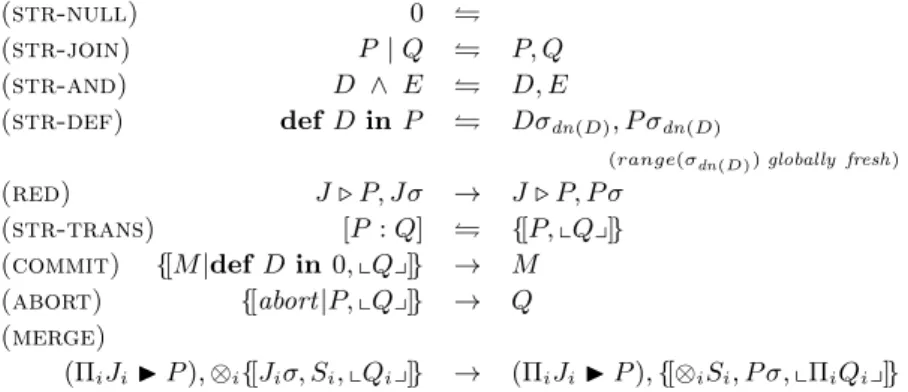
The chemical rules for cJoin are given in Figure 5. The first five chemical rules are the ordinary ones forJoin. Rule(str-trans)states that a term denoting a transaction corresponds to a sub-solution consisting of two molecules: the transactional process P and its compensationQ, which is frozen (the operatorx.y forbids the enclosed process to compute because there is no rule for applying reductions inside it).
A transaction can commit only when all internal computations have finished. This situation can be characterised as the special pattern{[M|def D in 0,xQy]}, comprising some messagesM, the definition D for computing inside the transaction and the so-far installed compensation Q. Since the scope of D is the nil process, it is evident that at commit time, private definitions of the transactional process can be discarded, because neither the messages that are being released contain those names nor they could have been extruded previously. On the other hand, if defined names of D were present in some of the messages inside the transaction, then the transactional activity would not yet be complete and the commit would not take place. When a transaction commit (rule (commit)), the local resourcesM produced inside a transaction are released as outcome. After commit, its compensation procedurexQyis useless and it is discarded as well.
The abortion of a transaction is handled by the rule(Abort), which releasesQ when-everabort is present in the solution.
Interactions among transactions are dealt with(merge), where we let the notation ΠiJi and ΠiQi denote, respectively, the parallel composition of messages J1|...|Jn and
the parallel composition of processesQ1|...|Qn. We also recall that the notation ⊗imi
denotes multisets of molecules and solutions. The rule(merge)consumes messages from different transactions and creates a larger transaction by combining the definitions and messages of the original ones with a new instance of the guarded process P σ, where dom(σ) = rn(J1|. . .|Jn). Name clashes are avoided because we assume that str-def generates globally fresh names. The compensation for the joint transaction is the parallel composition of all the original compensations.
The rule(merge)is quite general, as it can be used to join atomically an unbounded number of ongoing transactions. To help the understanding, we show a few particular instances of the rule(merge), which will be used frequently in the rest of this paper.
The first case is that of a trivial merge, where a unique transaction is involved. It is interesting to show it just to clarify that rule(merge)can be applied without merging transactions. This kind of merge rules works as global definitions that can be used in any transaction of the system.
(triv-merge)
(xhyiIP),{[xhvi, S,xQy]} → (xhyiIP),{[S, P{v/y},
xQy]}
The second case is that of a two-way merge, which will be very useful in our examples. (two-merge)
(x1hy1i|x2hy2iIP),
{[x1hv1i, S1,xQ1y]},
{[x2hv2i, S2,xQ2y]}
→ (x1hy1i|x2hy2iIP),{[S1, S2, P{v1,v2/y1,y2},xQ1|Q2y]}
Note that, as a degenerate case of rule (two-merge) we also have: (two-merge-deg)
(x1hy1i|x2hy2iIP),
{[x1hv1i, x2hv2i, S,xQy]}
→ (x1hy1i|x2hy2iIP),{[S, P{v1,v2/y1,y2},xQy]}
The following proposition states thatJoinis a sub-calculus of Join.
Proposition 3.1. Joinis a sub-calculus ofcJoin.
Proof. It is obvious from the syntax that any Join process is also acJoin process. It remains to show that: (1) for anyJoinprocessesP andQ, ifP →QinJoin, thenP →Q incJoin; and (2) for anyJoinprocessesP, ifP →QincJoin, thenQis aJoinprocess and P →QinJoin. Both implications follow straightforwardly from the fact that the chemical rules ofcJoincan be partitioned in two sets: one consisting exactly of the chemical rules of Join, and the other containing structural rules involving non-Joinoperators on both sides and reaction rules involving non-Joinoperators in the left-hand side.
We are now ready to revisit the hotel booking problem described in Section 1 and show how it can be modelled incJoin.
(str-null) 0
(str-join) P|Q P, Q
(str-and) D ∧ E D, E
(str-def) defDin P Dσdn(D), P σdn(D)
(range(σdn(D))globally fresh)
(red) J . P, J σ → J . P, P σ (str-trans) [P:Q] {[P,xQy]} (commit) {[M|defDin 0,xQy]} → M (abort) {[abort|P,xQy]} → Q (merge) (ΠiJiIP),⊗i{[Jiσ, Si,xQiy]} → (ΠiJiIP),{[⊗iSi, P σ,xΠiQiy]}
Figure 5. Operational semantics of cJoin.
HB ≡ def HotelSrvhri |HotelReqhd, κi I rhd, κi
in H|C
H ≡ [def requesthdetails, κi . κhprice, accepti+abort ∧ accepthcci . 0
in HotelSrvhrequesti:althhoteli]
C ≡ [def offerhrate, κi . κhcardi+abort
in HotelReqhdata,offeri:Q] Figure 6. Hotel Booking
Example 4. Process HBin Figure 6 shows a possible modelling for the hotel booking application, whereHdescribes the behaviour of the hotel service whileCmodels the pro-tocol followed by the client. There are two main differences with the description given in Section 1. First, we adhere to the continuation-passing style for enabling communication among different processes. Note that channelsrequestandoffercarry on one extra param-eter (the continuation) that identifies the channelκwhere to communicate next. Second, the system is not just the parallel composition of the two parties, but it also contains a merge definition that allows the communication among the two transactions. In fact, the two parties do not start by communicating directly and the first interaction takes place indirectly. Note thatC starts by sending the messageHotelReqhdata,offerito a merge channel. Similarly,HsendsHotelSrvhrequesti. While neitherCnorHcan complete their transactions in isolation, these two messages together enable the merge definition that forwards the request from the client to the hotel and joins both transactions, producing the following state
HB ≡ def HotelSrvhri |HotelReqhd, κi I rhd, κi
in [def requesthdetails, κi . κhprice, accepti (1)
+abort (2)
∧ accepthcci . 0 (3)
∧ offerhrate, κi . κhcardi (4)
+abort (5)
in requesthdata,offeri:althhoteli |Q]
At this moment the hotel receives the request from the client and it can (nonde-terministically) decide whether to make an offer (reaction (1)) or to abort (reaction (2)). We remind that the notation J . P +Q is syntactic sugar for J . P ∧J . Q. If the hotel aborts, then both transactions are aborted and the corresponding compensa-tions (i.e., althhoteli | Q) are activated. Otherwise, the hotel can produce the message offerhprice,accepti to send an offer to the client who, in turn, may decide whether to accept it (reaction (4)) or to abort the conversation (rule (5)). The abortion from the client is handled analogously to the previous case. If the client accepts the offer, then it generates the messageaccepthcardi, which enables the reaction rule (3). When reaction (3) is fired all messages inside the transaction are consumed, and hence the transaction commits (i.e., both parties have successfully finished).
Another interesting example is the modelling of a mailing-list manager with all-or-nothing delivery of messages to subscribers.
Example 5 (Mailing list). Consider a data structure that allows to send atomically a message to a list of subscribers (in the sense that the same message is either sent to all or to none). Such structure can be defined asML = MailingListhki.MLDef, where:
MLDef ≡defListin khadd,tell,closei |lhnili
List ≡ nilhv, wiIwhi
∧ lhyi |addhxi.defzhv, wiIxhvi |yhv, wiin lhzi ∧ lhyi |tellhvi.[def zhi.0in yhv, zi |lhyi:lhyi]
∧ lhyi |closehi.0
A new mailing list is created by sending a message to the portMailingList. SincecJoin adheres to the “continuation passing” style of programming, the content of the message sent toMailingList is a continuation portk, which expects information about the newly created mailing list. The creation of a new list defines five fresh ports nil, l, add, tell andclose: three of them (namelyadd, tell, andclose) will be used to interact with the list from “outside” and will be sent to the port k as the outcome of the creation. The remaining two ports will never be extruded. They denote the empty list (nil) and the actual state of the list (l). Once a list is created, a new subscriber can be added by sending a messageadd with the namexof the port where it will be listening to for new messages. In this case, the list is modified by installing z (on top of it), a forwarder of messages tox.
transaction identified by a fresh name z is generated, and the state of the structure is put inside the transaction, therefore all other activities, such as adding or closing are blocked until the transaction ends. Inside the transaction, the message v is sent to the forwarder at the top of the list y with the identifier of the transaction z. Note that each forwarder sends the message to the corresponding subscriber and to the following forwarder in the list. This is repeated untilnilis reached, when a message to the identifier of the transaction is sent. The firing rulezhi.0 consumes the last local name and the transaction commits by releasing all the messages addressed to the subscribers and the state of the list. Then the list is ready to serve new requests. The following processSys subscribes two users,Alice andBob to the mailing list, and sends the messageNews.
Emp ≡employeesha, t, ci. ahAlicei |ahBobi |thNewsi
Sys ≡def ML∧Empin MailingListhemployeesi
A possible computation of the processSysis shown in Figure 7. In this particular com-putation, both subscriptions take place before the emission of the message, nevertheless the process does not fix this priority and consequently messages could be consumed in a different order. For simplicity, we abbreviate chemical solutions by omitting definitions present in successive solutions, though we usually write only those definitions involved in the reduction step. Inside solutions, we underline the fired reaction rule and the consumed messages that matched the corresponding pattern. The phaseList creation instanti-ates a new mailing list by defining the fresh portsadd,tell andclose, which are sent to the portemployee. The second phase (Subscriptions) adds the namesAliceandBobto the created mailing list. PhaseDistribution ofNewsgenerates a new transaction that produces (in a sequential way) the copies of the nameNewsto be sent to any subscriber of the list. Nevertheless those messages are not released until the phaseCommittakes place. Only when the transaction commits, the generated messages are atomically sent to subscribers.
3.2. Flat transactions
Nesting is a useful mechanism for programming transactions, e.g. when a transaction can succeed even when certain sub-activities fail. In the area of databases, nested trans-actions have been studied since (Moss, 1981). Contrary to other languages proposed in the literature that do not support nesting (e.g.,Webπ∞(Lucchi and Mazzara, 2004) and
ρπ (Lanese et al., 2010a)), cJoin syntax allows for proper nested transactions, like in [[P : P0] : [Q : Q0]]. Nevertheless, many common situations that would involve nested transactions can be modelled incJoinwithout nesting by exploiting dynamic merge and message-passing communication, as shown in the multi-way transaction example (see Section 4.2).
This section introduces flat cJoin, which is a sub-calculus of cJoin without nested transactions. The following sections will show that flat cJoin is expressive enough for modelling several common programming patterns (Section 4) and, in addition, how it can be implemented (Sections 5 and 6). In fact, as it will be clear later, the syntactic restrictions imposed on flatcJoinhelp us to encode flatcJoinback toJoinand to extend
Initial Soup: {[Sys]}{[MailingListhki.MLDef, Emp, MailingListhemployeesi]}
List creation:
{[MailingListhki.MLDef, Emp,MailingListhemployeesi]} → {[MailingListhki.MLDef, Emp, MLDef{employees
/k}]}
{[MailingListhki.MLDef, Emp, List{employees/
k}, employeeshadd, tell, closei, lhnili]} →
{[lhyi |addhxi. . . . , . . . , lhnili, addhAlicei, addhBobi, tellhNewsi]}
Subscriptions:
{[lhyi |addhxi. . . . , . . . , lhnili, addhAlicei, addhBobi, tellhNewsi]} →
{[lhyi |addhxi. . . . , . . . , zAhv, wiIAlicehvi|nilhv, wi, lhzAi, addhBobi, tellhNewsi]} →
{[lhyi |tellhvi. . . ., . . . , zBhv, wiIBobhvi|zAhv, wi, lhzBi, tellhNewsi]} Distribution ofNews:
{[lhyi |tellhvi. . . ., . . . , zBhv, wiIBobhvi|zAhv, wi, lhzBi,tellhNewsi]} →
{[zBhv, wiIBobhvi|zAhv, wi, . . . ,{[zhi.0, zBhNews, zi, lhzBi,xlhzBiy]}]} →
{[zAhv, wiIAlicehvi|nilhv, wi, . . . ,{[zhi.0,BobhNewsi, zAhNews, zi, lhzBi,xlhzBiy]}]} →
{[nilhv, wiIwhi, . . . ,{[zhi.0,BobhNewsi,AlicehNewsi, nilhNews, zi, lhzBi,xlhzBiy]}]} →
{[. . . ,{[zhi.0,BobhNewsi,AlicehNewsi, zhi, lhzBi,xlhzBiy]}]} →
{[. . . ,{[zhi.0,BobhNewsi,AlicehNewsi, lhzBi,xlhzBiy]}]} Commit:
{[. . . , {[zhi.0, BobhNewsi, AlicehNewsi, lhzBi, xlhzBiy]} ]}
{[. . . , {[BobhNewsi, AlicehNewsi, lhzBi, defzhi.0in 0, xlhzBiy]} ]} →
{[. . . , BobhNewsi, AlicehNewsi, lhzBi]}
Figure 7. A possible computation of the Mailing list example
existing distributed implementation of Jointo implement flatcJoin. FlatcJoinis defined through the following type system involving the setT ={0,1,2} of types and the following type judgements:
`P :0 The transaction primitive [ : ] does not appear inP at all.
`P :1 Transactions may appear inP, but only inside definitions.P does not have active transactions but it may create them after some reductions.
`P :2 P has active flat transactions or may create them after some reductions.
`D:0 D does not contain transactions.
`D:1 D may contain flat transactions.
Definition 3.2 (Flat (or well-typed) definitions and processes). A definition D is said flat orwell-typed if`D :1 in the type system shown in Figure 8. Similarly, a processP is saidflat orwell-typed if`P :2.
(Sub-P) `P :i `P:j i<j (Sub-D) `D:0 `D:1 (Zero) `0 :0 (Mess) `xhyi:0 (Abort) `abort:0 (Par) `P:i `Q:i `P|Q:i (Trans) `P :0 `Q:1 `[P :Q] :2 (Def) `D:i `P :j
`def Din P:max(i,j) (Conj) `D:i `E:i `D∧E:i (Ord-0) `P :0 `J . P :0 (Ord) `P :i `J . P :1 (Merge) `P :0 `JIP:0 Figure 8. FlatcJoinTyping.
We comment on the typing rules in Figure 8. Rules(Sub-P)and(Sub-D) stand for the sub-type order0<1<2. Clearly, the inert process 0, the emission of a message xh~yiand the constantabort do not contain transactions and, hence, they have type0 (RulesZero, Mess, Abort). The parallel compositionP|Qhas type i if bothP and
Q are typed i (rule (Par)). Rule (Trans) prevents nesting by stating that [P : Q]
is typed 2 only when P has no transactions (i.e., ` P : 0). Note that the process P ≡[defahi.[P1:Q1]in ahi:Q] is not typable. AlthoughP is not a nested transaction, P may evolve to a nested transaction as followsP →[defahi.[P1:Q1] in [P1:Q1] :Q]. Contrastingly, a compensation may contain transactions as part of its definition. For instance, [xhyi | abort : defahi.[P : Q]in ahi] has type 2 when ` P : 0 and
`Q:1. The fact that the compensation includes a transaction as part of its definition does not compromise flatness because the compensation will run as an ordinary process after the transaction aborts. In fact, [xhyi |abort:defahi.[P :Q] in ahi]→defahi. [P : Q]in ahi, which does not introduce nesting. Rule (Def) combines the types of definitions and processes. Note that defD in P is typed 0 when neither D nor P contain transactions, i.e., if they both have type0. A processdefD in P has type1 when transactions appear only in definitions (i.e., either inDor in other local definitions occurring inP). Finally,defD in P has type2whenP contains an active transaction. A composed definition (i.e., a conjunction) is typed i only when both sub-terms
have type i (By rule (Conj)). An ordinary definition J . P is well-typed when its
guarded processesP is well-typed. Moreover, it has type0whenP has no transactions, i.e., ` P : 0. Differently, a merge rule is well-typed only when P has type 0 (rule (Merge)). This is required in order to avoid nesting, because the instances of P will execute inside transactions.
Example 6 (Well-typed terms). Consider the mailing list process introduced in Ex-ample 5. Several sub-terms and their types are shown below:
P1=defzhi.0inyhv, zi |lhyi P2= [P1:lhyi] D1=lhyi |tellhvi. P2 D2=lhyi |closehi.0
`P1:0 `P2:2 `D1:1 `D2:0 `D1∧D2:1
Moreover, ` MLDef : 1 (because it does not have active transactions but it can activate them) and also`ML:1.
(Mol-Proc) `P:τ P:τ (Mol-Def) `D:τ D:τ (Mol-Fzn) `P :1 xPy:0 (Membrane) S:0 {[S]}:2 (Soup) S1:i S2:j S1, S2:max(i,j) (Empty-Soup) ∅:0 Figure 9. Flat Solution Typing.
Example 7 (Counterexample). Process defxhi I [P : 0]in [def Din xhi : 0] is not well-typed because it has a merge definition whose guarded process is a transaction (rule (Merge) cannot be applied because6`xhiI[P : 0] :0). In fact, this process can reduce in one step todefxhiI[P : 0] in [defD in [P : 0] : 0] when x6∈dn(D), which has nested transactions.
3.3. Properties of FlatcJoin typing
This section summarises the main properties of our type system, namely,Joinprocesses have type0(Proposition 3.3) and subject reduction holds for0(Lemma 3.8) and2 (Lemma 3.9).
Proposition 3.3 (Join processes have type 0). Let P be a Join process, then
`P :0.
Proof. The proof follows by induction on the structure ofP.
—P ≡0 andP ≡xh~yi: the proof follows by using either rule (Zero) or (Mess).
—P ≡ def D in P0 with D = ∧iJi . Pi. By inductive hypothesis, ` P0 : 0 and
`Pi:0for alli. By using rule (Ord-0), we conclude that`Ji. Pi:0for alli. By repeatedly using rule (Conj) we conclude `D: 0. Proof is completed by applying rule (Def).
—P ≡P1|P2: the proof follows by inductive hypothesis and rule (par).
In order to prove subject reduction we need some technical preliminaries. In particular, we extend the typing from processes to solutions.
Definition 3.4 (Type of a solution). The typeτ of a solution S, noted asS :τ, is defined by rules in Figure 9. Moreover,S is flat iffS :2.
We start by proving that Definition 3.4 is consistent w.r.t. structural congruence of solutions, i.e. all types are preserved byα-conversion and heating/cooling; and that the type of a solution reflects on the type of its molecules.
Proposition 3.5. Letσbe a renaming substitution. If`P :τ then`P σ:τ.
Proof. Immediate by the fact that typing does not take into account names, but just the structure of terms, which cannot be changed by renaming substitutions.
Lemma 3.6. LetS:j. If{[S]}{[S0]}thenS0 :j.
Proof. By straightforward case analysis on the applied cooling/heating rule. When the applied rule is (str-def), then Proposition 3.5 is used.
Corollary 3.7. Let{[S]}∗{[⊗im
i]}. ThenS:j iff∀i.mi:i andi≤j.
We are now ready to prove subject reduction for0.
Lemma 3.8 (Subject Reduction for0). LetP :0. IfP →∗P0 thenP0 :0. Proof. The proof follows by induction on the length of the derivation.
— Base case:P0≡P (i.e., {[P]}∗{[P0]}). The proof follows by Corollary 3.7.
— Inductive Step: SupposeP → P00 →n P0 with n ≥ 0. The proof follows by case
analysis on the first applied rule and inductive hypothesis. Note thatP→P00implies
{[P]}∗{[S]} → {[S0]}
∗{[P00]}. Bychamsemantics we know thatS≡ ⊗imi. Since
P :0, thenmi:0 for alliby Corollary 3.7. Hence the only possible rule that can be applied is (red), because any other rule requires at least a molecule composed by a membrane, which cannot be typed 0. Consequently, S ≡ J . Q, J σ, S00 and S0 ≡J . Q, Qσ, S00, where S00 : 0. As Q: 0, by Proposition 3.5,Qσ :0. Hence S0 :
0 and therefore P00 : 0 (by Corollary 3.7). The proof follows by applying inductive hypothesis onP00→nP0.
The following result ensures that2is preserved by reductions.
Theorem 3.9 (Subject Reduction for2). LetP :2. IfP →∗P0 thenP0 :2. Proof. The proof follows by induction on the length of the derivation.
— Base case:P0≡P (i.e., {[P]}∗{[P0]}). The proof follows by Corollary 3.7.
— Inductive Step: SupposeP → P00 →n P0 with n ≥ 0. The proof follows by case
analysis on the first applied rule and inductive hypothesis. Note thatP→P00implies
{[P]}∗{[S]} → {[S0]}
∗{[P00]}. Bychamsemantics we know thatS≡ ⊗imi. Since
P :0,mi:i wherei≤2 for alliby Corollary 3.7. Then, there are four cases:
– Rule(red): When the reduction occurs at top-level, i.e.S≡J . Q, J σ, S00,S0≡
J .Q, Qσ, S00, andS00:2, the proof is similar to Lemma 3.8. The other possibility is when the reduction occurs inside a transaction, e.g. S ≡ {[S1]}, S00 and S0 ≡
{[S10]}, S00, where {[S1]} → {[S10]} by rule(red)and S00:2. Note that{[S1]}:2, and thereforeS1:0. By Lemma 3.8,S10 :0 and henceS0:2.
(The cases below occur at top-level, because negotiations cannot be nested in P.)
– Rule (commit): S ≡ {[M|defD in 0,xQy]}, S00, and S0 ≡ M, S00, with S00 :2 (by Corollary 3.7). AsM is the parallel composition of messages, it can be typed 0 and thereforeS0:2.
– Rule(abort):S≡ {[abort|P0,xQy]}, S00 andS0≡Q, S00, withS00:2 (by Corol-lary 3.7). AsxQy:0, it must beQ:1 and thereforeS0:2.
– Rule(merge):S ≡J1|. . .|Jn IR,⊗i{[Jiσ, Si,xQiy]}, S00 and S0 ≡J1|. . .|Jn I
R,{[⊗iSi, Rσ,xQ1|. . .|Qny]}, S00, with S00 : 2 (by Corollary 3.7). Since R : 0 and for alli Si:0andQi:1, we haveS0:2.
Remark 3.10. Subject reduction does not hold for 1. Consider P = defxhi.[Q : Q0]in xhi, where ` Q : 0 and ` Q0 : 1. Although ` P : 1, P reduces to P0 = defxhi.[Q:Q0]in [Q:Q0], which can be typed2 but not1.
Theorem 3.9 ensures that flat processes form a sub-calculus since reductions do not generate nesting.
Definition 3.11 (FlatcJoin). FlatcJoinis the sub-calculus of all flat processes.
4. Programming common transactional patterns in cJoin
In order to illustrate the transactional aspects of cJoin, we show how to code some common interaction patterns. We keep and enrich the hotel booking scenario as a running example.
4.1. Multi-step Transactions: Trip Booking
Let us assume now that the user is making plans for a trip and wants to make reser-vations for both a flight and hotel accommodation. Such scenarios are usually modelled by splitting the whole activity as a sequence of two independent transactions: the client executes a transaction for booking a flight first, and when it commits, a new transaction for making hotel reservation is started. If the last transaction aborts, then the first one is compensated for by cancelling the already committed flight reservation. This kind of composition is usually referred to as compensable flow composition, and it is tailored to model long running transactions in an orchestration context. Several proposals have appeared in the literature for describing transactional flow compositions (Butler and Fer-reira, 2004; Butler et al., 2005b; Bruni et al., 2005). Essentially, they describe the trip booking problem as follows
TripBooking ≡ {FlightBooking÷FlightCancelation; BookHotel÷0}
The entire activityTripBookingis delimited by the long running transaction scope{ }. A long running transaction is divided by ’;’ into sequential steps. ProcessFlightBooking in the first step allows the client to book a hotel accommodation. If it commits, then the compensationFlightCancelation is installed and the next step BookHotel÷0 is executed. The compensation is installed when a step commits and it is used only when one of the following steps fails. For instance, ifBookHotelfails during its execution, then the previously installed compensationFlightCancelation is executed.
Although cJoin does not offer a built-in mechanism for these kinds of transactions, they can be coded intocJoin. Let us consider a simple language defined as follow
L ::= {S}
whereP andQarecJoinprocesses. A possible encodingJ Kis below J{S}K ≡ JSK0 JPKc ≡ [P :c] JP÷Q;SKc ≡ def comphi.[c|Q: 0] ∧ conthi.JSKcomphi in [conthi |P :c]
provided {cont, comp} ∩f n(P|Q|S|c) =∅
The most interesting rule is the last one. A sequenceP÷Q;Sis encoded w.r.t. a contextc that indicates the compensation installed by the previous execution. Then, the sequence P÷Q;S corresponds to a process that activates the transaction [conthi |P :c], i.e., it attempts to executesP until completion (i.e., consuming all messages to its local ports). If P finishes (i.e., there is no pending message in local ports) and the transaction commits, then the message conthi is released. This message will activate the execution of the remaining part of the sequence. IfP aborts, then the previously installed compensationc is activated. The context for encoding the remaining partSof the sequence is the message comphi, corresponding to the updated compensation [c|Q: 0]. Hence, if activated, such compensation will first attempt to complete the execution ofQ. If this is the case, then the transaction will commit by releasing c, which will then activate the previously installed compensations.
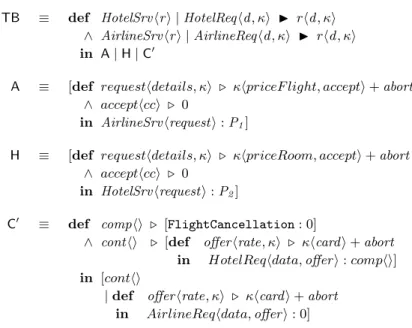
Then, the cJoin code for planning a trip as a multi-step transaction is in Figure 10. We model the hotel booking service H as in Figure 6, while the airline service A is analogous toH(the only difference is that Astarts by publishing on the merge channel AirlineSrv instead of HotelSrv). It is worth remarking that the homonymous (private) ports request and accept defined by both A and H are different ports. The renaming mechanism inherited from theJoincalculus ensures that such names are fresh, and hence there are no clashes when transactions are merged. In addition, we add one merging rule for allowing the interaction among the client and the airline. For the sake of the simplicity we do not include dynamic creation of sessions, but the presentation can be straightforwardly extended to consider them.
The system starts its execution with the client interacting with the airline component analogously to hotel conversation described in Example 4. If the interaction aborts, then the client finishes its execution (note that transaction compensation is set to 0). If it commits, the message conthiis released, which enables the second reaction rule of C0. Firing this rule will dynamically create a new transaction for interacting with the hotel booking service (the interaction is as in Example 4). If this newly created transaction finishes successfully, then the whole long running transaction ends by committing. If the last transaction aborts, then the compensationcomphi|P2 is released. Note thatcomphi can fire the first reaction of client component, which will executeFlightCancelation, i.e., the compensation of the previously committed step.
TB ≡ def HotelSrvhri |HotelReqhd, κi I rhd, κi ∧ AirlineSrvhri |AirlineReqhd, κi I rhd, κi
in A|H|C0
A ≡ [def requesthdetails, κi . κhpriceF light, accepti+abort ∧ accepthcci . 0
in AirlineSrvhrequesti:P1]
H ≡ [def requesthdetails, κi . κhpriceRoom, accepti+abort ∧ accepthcci . 0
in HotelSrvhrequesti:P2]
C0 ≡ def comphi . [FlightCancellation: 0]
∧ conthi . [def offerhrate, κi . κhcardi+abort
in HotelReqhdata,offeri:comphi]
in [conthi
|def offerhrate, κi . κhcardi+abort
in AirlineReqhdata,offeri: 0] Figure 10. Trip Booking as a multi-step transaction
4.2. Multi-way transactions: Trip Booking Revisited
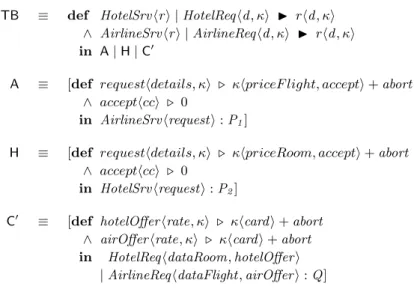
The main drawback of planning a trip as in the previous section is that compensations are usually not for free. Clearly, cancelling a flight reservation usually requires the client to pay cancelation fees. By taking advantage of cJoin transactional primitives, we can model the trip booking example as a multi-way transaction, i.e., a transaction that retains several entry and exit points, in which parties are not necessarily aware of the remaining parties in the transaction. Clearly the hotel and airline booking services should not be necessarily aware of the combined activity to be carried on by the client, and hence they remain unchanged. ThecJoinprocess for the whole system is shown in Figure 11.
The client is modelled by a transaction that initially sends two messages to different merge channels, one allows the merge with the airline service while the other joins it to the hotel service. Once merged, the parties interact by following the conversation pattern described in Example 4. The main difference is that the abortion of one of the parties after both merge actions take place implies the abortion of the interaction, and hence all three parties abort and run their own compensations. Otherwise, the whole interaction commits when all three parties successfully finish their transactional processes.
As far as the definition of the choreography is concerned, we note that (i) booking services are independent of the behaviour of the client, even though this may induce the transactional scope to be extended to third, unknown parties; (ii) the local descrip-tion of transacdescrip-tional interfaces ensures transacdescrip-tional properties to several different global interactions; (iii) no coordinator is needed for describing transactional, multiparty chore-ographies.
There is still one main drawback in the code given above: client description mixes two independent flows of interaction corresponding to two different roles played by the
TB ≡ def HotelSrvhri |HotelReqhd, κi I rhd, κi ∧ AirlineSrvhri |AirlineReqhd, κi I rhd, κi
in A|H|C0
A ≡ [def requesthdetails, κi . κhpriceF light, accepti+abort ∧ accepthcci . 0
in AirlineSrvhrequesti:P1]
H ≡ [def requesthdetails, κi . κhpriceRoom, accepti+abort ∧ accepthcci . 0
in HotelSrvhrequesti:P2]
C0 ≡ [def hotelOfferhrate, κi . κhcardi+abort ∧ airOfferhrate, κi . κhcardi+abort
in HotelReqhdataRoom,hotelOfferi |AirlineReqhdataFlight,airOfferi:Q] Figure 11. Trip Booking
component either as a hotel client or as an airline client. The only binding among these two flows of execution is the fact that both interactions should finish either successfully or with abortion. A more appealing modular definition for client behaviour is below.
Cm ≡ def RoomFoundhωi |FlightFoundhωi I 0
in [def hotelOfferhrate, κi . κhcardi |RoomFoundhhotelOfferi+abort
in HotelReqhdataRoom,hotelOfferi:Q1]
|[def airOfferhrate, κi . κhcardi |FlightFoundhairOfferi+abort
in AirlineReqhdataFlight,airOfferi:Q2]
Now, a client initiates two different transactions to interact independently with the hotel and the airline. The new merge rule allows such transactions to be joined when both flows of interaction terminate. In fact, the corresponding messages to the merge names (i.e.,RoomFoundhhotelOfferiandFlightFoundhairOfferi) are generated when the client transactions accept the offers proposed by the corresponding booking services. Let us consider the monolithic code again (Figure 11). For instance, if the hotel offers a convenient rate but the airline company does not, then the whole transaction is aborted. Hence the client should start from the scratch by booking again a room and trying with a different airline company. In the modular version, it would be enough to start a new transaction for finding a flight, while the booked room will be still a valid reservation. This feature may be interesting when client also may choose one of several available booking services (as discussed in the next sections). For example, the client can try a new airline booking (after an abort) while keeping the room booking. Note that this example also shows how a typical nested transaction pattern is smoothly modelled as a flatcJoin process.
A final remark is that the above decomposition of flows works only when both inter-actions eventually finish by proposing the merge, otherwise one transaction may remain
blocked for ever. When this is not ensured, the interaction that fails to find a suitable reservation should notify the other transaction to abort (this situation can be handled analogously to abortions of parallel activities explained in Section 4.3).
4.3. Speculative Computation
This section illustrates how to program a cJoin process that commits at most one of several concurrent transactions. This programming pattern is called speculative execu-tion or a-posteriori choice, and it is studied by several composiexecu-tion languages (Butler et al., 2005b; Bruni et al., 2005; Laneve and Zavattaro, 2005). Speculative computation is very much related to goal-oriented formalisms, like don’t know non-determinism in concurrent logic programming, where several alternatives must be explored before one can be selected. For example, when guarded Horn clauses are considered, the selection of the rule to be applied next for reducing a goal is subordinated to successful evaluation of the guard. Once a guarded clause is applied, all the other alternatives are pruned out and that intermediate goal reduction is committed (never to be undone). As guard evaluation can possibly trigger complex computations on its own and require further clause selections giving rise to speculative computations, whose abort corresponds to the non-satisfiability of the clause. One important difference though is that the linguistic abstraction we are after is not a basic search mechanism, deemed to fail in most cases, but rather a strategy language to increase the possibility of success and to handle search failures when they happen.
Although this pattern is not a built-in operator of cJoin, it can be coded by using merge definitions. For simplicity, we will consider just two concurrent transactions, but the mechanism can be easily extended to larger sets.
We assume a client trying to book a room from one of two alternative hotelsH1 and H2 (in no particular order), but wishing to make a reservation in only one of them. The
HB ≡ def HotelSrv1hri |HotelReq1hd, κi I rhd, κi (1)
HotelSrv2hri |HotelReq2hd, κi I rhd, κi (2)
in H1|H2|C (3)
C ≡ def althidi |booked1hwi I cancelling2hi (4)
∧ althidi |booked2hwi I cancelling1hi (5)
∧ cancelling1hi.[defwhi.0in aborting1hwi: 0] (6)
∧ cancelling2hi.[defwhi.0in aborting2hwi: 0] (7)
∧ booked1hii |aborting1hjiIabort (8)
∧ booked2hii |aborting2hjiIabort (9)
∧ ahi.[defwhi.0inalthwi:ahi] (10)
in [defofferhrate, κi . κhcardi |booked1hofferi (11)
+abort (12)
inHotelReq1hdata,offeri :Q1] (13) |[defofferhrate, κi . κhcardi |booked2hofferi (14)
+abort (15)
inHotelReq2hdata,offeri :Q2] (16)
|ahi (17)
Lines (1)−(3) define the system, which is composed by hotel servicesH1andH2defined
as in previous examples, and a client componentC. The clientCconsists in the concurrent execution of two transactions (lines (11)−(13) and (14)−(16)) for dealing with each booking service. They behave as in previous cases, but they finish the conversation by generating the merge messagesbookedihofferi(lines (11) and (12)). Differently from
multi-way transactions (Section 11), those messages are used not for joining both transactions but for encoding a kind of transactional internal choice. Let us suppose that both client transactions complete successfully; then the state of the client can be seen as follow
def . . . (4−10) in [def . . . (11−12) inbooked1hofferi :Q1] (130) |[def . . . (14−15) inbooked2hofferi :Q2] (160) |[defwhi.0 inalthwi:ahi] (170)
where definitions rules have been omitted since they remain unchanged. Line (170) has been obtained by firing the reaction rule in line (10) with message ahi(line (17)). No transaction can commit in this state because messages sent to merge ports carry on local names (offer and w) – this is the standard way to force a transaction to join before committing. At this point the merge rules in lines (1) and (2) are enabled. Assuming the second one fires, the client state reduces to
def . . . (4−10) in [def . . . (11−12) inbooked1hofferi :Q1] (130) |[def . . . (14−15) ∧whi.0 incancelling1hi:ahi|Q2] (160)
Assuming the hotel component also commits, then the second transaction commits by releasing the message cancelling1hi, which enables the reaction rule in line (6). After firing this rule, client state can be described as follow.
def . . . (4−10)
in [def . . . (11−12)
inbooked1hofferi :Q1] (130) |[defwhi.0 inaborting1hwi: 0]
Above state enables the merge rule in line (8). Client component moves to the following state when such rule is fired.
def . . . (4−10)
in [def . . . (11−12)
∧whi.0
inabort :Q1]
Finally, the remaining transaction aborts and the compensationQ1is released. Hence, the transaction with H2 has been committed while the conversation with H1 has been
aborted. The cases in which one transaction commits and the other aborts follow imme-diately since rules defined in lines (8) and (9) are never used, and therefore the auxiliary transaction generated by messagecancellingiremains blocked.
We comment on reaction rule in line (10), which generates an auxiliary transaction for selecting the committing interaction. Note that its compensation is set toahi. Although the scenario described so far assumes that the hotel component does not generateabort after receiving client confirmation, this may not be the case in the most general setting. Hence, if the selected transaction aborts after being chosen for committing, then the compensation ahi is released in order to allow the remaining alternative to be eligible again.
5. Language implementation
This section addresses the problem of implementing the transactional primitives provided bycJoin. For simplicity, we only consider flatcJoin, i.e., the sub-calculus of transactions without nesting introduced in Definition 3.11. In particular, we show how flatcJoincan be encoded into Join. For the sake of the simplicity we omit many technical details in this presentation and provide just a sketch of the translation and the main results. The