Universitätsstraße 38 D-70569 Stuttgart
Master Thesis No. 3460
Extending a Methodology for Migration
of the Database Layer to the Cloud
Considering Relational Database
Schema Migration to NoSQL
Rilinda Lamllari
Course of Study: Master Informatik
Examiner: Prof. Dr. Frank Leymann Supervisor: Steve Strauch
Commenced: January 28, 2013 Completed: June 27, 2013
The advances in Cloud computing and in modern Web applications have raised the need for highly available and scalable distributed databases to accommodate the big data being created and consumed. Along with the explosion in data growth comes the necessity to rapidly evolve databases and schemas to meet user demands for new functionality. A special attention is being paid to the vast amounts of semi-structured and un-structured data, and the data management tools should reflect the support for these needs. This has lead to the development of new Cloud serving systems such as ’Not Only’ SQL (NoSQL) databases. NoSQL databases were driven by the scalability needs of the big companies, such as Google, Facebook, Amazon, and Yahoo. While the demands of these key players are different from those of small and medium enterprises in terms of scalability, the core problem is the same — storage arrays are not scalable and force you into expensive, forklift upgrades.
These facts combined with changes in how IT resources are delivered and consumed through the Cloud computing paradigm, projects adopting NoSQL solutions are not a hype anymore. NoSQL databases are being offered as a service by the big Cloud providers, such as Google, Amazon, Microsoft, but by smaller vendors as well. In this master thesis we investigate the possibilities and limitations of mapping relational database schemas to NoSQL schemas when migrating the database layer to the Cloud. Based on literature research we provide recommendations and guidelines with regard to schema transformation and discuss the implications at other application architecture layers, such as business logic and data access layer.
We extend an existing data migration tool and methodology for incorporating the migration guidelines and hints. Moreover, we validate our work based on a chosen sub-set of relational and NoSQL databases by using example data from the established TPC-H benchmark.
1 Introduction 1 1.1 Motivating Scenarios . . . 2 1.2 Problem Statement . . . 4 1.3 Scope of Work . . . 4 1.4 Research Questions . . . 5 1.5 Research Design . . . 5 1.6 Outline . . . 6
1.7 Definitions and Conventions . . . 7
2 Fundamentals 9 2.1 Cloud Computing . . . 9
2.1.1 Migration to the Cloud . . . 11
2.2 SQL, NoSQL and NewSQL . . . 11
2.2.1 RDBMS and SQL . . . 12
2.2.2 NoSQL Stores . . . 14
2.2.3 NewSQL . . . 15
2.2.4 NoSQL Adoption Drivers . . . 16
2.2.5 Polyglot Persistence . . . 18
2.3 Non-Functional Properties of NoSQL Systems . . . 19
2.3.1 CAP Systems . . . 23
2.4 NoSQL Database Categories . . . 25
2.4.1 Key-Value Stores . . . 25
2.4.2 Document Databases . . . 27
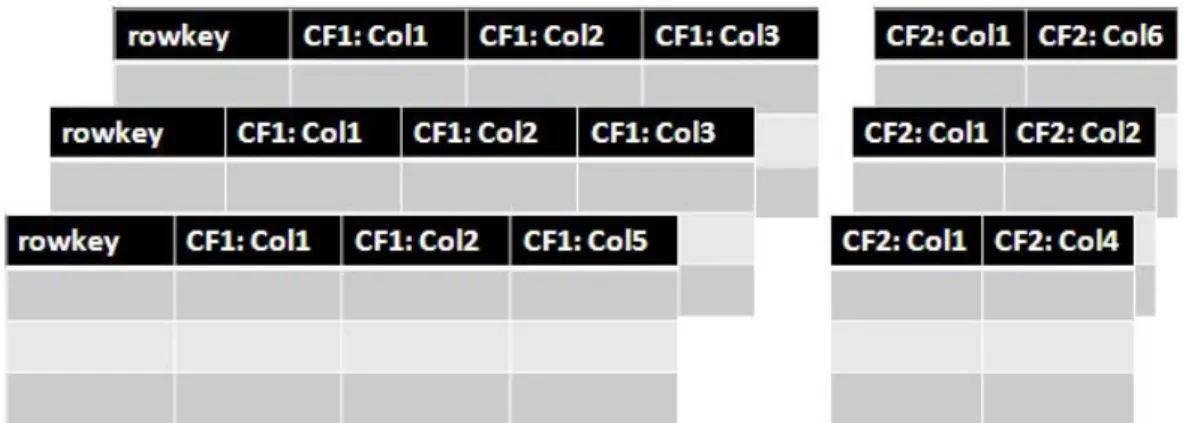
2.4.3 Column-Family Stores . . . 28
2.4.4 Graph Databases . . . 29
3 Related Work 33 3.1 Traditional Schema Mappings . . . 33
3.2 Migration Use Cases from RDBMS to NoSQL . . . 34
3.3 Schema Mappings Frameworks . . . 37
4 Analysis, Concept and Specification 39 4.1 System Overview . . . 39
4.2 Relational Model . . . 41
4.3 Non-Relational Model . . . 42
4.4 Relational Databases Analysis . . . 48
4.4.1 MySQL 5.6 . . . 49
4.5 NoSQL Stores Analysis . . . 51 4.5.1 Amazon SimpleDB . . . 51 4.5.2 Apache Cassandra 1.2 . . . 53 4.5.3 MongoDB 2.4 . . . 54 4.6 Modeling Practices . . . 57 4.7 Concept . . . 60
4.7.1 Schema Objects Mapping . . . 60
4.7.2 Systems Trade-offs . . . 62
4.7.3 Extending Cloud Data Hosting Solution Taxonomy for Functional Re-quirements . . . 65
4.7.4 Extending Cloud Data Hosting Solution Taxonomy for Non-Functional Requirements . . . 66
4.7.5 Application Layer Adaptation . . . 68
4.7.6 Data Access Layer Adaptations . . . 71
5 Design 73 5.1 System Overview . . . 73
5.2 Architectural Overview . . . 73
6 Implementation 77 6.1 Realization and Validation . . . 77
6.2 Discussion and Lessons Learned . . . 82
7 Outcome and Future Work 85 7.1 Recommendations . . . 85
7.2 Contributions and Future Work . . . 86
7.3 Conclusion . . . 87
8 Appendix 89 8.1 MySQL and PostgreSQL Data Types Summary . . . 89
8.2 More NoSQL Stores Analysis . . . 91
8.2.1 GoogleApp Engine Datastore . . . 91
8.2.2 Azure Table Storage . . . 93
8.2.3 Amazon DynamoDB . . . 94
2.1 Codd’s Relational Model . . . 12
2.2 Polyglot Persistence . . . 19
2.3 CAP Systems . . . 23
2.4 Column-oriented Data Model . . . 29
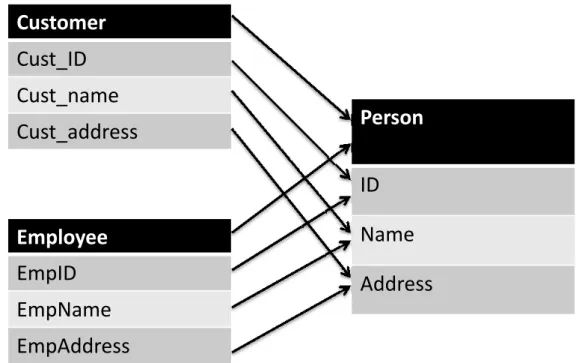
3.1 Relational Schema Mapping Example . . . 34
4.1 Cloud Data Migration Tool . . . 40
4.2 Valueless column in Cassandra . . . 59
5.1 System Architecture . . . 74
5.2 Data Migration Methodology - First Steps . . . 74
5.3 Methodology for Migration Scenario RDBMS to NoSQL . . . 75
5.4 Migration Component Architecture . . . 76
6.1 TPC-H Database Schema . . . 78
6.2 Cassandra Cluster Setup View . . . 80
6.3 Decision Support System Screenshot . . . 81
2.1 SQL vs NoSQL vs NewSQL Summary . . . 24
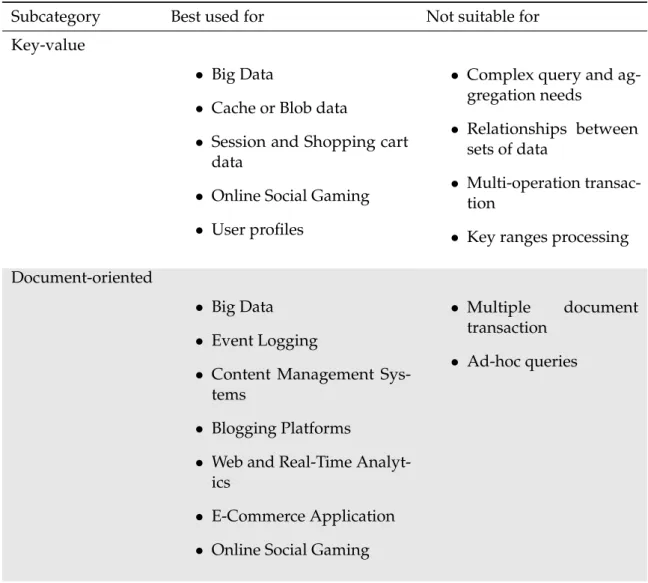
4.1 Application Use Cases for Key-Value And Document Databases . . . 44
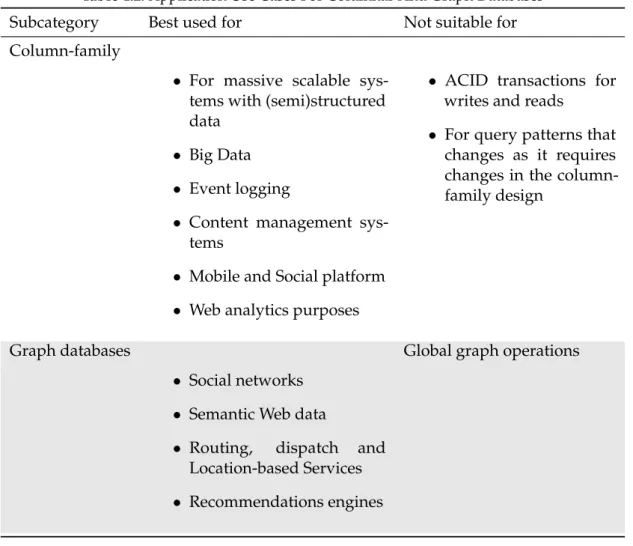
4.2 Application Use Cases For Columnar And Graph Databases . . . 45
4.3 RDBMS versus NoSQL Features Comparison . . . 47
4.4 MySQL Limitations . . . 50
4.5 SimpleDB Identifiers limits . . . 52
4.6 Best Workloads and Use Cases for selected NoSQL Stores . . . 57
4.7 Logical Data Model mapping . . . 61
4.8 Indexes Mapping . . . 62
4.9 RDBMS Schema Objects Migration Summary . . . 62
4.10 Cloud Data Hosting Solution Taxonomy . . . 69
8.1 PostgreSQL 9.2 Data Types . . . 90
With the advent of Web 2.0 sites where millions of users may both read and write data, scalability for simple database operations has become more important. The increasing volume and detail of information captured by enterprises and the rise of multimedia, as well as the social media is putting companies in front of large datasets. Examples of these large datasets are links, social networks, activity in Web or transactions logs, manufacturing data from assembly line devices, scientific data collections, etc. Websites have started tracking activity in a very detailed way in order to have more accurate and detailed performance information to deal with the performance requirements posed by their customers.
Big data, a very controversial name for large datasets, according to IBM spans three basic dimensions1: velocity, variety, and volume.
• Volume of data of different types is overgrowing in terabytes and even petabytes.
• Variety depicts the structured level of data: un-structured data (such as documents, e-mail, multimedia and social media), semi-structured data (CSV files, log files, form, reports), and structured data [IBM].
• Velocity is the speed with which these data are produced (e.g. real time data from social networks) and the speed with which these data should be processed (e.g. for time-sensitive processes such as fraud detection).
Companies are being faced with big data [Ins] and they are exploring ways on how to unlock and create value out of these data, being innovative and gaining competitive advantage. According to Gartner [Sta], in 2013, big data is forecast to drive $34 billion of IT spending which shows the worldwide interest in this explosion. Even though there is no universal agreement on what big data is, in this thesis we use it in the context of "data that exceed the processing capacity of traditional database systems". According to EMC2, big data is more characterized by a scale-out architectural style then by specific data sizes or processing speeds [Gro].
Another definition given by National Institute of Standards and Technology (NIST)3: "where the data volume, acquisition velocity, or data representation limits the ability to perform effective analysis using traditional relational approaches or requires the use of significant horizontal scaling for efficient processing" [CM]. Relational Database Management System (RDBMS) will be challenged to scale up or out to meet the demands posed by this exponential data growth [CM],[Gro].
While big data often gets associated with data analytics, in particular with Hadoop4, actually 1What is big data? http://www-01.ibm.com/software/data/bigdata/
2EMC: http://www.emc.com/index.htm
3US Agency of Department of Commerce which is responsible for developing standards and guidelines 4Apache Hadoop: http://hadoop.apache.org/
it is much broader than that, and is far more concerned with data storage than analytics. Technologies like Apache Hadoop are concerned with large scale data analysis and have been widely recognized and studied, while NoSQL systems are developed for Cloud data serving [CST+10]. Apache Hadoop, and its underlying file system Hadoop Distributed File System (HDFS)5, store the bulk of big data today, the need was for a more structured way to manage and expose data, stored in Hadoop or not – without the strong constraints that relational databases impose. Thus, laid the groundwork for the rapid growth of NoSQL systems.
NoSQL technologies, most commonly referred to as ’Not Only SQL’, is a term that describes a broad class of technologies that provide a different approach to data storage compared with traditional RDBMSs. Some refer to them as ’No relational’ or ’No RDBMS’, some simple prefer to call them Distributed Database Management Systems. Whatever the literal meaning, NoSQL is used today as an umbrella term for all databases and data stores that don’t follow the traditional and well-established RDBMS principles and often relate to large data sets accessed and manipulated on a Web scale [Tiw11]. They feature elasticity and scalability in combination with a capability to store big data and work with Cloud computing systems, all of which make them extremely popular at the time being. The reality is that one size doesn’t fit it all. NoSQL databases are targeted at a particular set of applications scenarios; they will not and cannot replace RDBMSs, they can address certain limitations and are a complement to deal with issues such as complexity, performance, and scalability.
Looking at the interest shown for NoSQL databases, some RDBMSs have started introducing NoSQL features into their products. For example, with the release of SQL Server 2008, a number of features were added to the product under the moniker "beyond relational" to store large binary objects in the file system with full transactional integrity [Lob]. It introduced a set of features that can be classified as NoSQL-like in nature. Oracle announced the introduction of a NoSQL-type interface into its MySQL Cluster product that is key/value in design. With SQL and NoSQL access through a new Memcached API, MySQL Cluster represents a "best of both worlds" solution allowing key value operations and complex SQL queries within the same database [Orab]. Also, PostgreSQL now supports schema-less (document key-value store) data as well, without losing the traditional database features, thehstoredata type is used for storing sets of key/value pairs within a single PostgreSQL value [Posb].
Not only the industry, with the most popular examples of [Ale], [Ana], [Pat], but also the research domain is showing a big interest in exploring NoSQL technologies. EPIC, a large research project on how do people use social media in times of crisis, has transitioned a large-scale data collection infrastructure from the relational database MySQL to a hybrid persistence architecture that makes use of both relational and NoSQL technologies [SA12].
1.1 Motivating Scenarios
In an era of high competition, having ’always-on’ capabilities is fundamental for established and new startup companies to survive. Being close to the customers and understanding their
preferences is the motto of today’s companies. According to McKensey survey [Ins], a retailer could increase its operating margin by more than 60 percent using big data to the full. And the adoption of NoSQL solutions by retailers seem to prove that.
DynamoDB6, or simply Dynamo, the database offering by Amazon is the result of 15 years of learning in the areas of large scale non-relational databases and Cloud services. It is the system being used by Amazon e-commerce itself. Riak database7- a Dynamo clone with commercial support by Basho - is based on Amazon’s architectural principles and has been adopted successfully by retail and e-commerce platforms [Basc], offering architectural, operational and development benefits for the retailers. Top retailers in US are using Riak for applications such as shopping carts, product catalogs, API platforms, and mobile applications.
As retailers grow and have to store more and more data, traditional relational databases aren’t always the best option. They want to scale easily, without the operational burden of manual partitioning of data. Meanwhile, business requirements demand their data is always available for reads and writes. For them failure to accept additions to a shopping cart, or serve product information quickly, has a direct and negative impact on revenue. Many retailers now operate online with an API or data services platform. They included Riak as an integral part in their transformation push to re-platform the eCommerce platform as it offers high availability and scale, so retailers can always serve customers, even under failure conditions, and rapidly grow to meet peak loads.
Netflix,.inc [Ana], a movie and TV shows streaming provider, migrated from Oracle to Ama-zon Web Services (AWS) SimpleDB8and Simple Storage Service (S3)9because AWS promised better availability and scalability in a relatively short amount of time. Also, Alexa.com [Ale] which offers web-scale services built on top of AWS, chose Amazon SimpleDB over MySQL to store intermediate status and log data, and Amazon S3 for put and retrieves datasets. Taking these use cases into consideration, we see that consumer facing applications benefit the most from NoSQL solutions as they are more concerned about low latency and high availability. This is the case for Amazon-like scenarios, where dealing with a huge traffic and where availability is crucial. But for the transaction data in a normal scenario you might not want to sacrifice the reliability of the RDBMS when dealing with transactions. This is the reason why e-commerce has often been a domain exclusive to RDBMSs. Another reason is that domains that require rich data models and sophisticated queries have been assumed to fit best within the realm of the RDBMS [Ban11]. Instead, product catalogue and shopping cart might be ideal use cases for migrating to NoSQL. Given these facts, we will migrate partially a relational database schema for an e-commerce into the NoSQL datastores. We use TPC-H benchmark as basis for example database schema, because it is business oriented and is targeting systems examining large volumes of data and executing queries with a high degree of complexity [Tra].
6Amazon DynamoDB: http://aws.amazon.com/dynamodb/ 7Riak: http://basho.com/riak/
8SimpleDB: http://aws.amazon.com/simpledb/ 9S3: http://aws.amazon.com/s3/
1.2 Problem Statement
RDBMS technology can no longer keep pace with the velocity, volume, and variety of data being created and consumed. These systems are based on relations and data normalization. Accommodating new big data into these systems causes the relational normalized schema to become too complex. Normalizing data requires more tables, which requires more table joins, thus requiring more keys and indexes. As databases size starts to grow into terabytes, performance starts to significantly degrade. The main reason why Cloud computing is being utilized by many organizations is to avoid high upfront costs and to avoid dealing with issues such as scalability in which Cloud providers have an extensive experience. The decision to start using NoSQL databases comprises a set of trade-offs, better said it’s all about trade-offs. Migrating to the Cloud NoSQL databases, requires some preparation for the enterprise IT that grew up with RDBMSs. The transition from legacy RDBMS to NoSQL requires careful planning. It is a completely different mindset needed by the developers and architects in order to get the most out of this new technology. Distributing data across multiple nodes in a data center results in a linear performance improvement. However, understanding how to store data in ways that allow scalability requires a rethinking of your overall approach to systems design. Thus, designing the tailored data model for your application, and not being only driven by the simple APIs these databases offer, should be at the core of the planning. To make the right decision when choosing the NoSQL store for your business problem, requires a very good low-level understanding of the target store. The plethora of NoSQL products with many different feature sets, makes it almost impossible to recommend only by the data model that they offer. Moreover, how will this transition impact the other application layers is another very important aspect of this process. Therefore, we investigate the potential and limitations when mapping relational schemas to NoSQL with the goal of providing guideline and support.
1.3 Scope of Work
This master thesis has the goal to specify, design, and implement a methodology for migration of the relational database schemas to a NoSQL database schema taking into consideration lessons learned from companies that have already migrated their applications and from the literature review. The relational databases we consider for the the validation of our approach are MySQL version 5.6 and PostgreSQL version 9.2. There are four basic categories of NoSQL databases: key-value stores, document, columnar, and graph databases. This classification is arguable, and many prefer to classify also Object Oriented Database Management Systems (OODBMS) and XML databases as NoSQL systems. In this thesis we focus on the three typical data models, key-value, document, and columnar databases. The graph databases are meant for a specific usage, i.e. highly interconnected data in social networking applications, this is the reason this is left out of scope of this work. In this thesis we propose and implement the extension of a multiple criteria decision support system for application migration from RDBMS to NoSQL databases in the Cloud. Users will obtain hints and recommendations on selecting the appropriate database based on their functional and non-functional properties.
Even though the right tool can be found by starting using and testing it, we provide a basis for the relevant features to be considered before migration. We leave outside of scope the efforts on estimating all the factors before migration including the pricing aspects of the solution and the scalability costs. The focus of this master’s thesis is the schema transformation. The main goal is to investigate the possibilities, limitations, and shortcomings when migrating from relational to NoSQL databases. The efforts involved in this transition with respect to changes at the application layer and the query transformation are not part of this work. Although for these two aspects where appropriate we provide hints and guidelines when the schema change has direct impact on them.
1.4 Research Questions
In the following we refine the major goal of investigating the potential and limitations when migrating relational schemas to NoSQL in order to provide guidelines and support into concrete research questions that are addressed in this thesis:
• What are the characteristics of NoSQL databases, and what are the characteristics of the applications making use of this new technology?
• What relational schema elements can be migrated to NoSQL? Which ones can be mapped directly, which cannot, which can be emulated differently?
• What are the trade-offs involved when choosing a NoSQL database, i.e. what trade-offs make these systems in order to support specific application needs? What are the trade-offs the application owner itself has to make related to: transactional behavior, complex and ad-hoc queries, data integrity, data types, etc.? And for those features that can’t be traded off, how can they (if possible) be emulated differently?
• What is the impact on other application layers, i.e. data acess layer and business logic layer, in case of missing functionality or different non-functional properties of the NoSQL target datastore, e.g. consistency, ACID transactions, etc.?
• How to support the decision process, migration, and refactoring when migrating from a relational database to a NoSQL store?
1.5 Research Design
For the first two research questions we performed a systematic review with the focus on iden-tifying and appraising the functional and non-functional properties of the NoSQL databases. Based on the different application migration use cases of the database layer to NoSQL in the Cloud, we abstracted the state of the art on use cases including types of applications. We performed a literature research on NoSQL stores and the different categories that fall under this umbrella from online resources, official websites, books and different industry reports. After the analysis, we abstracted the features to include in the methodology and
the questionnaire in order to support the decision process. Based on the analysis we also provide answers for the other research questions. Based on provider offerings we performed an analysis on differences of relational and NoSQL and NoSQL categories, and the results were incorporated to the Cloud Data Hosting Solution taxonomy.
Based on literature analysis and provider offerings, the outcome about application use cases for NoSQL is derived. From best practices, use cases, experience reports from industry and analysis of current state of tool, we model the extension of the methodology and the requirements for prototypical extension. For the validation of our work we use example data from established benchmark.
1.6 Outline
The following six chapters cover different phases of work that have been pursued to accom-plish the given goals and to conceive future tasks on the topic.
• Fundamentals, Chapter 2–At the beginning, relevant literature that covers the funda-mentals of this master thesis was surveyed. The chapter gives an explanation of NoSQL database categories, Data modeling, CAP Theorem, Software-as-a-Service (SaaS).
• Related Work, Chapter 3–This chapter presents the related work in the following do-mains relevant for this thesis: application scenarios suitable for using NoSQL databases, data modeling considerations and best practices when migrating from relational to NoSQL schemas based on the industry reports of successful use cases migration.
• Analysis, Concept and Specification, Chapter 4–an analysis of relational modeling and non-relational modeling, followed by an analysis of two relational databases and three NoSQL stores. Lessons learned in the first chapters are considered when formalizing the functional and non-functional requirements for the system. This includes a conceptual overview, a set of best and worst modeling practices, a decision support system analysis, and a taxonomy extension.
• Design, Chapter 5–An architectural overview devises components and their relations that together fulfill the described system requirements. The design of the extended architecture of the system developed by Bachman is shown. All the requirements abstracted from the analysis are mapped into categories of the questionnaire.
• Implementation, Chapter 6– In this chapter we describe the tools, libraries, etc. used for the implementation of the extensions.
• Outcome and Future Work, Chapter 7–This last chapter summarizes the outcomes of this work, the findings and suggests future extensions to the system.
1.7 Definitions and Conventions
The following definitions and abbreviations should be inspected for understanding the descriptions in this work. They are used throughout the document.
Definitions
List of Abbreviations
The following list contains abbreviations used in this document. BSON Binary JavaScript Object Notation
CAP Consistency Availability Partition tolerance CLI Command Line Interface
CQL Cassandra Query Language DAL Data Access Layer
DBMS Database Management System DDD Domain Driven Design
DDL Data Definition Language ETL Extract Transform Load IaaS Infrastructure-as-a-Service JSON JavaScript Object Notation LDBC Liberty Database Connectivity LOB Line of Business
NoSQL ’Not Only’ SQL
OLTP Online Transaction Processing
OODBMS Object Oriented Database Management Systems ORM Object-Relational Mapping
PaaS Platform-as-a-Service
RDBMS Relational Database Management System SaaS Software-as-a-Service
SLA Service Level Agreement SQL Structured Query Language
UnQL Unstructured Query Language UUID Universally Unique Identifier YCSB Yahoo Cloud Serving Benchmark
This master thesis relies on distinct conceptual and technological fundamentals that are clarified in this chapter. Together they form the context for the outcomes of this work. As the goal is to investigate the possibilities and limitations of mapping relational schemas to NoSQL schemas when moving the database layer to the Cloud, initially an introduction to Cloud computing is given in Section 2.1. We provide an overview on current trends in the database market in Section 2.2, a generic overview of non-functional properties of NoSQL data systems is given in Section 2.3, followed by a summary of NoSQL categories in Section 2.4.
2.1 Cloud Computing
The idea behind Cloud computing is to offer the computational power on demand in the same way the public utility services like electricity, water, gas, and telephony are provided. We as consumers are not aware of the whole infrastructure behind the electrical wall socket which hides the power generation stations and a huge distribution grid [VBB11]. Cloud computing is an evolving paradigm. It is the result of the convergence of a set of technologies which were considered as hype in their early stages. Because of specification and standardization processes, these technologies matured and form the foundation for Cloud computing. Such advancement in technologies include [VBB11]:
• Hardware: Virtualization, Multi-core chips
• Internet technologies: Web Services, Service-Oriented Architectures, Web 2.0, Mashups
• Distributed computing : Utility and Grid Computing (clusters and grids)
• Systems management : Autonomic Computing, Data Center Automation
NIST defines Cloud computing as "...a pay-per-use model for enabling ubiquitous, conve-nient, on-demand network access to a shared pool of configurable computing resources (e.g., networks, servers, storage, applications, and services) that can be rapidly provisioned and released with minimal management effort or service provider interaction" [MG09]. There are five essential characteristics for the Cloud model deriving from this definition. Firstly, the cus-tomer can provision computing resources without further intervention of the service provider. Moreover, the computing resources are accessible by various types of client platforms via standard protocols. In addition to raw computing and storage, Cloud computing providers usually offer a broad range of software services. They also include APIs and development tools that allow developers to build scalable applications upon their services. Below are given
three basic service models that compose a Cloud model: Infrastructure as a Service (IaaS), Platform as a Service (PaaS) and Software as a Service (SaaS).
• Software-as-a-Service (SaaS)is a service model where service providers offer appli-cations running on a Cloud infrastructure to their customers. The underlying Cloud infrastructure enables Cloud characteristics like elasticity and accessibility. In this model the customer can only control individual configurations that are applied while the customer uses the application.
• Platform-as-a-Service (PaaS) allows the customer to deploy and configure his own artifacts to the Cloud infrastructure, such as applications, services, or libraries. These artifacts are defined using programming languages, description languages, or modeling languages predetermined by the service provider.
• Infrastructure-as-a-Service (IaaS) is the most flexible service model providing the customer with control at the operating systems and virtual machines level. As a consequence, the customer can deploy any software that runs on the available operating systems.
There are many other flavors of these basic models, such as Database as a Service (DBaaS) which is a form of PaaS, Integration as a Service which can be a form of PaaS or SaaS, etc. The DBaaS is currently found in the public marketplace in three broad capabilities [PC]:
• Online relational databases such as Amazon RDS1(MySQL offering), Microsoft SQL Azure (SQL-server like product)2.
• Non-relational databases or NoSQL databases: Google AppEngine Datastore, Amazon SimpleDB and DynamoDB, Microsoft Azure Table storage, etc. Apart of the big Cloud providers, many other companies are offering NoSQL as a Service, such as Datastax, MongoHQ, Cloudera, Cloudant, Basho, etc.
• The ability to operate virtual machine images loaded with common open source databases such as MySQL or similar commercial databases.
Regarding the ownership of the physical resources, four deployment models can be distin-guished: APrivate Cloudis used exclusively by one organization, possibly comprising many divisions. ACommunity Cloudis shared by multiple organizations. Both deployment models do not pretend the Cloud infrastructure to be off premise. On the contrary, aPublic Cloud is not restricted to a group of organizations, and therefore, must be provided by a separate service provider. AHybrid Cloudcombines at least two different of the previous deployment models [MG09]. This approach allows an organization to use a public Cloud for its Business Continuity Plan (BCP), if its own computing capabilities can not handle with the current workload.
1Amazon Relational Database Service: http://aws.amazon.com/rds/
2Introducing Windows Azure SQL Database: http://msdn.microsoft.com/en-us/library/windowsazure/ee336230.aspx
2.1.1 Migration to the Cloud
Organizations migrate to the Cloud primarily for business and economic reasons, but also for technological reasons. The economic reasons driving the migration to the Cloud are the cost reduction of both IT capital expenditures (CAPEX) as well as the operational expenses (OPEX) [VBB11]. Many applications take advantage of storing data in the Cloud to build different kinds of clients — Web, mobile, desktop — that access the same data. The migration can happen at one of the five levels of application, code, design, architecture, and usage. Combined with the Cloud service models - IaaS, PaaS or SaaS model - it results in many migration use cases. Applications are typically built using a three layer architecture pattern consisting of a presentation layer, a business logic layer, and a data layer (Fowler et al., 2002). The presentation layer is responsible for application-users interactions, the business layer realizes the business logic and the data layer is responsible for application data storage. The data layer is in turn subdivided into the Data Access Layer (DAL) and the Database Layer (DBL). The DAL encapsulates the data access functionality, while the DBL is responsible for data persistence and data manipulation. In order to take advantage of Cloud computing, the applications either are designed to be run in the Cloud (Cloud-native application) or moved to the Cloud (Cloud-enabling them) [SABL13]. Each application layer can be hosted in different Cloud deployment models. Typically migration projects into the Cloud are implemented using a phased approach. T.S.Mohan et al. propose a generic iterative process based on a seven-step model for migration into a Cloud environment [VBB11]. By encapsulation your application functionalities into services, it supports changing the data storage technologies as the needs and technology evolve. Separating parts of applications into services also allows you to introduce NoSQL technologies into an existing application [SF12].Decisions to migrate existing systems to public IaaS clouds can be complicated as evaluating the benefits, risks and costs of using Cloud computing is not a straightforward process. In this thesis we do not consider such decisions, we assume that the decision to migrate to the Cloud has already been taken.
2.2 SQL, NoSQL and NewSQL
Different DBMSs are emerging to address the different applications requirements that came with the changes of the Web. Large enterprises have many Online Transaction Processing (OLTP) systems for different transactions such as order, withdraw money, cash a check, etc [Mica]. Extract Transform Load (ETL) products are used to extract data from these systems and put them in a common format in a data warehouse for business analysis. These activities were supported in large by traditional RDBMSs. The new Web-based workloads (new OLTP), such as online games, location based services, social networking, etc., pose new requirements for higher throughput and greater schema flexibility. This has led to the emergence of new database management systems like NoSQL and NewSQL. These new emerging workloads of modern Web applications are defined asserving workload and the systems supporting them as Cloudservingsystems. Such systems support online read and write access to data [CST+10].
2.2.1 RDBMS and SQL
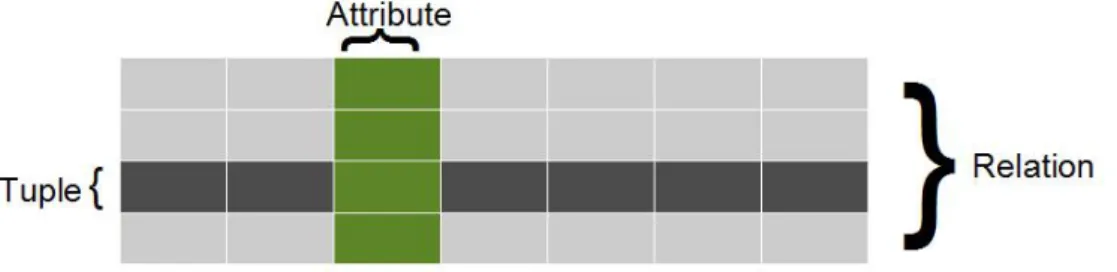
A RDBMS is a Database Management System (DBMS) that is based on the relational model introduced by Edgar F. Codd in 1969. The relational model is solidly based on two parts of mathematics: first-order predicate logic and the theory of relations. A mathematical relation is a set with special properties. All of the relation’s elements are tuples, all of the same type and unordered. Relation is the mathematical term for a table. Each row represents a tuple of the relation, see figure 2.1. The ordering of rows is immaterial and all rows are distinct from one another in content. There are twelve rules of the relational model that were adopted by many open source and commercial DBMS implementations. The relational model provides precise specification for what should be built by a DBMS, not how should it be built. He defined twelve rules for relational management system, and rule number five says: "The DBMS must support a clearly defined language that includes functionality for data definition, data manipulation, data integrity, and database transaction control" [Cod90]. The following
Figure 2.1:Codd’s Relational Model
are the most important data integrity features in the relational model and include primary key, foreign key and constraints. Together with relations (tables), tuples (rows) and attributes (columns) they form the basic blocks of the relational model.
A primary keyidentifies uniquely a row and may consist of a simple column or a combination of columns. When it consists of a combination of columns, the key is said to becomposite. A composite primary key enables you to specify two attributes in a table that collectively form a unique primary index. Each column participating in a composite primary key may be a foreign key, but not necessarily [Cod90].
Codd defines the two following types of integrity:
Entity integrity: the Primary key of a table must contain a unique, non-null value for each row. Referential integrity: if the Foreign key contains a value, that value must refer to an existing row in the parent table. You want to make sure that no one can insert rows in the Orders table that do not have a matching entry in the Customer table. This is called maintaining the referential integrity of your data.
Integrity constraints imposed by the relational model that are supported by RDBMSs are:
• Uniquenessconstraints to ensure that a given column is unique
• Foreign keyor referential constraints to ensure that two keys share a primary key to foreign key relationship
• Not Nullconstraint to ensure that no null values are allowed
• Check constraint: defines a business rule on a column, enforce domain integrity by limiting the values that are accepted by one or more columns (for example, a customer’s ageshould always be > 18)
Indexing- a mechanism for providing faster access to data. Indexes are special data structure to optimize the query for a specific set of columns (a.k.a performance-oriented objects). They are built to avoid full table scans during queries. They can be created on any combination of attributes on a relation.
Joinsare read operations that take two separate tables and combining them in some way to return a single table.
The relational DBMSs use Structured Query Language (SQL) as the industry standard lan-guage for implementing the functionalities of Codd’s rules and for querying the data. Amer-ican National Standards Institute (ANSI) passed the SQL as a standard in 1986. The Inter-national Standards Organization (ISO) adopted it in 1987. It has seen many changes since the first time it was published as a standard because most commercial vendors offered the features that were missing in it. The 1989 standards were more complete, but still left many important elements undefined. SQL is also interchangeably used to refer to databases that use SQL as their query language.
RDBMS ensure the transaction control via the well known ACID guarantees. The ACID model is one of the oldest and most important concepts of database theory. In the context of transaction processing it refers to the four following properties. They constitute the basic building blocks of any database transaction model. All four properties have to be met in order for database transactions to be processed reliably.
• Atomicity - an operation is atomic if it either completes entirely or not at all
• Consistency - all operations will bring the database from one consistent state to another, i.e. they will preserve the database rules.
• Isolation - ensures that the concurrent execution of transactions results in a system state that would be obtained if transactions were executed serially, i.e. one after the other.
• Durability - once a transaction has been committed, it will remain so, even in the event of power loss, crashes, or errors.
RDBMSs are in the market since three decades and are being offered by the big companies such as Oracle, IBM, and Sybase, Microsoft and open source software products such as MySQL and PostgreSQL. They generally guarantee ACID properties for transaction-oriented applications, i.e. OLTP. They are mature and offer many advanced features such as transactions and logging to ensure data integrity and query optimization features. These SQL databases work fine as long as the data comes in at a reasonable speed and is of a normal variety. The problem is that being relational and guaranteeing ACID is not necessary for some use cases and can add unnecessary overhead, which popular heavily trafficked website don’t want. We will describe such use cases later in this work.
PostgreSQL3is a powerful, open source object-relational database system. It has more than 15 years of active development and a proven architecture that has earned it a strong reputation for reliability, data integrity, and correctness. It runs on all major operating systems, including Linux, UNIX, and Windows. It is fully ACID compliant and it has full support for foreign keys, joins, views, triggers, and stored procedures (in multiple languages). Its SQL implementation strongly conforms to the ANSI-SQL:2008 standard. There are active PostgreSQL systems in production environments that manage in excess of 4 terabytes of data [Posa].
MySQL4 is the most used open source RDBMS. Since April 2009, and since version 5.1, MySQL is in two different variants: the open source MySQL Community Server and the commercial Enterprise Server. MySQL is modular in design, provides pluggable storage engines, and allows pluggable modules to support additional features as desired. It offers ACID compliance when using transaction capable storage engines (InnoDB and Cluster).
2.2.2 NoSQL Stores
The NoSQL movement began as an effort to accommodate the big data phenomenon. The Dynamo technology developed at Amazon [DHJ+07] and the BigTable distributed storage system developed at Google [CDG+08], have inspired many of today’s NoSQL applications and databases. The motivation behind BigTable was the need to store results from the WebCrawlers which extracted HTML pages, images, sounds, videos and other media from the Internet. The resulting data set was so large that it could not fit into a single relational database, so Google built their own storage system.
There are about 150 NoSQL databases [NoS] in the world today, and new ones are being worked on. This variety makes it difficult to select the best tool for a particular case. The plethora of NoSQL databases can be grouped into the four basic categories based on the data models that they use: key-value, document, columnar and graph databases which will be explained in the next section.
Driven by people who thought that tabular structure is too limiting, NoSQL databases are not a hype anymore but are being adopted by many applications. The most commonly accepted interpretation of NoSQL is ’Not Only SQL’ and thus conveying the belief that NoSQL databases will not replace the relational databases, they will just be part of a hybrid architecture addressing needs such as scalability, high-performance, and high availability. Rather than conforming to SQL standards and providing relational data modeling, NoSQL databases have different design points compared to RDBMSs. They typically offer fewer transactional guarantees in exchange for greater flexibility and scalability [PC]. NoSQL movement is seen by the old-school database world as an heretical movement because historically, databases almost always have tried to implement the relational model and be fully ACID-compliant. For the NoSQL proponents, for the top-tier Web sites it is important to enable massive scalability, low latency, and an easier programming model.
One of the great benefits of having a rich SQL implementation is that you hook into all of the development, reporting, ETL and backup tools, etc., that are used in the enterprise. Old
3PostgreSQL: http://www.postgresql.org/ 4MySQL: http://www.mysql.com/
school Database Administrators (DBA) and relational system designers believe that NoSQL supporters are going to stumble over the problems the veterans have already fixed [Moh13]. One of these arguments is about the querying features.
The programmer has limited control over the execution of the SQL statements; it is the database engine that takes care of the statements execution optimization. Aquery optimizer which is a very important architectural component of RDBMSs takes care of the execution by deciding which query plans to execute to most quickly answer a query. The query optimizers can leverage all the information and statistics that are available about the various tables and allow the developers to focus on the "what", in NoSQL world the query optimization responsibility is shifted to the application layer, i.e. choosing the right data model design. There is no common query language for NoSQL stores, like the SQL for relational databases. Even though there are some data stores like Cassandra and Hive that support a subset of SQL standard. Unstructured Query Language (UnQL)5aims to be a language specifically for unstructured data that can be used across the NoSQL landscape. With Couchbase as an industry-leader, the approach aims to create an open query language for JSON, semi-structured and document databases. It is much harder for a query optimizer to perform a global optimization taking into account latency, errors, etc. Hence, most NoSQL databases rely on explicit programmatic queries of a certain model such as MapReduce that can be executed on a distributed architecture.
MapReduceis a programming model for analytic and aggregation tasks for large scale data intensive applications. Actually the MapReduce framework is patented by Google, but ideas are adopted in a number of open-source implementations. Programs written in this functional style are automatically parallelized and executed on a large cluster of commodity machines. Themapfunction processes a key/value pair to generate a set of intermediate key/value pairs, and thereducefunction merges all intermediate values associated with the same intermediate key [DG08]. It is the equivalent of a relational table-scan. For the same purpose RDBMS databases use SUM, AVG and GROUP BY. The main purpose of MapReduce is to process large amounts of unstructured data and generate meaningful structured data as output. There are certain scenarios where you cannot use the MapReduce model, for example if the computation of a value depends on previously computed values.
2.2.3 NewSQL
As an alternative to NoSQL and custom deployments, a new class of parallel DBMSs, called NewSQLis emerging. They were driven by the need to preserve ACID guarantees while achieving scalability. This is based on using the ability of partitioning of OLTP work-loads [PCZ12]. The same way the performance of applications using NoSQL stores depends on the data model design, the scalability of OLTP applications on many of these newer DBMSs also depends on the existence of an optimal database design. There are three approaches to achieve the scalability and still preserve the ACID guarantees and SQL interface [Pra]:
• New databases - designed from scratch to achieve scalability and performance. These solutions can be software-only (VoltDB, NuoDB and Drizzle) or supported as an appli-ance (Clustrix, Translattice). Examples of commercial offerings are: Clustrix, NuoDB and Translattice, and open source offerings: VoltDB6, Drizzle7, etc,.
• New MySQL storage engines - to overcome MySQL’s scalability problems, a set of storage engines are being developed, which include Xeround, Akiban, MySQL NDB cluster, GenieDB, Tokutek, etc. The still use the MySQL interface, but the data migration from other databases (including old MySQL) is not supported. Examples of offerings are, commercial: Xeround, GenieDB and TokuTek; open source: Akiban, MySQL NDB Cluster and others.
• Transparent clustering - these solutions retain the databases in their original format, but provide a pluggable feature to cluster or shard transparently in order to improve scalability.
Note that this class of databases should not be confused with the new SQL database language. NewSQL is also a new SQL database access language which is still in the phase of collecting ideas and has partial functionality implemented. The idea is to have a standardized new query language to access a SQL database from Java because SQL is outdated and too complex. More importantly there is no real SQL standard, every product database has its own specifics, e.g. data types, keywords, size restrictions etc. In order to support the existing applications which are making use of SQL, to run with different databases, SQL to NewSQL and NewSQL to SQL converters are needed. Based on the Liberty Database Connectivity (LDBC) - a JDBC driver that provides vendor-independent database access - the SQL syntax is translated to each database. Applications can start using another database with no changes required. LDBC does not define a new database API, but it documents and enforces the expected behavior. With LDBC, applications will just work on all major databases and there is no need to change any source code8.
2.2.4 NoSQL Adoption Drivers
The NoSQL databases were endorsed by the big companies, Google and Amazon, but their adoption spread in other companies as well, of a comparable size such as Facebook, Yahoo, EBay and many smaller ones. The drivers for NoSQL adoption are categorized as follows:
• Schema Flexibility
Managing the continuously evolving schema and metadata for semi-structured and un-structured data, generated by diverse sources, is a convoluted problem [Tiw11]. Schema flexibility can be translated as the ability to handle semi-structured and un-structured data. Frequent changes to the schema are needed to react to frequent market changes and product innovations. Hence, the schema flexibility - also referred to as being schema-free or schema-less - is inducing organizations towards NoSQL solutions. According 6VoltDB: http://voltdb.com/
7Drizzle: http://www.drizzle.org/
to Couchbase’s9 survey [Cou] this is the main reason, together with scalability, why businesses are moving to NoSQL solutions. The RDBMSs data model is not flexible enough to handle big data that contain a mixture of structured, semi-structured, and unstructured data. In NoSQL it is easier to deal with non-uniform data as most of NoSQL databases do not impose schema restrictions. This feature will avoid the insertion of many columns with null values or with naming such as CustomField in the relational model when dealing with non-uniform rows.
The termschema-lessis a bit misleading and thus it requires some explanation. The lack of meaningful Data Definition Language (DDL) is conflated with the lack of a schema. In the NoSQL world the schema has to be defined by the application, because the data stream has to be parsed by the application when reading the data from the database. This schema is a set of assumptions about the data’s structure in the code that manipulates these data. As the data has to be parsed by the application, in case of a schema mismatch is the application that should catch and throw these errors, not the database as was the case with RDBMSs. Thus, even in schema-less databases, the schema of the data has to be taken into consideration when refactoring the application [SF12]. For applications using document-based stores, in fact the application has schema which is implicit to the documents. Nevertheless, you still have to think about modeling aspects, such as: the type of relationship with graph databases, the names and order of columns in column-family stores or how is the key assigned and what is the value structure in key-value stores. The database doesn’t care if different documents don’t follow the same schema or if different rows have different number of columns. Also, if you find you don’t need some data anymore, you can just stop storing them, without worrying about losing old data as you would if you delete columns in a relational schema. They offer a flexible schema design that can be changed without downtime or service disruption. This does not imply that you cannot do this in SQL, you can change with SQL statements the schema at anytime.
• High Performance
The new Cloud OLTP workloads require higher throughput than traditional ones. The in-memory features of these databases can offer higher performance for applications that are ready to trade away some functionality, such as durability or consistency. NoSQL stores are designed to run well on clusters. This is supported by the concept ofAggregate. The first three NoSQL database categories have a big similarity: all have a fundamental unit of storage which is a rich structure of closely related data: for key-value stores it’s the value, for document stores it’s the document, and for column-family stores it’s the column family. In Domain Driven Design (DDD) terms, this group of data is an aggregate. You create small domains of ownership so that you don’t have to deal with the whole domain model. An aggregate is a collection of related objects that you wish to treat as a unit. The updates and the communication with the database is done in terms of aggregates. They also make a natural unit for sharding and replication, by enabling running of databases in clusters [SF12].
• Application Development Agility 9Couchbase: http://www.couchbase.com/
RDBMS schema should be changed before the applications changes, limiting this way the adding/updating of application features. In NoSQL, the focus shifts todomain design by empowering agile development of applications. Furthermore, NoSQL databases are, in many cases, easier to get up and running than are relational databases. NoSQL databases better fit modern application development. There is a shorter time needed to go from concept to implementation, thus making NoSQL databases appealing for growing companies looking for agility. This is the case when applications are designed from the beginning to use Cloud technologies (Cloud-native application). The situation is more complex when the application migrates from a local relational database to a NoSQL in the Cloud (Cloud-enabling it) as it will impact the business layer and the data access layer where further adaptations are needed. Going back at the case of [Ale], the team highlights the ease of using Amazon Web Services by noting the time saved using the pre-built libraries provided in Amazon Web Services’ resource center enabling Alexa to kick start any new project with the comfort of building on top of existing libraries.
2.2.5 Polyglot Persistence
The kind of information that needs to be represented and stored has significantly changed over time. Features such as performance and availability are becoming paramount for the consumer facing applications, but the most critical enterprise applications still favor consis-tency over the availability. Line of Business (LOB) applications is the set of critical computer applications that are vital to run an enterprise, such as accounting, supply chain and enter-prise resource planning. These applications will keep using the power of relational databases. The database consistency, query optimization, and set-based declarative query capability that relational databases have provided for decades is still required by most LOB applications; this has not changed [BBBI].
This situation has led to the termPolyglot Persistencewhich means that enterprises will use different databases that have different persistence approaches to solve different problems within one application or across the enterprise. For example, in an e-commerce scenario, transactional data storage and session information storage have different performance re-quirements (consistency, availability, and backup). You can live without a backup of the session information, it can be reconstructed in case something goes wrong, but you cannot afford to lose customer orders. Or the payment information may be stored in a transactional relational database to ensure consistency, while product catalogs and shopping carts might achieve better performance by using NoSQL stores [SF12]. One can also mix the use of NoSQL inside SQL. One benefit of this approach is that the same data store can be used for both the SQL and the NoSQL data. For example, PostgreSQL implements thehstore data type for storing sets of key/value pairs (simply text strings) within a single PostgreSQL value. This can be useful in various scenarios, such as rows with many attributes that are rarely queried, or when dealing with semi-structured data - the schema-less benefit of using NoSQL databases.
Figure 2.2:Polyglot Persistence in an e-commerce scenario [SF12]
2.3 Non-Functional Properties of NoSQL Systems
Features such as horizontal scalability, high availability, and low latency are considered the main drivers for NoSQL databases adoption. For this reason, in this section we will summarize the non-functional properties that are the actual adoption drivers of the NoSQL systems. Scalability is the most discussed feature of NoSQL databases. For many Web applications, scalability involves the elimination of latency in rather simple operations, such as pulling up an individual note, writing out a status message, bringing up account settings or the profile for a specific customer, and so forth [BBBI]. In order to keep up with the transaction growth of modern applications, having systems able to scale is very important. A system can scale either vertically, moving the application to a more powerful server (i.e. one that has more RAM, CPU), or horizontally by adding more servers to the infrastructure. Both approaches are expensive, but the first one is also limiting as there is an upper limit to how large a system can be. Horizontal scaling is more flexible but brings also additional complexity. It can be achieved in two dimensions when considering data storage:
• Functional partitioning - any good database design decomposes the schema into functionality-related groups, also known as tables. For example in an e-commerce scenario customers and orders are functionally distinct and typically are put into sepa-rate tables. Functional partitioning is important for achieving high degree of scalability. The database constraints such as foreign keys ensure the consistency between these functional areas [Pri08].
• Sharding is splitting the data within one functional area across multiple databases. It is also known as horizontal partitioning. Data can be distributed across multiple servers, so each server acts as the single source for a subset of data. For example: customer data of customers in different geographical regions can be put on different machines.
If one node responsible for a subset of data goes down, the whole data becomes unavailable. In order to avoid data loss and achieve high availability, the replication mechanism is ap-plied - copying the dataset in more than one node (replica). There are two approaches to replication:
• Master-slaveWhen updates made in one master node are propagated to other replica nodes. This kind of replication helps with read scalability as more than one node is serving read requests but doesn’t help with the scalability of writes. Read resilience is provided only against slaves, while the master is a single point of failure for writes. In read-heavy workloads, should the master fail, the slaves can still handle read requests. However, you are still limited by the ability of the master to process and propagate those updates. So, it is not a good choice for datasets that are heavy write traffic.
• The master-masteror peer-to-peer (or master-less) replication addresses the problem of the single point of failure. In this architecture there is no master, all nodes are functionally similar; each one is used to handle read and write requests. In case of a node failure, the access to the data store is not affected and adding nodes to the cluster in order to improve performance is easier.
The drawback of replication is the impact in consistency: you face the risk that different clients, reading data from different nodes, will see different values because the changes haven’t all been replicated to the nodes. In distributed-storage systems that need to provide high performance and high availability, like NoSQL systems, the number of replicas is in general higher than two [Vogb]. Different NoSQL databases in order to have read consistency, ask more than one replica before sending the reply to the client. Read performance is improved further if replication is combined with caching techniques.
Relying on the database constraints to ensure consistency across functional groups creates a coupling of the schema to a database deployment strategy. In order to be able to apply the constraints, the tables must reside on a single database server, thus preventing horizontal scaling as transaction rates grow. Schemas that can scale to a high degree will place function-ally distinct data on different database servers. This shifts the implementation of the data constraints to the application layer, not at the database level anymore [Pri08].
Partitionsoccur when some nodes in a system cannot reach other nodes, but both data sets are reachable by different groups of clients. Partitions can happen within and across data centers. A system that is not tolerant to network partitions can achieve data consistency and availability, and often does so by using transaction protocol such as 2PC [BANE09]. The 2PC protocol was invented to enable running transactions on multiple database instances. But to send a message over a WAN significantly increases the latency of a transaction (on the order of hundreds of milliseconds), a cost too large for many Web applications that serve heavy write requests. Horizontal scalability is easier to achieve without using the 2PC protocol [CST+10].
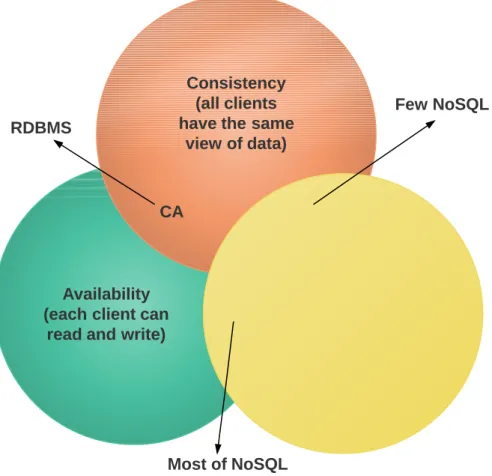
TheConsistency Availability Partition tolerance (CAP) theoremwhich lies at the heart of dis-tributed systems has been used by the NoSQL movement as one of the arguments against
traditional relational databases. Formulated by Eric Brewer in year 2000 in a keynote presenta-tion, the theorem states that it is possible to optimize for any two of Consistency, Availability, and Network Partition Tolerance, but not all three at the same time [Bre]. Said that, in case of a network partition a distributed system that is partition tolerant, it can either provide availability or consistency.
The rise of large Web applications and distributed data systems, makes the partition-tolerance property inevitable, thus imposing compromise on either consistency or availability. Dynamo was the pioneer of eventual consistency as a way to achieve high availability and scalability for its shopping cart application; data reads are not guaranteed to be up-to-date but all the nodes will see the updates eventually.
The relationship between CAP and ACID is more complex and often misunderstood, in part because the "C" and "A" in ACID represent different concepts than the same letters in CAP and in part because choosing availability affects only some of the ACID guarantees [Bre12].(In case of a partition, there is no ACID "I" because concurrent operations may occur on both sides of the partition. And there is no ACID "C" because you have only local integrity checks). The "C" in CAP - Consistency - means that there is the same copy of data in all the nodes where it is replicated, also referred to assingle-copy consistency. When some nodes crash or some communication links fail, it is important that the service still perform as expected. This explains the "A" in CAP, and it has a different meaning than the classic one we have for availability. A failed, unresponsive node doesn’t infer a lack of CAP availability. The availability in CAP means that a request should always be responded by a non-failing node [SF12].
This has introduced a new data semantics approach -BASE- a design philosophy created in the late 1990s to capture the emerging design approaches for Internet services for which the primary value was high availability of data. Compared to ACID which adopts a pessimistic approach and forces consistency at the end of every operation, BASE follows an optimistic approach that data will be available after a short period of time10. It stands for Basically Available, Soft state, Eventually consistent. The three techniques that achieve the BASE semantics are [FGC+97]:
• Stale data- services can tolerate stale data knowing that all copies will be eventually consistent after a short time.
• Soft state- in order to achieve high performance data is not written persistently; in case of failure it can be regenerated at the expense of additional computation.
• Approximate answers(based on stale data or incomplete soft state) delivered quickly may be more valuable than exact answers delivered slowly.
The systems that favor availability on consistency have a BASE approach. Another trade-off that is not part of CAP and which exists even when there are no network partitions, is the one between consistency and latency. Deciding for an asynchronous replication strategy versus a synchronous one comes to the point of choosing between consistency and latency. The synchronous approach wait until all updates have made it to the replica(s) before returning to
the user. It ensures strict consistency but as communication (especially over WAN) between independent entities is involved, it brings latency. The asynchronous approach doesn’t introduce latency, requests can be processed without waiting for the propagation of updates to other nodes. But, there is the risk that read request will be served by outdated nodes. This was the situation for year 2000. The modern view of CAP in 2012 is that the choice between availability and consistency is much more fine grained and complex. Perfect avail-ability and consistency in the presence of partitions is rare, but there is an incredible range of flexibility for handling partitions and recovering from them. The modern CAP goal should be to maximize combinations of consistency and availability that make sense for the specific application. The decision can be made more than once, and at very fine granularity; not only can subsystems make different choices, but the choice can change according to the operation or even the specific data or user involved [Bre12].
Vogel, the CTO of Amazon distinguishes between client-side and server-side consistency. The client-side deals with how consistency is perceived by the client, while server-side deals with how updates are propagated through the system and that the developer of the system can experience [Vogb].
• Client side: Strong, Weak, and Eventual (a specific form of weak consistency). The eventual consistency has the following variation forms:
– Casual consistency (read your write consistency, i.e. not reading in between a write)
– Read your write: if a process has updated a data item, it will always access the updated value and not the old one.
– Session consistency: if a process has updated a data item, it will always access the updated value and not the old one.
– Monotonic read consistency: if a process has seen an updated value, any subse-quent access will never return an older value of that data item.
– Monotonic write consistency: the system guarantees to serialize the writes by the same process.
• Server-side has to do with the configuration of the replicas. The following settings:
– N- total number of replicas for the dataset
– W- the number of replicas that need to acknowledge the receipt of the update before the update completes
– R - the number of replicas that are queried during a read operation
depend on what is the common case and which performance path needs to be optimized. For example, In R=1 and N=W (read only from one node) you optimize for the read case, and in W=1 and R=N (write to only one node) you optimize for a very fast write. In the latter case, durability is not guaranteed in the presence of failures, and if W < (N+1)/2, there is the possibility of conflicting writes when the write sets do not overlap.
W and R are respectively Write and Read quorums. The eventual consistency rises when having W+R<=N configuration, i.e. having no overlapping of nodes.
2.3.1 CAP Systems
Given the different behaviors of database system when they have to deal with partitions, the following is a popular classification of systems through the lens of CAP.
CPsystems: database systems that adhere to ACID properties, focus on CAP consistency
Figure 2.3:CAP Systems
first and then availability. They forfeit availability for consistency in case of partitions. APsystems: NoSQL systems designed to support applications that need to be highly available, in case of partitions they forfeit consistency, thus falling into the AP category. The case of PNUTS, the NoSQL system from Yahoo, seem not to fit into this definition. PNUTS relaxes consistency by only guaranteeing "timeline consistency" where replicas may not be consistent with each other but updates are guaranteed to be applied in the same order at all
Table 2.1:SQL vs NoSQL vs NewSQL Summary
Features RDBMS NoSQL NewSQL
Data model Relational model Domain driven Relational model
Transactions ACID (almost all) BASE ACID
Querying SQL REST, Client libraries, Protocol
buffers SQL
CAP classification CA AP/CP mainly CP
replicas [CRS+]. It also gives up availability - if the master replica for a particular data item is unreachable, that item becomes unavailable for updates.
CAsystems: refer to systems that are not tolerant to network partitions, traditional RDBMS fall into this category. But what if a partition happens? It means that they loose availability, thus falling into the same group as CP systems.
Tunable Consistency: allows the user to decide the level of consistency he wants. The consistency level is a setting that clients must specify on every operation (insert, update, read) and that allows the user to decide how many replicas in the cluster must acknowledge a write operation or respond to a read operation in order to be considered successful. As many of the NoSQL can tune the consistency level in case of partitions, this is the reason some NoSQL systems fall into AP and CP categories.
2.4 NoSQL Database Categories
A comprehensive summary of NoSQL databases and their features is given by Pramod and Martin in their "NoSQL Distilled" [SF12] book and a very up to date list of the databases is available online at [NoS]. In this thesis, we give a summary of NoSQL databases focusing on the application functionalities and non-functional properties that each category support. This summary is not claimed to be exhaustive as this is an immature and fast-growing market, and adoption drivers are still evolving.
It is important to understand each category, because they serve certain scenarios (applications and workloads) best. Comparison of data models is easy, while comparing them in terms of performance is a challenging task. Attempting to evaluate NoSQL systems all together conflates too many different needs with too many different kinds of required optimizations, and prevents meaningful comparison [NE]. Yahoo Cloud Serving Benchmark (YCSB) is an extensible framework from Yahoo Research that has become a standard for evaluating the performance of NoSQL stores. Currently they have developed two benchmark tiers: scalability and performance, while future addition on availability and replication have been announced. Performance of these systems depend on the partitioning, replication, and transactional consistency that they have chosen. To understand the performance implications of these decisions for a given type of application is challenging [CST+10].
Enumerations of NoSQL categories tend to vary, and there are cases when a database can fall in more than one group. In the following sections we will briefly introduce the four main categories of NoSQL stores.
2.4.1 Key-Value Stores
Key-value stores are the simplest NoSQL data stores and can bee considered as the mother of all NoSQL databases. Even though they are not the same, they have many things in common. A HashMap11is the simplest data structure that can hold a set of key-value pairs and they all store data as maps [Tiw11]. They were inspired by Amazon DynamoDB storage model. The APIs the databases of this category offer the "match query" options. A match query extracts the value associated with a certain key.
• Get(key) - extracts the value given a key
• Put(key, value) - creates or updates the value given its key
• Delete(key) - removes the key and its associated value
They are easy to use from an API perspective. - the client can either get the value for the key, put a value for a key, or delete a key from the data store; that is the reason why they are easy to scale and generally have great performance. The aggregates can be stored into one single bucket which is a namespace for keys. But storing all different objects in one single bucket increases the chance of key conflicts. An alternate approach is to append the name of the
![Figure 2.2: Polyglot Persistence in an e-commerce scenario [SF12]](https://thumb-us.123doks.com/thumbv2/123dok_us/10225301.2926372/29.892.156.766.151.491/figure-polyglot-persistence-in-an-commerce-scenario-sf.webp)

![Figure 4.1: Cloud Data Migration Tool[Bac].](https://thumb-us.123doks.com/thumbv2/123dok_us/10225301.2926372/50.892.181.740.311.473/figure-cloud-data-migration-tool-bac.webp)