Algebraic Model Counting
Angelika Kimmiga,∗, Guy Van den Broeckb, Luc De Raedta aDepartment of Computer Science, KU Leuven,
Celestijnenlaan 200a – box 2402, 3001 Heverlee, Belgium. bUCLA – Computer Science Department, 4531E Boelter Hall, Los Angeles, CA 90095-1596A, USA.
Abstract
Weighted model counting (WMC) is a well-known inference task on knowledge bases, and the basis for some of the most efficient techniques for probabilistic inference in graphical models. We introduce algebraic model counting (AMC), a generalization of WMC to a semiring structure that provides a unified view on a range of tasks and existing results. We show that AMC generalizes many well-known tasks in a variety of domains such as probabilistic inference, soft constraints and network and database analysis. Furthermore, we investigate AMC from a knowledge compilation perspective and show that all AMC tasks can be evaluated usingsd-DNNFcircuits, which are strictly more succinct, and thus more efficient to evaluate, than direct representations of sets of models. We identify further characteristics of AMC instances that allow for evaluation on even more succinct circuits.
Keywords: Knowledge Compilation, Model Counting, Logic
1. Introduction
Today, some of the most efficient techniques for probabilistic inference em-ploy reductions to weighted model counting (WMC) both for propositional and for relational probabilistic models (Park, 2002; Sang et al., 2005; Darwiche, 2009; Fierens et al., 2011; Van den Broeck et al., 2011). The resulting weighted
5
∗Corresponding author
Email addresses: [email protected](Angelika Kimmig),
model counting task is often solved by a single pass over a propositional circuit, which is a compact graphical representation of the models of interest. This approach makes it possible to perform the possibly expensive knowledge com-pilation step, that is, the construction of the circuit, only once, and to then evaluate this circuit repeatedly, for instance, under different evidence or with
10
different parameters.
On the other hand, it is well-known that probabilistic inference as well as many other tasks can be generalized to a sum of products computation over models with suitable operators from a semiring structure. This has led to com-mon inference algorithms for a variety of different inference problems in many
15
fields, including parsing (Goodman, 1999), dynamic programming (Eisner et al., 2005), constraint programming (Meseguer et al., 2006), databases (Green et al., 2007), Bayesian inference (Bacchus et al., 2009), propositional logic (Larrosa et al., 2010), networks (Baras & Theodorakopoulos, 2010) and logic program-ming (Kimmig et al., 2011). The work presented here provides a unified view
20
on these two lines of work by introducing both a general definition of model counting in a semiring setting and a solution approach for this task based on knowledge compilation.
As our first contribution, we introduce the task ofalgebraic model counting (AMC). AMC generalizes weighted model counting to the semiring setting and
25
supports various types of labels (or weights), including numerical ones as used in WMC, but also sets (e.g., to collect relevant variables), Boolean formulae (e.g., to obtain explicit representations of models), polynomials (e.g., for sen-sitivity analysis in probabilistic models), and many more. It thus provides a framework that covers many different tasks from a variety of different fields.
30
As our second contribution, we investigate how to solve AMC problems using knowledge compilation. As AMC is defined in terms of the set of models of a propositional logic theory, we can exploit the succinctness results of the know-ledge compilation map of Darwiche & Marquis (2002). We show that AMC can in general be evaluated using sd-DNNF circuits, which are more succinct, and
35
Furthermore, we identify a number of characteristics of AMC tasks that allow for evaluation on even more succinct types of circuits. Our results provide a unified view on existing results, which also allows us to generalize well-known insights for satisfiability and model counting in circuits to broad classes of AMC
40
tasks and to extend the task classification in algebraic Prolog (Kimmig et al., 2011) to more succinct types of circuits. As our third contribution, we further broaden the applicability of the AMC framework by linking it to semiring sums of products defined over derivations, that is, sequences of possibly repeated variables, instead of over models.
45
This paper is organized as follows. We introduce algebraic model counting in Section 2. Section 3 provides task characteristics that allow for correct eval-uation on specific classes of circuits and shows how these generalize previous results. We discuss future work and conclude in Section 4.
2. Algebraic Model Counting
50
Our definition of algebraic model counting builds upon the well-known task of weighted model counting for propositional logic theories. Given a proposi-tional logic theory T over a set of variables V, an interpretation of V assigns a truth value from the set{true,false} to every variable inV. The set M(T) ofmodels of theoryT contains exactly those interpretations of V for which T 55
evaluates to true. We here view interpretations (and models) as sets of literals, that is, for each variablev ∈ V, an interpretation contains either the positive literalv or the negative literal¬v. We useLto denote the set of literals for the variables inV. In weighted model counting, non-negative real-valued weights are associated with all literals, and the weighted model count of a propositional
60
theory is obtained by multiplying these weights for each model of the theory, and summing the results for all models.1
1The case where weights are associated with joint assignments to groups of variables, as in
Definition 1(Weighted Model Counting (WMC)). Given
• apropositional logic theory T over a set of variablesV and
• a weight function w:L →R≥0, mapping literals of the variables inV to 65
non-negative real-valued weights,
the task ofweighted model counting (WMC) is to compute WMC(T) = X
I∈M(T)
Y
l∈I
w(l). (1)
Algebraic model counting generalizes multiplication and summation of real-valued weights to corresponding operations from an arbitrary commutative semi-ring. It thus extends WMC to more general classes of weights, which are not
70
necessarily real-valued. To emphasize the latter, we use the termslabeling func-tionandlabel in the context of algebraic model counting.
Definition 2 ((Commutative) Semiring). A semiring is a structure (A,⊕,⊗, e⊕, e⊗), where
• addition ⊕is an associative and commutative binary operation over the
75
setA,
• multiplication ⊗is an associative binary operation over the setA,
• ⊗distributes over⊕,
• e⊕∈ Ais the neutral element of⊕, i.e., for alla∈ A, a⊕e⊕=a,
• e⊗∈ Ais the neutral element of⊗, i.e., for alla∈ A, a⊗e⊗=a, and
80
• e⊕ is an annihilator for⊗, i.e., for alla∈ A,e⊕⊗a=a⊗e⊕=e⊕. In acommutative semiring,⊗is commutative as well.
Examples of commutative semirings can be found in columns 2–6 of Table 1; these will be discussed below. Generalizing weighted model counting to labeling functions defined over commutative semirings, we now define algebraic model
85
Definition 3(AMC Problem). Given
• apropositional logic theory T over a set of variablesV,
• acommutative semiring (A,⊕,⊗, e⊕, e⊗), and
• alabeling function α:L → A, mapping literalsL of the variables inV to
90
values from the semiring setA,
the task ofalgebraic model counting (AMC) is to compute A(T) = M
I∈M(T)
O
l∈I
α(l). (2)
That is, starting from semiring values associated with individual literals via the labeling function, AMC assigns a value to each interpretation of the variables by combining the values of corresponding literals with semiring multiplication,
95
and a value to the theory by combining values of all its models with semiring addition.
2.1. Examples of AMC Tasks
To provide a better idea of the variety of tasks covered by this general definition, we next discuss examples of AMC tasks based on semirings and
100
labeling functions found in the literature, as summarized in Table 1. Probably the most basic instance of AMC is the evaluation of a Boolean formula for a given interpretation (Bool), where the labeling function assigns the truth values given by the interpretation to the literals, i.e., labels are Boolean,α(v) =true ifv is true in the given interpretation (andα(v) =f alseelse), negative literals¬vare
105
labeled¬α(v), and those labels are combined using the usual Boolean semiring with ⊕ = ∨ and ⊗ = ∧. In fact, this instance can be seen as providing the basis for the evaluation of AMC tasks via knowledge compilation as discussed in Section 3. Using the same Boolean semiring, but in combination with a labeling function that assignstrueto all literals, we obtain an instance of AMC
110
task A e ⊕ e ⊗ ⊕ ⊗ α ( v ) α ( ¬ v ) ref idp. ⊕ neut. (⊕ , α ) icp. (⊗, α ) Bool { true , false } false true ∨ ∧ ∈ { true , false } ¬ α ( v ) X X X SA T { true , false } false true ∨ ∧ true true B, BT, G, GK, K, L, M X X − WMC R ≥ 0 0 1 + · ∈ R ≥ 0 ∈ R ≥ 0 − − − #SA T N 0 1 + · 1 1 B, G, GK, K, L − − − Pr ob R ≥ 0 0 1 + · ∈ [0 , 1] 1 − α ( v ) B, BT, E, G, K − X − Sens R [ V ] 0 1 + · v or ∈ [0 , 1] 1 − α ( v ) K − X − Grad R ≥ 0 × R (0 , 0) (1 , 0) Eq. (5) Eq. (6) Eq. (3) Eq. (4) E, K − X − MPE R ≥ 0 0 1 max · ∈ [0 , 1] 1 − α ( v ) B, BT, G, K, L, M X − − S-P a th ∗ N ∞ ∞ 0 min + ∈ N 0 BT, GK, K X X − W-P a th ∗ N ∞ 0 ∞ max min ∈ N ∞ BT X X − Fuzzy [0 , 1] 0 1 max min ∈ [0 , 1] ∈ [0 , 1] GK, M X − − k Weight { 0 , . . . , k } k 0 min + k ∈ { 0 , . . . , k } ∈ { 0 , . . . , k } M X − − OBDD < OBDD < ( V ) OBDD < (0) OBDD < (1) ∨ ∧ OBDD < ( v ) ¬ OBDD < ( v ) K X X X Why ∗ P ( V ) ∅ ∅ ∪ ∪ { v } ∅ GK X − − RA + ∗ N [ V ] 0 1 + · v 1 GK − − − T able 1: Examples of AMC tasks based on comm utativ e semirings and lab eling functions that ha v e b een used in v ar io us con texts in the literature. T asks mark ed with ∗ are examples of algebraic deriv ation coun t tasks mapp ed to AMC, see Section 3.5 for details. Reference k ey: B (Bacc h us et al., 2009), BT (Baras & Theo dorak op oulos, 2010), E (Eisner, 2002), G (Go o dman, 19 99), GK (Gree n et al., 2007 ), K (K immig et al., 2011), L (Lar rosa et al., 2010), M (Meseguer et al., 200 6); more examples can b e found in these references. The last three columns classify the tasks based on the semiring prop erties studied in Sections 3.2 and 3.3: idemp oten t ⊕ (Def. 11), neutral ( ⊕ , α ) (Def. 12), and idemp oten t and consistency-preserving ( ⊗ , α ) (Def. 13).
As can already be seen from their definitions, weighted model counting (WMC) itself is another instance of AMC, which combines non-negative real numbers as labels with ordinary multiplication and addition. The well-known task of model counting (#SAT) corresponds to the special case where all
lit-115
eral weights are 1 (and counts thus restricted to the natural numbers), whereas probabilistic inference (Prob) in a setting where all variables are independently assigned truth values at random restricts the labeling function ofWMCto val-ues from [0,1] such that labels of positive and negative literals for each variable sum to one, i.e., for every variablev,α(v)∈[0,1] andα(¬v) = 1−α(v).
120
We can extend the Prob setting to an AMC task to perform sensitivity analysis (Sens) by allowing the use of variables instead of constant probabilities as labels, i.e., a positive literalvcan be labeled with a value in [0,1] as before, or with variablev, and negative literals are still labeled α(¬v) = 1−α(v). The corresponding semiring uses summation and multiplication of polynomials as⊕
and⊗, respectively. That is, the algebraic model count is an explicit function of the probabilities of the literals labeled with variables, which can directly be evaluated for various choices of these model parameters. Still within the same probabilistic setting, calculating the gradient with respect to one variable, which is an important subtask in many parameter learning approaches, can be formulated as AMC task as well (Grad). In this case, literal labels are tuples (pi, gi) with pi ∈ [0,1] the probability of the literal and gi the gradient with
respect to thekth variable2: α(vi) = (pi,1) ifi=k (pi,0) ifi6=k (3) α(¬vi) = (1−pi,−1) ifi=k (1−pi,0) ifi6=k (4) (a1, a2)⊕(b1, b2) = (a1+b1, a2+b2) (5) (a1, a2)⊗(b1, b2) = (a1·b1, a1·b2+a2·b1) (6)
If the second element of the label denotes a cost, theGRADsemiring calculates expected costs.
Another well-known task in the probabilistic setting is finding the probability of the most likely model (MPE), which is formulated as AMC task by using the Probsetting except for⊕, which now is maximization rather than summation.
125
The next two settings, finding the length of the shortest path (S-Path) and finding the width of the widest path (W-Path), are inspired by optimization tasks in weighted networks.3 In both cases, positive literals are labeled with a
natural number, and negative literals with the neutral element e⊗ of the cor-responding semiring multiplication, which ensures that the latter are not taken
130
into account when calculating labels of models. Furthermore, the choice of semi-ring operators ensures that optimization⊕always selects the value of a model containing a minimal set (w.r.t. cardinality) of positive literals (corresponding to the edges on a path). In the case of shortest path,⊗sums labels of literals and⊕minimizes over these sums, whereas in the case of widest path,⊗
mini-135
mizes over labels of literals (thus finding the narrowest part or bottleneck of a path), and⊕maximizes over those.
The Fuzzy AMC task is closely related to W-Path, also using ⊕= max and ⊗ = min, but assigns values from the interval [0,1] to literals, reflecting
2By using (n+ 1)-tuples, this can directly be extended to calculate gradients with respect
tonvariables in parallel.
their degree of membership in a fuzzy model. The algebraic model count then
140
corresponds to the highest minimal degree of membership of a literal in a model. Similarly, kWeightis closely related to S-Path and also uses⊕= min, but imposes an upper bound on the value of any model by restricting literal weights to integers{0, . . . , k}and using bounded addition +kas⊗. The algebraic model count then is the minimal value of a model, orkif no model has a smaller value.
145
As illustrated by theOBDD< task, labels in AMC can also be complex struc-tures. OBDD<circuits, which are canonical representations of Boolean functions, are a popular data structure in many fields of computer science, ranging from hardware verification to artificial intelligence. To use them for AMC, we la-bel each literal with its OBDD< circuit, and set ⊕ and ⊗ to disjunction and
150
conjunction onOBDD<, respectively.
The last two tasks in the table originate from probabilistic databases under the positive relational algebraRA+ and are thus defined in terms of (possibly
repeated) positive literals only. We will discuss suchalgebraic derivation count (ADC) tasks and their relation to AMC in Section 3.5. In contrast toS-Path
155
and W-Path, which also are instances of ADC originally, expressing Why andRA+-provenance requires to bring the propositional theory into a specific
form; we will come back to the details in Section 3.5. Negative literals are again labeled with the neutral element e⊗ of semiring multiplication. Why-provenance (Why) collects the set of identifiers of all tuples an answer depends
160
on. It labels positive literals with α(v) = {v}, and uses set union as both ⊕
and⊗. RA+-provenance constructs polynomials that also take into account the
number of times the tuples are used. Positive literals are labeled withα(v) =v, and ⊕and ⊗ are summation and multiplication on polynomials, respectively. Both settings thus provide insight into the way answers to database queries have
165
been derived, and can be used for instance to understand unexpected answers and to identify possible causes of wrong answers.
As a summary of this discussion, we obtain:
model counting (#SAT), weighted model counting (WMC), probabilistic
in-170
ference (Prob), sensitivity analysis (Sens), gradient (Grad), probability of most likely states (MPE), shortest (S-Path) and widest (W-Path) paths, fuzzy (Fuzzy) and k-weighted (kWeight) constraints, and OBDD< construc-tion are instances of AMC, with the semirings and labeling funcconstruc-tions provided in Table 1.
175
While all tasks listed in Table 1 are representative examples from the litera-ture, cf. the references given in the table, this is by no means an exhaustive list of semirings and labeling functions that can be used for AMC.
2.2. Related Work
As the examples discussed above illustrate, the AMC task shares its use of
180
semirings with a number of other tasks. The class of sum-of-products prob-lems generalizes factor graphs to the algebraic setting, but uses factors over discrete valued variables as basic building blocks (Bacchus et al., 2009), that is, the task is to computeL
I(V)
Nn
i=1fi(Ei), whereI(V) are all possible value assignments to the set of variablesV, and the fi are functions on sets of
vari-185
ablesEi⊆ Vtaking values from the underlying semiring. In this context, affine algebraic decision diagrams (Sanner & McAllester, 2005) and AND/OR multi-valued decision diagrams (Mateescu et al., 2008) have been used for inference with real-valued semirings. It has been shown before that the factor representa-tion can be transformed into a proposirepresenta-tional logic representarepresenta-tion by introducing
190
additional variables corresponding to factors (Chavira et al., 2006; Sang et al., 2005). Consider for example an algebraic factor f(x1, x2) associating a label
with each of the four joint assignments of Boolean variablesx1 andx2:
x1 x2 f(x1, x2)
0 0 α00
0 1 α01
1 0 α10
This factor could for instance represent the conditional probabilities Pr(x2|x1) = 195
f(x1, x2) for the edgex1 →x2 in a Bayesian network. In this case, the
equiv-alent AMC Prob task would consist of one logical equivalence for every row of the table, e.g.,θ01≡ ¬x1∧x2for the second row, and the labeling function
would assign α(θij) =αij, and α(l) = 1 for all other literals l. This principle generalizes to arbitrary AMC tasks, where we use the neutral element of
mul-200
tiplicatione⊗ instead of 1 as the label of all other literals. For more details on the transformation, we refer to Chavira et al. (2006); Sang et al. (2005). The restriction to two-valued variables allows us to directly compile AMC tasks to propositional circuits without adding constraints on legal variable assignments to the theory.
205
In soft constraint programming, additional constraints are imposed on the semiring, which ensure that addition optimizes the degree of constraint satis-faction (Meseguer et al., 2006). Wilson (2005) provides an algorithm that com-piles semiring-based systems into semiring-labelled decision diagrams, which are closely related to unordered binary decision diagrams (also known as free binary
210
decision diagrams or FBDDs), to compute valuations. Semiring-induced propo-sitional logic labels clauses with semiring elements with a weight associated to their falsification and is restricted to semirings whose induced pre-order is par-tial (Larrosa et al., 2010). In algebraic Prolog (aProbLog), a semiring-labeled logic program is reduced to AMC for inference (Kimmig et al., 2011).
215
In the context of knowledge compilation and algebraic frameworks, Fargier & Marquis (2007) introducevalued negation normal form (VNNF), a general-ization of NNF circuits from the Boolean domain to valuation structures over ordered sets, and study the complexity of a range of queries and transforma-tions on different subclasses of VNNFs. In contrast, we generalize a single task
220
(model counting) to the semiring setting and relate it to well-established sub-classes ofNNF. In both cases, properties of the circuit classes such as determinism and decomposability (cf. Sec. 3) as well as of the valuation structure (such as distributivity) play key roles.
While AMC sums over models, other tasks sum over sequences of possibly
re-225
peated variables. Examples include algebraic path problems (Baras & Theodor-akopoulos, 2010), semiring parsing (Goodman, 1999), provenance semirings for positive relational algebra queries in databases (Green et al., 2007), and semiring-weighted dynamic programs (Eisner et al., 2005). We will discuss the difference between such derivation-based settings and AMC in more detail in
230
Section 3.5.
3. AMC using Knowledge Compilation
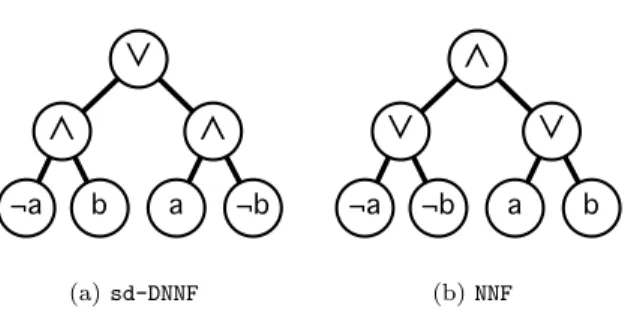
Propositional circuits represent Boolean formulae as rooted acyclic graphs where terminal nodes are labeled with literals and inner nodes with Boolean operators applied to their child nodes, cf. Figure 1 for examples. Given such a
235
representation, the underlying formula can be evaluated (as in theBooltask) by a single bottom-up pass from the terminal nodes to the root, which first assigns truth values to literals and then combines truth values of subcircuits at each inner node. In their knowledge compilation map, Darwiche & Marquis (2002) provide an overview of succinctness relationships between various types
240
of propositional circuits. Furthermore, they show which other reasoning tasks in propositional logic, such as (weighted) model counting (#SAT/WMC) or satisfiability checking (SAT), can be evaluated on which circuits in time poly-nomial in the size of the circuit. In these cases, the operations performed during circuit evaluation are adapted according to the problem at hand, for instance,
245
assigning weights to literals and replacing disjunction by summation and con-junction by multiplication forWMC. Propositional circuits are often used as a representation language in weighted model counting and similar tasks, includ-ing for instance probability calculation and sensitivity analysis in probabilistic databases (Jha & Suciu, 2011; Kanagal et al., 2011) and inference in
probabilis-250
tic and algebraic Prolog (Fierens et al., 2011; Kimmig et al., 2011).
In the following, we extend this approach to AMC, stating a single generic evaluation algorithm that operates on a propositional circuit. Using knowledge
compilation for AMC allows one to only perform the expensive compilation step once and to then evaluate the resulting circuit many times, for instance,
255
to repeatedly calculate gradients during parameter learning, to explore different parameter combinations (by keeping some variables’ values fixed and varying others) for sensitivity analysis, or to even perform different AMC tasks for the same theory.
In this section, we use conjunction (∧), disjunction (∨), true (>), false
260
(⊥), and propositional literals to denote generic labels of propositional circuits. Given an AMC task, evaluation interprets these as semiring multiplication (⊗), semiring addition (⊕), the neutral element of semiring multiplication (e⊗), the neutral element of semiring addition (e⊕), and the labels α(l) of these liter-als, respectively. We first repeat the relevant knowledge compilation concepts,
265
closely following Darwiche & Marquis (2002).
Definition 4 (NNF). A sentence in negation normal form (NNF) over a set of propositional variables V is a rooted, directed acyclic graph where each leaf node is labeled with true (>), false (⊥), or a literal of a variable inV, and each internal node with disjunction (∨) or conjunction (∧).
270
Definition 5 (Decomposability). AnNNFis decomposable if for each conjunc-tion nodeVni=1φi, no two childrenφi andφj share any variable.
Definition 6 (Determinism). AnNNF is deterministic if for each disjunction nodeWni=1φi, each pair of different childrenφi andφj is logically inconsistent. Definition 7 (Smoothness). An NNF is smooth if for each disjunction node
275
Wn
i=1φi, each childφi mentions the same set of variables.
DNNF, d-NNF, s-NNF, sd-NNF, d-DNNF, s-DNNF, and sd-DNNF are the
sub-sets of NNF satisfying (combinations of) these properties, where D stands for decomposable, dfor deterministic, ands for smooth. For instance, the circuit in Figure 1a is insd-DNNF, while the one in Figure 1b has none of the three
280
properties. DNF(disjunctive normal form) is the subset ofNNFwhere every sen-tence is a disjunction of conjunctions, andMODSis the subset ofDNFwhere every
∧
∨
¬
a
b
a
¬
b
∧
(a)sd-DNNF∨
∧
¬
a
¬
b
a
b
∨
(b)NNFFigure 1: Example of ansd-DNNFandNNFcircuit.
sentence is deterministic and smooth.
A key characteristic when comparing different subsets ofNNFis their ability to compactly represent propositional sentences, which is captured by the notion
285
ofsuccinctness.
Definition 8 (Succinctness (Darwiche & Marquis, 2002)). Let L1 and L2 be
two subsets ofNNF.L1isat least as succinct asL2iff there exists a polynomialp
such that for every sentenceφ2∈L2, there exists an equivalent sentenceφ1∈L1
with|φ1| ≤p(|φ2|), where|φi|is the size ofφi.
290
The algebraic model count A(T) is defined as a summation over the set of models M(T) of a propositional theory T, which corresponds to the MODS
language in the knowledge compilation map. However, asMODSis exponentially less succinct than any other representation ofTincluded in the map, converting toMODSin order to evaluate Equation (2) directly is undesirable. In the
follow-295
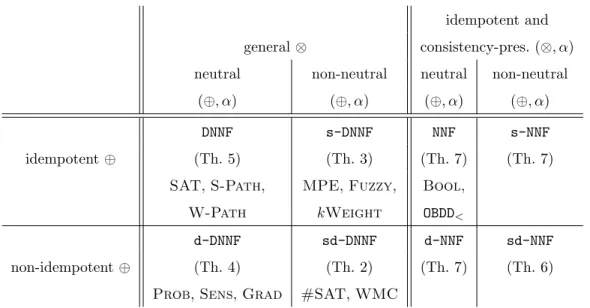
ing, we therefore establish a connection between characteristics of AMC tasks and properties of the NNF circuits they can be evaluated on, resulting in the classification scheme summarized in Table 2. The last three columns of Table 1 indicate for each example task which of the semiring characteristics it satisfies; the tasks are also included in the corresponding field of Table 2.
300
The key idea underlying NNF evaluation is to perform a bottom-up pass over the circuit, labeling each node with the value of the subcircuit rooted at that node. For disjunction nodes, the values of all their children are combined
idempotent and general⊗ consistency-pres. (⊗, α) neutral non-neutral neutral non-neutral
(⊕, α) (⊕, α) (⊕, α) (⊕, α)
DNNF s-DNNF NNF s-NNF
idempotent⊕ (Th. 5) (Th. 3) (Th. 7) (Th. 7)
SAT,S-Path, MPE,Fuzzy, Bool, W-Path kWeight OBDD<
d-DNNF sd-DNNF d-NNF sd-NNF
non-idempotent⊕ (Th. 4) (Th. 2) (Th. 7) (Th. 6)
Prob,Sens,Grad #SAT,WMC
Table 2: Semiring characteristics and corresponding circuits that allow for correct AMC eval-uation, with example tasks from Table 1.
using⊕, for conjunction nodes using⊗.
Definition 9 (NNFEvaluation). The function Eval specified in Algorithm 1
305
evaluatesanNNFcircuit for a commutative semiring (A,⊕,⊗, e⊕, e⊗) and label-ing functionα.
Consider for example #SAT for the two circuits in Figure 1, which both represent an exclusive OR of two variables. Evaluation of thesd-DNNFin Fig-ure 1a, which in fact is aMODSrepresentation, assigns label 1 to each leaf, 1·1 = 1
310
to each conjunction node, and 1 + 1 = 2 to the disjunction node at the root and thus the entire circuit, which is correct. On the other hand, evaluation on the general NNF in Figure 1b assigns 1 + 1 = 2 to each disjunction node and 2·2 = 4 to the conjunction node at the root. This overestimation is due to mod-els shared by the children of the same disjunction node and variables shared by
315
the children of the conjunction node, as we will see in more detail in Section 3.2 and 3.3.
propo-Algorithm 1 Evaluating an NNF circuit N for a commutative semiring (A,⊕,⊗, e⊕, e⊗) and labeling function α.
1: functionEval(N,⊕,⊗, e⊕, e⊗, α) 2: if N is a true node>thenreturne⊗
3: if N is a false node ⊥thenreturne⊕
4: if N is a literal nodel thenreturnα(l) 5: if N is a disjunction Wmi=1Ni then 6: returnLmi=1Eval(Ni,⊕,⊗, e⊕, e⊗, α) 7: if N is a conjunction Vmi=1Ni then 8: returnNmi=1Eval(Ni,⊕,⊗, e⊕, e⊗, α)
sitional theory T for a semiring (A,⊕,⊗, e⊕, e⊗) and labeling function α is a correct AMC computation iff Eval(NT,⊕,⊗, e⊕, e⊗, α) =A(T).
320
In the following, we establish a general correctness result for AMC evalu-ation on sd-DNNF circuits as well as properties of AMC tasks that guarantee correctness for various other subclasses of NNF. Given correctness, we inherit the polynomial complexity results of the knowledge compilation map (Darwiche & Marquis, 2002) for semiring operators with constant cost, cf. also Section 3.4.
325
Note however that there are semirings with more expensive operators. For in-stance, labels inOBDD< may grow exponentially in the circuit size.
3.1. sd-DNNFEvaluation
We show that AMC evaluation is correct onsd-DNNFcircuits. As these are strictly more succinct than MODS representations, they allow for more efficient
330
inference.
Theorem 2 (sd-DNNF Evaluation). Evaluating an sd-DNNF representation of the propositional theoryT is a correct AMC computation.
Proof. We show that Eval(NT,⊕,⊗, e⊕, e⊗, α) for an sd-DNNFrepresentation
NT of the theoryT computesA(T) with respect to all variables inNT:
335
1. Line 2: A(>) =L
I∈{∅}
N
2. Line 3: A(⊥) =L I∈{} N l∈Iα(l) =e⊕ 3. Line 4: A(l) =L I∈{{l}} N k∈Iα(k) =α(l)
Due to associativity and commutativity of the semiring operators, operands of each summation and each multiplication can be evaluated in arbitrary order.
340
We therefore restrict ourselves to binary disjunction and conjunction nodes here. In the following, we assume we have already correctly evaluated the two subcir-cuitsφ1 andφ2 over sets of variablesV1 andV2, respectively. Let the circuits’
sets of models with respect to those variables beM1 andM2. We now obtain:
4. Lines 5-6: Disjunction nodeφ1∨φ2: Forφ1=⊥, we haveA(⊥)⊕A(φ2) = 345
e⊕⊕A(φ2) =A(φ2) =A(⊥ ∨φ2) by neutrality ofe⊕ (and similarly for φ2=⊥by commutativity). As the circuit is deterministic, theφi cannot be >. We now consider the case where none of theφi is⊥or >. As the circuit is smooth, we haveV1=V2, and this is also the set of variables used by the circuit rooted at the disjunction. The set of models of this circuit is
350
thusM(φ1∨φ2) =M1∪M2, which is a disjoint union due to determinism.
Therefore,A(φ1)⊕A(φ2) = LI∈M1 N l∈Iα(l) ⊕ L I∈M2 N l∈Iα(l) = L M1∪M2 N l∈Iα(l) =A(φ1∨φ2).
5. Lines 7-8: Conjunction nodeφ1∧φ2: For the case ofφ1=>(or
symmetri-callyφ2=>), we haveA(>)⊗A(φ2) =e⊗⊗A(φ2) =A(φ2) =A(> ∧φ2) 355
by neutrality of e⊗. For the case ofφ1 =⊥(or symmetrically φ2 =⊥),
we haveA(⊥)⊗A(φ2) =e⊕⊗A(φ2) = e⊕ =A(⊥) =A(⊥ ∧φ2) ase⊕
is an annihilator for⊗. We now consider the case involving neither>nor
⊥ as one of the disjuncts. As V1∩ V2 = ∅ due to decomposability, we obtain all models of the conjunction by combining each model ofφ1with 360
each model ofφ2, that is,M(φ1∧φ2) ={I1∪I2|I1∈ M1, I2∈ M2}.
To-gether with distributivity, we getA(φ1)⊗A(φ2) = LI∈M1
N l∈Iα(l) ⊗ L I∈M2 N l∈Iα(l) =L M(φ1∧φ2) N l∈Iα(l) =A(φ1∧φ2).
Clearly, the correctness of AMC evaluation onsd-DNNFdepends on all three
365
properties may be exponentially smaller and thus allow for more efficient infer-ence. In the following, we therefore analyze evaluation in the absence of these properties, which allows us to identify characteristics of the semiring and la-beling function that ensure correct evaluation on the corresponding classes of
370
circuits.
3.2. Evaluation on other Decomposable Circuits
If a circuit is not deterministic, children of a disjunction node may have common models, in which case evaluation sums over such shared models multiple times. For instance, consider the circuit in Figure 1b with Prob, α(a) = 0.6
375
andα(b) = 0.3. Evaluation on this circuit results in 0.6 + 0.3 = 0.9 for the right disjunction node, whileA(a∨b) = 0.6·0.3 + (1−0.6)·0.3 + 0.6·(1−0.3) = 0.72. Definition 11 (Idempotent Operator). A binary operator over a set A is idempotent iff∀a∈ A:aa=a.
Theorem 3(s-DNNFEvaluation). Evaluating an s-DNNFrepresentation of the
380
propositional theoryT for a semiring with idempotent ⊕(a dioid) is a correct AMC computation.
Proof. Reconsider point (4) of the proof of Theorem 2. Without determinism,
φ1=>is possible, and with smoothness, we haveφ2 => in this case. Then,
A(>)⊕A(>) = e⊗ ⊕e⊗ = e⊗ = A(>) = A(> ∨ >) as ⊕ is idempotent.
385
The proof forφ1 =⊥ still holds. If both subformulae involve variables, with
smoothness, but without determinism,M1(φ1)∪ M2(φ2) is no longer a union
of disjoint sets, and A(φ1)⊕A(φ2) = Li=1,2LMiNl∈Iα(l) sums over the
models in M1(φ1)∩ M2(φ2) twice. Due to associativity and commutativity,
this is correct for idempotent⊕.
390
If a circuit is not smooth, the children of a disjunction node may use different sets of variables. Each model of a child node corresponds to a set of models for the full set of variables, but evaluation on a non-smooth circuit ignores the labels of unmentioned variables. For instance, consider the circuit in Figure 1b
withMPE, α(a) = 0.6 andα(b) = 0.3. Evaluating the right disjunction node
395
of this circuit results in max(0.6,0.3) = 0.6, whileA(a∨b) = max(0.6·0.3,(1−
0.6)·0.3,0.6·(1−0.3)) = 0.42.
Definition 12(Neutral (⊕, α)). A semiring addition and labeling function pair (⊕, α) isneutral iff∀v∈ V :α(v)⊕α(¬v) =e⊗.
For instance, the semiring addition and labeling function of theProbtask in
400
Table 1 are neutral, as for allv∈ V, we haveα(v)⊕α(¬v) =α(v) + (1−α(v)) = 1 =e⊗ in this case.
Theorem 4 (d-DNNF Evaluation). Evaluating a d-DNNF representation of the propositional theoryT for a semiring and labeling function with neutral (⊕, α) is a correct AMC computation.
405
Proof. Reconsider point (4) of the proof of Theorem 2. The cases involving >
or⊥still hold. For the remaining case of both subformulae involving variables to be correct, the sum of the AMCs computed by the children over their sets of variablesVi has to be equal to the AMC of the entire disjunction over the full set of variablesV1∪ V2. Given the child AMC AVi(φi), adding a variable v to Vi replaces each modelIofφi by two modelsI+=I∪ {v}andI−=I∪ {¬v}. Due to distributivity, commutativity and the neutral sum property, the algebraic sum of these two models equals the AMC of the original model:
AVi∪{v}(I) =AVi∪{v}(I+)⊕AVi∪{v}(I−) = (α(v)⊕α(¬v))⊗O l∈I α(l) =O l∈I α(l) =AVi(I)
Evaluation therefore computesAV1(φ1)⊕AV2(φ2) =AV1∪V2(φ1)⊕AV1∪V2(φ2),
which due to determinism is equal toAV1∪V2(φ1∨φ2).
Note that from a complexity point of view, non-neutral (⊕, α) does not influence the tractability of inference, as anyNNFcan be smoothed in polytime preserving determinism and decomposability (Darwiche & Marquis, 2002).
The previous two results can directly be combined forDNNFcircuits that are neither smooth nor deterministic.
Theorem 5(DNNFEvaluation). Evaluating aDNNFrepresentation of the propo-sitional theoryT for a semiring and labeling function with idempotent and neu-tral(⊕, α)is a correct AMC computation.
415
Proof. Reconsider point (4) of the proof of Theorem 2. Due to neutral (⊕, α), values for all children of a disjunction node (including>) are correct with respect to the full set of variables (cf. proof of Theorem 4). Due to idempotent ⊕, multiple occurrences of the same model do not influence the result (cf. proof of Theorem 3).
420
This completes the left part of Table 2, where no conditions are imposed on semiring multiplication.
3.3. Evaluation on Non-Decomposable Circuits
If a circuit is not decomposable, the children of a conjunction node may share variables. In this case, simply combining results for all pairs of their
425
models may produce results corresponding to (multi-)sets of literals that are not models, because they either contain contradicting literals, or several copies of the same literal, which results in erroneous extra multiplications. For instance, in Figure 1b, {¬a, b} is a model of both disjunction nodes, and {a, b} of the right one only. The conjunction node sums among others the productsα(¬a)⊗ 430
α(b)⊗α(a)⊗α(b), which does not correspond to a model, andα(¬a)⊗α(b)⊗ α(¬a)⊗α(b), where labels of both literals are multiplied twice.
Definition 13(Consistency-Preserving (⊗, α)). A semiring multiplication and labeling function pair (⊗, α) isconsistency-preservingiff∀v∈ V:α(v)⊗α(¬v) =
e⊕.
435
For instance, Boolean evaluation (BOOL) is consistency-preserving, asα(v)∧ ¬α(v) =false=e⊕.
Theorem 6(sd-NNFEvaluation). Evaluating an sd-NNFrepresentation of the propositional theoryT for a semiring and labeling function with idempotent and consistency-preserving(⊗, α) is a correct AMC computation.
440
Proof. Reconsider point (5) of the proof of Theorem 2. The set of models of φ1∧φ2 contains exactly all pairwise combinations of models of its parts
that agree on all shared variables. The circuit evaluates the AMC ofφ1∧φ2
as A(φ1)⊗A(φ2), which due to distributivity is the sum over all pairwise
combinations of models. Without decomposability, each such combination I 445
contains two literals for eachv ∈ V1∩ V2. As ⊗is associative, commutative and idempotent, repeated occurrences of a literall in⊗i∈Iα(i) do not affect the result. If{l,¬l} ⊆I,⊗i∈Iα(i) includes a multiplication by α(l)⊗α(¬l) =e⊕, which in a semiring means ⊗i∈Iα(i) = e⊕. Such inconsistent I thus do not contribute to the semiring sum.
450
Theorem 6 affects only conjunction nodes, whereas Theorems 3, 4 and 5 only affect disjunction nodes. Their combination thus extends our results to non-decomposable circuits that do not satisfy (one of) the other two properties either:
Theorem 7 (s-NNF, d-NNF, and NNFEvaluations). For a semiring and
label-455
ing function with idempotent and consistency preserving(⊗, α), evaluating the following representation of the propositional theoryT is a correct AMC compu-tation:
• s-NNF if⊕is idempotent
• d-NNF if(⊕, α)is neutral
460
• NNFif(⊕, α)is idempotent and neutral
This completes the right part of Table 2, where using non-decomposable circuits is possible as a consequence of restrictions on semiring multiplication. Given a new AMC instance, this table allows one to immediately choose the
appropriate type of circuit for efficient evaluation. Table 2 provides this
classi-465
fication for the examples discussed earlier, cf. Table 1. 3.4. Discussion
The results summarized in Table 2 provide a unified view on a number of known results. They generalize the complexity results for evaluation of SAT and#SATusing knowledge compilation to broad classes of tasks, provide more
470
succinct types of circuits for inference in algebraic Prolog, and show that all circuits that are practically relevant for AMC are well-studied in the knowledge compilation map. We now address these points in more detail.
First, Darwiche & Marquis (2002) show that SAT is correctly evaluated in polynomial time onDNNF, while#SAT is correctly evaluated in polynomial
475
time on d-DNNF, as the required smoothing to obtain an sd-DNNF is possible in polynomial time. We generalize these results to broad classes of semirings, always ensuring correctness, and, as discussed above, preserving polynomial time complexity as long as each semiring operation has constant cost. More specifically, our Theorem 5 generalizes correctness ofDNNFevaluation fromSAT
480
to all commutative semirings and labeling functions with idempotent and neutral (⊕, α), and our Theorem 2 generalizes correctness of sd-DNNF evaluation from #SATto arbitrary commutative semirings and labeling functions. As part of their tractability study of inference in weighted bases, that is, propositional theories with penalties on unsatisfied formulae, Darwiche & Marquis (2004)
485
have shown that the weight of a weighted base in normal form, that is, with all penalties on literals, can efficiently be computed on itsDNNFrepresentation. This directly translates to an instance of AMC with⊕= min and ⊗= + that satisfies our criteria forDNNFevaluation.
Second, Kimmig et al. (2011) reduce inference in algebraic Prolog (aProbLog)
490
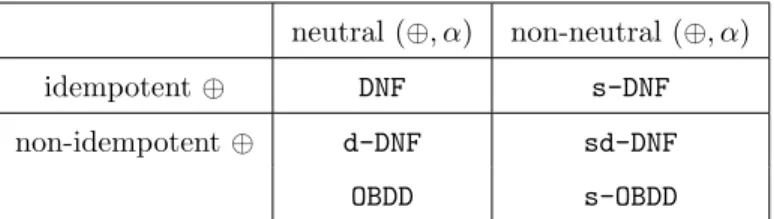
to AMC evaluation on disjunctive normal form (DNF). For non-idempotent ad-dition, a DNFwhose conjunctions are not mutually exclusive is then compiled into an ordered binary decision diagram (OBDD). For non-neutral (⊕, α), circuits are smoothed before evaluation. This results in the settings listed in Table 3.
neutral (⊕, α) non-neutral (⊕, α)
idempotent⊕ DNF s-DNF
non-idempotent⊕ d-DNF sd-DNF
OBDD s-OBDD
Table 3: Overview of AMC settings used in algebraic Prolog (Kimmig et al., 2011).
Table 2 uses the same characteristics of semiring operators and labeling
func-495
tion, but does not require to transform the theory to aDNFas starting point. The left half of Table 2 directly generalizes the aProbLog scheme to strictly more succinct superclasses of circuits, namely (s-)DNNF instead of (s-)DNF, and (s)d-DNNF instead of (s)d-DNF or (s-)OBDD. As probabilistic inference in ProbLog has recently been improved by replacingOBDD-based approaches with
500
weighted model counting onsd-DNNF(Fierens et al., 2011), our results promise practical improvements for aProbLog as well.
Third, we observe that while there are interesting inference tasks that are correctly evaluated on the more succinct class of DNNF instead of the general
sd-DNNFevaluation, the conditions for correct evaluation on non-decomposable
505
circuits are too strict in most practical cases. This is in line with the knowledge compilation map, which excludes non-decomposable circuits (with the exception of the most general classNNF) as they do not support any of the studied tasks in polytime (Darwiche & Marquis, 2002).
Fourth, extending weighted model counting towards negative probabilities
510
makes it possible to use existential quantification when defining probabilistic models based on first order logic (Van den Broeck et al., 2014; Beame et al., 2015). The correctness of this generalization follows immediately from our re-sults.
Finally, we note that our results imply general complexity bounds for AMC
515
in terms of the size of the original logical theory T. For example, when T is given in conjunctive normal form (CNF), an equivalentsd-DNNFcan be compiled
in time polynomial in the size ofT and exponential in itstreewidth (Darwiche, 2001). Hence, all AMC tasks inCNFwith constant-cost⊕and⊗can be evaluated in time polynomial in the size and exponential in the treewidth of T, and are
520
thus tractable for bounded treewidth. Similar results for (d-)NNF state that these circuits can be compiled starting fromCNFor DNFin time polynomial in the size ofT (Darwiche & Marquis, 2002, Lemma A.8).
3.5. AMC and Algebraic Derivation Counting
While AMC is a sum over models, or sets of literals, many other
semiring-525
based tasks require a sum over derivations, that is, sequences of possibly re-peated variables. Examples include algebraic path problems (Baras & Theodor-akopoulos, 2010), semiring parsing (Goodman, 1999), provenance semirings for positive relational algebra queries in databases (Green et al., 2007), and semiring-weighted dynamic programs (Eisner et al., 2005). We refer to this
530
type of task asalgebraic derivation counting (ADC), and restrict the discussion to the case of finite, distinct sequences.
Definition 14 (ADC Problem). Given
• a setS of finite sequences of variables from a setV,
• acommutative semiring (A,⊕,⊗, e⊕, e⊗), and
535
• a labeling function δ:V → A, mapping variables inV to values from the semiring setA,
the task ofalgebraic derivation counting (ADC) is to compute D(S) = M (v1,...,vn)∈S n O i=1 δ(vi). (7)
For instance, consider a graph with three nodess,tandr, and three directed edgese1 = (s, t), e2 = (s, r) ande3 = (r, t). A derivation in this context is a 540
the path fromsto tviar. The ADC of the set of all paths fromsto t in the graph is then given by
D({(e1),(e2, e3)}) =δ(e1)⊕(δ(e2)⊗δ(e3)) (8)
For instance, ifδassigns a cost to every edge, we could use theS-Pathor W-Pathsemirings to compute the cost of the shortest or widest path, respectively.
545
As a second example, consider the following context free grammar, where we add the variable we will use to refer to an application of the rule in a derivation in parentheses:
S→aS (s1) A →AA (a1)
S→AA (s2) A →a (a2)
S→ (s3)
The wordaahas two leftmost derivations in this grammar: S→aS →aaS→ 550
aa, using the rule sequence (s1, s1, s3), and S → AA → aA → aa, using
(s2, a2, a2). The ADC of this set of derivations is given by
D({(s1, s1, s3),(s2, a2, a2)}) = (δ(s1)⊗δ(s1)⊗δ(s3))⊕(δ(s2)⊗δ(a2)⊗δ(a2)) (9)
For instance, using the probability semiring, this corresponds to computing the probability ofaain a probabilistic context free grammar with these rules.4
While both ADC and AMC are semiring sums over semiring products, their
555
key difference is that computing ADC is based on the structure of a set of sequences of positive variables, whereas computing the AMC is based on the modelsof a propositional theory represented as an arbitraryNNF. Nevertheless, it is possible to map each of the tasks onto the other, as we will show now. Reducing AMC to ADC. Reducing an AMC task to an ADC task is
straightfor-560
ward. The set of variables in the ADC task contains one variable for each literal in the AMC task, labeled with that literal’s label. For each model of the AMC
4Note that the input to ADC is a set of finite derivations, not the grammar, i.e., ADC does
theoryT, the ADC derivation setScontains one sequence enumerating exactly the variables corresponding to the literals in the model. Then, Equation (7) and Equation (2) have the same structure, and the ADC of the translation thus
565
equals the original AMC.
However, this reduction is clearly not desirable from a complexity point of view, as it requires bringingT into MODS form. Alternatively, one could adapt the semiring used. For instance, Baras & Theodorakopoulos (2010) provide an ADC encoding of network reliability under probabilistic edge failure, that
570
is, theProb AMC task for a positive propositional formula. They essentially modify multiplication to filter repeated literals from derivations (i.e., repeated edges from cyclic paths), and addition to subtract shared models of its operands (i.e., subgraphs containing multiple paths), which, while operating on the ADC structure, drastically increases complexity of these operations. Under which
575
general conditions such transformations are possible is an open question. Reducing ADC to AMC. To reduce an arbitrary ADC task to AMC, we con-struct a propositional theory that has one model for every sequence in the ADC task. The construction (a) systematically uses different variables for repeated occurrences of the same variable in a derivation, and (b) makes explicit that (re-named) variables not appearing in a derivation do not contribute to the semiring product by adding their negation, labeled withe⊗, to the derivation. That is, if variablevoccurs at mostk times in any sequences∈S, we introducekcopies
v1, . . . , vk, all labeled withδ(v). Thus, Equation (9) becomes
Clearly, this construction in general does not change the ADC. Second, we expand derivations to all variables by adding negative literals, labeled withe⊗5:
D({(s11, s21, s13,¬s12,¬a12,¬a22),(s12, a12, a22,¬s11,¬s21,¬s13)})
=(δ(s11)⊗δ(s21)⊗δ(s13)⊗δ(¬s12)⊗δ(¬a12)⊗δ(¬a22))
⊕(δ(s12)⊗δ(a12)⊗δ(a22)⊗δ(¬s11)⊗δ(¬s21)⊗δ(¬s13))
This step again maintains the ADC, as can easily be verified using the properties of commutative semirings. Furthermore, as we now have a 1-1-correspondence between derivations and models, settingαtoδand T to the disjunction of the conjunctions of elements in derivations, i.e., s11∧s21∧s13∧ ¬s12∧ ¬a12∧ ¬a22
∨ 580 s1 2∧a12∧a22∧ ¬s11∧ ¬s21∧ ¬s13
, completes the reduction to AMC.
While this two-step reduction from ADC to AMC on aMODSrepresentation is possible for any commutative semiring and ADC labeling functionδ, for some semirings, AMC effectively selects the desired model for a derivation without need to make this explicit in the propositional theory.
585
First, for commutative semirings and labeling functions with idempotent, consistency-preserving (⊗, α) and idempotent, neutral (⊕, α) such as for in-stanceOBDD<, neither variable renaming nor model restriction are required. The reason is that repetition within derivations is handled by idempotent⊗, whereas idempotent, neutral (⊕, α) implies that summing out unmentioned variables
590
maps them to the label of the negative literal,e⊗ (cf. Theorem 5). However, as noted above, such tasks are rare.
Second, if derivations do not contain repeated variables, there is no need to rename variables. If furthermore⊕is idempotent and (⊕, α) is neutral, as in the first case, we do not need to explicitly restrict models. This is for instance the
595
case for theS-PathandW-Pathsemirings in Table 1. Intuitively, if we do not restrict models, instead of directly summing over the products for all (acyclic) paths, AMC additionally sums for each path over all subgraphs containing that
5Strictly speaking, ADC would require new, positive variables for those negative literals,
path, but the properties of the semiring and labeling function ensure that the results coincide. For instance, as absent edges are labeled with the minimal
600
value 0 in shortest path, among all graphs containing the same path, semiring addition (using min) effectively selects the one containing no additional edges.
On the other hand, the Whyand RA+ semirings also listed in Table 1 do
not fall into this category (as can be verified by inspecting the properties of their definitions), but require the full translation. Intuitively,Whycollects all
605
variables appearing in derivations, or, in its original database context, all tuples contributing to a query answer. Evaluating this on all models instead of the models constructed in the translation would result in the full set of variables (all tuples in the database) instead of just the relevant ones. RA+ refines
Whyby constructing a polynomial that keeps track of how often each variable
610
(positively) contributes to each derivation. Again, summing over all extensions of a derivation would add too much information to the result.
4. Conclusions and Future Work
We have introduced the task of algebraic model counting, which generalizes weighted model counting to a semiring setting and thus to various types of
615
labels, including numerical ones as used in WMC, but also sets, polynomials, or Boolean formulae. We have shown that evaluating AMC is correct onsd-DNNF
circuits, which are known to be more succinct than theMODS language used in the problem definition. Furthermore, we have provided characteristics of AMC tasks that guarantee correct evaluation on more succinct classes of circuits,
620
which provides a means of directly choosing a circuit type that allows for efficient inference given a new AMC task. AMC also provides a unified view on a number of known results as well as a framework to connect algebraic derivation counts to AMC tasks.
Given the results presented here, it is worth investigating which other
al-625
gebraic representations can be reduced to algebraic model counting. Another line of future work concerns the introduction of additional operators that would
make it possible to express additional tasks, for instance, partial MAP, which requires a maximization operator in addition to summation and multiplication. Acknowledgements. This work has been supported by the Research Foundation
630
Flanders (FWO Vlaanderen).
References
Bacchus, F., Dalmao, S., & Pitassi, T. (2009). Solving #SAT and Bayesian inference with backtracking search.Journal of Artificial Intelligence Research, 34, 391–442.
635
Baras, J. S., & Theodorakopoulos, G. (2010). Path Problems in Networks vol-ume 3 ofSynthesis Lectures on Communication Networks. Morgan & Claypool Publishers.
Beame, P., Van den Broeck, G., Gribkoff, E., & Suciu, D. (2015). Symmetric weighted first-order model counting. InProceedings of the 34th ACM
Sympo-640
sium on Principles of Database Systems (PODS)(pp. 313–328).
Chavira, M., Darwiche, A., & Jaeger, M. (2006). Compiling relational Bayesian networks for exact inference. International Journal of Approximate Reason-ing,42, 4 – 20.
Darwiche, A. (2001). On the tractable counting of theory models and its
ap-645
plication to truth maintenance and belief revision. Journal of Applied Non-Classical Logics,11, 11–34.
Darwiche, A. (2009). Modeling and Reasoning with Bayesian Networks. Cam-bridge University Press.
Darwiche, A., & Marquis, P. (2002). A knowledge compilation map.Journal of
650
Artificial Intelligence Research, 17, 229–264.
Darwiche, A., & Marquis, P. (2004). Compiling propositional weighted bases. Artificial Intelligence,157, 81–113.
Eisner, J. (2002). Parameter estimation for probabilistic finite-state transducers. InProceedings of the 40th Annual Meeting of the Association for
Computa-655
tional Linguistics (ACL)(pp. 1–8). Philadelphia.
Eisner, J., Goldlust, E., & Smith, N. (2005). Compiling Comp Ling: Weighted dynamic programming and the Dyna language. InProceedings of the Human Language Technology Conference and Conference on Empirical Methods in Natural Language Processing (HLT/EMNLP)(pp. 281–290).
660
Fargier, H., & Marquis, P. (2007). On valued negation normal form formulas. InIJCAI (pp. 360–365).
Fierens, D., Van den Broeck, G., Thon, I., Gutmann, B., & De Raedt, L. (2011). Inference in probabilistic logic programs using weighted CNF’s. InProceedings of the 27th Conference on Uncertainty in Artificial Intelligence (UAI) (pp.
665
211–220).
Goodman, J. (1999). Semiring parsing.Computational Linguistics,25, 573–605. Green, T. J., Karvounarakis, G., & Tannen, V. (2007). Provenance semirings. InProceedings of the 26th ACM SIGMOD-SIGACT-SIGART Symposium on Principles of Database Systems (PODS)(pp. 31–40).
670
Jha, A. K., & Suciu, D. (2011). Knowledge compilation meets database theory: compiling queries to decision diagrams. InProceedings of the 14th Interna-tional Conference on Database Theory (ICDT)(pp. 162–173).
Kanagal, B., Li, J., & Deshpande, A. (2011). Sensitivity analysis and explana-tions for robust query evaluation in probabilistic databases. InProceedings of
675
the ACM SIGMOD International Conference on Management of Data (SIG-MOD)(pp. 841–852).
Kimmig, A., Van den Broeck, G., & De Raedt, L. (2011). An algebraic Prolog for reasoning about possible worlds. InProceedings of the 25th AAAI Conference on Artificial Intelligence (AAAI) (pp. 209–214).
Larrosa, J., Oliveras, A., & Rodr´ıguez-Carbonell, E. (2010). Semiring-induced propositional logic: Definition and basic algorithms. In E. M. Clarke, & A. Voronkov (Eds.),Revised Selected Papers of the 16th International Con-ference on Logic for Programming, Artificial Intelligence, and Reasoning (LPAR)(pp. 332–347). Springer volume 6355 ofLecture Notes in Computer
685
Science.
Mateescu, R., Dechter, R., & Marinescu, R. (2008). And/or multi-valued deci-sion diagrams (AOMDDs) for graphical models. Journal of Artificial Intelli-gence Research,33, 465–519.
Meseguer, P., Rossi, F., & Schiex, T. (2006). Soft constraints. In F. Rossi,
690
P. Van Beek, & T. Walsh (Eds.),Handbook of constraint programming (pp. 281–328). Elsevier Science.
Park, J. D. (2002). Using weighted MAX-SAT engines to solve MPE. In Pro-ceedings of the 18th AAAI Conference on Artificial Intelligence (AAAI)(pp. 682–687).
695
Sang, T., Beame, P., & Kautz, H. (2005). Solving Bayesian networks by weighted model counting. In Proceedings of the 20th AAAI Conference on Artificial Intelligence (AAAI)(pp. 475–482).
Sanner, S., & McAllester, D. A. (2005). Affine algebraic decision diagrams (AADDs) and their application to structured probabilistic inference. In
Pro-700
ceedings of the 19th International Joint Conference on Artificial Intelligence (IJCAI) (pp. 1384–1390).
Van den Broeck, G., Meert, W., & Darwiche, A. (2014). Skolemization for weighted first-order model counting. InProceedings of the 14th International Conference on Principles of Knowledge Representation and Reasoning (KR)
705
(pp. 1–10).
Van den Broeck, G., Taghipour, N., Meert, W., Davis, J., & De Raedt, L. (2011). Lifted probabilistic inference by first-order knowledge compilation. In
Pro-ceedings of the 22nd International Joint Conference on Artificial Intelligence (IJCAI) (pp. 2178–2185).
710
Wilson, N. (2005). Decision diagrams for the computation of semiring valua-tions. InProceedings of the 19th International Joint Conference on Artificial Intelligence (IJCAI)(pp. 331–336).