PERPUST AKAAN UMP
11111111111
0000119333
STAIR CLIMBING ROBOT (MICROCONTROLLER AND SENSOR)
SHARIFAH FATMA MUNIRAH BINTI SYED ZAIN (TB13025)
Report submitted in partial fulfillment of the requirements for the award of Bachelor of Engineering Technology (Electrical) with Honors
Faculty of Engineering Technology UNIVERSITI MALAYSIA PAHANG
JANUARY 2017
PERPUSTAKAAN (1 UNIVERSITI MAlAYSIA PAHANG No. Porolehan No. Panggllan
119333
.f:\e
\C.
Tarikh
'P-'38
~
6 AUG 2017
y J.t>\"fe>c...-iii
SUPERVISORS' DECLARATION
I hereby declare that I have checked the thesis and in my opinion, this thesis is
adequate in terms of scope and quality for the award of the degree of Bachelor of
Engineering Technology (Electrical) with Honors.
Signature
Name of Supervisor Position
iv
STUDENT'S DECLARATION
I hereby declare that the work in this thesis is my own except for quotations and summaries which have been duly acknowledged. The thesis has not been accepted for any degree and is not concurrently submitted for award of other degree.
Signature Name
ID Number : TB13025 Date :JANUARY 2016
DEDICATION
Special thanks to:
My parents,
Syed Zain Bin Tuan Embong & Sharifah Rosidah Binti Sayed Mohamad
for their continuous motivations and love.
For my siblings,
Syuhada, Yuso.ff, Nairn, Hanafi & Fadhil for their supports.
For my groupmates,
Muhammad F akhri & Muhammad Firdaus for your cooperation.
And for my friends for the friendship and memories.
vi
ACKNOWLEDGEMENT
In the name of Allah, the Most Gracious and Most Merciful
I would like to express my special thanks of gratitude to project supervisor Madam Siti Aishah bt Rusdan and our advisor Madam Ashwaq Zaini bt Amat Haji Anwar who gave me the golden opportunity to do this wonderful project Stair Climbing Robot which also helped me in doing a lot of research and I came to know about so many new things.
Secondly I would also like to express our gratitude to Mr. Wan Hassan bin Wan
Hamat, Mr. Che Ku Mohammad Faizal bin Che Ku Yahya and all the supporting staff
that had helped us in this project, engineering technology faculty and to all friends, relatives, and others who in one way or another shared their support, either morally, financially and physically, thank you.
Last but not least, special thanks goes to my team mate Muhammad Fakhri bin Abdul Jalil and Muhammad Firdaus bin Ibrahim who help me to assemble the parts and gave suggestion about the task during finishing the project and also project report.
Above all, the Great Almighty, the author of the knowledge and wisdom, for his
countless loves and blessings. Thank you.
vii
ABSTRACT
Robots are generally required to help our everyday schedules particularly for tasks that are difficult to be done by us. The primary focus of the proposed project is to carry the load of 50 kg upwards the stairs. Then, the suitable of the microcontroller and the sensor of the robot is chosen to achieve the main objectives to be able the robot to carry the load on the stair.
This project is divided into two sections which are software and hardware. There are two types of software that used in this project which is PROTEUS and Arduino. This software is using output and input to declare which pin low or high. This software can give command at pin input and output. We just select the pin that we want to the input and output. The hardware components that connect to the microcontroller are DC gear motor, gyro sensor MPU6050 and other components. It controls all the functions of the robot especially to control the motor speed during the robot is move.
As the result from the purposed project, we had expected to build a very useful robot that is capable to carry 50kg load on rough surfaces and upwards and downwards stairs. We can conclude that with the help of the stair climbing robot, many people can use the robot to carry a heavy load upwards and downwards stairs. A more convenient and harmonic life can be achieved by using the stair climbing robot.
viii
ABSTRAK
Robot secara amnya diperlukan untuk membantu jadual seharian manusia terutamanya untuk tugas-tugas yang sukar untuk dilakukan oleh mereka. Fokus utama projek ini adalah untuk mengangkat beban seberat 50 kg oleh robot sambil mendaki tangga sesuai dengan pemilihan mickropengawal dan pengesan yang digunakan untuk mencapai objektif utama iaitu mereka sebuah robot dimana ia boleh membawa beban
sambil mendaki tangga.
Projek ini dibahagikan kepada dua bahagian iaitu perisian dan perkakasan.
Terdapat dua jenis perisian yang digunakan dalam projek ini iaitu PROTEUS dan Arduino. Perisian ini menggunakan konsep data masuk dan data keluar untuk memberi
isyarat samada pin yang digunakan dalam keadaan rendah atau tinggi. Perisian ini boleh
memberi arahan pada pin masuk dan pin keluar. Untuk projek ini, pin yang digunakan
hanyalah untuk sambungan komponen seperti DC motor, pengesan Gyro MPU6050 dan lain-lain. Fungsi utama mikropengawal adalah untuk megawal kelajuan robot.
Akhir sekali, selain target untuk robot ini mengangkat beban di atas tangga ia
juga boleh digunakan untuk permukaan yang kasar dan berbatu. Secara kesimpulannya,
ix
TABLE OF CONTENTS
Page
SUPERVISORS' DECLARATION iii
STUDENT'S DECLARATION iv DEDICATION v ACKNOWLEDGEMENTS vi ABSTRACT Vll ABSTRAK viii TABLE OF CONTENTS ix
LIST OF TABLES xii
LIST OF FIGURES xiii
LIST OF SYMBOLS XV
LIST OF ABBREVIATIONS xvi
CHAPTERl INTRODUCTION 1.1 Problem Background 1 1.2 Motivation 2 1.3 Problem Statement 2 1.4 Project Objectives 3 1.5 Theory 3 1.5.1 Speed Sensor 4 1.5.2 Balancing Sensor 4 1.5.3 Current Sensor 4
X
CHAPTER2 LITERATURE REVIEW
2.1 Types ofMicrocontroller 5
2.1.1 Atmel A VR Microcontroller (Arduino Nano) 6
2.1.2 ARM microcontroller 7
2.1.3 PIC Microcontroller 8
2.1.4 Atmel A VR Microcontroller (Arduino UNO) 9
2.2 Types of Sensor 9 2.2.1 Speed Sensor 10 2.2.1.1 Reed Sensor 10 2.2.1.2 Encoder Sensor 11 2.2.2 Balancing/Orientation Sensor 12 2.2.2.1 Gyro Sensor 12 2.2.2.2 Accelerometer 13 2.2.3 Current Sensor 14
2.2.3.1 Benchtop PC Power Supply 15
2.2.3.2 Current Sensor IC ACS756 15
CHAPTER3 METHODOLOGY
3.1 Overall Connection of the Components to the Arduino 17
3.2 Processing ofthe Arduino Nano 18
3.3 Connection of the Components to the Arduino Nano 19 3.3.1 Connection of the Gyro Sensor MPU6050 to the Arduino Nano 19 3.3.2 Connection of the Reed Sensor to the Arduino Nano 25 3.3.3 Connection of the Voltage Divider to the Arduino Nano 27 3.3.4 Connection of the Current Sensor IC ACS756 to the
3.3.5 Connection of the Handlebar Button to the Arduino Nano 31
CHAPTER 4 RESULTS AND DISCUSSION
4.1 Results
4.1.1 Testing of Gyro Sensor MPU6050 4.1.2 Testing of the Current Sensor 4.2 Discussion 4.3 Gantt Chart 4.4 Milestone 4.5 Cost Analysis 4.6 Procurement Summary 4.7 Ethical Consideration
CHAPTER 5 CONCLUSION AND RECOMMENDATION
5.1 5.2 Conclusion Recommendations REFERENCES APPENDICES A B
c
Datasheet ofiC ASC756 Datasheet of Arduino Nano
Datasheet of Gyro MPU6050 Sensor
33 33 35 36 38 39 41 43 43 45 46 47 48 49 50 xi
xii
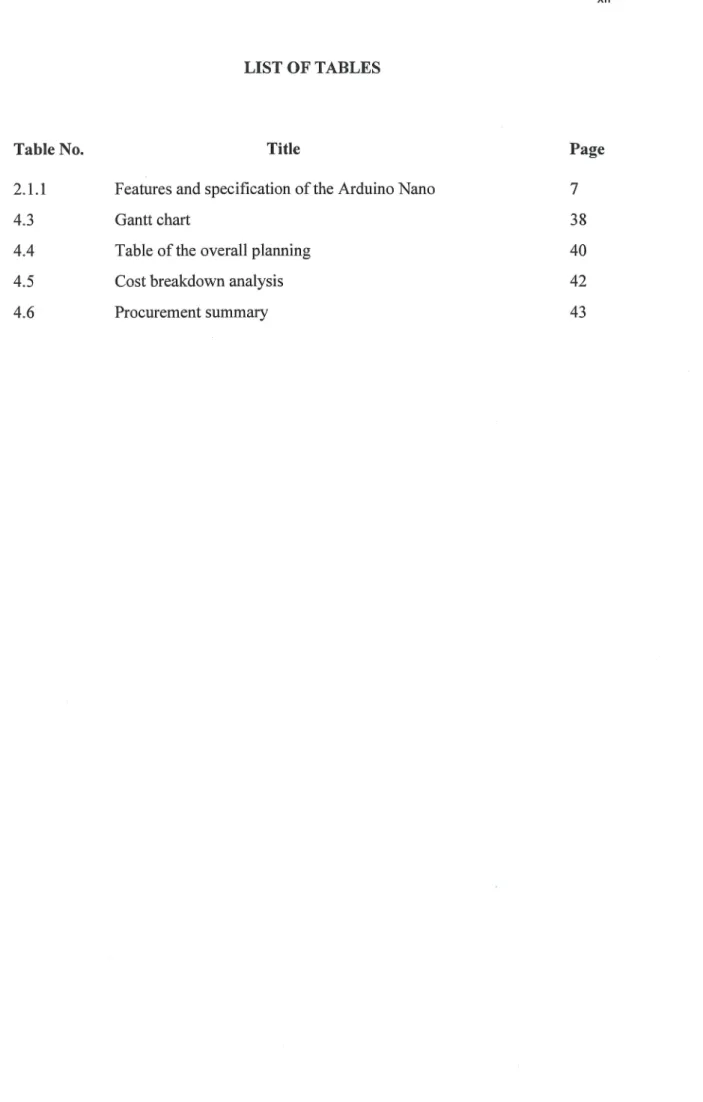
LIST OF TABLES
Table No. Title Page
2.1.1
Features and specification of the Arduino Nano 74.3
Gantt chart38
4.4
Table of the overall planning40
4.5
Cost breakdown analysis42
xiii
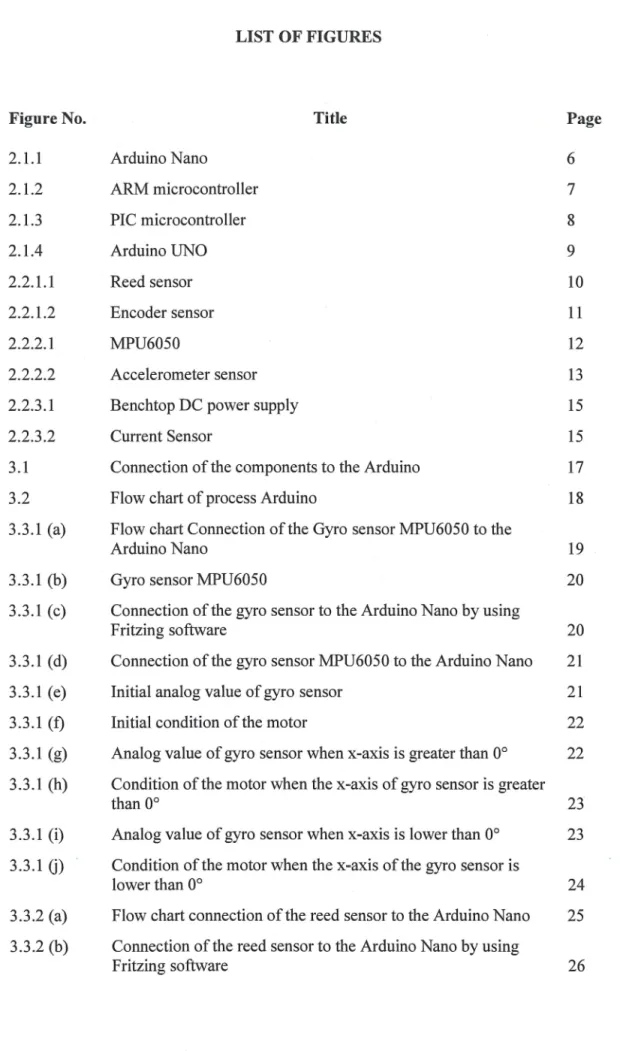
LIST OF FIGURES
Figure No. Title Page
2.1.1 Arduino Nano 6 2.1.2 ARM microcontroller 7 2.1.3 PIC microcontroller 8 2.1.4 Arduino UNO 9 2.2.1.1 Reed sensor 10 2.2.1.2 Encoder sensor 11 2.2.2.1 MPU6050 12 2.2.2.2 Accelerometer sensor 13
2.2.3.1 Benchtop DC power supply 15
2.2.3.2 Current Sensor 15
3.1 Connection of the components to the Arduino 17
3.2 Flow chart of process Arduino 18
3.3.1 (a) Flow chart Connection of the Gyro sensor MPU6050 to the
Arduino Nano 19
3.3.1 (b) Gyro sensor MPU6050 20
3.3.1 (c) Connection of the gyro sensor to the Arduino Nano by using
Fritzing software 20
3.3.1 (d) Connection of the gyro sensor MPU6050 to the Arduino Nano 21 3.3.1 (e) Initial analog value of gyro sensor 21
3.3.1 (f) Initial condition of the motor 22
3.3.1 (g) Analog value of gyro sensor when x-axis is greater than 0° 22 3.3.1 (h) Condition of the motor when the x-axis of gyro sensor is greater
than
oo
233.3.1 (i) Analog value of gyro sensor when x-axis is lower than 0° 23 3.3.1 G) Condition of the motor when the x-axis ofthe gyro sensor is
lower than 0° 24
3.3.2 (a) Flow chart connection of the reed sensor to the Arduino Nano 25 3.3.2 (b) Connection of the reed sensor to the Arduino Nano by using
xiv
3.3.2 (c) Connection of the reed sensor in the robot 26
3.3.3 (a) Flow chart connection of the voltage divider to the
Arduino Nano 27
3.3.3 (b) Initial value of voltage in LCD when no power is supply 28 3.3.3 (c) Value of the voltage in LCD when connected to 24 V
power supply 28
3.3.3 (d) Value of the voltage in LCD when connected to 14.5 V
power supply 29
3.3.4 (a) Flow chart connection of the current sensor to the
Arduino Nano 30
3.3.4 (b) Current sensor 31
3.3.5 (a) Connection of the reed sensor 31
3.3.5 (b) Handlebar button of the robot 32
4.1.1 (a) Robot orientation 34
4.1.1 (b) Body pitch 34
4.1.2 (a) Motor not move 35
4.1.2 (b) Motor move 35
Vout Rl R2 Output voltage Resistor 1 Resistor 2 XV LIST OF SYMBOLS
xvi
LIST OF ABBREVIATIONS
DC Direct Current
PIC Peripheral Interface Controller
ARM Advances RISC Machines
IC Integrated Circuit
PC Personal Computer
USB Universal Serial Bus
AREF Analog Reference (voltage)
LED Light emitting diode
ICSP In-Circuit Serial Programming
1
CHAPTER!
INTRODUCTION
1.1 PROJECT BACKGROUND
The coming of new rapid innovation and the developing computer capacity gave reasonable chance to new robot controls and acknowledgment of new strategies for control theory. Robots are mostly needed in order to lighten our daily routines especially for tasks that are impossible to be done by us. One of the major problems happened to the people around the world nowadays is to carry heavy stuff upwards or downwards the stairs. As example, Rome is famous for its steps and staircases, and most of them are attractions in their own right but in the other hands the residents of Rome occurred to suffer from difficulties to carry heavy things caused by those steps (Chavan & Annadate, 2013). Because of the development innovation, the outline of a robot equipped for climbing the stair while conveying the load was proposed. This anticipate manages the outlining and assembling of robot, which can climb on stair or move along unpleasant surface. The primary target of the proposed venture is to convey or exchange the load on stairs. By developing this robot, we can help those who live within many stairs such as in Rome or those who need to carry heavy stuff. This robot also can be used as military robots or security robots in urban environments where stair climbing and agile operation is an essential part of the mission. The robot is not only a stair climbing robot but operates in terrain where wheeled robots would operate.
2
1.2 MOTIVATION
Research on service robots has been attended in recent years. One of the most important reasons is the growing of aging population and decreasing of working population. It is not a long-term way by hiring many foreigners with cheaper payment to work at factories or to take home-caring job for the elder or disabled. As a result, for the latter, home-caring robot is an excellent candidate capable of supporting such an aging society. Specifically, the elders can control the robots directly for service.
The robot designed to directly carry elders up and down stairs needs a large vehicle and the stair rail for moving. The robot "HRP-2" from Harada successfully climbed up 280 mm stairs by grasping the stair rail (Wang, Mi, Wu, & Tu, 2013). The robot "WL-16RII" can walk independently and allow users to build its upper body based on their requirements, such as a walking wheelchair or as a walking support machine that is able to walk up and down stairs carrying or assisting an elder. The developed biped locomotor with Stewart platform legs successfully achieved walking up and down on stairs for 250 mm continuously and carrying 60 kg man on it. Another biped-type robot, for example, "Zero Walker-I", uses its two legs to assist the aged person walking and moving up and down stairs along the handrail by stepping onto the feet of the robot. However, the aforementioned robots generally need tremendous effect on expense and time. Furthermore, it is very difficult to lift an aged person by human force, and it is not very easy to have a large and heavy-weight lift machine in a normal house.
1.3 PROBLEM STATEMENT
Nowadays there are various type of microcontroller that had been used in robotic. This microcontrollers are used to control the system by manipulating the desired input and output devices. Microcontroller is basically a computer which is placed on a single integrated circuit chip. It consists of memory, a processor, as well as input-output interfaces. Microcontrollers are programmed to run a certain task, which means, if there is a need to change or enhance its functionality, one must install a new
3
program on the chip. Common microcontroller in robotic are Atmel A VR microcontrollers (Arduino Uno and Arduino Nano), Microchip Technology PIC microcontrollers (PIC16 and PIC24) and microcontrollers based on ARM technology.
For this project, the microcontroller that have been choose is Arduino because it is cheap and the programming language is quite easy to be understood compared to the other microcontrollers. The Arduino is used in our robot to control the motor based on input condition and also display the speed of the robot, current and voltage of battery supplied. Each function of the components used for input and output of the Arduino are analyzed and compared to find the suitable one for our robot.
1.4 PROJECT OBJECTIVES
(i) To define the suitable microcontroller of the robot. (ii) To analyze the function of microcontroller of the robot.
(iii) To build the programming for controlling the input and output component of the microcontroller.
1.5 THEORY
Relevant theories are presented and studied before moving on to construction of microcontroller so that everything is in place and organized. These theories help in understanding the basics of microcontroller of the stair climbing robot and determining the requirements for microcontroller constructions.
In this project, Arduino is needed to be power up only by 5V of voltage. So, an effective way has been implemented to the robot by connecting the micro-controller to the 12V of battery, the development board of Arduino has been equipped with the voltage regulator. So, the 12V is regulated to give only 5V as an output.
47
REFERENCES
An, Q., Ishikawa, Y., Nakagawa, J., Kuroda, A., Oka, H., Yamakawa, H., ... Asama, H.
(n.d.). Evaluation of Wearable Gyroscope and Accelerometer Sensor ( PocketiMU2) during Walking and Sit-to-Stand Motions.
Chavan, D., & Annadate, S. A. (20 13). A Surveillance Robot with Climbing Capabilities for Home Security ABSTRACT:, 2, 291-296.
Day, S., & Christenson, T. (2013). A High Aspect Ratio Microfabricated Reed Switch Capable ofHot Switching, 1-8.
Dey, S., & Halder, S. (2014). Gyroscopic stabilization oftwo-dimensional gimbals platform using fuzzy logic control 1, (8), 36--42.
Info, A. (20 15). Australian Journal of Basic and Applied Sciences Higher Degree Protection Technique of a Motor by Using PIC Microcontroller, 9(November), 272-276.
Jackson, J. T. (20 11 ). Trivial Defeat of a Balanced Magnetic Switch- Journal of Physical Security 5(1), 1-11 (2011), 5(1), 1-11.
Junior, L.A., Neto, 0. T., Hernandez, M. F., Martins, P. S., Roger, L. L., & Guerra, A. (2013). A Low-Cost and Simple Arduino-Based Educational Robotics Kit, 3(12). Kanchi, M. S. (n.d.). Design of an Advanced Wireless Controlled Stair Climbing Robot,
51-56.
Marne, N. S., Nagmode, P.M. S., & Komati, P.R. D. (2014). Vibration Measurement System with Accelerometer Sensor Based on ARM, 4(4), 760-764.
N, H. K. (2014). Design of Low Cost Stair Climbing Robot Using Arduino Jeyabalaji C 1, Vimalkhanna V 2, AvinashilingamN 2, Mohamed Zeeshan M, 4(10), 15-18. Naveena, S., & Riyazuddin, S. (2013). Autonomous Stair Climbing with Re
-configurable Tracked Mobile Robot, 5(2), 102-106.
Rathnaprabha, S., Nivetha, S., Pradeepa, S., & Sindhu, S. (2016). Designing of Hexapod Robot, 702-706. http:/ /doi.org/1 0.15662/IJAREEIE.20 16.0502009 Thickness, D., Support, D., & Load, S. (n.d.). The Accu-Coder, 5-6.
Wang, M., Mi, C., Wu, S., & Tu, Y. (2013). DSP-and FPGA-Based Stair-Climbing Robot Design, 2013.