WestminsterResearch
http://www.westminster.ac.uk/westminsterresearch
Enhancing Deeper Learning Using Empathy and Creativity In
Role-Playing Serious Games
Marda, M.
This is an electronic version of a PhD thesis awarded by the University of Westminster. © Ms Maria Marda, 2020.
The WestminsterResearch online digital archive at the University of Westminster aims to make the research output of the University available to a wider audience. Copyright and Moral Rights remain with the authors and/or copyright owners.
ENHANCING DEEPER LEARNING
USING EMPATHY AND CREATIVITY
IN ROLE-PLAYING SERIOUS GAMES
M. MARDA
2
This thesis is dedicated to my parents Andreas and Anna Marda,
who always supported my decisions and being there for me.
3
Acknowledgements
I would like to thank my first academic supervisor, Dr Daphne Economou, for her consistent guidance, patience and generous support throughout the research thesis. Special thanks also to my second academic supervisor, Dr Vassiliki Bouki, for her inspiration in creating serious games, her support, and willingness to debate issues and challenges. Both made a valuable impact on my professional learning and development, and I am very grateful for that.
This research thesis wouldn’t have been possible without the support of DrAlkystis Phinikaridou and Dr Antigoni Divoli, who I immensely thank for their enormous help, support and encouragement when commencing and throughout the years of my PhD research. Also, many thanks to Sarah Jackson and my Bermondseyan friends for their positive mood and motivation.
Special thanks to the University of Westminster which supported my work financially and provided me with all the means necessary for conducting my research, study, and writing up my thesis.
I would like to express my appreciation to the Cyprus Ministry of Education and Culture, the director of Secondary Education Dr Louis Kyprianou, and the director of Secondary Technical and Vocational Education Dr Elias Markatzis who supported my decision for undertaking this PhD study.
I am also thankful to the A.G. Leventis Foundation for their funding to support my living expenses in London.
Many thanks to CTVC, Dr Arinola Araba, and Kumiko Broadhurst for inspiring me on the issue of Domestic Violence and Abuse as well as the Serious Games at Westminster (SG@W) who supported my research thesis.
Finally, I would like to thank my friends back home and my family for their tolerance, love and unlimited support and encouragement.
4
Declaration
I declare that all the material contained in this thesis is my own work. The work in this thesis is based on research carried out at the University of Westminster, College of Design, Creative and Digital Industries, School of Computer Science and Engineering. No part of this thesis has been submitted elsewhere for any other degree or qualification.
Signed: (Maria Marda)
Date: 31/1/2020
5
Abstract
Although educational technology has been widely used in education and remarkably supported instruction and assessment in face-to-face instruction, remote teaching and e-learning, teaching approaches have little deviated from the conventional approaches. Since the last decade, there is a shift in education to redesign teaching strategies. Education set priorities in promoting and supporting deeper learning to empower learners in thinking critically and creatively and gain skills and expertise in transferring their knowledge and applying it in other contexts to solve new problems. Concurrently, there is a remarkable interest by educators in harnessing the power of digital games and transferring it in education by designing Serious games. Serious Games are digital games designed to support learning, training, skill acquisition, and social and behavioural change. Serious Games integrate game design elements and gamification elements such as story, characters, score, visual objects, and rewards to create a positive mood while learning, increasing excitement, interest, motivation and engagement. Bridging the necessity for guiding learners in reaching deeper learning with Serious Games, this research thesis proposes the DeLEC pedagogical framework. DeLEC provides a pedagogic model which includes an iterative learning process of instruction, assessment and feedback integrating the elements of empathy and creativity. Aiming to investigate whether the proposed DeLEC framework is valid and indeed supports learners in reaching deeper learning, a Serious Game is designed to apply the phases of the DeLEC framework. The Serious Game is called Stronger and has the form of role-playing designed with a story and characters on a fictitious scenario around domestic violence and abuse (DVA). Stronger was tested with participants in a comparative study with an e-learning course on the same learning material. The results emerged from the data analysis demonstrated higher results in learning and deeper learning compared to the e-learning course leading to conclusions that confirm that the proposed DeLEC framework indeed assists learners in reaching Deeper Learning with Serious Games.
6
Table of Contents
Acknowledgements ... 3
Declaration ... 4
Abstract ... 5
List of Figures and Tables ... 12
Abbreviations ... 17
Chapter 1. Introduction ... 18
1.1. Serious games and pedagogy... 19
1.2. Towards Deeper Learning ... 21
1.3. The Problem Statement ... 22
1.4. Research Aims ... 24
1.5. Research Objectives ... 25
1.6. Explaining the research thesis ... 25
1.7. Structure of the thesis ... 28
1.8. Summary ... 29
Chapter 2. Literature Review ... 30
2.1. The approach to literature review ... 31
2.2. Serious Games and Learning ... 32
2.2.1. How people learn with SGs... 33
2.2.2. Motivation in SGs ... 35
2.3. SGs Instructional Design principles ... 38
2.3.1. Assessment in SGs ... 39
2.3.2. Feedback in SGs ... 41
2.3.3. Pre-tests and post-tests ... 42
2.4. Digital Role-Playing Games ... 42
2.4.1. ‘Take it to the top: Stand up to Bullying’ ... 44
2.4.2. The ‘PR:EPARe game ... 44
7
2.5.1. The Input-Process-Output model ... 46
2.5.2. Adaptive Digital Game-Based Learning Framework ... 46
2.5.3. The MDA framework ... 48
2.6. Deeper Learning ... 49
2.6.1. Active learning and deeper learning ... 51
2.6.2. Teachers approach to promote deeper learning ... 51
2.6.3. Memory and Deeper Learning ... 53
2.6.4. Assessing Deeper Learning ... 54
2.7. Empathy ... 56
2.7.1. Parallel and Reactive Empathy ... 56
2.7.2. Empathy in SGs ... 57
2.7.3. Game design principles that foster empathy in SGs ... 58
2.8. Creativity ... 60
2.8.1. Creative pedagogy ... 61
2.8.2. Supporting creativity in the classroom ... 62
2.8.3. Creativity and deeper learning ... 64
2.9. Summary ... 64
Chapter 3. The Deeper Learning Empathy Creativity framework (DeLEC) ... 66
3.1. The lack of pedagogy in SGs... 67
3.2. The suitability of the Learning for Mastery model ... 68
3.3. Bloom’s Learning for Mastery ... 69
3.3.1. Proponents and opponents of LFM ... 71
3.3.2. Bloom’s LFM applied in SGs ... 72
3.3.3. Bloom’s applied in DeLEC framework ... 73
3.4. The proposed Deeper Learning Empathy and Creativity (DeLEC) framework .... 73
3.5. Summary ... 77
Chapter 4. Research Methodology ... 78
8
4.1.1. Violations in experimenting with SGs: ... 80
4.2. The Experimental Quantitative Research Design ... 81
4.3. Collecting Data from the Research tools ... 82
4.3.1. The design of the Digital Role-Playing Serious Game ... 84
4.3.2. Defining the categories of Low/Moderate and High Empathy ... 84
4.3.2.1. The design of variables for measuring empathy; ... 86
4.3.3. The design of variables for measuring creativity... 87
4.3.4. The design and development of the pre-tests and the post-test ... 88
4.3.5. The retention-knowledge questionnaire... 89
4.3.6. The design and development of a digital course; ... 89
4.3.7. The demographics questionnaire ... 90
4.3.8. Empathetic Characters Questionnaire ... 91
4.3.9. Summary of data collection for the experimental and the control group ... 91
4.4. Ethical considerations ... 92
4.5. Summary ... 93
Chapter 5. The Design of the Research Tools... 94
5.1. Introducing the digital role-playing game Stronger ... 95
5.2. The pre-designed phase of the Stronger game ... 95
5.2.1. Research on DVA resources ... 95
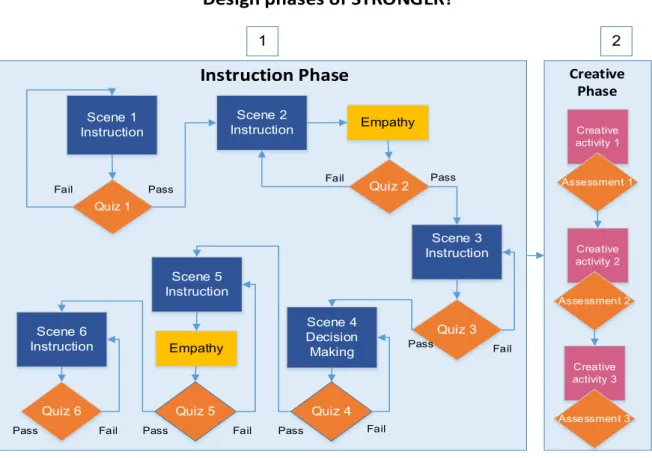
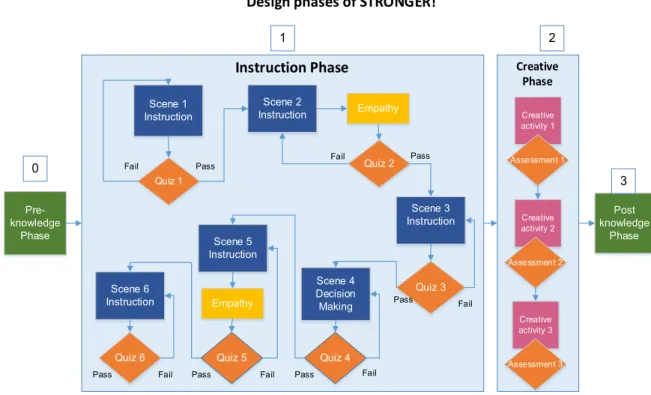
5.3. Designing the flow of Stronger ... 98
5.3.1. The extended flow of Stronger ... 101
5.4. Designing the screens of Stronger ... 102
5.4.1. The initial screen ... 103
5.4.2. The Pre-knowledge phase ... 103
5.4.3. The instruction phase ... 104
5.4.4. The creative phase ... 112
5.4.5. Post-knowledge phase ... 115
9
5.4.7. Game Design Elements in Stronger ... 119
5.4.8. Coding interactivity in Stronger ... 122
5.4.9. Exporting and collecting the data ... 124
5.5. The comparative study ... 124
5.5.1. Description of the DC ... 125
5.6 The questionnaires ... 129
5.6.1. Demographics questionnaire ... 129
5.6.2. The Empathetic personality Questionnaire ... 129
5.6.3. The retention-knowledge test... 129
5.7. Summary ... 130
Chapter 6 – Study and Data Analysis ... 131
6.1. The pilot testing ... 132
6.2. The recruitment of participants ... 132
6.3. The research study process ... 133
6.4. The Quantitative Data Analysis Process ... 134
6.4.1. The Data Analysis in steps ... 135
6.4.2. The learning variables ... 136
6.4.3. The dependent and independent variables ... 137
6.5. The Demographics Data Analysis ... 137
6.5.1. Gender ... 137
6.5.2. Age ... 138
6.5.3. The ethnicity of the participants ... 138
6.5.4. The level of education of participants ... 139
6.5.5. The frequency of using e-learning applications ... 139
6.5.6. Frequency of playing video games ... 140
6.5.7. Domestic abuse course ... 140
6.5.8. Summary of demographics between the two groups ... 140
10
6.6.1. Instruction, formative assessment and repetitions ... 142
6.6.2. Empathy ... 144
6.6.3. Creativity ... 154
6.6.4. The satisfaction of the prerequisite of DeLEC ... 157
6.6.5. Within Subjects Data analysis ... 157
6.7. Between subjects: The comparative study ... 163
6.7.1. ANOVA Analysis ... 164 6.7.2. Question 6 ... 168 6.7.3. Question 7 ... 171 6.7.4. Question 8 ... 173 6.7.5. Question 9 ... 174 6.7.6. Question 10 ... 177 6.7.7. Question 11 ... 179
6.8. Qualitative Data Analysis ... 181
6.9. Summary ... 182
Chapter 7 – Discussion ... 183
7.1. Summary of the research outcomes ... 183
7.2. Addressing Research Question 1 ... 185
7.3. Addressing Research Question 2 ... 188
7.4. Conclusions ... 192
7.4.1. Conclusions on the DeLEC framework ... 192
7.4.2. Conclusions on the Stronger game ... 194
7.4.3. Conclusions on Empathy ... 196
7.4.4. Conclusions on creativity ... 199
7.5. Summary ... 202
Chapter 8. Contribution to Knowledge and Directions for Future Work ... 203
8.1. The success of DeLEC in Learning ... 204
11
8.3. Contribution to Knowledge ... 208
8.3.1. The DeLEC Framework ... 208
8.3.2. The Stronger Role-Playing Game ... 210
8.3.3. The research data, the study results and conclusions ... 211
8.4. Limitations ... 211
8.5. Future Work ... 214
8.5.1. Examining separately the impact of empathy and creativity ... 214
8.5.2. Examining the impact of each game design element ... 215
8.5.3. Examining the demographic information and learning ... 216
8.5.4. Extending Stronger game ... 216
8.5.5. The DeLEC framework as the guideline for designing other SGs... 216
8.5.6. Using Immersive Learning Technologies ... 217
8.5.7. Using Artificial Intelligence ... 217
8.5.8. Other suggestions for future work... 217
8.6. Summary ... 218
List of References ... 220
Appendices ... 233
Appendix A – Participation Sheet ... 234
Appendix B – Invitation to participants ... 239
Appendix C – Pre/Post/Retention Knowledge Questions ... 241
Appendix D – Game Quizzes ... 245
Appendix E – Domestic Violence and Abuse Resources ... 252
Appendix F – Demographics Questionnaire ... 261
12
List of Figures and Tables
Figure 1. 1. The elements comprising the DeLEC framework for serious games ... 24
Figure 1. 2. The components of the DeLEC framework ... 27
Figure 2. 1. Linking the literature review with the research thesis ... 31
Figure 2. 2. SG design and video game. Adaptation from Zyda (2005), p.25. ... 33
Figure 2. 3. Cognitive Theory of Multimedia Learning. Source: (Mayer, 2014), p.66. ... 34
Figure 2. 4. Dragon Box Elements SG ... 37
Figure 2. 5. The state of Flow (Csikzentmihaly, 1991) ... 38
Figure 2. 6. Role-play strengths (Johnston-Hollitt, 2008) ... 43
Figure 2. 7. Stand up for Bullying. ... 44
Figure 2. 8. Snapshot from the game PR:EPARe (Arnab et al., 2013) ... 45
Figure 2. 9. The Input-Process-Output Model (Garris, Ahlers and Driskell, 2002, p.445) . 46 Figure 2. 10. ADGBL Framework (Tan et al., 2007) ... 47
Figure 2. 11. The MDA framework ... 48
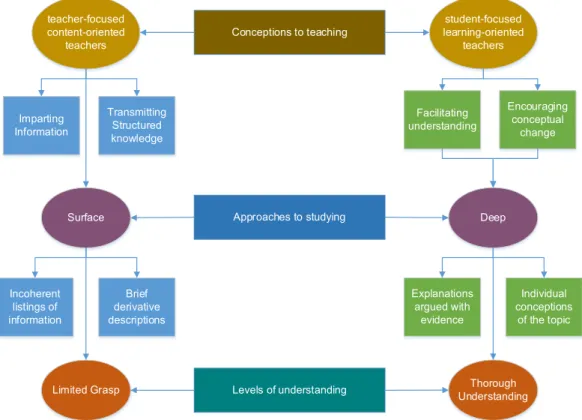
Figure 2. 12. Teachers’ approaches to teaching (Entwistle, 2000, p.5) ... 52
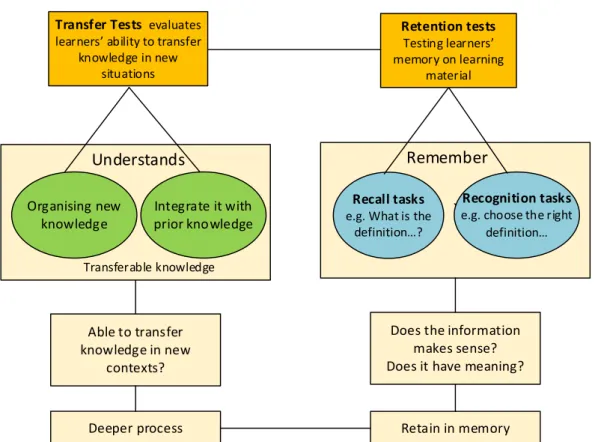
Figure 2. 13. Assessing deeper learning (adapted from Pellegrino & Hilton, 2012) ... 55
Table 2. 1. The three types of learning outcome (Mayer, 2010). ... 55
Figure 2. 14. Types of Empathy (adapted from Stephan and Finlay, 1999, p.736) ... 57
Figure 2. 15. The three elements of Creative Pedagogy (Lin, 2011, p. 152) ... 62
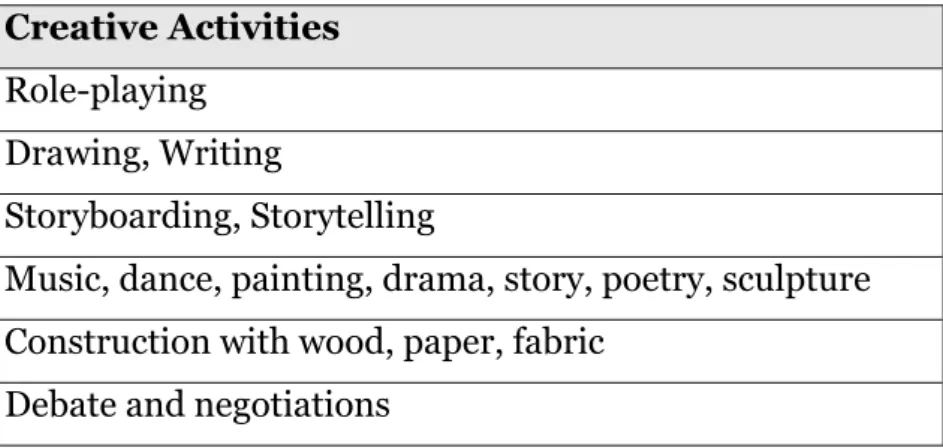
Table 2. 1. Creative activities to support learning (Chan, 2013) ... 63
Figure 3. 1. Bloom’s LFM (Pelkola, Antti and Christofer, 2017), p.4 ... 70
Figure 3. 2. Students’ performance in a traditional class ... 71
Figure 3. 3. Students’ performance with LFM ... 71
Figure 3. 4. DeLEC Framework - Deep Learning, Empathy and Creativity Framework ... 74
Figure 4. 1. The research study ... 82
Table 4. 1. Justification for designing the research tools ... 83
Table 4. 1. EQ categories of Empathy according to score ... 85
Figure 4. 2. Pre-knowledge and post-knowledge tests (Flanagan & Nissenbaum, 2014) ... 88
Table 4. 2. Summary of data collected by the experimental and the control groups ... 92
Figure 5. 1. Board Game on Domestic Violence and Abuse ... 96
Figure 5. 2. Game “P.S. Be Brave” ... 97
Figure 5. 3. Jesse game about Domestic Violence. ... 98
Figure 5. 4. The main phases of Stronger Role-Playing Serious Game. ... 100
13
Figure 5. 6. The Stronger game including the pre, post knowledge phases. ... 102
Figure 5. 7. The initial screen of the game “Stronger” ... 103
Figure 5. 8. A question in the Pre-knowledge test ... 104
Figure 5. 9. The main menu of the game showing all six scenes locked ... 105
Figure 5. 10. The game characters of Stronger ... 105
Figure 5. 11. The six scenes ... 106
Figure 5. 12. A snapshot from scene1 ... 107
Figure 5. 13. A snapshot from scene 2 revealing emotional and digital abuse. ... 107
Figure 5. 14. A snapshot from scene 3 ... 108
Figure 5. 15. Decision-making ... 108
Figure 5. 16. The reveal that Julia is a victim of physical abuse ... 109
Figure 5. 17. A snapshot from Scene 6 ... 110
Figure 5. 18. Instructions are given at the beginning of a quiz ... 110
Figure 5. 19. Questions and answers appear randomly ... 111
Figure 5. 20. Feedback for success in passing the quiz. ... 111
Figure 5. 21. Feedback fail to pass the quiz ... 112
Figure 5. 22. Creative activity 1 ... 113
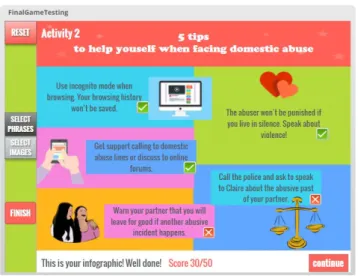
Figure 5. 23. Selecting the five correct statements. ... 113
Figure 5. 24. Creative Activity 2 - Infographic. ... 114
Figure 5. 25. Creative Activity 3 - Poster ... 114
Figure 5. 26. The post-knowledge Test ... 115
Figure 5. 27. Feedback for Correct Answer Post-Knowledge Test phase ... 115
Figure 5. 28. Feedback for Incorrect Answer Post-Knowledge Test phase ... 116
Figure 5. 29. Facial Expressions ... 117
Figure 5. 30. Recognising the feelings of the victim ... 117
Figure 5. 31. Emotions towards the victim ... 118
Figure 5. 32. State the level of empathy ... 119
Figure 5. 33. The use of dialogues in transferring learning. ... 120
Figure 5. 34. Final Scores are shown at the end of the game ... 121
Figure 5. 35. Score variables in a chronological sequence ... 121
Figure 5. 36. The key as the prize for completing the scene successfully ... 122
Figure 5. 37. Stronger Game, coding an event. ... 123
Figure 5. 38. Coding a slide ... 123
Figure 5. 39. The structure of the DC ... 125
14
Figure 5. 41. DC - Main Menu ... 126
Figure 5. 42. Screenshots from DC on domestic abuse. ... 127
Figure 5. 43. DC - Post-Knowledge Test- Feedback ... 127
Figure 5. 44. DC - Final Results ... 128
Table 5. 1. List of features of the Stronger game and the DC. ... 128
Figure 5. 45. Reviewing the Quiz ... 130
Figure 6. 1. The research study process ... 134
Table 6. 1. Gender of participants per group A and B ... 138
Table 6. 2. Participants’ age in each group. ... 138
Table 6. 3. Participants: Gender and Ethnicity ... 139
Table 6. 4. Education Level of the participants ... 139
Table 6. 5. Participants: Familiar with e-learning applications ... 140
Table 6. 6. Participants: Frequency of playing video games ... 140
Table 6. 7. Summary of demographics ... 141
Table 6. 8. Normality test ... 144
Table 6. 9. Comparison of the means ... 144
Table 6. 10. Initial Scores and Final Scores in the instruction ... 144
Figure 6. 2. Histogram shows participants’ rating of the Level of Empathy 1 ... 146
Figure 6. 3. Histogram shows participants’ rating of the Level of Empathy 2 ... 146
Figure 6. 4. The ROC Curve ... 147
Table 6. 11. The cut-off point ... 147
Figure 6. 5. Rate of emotions while playing the game. ... 148
Table 6. 12. Empathy score per category ... 148
Table 6. 13. Emotions Score Ratings ... 149
Figure 6. 6. The level of empathy ... 150
Table 6. 14. Total of participants in each category. ... 150
Table 6. 15. The level of empathy and the number of participants ... 151
Table 6. 16. Level of Empathy1 (Incident 1) and Learning ... 152
Table 6. 17. Level of Empathy2 (Incident 2) and Learning ... 152
Table 6. 18. Empathetic characters ... 153
Table 6. 19. Empathetic Characters and Level of Empathy. ... 154
Table 6. 20. The mean of Creative Score ... 155
Table 6. 21. Creativity Categories... 155
Table 6. 22. Creativity scores and number of participants ... 155
15
Table 6. 24. Normality Test pre-knowledge score – post-knowledge score ... 158
Table 6. 25. Wilcoxon Signed-Ranks Test for paired values ... 159
Table 6. 26. The means of pre-knowledge scores and post-knowledge scores ... 159
Figure 6. 7. Pre-knowledge score and Post-knowledge score within subjects. ... 159
Table 6. 27. The Normality Test Pre-Knowledge score – Retention-knowledge score .... 160
Table 6. 28. Paired t-test ... 161
Table 6. 29. Means of Pre-knowledge and Retention-knowledge score ... 161
Figure 6. 8. The means of the pre-knowledge score and retention-knowledge score ... 161
Table 6. 30. The Normality Test Pre-Knowledge score – Retention-knowledge score .... 162
Table 6. 31. The Wilcoxon Signed-Ranks Test, post-knowledge score, retain-score .... 162
Table 6. 32. The means of the post-knowledge score and retention-knowledge score. .... 163
Figure 6. 9. The means post-knowledge score, retention-knowledge score. ... 163
Table 6. 33. Between-Subjects Factors ... 164
Table 6. 34. Descriptive statistics of the dependent variables. ... 164
Table 6. 35. Multivariate Tests ... 165
Table 6. 36. ANOVA tests output ... 167
Table 6. 37. Test of normality of Pre-knowledge score for both groups. ... 169
Table 6. 38. The t-test of pre-knowledge score between the groups A and B. ... 170
Table 6. 39. Means of pre-knowledge score between groups A and B. ... 170
Figure 6. 10. Means of the pre-knowledge score of group A and B. ... 170
Table 6. 40. Test of normality of Post-knowledge score for both groups. ... 171
Table 6. 41. Non-parametric Test for Post-knowledge Score for groups A and B ... 172
Table 6. 42. The post-knowledge score for groups A and B. ... 172
Figure 6. 11. Means of Post-knowledge score for groups A and B. ... 172
Table 6. 43. Test of normality of post-knowledge score for both groups. ... 173
Table 6. 44. Independent Samples t-test for the retention-knowledge score ... 174
Table 6. 45. Means of the retention-knowledge score for groups A and B. ... 174
Figure 6. 12. Means of Retention-knowledge Score for groups A and B. ... 174
Table 6. 46. Normality Test ... 175
Table 6. 47. T-Test for variable dif_Post_Pre for groups A and B. ... 176
Table 6. 48. Mean for dif_PostPre for groups A and B. ... 176
Figure 6. 13. Mean of dif_PostPre for groups A and B. ... 176
Table 6. 49. Normality Test of dif_Ret_Pre ... 177
Table 6. 50. Independent samples t-test for dif_Ret_Pre for groups A and B. ... 178
16
Figure 6. 14. Mean of dif_Ret_Pre for groups A and B. ... 178
Table 6. 52. Test of Normality Dif_Post_Ret for groups A and B ... 179
Table 6. 53. Independent Samples t-test Dif_Post_Ret... 180
Table 6. 54. Means of differences ... 180
Table 6. 55. Mean Post-Knowledge score and Retention-knowledge Score ... 180
Figure 7. 1. The Learning results ... 184
Figure 7. 2. The level of empathy ... 185
Figure 7. 3. The creative score ... 185
17
Abbreviations
DC=Digital Course
DeLEC = Deep Learning Empathy Creativity Framework DVA= Domestic Violence and Abuse
DRPGs=Digital Role-Playing Games
DRPSG=Digital Role-Playing Serious Game GBL= Game-Based Learning
HC=High Creativity
HEC=High Empathetic Characters HES=High Emotions Score
IPO=Input Process Output LbT=Learning by Teaching LC=Low Creativity
LEC=Low Empathetic Characters
LFM = Learning for Mastery (Mastery Learning) LMLE=Low/Moderate Level of Empathy
LMES= Low/Moderate Emotions Score NPC=Non-Player Character
RPG=Role-playing Game
RPSG=Role-playing Serious Game SGs=Serious Games
STRONGER=Digital Role-playing game developed according to DeLEC framework VLE=Virtual Learning Environment
18
Chapter 1. Introduction
This chapter describes the scope and aims, the problem statement, the literature review, the methodology, the research instruments, the study and the data analysis, the discussion around the results, the contribution to knowledge, the conclusions and the future work. This chapter outlines the structure of the thesis, presenting how the field of Serious Games has contributed to education and discusses the process of deeper learning as part of the educational goals. Both serious games and deeper learning are significant elements in this thesis. The aim is to design serious games that support learners to reach deeper learning. Also, this chapter sets the research questions, describes the methodology designed to set up the research instruments and describes the study to collect and analyse data that would give answers to the research questions and contribute to knowledge.
19
1.1.
Serious games and pedagogy
Since the 90s, the emergence of technological advances have been applied extensively in the field of education, improving the delivery approaches with digital media such as images, sound, videos, animations that captivate the attention of learners and animate their eagerness for learning inside the classroom and remotely (Zhonggen, 2019). Since the millennium, the advent of digital or video games included all the forms of digital media plus high interactivity, managed to increase efficacy in learning by dragging learners into the magic circle of gameplay and learning.
The idea of designing serious games to be used for educational purposes originates from video games and their unique captivating and motivational power. Educators noticed that video games comprise an ideal environment for learning that inspire learners into becoming more focused, interested, motivated and excited for their learning (Freitas, 2018; Vos, Van Der Meijden and Denessen, 2011; Prensky, 2003). Educational scientists attempted to transfer video games in education, switching the purpose from playing for enjoyment to playing for learning. Attempting to design games that maintain the balance of learning and play the new genre of educational games is called Serious Games, where Serious refers to serving the purpose of learning and Games refers to the enjoyment and attractiveness to learners (Lameras et al., 2016). The effectiveness of SGs depends on their capacity to provide a balance between gaming and the educational experience (Brisson et al., 2012).
They are called “Serious” Games because in one hand they serve a serious purpose of learning and on the other hand they are games that provide enjoyment and fun to learners (Arnab, Lim, Carvalho, Bellotti, De Freitas, et al., 2015). Abt in 1970 coined the term SGs to define games used for learning purposes around the business context. In their digital form, SGs firstly used by David Rejeski and Ben Saywer in Serious Games Initiative (US) in 2002 (Gloria et al., 2014).
SGs are educational applications designed to interact with learners and captivate their attention, increase their motivation and engagement when teachers find it hard to engage their students with the conventional teaching process. SGs provide the environment for active learning, changing the role of learners from passive listeners to active participants who interact and become responsible for their learning (Jeffrey, 2006; Kampylis et. al., 2009; Navarrete, 2013; Mullet et al., 2016).
20 Learning with serious games can create a positive strong experience that might retain longer in memory (Bellotti, Kapralos, Lee, Moreno-Ger, et al., 2013). SGs foster the development of knowledge and skills through interactive stories, playful activities and immersive experiences (Almeida & Simoes, 2019).
SGs use elements to increase interactivity, competition, fun and motivate, engage and focus learners in achieving their learning goals (Alsawaier, 2018). Some examples of such elements are the following:
a. Gamification elements such as score, rewards, badges, leaderboards, trophies, visual objects;
b. Game Elements (game mechanics and game dynamics) such as story, characters, rules, levels, mission, mystery, curiosity;
c. Pedagogic Elements such as quizzes for evaluating learning and assessment, feedback, repetitions to encourage learning with trial and error, scenes and dialogues, tasks and activities.
Within the genre of SGs, the Digital Role-playing games (DRPGs) are popular. The role-playing technique is known in the Social Sciences as a teaching practice in the classroom to instigate students’ attention and active participation. Students learn by taking roles putting themselves in the shoes of another person and contributing in resolving an issue like a conflict situation. Accordingly, DRPGs use role-playing techniques within a digital environment where learners take a role of a game character and expose themselves to confront a problem and experience the consequences of their decisions and learn from them (Devlin-Scherer & Sardone, 2010). DRPGs open social orientations, promoting behavioural change, aiming in learning and altering beliefs and prejudice on social and cultural taboos (this is covered in detail in chapter 2).
Considering SGs as interactive and motivating applications that target learning, this research thesis examines the design of SGs and their efficacy as educational digital media designed to transfer and apply teaching strategies and pedagogic processes in meaningful contexts in assisting learners to obtain deeper learning. The effective design of SGs may result in effective learning. SGs is another approach in teaching and learning and they act as an additional educational media of learning. Their development does not exclude or undermine the importance and the value of the instructor inside or outside the classroom.
21
1.2.
Towards Deeper Learning
Recently, a shift in education turns the focus of teaching and learning to deeper learning (Fullan & Langworthy, 2013a) as a response for providing learners robust and transferable knowledge and skills. Shifting educational strategies into promoting deeper learning has become a priority among educators who find literacy, numeracy, and IT skills to be the fundamental knowledge, yet not enough to prepare learners with advanced skills needed to secure a job in the competitive markets (Dede, 2014). Promoting and supporting deeper learning strategies empower learners to think critically, make critical decisions, and become capable of solving new problems (Grover et al., 2015).
Deeper learning is a process through which learners become capable of taking the knowledge they’ve developed on a particular domain and transfer it and apply it to a new situation to find solutions (Pellegrino & Hilton, 2012). Deeper learning is considered an increasing need in education for developing broad background knowledge and a set of diverse skills that are meaningful and useful in the real-world (Dede 2014, Araya and Peters, 2010),
Therefore, there is a necessity for redesigning teaching approaches to deeper learning. Rethinking the new design of teaching approaches, it took into consideration learners’ personal needs and interests in supporting and achieving their learning goals. To achieve these learning goals, educational technologies such as SGs become the new interactive environments that encourage teaching and deeper learning through active participation, collaboration and cooperation, interaction and experimentation with the learning content as educational solutions that deviate from the conventional learning approaches (Gloria et al., 2014).
Deviating from conventional teaching and learning approaches, the current research thesis investigates the design and efficacy of serious games as learning environments in terms of achieving deeper learning. The thesis proposes DeLEC as the new pedagogic framework for Serious Games that enhances a learning process of instruction and assessment adapting it for SGs by using gamification elements, game design elements and pedagogic elements (see Section 1.1) as well as the components empathy and creativity. Empathy is about understanding and sharing another person’s situation and consequently involving the learner in understanding the learning content. The learning experience can be improved by the gaming experience and the invoke of emotions of empathy. Moreover, creativity becomes
22 another powerful approach in learning as the transfer of the acquired learning gained from the SGs and applying it in new contexts by creating artefacts within SGs.
Besides the pedagogic framework, the research thesis proposes the design of a new interactive serious game which aims to include the gamification, the game design and pedagogic elements and the components of empathy and creativity. The serious game developed is a role-playing game that involves instruction and assessment using a story with mystery, dialogues, mission, score, and visual objects. It also encourages the invoking of empathy of the learner using characters that portray emotions with their facial expressions, conversations, and the progress of the story. The serious game comprises a method of non-conventional approach to learning and it is completed with tasks of creativity, inviting the learner to apply their knowledge acquired from the game into creative activities.
The current research thesis claims its originality by putting forward a pedagogic framework that enhances the instructional process based on a known learning theory of Bloom’s Learning for Mastery (see Section 3.3) and besides the integration of the game design elements, it proposes the incorporation of empathy and creativity as components designed and adapted in SGs. Furthermore, the designed methodology is developed to evaluate the attainment of deeper learning following the suggestions of Pellegrino & Hilton, (2012) in designing transfer tests and
retention tests (see Section 2.6.4) for the assessment of deeper learning.
Due to the lack of a pedagogic framework that assists learners in achieving deeper learning with SGs, the next section describes this problem statement and suggests the solution.
1.3.
The Problem Statement
There is a concern around the lack of integrating pedagogic principles when designing serious games. Pedagogical aspects and educational principles are often not taken into consideration when designing serious games (Catalano et al., 2014; De Freitas, 2006). In many cases educational content is “poured” into the game in a retrospective manner, hoping that player/learner would be motivated just because “the content is housed inside a game” (Gunter et al., 2006). The literature documents positive outcomes when it comes to motivation, intensity and longevity of engagement, but there are less solid systematic outcomes around the design of
23 serious games for achieving knowledge and skills (Bellotti et al., 2014; Gunter et al., 2006).
Additionally, there is no pedagogical framework designed to guide learners in reaching deeper learning with serious games. Deeper learning is a process that supports learners to acquire and transfer their learning, skills and expertise to solve problems in new relative contexts, however, deeper learning has not been designed and tested using serious games.
Hence, the research thesis proposes the design of a new pedagogic framework designed for serious games to guide learners in reaching deeper learning. The pedagogic framework is designed based on educational theory and pedagogic principles. The Deeper Learning Empathy and Creativity Framework (DeLEC) (see chapter 3) proposes an integrated instructional process to support learners achieve deeper learning. The DeLEC framework proposes the design of an instructional process based on the educational theory of Bloom’s Learning for Mastery (LFM) and integrates the components of empathy and creativity.
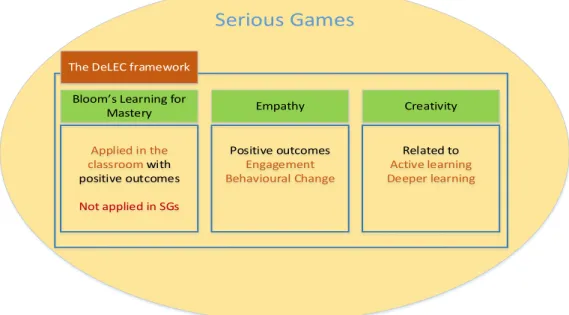
The DeLEC framework comprises of three elements illustrated in Figure 1.1. 1. The educational theory of Learning for Mastery (LFM) suggested by Benjamin
S. Bloom, (1968), which comprises the foundation of the proposed DeLEC framework. LFM (see Section 3.3) demonstrated positive results in assisting students to reach mastery in learning. It has never been applied using serious games.
2. Empathy is a feeling that has been used in serious games to trigger players emotionally. Games designed to foster empathy are known as Empathy Games and target in eliciting feelings of empathy to victimised groups or for social education to encourage tolerance and behavioural change (Belman & Flanagan, 2009). Triggering empathy increases motivation and engagement and assists learning and behavioural change (see Section 2.8).
3. Creativity is a component used as part of the DeLEC framework to involve learners in transferring and applying their knowledge in creative activities, transforming their learning into deeper learning (Pellegrino and Hilton, 2012).
24 The DeLEC framework
Bloom’s Learning for Mastery Applied in the classroom with positive outcomes Not applied in SGs Positive outcomes Engagement Behavioural Change Empathy Creativity Related to Active learning Deeper learning
Serious Games
Figure 1. 1. The elements comprising the DeLEC framework for serious games
1.4.
Research Aims
The research aims of the thesis are to investigate and evaluate whether learners can achieve deeper learning with Serious Games. Analytically, the research aims are the following:
1. The design of the pedagogic framework DeLEC as an integrated solution for achieving deeper learning with serious games.
2. The design and development of a serious game that applies the DeLEC framework in high fidelity.
3. The testing and evaluation of the learning effectiveness of the serious game by conducting a comparative study to conclude whether the Serious Game designed according to DeLEC framework produces a significant increment in learning and deeper learning. The study compared the results in learning and deeper of two digital media designed on the same learning material (see more in Chapter 5):
a. The serious game designed according to DeLEC and b. The e-learning lesson.
The research questions addressed by this research thesis are the following:
1. Have learners who played the serious game designed according to DeLEC framework achieved higher learning compared to the learners who followed the e-learning lesson?
25 2. Have learners who played the serious game designed according to DeLEC
framework achieved higher deeper learning compared to the learners who followed the e-learning lesson?
The aims of this research thesis are set to answer the above research questions following a rigorous methodology to plan, investigate, and analyse collected data, and emerging in results described in the following chapters.
1.5.
Research Objectives
The research objectives below outline the steps taken to design and evaluate the proposed pedagogic framework and answer the research questions.
• Research Objective 1: Identifies the gap in research (see Section 1.3) around Serious Games and learning and focuses its investigation to the formation of a methodology that designs and explores the possibility of assisting learners in achieving deeper learning with SGs.
• Research Objective 2: Designs the DeLEC pedagogic framework (see chapter 3) to become the guidance to game designers to design SGs that assist learners in reaching deeper leaning with serious games. DeLEC is an original framework designed, tested and evaluated as for its validity for achieving deeper learning.
• Research Objective 3: Designs the research methodology which contains the study plan, the literature review, and the design of the research instruments and the methods to assist the collection of data.
• Research Objective 4: Designs and develops the serious game according to the DeLEC framework to empirically evaluate the efficacy of the game and validate the DeLEC framework.
• Research Objective 5: Conducts the comparative study with participants using the serious game and the questionnaires to collect data and then statistically analyses data to emerge conclusions that evaluate the DeLEC framework and answer the research questions.
1.6.
Explaining the research thesis
The research thesis proposes a solution for achieving deeper learning with serious games by developing a pedagogic framework, the DeLEC framework that directs the design of educational serious games to assist learners in developing deeper learning, using empathy and creativity.
26 The research thesis aims to investigate and develop a solution combining the next components:
a. The design of the DeLEC framework based on Bloom’s LFM
educational theory.
Bloom’s LFM educational theory (Benjamin S. Bloom, 1968) is a well-known educational model which was tested in the classroom and demonstrated positive results regarding gaining mastery in learning (Guskey, 2007). However, it has not yet been tested with serious games. That means that there is no evidence in the scientific literature about how effective is the LFM model if implemented with serious games.
b. The design of the DeLEC framework and its evaluation by designing
and testing a serious game which applies the DeLEC in high fidelity.
To be able to evaluate whether the DeLEC framework can indeed assist learners in achieving deeper learning with serious games, it has to transfer from the theory to practice by designing a digital media tool, the serious game, which follows exactly the phases of DeLEC and then tested to analyse and evaluate the results.
c. The design and integration of empathy
Empathy is an element that has been tested in serious games, also known as Empathy Games (Belman & Flanagan, 2009). The results showed that instigating empathy in serious games can result in positive behaviour change (Grohn et al., 2014) and belief formation (Batson et al., 1997). Nevertheless, it is suggested that empathy in learners is the prerequisite for achieving learning (Jarvis, 2012) through emotional connection, motivation and engagement and therefore it is transferred in serious games.
d. The design and integration of creative activities
Creativity has become part of the key national educational policy and many initiatives are made across the UK to promote creativity in education (SEED, 2006). Creativity is found to benefit learning because by creating a positive mood for learning by increasing enthusiasm and enjoyment. In this PhD thesis, creativity has the form of creative activities and becomes an integral part of the DeLEC framework to assist learners with transforming their knowledge into
27 deeper knowledge.
e. The evaluation of deeper learning
Reaching deeper learning means learners acquired knowledge at the level that they have understood and retained knowledge in memory and they can recall it and apply it in new contexts finding solutions to new problems and they and apply. If information is understood and processed effectively, it is transformed into a deeper knowledge and is retained in the long-term memory. If the information has not been understood or learned incorrectly, or it was the result of rote memorisation, then it doesn’t transform into knowledge and soon it fades out from memory.
The approach followed in this research thesis for assessing the reach of deeper learning is by:
• applying the gained knowledge using creative activities; and
• evaluating whether the gained knowledge has been retained in memory four weeks later.
Figure 1.2 illustrates the components of the DeLEC framework consisting of Bloom’s LFM educational theory, empathy and creativity to reach deeper learning.
DELEC Framework Empathy Creativity Deeper Learning Serious Games Learning for Mastery
28
1.7.
Structure of the thesis
Chapter 1 “Introduction” outlines the research thesis presenting the background area, the problem statement, the research aims and objectives, and describes briefly the components of the DeLEC framework, which are discussed extensively in the following chapters.
Chapter 2 “Literature Review” describes the background area of serious games and pedagogy presenting the recent literature around all the relevant parts of the thesis including serious games, serious games design frameworks, role-playing serious games, empathy, creativity and deeper learning.
Chapter 3 “The DeLEC framework” describes the design of the proposed DeLEC framework setting its foundation on Bloom’s LFM educational model which is extended and adapted to apply in serious games by incorporating empathy and creativity.
Chapter 4 “Research Methodology” discusses the research methodology and describes the steps and the plan designed including the design of the DeLEC framework, the design of the corresponding serious game, the design of research instruments and variables, and research methods selected to collect the desired data to address the research questions and evaluate the proposed framework.
Chapter 5 “Design and Development of the research instruments” describes the research instruments designed to collect the desired data during the study to help emerge the correct results. Research instruments include the role-playing game called “Stronger”, the comparative e-learning resource, referred to as the Digital Course, and the questionnaires designed to collect users’ demographics data and other information.
Chapter 6 “Study and Data Analysis” describes the comparative study conducted and presents the statistical data analysis using the SPSS package for analysis and plotting. The chapter demonstrates the statistical output and the results emerged from the data analysis of the comparative study.
Chapter 7 “Discussion and conclusions” elaborates the discussion around the statistical output and the results focusing on the learning and deeper learning achievements of the experimental group in comparison to the control group and
29 providing clear arguments in answering the research questions. The chapter continues discussing the main conclusions of the research thesis.
Chapter 8 “Contribution to Knowledge and Direction for Future Work” presents the contribution to knowledge and proposes future work to extend the work of the current research thesis. The chapter and the research thesis complete with a summary of the main findings and conclusions and final remarks.
1.8.
Summary
This chapter introduces the issues and the components that this thesis aims to investigate, and it outlines the structure of the research thesis. The chapter starts by discussing how the Serious Games can become the foundation for learning in education and their environment in accommodating teaching strategies that can lead to Deeper Learning. The chapter presents the problem statement which discusses the lack of a pedagogic framework in underpinning deeper learning in Serious Games. Following the problem statement, the chapter explains the research aims that incorporate the research questions and then presents the research objectives as the plan and the steps to address the research questions. Next, the chapter explains the steps of the research thesis. Finally, the chapter outlines the structure describing briefly the content each of the 8 chapters of this PhD research thesis.
30
Chapter 2. Literature Review
This chapter presents the state-of-the-art in the field of serious games based on recent literature review. It is mainly focused on serious games designed to improve educational purposes through pedagogy, motivation, and engagement and with the use of game design elements. The literature concentrates on the role-playing serious games as this form of serious games is examined in this research. Also, three pedagogic frameworks for designing educational serious games are presented to constitute the guideline for developing the proposed framework for this research. Furthermore, the main elements, empathy and creativity, as the main components of the proposed framework are discussed. Finally, deeper learning forms the frame within it can be evaluated and become the achieved goal in serious games.
31
2.1.
The approach to literature review
Figure 2.1 illustrates the holistic view of the thesis demonstrating the elements linking and forming the pathway in which the literature review is presented. Starting from discussing the role of SGs in learning, including motivation and engagement, moving to the design of SGs and presenting three important SGs frameworks, then presenting Instruction, Assessment, Feedback, Empathy, Creativity and Deeper Learning. Figure 2.1 demonstrates how these elements link together to support the design of the proposed DeLEC framework (discussed in Chapter 3) that claims to assist the design of educational SGs that support learners to achieve effective learning. SERIOUS GAMES (SG) BLOOM’S LFM THEORY DELEC FRAMEWORK EMPATHY ACTIVE LEARNING INSTRUCTION ASSESSMENT FEEDBACK COGNITIVE PEDAGOGY EMOTIONAL CREATIVITY CREATIVE ACTIVITIES DEEPER LEARNING
ROLE-PLAYING GAME DESIGN
SG DESIGN FRAMEWORKS
Figure 2. 1. Linking the literature review with the research thesis
The research thesis investigates the role of SGs and how their design can lead to better learning. The following section (see Section 2.2) presents the state-of-the-art
32 SGs according to the literature and discusses the importance of SGs and contribution to education.
2.2.
Serious Games and Learning
Serious Games (SGs) is a relatively new discipline that combines learning, game mechanics and logic to provide game activities to transform users’ learning experience (Lameras et al., 2016). The term SGs was first coined by the author Clarke Abt in 1970 (Djaouti et al., 2011), but in their digital form, SGs firstly used in Serious Games Initiative (US) in 2002 (Gloria et al., 2014). The terms Educational Games, Digital Game-Based Learning, Instructional Games, and Serious Games are often used interchangeably (Tsekleves et al., 2016). Through the thesis, the term SGs prevails.
As multimedia tools, SGs are designed to teach, train or contribute to behavioural change (Bellotti et. al., 2013). They are applied in different educational domains to support players in achieving their learning goals (Serrano-Laguna et al., 2018). SGs inherit game design elements from video games such as story, characters, competition, goals, rules, challenge, and mystery that increase the attractiveness for playing and create a positive mood for learning (Arnab, Lim, Carvalho, Bellotti, De Freitas, et al., 2015).
With the game features, SGs include also instructional features that initiate the active participation of the learner and allow learning-by-doing with challenges, tasks and activities to increase attention, motivation and ultimately the effectiveness in learning (Meij et al., 2020). SGs’ players participate in new environments, observe, interact, learn new information through the game and use it in overcoming the obstacles and achieve the game mission (Connolly et al., 2012; Felicia & Egenfeldt-Nielsen, 2011). In this sense, the game mission correlates to the learning objectives.
Using SGs is proved to motivate and engage learners in achieving effective learning (Almeida & Simoes, 2019). Their setting offers a fertile environment for learning by allowing trial and error without any consequences outside of the game, and assists players to learn from their mistakes, experimentation and discovery of new solutions (Whitton, 2014). Those activities support learners to develop cognitive skills, such as decision-making, problem-solving and critical thinking (McGonigal, 2011). In well-designed games, learning is “hidden” behind the game missions and
33 activities, where players learn by being immersed in the gameplay and may become unaware of the learning that occurs (Ang et al., 2008).
Figure 2.2 illustrates the purpose and the main features of serious games to video games. Video games are played for fun and their power grips players’ attention and increase their readiness to continue playing losing themselves in the world of the game (Zhonggen, 2019). The features of video games (story, art, software) can be used for the design of SGs which the main purpose is learning. SGs are designed to incorporate also learning features such as educational theories and pedagogical processes such as instruction, assessment, and feedback to achieve a set of expected learning outcomes (Garneli et al., 2017; Zyda, 2005).
Fun Story Software Art
Video
Games
Pedagogy Learning Theories Assessment Feedback Learning OutcomeSerious
Games
Figure 2. 2. SG design and video game. Adaptation from Zyda (2005), p.25.
The next section discusses how people conceive and understand information making meaningful links in their brain, and store it in their memory, and how the trigger of motivation leads to learning.
2.2.1.
How people learn with SGs
Many theories exist on human brain information-processing that study cognitive development. Developmental psychologists who adopt the information-processing perspective contend that the theory of mental development is based on the idea that humans process the information they receive than merely responding to stimuli (Tangen & Borders, 2017). Based on information-processing theories, Mayer, (2014a) proposes the Cognitive Theory of Multimedia Learning and this theory is used in this thesis to explain how people learn with SGs. The theory links the human
34 information-processing system with multimedia learning and describes the way learning occurs in the human brain during the gameplay.
The human brain’s cognitive architecture is the system that represents, process, stores, recalls and accesses the information flowed in the brain, organising the new knowledge in the memory. Figure 2.3 depicts the information flow and human functions to receive, store and organise information.
Figure 2. 3. Cognitive Theory of Multimedia Learning. Source: (Mayer, 2014), p.66.
The Cognitive Theory of Multimedia Learning receives information using dual channels. The upper row shows the auditory/verbal channel, which receives information from the ears, while the bottom row shows the visual/pictorial channel that receives information from the eyes (see Figure 2.3).
Several different brain-memory systems exist which under normal conditions are engaged to some degree in most learning situations. Memory experiences are categorised into explicit and implicit. Explicit memory experiences involve the hippocampus-medial temporal lobe system and implicit involves the cerebellum, amygdala, and other systems (Thompson & Kim, 1996). Mayer, (2014c), explaining the conception and process of information depicts three types of memory:
a. sensory memory
Sensory memory holds a large amount of information input from human ears and eyes and stored for a short time (e.g. less than a quarter of a second).
b. working memory
Information is transferred from the sensory memory and transformed into verbal and visual representations that can be mentally manipulated. However, only a few items of verbal and visual information can be processed
35 at once. The information decomposes if thirty seconds passed without being actively processed.
c. long-term memory
It refers to effective and permanent storage of knowledge and skills which is meaningfully organised and can be accessed unlimited times. The function is to provide long-term storage of relevant material from working memory. Humans receive a vast amount of information each moment. Having a limited memory capacity, they can occupy only a small volume of information in each channel at a given time. Working Memory is the bottleneck in which each time only a small amount of information can be processed.
Meaningful learning happens when humans use the appropriate cognitive processing during learning, to pay attention to the relevant learning material, mentally organising it into a coherent representation and mentally integrating it after linking it to prior knowledge. The arrows in Figure 2.3 represent the cognitive process of selecting, organising and integrating information.
Mayer, (2014a) explains that the information-processing system for multimedia learning has crucial implications when learning with games because players’ working memory can easily get overloaded, reducing the opportunity for making sense of the material. Therefore, the knowledge which is stored in the long-term memory is meaningful and understood and it can be recalled and transferred to solve new problems.
In the next section, the role of motivation in achieving learning is discussed and links serious games to Flow theory.
2.2.2.
Motivation in SGs
Motivation refers to an individual’s willingness to engage in a task putting personal effort, devotion and persistence in that activity (Pintrich, 2003). Motivation is an important feature and plays a crucial role in learner’s performance. Psychological and cognitive states such as motivation, engagement, dissatisfaction or boredom influence learners’ will in acquiring new knowledge and skills (Derbali & Frasson, 2012). These states should be taken into consideration when designing a learning process for SGs. Motivated learners are what educators wish for: enthusiastic; focused; interested; engaged; exhibiting high performance and outcomes (Prensky,
36 2003). It is easy to recognise a motivated learner, although it is difficult to find or create one (Da Rocha Seixas et al., 2016). Hence, there is a particular relevance of how motivation advances learner’s performance in learning (Derbali & Frasson, 2012).
Motivation can be either intrinsic or extrinsic (Malone, 1980):
a. intrinsic motivation
Intrinsic motivation derives from a personal, internal willingness, enjoyment, self-determination, hard efforts and self-satisfaction of doing a task or engaging in learning (Braad et al., 2016)
b. extrinsic motivation
Extrinsic is the motivation which derives from the desire for external rewards, such as money, praise, promotion, recognition from others.
In game-based learning environments, the critical approach is to enhance intrinsic motivation using elements that are considered highly engaging, such as curiosity and challenge (Malone, 1980). SGs trigger motivation by using multimedia content (audio and visual features such as pictures, sounds, and video) and gamification elements such as challenges, curiosity, badges, trophies, points, timers, etc.
The DragonBox Elements (https://dragonbox.com/) is a math game designed to teach children maths, such as Algebra and Geometry created by a Norwegian studio and released in 2012. DragonBox introduces the player in understanding geometrical shapes, angles and theorems in Geometry. The game uses an imaginary world with cartoon characters and music. This innovative method advocates that SGs increase students’ motivation and facilitate active learning. The game won the award for “Best Learning Game” in 2016. Figure 2.4 depicts and a snapshot of DragonBox.
37
Figure 2. 4. Dragon Box Elements SG The Flow Theory
Many researchers used the Flow Theory introduced by (Csikzentmihaly, 1991) to explain how motivation and engagement are achieved with games (Sharek & Wiebe, 2014). The Flow Theory refers to the positive experience of a person to stay in the flow when engaged in an activity. The state of flow exists when while gameplay, a player maintains a balance between the level of their skills and the level of difficulty of the game.
Figure 2.5 illustrates the state of Flow. The horizontal axis shows the level of skills of the player and the vertical axis shows the level of challenge/difficulty of the game. If the game is easy compared to a player’s skills then, they might become bored while playing and soon quit the game. On the other hand, if the game is very difficult compared to a player’s skills then, after several tries, they might lose interest, feel frustrated and eventually quit playing the game. The channel of flow is positioned between the blue lines and shows the state of Flow, the state where the player’s skills are balanced with the game challenges. In the Flow state, the player feels motivated, focused, interested and desires to continue playing out of satisfaction and pleasure. The state of flow is necessary to keep the player in a continuous effort to accomplish a task or learning. When they accomplish the task, they get a reward for their effort, experiencing satisfaction and enjoyment (Lameras et al., 2016).
38 High High Low Boredom Frustration Skills Challenges
Figure 2. 5. The state of Flow (Csikzentmihaly, 1991)
The Flow Theory applies in any task and any field of activity. Educational researchers try to apply the Flow Theory to assist students in optimising their learning (Sharek & Wiebe, 2014).
Motivational methods can scaffold learners’ efforts by transforming the learning process into an enjoyable and effective experience. (Derbali & Frasson, 2012). Maintaining learners’ motivation is essential in achieving better learning.
In the next section, SGs instructional design is discussed which is an important part of the thesis. SGs instructional design discusses the design of instructional elements in SGs such as the instruction, assessment and feedback.
2.3.
SGs Instructional Design principles
As mentioned in previous sections the learning effectiveness of SGs is attributed to the design and integration of pedagogic principles and instructional features. The research of this thesis is interested in investigating the instructional design of SGs as for their learning effectiveness to be able to design the proposed SG that targets the achievement of deeper learning.
According to (Chorianopoulos & Giannakos, 2014), there is a need for designing applications that provide meaningful and playful learning. These applications integrate design principles that assist in the development of several cognitive skills. The authors claim that the story is a game design element that encourages motivation for playing the serious game. Therefore, one of the game elements that is used for the development of the proposed serious game is the unfolding of a story
39 Another game design principle is the use of characters in the game and their expressivity. According to Paiva et al. (2005), when the characters are believable enough to express appropriate and expected behaviours then their emotional state can be reflected in the players. The use of characters is another game element that is used for the development of the proposed game because it can maintain the player engaged in the game and increase their emotional connection towards the game characters.
The third game design principle relies on players’ competence to learn by going through meaningful experiences by designing activities, challenges and quizzes as part of the assessment and receive a score and immediate feedback (see Section 2.3.1 and 2.3.2).
The fourth game design principle is the design of levels that reach to the game mission. Levels correlate with the learning objectives. The completion of a level signifies the completion of learning objectives set to be covered. The game mission set in the beginning exists throughout the game and keeps the player motivated to reach it. The fourth game design principle is designed in the proposed game with the scenes which represent the levels and integrate the learning objects as well as the game mission of gaining the keys as a visual reward that open the next level. Setting learning as the principal purpose in SGs creates the need to explore how to evaluate learning outcomes in SGs that comply with their pedagogical goals.
The evaluation of SGs outcomes should include (Bellotti et al., 2013): • assessment of learning performance;
• feedback provided to the player.
The following sections discuss the assessment and particularly the formative assessment and feedback integrated in SGs.
2.3.1.
Assessment in SGs
Assessment is necessary to evaluate and report the progress of learning by establishing the assessment measures and criteria (Bellotti et al., 2013). Assessment of learning should constructively align with the learning objectives and the learning activities according to Bigg’s Constructive Alignment theory (Trigwell and Prosser,
40 2014). A learning objective intends to change learner’s knowledge through learning activities.
Assessing learning through SGs should include measurable quizzes and activities which indicate the level of learning progress and outcomes to both the learner and the teacher. The results should report that the necessary learning has been occurred by playing a serious game (Zhonggen, 2019).
An assessment conducted after the game-sessions is usually done with summative tests, interviews and questionnaires that cover learner’s overall knowledge and this is counts as a summative assessment. Additionally, assessment can be done within the game using variables that store score, levels, feedback and adaptation of the gameplay. The in-game activities and measures count in formative assessment (Westera, 2016).
Adams and Mayer (2014) propose three types of assessment:
a. pre-assessment
It is conducted before the gameplay to assess a player’s prior knowledge. It can be used to adjust the game level accordingly.
b. formative assessment
Formative assessment has the form of frequent testing during instruction, which checks whether the acquisition of knowledge is achieved. Formative assessment aims to determine areas for improvement (Bellotti et al., 2013). In SGs, formative assessment (Grover et al., 2015) is conducted during the gameplay, it becomes part of the experience, it assesses the learning progress of the player and gives appropriate user feedback (Shute et al., 2009).
c. summative assessment
The summative assessment has the form of the final exam and still dominates in education as it usually covers a major part of the learning content and assesses the overall learning activity (De Freitas, 2018).
Assessment can positively support students’ learning, especially when it takes a more formative than summative form. Given emphasis mainly on summative assessment, students focus merely on succeeding the maximum possible grades in the exam, ending up in adopting surface approaches to study such as memorisation
41 to pass the exam and then forget their learning (Lynch et al., 2012). In contrast to summative assessment, frequent formative assessments encourage students in adopting deeper approaches to study than memorisation. Many studies determine the magnitude of learning outcome by comparing the pre-assessment and summative assessment (i.e. pre-test to post-test scores).
Questions to players/learners related to whether they liked the game, or how they found the game, are considered as an invalid assessment as they are not associated with the desired learning outcome. Another common mistake of integrating assessment in games is including questions asking the players to rate how much they have learned during playing the game. Such questions do not correspond to the learning outcome, because learners are unaware of their learning (Mayer, 2014b).
2.3.2.
Feedback in SGs
Meaningful feedback is key for helping learners achieve their learning goals and reflect on errors in SGs (Lameras et al., 2016). The feedback that gives specific information about the errors and how to remediate them than giving a generic message of errors is found to be associated with deeper learning (Ambrose et al., 2010).
There are several types of feedback in SGs (Lameras et al., 2016).
• formative feedback projected by the system, focus on correcting knowledge misconceptions and inaccuracies (Mayer, 2014).
• Affective feedback is related to attitudes and moods, feelings and emotions (Lameras et al., 2016). Rewards in games may include characters, game gifts and objects that can lead to increased learners’ confidence, maintain tolerance to failures and decrease anxiety (Lameras et al., 2016).
• Motivational feedback in games aims in creating situations that trigger students’ curiosity to start playing the game and then keep them motivated to learn, by extending curiosity and balancing fun (game mechanics) with learning (learning elements) to succeed engagement (Arnab et al., 2012). • Progress feedback in games measures and informs the player about their
current progress done in the learning performance using the game encouraging to continue playing (Bellotti et al., 2014; Popescu et al., 2014).
42
2.3.3.
Pre-tests and post-tests
Pre-tests and post-tests as a common approach in educational research for assessing learning outcomes. Assessment with pre-test and post-tests is one of the most widely used experimental designs that aim to measure changes in learning outcomes after modifications to the learning process (Riemer & Schrader, 2015), e.g. testing the effect of a new teaching method or testing the effect of a learning media such as a game.
With this method, participants are allocated randomly to either the treatment group (playing and testing a new feature in the SG) or the control group (playing without the new feature in the SG). The pre-test is completed by the participants before the game/experiment, while the post-test is completed after the end of the experiment. Then the pre-tests and post-tests are compared. The significant differences in the learning outcome are credited to the treatment group (Papastergiou, 2009).
According to Mayer (2014), a learning outcome is a change in knowledge that emerges as the result of delivering teaching either in the classroom or using learning technologies. In terms of SGs, the learning outcome is the knowledge learners gain while playing SGs.
The proposed SG for this thesis includes the game design principles discussed in section 2.3 which includes the story, the characters, assessment/feedback, and levels. Therefore, the proposed SG is designed in the form of role-playing to include the above game design principles. Hence, the next section presents the literature around digital Role-playing games.
2.4.
Digital Role-Playing Games
Digital Role-Playing Games (DRPGs) simulate real-life situations for training purposes and acquisition of skills around conflict resolution or behavioural and prosocial change. DRPG creates a self-sustaining, highly motivating learning environment emphasising the significant role of language and narrative while playing (Cornillie et al., 2012).
Role-playing was first used to train medical staff to increase empathetic understanding, critical thinking and retain knowledge (Pettenger et al., 2014). Students in sociology and political science are often involved in role-playing. In law