An adaptive educational system that caters for combination of two
models of learning styles
Abdulrahman A. Alghamdi
A dissertation submitted for the degree of Doctor of Philosophy
Heriot-Watt University
School of Mathematical and Computer Sciences
November 2010
This copy of the thesis has been supplied on condition that anyone who consults it is understood to recognise that the copyright rests with its author and that no quotation from the thesis and no information derived from it may be published without the prior written consent of the author or of the University (as may be appropriate).
This thesis aimed to explore the affect of combining two models of learning styles (VARK, and Honey and Mumford) in terms of students‘ learning gains and satisfaction. VARK focuses on how the students perceive learning, while Honey and Mumford examines how an individual would like to learn. A web-based educational system was built to test the combination of the two models of learning styles. A study to examine the feasibility of the system was carried out on 129 participants to explore whether the system presented tutorials according to their individual learning styles. A second study to investigate learning gains and user satisfaction was carried out on 149 participants. Satisfaction was divided into three main concepts: usability, preference and perception of learning. Learning gains were tested by giving participants a pre-test, a post-test and a confirmatory test. Participants were divided into four groups and had the lesson presented according to one learning style of either the VARK or Honey & Mumford model, both of the participants‘ learning styles or with no personal customization. The results found that participants who used the two models of learning styles showed higher learning gains and had higher levels of satisfaction across all three factors; compared to those using only one or no learning style. Furthermore, those using only one learning style showed higher learning gains and had higher levels of satisfaction than those with no learning style. The application of these findings would be of benefit to educational institutions‘ decision makers, educators, students and e-learning designers.
Adaptation is a key feature of the system of research. It is intended for future work; preliminary research has shown that the users profile and learning item will change over time. This important finding is worth exploring in future research.
This study is dedicated to my parents who have been yearning to see me with my PhD after long five years of absence
I thank God for everything
Firstly I would like to express my gratitude to my supervisors: Dr. Roger Rist, Dr. Helen Ashton, Dr. Judy Robertson, and Mr. David Marwick, who all the ―thanking words‖ are not enough to thank them, who has provided considerable guidance, direction and encouragement throughout the research project. They have been constant source of new ideas and have been major catalysts in helping me to develop the themes of my work.
A big ―Thank you‖ to my family Zainah, Abdullah, Fatimah, and Mohammed whose support, encouragement, patience and love was all I ever really needed, and for their support and understanding of my absence time as I worked on completing my doctorate. I also want to extend special thanks to my employer ― Saudi Ministry of Education‖ for their sponsorship and their care.
I would also want to thank Heriot-Watt University, and much gratitude and appreciation to the school of Mathematical and Computer Sciences for all their support.
I would like to thank everyone who has assisted me along the journey of completing this PhD.
Chapter 1 Introduction ... 1
1.1 Aim ... 1
1.2 Motivation ... 2
1.3 Adaptive Hypermedia System ... 3
1.4 Learning Styles ... 4
1.5 Integration of learning styles into adaptive applications ... 5
1.6 Student Model ... 6
1.7 Research objectives and approaches ... 7
1.8 Outline of the thesis ... 8
Chapter 2 Literature Review ... 10
2.1 Learning Styles ... 10
2.1.1 Definition of Learning Styles ... 10
2.1.2 Why are Learning Styles used? ... 12
2.1.3 Categories and characteristics ... 13
2.1.3.1 Perceptual ... 16
2.1.3.2 Cognitive ... 19
2.1.3.3 Affective ... 26
2.1.4 Multiple Intelligences ... 27
2.1.4.1 Classification of Multiple Intelligence (MI)... 28
2.1.5 Concluding points from learning styles ... 29
2.1.6 Criticism of Learning Styles ... 30
2.1.7 Learning styles and teaching styles ... 31
2.1.8 Effects of Learning styles ... 31
2.1.9 The models used in the proposed system... 38
2.2 Intelligent Tutoring Systems ... 39
2.2.1 Components of the ITS ... 41
2.2.1.1 Domain Knowledge Model ... 42
2.2.1.2 Student Model ... 42
2.2.1.3 Tutoring Model ... 43
2.2.1.4 User Interface Model ... 43
2.2.2 Some Existing ITSs ... 44
2.2.2.1 Tactical Action Officer (TAO ITS) ... 44
2.2.2.2 Intelligent Tutoring System for teaching 1st year engineering students 44 2.2.2.3 ELM-ART ... 45
2.2.3 Adaptive Systems that uses learning styles ... 46
2.2.3.1 CS383 ... 46 2.2.3.2 CAMELEON ... 47 2.2.3.3 Arthur ... 47 2.2.3.4 SILPA ... 48 2.2.3.5 3DE ... 49 2.2.3.6 INSPIRE ... 49 2.2.3.7 ILASH ... 50
2.2.3.9 Summary ... 51
2.3 Adaptation ... 52
2.3.1 Adaptation in Educational Systems ... 53
2.4 Integrating Learning Styles with adaptive applications ... 54
2.4.1 Student Model ... 57
2.4.1.1 Initializing the Student model ... 58
2.4.1.2 Methods Used for Updating Student Models ... 60
2.5 Learning Object definitions ... 61
2.5.1 The reason for Learning Objects ... 61
2.5.2 Criteria of Learning Objects: ... 63
2.5.3 Taxonomy of Learning Objects ... 64
2.5.4 Connecting Learning Object to instructional design theory ... 65
2.5.5 Learning Object Repositories ... 66
2.6 The proposed system ... 66
Chapter 3 Methodology ... 69
3.1 Introduction ... 69
3.2 The emergence of the research inquiries ... 69
3.2.1 How did the questions arise? ... 70
3.3 The current research ... 71
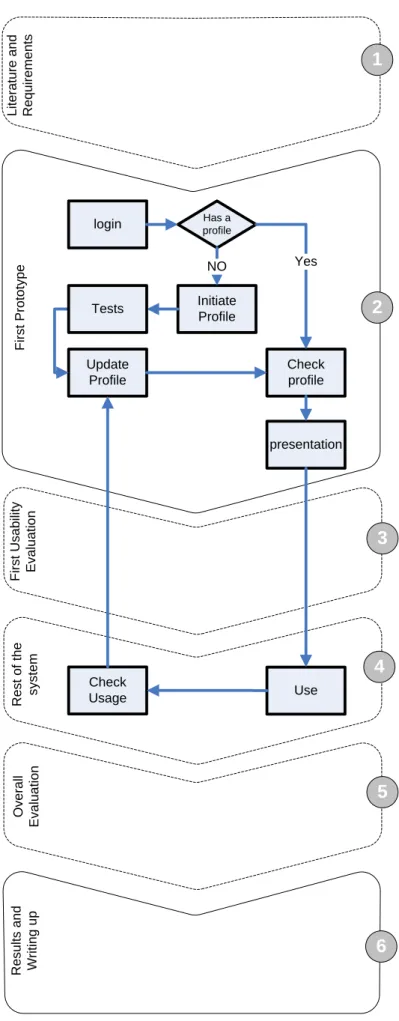
3.3.1 Progress stage ... 71
3.4 System Development Methodology ... 73
3.4.1 Feasibility study ... 73
3.4.2 System investigation ... 74
3.4.3 System analysis ... 74
3.4.4 System design ... 74
3.4.5 Implementation ... 75
3.4.6 Review and Maintenance ... 75
3.5 Methodology stages ... 76
3.6 Test phase ... 77
3.7 Survey Instruments Design ... 78
3.7.1 Testing components ... 80
3.7.2 The experimental design ... 81
3.8 Pilot study ... 82 3.8.1 Purpose... 82 3.8.2 Evaluation tools ... 83 3.8.2.1 Survey ... 83 3.8.3 Procedure ... 84 3.9 Interviewing experts ... 84 3.9.1 Purpose... 85 3.9.2 Procedure ... 86
3.10 Testing feasibility of the system Study ... 87
3.10.1 Sampling ... 87
3.10.2 Purpose ... 88
3.10.3 Evaluation tools ... 88
3.10.4 Procedure... 89
3.10.5 Tasks ... 90
3.11 Testing learning gains and satisfaction... 91
3.11.1 Procedure... 91
3.14 Ethical issues ... 95
3.15 Summary ... 97
Chapter 4 System ... 98
4.1 Introduction ... 98
4.1.1 Revisited Aim and Hypothesis ... 99
4.1.2 The problem description or feasibility study ... 99
4.2 Requirements and specifications ... 100
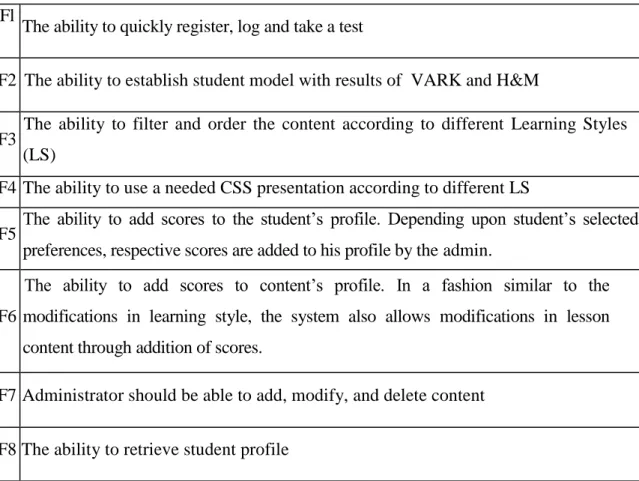
4.2.1 Functional requirements ... 100
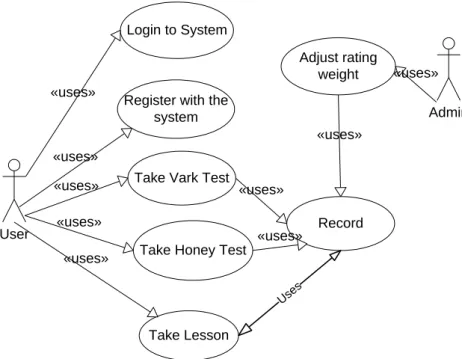
Primary Use Case for the system ... 101
4.2.2 Non-functional requirements ... 102 4.2.2.1 Portability ... 102 4.2.2.2 Reliability ... 102 4.2.2.3 Performance ... 102 4.2.2.4 Security ... 103 4.3 Development tools ... 103 4.3.1 SQL and MySQL ... 103 4.3.2 PHP ... 104 4.3.3 Technologies ... 104
4.4 Learning Styles Specifications ... 106
4.4.1 VARK ... 106
4.4.2 Honey and Mumford ... 107
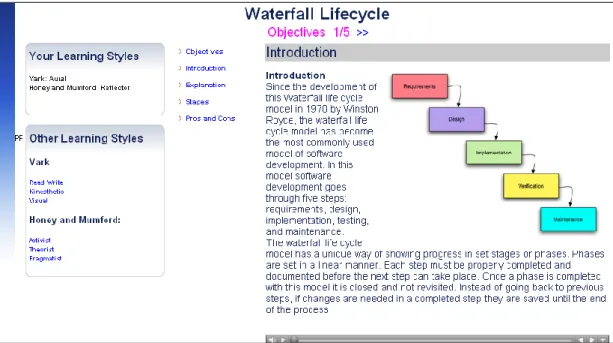
4.5 System Implementation ... 107
4.6 Waterfall cycle... 109
4.7 The first prototype ... 109
4.7.1 Purpose... 110 4.7.2 Evaluation tools ... 111 4.7.3 Data ... 111 4.7.4 Participants... 111 4.7.5 Results ... 112 4.7.5.1 Learnability ... 112
4.7.5.2 Ease of use and usability ... 113
4.7.5.3 Functionality ... 114
4.8 Interviewing Experts ... 115
4.8.1 Participants... 115
4.8.2 Results ... 116
4.8.2.1 The system and the evaluation methods ... 116
4.8.2.2 The Student Model ... 116
4.8.2.3 Evaluating the system ... 116
4.8.2.4 Drawbacks ... 117
4.8.2.5 System Improvement ... 117
4.8.2.6 Improvement of system evaluation ... 117
4.8.2.7 Features of study to be acceptable ... 118
4.8.2.8 Research Method ... 118
4.8.2.9 Study improvement ... 118
Chapter 5 Testing feasibility of the system ... 122
5.1 Introduction ... 122
5.2 Testing for correlations between the two learning styles models ... 123
5.2.1 Correlation between the VARK and Honey & Mumford Methods ... 123
5.2.2 Correlations within learning styles: ... 126
5.2.2.1 Correlations within the VARK learning style ... 126
5.2.2.2 Correlations within the Honey & Mumford learning style ... 126
5.3 Method of Data Collection ... 127
5.3.1 Participants... 127
5.3.1.1 Division of participants ... 129
5.3.2 Procedure ... 130
5.3.3 Differences in methodology... 131
5.4 Survey ... 131
5.5 Variables examined and method of analysis ... 133
5.5.1 Data analysis ... 134
5.5.2 Learning styles ... 134
5.6 Results of the survey questions ... 136
5.6.1 Question 1 ... 136
5.6.2 Question 2 ... 137
5.6.2.1 Can the collected data from two cities be analysed together? ... 138
5.6.2.2 Comparisons between different groups ... 140
5.6.2.3 Discussion of comparison results ... 146
5.6.2.4 Does the demographic data have an effect on question 2? ... 147
5.6.2.5 Success of the system ... 150
5.6.2.6 Questions 3 and 4 ... 152
5.6.2.7 Question 5 ... 154
5.6.2.8 Open-ended Questions ... 155
5.7 Summary ... 156
Chapter 6 Testing learning gains and satisfaction ... 160
6.1 Introduction ... 160
6.2 Learning gains ... 161
6.3 Satisfaction ... 161
6.4 Methodology ... 162
6.4.1 The instrument ... 162
6.4.2 Procedure of data collection ... 162
6.4.3 Participants and demographics: ... 163
6.4.4 Groups ... 164
6.4.5 Testing learning gains ... 165
6.5 Confirmatory test ... 168
6.5.1 Satisfaction... 169
6.5.2 Usability: ... 171
6.5.3 Preference: ... 173
6.5.4 Perception of learning: ... 176
6.5.5 Summary and conclusion ... 177
Chapter 7 Discussion ... 181
7.1 Methodology ... 183
7.4 Testing learning gains and satisfaction... 189
7.5 Other factors that may influence learning ... 192
7.6 Limitations ... 192
7.7 Future Directions ... 194
7.8 Conclusions ... 196
Chapter 8 Future Directions ... 198
8.1 Introduction ... 198
8.2 Second Version of the system ... 198
8.2.1 System Structure ... 198
8.2.2 Student Model ... 199
8.2.3 VARK test page ... 200
8.2.4 Honey & Mumford test page ... 201
8.2.5 Content Model ... 201
8.2.6 Presentation ... 202
8.2.7 Adaptation ... 204
8.3 Testing Adaptation ... 209
8.3.1 Test1 (the impact of users with different learning styles on the profile of the learning item) ... 213
8.3.2 Test2(A learning item with two equivalently high learning styles)... 215
8.3.3 Test3( A user‘s profile that matches the profile of the learning item) ... 217
8.3.4 Test4( The profile of a user who has not a specific learning style) ... 219
8.3.5 The need for an AI technique ... 221
8.4 Bayesian Networks ... 221
8.4.1 Introduction ... 221
8.4.2 Bayesian Networks Techniques ... 222
8.4.2.1 Influence Weights ... 223
8.4.2.2 Likelihood ... 223
8.4.3 Previous Studies ... 223
8.4.3.1 Learning Styles Recognition in e-learning environments with feed-forward neural networks ... 223
8.4.3.2 Adaptive Bayes for a Student Modelling Prediction Task based on Learning Styles (GIAS)... 225
8.4.3.3 An enhanced Bayesian model to detect students‘ learning styles in Web-based courses ... 226
8.4.3.4 Relationship between the existing and previous systems ... 226
8.4.4 Bayesian Networks and computerized educational systems... 227
8.4.5 Recommended Improvements in an Existing System ... 227
8.5 Summary and conclusion ... 229
Chapter 9 Conclusion ... 230
References ... 235
Table 4-1: Functional Requirement of the Adaptive System ... 101
Table 4-2:Summary of demographic information of the participants ... 112
Table 4-3: Learnability ... 112
Table 4-4: Ease of use and usability ... 113
Table 4-5: Functionality ... 114
Table 4-6: Participants in the Interviews ... 115
Table 5-1: Correlations between VARK and Honey & Mumford learning styles ... 125
Table 5-2: Gender Frequencies ... 128
Table 5-3: Discipline Frequencies ... 128
Table 5-4: Status Frequencies ... 129
Table 5-5: Age Frequencies ... 129
Table 5-6: The groups that participants were randomly assigned to by the system ... 130
Table 5-7: Summary of the variables used to test the hypotheses ... 133
Table 5-8: Frequency and Percentage of Honey & Mumford learning styles ... 135
Table 5-9: Frequency and Percentage of VARK learning styles ... 135
Table 5-10: Participants' knowledge of learning styles before visiting the website ... 137
Table 5-11: Means, standard deviations and standard errors for both groups A and C 141 Table 5-12: Means, standard deviations and standard errors for both groups B and C 142 Table 5-13: Means, standard deviations and standard errors for both groups C and D 143 Table 5-14: Means, standard deviations and standard errors for both groups A and B 144 Table 5-15: Means, standard deviations and standard errors for both groups A and D 145 Table 5-16: Means, standard deviations and standard errors for both groups B and D 146 Table 5-17: Question 1 * Status (Percentage) ... 149
Table 5-18: Cross Tabulation; Group inclusion * Q2 (percent) ... 150
Table 5-19: Q2 * Q3 ... 152
Table 5-20: Q2 * Q4 ... 154
Table 5-21: Q2 * Q5. ... 155
Table 6-1: Distribution of participants based on gender ... 163
Table 6-2: Distribution of participants based on discipline ... 163
Table 6-3: Distribution of participants based on age ... 163
Table 6-4: Distribution of participants based on educational status ... 164
Table 6-5: Distribution of participants based on groups of the experiment ... 165
Table 6-6: Mean scores of the pre-test ... 166
Table 6-9: Mean scores on additional test... 168
Table 6-10: Usability Summary ... 171
Table 6-11: Preference Summary... 173
Table 6-12: Perception of learning Summary ... 176
Table 8-1: Initial values for test1 ... 213
Table 8-2: Initial values for test2 ... 215
Table 8-3 : Initial values for test3 ... 217
Figure 2-1: Dunn and Dunn‘s model [63] ... 16
Figure 2-2: Kolb‘s model [12] ... 20
Figure 2-3: Honey and Mumford learning styles [5] ... 22
Figure 2-4: 4MAT quadrant [61] ... 25
Figure 2-5: Multiple Intelligence Theory [14] ... 27
Figure 2-6: Spectrum of the concept of adaptation [157] ... 53
Figure 3-1: Progress stages in research and the system development ... 72
Figure 3-2: Methodology of the System Life Cycle ... 73
Figure 4-1: The architecture of the model... 98
Figure 4-2: Use Case ... 102
Figure 4-3: A lesson page ... 108
Figure 5-1: Answers to Question 2 from Al-Baha students ... 138
Figure 5-2: Answers to Question 2 from Jeddah students ... 139
Figure 5-3: Comparisons between groups... 141
Figure 5-4: Clustered Boxplot: Question 2 * Discipline * Status ... 148
Figure 5-5: Clustered Boxplot: Q2 * Discipline * Gender ... 150
Figure 8-1: System Structure ... 199
Figure 8-2: Initialising Student Model ... 200
Figure 8-3: lesson delivery process ... 203
Figure 8-4: Lesson Sequence Explanation ... 204
Figure 8-5: Evolving Student Model (based on the Honey and Mumford model) ... 209
Figure 8-1: learning item ... 213
Figure 8-2: User2 (Note: K is over R and has the same value)... 214
Figure 8-3: learning item ... 215
Figure 8-4: user3 (Note: K is over A and has the same value) ... 216
Figure 8-5: learning item (Note: K is over R and has the same value) ... 218
Figure 8-6: user2 (Note: K is over R and has the same value) ... 218
Figure 8-7: learning item ... 219
Alghamdi, A., H. Ashton, and J. Robertson, A web-based Intelligent Tutoring System that adapts to the presentation of tutorials according to a user‘s learning style, Saudi International Innovation Conference 2008, Leeds
Alghamdi, A., Ashton, H. S. & Marwick, D. H. (2007) ―An Evaluation of an Adaptive System to Learning Styles‖, The Saudi Innovation Conference. Newcastle, UK, May
2007
AbdulRahman A. Alghamdi, Helen S. Ashton, and David H. Marwick, ―Adaptive System to Learning Styles‖, 5th International Conference on E-Learning Applications, Cairo, January 2007
1
Chapter 1
Introduction
1.1 AimMost universities are now moving to online and distance learning systems to meet the needs of different types of learners [1]. Indeed, ‗e-learning‘ is already being used by a number of universities [2], which offer online courses and degree programs. The online and distance learning systems can be used either to replace face-to-face learning or to assist students with face-to-face learning. Numerous different learning styles have been identified, which take into account individual differences in the way people learn. The learning styles theory implies that how much individuals learn has more to do with whether the educational experience is geared toward their particular style of learning than whether or not they are ―intelligent‖. Individuals perceive and process information in very different ways, therefore, there is a necessity for a learning system to take into account as many details as possible in terms of the learning styles of the users [3]. It is important to note that users can have more than one style that suits them, the learning system should therefore be able to adapt its presentation according to more than one learning styles model. All systems that have been developed to date, however, have only used one learning styles model, if using any at all.
The aim of this study is to examine the difference in learning gains and satisfaction between different groups of learners. One of the goals of this study is to develop a system that presents tutorials to learners using more than one learning style model to examine this difference. The aim is to use two learning styles in order to address the learner from two different points of views; different individuals have a tendency to both perceive and process information differently. The research is based on two models; VARK [4], and Honey & Mumford [5], which will be discussed in more detail throughout the following chapters in this thesis. Before the final study and after building the system a study will be conducted to examine if the learners could recognise the presentation of the system. By offering more than one learning style model, it is hoped that users will recognise that the system has used two of their learning styles and as a result will have a more positive attitude to the lesson than those presented with customisation to according to one or no learning styles.
In this introductory chapter, the general research agenda is presented. Section 1.2 describes the motivation of the research. Section 1.3 discusses adaptive hypermedia systems. Section 1.4 discusses Learning styles. Section 1.5 discusses the integration of learning styles into adaptive applications. Section 1.7 describes the research objectives and approaches. Section 1.8 below presents an outline of this thesis.
1.2 Motivation
One of the most fundamental objectives of a teaching process is to effectively convey the subject or message to the learners. Traditionally it has been a face-to-face practice in which both the teacher and learner have an opportunity to go about the issue in a direct and flexible way. In case either of the two have any difficulty in their respective role (i.e. problem faced by teacher and/or student in their respective teaching and/or learning positions) they have the privilege to give it more than one try to make the overall practice more useful. Face-to-face communication is thus considered to be the most successful teaching technique.
Since face-to-face learning is the most successful way of teaching, to maximise the resemblance with the real face-to-face teaching a student needs to be considered from different angles and the presentation of the lessons needs to be personalised. However, current e-learning systems do not offer as direct and interactive learning environment as face-to-face learning does - in the latter case, students have better opportunities to communicate with the teacher. E-learning models are therefore required to be very carefully and systematically designed in order to deliver a learning environment that is as effective as possible; the most appropriate factor to consider in e-learning would be to deliver customised lessons taking into account individual student‘s preferences and aptitudes.
This thesis deals with the topic of adaptive hypermedia and adaptive web-based systems specifically looking at the application of adaptive hypermedia in the context of e-learning with attention to learning styles theory.
1.3 Adaptive Hypermedia System
The term hypermedia relates to hypertext, which is essentially non-sequential text where pages or nodes are connected by links. Users can jump from page to page by following a set of links which allows them to browse. If there are many links, however, the user can be faced with the problem of navigational freedom where users can experience disorientation [6] . This is also referred to as the ‗lost in hyperspace‘ problem. When people read books this is usually done in a linear fashion; whilst browsing however, it can be difficult to choose from the many links and users can jump from page to page in any order. This poses extra cognitive demands on the user from having to maintain several tasks or ‗follow several trails‘, which leads to information overload or ‗cognitive overhead‘ [6]. To deal with this, hypermedia systems could ultimately ‗guide‘ users through the information that is related to the users‘ interests. This is where the term
personalisation can be introduced: this is the process of presenting information in a way suitable for each individual user.
The average hypertext system does not offer this and as a result a new generation of hypermedia systems Adaptive Hypermedia Systems (AHS) was born in the 1990‘s to
address the problem. This idea employs various techniques to collect user information and then uses the information gathered to provide personalised information to the users.
Adaptation, therefore, refers to the fact that these systems change (adapt) their behaviour for each individual user. It can change different aspects of the information, such as the media used, the length of the presentation, the level of difficulty, style, etc., all depending on the user's capabilities and preferences. Links offered to the user and the presentation of these links can also be changed. The user is guided towards relevant information so that they can reach interesting information more easily and quickly. At the same time AH does not restrict users, keeping the navigation freedom of traditional hypertext. It shows the relevance of links but lets users move freely through the pages of an application (even if the links are not relevant). Traditionally in the field of adaptive hypermedia these forms of adaptation are distinguished as adaptive presentation (or content adaptation) and adaptive navigation support (or link adaptation) [7].
An application area that has benefited hugely from adaptive hypermedia is adaptive educational hypermedia systems (AEHS). This is where every AEHS is able to perform adaptation to each individual user‘s knowledge to assist them in learning all the
material. The fact that different people have different learning approaches, namely that people perceive and process information in very different ways, will be referred to as learning styles throughout this thesis.
These differences will be referred to as learning styles throughout this thesis. The goal of the current research, therefore, is to bridge the gap by developing a system that is capable of adapting to individual‘s learning styles. Currently in the literature, there exist systems which use one learning styles model to address individual‘s learning styles – the current thesis aims to go further and incorporate two learning styles models. By using two combined models of learning styles, the current study aims to add to the knowledge and increase the ‘adaptive power’ of many other existing AHS which use only one model of learning styles, and to examine the learning gains of students who learn using two learning models of learning styles.
1.4 Learning Styles
Simply put, learning styles are different approaches or ways of learning. It is commonly believed that individuals learn best in different ways, sometimes using a variety of different learning styles. Based on this concept, the idea of individualised "learning styles" originated in the 1970s, it gained popularity during the 1980‘s and 1990‘s, but seems to have lost some popularity in the recent years. The concept has its origins in the early idealistic philosophy of Williams James and the psychology of Carl Jung [8]. Research into learning styles illustrates how learners retrieve and map any new information presented to them [9], and studies have identified a variety of individual preferences in the understanding of information [10-13].
Learning styles indicate a user‘s preference for different types of information or different ways of navigating or interacting with the information space. Researchers study the learning styles from different viewpoints, such as the medium in which students prefer to receive information. For example, users with a visual style preference prefer pictorial material, where-as users with a verbal style, prefer to receive more textual description, which could be in the form of written text or perhaps even spoken audio. Other styles come from an experiential point of view; they acknowledge that experience is an important part of learning. Learning styles are presented to fit the needs of individuals, to teach them in a way which they can gain the best out of applying the learning style, to know how to help people to learn in an efficient way [14-16]. Chapter 2 will discuss the concept of learning styles theory in more detail.
One of the problems that has been identified, however, by critics of learning styles, is that various definitions are provided by different authors resulting in no universally recognised definition. Furthermore, research into matching a student‘s learning styles with the instructional material is mixed. Some authors have shown that user's performance is much better if the teaching methods are matched to the user's learning styles [16, 17], whilst others have shown that there are no significant differences between the learning gains when the design of instruction material with learning styles is matched/mismatched [18, 19]. One of the aims of this thesis is to carry out experimental studies in order to contribute to the field of learning styles and adaptive systems together, and add to the literature an innovative system with a formal evaluation, of which there are few to find.
The plan for this research is to build a system that caters for more than one model of learning styles. In this research two models will be used. These two models should not conflict with each other. They must also have not any significant relationship between the different styles of the two models. This test will be explained in chapter five. From the programming perspective, if both of the models are quadrants, i.e. have four sub sections; it will be easier to develop the system.
1.5 Integration of learning styles into adaptive applications
The integration of learning styles into adaptive applications is a recent development in the field of computer science. It is not an easy process and as such very few studies have investigated the relationship between the two [20-25]. These systems use only one model of learning styles. Some of the systems applying learning styles models will be discussed further in Chapter 2.
By and large, the learning styles of users are assessed through psychological questionnaires and psychometric tests. The problem with this however, is that the questionnaires are quite long. This is due to the hard fact that determining learning characteristics is very difficult. Some researchers claim that these tests are not always reliable and valid [19, 26]. Furthermore not all characteristics they measure are stable and invariable across different subject domains [19, 26].
Despite the criticisms, it was considered that it would be worthwhile developing a system that enabled the material to be presented in a way that best suited each individual learner. This belief stemmed from a combination of factors from the researcher‘s teaching experience to increased awareness of the potential benefits of such an adaptive system in the field of education. It was important that the system was evaluated and provided more than just one learning style as learners optimum learning styles may not be addressed by one model alone. Hence, the current research was established and the experimental hypotheses formulated.
1.6 Student Model and Learning Item Profile
Profiles, i.e. ―student model‖ and ―learning item profile‖ store all the information of the learning styles to enable the system to adapt the presentation according to individual learning styles [158, 161]. On occasions where the user likes an item this preference is stored in the user‘ profile by adding more scores according to the preferred learning item. The profile of the learning item stores information about those who preferred it. The system keeps a record of each student‘s unique learning profile by using two sets of four fields within a table according to the defined learning styles of the two learning models used. These fields contain weightings of the four types of learning styles from each of the two tests as follows:
VARK: Visual, Aural, ReadWrite and Kinaesthetic
Honey & Mumford: Activist, Reflector, Theorist and Pragmatist
The student model is initialised when a new student logs into the system. Each user is categorised according to the learning style in which he scores highest (in this system the highest score tends to represent the preferred style of the user). For example: a user will be considered to have visual style if he/she gets the highest score under the Visual category in his profile. Similarly, someone who gets highest marks under the section of Aural will be regarded as having an Aural style. Just like users, any learning item‘s profile is also regarded according to the highest scores associated with it.
When a student takes a lesson, the profile is recalled and used to deliver lesson content that fits the student‘s learning style most closely. There may be several sections of a lesson that deliver basically the same content but they will be presented in different forms that are suitable for specific learning styles. This means that one lesson will teach the same facts and theories but will be delivered differently from student to student in
an effort to supply teaching that fits the student‘s individual learning type (see Chapter 4 for more information).
The learning styles of users also might change over time[67], this system is capable of adapting to this change by delivering the lesson according to the users new learning preferences. Additionally this adaptive ability of the system will enable changes to the profile of the learning item which may occur were an item was not previously tagged or has been tagged incorrectly. Enabling the profiles to change will enable the system to better the match and decide its suitability. Once the content has been taken the student is questioned about the suitability of the content. If a student decides that it did indeed fit with his/her learning styles, the previous learning style profile is updated. The system takes the learning style of the content and adds a weighting to the current student profile depending upon the choice (see Chapter 8 for more information).
1.7 Research objectives and approaches
In the current research the following points are investigated:
How to automatically determine the user‘s learning style by a machine prior to using the system.
How to combine two different well known learning styles (VARK and Honey and Mumford) and integrate them into an adaptive system.
How to design presentation of learning material automatically for each type of learner according to the selected learning style.
The ability of the user to distinguish between the presentations according to two of their learning styles, one or no personal tailoring according to their learning styles.
Determine the learning gains and satisfaction of the users as differentiated by users who are presented with the lesson using two of their learning styles, one or no personal tailoring.
In order to address these points, it was necessary for this researcher to carry out a review of existing learning styles models and adaptive systems. Once the models had been chosen, the researcher had to find the best way to present the instructional material according to the different learning styles within each model so that the same information (lesson content) could be delivered in different ways for each individual
user. As such, the researcher had to develop a system that was able to update the content according to each user as they interacted with the system to deliver a personalised lesson. Various pilot studies were carried out to ensure the working of the system and validity of the survey tool which essentially assessed the success of the study as a whole. Both quantitative and qualitative data were gathered to provide the researcher with varying input to analyse. The researcher aimed to go further than the existing adaptive systems by developing a system that incorporated two different learning styles models. This was to provide more flexibility for the users and to investigate if there was indeed an added effectiveness of having more than one learning styles model. It was hypothesised that when presented with a lesson according to two of their learning styles, compared to with one or no personal customisation, users will have a higher learning gains and express higher levels of satisfaction.
1.8 Outline of the thesis
Chapter 1 provides the introduction to the thesis and gives an overview to the research aim, motivation, objectives, and structure of the thesis.
Chapter 2 outlines the research questions and hypotheses in more detail. It reviews the background studies that are related to the aims of the research. The chapter presents the concept of learning styles and discusses various widely known models of learning styles. An explanation of intelligent tutoring systems and educational systems is presented, as well as an overview of the concept of adaptation explaining what the relationship between the two systems is.
Chapter 3 puts forth the route that the researcher had to adapt in order to perform the research. It shows the research design, tools and stages. This chapter details how the data collection took place and describes how the experimental design was developed.
Chapter 4 describes the system that was built; the stages of developing the system in particular are looked in detail. It demonstrates how the idea was then put into practice. This chapter concludes with the results of the pilot study and interviews carried out to provide essential feedback on the system prototype.
Chapter 5 presents the results of the ―Testing feasibility of the system‖ study, how participants responded to the system. This addresses the main research question focussing on whether or not users recognised that the system was adapting to their learning styles. It also examines various other issues such as the organisation of the site and ease of use.
Chapter 6 presents the results of the evaluation study that was carried out to test user‘s learning gains and satisfaction. This study aimed to provide a formal evaluation of the system.
Chapter 7 summarises the main findings and achievements of the study overall. Some limitations to the study are discussed followed by ideas and recommendations for future research.
Chapter 8 describes the work that is suggested for future work, and the exploration of different scenarios of the adaptation.
Finally, Chapter 9 reports the thesis conclusions and findings. It also highlights the research limitations, and recommendations. Directions for future work are also provided.
10
Chapter 2
Literature Review
Learning has been defined as the process of acquiring new knowledge, behaviours, skills, values, preferences or understanding, and may involve synthesising different types of information. Traditionally, learning took place via human instruction. Nowadays, more and more learning is taking place via various computer systems, from classroom based learning to sporting techniques [27]. This thesis focuses on the learning via ‗e-learning‘ which deals with Internet-based networked computer-enhanced learning.
It is an established fact that computers have been used in education for over 30 years [28], and the number of computerised instructional systems is rapidly increasing [29]. Technology has evolved significantly since the invention of the first computer and with it many new concepts have emerged [30]. ‗Adaptive hypermedia systems‘ or ‗intelligent tutoring systems‘, which a few decades ago were non-existent, are now terms which are commonly known in the field of computer science. These concepts will be discussed in more detail later on in the chapter. First, an overview of learning styles will be presented as the aim of the current research is to combine the two fields in order to produce a system that is capable of catering to each person‘s individual learning ‗needs‘. The chapter will conclude with the research questions and hypotheses.
2.1 Learning Styles
The term ―cognitive styles‖ was first used by American psychologists [31-33] to understand the individual differences in perception, analysis and categorisation. Awareness of learning styles theory has increased and developed over the years; some researchers have developed an umbrella term ―meta-styles‖ [34] to address the multitude of existing cognitive/learning styles.
2.1.1 Definition of Learning Styles
Gregorc (1979) defines learning styles as ―…distinctive behaviours, which serve as indicators of how a person learns from and adapts to his environment. It also gives clues as to how a person‘s mind operates‖ [35]. Garger and Guild describe learning
styles as ―…stable and pervasive characteristics of an individual, expressed through the interaction of one‘s behaviour and personality as one approaches a learning task" [36]. Grasha (1996), has defined learning styles as ―…personal qualities that influence a student‘s ability to acquire information, to interact with peers and the teachers, and otherwise to participate in learning experiences‖ [37]. James and Gardner (1995) define learning style as the ―complex manner in which, and conditions under which, learners most efficiently and most effectively perceive, process, store, and recall what they are attempting to learn‖[10].
Fatt mentioned the importance of learning styles and states that no education programme can afford to neglect the learning needs of students [38]. Educationalists introduced learning styles as ―…the attitudes and behaviours that determine our preferred way of learning‖[5]. Vincent and Ross (2001) note that most professional educators ―agree that learning styles exist and acknowledge the significant effect that learning styles have on the learning process‖ [39]. Both teachers and students should know about learning styles. It is important for students to know the way in which they learn best [38, 40]. When learning styles are identified, teachers should know the appropriate way to teach [41], and must put in mind the variety of learners [42]. Learning styles have been shown to be of benefit to learners by increasing both their motivation and performance. Chiya (2003) found that when tutorials were presented in a mismatch with learning styles a student is less motivated for studying unless he/she has a strong external motivation [43].
The researcher believes one model of learning styles does not sufficiently cover all aspects of the learning process or learner preferences. In the case of this study, the model of Honey and Mumford learning styles looks at how to interact with the learning, while VARK is from a different angle; it concerns how the learner perceive the information, or the dominant way to understanding and learning, by seeing, by hearing and discussion, by reading and writing, or by doing. That tells us that the Honey and Mumford model is still incomplete to describe everything about learning styles, and it looks at the learner from only one perspective. Both VARK and Honey and Mumford need each other to build a better way to look after learner from more than one perspective.
To re-iterate, learning styles can be described as the way a learner absorbs, remembers or processes new information according to different approaches. Sensing, logical understandings, seeing, acting, reacting, hearing, reasoning, exploring and picturing progressively affect the learning process. Tutoring techniques also differ. Teachers use various methods such as addressing others to reveal or guide learners to self- discovery; some spotlight on ideology and others on practical application; some stress memory and reasoning of understanding. People learn in different ways [44]; they never learn the same way [5]. Researchers have agreed on this fact and the importance to explore it. The underlying idea of learning styles approach is that a person learns more effectively when information is presented in a manner that matches their preferred method of acquiring and processing information.
2.1.2 Why are Learning Styles used?
Using learning styles is considered advantageous for the learning process [39]. It increases student motivation to learn [45], and makes lessons more lively and interesting [46]. When learning is presented according to a learners‘ preferences, it has been shown to induce effective learning [47, 48]. Hawk and Shah (2007) believe that the use of different learning styles enhances the learning and performance and expands conformability and capability of learning [44, 49].
Knowing a learner‘s own learning style not only has an influence on how they learn, but can also affect how they absorb and develop the information stated within the process [47]. It is an important factor in the learning process, as it determines the way and the style that will be taught; one also needs to be aware of how the learner can maintain information. Learning styles are presented to fit the needs of individuals; they will teach the students in a way where-by they can gain the best out of applying the learning style. They can also be used to help people learn in an efficient way [15]. Due to the great differences in the learning levels and abilities of students, often of different nationalities, and from different frames of reference, teachers need to find a suitable way of teaching to meet the range of learner's needs [39].
As such, it was decided in the current research to take the approach of using learning styles to motivate and increase student learning gains by incorporating them into the computer system. Including learning style theory in educational systems is still a research topic under active investigation [44]. Due to the differences that people have,
designing systems to accommodate individual differences and learning styles becomes one of the challenges that has to be accounted for in educational systems [50-53].
Research into learning styles has identified a variety of individual preferences to understand information. It examines how learners retrieve and map any new information presented to them [4, 5, 54]. A team of researchers from Newcastle University identified 71 models of learning styles, among which 13 were considered as the most important models depending on their theoretical importance in the field, their influence on other learning style models and their widespread use both academically and commercially [13, 19]. A complete review of the large number of learning styles is beyond the scope of this thesis. However, the following sections will discuss a few of the more prominent models, in an attempt to provide an overview of learning styles models exemplifying different categories of classification. A brief summary of some of these models will be outlined followed by the reason behind the assignation of the two particular learning styles used in the current study.
2.1.3 Categories and characteristics
Learning styles have been categorised broadly by different researchers – each varying the way of describing and categorising learning styles. The literature is filled with different modes of categorisation – each with its unique explanation as to why certain learning styles fit into certain categories. For instance, James and Gardner (1995) [10] categorise learning styles according to perceptual, cognitive, and affective dimensions, compared to Griggs (1991) [55] and Swanson (1995) [56] who use another set of categories: personality models, information processing models, social interaction models and instructional preference models. Learning styles have also been categorised by physical and sensory preferences, e.g., visual, auditory, ReadWrite, and kinesthetic [4] and by brain hemisphericity, Asselin and Mooney (1996) [57] who differentiate between right brain (global) and left brain (analytic) learners.
Before categorising various models of learning styles, the two hemispheres worth to be mentioned here. How the brain receives and observes information plays an important role in appreciative learning styles. Here, right and left hemispheres play a role, one of which is dominant over the other [58]. Both hemispheres are reason-oriented but with different approaches; hypnotically one hemisphere is prevalent over the other. The various senses, in their role as information processors, are known as sensory modalities.
These are seen as offering potential working methods into how the human mind internally organises and subjectively attaches meaning to events [59, 60].
A learner who tends to learn in a step-by-step manner is categorised as left-brain dominant, called a ―successive processor‖. These learners start with details and work up to a complete understanding. They are called analytic learners who are talented in gaining knowledge, searching, learning everything by heart, logical, ambitious, and focusing on the core competence of everything. Analytic learners understand very easily by absorbing certain facts [61].
Learners, who tend to learn by starting with a wide scope and then go into detail, are categorised as right-brain dominant ―simultaneous processor‖. They are called holistic or global learners, who take action towards emotion, remember faces, use body language when speaking, tend to listen to music while studying. Global learners receive a vast range of information without linking it and are able to understand everything. Holistic learners focus mainly on physical and mental behaviour; they tend to understand real actions as a mirror of the total understanding.
Applying sensory modalities: This includes auditory, visual, tactile, and kinaesthetic learning styles.
The auditory learner retains information via hearing or talking, tone of voice, pitch, and speed. They attain their lessons through discussion, lectures, and seminars. The most effective way for these learners to obtain information is to read out loud or to record.
The visual learner achieves information via visualisation, reading, seeing, or watching certain visual clips. Body and facial language have a great effect on their understanding; they gain better understanding through videos, diagrams, handouts, and tend to write notes while learning to enrich their understanding.
The tactile or kinaesthetic learner is active. They understand by touching and feeling things. However, this type is not well represented in the general population, i.e. not many students are of this type.
Physical needs: These needs have an effect on obtaining information. Some learners tend to walk or search around while studying, while others prefer to stay still. Others may want to eat, drink, or do something. Also time of study varies and plays a very important and critical part as some consider their active time is at night, while others prefer daylight.
Individuals‟ environmental preferences: This has to do with the learning environment, sound, light, temperature, and work-area. Sound: some students tend to listen to music, while others prefer it to be quiet. Light: some prefer bright lights, while others prefer dim lights. Temperature: some love cold weather, others warm weather. Finally, work area: some like it formal, while others prefer informal.
Social groupings: this concerns preferences for working alone or with peers, or under or away from authority. In this situation, the ultimate goal is to be able to learn effectively whilst feeling comfortable at the same time. Therefore, many options are available to suit every learner‘s style.
Individual‟s attitude:Varying one‘s references, aspects, and how one can handle things, all support the learning process. However, there are learners who want to stay with their frame of reference and do not want to change their perception, or improve what they value. Those who will not take the chance to have a paradigm shift will find this negatively affects their learning style.
Brain-based research shows that the brain performs many functions simultaneously which are continuously interacting with social and cultural contexts. This functioning for each individual is as unique as a human‘s learning style. Furthermore, different models use a variety of these concepts to describe the learning styles within each model. As such several researchers have attempted to categorise the models according to overlapping characteristics. There exist several different methods of categorisation, as mentioned above in the introduction to this section. For the purpose of this thesis, the three dimensions of learning offered by James and Gardner (1995) [10] will be used to differentiate between learning styles: perceptual, cognitive and affective.
2.1.3.1 Perceptual
The perceptual dimension of learning relates to physical and sensory elements that correspond to the body‘s response to external stimuli. This includes a range of perceptual elements such as visual, auditory, tactile and kinaesthetic. Two models that could be categorised as perceptual include Dunn and Dunn‘s model and the VARK model.
2.1.3.1.1 Dunn and Dunn’s model
Dunn and Dunn‘s learning styles model [62] became very popular internationally and is widely used in the United States of America. According to the Dunn and Dunn model
(Figure 2-1), learning styles are divided into 5 major strands called stimuli: (1)
Environmental, (2) Emotional, (3) Sociological, (4) Physiological, and (5) Psychological. These stimuli can provide valuable information regarding student‘s individual preferences, as was found from the feedback received of the students answering the Productivity Environmental Preference Survey (PEPS). These preferences were selected because of their wide ranging and natural interface with students.
Environmental preferences are related to natural phenomenon: light, sound, temperature and view of surroundings. Some learners like to study in a cool and quiet environment while other cannot stand it. Some tend to study while listening to music, while others cannot.
Emotional preferences deal with motivation, inspiration, persistence, perseverance and structure. Some learners have to start a new project before the previous one ends, while others like to do many tasks at the same time.
Sociological preferences handle individualised or group gathering as well as teaching links. This means some learners tend to learn alone or with peers. Others tend to learn in a routine manner.
Physiological preferences deal with perceptual, timing and mobility preferences and are based on beliefs. Some people tend to be in their high energetic status at night while others prefer daytime.
Psychological preferences, address the hemispheric and analytic modes. The hemispheric learner addresses the left and right brain, processing the impulsive versus reflective style; this describes how some people overreact without thinking, (irrational people) while others examine every single detail before moving ahead.
Dunn and Dunn based their theory on productivity style, in which each learner has his/her own maturity and mental preferences. They also stated that taking a step ahead in the learning system may arise from focusing on learner preferences and potentials. However, it is not only a target, e.g. what the student wants to learn, but also the subject, that the learner must consider when developing various plans and strategies to make him/her aware of different points of view and to improve their information and preferences. The authors of the Dunn and Dunn model believe that learning styles are fixed or at least are very difficult to change.
2.1.3.1.2 VARK
This theory expands upon earlier neuro-linguistic programming models that examine how the human mind processes information. It states that information is processed through the senses and as such focuses on how the learner receives information. VARK, developed by Fleming in the late seventies [4, 64], is yet another model that supplies learners with a sketch of their learning preferences. The preferences are simply a guide as to how the users interact with the learning process and gain information.
VARK stands forVisual or Aural or ReadWrite or Kinaesthetic. The model states that preferences may change with age, travel, work, relationships and experience, but in most cases some basic preferences will stay unchanged. It also highlights the multimodal learner who has many changeable preferences.
Results obtained from the VARK questionnaire treat users differently according to their preference. Different cultures are not an obstacle in the VARK questionnaire as it accustoms a learner by various preferences and tests to improve and suit their preferences. Experiments show important gender differences, showing that men have more kinaesthetic reactions, and women more ReadWrite reactions. In addition, students who prefer role-play have kinaesthetic preference while those who tend to prefer discussion are most likely aural learners.
The VARK method shows how a person perceives information. Studies have shown that those who work in design have high visual and those in text have high ReadWrite, and so on in various careers. In addition, it was found that those who have aural preferences may face problems with those having no preference in this area. Some people noticed the difference in their lives after exploring their learning styles. It is not only video, photographs, television and computer-based learning styles which are good for visual learners but also the way in which the information is presented. Kinaesthetic learners tend to prefer real situations. Aural learners tend to prefer computer-based programs. Analysis shows age differences, with people under the age of 35 having stronger kinaesthetic preferences, whereas those over the age of 35 having stronger ReadWrite leading preferences. This applied to both teachers and students [65]. The authors claim that knowing one‘s type and style helps learners to use strategy and criteria to improve their level; that is what will make the difference in their learning process. Note that this opposes the claims that Dunn and Dunn [62] made that learning styles are fixed or at least are very difficult to change.
One of the major strengths of VARK is that it does not rely on semantic criteria, instead, it is based on real life experience. Therefore, the learners do not face difficulties in completing the questionnaire. When designing questionnaires for assessing the various learning style preferences of students using VARK, it is imperative to draw questions resembling real life situations. This adds practicality to the questionnaire.
Furthermore, the students cannot judge the questions which prevent potential unrealistic results [66].
To discuss the validity of VARK, it has been mentioned that one of the strengths of VARK is that it was built based on experiences from real life. Learners became confident of the validity of VARK. The questions are consistent among the four variables. In the event that a researcher needs to focus on a single variable, it is required that a number of questions are added [66]. The latest version of VARK was improved after critiques received from communication experts. VARK is now considered to be more culturally balanced [67].
Despite criticisms from some quarters [67], the VARK model has been tested in several cross cultural scenarios for its effectiveness and students have been found to exhibit preferences in accordance with their preferred learning style as identified through VARK. The inferences drawn from VARK should be used cautiously with a thorough understanding of its limitations as with the passage of time student learning styles undergo several changes [67]. Therefore VARK tests conducted over a long span of time may yield different findings for the same individual. Consequently VARK should be used only in studies that are limited to a short time frame to ensure validity of results. All of the four learning preferences (V, A, R and K) have a very weak correlation amongst themselves and behave relatively independently. It was also found that there was no strong correlation between the variables VAR and K. It is also worth mentioning that VARK questionnaire results are given as individual scores, instead a descriptive measurement or a learner type is given. VARK was not designed for long periods of time as it can be affected by age and experience. For example, a learner can change profile if he reattempts the questionnaire after 12 months. Even though the VARK profile of a person changes over time, the core preferences are rarely found to change [67].
2.1.3.2 Cognitive
Another category that was identified by James and Gardner [10], is the cognitive style of learning, which describes the way in which learners receive, store, retrieve, transform and transmit information [68]. It also incorporates the idea of right versus left brain functioning, global versus analytical orientation and field dependence versus field
independence; i.e. right brained, global and/or field dependent learners tend to view things broadly whereas left brained, analytical and/or field independent learners tend to require detailed outlines.
2.1.3.2.1 Kolb's Theory
Kolb's model is the first model that will be discussed as it is the origin and the backbone of many other models. Kolb's model [12, 69], as shown in Figure 2-2, combines the two bipolar aspects of cognitive development well known by many psychologists: the "abstract-concrete dimension" and the "active-reflective dimension". The terms ‗concrete‘ and ‗abstract‘ refer to how the learner takes in information; while the terms ‗active‘ and ‗reflective‘ refer to how they internalise the information. The first factor is gained from direct contribution of non-influenced observation. The second factor is gained from handling substantial objects to dealing with hypothetical notions. Those polar limitations are used by Kolb to set a four-stage cycle of learning. It begins with the attainment of concrete experience (CE) that leads to reflective observation (RO) on that experience. On this basis, theory construction or abstract conceptualisation (AC) takes place. The concepts are then tested through active experimentation (AE). This cycle, through its experimentation, acquiesces new real experiences, knowledge and understanding [70].
Kolb categorised styles according to the following four categorisations based on the two cognitive dimensions as illustrated in Figure 2-2 above:
Divergers reveal experiences based on different perceptions; i.e. CE and RO strength; they process information concretely and process it reflectively. They are referred to as imaginative learners because they integrate experiences with the self and need to be personally engaged in the learning process.
Assimilators build up a hypothetical structure on the basis of their experiences; i.e. RO and AC; they perceive information abstractly and process it actively. They are pragmatists.
Convergers apply the theory practically; AC and AE; they perceive information abstractly and process it reflectively. They are attentive to detail.
Accommodators set those results for a new learning processes; CE and AE; they process information concretely and process it actively. They are risk-takers who relish change and flexibility.
The logic behind the cycle is that immediate concrete experiences provide the learner with a starting point for observations and reflections. As these are understood and assimilated, it can be applied to abstract concepts which can then be tested in new situations. The Kolb model states that learning is an endless loop – a continuous non-stop process. A learner may start at any place on the cycle, as each step leads to the other. For example: a learner could begin at phase 2 which is concerned with attaining some information and meditating on it before reaching any conclusions. These four stages of Kolb's model are interrelated together in a supportive way to help the learner "experience"," review", "conclude" and "plan".
The Kolb Learning Style Inventory is a tool to diagnose each learner's style, to find their strengths and weaknesses. To get to know one's learning style is a step toward empowering the learner, which in turn allows the learner to accomplish high targets through their learning life.
The problem with using this model for the current system is that none of these stages is totally accomplished by itself. Each phase has an equally essential role to support the
process and each phase requires time to apply. Also, timings differ from one stage to another. For the most part, people prefer certain stages to others. This preference leads to instability in the whole process.
Some of the critiques about Kolb‘s model:
Curtis Kelly [71] found the results dubious. He stated ―The wording in the questions seemed vague and the results did not jive with my own view of my preferred learning style‖[71].
Garner [72] argued that there is some theoretical weakness and contradictions in Kolb‘s model of learning styles; whether represent stable traits or flexible state. For these reasons it was decided not to incorporate Kolb‘s model into the system.
2.1.3.2.2 Honey and Mumford Approach
Honey and Mumford's (1986) model [5] approached four main styles: "Theorist", "Activist", "Reflector" and "Pragmatist". Figure 2-3 shows the four styles of Honey and Mumford and how they relate to Kolb‘s learning cycle.
The Honey and Mumford model [73] is less complicated than that of Kolb as they refer to the four styles as being four separate learning styles unlike Kolb who defined them as parts of the learning cycle stages. The authors stated that "Trainers too often assume that learners are empty buckets waiting to be filled by the training method the trainer favours. The fact that the buckets are of different sizes, and/or leak and/or are upside down is conveniently overlooked‖. They believe that no single style has an overwhelming advantage over the other; each has strengths and weaknesses. From this they developed the four different styles which are described in more detail below.
Theorists
Theorists adapt and integrate comments into multifaceted but rationally sound theories. They sense problems in a rational way of thinking. Their attitude is that of a perfectionist, in which they do not gain peace of mind until a logical condition is reached. Examining, evaluating and creating are their goals... "If it's logical it's good". Questions they frequently ask are: "Does it make sense?" "How does this fit with that?" "What are basic assumptions?" Logical thinking and approach are always their trend in solving problems.
Pragmatists
Pragmatists are eager to try and to apply ideas immediately. Once they understand a concept, they want to apply it. They are energetic in trying to put their knowledge into practice and to conduct the first experiment to get results. They are extroverts, searching for the new, applying any theoretical ideas, confident in themselves and in what they value. They are open–minded and solution-oriented people. Their philosophy is: "There is always a better way" and "If it works it's good".
Activists
Activists learn best from activities in which they try new experiences and challenges. They prefer short tasks involving problem-solving. Activists learn least from, and may react against, activities where they have a passive role (lectures, instructions, reading) or when they are required to assimilate, analyse and interpret lots of 'messy' data. They do not tolerate repeating or repeated practising of the same skills.
![Figure 2-1: Dunn and Dunn’s model [63]](https://thumb-us.123doks.com/thumbv2/123dok_us/11003303.2987843/29.892.205.775.711.1063/figure-dunn-and-dunn-s-model.webp)
![Figure 2-2: Kolb’s model [12]](https://thumb-us.123doks.com/thumbv2/123dok_us/11003303.2987843/33.892.248.733.729.1066/figure-kolb-s-model.webp)
![Figure 2-5: Multiple Intelligence Theory [14]](https://thumb-us.123doks.com/thumbv2/123dok_us/11003303.2987843/40.892.273.687.609.1030/figure-multiple-intelligence-theory.webp)