PERSONALIZED LEARNING: A CASE STUDY OF SUPPORTING LITERATURE APPLIED TO PRACTICE AND IMPLEMENTATION IN A HIGH SCHOOL
by
Matthew Paul Thomas
Bachelor of Science, University of Pittsburgh, 1996 Master of Science, Saint Vincent College, 2006
Submitted to the Graduate Faculty of the School of Education in partial fulfillment
of the requirements for the degree of Doctor of Education
University of Pittsburgh 2018
UNIVERSITY OF PITTSBURGH SCHOOL OF EDUCATION
This dissertation was presented by
Matthew Paul Thomas
It was defended on July 25, 2018 and approved by
Dr. Thomas Akiva, Assistant Professor, Learning Sciences and Policy Dr. William H. Kerr, Superintendent of Schools, Norwin School District Dr. R. Gerard Longo, Clinical Associate Professor, Administrative and Policy Studies
Copyright © by Matthew Paul Thomas 2018
This mixed methods case study examined a high school claiming to use personalized learning strategies. A review of literature revealed guiding supports that are used as a lens for data collection and analysis. The purpose of the study was to explore personalized learning through evidence, indicating the presence or absence of the guiding supports derived from the literature, focused specifically on the beliefs and practices of both teachers and principals. The seven guiding supports included (1) Professional Development for Teachers; (2) Readily Available Technology for all Students; (3) Flexible Scheduling; (4) Diagnosis of Relevant Learner Characteristics; (5) Emphasis on Learning to Mastery; (6) Interdisciplinary Approaches; and (7) Collegial School Culture Influencing Systemic Change. The study used two questions: 1) How is personalized learning described in a school professing to implement personalized learning?
(2) How does the concept of personalized learning in a school map onto seven guiding supports of personalized learning strategies drawn from the literature? To illuminate and
PERSONALIZED LEARNING: A CASE STUDY OF SUPPORTING LITERATURE APPLIED TO PRACTICE AND IMPLEMENTATION IN A HIGH SCHOOL
Matthew Paul Thomas, Ed.D University of Pittsburgh, 2018
defined in the literature review. Analysis of several documents provided a third exploration of the literature lenses. The study revealed that while personalized learning is a high-interest topic in professional practice, the term has not been adequately defined. The study further revealed that educators might benefit from unified explanations of how personalized learning impacts expectations of performance at the local, state and federal levels. Finally, the study revealed that school leaders could be empowered by developing a heuristically-led way of thinking.
TABLE OF CONTENTS
PREFACE ... XV
1.0 INTRODUCTION ... 1
1.1 BACKGROUND ... 1
1.2 PURPOSE OF THE STUDY ... 3
1.3 RESEARCH QUESTIONS ... 6
1.4 SIGNIFICANCE OF THE STUDY ... 6
1.5 MODELING PERSONALIZED LEARNING ... 8
1.6 IMPORTANCE TO STUDY ... 10
2.0 REVIEW OF THE LITERATURE ... 11
2.1 PERSPECTIVES ON PERSONALIZED LEARNING ... 11
2.1.1 Similarities of personalized learning to differentiated instruction... 11
2.1.2 Similarities of personalized learning to self-paced instruction ... 12
2.1.3 Current perspectives prompting changes in practice ... 14
2.2.5 Interdisciplinary approaches ... 19
2.2.6 Professional development for teachers... 20
2.2.7 Personalized devices: Readily available technology for all students ... 22
2.3 ALIGNMENTS TO CASE STUDY DESIGN ... 25
2.4 CRITIQUE OF CASE STUDY RESEARCH ... 26
2.5 RATIONALE FOR THIS STUDY... 27
3.0 METHOD ... 30
3.1 INTRODUCTION ... 30
3.2 CONCEPTUAL FRAMEWORK... 30
3.3 RATIONALE FOR CASE STUDY METHODOLOGY ... 32
3.4 RESEARCH QUESTIONS ... 33
3.5 SETTING AND PARTICIPANTS ... 34
3.6 DESCRIPTION OF CENTRAL YORK HIGH SCHOOL ... 35
3.7 INITIATION OF THE STUDY ... 36
3.8 DATA COLLECTION AND ANALYSIS ... 37
3.8.1 Survey data ... 37
3.8.2 Interview protocol ... 43
3.8.3 Document analysis ... 45
3.9 LIMITATIONS AND ASSUMPTIONS OF THIS STUDY... 45
3.10 ETHICAL ASSURANCES ... 47
3.11 PREVIEW OF SUBSEQUENT CHAPTERS ... 47
4.0 DEVELOPMENT OF A CONCEPTUAL HEURISTIC ... 49
5.1 DEMOGRAPHIC DATA ... 53
5.2 CONCEPTUAL FRAMEWORK AREA #1: ESSENTIAL STARTING POINTS 57 5.2.1 Professional development for teachers... 58
5.2.2 Readily available technology for all students ... 62
5.3 CONCEPTUAL FRAMEWORK AREA #2: PACING AND PEDAGOGY 63 5.3.1 Flexible scheduling ... 64
5.3.2 Diagnosis of learner characteristics ... 65
5.3.3 Learning to mastery ... 67
5.4 CONCEPTUAL FRAMEWORK AREA #3: OPTIMAL TARGETS ... 69
5.4.1 Interdisciplinary approaches ... 70
5.4.2 Engaging in and sustaining a collegial culture ... 71
5.5 GENERALIZED FEEDBACK RELATED TO GUIDING SUPPORTS... 72
5.6 LOOKING AHEAD ... 75
5.7 INTERVIEW #1: TEACHER ... 75
5.7.1 Essential starting points ... 75
5.7.1.1 Professional development for teachers (GS1) ... 76
5.7.2 Pacing and pedagogy ... 77
5.7.2.1 Flexible scheduling (GS3) ... 79
5.8.1 Essential starting points ... 84
5.8.1.1 Professional development for teachers (GS1) ... 84
5.8.1.2 Readily available technology for all students (GS2) ... 86
5.8.2 Pacing and pedagogy ... 87
5.8.2.1 Flexible scheduling (GS3) ... 87
5.8.2.2 Diagnosis of relevant learner characteristics (GS4) ... 88
5.8.2.3 Emphasis on learning to mastery (GS5) ... 89
5.8.3 Optimized targets ... 89
5.8.3.1 Interdisciplinary Instruction (GS6) ... 90
5.8.3.2 Collegial school culture influencing systemic change (GS7) ... 91
5.9 ANALYSIS OF DOCUMENTATION ARTIFACTS... 92
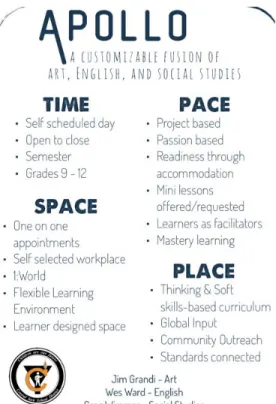
5.9.1 The Apollo Program brochure ... 92
5.9.2 Central York School District (CYSD) Ideal Learning Experience Classroom Placard ... 95
5.9.3 Learner agency continuum document ... 97
5.10 LOOKING AHEAD ... 102
6.0 ANSWERS TO THE RESEARCH QUESTIONS ... 103
6.1 PROFESSIONAL DEVELOPMENT FOR TEACHERS (GUIDING SUPPORT 1) ... 104
6.1.1 Description of professional development at Central York High School 104 6.1.2 Mapping of professional development at Central York High School to conceptual framework ... 105
6.2 READILY AVAILABLE TECHNOLOGY FOR ALL STUDENTS (GUIDING SUPPORT 2) ... 107
6.2.1 Description of technology at Central York High School ... 107 6.2.2 Mapping of technology at Central York High School to conceptual framework ... 108 6.3 FLEXIBLE SCHEDULING (GUIDING SUPPORT 3) ... 110 6.3.1 Description of flexible scheduling at Central York High School ... 110 6.3.2 Mapping of flexible scheduling at Central York High School to conceptual framework ... 112
6.4 DIAGNOSIS OF RELEVANT LEARNER CHARACTERISTICS
(GUIDING SUPPORT 4) ... 114 6.4.1 Description of diagnosis of relevant learner characteristics at Central York High School ... 114 6.4.2 Mapping of diagnosis of relevant learner characteristics at Central York High School to conceptual framework ... 116 6.5 EMPHASIS ON LEARNING TO MASTERY (GUIDING SUPPORT 5) . 118 6.5.1 Description of emphasis on learning to mastery at Central York High School 118
6.5.2 Mapping of learning to mastery at Central York High School to Literature ... 119
6.6.2 Mapping of interdisciplinary approaches at Central York High School
to literature ... 122
6.7 COLLEGIAL SCHOOL CULTURE INFLUENCING SYSTEMIC CHANGE (GUIDING SUPPORT 7) ... 124
6.7.1 Description of a collegial school culture at Central York High School 124 6.7.2 Mapping of collegial school culture at Central York High School to literature... 125
6.8 PRIORITIZATION OF SUPPORTS ... 127
6.9 LOOKING FORWARD ... 129
7.0 RECOMMENDATIONS AND IMPLICATIONS ... 130
7.1 NEED FOR ENHANCED PROFESSIONAL LEARNING ... 131
7.2 REVISION OF CONCEPTUAL FRAMEWORK ... 132
7.3 IMPLICATIONS FOR FUTURE RESEARCH, PRACTICE AND POLICY 134 7.4 THE EMERGENCE OF HEURISTIC THINKING ... 135
7.5 THIS RESEARCHER’S PROFESSIONAL GROWTH ... 137
APPENDIX A ... 139
APPENDIX B ... 157
APPENDIX C ... 158
LIST OF TABLES
Table 1. Seven Guiding Supports Reflected as Examples of Evidence from Literature ... 39
Table 2. Alignments to Research Questions 1-2 ... 42
Table 3. Content Areas of Current Teaching Assignment ... 54
Table 4. Level of Education Attained ... 55
Table 5. Total Number of Years Worked in Education ... 56
Table 6. Total Number of Years Worked at Central York HS ... 56
Table 7. Provision of Shared Collaboration Time During the Work Week ... 58
Table 8. Amount of Weekly Collaboration Time Provided ... 59
Table 9. Frequency of Implementation of Professional Development ... 61
Table 10. Frequency of Diagnosing Relevant Learner Characteristics ... 66
Table 11. Frequency of Implementation for Student Learning to Mastery ... 68
Table 12. Frequency of Implementation of Interdisciplinary Approaches ... 70
Table 13. Frequency of Implementation of Engaging in and Sustaining a Collegial Culture ... 71
Table 19. Essential Starting Points – Coding to the Principal’s Interview ... 84
Table 20. Pacing and Pedagogy – Coding to the Principal’s Interview ... 87
Table 21. Optimized Targets – Coding to the Principal’s Interview ... 90
Table 22. Apollo Program Brochure - Mapping to Guiding Supports ... 94
Table 23. CYSD Ideal Learning Experience Placard - Mapping to Guiding Supports ... 97
Table 24. Learner Agency Continuum - Mapping to Guiding Supports ... 101
Table 25. Concept Mappings to Professional Development for Teachers (GS1) ... 106
Table 26. Concept Mappings to Readily Available Technology for ALL Students (GS2) ... 109
Table 27. Central York Bell Schedule, 2017-2018 School Year ... 110
Table 28. Concept Mappings to Flexible Scheduling (GS3)... 113
Table 29. Concept Mappings to Diagnosis of Relevant Learner Characteristics (GS4)... 117
Table 30. Concept Mappings to Emphasis on Learning to Mastery (GS5) ... 120
Table 31. Concept Mappings to Interdisciplinary Approaches (GS6) ... 123
Table 32. Concept Mappings to Collegial School Culture Influencing Systemic Change (GS7) 126 Table 33. Top Two Priorities of Guiding Supports of Teachers versus Principals ... 127
LIST OF FIGURES
Figure 1: Conceptual Framework of Personalized Learning ... 32
Figure 2. Morville’s User Experience Honeycomb (2017) ... 50
Figure 3. Study Population versus Participant Response and Interviews ... 52
Figure 4. Belief Question: Goal of Personalized Learning Implementation ... 57
Figure 5. Adequacy of Collaboration Time ... 59
Figure 6. Adequacy of Technology Usage ... 63
Figure 7. Current Level of Satisfaction with Instructional Control... 64
Figure 8. Adequacy of Student Scheduling Flexibility ... 65
Figure 9. Apollo Program Brochure ... 93
Figure 10. CYSD Ideal Learning Experience Placard... 96
Figure 11. Learner Agency Continuum, attributed to Mr. Ryan Caufman, High School Principal ... 99
Figure 12. Conceptual Framework of Personalized Learning (Original to Study) ... 132
PREFACE
In the course of writing a dissertation, there are many human supports that make the experience possible. It would be impossible to list every single person, so I offer my thanks to some very special individuals:
I would like to thank my wife, Heather, and my sons Owen and Simon for their constant patience and love throughout the many years that I have spent as a graduate student at the University of Pittsburgh. I would like to thank my parents, Millard and Jean Thomas, for instilling a love for learning early in my life, and extend a thanks to my in-laws, William and Joan Berresford for contributing to my success in immeasurable ways.
It is important to acknowledge and thank my sister, Kathleen Shaffer, who, as a fellow educator, has served as a lifelong inspiration in many ways. I am forever grateful.
To my Dissertation Chair, Dr. Cynthia Tananis, I thank you for never giving up on me, finding each opportunity to craft my thinking, redirect when necessary, and refine my written language. I consider you my friend and hope to collaborate with you for many years to come. I would also like to thank my entire Dissertation Committee for their expertise and insight as the document evolved over time.
To my former colleague and dear lifelong friend, Dr. Susan Anderson, you have been a guiding light of learning and willing thought partner through all of my professional work. My gratitude for your friendship and mentorship is endless.
1.0 INTRODUCTION
1.1 BACKGROUND
Contemporary shifts in educational practice indicate progressive adaptations in how educators prepare students for an evolving new economy. Parents often assert the notion that students are bombarded with requirements to function in a twenty-first century world. For example, outside of the classroom, students are constantly learning new content by engaging with social media, communicating internationally in real-time and acquiring content through technological channels faster than their teachers could possibly deliver within the confines of a traditional classroom period.
In stark contrast, within many K-12 learning venues, the process of education has remained largely unchanged, designed around fixed time structures, institutional traditions, and value and belief principles ingrained into teachers who face a challenge to adapt their practice appropriately. Teachers who were taught from kindergarten through high school in traditional “one size fits all” classrooms may experience great challenge in adapting their learning
Some would argue that this static approach perpetuates a delay in the process of change and adaptability necessary to inspire innovation in today’s classrooms. Recent value-added measurement of student achievement has uncovered specific deficiencies in the current design of schooling as students are overwhelmed with content mismatched to their ability levels, rather than being taught to a level of functional competence. To illustrate the case in which content and experiences are not personalized on an individual level, Wright, Horn, and Sanders (1997) describe a concern about academic gains decreasing as the average achievement levels of students rise. They infer that “possible explanations include lack of opportunity for high-scoring students to proceed at their own pace, lack of challenging materials, lack of accelerated course offerings, and concentration of instruction on the average or below-average student” (p. 66).
There is an emerging revolution within the profession, where the redesign of “how we do school” within schools may change with the opportunity of further exploration and enhanced professional practice. Recently, the concept of Mass Customized Learning (McGarvey & Schwan, 2012) appeared as an intriguing notion for consideration.
McGarvey and Schwan define Mass Customized Learning as a flexibly scheduled, meaningful, individualized learner-specific experience with a goal of a mastery level of skill attainment (McGarvey & Schwan, 2012). Their proposal requires practitioners to suspend traditional definitions of outcomes and to identify the processes that underlie and constitute deep and authentic learning. Most often, their preferred learning environment strategically involves the use of mobile or personalized devices, commonly in a one-to-one application. Such devices permit educators to implement different pedagogical approaches and time flexibility for students to learn at a mastery level - the core of the authors’ beliefs about personalized learning.
In contrast to Mass Customized Learning, the term personalized learning is used for this study to facilitate analysis and investigation of the body of literature assembled. It is intended to encapsulate an approach to a learning relationship with a student, rather than a cliché or fad-like name, such as Mass Customized Learning. The former part of the name, “personalized,” is similar but not identical to mass customization of virtually anything. Paralleled examples of a “customized” lifestyle in McGarvey and Schwan’s work (2012) are “customized” Amazon shopping lists, tailor-made Starbucks coffee beverages, and preferred music choices within iTunes playlists. The authors infer that learning environments could receive similar treatment. In a hypothetical example, students would create topical “wish lists” to make a choice of content to study, enact a pace of course progression of their own will, and seek outcomes that demonstrate knowledge of content.
1.2 PURPOSE OF THE STUDY
The goal of this study was to investigate the implementation of personalized learning in a high school setting and map the observed practices to a framework of concepts from the literature related to and in support of personalized learning as a means to research promising practices for establishing personalized learning environments within schools. I identified present-day factors influencing successful integration of personalized learning into innovative school operational and
learning-based system that fulfills every learner’s need at his/her present performance level. Rickabaugh (2016) describes the industrial model of learning as an experience “to provide substantially the same learning stimuli to everyone in the class at the same time” (p. 22). Educators might describe personalized learning opportunities as methods to explore students’ most effective modality of learning, affording a learner a scenario in which to attain mastery-level comprehension of skills. The description may include highlighting essential concepts in a content area hoping to engage the student in content and activities that are relevant and exciting.
There are varied themes in the practice and the research that assume a similar linkage between mass customized learning and personalized learning. In many contemporary conversations among practitioners, the terms are used interchangeably, often to the point of confusion. The heart of the personalized approach is that instruction is intended to be different for every student’s learning style and environmental needs to enable him or her to achieve content and skill mastery. Rickabaugh (2016) refers to this as “learning that starts with the learner” inferring that “any connections that students make will be based on their experiences, interests, goals and needs” (p. 24). The root of the word “personalized” is “personal.” It is necessary to distinguish between the concepts of personal and personalized, as they are not identical.
There is diversity in the reasons why a high school would pursue personalized learning at all. Toshalis and Nakkula (2012) indicate one possible reason, related to how high school students seek greater independence, stating learning environments “that capitalize on the power of self-determination can substantially increase achievement and motivation” (p. 32). One impetus is the proliferation of mobile devices, which are now in the hands of teenagers, perhaps resulting in different expectations of communication and focus. Theoretically, every school in
the country could be mapped on a continuum of purely traditional methods of instruction (e.g., no personalization) to an opposite scenario that provides multiple strategies to reach learners. The latter on the continuum are often schools that advertise and endeavor to offer personalized learning.
My background in teaching various levels of Chemistry and Science in grades 9-12 and my experience as an administrator in grades 7-12 have shaped my interest in personalized learning; I have witnessed so many students contending with the academic content of today’s school instruction in a half-hearted manner. Student ownership of the learning environment may lead directly to meaningful student involvement (Fletcher, 2008). Many students lack a desire to participate in educational content with depth, often because of the pacing of a course and inadequate time allotted. Personalizing the learning experience for a student has the potential to center educational practice on the goals of differentiating instruction, adapting pacing and providing adequate instructional presentations for a diversity of learning styles. A greater attainment of mastery is possible through highly meaningful and individualized learning. The hope is to reveal the interconnections among the practices of personalized learning, as mapped onto the literature sources supporting such practice.
To clearly reiterate, the purpose of this study was to investigate the implementation of personalized learning within a high school setting, mapping observed practices onto a framework of literature related to and supporting personalized learning as a means to explore promising practices for establishing personalized learning environments within schools.
1.3 RESEARCH QUESTIONS
To enhance comprehension of personalized learning, I gathered data from teachers and administrators working in a Pennsylvania high school in an effort to review stated and observable practices as they relate to the literature underpinnings. The goal was to follow a case study design with one high school; this effort was to better understand the school’s practices regarding the personalized learning they advertise to their constituents, subsequently mapping the findings onto a body of literature derived from similar instructional practices. There are two specific research questions:
1. How is personalized learning described in a school professing to implement ‘personalized learning?’
2. How does the concept of personalized learning in a school map onto seven guiding supports of personalized learning strategies drawn from the literature?
1.4 SIGNIFICANCE OF THE STUDY
Personal learning involves an “intellectual intimacy” (Dewey, 1907) between the learner and the content to be learned, perhaps as a method to uncover his or her personal interests in the world. Personalized learning shifts the focus onto how the student receives an instructional experience, and how the learning approach is tailored for individual competency and mastery, at a pace of individual choice. John Dewey (1907) supported a notion of personalized learning over a century ago. He referenced a revolutionary shift in “the center of gravity” as indicated in an excerpt from The School and the Life of the Child: “I may have exaggerated somewhat in order to
make plain the typical points of the old education: its passivity of attitude, its mechanical massing of children, its uniformity of curriculum and method” (p. 51).
Dewey (1907) further elaborates that the center of gravity is unfortunately outside the child. In this notion, Dewey (1907) states “the center of gravity is in the teacher, the text-book, anywhere and everywhere you please except in the immediate instincts and activities of the child himself” (p. 51). Also, in his 1907 work, Dewey predicted a change which is coming into education premised on this shifting of the center of gravity. Then Dewey (1970) describes this as a change, a revolution, not unlike that introduced by Copernicus when the astronomical center shifted from the earth to the sun. In this case, the child becomes the sun about which the appliances of education revolve; he is the center about which they are organized. (p. 51)
Some could argue that personal learning has promise, enabling a pathway to the ability and interest levels of the student; the child attains mastery via the instructor’s facilitation of strategies, devices, or tasks. The point is for children to answer their questions about the world, gaining full comprehension of concepts with efficacy. With the advent of modern technology in the form of personal, mobile devices, often referred to as 1:1 device programs, the action of bringing personalized learning to schools, en masse, has the potential to become a vision fulfilled. Zheng, Arada, Niiya, and Warschauer (2014) elaborated on the use of mobile devices in schools by creatively listening to student voices, collecting perspective and opinions of how
efficient with laptops may be important in garnering and sustaining student support for the program” (p. 295).
Personalizing a learning environment is not new in K-12 education. The goal is not to seek out how this is a nouveau approach to teaching and learning. It has become, however, a more intriguing model of educating students as students have greater access to mobile devices. An analogy to be applied is one of a garden and the tools associated with a garden. While planting seeds and growing fruit has often been routine and purposeful, the soil of the garden itself has become more fertile with improved tooling. Mobile devices (e.g., smartphones, iPads, and laptops) with the addition of learning management systems (e.g., Schoology, Moodle, Blackboard) have the potential to make the personalization more accessible for administrators and teachers to design and to implement.
1.5 MODELING PERSONALIZED LEARNING
Peter Senge (1990) is responsible for seminal work on the concept of learning organizations where interactive and interdependent learning predominates. The primary rationale for the creation and existence of such organizations is that, given scenarios of accelerated change, only those organizations that are flexible, adaptive, and productive may realize operational success. While all people have the capacity to learn, the structures within which they are often required to operate may restrict the type of reflection and commitment that is paramount to learning. According to Senge, organizations expand their capacities to create their own futures through interdependence, where each person recognizes his or her commitment to the learning of others. Further, Senge (1990) found that, for many learners, truly exceptional learning experiences are
deeply personal, meaningful, and memorable when the environment is engaging, enlightening and optimally relevant. The classic bell curve may be the catalyst for a highly individualized survival type of thinking about learning where one learner’s success is defined relative to all other individuals who will earn a discreet place on that curve.
Senge (1990) recognizes that survival learning, or what is more often termed “adaptive learning,” is paramount and necessary. Additionally, a learning organization must go beyond “adaptive learning” and infuse “generative learning,” which is learning that enhances our capacity to “create” (Senge, 1990, p. 14). The dimension that distinguishes learning organizations from more traditional organizations is the shared responsibility for mastery of content and the efficacy of a truly creative learning operation (Senge, 1990).
Senge (1990) identifies five disciplines that converge to provide the foundation for innovative learning organizations. Senge (1990) further specifies that the disciplines are itemized as systems thinking; personal mastery; mental models; building shared vision; and team learning. He elaborates on the need for these disciplines to have a working functionality within an organization for it to qualify as a learning organization, premised on the sincerity of systems thinking. Senge (1990) writes that systems thinking is needed more than ever because we are becoming overwhelmed by complexity, given the exponential proliferation of knowledge at a pace of acceleration beyond what anyone can hope to absorb independently.
a true capacity to influence and shape the future. The author advocates that the best pathway to truly meaningful and personalized learning is through social and interactive exchanges.
1.6 IMPORTANCE TO STUDY
An increasing number of schools are advertising personalized learning as a way to attract students to their institutions, in an effort to compete with non-traditional schools such as charter schools and cyber-charter schools. Some may argue that awareness and cognition of learning theory among educators becomes paramount to adequately addressing the characteristics of learners enrolled in K-12 education environments. With a new generation of students currently enrolled in K-12 education dubbed “Generation Z,” educators may be surprised to observe that personalized learning feels natural due to their often ‘made-to-order’ life environment. Seemiller and Grace (2017) elaborated on this generation by stating “not only are they accustomed to engaging in individual learning, our study found that these students prefer it because they can focus, set their own pace, and make meaning of their learning before having to share that meaning with others” (p. 23). The essential learning needs of our current K-12 students provide us fertile ground for exploring the topic of personalized learning in high schools.
2.0 REVIEW OF THE LITERATURE
2.1 PERSPECTIVES ON PERSONALIZED LEARNING
2.1.1 Similarities of personalized learning to differentiated instruction
The purpose of this chapter is to engage the reader in a multitude of literature lenses that support how a personalized learning approach manifests itself in contemporary practice. A body of literature contextualizes ideas that underpin strategies in personalizing learning. These differentiated approaches to instruction seek to address students of varied content-readiness levels and modes of learning when present in the same classroom (Stradling & Saunders, 1993; Tomlinson, 2003). As Stradling and Saunders (1993) state, differentiated instruction is “the process of matching learning targets, tasks, activities, resources, and learning support to individual learners’ needs, styles, and rates of learning” (p. 129). In contrast to personalized learning, differentiated instruction focuses on delivery, rather than on a self-directed approach to learning. Dewey’s (1907) “shifting center of gravity” now may be contemplated as a shift in the locus of control from learning facilitator (i.e., teacher) to the learner. Tomlinson (1999) infers
all learners by providing varied levels of difficulty, adapting the amount of scaffolding, and modifying the way in which students demonstrate effort. Teachers using differentiated instruction often have a goal to capitalize on the individual student’s growth and abilities by delivering learning at the precise level of the student’s understanding, further maximizing their learning experience.
This is slightly different from personalized learning, where teachers facilitate learning activities and experiences, and in contrast, provide choice to their students in which path they choose. According to Tomlinson (1999), differentiated classrooms have a core belief that students of similar age differ in their readiness for learning and have unique life experiences and circumstances. Tomlinson (1999) further asserts that differences in abilities and experience are not negligible, but rather should be adapted for pacing and the level of intervention that they need from their teacher. Tomlinson (1999) concludes, "for all its promise…effective differentiation is complex to use and thus difficult to promote in schools. Moving toward differentiation is a long-term change process" (p. 6).
Differentiated instruction is rooted in assessment, like personalized learning; in contrast, however, it is often teacher-chosen and teacher-driven. Another similarity between the two modalities is that differentiated instruction, like personalized learning, explicitly emphasizes multiple approaches to teaching content (Tomlinson, 1999).
2.1.2 Similarities of personalized learning to self-paced instruction
One attribute of personalized learning is the self-directed, self-pacing of the learning experience. Self-paced instruction is an arrangement in which individual students set a personal schedule for learning and monitor their self-progress (Good, 1973). Most importantly, students progress at
their own rates through the curriculum. Various forms of self-paced instruction have been used sporadically in classrooms throughout the United States since the mid-nineteenth-century (Kulik, 1982); thus, self-paced learning exists in some facets of contemporary school culture, most likely the result of historical developments within the past sixty years.
During the 1960s, educational venues experienced self-paced, programmed instructional materials, perhaps generated by B. F. Skinner’s earlier position paper The Science of Learning and the Art of Teaching (1954). Skinner’s work was written in part from the vantage point of parental frustration with the pedagogy observed through his daughter’s mathematics classroom. One of the issues that Skinner (1954) noted in his paper was “the lack of a skillful program which moves forward through a series of progressive approximations to the final complex behavior desired” (p. 91). His perspective prompted discourse on how any learning could become ambiguous without a programmatic framework with an end-goal in mind.
After Skinner, individualized systems of instruction were developed and widely implemented at all levels of education (Gagne & Briggs, 1979). Systems such as Individually Prescribed Instruction (IPI) and the Personalized System of Instruction (PSI) relied on self-paced methods. These methods have since been incorporated into the development of Computer-Assisted Instruction (CAI) via the emergence of the personal computer in the 1980s, and most recently, the mobile device in the first decade of the twenty-first century. According to a 2015 Pew Research Center study, approximately 88 percent of United States teenagers (e.g., ages 13 to 17) possess or have access to a mobile phone, and a majority of teens (i.e., 73%) have
another in important instructional aspects. Self-paced instruction is a fundamentally embedded ideal within personalized learning environments where the learner accepts responsibility for pacing and timing to substantiate a mastery of content-area concepts and knowledge.
2.1.3 Current perspectives prompting changes in practice
Since the educational landscape has changed with the advent of charter schools and competition, I have observed that the culture has shifted to one of rapid change in practice, perhaps best served by imaginative leadership. The emergence of mobile devices in students’ hands has caused a disruptive shift whereby educators are challenged by learning environments and strategies that are not yet fully vetted. Darling-Hammond (1993) stresses the need for all students to learn at high levels and views the task of instruction as that of enabling diverse learners to construct their knowledge and to develop their talents in useful and meaningful ways. She proffers that effective educators should be skilled at improvising and adapting their own teaching practices to address varying ability levels and diverse individual interests. Perhaps the most salient examples of effective educator practice are those that evidence significant flexibility within the professional practice of the instructor.
Across a body of literature, exploration of personalized learning practices reveals seven converging themes of research and educational practice, evident within the current educational landscape: the concept of mastery learning; the practice of diagnosing salient learning characteristics; an increasingly collegial school culture influencing systemic change; the practice of flexible scheduling; a focus on interdisciplinary design, the provision of professional development for teachers, and readily available technology for all students. These literature
items are provided here for analysis as “guiding supports” of personalized learning practices in the subsequent sections in Chapter 2.
2.2 GUIDING SUPPORTS DRAWN FROM LITERATURE
2.2.1 Emphasis on learning to mastery
Perhaps the most lacking area of contemporary instruction of the masses is the notion of comprehension of concepts to a mastery level. Standards-aligned systems dictate alignments such as eligible content and pace but tend not to specify the degree to which students should be able to demonstrate their learning of a given concept. Moreover, logistical constraints (e.g., bell schedules, school years) may end up being the final determiners of how much instructional time is given to all concepts. These constraints have the potential to stifle flexibility for teachers to accelerate and to modify learning experiences for advanced learners or to decelerate and expand remediation and re-teaching for learners who experience difficulty. It is important to note that both acceleration and deceleration should require rigor and struggle with content.
In United States schools, the term “Generation Y or GenY-ers” has been used to describe current school students, defined as children born after 1995. These individuals have been brought into a culture of frequent gratification on many social and experiential levels, perhaps
learning is how instructors assess the work of learners. Some classrooms achieve minimum learning towards mastery, but may result in at least a passing grade for the student. In other words, in some classrooms, it would be easier for a learner to just pass a test than to demonstrate mastery knowledge of individual concepts. Some could argue that instructional technique required to result in student skill mastery is contrary and divergent from the learning pathway that constructed the instructor’s learning, potentially causing an unfortunate rift in expectations from both the instructor and learner perspectives.
2.2.2 Diagnosis of relevant learner characteristics
Educators regularly make decisions about the children whom they teach to assess their readiness to learn. Ostensibly, these decisions are centered on developmentally appropriate features of learning for a particular age or grade level. The assessment of group readiness is a traditional planning strategy, as opposed to assessment designed to personalize or individualize instruction. However, if educators are to meet the needs of every student in the classroom, the challenge then becomes ‘how’ to personalize learning in a way that attends to the learning readiness of the classroom, as a group, and as individual learners.
In the text Thought and Language, Vygotsky (1986) established the expression “zone of proximal development” or ZPD. This statement descriptively serves as a working definition for a student’s intellectual readiness for attaining a learning task or concept. ZPD is one way to conceptualize the notion of learner readiness, but it is used very finitely to describe a discrepancy between what a student may accomplish independently as opposed to what the student would achieve with a skilled learning facilitator.
Perhaps instructors would postulate that the precise area of personalized learning is on a continuum of learner readiness from ‘monotony’ to ‘apprehension’ of the content being learned in which every learner is unique and different. Readiness levels across a classroom of students differ; therefore, the levels of challenge provided would need to vary as well (Tomlinson, 2003; Vygotsky, 1986).
To further the notion of learner readiness, it is important to note the discrepancy between readiness and student motivation. Csikszentmihalyi, Rathunde, and Whalen (1993) evidenced a strategic correlation distinctly between these two variables. Their study, involving over two hundred students, queried why some adolescents appear to attach to the development of perceived talents while others in their peer group disengage and neglect the same. Their conclusions portray a strong correlation between the complexity of the learning task(s) and the individual skill level of the learner.
Learners who possessed adequate skills in a non-challenging environment demonstrated low involvement in the learning task with a corresponding decrease in concentration and focus. In contrast, those learners who entered the learning task with minimal skill related to the actual task demonstrated low involvement, low achievement, and declining self-confidence. The authors concluded that a lack of challenge or stimulation of learning undermined learners in personal perceptions of their individual competence and confidence. The ideal learning experience is one of adequate skill and challenge. Further, the researchers found that instructors who effectively develop students’ talents plan and design instructional activities that are
2.2.3 Collegial school culture influencing systemic change
The literature on the topic of Collegial School Culture seems to be organized around three major themes: change, culture, and curriculum. Educators hoping to create an environment of learning that is personalized to the student may view it as an opportunity to expand their own professional practice; however, this is a shift in culture that may be perceived as intimidating for teachers to implement. The discussion of a collegial school culture in support of personalized learning must ensue to empower educators to study personalized learning. For this reason, cultural change and curriculum modification will receive elaboration.
A focus on systemic change across the United States is currently guiding professional development programs centered on school reform, particularly in quantitative accountability measures of both students and educators. The catalysts for the reform efforts are often complex. Fullan (2000) summarizes his belief into a formula: E =MCA2. The variable E refers to the rate of Efficacy of the system; M refers to the Motivation for reform (i.e., will, purpose, commitment) while C refers to the Capacity for reform (i.e., available resources, know-how, skills). A2 refers to Assistance times Accountability (Fullan, 2000).
With the complexity of establishing “who” is responsible for exhibiting the reform in schools, Fullan’s formula holds true today, as professional development is intimately associated with all tenets of this computation (2000). Expanding on the reform effort, the “who” also becomes of paramount importance influencing how educators measure the scope and scale of professional development. Coburn (2003) found that it is more challenging to measure conceptual change or enacted pedagogical principles than to record and quantify the presence or absence of activities or materials. Further, Coburn’s study found it is more challenging to measure the spread of “norms of interaction” than the number of teachers or schools involved in
an initiative (Coburn, 2003, p. 9). The scale of data collection when considered in the context of the moniker “school reform” has social and political implications, as public policy is driven by multitudes of data collected across schools, districts, intermediate units, states, and national regions.
2.2.4 Flexible scheduling
Most secondary schools design a “bell schedule” for students of four to eight periods of equal length; a typical student schedule specifies a time for travel between classes and provides time for serving and eating lunch. The concept of a bell schedule is premised on the factory-model of schools delivered on a nine-month schedule and influenced by an agrarian calendar of the nineteenth and twentieth centuries. Innovative notions, such as open education and non-graded schools, have inspired school leaders to implement flexible options for both students and teachers.
2.2.5 Interdisciplinary approaches
In addition to the innovation of flexible time schedules, interdisciplinary teaming was also brought into planning discussions as a catalyst to teach concepts that span multiple academic disciplines. Rickabaugh (2016) expresses flexibility in scheduling as an opportunity for learning,
What is more fascinating is that the concept of interdisciplinary teaming is not a new concept. During the 1960s and 1970s, this approach toward an interdisciplinary teaming was dubbed the Pontoon Transitional Design (PTD), an integral component of the NASSP Model Schools Project. PTD had a goal of developing a temporary “pontoon bridge” of time during the school day during which teachers gather in interdisciplinary groups with a goal of spanning the gap between educating mass numbers of students while personalizing education. It further served as a comprehensive model to inspire collaboration, placing responsibility for decision-making, scheduling, grouping, and cross-integration of academic content with teachers during the time afforded to the “pontoon” component of a school day (Georgiades, 1969).
2.2.6 Professional development for teachers
The process of establishing school culture where all stakeholders, especially educators, possess ownership and are motivated to receive professional development is a continuously evolving lens within the literature. Sociologist Dan C. Lortie (1975) in his book Schoolteacher: A Sociological Study expressed the complexity of schools and the educators that teach students within their walls. Specifically, he defined educators as possessing three characteristics which would have a significant impact on how they approach professional development. The first, “presentism,” is a short-term perspective that prevents educators from envisioning or planning collaboratively for long-term, systemic change. The second, “conservatism,” is a mistrust of reform initiatives and a reluctance to change everyday classroom practices, even in the face of research findings and pupil learning outcomes suggesting that better approaches are needed. The third, “individualism,” is identified as teachers closing their classroom doors and working in isolation from colleagues and administrators, which has been linked to weak teamwork, lower levels of
teacher efficacy and self-efficacy, less relational trust, failed innovations and reforms, and lower student achievement (Lortie, 1975).
Social cognitivist Albert Bandura (1986) identified four sources of self-efficacy: enactive mastery, vicarious experience, social/verbal persuasion, and physiological arousal. Related to school culture, and specifically to teacher professional development, is enactive mastery, which is a condition whereby educators rely on perceptions of past mastery to produce information that is used to make judgments about present capabilities (Bray-Clark & Bates, 2003). Educators may appreciate an opportunity to participate in professional development that will lead them to mastery of new teaching strategies and exposure to curriculum content before any leadership expectation for classroom implementation. When teachers are challenged to use their learning from professional development, and can do so successfully, they are more likely to use that learning when they return to a classroom setting (Bray-Clark & Bates, 2003).
The effectiveness of professional development has a strong interaction with curriculum structures in school, particularly when used in a specified content area. Penuel, Fishman, Yamaguchi, and Gallagher (2007), researching the implementation of a science curriculum, found the following:
“a) There must be a good ‘fit’ between the curriculum and the local context, shaped partly by the effectiveness of the professional development activities; b) ‘Fit’ is also shaped by the ability of the professional development providers to meet the training needs of the teachers; and c) The coherence of the professional development is most
Thus, meaningful professional learning has the potential to enhance positive school culture for educators.
In a quantitative study, Cwikla (2003) found that educator training focused on the National Council for the Teaching of Mathematics (NCTM) Standards had not yet explicitly described professional development activities related to teacher learning goals, nor did it specify an optimal training environment needed for teachers to maximize comprehension. Moreover, curriculum innovation could not be defined with fidelity until individual teacher learning goals were explicit. Subsequent empirical research on the methods to support teacher development and their respective learning environments could not accumulate until explicit goals were identified (Cwikla, 2003).
Each study within the body of literature reviewed here offers a contextual lens within the research that is presented. In whole, these findings are quite varied. It is fascinating to see, within the literature, a significant focus on the attributes of the human psyche when considering the teacher as learner. Professional development must be adapted accordingly to nurture individual human needs of teachers as adult learners. Not surprisingly, the educator becomes the learner when in the setting of professional development activities, and thereby, requires differentiation to make the experience personal and meaningful.
2.2.7 Personalized devices: Readily available technology for all students
While one-to-one mobile computing implementations have brought about changes in teacher pedagogy, these initiatives have also affected student motivation and engagement (Bebell, 2005; Silvernail & Lane, 2004; Swan et al., 2005). Bebell (2005) surveyed over four hundred seventh grade students and thirty-five teachers during the first six months of a one-to-one laptop program
in six schools in New Hampshire. The survey questions focused on access to, and use of, technology. He found that students almost doubled their use of the laptops during the implementation period across all the main subject areas. The teachers reported improvement in student participation, motivation, attendance, and their ability to work independently and in groups. Additionally, over ninety percent of teachers reported an increase in student engagement for both traditional and at-risk students. Students also displayed more effort in the quality of products they produced, were more willing to complete new drafts when assigned writing assignments, and seemed to work harder on classwork (Bebell, 2005).
Silvernail and Lane (2004) found similar results for student engagement when they evaluated the initial phase of the Maine Learning Technology Initiative (MLTI). The study used a mixed-method approach and analyzed over twenty-six thousand student surveys regarding the use of laptops to support instruction. It also included one thousand seven hundred parent surveys, along with site visits, observations, and document analysis. The researchers found that almost seventy percent of the students reported being “more involved in school and with their classmates” and that the laptops “made school more interesting” (Silvernail & Lane, 2004, p. 17). For personalized learning to be efficient in today’s school culture, it seems reasonable to predict that a learning device such as an iPad or Chromebook has the potential to enhance the learning experience; technology, however, brings a new and evolving set of leadership challenges. Implementing a one-to-one program can bring about several challenges for teachers and administrators working at a school. The issues that arise from these problems may cause
Abell Foundation, 2008; Brodzik, 2012; Rousseau, 2007). Classroom management is an essential component needed to implement a successful one-to-one program (Brodzik, 2012).
Teachers with strong classroom management skills will have a higher chance of being able to change their curriculum to coincide with the introduction of technology (Brodzik, 2012). Researchers have found that even with clear discipline procedures, laptops in every student’s hands can be a forum for a variety of challenges. Rousseau (2007) compared student discipline during one-to-one laptop programs in low- and high-socioeconomic (SES) schools in Maine. She collected qualitative data through observations and interviews and found significant behavior issues related to the laptops mainly in the low SES school. Students were intentionally damaging their laptops. Participants in the study reported abuses ranging from liquids being poured on the laptop to students “trying to round the edges by dragging it on the street out a moving car” (Rousseau, 2007, p. 131).
These distractions also occurred in the classroom setting. During an unstructured time, students were observed listening to music, accessing inappropriate websites, and instant messaging (Rousseau, 2007). Tasgold (2012) found similar results from an analysis of experiences with one-to-one computing among teachers and students in a high school in North Carolina. She conducted interviews with sixteen students and three teachers and observed six classrooms. She found students using proxies to bypass Internet filters meant to keep them from accessing inappropriate websites. Students in the study also admitted that having the laptop encouraged off-task behaviors such as checking their emails or accessing social networking sites (Tasgold, 2012).
2.3 ALIGNMENTS TO CASE STUDY DESIGN
In case study design, research questions guide decisions regarding the subject to be studied, as well as help to craft a “blueprint” of how the case study will be conducted. Yin (2014) notes that “research design is much more than a work plan” (p. 29) and encourages researchers to avoid situations in which the evidence and outcomes do not correspond to the initially proposed research questions. He adds that an excellent research design should evolve to deal with a logical problem to be resolved. The actual design of a case study should not be viewed as a checklist or work plan. Yin encourages researchers to place whole focus on how the design impacts the research questions to be answered.
Yin (2014) creates a framework for a case study research design, placing emphasis in five areas: (a) study questions, (b) study propositions, (c) unit of analysis – “the case,” (d) a logic that links data to propositions, and (e) criteria for interpreting the findings of the case study (p. 36). The first three components of the framework lead the researcher to identify data that are to be collected, whereas the lattermost two elements infer “what is to be done after the data have been collected” (p. 37).
When in the design phase of a case study, theory development is highly recommended. Yin (2014) encourages a straightforward theoretical statement from the outset of the initial research design and deliberation, to manifest strong fidelity and identifiable linkages to all five desired areas in the research design. Theory development is supported by a review of the
to “analytic generalization” and “statistical generalization,” both serving as strategies to compare and contrast the current case study design with lessons learned from other research projects. Analytic generalization refers to the role of a theory within a research design. In contrast, statistical generalization refers to how a researcher could comparatively simplify empirical data gleaned from other research, such as making an inference across an entire population, as compared to an individual sampling (Yin, 2014, p. 40). Researchers need to know the confidence in which they may extrapolate a theory’s functionality from a small sampling of data, as compared to a large population of data. Yin (2014) denotes a “fatal flaw” when a case has a minimal sample size, which nullifies the ability for the sample to represent any larger population of data.
2.4 CRITIQUE OF CASE STUDY RESEARCH
Well-reviewed descriptive case studies, often in a narrative format, enable the researcher to engage complex projects and make them accessible in an attractive fashion for, at times, a non-researcher audience. The scope of the case study design is flexible and broad, ranging from brief summaries to annotated accounts. Case study enables a “storytelling” approach, whereas the researcher can propose the beginning of ideas, an exploration of what was observed, and sometimes “why,” restate the goals of the research, delve into particular phenomena, and often present outcomes in their original complexity. The latitude to obtain varied forms of data gives the case study researcher an ability to explore new research ideas and discuss the evolving characteristics of a project.
Despite their advantages, case studies have received criticisms. Yin (2014) discusses three types of arguments against case study research. First, case studies are often accused of lack of rigor. Yin (2014) notes that, “Too many times, the case study investigator has been sloppy, and has allowed equivocal evidence or biased views to influence the direction of the findings and conclusions” (p. 20). Some critics note that case studies establish a minimal basis for scientific generalization since they use a small number of subjects. The question raised by Yin (2014) is “how can you generalize from a single case?” (p. 20). Tellis (1997) also explored a dependency on a single case exploration, finding it difficult to reach a generalizing conclusion.
Case studies are often identified as being too long, difficult to conduct and producing a massive amount of documentation (Yin, 2014). If analyzing a sampling of students over several years, a single researcher would be facing a monumental task of handling copious amounts of data in that timeframe. Data that are not managed and organized systematically become problematic and a menace to a thoughtful and precise outcome.
Yin (2014) considered case methodology “microscopic” as a result of the limited sampling cases. Yin, however, believes that establishing parameters and an appropriate research context are of paramount importance when compared to designing for a large sample size. The establishment of parameters, a well-organized plan for data collection, and clarity of context will be the goals of my methodology.
learning styles. From John Dewey’s (1907) “shift in the center of gravity” to the present-day shift in the locus of control from teacher to student, described by Peter Senge as the “discipline of personal commitment and mastery” (1990), attempts at implementation of personalized learning have persisted from initial iterations of programmed learning to the present-day Mass Customized Learning initiative which is augmented by new technology.
Although well-grounded in the belief that personalized learning is, and ought to be the goal, practical issues such as scheduling constraints, shortage of time, and limited resources have impeded attempts to implement a sustainable model to the fullest extent. Additional studies are needed to understand the full potential of personalized learning with twenty-first century technology and limited constraints.
During 2015, the Bill and Melinda Gates Foundation engaged the RAND Corporation to conduct research related to personalized learning. Sixty-two public schools, identified as predominantly urban/suburban, charter-driven, and of economically disadvantaged status committed to participate in this study (Pane, Steiner, Baird, & Hamilton, 2015). According to the report, student achievement was the focus of the study, providing a quantitative measurement of growth or regression within standardized assessments. The measurement was a comparison of different systems, a multitude of practices and varied learning environments, all three of which were viewed as “core attributes” of the research conducted.
What has not been studied as intently are the perceptions and beliefs of administrators and teachers that are working within schools that ‘advertise’ a personalized learning approach to their constituents, but are not following a prescribed organizational approach or research-tested methodology. These are the schools, particularly at the secondary-level, that interest me because there is a distinct possibility that the presence and notion of personalized learning in schools will
grow in popularity during the next decade. The business of schools is evolving, perhaps due to the competition of other learning environments, such as charter schools, cyber charter schools, learning centers (e.g., Sylvan and Huntingdon Learning Centers), all in concert with new devices and applications that encourage a single user to engage in technology-enhanced, student-centered instruction.
3.0 METHOD
3.1 INTRODUCTION
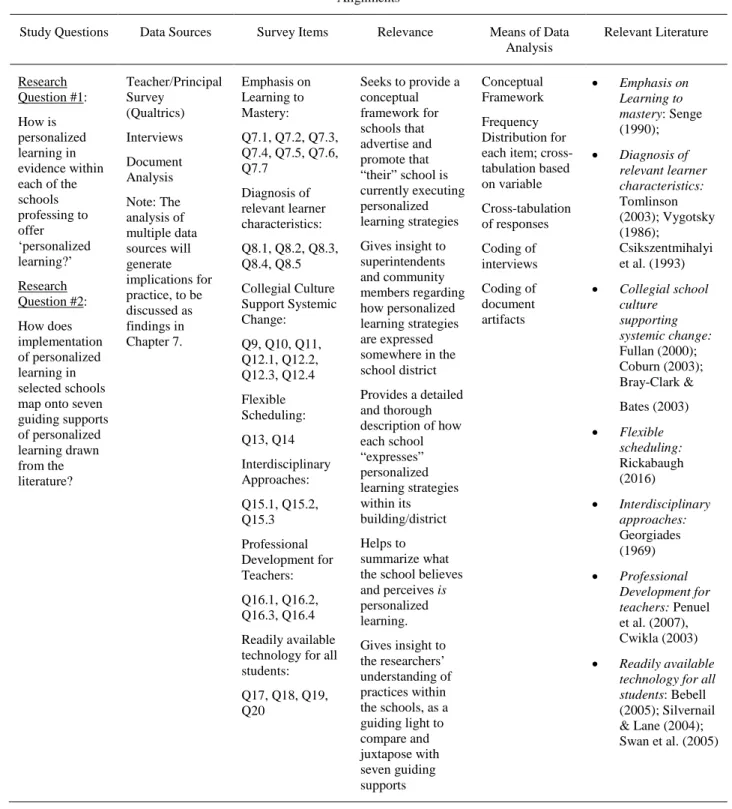
This case study examined a high school claiming to use personalized learning strategies. It focused specifically on the beliefs and practices of both teachers and principals. I will use the conceptual framework of guiding supports discussed in Chapter 2 as a lens for data collection and analysis. To illuminate and understand the qualities of the case, the study was conducted in two phases of inquiry. Participants from the high school participated in an online survey. Subsequently, the survey data was used as a filter to identify interview questions with both a teacher and a principal to understand better how their experiences related to various supports for implementation as defined in the literature review (See Section 2.2). The sections that follow serve to describe the case study design, identify the participants, and describe the methods used for data collection and analysis.
3.2 CONCEPTUAL FRAMEWORK
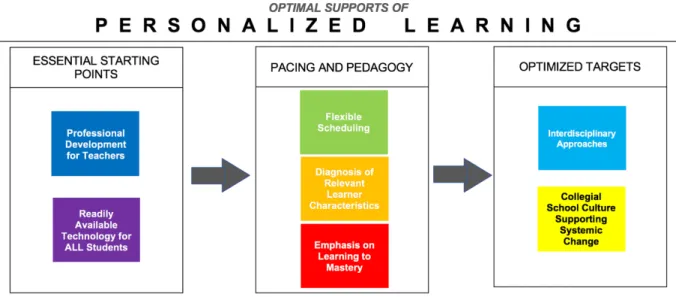
This case study focused on a proposed conceptual framework derived from the literature sources found in Chapter 2. As the literature review revealed, seven guiding supports have the potential to remove constraints and optimize opportunities for students to experience personalized
learning within schools: (a) emphasis on learning to mastery, (b) diagnosis of relevant learner characteristics, (c) collegial school culture supporting systemic change, (d) flexible scheduling, (e) interdisciplinary approaches, (f) professional development for teachers, and (g) readily available technology for all students.
The purpose of the study was to explore personalized learning through evidence indicating the presence or absence of these guiding supports derived from the literature. This case study examined a high school claiming to implement personalized learning practices. The high school demonstrated a commitment to implementing personalized learning strategies for students.
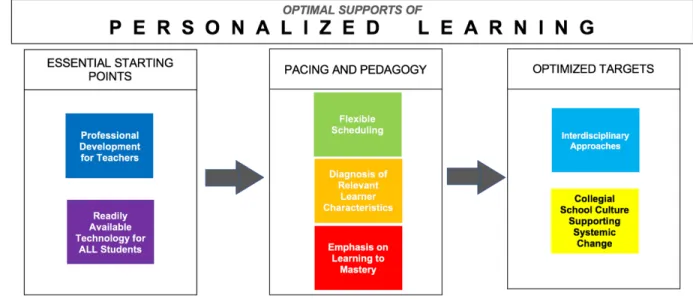
Sources of evidence used for the purpose of this study include survey data from teachers and principals as well as two follow-up interviews. Data types included perceptions of instructional delivery; scheduling practices; professional development practices; evidence of flexible scheduling within the master schedule, including teacher discretionary options for the use of instructional time; and documentation indicating availability and ease of access of mobile devices for all students. These descriptors of data sources align to the seven guiding supports derived from literature discussed in Chapter 2, as displayed in Figure 1.
Figure 1: Conceptual Framework of Personalized Learning
This conceptual framework assisted with identification and categorization of evidence that personalized learning strategies are in place in the high school of study. Further, the conceptual framework served as a common reference between the researcher and the participants, to lead discussions and facilitate data collection related to personalized learning strategies observed in the participating high school.
3.3 RATIONALE FOR CASE STUDY METHODOLOGY
Contrary to Yin (2014), who would most likely recommend a narrow and regimented design for case study method, Stake (2005) argues for a flexible design, which would allow researchers to make major changes even after they proceed from their initially proposed design to the research itself. Merriam and Tisdell (2016) posit, “the single most defining characteristic of case study research lies in delimiting the object of study: the case” (p. 38). The “what” is a single entity
around which there are boundaries, able to “fence in what you are going to study” (p. 38). A broader and more flexible definition of cross-case analysis came from Miles, Huberman, and Saldaña (2014) when they described it as “a phenomenon of some sort occurring in a bounded context” (p. 28).
The proposition of personalized learning as a broadly defined “accepted” pedagogical strategy within education settings remains a question, perhaps due to its nebulous interpretation across constituencies. The study of what others perceive as “personalized learning,” as well as how they juxtapose their own beliefs about pedagogy therein, served as the underpinning for a case analysis of the high school in this study. I chose case study methodology for this study due to its flexible design, its capacity to enable focus on a single entity, and its application to a “bounded context.”
3.4 RESEARCH QUESTIONS
The research questions for this study are the following:
1. How is personalized learning described in a school professing to implement ‘personalized learning?’
2. How does the concept of personalized learning in a school map onto seven guiding supports of personalized learning strategies drawn from the literature?
3.5 SETTING AND PARTICIPANTS
Teachers and administrators working in the Commonwealth of Pennsylvania was the baseline condition for establishing the participants of this study. The research was conducted in one such high school in the Central York School District, York County, Pennsylvania. I discussed this study with Dr. Michael Snell, Superintendent of the Central York School District and obtained his agreement for official participation in this study. There were two reasons for the selection of this school district. First, the school indicated that it markets personalized learning practices to its local constituency, encouraging several learning options within coursework at the school. The survey data initially collected served as a springboard into follow-up interviews to probe for nuances and uncover distinctive features of the school via coding in personal interviews. As recommended by Saldaña (2016), the plan for analysis of the participants’ responses was to conduct coding as a “cyclical act” (p. 9). Saldaña elaborates that the first cycle of coding data is rarely, perfectly attempted: “the second cycle (and possibly the third and fourth, etc.) or recoding further manages, filters, highlights, and focuses the salient features of the qualitative data records for generating categories, themes and concepts, grasping meaning, and/or building theory” (p. 9). Second, Central York High School appeared to have created an energetic and novel academic experience for students, as guided by individual teachers. The goal was to draw from the experiences of both teachers and principals in their planning and delivery of their courses to date, in an associative examination with the seven guiding supports. I focused squarely on the practical work of teachers and principals who have chosen to provide their version of personalized learning practices to their students.
3.6 DESCRIPTION OF CENTRAL YORK HIGH SCHOOL
Central York High School (CYHS) houses approximately 1836 students in grades nine through twelve. CYHS is located in York, Pennsylvania, situated within York County in southcentral Pennsylvania. According to the Pennsylvania Department of Education (School Performance Profile, 2016), economically disadvantaged students represent 29% of the overall enrollment, with approximately 8% receiving special education services. The school is a near 50-50 composition of female and male students. Academic offerings include thirteen Advanced Placement courses, College in High School courses, and an intensive scheduling model (e.g., “block” scheduling), whereas students engage in learning periods of seventy-five minutes each. CYHS indicates that it offers personalized learning for students referenced within the Course Selection Guide as learning options:
“Self-paced: Learners can move through the course at their optimal learning pace while receiving timely instruction from their teacher. Self-paced courses will have scheduled in and out of the classroom times with the teacher being available to the learners each day. Online Course: CYHS will offer online courses that mirror the courses provided in the traditional in-class course. These courses will be run through Schoology and are different from the Odysseyware online courses offered through the Central York Cyber School. Project Based Learning: These courses will focus on assessing learners through the use of projects to demonstrate mastery of the required skills and content.