Environmental Management Systems:
An Implementation Guide for
Small and Medium-Sized Organizations
Continual
Improvement
Environmental
Policy
Planning
Implementation
Checking /
Corrective Action
Management
Review
An Implementation Guide for Small and Medium-Sized Organizations
Written by:
Philip J. Stapleton, Principal
Margaret A. Glover, Principal
Glover-Stapleton Associates, Inc.3 Bunkers Court Grasonville, MD 21638
410-827-7232
and
S. Petie Davis, Project Manager
NSF ISR789 N. Dixboro Road Ann Arbor, MI 48158
1-888-NSF-9000
Copyright © NSF 2001 All rights reserved
This work has been copyrighted by NSF to preserve all rights under U.S. Copyright law and Copyright laws of Foreign Nations. It is not the intent of NSF to limit by this Copyright the fair use of these materials. Fair use shall not include the preparation of derivative works.
management systems (EMS) was a relatively new, but rapidly expanding phenomenon. Considerable experience in EMS design and implementation has been gained since the first edition of this Guide was published. The authors’ primary goal in preparing this second edition of the Guide was to take
advantage of the many new developments in the EMS field as well as the insights and experiences of many organizations that have implemented EMS over the past few years.
The second edition was prepared by NSF International with funding through a cooperative agreement with the U.S. Environmental Protection Agency’s Office of Wastewater Management; Office of Enforcement and Compliance Assistance; Office of Pesticides, Prevention and Toxic Substances; and Office of Policy Economics – Innovation.
In preparing the second edition, the authors solicited input from a variety of organizations that used the Guide in EMS planning and implementation activities. Feedback from the user community was very helpful in framing the changes that are reflected in this second edition. In particular, the authors would like to thank the following individuals for sharing experiences and insights on their use of the first edition of the Guide.
• Sue Mills, Champion International,
• Charles Tellas, Milan Screw Products, Inc.,
• Ronda Moore, Zexel Corporation
• Susan Briggs, Brookhaven National Laboratory
NSF International also would like to acknowledge the following individuals for their many contributions to the first edition of this Guide:
• Jeffrey R. Adrian, The John Roberts Company
• Lemuel D. Amen, Washtenaw County Department of Environment & Infrastructure Services
• Stephen P. Ashkin, Rochester Midland
• Christine A. Branson, Industrial Technology Institute
• Ken Burzelius, Midwest Assistance Programs, LeSueur County
• Marci Carter, Iowa Waste Reduction Center, University of Northern Iowa
• John Dombrowski, U. S. Environmental Protection Agency (Office of Compliance)
• David Fiedler, Michigan Department of Environmental Quality (Environmental Assistance Div.)
• Wendy Miller, U. S. Environmental Protection Agency (Office of Compliance)
• Charles Tellas, Milan Screw Products, Inc.
• Bryant Winterholer, K. J. Quinn & Co., Inc.
Finally, the authors of this Guide would like to thank Jim Horne of the U. S. Environmental Protection Agency (Office of Wastewater Management) for his significant contributions to the development of this Guide.
CONTENTS
Introduction to Second Edition... 1
Section 1: Why Your Organization Should Have an EMS... 4
Section 2: Key EMS Concepts ... 8
Section 3: READY! (Initial EMS Planning)... 10
Section 4: SET! (Key Elements of an EMS)... 14
Environmental Policy ...16
Identifying Environmental Aspects ...20
Legal and Other Requirements ...25
Objectives and Targets ...28
Environmental Management Program(s) ...32
Structure and Responsibility ...35
Training, Awareness and Competency ...39
Communications ...43
EMS Documentation ...47
Document Control ...50
Operational Control...53
Emergency Preparedness and Response ...57
Monitoring and Measurement ...60
Nonconformance and Corrective / Preventive Action...65
Records ...69
EMS Auditing ...71
Management Review ...75
Section 5 : GO! (Roadmap for EMS Development) ... 78
Creating Your EMS: Step by Step ... 80
Appendix A: TOOL KIT ... 88
Sample Environmental Policies...89
Resources for Tracking Environmental Laws and Regulations ...111
Sample Process Tool: Setting Objectives & Targets...113
Sample Procedure: Setting Objectives & Targets ...117
Sample Tools: Environmental Management Program...120
Sample Responsibility Matrix ...123
Sample Environmental Training Log ...125
Sample Procedure: Communications with External Parties ...127
Sample Document Index...130
Outline of Sample EMS Manual and Other EMS Documents ...132
Sample Records Management Form (supplied courtesy of ...134
General Oil Company) ...134
Sample Procedure: Corrective and Preventive Action ...136
(includes tracking log) ...136
Sample Environmental Records Organizer ...141
Sample Procedure: EMS Audits...143
Sample EMS Audit Forms...149
Sample EMS Audit Questions...152
Sample Procedure: Management Review...157
Appendix B: EPA’s Performance Track and Other Government EMS Initiatives ... 159
Appendix C: Information on Process Mapping and Design for Environment ... 169
Appendix D: Registration of Environmental Management Systems ... 178
Appendix E: Integration of Environmental Management Systems and Quality
Management Systems ... 182
Appendix F: Additional Sources of Information and Contacts ... 186
Glossary of Acronyms... 195
EMS is a voluntary approach to improving environmental performance. Over the past several years, many public and private sector organizations have implemented EMS and their numbers grow daily. These organizations report a number of important EMS benefits, as described in this Guide.
Many changes were made in this edition of the Guide to improve its usefulness and to reflect EMS experience gained over the last four years The changes were based on feedback solicited from selected users of the first edition of the Guide, lessons learned and implementation examples from the NSF/EPA projects, the Multi-State Working Group, Guide users, and Technical Committee 207-Small and Medium-Sized Enterprise efforts. In particular, the authors have provided additional information on certain EMS elements that many organizations have found to be particularly challenging – including environmental aspects, communications and operational controls, among others. Sections 3 through 5 have been reconfigured into a new “Ready-Set-Go” format. The new Section 5 (GO!) has been added to provide a “roadmap” or logical sequence for implementing the key elements of an EMS. In addition, pollution prevention success stories and examples of EMS implementation practices from public sector and service based-organizations have been added to help demonstrate the value of EMS.
This Guide is designed primarily for use by EMS implementers — the people in a small or medium-sized organization that lead the EMS development effort. The heart of the Guide is found in Section 4, “Key Elements of an EMS.” For each of the key EMS elements, this section describes the importance of the element, how to get started on implementation, and other key suggestions. In this edition, worksheets have been added to help users “capture their learning” as they progress from one EMS element to the next. Readers of the Guide can use these worksheets to summarize and evaluate their existing management processes, to initiate needed improvements and to help maintain implementation momentum.
The Guide continues to use the ISO 14001 standard as one important EMS model. ISO 14001, published in November 1996, is the most widely accepted international standard for EMS. EPA, as part of its effort to promote the use of EMS’s that can help organizations improve environmental performance (including compliance) and make greater use of pollution prevention approaches, is implementing several EMS initiatives that might be useful to some organizations. These include the National Environmental Performance Track, the EMS Initiative for Local Governments and the Design for Environment EMS Guide. Information on the National Environmental Performance Track program and other Federal and state-level EMS initiatives can be found in Appendix B and other relevant sections of this Guide.
While this Guide is intended primarily for organizations outside the Federal government, some Federal agencies are developing EMS’s at their facilities. These agencies may wish to use this Guide to support their EMS efforts.
This Guide is not intended for use by registrars (or others) for registration purposes, nor is it intended to provide specific interpretations of the ISO 14001 Standard.
Why Your Organization Should Have an EMS
help your organization to compete and prosper in today’s global marketplace.
Section 2:
Key EMS Concepts
Summarizes overall management systems concepts. This section explains what a management system is and what must be in place for a successful EMS.
Section 3:
Initial EMS Planning
Describes the initial process for planning an EMS and recommends some steps in the overall EMS planning effort.
Section 4:
Key Elements of an EMS
Provides detailed guidance on how each element of your EMS could be designed and implemented. Discusses each of the key elements of an EMS and suggests how to put them in place.
Section 5:
Roadmap for EMS Development
Describes a sequence of events or “roadmap” for implementing the key elements of an EMS and explains why the implementation of certain elements might precede others.
Appendices Describe sources of EMS information and related EPA and state programs. Also describe the process for registering an EMS and selecting and working with a registrar. The Tool Kit (Appendix A) provides sample EMS policies, procedures and other tools that your organization can tailor to fit its EMS needs. The sample procedures are adapted from actual EMS procedures used by organizations that have implemented EMS.
Use of
Icons
A variety of icons are used in this Guide to highlight key concepts and suggestions for the reader. The most frequently used icons include:
The light bulb is used to highlight EMS examples and experiences from various organizations.
The hand is used to point out hints for implementing EMS elements.
The key is used to indicate keys to successful EMS implementation, as identified by various organizations.
The Tool Box icon is used to highlight references to useful examples and other tools
that are found in Appendix A (the Tool Kit).
Section 1: Why Your Organization Should Have an EMS
A systematic approach to achieve your environmental and other organizational goals
“We view the establishment of an
EMS as a process that forces us to better organize our
priorities and projects and to identify problems
and exposures before they occur.”
- K.J. Quinn & Co., a small specialty chemical company
Does your organization need an EMS? Well, ask yourself the following questions:
• Is your organization required to comply with
environmental laws and regulations?
• Are you looking for ways to improve your
environmental performance?
• Is the state of your organization’s environmental affairs a significant liability?
• Does a lack of time or resources prevent your organization from managing its environmental obligations effectively?
• Is the relationship between your organization’s
environmental goals and other goals unclear?
If you answered YES to one or more of the above questions, an EMS can help your organization — and so will this Guide!
As one of your organization’s leaders, you probably know that interest in environmental protection and sustainable development is growing each year. You might hear about these issues from customers, the public or others. Like many, your organization may be increasingly challenged to demonstrate its commitment to the environment. Implementing an EMS can help you meet this challenge in several important ways.
First, an effective EMS makes good sense, whether your organization is in the public or private sector. By helping to identify the causes of environmental problems and then eliminate them, an EMS can help you save money. Think of it this way:
v Is it better to make a product (or provide a service) right the first time or to fix it later?
v Is it cheaper to prevent a spill in the first place or to clean it up afterwards?
v Is it more cost-effective to prevent pollution or to manage it after it has been generated?
Key EMS Benefits
þ
improved environmental performanceþ
reduced liabilityþ
competitive advantageþ
improved complianceþ
reduced costsþ
fewer accidentsþ
employee involvementþ
improved public imageþ
enhanced customertrust
þ
more favorable credit termsþ
meet customer requirements“We found that an EMS could improve employee retention, new hire selection, working conditions, and the perceptions of our customers, suppliers, lenders, neighbors, and
regulators.”
- Milan Screw Products, a 32-person manufacturer of precision fittings
Second, an EMS can be an investment in long-term viability of your organization. An EMS can help you to be more effective in achieving environmental goals. And, by helping businesses to keep existing customers and attract new ones, an EMS adds value.
Here’s some good news: Much of what you need for an EMS may already be in place! The management system framework described in this Guide includes many elements that are common to managing many organizational processes, such as quality, health & safety, finance, or human resources. As you review this Guide, you will probably find that your organization has many EMS processes in place, even though they may have been designed for other purposes. Integrating environmental management with other key organizational processes can improve financial, quality and environmental performance. The key to effective environmental management is the use of a systematic approach to planning, controlling, measuring and improving an organization’s environmental performance. Potentially significant environmental improvements (and cost savings) can be achieved by assessing and improving your organization’s management processes. Many environmental “problems” can be solved without installing expensive pollution control equipment.
Of course, there is some work involved in planning, implementing and maintaining an EMS. But many organizations have found that the development of an EMS can be a vehicle for positive change. Many organizations have seen that the benefits of an EMS far outweigh the potential costs. And while these EMS concepts certainly apply to the private sector, a number of public sector organizations (including municipalities) have found that they can benefit from an EMS.
In the Total Quality Management (TQM) world, they say that “quality is free” — as long as you are willing to make the investments that will let you reap the rewards. The same holds true for environmental management.
Want to know more about EMS costs and benefits?
Then read on … Some reasons that
municipalities have implemented an EMS:
þ
Improved compliance performanceþ
Enhanced management confidenceþ
Increased efficiencyþ
Public image concernsþ
Growth managementþ
Desire to be seen as leaders and innovatorsEPA encourages the use of EMS that improve compliance, pollution prevention and other forms of environmental performance. The Agency is assessing how EMS can be used to strengthen environmental programs and policies.
Steve Daut, Council Trustee Village of Chelsea, Michigan
Frequently Asked Questions about EMS
1. We already have a compliance program – why do we need an EMS?
An EMS can help you to comply with regulations more consistently and effectively. It also can help you identify and capitalize on environmental opportunities that go beyond compliance.
2. How big does an organization need to be to successfully implement an EMS?
EMS have been implemented by organizations ranging in size from a couple of dozen employees to many thousands of employees. The elements of an EMS (as described in this Guide) are flexible by design to accommodate a wide range of organizational types and sizes.
3. Will an EMS help us to prevent pollution?
A commitment to preventing pollution is a cornerstone of an effective EMS and should be reflected in an organization’s policy, objectives and other EMS elements. Examples throughout this Guide show how organizations have used an EMS to prevent pollution.
4. To implement an EMS, do we have to start from scratch?
Much of what you have in place now for environmental management probably can be incorporated into the EMS. There is no need to “start over”.
5. How will an EMS affect my existing compliance obligations?
An EMS will not result in more or less stringent legal compliance obligations. But an EMS should improve your efforts to comply with legal obligations, and, in some cases, may lead to more flexible compliance requirements. (See discussion of Performance Track in Appendix B.)
6. Do we need to be in 100% compliance in order to have an EMS?
No. The concept of continual improvement assumes that no organization is perfect. While an EMS should help your organization to improve compliance and other measures of performance, this does not mean that problems will never occur. However, an effective EMS should help you find and
“We needed a system to manage things that came up in a consistent way. Our area is growing and an EMS will help us handle development issues such as controlling soil erosion and preserving the natural features of the area. An EMS is a way to control
environmental problems in a rapidly growing community.”
EMS Costs and Benefits
POTENTIAL COSTS
Internal • Staff (manager) time • Other employee time
(Note: Internal labor costs represent the bulk of the EMS resources expended by most organizations)
External
• Potential consulting assistance • Outside training of personnel
POTENTIAL BENEFITS
• Improved environmental performance • Enhanced compliance
• Prevention of pollution/resource conservation • New customers / markets
• Increased efficiency / reduced costs • Enhanced employee morale
• Enhanced image with public, regulators, lenders, investors
• Employee awareness of environmental issues and responsibilities
If your organization already has or is considering a quality management system
(based on ISO 9001, for example),you will find significant synergy between what you need for quality management and for
environmental management (see below).
Some Common Aspects of Quality and Environmental Management Systems
QMS• Quality Policy
• Adequate Resources
• Responsibilities and Authorities • Training • System Documentation • Process Controls • Document Control • System Audits • Management Review EMS • Environmental Policy • Adequate Resources
• Responsibilities and Authorities • Training • System Documentation • Operational Controls • Document Control • System Audits • Management Review
One final note: Small and medium-sized organizations often have certain advantages
over larger organizations in ensuring effective environmental management. In smaller organizations, lines of communication are generally shorter, organizational structures are less complex, people often perform multiple functions, processes are generally well understood, and access to management is simpler. These can be real advantages for effective environmental management.
Are you interested in learning more about how an EMS can help your organization? If so, let’s look at some key management systems concepts
Section 2: Key EMS Concepts
The focus on quality principles
An EMS is:
A continual cycle of planning,
implementing, reviewing and improving the processes and
actions that an organization undertakes to meet its environmental obligations.
An effective EMS doesn’t just happen. An effective EMS needs ongoing and visible management support
Top management" is the person or group with
executive responsibility for the organization”
You have probably heard of Total Quality Management
(TQM). Your organization may apply TQM principles to some of its operations and activities.
An effective EMS is built on TQM concepts. To improve environmental management, your organization needs to focus not only on what things happen but also on why
they happen. Over time, the systematic identification and correction of system deficiencies leads to better environmental (and overall organizational) performance. Most EMS models (including the ISO 14001 standard, which is described later) are built on the “Plan, Do, Check, Act” model introduced by Shewart and Deming. This model endorses the concept of continual improvement.
Plan
Do
Check
Act
In the EMS model described in this Guide, the “Plan, Do, Check, Act” steps have been expanded into seventeen elements that are linked together. These EMS elements and their linkages are discussed in Section 4. Some of the keys to a successful EMS include:
Top Management Commitment
Applying TQM principles to the environmental area and providing adequate resources are the job of top management. To initiate and sustain the EMS effort, top management must communicate to all employees the importance of :
• making the environment an organizationalpriority
(thinking of effective environmental management as fundamental to the organization’s survival)
• integrating environmental management throughout the organization
(thinking about the environment as part of product/service and process development and
Figure 1
Continual Improvement:
Enhancing your EMS to better your overall
environmental performance
• looking at problems asopportunities
(identifying problems, determining root causes and preventing problem recurrence)
Focus on Continual Improvement
No organization is perfect. The concept of continual improvement recognizes that problems will occur. A committed organization learns from its mistakes and
prevents similar problems from recurring.
Flexibility
An effective EMS must be dynamic to allow your organization to adapt to a quickly changing environment. For this reason, you should keep your EMS flexible and simple. This also helps make your EMS understandable for the people who must implement it — your organization’s managers and other employees.
Some organizations have found that an effective EMS allows them to design pollution and other environmental impacts out of their products, services and operations. This can save money and reduce liability.
Employee involvement is crucial. An effective implementation team is pivotal to the success of many organizations.
An EMS should integrate environmental
management into day-to-day operations as well as strategic decisions. It can make the environment the responsibiity of every employee.
Compatibility with Organizational Culture
The EMS approach and an organization’s culture should be compatible. For some organizations, this involves a choice: (1) tailoring the EMS to the culture, or (2) changing the culture to be compatible with the EMS approach. Bear in mind that changing an organization’s culture can be a long-term process. Keeping this compatibility issue in mind will help you ensure that the EMS meets your organization’s needs.
Employee Awareness and Involvement
As you design and implement an EMS, roadblocks may be encountered. Some people may view an EMS as bureaucracy or extra expense. There also may be resistance to change or fear of new responsibilities. To overcome potential roadblocks, make sure that everyone understands why the organization needs an effective EMS, what their role is and how an EMS will help to control environmental impacts in a cost-effective manner. Employee involvement helps to demonstrate the organization’s commitment to the environment and helps to ensure that the EMS is realistic, practical and adds value.
Building or improving an EMS (with the help of this Guide) provides an opportunity to assess how your organization manages environmental obligations and to find better (and more cost-effective) solutions. While you will probably identify some areas where your current EMS can be improved, this does not
mean that you should change things that are working well! By reviewing what your organization does and how well it works, you can ensure that your EMS will be viable and effective, both now and in the future.
Flexible & Simple = Adaptable & Understandable
Section 3: READY! (Initial EMS Planning)
Putting the theory of EMS into practice
Milan Screw Products found that the use of a cross-functional team (the environmental task group) was the key to progress in evaluating and implementing their EMS. Participation of line managers and employees is essential in successfully implementing an EMS. Appendix F has information on EMS resources
K.J.Quinn & Company found that it could perform an initial assessment of its
environmental programs in 20-25 hours
Preliminary Review Tools: See the “NSF ISO 14001 Self Assessment Tool” (at www.nsf-isr.org) or “Incorporating Design for Environment into your Gap Analysis”
(at www.epa.gov/dfe)
Building an EMS might sound like an overwhelming task for a smaller organization, but it need not be. Since time and other resources are limited in any organization, it is important that you use resources wisely. One way to do this is by preparing and following a simple, effective plan. Fortunately, you can build on the experiences of other organizations that have already implemented an EMS. Examples are provided throughout this Guide.
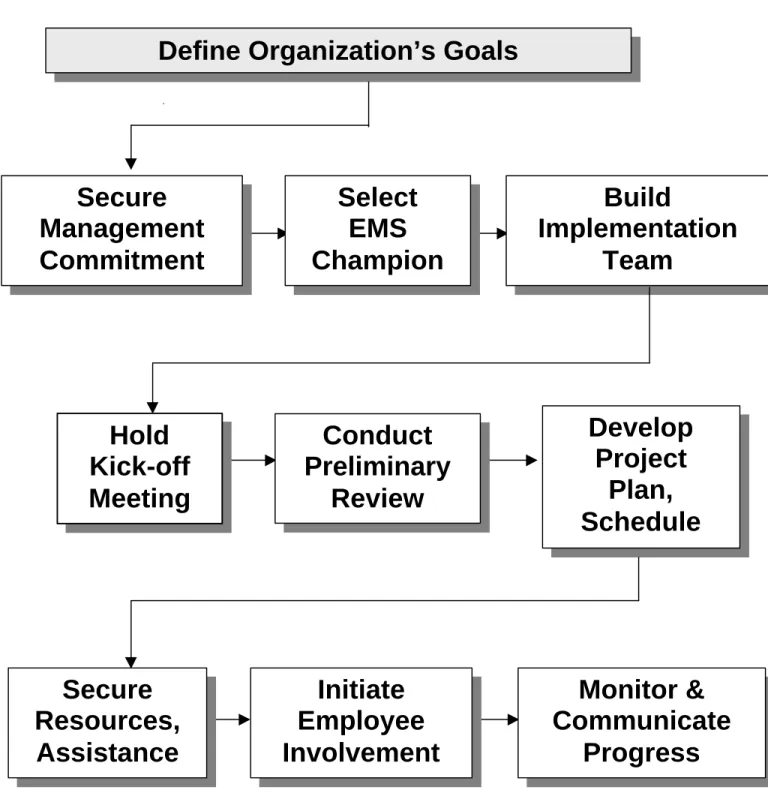
Figure 2 illustrates the initial steps in the EMS planning process. The importance of careful planning cannot be overemphasized. Taking the time to figure out what you need to do, how you will do it, and who must be involved will pay big dividends down the road.
Experience shows that using a team approach to planning and building an EMS is an excellent way to promote commitment and ensure that your objectives, procedures and other system elements are realistic, achievable, and cost-effective. Ideas for using a team and involving employees are discussed in this section.
A few hints to keep in mind as you build your EMS: • Help is available — don’t hesitate to use it.
(See Appendix F for information on resources.) • Pace yourself. Move quickly enough that employees
stay interested and engaged, but not so fast that those involved are overloaded or that the effort becomes superficial.
• Don’t re-invent the wheel -- existing management practices should help you to meet EMS requirements. • Consultants can help you evaluate your EMS and suggest approaches used successfully elsewhere. Explore ways to hold consulting costs down. You may be able to join forces with other organizations to hire a consultant or sponsor a training course.
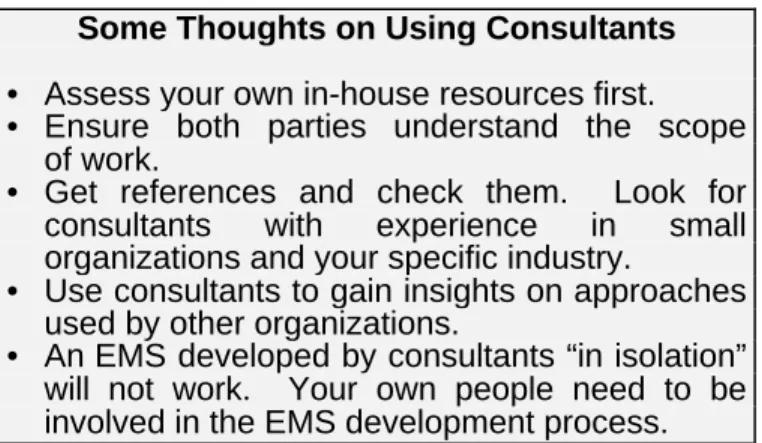
Some Thoughts on Using Consultants
• Assess your own in-house resources first. • Ensure both parties understand the scope
of work.
• Get references and check them. Look for consultants with experience in small organizations and your specific industry.
• Use consultants to gain insights on approaches used by other organizations.
• An EMS developed by consultants “in isolation” will not work. Your own people need to be
FIGURE 2: INITIAL EMS PLANNING STEPS
READY!
Define Organization’s Goals
Build
Implementation
Team
Secure
Management
Commitment
Conduct
Preliminary
Review
Initiate
Employee
Involvement
Select
EMS
Champion
Develop
Project
Plan,
Schedule
Secure
Resources,
Assistance
Monitor &
Communicate
Progress
Hold
Kick-off
Meeting
Laying the Groundwork for an EMS: Key Steps
A first step in EMS planning is to decide why you are pursuing the development of an EMS. Are you trying to improve your environmental performance (for example, compliance with regulations or prevent pollution)? Are you trying to promote involvement throughout the organization? Write your goals down and refer back to them frequently as you move forward. As you design and implement the EMS, ask: How is this task going to help us achieve our goals? This also is a good time to define the project scope or
“fenceline” (i.e., what is the “organization” that the EMS will cover? One location? Multiple locations? Should we “pilot” the EMS at one location then implement the system at other locations later?).
One of the most critical steps in the planning process is
gaining top management’s commitment to support EMS development and implementation. Management must first understand the benefits of an EMS and what it will take to put an EMS in place. Explain the strengths and limitations of your current approach and how those limitations can affect the organization’s financial and other performance. Management also has a role in ensuring that the goals for the EMS (see above) are clear and consistent with other organizational goals. Management’s commitment should be communicated across the organization. Not all small- or medium-sized organizations have the luxury of choosing among multiple candidates, but your choice of project champion is critical. The champion should have the necessary authority, an understanding of the organization, and project management skills. The champion should be a “systems thinker” (ISO 9000 experience can be a plus, but is not necessary), should have the time to commit to the EMS-building process and must have top management support. A team with representatives from key management functions (such as engineering, finance, human resources, production and/or service) can identify and assess issues, opportunities, and existing processes. Consider including contractors, suppliers or other external parties as part of the project team, where appropriate. The team will need to meet regularly, especially in the early stages of the project. A cross-functional team can help to ensure that procedures are practical and effective and can build commitment to and “ownership” of the EMS.
Once the team has been selected, hold a kick-off meeting to discuss the organization’s objectives in implementing an EMS, the steps that need to be taken initially, and the roles of team members, among other
Define Organization's Goals for EMS
Secure Top Management Commitment Select EMS Champion Build Implementation Team Hold Kick-Off Meeting
Creating Your Own EMS (cont’d.)
meeting also is a good opportunity to provide some EMS training for team members. Follow-up this meeting with a communication to all employees.
The next step is for the team to conduct a preliminary review of your current compliance and other environmental programs/systems and to compare these against the criteria for your EMS (such as ISO 14001). Evaluate your organization’s structure, procedures, policies, environmental impacts, training programs and other factors. Determine which parts of your current EMS are in good shape and which need additional work. See the “NSF ISO 14001 Self-Assessment Tool” (www.nsf-isr.org) or “Incorporating Design for the Environment into Your Gap Analysis” (www.epa.gov/dfe) for gap analysis tools.
Based on the results of the preliminary review, prepare a project plan and budget. The plan should describe in detail what key actions are needed, who will be responsible, what resources are needed, and when the work will be completed. Keep the plan flexible, but set some stretch goals. Think about how you will maintain project focus and momentum over time. Look for potential “early successes” that can help to build momentum and reinforce the benefits of the EMS. The plan and budget should be reviewed and
approved by top management. In some cases, there may be outside funding or other types of assistance that you can use (from a trade association, a state technical assistance office, etc.). See Appendix F for more ideas on possible sources of help. Employees are a great source of knowledge on environmental and health & safety issues related to their work areas as well as on the effectiveness of current processes and procedures. They can help the project team in drafting procedures. Ownership of the EMS will be greatly enhanced by meaningful employee involvement in the EMS development process.
As you build the EMS, be sure to regularly monitor your progress against the project plan and
communicate this progress within the organization. Be sure to communicate the accomplishments that have been made and describe what happens next. Build on small successes. Be sure to keep top management informed and engaged, especially if additional resources might be required.
Advertise your successes to keep management and employees aware of your EMS efforts. Document benefits, no matter how small they may seem at the
Conduct Preliminary Review Prepare Budget and Schedule Involve Employees Monitor and Communicate Progress Secure Resources, Assistance
Check
Section 4: SET! (Key Elements of an EMS)
What does an EMS consist of? How are the elements linked together?
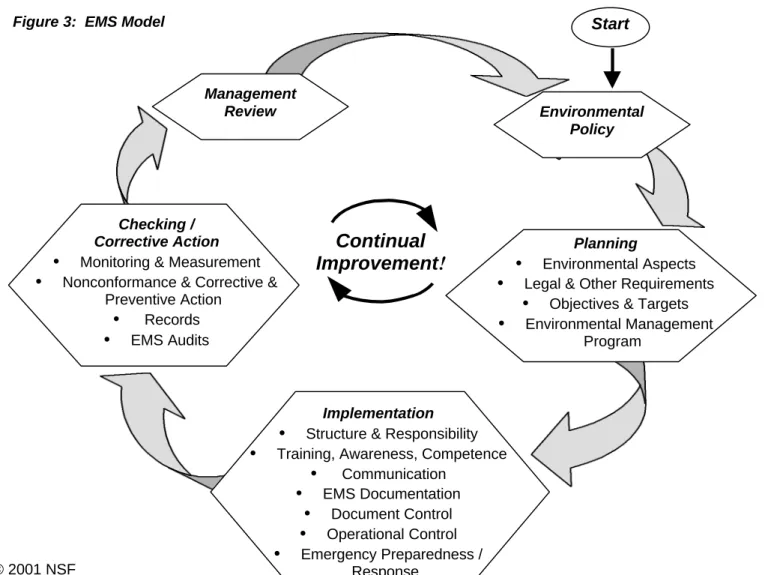
As mentioned earlier, your EMS should be built on the “Plan, Do, Check, Act” model to ensure that environmental matters are systematically identified, controlled, and monitored. Using this approach will help to ensure that performance of your EMS improves over time and that you meet your goals for implementing an EMS in the first place.
This section describes seventeen EMS elements that are common to most EMS models. This section also notes the key linkages among these elements. While there are several good EMS models available, this Guide generally uses the ISO 14001 Standard as a starting point for describing EMS elements. This has been done for several reasons:
• ISO 14001 is a widely accepted international standard for EMS that focuses on continual improvement;
• Companies may be asked to demonstrate conformance with ISO 14001 as a condition of doing business in some markets; and
• The Standard is consistent with the key elements found in many EMS models, including the European Union’s Eco-Management and Audit Scheme, EPA’s Performance Track and the Code of Environmental Management Principles for Federal Agencies, among others.
Figure 3: EMS Model
Planning
• Environmental Aspects
• Legal & Other Requirements
• Objectives & Targets
• Environmental Management
Program
Implementation
• Structure & Responsibility
• Training, Awareness, Competence
• Communication
• EMS Documentation
Start Environmental Policy Checking / Corrective Action• Monitoring & Measurement
• Nonconformance & Corrective &
Preventive Action
• Records
• EMS Audits
Continual
Improvement
!
Management ReviewKey Elements of an EMS: A Snapshot
• Environmental policy — Develop a statement of your organization’s commitment to the environment. Use this policy as a framework for planning and action.
• Environmental aspects — Identify environmental attributes of your products, activities and services. Determine those that could have significant impacts on the environment.
• Legal and other requirements — Identify and ensure access to relevant laws and regulations, as well as other requirements to which your organization adheres.
• Objectives and targets — Establish environmental goals for your organization, in line with your policy, environmental impacts, the views of interested parties and other factors.
• Environmental management program — Plan actions necessary to achieve your objectives and targets.
• Structure and responsibility — Establish roles and responsibilities for environmental management and provide appropriate resources.
• Training, awareness and competence — Ensure that your employees are trained and capable of carrying out their environmental responsibilities.
• Communication — Establish processes for internal and external communications on environmental management issues.
• EMS documentation — Maintain information on your EMS and related documents.
• Document control — Ensure effective management of procedures and other system documents.
• Operational control — Identify, plan and manage your operations and activities in line with your policy, objectives and targets.
• Emergency preparedness and response — Identify potential emergencies and develop procedures for preventing and responding to them.
• Monitoring and measurement — Monitor key activities and track performance.
Conduct periodic assessments of compliance with legal requirements.
• Nonconformance and corrective and preventive action — Identify and correct problems and prevent their recurrence.
• Records — Maintain and manage records of EMS performance.
• EMS audit — Periodically verify that your EMS is operating as intended.
• Management review — Periodically review your EMS with an eye to continual improvement.
Check
Environmental Policy
Communicating your environmental vision
Sample environmental policies are provided in the
Tool Kit (see Appendix A).
An environmental policy is top management’s declaration of its commitment to the environment. This policy should serve as the foundation for your EMS and provide a unifying vision of environmental concern by the entire organization. Given its importance, your policy should be more than just flowery prose.
Since it serves as the framework for setting environmental objectives and targets, the policy should be brought to life in your plans and deeds. Everyone in the organization should understand the policy and what is expected of them in order to achieve the organization’s objectives and targets.
Your policy should reflect three key commitments (see box), including a commitment to continual improvement. While this does not mean that you must improve in all areas at once, the policy should drive your organization’s efforts to continually improve environmental management (and the improved performance that results from these efforts).
+
ISO 14001
Hints:
• Your organization probably has some type of environmental policy now, even if it’s not written down. For example, your organization probably is committed to complying with the law and avoiding major environmental problems, at a minimum. Document existing commitments and goals as a starting point.
• The policy should relate to your products and services, as well as supporting activities. Consider the results of your preliminary review (see Section 3) and your analysis of the environmental aspects
of your products, services and activities before finalizing the policy. These two steps can provide insight as to how your organization interacts with the environment and how well it is meeting its challenges. For example, information obtained during the preliminary review might help you define specific policy commitments.
• Keep your policy simple and understandable. Ask yourself: What are we trying to achieve? How can we best communicate this to the rest of the organization? One test to use: Could our employees describe the
Key Policy Commitments:
þ
Continual improvementþ
Pollution preventionþ
Compliance with relevant laws and regulationsContinual Improvement:
"Process of enhancing the environmental management system to achieve
improvements in overall environmental performance in line with the organization's environmental policy."
I M P R O V E M E N T Environmental Policy C O M P L I A N C E P R E V E N T I O N
Figure 4:
Three Pillars of an
Environmental Policy
• Environmental Aspects• Objectives & Targets
• Training & Awareness
• Communication
• Management Review
• The environmental policy should be explicit enough to be audited. If you choose to use phrases such as “We are committed to excellence and leadership in protecting the environment”, consider how you would demonstrate that such a commitment is being met.
• The environmental policy can be a stand-alone document or it can be integrated with your health & safety, quality, or other organizational policies.
• Consider who should be involved in developing the policy and the best process for writing it. Input from a range of people within your organization should increase commitment and ownership.
• Make sure that your employees understand the policy. Options for communicating your policy internally include posting it around work sites (e.g., in lunchrooms), using paycheck stuffers, incorporating the policy into training classes and materials, and referring to the policy at staff or all-hands meetings.
Test awareness and understanding from time to time by asking employees what the policy means to them and how it affects their work.
• The policy also should be communicated externally. Some options for external communications include placing the policy on business cards, in newspaper advertisements and in annual reports, among other options. You might choose to communicate the policy proactively or in response to external requests (or both). This decision should be factored into your overall strategy for external communication (see later discussion under “Communications”).
• Consider how you would demonstrate that you are living by the commitments laid out in the policy. This is a good test of whether or not the policy is a “living document”.
For EPA’s Performance Track program, an organization’s policy must
include:
•
compliance with legal requirements and voluntary commitments;
•
pollution prevention (see Figure 5);
•
continuous improvement in environmental performance, including
areas not subject to regulation, and
•
sharing information on environmental performance and their operation
of the EMS with the community.
Check
Commitments toCompliance with Legal Requirements and Pollution Prevention
Compliance with legal requirements is a critical consideration in EMS development and implementation. EMS implementation requires an organization, among other things, to:
• develop and communicate an environmental policy that includes a commitment to compliance;
• develop and implement a procedure to identify, analyze and have access to environmental laws and regulations;
• set objectives and targets in line with its environmental policy, which includes a commitment to compliance;
• establish management programs to achieve its objectives;
• train employees and communicate relevant EMS requirements to them;
• establish and implement operational control procedures;
• establish and implement a procedure for periodically evaluating compliance; and
• establish and implement a procedure to carry out corrective and preventive actions.
While the requirements noted above relate directly to an organization’s management of legal requirements, each of the seventeen EMS elements described in this Guide can contribute to enhanced compliance (including communication, documentation and document control, records management, EMS audits, and management review). An EMS that includes the elements described in this Guide will help your organization improve or maintain its compliance performance and facilitate the establishment of objectives and targets that go “beyond compliance.”
Figure 5
EMS design and implementation also should take into account the Pollution Prevention (P2) hierarchy. In evaluating P2 opportunities, organizations should start at the top of the pyramid (i.e., source reduction) and work their way down as needed to define the most appropriate methods for preventing pollution. Examples and best practices of P2 in operation are provided throughout this Guide.
Prevention of Pollution Hierarchy
Source Reduction In-Process Recycling Other Recycling Treatment & Recovery Control Mechanisms
Capture the Learning: Environmental Policy Worksheet
Do we have an existing policy?
If yes,how was the policy developed? When was the policy last reviewed?
Does the policy reflect the three key commitments (commitments to
compliance, prevention of pollution and continual improvement?)
What other commitments does or should our policy contain?
How does our policy take into account the environmental attributes of our
products, activities and services?
How would we demonstrate conformance to our policy?
How is the policy communicated to our employees? Do our employees
understand the critical elements of our policy? How do we know?
What feedback have we received on the policy (from employees, contractors or other interested parties)?
What happens when we receive feedback on the policy?
How do we make our policy available to external parties? Is this process effective?
Our next step on environmental
policy is to …
Check
Identifying Environmental Aspects
How an organization interfaces with the environment
Environmental Aspect:
“Element of an organization’s activities, products, or
services that can interact with the
environment.”
ISO 14001
Environmental Impact:
“Any change to the environment, whether adverse or beneficial, wholly or partially resulting from an organization’s activities, products, or services.”
To plan for and control its environmental impacts, an organization must know what these impacts are. But knowing what the impacts are is only part of the challenge — you also should know where these impacts come from. Stated another way, how does your organization (i.e., your products, services and activities) interact with the environment?
If your organization has undertaken pollution prevention projects, you are probably familiar with this concept — that is, you must know howand where a waste is generated in order to minimize or eliminate it. And like pollution prevention, the identification and management of environmental aspects can (1) have positive impacts on the bottom line and (2) provide significant environmental improvements.
So, an EMS should include a procedure to identify and assess environmental aspects that the organization:
• can control, and
• over which it can have an influence.
Your organization is not expected to manage issues outside its sphere of influence or control. For example, while your organization probably has control over how much electricity it buys from a supplier, it likely does not
control or influence the way in which that electricity is generated. Similarly, if your organization manufactures a product that is subsequently incorporated into another product (for example, a bumper that becomes part of an automobile), your organization does not control the environmental aspects of that “finished” product (the automobile). Thus, your focus should be on the environmental aspects of your products or services.
The relationship between aspects and impacts is often one of cause and effect. The term “aspects” (see definition above) is neutral, so keep in mind that your environmental aspects can be either positive (such as making a product out of recycled materials) or negative (such as discharging toxic materials to a stream). Aspects may result from past activities, such as spills.
Once you have identified the environmental aspects of your products, activities, and services, you should determine which aspects could have significant impacts on the environment. Aspects that have one or more significant impact should be considered significant environmental aspects. These significant aspects should be considered when you establish environmental objectives, define
operational controls and consider other actions, as
Define environmental
aspects
Decide if under your control and
influence Identify related impacts Decide if the impacts are significant environmental
+
Milan Screw Products set up an internal task group to identify environmental aspects. As part of this process, external
stakeholders were identified and interviewed to
understand their
environmental concerns. These stakeholder concerns were added to the list of environmental aspects.
A multi-step process can be used to make this evaluation. Keep the resulting information up-to-date, so that potential aspects of new products, services, and activities are factored into your objectives and controls.
Hints:
• In identifying aspects and impacts, look beyond activities covered by laws and regulations. But because many of your aspects/impacts may be addressed by legal requirements, your compliance program might yield some valuable information. Permits, audit reports, and monitoring records can be useful inputs. Beyond regulated aspects, consider land, energy, and natural resource use, for example.
• Once you have identified environmental aspects and related significant impacts, use this information in setting your objectives and targets. This does not mean that you need to address all of your impacts at once. There may be good reasons (such as cost, availability of technology or scientific uncertainty) for addressing some impacts now while deferring action on others. Keep in mind that managing environmental aspects can have
positive impacts on the organization.
• Remember to look at services as well as products. While the need to examine on-site operations might be obvious, you also should consider the potential impacts of what you might do “off-site” (such as servicing equipment at customer sites). Similarly, the environmental aspects of the products, vendors, and contractors you use may be less obvious, but should still be considered.
• Identifying significant environmental aspects is one of the most critical steps in EMS implementation. It can be one of the most challenging – as well as one of the most rewarding. Decisions you make in this step can affect many other system elements (such as, setting objectives and targets, establishing operational controls and defining monitoring needs). Careful planning of this activity will pay dividends in later steps.
Getting Started
• To understand your environmental aspects, it helps to understand the processes by which you generate products and services. Flow charting your major processes can help you understand the process inputs and outputs as well as how materials are used. A sample flow chart is provided in the Tool Kit (see Appendix C). You might also want to consider the views ofinterested parties (e.g., neighbors, civic groups, regulators, etc.) in this process. Some organizations have found external parties to be a good resource in identifying environmental
US Postal Service Assesses Its Environmental Aspects
The US Postal Service examined environmental aspects related to the vehicles it operates, the chemicals it uses to maintain equipment, the solid wastes it generates, and the products (stamps) that it sells.
“Products” are tangible results of a process that transforms inputs into outputs (for example, cars or computers). “Services” also result from processes, but are intangible in that you cannot “hold” them (such as dry cleaning or equipment maintenance at a customer site). “Activities” may relate directly or indirectly to the provisionof products or services to customers (such as purchasing or product design).
Check
Use visual tools. As a starting point, some organizations prepare maps of their site and building(s), along with surrounding land uses. The implementation team uses these maps to “audit” the site and identify potential environmental aspects.
• Objectives & Targets
• Training & Awareness
• Communications
• Operational Controls
• Monitoring & Measurement
• You can use many sources of information to help you identify and assess your environmental aspects. For starters, look at your permits, the regulations that apply to your operations, EPCRA reports, Material Safety Data Sheets and monitoring records. Trade associations, regulatory agencies, customers and suppliers also might provide useful information to support the assessment
• Your team should define the criteria that will be used to determine significance. Such criteria often include the types of impact; the magnitude, frequency and duration of the impact; regulatory status, and other factors. Consider the questions on the following page for identifying and characterizing aspects and impacts.
• Various approaches exist for evaluating environmental aspects and impacts. Select one that can be readily adapted for your use and that makes sense for your organization. Examples of approaches for evaluating environmental aspects and impacts can be found in the
Tool Kit (see Appendix A).
• Once you’ve found a process that works for your organization, describe the process in the form of a written procedure. A sample procedure for performing the assessment is provided in the Tool Kit.
• You can start out with a simple process for identifying aspects and impacts, then refine the process in the future as needed. You also can identify and consider more obvious environmental impacts or “low hanging fruit” first, then enhance the assessment process to consider more complex environmental impacts later. As with any element of the EMS, there is virtue in considering how your process for identifying aspects and impacts might be improved over time. Ask yourself:
Is there additional information we should consider in this process? Do we have the right people involved? Are we using the results in a meaningful way?
• Use the worksheet at the end of this section to capture some of your ideas. Using this worksheet will give you a “jump start” on implementing this EMS element.
In evaluating your environmental aspects and impacts, consider both normal and abnormal (such as start-up and shutdown) operating conditions.
Identifying Aspects and Impacts: Some Questions to Consider:
Identifying Aspects
q Which operations and activities interface with the environment in a way that could result (or has resulted) in environmental impacts?
q What materials, energy sources and other resources do we use in our work?
q Do we have emissions to the air, water or land?
q Do we generate wastes, scrap or off-spec materials? If so, does the treatment of disposal of these materials have potential environmental impacts?
q Which characteristics or attributes of our products or services could result in impact the environment (through their intended use, end-of-life management, etc.)?
q Does our land or infrastructure (e.g., buildings) interact with the environment?
q Which activities (for example, chemical storage) might lead to accidental releases?
Evaluating Impacts
q Are the impacts actual or potential?
q Are the impacts beneficial or damaging to the environment?
q What is the magnitude or degree of these impacts?
q What is the frequency or likelihood of these impacts?
q What is the duration and geographic area of these impacts?
q Which parts of the environment might be affected (e.g., air, water, land, flora, fauna)?
q Is the impact regulated in some manner?
q Have our interested parties expressed concerns about these impacts?
The Link Between Aspects and Impacts (some examples from a real company)
Aspects Potential Impacts
Emissions of volatile organic compounds
Increase in ground level ozone
Discharges to stream Degradation of aquatic habitat and drinking water supply
Spills and leaks Soil and groundwater contamination Electricity use Air pollution, global warming
Use of recycled paper Conservation of natural resources
Some Potential Environmental Aspect Categories:
• Air Emissions
• Solid and Hazardous Wastes
• Contamination of Land
• Local Issues
(e.g. noise, odor, dust, traffic, etc.)
• Water Discharges
• Energy Use
• Raw Material and Resource Use (water, energy, etc.)
Check
Capture the Learning: Environmental Aspects Worksheet
Do we have an existing process for identifying aspects and/or impacts?
If yes, does that process need to be revised? In what way?
Who needs to be involved in this process within our organization? Should any outsideparties be involved?
When is the best time for us to implement this process? Can it be
linked to an existing organizational process (such as our budget, annual planning or auditing cycles?)
What are some obvious
environmental aspects of our:
F Operations and activities?
F Products?
F Services?
What sources of information can we use to identify environmental aspects?
What sources of information can be used to determine the environmental
impacts of these aspects?
What significance criteria might make sense for our organization?
How will we keep this information up-to-date?
Our next step on environmental
aspects is to …
Legal and Other Requirements
Setting the legal framework for your EMS
Legal requirements include: • Federal requirements • State and local requirements • Standards in locations where
you sell products/services • Permit conditions
Other requirements might include ( for example): • Company-specific codes • International Chamber of Commerce (ICC) Charter for Sustainable Development • American Chemistry Council’s (ACC) Responsible Care • American Petroleum
Institute’s Strategies for Today’s Environmental Partnership (API STEP) • Other industry codes or
programs to which your organization voluntarily subscribes.
In order to comply withlaws and regulations that apply to your organization, you must first know what the rules are and how they affect what you do. As discussed earlier, compliance with legal requirements is one of the “three pillars” upon which your environmental policy should be based. The potential costs of non-compliance (possible damage to the environment, revenue loss and impact on public image, for example) can be very high. Thus, an effective EMS should includes processes to:
• identify and communicate applicable legal and other requirements, and;
• ensure that these requirements are factored into the organization’s management efforts.
New or revised legal requirements might require modification of your environmental objectives or other EMS elements. By anticipating new requirements and making changes to your operations, you might avoid some future compliance obligations and their costs.
Getting Started
Your EMS should include a procedure for identifying, having access to and analyzing applicable legal and other requirements. “Other requirements” might include industry codes of practice or similar requirements to which your organization might subscribe.
Identifying applicable regulations, interpreting them, and determining their impacts on your operations can be a time-consuming task. Fortunately, there are many methods for obtaining information about applicable laws or regulations. These methods include:
• commercial services (with updates offered on-line, on CD-ROM or in paper form);
• regulatory agencies (federal, state and local); • trade groups / associations;
• the Internet (see USEPA web site at www.epa.gov); • public libraries;
• seminars and courses; • newsletters / magazines; • consultants and attorneys; and
• customers, vendors and other companies.
Small business assistance programs exist in every state. Under the Clean Air Amendments of 1990, each state
KEY STEPS
þ
Identify Requirementsþ
Analyze Impactsþ
Communicateþ
ActCheck
For more information on EMS and compliance, see “Improving Environmental Performance and Compliance: Ten Elements of Effective Environmental Management Systems” (see Appendix F for details)
• Environmental Policy
• Objectives & Targets
• Training & Awareness
• Communication
• Operational Controls
See Appendix A for information on resources for tracking environmental laws and regulations.
technical and compliance assistance programs to help companies comply with air quality rules. In some cases, these programs have expanded into other environmental “media”, such as water and waste management. In addition, National Compliance Assistance Centers can provide compliance assistance for certain industry sectors (see Appendix F for more information).
Once applicable requirements have been identified and analyzed for potential impacts, communicate these requirements (and plans for complying with them) to employees, on-site contractors and others, as needed. Communicating “other applicable requirements” (as well as their impacts on the organization) is an important but often overlooked step. Keep in mind that different people may have different information needs.
As with many EMS elements, this is not a “one time” activity. Since legal and other requirements change over time, your process should ensure that you are working with up-to-date information.
Resources to identify and track environmental laws and regulations are described in the Tool Kit (Appendix A).
Commonly Applicable Federal Environmental Laws in the US Clean Air Act (CAA)
[40 CFR Parts 50-99]
Establishes ambient and source emission standards and permit requirements for conventional and hazardous air pollutants. Clean Water Act (CWA)
[40 CFR Parts 100-145, 220-232, 410-471]
Establishes ambient and point source effluent standards and permit requirements for water pollutants, including sources that discharge directly to a waterbody or to a public sewer system. Federal Insecticide, Fungicide and
Rodenticide Act (FIFRA) [40 CFR Parts 150-189]
Establishes a program for Federal review of, registration and control of pesticides.
Resource Conservation and Recovery Act (RCRA)
[40 CFR Parts 240-299]
Establishes regulations and permit requirements for hazardous waste management. Also, creates standards for underground storage tanks that hold oil or hazardous substances.
Toxic Substances Control Act (TSCA) [40 CFR Parts 700-799]
Regulates the use, development, manufacture, distribution and disposal of chemicals. Certain chemicals (such as PCB’s) are subject to specific management standards.
Comprehensive Environmental
Response, Compensation and Liability Act (CERCLA, also known as “Superfund”) [40 CFR Parts 300-311]
Establishes a program for cleaning up contaminated waste sites and establishes liability for clean-up costs. Also, provides reporting requirements for releases of hazardous substances Emergency Planning and Community
Right-To-Know Act (EPCRA) [40 CFR Parts 350-374]
Establishes a program (also known as the “Toxic Release Inventory”) to inform the public about releases of hazardous and toxic chemicals. Reporting requirements apply to companies that use, process or store specific chemicals over specified quantities. Hazardous Materials Transportation Act
(HMTA) [49 CFR Parts 100-180]
Establishes standards for the safe transportation of hazardous materials.
Capture the Learning: Legal & Other Requirements Worksheet
Do we have an existing process for identifying applicable legal and other requirements?
If yes, does that process need to be revised? In what way?
Who needs to be involved in this process within our organization? What should their responsibilities be?
What sources of information do we use to identify applicable legal and other requirements?
Are these sources adequate and effective? How often do we review
these sources for possible changes?
How do we ensure that we have
access to legal and other
requirements? (List any methods used, such as on-site library, use of web sites, commercial services, etc.)
How do we communicate information
on legal and other requirements to people within the organization who need such information?
Who is responsible for analyzing new or modified legal requirements to determine how we might be affected?
How will we keep information on legal and other requirements up-to-date?