DOI: 10.24042/tadris.v3i2.3321
© 2018 URPI Faculty of Education and Teacher Training Universitas Islam Negeri Raden Intan Lampung
Physics Learning Based on Virtual Laboratory to Remediate
Misconception in Fluid Material
Rahma Diani1*, Sri Latifah1, Yanda Meilya Anggraeni2, Dwi Fujiani3
1Faculty of Education and Teacher Training, Universitas Islam Negeri Raden Intan Lampung, Indonesia 2SMP Islam Darus As Sa'adah Pesawaran, Indonesia
3Faculty of Education and Teacher Training, Institut Agama Islam Negeri Kerinci, Indonesia
______________ Article History: Received: October 13th, 2018 Revised: November 15th, 2018 Accepted: December 25th, 2018 Published: December 30th, 2018 _________ Keywords: Misconception, PDEODE Model, PhET Simulation, Physics Learning, Virtual Laboratory. _______________________ *Correspondence Address: [email protected]
Abstract: An understanding of concepts is very necessary in physics
learning. It has been confirmed that often students have different understanding of scientific concepts, this term is what commonly called Misconception. Misconception is a problem that must be addressed immediately because misconception is one factor that causes students to experience difficulties in learning physics. This study aims to determine the effect of physics learning with the PDEODE model (predict-discuss-explain-observe-discuss-explain) assisted by virtual laboratory in the form of PhET simulation in remediating students’ misconceptions in the fluid material. This type of research is a Pre-Experimental One Group Pretest-Posttest design. The samples of this study were eleventh-grade science students of State Senior High School in Gadingrejo District, Lampung Province, taken through simple random sampling technique. The test used was in the form of a multi-tiered multiple-choice test of the four-tier diagnostic test with certainty response index (CRI) consisting of 20 items. The result of this study indicates that students' misconceptions decrease for all sub-concepts of fluid material. Based on the previously described statements, it can be concluded that physics learning based on virtual laboratory can remedy students' misconceptions, especially in fluid material.
INTRODUCTION
Education cannot be separated from the process of teaching and learning activities. One means of supporting the learning process is through formal education in schools (Diani, 2016). The learning process in schools is done so that students get new knowledge from what they learn (Yudhittiara, Hindarto, & Mosik, 2016).
Understanding of concepts is very important in the early stages of thinking, especially in the field of physics. Physics is one of the fields of science that focuses on understanding the concepts rather than
memorization (Sholihat, Samsudin, & Nugraha, 2017). Physics contains many scientific concepts, laws, equations, and events that occur in everyday life (Aldila, Setyarsih, & Kholiq, 2016; Syahrul & Setyarsih, 2015; Yuwarti, Pasaribu, & Hatibe, 2017; Zulia Witanecahya & Jatmiko, 2014). Learning physics can make students master knowledge in the form of facts, concepts, principles, and the process of discovery (Diani, Yuberti, & Syafitri, 2016).
Knowledge possesses by the
students is not just poured into their minds but must be actively constructed
168 | Tadris: Jurnal Keguruan dan Ilmu Tarbiyah 3 (2): 167-181 (2018) (Saputra, Halim, & Khaldun, 2013). Prior
to obtaining a formal education, students have preconceptions with different understandings. In line with Pinker's research in wahyuningsih, et al., generally students come to school not with a blank mind, but they have brought a number of experiences or ideas formed before when interacting with their environment (Wahyuningsih, Raharjo, & Masithoh, 2013). The concept that students have could be in accordance with scientific concepts yet can also experience irregularities. Concept deviations or incompatibility of understanding of these concepts are often called misconceptions (Hono & Yuanita, 2014; Subagyo, Suyono, & Tukiran, 2014; Suparno, 2005). The misconception is the initial concept held by students, which is not in harmony with scientific conceptions or physicists (Ariyastuti & Yuliawati, 2017; Martinez-Borreguero, Pérez-Rodríguez, Suero-López, & Pardo-Fernández, 2013; paul suparno, 2013).
The students' misconceptions often occur in a fluid material, which is also one of the fields of mechanics, where mechanics experiences the greatest misconception. According to the data obtained by Wandersee, et al. in Suparno, with an article entitled Research on Alternative Conception in Science, which was studied from 700 studies of alternative concepts in physics (Suparno, 2013). It reveals that there is 300 research on misconceptions in mechanics, 159 research on electricity, 70 research on heat, optics, and material properties, 35 research on earth and space, and 10 research on modern physics (Zulvita, Halim, & Elisa, 2017). One form of misconception on the fluid is that students assume the density of water is smaller than the density of kerosene with the same volume and height (Pratiwi & Wasis, 2013).
One of the causes of the students’ misconception is the lack of the mastery of concepts (Arjanggi & Suprihatin,
2010), wrong intuition (Fariyani, Rusilowati, & Sugianto, 2015) and broadly caused by students, teachers, textbooks, contexts, and teaching methods (Jannah, Ningsih, & Ratman, 2016;
Wahyuningsih et al., 2013).
Misconceptions that occur as early as possible must be known and corrected, because the ignored conceptual errors will have an impact on the low learning outcomes (Chaniarosi, 2014; Susanti, 2013), influence the process of understanding of the subsequent concepts, and disrupt the process of identifying examples of physics phenomena in everyday life (Artiawati, Mulyani, & Kurniawan, 2016; Pebriyanti, Sahidu, & Sutrio, 2015).
Therefore, one effort to overcome misconceptions is by remediation which is an activity to improve learning that is less successful in understanding subject matter (Zulvita et al., 2017). Remediation needs the right and complex learning model, one of which is the application of the
Predict-Discuss-Explain-Observe-Discuss-Explain (PDEODE) learning
model. PDEODE Learning Model is a model that refers to the views of constructivism (Costu, 2008), which has six stages namely Predict, Discuss (first), Explains (first), Observe, Discuss (second), Explain (second) (Sdarmi, Suarni, & Dibia, 2013). The stages of the PDEODE model can familiarize the students to form scientific concepts because they can think independently, carry out and directly investigate an experiment, discuss in groups, and get more scientific new concepts because the students' initial concepts are compared to the results of investigations (Ardiyan, 2015).
The PDEODE learning model also helps students to understand science in daily life (Costu, 2008), the learning process is more active and conceptual. The changes occur from the students' incorrect initial thoughts to the new knowledge that is definitely true (Kolari,
Tadris: Jurnal Keguruan dan Ilmu Tarbiyah 3 (2): 167-181 (2018) | 169 Savander-ranne, & Tiili, 2005). In
addition, the PDEODE Model is effective in identifying misconceptions and improving critical-thinking skills (Sri & Wulandari, 2013), effectively reducing misconceptions that occur in students (Dewi & Suhandi, 2016; Siregar, 2015), and can improve students’ learning outcomes (Budianto & Istyadji, 2015).
To support the PDEODE learning model which contains observe stage (experimentation), an instructional media is needed that may improve the concepts understanding as well as lowering
misconceptions (Suhandi, Sinaga,
Kaniawati, & Suhendi, 2008). Along with the development of the times marked by the development of products and the use of technology and information, the implementation of learning has also shifted into an effort to realize modern learning.
One of the learning media that enables an experiment without using many tools is PhET simulation equipped with student worksheets. PhET Virtual Media simulation can help students to understand concepts, receive feedback,
provide interactive approaches,
constructivists, and think critically and creatively because PhET simulation prioritizes the relevance of real-life phenomena with underlying knowledge (Perkins, Adams, Dubson, & Finkelstein, 2006; Sholihat et al., 2017). Students will compare their predictions with the experiments conducted. PhET media simulation can reduce misconceptions and can improve learning outcomes (Atmoko & Wasis, 2015; Jauhari, Hikmawati, & Waahyudi, 2016).
Based on the results of pre-research conducted on the eleventh-grade science students of State Senior High School in Lampung Province, learning is still dominated lecturing centered on teachers. The students only focus on memorizing formulas without understanding the concepts. In addition, the identification of
misconception was done using the four-tier diagnostic test equipped with the certainty of response index (CRI) on fluid material. The average percentage of misconceptions in fluid material is 44.83%. One form of misconception in Archimedes' sub-law is that students assume that the density of objects is greater than the density of the water, so the object will sink. So, the effort made in this study was by applying the PDEODE model assisted by PhET simulation in reducing misconceptions in a fluid material.
METHOD
This study employs a
pre-experimental method. The design of the research is One-Group Pretest-Posttest Design. This design is used in one group of subjects (Irwan, Thamrin, & Budayawan, 2016). Treatment is given to a subject group after that the effect of the treatment is observed (Saputra et al., 2013). The research variable is the PDEODE model assisted by PhET simulation as an independent variable and a misconception as the dependent variable.
This study aims to remedy students' misconceptions in a fluid material. It was conducted in the first semester of the 2018/2019 academic year. The population of this study was all students of eleventh-grade science students of State Senior High School (SMA) in Gadingrejo District, Lampung Province, with the sample of 30 students as an experimental class. The sampling was carried out
through simple random sampling
technique. The instrument of this study was 20 items of multiple choices in the form of four-tier diagnostic tests equipped with CRI. The test was a four-tier test developed from the three-tier test. There also present a confidence rating (level of confidence) using CRI on the reason for the answer so that the level of confidence is more accurate (Zaleha, Samsudin, &
170 | Tadris: Jurnal Keguruan dan Ilmu Tarbiyah 3 (2): 167-181 (2018) Nugraha, 2017). The categories of
combinations of answers to the four-tier diagnostic tests are shown in Table 1 (Fariyani et al., 2015; Sheftyawan, Prihandono, & Lesmono, 2018), and the
categories for confidence level scale of the Certainty of Response Index (CRI) is in Table 2 (Hasan, Bagayoko, & Kelley, 1999).
Table 1. The Answer Combination of the Four-tier Diagnostic Test
Answer Combination
Answer Combination
Answer Level of
Confident
Reason Level of Confident
on the Reason Understand the Concept Correct Correct Correct Correct Sure Unsure Sure Unsure Correct Correct Correct Correct Sure Unsure Unsure Sure Do not Understand the Concept Correct Incorrect Incorrect Correct Incorrect Correct Correct Unsure Unsure Unsure Sure Unsure Unsure Sure Incorrect Correct Incorrect Incorrect Correct Incorrect Incorrect Unsure Unsure Unsure Unsure Sure Sure Sure Misconception Incorrect Incorrect Incorrect Incorrect Incorrect Sure Sure Sure Unsure Sure Correct Correct Incorrect Incorrect Incorrect Unsure Sure Unsure Sure Sure
Table 2. The Category of the Scale Confidence Level of Certainty Response Index (CRI)
Category Scale Level of Confident
Guessing 0 Low/Unsure Really Unsure 1 Unsure 2 Sure 3 High/Sure Really Sure 4 Very Sure 5
Before the question was used for the research on misconception, first the validity was tested using the Karl Pearson correlation test (Arikunto, 2013). The 20 questions were stated as valid. The reliability test used was Cronbach alpha formula. The differentiating power and the level of difficulty of the questions were also tested.
After it can be used, the questions were tested for its normality by using the
Lilliefors test (Samidi, 2015),
homogeneity with the F-test (Irwan et al., 2016) and hypothetical test using the t-test to see the difference in the mean between pretest and posttest, which conclusions were then drawn. Furthermore, the scores
of students' learning achievements were compared between the pretest and posttest, and then analyzed using the N-gain test (Khairati, Feranie, & Karim, 2016). The normalized N-gain score obtained were categorized as shown in the Table 3 (Simbolon & Tapilouw, 2015).
Table 3. Category of N-Gain Value
Category Criteria
g > 0,70 High 0,30 ≤ g ≤ 0,70 Moderate
g < 0,30 Low
Then to calculate the percentage of the students who understand the concept, misconception, and do not understand the concept, the equations proposed by (Arikunto, 2013; Sudijono, 2013; Utami, Agung, & Bahriah, 2017) was used. Then the results of calculation of the
misconceptions were categorized
according to the percentage in Table 4 (Fitria, Muhibbuddin, & Safrida, 2017; Suwarna, 2014).
Tadris: Jurnal Keguruan dan Ilmu Tarbiyah 3 (2): 167-181 (2018) | 171
Table 4. Criteria for Misconceptions Level
Value of P Criteria
61 % - 100 % High 31 % - 60 % Moderate
0 % - 30 % Low
RESULT AND DISCUSSION The Implementation
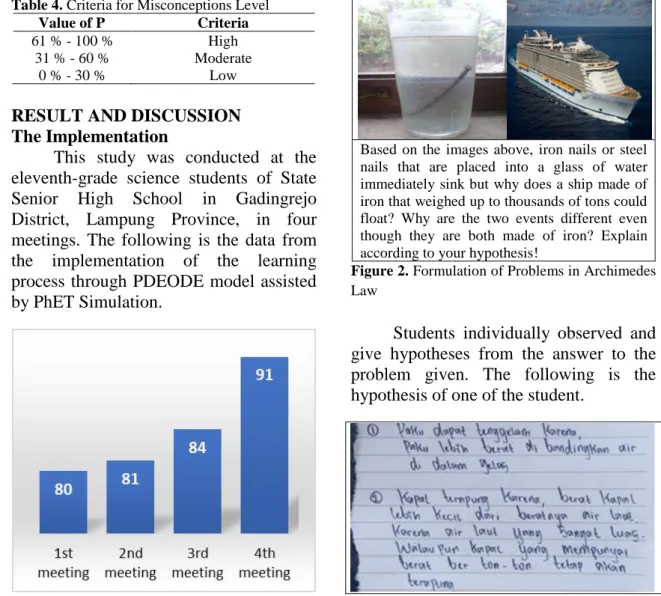
This study was conducted at the eleventh-grade science students of State Senior High School in Gadingrejo District, Lampung Province, in four meetings. The following is the data from the implementation of the learning process through PDEODE model assisted by PhET Simulation.
Figure 1. Percentage of Implementation of
Learning Models
Based on Figure 1, the average percentage is 84% with a very good category. The following is one of the results of the implementation of the PDEODE model assisted by PhET on Archimedes law subconcept.
Predict Stage
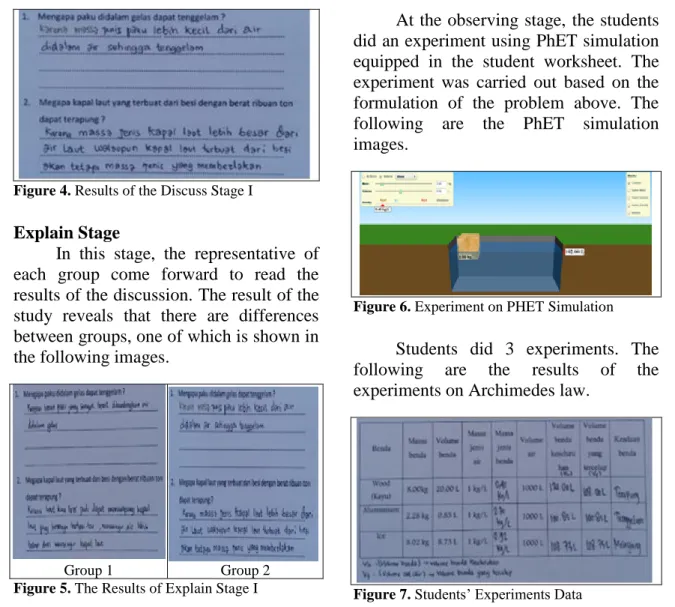
In this stage, the students observed the problem formulation of static fluid events in daily life as follows.
Based on the images above, iron nails or steel nails that are placed into a glass of water immediately sink but why does a ship made of iron that weighed up to thousands of tons could float? Why are the two events different even though they are both made of iron? Explain according to your hypothesis!
Figure 2. Formulation of Problems in Archimedes
Law
Students individually observed and give hypotheses from the answer to the problem given. The following is the hypothesis of one of the student.
Figure 3. Answer of the Predict Stage
In the first answer, it can be seen that students experienced a misconception in which the nails sink due to the density of nails is greater than the density of
water, not weight but density.
Misconceptions in question number 2 are that the ship is able to float because the ship's volume is smaller than the volume of seawater so that the density of the ship is lesser than the density of seawater. Discuss Stage I
In this stage, the students were grouped to discuss the formulation of the problem. They combined the individual prediction to produce a problem-solving. Here is the result of discussion from one of the groups.
172 | Tadris: Jurnal Keguruan dan Ilmu Tarbiyah 3 (2): 167-181 (2018)
Figure 4. Results of the Discuss Stage I
Explain Stage
In this stage, the representative of each group come forward to read the results of the discussion. The result of the study reveals that there are differences between groups, one of which is shown in the following images.
Group 1 Group 2
Figure 5. The Results of Explain Stage I
It can be seen that there are differences of opinion between groups in
which group 1 experiences a
misconception that nails sink because they are heavier than seawater while sea water is heavier than the ship, so it floats. For group 2, there is a misconception where the density of nails is smaller than the density of seawater, so it sinks while the density of the vessel is larger so it sinks. Both groups experienced a misconception that it should be the first group that affects density not weight and the second group should be the density of objects is greater than the density of water so that objects float while the density of objects is smaller than the density of water so that objects sink. The misconceptions will be proven in the later stage.
At the observing stage, the students did an experiment using PhET simulation equipped in the student worksheet. The experiment was carried out based on the formulation of the problem above. The following are the PhET simulation images.
Figure 6. Experiment on PHET Simulation
Students did 3 experiments. The following are the results of the experiments on Archimedes law.
Figure 7. Students’ Experiments Data
In this second discussion stage, the students in groups discussed the results of the experiments conducted. The results of the discussion are shown in the following images.
Figure 8. Results of Discuss Stage II
Based on the results of observation, the students compared the initial
Tadris: Jurnal Keguruan dan Ilmu Tarbiyah 3 (2): 167-181 (2018) | 173
hypothesis with the results of
experiments. It is known that the students who experience misconceptions can change their concepts to understand the concepts. For example, the students initially predict that the ship floats because the density of the ship is greater than the density of seawater. After the observing stage was applied using PhET simulation, they know that the ship can float because the density of the ship is smaller than the density of seawater. Explain Stage II
The representatives of each group explained the answers to the formulation of the problem in detail. The following is the result of the explain stage II.
Group 1
Figure 9. Results of Discuss Group 1
Group 2
Figure 10. Results of Discuss Group 2
The Results of Students’ Misconception The differences in the results of the pretest and posttest can be calculated using the normalized gain formula. The following is the data of pretest and posttest.
Table 5. Normalized Gain Test
Test Type Ave-rage Score N-Gain % N-gain Category Pretest 16.9% 0.41 3 41% Moderate Posttest 26.3%
Statistical test which is one of the characteristics of quantitative research that aims to direct the researcher to answer the formulation of the problem and to test the predetermined hypothesis. Before the hypothesis can be accepted, a series of statistical tests are conducted on the data of pretest and posttest obtained in the study. The recapitulation of statistical tests is presented in Table 6.
Table 6. Statistical Test Results of the Pretest and Posttest
Data Analysis Techniques Types of Test Results
Normality Lilliefors Sig. Pretest = 0.140 Sig Post-test = 0.09
Homogeneity Test-F Sig. = 1906
Hypothetical Test T-Test Sig. = 12:15
Α 0:05
Conclusions
data were normally distributed and Homogeneous Ho is rejected
H1 is accepted
Based on the results of the t-test, there is a difference of significance seen
from the average score that posttest is greater than the pretest. It can be claimed
174 | Tadris: Jurnal Keguruan dan Ilmu Tarbiyah 3 (2): 167-181 (2018) that the PDEODE learning model assisted
by PhET simulation can remediate students’ misconceptions in the fluid
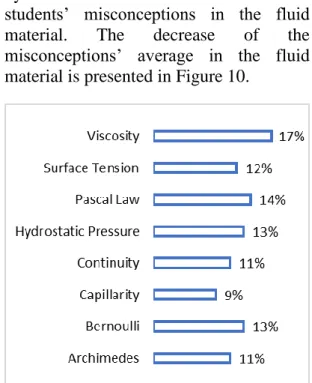
material. The decrease of the
misconceptions’ average in the fluid material is presented in Figure 10.
Figure 11. The Percentage of the Misconception’s
Average Decrease in Each Sub-concept of Fluid Material
Based on the implementation of the PDEODE learning model assisted by PhET simulation in 4 meetings, it obtains a positive response from the students based on the interviews and conditions in the field. The students said that the learning process is very fun so that they can better understand the fluid material. seen from the enthusiasm and activeness of students, they followed all stages of the PDEODE model assisted by PhET simulation although initially they felt confused with the repetitive learning process and the use of PhET media simulation but in the next meeting, with the guidance of teachers, the students could understand the purpose of using the PDEODE model and the use of PhET simulation. This opinion is also reinforced by research from Costu stating that the PDEODE model is effective in helping students to understand science in everyday life and contribute to get a better understanding of concepts (Costu, 2008). This research was also conducted by
Fatimah et al., that state the PDEODE model receives good responses from students and increases the ability to understand the concept of organizational life (Fatimah, Martono, & Hadiansah, 2015). Besides, according to Kolari et al., the PDEODE model makes the students more active in interacting with study groups, more active in constructing their own knowledge, and feeling confident (Kolari et al., 2005).
The steps of the PDEODE model assisted by PhET simulation are: (1) predict, students individually predict the formulation of the problem given by the teacher, so that it gives an initial picture of the misconceptions. In line with research from Riko which states that the predict stage is used as an estimate of the initial knowledge that students have about DC electrical circuits (Riko, 2018). (2) Discuss stage I, the students are grouped to actively exchange opinions and to unite their individual predictions into one conclusion. This is in line with research by Nursinar, which states the discussion makes students able to complete the task by exchanging opinions between students which influence the learning outcomes (Nursinar, 2017). (3) Explain stage I, and each group has a different opinion so that at this stage, the students experience cognitive conflict. In line with the research from Suparno, that cognitive conflict can arise if the data or concepts possessed by students are very different from what was thought before, then students experience conflict on their minds (Suparno, 2013). (4) Observe, the activeness of the students is high when students were experimenting using PhET simulation. It is seen that students really enjoy learning when they experience and shape their own knowledge through experiments using the PhET simulation. In accordance with the opinion of
Nurjanah in Riko, that through
experiments, the learning process becomes very interesting because students
Tadris: Jurnal Keguruan dan Ilmu Tarbiyah 3 (2): 167-181 (2018) | 175 can observe events that occur directly, so
they don't just listen (Riko, 2018).
In addition, the Observe stage makes learning become more interesting students’ conception at the beginning of learning could be quickly corrected during the experiment in which students can obtain data. This is because students interact directly with the fluid material when they are changing the size, comparing, and finding out the criteria contained in the experiment using PhET simulation so that the truths can be more believed by the students who experienced misconception.
The results of this study were also conducted by Joyce in Mursalin, stating that PhET simulation makes students more active in increasing their knowledge of concepts or principles, making it simpler to understand the concept of electric circuits, and learning becomes more interesting so that many things can be learned (Mursalin, 2013). Research by Sari et al., reveals that students can relate their initial knowledge with PhET simulations experiments (Sari, Lutfi, & Qosyim, 2013). The learning activity is in the form of playing while learning, so that learning becomes more interesting. (5) Discuss stage II, in this stage, and the students construct knowledge from existing knowledge (existing hypotheses) with new knowledge (experimental results) and the students fix the errors of thinking. This is in line with the research conducted by Costu that the PDEODE model at the Discuss stage promotes knowledge construction (Costu, 2008). (6) Explain stage II, by reading the results of the discussion in front of the class, and the groups verify the truth. Because at this stage, through the guidance from the teacher, the students respond to questions asked by other groups to find out which concepts are right and wrong on prediction stage, experiment stage, and discussion stage so that misconceptions that occur can be resolved and the
students could construct old knowledge and new knowledge. This is in line with the research conducted by Kearney in Riko, which reveals that when the discussion phase of the experiment runs properly, the students' misconceptions can be overcome (Riko, 2018).
Based on the percentage of the average misconception experienced by
students, the following are the
misconceptions in the hydrostatic pressure sub concept which reveal that in a flat plane, the large density of a vessel will have a large pressure. The pattern of students’ answers is in accordance with the research conducted by Wartono et al., that there is a misconception in the hydrostatic pressure sub concept but after remediation, the misconception decreases (Wartono, Saifullah, & Sugiyanto, 2016). Misconceptions that occur in the hydrostatic pressure sub-concept in the pretest are 59.17%, but after remediation with the PDEODE model assisted by PhET simulation, it decreased by 26.67% in the posttest. Students' misconceptions, in this case, are caused by incomplete information, or according to Suparno are caused by incomplete reasoning due to over generalization (Suparno, 2013).
Whereas in the Pascal law concept, the students assume that a plastic bag containing water with three holes when it is squeezed, the big hole will get a great pressure as well as a greater force, this is, however, different from the scientific concept. Misconceptions that occur in the Pascal law concept at pretest are 56.67%, but after being remediated with the PDEODE Model assisted by PhET simulation, it decreases by 33.3% in the posttest. This misconception is thought to be caused by the students’ experience in their daily lives and according to Suparno is caused by the wrong associative thinking (Suparno, 2013).
For the sub-concepts of Archimedes law, students consider the object sinks because the density of objects is less than
176 | Tadris: Jurnal Keguruan dan Ilmu Tarbiyah 3 (2): 167-181 (2018) the density of water, but while floating,
the density of objects is greater than the density of water. When the density of objects is similar to the density of water, the concept deviates from the real concept. The misconception that occurred in Archimedes law concepts in pretest was 43.44%, but after being remediated with the PDEODE Model assisted by PhET simulation, it decreased by 24.44% in the posttest. Misconceptions that occur are thought to be caused by the students' wrong intuition based on provided pictures, or the students only guess the answers and the reason. According to Kurniawan and Arief, that the lecturing method is used by the teachers can cause misconceptions (Kurniawan & Arief, 2015). In line with the research conducted by Rukmana, that in the sub-concepts of Archimedes law,
the students experience many
misconceptions regarding the position of objects in the fluid (Rukmana, 2017).
In the principle of continuity, the students assume that in a large pipe, the speed will be large while in a small pipe the speed will be small. The concept deviates from the actual concept. Misconceptions that occur in the continuity sub-concept is 42.22%, but after remediation with the PDEODE model assisted by PhET simulation, it decreases by 23.33% in the posttest. The misconception is allegedly caused by the students themselves. In addition, according to Repi in Winarto et al., information received by students is incomplete when the teacher explains, and the students also use wrong intuition (Suparno, 2013; Winarto, Tandililing, & Mursyid, 2015). Intuition can influence the students in giving reasons. In this case, it occurs in the concept of continuity where students rely on the characteristics of the image. In the Bernoulli principle, students assume that the small fluid velocity in the pipe with a small cross-sectional area will produce small pressure also. Misconceptions that occur in the
Bernoulli principle are 50.56%, but after being remediated with the PDEODE model assisted by PhET' simulation, it decreases by 22.22% in the posttest. The students' assumptions give rise to misconceptions due to the students' lack of understanding and analysis. The reason for the answer is shown in the CRI level of confidence. This is in line with the research conducted by Sholihat et al., that the misconceptions experienced in the Bernoulli concept are caused students’
analysis using inappropriate
understanding and logical thinking (Sholihat et al., 2017).
Misconceptions experienced by students with the average pretest score of 50.66% and after remediation using the PDEODE model assisted by PhET simulation, it decreased by 24.58% so that there is a decrease in misconceptions between pretest and posttest by 51.96%. This proves that there is an influence of the PDODE model assisted by PhET simulation in reducing misconceptions. The success of the PDEODE model assisted by PhET simulation in this study in reducing misconceptions is in line with the research from Kolari et al., which suggests the PDEODE model can enable students to have conceptual changes from the initial mistaken concept into correct new knowledge (Kolari et al., 2005). Another study shows the success of the PDEODE learning model in remediating misconceptions and to get a better understanding of the concept in the material changes in physics and chemical change (Dewanti & Hidayat, 2018), and effective in identifying misconceptions and improving critical-thinking skills (Sri & Wulandari, 2013). As well as the research conducted by Dewi and Suhandi, that the PDEODE model can reduce misconceptions and change the incorrect conceptions into scientific concepts (Dewi & Suhandi, 2016). The PhET media simulation plays a role in strengthening the PDEODE model in remediating misconceptions. This is in line with the
Tadris: Jurnal Keguruan dan Ilmu Tarbiyah 3 (2): 167-181 (2018) | 177 results of the study by Atmoko and
Wasis, that state the guided discovery learning using the demonstration method in the form of PhET simulation can reduce misconceptions in dynamic electrical matter (Atmoko & Wasis, 2015).
So that by decreasing the level of misconception, it will also have an effect on increasing students’ learning outcomes based on the result of pretest and posttest data shown in Table 3. The results of this study are also in accordance with research conducted by Lebdiana et al., which states
that students who experience
misconceptions are reduced after
remediation and it could improve
students’ learning outcomes in
temperature and heat material (Lebdiana & Sulhadi N.Hindarto, 2013). The research by Budianto and Istyadji, regarding multimedia-based PDEODE learning model, could effectively improve learning outcomes (Budianto & Istyadji, 2015). In addition, the use of PhET can also improve student learning outcomes (Jauhari et al., 2016).
However, this study did not
completely reduce misconceptions
because misconception is a difficult thing to fix and usually it is consistently maintained by the students. This opinion is also reinforced from the research conducted by Ibrahim in Rahayu and Nasrudin, that misconceptions are resistant to change, tend to maintain the concept so that it is difficult to change (persistent) (Rahayu & Nasrudin, 2014). CONCLUSION
Based on the results of the study, it can be concluded that physics learning with the PDEODE learning model based on virtual laboratory PhET simulation was influential in remediating students’ misconceptions in the fluid material. The
results obtained also show that
misconceptions have not been completely erased. This is because misconception is a
difficult thing to fix. For this reason, there is a need for continuous and consistent effort to implement the PDEODE learning model based on virtual laboratory PhET simulation on physics learning.
REFERENCES
Aldila, W. Y., Setyarsih, W., & Kholiq,
A. (2016). Penggunaan PhET
Simulation dalam ECIRR Untuk Mereduksi Miskonsepsi Siswa pada Materi Fluida Dinamis. Jurnal
Inovasi Pendidikan Fisika (JIPF),
05(03), 161–164.
Ardiyan, F. R. (2015). Pengaruh Strategi Pembelajaran PDEODE ( Predict – Discuss – Explain – Observe – Discuss - Explain ) Terhadap Hasil Belajar SISWA Kelas X Pada
Kompetensi Dasar Menerapkan
Macam-Macam Gerbang Dasar
Rangkaian Logika Di SMK Negeri 2 Surabaya. Jurnal Pendidikan Teknik
Elektro, 04(03).
Arikunto, S. (2013). Prosedur Penelitian
Suatu Pendekatan Praktik. Jakarta:
PT. Rineka Cipta.
Ariyastuti, Y., & Yuliawati, F. (2017).
Identifikasi miskonsepsi ipa
menggunakan soal esai bagi siswa
cerdas istimewa di SD
muhammadiyah condongcatur
sleman. Jurnal JPSD, 4(1), 27–37. Arjanggi, R., & Suprihatin, T. (2010).
Metode pembelajaran tutor teman sebaya meningkatkan hasil belajar berdasar regulasi-diri. Jurnal
Makara, Sosial Humaniora, 14(2),
91–97.
Artiawati, P. R., Mulyani, R., & Kurniawan, Y. (2016). Identifikasi Kuantitas Siswa Yang Miskonsepsi Menggunakan Three Tier-Test Pada Materi Gerak Lurus Beraturan
(GLB). JIPF (Jurnal Ilmu
Pendidikan Fisika), 1(1), 13–15.
https://doi.org/10.26737/jipf.v1i1.54 Atmoko, P. M. S., & Wasis. (2015).
178 | Tadris: Jurnal Keguruan dan Ilmu Tarbiyah 3 (2): 167-181 (2018)
Discovery Dengan Metode
Demonstrasi Menggunakan PhET
Simulation Dalam Menurunkan
Miskonsepsi Siswa Pada Materi Listrik Dinamis di Kelas X SMAN 1 Tegaldlimo , Banyuwan. Jurnal
Inovasi Pendidikan Fisika (JIPF),
04(03).
Budianto, A., & Istyadji, M. (2015). Komparasi Hasil Belajar ANtara Strategi Predict-Discuss-Explain-Observe-Discuss-Explain
(PDEODE) Berbasis Laboratorium Dan Berbasis Multimedia Pada Pembelajaran Kelarutan Dan Hasil Kali Kelarutan. Quantum, Jurnal
Inovasi Pendidikan Sains, 6(1).
Chaniarosi, L. F. (2014). Identifikasi Miskonsepsi Guru Biologi SMA Kelas XI IPA Pada Konsep Sistem Reproduksi Manusia. Jurnal EduBio
Tropika, 2(2), 187–250.
Costu, B. (2008). Learning Science through the PDEODE Teaching Strategy : Helping Students Make Sense of Everyday Situations. Eurasia Journal Of Mathematics
Science & Technology Education,
4(1).
Dewanti, L. A., & Hidayat, S. N. (2018). Penerapan Pembelajaran IPA dengan Sytategi PDEODE Untuk Mereduksi Miskonsepsi Siswa Pada Materi Perubahan Fisika Dan Perubahan Kimia Kelas VII SMP. Jurnal
Pendidikan Sains, 6(1).
Dewi, S. Z., & Suhandi, A. (2016). Penerapan Strategi Predict , Discuss , Explain , Observe , Discuss , Explain ( PDEODE ) Pada Pembelajaran IPA
SD Untuk Meningkatkan
Pemahaman Konsep Dan
Menurunkan Kuantitas Siswa Yang Miskonsepsi Pada Materi Perubahan
Wujud Benda Di Kelas V.
Eduhumaniora: Jurnal Pendidikan
Dasar, 8(1).
Diani, R. (2016). Pengaruh Pendekatan Saintifik Berbantukan Lks Terhadap Hasil Belajar Fisika Peserta Didik
Kelas Xi Sma Perintis 1 Bandar Lampung. Jurnal Ilmiah Pendidikan
Fisika Al-BiRuNi, 5(1), 83–93.
Diani, R., Yuberti, & Syafitri, S. (2016). Uji Effect Size Model Pembelajaran Scramble Dengan Media Video Terhadap Hasil Belajar Fisika Peserta Didik Kelas X Man 1 Pesisir Barat. Jurnal Ilmiah Pendidikan
Fisika Al-Biruni, 05(2).
Fariyani, Q., Rusilowati, A., & Sugianto. (2015). Pengembangan Four-Tier Diagnostic Test Untuk Mengungkap Miskonsepsi Fisika Siswa SMA Kelas X. Journal of Innovative
Science Education, 4(2), 41–49.
Fatimah, S. W. S., Martono, A., &
Hadiansah. (2015). Pengaruh
Strategi PDEODE (Predict-Discuss-Explain-Observe-Discuss-Explain) Terhadap Penguasaan Konsep Siswa Pada Materi Organisasi Kehidupan. Jurnal Program Studi Pendidikan
Biologi, 5(1).
Fitria, D., Muhibbuddin, & Safrida. (2017). Pembelajaran Melalui Modul Berbasis Konstruktivisme Dalam
Upaya Mengatasi Miskonsepsi
Peserta Didik Pada Konsep Sel Di SMA Begeri 2 Sabang. Jurnal
Biotik, 5(2), 157–164.
Hasan, S., Bagayoko, D., & Kelley, e L. (1999). Misconception and the Certainty of Response Index (CRI).
Physics Education, 34(5).
Hono, A. S., & Yuanita, L. (2014). Penerapan Model Learning Cycle 7E
Untuk Memprevensi Terjadinya
Miskonsepsi Siswa Pada Konsep Reaksi Redoks. (JPPS) Jurnal
Penelitian Pendidikan Sains, 3(2),
354–360.
Irwan, S., Thamrin, & Budayawan, K. (2016). Kontribusi Partisipasi Aktif Siswa Dan Fasilitas Praktikum Teradap Hasil Belajar Pada Mata Pelajaran Teknik Kerja Bengkel (TKB) Kelas X Jurusan Teknik Audio Video Di SMK Negeri 1 Batipuh. Jurnal Volasional Teknik
Tadris: Jurnal Keguruan dan Ilmu Tarbiyah 3 (2): 167-181 (2018) | 179
Elektronika & Informatika, 4(1).
Jannah, M., Ningsih, P., & Ratman. (2016). Analisis Miskonsepsi Siswa Kelas XI SMA Negeri 1 Banawa Tengah Pada Pembelajaran Larutan Penyangga Dengan CRI (Certainty
Of Response Index). Jurnal
Akad.Kim, 5(2), 85–90.
Jauhari, T., Hikmawati, & Waahyudi.
(2016). Pengaruh Model
Pembelajaran Berbasis Masalah Berbantuan Media Phet Terhadap Hasil Belajar Fisika Siswa Kelas X
SMAN 1 Gunungsari Tahun
Pelajaran 2015 / 2016. Jurnal
Pendidikan Fisika Dan Teknologi,
II(1).
Khairati, I. A., Feranie, S., & Karim, S.
(2016). Penerapan Strategi
Metakognisi pada Cooperative
Learning untuk Mengetahui Profil
Metakognisi dan Peningkatan
Prestasi Belajar Siswa SMA pada Materi Fluida Statis. Jurnal
Penelitian Dan Pengembangan
Pendidikan Fisika, 2(1).
Kolari, S., Savander-ranne, C., & Tiili, J. (2005). Enhancing engineering
students ’ confidence using
interactive teaching methods - Part 2 : post-test results for the Force
Concept Inventory showing
enhanced confidence, 4(1).
Kurniawan, R., & Arief, A. (2015). Identifikasi Miskonsepsi Hukum Newton Tentang Gerak Bagi Siswa
Sekolah Menengah Atas Di
Kabupaten Nganjuk, 04(02), 1–3. Lebdiana, & Sulhadi N.Hindarto, R.
(2013). Pengembangan Perangkat Pembelajaran Materi Suhu dan Kalor Berbasis POE
(Predict-Observe-Explain) untuk Meremediasi
Miskonsepsi Siswa. Unnes Physics
Education Journal, 4(2), 1–6.
Martinez-Borreguero, G.,
Pérez-Rodríguez, Á. L., Suero-López, M. I., & Pardo-Fernández, P. J. (2013). Detection of Misconceptions about
Colour and an Experimentally Tested
Proposal to Combat them.
International Journal of Science
Education, 35(8).
Mursalin. (2013). Model Remediasi
Miskonsepsi Materi Rangkaian
Listrik Dengan Pendekatan Simulasi PhET. Jurnal Pendidikan Fisika
Indonesia, 9.
Nursinar. (2017). Penerapan Metode Diskusi Untuk Meningkatkan Hasil Belajar Matematika Siswa Sekolah Dasar. Jurnal Ilmu Pendidikan
Sosial,Sains Dan Humaniora, 3(4).
paul suparno. (2013). miskonsepsi dan perubhan konsep dalam pendidikan
fisika.
Pebriyanti, D., Sahidu, H., & Sutrio, S.
(2015). Efektifitas Model
Pembelajaran Perubahan Konseptual Untuk Mengatasi Miskonsepsi Fisika pada Siswa Kelas X Sman 1 Praya Barat Tahun Pelajaran 2012/2013.
Jurnal Pendidikan Fisika Dan
Teknologi, 1(1), 92–96.
Perkins, K., Adams, W., Dubson, M., & Finkelstein, N. (2006). PhET : Interactive Simulations for Teaching and Learning Physics. The Physics
Teacher, (44).
Pratiwi, A., & Wasis. (2013). Pembelajaran Dengan Praktikum
Sederhana Untuk Mereduksi
Miskonsepsi Siswa Pada Materi Fluida Statis Di Kelas XI SMA Negeri 2 Tuban. Jurnal Inovasi
Pendidikan Fisika, 02(03), 177–120.
Rahayu, alvi dwi puri, & Nasrudin, H.
(2014). Penerapana strategi
konstruktivis untuk mereduksi miskonsepsi level sub-mikroskopik siswa pada materi kesetimbangan kimia kelas XI SMA Hang Tuah 2
Sidoarjo. UNESA Journal of
Chemistry Education, 3(02).
Riko, M. (2018). Remediasi miskonsepsi rangkaian listrik DC Menggunakan Model POE Berbantuan PhET Dan
180 | Tadris: Jurnal Keguruan dan Ilmu Tarbiyah 3 (2): 167-181 (2018)
Pendidikan Dan Pembelajaran, 7(9).
Rukmana, D. (2017). Identifikasi Miskonsepsi Pada Materi Prinsip
Archimedes Di SMK Dengan
Menggunakan Tes Diagnostik
Pilihan Ganda Tiga Tingkat. Jurnal
Wahana Pendidikan Fisika, 2(2),
36–43.
Samidi. (2015). Pegaruh Strategi Pembelajaran Student Team Heroic Leadership Terhadap Kreativitas Belajar Matematika Pada Siswa SMP Negeri 29 Medan T.P 2013/2014.
Jurnal EduTech, 1(1).
Saputra, H., Halim, A., & Khaldun, I. (2013). Children Learning in Science
( CLIS ) Berbasis Simulasi
Komputer pada Pokok Bahasan Listrik Dinamis. Jurnal Pendidikan
Sains Indonesia (JPSI), 1(1).
Sari, D. P., Lutfi, A., & Qosyim, A. (2013). Uji Coba Pembelajaran IPA Dengan LKS Sebagai Penunjang Media Virtual PhET Untuk Melatih Ketrampilan Proses Pada Materi
Hukum Archimedes. Jurnal
Pendidikan Sains E-Pensa, 01(02).
Sdarmi, N., Suarni, N. K., & Dibia, I. K.
(2013). Pengaruh Model
Pembelajaran PDEODE Terhadap Hasil Belajar IPA Siswa Kelas IV SD Di Gugus V Kecamatan Seririt.
Jurnal JJPGSD, 1.
Sheftyawan, W. B., Prihandono, T., & Lesmono, A. D. (2018). Identifikasi miskonsepsi siswa menggunakan four-tier diagnostic test pada materi optik geometri. Jurnal Pembelajaran
Fisika, 7(2), 147–153.
Sholihat, F. N., Samsudin, A., & Nugraha,
M. G. (2017). Identifikasi
Miskonsepsi dan Penyebab
Miskonsepsi Siswa Menggunakan Four-Tier Diagnostic Test Pada
Sub-Materi Fluida Dinamik: Azas
Kontinuitas. Jurnal Penelitian &
Pengembangan Pendidikan Fisika,
3(2), 175–180.
Simbolon, E. R., & Tapilouw, F. S. (2015). Pengaruh Pembelajaran
Berbasis Masalah Dan Pembelajaran Kontekstual Terhadap Berpikir Kritis Siswa SMP. EDUSAINS, VII(1). Siregar, W. L. R. (2015). Keefektifan
Model Pembelajaran
Predict-
Discuss-Explain-Observe-Discuuss-Explain (PDEODE) Untuk
Mereduksi Miskonsepsi Siswa Pada
Pemahaman Konseptual Materi
Buffer. In Prosiding SEMIRATA 2015 bidang MIPA BKS-PTN Barat
Universitas Tanjungpura, Pontianak.
Sri, T., & Wulandari, H. (2013). Penerapan Strategi PDEODE Dalam
Mengatasi Miskonsepsi dan
Meningkatkan Ktrampilan Berfikir
Kritis Pada Botani Tumbuhan
Rendah. In Prosiding Seminar
Biologi.
Subagyo, A. I., Suyono, & Tukiran. (2014). Penerapan Modified Inquiry
Models Untuk Mencegah
Miskonsepsi Siswa Pada Konsep Kesetimbangan Kimia. JPPS (Jurnal
Penelitian Pendidikan Sains), 3(2),
361–366.
Sudijono, A. (2013). Pengantar Evaluasi
Pendidikan. Jakarta: Rajawali.
Suhandi, A., Sinaga, P., Kaniawati, I., & Suhendi, E. (2008). Efektivitas Penggunaan Media Simulasi Virtual
Pada Pendekatan Pembelajaran
Konseptual Interaktif Dalam
Meningkatkan Pemahaman Konsep Dan Meminimalkan Miskonsepsi. Jurnal Pengajaran Matematika Dan
Ilmu Pengetahuan Alam, 13(1).
https://doi.org/10.18269/jpmipa.v12i 1.317
Suparno, P. (2005). MIskonsepsi dan
Perubahan Konsep Dalam
Pendidikan Fisika. Jakarta:
Grasindo.
Suparno, P. (2013). Miskonsepsi dan
Perubahan Konsep Dalam
Pendidikan Fisika. Jakarta: PT.
Gramedia Widiasarana Indonesia. Susanti. (2013). Pengembangan Perangkat
Pembelajaran Fisika Melalui
Tadris: Jurnal Keguruan dan Ilmu Tarbiyah 3 (2): 167-181 (2018) | 181 Meminimalisir Miskonsepsi Fluida
Dinamis. JPPS (Jurnal Penelitian
Pendidikan Sains), 2(2), 224–230.
Suwarna, I. P. (2014). Analisis Miskonsepsi Siswa Kelas X pada Materi Pelajaran Fisika Melalui CRI (Certainty of Respone Index) Termodifikasi. Jurnal Laporan
Lemlit, 1–15.
Syahrul, D. A., & Setyarsih, W. (2015).
Identifikasi Miskonsepsi dan
Penyebab Miskonsepsi Siswa dengan Three-tier Diagnostic Test Pada Materi Dinamika Rotasi. Jurnal
Inovasi Pendidikan Fisika (JIPF),
04(03), 67–70.
Utami, R. D., Agung, S., & Bahriah, E. S. (2017). Analisis Pengaruh Gender Terhadap Miskonsepsi Siswa SMAN
Di Kota Depok Dengan
Menggunakan Tes Diagnostic Two-Tier (pp. 93–102).
Wahyuningsih, T., Raharjo, T., & Masithoh, D. F. (2013). Pembuatan Instrumen Tes Diagnostik Fisika SMA Kelas XI. Jurnal Pendidikan
Fisika, 1(1), 111–117.
Wartono, Saifullah, A. M., & Sugiyanto. (2016). Identifikasi Miskonsepsi Siswa Kelas X pada Materi Fluida Statis dengan Instrumen Diagnostik Three-Tier. Jurnal Pendidikan Dan
Pembelajaran, 23(1), 20–26.
Winarto, D. D., Tandililing, E., &
Mursyid, S. (2015). Kerja
Laboratorium Melalui Phet Untuk Meremediasi Miskonsepsi Siswa
SMP Pada Materi Hukum
Archimedes. Jurnal Pendidikan Dan
Pembelajaran, 4(11).
Yudhittiara, R. F., Hindarto, N., & Mosik. (2016). Identifikasi Miskonsepsi
Menggunakan CRI Dan
Penyebabnya Pada Materi Mekanika
Fluida Kelas XI SMA. Unnes
Physics Education Journal, 5(1).
Yuwarti, Pasaribu, M., & Hatibe, A. (2017). Analisis Pemahaman Konsep Siswa SMA Lab-School Palu pada
Materi Hukum Newton. Jurnal
Pendidikan Fisika Tadulako (JPFT),
5(3), 36–41.
Zaleha, Samsudin, A., & Nugraha, M. G. (2017). Pengembangan Instrumen Tes Diagnostik VCCI Bentuk Four-Tier Test pada Konsep Getaran.
Jurnal Pendidikan Fisika Dan
Keilmuan (JPFK), 3(1), 36–42.
Zulia Witanecahya, S., & Jatmiko, B.
(2014). Penerapan Model
Pembelajaran Inkuiri Terbimbing (Guided Inquiry) untuk Mengurangi Miskonsepsi Siswa Kelas X SMAN 2 Ponorogo pada Pokok Bahasan Perpindahan Panas. Jurnal Inovasi
Pendidikan Fisika (JIPF), 03(03), 6–
10.
Zulvita, R., Halim, A., & Elisa. (2017).
Identifikasi dan Remediasi
Miskonsepsi Konsep Hukum
Newton dengan Menggunakan
Metode Eksperimen di MAN
Darussalam. Jurnal Ilmiah
Mahasiswa Pendidikan Fisika, 2(1),