
Crossover and mutation operators of real coded genetic algorithms for global optimization problems
45
0
0
Full text
(2) PM. By. LIM SIEW MOOI. ©. C. O. PY. R. IG. H. T. U. CROSSOVER AND MUTATION OPERATORS OF REAL CODED GENETIC ALGORITHMS FOR GLOBAL OPTIMIZATION PROBLEMS. Thesis Submitted to the School of Graduate Studies, Universiti Putra Malaysia, in Fulfilment of the Requirements for the Degree of Doctor of Philosophy. February 2016.
(3) COPYRIGHT. PM. All material contained within the thesis, including without limitation text, logos, icons, photographs and all other artwork, is copyright material of Universiti Putra Malaysia unless otherwise stated. Use may be made of any material contained within the thesis for non-commercial purposes from the copyright holder. Commercial use of material may only be made with the express, prior, written permission of Universiti Putra Malaysia.. ©. C. O. PY. R. IG. H. T. U. Copyright © Universiti Putra Malaysia.
(4) PM. DEDICATIONS. ©. C. O. PY. R. IG. H. T. U. This thesis is dedicated to: my beloved husband Wu Ta Hong, my daughter Elvina Wu Jit Shern, my son Enrico Wu Yew Ke, my family and friends..
(5) Abstract of thesis presented to the Senate of Universiti Putra Malaysia in fulfillment of the requirement for the degree of Doctor of Philosophy. PM. CROSSOVER AND MUTATION OPERATORS OF REAL CODED GENETIC ALGORITHMS FOR GLOBAL OPTIMIZATION PROBLEMS. By. February 2016. U. LIM SIEW MOOI. Associate Professor Md Nasir Sulaiman, PhD. Faculty:. Computer Science and Information Technology. H. T. Chairman:. PY. R. IG. This study is primarily aimed at investigating two issues in genetic algorithm (GA) and one issue in conformational search (CS) problems. First and foremost, this study examines the proposed crossover and mutation operators on the problems of slow convergence and premature convergence to suboptimal solution. Second of all, this study operates within experimental design with Taguchi method to discover the optimal design factors for the two proposed genetic operators. On the other hand, the CS issue focuses on the effects of the combination of the two proposed genetic operators on two CS problems.. O. Past studies have revealed that GAs are one of the most prevalently used stochastic search techniques to date. The strength of the algorithm lies in the fact that it assists the evolution of a population of individuals who would thrive in the survival of the fittest towards the next generation. GA has been employed in resolving many complex combinatorial optimization problems such as CS problems.. ©. C. However, the lack of diversity in a population and the difficulty to locally exploit the solutions within a population creates a setback for GA. Apart from that, its tuning variables are tricky, as it requires intricate setting properties. On another note, the drawback in CS is in locating the most stable conformation of a molecule with the minimum potential energy based on a mathematical function. The number of local minima grows exponentially with molecular size and this makes it that more difficult to arrive at a solution. As such, this research is aimed at resolving the issues mentioned.. i.
(6) PM. The rationale behind developing algorithms using real encoding of chromosome representations is the limitations of binary encoding. In relation to this, Real Coded GA (RCGA) refers to GAs which incorporate real number vector representations of chromosomes. Because the representations of the solutions are similar to the natural formulation, RCGA gets better-customized to the optimization of problems in a continuous domain. Throughout the years, there has been a shift in focus on constructing new crossover and mutation operators to improve the performance of GA in function optimization.. IG. H. T. U. GA operators employ two main strategies; that is, exploration and exploitation to locate the optimum solutions. This research employed a new generational GA based on a combination of the proposed Rayleigh Crossover (RX) and proposed Scale Truncated Pareto Mutation (STPM) called RX-STPM. It is applied in optimization problems like CS. While RX displays self-adaptive behavior and possesses exploration capabilities, STPM thrive in its exploitation features. Hence, RX-STPM becomes an optimal equilibrium between exploration and exploitation strategies in leading the system towards global optima. The explorative and exploitative features of the proposed GA are regulated by substantial crossover probability and mutation rate set up using the Taguchi method. Aside from that, tournament selections with proper tournament sizes, used in the design of the proposed operators, also led to strong exploration potentials.. PY. R. As you will see in this study, the performance of all RCGAs is contrasted to the standard criteria used in GA literature, which involves accuracy (judged by average error, mean and standard deviation of the objective function values), efficiency and reliability (judged by success rate and average number of function evaluation). RX and STPM operators were separately tested on a dataset of ten benchmark global optimization problems according to the specified experimental procedure. The numerical findings gathered from performance evaluations for RX and STPM were promising and they have shown significantly better results in comparison to the other crossover and mutation operators found in the literature.. ©. C. O. An accurate combination of GA operators is pivotal in securing effective resolution to the problem. In this study, the GA was analyzed on a few operators. The numerical results obtained from the performance evaluation indicated that the RX crossover is the most fitting pair to the STPM mutator in competently solving two CS problems i.e. minimizing a molecular potential energy function and finding the most stable conformation of pseudoethane through a molecular model, which involves a realistic energy function.. ii.
(7) Abstrak tesis yang dikemukakan kepada Senat Universiti Putra Malaysia sebagai memenuhi keperluan untuk Ijazah Doktor Falsafah. PM. PENGENDALI CROSSOVER DAN MUTASI ALGORITMA GENETIK KOD NYATA UNTUK MASALAH OPTIMUM SEJAGAT. Oleh. Februari 2016. U. LIM SIEW MOOI. Profesor Madya Md Nasir Sulaiman, PhD. Fakulti:. Sains Komputer dan Teknologi Maklumat. H. T. Pengerusi:. PY. R. IG. Tujuan kajian ini adalah untuk meneliti dua isu dalam algoritma genetik (GA) serta satu isu penting melibatkan masalah carian konformasi (CS). Isu GA Pertama: Kajian ini meneliti pengendali crossover dan mutasi yang dicadangkan ke atas masalah penumpuan perlahan dan penumpuan pra-matang untuk penyelesaian suboptimal. Isu GA Kedua: Reka bentuk kajian ini adalah berasaskan kaedah Taguchi dalam mencari faktor-faktor reka bentuk optimum bagi kedua-dua pengendali genetik yang dicadangkan. Isu CS ditumpukan kepada kesan Algoritma Genetik Kod Nyata (RCGA) dengan menggabungkan dua pengendali genetik yang dicadangkan ke atas dua masalah CS.. ©. C. O. GA merupakan salah satu teknik carian stokastik yang paling umum digunakan. Algoritma ini mengevolusi populasi individu yang bakal berkesinambungan dalam kehidupan dengan tujuan untuk menghala ke generasi akan datang. Berdasarkan kajian lepas, GA telah digunakan dalam menyelesaikan banyak masalah pengoptimuman kombinatorik yang sukar seperti masalah CS. Namun begitu, GA juga mempunyai kelemahan tersendiri disebabkan oleh kekurangan dalam kepelbagaian populasi dan kesulitan dalam mengeksploitasi penyelesaian dalam populasi.. Selain itu, sifat tetapan rumit dalam pembolehubah penalaan juga menambah cabaran. Kelemahan dalam CS adalah dalam pencarian pengesahan molekul yang paling stabil dengan menggunakan tenaga keupayaan yang minimum berdasarkan fungsi matematik. Bilangan tempatan minima berkembang sejajar dengan saiz molekul dan ini merupakan satu cabaran. Oleh yang demikian, kajian ini bertujuan untuk menyelesaikan isu-isu yang dinyatakan.. iii.
(8) PM. Faktor-faktor utama untuk membina algoritma menggunakan pengekodan sebenar kromosom representasi adalah bagi mengatasi batasan pengekodan perduaan. RCGA merupakan GA yang menggabungkan perwakilan vektor nombor nyata kromosom. Similariti antara representasi penyelesaian kepada formulasi semulajadi membolehkan RCGA diubahsuai untuk masalah pengoptimuman dalam domain yang berterusan. Baru-baru ini, kita dapat perhatikan bahawa tumpuan pada pembinaan pengendali crossover dan mutasi baru telah beralih untuk meningkatkan prestasi GA dalam fungsi pengoptimuman.. IG. H. T. U. Pengendali GA menggunakan dua strategi utama; iaitu eksplorasi dan eksploitasi untuk mencari penyelesaian yang optimum. Oleh yang demikian, kajian ini telah melahirkan satu GA generasi baru dengan mengabungkan cadangan Rayleigh Crossover (RX) dan Scale Truncated Pareto Mutation (STPM) iaitu RX-STPM bagi menyelesaikan masalah pengoptimuman seperti CS. RX mempunyai sifat penyesuaian sendiri serta keupayaan eksplorasi, manakala STPM juga menonjolkan ciri-ciri eksploitasi. Oleh itu, RX-STPM dikatakan mampu mengekalkan keseimbangan yang baik antara strategi eksplorasi dan eksploitasi kearah sistem optima sejagat. Ciri-ciri penerokaan dan mengeksploitasi GA yang dicadangkan adalah dikawal oleh kebarangkalian crossover dan mutasi yang ditubuhkan dengan menggunakan kaedah Taguchi. Selain itu, pilihan berdasarkan pertandingan (dengan saiz pertandingan yang sesuai) bakal menaikkan potensi eksplorasi.. O. PY. R. Berpandukan laporan dalam kajian ini, prestasi kesemua RCGA diukur-banding mengikut kriteria standard yang digunakan dalam kesusasteraan GA, iaitu ketepatan (dinilai dengan kesilapan skor, min dan sisihan piawai nilai fungsi objektif), kecekapan dan kebolehpercayaan (dinilai dengan kadar kejayaan dan nombor purata penilaian fungsi). Pengendali RX dan STPM yang dicadangkan telah diuji secara berasingan ke atas sepuluh dataset masalah pengoptimuman sejagat mengikut prosedur eksperimen yang dinyatakan. Hasil kajian yang dikumpul dari penilaian prestasi mengesyorkan bahawa RX dan STPM berpotensi dan ianya telah menghasilkan keputusan yang lebih baik berbanding dengan pengendali crossover dan mutasi lain yang ditemui dalam kesusasteraan .. ©. C. Gabungan pengendali GA yang tepat adalah amat penting dalam mengecapi penyelesaian yang berkesan untuk kesemua masalah GA. Dalam kajian ini, GA telah dianalisis dengan mengunakan beberapa pengendali. Keputusan statistikal yang diperolehi daripada penilaian prestasi membuktikan bahawa pengendali RX dan STPM merupakan pasangan yang paling sesuai bagi menyelesaikan dua masalah CS. Ini dicapai dengan mengurangkan satu fungsi tenaga keupayaan molekul dan mencari pengesahan yang paling stabil untuk molekul pseudoethane melalui model molekul yang melibatkan fungsi tenaga realistik.. iv.
(9) ACKNOWLEDGEMENTS. PM. I would like to express my sincere gratitude to the supervisory committee led by Assoc. Prof. Dr. Md Nasir B Sulaiman and committee members Assoc. Prof. Dr. Abu Bakar Md. Sultan, Assoc. Prof. Dr. Norwati Mustapha and Assoc. Prof. Dr. Bimo Ario Tejo for their guidance, valuable suggestions and advice throughout my research.. T. U. My deepest appreciation is to my husband, children and parents for their love, continued support, encouragement and prayers over the past years, which made it possible for me to complete my research. My thanks are also extended to my friends, colleagues and others who have directly or indirectly helped me in the completion of this work.. ©. C. O. PY. R. IG. H. Finally, I would like to gratefully acknowledge Universiti Putra Malaysia (UPM) for providing a very conducive and motivating place for study and Ministry of Higher Education, Malaysia for sponsoring my study.. v.
(10) U. Md Nasir Sulaiman, PhD Associate Professor Faculty of Computer Science and Information Technology Universiti Putra Malaysia (Chairman). PM. This thesis was submitted to the Senate of Universiti Putra Malaysia and has been accepted as fulfilment of the requirement for the degree of Doctor of Philosophy. The members of the Supervisory Committee were as follows:. H. T. Abu Bakar Md. Sultan, PhD Professor Faculty of Computer Science and Information Technology Universiti Putra Malaysia (Member). IG. Norwati Mustapha, PhD Associate Professor Faculty of Computer Science and Information Technology Universiti Putra Malaysia (Member). PY. R. Bimo Ario Tejo, PhD Associate Professor Faculty of Science Universiti Putra Malaysia (Member). C. O. ____________________________ BUJANG BIN KIM HUAT, PhD Professor and Dean School of Graduate Studies Universiti Putra Malaysia. ©. Date:. vii.
(11) DECLARATION. PM. Declaration by graduate student. PY. R. IG. H. T. U. I hereby confirm that: this thesis is my original work; quotations, illustrations and citations have been duly referenced; this thesis has not been submitted previously or concurrently for any other degree at any other institutions; intellectual property from the thesis and copyright of thesis are fully-owned by Universiti Putra Malaysia, as according to the Universiti Putra Malaysia (Research) Rules 2012; written permission must be obtained from supervisor and the office of Deputy Vice-Chancellor (Research and Innovation) before thesis is published (in the form of written, printed or in electronic form) including books, journals, modules, proceedings, popular writings, seminar papers, manuscripts, posters, reports, lecture notes, learning modules or any other materials as stated in the Universiti Putra Malaysia (Research) Rules 2012; there is no plagiarism or data falsification/fabrication in the thesis, and scholarly integrity is upheld as according to the Univeristi Putra Malaysia (Graduate Studies) Rules 2003 (Revision 2012-2013) and the Universiti Putra Malaysia (Research) Rules 2012. The thesis has undergone plagiarism detection software.. Signature: _____________________________. Date: ___________________. ©. C. O. Name and Matric No.: ________________________________________________. viii.
(12) Declaration by Members of Supervisory Committee. U. PM. This is to confirm that: the research conducted and the writing of this thesis was under our supervision; supervision responsibilities as stated in the Universiti Putra Malaysia (Graduate Studies) Rules 2003 (Revision 2012-2013) are adhered to.. IG. H. T. Signature: Name of Chairman of Supervisory Committee: Md Nasir Sulaiman, PhD. PY. R. Signature: Name of Member of Supervisory Committee: Abu Bakar Md. Sultan, PhD. ©. C. O. Signature: Name of Member of Supervisory Committee: Norwati Mustapha, PhD. Signature: Name of Member of Supervisory Committee: Bimo Ario Tejo, PhD. ix.
(13) TABLE OF CONTENTS. Page i iii v vi viii xiv xvi xviii. U. PM. ABSTRACT ABSTRAK ACKNOWLEDGEMENTS APPROVAL DECLARATION LIST OF TABLES LIST OF FIGURES LIST OF ABBREVIATIONS. H. IG. 1 INTRODUCTION 1.1 Background of Studies 1.2 Problem Statement 1.3 Objectives 1.4 Scope of the Study 1.5 Research Contribution 1.6 Organization of Thesis. T. CHAPTER. ©. C. O. PY. R. 2 LITERATURE REVIEW 2.1 Introduction 2.2 Combinatorial Optimization Problem 2.3 Deterministic versus Stochastic Approaches 2.4 Metaheuristic Techniques 2.5 Evolutionary Algorithms 2.6 Genetic Algorithms as an Evolutionary Approach 2.6.1 Advantageous of Genetic Algorithm 2.6.2 Binary Coded versus Real Coded Genetic Algorithm 2.6.3 Achieving Exploration and Exploitation in Genetic Algorithm 2.6.4 Mutation Operators 2.6.5 Crossover Operators 2.6.6 Parameter Setting 2.6.7 Genetic Algorithm Applications in Conformational Searches of Molecular Systems 2.7 Summary. x. 1 3 4 5 5 6. 8 8 9 10 12 13 14 15 15 17 19 22 24 25.
(14) 26 26 27 28. PM. 3 TECHNIQUES FOR CONFORMATIONAL SEARCH 3.1 Introduction 3.2 Conformational Search Problems 3.3 Computational Steps in Conformational Search 3.4 Technical Aspects of Method Comparisons in Conformational Search 3.5 Techniques for Conformational Search Problem 3.6 Application of Metaheuristic to Conformational Search Problems 3.6.1 Probabilistic Algorithms 3.6.2 The Metropolis Algorithms 3.6.3 Physical Algorithms 3.6.4 Swarm Algorithms 3.6.5 Other Metaheuristic Algorithms 3.7 Systematic Search Algorithms 3.8 Build-Up Procedure / Fragments 3.9 Distance Geometry 3.10 Smoothing / Deformation Method 3.11 Summary. 28 29. H. T. U. 30 33 34 35 36 37 38 38 39 39. ©. C. O. PY. R. IG. 4 RESEARCH METHODOLOGY 4.1 Introduction 4.2 Research Overview 4.2.1 Identifying the Research Problem 4.2.2 Implementation of the Recent Related Work 4.2.3 Design and Implementation 4.2.4 Experimental Evaluation 4.3 Datasets 4.3.1 Five Non-Scalable Benchmark Functions 4.3.2 Five Scalable Benchmark Functions 4.3.3 First Conformational Search Application Problem 4.3.4 Second Conformational Search Application Problem 4.4 System Design 4.4.1 Computing Environment 4.4.2 System Development 4.4.3 System Architecture 4.5 System Implementation 4.5.1 Running of the System 4.5.2 Experimental Design 4.6 Evaluation Analysis 4.6.1 Capturing Data for Orthogonal Array and Signal-toNoise Ratio 4.6.2 Capturing Data for Average Number of Function Evaluation and Success Rate 4.6.3 Capturing Data for Average Error, Mean and Standard Deviation 4.7 Summary. xi. 40 40 41 41 41 42 42 43 44 45 47 49 49 50 51 52 52 52 52 53 54 55 56.
(15) 57 57 58 60 60 62 65 65 66. U. PM. 5 A NEW REAL CODED GENETIC ALGORITHM 5.1 Introduction 5.2 Background 5.3 Fundamental Issues in Rayleigh Crossover-Scale Truncated Pareto Mutation 5.3.1 Chromosome Representation 5.3.2 Scale Truncated Pareto Mutation 5.3.3 Rayleigh Crossover 5.3.4 Selection 5.3.5 Initialization, Evaluation and Termination 5.4 Parameter Setting for Rayleigh Crossover-Scale Truncated Pareto Mutation 5.5 Summary. ©. C. O. PY. R. IG. H. T. 6 RESULTS AND DISCUSSION 6.1 Introduction 6.2 Final Parameter Settings for Laplace Crossover-Scale Truncated Pareto Mutation 6.2.1 Orthogonal Array Chart 6.2.2 Signal to Noise Ratio 6.3 Performance Analysis for the Comparative Mutators 6.3.1 Average Number of Function Evaluation and Success Rate 6.3.2 Average Error, Mean and Standard Deviation 6.4 Final Parameter Settings for Rayleigh Crossover-Scale Truncated Pareto Mutation 6.4.1 Orthogonal Array Chart 6.4.2 Signal to Noise Ratio 6.5 Performance Analysis for the Comparative Crossovers 6.5.1 Average Number of Function Evaluation and Success Rate 6.5.2 Average Error, Mean and Standard Deviation 6.6 Performance Analysis for Rayleigh Crossover-Scale Truncated Pareto Mutation on First Conformational Search Application Problem 6.6.1 Average Number of Function Evaluation and Success Rate 6.7 Performance Analysis for Rayleigh Crossover-Scale Truncated Pareto Mutation on Second Conformational Search Application Problem 6.7.1 Average Number of Function Evaluation and Success Rate 6.8 Summary. xii. 66. 67 67 67 67 70 71 72 74 74 74 76 76 78 80. 81 84. 84 86.
(16) 7 CONCLUSION AND FUTURE WORK 7.1 Introduction 7.2 Conclusions 7.3 Future work. PM. 88 89 90. 92 107 121 122. ©. C. O. PY. R. IG. H. T. U. REFERENCES APPENDICES BIODATA OF STUDENT LIST OF PUBLICATIONS. xiii.
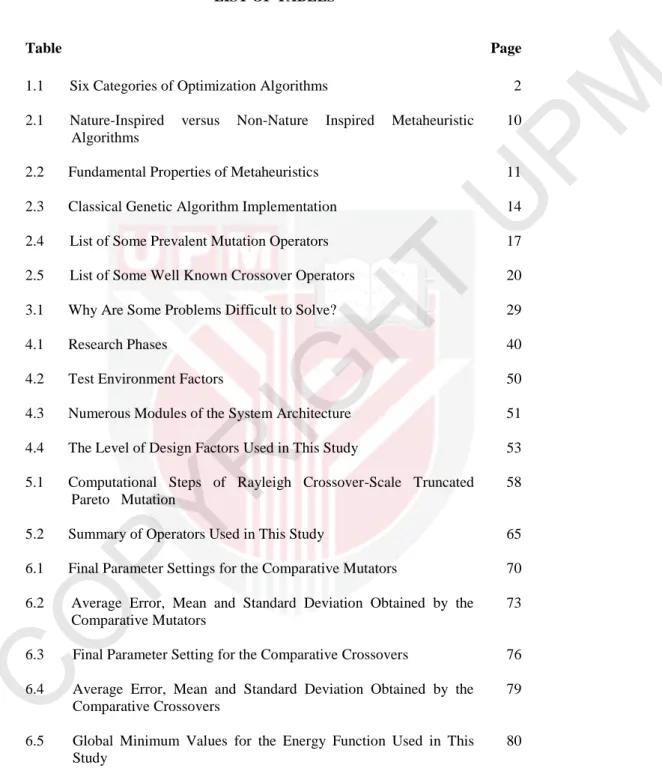
(17) LIST OF TABLES. Page. PM. Table 1.1. Six Categories of Optimization Algorithms. 2.1. Nature-Inspired Algorithms. 2.2. Fundamental Properties of Metaheuristics. 2.3. Classical Genetic Algorithm Implementation. 2.4. List of Some Prevalent Mutation Operators. 2.5. List of Some Well Known Crossover Operators. 20. 3.1. Why Are Some Problems Difficult to Solve?. 29. 4.1. Research Phases. 40. 4.2. Test Environment Factors. 50. 4.3. Numerous Modules of the System Architecture. 51. 4.4. The Level of Design Factors Used in This Study. 53. 5.1. Computational Steps of Rayleigh Crossover-Scale Truncated Pareto Mutation. 58. 5.2. Summary of Operators Used in This Study. 65. 6.1. Final Parameter Settings for the Comparative Mutators. 70. 6.2. Average Error, Mean and Standard Deviation Obtained by the Comparative Mutators. 73. 6.3. Final Parameter Setting for the Comparative Crossovers. 76. 6.4. Average Error, Mean and Standard Deviation Obtained by the Comparative Crossovers. 79. 6.5. Global Minimum Values for the Energy Function Used in This Study. 80. Inspired. Metaheuristic. 11. H. IG. R. PY. C. ©. 14 17. O. xiv. 10. U. Non-Nature. T. versus. 2.
(18) Final Parameter Setting for the Comparative Algorithms Used in First Conformational Search Application Problem. 80. 6.7. Final Parameter Setting for the Comparative Algorithms Used in Second Conformational Search Application Problem. 84. 7.1. Recommendation for Future Research. B1. Mean Values Obtained by Laplace Crossover-Scale Truncated Pareto Mutation. 117. B2. Signal to Noise Ratio Obtained by Laplace Crossover-Scale Truncated Pareto Mutation. 118. B3. Ideal Parameter Values Obtained by Laplace Crossover-Scale Truncated Pareto Mutation. 118. C1. Average Number of Function Evaluation and Success Rate Obtained by the Comparative Mutators. D1. Mean Values Obtained by Rayleigh Crossover-Scale Truncated Pareto Mutation. D2. Signal to Noise Ratio Obtained by Rayleigh Crossover-Scale Truncated Pareto Mutation. 121. D3. Ideal Parameter Values Obtained by Rayleigh Crossover-Scale Truncated Pareto Mutation. 121. E1. Average Number of Function Evaluation and Success Rate Obtained by the Comparative Crossovers. 122. Average Number of Function Evaluation and Success Rate Obtained by the Comparative Algorithms for the First Conformational Search Application Problem. 123. PM. 6.6. PY. R. IG. H. T. U. 91. O. F1. Average Number of Function Evaluation and Success Rate Obtained by the Comparative Algorithms for the Second Conformational Search Application Problem. ©. C. G1. xv. 119. 120. 124.
(19) LIST OF FIGURES. Page. PM. Figure 2.1. Evolutionary Algorithms. 2.2. Action Interval for Two Genes (Ca and Cb). 3.1. Population-Based Incremental Learning Algorithms. 3.2. Optimization as a Markov Chain. 3.3. Simulated Annealing Algorithms. 3.4. Bees Algorithms. 3.5. Simple Tabu Search Algorithms. 4.1. Pseudoethane Molecule. 4.2. Potential Energy of Pseudoethane Molecule. 48. 4.3. MATLAB 2012b Command Window. 52. 5.1. Flowchart Mutation. Pareto. 59. 5.2. Pseudocode of Rayleigh Crossover-Scale Truncated Pareto Mutation. 60. 5.3. A Real-Valued Chromosome Representation. 60. 6.1. Ideal Parameter Values Obtained by Laplace Crossover-Scale Truncated Pareto Mutation. 69. 16. U. 33. H. T. 34. IG. Rayleigh. 32. Crossover-Scale. Truncated. PY. O. ©. 37. Average Number of Function Evaluation Obtained by the Comparative Mutators. 71. 6.3. Success Rate Obtained by the Comparative Mutators. 72. 6.4. Average Error Obtained by the Comparative Mutators. 73. 6.5. Ideal Parameter Values Obtained by Rayleigh Crossover-Scale Truncated Pareto Mutation. 75. 6.6. Average Number of Function Evaluation Obtained by the Comparative Crossovers. 77. C. 6.2. 36. 47. R. of. 12. xvi.
(20) Success Rate Obtained by the Comparative Crossovers. 78. 6.8. Average Error Obtained by the Comparative Crossovers. 79. 6.9. Average Number of Function Evaluation Obtained by the Comparative Algorithms in the First Conformational Search Application Problem. 82. 6.10. Success Rate Obtained by the Comparative Algorithms in the First Conformational Search Application Problem. 83. 6.11. Average Number of Function Evaluation Obtained by the Comparative Algorithms in the Second Conformational Search Application Problem. 85. 6.12. Success Rate Obtained by the Comparative Algorithms in the Second Conformational Search Application Problem. 86. A1. Final Parameter Settings for Laplace Crossover-Scale Truncated Pareto Mutation. 111. A2. Performance Analysis for the Comparative Mutators. 112. A3. Final Parameter Settings for Rayleigh Crossover-Scale Truncated Pareto Mutator. 113. A4. Performance Analysis for the Comparative Crossovers. 114. A5. Performance Analysis for Rayleigh Crossover-Scale Truncated Pareto Mutation and the Comparative Algorithms on the First Conformational Search Application Problem. 115. Performance Analysis for Rayleigh Crossover-Scale Truncated Pareto Mutation and the Comparative Algorithms on the Second Conformational Search Application Problem. 116. PY. R. IG. H. T. U. PM. 6.7. ©. C. O. A6. xvii.
(21) LIST OF ABBREVIATIONS. Adaptive Directed Mutation. AE. Average Error. AFE. Average Number of Function Evaluation. BA. Bees Algorithms. BCGA. Binary Encoding Genetic Algorithms. BGAM. Breeder GA Mutation. CMA-ES. Covariance Matrix Adaptation Evolution Strategy. COP. Combinatorial Optimization Problem. CPU. Central Processing Unit. CS. Conformational Search. EA. Evolutionary Algorithms. F1. Test Function Number 1. F2. Test Function Number 2. F3. Test Function Number 3. U. T. H. IG. R. PY. Test Function Number 4. F5. Test Function Number 5. F6. Test Function Number 6. O. F4. F7. Test Function Number 7. F8. Test Function Number 8. F9. Test Function Number 9. F10. Test Function Number 10. GA. Genetic Algorithm. C. ©. PM. ADM. xviii.
(22) Genetic Algorithm Optimization Toolbox. GSTM. Greedy Sub Tour Mutation. HYB. Stage Hybrid with Full Simplex. LLM. Log Logistic Mutation. LM. Logarithmic Mutation. LX. Laplace Crossover. MI-LXPM. Mixed Integer Laplace Crossover-Power Mutation. MM. Muhlenbein’s Mutation. MNUM. Multi Non-Uniform Mutation. MPTM. Makinen, Periaux and Toivanen Mutation. NP. Non-Deterministic Polynomial. NUM. Non-Uniform Mutation. oHYB. Simplex as Operator Hybrid. OS. Operating System. U. T. H. IG. R Polynomial. PY. P. PM. GAOT. Population Based Incremental Learning Algorithms. PCA. Principal Component Analysis Mutation. PCX. Parent Centric Crossover. O. PBIL. Polynomial Mutation. PM. Power Mutation. ©. C. PLM. Pm. Mutation Rate. PoD. Pointed Directed Mutation. Ps. Population Size. Pc. Crossover Probability. QSAR. Quantitative Structure Activity Relationship xix.
(23) Real Coded Genetic Algorithm. rHYB. Stage Hybrid with a Reduced Simplex. RX. Rayleigh Crossover. RX-STPM. Rayleigh Crossover-Scaled Truncated Pareto Mutation. S/N. Signal to Noise Ratio. SA. Simulated Annealing. SBX. Simulated Binary Crossover. SPX. Simplex Crossover. SR. Success Rate. SS. Systematic Search. STPM. Scaled Truncated Pareto Mutation. TS. Tabu Search. Ts. Tournament Size. UNDX. Unimodal Normal Distribution Crossover. WX. Weibull Crossover. ©. C. O. PY. R. IG. H. T. U. PM. RCGA. xx.
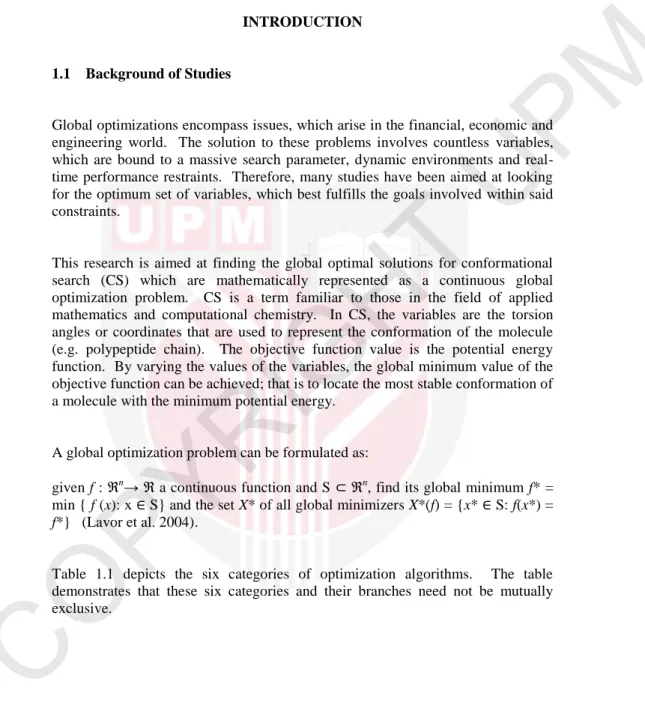
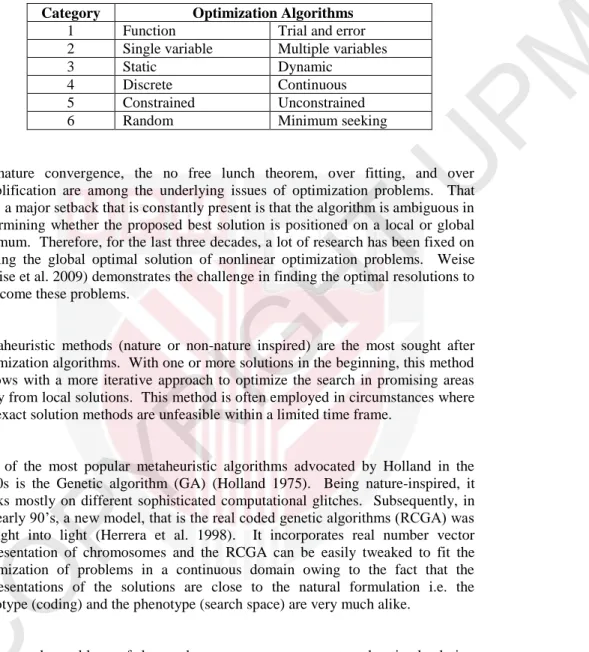
(24) CHAPTER 1. 1.1. PM. INTRODUCTION. Background of Studies. T. U. Global optimizations encompass issues, which arise in the financial, economic and engineering world. The solution to these problems involves countless variables, which are bound to a massive search parameter, dynamic environments and realtime performance restraints. Therefore, many studies have been aimed at looking for the optimum set of variables, which best fulfills the goals involved within said constraints.. R. IG. H. This research is aimed at finding the global optimal solutions for conformational search (CS) which are mathematically represented as a continuous global optimization problem. CS is a term familiar to those in the field of applied mathematics and computational chemistry. In CS, the variables are the torsion angles or coordinates that are used to represent the conformation of the molecule (e.g. polypeptide chain). The objective function value is the potential energy function. By varying the values of the variables, the global minimum value of the objective function can be achieved; that is to locate the most stable conformation of a molecule with the minimum potential energy.. A global optimization problem can be formulated as:. PY. given f : ℜn→ ℜ a continuous function and S ⊂ ℜn, find its global minimum f* = min { f (x): x ∈ S} and the set X* of all global minimizers X*(f) = {x* ∈ S: f(x*) = f*} (Lavor et al. 2004).. ©. C. O. Table 1.1 depicts the six categories of optimization algorithms. The table demonstrates that these six categories and their branches need not be mutually exclusive..
(25) Optimization Algorithms Function Trial and error Single variable Multiple variables Static Dynamic Discrete Continuous Constrained Unconstrained Random Minimum seeking. U. Category 1 2 3 4 5 6. PM. Table 1.1: Six Categories of Optimization Algorithms (Haupt et al. 2004). IG. H. T. Premature convergence, the no free lunch theorem, over fitting, and over simplification are among the underlying issues of optimization problems. That said, a major setback that is constantly present is that the algorithm is ambiguous in determining whether the proposed best solution is positioned on a local or global optimum. Therefore, for the last three decades, a lot of research has been fixed on finding the global optimal solution of nonlinear optimization problems. Weise (Weise et al. 2009) demonstrates the challenge in finding the optimal resolutions to overcome these problems.. R. Metaheuristic methods (nature or non-nature inspired) are the most sought after optimization algorithms. With one or more solutions in the beginning, this method follows with a more iterative approach to optimize the search in promising areas away from local solutions. This method is often employed in circumstances where the exact solution methods are unfeasible within a limited time frame.. ©. C. O. PY. One of the most popular metaheuristic algorithms advocated by Holland in the 1960s is the Genetic algorithm (GA) (Holland 1975). Being nature-inspired, it works mostly on different sophisticated computational glitches. Subsequently, in the early 90’s, a new model, that is the real coded genetic algorithms (RCGA) was brought into light (Herrera et al. 1998). It incorporates real number vector representation of chromosomes and the RCGA can be easily tweaked to fit the optimization of problems in a continuous domain owing to the fact that the representations of the solutions are close to the natural formulation i.e. the genotype (coding) and the phenotype (search space) are very much alike.. However, the problems of slow and premature convergence to suboptimal solution remain an existing struggle that GA is facing. Due to lower diversity in a population, it becomes challenging to locally exploit the solutions. In order to resolve these issues, the focus is now on reaching equilibrium between the explorative and exploitative features of GA. Therefore, the search process can be prompted to produce suitable GA solutions (Yuan et al. 2010).. 2.
(26) 1.2. U. PM. Although optimization algorithms with higher degree of exploitation may have higher convergence speed, the challenge lies in locating the optimal solution and chances are it may not get past a local optimum. On the other hand, algorithms that favor exploration over exploitation might consume more time in locating the global optimum, that is, coincidentally, due to its less sophisticated candidate solutions. Both features of GA are categorized based on the crossover and mutation operator, crossover probability (Pc), mutation rate (Pm), tournament size (Ts) and population size (Ps), all of which poses existing challenge to the current studies in GA. So the quality of GA solution and the computational time is governed by a fitting scheme of operators and parameter setting.. Problem Statement. IG. H. T. The implementation of real chromosomes encoding stems from the limitations of binary encoding (Deep et al. 2007a). In RCGA, a chromosome length is a vector of floating point numbers to the problem; thus, each gene represents a variable of the problem. Through data gathered from the literature, the many pros of RCGAs have been made apparent over Binary Coding GA (BCGA) particularly in terms of optimizing numerical functions (Deb et al. 2014, Sawyerr et al. 2014). Therefore, the express purpose of this study is aimed at refining the growth in RCGAs instead of BCGAs.. PY. R. The key focus of this study is narrowed down to the design of genetic operators. It is important to note that the success of exploration and exploitation in GA significantly depends on the efficient crossover and mutation search operators. It also depends on the appropriate coordination among the operators (Elsayed et al. 2014). These genetic operators will exchange information between the peaks and hinders the search from winding up at a local optimum. Over the years, there have been notable efforts in fine-tuning the existing operators by the evolutionary computation community.. ©. C. O. The main search operator in GA is the crossover operator which equally as significant as mutation, selection and coding in GA. The crossover operator functions primarily in the survey of information that is accessible through the search space, which inadvertently improves the behavior of the GA. A lot of RCGA efforts are channeled toward designing new crossover operators to heighten the performance of function optimization (Chuang et al. 2015).. On another note, mutation is a secondary operator. It functions to alter the genes of the offspring. A mutator will diversify the existing population and this inadvertently allows GAs to exploit promising areas of the search space thus avoiding local solutions (Korejo et al. 2010). Some of the mutation operators are designed to explicitly overcome certain types of issues over others (Gong et al. 2015). 3.
(27) The performance among all the comparative of GA operators are easily validated and compared through unbiased test problems from the literature, which are diverse in properties in terms of complexity and modality.. U. PM. Apart from that, the parameter settings of the GA is yet another key focus of this study. Significant attention has been shed in light of this to achieve exploration and exploitation in GA. The tuning methods involve increasing the algorithm performance or decreasing the effort. Since GA parameters can be divided into several levels, there are almost an infinite numbers of possibilities.. IG. H. T. Therefore, this research proposes the ideal operators with appropriate parameters and mechanisms to overcome global optimization problems such as CS, which are extremely challenging due to the volume of the search space. In this case, CS occurs when the total number of possible conformations grows exponentially with the total number of degrees of freedom (usually the dihedral angles). It had been confirmed that CS belongs to the category of NP-hard (non-deterministic polynomial time) problem. Such complexity requires an equally long amount of time to achieve resolution. This phenomenon is thus known as the 'combinatorial explosion' (Leach 2007).. PY. R. On the downside, the conventional experimental design is tedious due to the fact that the large number of experiments increases proportionally with the number of process parameters. These parameters are most likely to influence the performance of a studied system. To rectify that flaw, Genichi Taguchi (Taguchi 1962) presented an efficient and systematic approach called the Taguchi method to iron out the existing issues present in the conventional experimental design. Hence, this study incorporates the Taguchi method in the proposed operators.. 1.3. Objectives. ©. C. O. The main objective of this research is to propose new RCGA operators in the search for the optimum solution for continuous global optimization problems along with CS problems. The following details are identified to achieve the main objective of this study: To propose a mutation operator to exploit good solutions further in order to reach the optimum solution. To propose a crossover operator to perform a rapid and thorough discovery examination of the search space in order to speed up the exploration process. To propose a generic GA by combining the proposed crossover and mutator to achieve a good balance between exploration and exploitation.. 4.
(28) To apply the newly defined GA in the global minimization of a molecular potential energy function and finding stable conformations of small molecules.. Scope of the Study. PM. 1.4. U. This study focuses primarily on new genetic operators to achieve a balance between exploration and exploitation strategies in GA in order to solve global optimization problems. The two main tools used in the Taguchi method were incorporated in the proposed approach to study all the decision variables involved simultaneously and to measure the quality of solution.. Research Contribution. R. 1.5. IG. H. T. The two proposed genetic operators were tested separately on a data set of ten standard global optimization test problems with varying properties and type of difficulty levels. The test set comprised five non-scalable problems and five scalable problems. The findings gathered from the proposed crossover and mutation operators were compared separately with other GA operators using different probability distributions namely the Laplace distribution, Log Logistic distribution and Power distribution. The effect of the two proposed operators were also tested on two CS application problems. For validity purposes, we adopted the method of analysis that is similar to previous related work to analyze the effect of the newly proposed genetic operators on the GA performance.. PY. This study substantially contributes in defining a new generational RCGA, which maintains a good balance between exploration and exploitation strategies while manufacturing the optimum GA solutions. The following highlights the strength of the proposed genetic operators:. ©. C. O. The Pareto distribution employed in the new mutation operator has been altered to include a scale to the bounded Pareto. The scale limits the influence of the mutation on the offspring created by the crossover. To supplement that, the truncated Pareto distribution, which always has finite moments, is applied and a modulus is added into the distribution to eliminate the possible imaginary number. Therefore, the new mutator is named Scale Truncated Pareto Mutation (STPM). STPM facilitates the algorithm in generating new solutions from existing ones. It not only improves but also combines the traits of the currently known solution(s). This process can expedite the convergence giving a greater impact on the diversity of the populations.. 5.
(29) 1.6. U. PM. In the new crossover operator, a Log is introduced to set the boundary of the Rayleigh distribution. A modulus is also included to select only the positive values of the Rayleigh distribution numbers. This operator produces two offspring solutions from two parents. Each offspring solution would inherit favorable elements from both parents. The new parent-centric approach crossover has a higher probability in generating the offspring solutions near each of the parents. This crossover operator exhibited self-adaptation features through the generation of additional diversity beginning from the current one. In other words, the operator seeks new solutions within an unexplored search space and this will inadvertently enhance the competence of GA performance.. Organization of Thesis. H. T. This thesis is structured in a way that it complies with the standard structure of thesis and dissertation of University Putra Malaysia. The thesis consists of seven chapters, which are organized as follow:. IG. Chapter 1 is the introductory chapter, which includes the background, problems, objectives, scope and contributions of the study. This chapter outlines some fundamental information on the importance of this study and the outcomes of the research.. PY. R. Chapter 2 reviews the theoretical foundation on the related topics about algorithms. The chapter begins with the introduction of combinatorial optimization and the role of algorithms starting from the big family of stochastic approaches followed by metaheuristic techniques, evolutionary methods and finally GA in solving these problems and related issues.. ©. C. O. Chapter 3 explains the computational methods and computational steps for CS. This chapter also provides various algorithmic approaches that have been applied to various common CS problems over the last few decades. It covers an overview of five popularly used metaheuristic approaches and five other techniques with their respective mechanisms on solving all kind of CS problems.. Chapter 4 discusses the research methodology of this study. It covers the descriptions of ten benchmark datasets, two CS application problems, the relevant experimental procedures and detailed experimentation evaluations. It begins with the four major research phases, which cover the proposed algorithms, and the experimentation conducted to compare the performance among the algorithms.. 6.
(30) PM. Chapter 5 outlines the major contribution of the work. This chapter introduces an overview of a novel RCGA model called Rayleigh Crossover-Scale Truncated Pareto Mutator (RX-STPM) capable of solving two CS problems. Apart from that, the design and analysis of GA parameters using the Taguchi approach are also introduced in this chapter.. T. U. Chapter 6 discusses the computational results obtained from the proposed GA approach in Chapter 5 based on experiments performed on the ten benchmark test problems and two CS application problems. The discussions are presented in six different parts. The first four parts examine the results obtained from the finalparameter-tuning and performance analyses for the proposed RX crossover and STPM mutator operators over a set of ten benchmark global optimization test problems. Subsequently, the last two parts confers the results of the performance analysis in the minimization of a simplified molecular model and stable conformations of pseudoethane over the proposed RX-STPM algorithm.. ©. C. O. PY. R. IG. H. Last but not least, Chapter 7 concludes the core findings of the study and several recommendations are suggested for possible future research in various aspects of GA and CS problems.. 7.
(31) REFERENCES. PM. Abhang, L., & Hameedullah, M. (2012). Optimization of machining parameters in steel turning operation by taguchi method. Procedia Engineering, 38, 40-48. Adjiman, C. S., & Floudas, C. A. (1996). Rigorous convex underestimators for general twice-differentiable problems. Journal of Global Optimization, 9(1), 23-40.. U. Agrawal, R. B., Deb, K., & Agrawal, R. B. (1994). Simulated binary crossover for continuous search space.. T. Agrawal, S., & Silakari, S. (2014). Fletcher–Reeves based particle swarm optimization for prediction of molecular structure. Journal of Molecular Graphics and Modelling, 49, 11-17.. H. Albayrak, M., & Allahverdi, N. (2011). Development a new mutation operator to solve the traveling salesman problem by aid of genetic algorithms. Expert Systems with Applications, 38(3), 1313-1320.. IG. Atkins, P. W., & Friedman, R. (2011). Molecular quantum mechanics, Oxford university press.. R. Back, T. (1996). Evolutionary algorithms in theory and practice, Oxford Univ. Press.. PY. Bahamish, H. A. A., Abdullah, R., & Salam, R. A. (2008). Protein conformational search using bees algorithm. Modeling & Simulation, 2008. AICMS 08. Second Asia International Conference on, 911-916. Baluja, S. (1994). Population-Based Incremental Learning.a Method for Integrating Genetic Search Based Function Optimization and Competitive Learning,. O. Banu, R. N., & Devaraj, D. (2009). Multi-objective evolutionary algorithm for security enhancement. Journal of Electrical Systems, 5(4), 1-16.. ©. C. Barbosa, H. J., Lavor, C. C., & Raupp, F. M. (2005). A GA-simplex hybrid algorithm for global minimization of molecular potential energy functions. Annals of Operations Research, 138(1), 189-202.. Barr, R. S., Golden, B. L., Kelly, J., Steward, W., & Resende, M. (2001). Guidelines for designing and reporting on computational experiments with heuristic methods. Proceedings of International Conference on Metaheuristics for Optimization. Kluwer Publishing, Norwell, MA, 1-17. Berry, A., & Vamplew, P. (2004). PoD can Mutate: A Simple Dynamic Directed Mutation Approach for Genetic Algorithms,. 92.
(32) Beusen, D. D., Berkley Shands, E., Karasek, S., Marshall, G. R., & Dammkoehler, R. A. (1996). Systematic search in conformational analysis. Journal of Molecular Structure: THEOCHEM, 370(2), 157-171.. PM. Beyer, H., & Deb, K. (2001). On self-adaptive features in real-parameter evolutionary algorithms. Evolutionary Computation, IEEE Transactions, 5(3), 250-270. Bhandari, D., Pal, N. R., & Pal, S. K. (1994). Directed mutation in genetic algorithms. Information Sciences, 79(3), 251-270.. U. Blum, C., & Roli, A. (2003). Metaheuristics in combinatorial optimization: Overview and conceptual comparison. ACM Computing Surveys (CSUR), 35(3), 268-308.. T. Brad L. Miller, & David E. Goldberg. (1995). Genetic algorithms, tournament selection, and the effects of noise. Complex Systems 9, , 193-212.. H. Brintaki, A. N., Lai-Yuen, S. K., & Nikolos, I. K. (2011). A kinematics based evolutionary approach for molecular conformational search. Computer-Aided Design and Applications, 8(1), 23-36.. IG. Cai, W., & Shao, X. (2002). A fast annealing evolutionary algorithm for global optimization. Journal of Computational Chemistry, 23(4), 427-435.. R. Çakıroğlu, R., & Acır, A. (2013). Optimization of cutting parameters on drill bit temperature in drilling by taguchi method. Measurement, 46(9), 3525-3531.. PY. Camposeco-Negrete, C. (2013). Optimization of cutting parameters for minimizing energy consumption in turning of AISI 6061 T6 using taguchi methodology and ANOVA. Journal of Cleaner Production, 53, 195-203.. O. Cao, Z., & Zhang, Z. (2010). Parameter settings of genetic algorithm based on multi-factor analysis of variance. Genetic and Evolutionary Computing (ICGEC), 2010 Fourth International Conference on, 305-307.. ©. C. Ceci, G., Mucherino, A., D’Apuzzo, M., Di Serafino, D., Costantini, S., Facchiano, A., & Colonna, G. (2007). Computational methods for protein fold prediction: An ab-initio topological approach. Data mining in biomedicine (pp. 391-429) Springer. Chang, C., & Gilson, M. K. (2003). Tork: Conformational analysis method for molecules and complexes. Journal of Computational Chemistry, 24(16), 19871998. Chen, M., & Liao, F. (1998). Adaptive mutation operators and its applications. Journal of Dayeh University, 7(1), 91-101.. 93.
(33) Christen, M., & Van Gunsteren, W. F. (2008). On searching in, sampling of, and dynamically moving through conformational space of biomolecular systems: A review. Journal of Computational Chemistry, 29(2), 157-166.. Clark, D. R. (2013). A note on the upper-truncated pareto distribution.. PM. Chuang, Y., Chen, C., & Hwang, C. (2015). A real-coded genetic algorithm with a direction-based crossover operator. Information Sciences, 305, 320-348.. U. Črepinšek, M., Liu, S., & Mernik, M. (2013). Exploration and exploitation in evolutionary algorithms: A survey. ACM Computing Surveys (CSUR), 45(3), 35. Crippen, G. M. (2013). Distance geometry for realistic molecular conformations. Distance geometry (pp. 315-328) Springer.. T. D. Futuyma. (2009). Evolution (2nd edition ed.) Sinauer Associates Inc.. H. Darwin, C., & Bynum, W. F. (2009). The origin of species by means of natural selection: Or, the preservation of favored races in the struggle for life AL Burt.. IG. Davim, J. P. (2003). Design of optimisation of cutting parameters for turning metal matrix composites based on the orthogonal arrays. Journal of Materials Processing Technology, 132(1), 340-344.. R. Davis, L. (1991). Handbook of genetic algorithms Van Nostrand Reinhold New York.. PY. Dawkins, R. (2006). The selfish gene. Oxford University Press. De Jong, K. A. (2006). Evolutionary computation: A unified approach MIT press. De Jong, K. A. (2007). Parameter settings in evolutionary algorithms: A 30 years perspective. Studies in Computational Intelligence (SCI), 54, 1-18.. O. Deb, K. (2001). Multi-objective optimization using evolutionary algorithms. John Wiley & Sons.. ©. C. Deb, K., Anand, A., & Joshi, D. (2002). A computationally efficient evolutionary algorithm for real-parameter optimization. Evolutionary Computation, 10(4), 371-395.. Deb, K., & Deb, D. (2014). Analyzing mutation schemes for real parameter genetic algorithm. International Journal of Artificial Intelligence and Soft Computing, 4(1). Deb, K., & Goyal, M. (1996). A combined genetic adaptive search (GeneAS) for engineering design. Computer Science and Informatics, 26, 30-45.. 94.
(34) Deep, K., & Katiyar, V. (2009). Finding stable conformations of small molecules using real coded genetic algorithm. Nature & Biologically Inspired Computing, 2009. NaBIC 2009. World Congress on, 342-348.. PM. Deep, K., Barak, S., Katiyar, V. K., & Nagar, A. K. (2011). Minimization of molecular potential energy function using newly developed real coded genetic algorithms. An International Journal of Optimization and Control: Theories & Applications (IJOCTA), 2(1), 51-58.. U. Deep, K., & Katiyar, V. (2012). A new real coded genetic algorithm operator: Log logistic mutation. Proceedings of the International Conference on Soft Computing for Problem Solving (SocProS 2011) December 20-22, 2011, 193200.. T. Deep, K., Singh, K. P., Kansal, M., & Mohan, C. (2009). A real coded genetic algorithm for solving integer and mixed integer optimization problems. Applied Mathematics and Computation, 212(2), 505-518.. H. Deep, K., & Thakur, M. (2007a). A new crossover operator for real coded genetic algorithms. Applied Mathematics and Computation, 188(1), 895-911.. IG. Deep, K., & Thakur, M. (2007b). A new mutation operator for real coded genetic algorithms. Applied Mathematics and Computation, 193(1), 211-230.. R. Dorn, M., e Silva, M. B., Buriol, L. S., & Lamb, L. C. (2014). Three-dimensional protein structure prediction: Methods and computational strategies. Computational Biology and Chemistry.. PY. Eiben, A., & Smith, J. (2008). Introduction to evolutionary computing (natural computing series). Eiben, A. E., & Smith, J. E. (2010). Introduction to evolutionary computing Springer Berlin.. O. Eiben, A. E., Hinterding, R., & Michalewicz, Z. (1999). Parameter control in evolutionary algorithms. Evolutionary Computation, IEEE Transactions, 3(2), 124-141.. ©. C. Eisenmenger, F., Hansmann, U. H., Hayryan, S., & Hu, C. (2006). An enhanced version of SMMP—open-source software package for simulation of proteins. Computer Physics Communications, 174(5), 422-429.. Elsayed, S. M., Sarker, R. A., & Essam, D. L. (2014). A new genetic algorithm for solving optimization problems. Engineering Applications of Artificial Intelligence, 27, 57-69. Eshelman, L. J. (1993). Chapter real-coded genetic algorithms and intervalschemata. Foundations of Genetic Algorithms, 2, 187-202.. 95.
(35) Eshelman, L. J. (1997). Crossover operator biases: Exploiting the population distribution. Proceedings of the Seventh International Conference on Genetic Algorithms, 354-361.. PM. Falkenauer, E., & Delchambre, A. (1992). A genetic algorithm for bin packing and line balancing. Robotics and Automation, 1992. Proceedings., 1992 IEEE International Conference, 1186-1192.. U. Fang, N., Zhou, J., Zhang, R., Liu, Y., & Zhang, Y. (2014). A hybrid of real coded genetic algorithm and artificial fish swarm algorithm for short-term optimal hydrothermal scheduling. International Journal of Electrical Power & Energy Systems, 62, 617-629.. T. Floudas, C. A., Pardalos, P. M., Adjiman, C. S., Esposito, W. R., Gümüs, Z. H., Harding, S. T., . . . Schweiger, C. A. (1999). Twice continuously differentiable NLP problems. Handbook of test problems in local and global optimization (pp. 107-204) Springer.. H. Fogel, D. B. (2006). Evolutionary computation: Toward a new philosophy of machine intelligence Wiley-IEEE Press.. IG. Fogel, L. J. (1999). Intelligence through simulated evolution: Forty years of evolutionary programming John Wiley & Sons, Inc.. R. Fraley, S., Oom, M., Terrien, B., & Date, J. (2006). Design of experiments via taguchi methods: Orthogonal arrays. The Michigan Chemical Process Dynamic and Controls Open Text Book, USA, 2(3), 4.. PY. Frausto-Solis, J., Román, E., Romero, D., Soberon, X., & Liñán-García, E. (2007). Analytically tuned simulated annealing applied to the protein folding problem. Computational Science–ICCS 2007 (pp. 370-377) Springer.. O. Frausto-Solis, J., Soberon-Mainero, X., & Liñán-García, E. (2009). MultiQuenching annealing algorithm for protein folding problem. MICAI 2009: Advances in artificial intelligence (pp. 578-589) Springer.. ©. C. Garduño-Juárez, R., & Morales, L. B. (2003). A genetic algorithm with conformational memories for structure prediction of polypeptides. Journal of Biomolecular Structure and Dynamics, 21(1), 65-87.. Glover, F., & Laguna, M. (2013). Tabu search. Springer. Goldberg, D. E. (1989). Genetic algorithms in search, optimization and machine learning. New York: Addison-Wesley. Gong, W., Cai, Z., & Liang, D. (2015). Adaptive ranking mutation operator based differential evolution for constrained optimization. Cybernetics, IEEE Transactions, 45(4), 716-727.. 96.
(36) Hamida, S. B., & Petrowski, A. (2000). The need for improving the exploration operators for constrained optimization problems. Evolutionary Computation, 2000. Proceedings of the 2000 Congress on, , 2 1176-1183.. PM. Hansen, N., & Ostermeier, A. (2001). Completely derandomized self-adaptation in evolution strategies. Evolutionary Computation, 9(2), 159-195. Haupt, R. L., & Haupt, S. E. (2004). Practical genetic algorithms John Wiley & Sons.. U. Hedar, A., Ali, A. F., & Abdel-Hamid, T. H. (2010). Finding the 3D-structure of a molecule using genetic algorithm and tabu search methods. Intelligent Systems Design and Applications (ISDA), 2010 10th International Conference on, 296301.. T. Hehre, W. J. (2003). A guide to molecular mechanics and quantum chemical calculations Wave function Irvine, CA.. H. Herrera, F., & Lozano, M. (1996). Adaptation of genetic algorithm parameters based on fuzzy logic controllers. Genetic Algorithms and Soft Computing, 8, 95-125.. IG. Herrera, F., Lozano, M., & Sánchez, A. M. (2003). A taxonomy for the crossover operator for real‐ coded genetic algorithms: An experimental study. International Journal of Intelligent Systems, 18(3), 309-338.. PY. R. Herrera, F., Lozano, M., & Sánchez, A. M. (2005). Hybrid crossover operators for real-coded genetic algorithms: An experimental study. Soft Computing, 9(4), 280-298. Herrera, F., Lozano, M., & Verdegay, J. L. (1998). Tackling real-coded genetic algorithms: Operators and tools for behavioural analysis. Artificial Intelligence Review, 12(4), 265-319.. O. Hinterding, R. (1995). Gaussian mutation and self-adaption for numeric genetic algorithms. Evolutionary Computation, 1995., IEEE International Conference, 1 384.. ©. C. Hinterding, R., Michalewicz, Z., & Peachey, T. C. (1996). Self-adaptive genetic algorithm for numeric functions. Parallel problem solving from Nature—PPSN IV (pp. 420-429) Springer. Holland, J. H. (1975). Adaption in natural and artificial systems. University of Michigan press. Hou, T., Su, C., & Liu, W. (2007). Parameters optimization of a nano-particle wet milling process using the taguchi method, response surface method and genetic algorithm. Powder Technology, 173(3), 153-162.. 97.
(37) Houck, C. R., Joines, J., & Kay, M. G. (1995). A genetic algorithm for function optimization: A matlab implementation. NCSU-IE TR, 95(09). PM. Hsieh, C., Chou, J., & Wu, Y. (2001). Optimal grey-fuzzy gain-scheduler design using taguchi-HGA method. Journal of Intelligent and Robotic Systems, 32(3), 321-345. James, J., & Li, V. O. (2015). A social spider algorithm for global optimization. Applied Soft Computing, 30, 614-627.. U. Jamil, M., & Yang, X. (2013). A literature survey of benchmark functions for global optimisation problems. International Journal of Mathematical Modelling and Numerical Optimisation, 4(2), 150-194.. T. Jin, J., Yang, X., & Ding, J. (2001). An improved simple genetic algorithm— accelerating genetic algorithm. Theory and Practice of System Engineering, 4, 8-13.. H. Kita, H. (2001). A comparison study of self-adaptation in evolution strategies and real-coded genetic algorithms. Evolutionary Computation, 9(2), 223-241.. IG. Kita, H., Ono, I., & Kobayashi, S. (1999). Multi-parental extension of the unimodal normal distribution crossover for real-coded genetic algorithms. Evolutionary Computation, 1999. CEC 99. Proceedings of the 1999 Congress on. R. Kitchen, D. B., Decornez, H., Furr, J. R., & Bajorath, J. (2004). Docking and scoring in virtual screening for drug discovery: Methods and applications. Nature Reviews Drug Discovery, 3(11), 935-949.. PY. Kleiber, C., & Kotz, S. (2003). Statistical size distributions in economics and actuarial sciences John Wiley & Sons.. O. Kolahan, F., & Doughabadi, M. H. (2012). The effects of parameter settings on the performance of genetic algorithm through experimental design and statistical analysis. Advanced Materials Research, 433, 5994-5999.. ©. C. Korejo, I., Yang, S., & Li, C. (2010). A directed mutation operator for real coded genetic algorithms. Applications of evolutionary computation (pp. 491-500) Springer. Kumar, P., Pant, M., & Abraham, A. (2011). Two enhanced differential evolution variants for solving global optimization problems. Nature and Biologically Inspired Computing (NaBIC), 2011 Third World Congress on, 201-206. Kumar, S., Sharma, V. K., & Kumari, R. (2014). A novel hybrid crossover based artificial bee colony algorithm for optimization problem. ArXiv Preprint arXiv:1407.5574. 98.
(38) PM. Lagorce, D., Pencheva, T., Villoutreix, B. O., & Miteva, M. A. (2009). DGAMMOS: A new tool to generate 3d conformation of small molecules using distance geometry and automated molecular mechanics optimization for in silico screening. BMC Chemical Biology, 9, 6-6769-9-6. doi:10.1186/14726769-9-6 [doi] Larranaga, P. (2002). A review on estimation of distribution algorithms. Estimation of distribution algorithms (pp. 57-100) Springer.. U. Lau, M. S., & Kwong, C. (2006). A smoothing method of global optimization that preserves global minima. Journal of Global Optimization, 34(3), 369-398.. T. LaValle, S. M., Finn, P. W., Kavraki, L. E., & Latombe, J. (2000). A randomized kinematics‐ based approach to pharmacophore‐ constrained conformational search and database screening. Journal of Computational Chemistry, 21(9), 731-747.. H. Lavor, C. (2003). A deterministic approach for global minimization of molecular potential energy functions. International Journal of Quantum Chemistry, 95(3), 336-343.. IG. Lavor, C., & Maculan, N. (2001). Interval analysis applied to global minimization of potential energy functions. Advances in convex analysis and global optimization (pp. 333-344) Springer.. R. Lavor, C., & Maculan, N. (2004). A function to test methods applied to global minimization of potential energy of molecules. Numerical Algorithms, 35(2-4), 287-300.. PY. Leach, A. R. (2007). A survey of methods for searching the conformational space of small and Medium‐ Sized molecules. Reviews in Computational Chemistry, Volume 2, , 1-55.. O. Lee, K., Czaplewski, C., Kim, S., & Lee, J. (2005). An efficient molecular docking using conformational space annealing. Journal of Computational Chemistry, 26(1), 78-87.. ©. C. Leong, W. J., & Abu Hassan, M. (2008). Predicting minimum energy structure of a peptide via a modified potential smoothing kernel. Malaysian Journal of Mathematical Sciences, 2(2), 29-39. Liang, Y., Leung, K., & Xu, Z. (2007). A novel splicing/decomposable binary encoding and its operators for genetic and evolutionary algorithms. Applied Mathematics and Computation, 190, 887-904. Liberti, L., & Kucherenko, S. (2005). Comparison of deterministic and stochastic approaches to global optimization. International Transactions in Operational Research, 12(3), 263-285.. 99.
(39) Liberti, L., Lavor, C., Mucherino, A., & Maculan, N. (2011). Molecular distance geometry methods: From continuous to discrete. International Transactions in Operational Research, 18(1), 33-51.. PM. Lim, T. Y., Al-Betar, M. A., & Khader, A. T. (2015). Adaptive pair bonds in genetic algorithm: An application to real-parameter optimization. Applied Mathematics and Computation, 252, 503-519.. U. Lin, Y., & Stadtherr, M. A. (2005). Deterministic global optimization of molecular structures using interval analysis. Journal of Computational Chemistry, 26(13), 1413-1420. Ling, S., & Leung, F. F. (2007). An improved genetic algorithm with averagebound crossover and wavelet mutation operations. Soft Computing, 11(1), 7-31.. H. T. Liu, D., & Cai, Y. (2005). Taguchi method for solving the economic dispatch problem with nonsmooth cost functions. Power Systems, IEEE Transactions on, 20(4), 2006-2014. Lobo, F. G., & Goldberg, D. E. (2004). The parameter-less genetic algorithm in practice. Information Sciences, 167(1), 217-232.. IG. Long, S. M., Tran, T. T., Adams, P., Darwen, P., & Smythe, M. L. (2011a). Conformational searching using a population‐ based incremental learning algorithm. Journal of Computational Chemistry, 32(8), 1541-1549.. R. López-Camacho, E., Godoy, M. J. G., García-Nieto, J., Nebro, A. J., & AldanaMontes, J. F. (2015). Solving molecular flexible docking problems with metaheuristics: A comparative study. Applied Soft Computing, 28, 379-393.. PY. Lučić, P. (2002). Modeling Transportation Problems using Concepts of Swarm Intelligence and Soft Computing.. O. Lynch, S. (2014). A tutorial introduction to MATLAB. Dynamical systems with applications using MATLAB® (pp. 1-14) Springer. M. L. Huang and K. Zhao. (2010). On estimation of the truncated pareto distribution. Advances and Applications in Statistics, 16(1), 83-102.. ©. C. Manikandan, S., Ramar, K., Iruthayarajan, M. W., & Srinivasagan, K. (2014). Multilevel thresholding for segmentation of medical brain images using real coded genetic algorithm. Measurement, 47, 558-568.. Maranas, C. D., & Floudas, C. A. (1994a). A deterministic global optimization approach for molecular structure determination. Journal of Chemical Physics, 100(2), 1247-1261.. 100.
(40) Maranas, C. D., & Floudas, C. A. (1994b). Global minimum potential energy conformations of small molecules. Journal of Global Optimization, 4(2), 135170.. PM. Masoom Ali, M., & Nadarajah, S. (2006). A truncated pareto distribution. Computer Communications, 30(1), 1-4. Michalewicz, Z., & Fogel, D. B. (2004). Why are some problems difficult to solve? How to solve it: Modern heuristics (pp. 11-30) Springer.. U. Michalewicz, Z., Logan, T., & Swaminathan, S. (1994). Evolutionary operators for continuous convex parameter spaces. Proceedings of the 3rd Annual Conference on Evolutionary Programming, 84-97.. T. Montgomery, D. C., Montgomery, D. C., & Montgomery, D. C. (2008). Design and analysis of experiments. Wiley New York.. H. Moraglio, A., Kim, Y., Yoon, Y., & Moon, B. (2007). Geometric crossovers for multiway graph partitioning. Evolutionary Computation, 15(4), 445-474.. IG. Morales, L. B., Garduño–Juárez, R., Aguilar–Alvarado, J., & Riveros–Castro, F. (2000). A parallel tabu search for conformational energy optimization of oligopeptides. Journal of Computational Chemistry, 21(2), 147-156.. R. Mühlenbein, H., & Schlierkamp-Voosen, D. (1993). Predictive models for the breeder genetic algorithm i. continuous parameter optimization. Evolutionary Computation, 1(1), 25-49.. PY. Mühlenbein, H., Schomisch, M., & Born, J. (1991). The parallel genetic algorithm as function optimizer. Parallel Computing, 17(6), 619-632. Munteanu, C., & Lazarescu, V. (1999). Improving mutation capabilities in a realcoded genetic algorithm. Evolutionary image analysis, signal processing and telecommunications (pp. 138-149) Springer.. ©. C. O. Nahmany, A., Strino, F., Rosen, J., Kemp, G. J., & Nyholm, P. (2005). The use of a genetic algorithm search for molecular mechanics (MM3)-based conformational analysis of oligosaccharides. Carbohydrate Research, 340(5), 1059-1064. Ng, M. C., Fong, S., & Siu, S. W. (2015). PSOVina: The hybrid particle swarm optimization algorithm for protein–ligand docking. Journal of Bioinformatics and Computational Biology, 13(03), 1541007. Noraini, M. R., & Geraghty, J. (2011). Genetic algorithm performance with different selection strategies in solving TSP.. 101.
(41) Ono, I., Satoh, H., & Kobayashi, S. (1999). A real-coded genetic algorithm for function optimization using the unimodal normal distribution crossover. Transactions of the Japanese Society for Artificial Intelligence, 14, 1146-1155.. PM. Osguthorpe, D. J. (2000). < i> ab initio</i> protein folding. Current Opinion in Structural Biology, 10(2), 146-152.. Ouadfel, S., & Taleb-Ahmed, A. (2016). Social spiders optimization and flower pollination algorithm for multilevel image thresholding: A performance study. Expert Systems with Applications. U. Ozkan, S. B., & Meirovitch, H. (2004). Conformational search of peptides and proteins: Monte carlo minimization with an adaptive bias method applied to the heptapeptide deltorphin. Journal of Computational Chemistry, 25(4), 565-572.. H. T. Paenke, I., Branke, J., & Jin, Y. (2007). On the influence of phenotype plasticity on genotype diversity. Foundations of Computational Intelligence, 2007. FOCI 2007. IEEE Symposium on, 33-40.. IG. Pelikan, M., Goldberg, D. E., & Lobo, F. G. (2002). A survey of optimization by building and using probabilistic models. Computational Optimization and Applications, 21(1), 5-20. Perline, R. (2005). Strong, weak and false inverse power laws. Statistical Science, , 68-88.. PY. R. Pham, D., Ghanbarzadeh, A., Koc, E., Otri, S., Rahim, S., & Zaidi, M. (2006). The bees algorithm-a novel tool for complex optimisation problems. Proceedings of the 2nd Virtual International Conference on Intelligent Production Machines and Systems (IPROMS 2006), 454-459.. O. Pillardy, J., Czaplewski, C., Liwo, A., Lee, J., Ripoll, D. R., Kaźmierkiewicz, R., . . . Arnautova, Y. A. (2001). Recent improvements in prediction of protein structure by global optimization of a potential energy function. Proceedings of the National Academy of Sciences, 98(5), 2329-2333. Poli, R., Langdon, W. B., McPhee, N. F., & Koza, J. R. (2008). A field guide to genetic programming Lulu. com.. ©. C. Pongcharoen, P., Chainate, W., & Thapatsuwan, P. (2007). Exploration of genetic parameters and operators through travelling salesman problem. Science Asia, 33(2), 215-222. Prechelt, L. (2001). An empirical comparison of seven programming languages. IEEE Computer, 33, 23-29. Radcliffe, N. J. (1991). Equivalence class analysis of genetic algorithms. Complex Systems, 5(2), 183-205.. 102.
(42) Ramli, Rosshairy Abd Rahmanand Razamin.Average concept of crossover operator in real coded genetic algorithm.. PM. Ru, X., Song, C., & Lin, Z. (2016). A genetic algorithm encoded with the structural information of amino acids and dipeptides for efficient conformational searches of oligopeptides. Journal of Computational Chemistry. Sarmady, S. (2007). An investigation on genetic algorithm parameters. School of Computer Science, Universiti Sains Malaysia,. U. Sawyerr, B. A., Adewumi, A. O., & Ali, M. M. (2014). Real-coded genetic algorithm with uniform random local search. Applied Mathematics and Computation, 228, 589-597.. T. Schlierkamp-Voosen, D. (1993). Predictive models for the breeder genetic algorithm. Evolutionary Computation, 1(1), 25-49.. H. Setzer, W. N. (2009). Conformational analysis of thioether musks using density functional theory. International Journal of Molecular Sciences, 10(8), 34883501.. IG. Shashi, K. D., Katiyar, V., & Katiyar, C. (2009). A state of art review on application of nature inspired optimization algorithms in protein-ligand docking. Indian Journal of Biomechanics: Special Issue, 3, 7-8.. R. Sinha, A., Tiwari, S., & Deb, K. (2005). A population-based, steady-state procedure for real-parameter optimization. Evolutionary Computation, 2005. the 2005 IEEE Congress on, , 1 514-521.. PY. Spears, W. M. (1995). Adapting crossover in evolutionary algorithms. Evolutionary Programming, 367-384.. O. Stepanenko, S., & Engels, B. (2009). Tabu search based strategies for conformational search†. The Journal of Physical Chemistry A, 113(43), 1169911705.. ©. C. Strino, F., Nahmany, A., Rosen, J., Kemp, G. J., Sá-Correia, I., & Nyholm, P. (2005). Conformation of the exopolysaccharide of< i> burkholderia cepacia</i> predicted with molecular mechanics (MM3) using genetic algorithm search. Carbohydrate Research, 340(5), 1019-1024. Subbaraj, P., Rengaraj, R., & Salivahanan, S. (2011). Enhancement of self-adaptive real-coded genetic algorithm using taguchi method for economic dispatch problem. Applied Soft Computing, 11(1), 83-92. Sun, J. U. (2007). A taguchi approach to parameter setting in a genetic algorithm for general job shop scheduling problem. IEMS, 6(2), 119-124.. 103.
(43) T. Back, D. B. Fogel and Z. Michalewics, editors. (2000a). Evolutionary computation 1: Basic algorithms and operator IoP.. PM. T. Back, D. B. Fogel and Z. Michalewics, editors. (2000b). Evolutionary computation 2: Advanced algorithms and operations IoP. Taguchi, G. (1962). Studies on mathematical statistics for quality control. Doctoral Thesis, Kyushu University.. U. Tang, P., & Tseng, M. (2012). Adaptive directed mutation for real-coded genetic algorithms. Applied Soft Computing. Tang, P., & Tseng, M. (2013). Adaptive directed mutation for real-coded genetic algorithms. Applied Soft Computing, 13(1), 600-614.. H. T. Tantar, A., Melab, N., & Talbi, E. (2010). A grid-based hybrid hierarchical genetic algorithm for protein structure prediction. Parallel and distributed computational intelligence (pp. 291-319) Springer.. IG. Temby, L., Vamplew, P., & Berry, A. (2005). Accelerating real-valued genetic algorithms using mutation-with-momentum. AI 2005: Advances in artificial intelligence (pp. 1108-1111) Springer.. R. Toivanen, Raino AE Mäkinen Jari, Périaux, J., & Cloud Cedex, F. (1999). Multidisciplinary shape optimization in aerodynamics and electromagnetics using genetic algorithms. Int.J.Numer.Meth.Fluids, 30, 149-159.. PY. Tsai, J., Liu, T., & Chou, J. (2004). Hybrid taguchi-genetic algorithm for global numerical optimization. Evolutionary Computation, IEEE Transactions on, 8(4), 365-377. Tsutsui, S., Yamamura, M., & Higuchi, T. (1999). Multi-parent recombination with simplex crossover in real coded genetic algorithms. Proceedings of the Genetic and Evolutionary Computation Conference, , 1 657-664.. O. Vainio, M. J., & Johnson, M. S. (2007). Generating conformer ensembles using a multiobjective genetic algorithm. Journal of Chemical Information and Modeling, 47(6), 2462-2474.. ©. C. Vengadesan, K., & Gautham, N. (2005). A new conformational search technique and its applications. Curr Sci, 88, 1759-1770.. Voigt, H., & Anheyer, T. (1994). Modal mutations in evolutionary algorithms. Evolutionary Computation, 1994. IEEE World Congress on Computational Intelligence., Proceedings of the First IEEE Conference on, 88-92. Vrajitoru, D., & DeBoni, J. (2005). Hybrid real-coded mutation for genetic algorithms applied to graph layouts. Proceedings of the 2005 Conference on Genetic and Evolutionary Computation, 1563-1564. 104.
(44) Wang, L., Chen, Z., & Zheng, Q. (2004). Prediction of the folding of short polypeptide segments by uniform. conformational sampling. Biopolymers. PM. Watts, K. S., Dalal, P., Murphy, R. B., Sherman, W., Friesner, R. A., & Shelley, J. C. (2010). ConfGen: A conformational search method for efficient generation of bioactive conformers. Journal of Chemical Information and Modeling, 50(4), 534-546. Wehrens, R. (2000). Small-molecule geometry optimization and conformational search. Evolutionary Algorithms in Molecular Design, 8, 15-30.. U. Weise, T., Zapf, M., Chiong, R., & Nebro, A. J. (2009). Why is optimization difficult? Nature-inspired algorithms for optimization (pp. 1-50) Springer.. H. T. Wilke, D. N., Kok, S., & Groenwold, A. A. (2007). Comparison of linear and classical velocity update rules in particle swarm optimization: Notes on diversity. International Journal for Numerical Methods in Engineering, 70(8), 962-984. Wolpert, D. H., & Macready, W. G. (1997). No free lunch theorems for optimization. Evolutionary Computation, IEEE Transactions on, 1(1), 67-82.. IG. Wright, A. H. (1990). Genetic algorithms for real parameter qptimization, in: G.J.E. rawlins (ed.). Foundations of genetic algorithms I, FOGA, 205-218.. R. Xinchao, Z. (2011). Simulated annealing algorithm with adaptive neighborhood. Applied Soft Computing, 11(2), 1827-1836.. PY. Yang, J. (2003). An evolutionary approach for molecular docking. Genetic and Evolutionary Computation—GECCO 2003, 2372-2383. Yang, X. (2010). Nature-inspired metaheuristic algorithms. Luniver press.. O. Yang, X. (2012). Flower pollination algorithm for global optimization. Unconventional computation and natural computation (pp. 240-249) Springer.. Yoon, Y., & Kim, Y. (2013). Geometricity of genetic operators for real-coded representation. Applied Mathematics and Computation, 219(23), 10915-10927.. ©. C. Younes, M., & Rahli, M. (2006a). On the choice genetic parameters with taguchi method applied in economic power dispatch. Leonardo Journal of Sciences, 9, 9-24. Younes, M., Rahli, M., & Koridak, L. A. (2006b). Economic power dispatch using evolutionary algorithm.. 105.
(45) Yu, W., Wu, Z., Chen, H., Liu, X., MacKerell Jr, A. D., & Lin, Z. (2012). Comprehensive conformational studies of five tripeptides and a deduced method for efficient determinations of peptide structures. The Journal of Physical Chemistry B, 116(7), 2269-2283.. PM. Yuan, Q., Qian, F., & Du, W. (2010). A hybrid genetic algorithm with the baldwin effect. Information Sciences, 180(5), 640-652.. Z. Michalewicz. (1996). Genetic algorithms + data structures = evolution programs (3rd edition ed.) Springer.. U. Zhan, L., Chen, J. Z., & Liu, W. (2006). Conformational study of met-enkephalin based on the ECEPP force fields. Biophysical Journal, 91(7), 2399-2404.. T. Zhang, Z. (2002). An Overview of Protein Structure Prediction: From Homology to Ab Initio. ©. C. O. PY. R. IG. H. Zhou, Q., & Li, Y. (2003). Directed variation in evolution strategies. Evolutionary Computation, IEEE Transactions on, 7(4), 356-366.. 106.
(46)
Figure
Related documents
In a surprise move, the Central Bank of Peru (BCRP) reduced its benchmark interest rate by 25 basis points (bps) to 3.25% in mid-January following disappointing economic growth data
Other factors that favor good performance in adult cochlear implant candi- dates include lip-reading ability and residual hearing before implantation (patients with some hearing in
To successfully solve a combinatorial problem using constraint-based techniques (constraint programming or CP), we need to (1) represent the constraints and (2) model the problem in
Choice of supplier can play a large role in your supply chain costs, and using locally based suppliers instead of the usual global 3PL services can be a huge area for cost savings
A : Acid suppression with a proton pump inhibitor should relieve symptoms. B : Repeat endoscopy is required to ascertain response to treatment. C : Helicobacter eradication is
The LSO is responsible for developing criteria and drafting policy for the DOT regarding instructor certification and evaluation, documentation of training safety requirements,
Using a nationwide database of hospital admissions, we established that diverticulitis patients admitted to hospitals that encounter a low volume of diverticulitis cases have
18 th Sunday in Ordinary Time Saint Rose of Lima Parish Parroquia Santa Rosa de Lima.. August
