Exploring the Correlation between Professors’ Use
of ICT in Teaching and the Levels of Institutional
Support
Drissia Chouit
Moulay Ismail University, Meknés, Morocco
Abdelhamid Nfissi
Sidi Mohamed Ben Abdellah University, Fes, Morocco
Hicham Laabidi
Sidi Mohamed Ben Abdellah University, Fes, Morocco [email protected]
Abstract
The implementation of computer technologies in education has become the main goal of many educational reforms throughout the globe. Like many other nations, the Moroccan kingdom has understood the importance of using computers in schools and universities. For this reason, the Moroccan government has launched numerous projects aiming at the diffusion of Information and Communication Technologies (ICTs) in education system. To prepare students to face the challenges of the twenty-first century, teachers should integrate computer technologies into their teaching practices. These modern technologies are beneficial for both teachers and students. They help teachers develop professionally through the use of various ways of teaching. Students, on the other hand, can increase their achievements in the sense that they access several materials. The use of ICT in classroom practices is extremely significant for providing opportunities for students to function appropriately in an information age. This paper aims to examine the relationship between professors’ use of computer technologies for pedagogical purposes and the JELTL (Journal of English Language Teaching and Linguistics)
e-ISSN: 2502-6062, p-ISSN: 2503-1848 2017, Vol. 2 (1) www.jeltl.org doi: http://dx.doi.org/10.21462/jeltl.v2i1.39
levels of encouragement provided by their institutions. Descriptive analysis of means, and standard deviations were used to analyse the collected data. Also, inferential statistics, mainly Pearson Product Moment Correlation, were employed to account for this correlation. The findings revealed that there is a strong positive correlation between the two variables, r = 0.59, p < .01.
Keywords: computer technologies, educational reforms, information and communication technology, teaching practices, information age.
1. INTRODUCTION
In the last decades, much research has been carried out to investigate the use of the new technologies in the field of education. During this time, there has been a shift from the focus on what computers could offer students to how to make effective and successful use of computer technology to facilitate learning (Chapelle, 2001). Hence, the integration of computer technologies in English Language Teaching (ELT) has become the interest of different educational stakeholders and policymakers since Information and Communication Technologies (ICTs) provide several effective instruments that boost both English language learning and teaching (Steel & Hudson, 2001). Higher educational institutions have recognized the importance of incorporating these new innovative tools within classroom practices. Indeed, these institutions have understood that computer technology could play a big part in transforming all the levels of education. For this reason, universities and other higher educational institutions are determined to provide the necessary devices and effective training for professors to achieve successful implementation of ICTs in the classroom (Sahin & Thompson, 2006).
Like various countries, Morocco has undertaken numerous innovative and comprehensive educational reforms in an effort to ameliorate and update the quality of Moroccan educational system. One of the most fundamental components of the last educational plan to reform Moroccan educational system is the integration of computer technologies in the teaching and learning processes to improve the quality of education provided for Moroccan students. Incorporating computer technology in education has become an important strategy to prepare learners cope with life in the 21st century. Indeed, Article 10 of the National Charter of Education and training of 1999 stresses the inclusion of ICT in education. It also backs up equipping Moroccan schools, universities and other institutions with many sophisticated instructional technologies. As a result of this plan, the Ministry of Moroccan Higher Education has been working hard to promote educational standards through attempting to computerise instruction in various schools and universities (Hamdy, 2007; Fatmi, 2013; Alj & Benjelloun, 2013).
2. LITERATURE REVIEW
One of the major complex barrier that discourages effective and successful ICT integration into education is inadequate administrative support (Bitner & Bitner, 2002; Sife et al., 2007; Brill & Galloway, 2007; Rogers, 2000). Administrative support is a decisive factor in the effective integration of instructional technologies (Atkins & Vasu, 2000; Nachmias et al., 2004; Van Melle et al., 2003). According to Bower (2001), administrative support is a significant factor which is thought to have a big effect on professors’ attitudes toward the use of computer technology for teaching purposes. Institutional support such as incentives for teachers is significant to the effective adoption of computer technologies into education. Institutional encouragement incorporates also helping teachers to develop the ability to access the Internet and other computer accessories such as the data projector, printer, digital camera and the scanner. It should also include pedagogical back up such as recommendations for ways on how to select the most suitable software (Sife et al., 2007). Thus, administrative support must be provided for teachers to facilitate their integration of computer technologies in classroom practices (Bitner & Bitner, 2002). Many previous studies that were conducted to investigate teachers’ use of the new innovations in education reported that administrative support affected successful implementation of ICT in the classroom. For instance, Cameron & Ulrich (1986) concluded that insufficient administrative back up represented a significant barrier to the effective use of computer technologies in Nigerian educational institutions. Hashemi (2016) found that ICT enhances language learning experience and can act as an effective tool both for teaching and learning. Moreover, Sife et al. (2007) found that obstacles discouraging teachers from embracing the new technologies included inadequate administrative, technical and financial encouragements. Hsin-Kai et al. (2007) found that most teachers involved in their study were reluctant to integrate computer technologies in their teaching practices due to the lack of administrative assistance provided by their educational institutions.
Bailey & Lumley (1997) reported that effective administrators are those who firmly believe that computer technology is an efficient instrument which is expected to change the traditional methods that were used to teach students. So, administrators should understand that computer “technology integration presents a shift in values in our views of teaching and learning, and raising the level of awareness of this conflict is not only necessary, but also a fundamental component to successful change” (Fullan, 1991, p.4).
Brill & Galloway (2007) noted that if professors are not offered the required administrative support, successful computer implementation will not be guaranteed. Furthermore, the researchers concluded that professors revealed the necessity of technical help to increase their willingness to embrace modern technologies and make beneficial usage of them. Actually, it is worthless to equip higher institutions with highly sophisticated technological instruments without offering professors the necessary administrative help (Rogers, 2000)
Cuban (1996) stated that it is not acceptable to blame teachers for not integrating computer technology in the classroom with the presence of several
barriers that are extrinsic to teachers mainly the lack of administrative assistance. In this context, Chiero (1997) found that 75% of the teachers who participated in the study stated that the only technological assistance available was the one provided by their colleagues. Similarly, Kotrlik & Smith (1989) asserted that instructors who did not receive any kind of assistance possessed high proportions of computer anxiety and thus become hesitant to make use of ICT in their classrooms. On the other hand, those who were provided with the required administrative back up tended to be more enthusiastic to implement these new technologies in their instructional practices (Kariuki, 2004)
Spodark (2003) noted that in spite of the huge sums of money that have been invested to equip computer labs in different educational institutions, instructors do not make use of these technological instruments. The availability of computers, data shows, and other peripherals within the classroom without providing the most suitable support is unproductive. Also, Pajo and Wallace (2001) found that barriers toward successful adoption of ICT involve time commitments, insufficient training, inadequate computer competence, and the lack of administrative support. In their study, Bailey, Ross, & Griffin (1995) concluded that teachers’ use of computer technology can be hindered by ten fundamental obstacles which incorporate “administrative failing to share their vision of how technology should be used to improve teaching and learning, the failure to design and implement effective technology staff development programs, and the failure to empower teachers and students to engage in risk-taking and experimentation with new technologies” (p.16). Also, Swan & Dixon (2006) noted that teachers require sufficient administrative support to integrate ICT successfully into the classroom.
The study of O’Dwyer et. (2004) concluded that institutional encouragement played a significant part in increasing teachers’ willingness to adopt ICTs in their teaching. In fact, the provision of a cooperative environment between instructors, administrators and technical staff has been reported to be an influential factor regarding the implementation of ICTs in the classroom (Grant et al., 2005; Van Melle et al., 2003). University administrators should provide leadership that encourages collaboration and recognizes the importance of using computer technologies in instruction (Nachmias et al, 2004). However, the lack of cooperative environment hinders the successful inclusion of ICTs in instruction. Collaboration between the different members of a particular educational institution helps instructors to overcome various obstacles and allows more opportunities to share experiences and receive appropriate feedback (Ertmer et al., 1999; Sandholtz, Ringstaff & Dwyer, 1997). Moreover, Marcus (1986) noted that universities should provide several kinds of support for professors to integrate ICTs across the curriculum. This includes technical support, pedagogical design support, financial support, sufficient training, and different incentives. Indeed, institutional support should be a regular process through the distinctive stages of computer technology integration (Kosak,et al., 2004).
Hong and Koh (2002) carried out a study involving 200 teachers to investigate these areas: computer anxiety, teachers’ attitudes, the correlation between anxiety and attitudes, and the distinctions in teachers’ attitudes and anxiety
based on different demographic factors. They found that teachers who receive constant administrative support do not feel anxious toward the use of ICTs and possess positive attitudes regarding computer integration. Similarly, Norum, Grabinger, & Duffield (1999) conducted a study to investigate professors’ thoughts, perceptions, beliefs, experiences, and knowledge about the successful incorporation of computer technologies in the teaching process. Twenty three teachers took part in the research study: 2 males and 21 females. Their ages range from 25 to 50. The results of the investigation revealed that most teachers stressed the necessity of administrative support which plays a significant part in achieving effective technology implementation in education. The researchers stated that administrations ought to “ provide opportunities to make the classroom change possible, allow time for staff development activities, share the vision for technology in the school and district, and allocate funding to technology” (p.191).
So as to encourage teachers to use technological devices as a medium to deliver instruction and interact with their students, there should be a back up from their administration. In other words, administrators must encourage, support, and help teachers to make successful use of ICT in their teaching practices (Tusubira & Mulira, 2004). Also, collegial support significantly influenced professors’ implementation of instructional technologies. Faculty sharing ought to be fostered to enhance the inclusion of computer technologies in classroom practices ( Roberts et al.,2007) . Indeed, collegial communication was reported as a crucial predictor of the use of ICTs for pedagogical goals (Sahin & Thompson, 2007). In the same framework, Sife et al. (2007) reported that in order to achieve successful integration of ICTs in the teaching and learning processes, administrators themselves should be highly qualified in computer technology usage and must develop the willingness to provide teachers with administrative, technical, and financial support.
3. RESEARCH METHODS 3.1 Population
Approximately 300 teachers were requested to take part. In this study; however, only 195 (65 %) full-time and part-time English teachers agreed to respond to the survey. The researchers discarded 32 questionnaires which were incomplete since they had significant parts of the survey instrument missing. Hence, 163 (54, 33%) answered the questionnaire appropriately. Finally, the resulting sample size employed in this study was a total of 163 teachers working in various Moroccan higher institutions.
3.2 Instruments
For the purpose of this study, two different types of research instruments were designed. The first instrument consisted of a survey questionnaire ( both paper-based and online versions) and the second one comprised several interview questions. The survey instrument was designed to examine English professors’ use of computer technology in their classroom practices and the level of support provided by their institutions. So as to gain a full understanding of the effective implementation of computer technology in higher education, a semi-structured
interview was employed. All interviews were recorded via phone and later transcribed into Microsoft Word.
3.2 Data Analysis Procedures
Both descriptive and inferential statistical analyses were used to answer the research question: is there any significant correlation between professors’ use of ICT and the level of institutional support? Inferential statistics, mainly Pearson Product Moment Correlation was utilized to account for this relationship. The dependent variable was professors’ use of computer technology and the independent variable was the level of institutional support.
4. RESULT
4.1. Demographic Data of the Participants
Responses on the first section of the survey questionnaire provided demographic data about the professors who participated in this study. The data describing the demographic characteristics were computed and analyzed using descriptive statistics such as frequencies and percentages. The examined demographic information incorporated gender, university of affiliation and computer experience.
4.1.1 Gender of the Participants
As shown in figure 1, the total number of participants was 163. The majority of respondents who completed the survey indicated their gender was male (n = 114), 69.9 %. Of the remaining respondents, 49 (30.1 %) reported that their gender was female.
Figure 1 Distribution of Participants by Gender
4.1.2 University of Affiliation of the Participants
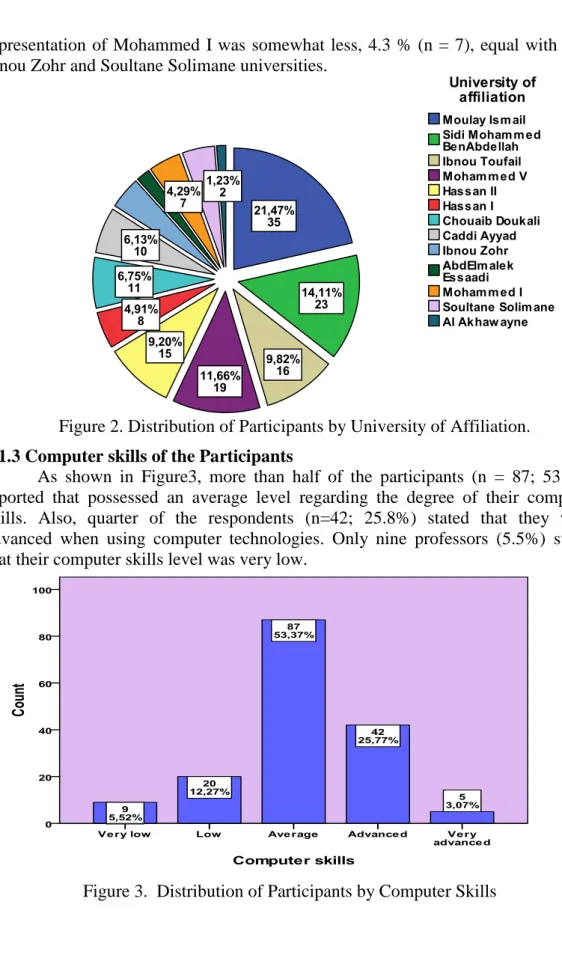
As illustrated in Figure 2 below, the professors participating in this study were from thirteen different Moroccan universities. The highest percentage of the respondents 21.5 % (n =35) taught English language at Moulay Ismail University followed by Sidi Mohammed BenAbdellah university, 14.1 % (n = 23). Of the 163 participants, 11.7 % (n = 19) taught at Mohammed V. The data showed that the
representation of Mohammed I was somewhat less, 4.3 % (n = 7), equal with both Ibnou Zohr and Soultane Solimane universities.
Figure 2. Distribution of Participants by University of Affiliation.
4.1.3 Computer skills of the Participants
As shown in Figure3, more than half of the participants (n = 87; 53.4%) reported that possessed an average level regarding the degree of their computer skills. Also, quarter of the respondents (n=42; 25.8%) stated that they were advanced when using computer technologies. Only nine professors (5.5%) stated that their computer skills level was very low.
4.2. Findings Related to the Research Questions
The main purpose of this research question is to examine the relationship between teachers’ implementation of computer technology in instruction and the degree of support provided by their institutions. Descriptive statistical analysis of percentages, means, and standard deviations was used to address this question. High the scores indicated high level of institutional encouragement. Concerning the interpretation of the mean values, the following scales were used: mean scores ranging from 2.00 to 2.99 indicated low level of institutional support. Mean scores ranging from 3.00 to 3.25 implied moderate institutional encouragement. Furthermore, mean scores exceeding 3.25 denoted high level of support provided by higher institutions. Actually, Pearson Product Moment Correlation was used to account for this relationship. The findings are outlined in the following section.
4.2.1. The Quantitative Findings
4.2.1.1 The Level of Institutional Support
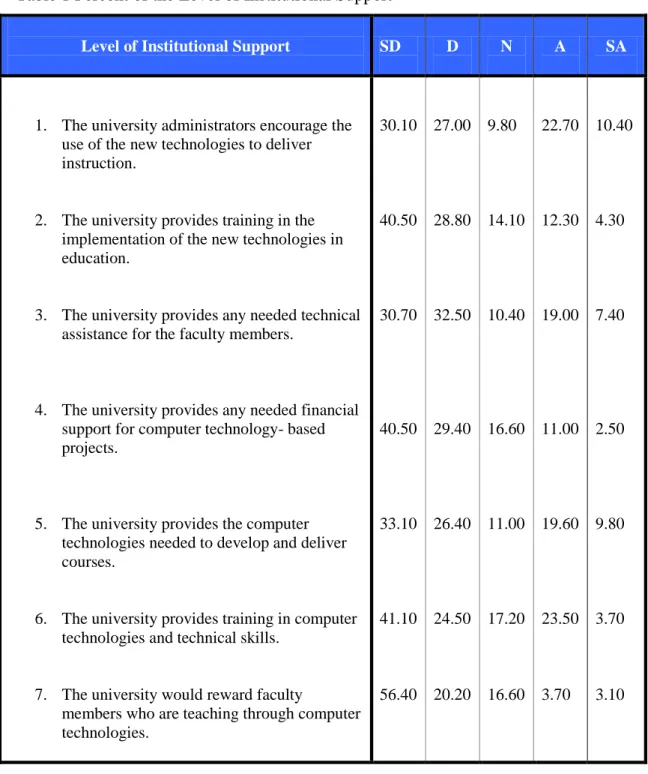
According to the results provided in Table 1 below, more than half of the respondents (57.10%) expressed their disagreement with the statement that the university administrators encouraged the use of computer technology to deliver instruction. A third of the sample (33.10%) agreed with the statement. When the professors were asked about the training provided by their institutions to implement technology, most of the respondents (69.30%) reported that they did not benefit from any training, whereas 16.60% of them confirmed that their universities provided training. Also, the majority of the participants (63.20%) disagreed with the third statement, “the university provided any needed technical assistance for the faculty members”. Only (26.40%) of them agreed with it.
Professors’ responses showed that more than two thirds of the sample (69.90%) disagreed with the statement that the university provided any needed financial support for computer technology-based projects. A small proportion (13.50%) reported that their institutions did. In response to the fifth statement, “the university provides the computer technologies needed to develop and deliver courses”, more than half of the respondents (59.50%) disagreed with the statement. On the other hand, nearly one third of the sample (29.40%) confirmed that their institutions offered them the needed computer instruments to deliver instructional courses. Moreover, the majority of professors (65.60%) revealed that their universities did not provide training in computer technologies and technical skills; whereas more than a third of them (37.20%) pointed out that their institutions offered such training. As for the last statement in the institutional support scale, a minority of respondents (6.80%) agreed that their universities would reward faculty members who were teaching through computer technologies. In fact, the majority of the sample (76.60%) reported that their institutions would not offer any rewards.
Table 1 Percent of the Level of Institutional Support
Level of Institutional Support SD D N A SA
1. The university administrators encourage the use of the new technologies to deliver instruction.
2. The university provides training in the implementation of the new technologies in education.
3. The university provides any needed technical assistance for the faculty members.
4. The university provides any needed financial support for computer technology- based projects.
5. The university provides the computer technologies needed to develop and deliver courses.
6. The university provides training in computer technologies and technical skills.
7. The university would reward faculty
members who are teaching through computer technologies. 30.10 40.50 30.70 40.50 33.10 41.10 56.40 27.00 28.80 32.50 29.40 26.40 24.50 20.20 9.80 14.10 10.40 16.60 11.00 17.20 16.60 22.70 12.30 19.00 11.00 19.60 23.50 3.70 10.40 4.30 7.40 2.50 9.80 3.70 3.10
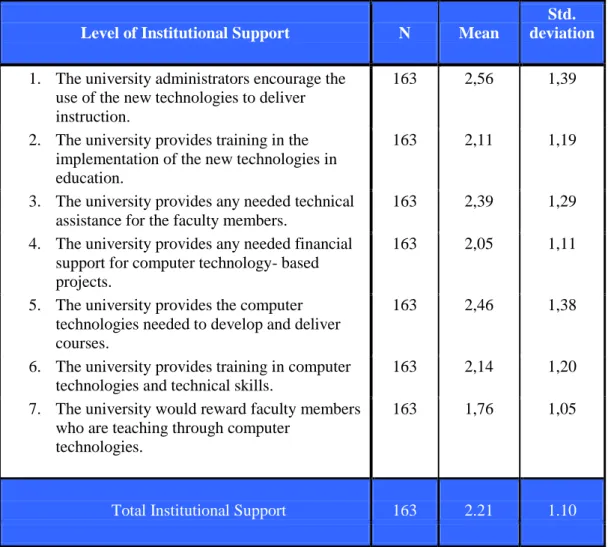
Note. SD=Strongly disagree, D=Disagree, N=Neutral, A=Agree, and SA=Strongly agree. In general, the level of institutional support provided for the professors was very low, with an overall mean score of 2.21 and a standard deviation of 1.10. The overall mean value of the total institutions support (M = 2.21, SD = 1.10) indicated that higher institutions did not offer professors the required assistance to implement the new technologies in their teaching practices. Table 2 illustrates that the highest
mean score was 2.56 (SD = 1.39), indicating a high level of support from the part of administrators to use ICT in the delivery of instruction. As far as the lowest mean score (M = 1.76, SD = 1.05) is concerned, it suggested that the university would not reward professors who were likely to integrate ICT in their teaching.
Table 2. Means and Standard Deviations of the level of Institutional Support
Level of Institutional Support N Mean
Std. deviation 1. The university administrators encourage the
use of the new technologies to deliver instruction.
163 2,56 1,39
2. The university provides training in the implementation of the new technologies in education.
163 2,11 1,19
3. The university provides any needed technical assistance for the faculty members.
163 2,39 1,29 4. The university provides any needed financial
support for computer technology- based projects.
163 2,05 1,11
5. The university provides the computer technologies needed to develop and deliver courses.
163 2,46 1,38
6. The university provides training in computer technologies and technical skills.
163 2,14 1,20 7. The university would reward faculty members
who are teaching through computer technologies.
163 1,76 1,05
Total Institutional Support 163 2.21 1.10
Note. Mean of the level of institutional support: 1=Strongly disagree, 2=Disagree, 3=Neutral, 4=Agree, and 5=Strongly agree.
4.2.1.1 The correlation between the use of ICT and the level of institutional support
It is clear from Table 3 below that there is a strong positive correlation between the two variables, r = 0.59, p < .01. In other words, as the level of institutional support increases, the use of computer technologies increases as well. Furthermore, the p value (p=0.000) is less than the significant level set at 0.01 (2-tailed). Therefore, the null hypothesis stating that there is no significant correlation between professors’ use of ICT in teaching and the level of institutional support can be rejected.
Table 3. Correlation between professors’ use of ICT and the level of institutional support
Correlation Professors’ Use
of ICT in Teaching The Level of Institutional Support Professors’ Use of ICT in Teaching Pearson Correlation 1 ,598** Sig. (2-tailed) ,000 N 163 163 The Level of Institutional Support Pearson Correlation ,598** 1 Sig. (2-tailed) ,000 N 163 163
**. Correlation is significant at the 0.01 level (2-tailed).
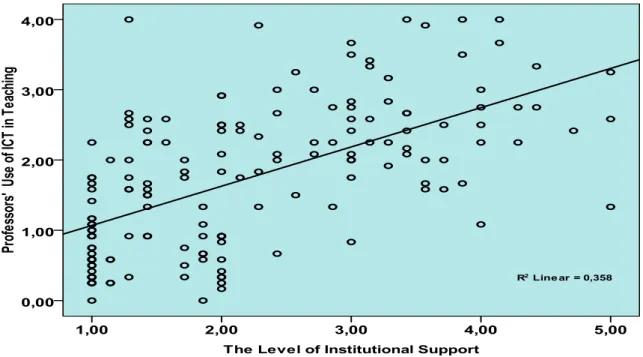
To further explore the relationship between the use of ICTs and the degree of institutional support, a scatter plot was created (Figure 4). It is apparent from the scatter plot that the two variables strongly and positively correlate. Also, it is clear that the relationship between the variables is strong because the data points are
moderately clustered around the straight line. The coefficient of determination (r2 =
0.35) indicates a 35% of shared variance between professors’ use of ICT and the level of institutional support. That means that 35 % of the variability in professors’ use of ICT in instruction is accounted for by the level of support provided by their institutions. This suggests that there are other independent variables that explain teachers’ adoption of ICT in teaching processes.
Figure 4. Means plot for professors’ use of ICT and the level of institutional support
4.2.1. The Qualitative Findings
All interview participants reported that insufficient institutional support is regarded as one of the major factors that affect professors’ use of ICT in their teaching practices. One of the respondents (P7) noted that “lack of support from the institution is one of the reasons many teachers do not integrate ICT in their classrooms”. In fact, some of the participants stated that their institutions provided some of the required support such as data-shows, remote controls, printers, plugs and cables. Yet, they need other materials like speakers, interactive boards and mainly Internet connection. P8 said “honestly speaking, I would like my institution to provide teachers with access to the Wifi and an electronic library”.
Participants emphasized on providing sufficient computer training for all professors to guarantee the successful implementation of ICT in their classrooms. One of the respondents (P4) commented “I would highly appreciate if my institution could provide us with good quality training”. Another professor (P7) also pointed that the university should provide “quality training courses for teachers to enable them use ICT devises to meet the needs of the new millennium learners”.
Participants revealed that the university needs to offer other forms of institutional support. They suggested that the institution should provide up-to-date technology infrastructure, a well-organized technical support, and other facilities such as wireless coverage and internet accessibility. In this context, one of the respondents commented “I think that along with providing materials, the institution should think of providing classes with fixed materials and making them available for teachers when necessary” (P9).
As for the support provided by the Moroccan government, the participants noted that computer programs such as MARWAN, ITQAN, INJAZ and others are very great initiatives that encourage the integration of computer technologies in Moroccan universities. One of the participants said it’s “a good initiative deserving the thumbs up” (P11). Another one commented “personally, I appreciate this policy since information and communication technology has become an essential section of most organizations these days” (P4). P8 shared the same perspective and added that such technology programs are crucial “because technology is part of students’ daily lives. Therefore, teachers have to use computer technology to introduce, reinforce, extend, enrich, and remediate students’ mastery of curricular goals” (P8).
However, the majority of the participants are not satisfied with the actual implementation of these programs within classrooms. Indeed, “there is a mismatch between what the Moroccan government expresses and the actual facilitations of integrating computer technology” (P5). One of the participants reported “I think the government’s policy has proved to be unsuccessful in the sense that it has spent huge budget on Genie project, for example, and other initiatives, but the impact of such programs on teachers’ teaching practices in Moroccan schools is almost absent”. P6 also noted that it’s “a good initiative, but it is still unsatisfactory; more materials and budget should be allocated to integrating ICT in education. In fact we are still lagging behind in comparison to some North African countries”. P7 made the following statement:
the use of computer technology in Moroccan higher educational system is still far behind the required ICT level and standards; we are still unable to provide the appropriate ICT environment to our students not only because of the poverty of infrastructural stimuli but also because - according to the research conducted by several pedagogical supervisors and researchers - of the widening gap between the pace at which modern life is progressing and our educational model.
5. DISCUSSION
Institutional support was examined as one of the major independent variables that could have a substantial impact on professors’ willingness to adopt ICT in the classroom. In other words, teachers have been encouraged to use computer technology in teaching practices through numerous sources including institutional help. Generally, institutional support is understood in terms of training, financial back up, technical assistance, and the availability of various incentives.
The findings of the present study have demonstrated that there are low levels of institutional encouragement provided for instructors teaching in different Moroccan universities, with an overall mean score of 2.21 out of 5. Accordingly, about two thirds of the participants (63.20%) disagreed with the statement noting that the university provided any technical assistance for the faculty members. Also, the majority of the respondents (69.30%) reported that the university did not provide any kind of computer training that aims at promoting the integration of the new technologies in education. Most of them (60.74%, n=99) stated that they received self-training. The quantitative results also revealed that most Moroccan higher education institutions (76.06 %) would not reward professors who were instructing through the use of the new technological instruments. Actually, results from the qualitative analyses confirmed the findings obtained from the quantitative data. Interview responses indicated that Moroccan universities offered little support for professors willing to integrate ICT in teaching and learning processes. The results of the current study conflict with the findings of Marcus (1986) who found that there were moderate levels of assistance offered to the teachers by their institutions.
A possible explanation for the low levels of institutional support is related to the budget allotted to the promotion of ICT integration in Moroccan education system. According to some interview participants, the financial resources granted by the Ministry of higher education to the projects aiming at boosting computer technology implementation in various universities were not sufficient to equip these institutions with the necessary infrastructure and materials. Others reported that the lack of institutional support can be explained by the fact that Morocco is considered part of the third world which faces several economic, social and educational challenges.
Correlation analysis showed that there is a significant positive correlation between the dependent variable (ICT use) and the independent variable (Institutional support). The findings from the survey revealed that professors who tend to integrate computer technology in their teaching have received high levels of institutional back up.
The null hypothesis stated that no statistical significant correlation exists between professors’ use of ICT and the degree of help offered by universities. To test the hypothesis, a Pearson product-moment correlation was conducted to assess the association between the dependent and independent variables. The results showed that there is a strong positive correlation between the variables, (r = 0.59, p<.05). This result suggests that as the levels of institutional support increase, the use of ICT in teaching augments as well. Accordingly, since the calculated significance (the p value) is less than the alpha level set at .05, there is enough statistical evidence to reject the null hypothesis and accept that there is a positive significant correlation between the level of institutional support and ICT integration for pedagogical purposes. As for the coefficient of determination, the results
displayed that the r2equals 0.35, indicating that 35% of the variability in professors’
use of the new technologies in teaching is explained by the levels of encouragement provided by the institutions where they instruct.
The findings of the present study support the findings of previous research studies. For instance, Bower (2001) found that the level of institutional assistance would have a positive association with teachers’ attitudes towards the adoption of the modern technological tools in the classrooms. Additionally, Marcus (1986) reported that the degree of administrative support correlated with the implementation of computer technology in education. Pajo & Wallace (2001) found similar results.
6. CONCLUSION
The value of modern technological instruments in higher education institutions relies on how effectively professors integrate them into the curriculum. According to the results of this study, the levels of computer technology integration are low. Teachers of English do not integrate ICT tools on a regular basis due to the existence of several barriers related to teachers as well as the institutions. The barriers that limited professors’ use of computer technology for pedagogical objectives were lack of basis infrastructure, lack of equipments and materials, lack of teachers’ computer skills, and lack of appropriate computer training, lack of time, and lack of administrative support. Understanding the barriers professors’ face when they integrate technology in the classroom would help to find efficient methods to eradicate such obstacles which would result in producing a learning context which boosts the best strategies to enable students face future challenges . Finally, in order to enhance effective ICT integration in higher education institutions, the previously mentioned obstacles should be removed.
REFERENCES
Alj,O.,& Benjelloun, N. (2013). Intégration des TIC dans l’enseignement des sciences physiques au Maroc dans le cadre du programme GENIE : Difficulés et obstacles. International Journal of Technologies in Higher Education, 10 (2), 49-65.
Atkins, N. E., & Storey-Vasu, E. (2000). Measuring knowledge of technology usage and stages of concern about computing; A study of middle school teachers. Journal of Technology and Teacher Education, 8(4), 279-302.
Bailey, G., & Lumley, D. (1997). Technology staff development program—A leadership sourcebook for school administrator's. Bloomington Ind: National Educational Service.
Bailey, Ross, & Griffin (1995). Barrier to curriculum-technology integration in education: Are you asking the right questions? Catalyst for Change 25 (1), p. 16.
Bitner, N., & Bitner, J. (2002). Integrating technology into the classroom: Eight keys to success. Journal of Technology and Teacher Education, 10(1), 95–100. Bower, B. (2001). Distance education: Facing the faculty challenge. Online Journal
of Distance Learning Administration, 4(2). Retrieved January 11, 2015, from http://www.westga.edu/~distance/ojdla/summer42/bower42.html
Brill, J. M., & Galloway, C. (2007). Perils and promises: University instructors’ integration of technology in classroom-based practices. British Journal of Educational Technology, 38(1), 95–105.
Cameron K. S., and Ulrich, D. O. (1986). Transformational leadership in colleges and universities. Higher education: Handbook of Theory and Research. New York: Agathon Press, 2 (1), 1-42.
Chapelle, C. A. (2001). Computers applications in second language acquisition: Foundations for teaching, testing and research. Cambridge: Cambridge University Press.
Chiero, R. T. (1997). Teachers’ perspectives on factors that affect computer use. Journal of Research on Computing in Education, 30(2), 133-145.
Cuban, L. (1996). Teachers and machines. New York: Teachers College Press. Ertmer, P. A. (1999). Addressing first- and second-order barriers to change:
Strategies for technology integration. Educational Technology Research and
Development, 47(4), 47 61. Retrieved July 2nd, 2015 from
http://cseproxy1.cse.edu/login?url=http://vnweb.hwwilsonweb.com/hww/jump start.jhtml
Fatmi, H.(2013). Factors affecting Moroccan teachers’ ICT integration. In M.Larouz (ed), ICT in education, future prospects and potential challenges (pp.107-128). Proceedings of the 1st International Conference on ICT in Education, Faculty of Arts and Humanities, Meknes, Morocco.
Fullan, M. G. (1991). The new meaning of educational change (2nd ed.). New York: Teachers College Press.
Grant, M.M., Ross, S.M., Wang, W., & Potter, A.(2005). Computers on wheels: An alternative to ‘each one has one’. British Journal of Educational Technology, 36(6), 1017-1034.
Hamdy, A. (2007). ICT in education in Morocco. Retrieved 12 10, 2014 from http://www.infodev.org/infodev-files/resource/InfodevDocuments_418.pdf Hashemi, Ali. (2016). The Impact of Information and Communication Technology
Hong, K. S., & Koh, C. K. (2002). Computer anxiety and attitudes toward computers among rural secondary school teachers: A Malaysian perspective. Journal of Research on Technology in Education, 35(1), 27-48.
Hsin-Kai, W., Ying-Shao, H. and Fu-Kwun, H. (2007). Factors affecting teachers‟ adoption of technology in classrooms: Does school size matter? International Journal of Science and Mathematics Education, 6: 63-85
Kariuki, M. (2004). Factors influencing pre-service teachers‟ use of laptops for teaching/learning purposes during practicum. European Journal of Social Sciences 7, (1)
Kosak, L., Manning, M., Dobson, E., Rogerson, L., Cotnam, S., Colaric, S., et al. (2002). Prepared to teach online? Perspectives of faculty in the University of North Carolina System. Online Journal of Distance Learning Administration,
7(3). Retrieved October 10th , 2015, from
http://www.westga.edu/~distance/ojdla/fall73/kosak73.html
Kotrlik, J.W., & Smith, M.N.(1989). Computer anxiety levels of vocational agricultural teachers. Journal of Agricultural Education, 30, 41-48.
Marcus, J. A. (1986). Diffusion of innovations and social learning theory: Adoption of the context text-processing system at Stanford University. Dissertation Abstracts International, A 46/12, 3553 (University Microfilms No. AAT 8602506).
Nachmias, R., Mioduser, D., Cohen, A., Tubin, D., & Forkosh-Baruch, A.(2004). Factors involved in the implementation of the pedogogical innovations using technology. Educational and Information technologies, 9(3), 291-308.
Norum, K. E., Grabinger, R. S., & Duffield, J. A. (1999). Healing the universe is an inside job: Teachers’views on integrating technology, Journal of Technology and Teacher Education, 7(3), 187-203.
O’Dwyer, L.M., Russell, M. & Bebell, D.J. (2004). Identifying teacher, school and district characteristics associated with elementary teachers’ use of technology: A multilevel perspective. Education Policy Analysis Archives, 12(48). Retrieved December 10th , 2014 from http://epaa.asu.edu/epaa/v12n48/. Pajo, K. & Wallace, C. (2001). Barriers to the uptake of web based technology by
university teachers. Journal of Distance Education, 16(1), 70-84.
Roberts, F. D., Kelley, C. L., & Medlin, B. D. (2007). Factors influencing accounting faculty members’ decision to adopt technology in the classroom. College Student Journal, 41(2), 423-435.
Rogers, P. L. (2000). Barriers to adopting emerging technologies in education. Journal of Educational Computing Research, 22(4), 455-472.
Sahin, I., & Thompson, A. (2006). Using Rogers’ theory to interpret instructional computer use by COE faculty. Journal of Research on Technology in Education, 39(1), 81–104.
Sahin, I., & Thompson, A. (2007). Analysis of predictive factors that influence faculty members’ technology adoption level. Journal of Technology and Teacher Education, 15(2), 167–190.
Sandholtz, J.H, Ringstaff, C. and Dwyer, D.C. (1997) Teaching with technology : Creating student-centered classrooms. New York: Teachers College Press.
Sife, A. S., Lwoga, E. T. and Sanga, C. (2007). New technologies for teaching and learning: Challenges for higher learning institutions in developing countries. International Journal of Education and Development using Information and Communication Technology, 3 (2), 57-67
Spodark, E. (2003). Five obstacles to technology integration at a small liberal arts university. T.H.E. Journal, 30(8), 14–24.
Steel, J., & Hudson, A. (2001). Educational technology in learning and teaching: The perceptions and experiences of teaching staff. Innovations in Education and Teaching International, 38(2), 103–111.
Swan, K., & Dixon, J. (2006). The effects of mentor-supported technology professional development on middle school mathematics teachers’ attitudes and practice. Contemporary Issues in Technology and Teacher Education, 6(1).
Tusubira, F. and Mulira, N. (2004). Integration of ICT in organizations: Challenges and best practice recommendations based on the experience of Makerere University and other organizations, Paper presented at the International ICT Conference held at Hotel Africana, Kampala, Uganda. 5th to 8th September, 2015.
Van Melle, E., Cimellaro, L.,& Shulha, L.(2003). A dynamic framework to guide the implementation and evaluation of educational technologies. Education and Information Technologies, 8(3), 267-285.
About the authors:
Drissia CHOUIT is a founding member of the Research Group on Mass Communication, Culture and Society; Professor of Comparative Linguistics,
Communication and Media Studies, Faculty of Arts and Humanities, Moulay Ismail University, Meknés, Morocco.
Abdelhamid NFISSI is the founder and director of the Research Group on Mass Communication, Culture and Society; Professor of Comparative Linguistics, Communication and Media Studies, Faculty of Arts and Humanities, Sais-Fes, Sidi Mohamed Ben Abdellah University, Fes, Morocco. He is currently the Chairman of the English Department.
Hicham LAABIDI is a teacher-trainer at CREMF, Meknés, Morocco. He is also a part-time professor at Faculty of Arts and Humanities, Moulay Ismail University, Meknés, Morocco. Beisdes, he is a PhD candidate in Discourse Creativity & Society at Faculty of Arts and Humanities, Sais-Fes, Sidi Mohamed Ben Abdellah University, Fes, Morocco.