STRATEGY IMPLEMENTATION AND
CAPABILITIES DEVELOPMENT IN UNIVERSITY
ACADEMIC UNITS: IMPACTS ON PERFORMANCE
A thesis submitted
in fulfilment of the requirements for the degree of
Doctor of Philosophy
BELETE JEMBER BOBE
MBA, Grad Dip (Management), BA (Accounting), FCCA, CPA
School of Accounting
College of Business
RMIT University
I, Belete Jember Bobe, certify that the work completed is mine alone, that this work has not been submitted previously to qualify for an academic award, that the content of this thesis is the result of work which has been carried out since the official commencement date of the approved research program, that any editorial work undertaken by a third party is acknowledged, and relevant ethics procedures and guidelines have been followed.
Belete Bobe August 2012
Several people have helped and supported me in different ways in writing this thesis. First, I would like to express my gratitude to my supervisor, Professor Dennis Taylor, for his guidance and supervision in the last three years of my study. I thank him for listening patiently and questioning and challenging my ideas which have helped me stay focused and clarify my thoughts. I would also like to thank Professor Beverley Jackling who was my principal supervisor for the first one-and-a-half years of my study until she moved to another university. I am indebted to her for the many hours she spent in helping me develop the PhD proposal and prepare for confirmation of my candidature.
A special word of gratitude goes to my friend, Associate Professor Alemayehu Molla, for being there for me whenever I needed him, sometimes at late hours, from day one of this research project. He has been so generous in his time in reading and commenting on various draft documents and chapters and sharing his research experience with me unreservedly. I also thank my longtime friend Asmare Emire for sharing the educational journey from bachelor to PhD degrees. He is one of the trustworthy friends I have made in my life.
I would also like to extend my gratitude to the School of Accounting, Economics and Finance, Deakin University colleagues, in particular, Professors Barry Cooper, Nava Subramaniam, Graeme Wines and Mr Bruce Hoyle for their mentoring, encouragement and institutional support. I thank Dr Judy Maxwell, Study and Learning Centre, RMIT University, for reading some of the draft chapters. I would also like to thank and express my appreciation of Ms Lynn Spray for her prompt, thorough and professional proof-reading services.
A number of progress presentations were made at different stages of this PhD project at School of Accounting, Economics and Finance, Deakin University, research seminars. I thank all my colleagues for their valuable comments. I would also like to acknowledge that this thesis has benefited from the constructive feedback received at the following conferences, and I extend my sincere gratitude to the participants at: Global Management Accounting Research Symposium (GMARS) 2008, University of New South Wales, Sydney, June 2008; Monash University Forum for Management Accounting (MONFORMA) 2009, Doctoral Colloquium, Melbourne, June 2009; AFAANZ 2009, Adelaide, July 2009; 6th Asia Pacific Interdisciplinary Research in Accounting (APIRA) 2010, The University of Sydney,
Greenwich, London, September 2010; and MONFORMA 2010, Melbourne, November 2010.
I am grateful to the Pro Vice-Chancellors and Heads of Schools/Departments in the two universities in Victoria, Australia, who participated in the pilot study, and to the Heads of Schools/Departments in all thirty-nine Australian universities who completed the survey questionnaire.
Several other people whose names I have not listed above due to limitations of space have supported and encouraged me. I thank each and every one of them from the bottom of my heart.
Words cannot convey the appreciation and love I have for the most important people in my life - my family. Without the understanding, encouragement and above all love of my wife Emebet, and my sons, Kale-Ab (10) and Daniel (1), I could not have completed this thesis. I hope this work will inspire my boys in their life journey.
Belete Jember Bobe August 2012
DECLARATION ... ii
ACKNOWLEDGEMENTS ... iii
Table of Contents ... v
List of Figures ... xi
List of Tables ... xi
List of Appendices ... xiv
List of Acronyms and Abbreviations ... xv
SUMMARY ... 1
CHAPTER ONE: ... 5
INTRODUCTION... 5
1.1. INTRODUCTION ... 5
1.2. BACKGROUND AND MOTIVATION TO THE STUDY ... 6
1.2.1. Introduction to the Australian higher education sector ... 6
1.2.2. Motivations for the study ... 9
1.3. RESEARCH AIMS AND OBJECTIVES ... 14
1.4. RESEARCH QUESTIONS ... 15
1.5. SIGNIFICANCE OF THE STUDY... 17
1.6. THE STRUCTURE OF THE THESIS ... 18
1.7. CHAPTER SUMMARY ... 21
CHAPTER TWO: ... 22
THE AUSTRALIAN HIGHER EDUCATION CONTEXT ... 22
2.1. INTRODUCTION ... 22
2.2. NEW PUBLIC MANAGEMENT (NPM) ... 23
2.2.1. The origin of New Public Management ... 23
2.2.2. Doctrines of New Public Management ... 25
2.3. AUSTRALIAN HIGHER EDUCATION SECTOR REFORMS ... 28
2.4. OVERVIEW OF THE AUSTRALIAN HIGHER EDUCATION SECTOR ... 33
2.4.1. Structure of the Australian higher education sector ... 33
2.4.2. Student and staff statistics ... 37
2.5. DIRECTIONS OF AUSTRALIAN HIGHER EDUCATION SECTOR ... 39
AND MANAGEMENT CONTROLS ... 44
2.8. CHAPTER SUMMARY ... 46
CHAPTER THREE: ... 48
LITERATURE REVIEW ... 48
3.1. INTRODUCTION ... 48
3.2. REVIEW OF THE LITERATURE ON ORGANISATIONAL CAPABILITIES ... 50
3.2.1. Introduction ... 50
3.2.2. Sources of sustainable competitive advantages: internal strengths versus external forces 53 3.2.2.1. The environmental determinist view of competitive advantage ... 53
3.2.2.2. The resource-based view of competitive advantage ... 54
3.2.2.3. Organisational capabilities and performance ... 64
3.2.2.4. Application of RBV in universities ... 69
3.2.2.5. Review of the empirical RBV studies on higher education institutes ... 74
3.2.2.6. Conclusion on the review of the literature on organisational capability... 88
3.3. REVIEW OF THE LITERATURE ON STRATEGY IMPLEMENTATION MECHANISMS THAT IMPACT THE DEVELOPMENT OF ORGANISATIONAL CAPABILITIES ... 89
3.3.1. Performance measures ... 90
3.3.1.1. Introduction ... 90
3.3.1.2. The meaning of performance measures ... 91
3.3.1.3. Purposes of performance measures ... 92
3.3.1.4. Performance measures and New Public Management ... 94
3.3.1.5. Public sector performance measures and management accounting research 94 3.3.1.6. Performance measures in the higher education sector ... 96
3.3.1.7. Performance measures of Australian universities ... 101
3.3.1.8. Conclusion on the review of the literature on performance measures ... 104
3.3.2. Strategy implementation ... 105
3.3.2.1. Introduction ... 105
3.3.2.2. The meaning of flexibility and efficiency focused strategy implementations ... 105
3.3.3.2. The meaning and elements of management control systems ... 109
3.3.3.3. Features of the interactive and diagnostic control systems ... 112
3.3.3.4. Review of empirical studies that applied the Levers of Control framework 117 3.3.3.5. Conceptualisation of the relationship between the style of use of MCS and performance – direct, mediating and moderating effects ... 119
3.4. INTEGRATING THE NPM, HIGHER EDUCATION, STRATEGY IMPLEMENTATION, MANAGEMENT CONTROL SYSTEMS AND RBV LITERATURE 126 3.4.1. Conceptual mapping of the interactive and diagnostic control systems and the collegialism and managerialism forms of university administrations ... 126
3.4.2. Strategy implementation and management control systems ... 129
3.4.3. Integrating the MCS and RBV literature ... 133
3.5. CHAPTER SUMMARY ... 134
CHAPTER FOUR: ... 136
DEVELOPMENT OF THE CONCEPTUAL MODEL AND GENERATION OF HYPOTHESES ... 136
4.1. INTRODUCTION ... 136
4.2. THE CONCEPTUAL MODEL ... 137
4.3. MANAGERIALISM, ACCOUNTABILITY AND KPI EMPHASIS ... 139
4.3.1. Managerialism in the higher education sector ... 139
4.3.2. Reification of accountability and KPI emphasis ... 140
4.4. PATHS THROUGH THE LEVERS OF CONTROL FRAMEWORK ... 141
4.4.1. Nature of the LOC Framework ... 141
4.4.2. Selection of elements from the LOC framework for this study ... 144
4.5. KPI EMPHASIS, MCS USE AND STRATEGY IMPLEMENTATION FOCUS ... 147
4.5.1. KPI emphasis as an Antecedent Variable ... 147
4.5.2. Relating KPI emphasis to MCS use ... 149
4.5.3. Relationship between diagnostic and interactive MCS uses ... 150
4.5.4. Relating KPI emphasis to strategy implementation focus ... 152
4.5.5. Relationship between flexibility and efficiency focus strategy implementations 155 4.6. MCS USE AND STRATEGY IMPLEMENTATION UNDER LOC FRAMEWORK 156 4.6.1. The MCS and strategy literature ... 156
flexibility and efficiency in strategic implementation ... 157
4.7. STRATEGY IMPLEMENTATION, ORGANISATIONAL CAPABILITIES AND PERFORMANCE UNDER THE RBV ... 158
4.7.1. The central position of capabilities in the resource-based view ... 158
4.7.2. Strategy implementation and capabilities development ... 160
4.7.3. Organisational capabilities and metrics-based organisational performance ... 162
4.7.4. Indirect paths from KPI emphasis to metrics-based organisational performance 163 4.8. EMPIRICAL SCHEMA ... 164 4.9. CHAPTER SUMMARY ... 164 CHAPTER FIVE: ... 165 RESEARCH METHODOLOGY ... 165 5.1. INTRODUCTION ... 165 5.2. RESEARCH PARADIGMS ... 166 5.3. METHODOLOGICAL ISSUES ... 168
5.4. SURVEY RESEARCH METHOD... 170
5.4.1. Purpose and design of the survey ... 171
5.4.2. Population definition and sampling (external validity) ... 172
5.4.3. Sample size ... 173
5.4.4. Survey questionnaires and other research method issues (internal validity) ... 174
5.4.5. Survey instrument development ... 174
5.4.6. Structure and content of the survey questionnaire ... 178
5.4.7. Administration of the data collection ... 188
5.5. DATA ANALYSIS APPROACH ... 189
5.5.1. Introduction to Partial Least Squares ... 190
5.6. CHAPTER SUMMARY ... 193
CHAPTER SIX: ... 195
ASSESSMENT OF SCALES – VALIDITY AND RELIABILITY ... 195
6.1. INTRODUCTION ... 195
6.2. CONTENT VALIDITY AND DIMENSIONALITY OF SCALES ASSESSMENTS 196 6.2.1. Indicator (content) validity assessment ... 196
6.2.2. Dimensionality assessment ... 196
6.2.6. Strategy implementation focus ... 205
6.2.7. Organisational (academic unit) performance ... 205
6.3. INDICATOR RELIABILITY, CONSTRUCT RELIABILITY AND CONSTRUCT VALIDITY ASSESSMENTS ... 206
6.3.1. Validity and reliability tests through evaluation of PLS outer model – Overview 207 6.3.2. Indicator and construct reliability assessments ... 209
6.3.3. Construct validity assessment ... 214
6.4. CHAPTER SUMMARY ... 218
CHAPTER SEVEN: ... 219
RESULTS AND DISCUSSION ... 219
7.1. INTRODUCTION ... 219
7.2. DESCRIPTIVE STATISTICS ... 220
7.2.1. Descriptive statistics - profile of respondents and characteristics of their academic units 220 7.2.2. Descriptive statistics – organisational capabilities ... 223
7.2.3. Descriptive statistics – use of key performance measures ... 228
7.2.4. Descriptive statistics – strategy implementation focus ... 233
7.2.5. Descriptive statistics – performance ... 235
7.3. PRELIMINARY TESTS OF HYPOTHESES - BIVARIATE CORRELATIONS ANALYSES ... 238
7.4. FORMAL TESTS OF HYPOTHESES – PARTIAL LEAST SQUARES STRUCTURAL MODEL EVALUATION ... 241
7.4.1. Evaluation of the PLS structural model – overview and criteria ... 241
7.4.2. Hypotheses testing (PLS structural model results) ... 243
7.4.2.1. Hypotheses H1 and H7 ... 244 7.4.2.2. Hypotheses H2... 245 7.4.2.3. Hypothesis H3 ... 245 7.4.2.4. Hypotheses H4.1 and H4.2 ... 245 7.4.2.5. Hypotheses H5.1 and H5.2 ... 246 7.4.2.6. Hypotheses H6.1, H6.2 and H6.3 ... 247
7.4.2.7. PLS results for un-hypothesised relations ... 247
7.6. CHAPTER SUMMARY ... 256
CHAPTER EIGHT:... 258
SUMMARY, CONCLUSIONS AND IMPLICATIONS ... 258
8.1. INTRODUCTION ... 258
8.2. SUMMARY OF RESEARCH QUESTIONS, HYPOTHESES AND RESULTS ... 259
8.3. CONCLUSIONS DRAWN FROM THE FINDINGS ... 261
8.4. IMPLICATIONS ... 262
8.4.1. The emphasis on KPIs ... 262
8.4.2. Use of MCSs in academic units ... 263
8.4.3. The perspective and measurement of bundles of capabilities ... 264
8.5. LIMITATIONS ... 265
8.6. RECOMMENDATIONS FOR FUTURE RESEARCH ... 265
APPENDICES ... 267
Figure 3.1: Conceptual framework of the resource-based view ... 55
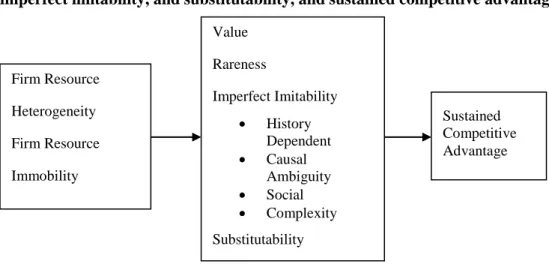
Figure 3.2: The relationship between resource heterogeneity and immobility, value, rareness, imperfect imitability, and substitutability, and sustained competitive advantage. ... 60
Figure 4.1: Conceptual model ... 138
Figure 4.2 Levers of Control framework ... 146
Figure 4.3: Empirical schema ... 164
Figure 5.1: Smart PLS output ... 192
Figure 7.1: PLS structural model results... 243
List of Tables
Table 2.1: Doctrinal components of new public management ... 27Table 2.2: Frame shifts in Australian higher education policy ... 30
Table 2.3: List of Australian universities by state and ownership ... 34
Table 2.4: Grouping of Australian universities ... 36
Table 2.5: Australian Higher Education Student Summary – 1996 to 2011 ... 38
Table 2.6: Australian Higher Education Staff Summary and Student to Academic Ratio – 1996 to 2011 ... 39
Table 3.1: Summary of key ideas of the resource-based view ... 56
Table 3.2: Some of the terms used in the RBV literature to refer to ‗resource‘ within the context of the resource-based view ... 57
Table 3.3: Definition of ‗resource‘ within the context of the RBV ... 59
Table 3.4: Summary of selected empirical research on the impact of capabilities on performance ... 67
Table 3.5: Identifying the competitive resources [organisational capabilities] of a university... 73
Table 3.6: Capabilities identified in RBV empirical research on higher education institutes and their definitions, descriptions and/or measurement ... 79
performance measures in the public sector (excluding the higher education
sector) ... 96
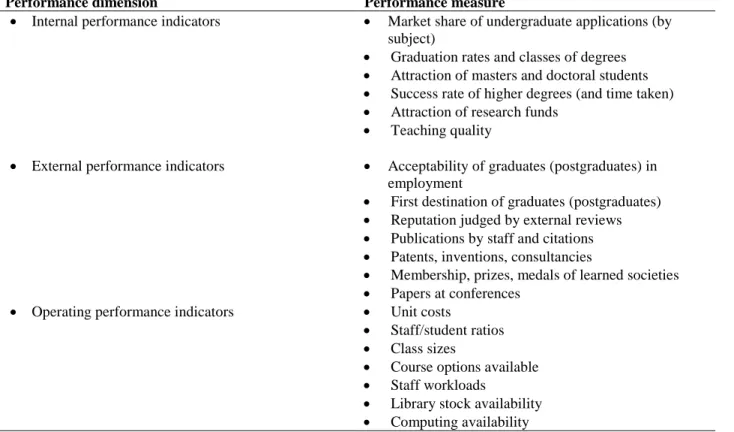
Table 3.9: Performance measures recommended by Jarratt Committee (1985) for application in UK universities ... 98
Table 3.10: Categories of performance indicators voluntarily disclosed by 44 Canadian universities ... 99
Table 3.11: Selected literature on performance measures in the higher education sector ... 100
Table 3.12: Performance indicators used in Australian universities as per the Australian government‘s institutional framework for higher education institutions ... 103
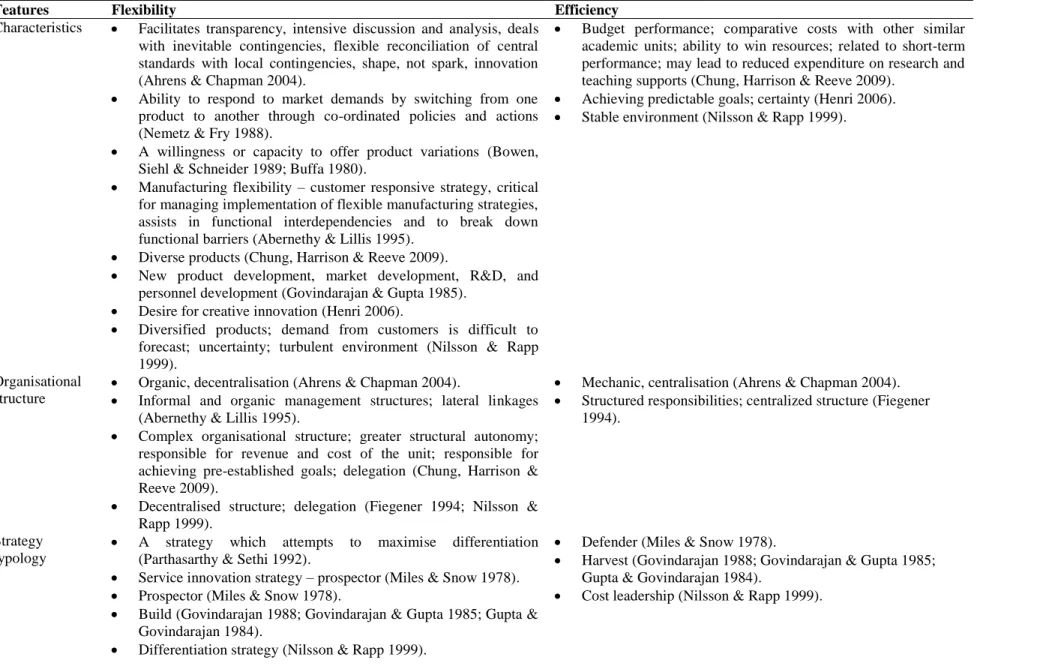
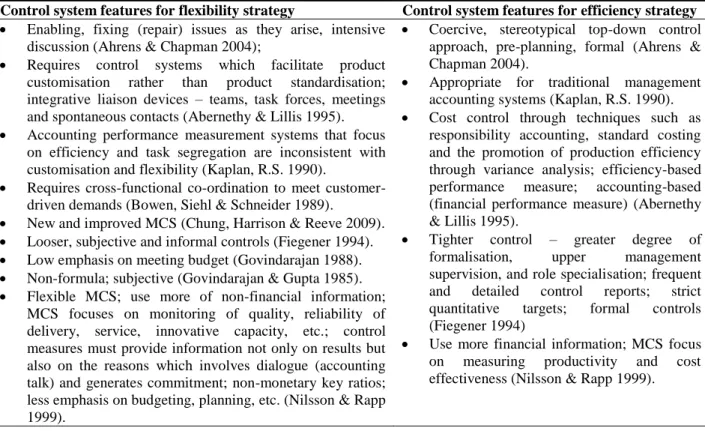
Table 3.13: Features of flexible and efficiency strategic objectives and policies ... 108
Table 3.14: Summary of elements of management control systems provided in selected literature ... 111
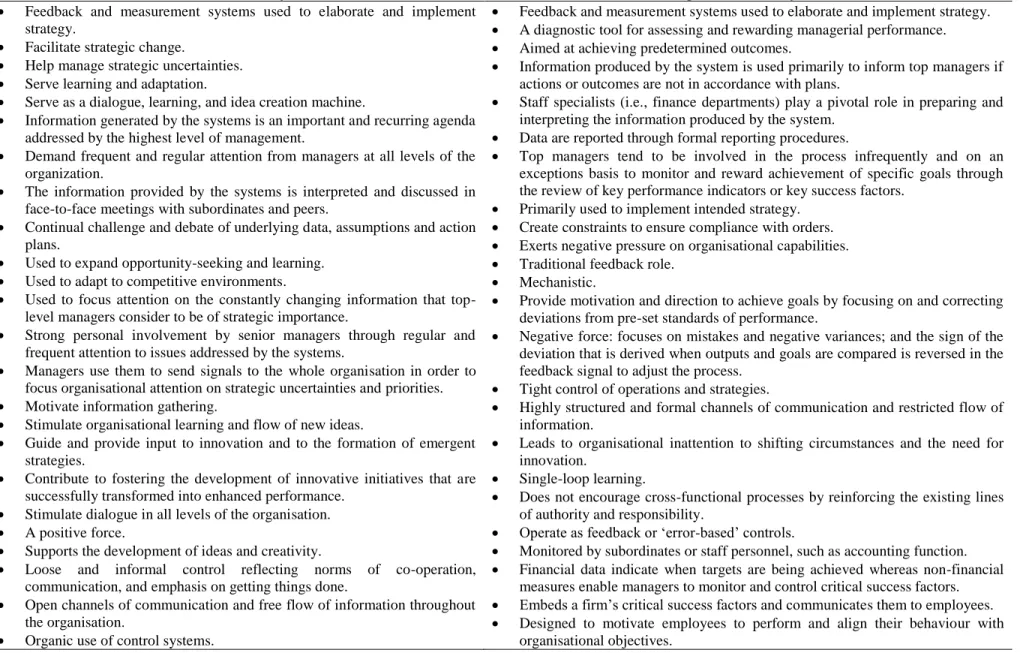
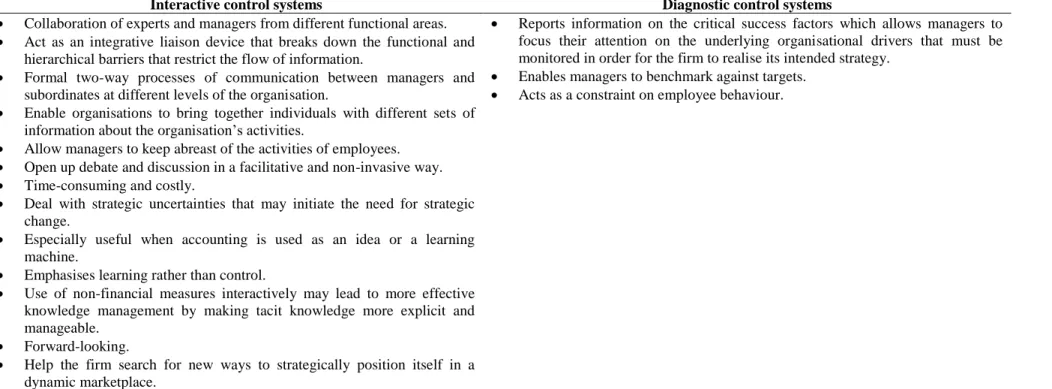
Table 3.15: Summary of the nature, purpose and characteristics of interactive and diagnostic control systems ... 115
Table 3.16: Summary of empirical studies employing Simons‘ Levers of Control framework ... 124
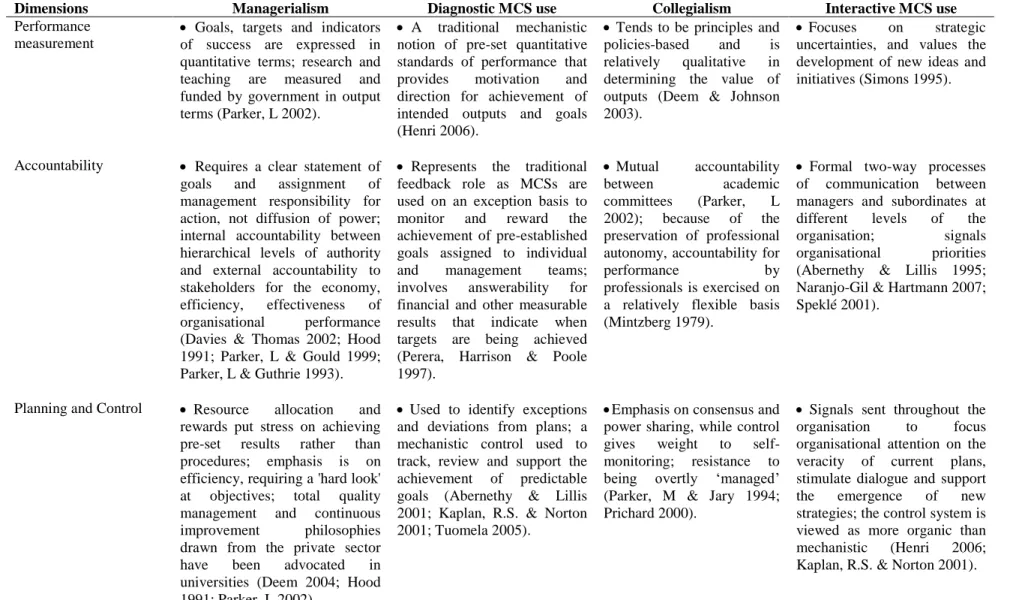
Table 3.17: Conceptual matching of NPM principles with diagnostic and interactive control systems... 128
Table 3.18: Control systems necessary to implement flexible and efficiency strategic objectives and policies ... 129
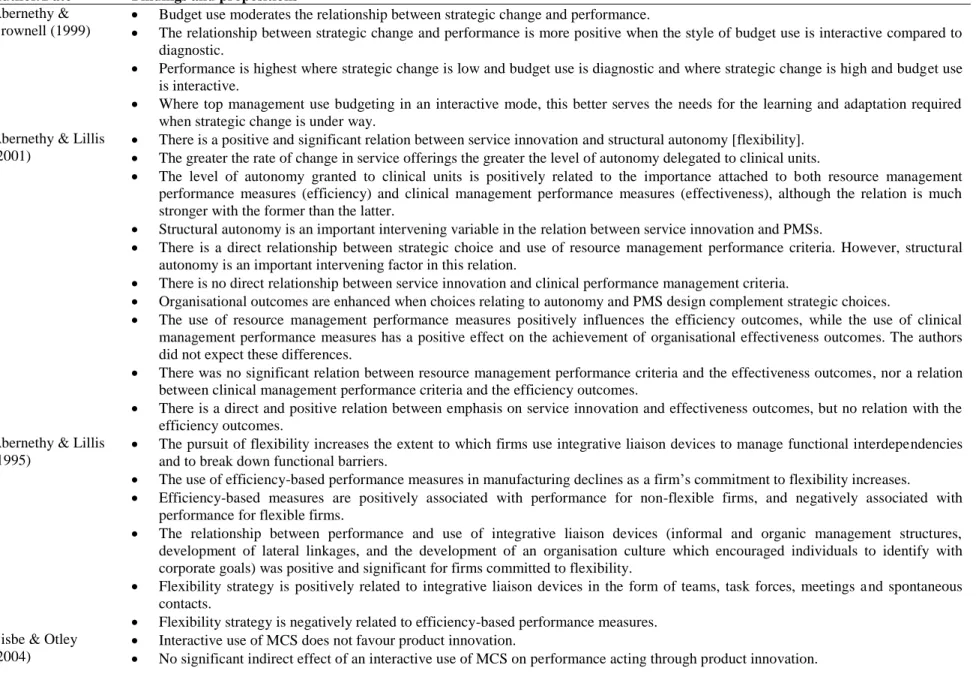
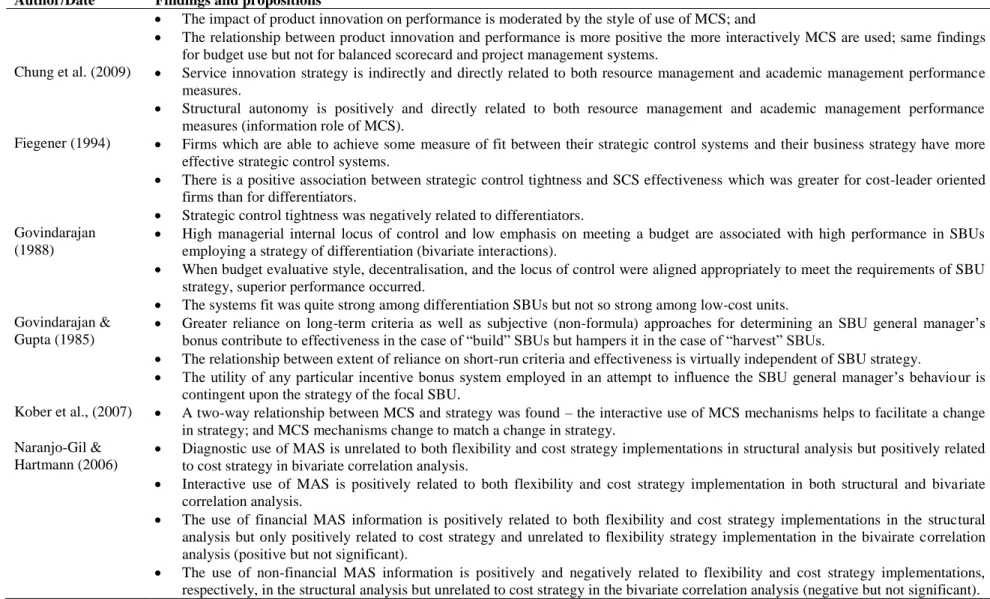
Table 3.19: Summary of empirical findings on the relationships between control systems and strategy implementation and their impact on performance ... 131
Table 4.1: Summary of the phrases associated with ‗clinical/academic management performance measures‘ and ‗resource management performance‘ measures ... 148
Table 5.1: Assumptions of positivist and interpretivist paradigms... 167
Table 5.2: Association of paradigms and methodologies ... 168
Table 5.3: List of studies used in the development of the initial survey instrument ... 175
Table 6.1: Organisational capabilities – initial factor solution (Rotated Component Matrixa) ... 198
Table 6.2: Organisational capabilities – final factor solution (Rotated Component Matrixa) ... 200
Table 6.3: Performance measures – initial factor solution (Rotated Component Matrixa) .... 202
Table 6.7: Factorial analysis – strategy implementation (Rotated Component Matrixa) ... 205
Table 6.8: Stage 1 of 2 PLS outer model analyses ... 211
Table 6.9: Stage 2 of 2 (final) PLS measurement model analysis ... 213
Table 6.10: Summary of PLS measurement model evaluations ... 214
Table 6.11: Discriminant validity ... 215
Table 6.12: Cross-loadings ... 217
Table 7.1: Profile of respondents (Heads of Schools) and their academic units ... 222
Table 7.2: Descriptive statistics – organisational capabilities ... 224
Table 7.3: Description of teaching capability survey items used in statistical analyses ... 226
Table 7.4: Description of research capability survey items used in statistical analyses ... 227
Table 7.5: Description of network capability survey items used in statistical analyses ... 228
Table 7.6: Descriptive statistics – use of key performance data ... 229
Table 7.7: Description of key performance measure survey items used in statistical analyses ... 230
Table 7.8: Descriptive statistics – management control systems use ... 231
Table 7.9: Description of interactive and diagnostic management control systems uses in survey items used in statistical analyses ... 232
Table 7.10: Descriptive statistics – strategy implementation focuses ... 234
Table 7.11: Description of the flexibility and efficiency strategy implementation objective survey items used in statistical analyses ... 235
Table 7.12: Descriptive statistics - performance ... 236
Table 7.13: Description of the organisational performance survey items ... 237
Table 7.14: Pearson correlation matrix ... 238
Table 7.15: Summary of Pearson correlations (preliminary hypotheses testing) (N=166) ... 240
Table 7.16: PLS structural model results ... 244
Table 7.17: PLS results for un-hypothesised relationships ... 248
Table 7.18: Sub-group analysis – field of education for the highest academic qualification 250 Table 8.1: Summary of research questions, hypotheses and findings ... 260
Appendix A: List of Australian higher education providers ... 267
Appendix B: Top eight Australian universities‘ world rankings from 2007 to 2010 ... 269
Appendix C: 2010 Universities world rankings – top ten universities ... 269
Appendix D: Mapping of the scales used to measure the interactive and diagnostic styles of MCS uses constructs with their sources ... 270
Appendix E: Mapping strategy scales ... 271
Appendix F: Survey covering letter ... 272
AGS Australian Graduate Survey
AHES Australian Higher Education Sector or System ARWU Academic Ranking of World Universities
ATN Australian Technology Network (group of universities) CAE College of Advanced Education
CEO Chief Executive Officer
CEQ Course Experience Questionnaire
CWCU Centre for World-Class Universities of Shanghai
DEETYA Department of Employment, Education, Training and Youth Affairs
DEEWR Department of Education, Employment and Workplace Relations (Australian Government)
DEST Department of Education, Science and Training EFTSL Equivalent Full-Time Student Load
FMI Financial Management Initiative
FMIP Financial Management Improvement Project FTE Full-Time Equivalent
Go8 Group of Eight universities GBE Government Business Enterprise GDS Graduate Destination Survey
HECS Higher Education Contribution Scheme HEI Higher Education Institution
HELP Higher Education Loan Programme HOS Head of School
HRD Human Resource Development IRU Innovative Research Universities KPI Key Performance Indicator LOC Levers of Control
MAS Management Accounting System MCS Management Control System
NGU (Australian) New Generation Universities NPM New Public Management
OECD Organisation for Economic Co-operation and Development PCA Principal Component Analysis
PLS Partial Least Squares PM Performance Measure
PMS Performance Measurement System
PREQ Postgraduate Research Experience Questionnaire QAA Quality Assurance Agency (UK)
RAE Research Assessment Exercise (UK) RBV Resource-Based View
SCP Structure-Conduct-Performance SEM Structural Equation Modelling TAFE Technical and Further Education TMT Top Management Team
UNS Unified National System USA United States of America UK United Kingdom
SUMMARY
This thesis develops and tests a model looking at the ways strategic business unit managers in knowledge-based public sector organisations (namely, Heads of academic schools1/departments in public universities, referred to as ‗Heads‘ hereafter) can emphasise, orient, approach, or otherwise use, their existing key performance indicators (KPIs), management control systems (MCS) and strategies to affect their unit‘s capabilities and, in turn, their unit‘s performance. Theoretical perspectives relating to control systems, organisational capabilities and managerial worldview are invoked to underpin this model. Specifically, the thesis investigates the behaviours of Heads in Australian universities in terms of the relationships between the extent of emphasis they give to KPIs, their style of MCS use and their orientation of strategy implementation in their school. It then proceeds to model and provide evidence on the impacts that these three related behavioural areas, as implemented by the Heads, have on the development of organisational capabilities and, in turn, the organisational performance of their academic unit.
These research variables are investigated in the context of the application of managerialism2 doctrines that have sought to reform Australian universities while acknowledging the relevance of their collegial traditions. The tensions created between the managerialism ethos and collegialism3 ethos are expected to have predictable consequences for the way the relationships among the research variables will play out. The conceptual model starts from a premise that managerialism has become the dominant ethos in Australian universities. Under this ethos, managers of academic units who pay strict attention to meeting pre-determined KPIs would be
1The term school or department or another name may be used in other universities and countries. In this study, school is defined as the lowest level academic organisational unit in a university structure. It may consist of one or more academic disciplines and is headed by a head of school, a head of department, or chairperson of a school or a department. There are about 680 such schools/departments in the 39 Australian universities. Heads of schools/departments will normally be assisted by deputy heads or associate heads, discipline leaders, teaching and learning directors, research directors and school/department managers. These academic managers form the executive team of the school/department.
2 Managerialism, also known as corporate managerialism or new public management, refers to the implementation of private corporate sector management and operation practices in public sector organisations.
3 Collegialism is defined in this study as the traditional university administration system where most strategic school decisions are made by staff committees, and the position of Head of School is filled by election of a staff member (usually a senior staff member) from within the school and the position is held for 2 to 3 years with rotations.
expected to have a higher performing unit, in terms of meeting metrics-based performance outputs, in a culture of managerialism in the higher education sector. However, under managerialism, the paths taken by a manager in managing the achievement of the performance outputs of his or her organisational unit are much less under scrutiny by superiors in the organisation or stakeholders outside the organisation, than is the accountability of the manager for the performance outputs attained by the unit. Therefore, the main focus of the conceptual model and the hypotheses developed in this thesis aim to establish the various paths that heads of academic units could take through styles of MCS use, orientations of strategy implementation and means of enhancing the organisational capabilities that lead to the desired performance levels of the academic unit.
There are a large number of empirical and theoretical studies in the management control systems literature examining the relation between MCS and strategy, mainly investigating the design aspects of MCS and to some extent its uses, from diverse theoretical perspectives. There has recently been a small but growing stream of MCS research investigating the MCS-strategy link from the resource-based view (RBV) perspective. There have also been studies independently focusing on the role of MCS use in supporting strategy implementation. However, there is limited research that has integrated the RBV of strategy with the literature on the use of performance measures (PMs) and, more broadly, management control systems (defined in this thesis to include planning, budgeting, monitoring and reporting systems). In particular, there is a gap in prior evidence about the way both attention to PMs and use of MCSs could have a role in supporting strategy implementation and the development of organisational capabilities. It is necessary to study the integrated relationship as it can have important implications for organisations' competitiveness and, in turn, performance outcomes.
Against the above background, the primary research question guiding this thesis is: In the context of the adoption of managerialism doctrines in collegial traditions in university academic units, how does a Head’s emphasis on KPIs, style of MCS use and strategy implementation orientations impact on the development of the unit’s capabilities and, in turn, the unit’s organisational performance outcomes? To answer the above primary research question, six secondary questions are formulated which are then developed into fifteen testable hypotheses.
These predicted relationships (hypotheses) are generated from the theoretical perspectives underpinning the study, and sit within a comprehensive empirical schema.
To test these hypotheses, a mail survey method is used to collect data from a sample of 679 Heads in all 39 Australian universities. There were 166 usable responses obtained, giving a 24.5% response rate. For the data analysis, partial least square (PLS) analyses are employed, supplemented by descriptive, correlation and principal components factor analyses. The PLS path modelling is used to undertake both outer model (tests of reliability and validity) and inner model (tests of hypotheses) evaluations.
This thesis provides several key findings. First, the extent of emphasis Heads place on KPIs through an inferred acceptance of managerialism and its reification of KPIs, is not, directly or indirectly, related to the metrics-based performance outcomes of the school, although it is positively related to both the diagnostic style of MCS use and efficiency focus strategy implementation which are the hallmarks of managerialism. Second, strategy implementation which is oriented primarily to gaining efficiency does not support the development of academic schools‘ research capabilities, or teaching and networking. On the other hand, strategy implementation which is oriented primarily to enhancing flexibility does support the development of academic schools‘ capabilities. Third, an interactive use of MCS (a proxy for collegialism) is positively associated with a flexibility strategy implementation orientation and is also indirectly positively related to overall school performance mediated through flexibility strategy implementation and organisational capabilities. Fourth, the extent of development of core organisational capabilities is positively related to overall school performance. Finally, the educational backgrounds of the Heads are found to have no confounding impact on the relationships investigated in the thesis.
The main conclusion from the findings of the thesis is that, in Australian universities, managerialism has become entrenched but has not fully displaced collegialism as expressed in the form of interactive use of MCS and flexibility in strategy implementations. The findings have practical implications for university management in terms of the over-emphasis on KPIs driven by managerialism, the need for maintaining collegialism in the form of an interactive style of
MCS use, and allowing flexibility in strategy implementation and the significance of the development of core organisational capabilities in functional areas for achieving greater overall school performance.
The theoretical contribution to management accounting research is in the area of the integration of the relationships between MCS use, strategy implementation, capabilities development and organisational performance into one model. Further, the inclusion of the perspective of a managerial ethos, incited because of this study‘s organisational context, is a likely tension between managerialism doctrines and collegialism traditions, and is new to MCS research.
CHAPTER ONE:
INTRODUCTION
―The best-laid plans are worthless if they cannot be implemented successfully,‖ (Simons 1995, p. ix).
1.1.
INTRODUCTION
This thesis is a study of the relationships between performance measures, management control systems, strategy implementation, organisational capabilities and organisational performance. It combines control-based and resource-based theoretical perspectives to model the way managers of complex strategic units achieve performance outcomes for their unit. Specifically, the thesis investigates the relations between the extent of emphasis given by Heads of Schools4 (referred to as ‗Heads‘ hereafter) in all thirty-nine Australian universities to key performance indicators (KPIs) and the Heads‘ style of management control systems (MCSs) use and the orientation of strategy implementation objectives of their schools. This relationship signifies, as the quote at the start of the chapter states, the importance of control systems to support the successful implementation of strategies. It then proceeds to model and provide evidence on the impacts that these three related management behavioural approaches, as implemented by Heads, have on the development of the organisational capabilities of the academic units and, in turn, their organisational performance outcomes. As such, the extent of monitoring of KPIs, style of MCS use, strategy implementation orientations, development of organisational capabilities and organisational performance are the research variables investigated in this thesis.
These research variables are investigated in the context of the applications of managerialism5 doctrines in Australian universities, which have traditionally been administered using collegial
4The term school or department or another name may be used in other universities and countries. In this study, school is defined as the lowest level academic organisational unit in a university structure. It may consist of one or more academic disciplines and is headed by a head of school, a head of department, or chair person of a school or a department. There are about 680 such schools/departments in all the 39 Australian universities. Heads of schools/departments will normally be assisted by deputy heads or associate heads, discipline leaders, teaching and learning directors, research directors and school/department managers. These academic managers form the executive team of the school/department.
5 Managerialism, also known as corporate managerialism or new public management, refers to the implementation of private corporate sector management and operation practices in public sector organisations.
traditions. The tensions created between the managerialism ethos and the collegialism6 ethos are expected to have predictable consequences for the way the relationships among the research variables will play out. The research is founded on the view that the use of performance measures, the style of use of MCS, strategy implementation objectives and policies as well as organisational capabilities, taken together, are the means by which management implement the strategy of the organisation for the purpose of achieving competitive organisational performance.
The remainder of the chapter is organised as follows. The next section will present the background and motivation to the study followed by descriptions of the aims and objectives of the research. It will then present the research questions designed to achieve the research aims and objectives. The significance of the study, followed by brief descriptions of the structure of the thesis, will be presented subsequently. The last section will summarise the chapter.
1.2.
BACKGROUND AND MOTIVATION TO THE STUDY
1.2.1. Introduction to the Australian higher education sector
Universities are unique institutions in their structure and purpose and have diverse activities. They are unlike production, bureaucratic or other service organisations (Anderson, Johnson & Milligan 1999) . Decision-making freedom extends to faculties/schools and to the academic staff who are the holders of ‗ultimate professional and disciplinary expertise… and the ‗workers‘ possess considerable autonomy‘ (Anderson, Johnson & Milligan 1999). Anderson, Johnson and Milligan (1999, p. 9) further describe the unique nature of universities as:
…universities are not unitary institutions. They are composed of faculties and schools which have distinct tasks preparing students for entry to particular professions, or inducting them into the intellectual traditions and methods of distinct academic disciplines. Professions and disciplines have external reference groups, and a fact of university life is that staff loyalty and identification can be more strongly devoted to a professional organization or to an international disciplinary network than to the seemingly less relevant university that happens to employ them.
6 Collegialism is defined in this study as the traditional university administration system where most strategic school decisions are made by staff committees and the position of Head of School is filled by election of a staff member (mostly a senior level staff) from the staff of the school and is held for 2 to 3 years with rotations.
This traditional tenet of enabling academic autonomy and decision-making freedom has been subjected to much more fully-developed resource management and accountability systems since the 1980s, when major public sector reforms under the banner of New Public Management (NPM) were implemented in the UK, Australia, New Zealand and other western countries (Deem 1998; Hood 1995; Lane, Jan-Erik 1997; Lane, Jan-Erike 2000; Pollitt & Bouckaert 2004; van Helden 2005). The higher education sectors in those countries have not been immune to the NPM reforms (Davies & Thomas 2002; Deem 2001; Guthrie & Neumann 2007). The earliest NPM reform in the Australian higher education sector (AHES) was the abolition of the binary system and its replacement by a unified system by the Hawke Government in the late 1980s (Dawkins 1987, 1988). The two most recent reforms implemented (or being implemented) in the AHES by the current government and its predecessor have been:
Transforming Australia’s Higher Education System 2009 (DEEWR)
Our Universities - Backing Australia's Future 2003 (Nelson 2003)
The major rationale behind the reforms as claimed by successive governments has been to make the AHES more efficient (DEEWR ; Nelson 2003). Putting aside the debate about the real motives behind the reforms, it can safely be said that the AHES under NPM is different from what it used to be. Under NPM, the AHES is characterised by intense competition; reduced government funding, necessitating universities to supplement a significant part of their budget from fee-paying students, in particular international students (Abbott & Doucouliagos 2009; Bradley 2008); commercialisation of research outputs; the increasing significance of international education markets (Marginson, S 2006; Mazzarol, T & Soutar 1999); and, in general, universities acting largely like corporations (Deem 2004; Parker, L 2002). With the introduction of a ‗Student-Centred Funding System‘7 (DEEWR) and the lifting of the ‗cap system‘8
, it is expected that the competition for students among Australian higher education institutes will further intensify. Studies indicate that in the current NPM environment, Australian universities generate about half of their operating income from domestic and international fee-paying students and non-government research funding (Bradley 2008).
7 From 2012, all Australian public universities and the Batchelor Institute of Indigenous Tertiary and Education will be funded for student places on the basis of student demand. This means that students can choose any higher education provider, and the government will fund universities based on actual enrolments rather than ‗block‘ funding.
Despite the reforms under NPM, governments and societal expectations of the AHES remain unchanged. The following quote taken from the home page of the Higher Education website of the Australian government states:
The Australian higher education system is seen to make a fundamental contribution to the future of Australia and plays a vital role in Australia‘s intellectual, economic, cultural and social development. The higher education sector educates our future professional workforce, creates future leaders, provides jobs for Australians, drives much of our economic and regional success, and facilitates cultural and trade links with other countries. The sector plays a key role in the growing knowledge and innovation-based economic health of Australia. It enriches our social and environmental landscape and promotes the tolerance debate that underpins Australian society (DEEWR).
Thus, the traditional primary objectives of universities of the creation and dissemination of knowledge still continue. However, these objectives have expanded, if not been downgraded, to include economic efficiency under NPM, as can be seen from the following quotes:9
…the governance arrangements of some institutions do not provide the appropriate balance of capability, experience and business acumen needed to manage a large and complex organization with oversight of budgets of millions of dollars (Nelson 2003, p. 9).
Universities are not businesses but nevertheless manage multi-million dollar budgets. As such, they need to be run in a business-like fashion. Anachronistic governance arrangements, in which universities have up to 35 Council members with an average of 21, are not conducive to sound decision making (Nelson 2003, p. 15).
The above quotes typify the tension between the conflicting objectives demanded of universities; conflicting objectives which create a unique and complex management control situation.
Australian universities, by necessity, have been developing strategies to cope with the new environment. The following comment was made by Professor Dennis Gibson AO when he was appointed as Chancellor for RMIT University, Melbourne, Australia, in April 2003 (RMIT University):
Not only are we competing for students, staff and funding, we‘re also under pressure to identify our key strengths and seek out partnerships to deliver strong returns to the community and to the institution (RMIT University).
Professor Gibson‘s comment highlights the concerns of the universities, and suggests a potential strategy to cope with the competition by identifying and exploiting their key strengths to deliver greater performances to their stakeholders. Therefore, even if the nature of competition in
9 Chapter 2 will provide a full review of the context of the Australian higher education sector in regard to the major reforms and their implications for management control.
universities might be different from the private sector, universities, like commercial enterprises in the private sector, operate in a competitive environment. In such an environment, identifying and exploiting the resources and mechanisms to formulate and implement strategies that help the universities cope with the competition and achieve their institutional and societal objectives, is more critical than ever.
1.2.2. Motivations for the study
The first motivation for this thesis is to contribute towards the call to analyse the MCS-strategy link under the RBV perspective. To explain, strategic management literature that is linked specifically to the RBV, suggests that organisational capabilities are potential sources of sustainable competitive advantage (Barney, Jay B. 1991; Day 1994; Rumelt 1984; Wernerfelt 1984). Consistent with the RBV literature, organisational capabilities are defined in this thesis as distinctive resources, expertise, networks or reputations that an organisation (e.g. university) and its units (e.g., academic schools) have developed especially well vis-à-vis competitors.
A small but growing stream of MCS literature has recently begun exploring the relationship between MCS and strategy from the RBV perspective. So far, Grafton et al. (2010), Henri (2006), and Widener (2006) have produced the only such studies that can be ascertained in the accounting research literature. Henri (2006) argues that the inconsistent and sometimes contradictory findings in MCS-strategy research might have been caused by using the wrong level of analysis. He suggests that the relationship be explored at the MCS-capability level rather than the MCS-strategic choice level, which has been the focus of the majority of MCS-strategy research. This study seeks to extend the modelling from these three prior studies to the relationships between MCS, strategy and capabilities.
The second motivation of this thesis is to extend Henri‘s (2006) idea of relating Simons‘ (1995) Levers of Control (LOC) framework to the RBV of an organisation. In investigating the MCS-strategy relationship from the RBV perspective, this thesis adopts Simons‘ (1995) conceptualisation of MCS use. Despite the fact that Simons‘ (1995) LOC framework has been widely applied in MCS-strategy research (e.g., Abernethy & Brownell 1999; Bisbe & Otley
2004; Kober, Ng & Paul 2007; Naranjo-Gil & Hartmann 2006), the application of the framework in the context of the RBV perspective has, so far, been minimal. Of the three studies indicated above, only Henri (2006) used Simons‘ (1995) LOC framework. Henri (2006) applied Simons‘ LOC framework to conceptualise the use of performance measurement systems use and then modelled it in relation to the development of organisational capabilities. This study takes a broader measure of MCS use than Henri (2006) did, as was intended under Simons‘ LOC framework, and applies it in a more comprehensive MCS-strategy-capabilities model than Henri‘s (2006) MCS-capabilities model.
The third motivation for this study is to embed the MCS-strategy-capabilities model into the somewhat unique context of the higher education sector. Prior studies have predominantly investigated MCS-strategy and MCS-capabilities relationships in private corporate sector settings. To clarify how a study in the higher education sector can enrich the understanding of whether the conceptualised dimensions of the LOC framework for approaches to strategy implementation and for types of capabilities development, are context-sensitive, it is necessary to first introduce the conceptualised dimensions. First, Simons‘ (1995) LOC framework comprises four levers – belief, boundary, interactive and diagnostic. The framework is principally centred on the tensions between the organisational need for creativity and innovation, and the organisational need for achievement of pre-established objectives, and the resultant tensions that would be created among the elements of the formal MCS (Bisbe & Otley 2004). The four levers can be regrouped into two categories: the levers used to frame the strategic domain of an organisation (belief systems and boundary systems), and the levers used to elaborate on and implement the strategy, also referred to as feedback and measurement systems (interactive systems and diagnostic systems) (Bisbe & Otley 2004; Mundy 2010; Simons 1995). Since the aim of this thesis is to examine the relationship between strategy implementation approaches and the use and development of organisational capabilities, its scope is limited to the elements of the LOC framework that are directly related to school-level strategy implementation, that is, the diagnostic and the interactive elements of the LOC framework10.
10 Chapter Three will provide full discussion on the rationale for singling out two of the four elements to investigate in this thesis.
Simons (1995) defines diagnostic control systems as ―the formal information systems that managers use to monitor organisational outcomes and correct deviations from pre-set standards of performance,‖ (p.59), and interactive control systems as ―formal information systems managers use to involve themselves regularly and personally in the decision activities of subordinates‖ (p. 95). Hence, the diagnostic and interactive uses of control systems are operationalised in this study, following Simons (1995), as formal control systems used by Heads of schools to elaborate on and implement their schools‘ strategies (Bisbe & Otley 2004). They include budget systems, performance evaluation systems such as teaching performance evaluation systems (e.g., teaching satisfaction surveys), and research performance evaluation systems (e.g., research publications and research income). These systems are used diagnostically or interactively depending on the purpose of their use. However, it is also recognised that there will not be a purely diagnostic or interactive use of the control systems. What differentiates a diagnostic from an interactive style is the degree to which Heads seek to monitor results against pre-determined targets and take corrective action, compared to focusing on maintaining a regular and personal involvement in decisions with peers and subordinates.
Further, the current study models the relationship between MCS use and capabilities, as mediated through strategy implementation of objectives. This thesis adopts the flexibility versus efficiency dimensions of strategy implementation employed by most MCS-strategy studies (e.g., Ahrens & Chapman 2004; Fiegener 1994; Naranjo-Gil & Hartmann 2006). It extends the validation of the measurement of these conceptual dimensions to the organisational context of higher education. Flexibility strategic objectives and policies are operationalised as objectives and policies designed and implemented primarily to enhance flexibility of product design and delivery rather than to gain economic efficiency. Examples of such policies include decentralisation of decision-making power and involvement of stakeholders (e.g., staff and students) in the strategic activities of an organisation. Alternatively, efficiency strategic objectives and policies are operationalised as objectives and policies designed and implemented primarily to gain economic efficiency. Examples of such policies include centralisation of decision-making power and standardisation of services and products.
The AHES setting chosen for this study provides a situation in which the Heads can be perceived as using MCSs in a more diagnostic way and implementing policies and objectives that are primarily aimed at gaining economic efficiencies in a university management ethos of managerialism or, alternatively, in a more interactive way in an ethos of collegialism. On the one hand, a managerialism ethos has been present in universities since the NPM reforms of the 1980s. The main features of managerialism are a greater emphasis on economic efficiency, targets, quantification of performance, benchmarking, and treating schools/departments as strategic business units and, in general, the introduction of corporate-style management into universities.11 These characteristics are conducive to a diagnostic style of MCS use by Heads and achievement of economic efficiencies. On the other hand, an academic unit where traditions of collegialism are prevalent would be characterised by features such as shared decision-making, professional autonomy of the academics, resistance to bureaucratic procedures, collegial governance through committee representation, little formal control over the activities of individual members of staff (Deem 2004), mutual accountability between academic committees, and collegial management by committees (Parker, L 2002). Such characteristics would support an interactive style of MCS use by Heads and enhancement of flexibilities. This study will provide new evidence about the current extent of diagnostic compared to interactive styles of MCS use by Heads and, by further argument and inference, the extent to which a managerialism compared to a collegialism ethos is present in schools.
The few MCS-capabilities studies indicated above have all been conducted in the context of the private corporate sector; the current study examines the relationship in a public university sector. Notwithstanding that the Australian universities, at present, generate nearly half of their revenue from non-government sources, in particular the international student market (Bradley 2008), they remain public institutions for all practical purposes. The nature of academic work and management and the traditions of universities all contribute to the sector‘s unique and complex setting (Chapter Two elaborates on the context of universities and their implications for styles of MCS uses and strategy implementation focuses).
11 Chapter Three will provide conceptual mapping of the diagnostic and interactive MCS uses, and the managerialism and collegialism forms of academic governance.
The fourth motivation for this study also arises from the special context of management in universities. Prior evidence is lacking on the effect that pressure on universities to meet KPIs, arising from government funding agencies and commercialisation, has at the academic unit level. Academic schools are, typically, knowledge-intensive and strive for originality in their research and teaching programs. So, do Heads who put greater emphasis on quantitatively-based KPIs when managing their academic staff, achieve superior performances for their schools?
The NPM literature has demonstrated that universities in the current NPM environment are performance-driven, operate like big businesses, and their managers pay significant attention to the attainment of KPIs (Deem 2004; Guthrie & Neumann 2007; Parker, L 2002; Parker, M & Jary 1994). Simons (1995, p. 63) uses the term ‗critical performance variables‘ for ‗key performance indicators‘ and defines them as ―…factors that must be achieved or implemented successfully for the intended strategy of the business to succeed‖. As will be elaborated on later in this thesis, in the current Australian environment of metrics-based performance management, KPIs can be considered the driving forces behind most managerial decisions.
The relation between the attention given to KPIs by the managers and other strategy implementation mechanisms has not been fully explored in management accounting research. Most of the management accounting studies on MCS are based on the theoretical and empirical analyses of the manufacturing sector and, to some extent, other commercial enterprises (e.g., Euske, Lebas & McNair 1993; Gosselin 2005; Hussain 2005; Ittner & Larcker 1995; Kaplan, R.S. & Norton 1992, 1996b). Management accounting research concerning performance management in the public sector at large, and in the higher education sector in particular, is scant. Most research on performance measures in universities has been published outside the management accounting literature, primarily in public administration and higher education management literature (e.g., Barnetson & Cutright 2000; Guthrie & Neumann 2007). It is also noteworthy that most studies on performance measures in the public sector, including the higher education sector, have been in relation to critiquing NPM (Chang 2006; Deem 2004; Hood 1991; Parker, L 2002; Pollitt 1986).
The current study is interested in the use of KPIs by Heads, where universities are strongly driven by government-determined and funding-dependent performance measures. As such, this thesis focuses on the extent of myopic use of KPIs in terms of their reification by university management, which can pervade the thinking of Heads and increase their degree of anxiety about outputs. This direct focus on the end game of meeting KPI-directed annual outputs can divert the attention of Heads away from the processes of effectively using MCSs or implementing strategies that will develop the unit‘s capacities in order to achieve desired outputs. Therefore, this thesis will address a research question, not previously addressed in the management accounting research literature, concerning whether a Head‘s emphasis on KPIs has a direct or indirect effect on the performance outputs of the academic unit.
The final motivation for this thesis is to develop and test a more comprehensive model of the way that MCS use fits into the performance management of strategic units in universities. Prior research has independently investigated MCS-strategy implementation (Naranjo-Gil & Hartmann 2006), and MCS-capabilities development (Grafton, Lillis & Widener 2010; Henri 2006; Widener 2006). However, no study has examined all of these variables comprehensively in one integrated study. It draws on theoretical perspectives from the NPM, the LOC, and RBV frameworks. Detailed discussion will be provided in Chapter Four. Thus, the final motivation for this thesis is to gain a more complete understanding of the complex practices involved in the performance management of academic units by modelling constructs found in the conceptual frameworks of MCS, RBV and NPM.
1.3.
RESEARCH AIMS AND OBJECTIVES
The background discussion above has indicated the competitive nature of the current higher education sector. For strategic academic units within universities, their organisational capabilities, as conceptualised in the RBV literature, can be a critical means of coping with their competition and achieving their performance goals. It is posited that the way Heads use MCSs and approach strategy implementation will significantly affect the strength and direction of development of their school‘s capabilities. In turn, these capabilities, coupled with the extent to
which Heads are more or less myopic about meeting KPIs, are expected to significantly affect their school‘s performance.
In the context of managerialism, recent major higher education reforms and collegialism traditions, the overall aim of this thesis is to investigate how strategy implementation objectives and the control mechanisms used to implement the strategies are related to the development of organisational capabilities and, in turn, to organisational performance in academic schools in Australian universities. The specific objectives of the thesis are to model and test hypotheses regarding:
1. The direct and indirect relationships between the extent of emphasis given by Heads of schools in Australian universities to KPIs and the level of organisational performance; 2. The impact of the extent of emphasis given by Heads to KPIs on their style of MCS use; 3. The impact of the extent of emphasis given by Heads to KPIs on the orientation to the
strategy implementation objectives of their schools;
4. The impact of the Heads‘ style of MCS use on the strategy implementation orientation of their school;
5. The impact of the orientation of the strategy implementation objectives of schools on the extent of development of the organisational capabilities of those schools; and
6. The impact of the extent of the development of organisational capabilities on the organisational performance of the schools.
Further to the empirical research objectives described above, the thesis will also analyse the demographic and professional information (education and experience) collected on the participating Heads to provide a background for their styles of MCS use and strategy implementation focuses.
1.4.
RESEARCH QUESTIONS
To achieve the above research aims and objectives of this thesis, the following primary and secondary research questions are formulated. The primary research question is stated as follows:
In the context of the application of managerialism doctrines in collegial traditions in university academic units, how do Heads’ emphasis on pre-determined key performance indicators, their styles of management control systems use, and the strategy implementation focuses of their schools impact on the development of the schools’ capabilities and, in turn, the metrics-based overall performance outcomes of the schools?
In order to answer this primary research question, the following six sub-questions will be addressed in this thesis:
RQ1: How does the extent of emphasis given by Heads on pre-determined key performance indicators relate to their academic schools‘ overall metrics-based performance outcome?
RQ2: How does the extent of emphasis given by Heads on pre-determined key performance indicators relate to the diagnostic style of their MCS uses?
RQ3: How does the extent of emphasis given by Heads on pre-determined key performance indicators relate to their schools‘ efficiency strategy implementation orientation?
RQ4: How do the Heads‘ styles of MCS use relate to the strategy implementation orientations of their schools?
RQ5: To what extent do strategy implementation focuses affect the extent of the development of organisational capabilities?
RQ6: How does the extent of the development of organisational capabilities of schools impact on their overall metrics-based performance?
1.5.
SIGNIFICANCE OF THE STUDY
This thesis advances prior literature in several ways. As indicated above in the motivation section, prior management accounting research has studied the relationship between performance information and MCS (Grafton, Lillis & Widener 2010), MCS and strategy implementation (e.g., Naranjo-Gil & Hartmann 2006), and MCS and capabilities (e.g., Henri 2006). The current study links the three branches of MCS research into one study; namely, MCS is related to performance measurement emphasis, strategy implementation, and capabilities development.
Furthermore, in developing and testing this comprehensive model, some conceptual and construct validation innovations have been pursued. First, the study draws on separate MCS and NPM literature to develop a map of the characteristics of the diagnostic and interactive styles of MCS use alongside the characteristics of the management ethos of managerialism and of collegialism. Second, the study takes the sets of capabilities conceptualised by Lynch and Baines (2004) for universities, and operationalises and empirically tests those sets of capabilities to establish their validity and reliability.
In terms of the significance of this study for practice, the findings provide new insights of relevance to the top management of universities and to their academic units. The findings clarify the extent of inter-connectedness between the mix of styles of MCS use, approaches to implementing strategies, and emphases given to KPIs by Heads of schools. Insights into the way certain combinations of management styles, approaches and emphases by Heads can impact on the strength and direction of development of their school‘s distinctive capabilities and performance outcomes, can assist top management and Heads to address management issues in the higher education context that are driven by the pressures of managerialism, while also recognising the distinctive competitive advantages maintained from protecting a collegial ethos.
1.6.
THE STRUCTURE OF THE THESIS
The thesis is organised into eight chapters. This section briefly introduces each chapter.
CHAPTER ONE – INTRODUCTION
This chapter has introduced the thesis. Specifically, it provided the background of the study, outlined the motivations and the significance of the study, described the aims and the objectives of the research, and formulated the primary and secondary research questions.
CHAPTER TWO – THE CONTEXT OF THE AUSTRALIAN HIGHER EDUCATION SECTOR
Chapter Two will review the context of the Australian higher education sector. In doing so, it draws extensively from the new public management literature to review the origin, rationale and application of managerialism in the public sector in general, and in the higher education sector in particular. It will also document the major reforms that have taken place in the Australian higher education sector since the 1980s under the banner of New Public Management. The current environment of the Australian higher education sector and its future directions, and the unique nature of universities will also be assessed. This chapter is designed to contextualise the setting of the study as well as identify the possible impacts of the context on the research variables.
CHAPTER THREE – LITERATURE REVIEW
Chapter Three reviews the literature related to the research variables pursued within the domain of the research objectives and research questions. The literature review will draw from several bodies of literature. Specifically, it will examine management accounting and general accounting, strategic management, general management, marketing, the public sector - in particular New Public Management, and higher education sector administration literature. The literature review is designed to provide broad conceptual analyses of the major topics followed
by a review of empirical studies. The review will conclude by identifying the gaps in the extant literature which the current study aims to fill.
CHAPTER FOUR – CONCEPTUAL MODEL AND GENERATION OF HYPOTHESES
Chapter Four builds on the gaps in the literature that will be identified in Chapter Three, and applies the contextual setting to be formulated in Chapter Two, in order to present the conceptual model and generate the hypotheses for this study. The conceptual model will identify relevant theoretical frameworks that provide insights to answer the research questions. In order to achieve the research objectives and answer the research questions, guided by insights from the theoretical frameworks and drawing on relevant empirical and conceptual studies, the chapter will generate hypotheses for empirical testing.
CHAPTER FIVE – RESEARCH METHODOLOGY
Chapter Five will describe the research methodology adopted and the methods used to gather evidence. It will also introduce the statistical technique chosen to analyse the data and test the hypotheses. First, the literature will be reviewed on methodological issues in undertaking studies such as the current one, which will provide the rationale for the specific research approach and methods employed in this study. Next, the approaches followed and steps taken to develop the survey instrument will be outlined. It will also detail the process of the survey administration. Finally, the statistical approach chosen to test the hypotheses will be introduced. Partial least squares structural modelling is the main statistical tool used to test the reliability and validity of the manifest variables and test the hypotheses. However, other statistical programs, such as SPSS, will also be employed, as appropriate, in the data screening and descriptive statistics analyses stages of the data analysis phase.
CHAPTER SIX – ASSESSMENT OF SCALES
Chapter Six will build from Chapter Five and present the preliminary analyses of the survey items. This procedure will be carried out in two stages. First, confirmatory factor analysis on the
variables being measured using a multi-item survey instrument will be carried out to ensure the expected unidimensionality of the items. In the second stage, the manifest variables in their newly regrouped constructs will be evaluated using partial least squares (PLS) to further establish the reliability and validity of all manifest variables. In this stage, items that do not meet the reliability and validity criteria consistent with the relevant literature will be dropped from further analyses.
CHAPTER SEVEN – RESULTS AND DISCUSSION
Chapter Seven will proceed to statistical analyses of the results in two main parts. In the first part, descriptive statistics on each of the manifest and latent variables, as well as on the profile of the respondents and their academic units, will be presented. The second part will test the hypotheses formulated in Chapter Four. Prior to analysing the data using partial least squares (PLS) causal modelling, bivariate correlations analyses using SPSS will be carried out in order to assess the appropriateness of the structural model, as suggested by Hair et al. (2010). This procedure is common in management accounting research that employs PLS causal modelling (e.g., Naranjo-Gil & Hartmann 2006; Widener 2006). As indicated previously, the PLS structural model analyses will be the main technique to test the hypotheses of the study and, in essence, achieve the research objectives and answer the research questions. This procedure will involve the computation of PLS algorithms using SmartPLS and an evaluation of the model through testing of the significances of the path coefficients, that is, the relationships between exogenous and endogenous variables, using a bootstrapping technique. PLS is a relatively new tool in management accounting research. This chapter will be written with this fact in mind, and the chapter will provide detailed explanations, as appropriate, on the assessment of the measurements and the structural models, with the aim of contributing to the advancement of PLS in management accounting research.
After presenting the analysis of the structural model, the chapter will discuss the results in great detail to draw the theoretical and practical meanings out of the results. This discussion will be carried out with reference to the three theoretical foundations of the study, namely,
managerialism, the LOC framework, and the resource-based view, and will provide comparisons of the results with similar prior research.
CHAPTER EIGHT – SUMMARY, CONCLUSIONS AND IMPLICATIONS
Chapter Eight will present a summary and the conclusions of the thesis. Specifically, it will draw the main conclusions of the study in reference to the research questions. The limitations of the study will be discussed and areas suggested for future research.
1.7.
CHAPTER SUMMARY
This chapter has introduced the thesis. Specifically, it has provided the background of the study, articulated the motivations and the significance of the study, stated the aims and objectives of the research, and formulated the primary and secondary research questions. The thesis structure has also been described in the final section. The next chapter will review the context of the Australian higher education sector.