Knowledge Management Systems
Chawanrat Tongchuay 1
Prasong Praneetpolgrang2
Doctor of Philosophy (Information Technology) Graduate School,Sripatum University 61 Phaholyothin Rd., Jatujak, Bangkok 10900
1
[email protected], [email protected]
Abstract
The objective of research was to present the conceptual framework for creating criteria f o r q u a l i t y o f k n o w l e d g e i n k n o w l e d g e m a n a g e m e n t s y s t e m s. T h i s r e s e a r c h demonstrated the steps in knowledge quality process. Research methodology has mixed in b o t h q u a l i t a t i v e a n d q u a n t i t a t i v e . The preliminary result has shown the data analysis such as the quality criteria with measure of knowledge quality. The proposed quality criterions were timeliness, accuracy, completeness, consistent and relevancy.
1. Introduction
Knowledge management (KM) is a common function in organizations since it can create, storage, retrieval, tr ansfer and reuse knowledge. Nowadays, knowledge is become the key resource, for its economic s t r e n g t h . I t i s t h e m a i n f a c t o r f o r organizations to gain competitive advantages. In addition, knowledge management in organizations is achieved as a result of having sufficient factors such as learning organization, knowledge sharing intention, t e a m a c t i v i t y [ 1 ] , t o p m a n a g e m e n t committment, collaboration and quality of knowledge [2]. Knowledge quality is the important factor for knowledge management process because knowledge quality can useful such as solving problem, decision support in work and innovation knowledge [3]. Knowledge management performance can measure by knowledge quality. However,
measure of knowledge quality in knowledge management is challenge since measurement criterions are not accurate. Then, users are not confident in quality of knowledge that d e l i v e r y o r g a i n f r o m k n o w l e d g e management systems in orgaizations.
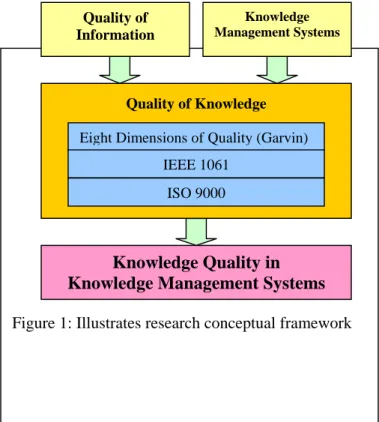
From problem in quality criteria and the measurement of knowledge quality, the researcher demonstrates the criteria for quality of knowledge in knowledge management systems. Moreover, the proposed research conceptual framework has shown in Figure 1.
Figure 1: Illustrates research conceptual framework
Knowledge Quality in Knowledge Management Systems
Quality of Information
Knowledge Management Systems
Quality of Knowledge
Eight Dimensions of Quality (Garvin) IEEE 1061
2. Theoretical Background 2.1 Knowledge
Intellectual capital is resource in the evaluation of global knowledge economics. Intangible asset are more important than tangible asset and organizations have intangible asset more than tangible asset. Dr. Steward said that “In the past, investment budget ratio between materials and knowledge is 80:20, and it is now change to 30:70”. In the present, human resource is the most valuable asset in organizations because human uses all resources in organizations. Human resource has knowledge and can also use knowledge for managing other resources. Then, organizations aware in provides knowledge domain for users.
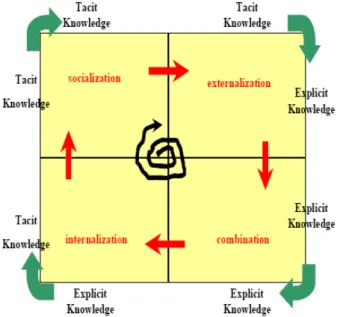
Knowledge is “justified true belief” [4], it is an important approach interpreting certain a s p e c t s o f o r g a n i z a t i o n a l a c t i v i t i e s . Knowledge is integrate from individual history, skill, interpretion and reflection. Knowledge is a high value asset and it can u s e f o r d e c i s i o n s u p p o r t i n w o r k . The knowledge creation process can be drawn from a distinction between two types of knowledge “tacit knowledge and explicit knowledge.Both knowledge are related. The assumption that knowledge is created through conversion between tacit and explicit knowledge. They allow us to p o s t u l a t e f o u r d i f f e r e n t “ m o d e s ” o f knowledge conversion: (1) there is a mode of knowledge conversion that enables us to convert tacit knowledge through interaction b e t w e e n i n d i v i d u a l s , w i l l b e c a l l e d “socialization.” One important point to note here is that an individual can acquire tacit k n o w l e d g e w i t h o u t l a n g u a g e , b u t b y observation, imitation, and practice, (2) there is a mode of knowledge conversion involves the use of social processes to combine different bodies of explicit knowledge held by individuals, will be called “combination.” I n d i v i d u a l s e x c h a n g e a n d c o m b i n e
k n o w l e d g e t h r o u g h s u c h e x c h a n g e mechanisms as meetings and telephone conversations, (3) there is a mode of knowledge conversion of tacit knowledge into explicit knowledge, which will be called “externalization.” There is a mode through such exchange mechanisms as conversation and reflection knowledge, (4) there is a mode o f k n o wl e d g e c o n v e r s i o n o f e x p l i c i t knowledge into tacit knowledge, which bears some similarity to the traditional notion of “learning” and will be referred to here as “internalization.” Figure 2 illustrates the four modes of knowledge conversion.
Figure 2: Illustrates the four modes of knowledge conversion
2.2 Quality
There are many definitions of quality, such as "fitness for use", "fitness for purpose", "conformance to requirements". Each of these statements represents a facet of quality and is incorporated into the international definition, given below:
Deming (1940) defines quality as quality of design and quality of the process; it is perception of the value of the suppliers' work output.
C r o s b y ( 1 9 7 9 ) d e f i n e s q u a l i t y a s conformance to requirement.
ISO 9000-2000 defines quality as fitfor the purpose orfitness for useor conformance to requirements.
Garvin (1987) proposes eight critical dimensions or categories of quality that can serve as a framework for strategic analysis: 1) performance refers to a product's primary operating characteristics, 2) features are usually the secondary aspects of performance, the "bells and whistles" of products and s e r v i c e s , t h o s e c h a r a c t e r i s t i c s t h a t
s u p p l e m e n t t h e i r b a s i c f u n c t i o n i n g , 3) reliability, this dimension reflects the
probability of a product malfunctioning or failing within a specified time period, 4) conformance, is the degree to which a product's design and operating characteristics meet established standards, 5) durability, a measure of product life, durability has both e c o n o m i c a n d t e c h n i c a l d i m e n s i o n s 6) serviceability, is the speed, courtesy, competence, and ease of repair. Consumers
are concerned not only about a product breaking down but also about the time before service is restored, the timeliness with which service appointments are kept, the nature of dealings with service personnel, and the frequency with which service calls or repairs
f a i l t o c o r r e c t o u t s t a n d i n g p r o b l e ms 7) aesthetics, is a subjective dimension of
quality. How a product looks, feels, sounds, tastes, or smells is a matter of personal judgment and a reflection of individual preference. On this dimension of quality it may be difficult to please everyone and 8) perceived quality, consumers do not always have complete information about a product's or service's attributes; indirect measures may be their only basis for comparing brands. A product's durability for example can seldom be observed directly; it must usually be inferred from various tangible and intangible aspects of the product.
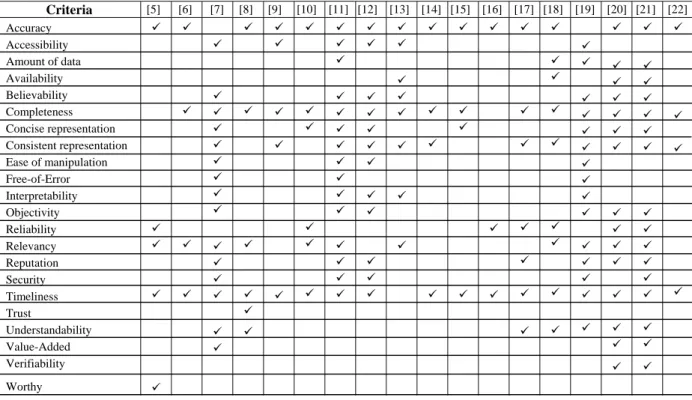
From quality define, knowledge quality as fit for the purpose or fitness for use or conformance to requirements and useful. Table1: Information Quality Criteria
Criteria Accuracy Accessibility Amount of data Availability Believability Completeness Concise representation Consistent representation Ease of manipulation Free-of-Error Interpretability Objectivity Reliability Relevancy Reputation Security Timeliness Trust Understandability Value-Added Verifiability Worthy 9 9 9 9 9 9 9 9 9 9 9 9 9 9 9 9 9 9 9 9 9 9 9 9 9 9 9 9 9 9 9 9 9 9 9 9 9 9 9 9 9 9 9 9 9 9 9 9 9 9 9 9 9 9 9 9 9 9 9 9 9 9 9 9 9 9 9 9 9 9 9 9 9 9 9 9 9 9 9 9 9 9 9 9 9 9 9 9 9 9 9 9 9 9 9 9 9 9 9 9 9 9 9 9 9 9 9 9 9 9 9 9 9 9 9 9 9 9 9 9 9 9 9 9 9 9 9 9 9 9 9 9 9 9 9 9 9 9 9 9 9 9 9 9 9 9 9 9 9 9 9 9 9 [5] [6] [7] [8] [9] [10] [11] [12] [13] [14] [15] [16] [17] [18] [19] [20] [21] [22]
Measurement criteria factors of national knowledge assets; in relation to the valuation, growth, monitoring and management of intangible assets such as information, knowledge, innovation and other derivatives, is not consistent. But, results fromliterature review and survey research, show that measurement criteria factors of information quality and quality metrics can be represent in Table 1.
3. Research Methodology
Researchers are creating criteria for quality of knowledge. This part consists of six section:1) literature review: materials and research report on knowledge management field and quality criteria, 2) study IEEE standard for software quality such as IEEE standard 1992, IEEE standard 1061-1998, 3) synthesis quality criteria in knowledge 4) measure of reliability and validity of data by statistics method 5) use Delphi technique as questionnaires (closed-ended question and open-(closed-ended question) make an enquiry from experts 6) analysis and measure of questionnaires by statistics parameter such as arithmetic mean, median, mode, range, quintile, standard deviation and variance.
3.1 Preliminary ResearchResult
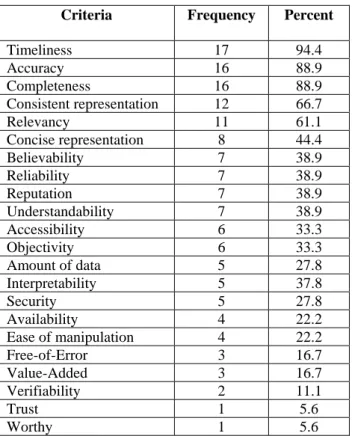
In this section, researchers present the preliminary result from literature review, analyze the relationships between data, information and knowledge, system theory and then, determine the result. We found that knowledge quality relate to data quality and information quality. Then, information quality criteria can be used to measure the knowledge quality. We analyse data from survey report and found the total reliability (α) equal to 0.8454 as shown the result in Table 2.
From Table 2, the results show that the highest important information quality criteria
are the probability criterions with measure of
knowledge quality such as timeliness, accuracy, completeness, consistent and relevancy, respectively.
Criteria Frequency Percent
Timeliness 17 94.4 Accuracy 16 88.9 Completeness 16 88.9 Consistent representation 12 66.7 Relevancy 11 61.1 Concise representation 8 44.4 Believability 7 38.9 Reliability 7 38.9 Reputation 7 38.9 Understandability 7 38.9 Accessibility 6 33.3 Objectivity 6 33.3 Amount of data 5 27.8 Interpretability 5 37.8 Security 5 27.8 Availability 4 22.2 Ease of manipulation 4 22.2 Free-of-Error 3 16.7 Value-Added 3 16.7 Verifiability 2 11.1 Trust 1 5.6 Worthy 1 5.6
Table2: Frequency of Selection by Order of Information Quality Criteria
4. Discussion
This research, researchers try to emphasize on quality of knowledge using expert’ opinions based on Delphi technique. For control quality of knowledge, it can use many techniques. In the future, researchers will collect data from experts and use trust-based recommendation to form quality metrics and quality measurement. In addition, we plan to use focus group and snowball techniquefor this additional research. Since the snow ball technique is non-probability sampling or other word represent that it is chance procedure. We believe that with using many techniques, we can promote quality metrics and knowledge quality assessment.
5. Conclusions
In this research, we tried to develop criterions for quality of knowledge in knowledge management systems. We also presented the conceptual framework for measurement the quality of knowledge. The preliminary result of this paper came from the survey and data analysis. We found the probability criteria with measure of knowledge quality in term of timeliness, accuracy, completeness, consistent and relevancy. In the near future, we will evaluate the quality criterions of knowledge in knowledge management systems with Delphi technique and other methods.
References
[1] Sung-Ho Yu , Young-Gul Kim and Min-Yong Kim. (2004). Linking Organizational Knowledge Management Drivers to Knowledge management Performance. IEEE Computer: introduction to the special issue on “Proceedings of the 37th Hawaii International Conference on System Sciences”.
[2] Bobby Dale Thomas. (2006). An Empirical Investigation of Factors Promoting Knowledge Management System Success. Texas Digital Library: introduction to the special issue on “Theses and Dissertations”, August. [3] Christine W. Soo and Timothy M.
Devinney. (2002). The Role of Knowledge Quality in Firm Performance. For Submission to The Third European Conference on Organization Knowledge, Learning, and Capabilities – Academic Track
[4] Nonaka, I. (1994). “A dynamic theory of organizational knowledge creation”, Organization Science, 5(1), 14–37.
[5] Jungwoo Lee, Younghee, Lee, Yeontaek Ryu and TaeHoon, Kang. (2007). Information Quality Drivers of KMS. IEEE Computer: International
Conference on Convergence Information Technology.
[6] Balaji Rajagopalan & Mark W. Isken. (2001). Exploiting Data Preparation to Enhance Mining and Knowledge Discovery. IEEE: Transactions on Systems, Man, and Cybernetics—Part C: Applications and Reviews, Vol. 31, No. 4.
[7] Beverly K. Kahn, Diane M. Strong, and Richard Y. Wang. (2002). Information Quality Benchmarks: Product and Service Performance. ACM: Communications of the ACM. pp. 187–
188.
[8] Jack E. Olsen. (2003). Data Quality: The Accuracy Dimension. San Francisco: Morgan Kaufmann Publishers.
[9] Carlo Batini & Monica Scannapieca. (2006). Data Quality. Springer-Verlag Berlin Heidelberg. p. 19–48.
[10] W.H. Delone & E.R. McLean. (1992). Information systems success: the quest for the dependent variable. Information systems research 3 (1), pp. 60–95.
[11] Latif Al-Hakim. (2007). Information Quality Management: Theory and Applications. Australia: University of Southern Queensland, Idea Group Publishing.
[12] R.Y. Wang & D.M. Strong, Beyond. (1996). Accuracy: what data quality means to data consumers. Journal of Management Information Systems 12 (4). pp. 5–34.
[13] W.H. Delone & E.R. McLean. (1992). Information systems success: the quest for the dependent variable. Information systems research 3 (1). pp. 60–95.
[14] D.P. Ballou & H.L. Pazer. (1985). Modeling data and process quality in multi-input, multi-output Information systems. Management Science 31 (2). pp. 150–162.
[15] P. Cykana, A. Paul & M. Stern, DoD. (1996). Guidelines on data quality management. Proceedings of the
Conference on Information Quality, Cambridge, MA. pp. 154–171.
[16] R. Kovac, Y.W. Lee and L.L. Pipino. (1997). Total Data Quality Management: the case of IRI. Proceedings of the Conference on Information Quality, Cambridge, MA. pp. 63–79.
[17] V.V. Mandke & M.K. Nayar. (1997). Information integrity–a structure for its definition. Proceedings of the Conference on Information Quality, Cambridge, MA. pp. 314–338.
[18] Felix Naumann & Ulf Leser. (1999). Quality-driven Integration of Heterogeneous Information Systems. Scotland: Proceedings of the 25th VLDB Conference.
[19] Yang W. Lee, Diane M. Strong, Beverly K. Kahn and Richard Y. Wang. (2002) AIMQ: a methodology for information quality assessment. Elsevier Science B.V. All rights reserved. pp. 133–146.
[20] Naumann, F., & Rolker, C. (2000). Assessment methods for information quality criteria. In Proceedings of the 2000 Conference on Information Quality (pp. 148-162).
[21] Wand, Y., & Wang, R.Y. (1996). Anchoring data quality dimensions in
ontological foundations. Communications of the ACM, 39(11),
86-95.
[22] Laure Berti-Équille. (2007). Quality-Extended Query Processing for Mediation Systems. IRISA, France. Idea Group Publishing.
[23] Quintas, P., Lafrere, P. and Johnes, G.(1997) Knowledge Management: Strategic Agenda, Long Range Planning, Vol.30, No.3, pp.386-391.
[24] Shimemura, E. and Nakamori, Y. na Information Technology and Knowledge Management,
http:// kbn.icm.edu.pl/GRV/abstracts/p3-5.pdf
[25] Southon, Gray and Todd, Ross, (1999) Knowledge Management: A Social
Perspective, Presented to KNOW’99, Sydney, November, 1999.
http://www.providersedge.com/docs/km_ articles/KM_-_A_Social_Perspective.pdf [26] Spender, J.-C. and Scherer, Anderson,
Georg, (2007) The Philosophical Foundations of Knowledge Management: Editors’ Introduction Organization, Vol.14, No.1, pp.5-28.
[27] Weick, K.E., Sutcliffe, K.M. & Obstfeld, D., (2005) Organizing and The Process of Sensemaking, Organization Science, Vol.16, No.4, 409–21.
[28] Wiessner, Colleen, Aalsburg.(2007) New Learning Constructing Knowledge in Leadership Training Programs, Community College Review, Vol.35, No.2, pp.88-122. [29] Wiig, K., (1993) Knowledge
Management Foundation: Think About-Thinking How People and Organization Create, Represent and Use Knowledge, Arlington, TX: Schema Press.
[30] Kankanhalli, Atreyi, Tanudidjaja, Fransiska, Sutanto, Juliana and Tan, Bernard C.Y., (na.), Role of Information Technology in Successful Knowledge Management Initiatives, Department of Information Systems National University of Singapore.
[31] Holvland, Ingie, (2003) Knowledge Management and Organisational Learning: An International Development Perspective, Overseas Development Institute, London.