Ŕ periodica polytechnica
Transportation Engineering 39/1 (2011) 11–16 doi: 10.3311/pp.tr.2011-1.03 web: http://www.pp.bme.hu/tr c Periodica Polytechnica 2011 RESEARCH ARTICLERenewing rail infrastructure
management by developing a cost
calculation methodology based on ABC
CsabaHokstokReceived 2010-10-27
Abstract
Due to liberalisation the structure of the rail transport sector – including rail infrastructure management – is changing sig-nificantly. Beside technological innovations the improvement of the accounting system has also had a marginal role in the rail development process. The aim of the study is to create a new cost calculation method for rail infrastructure management on the basis of Activity Based Costing (ABC). To reach this target it is necessary to analyse the activities of the Hungarian incum-bent rail company. A critical stage in this process is to identify the cost drivers based on real rail performances through the def-inition of the cause-effect relations between infrastructure man-agement activities and infrastructure services. Using this new model yields more accurate rail infrastructure costs on the one hand while costs based on more exact calculations can lead to more realistic determination of the user charges on the other hand.
Keywords
rail infrastructure·activity based costing·cost drivers·time registration database
Csaba Hokstok
Department of Transport Economics, BME, Bertalan L. u. 2, H-1111 Budapest, Hungary
e-mail: [email protected]
1 Introduction
Rail infrastructure has a significant role in the whole transport network, so the most of the European countries started a strong development and reforms. The structure reforms and the liberal-isation of the railways have been going on in Europe for almost two decades with more or less success. The final aim is to con-struct a uniform rail market considering the legal, the economic and the technological aspects. At the same time rail companies and governments have to face the fact that in spite of several in-novations they have not been able to cope with the decreasing competitiveness in the last years.
The rail infrastructure management is a stressful point of the rail liberalisation but it was treated only marginally because of several difficulties. Hence its reform shows some deficiencies. Therefore it is inevitable to analyse the rail infrastructure man-agement also from a costing point of view. It requires the ap-plication of new controlling and cost calculation methods with corresponding adaptations for the specific characteristics of rail infrastructure.
The aim of the study is to work out the theoretical scheme of a new cost calculation model which is able to determine the overhead costs of the infrastructure manager and the costs of infrastructure services in a better and more precise way.
In the second chapter the most important aims of the new model will be reviewed. The third chapter gives the frame-work of the future cost calculation methodology including an overview flow diagram to show how it works and the main steps of the calculation.
2 Target hierarchy of the new methodology
Before the method is presented, those aims have to be formu-lated, which are indispensable from the aspect of the developed model. The main target is to define the overhead costs of the rail infrastructure management in the interest of the more exact cost identification of the produced rail infrastructure services so that the rail charges can reflect the real expenditures and costs.
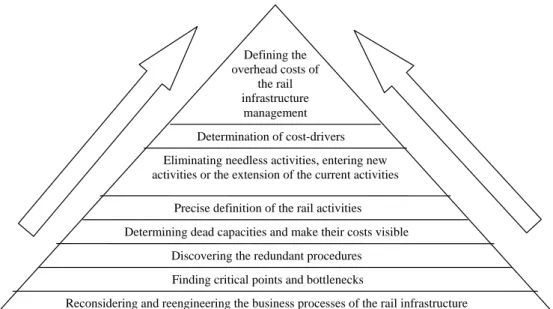
More sub-aims can be determined and enumerated by the right of their hierarchy:
Figure 1 shows the system of the aims and the possible overlaps. The arrows present the direction of realization.
Defining the overhead costs of the rail infrastructure management Determination of cost-drivers Eliminating needless activities, entering new activities or the extension of the current activities
Precise definition of the rail activities Determining dead capacities and make their costs visible
Discovering the redundant procedures Finding critical points and bottlenecks
Reconsidering and reengineering the business processes of the rail infrastructure
Fig. 1. Target system of the developed methodology
the rail infrastructure
• Finding critical points and bottlenecks in the previously men-tioned processes (for instance: lack or overflow of capacity, lack of financial sources, education of rail staff)
• Discovering the redundant procedures (for instance in assets management, transport of special goods, estate management and maintenance)
• Determining dead capacities and make their costs visible (buildings, tracks, etc.)
• Giving precise definitions of the rail activities joining the pro-cesses
• Eliminating needless activities (paper administration), enter-ing new activities or the extension of the current activities (controlling processes)
• Determination of more exact cost-drivers (demand of capac-ity, basis of real rail performance)
Fig. 1 shows the system of the aims and the possible overlaps. The arrows present the direction of realization.
3 Development of the new cost calculation model
This chapter discusses the overview of the new methodology including the review of the main steps of the cost calculation.
3.1 Theoretical scheme of the methodology
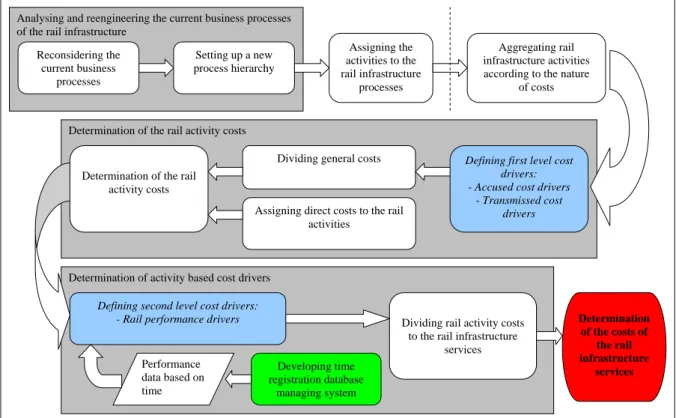
The scheme of the new methodology is indicated in Fig. 2. The cost calculation model consists of four main parts. The first part analyses the processes of the rail infrastructure man-agement, the second part discusses the rail activity analysis and the determination of the activity costs. The third part intro-duces the background of the definition of the activity based cost drivers. Finally the fourth part gives the mathematical model for the costs of rail infrastructure services.
In the first step the current processes of the rail infrastructure and their process maps and documentations have to be exam-ined. It can be seen that there are over and also under specified processes. The main processes are not exactly defined, and the fundamental activities are not clearly separated from the other supporting, complementary processes. Therefore the rail infras-tructure processes have to be reconsidered and a new process hierarchy has to be set up. By the latter the rail activities (activ-ity codes) can be squarely assigned to each process.
The second step comprises two acts. First the rail infrastruc-ture activities have to be aggregated according to the nainfrastruc-ture of costs.
Then the determination of the cost drivers (first level cost drivers) comes, which assigns the directly managed part of gen-eral costs (costs of indirect activities) to the direct activities. Af-ter defining these parameAf-ters - called accused and transmissed cost drivers - and splitting the general costs the direct activity costs will be identified.
The third step is the core part of the methodology. The criti-cal point is the determination of the activity based, second level cost drivers (hereafter referred to as rail performance drivers). It needs a new data collection method, which denotes a database managing system (time-registration system).
The last step is the formulation of the cost model by perform-ing the cost allocation of the previous steps.
3.2 Explaining the main steps of the cost calculation By the methodology presented in the previous chapter some main steps will be detailed in this part. Due to the limits of this paper the other steps will not be explained here. Only the following three important steps are presented: aggregating rail infrastructure activities according to the nature of costs, deter-mination of the rail activity costs and defining rail performance drivers.
Analysing and reengineering the current business processes of the rail infrastructure
Reconsidering the current business processes Setting up a new process hierarchy Assigning the activities to the rail infrastructure processes Aggregating rail infrastructure activities according to the nature
of costs Determination of the rail activity costs
Defining first level cost drivers: - Accused cost drivers
- Transmissed cost drivers
Dividing general costs
Assigning direct costs to the rail activities
Determination of the rail activity costs
Determination of activity based cost drivers
Defining second level cost drivers: - Rail performance drivers
Developing time registration database
managing system
Dividing rail activity costs to the rail infrastructure
services Determination of the costs of the rail infrastructure services Performance data based on time
Figure 2.: Overview map of the developed cost calculation methodology Fig. 2. Overview map of the developed cost calculation methodology
3.2.1 Aggregating rail infrastructure activities according to the nature of costs
On the basis of aggregating rail activities not only the cost drivers will be selected but the costs of activities will also be calculated.
The first round of allocation has to indicate that the costs of indirect activities will be assigned to the direct rail activities. In view of type of the assignment a notation for the cost groups has to be introduced: squarely allocatable – A, allocatable with cost drivers – CA, and not allocatable – NA [2].
The identified cost groups are the followings: • General costs, within that
– Management, controlling and other general costs (NA) – Other marketing costs (NA)
– Costs once convertible to direct costs, within that ∗ Accused costs (CA1)
∗ Transmissed costs (CA2) • Direct costs
Direct costs can be assigned directly to the rail activities and can be joined squarely to the rail infrastructure services. These are:
• Costs of rail track activities (substructure, superstructure, sid-ings, bridge, operation and maintenance of buildsid-ings, amorti-zation)
• Costs of equipments and appliances belonging to the rail track (telecommunication, interlocking, block systems and other electric appliances, operation and maintenance of overhead cable system, amortization)
• Costs of other elementary activities (for instance: traffic op-erations, shunting)
To the transmissed activities belong costs, which can be allo-cated to each rail infrastructure activities with the help of cost drivers. For instance: activities of building industry, costs of road and other vehicles, costs of material management.
The accused costs can arise in two ways: either as items appearing in the internal accounting between two organisation units (for instance: maintenance of the telephone network of the rail traffic operations by the TEB – Telecommunication, Electric and Block system – unit as service, at the infrastructure manage-ment as internal cost) or as an invoice to a subsidiary company (rail traffic training of the personal transport company) [1].
Finally the general costs can not be allocated to the direct rail activities, this would require a whole analysis but due to the limits of the paper there is no opportunity to enlarge upon this here.
3.2.2 Determination of rail activity costs
Costs of the direct rail activities consist of two parts: the sum of the costs which are squarely allocatable (direct costs) and a certain part of the general costs once convertible to direct costs within the first level of cost drivers.
Two groups of the first level cost drivers are differentiated: • Accused cost drivers
• Transmissed cost drivers
For the cost group CA1 the accused, for CA2 the transmissed cost drivers are applied. As an example let us review what kind
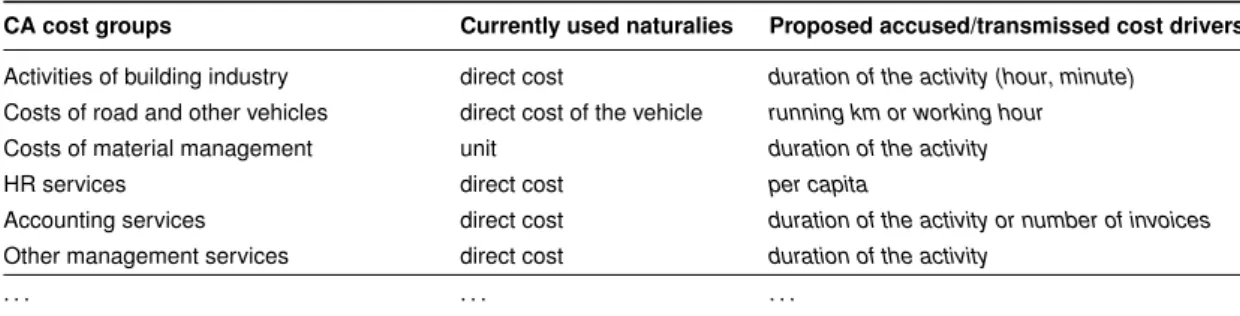
of cost drivers can be identified for some cost groups. The sec-ond column of Table 1 shows the currently used dividing factors, called naturalies [3].
According to the observations at the incumbent rail company, the presently used cost drivers are relatively simple and belong to the transaction types but the problem with these is that they can not reflect the real relationship between subservient and di-rect rail activities and they also make distortion at the assigning process [5]. Hence another point of view can be suggested for the determination of the relations. The time period type cost drivers which are based on estimated time required for perform-ing the rail activities, have to be used to revise the accuracy of the cost allocation. For this it is indispensable to measure the time of the activities. This can be realized with a time registra-tion database managing system (see in the next secregistra-tion).
The last column of Table 1 shows the identified new cost drivers based on time period. The majority of the costs can be allocated by the time period cost drivers but where the time mea-surement is not possible it is required to find a rail performance indicator which assigns values to the given activity.
3.2.3 Defining rail performance drivers
The other critical point of this methodology is to determine the second level cost drivers, called rail performance drivers. As mentioned in the previous subchapter the performance data have to be collected with the estimated time of rail activities in a time registration database information system.
The role of the second level cost drivers is to assign the costs of direct rail infrastructure activities (for example: shunting, traffic operations) to the rail infrastructure services (see next chapter).
The currently used cost drivers, also called naturalies – as in the case of the first allocation – lead to the problem that they are mostly based on the complied services by the sections of the used train route, so they can not show the difference among the several services (for instance: shunting of a passenger or a freight train). Considering the duration of performing the activ-ities eliminates the former problem [4]. Table 2 gives examples for the presently used and the suggested cost drivers through some direct cost groups of rail infrastructure activities. Due to the limit of the paper it is not possible to review all of the cost groups.
4 The mathematical formula of the model
After discussing the main steps of the methodology the cost model of the rail infrastructure services can be built up. The model will be generated as a result of a two step calculation process.
As presented in the previous chapters, the first step is the cost determination of the direct rail activities. Costs of each rail in-frastructure activity is defined by the sum of the direct costs of activities and parts of the general costs, assigned through first level cost drivers. This can be formalised in general for each
activity as follows: 1.D AC= f(I C1, ...,I Cn,DC1)=α1·I C1+β1·I C2+...+DC1 2.D AC= f(I C1, ...,I Cn,DC2)=α2·I C1+β2·I C2+...+DC2 ... X.D AC= f(I C1, ...,I Cn,DCx)=αx·I C1+βx·I C2+...+DCx (1)
Written in matrix form:
1.D AC 2.D AC ... X.D AC = α1 β1 ... ζ1 α2 β2 ... ζ2 ... ... ... ... αx βx ... ζx n×x × I C1 I C2 ... I Cn 1×n + DC1 DC2 ... DCx 1×x (2) wherein,
1., . . . , X. DAC: direct costs of each rail infrastructure activ-ity (for instance: shunting of electric locomotives, maintenance of the rail track superstructure, maintenance of overhead cable, traffic services)
IC1, . . . , ICn: general costs, assigned through first level cost drivers α1...x β1...x ... ζ1...x
:weighting factors of the first level cost drivers
DC1. . . x: sum of direct cost elements of each rail
infrastruc-ture activity
The second step is the allocation of the rail activities to each rail infrastructure services by the rail performance drivers. Its formula can be seen in matrix form, aggregated by type of ser-vices:
1 Elementary services
"
1.Reservation of the train route 2.Line running services
# = " α∗ 1 β1∗ ... ζ1∗ α∗ 2 β2∗ ... ζ2∗ # x×2 × 1.D AC 2.D AC ... X.D AC 1×x (3) 2 Incidental services
3.Usage of the stations for stops of the passenger trains 4.Usage of the departure/terminal stations
for passenger trains ...
11.Renting rail infrastructre staff
= α∗ 3 β3∗ ... ζ3∗ α∗ 4 β4∗ ... ζ4∗ ... ... ... ... α∗ 11 β11∗ ... ζ11∗ x×9 × 1.D AC 2.D AC ... X.D AC 1×x (4)
Tab. 1. Currently used naturalies and suggested cost drivers of CA cost groups
CA cost groups Currently used naturalies Proposed accused/transmissed cost drivers
Activities of building industry direct cost duration of the activity (hour, minute) Costs of road and other vehicles direct cost of the vehicle running km or working hour Costs of material management unit duration of the activity
HR services direct cost per capita
Accounting services direct cost duration of the activity or number of invoices Other management services direct cost duration of the activity
. . . .
Tab. 2. Currently used naturalies and suggested cost drivers of cost groups of services
Cost groups of rail infrastructure services Currently used naturalies Proposed rail performance drivers
Costs assigned to Costs of using overhead
ca-ble
direct cost
duration of the activity
open track section Costs of network access
ser-vices
direct cost duration of the activity
. . . .
Costs assigned to stations
Costs of using overhead ca-ble
direct cost duration of the activity
Usage of the stations for stops
sections of the used train route duration of the activity
. . . .
Costs of service groups Shunting etc. sections of the using train route duration of the activity
Common costs of services Traffic operations, block sys-tems etc.
sections of the using train route duration of the activity
3 Complementary services
12.Train data acception 13.Renting shunting staff
...
20.Usage licence of bogies
= α∗ 12 β12∗ ... ζ12∗ α∗ 13 β13∗ ... ζ13∗ ... ... ... ... α∗ 20 β20∗ ... ζ20∗ x×9 × 1.D AC 2.D AC ... X.D AC 1×x (5) 4 Supplementary services
21.Technical certification of railway vehicles=
α∗ 21·1.D AC+β21∗ ·2.D AC+...ζ21∗ ·X.D AC (6) wherein α1...x β1...x ... ζ1...x
:weighting factors of the rail performance drivers
Contracting these two steps and fitting them in one mathematical model leads to the following algorithm for each rail infrastruc-ture service:
1.Reservation of the train route 2.Line running services ...
21.Technical certification of railway vehicles
= α∗ 1 β∗1 ... ζ1∗ α∗ 2 β∗2 ... ζ2∗ ... ... ... ... α∗ 21 β∗21 ... ζ21∗ x×21 × 1.D AC 2.D AC ... X.D AC 1×x = α∗ 1 β∗1 ... ζ1∗ α∗ 2 β∗2 ... ζ2∗ ... ... ... ... α∗ 21 β∗21 ... ζ21∗ x×21 × α1 β1 ... ζ1 α2 β2 ... ζ2 ... ... ... ... αx βx ... ζx n×x × I C1 I C2 ... I Cn 1×n + DC1 DC2 ... DCx 1×x
Accordingly the model provides overhead cost of each rail infrastructure service.
The costs can be determined in a more accurate way through more exact definition of the relation between the rail activities and services and the more detailed selection of the cost drivers. Knowing the costs of each service the rail charges of the services can be calculated.
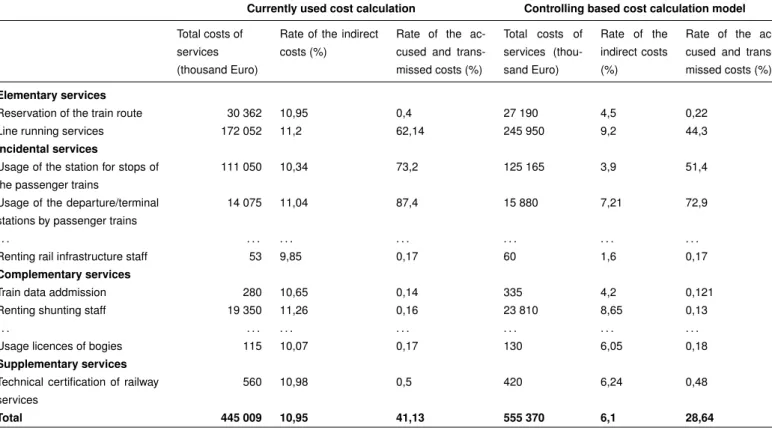
Tab. 3. Results of the preliminary calculation compared with the currently used method
Currently used cost calculation Controlling based cost calculation model
Total costs of services (thousand Euro)
Rate of the indirect costs (%)
Rate of the ac-cused and trans-missed costs (%) Total costs of services (thou-sand Euro) Rate of the indirect costs (%)
Rate of the ac-cused and trans-missed costs (%)
Elementary services
Reservation of the train route 30 362 10,95 0,4 27 190 4,5 0,22
Line running services 172 052 11,2 62,14 245 950 9,2 44,3
Incidental services
Usage of the station for stops of the passenger trains
111 050 10,34 73,2 125 165 3,9 51,4
Usage of the departure/terminal stations by passenger trains
14 075 11,04 87,4 15 880 7,21 72,9
. . . .
Renting rail infrastructure staff 53 9,85 0,17 60 1,6 0,17
Complementary services
Train data addmission 280 10,65 0,14 335 4,2 0,121
Renting shunting staff 19 350 11,26 0,16 23 810 8,65 0,13
. . . .
Usage licences of bogies 115 10,07 0,17 130 6,05 0,18
Supplementary services
Technical certification of railway services
560 10,98 0,5 420 6,24 0,48
Total 445 009 10,95 41,13 555 370 6,1 28,64
5 Using the calculation for determining the costs of rail infrastructure management
This chapter gives some examples on the use of this model for determining the costs of rail infrastructure services as compared with the currently used methodology.
The preliminary results shown in Table 3 highlight the fact that this calculation creates less general costs (indirect, accused and also transmissed), than using the current cost calculation method. The basic idea of the difference is to select the cost-drivers by the duration of the activity as mentioned in the pre-vious chapters. This proper and more detailed choice gives the possibility for a certain part of general costs to be converted into direct ones.
For instance the general costs of the service “Renting rail in-frastructure staff” decreased significantly from 9,85% to 1,6% using time period type cost drivers (like e.g. work hours). Ta-ble 3 shows the costs of some rail infrastructure services as com-pared to the costs calculated with the system applied at the mo-ment.
6 Concluding remarks
It could be seen that one core element of the rail liberalisation is the improvement of the accounting and cost collection system of the rail infrastructure companies. The Hungarian incumbent railway company would like to renew its lately used, outdated financial and accounting system because the foregoing correc-tions have not brought about complete success. Due to the for-merly mentioned problems it is required to develop a completely new methodology for cost allocation at the rail infrastructure.
In the second chapter a whole target system for the require-ments of the improvement were summarised. The third chapter presented the framework of the developed methodology. The critical point of the model is to identify the relationship between activities and rail infrastructure services through the right selec-tion of the cost drivers. The analysis gives a soluselec-tion for this. The basic idea is to measure the time period of each activity if it is possible. These durations will be the weighting factors of the cost drivers, not only on the second but on the first level as well. If the measurement is not possible or is useless depend-ing on the nature of the activities, the real rail performance has to be found and assigned to these activities. In sub-chapter 3.3 this methodology is translated to a mathematical model which integrates the two level cost allocation into one formula.
The developed cost calculation methodology seizes better the real causes and relationships between the subservient and direct rail infrastructure activities (first level) and between rail activi-ties and rail infrastructure services (second level) through more detailed selection of proper cost drivers based on estimated time required for performing the activities.
References
1 Accounting rules of MÁV ZRt., 2007. in Hungarian.
2 Hokstok Cs,Conception of transforming the infrastructure management costing into a controlling based system, 2008. in Hungarian, MSc thesis. 3 Methodology of charge calculation in MÁV Zrt, 2009. in Hungarian. 4 Cooper R,The rise of Activity Based Costing – Part Three: How many cost
drivers do you need and how do you select them?, Journal of Cost Manage-ment (1989), 34-46.
5 Bokor Z, New Approaches of Cost Management in Rail Transport, Zeleznicna doprava a logistika5(2009), no. 2, 62-66.