Portfolio Management in the Air Force:
Current Status and Opportunities
By MASSACHUSETTS INSTITUTE
OF TECHNOLOGY
Dave B. Morgan
JUL 2
0
2011
B.A. Mathematics, May 1988, Temple University LIBRARIES M.B.A., May 1993, The Ohio State University ARCHNES Submitted to the System Design and Management Program
In Partial Fulfillment of the Requirements for the Degree of
Master of Science in Engineering and Management
at the
Massachusetts Institute of Technology January 14, 2011
© 2011 Massachusetts Institute of Technology
All rights reserved
Signature of Author
Dave B organ System Design and Managemen Program May 7, 2010
Certified by
Ricardo Valerdi Research Associate, Engineering Systems Division Thesis Supervisor
Certified by
- tr'ick liale System Design & Management Program Director
Disclaimer
The views expressed in this work are those of the author and do not reflect the official policy or position of MIT, the United States Air Force, Department of Defense or the
ACKNOWLEDGEMENTS
I would like to express my heartfelt thanks and gratitude for the all the help;
encouragement and support to numerous individuals whose contributions of time and effort were the real reason the thesis came to fruition.
To the scholars and great people of the Lean Advancement Initiative. Thank you for passing your great knowledge, wisdom, and support. I hope I can translate what you taught me about Lean concepts and holistic thinking into something useful for the Air Force and my self.
To my thesis advisor, Dr. Ricardo Valerdi, thank you for having great advice and continuously pushing me to see another point of view. Your guidance and encouragement was invaluable and will never be forgotten.
To my sister, Marcia Cornelius, thank your for your encouraging words when I was down. You were always there to listen to me vent and made me realize this is not as complicated as I made it. You're my confident and I love you very much.
To my dear friends, David, Stephanie, Patricia, and Samantha, you all gave me so much encouragement and I cannot put the appreciation into words. I will always be in your debt and it is an honor to call you my friends.
To my SDM classmates, Mario and Vishal thanks for lending me your ears when I needed to chat about some ideas.
To SAF/ACPO thanks for the straightforward and comprehensive comments. You made me dig deeper with my analysis thus making the thesis a better product.
To the ODB crew, John, Greg, and Kris. I reflected on the good times we had to get me through the times when I was a little despondent. ODB crew lives on!
To Melissa, thanks for the proofreading and catching those unnecessary punctuations and spit infinitives.
To Charlie A. for letting me use his computer for six months; you are indeed Mr. SDM. Last, I want to thank all the acquisition professionals who were kind enough to let me intrude in their busy work schedule and let me interview them. You folks are unsung heroes who work in a very difficult environment; yet your work is what has made the
Abstract
There are hundreds of weapons programs, under the management of the United States Air Force worth billions of dollars. These programs are being developed to fulfill a need in the U.S. defense strategy. Bringing these weapon systems to operational status is not an easy process. It takes communication and coordination of many stakeholders and development of state-of the-art technology. More often than not, weapons programs are developed with the final cost and schedule being much higher that forecasted.
Inherently weapons systems are expensive, however the costs of these systems continue to rise with no apparent end in sight. The Government
Accountability Office, RAND, Congressional studies and the Defense Acquisition Performance Assessment have has criticized the Department of Defense for
escalating costs. These studies point to poor requirement definition, errors in cost and scheduling forecasts, poor oversight, bad decisions by the government, and failure to adopt recommendations from reform policies as the main causes. One way ameliorate cost escalation is to employ portfolio management technique. The Air Force groups their weapon systems into 20 portfolios. Some form of portfolio
management has been employed for the last decade. Portfolio management cannot solve the issues above but it can offer a solution that can potentially save millions and perhaps billions of dollars
This thesis examines the Air Force's current use of Portfolio Management theory and what opportunities we can do to improve it in the acquisition
community. The thesis poses three research questions: 1) How can the Air Force better employ portfolio management to curb cost overruns and schedule delays in their weapon acquisition programs? 2) What can the Air Force do to empower portfolio managers for success? 3) What barriers can the Air Force eliminate or streamline to help portfolio managers execute their portfolios more effectively and efficiently.
Acquisition professionals were interviewed to glean their perspectives and opinions. More specifically acquisition personnel were asked how portfolio
management was being executed and how can the Air Force improve this technique to better execute weapon systems programs.
From these interviews and the research conducted, the following
recommendations were made: 1) Program Executive Officers should be given more authority with respect to utilizing funds and hiring of specialized personnel 2) The Air Force needs to streamline the process for reallocating funds and, 3) The Air Force needs to modify number of reporting requirements and policy changes to make the process more efficient and effective.
Table of Contents
Acknowledgements...3 A bstract ... 4 Table of Contents...5 List of Figures ... 7 List of Tables...8 A cronym s...9 Chapter 1 Introduction...101.1 Research questions, approach and method...12
1.2 R esearch L im itations...13
1.3 T hesis O utline... .. ... 15
Chapter 2 Literature Review...16
2.1 DoD and Air Force Budget...16
2.2 A cquisition H istory ... 18
2.3 Acquisition Reform/Initiatives... ... 19
2.4 Portfolio Management Theory...28
2.5 Summary of Literature Review -Key Takeaways... ... 30
Chapter 3 USAF Portfolio Management Today...31
3.1 Stakeholders... ... 34
3.2 B udgetary F low ... 37
3.3 Portfolio Management: Current View...40
3.4 Portfolio Management: Future View...45
Chapter 4 What Do the People Say: Observations, Analysis... 47
4.1 PE O Structure... 47
4.2 Roles/Responsibilities...49
4.3 A uthority ... . 50
Chapter 5 Portfolio Management and Risk...55
Chapter 6 Recommendations...57
C hapter 7 C onclusions.... ... 62
Bibliography...65
Appendix A -Sample Interview Questions...69
Appendix B -AFI 63-101 Roles and Responsibilities...70
List of Figures
Figure 2.1: Figure 2.2: Figure 2.3: Figure 2.4: Figure 2.5: Figure 3.1: Figure 3.2: Figure 3.3: Figure 3.4: Figure 3.5: Figure 3.6: Figure 3.7: Figure 3.8:U.S. Defense Spending Since 2001...16
U.S. Federal Spending...17
Packard Commission Formula for Action...23
FY 2009 Budget by Service...27
Modem Portfolio Theory Example...28
PEO Structure, Pre-Summer 2010...32
Current PEO Structure...33
Portfolio Stakeholders...35
Budget Process Flow...38
Weapons Portfolio Funding...41
Fund Transfer Request Process...43
Current Funds Transfer Process...44
List of Tables
Table 1: C arlucci Initiatives...20 Table 2: Grace Commission Recommendations... 21 Table 3: Successful Characteristics of Acquisition Organization...3
Acronyms
AAC ACAT AFI AFMC ALC ASC AT&L CBO DAES DAIP DMR DoD ESC FAR FM GAO GWOT IBR ISO JRMB MAJCOM MAR MDA OMB OSD PCO PEO PM PMT POM R&D RDT&E SAE SAF/AQ SAR SMC SPR UCA UCR USAF USD WR-ALC WSARAAir Armament Command Acquisition Category Air Force Instruction
Air Force Material Command Air Logistics Center
Aeronautical Systems Center
Acquisition Technology & Logistics Congressional Budget Office
Defense Acquisition Executive Summary Defense Acquisition Improvement Program Defense Management Review
Department of Defense
Electronic Systems Command Federal Acquisition Regulation Financial Management
Government Accountability Office Global War on Terrorism
Investment Budget Review
International Standards Organization
Joint Requirements and Management Board Major Command
Monthly Acquisition Report Milestone Decision Authority Office of Management and Budget Office of the Secretary of Defense Procurement Contracting Officer Program Executive Office Program Manager
Portfolio Management Theory Program Objective Memorandum Research and Development
Research, Development, Test and Education Service Acquisition Executive
Secretary of the Air Force / Acquisition Department Selected Acquisition Reports
Space Missile Command Spring Program Review Undefinitized contract actions Unit Cost Report
United States Air Force Under Secretary of Defense
Warner Robins Air Logistics Center Weapons System Acquisition Reform Act
Chapter 1: Introduction
The United States Air Force (USAF) has awesome responsibilities. It is charged with securing the airspace of the United States protecting U.S and allied ground troops from air attack, and protecting U.S and allied military installations from air and space attack. Accomplishing these tasks encompasses a defense system that is mind boggling. It requires multiple types of aircraft including fighters, bombers, surveillance, transport, and refueling aircraft. It also requires systems that carry out command and control
functions, sophisticated munitions, logistics systems, information systems, space systems, and many more that comprise the USAF Systems Enterprise. To acquire these systems the USAF contracts with defense contractors and their suppliers who develop design and manufacture these systems to certain requirements so the USAF can carry out their mission and the protect the nation's interests. These weapon systems allow the USAF to maintain its combat superiority and its ability to prosecute the war in the air better than any other air force in the world.
Currently the USAF has approximately 400 defense related programs worth over $40 billion dollars. The defense acquisition system is a unique system with hundreds of beneficiaries and stakeholders. It is safe to say that acquiring a major weapon system is definitely not an exact science and is most definitely an art. One cannot put a timetable on the maturity of technology. The funding of weapon systems is budgeted on a yearly basis and may be interrupted due to political or economic reasons. Security issues may change affecting a particular weapon system's development. Skilled and experienced engineers and program managers from the government as well as the defense contractors are a drivng force behind a weapon systems program success. All these and many more
factors that cannot be objectively measured make it difficult to manage and execute these programs. Hence, it is an art that requires extreme ingenuity and patience.
The defense acquisition system has been a watch list item for the United States Government Accountability Office (GAO) for quite some time. GAO-06-368 states, "Over the past 3 decades, the Department of Defense (DoD) acquisition environment has undergone many changes aimed at curbing cost, schedule and other problems." Recent
GAO reports have criticized the DoD for poorly managing weapons acquisition programs
leading to costly overruns upwards of 60 percent of the agreed upon baseline and schedule delays upwards to 24 months. In fact one GAO report released in 2009 indicated that only 20 percent of weapons programs were expected to deliver on time or ahead of schedule. Furthermore, the GAO stipulates weapon systems cost went from $1.2 trillion in 2003 to $1.6 trillion in 2008 (fiscal year 2009 dollars) (GAO-09-326SP).
Inherently weapons systems are expensive and it is difficult to put a price tag on national security. However, what continues to trouble acquisition stakeholders is the increase in costs of already tremendously expensive items. In just about all facets of weapon system acquisition process costs and schedule delays are rampant.
A wealth of research has been conducted to improve the acquisition process and
help curb the escalating costs and delays. These include GAO and RAND studies, the House Armed Services Committee Panel on Defense Acquisition Reform, and the Defense Acquisition Performance Assessment. The conclusions of the studies
accomplished on weapon systems acquisition can be summed up in these areas: 1) Poor requirements definition, 2) Errors in estimation and scheduling, 3) Decisions made by the
government, 4) Oversight issues, 5) Financial matters, and 6) Failure to adopt acquisition reform policies.
Acquisition reform is a huge endeavor. This thesis will not tackle all five categories; however in the last decade the acquisition leadership has embraced a technique that they believe will help reduce the cost and schedule overruns. Portfolio management theory or product portfolio is that tool. The Clinger-Cohen Act of 1996 mandates the use of Portfolio Management for all federal agencies acquiring information technology projects. Portfolio management is also used in many companies to bring products to the market efficiently, reduce risk and optimize resources. The USAF
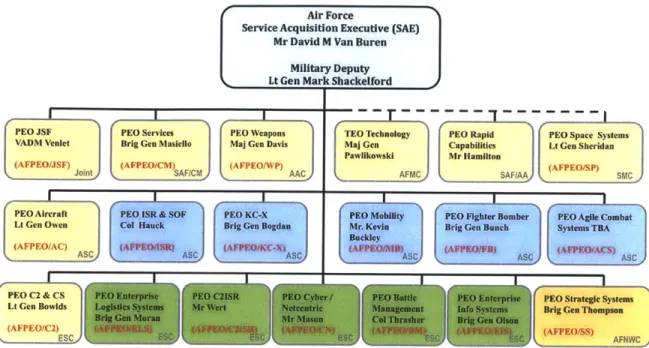
acquisition community has organized their weapon system programs in portfolios. In the summer of 2010 the Air Force changed their portfolio structure from six PEOs to twenty. This reduced the span of control of the PEOs with the intent to improve overall portfolio performance. It is unknown whether this new structure is indeed improving the execution of acquisition programs; however, this thesis will offer a subjective evaluation to
determine whether the portfolio management methodology can produce results that can ameliorate the weapons acquisition process as it has done in other commercial
organizations.
1.1 Research Questions, Approach, and Methods
The primary the questions this thesis addresses is: How can the Air Force better employ portfolio management to curb cost overruns and schedule delays in their weapon acquisition programs? A corollary question is: What can the Air Force do to empower portfolio managers for success? Yet another question is: What barriers can the Air Force
eliminate or streamline to help portfolio mangers execute their portfolio more effectively and efficiently?
In order to understand why portfolio management is a topic of interest, the author performed a comprehensive examination of acquisition reform over the last three
decades. Then an investigation of the current environment with respect to DoD and Air Force acquisition was completed. Finally, the author interviewed acquisition
professionals at different levels in the acquisition community from various geographic locations representing different portfolios.
The examination, investigation, interviews, and experience of the author led to the development of a model of how current portfolio management is executed and another model of how it could be accomplished in order to improve program execution, decrease cost and, reduce schedule delays.
1.2 Research Limitations
This paper is intended to start a discussion about the application and employment of portfolio management in the acquisition community and its ability to improve their processes. It is not intended to cast aspersions on the Air Force acquisition community or its personnel; especially the ones who have given their time to be interviewed. The Air Force acquisition process is extremely complex with political overtones in every
program. Balancing the defense of the nation along with practicing good stewardship of the taxpayers' money is very difficult and worth a study of its own.
The bulk of the information for this research comes for the many discussion the author had with acquisition professionals who were promised anonymity. These discussions provided differing opinions. We have tried to represent these opinions as accurately as possible. The people who work in the acquisition career field are extremely intelligent, hard working, and proud. Most of the interviews come from on product center, ESC at Hanscom AFB. ESC is very unique as are the other product centers. However, since no one from Aeronautical Systems Center or Air Armament Center was interviewed, we must point out that there could be sampling bias. The author, with the help of some colleagues, developed a set of interview questions. (Appendix A). These questions were intended to be objective and solicit open feedback about portfolio management and the acquisition process. However, not all questions were answered by during the interview sessions because of time constraints or knowledge limitations. Also, some questions were added when the interviewee brought up a good point. Moreover, it would have been interesting to interview acquisition professionals in the Navy and Army to obtain a broader set of perspectives but time and access did not permit this to happen; hence this is an Air Force-centric version of portfolio management analysis.
It is the hope, of the author, that this thesis spurs further research that will produce policy that will help improve the way the acquisition community employs portfolio management through its processes and policies..
1.3 Thesis Outline
The following is a brief description of the thesis. Chapter 2 contains a review of the literature. Most of this chapter explains the history of acquisition reform over a 30-year span. Then, there is discussion on portfolio management and portfolio product management to include: execution, theories and applications with respect to product development.
Chapter 3 addresses the current environment on portfolio management with respect to the program managers, program executive officers and Air Force headquarters personnel. Their interactions are crucial to the effectiveness of portfolio management. The analysis of the interviews with acquisition professionals will be documented in this chapter. Also discussed in this chapter are the other key stakeholders that affect portfolio management operations.
Chapter 4 outlines the interviews that were conducted. Observations and analysis are documented with the current PEO structure, authority and personnel.
Chapter 5 discusses the other part of portfolio management, risk. Every program is required to have a risk management plan. The Air Force charged LAI to develop a risk index to help with portfolio management. This chapter introduces the work being
accomplished by another colleague and how it may benefit the PEOs and PMs,
Chapter 6 details the authors recommendations he gleaned from the research and interviews conducted.
Chapter 2: Literature Review
This chapter contains the background and rationale for studying this problem through a close examination of the literature. To tell this story thoroughly we must examine several areas. First we take a look at the Department of Defense (DoD) budget and then narrow it down to the Air Force budget. Second, we examine some of the literature on acquisition reports from agencies such as General Accounting Office (GAO) and RAND Corporation. Third we explore some of the history of Acquisition Reform over the last 30 years. Finally, we analyze the literature on portfolio management and some of its applications in the commercial sector
2.1 DoD and Air Force Budget
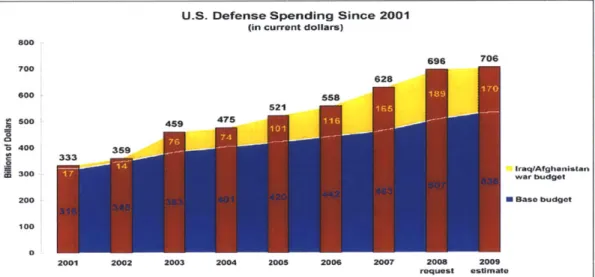
The defense of the United States is a very expensive proposition. When we add the expense of conflicts such as Afghanistan and Iraq the costs are staggering. In 2009 the DoD's budget totaled more than $700 billion dollars (see Figure 2.1 below).
U.S. Defense Spending Since 2001 (in current dollars)
Figure 2.1: U.S Defense Spending Since 2001 (CBO, DoD, OMB)
100 696 706 700 628 600 621 nia 000 459 lraciAfgh 3100 war budgl 200 I Base bud 100 0 2001 2002 2003 2004 2005 2006 2007 2008 2009 request estimate
Notes: Baso budget fgures are from OMB and mcludo Department of Energy nuclear weapons actmvtes and OOD-related spending try other agencies Iraq. Afghnistan air utdget fiurs ame fror COO ~Analysis of the Growh in Funding 1or Operalon. in Iraq and AlIghanistan- Febloasy 11 2008
anistan
In 2009, the DoD's budget (Figure 2.2) accounted for 23% of the United States federal budget and represents over 25% of the revenues collected from U.S. taxpayers. It accounts for close to 5% of the total Gross Domestic Product and over 50% of all
discretionary spending. These figures have been on the steady rise for last several years.
Total interest 151 $3,518 B 187 4% Defense Other 5% 782 Discretionary 23% 437 12% Other Mandatory Social Security 17% 678
20%
Medicare & Medicaid 676 19%Source: OMB - 2011 Budget - Summaiy Table S-3
Figure 2.2. U.S Federal Spending - (OMB, 2009)
The U.S military outspends it nearest competitor, China, by nearly 6 to 1. In fact the U.S military budget is larger than the combined military budgets of the next 45 countries and accounts for over 40% of global arms spending (International Institute for Strategic Studies, 2008)
This huge spending gap and our current economic climate has many members in Congress and the American public demanding we curtail spending and even cut the military budget. Those in favor of reducing the military budget believe the military budget is endangering other domestic programs such as Medicare & Medicaid and Social
Security. They also argue that there is massive waste and overspending intertwined in the DoD and this must stop. These very claims are the main drivers of this thesis.
2.2
Acquisition History
"A billion here, a billion there, and pretty soon you're talking real money." This
phrase about government expenditures, attributed to Senator Everett Dickerson from Illinois, some say erroneously, but its roots go back as far as 1917, has become a classic. Nevertheless it has become synonymous with DoD spending. I think it is necessary to give a little history of Acquisition Reform with respect to the improvement of cost, schedule and performance of weapons programs. This issue has been a well debated by government leaders for quite some time.
Defense acquisition reform has been going on for over 60 years, some argue much longer but for the sake of brevity we will only go back 30 years. General Accounting Office reports are an indictment on the acquisition process. GAO-06-368 states, "Changes made in DoD's acquisition policy over the past 5 years have not eliminated cost and schedule problems for major weapons development programs." GAO-08-467SP states "Since 2000 the DoD has roughly doubled its planned investment in new systems from $790 billion to $1.6 trillion in 2007 but acquisition outcomes in terms of cost and schedule have not improved. Nearly every report from the GAO dating back to the year 2000 reflects the same message of spiraling costs, late deliveries and slow adoption of recommend changes.
In March 2009 Committee Chairman Ike Shelton and Congressman John McHugh initiated the House Armed Services Committee Panel on Defense Acquisition Reform.
The Panel was established because of wide spread feelings of the committee that DoD acquisition was not responsive to current environment and were not being good stewards of the taxpayers money. The Panel used as evidence many GAO reports and findings. Although the Panel did assert there is not an objective way to discern how well the DoD
acquisition is doing when delivering value to the warfighter; it did determine the acquisition system was in need of many changes to include its inability to provide accurate and timely financial information. The Panel concluded this alone was a major impediment to good management. The Panel's negative findings led to the Weapon
Systems Acquisition Reform Act of 2009, which is briefly discussed later in this chapter. Finally, the RAND Corporation has published more reports and studies for the government with respect to acquisition than any other organization. In fact most initiatives will cite the RAND Corporation in their research such as the previous panel. We will not list all the reports RAND has accomplished but it is very safe to say the RAND Corporation has also arrived at similar conclusions than many others with respect to cost and schedule delays of programs. They have cited errors in estimation and scheduling, decisions made by the government, financial matters, and requirements growth to name a few.
2.3 Acquisition Reform/Initiatives
In the 1980s the "Cold War" unleashed a great amount of fear and angst about the security of the United States. The DoD worked feverishly with defense contractors to expedite weapon systems for operational use. As a consequence the costs of these systems steeply increased. When costs increased many watch dog groups suspected
wrongdoings. Under the Reagan Administration many efforts were undertaken to address fraud, waste and abuse. The most notable ones were 1) The Carlucci Initiatives, 2) the Grace Commission, 3) the Packard Commission, 4) Goldwater-Nichols Act.
Carlucci Initiatives
In 1981 Deputy Secretary of Defense Frank Carlucci sought to eliminate program turbulence, over-burdensome reporting, and poor cost estimating all in the hopes of fielding viable weapon systems. In April 1981, he introduced 31 initiatives that would improve the acquisition process; by 1984 the number grew to 33. These initiatives were indoctrinated into the services as the Defense Acquisition Improvement Program (DAIP) but were more colorfully known as the "Carlucci Initiatives." (See Table 1)
Table 1. Carlucci Initiatives (Carlucci, 1986)
These initiatives came "with the priorities of reducing cost, making the acquisition process more efficient, increasing the stability of the programs, and decreasing the
acquisition time of military hardware."
1. Reaffirm Acquisition Management Principles 18. Budget for Inflation
2. Increase Use of Preplanned Product Improvement 19. Forecast Business Base Conditions 3. Implement Multiyear Procurement 20. Improve Source Selection Process 4. Increase Program Stability and 21. Develop and Use Standard Operation a
Support Systems
5. Encourage Capital Investments to Enhance 22. Provide More Appropriate Design-to-Cost Goal Productivity
6. Budget to Most Likely Costs 23. Implement Acquisition Process Decisions 7. Use Economical Production Rates 24. Reduce DSARC Milestones
8. Assure Appropriate Contract Type 25. Submit MENS with Service POM (MENS later called JMSNS)
9. Improve System Support and Readiness 26. Revise DSARC Membership Executive
10. Reduce Administrative Costs and Time 27. Retain USDR&E as Defense Acquisition 11. Budget for Technological Risk 28. Raise Dollar Thresholds for DSARC Review 12. Provide Front-End Funding for Test 29. Integrate DSARC and PPBS Process
Hardware
13. Reduce Government Legislation Related to 30. Increase PM Visibility of Support Resources Acquisition
14. Reduce Number of DoD Directives 3 1. Improve Reliability and Support 15. Enhance Funding Flexibility 32. Increase Competition (added July 81) 16. Provide Contractor Incentives to Improve 33. Enhance the Defense Industrial Base (1984)
Reliability
17. Decrease DSARC Briefing and Data Requirements
Unfortunately the widespread reform Carlucci had hoped for did not materialize. The GAO reported, in1986, the initiatives were somewhat successful but were not being inculcated into the acquisition culture. Also the GAO did not find that senior leadership embraced the initiatives, which was crucial for success. Without leadership buy-in and commitment DAIP failed.
Grace Commission
In 1982 President Reagan directed the Private Sector Survey on Cost Control. It is most commonly known as the Grace Commission. It was named after Peter Grace, the co-Chairman of Citizens Against Government Waste, a non-profit organization. In 1984 the Grace Commission delivered a 21,000- page report to President Reagan. A total of
31 issues and over 100 recommendations were aimed at the DoD acquisition process.
Thirteen of the key recommendations are in Table 2.
Table 2. Grace Commission Recommendations (House Rep Hearings, 1985) 1. Greater use of multiyear contracting to improve program stability
2. Prioritize all weapons programs
3. Streamline and strengthen the contract selection process
4. Upgrade cost estimating
5. Enhance the role, responsibility, authority and accountability of the PM
6. Increase the use of dual sources throughout the life of the program
7. Increase emphasis on the Spare Parts Breakout Program to identify and obtain spare parts from sources other than the prime contractor.
8. Consolidate responsibility for contract administration activity at the level of the OSD9.
Simplify / streamline the 30,000 pages of regulation related to Defense procurement
10. Mandate use of common components, subsystems and equipment by all services. 11. Eliminate the use of unnecessary military specifications
12. Outsource commercial functions
The Grace Commission criticized Congress for impeding efficient acquisition operations, micromanagement, and adding pork barrel projects (pork barrel projects are projects added in by Congressmen and Senators that the military leadership deems unnecessary. These projects are almost always in the Congressman's district and the
Senators home state. The politicians justify these projects under the banner of national defense against the wishes of the DoD) unwanted by the military. The GAO and the OMB embraced many of the recommendations of the Grace Commission. However, the Carlucci Initiatives and DAIP were underway concurrently during this time. Hence, the DoD leadership saw many overlapping areas with the Grace Commission and the
Carlucci Initiative. Both these efforts in essence became one gigantic current reform and as stated before the Carlucci initiatives did not fully take hold in the acquisition culture and thus the Grace Commission, which was tied to Carlucci did not take root as well.
Packard Commission
In 1985, President Reagan established the Blue Ribbon Commission on Defense, which became known as the Packard Commission. This effort was put into motion because of scandalous media reports of exorbitant overspending of material and increasing schedule delays. In the late 1970s, David Packard issued a 7-page memo which later developed into DoD 5000.1 and DoD 5000.2, which are the foundation of the defense acquisition system. Now in his second foray into acquisition reform, the
commission Packard headed looked at successful acquisition organizations and identified what made them successful (Table 3) and a "Formula for Action" (Figure 2.3).
Table 3: Successful Characteristics of Acquisition Organizations 1. Clear Command Channels
2. Stability
3. Limited Reporting Requirements
4. Small, high-quality staffs
5. Communications with users
6. Prototyping and testing
Figure 2.3. Packard Commission Formula for Action A Formula for Action
A. Streamline Acquisition Organization and Procedures
-Create new position of Under Secretary of Defense (Acquisition) (USD(A))
-- manages defense acquisition full-time
-- becomes the new Defense Acquisition Executive (DAE)
-Each service should establish a comparable Service Acquisition Executive (SAE)
-Each SAE should appoint a number of Program Executive Officers (PEOs).
-Program managers would report directly to the PEOs.
-Incorporating the above, substantially reduce the number of acquisition personnel
-Recodify federal laws into a single, greatly simplified statute
B. Use Technology to Reduce Cost
-Emphasize building and testing prototypes to demonstrate new technology
-Operational testing, using prototypes, should begin early in development
-Prototypes can also provide a basis for improved cost estimating
C. Balance Cost and Performance
-Restructure the Joint Requirements and Management Board (JRMB) to be co- chaired by
the USD (A) and the Vice Chairman of the Joint Chiefs of Staff.
-The JRMB should define weapon requirements for development, thereby providing an
early trade-off between cost and performance.
D. Stabilize Programs
-By "baselining" programs and by multi-year funding
E. Expand the Use of Commercial Products.
-Don't rely on military specifications
-Use Off-the-shelf products as much as possible
F. Increase the Use of Competition
-Focus on more effective competition, modeled after commercial practices
-Emphasize quality and past performance as well as price
G. Enhance the Quality of Acquisition Personnel.
- Allow Secretary of Defense to establish flexible personnel management policies
- Recommend an alternative personnel management system for senior acquisition
The Packard Commission chief success was the 1986 Goldwater Nichols Act, which is arguably the most significant defense reorganization act since the 1940s. In terms of acquisition, it created an Under Secretary for Acquisition and Acquisition
Executive positions for each military (a political appointee) and the Vice Chairman of the Joint Chief of Staff. All this was directed at streamlining the military acquisition
structure.
The establishment of the Under Secretary of Acquisition helped the
recommendations of the Packard Commission and multiyear contracting and purchasing did seem to help program stability but enhancing the quality of the acquisition personnel did not fare as well because of lack of Congressional action or input.
Defense Management Report
In 1989, President Bush directed Defense Secretary Dick Cheney to look at initiatives to improve the DoD's processes. In July 1989 the Defense Management Report (DMR) was published and recommended streamlining operations, in particular Finance, Procurement and Contract Management. It is ironic the DMR recommendations led to consolidation of contracting under the Defense Logistics Agency, a
recommendation made by the Grace Commission. Another irony of the DMR was its harsh criticism of the acquisition community for being undisciplined and plagued by numerous regulations (which was heaped on them by other commissions and studies). DoD responded to the criticism by adding a third volume of DoD 5000.1. The third volume incorporated many DoD directives and policies that were issued over the last decade.
The Defense management Report ushered a new era of deregulation of the acquisition process. This was done to lower costs, simplify and streamline the process. As stated above reducing burdensome regulations was key to the DMR's
recommendations. Senior leaders also wanted to reduce government overhead. To that end the Air Force merged Air Force Systems Command and Air Force Logistics
Command to become Air Force Material Command. However this drastically reduced the number of seasoned and experienced acquisition professionals.
In 1994 Secretary of Defense William Perry, responding to criticism of too many standards, which imposed unnecessary restrictions and increased costs to contractors issued what we now call the Perry Memo. At the time there were over 30,000 standards with many contradicting one another. The Perry Memo, which was issued in1994, cancelled many standards and encouraged the use of industry standards such as ISO 9000 series for quality assurance. Weapons systems were required to use "performance
specifications" that described the desired features of the weapon, as opposed to requiring a large number of defense standards.
2000
-
Present
The present decade has seen the military budget increase from $333B to over
$700B. Of course there are reasons for this; chief being "911." Later in 2001 the war in
Afghanistan began and in 2003 military operations in Iraq commenced. Also during this time we still saw weapon systems cost continue to increase. The GAO submitted reports
"Total acquisitions costs for major defense programs in the fiscal year 2007 portfolio have increased 26 percent from first estimates, compared with 6 percent in 2000.
Programs have also often failed to deliver capabilities when promised." (GAO-08-467SP)
"...Of the 96 weapons programs the auditors at the GAO reviewed 64 percent had reported cost increases and only 28 percent were expected to be delivered on time or ahead of schedule..." (GAO-09-326SP)
"A number of defense programs have entered the systems development phase with
immature technologies and then moved into the systems demonstration period with low levels of design stability..." (GAO-09-326SP)
In response to the Pentagon's troubled procurement process; President Obama signed the Weapon Systems Acquisition Reform Act (WSARA) in Dec 2009. Already critics say WSARA can exacerbate some of the problems it was passed to fix (Ervin,
2010). Others say WSARA duplicates existing policies and regulations and creates more
bureaucracy and unnecessary complexity (Erwin, 2010). The WSARA is only one year old and it already seems headed to the same fate as the acquisition reform initiatives that came before it.
However, as stated earlier, the size of the defense budget has come under more scrutiny than ever before. In the summer of 2010, just as many of his predecessors such as Carlucci and Perry, Secretary Gates delivered his own memo. The Secretary of Defense's memo calls for slashing $100 billion over the next 5 years from the defense
budget from all available sources. Ashton Carter, the Under Secretary of Defense for the Acquisition Technology & Logistics followed Secretary Gates memo with two memos (Sep and Nov 2010 Memos) where he called for "Better management of acquisition programs, more accurate forecasts, better cost/schedule control and the possible
elimination of programs." (Carter, Appendix D). Ashton Carter's memos were clearly a precursor to what many believe is a movement to reduce and eliminate the many weapons programs throughout the DoD. The Air Force, which prides itself with technological savvy programs, which cost billions of dollars, is clearly a target of the initiatives in the memos.
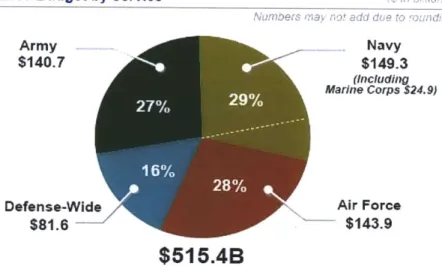
Below is the DoD budget for fiscal year 2009 in Figure 2.4.
FY 2009 Budget by Service mo
NuOers mrayV no9 add duetomunin
Army Navy
$140.7 $149.3
(including
Marine Corps $24.9)
Defense-Wide Air Force
$81.6 - - ~ 143.9
$515.4B
Figure 2.4 FY 2009 Budget by Service (DoD, 2009)
Thirty-two percent of the Air Force's $170 billion budget is earmarked for Research Development Test and Evaluation (RDT&E) and Procurement programs. It is clear a good portion of the $100 billion savings over the next five years will come for weapon systems programs across all services. The Air Force will either have to eliminate some
programs, live with fewer items or apply better management techniques to curb costly overruns. Portfolio Management may be able to help.
2.4 Portfolio Management Theory (PMT)
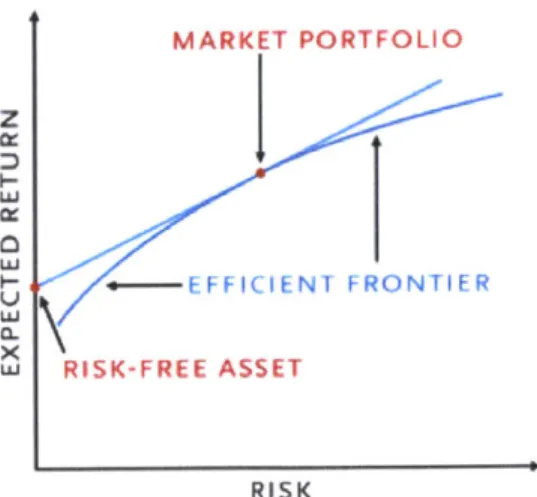
Dr Harry Markowitz, Noble Prize winner, was the first to describe modern portfolio management theory (Markowitz, 1952). His theory was so revolutionary that it prompted Milton Friedman, another prominent economist, to question whether it was even economics (Markowitz, 1990). Markowitz major contribution was his concept of an optimal portfolio whose objective is to maximize return and minimize risk by careftlly choosing different assets.
MARKET PORTFOLIO
z
Z- EFFICIENT' FRONTIER
w RISK-FREE ASSET
RISK
Figure 2.5 Modern Portfolio Theory Example
Markowitz theory, although close to 60 years old, still continues to the foundation of millions of portfolios with respect to stocks and bonds in the marketplace. For his work Dr. Markowitz received the Nobel Prize in Economics in 1990. Dr. Markowitz theory is now widely applied in corporation management philosophy.
James L. Farrell Jr states, in his book Guide to Portfolio Management Theory (1983), "Portfolio management consists of three major activities: (1) asset allocation, (2) weighting shifts across major asset classes, and (3) security selection within asset classes. Asset allocation can best be characterized as the blending together of major asset classes"
Christine Brentani in her book Portfolio Management in Practice (2004) as well as Modern Portfolio Theory The Principles of Investment Management (1988) by Andrew Rudd and Henry K. Cashing, Jr. hammers home the point that the effective management of risk is the key issue with PMT. In point of fact all the literature on PMT emphasizes risk. In truth the basic premise of PMT from all the literature does not differ and if we did a statistical analysis we would fine the basic definition of PMT, from all authors, has a standard deviation of .00001. However, weapons systems are not securities and cannot be managed as such. There are two major differences, 1) they are not liquid assets that can be traded and 2) they are not divisible into small units like stocks. True, they do have an enormous amount of risk, which must be managed by the program manager. Therefore we turn to the literature that discusses PMT of products.
Portfolio Managementfor New Products (1998) by Robert Cooper, Scott Edgett, and Elko Kleinschmidt provide a framework that is most appropriate for the application of PMT to Air Force weapons systems. These authors assert the PMT, in a firm, revolves around product prioritization and resource allocation. The following description sums up PMT with respect to new products and weapon systems: "Portfolio management for new
products is a dynamic decision process wherein the list of active new products and R&D projects is constantly revised. In this process, new projects are evaluated, selected, and prioritized. Existing projects may be accelerated, killed or deprioritized and resources are allocated and reallocated to the active projects. The portfolio decision process is
characterized by uncertain and changing information, dynamic opportunities, multiple goals and strategic considerations, interdependence among projects, and multiple decision makers and locations." The authors go on to say this is an iterative process, which includes continuous decisions from multiple stakeholders and a continuous reallocation of resources. This is the model that will be used. In Chapter 3 will examine the "As-is" portfolio management process in the Air Force.
2.5
Summary of Literature Review
-
Key Takeaways
This chapter showed a brief history of the budget increases and the acquisition changes that has occurred. We do this to show (1) the budget is a major concern for the American taxpayer and thus the politicians (2) reforming acquisition has been an ongoing effort for decades. Improving management of weapons system acquisition in order to reduce costs and provide on-time weapon systems to the warfighter is paramount to all
stakeholders in Congress and DoD. The literature discussed in the chapter depicts how PMT can be used for product development and portfolio management is one technique used to manage Air Force weapon systems. The following chapter will examine how portfolio management is used or is it a tool in name only as so many suggested techniques have been in the last 30 years.
Chapter 3: USAF Portfolio Management Today
The Air Force has determined that one of best way to manage their weapon systems is by using portfolio management. Portfolio management has been utilized for many years but is becoming more prominent since the establishment of the PEO
Structure in early part of this decade. There are many different portfolios in the Air Force such as the Senior Acquisition Executive's portfolio consists of all the weapon programs in the Air Force. Staff agencies such as AQX and AQC claim the all the weapon programs as their portfolio as well. However at the tactical level, the PEO and
by the Program Manager (PM) are responsible for portfolio management. The PEO and
PM's roles and responsibilities are governed by Air Force Instruction 63-101: Acquisition and Sustainment Life Cycle Management (Air Force, 2010); their main responsibility is program execution. (Appendix B).
In order to determine the true state of portfolio management in the Air Force, interviews were conducted with acquisition professionals. We know that primarily PEOs and PMs/SPMs perform tactical portfolio management; therefore most of the interviews conducted were with these professionals. However to get a complete picture, interviews were performed with contracting and finance personnel as well as acquisition
professionals in SAF/AQ. We interviewed both military and civilians personnel as well as retired acquisition professionals. Interviews were conducted at the Pentagon, AFMC bases and tactical Air Force bases.
The interview format was semi-structured. A basic set of questions were developed for PEOs and SPMs but occasionally developed into an open conversation.
All interviewees were afforded anonymity to allow the interviewee to give their unbiased
and uncensored opinions. In chapter 4, I will further aggregate their comments.
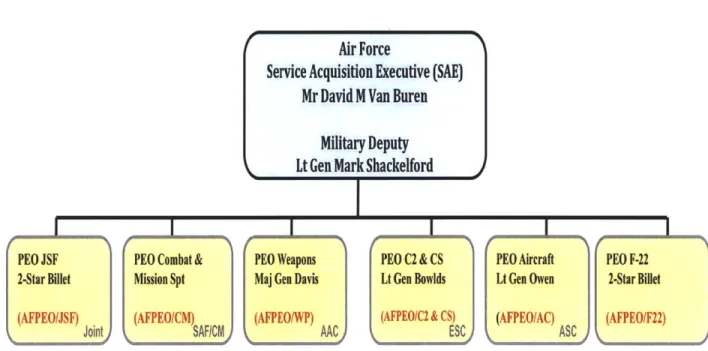
To give PEOs more flexibility; the Air Force modified its structure in summer
2010. The previous PEO structure had only 6 PEOs (See Figure 3.1). This hampered the
PEO's program execution, ability because he/she could not devote enough time to the weapon programs in their portfolio.
The current PEO structure has 20 PEOs with far less programs in each PEO (See Fig 3.2)
Figure 3.2 Current PEO Structure (Source: SAF/AQ)
As stated in Chapter 2, the PMT we are utilizing is based on Cooper et al(Copper, 2001). In chapter 3 will try and decipher if portfolio management is occurring at the PEO and at the PM organizational level. We will fist conduct a stakeholder analysis to determine the key players with respect to portfolio management and the PEO. Second we will look at the monetary flow and personnel allocation. Third, we look at the As-Is state and model a future state with respect to portfolio management process. Finally we synthesize the information we received from our interviews.
3.1 Stakeholders
Stakeholders are very important because in effect they are critical the PEOs/PMs execution of the portfolio and their ability to use portfolio management theory correctly. There are a myriad of definitions of a stakeholder offered by academia and industry. Freeman et al (1984) define a stakeholder "any group our individual who can affect or is affected by the achievement of the organization's objectives" Another definition comes from Murman et al (2002). Here stakeholder potential saliency must meet three criteria:
(1) the extent to which they contribute valuable resources to the enterprise; (2) the extent
to which they put these resources at risk and would realize costs were the enterprise to fail or their relationship with the enterprise to terminate; (3) the power they have over the enterprise. If a stakeholder meets all three criteria the stakeholder is deemed definitive. Finally, the Air Force definition of a stakeholder as it is stipulated in AFI 63-101 (Appendix C) is "an individual or organizational entities (users, developers, acquirers, technologists, testers, budgeters, sustainers, and industry) that are, or will be, associated with implementing and supporting the associated subsystem, or end-item capability requirements." Without exaggeration the acquisition system an enterprise can literally have hundreds of stakeholders such as Congress, OMB, OSD, SAF/AQ, SF/FM,
MAJCOM with each of these agencies having smaller agencies within claiming some sort
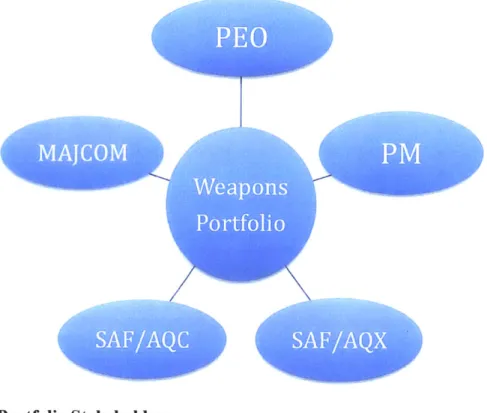
authority with little accountability. In order to give brevity and clarity we narrow down our stakeholders to the ones that most directly affect the PEO's portfolio, which in figure below is deemed the enterprise. Figure 3.3 shows the Enterprise stakeholders.
Figure 3.3 Portfolio Stakeholders
The simplified stakeholder model is sufficient to examine the functionality of PMT at the tactical level. Let us further define this figure and these stakeholders in order to be comprehensive:
Weapons Portfolio: A collections of programs however what we do want to point out is a portfolio may have programs which are in full scale production some that are early stages of research, development, test and evaluation. This is important because these different phases of the program use different type of funding which is significant in Air Force portfolio management.
The MAJCOMs in this case is the user or customer. The system is developed for their operational use. The PEO and PM should have close work relationship with the user to ensure requirements are stable or discuss a significant change. (Appendix B &C)
The PEO, as defined by AFI 63-101, is the individual dedicated to executive management and supervision of a portfolio of mission-related ACAT and selected programs. The PEO shall be chartered by and is accountable to Service Acquisition Executive (SAE). (See Appendix B)
The PM (also referred to as the SPM in this case), as defined by AFI 63-10 1, is the Air Force designated individual with responsibility for and authority to accomplish system objectives for development, production, and sustainment to meet the users' operational needs. For systems in acquisition, the PM/SPM is accountable for credible cost, schedule, performance, and materiel readiness to the MDA. ACAT I, ACAT IA, and ACAT II PMs/SPMs will be chartered by the SAE and the PEO. (See Appendix C for detailed definitions)
SAF/AQX chief role that affects PEO portfolio management operations is its
authority to issue Program Authorizations documents, execution-year adjustments to program funding, to include release/withhold of funds, below threshold reprogramming
actions, and subprogram level of funding realignments. (Appendix B)
SAF/AQC as spelled out in AFI 63-101, is responsible to exercise and further delegate
respect to contracts and agreements (grants, cooperative agreements, and other transactions), and (2) the authority to issue, modify, or rescind Air Force contracting regulations under the system of the Federal Acquisition Regulations (FAR). SAF/AQC also has the responsibility of allocating and transferring contraction personnel to System Program Office. (Appendix B).
To summarize, the PEO with a tremendous amount of help from the PM/SPMs, is responsible to the customer (MAJCOM) and SAE to execute and deliver weapon systems to satisfy a national security requirement/mission. The PEO is given the authority to execute by said SAE via the PMT. The other major requirement a PEO will need to exercise good portfolio management performance is authority in the way of controlling and allocating resources. The chief resources we speak of are funding and personnel. The SAE has delegated authority of funding to SAF/AQX and major personnel authority to SAF/AQC. Hence we see PEO is accountable but does not have full authority. This is a critical theme and one we will revisit in later chapters.
3.2 Budgetary Flow
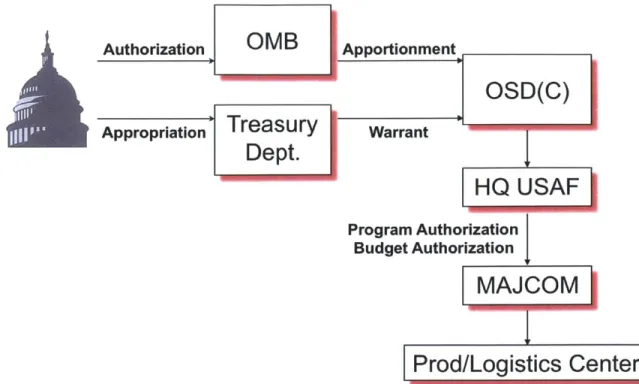
Continuing with the resources theme; we must examine the process of monetary resource. This is the lifeblood of acquisition programs because whoever controls the money wields enormous influence and authority. The distribution process and stakeholders are depicted in Figure 3.4.
Authorization Appropriation Warrant
HQ USAF
Program Authorization Budget Authorization IMAJCOM
Figure 3.4 Budget Process Flow (Source - SAF/USAM)
In Figure 3.4 flow starts with Congress, then to OMB, to the Treasury Department, next to DoD, followed by the Air Force and then to the Air Force Agencies SAF/FM, SAF/AQ etc. Figure 3.4 provides a high-level budget process however I think it is important we go over the budget flow comprehensively. After painstaking debate and much haggling and deal making, Congress will pass authorization and appropriation bills for the defense discretionary spending in the upcoming fiscal year. The appropriation bills give the authority for funds to be drawn from the U.S. Treasury Department. The Treasury Department establishes the amount of cash that is available using official documents called warrants. The warrants are sent to OMB who reviews the warrants for accuracy and completeness. OMB then issues apportionment documents, which specifies the amount of funds each agency (see Fig.2.2 in Chapter 2) may use by time period, program or activity. When DoD receives their budget authority via OMB, they delegate the OSD
Comptroller to review the documentation sends the respective services agencies their fiscal year budget. The Air Force budget is sent to SAF/FM, who is essentially the comptroller for the Air Force, where program authorizations and budget authorization documents are prepared. SAF/FM will send funds to the MAJCOM and other Air Force agencies in the following categories: 1) Operations and Maintenance, 2) Military
Personnel, 3) Procurement, 4) RDT&E, 5) Military Construction, and 6) Family Housing. The functional manager for RDT&E and Procurement budgets is delegated to SAF/AQ.
SAF/AQ delegates the distribution of funding to the acquisition programs to SAF/AQX
who transfers the money AFMC and its various product and logistics centers: AAC,
ASC, ESC, SMC, WR-ALC, Hill ALC and Tinker ALC. At the centers, the respective
FM branches transfers the money to proper weapons acquisition program.
Note, of the stakeholders identified in section 3.1 only SAF/AQX and the
MAJCOMs are part of the funding distribution process. However what is glaring obvious is the PEO is not involved. Which means they would have to ask permission to move money around inside of their portfolio. This seems to go against the overriding tenet and definition of PMT and counterproductive to efficient portfolio management.
3.3 Portfolio Management: Current View
As was stated before, portfolio management is exercised at various levels in DoD and the Air Force. We are chiefly concerned with the portfolio management and that the tactical level. Hence, we must examine how portfolio management is accomplished at that level or very close to it. Since the PEO and the PM as the chief portfolio managers use their two chief resources, personnel and money, to execute their portfolios and programs. Of the two, money is the key constraint so it is watched closely thru the obligation and expenditure reviews. The PEO tracks obligations and expenditures thru their monthly reviews and submits the results in the MAR to SAF/AQ. These monthly reviews focus on the identification of monetary issues and providing quick corrective action. Potential issues are classified as a shortfall of funding or excessive funding at a particular time. It should be clearly noted here that if these issues are current and the PEO wants to move money then she has to ask permission from SAF/AQ. SAF/AQ delegates the authority of this function to SAF/AQX. This process does not have a set time because every request is different. However, suffice to say it is not a deliberate or quick process and the leaders at the SAF/AQ level have different monetary priorities than the PEO.
Nevertheless, the next step in the current process is the Spring Program Review (SPR) and the Investment Budget Review (IBR). These reviews address the cost,
schedule and current issues of the Air Force portfolio. Here PMs deliver presentations on the current health of their programs and discuss issues they may need SAF/AQ to help them overcome. The other goal of these reviews, which occur during the April-May timeframes every year, is to find sources of funding to reprogram into other Air Force
programs and priorities. Coincidently the OSD Comptroller is concurrently their mid-year review of the entire DoD fiscal mid-year budget.
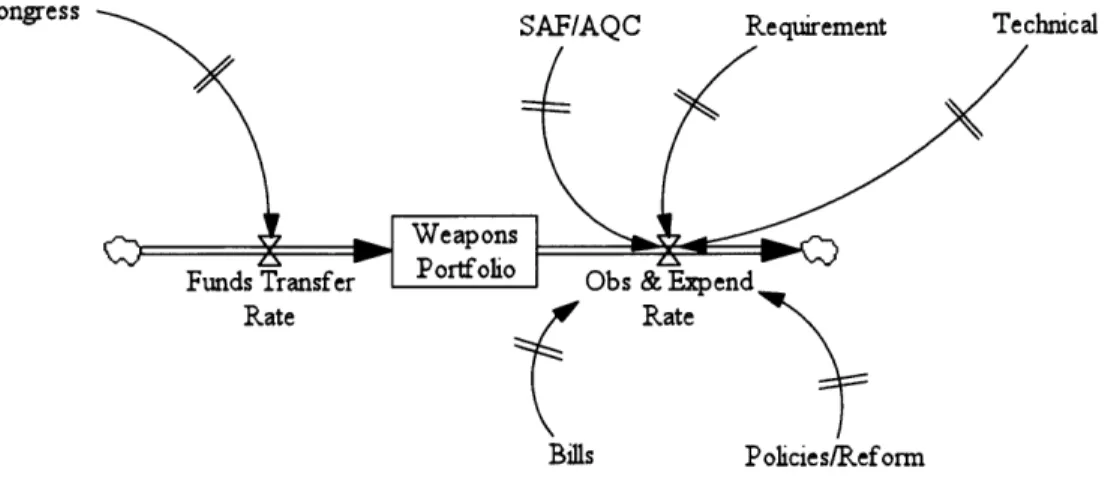
In this current scenario if a PEO wanted to move some funds into another program in their portfolio, which is what we have referred to above as reprogramming, they would have to convince and get permission from SAF/AQX to do so. Then they would have to negotiate with their contracting officer, who must get permission thru their channels (sometimes all the way up to SAF/AQC) to put the money on a contracting vehicle. If this process seems tedious, complex and time-consuming.. .well it is. There isn't a set standard time to muddle through this process but the results of interviews puts the time from weeks to as long as 2 months. Figure 3.5 and 3.6 shows the weapons portfolio process using casual loop diagram technique of systems dynamics.
Congress SAF/AQC Requirement Technical
Weaponslt ,.
Funds Transfer Prflo Obs & Expend
Rate Rate
Bills Policies/Reform
Figure 3.5 Weapons Portfolio Funding Process
Figure 3.5 uses system dynamics to illustrate the weapons portfolio dynamic with respect to funding. If the system is in equilibrium then the "Funds Transfer Rate" would equal the "Obs & Expend Rate" which means all the money given to the portfolio is spend by
the portfolio. However, this rarely happens and the reasons are shown in the model. First the money rarely gets to the program on time. Programs are usually operating under a continuing resolution authority, CRA (CRA gives the programs a percentage of
previous year's funding to carry out minimum operations until the President's Budget is signed) well into January or February of that fiscal year. The fiscal year is 12 months, starting on 1 October of the previous year and ending 30 September of the current year i.e fiscal year 2011 begins 1 Oct 2010 and ends 30 September 2011.
The variable "Congress" with the double dash on the loop depicts a delay of funding to the portfolio. Once the money does get to the programs there are a myriad of reasons why the funds may not get obligated and expended in that fiscal year. In the model the
reasons could be 1) SAF/AQC, which represents contracting, may have difficulty putting the money and the correct contract vehicle or the process may take too long and then the funds or in jeopardy to expire so they are taken away; 2) Requirements may change so this may involve new negotiations and reworking of the verbiage of the contract; 3) The defense contractor may run into a technical obstacle stalling the next step, which the current funds are designated; 4) Many times the DoD will have a higher priority project that must be funded so funds are cut from programs. An example would be the funding of the GWOT. 5) New policies or acquisition reforms may come down which may interrupt the process depending how fast they must be enacted; WSARA and Gates Memo are examples. These are just a few reasons that a particular program in a portfolio may not be able to use their funds or just lose their funds all together.
So when a program cannot use their funds and the PEO wants to use these funds for another program they have to go through a process that may be lengthy. Figure 3.6 illustrates the process.
Contracting Disapproval PRO Funds Request Approval Authority
Figure 3.6 Fund Transfer Request Process
If a PEO wants to move funds from one of his or her programs to another
(assuming same type of funds) then the PEO first must get approval for SAF/AQ and this function has been delegated to SAF/AQX. This process is fraught with delays and can be very time consuming. Firs the PEO may have to vet this with his center commander. Once that is complete it is sent to SAF/AQX for approval or disapproval. This process may take weeks or months because many senior level staffers may have to give it their blessing. If it is approved it will have to be put on contract by the PEO or program PCO
which entails another delay. Please keep in mind that time is a major factor and most programs do not receive funds until late winter or early spring and must have most of their funds obligated by the June timeframe. This knowledge, and the fact most requests are denied, deters the PEO from making these requests frequently although these requests seem to be a wise business decisions. The process depicted in figure 3.7 is the one the Air Force has been using for the last 25 years.
SPR
Reprogramming
Figure 3.7 Current Funds Transfer Process
In system Dynamics the Air Force weapons acquisition fund transfer process would be defined as a positive or self-reinforcing loop. The R with the clockwise circle depicts this casual loop diagrams as reinforcing. Positive loops tend to reinforce or amplify whatever is happening in the system (Sterman, 2000). Hence, programs and portfolios get funds late in the fiscal in the year, the complexity of the acquisition process and nature of the systems drives delays and makes it difficult to spend money as
forecasts, so these funds are taken away and put to use on some other Air Force program or priority. This ultimately leads to schedule delays, which leads to cost overruns.
3.4 Portfolio Management: Future View
Dealing with complexity is an inefficient and unnecessary waste of time, attention and mental energy. There is never any justification for things being complex when they could
be simple. Edward de Bono
The acquisition system is as complex a system as there is and simplifying it, over the last 40 years, has proven to be very difficult. However, in the world of tactical portfolio management, it is not so difficult. Murman et al (2002) identify one of the seven wastes as "waiting time." The current process imposes a significant waiting time that hampers a PEO's ability to execute and reprogram funds within her portfolio. So how can we eliminate this waste? By delegating or giving the PEO the authority to move like funds within her portfolio. Now that we have reduced waiting time then the funds can be put on contract faster and ensure operations are not discontinued. This ultimately will lead to increased on-time delivery. Figure 3.8 illustrates this process.
Reprogrammiing
Figure 3.8 Proposed Funds Transfer Process
The new process does not eliminate the current process but gives it more
flexibility and robustness. This system will require senior leaders at SAF/AQ to apply a different mental model with respect to decision-making, delegation of authority and trust in their PEOs. The PEOs will now have to return this trust by ensuring they make good decisions based on empirical facts, risk assessment and technological maturity. As stated earlier acquisition is not a science but an art. There are many facets to consider and there will be unforeseen errors even after comprehensive examination of facts and all the evidence. Many decisions will be subjective and the SAF/AQ leadership must not return to the old way of business because a PEO makes a mistake. This will only prove to make PEOs hesitant and overly cautious, which leads to decisions made for the wrong reasons.