Practicing Oblivious Access on Cloud Storage: the Gap,
the Fallacy, and the New Way Forward
Vincent Bindschaedler
1, Muhammad Naveed
1, Xiaorui Pan
2, XiaoFeng Wang
2, and Yan Huang
21University of Illinois at Urbana-Champaign {bindsch2,naveed2}@illinois.edu
2Indiana University, Bloomington {xiaopan,xw7,yh33}@indiana.edu
www.oblivious-storage.com
ABSTRACT
To understand the gap between theory and practice for obliv-ious cloud storage, we experimentally evaluate four repre-sentative Oblivious RAM (ORAM) designs on Amazon S3. We replay realistic application traces to these ORAMs in order to understand whether they can meet the demands of various real applications using cloud storage as a backend. We find that metrics traditionally used in the ORAM litera-ture, e.g., bandwidth overhead, fail to capture the practical needs of those applications. With a new understanding of the desirable properties, relevant metrics, and observations about the cloud services and their applications, we propose CURIOUS, a new modular partition-based ORAM frame-work, and show experimentally that it is thus far the most promising approach.
Categories and Subject Descriptors
K.6.5 [Management of Computing and Information Systems]: Security and Protection
General Terms
Security, Measurement, Experimentation, Performance, Al-gorithms
Keywords
Oblivious Cloud Storage; Oblivious RAM; ORAM; Access Pattern
1.
INTRODUCTION
Oblivious Random Access Memory (ORAM) is a secu-rity mechanism to hide data access patterns. This concept was proposed decades ago, for the purpose of hiding the way a program accesses memory to defend against software reverse-engineering [5]. Recently, the growing popularity of
Permission to make digital or hard copies of all or part of this work for personal or classroom use is granted without fee provided that copies are not made or distributed for profit or commercial advantage and that copies bear this notice and the full citation on the first page. Copyrights for components of this work owned by others than the author(s) must be honored. Abstracting with credit is permitted. To copy otherwise, or republish, to post on servers or to redistribute to lists, requires prior specific permission and/or a fee. Request permissions from [email protected].
CCS’15,October 12–16, 2015, Denver, Colorado, USA.
Copyright is held by the owner/author(s). Publication rights licensed to ACM. ACM 978-1-4503-3832-5/15/10 ...$15.00.
DOI: http://dx.doi.org/10.1145/2810103.2813649.
cloud computing has reinvigorated the research on the idea, which can potentially be applied to secure online storage sys-tems that are increasingly being used to host personal or or-ganizational data of critical importance (e.g., financial docu-ments, health-care data, location information, etc.). Privacy concerns for those systems come not only from explicit data exposure, which could be addressed through encryption, but from possible side-channel leaks in which an unauthorized party (including the cloud provider) infers sensitive infor-mation from the pattern in which data is accessed. To miti-gate this threat, numerous ORAM algorithms [16,9,25,24, 22] have been proposed, particularly to make this oblivious access technique more applicable to the cloud.
Rethinking ORAM on the cloud. Despite significant progress made on ORAM designs, when it comes to the cloud application, it is still unclear whether this theoretic concept is indeed moving towards the practical end. A fundamen-tal question one may ask is: Whether the security model and performance metrics of today’s ORAM designs are in line with the constraints and demands of real-world cloud services and applications? As mentioned earlier, the con-cept of ORAM originates from memory protection, which does not take into account unique properties of the modern cloud. Examples include its elastic resource allocation and asynchronously running applications, which all affect the se-curity assurance by the ORAM primitive (Section4.2, [20], and [13]). On the performance front, conventional ORAM algorithms seek to minimize the client-side storage (e.g., log-arithmic of the outsourced storage, or even constant [19]), and the data-access bandwidth. This is increasingly out of the touch with the reality of modern computing. Indeed, storage has become increasingly cheaper, and even a smart-phone today can easily afford gigabytes of space for sup-porting security-critical services. It is conceivable that an (otherwise-preferable) ORAM scheme requiring linear local storage works well in practice, as long as theoutsourcing ra-tio is reasonably high (e.g., 1 TB on the cloud vs. 1 GB on a mobile device). Given such misalignments, together with the technical challenges in making ORAM efficient, we may further ask: How close the current ORAM techniques are to offering any practical support for cloud applications? Are we on the right track to narrow this gap?
These questions can only be answered by a systematic study of the operations of state-of-the-art ORAM schemes over real-world cloud storage systems. This is a challenging
task. First, most existing ORAM approaches do not have prototypes suitable for running on the cloud. Realizing the-oretical ORAM constructions on existing cloud storage plat-form requires additional careful examination and engineer-ing efforts. Take Path ORAM [22] as an example to see the gap, although the full protocol can be described by merely 16 pseudo instructions, a single instruction that reads data blocks from a path needs tens of lines of Java code for care-fully issuing asynchronous requests to the cloud. Second, running a real cloud application on top of ORAM in prac-tice requires changes to all its storage access instructions (see Section3.1), which is complicated due to the mismatch in the storage API designs and the low availability of the source code of existing ORAM implementations. Actually, never before has any ORAM implementation been tested on a commercial cloud storage system, not to mention any attempt to understand its effectiveness in supporting real-world cloud applications.
Understanding the gap. Understanding the gap between the idea of ORAM andtoday’s cloud realityis the only way to keep the research on the right track. Since it is un-likely that the cloud architecture, implementation and busi-ness model will be changed to suit the ORAM designs, we argue it is important to adjust ORAM designs to better fit it with the cloud. To this end, we built cloud-capable versions of four most representative ORAM algorithms, in-cluding a layered ORAM [7], a tree-based ORAM (PathO-RAM [22]), a partition-based ORAM (ObliviStore [20]) and a large-message ORAM [8]1. These implementations were
evaluated against realistic cloud applications and workloads using a unique methodology. More specifically, we connected Filebench [18], a popular storage benchmark, to Amazon S3, and ran the tool to produce a large amount of diverse storage-access workloads. Such workloads realistically de-scribe the real-world operations of a variety of cloud-related services and applications, e.g., web servers, file servers, etc. Their traffic traces were captured on the cloud end and then replayed to our ORAM implementations, which were also connected to S3.
We found that today’s ORAM designs are still far from practical deployment. For example, for some task, even the most efficient design, ObliviStore, took 181 seconds to han-dle what was accomplished within 38.5 seconds in the ab-sence of the ORAM, generating more than 17 times of ad-ditional traffic and costing its user 68 times more in terms of monetary expense. For the most optimistic task they could handle, other approaches incurred between 3.3 and 32.8 times of performance slowdown and between 53 and 795 times extra fees for renting the Amazon service. Most im-portantly, our research brought to light significant and sur-prising misalignments between the metrics used to evaluate an ORAM scheme and those to evaluate a cloud application. Traditional metrics for evaluating ORAM (e.g., bandwidth) do not fully reflect its ability to support cloud applications. The mismatch can be explained with several overlooked fea-tures of cloud services and overlooked application require-ments. For instance, compare uploading with downloading the same amount of data, uploading is much slower (1.5 to 1.8 times for S3) than downloading; and it also costs more
1
These systems were all developed by strictly following their pub-licly available descriptions and leveraging existing code when possible (Section3.2).
money (12.5 times for S3). In addition, data access pat-terns can also affect the performance and monetary cost in substantial ways. Missing these points, as do all existing approaches, a conventionally appealing ORAM construction may turn out to be unusable in cloud environment. Further, many ORAM designs (e.g., layered and tree-based family of ORAMs) assumes a sequential requests model, which makes them ill-suited for a majority of modern cloud applications that would be unusable without concurrent data access (Sec-tion4.2). Additionally, we found that some applications can-not be supported by synchronous ORAM schemes (existing or future), because they also need to manipulate variable-size objects (recall all existing ORAMs assume fixed-variable-size blocks). Last, the eviction process of many popular ORAMs are incompatible with some applications such as back-up ser-vices because certain fresh data is cached on the client side and if the client crashes, it gets lost.
Although some of these missing design metrics have been mentioned by some prior studies (such as elasticity in [13] and asynchronicity in [20]), our research shows that adding them to the ORAM design is more difficult than thought: for example, asynchronous operations have not been done right in any existing implementation. We found the pro-totype of ObliviStore leaking information in the presence of multiple requests for the same data block (Section4.2). Fur-ther, these properties do not appear to be the primary focus of the mainstream ORAM research. After inspecting 39 re-search papers on this subject and the citations they receive (Section5.2), we found that most recent work continues to focus on the constructions that are less likely to support cloud applications. This finding suggests that the research in this area could actually be moving away from one of its major objectives, i.e., cloud storage protection.
Seeking new solutions. Based upon the understanding, we identified a new set of metrics for evaluating ORAM designs, focusing more on latency, monetary expense, out-sourcing ratio, elasticity and reliability. Among all exist-ing designs, ObliviStore, which is built on partitionexist-ing the main ORAM into a set of smaller server-side ORAMs, turns out to be the most promising one. However, we found that in addition to its privacy weakness in its implementation, the construction is overly complicated due to some of its specific performance optimization (e.g., background shuf-fling). In our research, we come up with a new ORAM design, called CURIOUS (Cloud Framework for Oblivious Storage). CURIOUS is characterized by a set of fixed-size small ORAMs, offering a large constant outsourcing ratio, convenience for supporting asynchronous operations and the capability to expand and shrink its cloud-side storage. It has been carefully built to ensure oblivious data access when serving multiple requests concurrently, and adopt a sim-pler eviction strategy, making it easier to implement. Also importantly, unlike ObliviStore, which is tied to a layered ORAM scheme [20, 21], CURIOUS allows its underlying small, fixed-size ORAMs to be easily replaced. As a result, its performance will be continuously improved whenever a new design of such a building-block ORAM is available. For applications easily supported by ORAM, both ObliviStore and CURIOUS perform comparably. However, for demand-ing applications that stressed ORAM, CURIOUS signifi-cantly outperforms ObliviStore in response time (only its 25%), despite doubling the network traffic. In all cases, CU-RIOUS incurred lower monetary expense than (1/2∼2/3
of) ObliviStore. Our design serves as a starting point for further efforts to bring ORAM closer to its deployment for cloud storage.
Contributions. Our contributions include:
•New understanding. We made the first attempt to evaluate mainstream ORAM designs on the real-world cloud storage and applications. Our study reveals not only the perfor-mance gap between the state-of-the-art of ORAM research and the cloud reality, but also some fundamental design re-quirements missing in today’s ORAM constructions. Such miscalibrations risk moving the area further away from prac-tice, as suggested by the trend of the proposed new construc-tions (Section5.2). Better understanding of what needs to be done and what should be avoided is critical for putting the research back on the right track.
• New technique. We developed CURIOUS, a
modular-ized framework for supporting oblivious storage access on the cloud. Compared with prior approaches, CURIOUS is a step closer to supporting real-world applications with oblivious cloud storage. To encourage further research, we make the code of the CURIOUS framework available at
http://oblivious-storage.com.
2.
BACKGROUND AND PRELIMINARIES
2.1
Cloud Storage
A prominent example of online cloud storage is Amazon Simple Storage Service (S3). S3 allows customers to organize their data intobuckets, each of which has a separate name space, holding a large number of objects such as files. An S3 user can perform five bucket operations through the Ama-zon APIs, includinggetorputthat downloads and uploads objects respectively, and list, copy, or delete that per-forms the functionalities of the UNIX commandsls,cpand
rmrespectively. The service provider (Amazon) determines the user’s bill based on the number and type of operations she performed (e.g., 0.004 USD per 10K gets, 0.005 USD per 1000 puts, lists, andcopys), the amount of network traffic (e.g., 0.09 USD per GB for up to 10 TB/month), and the storage used (e.g., 0.03 USD per GB for the first 1 TB/month). Other popular cloud storage systems, like Google Cloud, all have similar APIs and pricing structures. Throughout the paper, we consider a typical way of us-ing the cloud storage system: an application runnus-ing on the client device (e.g., the user’s in-house server, desktop, smartphone, etc.) integrates thestorage interface (i.e., the aforementioned APIs) and utilizes the interface to operate on its cloud-side data. For example, a mobile app could use the interface to upload the user’s pictures onto the cloud. Note that we do not consider the setting where both the application and its storage sit on the same cloud, as used in the prior research [10].
2.2
Oblivious RAM
An Oblivious RAM scheme is a trusted mechanism on a client, which helps an application or the user access the un-trusted cloud storage. For each read or write operation the user wants to perform on her cloud-side data, the mecha-nism converts it into a sequence of operations executed by the storage server. The design of the ORAM ensures that for any two sequences of requests (of the same length), the dis-tributions of the resulting sequences of operations are
indis-tinguishable to the cloud storage. Existing ORAM schemes typically fall into one of the following categories: (1) lay-ered (also called hierarchical) [5,25], (2) partition-based [20], (3) tree-based [19,22,2,23,11,17]; and (4) large-message ORAMs [1,8,15].
In this paper, we consider ablockto be the unit of ORAM data that is uniquely identified by itskey (i.e., a block iden-tifier). To access a block with keyx, an application sends a request to the ORAM mechanism running on the client side. The ORAM client then performs the operations through is-suing a sequence of cloud storage instructions.
Representative schemes. A layered ORAM organizesn
data blocks on the storage into a hierarchical structure with logn+ 1 levels. Each level consists of a hash table, whose size increases exponentially: the size of the table on layeri
doubles that on layeri−1. Typically, Cuckoo hashing [16, 9] is used to realize the hash tables. To access blockx, the ORAM client proceeds layer by layer (from the lowest layer upwards) reading all blocks using the hashes ofxas indices (except for layers after x is found, where random dummy blocks will be retrieved). Once the query is done, block x
is stored back into the hierarchy (in the lowest layer with an empty entry). Periodically, all blocks in layers below and including layeriwill be reshuffled and pushed into layeri+1. A tree-based ORAM organizes the external storage as a tree where each tree node holds a few blocks. To serve a request to access x, the ORAM client looks up a position map that links a block to a tree leaf. From the leaf, all blocks on the path to the root is then retrieved to find the block x. An eviction procedure follows that aims to save
xsomewhere back in the tree. A representative tree-based ORAM is PathORAM [22].
A partition-based ORAM divides its external storage into
m partitions, each managed separately. The client main-tains a position map to keep track of each block’s partition, and an eviction cache to hold the block downloaded from the storage for a random amount of time, before re-writing it back to a random partition. So far, only two (very simi-lar) partition-based schemes have been proposed, which are all based upon simplified layered ORAM (without Cuckoo tables). A prominent example is ObliviStore [20].
A large-message scheme [8,1,15] maintains a cache on the client side. The ORAM simply reads from the cache when the requested block is there, or fetches it from the external storage and then puts the block in the cache afterwards. Once the cache is full, the entire external storage has to be rebuilt through an oblivious sorting algorithm.
We do not consider schemes which require server compu-tation such as [24,3,11,4,14], since they are not supported in our setting.
3.
ANALYSIS OF ORAM ON THE CLOUD
3.1
Methodology
At a high level, our methodology is to run a set of popu-lar applications that utilize cloud storage (e.g., web servers, email servers, web proxies, etc.) on the client system (in-house server, workstation, mobile devices etc.), under re-alistic workloads, to access their cloud-side data through an ORAM client. The idea is to understand how the op-erations for achieving obliviousness affect the performance of the application, whether such impacts are in line with
what is predicted by existing metrics, and also what privacy implications the ORAM design could have in a real cloud-computing environment. It is important to note that we do not consider the scenarios where cloud-side supports are pro-vided to facilitate ORAM operations, as assumed in some prior research [11, 24], since it is less clear whether cloud service providers are willing to change their service model to support ORAMs and even if so, how they are going to do that. Without support from actual providers, it is hard to conduct a preliminary study in that direction.
When it comes to the details, two issues must be addressed to make the methodology work: we need to select from tens of ORAM designs the most representative and promising ones for evaluation, and also find a way to incorporate them into the applications using cloud storages.
Choosing ORAM representatives. As mentioned ear-lier, mainstream ORAM designs can be roughly classified into four categories: layered ORAMs, tree-based ORAMs, partition-based ORAMs, and large-message ORAMs. We selected a representative from each category. Specifically, for layered ORAMs, we picked the asymptotically most effi-cient de-amortized worst-case layered scheme [7] (which we callLayeredORAM) that utilizes Cuckoo hashing and Ran-domized Shell Sort. For tree-based approaches, we chose PathORAM [22], a construction known for its efficiency and simplicity. There are only two partition-based designs and ObliviStore [20] is the one that was evaluated on Amazon EC2 (not S3) and achieved a high throughput. In the large-message ORAM category, we selectedPracticalOS [8], due to its improved performance over previous schemes in the same category such as [1]. None of these have prototypes suitable for running on cloud storage, so we implemented them (Section3.2).
We did our best to select the most representative ORAM schemes, typically the most efficient ones (asymptotically) in their respective categories. We believe the results of our study at least offer new insights about how the state-of-the-art ORAMs could work in a real-world cloud storage system. We emphasize that our goal is to understand the gap between current designs and what cloud applications require; not merely identify the best ORAM scheme.
Evaluating ORAM supports for cloud apps. To un-derstand how well these ORAM designs are up to the task of supporting cloud applications, we need to evaluate ap-plications on top of the ORAM implementations. As dis-cussed earlier, this is nontrivial due to the challenges in in-tegrating ORAM interfaces into those applications and fur-ther generating realistic workloads during their runtime. In our research, we adopted a unique approach, which recorded the communication traces between an application workload generator and its cloud-side storage, and then replayed the traces to our ORAM implementations.
Specifically, we used Filebench [18, 12], a popular per-formance benchmark capable of emulating the workloads of many complex applications (e.g., mail, web, file and database servers), as the workload generator. In our research, we mounted an S3 folder (i.e., a bucket) to a client system us-ing S3FS and ran Filebench over this folder. After executus-ing a task, e.g., simulating a web server’s workload for ten min-utes, we retrieved from S3 a server access log file recording request details (including the type of operations (get,put, etc.), the arrival time of each request, the number of bytes
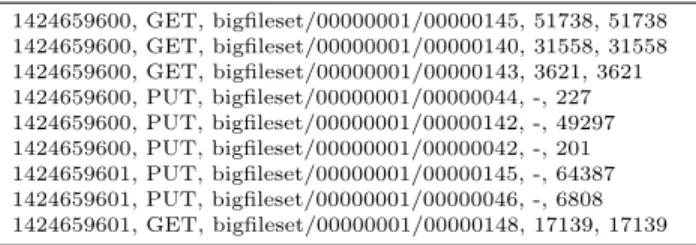
1424659600, GET, bigfileset/00000001/00000145, 51738, 51738 1424659600, GET, bigfileset/00000001/00000140, 31558, 31558 1424659600, GET, bigfileset/00000001/00000143, 3621, 3621 1424659600, PUT, bigfileset/00000001/00000044, -, 227 1424659600, PUT, bigfileset/00000001/00000142, -, 49297 1424659600, PUT, bigfileset/00000001/00000042, -, 201 1424659601, PUT, bigfileset/00000001/00000145, -, 64387 1424659601, PUT, bigfileset/00000001/00000046, -, 6808 1424659601, GET, bigfileset/00000001/00000148, 17139, 17139
Figure 1: Excerpt trace of the varmail filebench application. It con-tains the following fields (in order): timestamp (UNIX format), type of request, name of object/file requested, number of bytes read (if
get), total size (in bytes) of the object/file.
delivered etc.) Amazon received. An example trace is illus-trated in Figure1.
To evaluate an ORAM, we then replayed the traces to the ORAM client that communicated across the Internet with S3. The ORAM client kept track of the response time for each request (which may contain multiple round-trips between the client and S3), the amount of data exchanged, monetary cost, and other performance data. We further compared these measurements with a baseline client that did not use ORAM (nor providing access pattern privacy).
Adversary model. We make the standard assumptions made by other ORAM research: the cloud is an honest-but-curious party; but, the client is trusted.
3.2
Optimistic Implementation
Surprisingly, we found that building those ORAM ap-proaches was complicated by the lack of design details — the papers [7,20,21] did not describe many important de-sign details for developing working systems. To fill up the gap, we contacted the authors and acquired the prototypes of ObliviStore and PathORAM, which we modified to make them work on a cloud storage system. However, since the implementation of LayeredORAM and PracticalOS was not available, we adopted an “optimistic” way to implement their schemes. PracticalOS could be implemented fully from the description. However, for LayeredORAM, we just built the parts explicated by the paper and simplified the components whose details are missing there (see below), so it did not fully function as an ORAM, yet in terms of performance, it should outperform the fully implemented version, as only part of the overall overhead is actually measured.
LayeredORAM [7]. The paper of LayeredORAM is quite detailed about the way the worst case performance is achieved and the ideas behind de-amortizing the scheme. This en-abled a faithful implementation in our cloud storage exper-iments. However, when it comes to the concurrent Cuckoo table rebuilding, which includes concurrent reshuffling and the concurrent oblivious Cuckoo hash tables construction, we found that these details were missing. Specifically, it gave reference pointers on randomized Shell-sort [6] and the obliv-ious hash table rebuilding, but did not explain how those operations can be concurrently spread out over multiple re-quests (which is needed for de-amortization). The paper only specifies that 2baccesses have to be made “towards a re-build” (of each layer’s Cuckoo table) for someb >0, without specifying what those accesses are. As a result, we could only construct a component that “emulated” what was expected to be done. More specifically, we performed 2bdummy ac-cesses, i.e., b(concurrent) gets followed by b (concurrent)
puts. Because we optimistically set b = 1, our implemen-tation can only lead to underestimation of their scheme’s cost. Also, the paper does not give concrete values for some critical parameters, including epoch sizeq=O(logn), and stash size 2slogn for somes > 1. Optimistically, we set
q= log2n, ands= 2.
PathORAM [22]. Conceptually, PathORAM is rather simple; it can be described by merely 16 lines of pseudo-code. The implementation, however, is more complicated. Even with the prototype we obtained, we still made signif-icant efforts to make it work with S3. As an example, in the PathORAM paper [22], retrieving a path was described in a single line of code. When performing this operation, however, the ORAM client first needs to calculate the path locally upon the data structure describing the tree, then schedule the queries (for different blocks on the paths on the S3) asynchronously and wait for their completion. In the end, the prototype we used for our study includes over 1000 lines of code. Based on the most optimistic parame-ter setting in the original paper [22, Table 3], we chose the number of blocks per tree-nodez= 4 and stash sizes= 89.
ObliviStore [20]. Among all the schemes we tested, Oblivi-Store is the most complex one. The complexity stems from its attempts to support asynchronous request processing and backgrounded shuffling and eviction. This calls for sub-tle synchronization to avoid messing up the system’s states (e.g., the shuffling should not be executed before all the blocks have been read). Unfortunately, such critical details on how to concurrently perform those operations efficiently and securely was missing in the paper. The prototype pro-vided by the authors utilizes two semaphores to keep some level of synchronization between shuffling, requests process-ing, and local memory operation. It runs a single thread to sequentially schedule these tasks: each request or back-ground shuffling task is put in a single queue and executed one by one; this ensures that there are no concurrent modifi-cations of the local state that would result in inconsistency. Note that the tasks being scheduled can still run concur-rently, in the sense that the system does not need to wait for the completion of one task before invoking another. The complexity in asynchronous and concurrent processing ac-tually makes it more difficult to achieve obliviousness, as we discuss in Section4.2.
The original prototype of ObliviStore was in C#, while PathORAM and other ORAM prototypes were built in Java. To compare these systems in the same environment (which was convenient for the experiment setting and data collec-tion), we re-implemented ObliviStore in Java by strictly fol-lowing the code provided by the authors, and just adding the functionalities to interact with S3. Note that the per-formance impact of the programming languages is minimum here, because all the delays we observed in our study were predominantly caused by communication and cloud-side op-erations. More specifically, we observed that the client-side processing (e.g., scheduling a request) is on the order of 1ms or less, whereas the processing time of those requests, i.e., interaction with S3, is on the order of 100ms or more.
PracticalOS [8]. We fully implemented PracticalOS. The only issue we encountered was that the authors made as-sumptions about a few cloud APIs that S3 and other cloud-storage services (like Google) do not actually provide. For example, getRange was assumed in the original design to
retrieve a set of blocks with consecutive keys in one single operation. To address this inconsistency, we had to uti-lize the existing storage interfaces to “emulate” those APIs. Specifically,getRangewas realized withlistand a number ofget operations performed in parallel, as suggested in [8, Section 7]. We further enabled sending requests to the cloud storage asynchronously, for bothgetanddeleteoperations. However, the re-shuffling process, cannot be performed con-currently with outstanding requests, because all data blocks, including those in the local dictionary [8], are required to be obliviously sorted together. The paper provides construc-tions for arbitrary c≥2, where cindicates the amount of local memory being used. We chosec= 2, which uses the most memory, but has the lowest communication overhead.
4.
FINDINGS
Experiment settings. Our experiments were conducted from a Linux server on a university network. The machine ran an ORAM client to interact with S3; the S3 buckets were placed on the US EAST1 Standard (North Virginia) Ama-zon S3 region. This region has the lowest round-trip time with the ORAM client. The bandwidth between the client and S3 was 50 MB/s downstream and 10 MB/s upstream2. In our experiments, we always started running an ORAM in a warmed-up state (after O(n) requests were processed wherenis the capacity of the ORAM instance).
4.1
Results: the Landscape
Overheads. We ran experiments to find out the per-block access overhead for each of the four ORAM schemes. For this purpose, we generated a trace of single-block requests, under different ORAM capacities — 1 MB (256 4KB blocks) versus 1 GB (218 4KB blocks) — and replayed it to each ORAM
implementation. The trace was also replayed directly to S3 without going through an ORAM. In each case, 3 sets of 100 random requests (for random blocks) were replayed and the results are presented in Table1. We measured: the bandwidth usage (i.e., KB downloaded and uploaded per re-quest), mean response time (i.e., time from when the request is scheduled to when it is completed), and outsource ratio (i.e., ratio between the amount of data stored on the cloud and locally)3. Comparing to the baseline, all tested ORAM
Scheme Without ObliviStore PathORAM LayeredORAM PracticalOS
1 M B Bandwidth 4 79.26 287.95 468.48 660.68 Resp. time 0.076 0.079 0.322 1.544 2.386 Outsource ∞ 1.57 2.87 N/A4 7.96 1 G B Bandwidth 4 140.06 608.05 846.64 -Resp. time 0.085 0.156 0.406 1.487 -Outsource ∞ 538.50 929.35 N/A
-Table 1: Overhead of single-block requests. Bandwidth usage (in KB/req), mean response time (sec), and outsource ratio were mea-sured, for ORAM capacities: 1MB, 1GB; the block size was 4KB.
schemes incurred significant overheads. While ObliviStore stands out with the lowest bandwidth usage and response time, its response time is nearly doubled when its capacity goes up from 1 MB to 1 GB (i.e., 0.156s vs. 0.079s). In contrast, the response time of PathORAM for 1GB is only
2
Measured through the download/upload of a 100MB file from/to S3.
3
In all experiments, we calculate the outsource ratio experimentally based on thepeakmemory usage of each scheme during the replay.
20 40 60 80 100 120 140 0 0.5 1 1.5 2 2.5 3 3.5
Theoretical metric (bandwidth overhead)
Practical metric (response time [s/req])
ObliviStore PathORAM LayeredORAM PracticalOS
(a) Response time
20 40 60 80 100 120 140 0 2 4 6 8 10 12 14
Theoretical metric (bandwidth overhead)
Practical metric (throughput [req/s])
ObliviStore PathORAM LayeredORAM PracticalOS (b) Throughput 0 20 40 60 80 100 120 140 160 180 0 1 2 3 4 5 6x 10 −4
Theoretical metric (bandwidth overhead)
Practical metric (monetary cost [USD/req])
ObliviStore PathORAM LayeredORAM PracticalOS
(c) Monetary cost
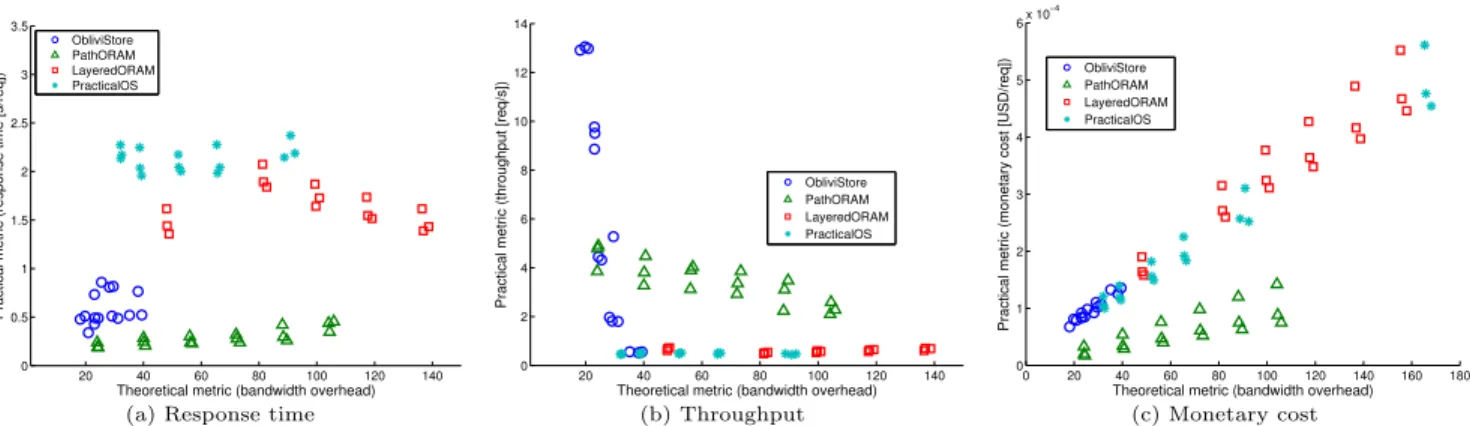
Figure 2: Theoretical metric (i.e., bandwidth overhead) against a variety practical metrics for the considered ORAMs. For all schemes we consider block sizes of 1KB, 4KB, and 16KB. The considered number of blocks (i.e.,n) were: 4, 16, 64, 256, 1024, 4096, for PathORAM and LayeredORAM; 1024, 4096, 8192, 16384, 65536, 262144, for ObliviStore; and 4, 8, 16, 32, 64, 256, for PracticalOS.
26% higher than for 1MB. This is surprising because in both cases the bandwidth usage for 1GB is roughly twice that of 1MB, while bandwidth was one of the foremost performance metrics. Yet, it did not seem to correlate well to the response time across schemes.
To better understand this phenomena, we ran more ex-periments with a wider range of ORAM capacities and block sizes. Besides response time, we also measured throughput (in number of requests per second) and monetary cost. We varied the number of blocks to keep the bandwidth consump-tion in different schemes within a comparable range. Fig-ure2plots the relations between bandwidth as a metric and several practical metrics such as response time, throughput, and monetary cost.
We observed that, when bandwidth was not saturated, bandwidth as a metric did not reflect very consistent ef-fect on other metrics such as response time, throughput and monetary expenses. This observation was found to be true both within and across schemes. For example, PathORAM, which consumed more bandwidth than ObliviStore, some-times resulted in lower response time. Even though mone-tary expense exhibit a strong linear correlation to bandwidth overhead, not all schemes follow the same line; also PathO-RAM resulted in lower monetary cost than others despite its higher bandwidth usage. This indicates a mismatch be-tween ORAM’s theoretical design and its the practical per-formance considered in a cloud environment.
Misalignments. To further explore this misalignment, we measured the performance of the ORAM schemes in the context of different applications. Specifically, we replayed various Filebench traces with and without ORAM5, with a varying number of application-level requests (i.e., 200 for varmail, 500 for webproxy, and 1000 for both webserver and fileserver)6. The replay was done according to the actual timings of requests produced by different applications as recorded in the trace.
A real-world cloud application needs to handle multiple service requests, while the service time experienced by the
4
For reasons described in Section3, we are unable to calculate the outsource ratio of LayeredORAM.
5
In the experiment, we set the ORAM capacity to an appropriate value, since each trace manipulates a different amount of data.
6
We varied the number of requests based on the intensity of the communication. For example, varmail has lower intensity than other traces: 200 requests is roughly 40 seconds of real time.
user is also affected by other requests. To understand whether current ORAM schemes could support such applications, we further measured theslowdownfactor on batches of requests, i.e., the ratio between the delays to complete all requests in a batch, with and without ORAM.
During an oblivious data access, eachapplication-level re-quest (e.g., getting an HTML page) needs to be translated into one or more ORAM requests (i.e, read/write blocks), and the ORAM request further involves multiple rounds of interaction with the cloud storage server. When an object cannot be accommodated by a single block, an application-level request needs to be fulfilled by a sequence of ORAM requests. This is why the response time when replaying application-level requests (Table2) is longer than when re-playing individual ORAM requests (Table 1). In general, the request initiated by the application will only be served after all related blocks have been obliviously retrieved from (for aget), or written to (for aput) the cloud storage. The size of ORAM blocks also affects ORAM performance. In our experiments, we tested two sizes for each application, 16 KB and 64 KB for fileserver, and 4 KB and 16 KB for oth-ers (varmail, webserver and webproxy). Those are also the typical parameters adopted by prior ORAM schemes [20].
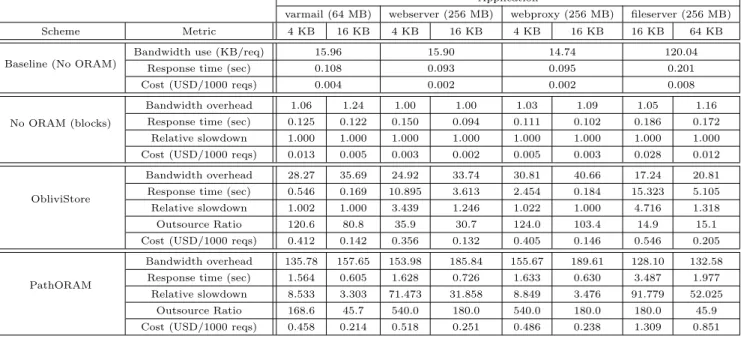
The outcomes of our study are illustrated in Tables 2
and 3. In addition to the four ORAM schemes tested, we include two baselines: (1) “No ORAM” and (2) “No ORAM with Blocks”, in which files were split into fixed-size blocks. The results indicate that except ObliviStore, none of the other ORAM schemes handles the applications well, as ev-idenced by their substantial slowdowns. ObliviStore was found to work well with both varmail and webproxy, but it was unable to keep up with webserver and fileserver, which were more intensive (sending requests more frequently) than other applications. In terms of the monetary cost, all these schemes cost significantly more than the baselines. For ex-ample, running those applications on top of ObliviStore in-curred 25 to 200 times the expense of not using ORAM ObliviStore’s bandwidth overhead ranges from 17.24 to 40.66 per request, and it’s outsource ratio varies from 14.9 to 124. Similar to the results in Figure2, we find that the bandwidth overhead is not strongly correlated to other practical met-rics. For example, for fileserver with block size 16KB, the bandwidth overhead is at its lowest (17.24) among all com-binations of trace and block size, while the monetary cost overhead is 0.546/0.008 = 68.25 (more than 2.5 times its
Application
varmail (64 MB) webserver (256 MB) webproxy (256 MB) fileserver (256 MB) Scheme Metric 4 KB 16 KB 4 KB 16 KB 4 KB 16 KB 16 KB 64 KB
Baseline (No ORAM)
Bandwidth use (KB/req) 15.96 15.90 14.74 120.04
Response time (sec) 0.108 0.093 0.095 0.201
Cost (USD/1000 reqs) 0.004 0.002 0.002 0.008
No ORAM (blocks)
Bandwidth overhead 1.06 1.24 1.00 1.00 1.03 1.09 1.05 1.16 Response time (sec) 0.125 0.122 0.150 0.094 0.111 0.102 0.186 0.172
Relative slowdown 1.000 1.000 1.000 1.000 1.000 1.000 1.000 1.000 Cost (USD/1000 reqs) 0.013 0.005 0.003 0.002 0.005 0.003 0.028 0.012
ObliviStore
Bandwidth overhead 28.27 35.69 24.92 33.74 30.81 40.66 17.24 20.81 Response time (sec) 0.546 0.169 10.895 3.613 2.454 0.184 15.323 5.105 Relative slowdown 1.002 1.000 3.439 1.246 1.022 1.000 4.716 1.318 Outsource Ratio 120.6 80.8 35.9 30.7 124.0 103.4 14.9 15.1 Cost (USD/1000 reqs) 0.412 0.142 0.356 0.132 0.405 0.146 0.546 0.205
PathORAM
Bandwidth overhead 135.78 157.65 153.98 185.84 155.67 189.61 128.10 132.58 Response time (sec) 1.564 0.605 1.628 0.726 1.633 0.630 3.487 1.977
Relative slowdown 8.533 3.303 71.473 31.858 8.849 3.476 91.779 52.025 Outsource Ratio 168.6 45.7 540.0 180.0 540.0 180.0 180.0 45.9 Cost (USD/1000 reqs) 0.458 0.214 0.518 0.251 0.486 0.238 1.309 0.851
Table 2: Comparison of ORAM schemes replaying various applications traces (see Section3.1), for various block sizes, and according to various metrics: mean response time per request (in seconds), relative slowdown, outsource ratio, and monetary cost (in USD per 1000 reqs).
varmail (64 MB)
Scheme Metric 4 KB 16 KB
LayeredORAM
Bandwidth overhead 230.28 258.25 Response time (sec) 11.641 3.491
Relative slowdown 63.7 19.1 Cost (USD/1000 reqs) 2.747 0.909
PracticalOS
Bandwidth overhead 1394.12 974.13 Response time (sec) 22.824 6.084
Relative slowdown 124.1 32.8 Outsource Ratio 63.7 32.0 Cost (USD/1000 reqs) 15.436 3.180
Table 3: Replay of varmail with LayeredORAM and PracticalOS, for block sizes 4KB and 16KB, respectively.
lowest value). Also, PathORAM uses a significant amount of bandwidth, the overhead ranges from 128.10 to 189.61, which is 4 times or more than that of ObliviStore. Yet its operating monetary cost in most cases comes below twice that of ObliviStore. Moreover, though PathORAM offers a higher outsource ratio, its slowdown is significant in all cases.
Table 3 shows the performance metric for both Layere-dORAM and PracticalOS for the varmail application. Both schemes simply cannot handle this application. For Prac-ticalOS, the median response we measured is quite low (e.g., 0.147 for 4KB blocks, and 0.117 for 16KB blocks) but the mean response time (Table3) is high due to the expensive reshuffling operation (e.g., 6.084 for 16KB block size). That is, in terms of response time without considering reshuffling, the scheme is very competitive. However, even if the reshuf-fling is performed “offline” (e.g., during periods of inactiv-ity, thus does not directly impact application performance), the scheme is still prohibitively expensive monetarily (cost-ing more than 15 USD per 1000 application-level requests for 4KB block size). Due to their inefficiency (e.g., it took PracticalOS more than one hour to replay a trace running 35
seconds on baseline, for 4KB block size.) and high monetary cost, we did not consider further experiments for LayeredO-RAM and PracticalOS.
4.2
Understanding the Cost
To gain insights into the aforementioned findings, we looked at the specific features of each ORAM scheme to under-stand: (1) what is causing the discrepancy between the theoretical metric and the practical ones, and (2) what al-lows some schemes to handle real cloud applications, while other schemes cannot. To this end, we compared different schemes, focusing on their features that could make a differ-ence in the throughput, latency and monetary expense they could get. We made the following discoveries.
Asynchronicity. An interesting observation is that PathO-RAM performed reasonably when dealing with single block requests but caused a huge slowdown when processing ap-plication requests in batch (e.g., 71 times slower in one case). Compared with ObliviStore, which handled the ap-plications much more comfortably, the most prominent dif-ference between the approaches is their support for asyn-chronity, which enables ObliviStore to process requests con-currently. This is critical for performance when the net-work bandwidth is not a bottleneck. In our research, we found that the network usages of both schemes, under differ-ent applications, were well below the bandwidth limit: e.g., with varmail over 4KB blocks, PathORAM consumed about 677 KB/s downstream (and the same upstream), whereas at least 10 MB/s was actually available; ObliviStore consumed about 537 KB/s downstream and 1163.52 KB/s upstream. Although the combined bandwdith was greater than PathO-RAM, it did not have any observable impact on its perfor-mance. In this setting, latency is the actual bottleneck due to the relatively small amount of data that needs to be trans-ferred per request.
Intuitively, it is imaginable that asynchronicity enables an ORAM scheme to work on multiple requests concurrently,
as also identified in the prior research [20]. Our research, however, further reveals theuniqueimportance of this prop-erty to oblivious cloud storage. The root cause here is that multiple ORAM accesses are required to retrieve a single application object, when the latter is scattered in multiple blocks. This inevitably brings up the time cost if the pro-cess is not asynchronous (and thus cannot serve multiple ORAM accesses concurrently). Specifically, we replayed the varmail trace without ORAM (i.e., directly on S3) while en-forcing synchronous replay, i.e., the next request was not started until the previous one completed. Surprisingly, this did not result in an observable slowdown. However, when we split each object into blocks and ran the process again (still without using ORAM), we observed a significant slowdown (e.g., 2.18 for 4KB blocks) in most cases. Observing simi-lar phenomena with other applications, we learn that asyn-chronicity is critical for services that access multiple blocks to retrieve an object, which is common in applications of cloud storage systems.
Given the importance of asynchronicity, one may ask how easily it can be achieved. This turns out to be more com-plicated than it appears to be, and there are many pitfalls when it comes to implementation. Take ObliviStore [20], the most promising prior work that supported asynchronic-ity, as an example. Although the paper formally proved the security of its construction in handling asynchronous operations, we discovered a subtle issue that apparently un-dermined its security claims. The problem stems from con-current processing of interdependent reads/writes, such as multiple requests of the same ORAM block. The implemen-tation of ObliviStore used an “AsyncConflictScheduler” to sequentialize the processing of requests targeting the same ORAM block. However, an adversarial cloud server could still observe the difference between the processing times of a sequence of highly interdependent requests and that of inde-pendent requests. To understand whether this would indeed leak information, we conducted an experiment using our implementation of ObliviStore in Java, which performs an equivalent sequentialization of such conflicting requests. We used two sequences of 1000 requests (with identical request-ing timestamps): the first randomly read blocks 1 through 1024, whereas the second read blocks 1 through 4. We then repetitively replayed the two sequences 15 times. It turned out that a two-sample Kolmogorov-Smirnov test (which re-turned a p-value in the order of 10−7) easily distinguished the two sequences based on their different processing times: 18.12 seconds on average for the first versus 36.39 seconds for the second. This issue was not discussed in the ObliviS-tore paper [20] and appeared to be a realistic attack of the original C# implementation of ObliviStore.
Bandwidth asymmetry. As mentioned earlier, we ob-served significant differences in the per request response time across different ORAM schemes (Table1), even when the bandwidth overheads are comparable (see Figure2a). For example, for each request, PathORAM always downloads all the nodes along a path and then uploads the nodes on the same path, whereas ObliviStore downloads one block per non-empty layer, and uploads those blocks back later, dur-ing its background shuffldur-ing operation. Due to the presence of dummy blocks, ObliviStore tends to upload more data than it downloads on average, per request (e.g., 176.4 KB downloaded vs 392.7 KB uploaded, for varmail with 16KB blocks). This has an observable impact on the monetary cost
to support cloud applications. In particular, for the same ORAM capacity the monetary cost of operating PathORAM is only slightly higher than that of ObliviStore, even though the latter uses less than a fourth of the bandwidth. This is because cloud storage systems tend to charge much more for uploading data than downloading. For S3, the cost of aput
operation is 12.5 times that of agetoperation.
1KB 2KB 4KB 8KB 16KB 32KB 64KB 128KB
GET Median 59.0 59.0 60.0 62.0 61.0 62.0 62.0 91.0
IQR 11.5 10.0 10.5 13.0 11.5 20.5 14.0 28.5
PUT Median 87.5 91.0 87.0 96.0 102.0 107.0 111.5 136.0
IQR 17.5 16.0 17.0 18.0 25.0 20.0 35.0 49.0
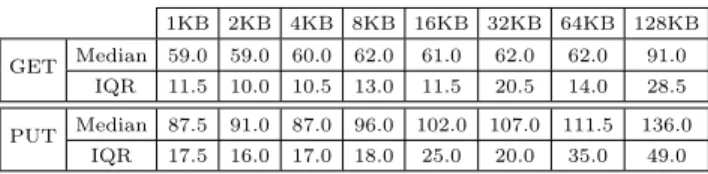
Table 4: Median and interquartile range of the response time (ms) for varying object sizes of single object PUT, GET operations on S3.
Beside financial cost, we may ask whether there is any performance difference, in terms of response time, between thegetandputoperations. For this purpose, we ran a set of experiments directly on S3 (without ORAM) that per-formed the operations on blocks of varying sizes (from 1KB to 128KB). For each size, we created a bucket and populated it with 1024 blocks of that size, each containing random data. For each operation and each block size, we performed the operation on a randomly chosen block (among the pool of 1024 objects in the bucket). The experiment was repeated 200 times, and the response time for each request was mea-sured. Table4shows the median and interquartile range of the response time (in ms). The response time is dominated by the network latency, especially when the block sizes are small (e.g.,≤16KB). The median response time for a put
operation was between 1.45 and 1.8 times that of its get
counterpart. This demonstrates thatputoperations are not only more expensive financially but also significantly slower. The finding shows that compared with the overall bandwidth consumption, download and upload bandwidths need to be considered separately for a more realistic measurement of an ORAM scheme’s performance.
Data access strategies. The pattern of API calls to the cloud storage server may also affect the ORAM response time. For instance, PracticalOS downloads a single block per request, but must perform a full reshuffling of all the storage blocks every√nrequests, hence resulting in longer average response time due to the high cost of the reshuf-fling. Another less extreme case is PathORAM, whose unit of data access are nodes (i.e., a set of blocks). It issues logn+ 1 requests to download (or upload) a path, instead of
z(logn+ 1) requests (wherezdenotes the number of blocks in a node). Thus one may ask: is it the case that accessing a fixed amount of data (say 64KB) results in the same de-lay regardless of whether it is accessed in smaller or bigger chunks7?
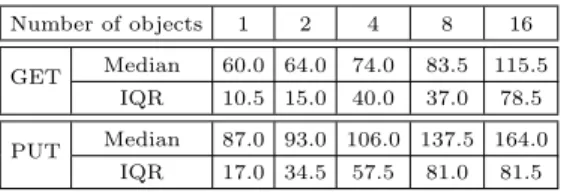
To answer this question, we first ran experiments that performedgetandputoperations on 4KB blocks, where the number ofsimultaneously issuedoperations varied from 1 to 16. Here the response time measured the interval between the initiation of the first operation and when all operations are completed. Table5shows the median and interquartile range of the response time (in ms) for different numbers of simultaneous requests: as the number of simultaneously
7
In both cases, all operations can be performed in parallel using sep-arate threads to minimize the overall response time.
Number of objects 1 2 4 8 16
GET Median 60.0 64.0 74.0 83.5 115.5 IQR 10.5 15.0 40.0 37.0 78.5
PUT Median 87.0 93.0 106.0 137.5 164.0 IQR 17.0 34.5 57.5 81.0 81.5
Table 5: Median and interquartile range of the response time (ms) for varying number of PUT, GET operations on S3, with 4KB objects.
queried blocks increases, so do the response time and its interquartile range. We note that the increase was not due to scheduling: the median scheduling time was under 10ms, even for simultaneous query of 16 blocks.
Time (ms) Op 1×64KB 2×32KB 4×16KB 8×8KB 16×4KB Median GET 63.0 67.0 85.0 91.0 128.5 PUT 125.0 132.0 129.5 153.5 176.5 75th percentile GET 77.0 84.0 117.5 131.5 184.5 PUT 199.5 172.5 184.0 209.5 234.5 90th percentile GET 110.0 127.0 187.5 202.0 270.0 PUT 239.5 229.5 239.5 301.0 319.5
Table 6: Response time (ms) for simultaneous GET, PUT operations of varying number of objects of varying size, totaling 64KB in each case, on Amazon S3.
We then ran another set of experiments to assess the re-sponse time of accessing 64KB data in varying sizes of blocks (which are requested simultaneously). Table 6 shows the median, 75th and 90th percentiles of the response time. We found that it is significantly faster to access fewer-but-larger blocks than multiple smaller one, given that their total sizes remain the same. For example, the median response time for downloading 16 blocks of 4KB each was 51% and 92% longer than getting 4 blocks of 16KB each, and 2 blocks of 32KB each, respectively.
These findings suggests that simulation-based evaluation of ORAM would not reflect the performance of the protocol over real-world cloud storages. Unfortunately, it is common in the literature, for instance, to assume a storage backend whose response time is 50ms, independent of the block size, type of operation (getorput) and data access strategy.
5.
METRICS AND THE GAP
Next, we summarize a list of important metrics in eval-uating oblivious storage schemes and highlight the gap ex-hibited by these metrics.
5.1
Metrics for Oblivious Cloud Storage
Response time and slowdown. The response time cap-tures the per-request delay experienced by the application. The slowdown measures the ratio of the time taken by an application to process a batch of operations on top of ORAM and that of processing the same batch without ORAM. Both metrics need to be taken into account: the response time alone is insufficient as it does not capture the impact of asynchronicity. Though synchronous schemes like PathO-RAM may exhibit low response times, their slowdowns can still be high since all requests are processed sequentially.
Monetary expense. The operating monetary cost, though overlooked by the literature, is a key metric for ORAM. Indeed, it is one of the most important reasons that people
opt to use cloud services. The monetary cost is not always strongly correlated with the network bandwidth usage, as designs with low bandwidth overhead may actually incur higher monetary expense. On the other hand, monetary expenses subsumes some traditional metrics, such as server-storage overhead.
Local storage and outsource ratio. Various ORAM de-signs minimize the amount of local storage. This is out of touch with the goal of oblivious cloud storage, and we argue a better goal is to aim for reasonable outsource ratio (e.g., 1TB stored on the cloud for 1GB stored locally). Indeed, workstations and laptops have hundreds of GB of available local storage, even smartphones have dozens.
To understand the cost of minimizing local storage, we ran an experiment using PathORAM. which involves a linear-size position map that can be stored recursively on the cloud (as opposed to being kept locally). We ran two experiments consisting of replaying a varmail trace of 200 requests (with 4KB blocks and 1GB ORAM capacity, i.e.,n= 218blocks).
In the first case, the position map (about 756KB) is stored locally, whereas in the second it is stored recursively on the cloud. Without recursion, the outsource ratio was 929, re-sponse time 1.712 sec, and slowdown 9.5; whereas with re-cursion, the outsource ratio was 2869, response time 4.344 sec, and slowdown 24.1. That is, the cost of storing the po-sition map recursively is: 2.54 times higher response time and slowdown, a 1.86 times higher monetary cost, all for a 3 times higher outsource ratio.8
Elasticity. An essential feature of the cloud is its elasticity. While this may not be directly critical for performance, real-world applications may expect such feature.
Reliability. Cloud applications using S3 as a storage back-end require that files are stored durably and reliably. This is especially true for backup or file storage apps. However, many ORAM schemes keep local state that is not replicated on the storage, e.g., position maps, cryptographic keys, and blocks in a local cache. As a result, the reliability guarantee provided by the cloud is forfeited because critical local data may be lost due to client-side software or hardware failures.
5.2
Are We on the Right Track?
In this section, we analyze the ORAM literature to un-derstand if we are moving in the right direction.
Methodology and paper collection. We collected pa-pers which cited the four ORAM designs, and among those, papers which proposed (or improve upon) an ORAM scheme.
Analysis and discussion. At the time of writing, the citation numbers of the four schemes considered in this pa-per are: 91 (PathORAM, 2013), 47 (ObliviStore, 2013), 61 (LayeredORAM, 2011), and 28 (PracticalOS, 2012). We found a total of 39 papers citing the four schemes we consid-ered which proposed new ORAM schemes or improvements. These 39 papers cited PathORAM 30 times, ObliviStore 16 times, LayeredORAM 23 times, and PracticalOS 10 times. While tree-based ORAMs have received the most attention (and PathORAM is the most cited scheme considered), we
8
To achieve a constant outsource ratio, storing the position map lo-cally makes sense as long as the ratio between the block size (in bits) and log2nis greater than or equal to the desired outsource ratio.
found it less suitable for cloud storage than ObliviStore (see Section4).
Also, out of the 39 papers, we found 29 papers mention-ing asynchronicity and concurrent requests processmention-ing, 14 with some discussion of those properties, but only 3 actu-ally supported such capability with an implemented system or simulation (all 3 are partition-based and by the same re-search group). Of these, 2 were published in 2013 (out of 9 ORAM papers) and only 1 was published in 2014 (out of 14 ORAM papers). It seems asynchronicity has not become the research focus of the community; though, we acknowl-edge that many ORAM papers do not consider cloud storage as their primary setting. Finally, we found only one paper [3] which considers the impact of application/workload in the cloud storage setting, albeit in simulations.
Our findings suggest that ORAM has improved so much that practical performance considerations ignored before (in favor of asymptotic improvements) should now be taken into account. We also stress that our results may not be appli-cable to scenarios outside of cloud storage. Nevertheless, we believe our methodology to understand the gap between theory and practice may be of value for other scenarios.
6.
THE CURIOUS FRAMEWORK
In this section, we propose CURIOUS a general partition-based framework for oblivious cloud storage, which we argue and show experimentally is thus far the most promising ap-proach.
6.1
Design Goals
Sections4and5indicate that: (1) metrics such as band-width overhead or client storage, treated as paramount in the existing literature often fail to capture real world per-formance; (2) other important metrics and properties (e.g., monetary expense, reliability) have been overlooked; (3) even when targeting the right set of metrics and properties, im-plementation usually involves many subtle issues (that can result in security vulnerabilities such as the one described in Section4.2) and require major software engineering effort.
Following our findings, we incorporated the metrics de-scribed in Section5.1 into the design goals of CURIOUS. Additionally, we emphasize the following:
1. Compatibility with storage APIs: schemes must use the APIs of existing cloud storage systems, whichdo not offer any ability of computation, since existing cloud storage services are unlikely to change their APIs to suit ORAM.
2. Asynchronicity: schemes must be able to process mul-tiple requests concurrently, so as to offset the adverse impact of network latency.
3. Elasticity: schemes should be able to grow and shrink the capacity of the storage in inexpensive ways. 4. Reliability: schemes should be able to efficiently
re-cover from client crashes (e.g., corrupted client caches) without data loss.
5. Parameterized local storage: schemes should be able to tune the amount of local storage used, since, for typical application scenarios, only the actual outsource ratio matters.
6.2
Design and Implementation
We describe the design of CURIOUS, a modular partition-based framework, which despite being asymptotically worse
(in terms of bandwidth overhead) is able to outperform ObliviStore in both monetary expense and response time, by exploiting some observations of the previous sections.
Modular partition-based framework. CURIOUS uti-lizes many small constant-size ORAMs (called subORAMs, or partition ORAMs), and uses existing remote storage ser-vices in a black-box way. At a high level, the framework consists of a position map, an eviction cache (both stored locally), and a collection of m subORAMs (whose state is kept locally, but whose storage is outsourced to the cloud). CURIOUS is modular: it cleanly separates the modules so that modules (e.g., partitions) can be improved upon inde-pendently, and specific modules may be replaced by others in order to suit a specific application scenario.
To process a request for blockx, CURIOUS uses the posi-tion map to find which subORAM containsx. It then calls the subORAM module to both retrieve xand evict one or more (possibly dummy) blocks to that subORAM. Once re-trieved,xis put into the eviction cache, and associated with a random subORAM. This ensuresxwill be evicted at a ran-dom time, preventing the cloud from learning information about the requests from the subORAM access sequences.
Comparing to ObliviStore. CURIOUS resembles Oblivi-Store in its partition-based design. However, we made sub-stantial improvements to meet the additional design goals.
ObliviStore uses a variant of layered ORAM in each par-tition and includes multiple optimizations such as: back-ground shuffling, batched shuffling (multiple shuffle jobs can be batched into a single job), and cache-ins during shuf-fling. In contrast, CURIOUS performs evictions (which may lead to shuffling depending on the subORAM technology) directly after each access. This significantly simplifies the scheme.
ObliviStore makes use of 4 semaphores (only 2 found in the implementation) to synchronize the background shuffling and handling new requests, which involves a complex proce-dure to avoid timing leaks. CURIOUS bounds the number of requests processed concurrently using a single semaphore (initialized to 128, in our experiments) which is decremented when a request is scheduled, and incremented once the last storage operation associated with the request completes.
Another significant difference lies in the asynchronous pro-cessing of concurrent requests. ObliviStore does not define a concurrency model (i.e., under what circumstances two re-quests can run concurrently) and must ensure that concur-rent requests are supported even when a partition is being reshuffled. This may lead to the security issue detailed in Section4.2. It is unclear how (or at what cost) this prob-lem can be fixed while still retaining other optimizations of ObliviStore.
Asynchronicity and concurrency. Oblivious processing of concurrent requests is challenging, and can compromise security or correctness when done incorrectly. To illustrate this, consider the sequence of requests get, put, get, all for the same block x. If an asynchronous scheme processes these requests sequentially, whereas other requests would be processed concurrently, it becomes vulnerable to certain at-tacks (Section 4.2). However, naively processing the three requests concurrently can compromise correctness or secu-rity, too. Indeed, naive processing would, for each request, lookup the position of x(i.e., which subORAM) using the position map, and then it would retrievex. Now the cloud
Local state:
1. Position map, storing for each blockk: a pair (s, p), wheres
is the subORAM, andpthe position within that subORAM. 2. Eviction cache, storing pairs (k, s), wherekis a block and
sis the index of the associated subORAM. 3. For each of themsubORAMs: their state.
scheduleGet(k, callback)
• Callschedule(k,⊥, callback).
schedulePut(k,v, callback)
• Callschedule(k,v, callback).
lookupPos(k)
• Lookup (s, p) for blockk.
• If blockkis in cache, setsandpuniformly at random.
evictBlocks(s)
• Pick and removeccache entries of the form (k, s).
• If there are less thancsuch entries, add dummy blocks.
addToCache(k)
• Picks, the index of a subORAM, uniformly at random.
• Store (k, s) in the cache.
schedule(k,vcallback)
• CalllookupPos(k) to get (s, p).
• CallevictBlocks(s) to gete, the set of blocks to evict.
• Calls.retrieveBlockAndEvict(p,e).
• Ifv6=⊥, then overwrite then content of blockkwithv.
• If blockkis newly retrieved, calladdToCache(k).
• Call callback.
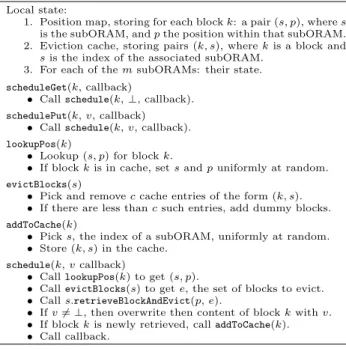
Figure 3: Modular framework construction.
observes three concurrent requests to the same subORAM, an event that would happen only with probability 1/m3 for
m subORAMs (e.g., m = 210), if the three requests were independent. In addition, we need to ensure correctness, i.e., the last request (get) must return the data written to the block by the 2nd request (put), and consistency, e.g., a request should not unexpectedly override something written by a concurrent request.
To address these requirements, CURIOUS leverages mod-ularity and adopts a simple concurrency model: the event that any two requests are run concurrently is statistically independent of their requests’ parameters (i.e., type and block). To ensure this, CURIOUS uses a sequential schedul-ing process that detects whether two requests are “in con-flict” (e.g., they access the same block). By keeping track of pending requests, the framework can make such conflicts oblivious to the cloud (i.e., it appears as if such conflicting requests are of any two random requests).
Construction. Figure 3 describes the modular construc-tion of CURIOUS. The interface includesscheduleGetand
schedulePut, both of which are asynchronous (i.e., the call
returns immediately, but the callback is invoked upon com-pleting the request).
To process requests concurrently as well as obliviously, CURIOUS ensures that the event that any two requests are processed concurrently is statistically independent of those requests. Each request will operate on a random subORAM so two requests are only competing (i.e., must be executed sequentially) if they operate on the same subORAM. When a request operates on a subORAM, it gets a lock on it and only accesses blocks of that subORAM.
We schedule two competing requests sequentially, though the request processing (i.e., accessing the subORAM) can be asynchronous and concurrent. The idea is that when scheduling a request, the framework will mark the targeted block as “in transit”, indicating that a request is in the pro-cess of retrieving that block. Subsequent requests for the same block are aware of the fact that the block is already
being retrieved so they perform a dummy access (to a ran-dom subORAM) to hide (to the cloud) the fact that the two requests targeted the same block. Upon finishing the first request, the block is put in the cache, and also delivered to each concurrent request targeting the same block. This pre-vents the kind of leaks uncovered in Section4.2, at the cost of disallowing requests to concurrently operate on the same subORAM.
To address correctness, i.e., it must appear (to the appli-cation) as if requests are processed sequentially, CURIOUS maintains a version id in the header of each block. This allows the framework to ensure that every get always re-trieves the correct version of the data, even in presence of concurrentputs to the same block.
Eviction. Akin to ObliviStore, when a block is added to the eviction cache (e.g., as a result of a request) it becomes as-sociated with a uniformly randomly chosen subORAM. This random choice is integral to ensure obliviousness. CURIOUS performs evictions right after each subORAM access, i.e., a constant number of blocks associated with that subORAM (in the eviction cache) are re-written to it. Dummy blocks are used for padding, if needed. The subORAM module decides how many blocks are evicted.
To the cloud, the eviction process is statistically indepen-dent of the requests, because all it sees is a fixed number of blocks (some of which may be dummy) evicted to the same subORAM that was just accessed. This is guaranteed if the subORAM’s module eviction process (in terms of what the cloud sees) is also independent of which blocks are evicted.
Security. Part of the challenge to secure an asynchronous scheme involves timing. There are two ways in which tim-ing may leak information: (1) through the application run-ning on top of ORAM whose requests have input-dependent timing patterns, and (2) due to a weakness in the ORAM design itself. Like ObliviStore, CURIOUS only addresses the latter. The former is not meant to be prevented by ORAM, which was not designed to hide application timing. We adopt the security definition of ObliviStore (Definition 1), which roughly says that for any two applications with the same timing pattern, the ORAM’s timing and accesses must be statistically indistinguishable.
To prove the security of CURIOUS we need to show that what is observed by the cloud provider is statistically inde-pendent of the requests (i.e., type, blocks, timing). Consider a CURIOUS instance of a fixed capacity withmsubORAMs. The cloud sees: (1) the timing of operations to the storage, (2) the sequence of subORAMs accessed, and (3) the exact operations to each subORAM’s raw storage.
CURIOUS’ concurrency model (as argued above) takes care of (1). Regarding (3), we already argued for the sta-tistical independence of the requests, after introducing the proposed subORAM design. This leaves (2) to be dealt with here.
Theorem 6.1. For any sequence of t requests, the
se-quence of subORAMs accessed by CURIOUS is statistically independent of the type and target block of those requests.
Proof. Consider an arbitrary request; there are three
possibilities for the targeted block: (1) it has not been re-quested before; (2) it has been rere-quested before and is in the cache; or (3) it has been requested before and is not in cache. Since during initialization blocks are randomly assigned to a subORAM, for (1), from the point of view of the cloud, a