Factors Influencing the Development of Digital
Competence in Teachers: Analysis of the Teaching
Staff of Permanent Education Centres
FRANCISCO-JAVIER HINOJO-LUCENA , INMACULADA AZNAR-DÍAZ , MARÍA-PILAR CÁCERES-RECHE , JUAN-MANUEL TRUJILLO-TORRES , AND JOSÉ-MARÍA ROMERO-RODRÍGUEZ
Department of Didactics and School Organization, University of Granada, 18071 Granada, Spain Corresponding author: José-María Romero-Rodríguez ([email protected])
This work was supported by the Asociación para la Investigación y Promoción de la Educación en la Sociedad Digital–PROMOEDUCA, Granada, Spain.
ABSTRACT The technological development of recent decades has had an impact on the lifestyle of adults. As a result, it has been necessary for citizens to adapt and learn how to use technological resources, an essen-tial requirement to foster employability. This requirement acquires a special nuance within Permanent Education, which mainly involves adults who would like to cover some training need. The aims of this study were to analyze the digital competence of Permanent Education teachers, and to determine the factors that have an impact on its development. Therefore, a quantitative methodology has been used, whereby a sample of Permanent Education teachers in the region of Andalusia, Spain, were asked to complete a questionnaire on digital competence (n=140). The results confirmed the low digital competence of teachers, and how some factors such as age, kind of centre, prior training on ICT, degree, teaching experience and professional category affect the development of digital competence. The last part of the study discussed the potential explanations for the study findings and suggestions for future research.
INDEX TERMS Digital competence, adult learning, information literacy, teacher professional development, 21st century abilities.
I. INTRODUCTION
The Digital Agenda for Europe 2020 passed by the European Parliament enshrines as a principle to ensure the digital skills and literacy of all citizens [1]. The G20 and the OECD advise of the need to train adults on the digital field to guarantee adequate work performance in current and future profes-sions [2]. This need is extended to the teaching field, where the implementation of technology demands digitally-skilled teachers [3], [4].
In terms of education, different editions of the Horizon reports have set the trends regarding the adoption of Informa-tion and CommunicaInforma-tion Technologies (ICT) in higher edu-cation. Nevertheless, in the 2018 edition, they highlight the improvement of digital literacy as a significant challenge [5]. As a consequence, it is necessary to establish what the general action lines towards digitalization and digital competence development are [6], [7].
The associate editor coordinating the review of this manuscript and approving it for publication was Laxmisha Rai .
Faced with this challenge, the adult population feels at a clear disadvantage compared to people who were born during the technology boom [8]. In this sense, adults have needed to start a learning process for the Internet and the handling of electronic devices. Nonetheless, the socio-economic con-text has influenced the progress of digital literacy in certain regions [9].
Andalusia, in Spain, is the region with the highest popula-tion in the country, and at the same time it has the highest rate of illiterate inhabitants. This has resulted in the pres-ence of more than 600 public Adult Education centres in Andalusia. Taking this into account, this study focuses on the teaching staff of Centres and Sections of Adult Per-manent Education (CEPER and SEPER). These teachers are responsible for training the adults who wish to meet a given training need, against the backdrop of the 21st century society, where digital competence is essential [10]. On this basis, the study intended to analyze teachers’ digital com-petence and the socio-demographic factors that affect its development.
II. BACKGROUND
There has been a lack of consensus on the definition of the term ‘‘digital competence’’. In order to unify the concept, the revision of the literature on the definition of digital com-petence by Ilomäki et al. [11] highlights that digital com-petence comprises: (i) technical skills; (ii) the ability to use digital technologies meaningfully for work, studies and daily life; (iii) the ability to critically assess digital technologies; and (iv) the motivation to participate and to commit to digital culture.
In light of this phenomenon, several institutions have estab-lished general frameworks to specify the composition of dig-ital competence and how it is measured, and to promote its development. Among the most relevant standards in the inter-national and inter-national context, we find the ICT Competency Standards for Teachers [12], the ICT National Educational Technology Standards for Teachers in the USA [13], the European Framework for the Digital Competence of Educa-tors - DigComp [14] and the Common Framework of Digital Competence for Teachers in Spain [15].
Each framework has its own characteristics and they show different measurement units to catalogue the level of digital competence acquisition. However, they all include similar phases and contents. In sequence, UNESCO [12] describes three levels: (i) integration, in which ICT are used to inform and optimize communication channels; (ii) re-orientation, in which ICT are used as tools for enabling knowledge build-up; and (iii) evolution, in which ICT make it possible to create environments for representing, processing, transmit-ting and sharing information. ISTE [13] sets out four phases: (i) beginner, starting in the use of ICT; (ii) medium, with more experience and flexibility in the use of ICT; (iii) expert, with an efficient utilization of ICT; and (iv) transformer, adapting and applying ICT to change the teaching-learning process. The DigComp shows levels of classification similar to the ones established by the Common European Framework of Reference for Languages [16], being the framework with the highest level of concretion: A1 (newcomer); A2 (explorer); B1 (integrator); B2 (expert); C1 (leader); C2 (pioneer). Mean-while, the Common Framework of Digital Competence for Teachers, which is a benchmark in Spain, is an adapta-tion of the European Framework DigComp. Nevertheless, it shows different levels of classification (basic, intermediate and advanced) based on the level of acquisition gained in each area of digital competence [15].
The INTEF [15] established five areas of reference that comprise digital competence in teachers:
1. Information and data literacy: ability to search, store, organise and analyse the relevant data available on the Internet.
2. Communication and collaboration: ability to inter-act through social media, to communicate and to share information.
3. Digital content creation: ability to prepare and edit digital content, either to generate new content or to rework
existing content, taking into account intellectual property and copyright matters.
4. Security: ability to apply security measures to protect personal data and digital identity.
5. Problem solving: ability to solve problems in a cre-ative way using technology and making the most appropriate decisions.
The level of acquisition in each area, particularly elemen-tary levels (areas 1 and 2), has a direct impact on teaching activity and on the practical use of ICT [17]–[19]. In par-ticular, older teachers have the added difficulty of lacking technological skills [20], in addition to the limited social and institutional systems, which hinder older adults’ ability to acquire experience and ease with technology [21]. Therefore, there is a tendency for digital competence to be lower in the adult population than in youngsters [22], [23].
All the same, such digital skills cannot be learned by themselves, but need specific training [24]–[26]. This training is very frequently non-existent or does not have the desired effect of increasing users’ levels of digital competence acqui-sition [27], [28]. Likewise, this problem does not only arise from the lack of specific training; social characteristics also influence digital competence development [29], [30].
In this regard, previous studies have manifested the influ-ence of demographic factors on digital literacy levels in adults in Andalusia [9]: the influence of the years of teaching experience, the regular use of ICT, and the fact of seeing oneself as trained in the field of digital competence [31]; the links between age, occupation, the use of technology and its repercussion on digital competence [32]; the influence of gender, self-efficacy and socioeconomic background on the use of ICT [33]; and motivation itself and emotional variables as mediators in the effects of digital self-efficacy [34].
More specifically, the theoretical and empirical insights on adults’ digital competence note that it is a topic of particular interest considering the specificities of this population sec-tor. Nonetheless, most research works on digital competence focus on Secondary Education students [35], which shows a scarcity of research where the main aim of the study is Perma-nent Education. The aims of this study were: (i) to analyse the digital competence level of Permanent Education teachers; and (ii) to determine the factors that have an impact on digital competence development. At the same time, the following research questions were laid out:
RQ1 What is the digital competence level of Permanent Education teachers in Andalusia?
RQ2 Does the kind of Permanent Education centre have an impact on permanent education teachers’ digital competence?
RQ3 Does the age factor have an impact on permanent education teachers’ digital competence?
RQ4 Does gender have an impact on permanent education teachers’ digital competence?
RQ5 Do qualifications have an impact on permanent education teachers’ digital competence?
RQ6 Do years of teaching experience have an impact on permanent education teachers’ digital competence?
RQ7 Does the professional category have an impact on permanent education teachers’ digital competence?
III. METHOD
A quantitative methodology was used with the aim of col-lecting empirically verifiable data and describing the reality observed [36]. From a methodological perspective, this study has promoted the quantification of participants’ answers, the establishment of statistical descriptive values and multiple linear regression models.
A. PARTICIPANTS
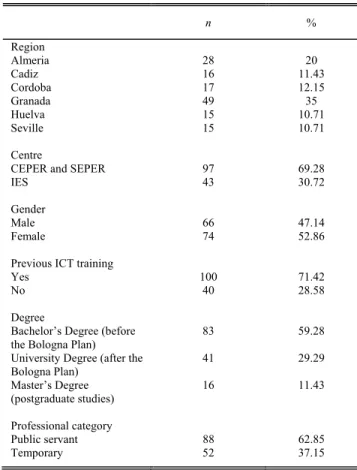
The population consisted of Permanent Education teachers in the region of Andalusia, Spain (N =2034). The study applied a stratified random sampling, taking into account some provinces of Andalusia (Almeria, Cadiz, Cordoba, Granada, Huelva and Seville) and the three main typologies of Adult Education centres: Permanent Education Centres and Permanent Education Sections (CEPER and SEPER) and Secondary Education Schools with training for adults (IES). Thus, the sample consisted of 140 teachers, being a repre-sentative sample of the population with a 95% confidence index and a margin of error of 8% [37]. Access to this body of teachers is made through a public competition, which is divided into two main phases: (i) the competition stage, where the academic and professional merits of the entrant are taken into account and (ii) the public examination stage, where the entrant is faced with a written test and an oral presentation. Before applying to the body of teachers, it is necessary to be in possession of the official Master’s degree in Teacher Training. Once selected, the teacher decides the type of school in which he or she would like to practice his or her profession. Although access to the body is the same for a secondary and a permanent education teacher, the difference lies in the type of student in each modality. In secondary education the age of the students is 12-18 years and in permanent education they are older than 18 years.
Table 1 shows the socio-demographic data. The age of the participants ranged from 22 to 55 years (M = 35.4,
SD=8.56) and the teaching experience was minimum 1 year and maximum 12 years (M =4.98,SD=3.06).
B. DATA COLLECTION
The data collection took place between January and March 2019 after implementing an online questionnaire on digital competence. Thead hoc questionnaire consisted of 91 items divided into the five areas of digital competence set by INTEF [15]. The items were based on each of the indicators included in each of the five areas: 16 indicators on information and data literacy; 31 on communication and collaboration; 16 on digital content creation; 13 on security; and 15 on problem solving. Participants were asked to indi-cate whether they have complied with each indicator, which can be consulted in open access in the INTEF document [15].
TABLE 1.Socio-demographic data.
The response mode was categorized in a 10 point Likert scale (1=never; 10=always). The instrument reliability analysis gave an acceptable value in the Cronbach’s alpha coefficient (α=0.93).
C. DATA ANALYSIS
For the analysis of data, the IBM software for quantitative analysis SPSS version 24.0 and RStudio version 1.1.383 were used. Firstly, the descriptive-statistical data were processed with the IBM programme SPSS, with the aim of calculating the mean and the typical deviation in each area. Subsequently, using RStudio, the Shapiro-Wilk test was used to calculate the multivariate normality of data, the Box’s M test was used for the homogeneity of variances and covariances, and the GGally package function ggpairs for linearity. These steps were primordial to set the multiple linear regression mod-els [38]. The confidence level used was 95% (p-value<0.05). The socio-demographic data and the areas of digital com-petence were codified with RStudio with the following abbre-viations: CEPER and SEPER (Centre1); IES (Centre 2); Age (Age); Gender (Gender1); Previous ICT training (TIC.For1); Bachelor’s and University Degree (Degree1); Master’s Degree (Degree2); Teaching experience (Expe-rience 2-12, from 2 to 12 years); Professional category (Prof.Cat1); Information and data literacy (B.1); Commu-nication and collaboration (B.2); Digital contents creation (B.3); Security (B.4); and Problem solving (B.5).
IV. RESULT
In the first instance, the descriptive-statistical data of the five areas of digital competence were calculated to verify teachers’ acquisition level. The collected answers, based on the Likert scale (1-10 points), showed a low level of digital competence, given that all the areas registered values lower than the neutral value (5) (table 2).
TABLE 2. Descriptive statistics.
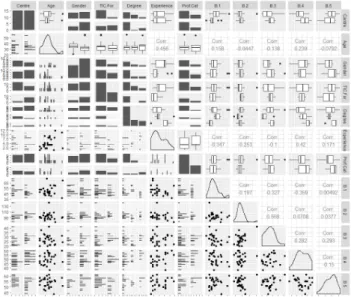
In addition, in order to verify the adequacy of the multiple linear regression models, data were segmented in a training group and a testing group (p-value=0.5), and the classical multivariate assumptions of normality, homoscedasticity and linearity were also calculated. The measures evidenced that the multivariate assumption normality (p-value>0.05) was not met. However, the assumption homogeneity of variance-covariance (p-value>0.5) was fulfilled. To this regard, no lin-earity issues were observed within the data (figure 1). Hence, multiple linear regression models would be appropriate.
More specifically, the multiple linear regression models explain the significance of the different socio-demographic factors with the areas of digital competence. The variables marked with an asterisk (∗) contributed significantly in each area.
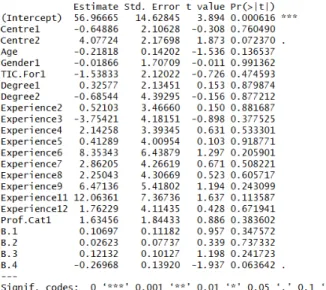
The linear regression model for information and data lit-eracy (B.1) has a good adjustment, the model is significant (F-statistic (22, 26)=2.655;p-value=0.0092) and explains the 43% of the total variance of data (R2 =0.4314). The base category was Centre0, Gender0, Tic.For0, Experience1,
FIGURE 1. Linear and correlation analysis.
FIGURE 2. Multiple linear regression model for B.1.
Prof.Cat0 and B1. For B.1, the significant socio-demographic factors are age and teaching experience of six, eight and 11 years. B.1 punctuations are significantly different compared to B.2 (figure 2).
The linear regression model for communication and collab-oration (B.2) was not significant (F-statistic (22, 26)=1.793;
p-value=0.077) and only explained 26% of the total variance of data (R2 = 0.266). The sole variables that contribute significantly to B.2 were teaching experience of six years and B.1 (figure 3).
For the digital content creation area (B.3) the model was not significant either (F-statistic (22, 26) = 1.451;
p-value=0.1807), and gathered 17% of the total variance explained (R2 =0.1713). None of the variables contributed significantly to B.3. (figure 4).
FIGURE 4. Multiple linear regression model for B.3.
Unlike the models of B.2 and B.3, the linear regression model of the security area (B.4) is significant (F-statistic (22, 26)=2.209, p-value=0.027). This model gathers 35% of the total variance of data (R2=0.356). The base category was Centre0, Gender0, Tic.For0, Experience1, Prof.Cat0 and B.4. Concerning the statistical significance, we can highlight the kind of centre and the teaching experience of three years (figure 5).
FIGURE 5. Multiple linear regression model for B.4.
Finally, the area of problem solving (B.5) has a significant model (F-statistic (22, 26)= 2.096;p-value= 0.036) and explains 33% of the total variance of data (R2=0.334). The base category was Centre0, Gender0, Tic.For0, Experience1, Prof.Cat0 and B5. The results show that none of the variables contributed significantly to B.5 (figure 6).
FIGURE 6. Multiple linear regression model for B.5.
In order to confirm the statistical significance of each socio-demographic factor in the multiple linear regression models, regression models were calculated automatically with the algorithm regsubset and with the Bayesian Informa-tion Criterion (BIC) in the significant models: B.1 (figure 7), B.4 (figure 8) and B.5 (figure 9). The variables shaded black contributed significantly. Hence, for B.1 we find kind of centre, prior training on ICT, teaching experience of eight, 11 and 12 years, and the security area (B.4). The main areas in B.4 are kind of centre, prior training on ICT, degree, teach-ing experience of three years, and problem solvteach-ing (B.5). B.5 shows kind of centre, prior training on ICT, professional category and the areas of digital content creation (B.3) and security (B.4).
FIGURE 8. Automatic regression model for B.4.
FIGURE 9. Automatic regression model for B.5.
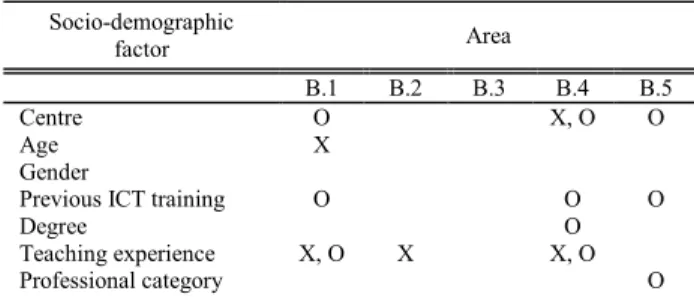
Finally, with the aim of completing the regression anal-ysis, a Deep Learning regression model with H20 was implemented in areas B.1, B.4 and B.5 to specify the root mean square error (RMSE) with a tanh function activa-tion. The results showed that the RMSE was 5.25 for B.1, 3.99 for B.2, and 2.40 for B.3. B.2 and B.3 had good results. As a synthesis of the above, table 3 shows the impact of each socio-demographic factor, according to the digital competence area.
TABLE 3. Influence of sociodemographic factor according to the digital competence area.
V. DISCUSSION
This study focused mainly on analysing the digital compe-tence level of Permanent Education teachers, and determining the factors that have an impact on the digital competence development. The findings evidence that the digital
competence level for teachers is low, and they detect certain socio-demographic factors that have a significant impact on the acquisition of digital competence, according to each area. It is confirmed that adults show a low digital compe-tence [8], [20], [21]–[23]. This is reflected in the average scores obtained in each area that were situated below a neutral value (5). For instance, the area of digital content creation is particularly low.
According to the general frameworks of digital compe-tence, the Permanent Education teachers of Andalusia would fall within the following levels: integration [12]; begin-ner [13]; A2-explorer [14], [16]; and basic [15]. This confirms the need to have digitally-skilled teachers [3], [4], [10].
Likewise, the multiple linear regression models confirm the influence of socio-demographic factors in digital com-petence development [9] [29], [30]. Hence, factors like age, teaching experience and the area of communication and col-laboration weigh on the area of information and data literacy. Nevertheless, for the area of communication and collabora-tion, only teaching experience and the area of information and data literacy have an impact. To this regard, there is reciprocity between the areas of information and data literacy, and communication and collaboration, which are the basic or elementary areas of digital competence acquisition [15], [19]. In contrast, the area of digital content creation (the area with the lowest scores) has no influence on any factor. The security area receives the impact of the kind of centre and the teaching experience. Finally, the problem solving area does not register any influencing factors.
The analysis of the multiple linear regression models with significant values through the automatic regression models reflects the purification of the socio-demographic factors influencing digital competence development. Therefore, this materialisation indicates that in terms of information and data literacy, the kind of centre, prior training on ICT, teaching experience of eight, 11 and 12 years, and the security area have an important weight. For the security area, we can remark the kind of centre (CEPER and SEPER, IES), prior training on ICT, degree (Master’s Degree), teaching experi-ence of three years, and the problem solving area. Regarding the latter, it includes the kind of centre (only IES), prior training on ICT, professional category and the areas of digital content and security. The data evidence that teaching experi-ence is the socio-demographic factor with the greatest impact on digital competence acquisition, particularly experience of between eight and 11 years. Furthermore, the fact of having had more years of teaching experience leads to achieving a higher digital competence level.
In addition, significant relationships are observed within the areas of digital competence. As a result, certain links have been generated between the area of information and data literacy, and communication and collaboration, and security; between communication and collaboration, and information and data literacy; between security and problem solving; and between problem solving and digital content creation and security. This fact verifies that these areas are not isolated, but
they interact significantly in digital competence development and acquisition.
Lastly, concerning prior studies, it is stated that there is an influence on the digital competence development of socio-demographic factors by: age and professional cate-gory [9], [31], [33]; teaching experience [9], [31]; and prior training on ICT [9], [28], [32]–[34]. Nonetheless, unlike other studies, the impact of the gender factor is excluded [33].
In summary, these findings indicate the relationship of certain sociodemographic factors with areas of digital com-petence. The difference in each area is substantial, since each one refers to certain guidelines of digital competition, so it is not surprising that different sociodemographic fac-tors influence each area. The areas of greatest influence are information and data literacy (B1) and security (B4). With respect to the influence of factors in specific areas, this may be due to several reasons: the centre where teachers work determines the acquisition of areas B1, B4 and B5, possibly due to the difference in technological resources available in each type of centre. In the case of IES, technological material is usually more abundant due to the high number of students exceeding those enrolled in CEPER or SEPER. In relation to age (influential in B1), the generational variable is explanatory in some cases of the use of technology, where it is attributed that younger teachers use it more frequently than older teachers [20]. Previous ICT training has a direct impact on digital competence areas B1, B4 and B5, since this type of training focuses on training teachers in the use of technolog-ical tools, where the most basic level of digital competence (B1) is revealed and guidelines are established on security and problem solving. On the one hand, teaching experience is key to the development of areas B1, B2 and B4, years of experience act as moderators of teaching behaviour, so it is not surprising that the greater the experience, the higher the degree of information and data literacy, as well as the fact of using communication and collaboration network tools. In this sense, experience can make teachers evolve methodologically and give them the wisdom to know which technological tools are the most appropriate. Something similar happens with security, where the greater the degree of experience, the greater the security mechanisms are established, possibly due to the reflection of the teaching given in previous years and the testing of different technological resources.
On the other hand, the professional category has been a determinant of area B5, the existence of this link is really interesting, since it differentiates between temporary and per-manent teachers in terms of problem solving. This factor has indicated that temporary teachers present a greater resolution of problems with technology, possibly this influence is due to the temporary nature of their job and the fact that they rotate through different schools.
Finally, the degree is determinant of the B4 area, depending on the university degree studied, different knowledge and perceptions are acquired about network security. This is the case of teachers who have studied in the scientific branch. The level in the area of security is higher than those who have
studied in the humanities. This may be due to the scientific tradition of each area of knowledge, where traditionally the scientific branch is linked to practical knowledge while the humanistic branch is linked to philosophical knowledge [39]. In the end, no sociodemographic factor is determinant for the creation of content (B3). This, in turn, has been the area with the lowest score, denoting the possibility that only a minority of the teachers surveyed generate their own digital resources while the rest use resources already created. In considera-tion, this may have been the main cause of not generating influential sociodemographic factors.
VI. CONCLUSION
The adult population is at a disadvantage when it comes to digital competence development and acquisition, due to the lack of ICT training in the first instance. The desire to make progress and get familiar with technology, together with the years of teaching experience are the main factors that con-tribute to Permanent Education teachers’ digital competence. This study has responded to the aims pursued on analysing the digital competence level of Permanent Education teach-ers, and determining the factors that have an impact on digi-tal competence development. In the same way, the research questions raised were addressed, where: (RQ1) The level of digital competence acquisition is low. It reaches neither average values nor optimal values, which results in a limited aptitude in every area of digital competence, among which the creation of content shows the lowest aptitude. Concerning the general framework for digital competence, the Perma-nent Education teachers would be categorised in the most basic levels; (RQ2) There is a significant influence on digital competence, based on the fact of belonging to a CEPER and SEPER, or to an IES. This incidence is particularly clear in the information and data literacy, security and problem solving areas. To this regard, data evidence that teachers of IES show a higher teacher’s digital competence; (RQ3) Age is another conditioning factor when developing digital competence, especially in the information and data literacy areas. As a result, the fact of being competent in the most basic area of digital competence depends, in the first instance, on the teacher’s age; (RQ4) None of the multiple linear regression models notes gender as an influencing factor in digital competence; (RQ5) Qualifications condition training in the security area. Hence, there is a difference between completing a Bachelor’s Degree, a University Degree and a Master’s Degree. The qualification with the greatest impact on digital competence development is the Master’s Degree; (RQ6) Teaching experience is also a conditioning factor in those teachers with eight or 11 years of experience, who show a higher level of digital competence for teachers. Moreover, this factor is significant in the information and digital com-petence, collaboration and security areas; (RQ7) Professional category affects digital competence development, mainly the problem solving area.
It is necessary to remark among all the limitations for this study that access to the sample was difficult. It is a limited
group that often has few teachers in a single academic centre, with even a maximum of three to six teachers per centre. Consequently, the sample achieved is quite wide in relation to the study population. The instrument used is too long; future studies should reduce certain items. Yet, this application with all the items has made it possible to faithfully reflect each area of digital competence. Furthermore, another limitation is the purely descriptive character of the research, in future works it would be convenient to include direct measures to deepen in the why of the findings of the study.
Finally, the following ideas could be addressed in future research lines and works:(i) extension of the sample all over Spain to know whether these data remain at a national level; (ii) comparison between Permanent Education teachers and Primary and Secondary Education teachers; (iii) broaden-ing the socio-demographic factors to verify whether there are more that affect digital competence development; (iv) design and application of training programmes to increase digital competence; and (v) study of digital competence of Permanent Education students.
Concerning the study, there is still some way to go in terms of digital training for the real inclusion of technology and to achieve technological literacy, identity and human-ism. The first step for this aim is to develop the necessary skills to apply the wide range of technological resources that are accessible to teachers. Hence, we will be able to progress towards student-centred learning, with technologies that facilitate the adaptation of the contents to each individ-ual’s learning rhythm, and based on network working and the promotion of active methodologies.
REFERENCES
[1] European Commission. (2010).A Digital Agenda for Europe. [Online]. Available: https://eur-lex.europa.eu/LexUriServ/LexUriServ.do?uri= COM:2010:0245:FIN:EN:PDF
[2] E. Bode and R. Gold, ‘‘Adult training in the digital age,’’Economics, vol. 12, no. 36, pp. 1–14, Jun. 2018.
[3] C. Tømte, A.-B. Enochsson, U. Buskqvist, and A. Kårstein, ‘‘Educat-ing online student teachers to master professional digital competence: The TPACK-framework goes online,’’Comput. Educ., no. 84, pp. 26–35, May 2015.
[4] M. S. Ramírez-Montoya, J. Mena, and J. A. Rodríguez-Arroyo, ‘‘In-service teachers’ self-perceptions of digital competence and OER use as determined by a xMOOC training course,’’Comput. Hum. Behav., vol. 77, pp. 356–364, Dec. 2017.
[5] S. Adams, M. Brown, E. Dahlstrom, A. Davis, K. DePaul, V. Díaz, and J. Pomerantz, ‘‘NMC horizon report: 2018 higher education edition,’’ EDUCAUSE, Louisville, CO, USA, Tech. Rep. 7, 2018.
[6] O. E. Hatlevik, G. B. Guðmundsdóttir, and M. Loi, ‘‘Digital diversity among upper secondary students: A multilevel analysis of the relationship between cultural capital, self-efficacy, strategic use of information and digital competence,’’Comput. Educ., vol. 81, pp. 345–353, Feb. 2015. [7] A. Nuzzaci, ‘‘Technological skills and initial teacher training:
An exploratory research on attitudes of the future teachers towards ICT,’’
Int. J. Digit. Literacy Digit. Competence, vol. 8, no. 3, pp. 1–16, 2017. [8] M. Prensky, ‘‘Digital natives, digital immigrants Part 1,’’Horiz., vol. 9,
no. 5, pp. 1–6, 2001.
[9] I. Aguaded-Gómez, R. Tirado-Morueta, and Á. Hernando-Gómez, ‘‘Media competence in adult citizens in Andalusia, Spain,’’Inform. Commun. Soc., vol. 18, no. 6, pp. 659–679, 2015.
[10] G. B. Gudmundsdottir and O. E. Hatlevik, ‘‘Newly qualified teachers’ professional digital competence: Implications for teacher education,’’Eu. J. Teachers Educ., vol. 41, no. 2, pp. 214–231, 2018.
[11] L. Ilomäki, S. Paavola, M. Lakkala, and A. Kantosalo, ‘‘Digital competence—An emergent boundary concept for policy and educational research,’’Educ. Inf. Technol., vol. 21, pp. 655–679, May 2016. [12] Competencias y Estándares TIC Desde la Dimensión Pedagógica: Una
Perspectiva Desde Los Niveles de Apropiación de Las TIC en la Práctica Educativa Docente, UNESCO, Pontificia Javeriana Univ., Bogota, Colombia, 2016.
[13] International Society for Technology in Education (ISTE). (2017).
Standards for Education in Information and Communication Tech-nologies (ICT). [Online]. Available: http://www.iste.org/standards/for-educators
[14] A. Ferrari, ‘‘DIGCOMP: A framework for developing and understanding digital competence in Europe,’’ JRC, Publications Office Eur. Union, Luxembourg, U.K., Tech. Rep. 1, 2013.
[15] Marco Común de Competencia Digital Docente, Ministry Educ., Culture Sport, Nat. Inst. Educ. Technol. Teacher Training Spain (INTEF), Madrid, Spain, 2017.
[16] C. Redecker and Y. Punie, ‘‘Digital competence framework for educators (DigCompEdu),’’ Eur. Union, Brussels, Belgium, Tech. Rep. 1, 2017. [17] E. Rolf, O. Knutsson, and R. Ramberg, ‘‘An analysis of digital competence
as expressed in design patterns for technology use in teaching,’’Brit. J. Educ. Technol., vol. 50, no. 6, pp. 3361–3375, 2019.
[18] L. Amhag, L. Hellström, and M. Stigmar, ‘‘Teacher educators’ use of digital tools and needs for digital competence in higher education,’’
J. Digit. Learn. Teacher Educ., vol. 35, no. 4, pp. 203–220, 2019. [19] J. López-Belmonte, S. Pozo-Sánchez, A. Fuentes-Cabrera, and
J. M. Trujillo-Torres, ‘‘Analytical competences of teachers in big data in the era of digitalized learning,’’Educ. Sci., vol. 9, no. 3, p. 177, 2019. [20] E. Instefjord and E. Munthe, ‘‘Preparing pre-service teachers to integrate
technology: An analysis of the emphasis on digital competence in teacher education curricula,’’Eur. J. Teacher Educ., vol. 39, no. 1, pp. 77–93, 2016. [21] K. Schreurs, A. Quan-Haase, and K. Martin, ‘‘Problematizing the digital literacy paradox in the context of older adults’ ICT use: Aging, media discourse, and self-determination,’’ Can. J. Commu., vol. 42, no. 2, pp. 359–377, 2017.
[22] J. A. Maderick, S. Zhang, K. Hartley, and G. Marchand, ‘‘Preservice teachers and self-assessing digital competence,’’J. Educ. Comput. Res., vol. 54, no. 3, pp. 326–351, 2016.
[23] E. Mirke and S. Cakula, ‘‘Adults’ digital competence and readiness for online learning: Preliminary findings on latvian adult learners’ readiness to study online,’’Int. J. Adv. Trends Comput. Sci. Eng., vol. 8, no. 1, pp. 22–27, 2019.
[24] R. Eynon and A. Geniets, ‘‘The digital skills paradox: How do digitally excluded youth develop skills to use the Internet?’’Learn. Media Technol., vol. 41, no. 3, pp. 463–479, 2016.
[25] E. J. Instefjord and E. Munthe, ‘‘Educating digitally competent teachers: A study of integration of professional digital competence in teacher education,’’Teach. Teacher Educ., vol. 67, pp. 37–45, Oct. 2017. [26] J. M. T. Torres, F. J. Hinojo-Lucena, and I. A. Díaz, ‘‘Innovating proposals
of work and collaborative e-learning 2.0 as the society of knowledge requires,’’Proc. ESE, vol. 20, pp. 141–159, Jun. 2011.
[27] F. J. Fernández-Cruz and M. J. Fernández-Díaz, ‘‘Los docentes de la Generación Z y sus competencias digitales,’’Comunicar, vol. 24, no. 46, pp. 97–105, 2016.
[28] M. A. Moreira, V. M. H. Rivero, and J. J. S. Alonso, ‘‘Leadership and school integration of ICT. Teachers perceptions in Spain,’’Educ. Inform. Technol., vol. 24, no. 1, pp. 549–565, 2019.
[29] B. Cortina-Pérez, M. Á. Gallardo, M. Á. Jiménez-Jiménez, and J. M. Trujillo, ‘‘Digital illiteracy: A challenge for 21st century teachers,’’
Cultura Y Educación, vol. 26, no. 2, pp. 231–264, 2014.
[30] M. Gui and G. Argentin, ‘‘Digital skills of Internet natives: Different forms of digital literacy in a random sample of northern Italian high school students,’’New Media Soc., vol. 13, no. 6, pp. 963–980, 2011.
[31] M. Area-Moreira, V. Hernández-Rivero, and J. J. Sosa-Alonso, ‘‘Models of educational integration of ICTs in the classroom,’’Comunicar, vol. 24, no. 47, pp. 79–87, 2016.
[32] M. Arrosagaray, M. González-Peiteado, M. Pino-Juste, and B. Rodríguez-López, ‘‘A comparative study of Spanish adult students’ attitudes to ICT in classroom, blended and distance language learning modes,’’Comput. Educ., vol. 134, pp. 31–40, Jun. 2019.
[33] O. E. Hatlevik, I. Throndsen, M. Loi, and G. B. Gudmundsdottir, ‘‘Stu-dents’ ICT self-efficacy and computer and information literacy: Determi-nants and relationships,’’Comput. Educ., vol. 118, pp. 107–119, Mar. 2018.
[34] E. Moreira-Fontán, M. García-Señorán, A. Conde-Rodríguez, and A. González, ‘‘Teachers’ ICT-related self-efficacy, job resources, and positive emotions: Their structural relations with autonomous motivation and work engagement,’’Comput. Educ, vol. 134, pp. 63–77, Jun. 2019. [35] F. Siddiq, O. E. Hatlevik, R. V. Olsen, I. Throndsen, and R. Scherer,
‘‘Tak-ing a future perspective by learn‘‘Tak-ing from the past—A systematic review of assessment instruments that aim to measure primary and secondary school students’ ICT literacy,’’Educ. Res. Rev., no. 19, pp. 58–84, Nov. 2016. [36] R. Hernández, C. Fernández, and P. Baptista,Investigation Methodology.
Mexico City, Mexico: McGraw-Hill, 2016.
[37] J. A. García-García, A. Rening-Bernal, and J. C. López-Alvarenga, ‘‘Sample size calculation in medical education research,’’Inv. Ed. Med., vol. 2, no. 8, pp. 217–224, 2013.
[38] J. Wright, A. Y. Yang, A. Ganesh, S. S. Sastry, and Y. Ma, ‘‘Robust face recognition via sparse representation,’’IEEE Trans. Pattern Anal. Mach. Intell., vol. 31, no. 2, pp. 210–227, Feb. 2009.
[39] I. Murillo, Tradición Filosófica Y Tradición Científica. Madrid, Spain: Diálogo Filosófico, 2010.
FRANCISCO-JAVIER HINOJO-LUCENA has been a Full Professor with the Department of Didactics and School Organization (DOE), University of Granada (UGR), since 2003, under different contractual modalities (Assistant Profes-sor No Doctor, Assistant ProfesProfes-sor First Level, Collaborating Professor, and Contracted Professor Doctor). Over the last few years, his research activity has been essentially applied, based on the inclusion of ICTs in schools and teacher training with technological resources through active learning methodologies (digital competence of the teacher) and lifelong learning. He has also coordinated different teaching innovation projects related to e-Learning, blended learn-ing, active teaching-learning methodologies with ICT resources, virtual learning environments, and learning communities. During this time, he has participated as a Researcher in different projects and research contracts, financed in competitive calls at regional, national, and international level, published more than 80 articles indexed in WoS (JCR and Thomson Reuters), SRJ (SCOPUS), Seal quality FECYT, CIRC, and Latindex, among other indexed databases, more than 50 book chapters and 100 contributions to international and national conferences. His research was the achievement of a Sabbatical period in England and Portugal, subsidized by the University of Granada.
INMACULADA AZNAR-DÍAZ received the degree in psychopedagogy, the master’s degree in primary education, and the Ph.D. degree in educational sciences from the University of Granada. She is currently a Full Professor with the Department of Didactics and School Organization, University of Granada, with more than 15 years of teaching and research experience. She teaches with the Faculty of Education Sciences and the Graduate School. She has also developed the teaching and research work with the University of Cordoba. She works in the line of school organization, digital competence in education, training for employment, and active methodologies for learning with ICTs. She has authored several books, chapters, and articles in international scientific jour-nals related to above mentioned lines. She was the Coordinator of different educational innovation projects and good teaching practices approved by the National Agency for Quality Assessment and Accreditation (ANECA). She was a Researcher in Ph.D. Program with the Postgraduate School, University of Granada, and the Director of 21 Doctoral Theses. She was a reviewer in different international scientific reviews, such as Scientific Research publishing; European Scientific Journal (ESJ); Open Journal of Leadership; Revista Comunicar, Ibero-American scientific journal of communication and education;Revista Pixel-Bit, media and education mag-azine;Revista Edmetic;Revista Apertura de Innovación Educativa;Revista Latinoamericana de Ciencias Sociales, niñez y juventud; andRevista Educar and Revista Complutense de Educación. She has actively participated in several research and teaching innovation projects related to virtual teaching, digital competence in teachers, and learning through mobile devices.
MARÍA-PILAR CÁCERES-RECHE received the Diploma degree in teaching English from L.E., and the degree in psychopedagogy and the Ph.D. degree in educational sciences from the University of Granada. She is currently a Professor with the Department of Didactics and School Organization, University of Granada. She was a professional trajectory in the University, with more than ten years of teaching and research experience, being coordinator of different projects of teaching inno-vation, in the last years, centered in the implantation of experiences on the framework of European convergence, active methodologies and the devel-opment of teaching competences in the students of Education. In relation to the research activity, she focuses on various lines within the AREA Group (HUM/672), such as the integration of ICT in teaching and learning processes, and leadership and organizational development. She has more than 50 articles published in international journals indexed in international databases (some with JCR impact, ISI/Thomson, such as the scientific journalComunicar,Revista Española de Pedagogía,Educatio Siglo XXI,
Revista Complutense de Educación, andWestern Journal of Medicine); and in other databases, such as ISOC del CSIC and Latindex catalogue, IN-RECS (Financed by the Directorate General of Universities and with national impact index), RESH (CINDOC, CSIC, and MEC), ERCE, Dialnet or DICE (Quality of Spanish journals, CSIC).
JUAN-MANUEL TRUJILLO-TORRES received the Diploma degree in teaching and the Ph.D. degree in educational sciences from the Univer-sity of Granada, the degree in pedagogy from the UNED, Madrid, and the master’s degree in new technologies applied to education from the University of Malaga. He has a great experience as a Teacher in different Primary and Secondary Education Centers, carrying out numerous ICT projects through collaborative network work and the development of competences in both teachers and students, which has led to one of the most relevant lines of research in his professional career, and the study of leadership, management, and institutional micropolitics. He is currently a Full Professor with the Department of Didactics and School Organization, University of Granada. He presented more than 70 articles published in international impact journals, 75 book chapters published in impact editorials, and 130 articles and/or communications in International Congresses, positive assessment of a six-year period of research CNEAI (requested the 2nd). He participated and attended more than 160 International Congresses on Education.
JOSÉ-MARÍA ROMERO-RODRÍGUEZreceived the degree in pedagogy from the University of Granada, in 2016, with the Extraordinary End of Degree Award, and the master’s degree in research and innovation in curriculum and training from the Department of Didactics and School Orga-nization, University of Granada. He is currently pursuing the Ph.D. degree with the doctoral thesis of Education Sciences Programme. He is currently a Teaching and Research Staff in training (FPU) with the Department of Didactics and School Organization. He carries out his research work with the AREA Research Group (HUM-672), Department of Education and Science, Regional Government of Andalusia, belonging to the Department of Didactics and School Organization. He is the author of several communications and scientific articles on the use of information and communication technologies (ICT) to improve the teaching-learning process and risks associated with the problematic use of the Internet.