Paula Lehto and Johanna Leskelä (eds.)
INTERACTIVE CaringTV
®AND
USERDRIVEN eSERVICES
The Safe Home Project: Final Report
LAUREA UAS PUBLICATIONS
B
•45
2011 Espoo
Laurea University of Applied Sciences Publications
B 45
Interactive CaringTV® and
Userdriven eServices
The Safe Home Project:
Final Report
Copyright © Authors
and Laurea University of Applied Sciences ISSN 1458-7238
Edita Prima Oy, Helsinki ISBN 978-951-799-252-7
Contents
ABSTRACT 5 FOREWORD 7 FOREWORD 9
1 INTRODUCTION 12
2 SAFE HOME PROJECT 14
2.1 EHYENÄ Subproject 14
2.2 OMANA Subproject 16
3 ACTION RESEARCH AND USERDRIVEN METHODS IN THE
SAFE HOME PROJECT 18
3.1 Safe Home Project - Background 18
3.2 Purpose and Methodology 20
3.3 Research Participants 24
3.4 Userdriven Methods and Data Collection 27 3.5 Programme Themes and eWellbeing Services 29
3.6 CaringTV Conceptual Model 32
4 CARINGTV® AS AN EVERYDAY SUPPORT OF DIFFERENT
USER GROUPS 39
4.1 Interactive Programmes for the Everyday Lives of the Elderly 39 4.2 CaringTV as a Support for Family Caregivers 51 4.3 CaringTV as an Everyday Support for Elderly Clients of Home
Care and Service houses in SouthWest Finland 58 4.4 CaringTV Programmes in the Disabled Group 63 4.5 CaringTV as a Support in Group Activity For Mental Health
Rehabilitation Patients 70
4.6 Interactive CaringTV as a Support For Young People 75
5 PROJECT ASSESSMENT AND EFFECTIVENESS 81
5.1 Assessment of CaringTV From the Users' Point of View 81
5.3 Assessment of eServices 88
5.3.1 eConsultations 89
5.3.2 ePharmacy services 99
5.3.3 Virtual contact: new tool for social work with young
people 102
5.3.4 Examples of eService process descriptions 104 5.4 Usability Study Outcomes: Assessment of Telecare System 109
5.5 Assessment of Competence Creation 117
5.5.1 Interactive CaringTV as a learning platform 117 5.5.2 Experts' competence development and changes in
work 124
5.6 Technological Solutions in the Safe Home Project 127 5.6.1 CaringTV and other technologies 128
5.6.2 ArctiCare telecare system 130
5.6.3 Technology assessment 134
6 DISCUSSION 138
6.1 Ethical Aspects of the Study 138
6.2 Reliability Analysis 138
6.3 Analysis of the Findings 139
6.4 New Operating Models 141
6.5 Competence Creation 142
6.6 Future Challenges 143
REFERENCES 145 APPENDICES 155
Abstract
The Safe Home project is funded by the European Regional Development Fund (EU/ERDF) and implemented in the regions of Uusimaa, Kymenlaakso and SouthWest Finland between 1st of September 2008 and 31st of August 2011. The project consists of two subprojects: the Ehyenä project in Laurea University of Applied Sciences, and the Omana project in Turku University of Applied Sciences. The Safe Home project was coordinated by Laurea. The City of Espoo and the City of Turku were key partners in the project. Business partners include Videra Ltd, Medixine Ltd, Everon Ltd, ArctiCare Ltd, FysioSporttis Ltd, Lääkärikeskus Yhtymä and Medineuvo Ltd (ad. 29 September 2010).
The purpose of the Safe Home project was to study, develop, produce and evaluate eWellbeing services with various focus groups; to promote welfare, rehabilitation and support independent living at home. The project produced interactive programmes and selected eWellbeing services through CaringTV® or alternative technological solutions. The aim was to produce virtual wellbeing services to support the focus group’s daily life at home and enhance participation in group activities.
The project was based on action research approach and userdriven methods. CaringTV as an interactive concept is developed with various partners and participants in private homes, assisted living facilities and residential units. Collaboration between clients, students, municipalities, business ventures and third sector partners evolved into a development process of CaringTV and other usable technologies. The participants in the project included the elderly (N=176), families with small children (N=4) who were clients of child welfare services, young people who were clients of child welfare services and lived in family support centres (N=28), mental health rehabilitation patients (N=4) and disabled persons (N=12). In addition, experts (N=105) from different operating environments were actively involved in the development work.
All the participants were both service users and concept developers. Data collection was conducted through individual interviews, focus group interviews and workshops. Programme themes for CaringTV and eService concepts were developed from the collected data. Data analysis was conducted mainly through qualitative content analysis. Programmes and eServices have been developed and tested with different partners based on continuous assessment in line with the action research approach.
The participatory programmes consisted of coordinated activities, interactive discussion programmes and meetings with experts. Piloted eServices included eDoctor, eNurse and ePhysiotherapist consultation services. ePharmacist, eClubs and virtual calls were also piloted. Interactive image-based services were developed and tested as part of the project. These included long-distance monitoring systems, security systems and e24h services. The outcome of the research is the userdriven conceptual model of CaringTV. The model consists of promoting factors, inhibiting factors, content and methods and the meaning of CaringTV. Key concepts of the userdriven model are participation, interaction and empowerment. Project outcomes also include processes and cost calculations for selected eServices, evaluations by the clients, and evaluation of competences.
The existing challenges relate to developing CaringTV and other technological solutions to meet the expectations of different client groups and to correspond with the availability of eWellbeing services. Successful transfer of the CaringTV concept requires close collaboration with local authorities and different service providers. The productisation of the concept is another challenge. Further research is needed into the development of new eWellbeing services, the availability of services, service/client processes, and systematic evaluation of costs and effectiveness.
Keywords: CaringTV, eService, health, userdriven, virtual service, welfare technologies, wellbeing
Foreword
The Safe Home project is continuation of other development projects previously implemented at Laurea, including the Coping at Home I and II and the KOTIIN (Going Home) projects. All projects were aimed at developing new operating models for home care to support independent living for the elderly. The technological tool in all projects was CaringTV. The societal importance of these activities was highlighted in the latest national forecast for labour and educational needs, which concluded that it will be impossible to train enough workforce for care services. For that reason, it is imperative that "lighter" forms of care, prevention, and other solutions are developed in Finnish public health care to reduce the need for institutional care and to secure the availability of essential services.
The project objectives included further development of the CaringTV service concept, the production of userdriven and customised eServices, and a new operating model for the provision of welfare services using welfare technologies. The Safe Home project ran from 1 September 2008 until 31 August 2011. The project has broadened the range of services produced for CaringTV both in geography and content. The project comprised two subprojects: EHYENÄ, coordinated by Laurea UAS, and OMANA, which was coordinated by Turku UAS. Project focus groups included family/youth clients of child welfare services, disabled people, mental health rehabilitation patients, and elders and family caregivers in the cities of Espoo, Vantaa, Turku, Salo, Laitila and Kouvola. In addition to local authorities and universities of applied sciences, project partners included the following businesses and organisations: ASPA palvelut Ltd, Helsingin lyhytaikaiskoti ja työpaja Lyhty ry., Auralan Setlementti ry./S-Kotoset, Turun lähimmäispalveluyhdistys ry Kotikunnas, Laitilan terveyskoti, Videra Ltd, ArctiCare Technologies Ltd, Medixine Ltd, Everon Ltd, Medineuvo Ltd (until 29 September 2010), FysioSporttis Ltd and Lääkärikeskus Yhtymä. The project was funded under the European Regional Development Fund of the European Union. The funding was provided through the Regional Council of Päijät-Häme.
The development project included research into the users' experiences from new operating models and services. An important part of the project was the introduction of students to new methods and operating models. Several theses were produced as part of the subprojects. The pedagogical LbD (Learning by Developing) model was used to combine the project objectives and the learning
objectives. The best way of reforming operating models is to ensure that new graduates adopt them during their studies.
An important question is how the activities can be continued after the project finishes. The technologies and operating models are in place, but funding is difficult to come by. Clients who have been involved in the project have understandably expressed their concerns about whether the services will continue. These services would offer an ideal application for the care service voucher scheme that is already in place in many municipalities. Implementing these forms of services in a wider area would require increasing the limits of patient contribution. The society cannot pay for everything, but it should provide the channels for making services available. The final report is aimed at disseminating the new operating models and practices produced in the project. The vast partner network has required flexibility and openness from all partners and participants. As the chairman of the project steering group, I would like to express my gratitude to all those who have been involved and give my special thanks to project coordinators Paula Lehto, Johanna Leskelä, Esko Ovaska, Ari Poikola, Outi Rantala and Elina Vuorio.
Vantaa, 2011
Pentti Rauhala President, docent
Laurea University of Applied Sciences
Foreword
Strong Pedagogical Link between Applied Research and Development Universities and Universities of Applied Sciences are not substitutes for one another. Instead, they complement each other. Likewise, not all universities of applied sciences are the same. They have different characteristics that depend on their operating environments, structures and circumstances. These are described in the university's strategy and quality system. Universities aim to exploit these characteristics in order to improve their competitiveness, to adapt their activities based on regional needs, and to increase their wider influence. Each university has defined its own profile to describe these qualities in line with the recommendation of the Ministry of Education.
The Safe Home project was implemented using the Learning by Developing approach developed by Laurea University of Applied Sciences, the project partner of Turku UAS. Learning by Developing (LbD) is an integral part of Laurea's profile. At Laurea, the LbD approach is aimed at producing new competences in line with the university's profile, in the form of new products, operating models and workplace cultures. Development projects carried out to support regional development provide a learning environment where new knowledge and competence are gained by both the individual (student) and the community.
Turku University of Applied Sciences has chosen and developed innovation pedagogy as its profile based on a multidisciplinary approach that promotes userdriven innovation. The pedagogic approach supports innovation which can be exploited at workplaces in the SouthWest region. Flexible curriculum structures and alternative forms of completion enable the university to incorporate R&D, entrepreneurship and internationalisation into its study programmes while ensuring regulatory quality. In innovation pedagogy, communal and network-based learning are emphasised alongside personal learning.
The two universities have very similar pedagogic approaches: both focus on individual, communal and network-based learning in applied research and development activities that support regional development. However, compared to the Learning by Developing approach, innovation pedagogy focuses on a more multidisciplinary approach that is characteristic of userdriven, innovative development projects promoting regional development. Furthermore, innovation pedagogy emphasises flexible curriculum structures and the promotion of
entrepreneurship and internationalisation - integral elements of the activities of universities of applied sciences.
Finnish Universities of Applied Sciences have developed their pedagogic approaches to ensure that study programmes incorporate applied R&D activity, support regional development, and provide students with knowledge of project development and management. The integration of applied R&D into education is a national characteristic of universities of applied sciences which lacks clear international examples. Universities focussing on basic research have not been able to offer sufficient pedagogic resources for the development of UAS education.
The Safe Home project was aimed at developing electronic wellbeing services for the elderly, family caregivers, mental health rehabilitation patients, the disabled, and family and youth clients of child welfare services. This exemplary project contributes significantly to both universities' profiles as promoters of regional development.
Turku, 2011
Juha Kettunen President, docent
Turku University of Applied Sciences
Authors
Photography: Laurea UAS and Turku UAS
Paula Lehto Principal Lecturer, PhD Laurea Johanna Leskelä Project Manager, MSc. Laurea Ari Poikola Project Manager
Safe Home project, Laurea
Riitta Matero Project worker Laurea Hanna Kantell Project worker Laurea Katja Tikkanen Project worker Laurea Ville Nieminen Assistant Laurea Annika Isaksson Assistant Laurea Päivi Immonen-Orpana Delopment manager, PhD Laurea Elina Vuorio Project Manager, M.Soc.Sc.
Turku University of Applied Sciences
Mika Arvola Financial/technical Coordinator
Turku University of Applied Sciences
Kaisa Jokela
Project Planner, MA(Ed) Turku University of Applied Sciences
Jaana Ylitalo Project Coordinator Turku University of Applied Sciences
Päivi Saalasto Senior Lecturer, MSc. Turku University of Applied Sciences
1 Introduction
Technological development facilitates innovation and the creation of new services for the welfare sector. The European Union has funded a number of research and development projects aimed at developing and supporting new digital services. The projects are aimed at finding new solutions and answers to existing social challenges such as the aging population, increasing rates of chronic illnesses, rising public spending, and shortages of healthcare workers. According to Topo (2008) and others, the objective of research and development of welfare technologies is to maintain and prevent deterioration of functional abilities and to improve and coordinate the way welfare services are delivered. The European Commission has published the Public Consultation on the eHealth Action Plan (eHAP) 2012-2020, which highlights the following areas:
• Improving awareness of the use of electronic services
• Wide-ranging use of services
• Solving technical interoperability issues
• Improving legal security
• Supporting innovation and research.
CaringTV® is an innovation based on research. It has been developed under three different RD&I projects. The research and development activities are conducted through an action research approach (see. e.g. Lehto 2008, Raij & Lehto 2010). In action research, different actors are active participants of the development process. In real life situations and contexts, new knowledge or action is produced in a cyclical process. In action research, the developers work with the actors to examine the background to the activity, and to review and develop solutions to solve problems based on the objectives (cf. Aaltoila & Syrjälä 1999, Kuula 2000, Heikkinen 2001.) The actors of the CaringTV project included different user groups consisting of clients, relatives, social and health care experts, partners and students.
The Safe Home project was funded by the European Regional Development Fund (ERDF). The project was implemented in the Uusimaa, SouthWest Finland and Kymenlaakso regions. The main partner and coordinator was Laurea University of Applied Sciences. Turku University of Applied Sciences took part in Safe Home with its own subproject. The objective of the Safe Home project was to research, develop and produce different types of eWellbeing services using
the CaringTV system and alternative technologies to support different client groups in their ability to live independently. Collaboration between clients, universities, municipalities, business ventures and third sector partners evolved into a development process of CaringTV and other usable technologies. The aim was to produce virtual wellbeing services to support the clients' daily life at home and enhance participation in group activities.
The project research was based on the action research approach and user driven methods. Action research is highly suitable for testing and piloting new technological solutions (cf. Hyysalo 2009, Kuula 2000). At its best, thanks to its dynamic process, action research can be a self-correcting and generating approach. In action research, data is collected from different actors in different stages of the process. Activities are planned based on the collected data and revised according to evaluations. A userdriven approach and the LivingLab approach are the cornerstones of European R&D and innovation today. Hyysalo's (2006) method for examining the user experience and its different aspects was used as a reference framework in the Safe Home project. User research also included a case study which provided a means for testing and producing interactive programmes and eWellbeing services for different groups in real environments. In the context of ethics, the different focus groups of this project were highly demanding and vulnerable.
The starting points, methodological solutions and outcomes of the project are presented in this final report. The interactive programmes of CaringTV and the chosen eServices are described by focus group. The results are examined from the point of view of the elderly, family caregivers, the disabled, and the clients of child welfare services and mental health rehabilitation services. Genuine examples of interactive programmes, eServices, technological solutions and new work methods are described using the case study. In evaluation terms, the meaning of CaringTV and other technological solutions is assessed by means of a customer survey and userdriven test results. Process models and costs for two eService concepts produced as part of the project are presented using process descriptions. Competence development is examined both from the experts' and the students' point of view.
2 Safe Home Project
Ari Poikola
The Safe Home project consists of two subprojects: Ehyenä and Omana. Under this project, collaboration between clients, universities, municipalities, business ventures and third sector partners evolved into a development process of CaringTV and other usable technologies. The purpose of the Safe Home project was to study, develop, produce and evaluate eWellbeing services with various client groups; to promote welfare and rehabilitation, and to support independent living at home. The participants included elderly people, family caregivers, mental health rehabilitation patients, disabled people, and family and youth clients of child protection services.
The project was based on the action research approach and Laurea's Learning by Developing model. The participants included clients, students, welfare experts, partners and businesses. The technological solutions included the interactive CaringTV, telecare systems, safety circuits and remote monitoring devices such as weighing scales, blood pressure and glucose monitors. The project's outputs included programme contents and selected eServices. In addition, project participants researched, tested and produced models for the 24h eService concept and the related processes and their cost-effectiveness. The project partners included municipalities and third sector operators. These partners had a dual role in the project: On one hand, they provided a test environment for the activities and produced content in the focus groups' everyday lives; on the other hand, they were involved in producing contents and eServices to the client groups taking part in the project. In joint content production activities, the aim was to utilise the expertise and local knowledge of different actors in the best possible way.
The project results have been presented in various national and international seminars, conferences and events. A number of theses were produced under both subprojects. The project has had a lot of interest in the media, and a number of articles have been written about it. (Appendix 1).
2.1 EHYENÄ
Subproject
The Ehyenä subproject was aimed at developing new preventive eServices from a userdriven approach in the Uusimaa and Kymenlaakso regions. The objective
was to research, develop and produce different eWellbeing services using the CaringTV system and alternative technologies to support different client groups in their ability to live independently.
The subproject was aimed at
- improving the quality and effectiveness of services by producing new preventive eServices
- researching, developing and modelling sustainable welfare processes for different focus groups along with models and co-participatory services from a userdriven approach
- productising the programme contents of CaringTV, eService contents and services
- piloting the implementation of eServices as a 24h service
- demonstrating the cost-effectiveness of the eService concept with selected eServices
- researching, developing and testing alternative eService interfaces. Interactive online services were developed and tested as part of the project. These included telemonitoring systems, security systems and e24h services. Various programme contents of CaringTV, eService contents, and services were productised as part of the project. The project outputs include descriptions and models for the service processes, and their cost assessments.
The client groups included elderly people (living at home or in service houses), families with small children who were clients of child welfare services, youth clients of child welfare services living at home or participating in group activities, mental health rehabilitation patients living in residential units, and people with developmental disabilities. A total of 136 clients and 77 experts took part in the subproject.
Laurea University of Applied Sciences is responsible for the overall coordination of the Safe Home project and for the subproject carried out in Uusimaa and Kymenlaakso regions. Equipment suppliers are Videra Ltd, Everon Ltd and Medixine Ltd. A total of 44 CaringTV systems supplied by Videra were used in the project (a touch screen version, mobile version and Broadcasting Centre). Other technologies used in the project include the remote monitoring packages supplied by Medixine (blood pressure and weight scales) and security solutions provided by Everon. Other business partners included Lääkärikeskus Yhtymä Ltd, FysioSporttis Ltd, and Medineuvo Ltd (until 29 September 2010).
The organisations that took part in the subproject were the social family services, social welfare services and services for the elderly from the City of Espoo, certain units of ASPA Ltd from Kuusankoski and Kouvola, and the Helsinki-based housing service Lyhty ry.
2.2 OMANA
Subproject
The objective of the subproject was to take a proactive approach and to further promote the guidance and counselling service concept of CaringTV, which was developed as part of the KOTIIN project under the InnoELLI Senior 2006-2008 programme, in SouthWest Finland. Further welfare technologies were also tested with the addition of telecare and security solutions. The primary objective was to develop userdriven guidance and counselling service concept based on action research, and to diversify and pilot the activities with different focus groups among the elderly. The project was carried out in close collaboration with the previous partner network, and further partners were included to broaden the range of services. The inclusion of telecare solutions for relatives in the eServices was a particular strength of the subproject.
The main objectives of the subproject were:
- To further develop the guidance and counselling concept in SouthWest Finland using an action research approach and userdriven methods by extending and diversifying the services both internally (Turku UAS) and externally (partners such as Palvelukeskus Kotikunnas, Aurala, Laitilan Terveyskoti, and the cities of Laitila, Salo and Turku).
- To promote the activity at local level as part of workplace cultures in services for the elderly, among family caregivers, and in long-term/rehabilitation care, and as part of multidisciplinary activities (across degree programmes/departments) at Turku UAS.
- To test technological solutions designed for communication between elders and their relatives.
The clientgroups of the OMANA subproject included elderly home care clients and family caregivers, patients with long-term illnesses, clients of rehabilitation services, and elderly clients of service houses. A total of 91 clients and 28 experts took part in the pilot and action research for the virtual guidance and counselling service concept.
Videra Ltd and ArctiCare Technologies were selected by a tendering process to provide the technologies for the pilot. Four CaringTV® units and four telecare units provided by ArctiCare were used in Laitila by elderly clients of the municipal home care services. In addition, one CaringTV unit was installed in the day room of Laitilan Terveyskoti for elderly clients. In Salo, seven CaringTV units were tested in the homes of elderly family caregivers. In Turku, the focus was on piloting the CaringTV units in service houses and day centres. The units were tested in communal areas at the facilities of Aurala, Kotikunnas, Lehmusvalkama and Portsakoti.
During the project, user feedback was regularly collected from the focus groups in line with the action research approach of the Safe Home project. In SouthWest Finland, the focus group was selected with the aim of supporting clients who already needed support in order to be able to live independently, while considering the future users of services (the clients of the peer group). The subproject provided added value by developing contact between elderly clients and their relatives using CaringTV and telecare technologies. The interactive video connection between the elders and relatives who took part in the pilot gave users new ways to be involved in each other's everyday lives.
Workplace partners included local authorities such as the City of Laitila (social and health services/home care), the City of Salo (services for the elderly and family caregivers), and the City of Turku (social and health care/service houses), the Kotikunnas assisted housing centre of the Association for Vicinity Services in Turku, Laitilan Terveyskoti and Aurala. The organisations participated in the project by testing the CaringTV and/or telecare systems and the eServices provided via these technologies in non-institutional social and health care services, in informal care (family caregivers), and in service houses/day centres.
3 ACTION RESEARCH AND USERDRIVEN
METHODS IN THE SAFE HOME PROJECT
Paula Lehto
3.1
Safe Home Project - Background
The Socially Sustainable Finland 2020 strategy for social and health policy continues to emphasise seamless cooperation between experts and citizens. In particular, cooperation is called for to address the issues related to the aging population, mental health and substance abuse services, and children and young people at risk of social exclusion. The aim is to utilise communication technologies and new forms of service to promote coping and independent living. (Socially Sustainable Finland 2020).
Accessibility, availability and independent living are important social concepts. In Finland, a number of reforms have taken place in the provision and allocation of social and health care services over the last decade. The previous government programme already placed emphasis on userdriven, comprehensive and effective social and health care services and implementing best practices through close cooperation within the social and health care sector. The programme commits to ensuring good care services for the elderly and providing preventive services. Specifically, the aim is to promote home care, the associated support services, and the independent coping and living of the elderly. Other development areas include informal care and the creation of a comprehensive counselling and service network for the elderly across the country. (Government 2007a.) Promoting the wellbeing and health of elderly people is a key objective (Government 2007b). The national KASTE programme also puts focus on issues related to the elderly. The Health 2015 public health programme notes that illnesses can be prevented and the functional abilities of elderly people can be promoted and rehabilitated to support their autonomy. The elderly should have opportunities to develop their skills, knowledge and abilities related to self care and to live as independently as possible with a high quality of life and sufficient financial means. Living environments, local amenities and transport facilities should be developed and new technologies exploited to support independent living and access for all elderly people. Similar objectives can be found in the quality recommendation on services for the elderly which was updated in 2008 (in Finnish: Ikäihmisten palvelujen laatusuositus 2008).
The development of digital services is an integral part of reforming the service structures of social and health care. Digital services are developed and designed based on qualities such as availability, flexibility, safety and accessibility. The quality and availability of services can be assessed by evaluating the user experiences of clients and experts, and the effectiveness of services in terms of people's wellbeing, health and everyday lives. The adoption of digital services in social and health care requires developing and mastering new practices. (Heiskanen, Hyvönen, Repo & Saastamoinen 2007, Hautamäki 2008).
Services are aimed at supporting the good quality of life, right of self-determination, and independent living of the elderly regardless of their functional abilities. The personal needs of the elderly provide the starting point. The home is a meaningful and important place for elderly people, and services such as home nursing and home help services are needed. (Krons, 2003.) In the quality recommendation on the care and services for the elderly, the goal is to ensure that as many elderly people as possible can live independently in their own homes and in familiar living environments. Every municipality should have an up-to-date ageing strategy which guarantees the social rights of elderly people, and a development programme to that end. The development programme should allocate sufficient resources for these activities, and services should be ethical,userdriven and based on recommendations regarding care and nursing practices. Progress towards these objectives is monitored with a follow-up system which includes quality indicators for each service. (Quality recommendation on services for the elderly 2008)
In the quality recommendation on the care and services for the elderly, the goal is to ensure that as many elderly people as possible can live independently in their own homes and in familiar living environments. The 2002 ageing policy of the City of Espoo has been updated for the 2009-2015 period (Kylmänen-Kurkela et al. 2009). One of the policies outlined in the programme concerns the use of technologies to support independent living. Welfare technologies are used to promote wellbeing and the prevention of illnesses. IT solutions facilitate the use of remote services, and further developments in welfare technologies mean that the focus can be shifted from institutional care towards non-institutional and home-based forms of care. The possibility of using technologies in home care should be considered.
Welfare technology refers to diverse technical solutions that can be used to maintain or improve people’s quality of life, wellbeing or health. Welfare technology is intended to increase the flexibility and efficiency of welfare services. Technology has increased the equality of service users, improved
availability, reduced the work of service providers and produced cost savings. (cf. Jones, Skirton & McMullan 2009.) In Finnish social and health care, welfare technologies are defined as ICT solutions aimed at improving individuals' quality of life. Welfare technologies are used increasingly to provide help for the elderly. (Ahtiainen & Auranne, 2007, Tanskanen et al. 2009).
Welfare technologies can be used to improve the quality of services. They provide opportunities for developing new solutions that promote wellbeing. Welfare technologies have a human focus and they utilise new knowledge in interdisciplinary contexts for the diagnostics and prevention of illnesses and remote monitoring application. New technological solutions support areas such as home nursing services and self-care. (Hallipelto, 2008.)
As the welfare sector moves towards virtual services, ethical questions grow in significance and require systematic research (Topo 2008). Training and competence development must be provided flexibly to experts and staff. The digitisation of technological tools, methods and activities that support learning and increase competence requires competence-related research and development. The technology revolution opens doors to new business opportunities and creates the need for userdriven innovation (Lehenkari, Kautonen, Lemola & Viljamaa 2009).
3.2 Purpose
and
Methodology
The research purpose of the Safe Home project was to study, develop, produce and evaluate eWellbeing services with various client groups; to promote welfare, rehabilitation and support independent living at home. The project produced interactive programmes and selected eWellbeing services through CaringTV® or alternative technological solutions. The objective was to study, test and model the eWellbeing service concept and the related processes.
The cost-effectiveness of eWellbeing services was studied from the point of view of selected focus groups, services and technological solutions. The aim was to produce models for the processes and costs of selected eServices. In addition, the project evaluated new competences related to eWellbeing services and their provision.
The research initiative sought answers to the following questions:
1. What kind of eWellbeing service concept takes shape as a userdriven operating model?
• What expectations do the different client groups and experts have with regard to the content and implementation of eWellbeing services?
• What methods are used to produce eWellbeing services?
2. What effects do the selected eWellbeing services have on the welfare of different client groups?
• What kinds of user experiences do different client groups and experts have about the produced eWellbeing services?
3. How are process descriptions modelled for the eWellbeing service? 4. What kind of competence does the project produce?
Action research was chosen as the methodological approach for the project. The action research process implies that the subjects of research are active participants in the change and research process, that the research is practically oriented, and that the process is cyclical, alternating between planning, action and evaluation. Action research analyses the background of actions, reflects on and develops alternative solutions to problems in order to achieve the set objectives, and produces new knowledge and operating models (cf. Aaltoila & Syrjälä 1999, Kuula 2000, Heikkinen 2001). Action research is based on critical knowledge interests - the goal is to produce new knowledge and forms of operation (Kyrö 2004). The basic principles of action research are practicality, subject participation and the creation of new activities or interventions related to change. (Kuula 2000). The project actors include clients, relatives, social and health care experts, partners and students. Data was collected using a number of different methods which meant that new information and activities could be produced proactively in different stages of the project. The Safe Home project was based on an action research process, a user study and a case study. Action research anchored new development activities into real-life environments, such as a home or a service house, immediately during the process. Having different user groups as actors ensured that welfare technologies were viable and that contents were suitable for the expectations and personal circumstances of the users. In the case study, the strengths and weaknesses of welfare technologies were identified by individuals and groups - even organisations - in different contexts. The case study provided opportunities for piloting new practices and finding potential solutions. The purpose, process, time perspective and actors' roles in the action research process, case study and user study are described in the following table. (Table 1).
Table 1. Characteristics of action research, case study and user study (Heikkinen 2001, Saarela - Kinnunen & Eskola 2001, Yin 1994)
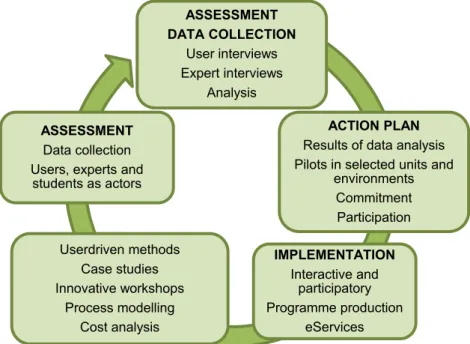
Action research together with Laurea's Learning by Developing model enhanced the compatibility and practicality of research and development activities. The Safe Home project is based on the innovation process and a userdriven approach. Action research and the LbD model have been used in previous CaringTV RD&I projects (cf. Lehto 2008). Action research in the Safe Home project was carried out in a cyclical process (Figure 1.)
Action Research Case Study User Study
Purpose Change Empowerment Understanding and reconstruction
Sharing knowledge, skills, competences and experiences
Process Dialogue and critical reflection Active participation
Retrospective description
Testing, piloting, and creation of new solutions
Producing tacit knowledge, ideas and solutions
Time perspective Current Past - current Current - future
Actors' roles Individuals as partners in interaction
Individual Group Situational Organisation as the subject of the case study
Researcher Inventor Innovator
Figure 1. Action research cycle
The LivingLab approach was utilised in the project (cf. Luotonen, Marttila, Hyyppä et al. 2011) alongside userdriven methods, which meant that different actors were actively involved in the development process of CaringTV. New knowledge and activities were produced in a cyclical process in real-life situations and genuine environments. The activities were studied, reflected upon and developed together with the participants to produce alternative solutions based on the project objectives. (cf. Kuula 2000, Heikkinen 2001, Raij & Lehto 2008). During the development process, clients and experts produced ideas together for new interactive programmes and virtual eServices. Different users and groups tested the new contents and methods and provided feedback. Virtual eServices were implemented by using different technological solutions and methods. (cf. Lehto 2008.)
Real-life operating environments and LivingLabs included the home environments and service houses of elderly people and other special groups, day centres, and the operating environments of service providers such as libraries and parishes. The LivingLab approach meant that participants from different environments took part and used the new technologies to produce programmes and develop digital services. Latest IT solutions and mobile equipment were used and applied as early as possible. Some participants were able to use equipment such as laptops independently or with assistance and
ASSESSMENT DATA COLLECTION User interviews Expert interviews Analysis ACTION PLAN
Results of data analysis Pilots in selected units and
environments Commitment Participation IMPLEMENTATION Interactive and participatory Programme production eServices Userdriven methods Case studies Innovative workshops Process modelling Cost analysis ASSESSMENT Data collection Users, experts and
take part in interactive programmes. The majority of participants needed technological solutions such as larger monitors or touch screens due to restricted abilities. Active participation by experts also required the use of new IT equipment to ensure that objectives were achieved. The programmes produced during the project included coordinated sessions, interactive discussion and culture-related programmes, and new digital wellbeing services.
The objective was to produce new virtual services in the context of CaringTV to promote interaction and participation. The development of virtual digital welfare services with different operators and in different operating environments using alternative technological solutions requires innovative service solutions, planning and testing. Cooperation with different operators strengthens the role of participants and anchors the activities in real life.
3.3 Research
Participants
The participants of the Ehyenä subproject of Safe Home included clients (N=136) and experts (N=77). Of the elderly participants (N=85), seven lived at home and 78 lived in service houses or used their day centres.
The average age of those living in their own homes was 78.5 years. The age range was 61-89. Three of those living in their own homes were women, and the remaining four were men. The average age in service houses was 79.5, and the age range was 60-94. There were 38 women and 40 men. In addition, the focus group included 16 Swedish-speaking elderly people who participated in group activities organised at the day centres of service houses. (Figure 1.) The number of participants with developmental disabilities was 12. Their average age was 42.3 years. Nine participants were women and three were men. The majority lived in assisted facilities in their own rooms in residential centres or units. Nearly all of the disabled participants had day jobs outside the homes.
Other participants were persons with mental health problems (N=4), and families with small children (N=4) and young people (N=28) who were clients of child welfare services. The mental health patients were three men and one female who actively took part in the programmes provided via CaringTV. Their average age was 32.8 years. All had suffered from mental health problems for several years and had problems coping independently. The participants lived in their own homes or in assisted flats. They used the group services and other services provided by the coordinating unit almost weekly. In the final stage of the project,
the mental health rehabilitation patients participated in the programmes every third week.
The families with small children participated in the project once a week at a group facility. The average age of the parents was 27.3 years. The total number of children was seven. Their average age was 2.1 years. The children's ages ranged between 11 months and 5 years. The families needed support in the general care of the children and in coping with everyday responsibilities. The young people who took part in the project (N=28) lived at home, independently or in family units. The average age of those living in family units was 15.6 years, and the average age of the remaining young participants was 18. 4 years. There were six boys and 22 girls. Some of the young people participated in CaringTV programmes as a group, and some took part one-to-one conversations with an expert via mobile connection (laptop).
The experts (N=77) representing the operating environments of the participants also contributed data to the research. The experts represented the different services accessed by the client participants, such as social and health care units, service houses and residential units. The average age of experts representing the services for the elderly (N=27) was 49.7 years. All but one of these experts were women. Only one had a higher university degree; five had a bachelor's level degree or a vocational qualification (Bachelor of Health Care). The majority of the experts had completed vocational education (enrolled nurse). 20 had over 10 years of work experience.
22 of the child welfare experts (N=27) were women and five were men. Their average age was 43.8 years. Over half of them had a higher university degree (professional title of social worker) and others had lower degrees (e.g. social instructor) or a vocational qualification (coordinator). Over half of the experts had over 10 years of work experience.
The age of experts working with the disabled ranged between 24 and 56 years. Nearly all were women and nurses, physiotherapists or enrolled nurses. Background of the experts were Bachelor of Health Care or Bachelor of Social Services or Master of Health Care. Four had less than 10 years of work experience. The educational background of experts working with mental health rehabilitation clients was either a bachelor's level degree or a vocational qualification in social and health care. Only one had less than 10 years of work experience.
The participants of the Omana subproject were specifically elderly clients of home care services who lived independently, family caregivers, and service
house clients with long-term illnesses or rehabilitation needs. A total of 91 people took part in the pilot and action research project for the virtual guidance and counselling service concept. Of the elderly participants, 62 were users of CaringTV; 5 of these were home care clients, 11 were elderly family caregivers, 29 were elderly service house clients, and 17 were elderly people from the peer group (Aurala study group representatives (N=7) and representatives of the Aurala Seniorituki KOTOSET technology group (N=17). In addition, 8 elderly users of telecare systems took part in the Omana subproject. These individuals lived in their own homes. Other participants included 21 relatives and family members; 9 of these participated in the CaringTV pilot and 12 participated in the telecare pilot, and both groups were actively involved in the development activities. A total of 28 experts participated in the Omana subproject. These included representatives of municipalities, home care and service house supervisors or workers, and other experts.
3.4
Userdriven Methods and Data Collection
In a user study, the emphasis is on systematic collection and refining of personal experiences, and the user's participation in the product development process (Hyysalo 2006). User data refers to information about the characteristics, features, forms and aesthetic qualities of a product or service as perceived by an individual or a group. The situation, relationship with other people or objects, and earlier experiences can provide user data for research purposes. In addition, user data can be collected by examining the experiences, visions and assumptions of designers, although collaboration with users is increasingly common.
User studies are usually based on qualitative research methods. In addition to conventional methods such as one-to-one interviews, focus groups, observation and participant observation, data can be collected using methods such as stories, thinking aloud, video recordings, images and drawings. In user study, observation refers to monitoring the user in his or her own environment to collect information about the user, his or her activities and user environment, and details about the product's use. The data is analysed, utilised and visualised using models and prototypes. Existing published information about the topic is also collected. (Ovaska, Aula & Majaranta 2005, Hyysalo 2006.)
Hyysalo's (2006) method for examining the user experience and its different aspects was used as a reference framework in the Safe Home project. The user experiences of different client groups and experts were examined in different stages of the project using the world schemes proposed by Hyysalo. The client groups represented the "people's world", where user experiences are examined with regard to issues such as the suitability of different technologies in improving safety. The "activity world" was used to examine the role of interaction in the use of the technological platform. Safety circuit solutions represented the "product world". The development of CaringTV and the related eServices was partly representative of the "physical world" proposed by Hyysalo: bringing services to environments such as homes requires special solutions. The user study also included a case study which provided a means for testing and producing interactive programmes and eWellbeing services for different groups in real environments. In the Safe Home project, data was collected in different stages of the action research process by a number of different methods. (Figure 2).
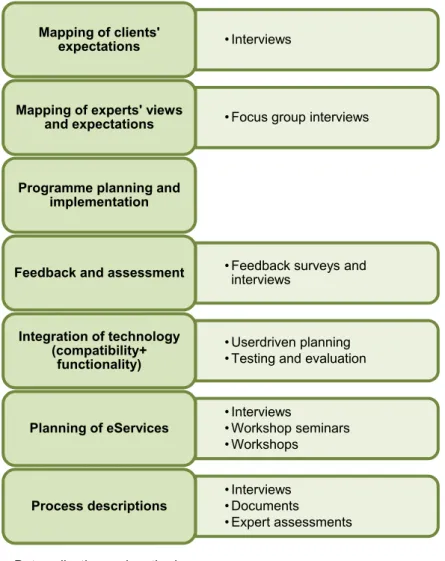
Figure 2. Data collection and methods
In the first stage of data collection, the participants were interviewed in order to map their expectations and to develop contents for CaringTV programmes. As project actors, the participants were also involved in workshops which produced ideas for new virtual services. Active participation produced a plethora of new ideas for services. The active role and participation of the actors is typical of action research. (cf. Kuula 2000).
Information about the problems, expectations and challenges of different actors was collected along with a description of the current state. The innovation process continued in workshops to develop new solutions, ideas and digital virtual services. In order to ensure the progress of the development process and attainment of its objectives, it is important to identify and evaluate genuine,
• Interviews
Mapping of clients' expectations
• Focus group interviews
Mapping of experts' views and expectations
Programme planning and implementation
• Feedback surveys and interviews
Feedback and assessment
• Userdriven planning • Testing and evaluation
Integration of technology (compatibility+ functionality) • Interviews • Workshop seminars • Workshops Planning of eServices • Interviews • Documents • Expert assessments Process descriptions
userdriven experiences when developing new services and operating models. In action research, the innovation or change happens and takes shape during the research project (cf. Kyrö 2004). Learning takes place between participants through the reflection and sharing of experiences, which means that the change is genuine. Research material was analysed by inductive qualitative content analysis and using Glaser's (1978) Six C's model. (Cf. Lehto 2008.)
3.5 Programme Themes and eWellbeing Services
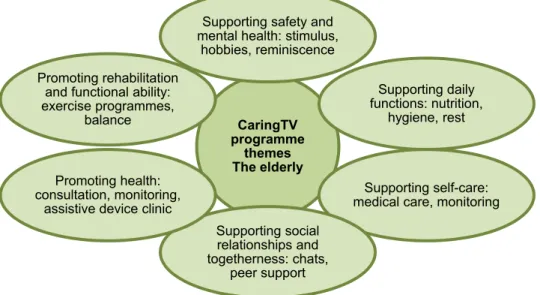
In this study, the participants were simultaneously the users and developers of services. Data was collected and evaluated by a number of different methods throughout the project. Analyses during different stages of data collection provided new contents for interactive programming, new virtual eWellbeing services, and new working methods for different client group. Using continuous evaluation, the interactive programmes and eServices were tested and developed in cooperation with different actors. The participants were engaged, empowered and activated through genuine partnership. (Cf. Lehto 2008.) Figure 3 contains an example of programme themes designed for the elderly.
Figure 3. Interactive programme themes
As the amount of information increases, so does the significance of technology; new applications and utilisation models are needed for both private and public
CaringTV programme
themes The elderly
Supporting safety and mental health: stimulus,
hobbies, reminiscence
Supporting daily functions: nutrition,
hygiene, rest
Supporting self-care: medical care, monitoring Supporting social relationships and togetherness: chats, peer support Promoting health: consultation, monitoring, assistive device clinic Promoting rehabilitation
and functional ability: exercise programmes,
sector clients. The need for welfare services grows in line with aging. Particularly virtual guidance and counselling services based on clients’ expectations and needs are constantly developing and growing. Today’s clients are increasingly skilled and demanding in using virtual services. More and more clients have access to the Internet and other multimedia solutions and opportunities. (Armanto 2005).
A number of different userdriven data collection methods were used in the Safe Home project, including workshops and co-ideation in conjunction with seminars. Interview data and workshop results were used to formulate ideas for new eWellBeing services (Figure 4).
Figure 4. Virtual eWellBeing services
The development objective of the Safe Home project was to produce interactive and virtual eWellbeing services based on new knowledge of information technologies. The availability of virtual services promotes preventive and self-directed health care. If new client-oriented operating models and alternative services are to be produced virtually and in diverse service environments, they must be compatible. The purpose of new operating models is to activate users and bring together various services (cf. Rajala, Pirnes & Hiroo 2007). Userdriven models create a basis for innovation and business operations that form a part of the great shift from service system orientation to client orientation. Technical
eServices (N=691) Product and prescription services Library services Parish services Club activities
Ask the expert Consultation and
clinic services eDiscussion
Click for help Information
channel
Cultural and recreational
solutions are increasingly moving to clients’ operating environments, be it in the home or the workplace (e.g. Aro, Harmo Kainulainen, etc. 2008). Technological solutions were utilised with a userdriven approach in the development and testing of welfare and health-related eWellbeing services. Table 2 below summarises the eServices produced and piloted as part of the project, their objectives, contents and client groups.
Table 2. Contents of eWellbeing services
eWellBeing
service Objective Contents Target group
eNurse
To support
wellbeing, health and coping at home
General health Social relationships Daily activities
Feelings and concerns Remote health data
Elderly living in their own homes
eDoctor To support health and provide information about illnesses and possible symptoms Medical guidance Discussions about health and symptoms
Elderly living in their own homes Experts ePhysio-therapist To support and encourage clients to maintain and improve their functional abilities Tailored plans Elderly living in their own homes The disabled Mental health patients
eDeacon
To offer discussion and support for the client's personal issues and feelings
Discussions about personal matters
Elderly living in their own homes Elderly living in service houses
eLibrary
To support and promote reading and music as hobbies
Literature sessions Music and singing sessions
The elderly Young people
3.6 CaringTV Conceptual Model
The starting points for CaringTV in the Safe Home project include the following concepts: participation, interaction and empowerment. The concepts took shape as the result of inductive analyses of collected data. Data was collected and analysed during different cycles of the action research process during the project. Userdriven methods provided new knowledge which was utilised in the implementation and testing of programmes and eWellbeing services. (Figure 5).
Figure 5. Conceptual model: CaringTV with and for elderly.
In the action research process and userdriven methods, the focus was on the participation of different actors. Participation as a concept can be examined from the point of view of promoting and inhibiting factors. Factors that promote participation are motivation and the willingness to participate, support and encouragement from another individual or group, and an inspiring environment. The contents and topicality of programmes can also promote participation. Since the focus groups of the Safe Home project are particularly sensitive and demanding, the main factors that inhibited participation were poor health, poor
PROMOTING FACTORS
participation (willingness and enthusiasm) interaction
peer group
enthusiastic and supportive expert
CONTENTS AND METHODS interactive programmes discussions
spontaneous programme sessions eWelfare services (eNurse, eDoctor, ePhysiotherapist eDeacon, eLibrary, eClub)
INHIBITING FACTORS client sensitivity and demands environmental distractions technical faults
attitudes
programme timing
MEANING OF CaringTV
Personal significance of CaringTV in terms of
- social relationships - everyday life - functional ability empowerment
CaringTV as a support for health and independent living of the elderly
functional ability, and forgetfulness. In the case of the experts, unwillingness to participate in the project, attitudes, and lack of know-how were identified as inhibiting factors. Other factors that inhibited participation in CaringTV included technical problems, such as faults or breaks in sound, and problems related to the physical environment, such as noise.
Active and regular participation in CaringTV programmes in the Safe Home project supports the functional ability and everyday coping of the individual or group, and provides meaningful activity in their everyday lives. For example, for elderly people living in their own homes, the programmes provided more variety in daily routines as well as peer support. For disabled people, participation in CaringTV programmes even replaced one weekly activity session, which meant that the staff could give more attention to residents with special needs. In the operating environment of young people, CaringTV provided a new form of group activity. According to feedback, CaringTV did not prevent or inhibit the functional ability or everyday activities of any person or group in any of the focus groups. According to previous studies, the use of technology may help to activate individuals or groups. The use of technology saves time in client work and administration. Technology is also important in the deployment of new methods. Technology promotes opportunities for clients to participate in the development of wellbeing services.
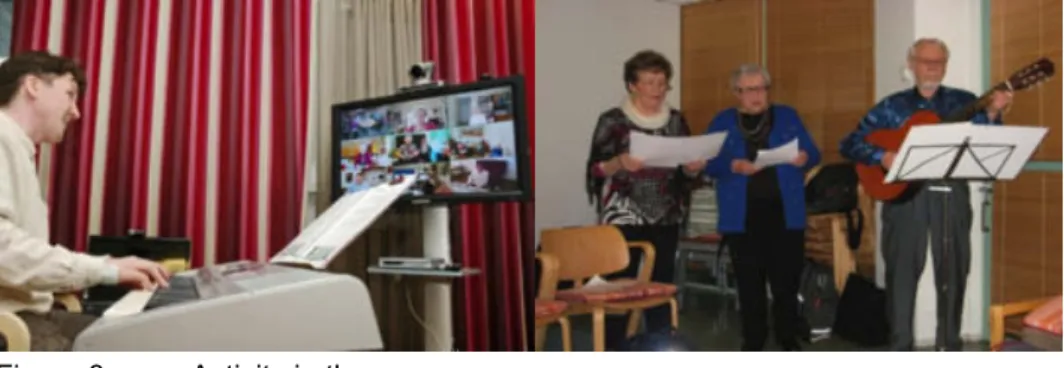
Participation appears as a multi-dimensional concept in the research material. The concept of participation can be examined from the point of view of activity. Participation can be passive or active. In passive participation, the participants of CaringTV programmes are assisted and guided by other operators such as experts. In this case, a programme coordinator or a member of staff actively coordinates the programme for the individual or group. A typical example of passive participation is a programme that focuses on informative content or given instructions. Active participation refers to active, interactive or spontaneous participation of an individual or group in CaringTV programmes. Examples of active participatory programmes are activity-based programmes or programmes prepared and coordinated by the participants themselves. (Figure 3.)
Figure 3. Activity in the programme
In activities involving active participation, interaction is richer, more active and interactive than in passive participation. Interaction is another key concept of CaringTV. In terms of content, interaction occurs in the form of reminiscence, examination of the present, situational sensitivity, or a future orientation. In the context of the past, interaction occurs in the form of reminiscence in a group or as individuals, recounting of personal experiences, and sharing of information. In the present dimension, interaction refers to the recognition of information or situation, concentration, or sharing about the programme theme or pre-agreed content. An example of a programme focussing on the present is one that relates to a current news story or event.
Situational or momentary interaction is about active dialogue and deep sharing of issues or situations. Situational sensitivity supports spontaneous discussion about the topic and it requires continuity. One example of situationally sensitive interaction is the "Saturday coffee session" organised by elderly people living independently. In these sessions, the participants take part in a userdriven, voluntary activity, discussing and sharing thoughts and experiences about a spontaneous topic. Situational sensitivity is also evident in how the participants continue discussion amongst them after the programme ends. Future orientation in interaction shows in the content of discussions and reflections related to the expectations, hopes and anticipations of the participants. In the evaluation data of virtual eWellbeing services, the future dimension occurs in areas such as hopes expressed about a new eHealth centre or about userdriven, tailored services. (Figure 6).
The analysis of the content and scope of interaction as a concept in the context of interactive CaringTV can be described as follows:
Figure 6. Interaction in CaringTV (example: the elderly)
The userdriven approach and programme contents were selected based on interview data from interviews with both clients and experts. From the client's point of view, the evaluation of interaction concerns activation, sense of belonging, care and relaxation. Interaction means different things to different client groups. For lone elders living at home, interaction through CaringTV has provided everyday content that supports their functional abilities and independent living. CaringTV has provided a community for the elderly, and it has become a part of their everyday lives.
"How happy we are, we get a chance to support each other" "We are like one big family"
Interaction has promoted the activation and sociability of individuals in different focus groups and improved their sense of belonging and concentration in different operating environments. Familiarity and continuity are prerequisites for interaction. The enthusiasm and commitment of the expert promoted and strengthened active participation by individuals living in different types of operating environments, such as disabled people, and the intelligibility of interaction. The presumptions about the demands and difficulty of interaction via
CaringTV between disabled people were proven wrong. Authenticity and focus of interaction, and the clarity of communication supported the clients' participation.
The concept of empowerment was derived from the analysis of the concepts of participation and interaction. Empowerment as a concept indicates trust, encountering, presence, and opportunity. With regard to content, empowerment can be described both in terms of encountering the individual and communal participation. Individuality refers to the consideration of the participants' expectations and focus in the planning and implementation of programmes. Trust strengthens the participants' active roles both in programme production and in the implementation of eWellbeing services. One-to-one discussions with the eNurse or eDoctor support, promote and strengthen the general situation of an elderly person. Having the courage to participate in the programme or in the ensuing discussion indicates empowerment. At its best, empowerment is about genuine presence and sense of belonging. Empowerment includes the dimension of possibility, which means that the participant himself/herself wants to become active in a new way. In the context of CaringTV, empowerment manifests in the participants' desire and courage to take responsibility for programme production. An example of possibility in empowerment is a shy and timid young person who has the courage and confidence to design and implement an activity programme for other young people on CaringTV. CaringTV can support a person's self-esteem and self-confidence. The expert's encouragement and role are significant in the empowerment process.
Figure 7. CaringTV roadmap
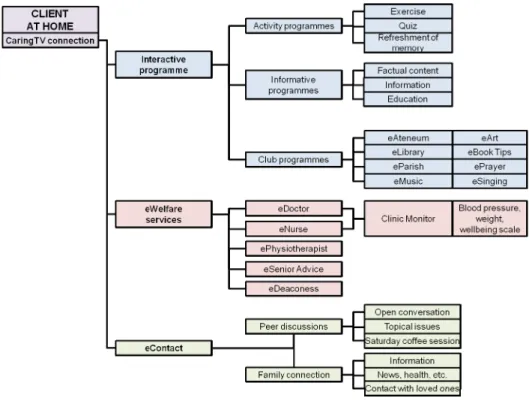
Figure 7 describes the services related to the CaringTV concept (road map) CaringTV programming includes interactive programmes, eWellbeing services, and eCommunications. Interactive programming comprises activity programmes, informative programmes, and club programmes. eServices formed a separate group which included the eDoctor, eNurse, ePhysiotherapist, eSenior Counselling, and the eDeaconess/eDeacon services. eCommunications consisted of peer chats and contact with relatives. The services produced as part of the research activity in the Safe Home project have been piloted and evaluated. The road map facilitates the provision of customised and focused solutions for virtual and digital services to a number of different user groups.
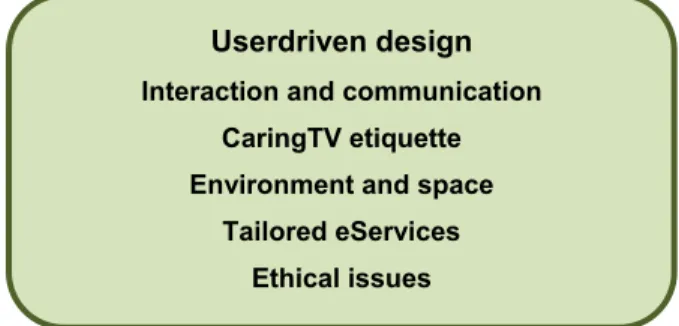
The following recommendations can be drawn from the research data. (Figure 8).
Figure 8. Userdriven recommendations: interactive programming and virtual services
Userdriven design
Interaction and communication CaringTV etiquette Environment and space
Tailored eServices Ethical issues
4 CaringTV® as an Everyday Support of
Different User Groups
In the Safe Home project, both the clients and the experts had an important role in the development of the project. The results of their participation, evaluations and joint workshops have been used to carry the project through with a userdriven approach. Even minimal participation by users can result in better functionality and usability of services. Furthermore, user experiences and feedback can provide improvement ideas with regard to the usefulness and appeal of products, and new product ideas for businesses. (Heiskanen et al. 2007.)
Further development of alternative technological solutions is needed in order to fulfil different user groups' expectations about the availability of virtual services. One aspect of the userdriven approach is the desirability of the technology. If the users find the products and services appealing, they can be used in a more productive way. The clients and all parties should have a clear idea about what need is being fulfilled with the technology. This is a step towards understanding the bigger picture: technology is a good servant but bad master. The effectiveness of technologies and the related services is an important development area from the point of view of the society as a whole. Good planning pays dividends in the future. (Raappana & Melkas 2009.)
Clients' participation in the project and focus groups are described in the following chapters along with the results of action research.
4.1
Interactive Programmes for the Everyday Lives
of
the
Elderly
Paula Lehto, Johanna Leskelä, Hanna Kantell & Katja Tikkanen
As early as the 1990s, research showed that the challenges of elderly and geriatric care will be a central area where development is needed by private and public social service and health providers. Senior citizens’ desire to live at home
is growing significantly. A period of extensive institutional construction came to an end in the 1990s. Long-term living at home postpones the use of elderly services until a very late age, so the importance of friends and relatives in providing support for living at home increases. Some estimates indicate that more than 80% of daily services needed by senior citizens already come from outside the public sector. Another challenge relates to social, economic and cultural changes in aging. In the future, the elderly population will be more financially independent and more highly educated, being able to make independent decisions on their lives until a late age. They will have more economical and political power in society. Their consumption habits will also change. Improvements in the health and coping ability of the elderly population are already visible; in future there will be more and more healthy, capable senior citizens. (Holma 2003.)
Koskinen (2004) identifies the third, fourth and fifth ages as stages of life. In the third age, life continues actively. The fourth age involves gradual renunciation and dependency, which means an increased need for care and support. In the fifth age, we are more dependent on other people’s assistance. Koskinen (2004) links the new concept of “productive aging” to the third age. In productive aging, retirement after a long career can be seen from the point of view of unused, valuable resources and tacit knowledge. The third age and productive aging recognise the opportunities for the elderly of actively participating in and benefiting society.
The concept of productive aging also questions traditional aging-related age structures, norms, stereotypes and expectations. (Koskinen 2004.) The third and fourth ages are challenges for positive aging, and particularly for the active participation of the elderly in the research and development of new aging-related welfare services. The personal experiences and understanding of senior citizens in relation to health and wellbeing are particularly significant. Even if functional ability should be reduced or limited, activeness and humanity can continue through participation and the smooth functioning of daily activities. Each senior citizen is different, with unique health, capabilities, life experiences, social resources and financial circumstances. Some are completely independent and can cope alone at home. According to Heikkinen (2003), aging can be described using diverse characteristics: aging is universal and chronologically progressive; it weakens bodily functions and increases the likelihood of death. Some definitions see aging mainly as a property of a biological system, all multi-celled organisms being subject to the same laws of nature. In other definitions, aging is seen as a broader phenomenon, involving changes in bodily structures as well