IMPROVING LEARNING MOTIVATION AND COGNITIVE LEARNING
OUTCOMES USING BLENDED LEARNING-BASED GUIDED INQUIRY
STRATEGY THROUGH LESSON STUDY IN GENETICS
Waris1,* and Herawati Susilo2
1
Faculty of Mathematics and Science Education, Teacher Training College PGRI Jember, Indonesia
2
Faculty of Mathematics and Science, State University of Malang (UM), Indonesia
*Corresponding email: [email protected]
Abstract
There are still problems in the teaching and learning processes in Biology Department, Faculty of Mathematics and Science Education, Teacher Training College PGRI Jember. Most of the lectures are still conducted through face to face meeting, unidirectional and low participation of students. Therefore, the
students’ motivation and cognitive learning outcomes are also still not as expected. There are also lack of
sharing among lecturers in planning the teaching and learning processes, and the use of multimedia information technology is not maximized. This research aims to improve the motivation and cognitive learning outcomes of the students with different academic capabilities by using Blended Learning-based guided inquiry strategy through Lesson Study in Genetics Course. The subjects were 54 biology education students of the Teachers Training College PGRI Jember who attended genetics course. The subjects were divided into two groups, which are lower academic group and higher academic group. The indicator of improvement was determined by the increase of percentage (%) in motivation and cognitive learning outcomes before and after the learning processes.
The results showed that the increase of motivation to learn in the lower academic capability students was 29.61%. This was higher than the increase of motivation to learn in the higher academic capability students which was 25.35%. The increase of cognitive learning outcomes in the lower academic capability students was 95.86%. This was also higher than the increase of cognitive learning outcomes in the higher academic capability students which was 81.16%. The increase in all aspects happened because by using the Blended Learning-based guided inquiry strategy, the students could search for and found their own
concepts of genetics by using information technology. The Lesson Study has improve the lecturers’
awareness of the need to share experience among lecturers to improve their experties in conducting a higher quality of teaching learning processes.
Keywords: blended learning, cognitive learning outcomes, Genetics, guided inquiry, motivation to learn.
1. INTRODUCTION
Basically the process of learning in college is to prepare students to have knowledge and technology through the development of talents, interests, thinking skills, creative attitude, collaboration, and confidence as a preparation to face the challenges in an increasingly competitive society. Therefore, the learning process should be conducted interactively, inspiringly, excitingly and motivate students to actively participate and provide enough space for initiative, creativity, and independence according to student talents and interests [1]. However, in fact, in Department of Biology Education, Faculty of Science, Institute of Teacher Training and Education (IKIP) PGRI Jember, most of learning process is still conducted face-to-face, unidirectional meeting and is less fostering students’ active participation. The learning process is done classically which still pays less attention to students with low academic ability, the strategy/model learning used is not in line with students interests and character, there is lack of sharing among faculty members in lesson planning, and the use of information multimedia technology is not maximal. Thus, the motivation and cognitive learning outcomes do not meet expectation. Based on the preliminary survey on motivation of learning on October 13, 2012 toward 58 students of Biology
Education Department, Faculty of Science, Institute of Teacher Training and Education (IKIP) PGRI Jember, it was shown that student motivation was still in the low category. Results of interviews with one of lecturers of Biology subject also showed complaint that students had lack of learning motivation. Student learning outcomes was still in fair category. Based on the score of final examination, Biology Education Department, IKIP PGRI Jember in 2012, it was found that the last three years student learning outcomes for the course of genetics were in average of 65 in the category C. In 2009, the number of students who took the subject of genetics was 82 who got marks A (18.5%), B (37.4%), C (41%), D (3.1%). In 2010 the number of students who took the subject of genetics was 68 with marking A (7.3%), B (23.5%), C (57.4%), and D (11.8%). In 2011, the number of students who took the course of genetics was 59, with marks A (6.8%), B (20.3%), C (59.3%), and D (13.6%).
Based on the learning processes that occurred at IKIP PGRI Jember, it is necessary to take efforts to enable the learning process in accordance with the student character, one of which is by implementing guided inquiry strategy based on Blended Learning through Lesson Study. This is because this strategy can build students own knowledge undertaken by the students themselves based on their previous experience, through active, dynamic, explorative processes of the inductive activities, builds up learning motivation in order to obtain the expected student cognitive learning outcomes. Guided inquiry is the learning that focuses on the activities and the provision of learning experiences directly to students, so that students can have the opportunity to observe, formulate the problem, generate hypotheses, design experiments, collect and analyze data, and interpret data, draw conclusions based on authentic evidence and communicate the results of their inquiry activities [2]-[3]. [4] states that through the implementation of guided inquiry, students can conduct investigation, exploration, searching, researching, chasing, and learning.
The implementation of guided inquiry strategy proves effective to improve student thinking skill, attitude, cognitive learning outcome, and learning motivation [5]-[6]. The results of the study [7] showed that the student interest and understanding increased from 72.90% to 76.81% after the application of guided inquiry strategy supported with multimedia. Research results [8] also showed that the process of learning applying guided inquiry can enhance student activities and learning outcomes.
Guided inquiry can be developed to improve the quality of learning system, which converts a conventional learning system into constructivist learning system supported by information technology facilities. Application of information technology in education can make a variety of teaching materials be produced and used in the form of attractive and varied performance, so it can arouse students learning motivation. A learning which is based on Blended Learning not only develops the learners’interaction but also provides a positive learning environment [9]. Blended Learning-based learning also can make students become more motivated and interested because students can access multimedia and other innovative devices. The results of the study [10] showed that 78.35 % of students felt interested and motivated in learning using of information technology or internet. The implementation of Blended Learning-based guided inquiry enables a shift in learning orientation from outside-guided learning into self-guided and from knowledge-as-possession into knowledge-as-construction [11].
Lesson Study (LS) is a model of professional educator development through collaborative and sustainable learning assessment based on collegiality principles by a group of lecturers to build a learning community. In the LS, the learning device is developed based on the results of professional knowledge "sharing" which is in accordance with practice of results [12]. Through three stages in the LS namely plan,
do, and see, the collaborating lecturers can exchange ideas to improve the quality of learning process to
help students who have difficulty in learning, to increase student motivation and learning outcomes.
2. METHODOLOGY
The research subjects were 54 students majoring in Biology Education, Faculty of Science Education, IKIP PGRI Jember who took the course of genetics. The research subjects were divided into two classes, that is, class A and class B. In each class, there were higher academic group and lower academic group. Data on student learning motivation were obtained in two ways; the first was by using learning motivation questionnaire given before and after the learning process, and the second was by observing any learning process for 13 meetings. The questionnaire of learning motivation consisted of 62 items with a maximum score of 5 each item. Observation instrument consisted of 14 items with a maximum score of 1 each item. Data on cognitive learning outcomes were obtained from the test results using essay test conducted before
motivation and cognitive learning outcomes are available as on Table 1. LS Activities were carried out 10 cycles with 13 meeting for 10 major themes of genetics materials. The first LS activities were carried out in class A, and then the results of reflection of LS activities in class A were used as bases for improvement of the learning process in class B. Time of LS activities is shown in Table 2.
Table 1: Questionnaire Assessment Scale of Motivation and Cognitive Learning Outcomes. Questionnaire of Motivation Results of Observation on Motivation Cognitive Learning Outcomes
Score Category Score Category Score Category 209-312 High 11-15 High 67-99 High 105-208 Fair 6-10 Fair 34-66 Fair
1-104 Low 1-5 Low 1-33 Low
Tabel 2: Time of LS Activities.
Cycle Meeting Main Subject Time of LS in Class A
Time of LS in Class B 1 1 Mendelian Genetics 29 April 2013 3 May 2013
2 Medium Making of Drosophila Culture 6 May 2013 10 May 2013 3 Monohybrid Crossing 13 May 2013 17 May 2013 4 Dihybrid Crossing 20 May 2013 24 May 2013 2 5 Properties Inheritance Pattern Outside
Mendel Genetics
27 May 2013 31 May 2013
3 6 Probability Theory 3 June 2013 7 June 2013 4 7 Sex Linkage 10 June 2013 14 June 2014 5 8 Sex Dtermination 17 June 2013 21 June 2013 6 9 Chromosomal Crossover and Map 24 June 2013 28 June 2013 7 10 Chromosome abnormality 1 July 2013 5 July 2013 8 11 Gene Expression 8 July 2013 12 July 2013 9 12 Population Genetics 15 July 2013 19 July 2013 10 13 Recombinant DNA Technology 22 July 2013 26 July 2013
3. RESULTSANDDISCUSSION
Data on mean value of learning motivation questionnaires in class A and class B and mean value of learning motivation questionnaires on student groups with higher and lower academic ability are shown in Table 3 and Table 4.
Table 3. Mean Value of Learning Motivation Questionnaires Based on Class.
Class
Mean Value of Questionnaire
Beginning of Lecture End of Lecture Increase (%) Value Category Value Category
A 224.2 High 283.7 High 26.54 B 224.0 High 285.6 High 27.50
Table 4. Mean Value of Learning Motivation Questionnaires Based on Academic Ability.
Academic Ability
Mean Value of Questionnaire
Beginning of Lecture End of Lecture Increase (%) Value Category Value Category
Higher 227.50 High 280.18 High 23.43 Lower 221.00 High 274.52 High 24.22
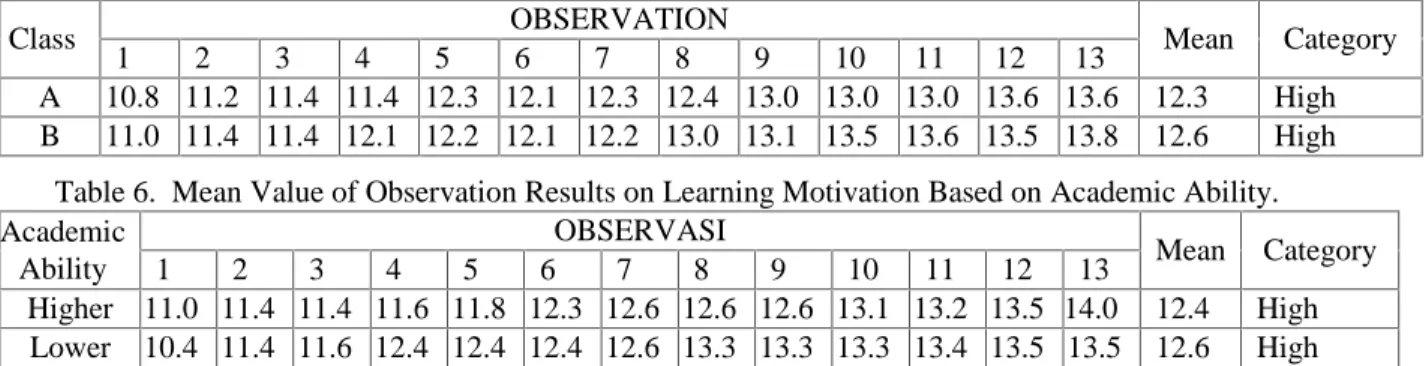
Data on mean value of the observation results of learning motivation in class A and class B and mean value of observation results of learning motivation on student groups with higher and lower academic capability are shown in Table 5 and Table 6.
Table 5. Mean Value of Observation on Learning Motivation Based on Class.
Class OBSERVATION Mean Category
1 2 3 4 5 6 7 8 9 10 11 12 13
A 10.8 11.2 11.4 11.4 12.3 12.1 12.3 12.4 13.0 13.0 13.0 13.6 13.6 12.3 High B 11.0 11.4 11.4 12.1 12.2 12.1 12.2 13.0 13.1 13.5 13.6 13.5 13.8 12.6 High
Table 6. Mean Value of Observation Results on Learning Motivation Based on Academic Ability. Academic Ability OBSERVASI Mean Category 1 2 3 4 5 6 7 8 9 10 11 12 13 Higher 11.0 11.4 11.4 11.6 11.8 12.3 12.6 12.6 12.6 13.1 13.2 13.5 14.0 12.4 High Lower 10.4 11.4 11.6 12.4 12.4 12.4 12.6 13.3 13.3 13.3 13.4 13.5 13.5 12.6 High The mean value of cognitive learning outcomes in classes A and B and the mean value of cognitive learning outcomes of student groups with higher and lower academic ability are shown in Table 7 and Table 8.
Table 7: Mean Value of Pre-Test and Post-Test of Cognitive Learning Outcomes Based on Class
Class Mean Value of Pre-Test Mean Value of Post-Test Increase (%) Value Category Value Category
A 42.41 Fair 79.15 High 86.63 B 42.22 Fair 80.37 High 90.36
Table 8: Mean Value of Pre-Test and Post-Test of Cognitive Learning Outcomes Based on Academic Ability
Academic Ability
Mean Value of Pre-Test Mean Value of Post-Test
Increase (%) Value Category Value Category
Higher 44.22 Fair 80.11 High 81.16 Lower 40.11 Fair 79.22 High 95.86
In Table 3 is seen the increase in student learning motivation in class B (38.51%). This is higher than the increase in student learning motivation in class A (36.39%). Similarly, Table 5 shows that the learning motivation in class B (12.5) is higher than that in class A (11.2). In Table 5 is also shown that the learning motivation tends to increase from the previous meetings. This happens because there have been improvement and development of the learning process in class B based on the reflection results of Lesson Study activities in the learning process in class A. Student learning motivation in class B was improved by adding questions/problems that required problem solving by students themselves, so the student attention and concentration were more focused on learning activities. In addition, in the learning process in class B the number of learning videos relevant to the topic of learning was added, so that this could add and improve student perception of the learning topics.
In Table 4, it is seen that the learning motivation in students group with the lower academic ability increases (29.61%). This is higher than the increase in learning motivation in students group with higher academic ability (25.35%). Similarly, Table 6 indicates that the observation results of student learning motivation of student group with lower academic ability (12.6) is higher than that in student group with higher academic ability (11.6). This happens because in the implementation of guided inquiry strategy on the basis of Blended Learning, students with lower academic ability had large opportunity to do activities, and their creativity was in accordance with the desires and wants; students performed inquire by confidence and feeling able to do successfully. Students, who have confidence, have a positive judgment about themselves and tend to show good performance continuously. This attitude encouraged students to achieve optimal success. Confidence and feeling to capably perform inquiry successfully will encourage students to do the activities as well as possible in order to achieve better results than ever before.
Table 7 shows the increase in cognitive learning outcomes in class B (90.36); this is higher than that in class A (86.63). Similarly, in Table 8 is shown that the increase in cognitive learning outcomes in students group with lower academic ability (29.61%) is higher than that in the students group with higher academic ability (25.35%). All of this happened because of the implementation of guided inquiry on the basis of
ability is higher than that in the students group with higher academic capability. The high motivation is able to generate and sustain attention, develop confidence, develop student satisfaction on learning. The significant increase in learning motivation will help students improve cognitive learning outcomes.
In addition, this is because the implementation of Blended Learning-based guided inquiry can be undertaken either inside or outside the classroom. The learning process which is only done in the classroom can make students feel bored or saturated; however, by learning location that is considered suitable which is determined by the students themselves to do inquiry can be a motivator for students to carry out the process of learning. By the implementation of guided inquiry, students may find the concepts of genetics and solve genetics problems that exist in the environment based on their own experience, such as doing the hybridization to prove Mendel's theory, analyzing positive and negative impacts of genetically-engineered crops for human life and for the survival of the plant itself as well as performing the other activities relevant to the genetics materials. The knowledge gained from their own experience and direct observation of the actual objects will be stored in long term memory. This can improve their cognitive ability. The results of study [13] proves that the implementation of guided inquiry gains the early average value of cognitive learning achievement by 60.30 while the average value of the end of result of cognitive learning is 72.50.
Through Blended learning, students with lower academic ability can any time interact, discuss and consult with their peers and lecturers to overcome their learning difficulties. By using Blended Learning, students can access, read and study more literatures and more widely, which will increase and develop their insight. Using Blended learning, teaching materials can be compiled and presented in the form of audio-visual devices, so students are interested in learning, teaching materials can be stored in the form of a compact disk or flash disk, so students can study the materials repeatedly anywhere and anytime. Similarly, the time spent for learning by students will be longer. All of these will increase the student motivation and cognitive learning outcomes. The results of the study [14] state that the Blended Learning program has the potential to improve student learning outcomes and also low the dropout rate compared to full online learning. Also, it is found that the blended-based learning model is better than face-to-face learning.
Through Lesson Study, lectures can deliver the instructional activities of shared knowledge on the basis of observation. The observation results of the learning process in class A toward motivation, perception, concentration, and student-student, student-lecturer interactions are made as reflections used for refinement and improvement of the quality of the learning process in class B. Through Lesson Study lecturers can together think of knowledge which is considered essential and mutually share information that is necessary for teaching students. The process of reflection which is done sustainably conducted by lecturers can increase the quality of learning and students learning activities and will produce professional lecturers.
4. CONCLUSION
The implementation of Blended Learning-based guided inquiry strategy can increase motivation and learning outcomes in classes with learning process which is done after Lesson Study and in the group of students with lower academic ability and in the group of students with higher academic ability. This occurs because the implementation of Blended Learning-based guided inquiry strategy through Lesson Study can help students access more literatures, give larger study room, provide a longer time of study as well as provide an opportunity for students to explore and find their own concepts of genetics through actual experiences.
REFERENCES
[1] Republic of Indonesia Government Rule Number 19 Year 2005 on National Education Standard. [2] Scapler, J.A., Sethakorn, N.&S. Styer, Cultured Inquiry, The Science Teacher, 6 (2), 2003, pp.56-61. [3] Depdiknas, Kurikulum 2004 SMA Pedoman Khusus Pengembangan Silabus dan Penilaian Mata
Pelajaran Biologi, Jakarta: Direktorat Pendidikan Menengah Umum Departemen Pendidikan
Nasional, 2003a.
[4] Kulthau C.C., Maniotes L.K., Caspari A.K., Guided Inquiry: Learning in the 21st Century School. Westport, CT: Libraries Unlimited, 2007.
[5] Joyce B., M. Weil & E. Calhoun, Model of Teaching 6thedition, Allyn Bacon, Boston, United State of America, 2000.
[6] Bodzin, Alec M, Waller, Patricia L, Lana Edwards Santoro, Kale, Darlene, Investigating the Use of Inquiry & Web-Based Activities with Inclusive Biology Learners, The American Biology Teacher, 69 (5), 2007 pp. 273-279.
[7] Wahyudin, Kusnandi dan Tia Purniati, Upaya Meningkatkan Pencapaian Belajar Mahasiswa pada
Perkuliahan Kapita Selekta Matematika Sekolah Melalui Pembelajaran Resiprokal, FPMIPA UPI,
Bandung, 2010.
[8] Tin Rustini, Penerapan Model Inkuiri Dalam Meningkatkan Pembelajaran IPS di Kelas IV Sekolah Dasar, Jurnal Pendidikan Dasar, Nomor 11, 2009, pp.16-20.
[9] Koesnandar, Pengembangan Bahan Ajar Berbasis Web, Pusat Teknologi Informasi dan Komunikasi, Depdiknas, Jakarta, 2008.
[10] Rathomy, B., Penerapan Media Pembelajaran Berbasis Web Meningkatkan Keterampilan Berpikir Kritis Siswa, Jurnal Pendidikan Biologi, 1 (2), 2010, pp.189-197.
[11] Turino, E-Learning Bahasa Inggris Berbasis Web, Jurnal Teknologi Informasi, 5(2), 2009, pp.726-729.
[12] Tim Lesson Study, Rambu-Rambu Pelaksanaan Lesson Study, Yogyakarta: FMIPA UNY, 2007. [13] Wahyudin, Sutikno, A.Isa, Keefektifan Pembelajaran Berbantuan Multimedia Menggunakan Metode
Inkuiri Terbimbing Untuk Meningkatkan Minat Dan Pemahaman Siswa, Jurnal Pendidikan Fisika
Indonesia, Vol.6, 2010, pp.58-62.
[14] Charles D. Dziuban, Joel L. Hartman, Patsy D. Moskal, Blended Learning, Research Bulletin. Volume 2004, Issue 7, March 30, 2004.