European journal of vocational training – No 40 – 2007/1 – ISSN 1977-0219
Training in
socio-emotional skills through
on-site training (
1
)
Elvira Repetto Talavera
Professor of Educational Guidance in the Universidad Nacional de Educación a Distancia (National University for Distance-Learning, UNED), Spain
Juan Carlos Pérez-González
Professor in the Education Faculty in the Universidad Nacional de Educación a Distancia (National University for Distance-Learning, UNED), Spain
SUMMARY
Socio-emotional skills are highly prized on the labour market these days; many writers say that competencies of this type help to increase individuals’ employ-ability, but educational institutions consistently forget their responsibility for pro-viding training in them.
Most jobs call not only for knowledge and specific technical competencies, but also for a certain level of social and emotional skills enabling workers, for ex-ample, to work in teams, to motivate themselves when confronting problems, to solve interpersonal disputes, and to tolerate high levels of stress.
The best way of developing socio-emotional skills is through experience, appro-priate training and practice. For this reason, we argue that the time spent under-going on-site training is a perfect opportunity for tutors to help students and re-cent graduates to develop their socio-emotional skills.
Acknowledgements
The preparation for this article has been carried out as part of Project SEJ2004-07648/EDUC, funded by the Spanish Ministry of Education and Science. We wish to express our gratitude to the anonymous reviewers for their interesting comments and suggestions on the first draft.
Key words Social skill, apprenticeship, vocational training, work-based training, personal development, vocational guidance, mentoring
(1) This article forms part of research carried out under the ‘Orientación y desarrollo de
com-petencias socioemocionales a través de las prácticas en empresas’ [Socio-emotional skills guidance and development through on-site training] (SEJ2004-07648/EDUC) research pro-ject, funded by the Spanish Ministry of Education and Science and directed by Professor Elvira Repetto. However, it does not necessarily represent the Ministry’s position or policies; accordingly, the content of the article no more than represents the free expression of the authors’ professional opinions.
Introduction
Hand in hand with the recent technological revolution and economic globalisation of the 20th century, the concept, structure and work dynam-ics of organisations the world over have been re-defined; at the same time, changes have occurred in kinds of work, in organisational and intangible technologies and, logically, in the skills profiles required of young people and workers.
Our society needs more and more professionals endowed with a wide range of skills, and in particular with those skills that are not restrict-ed to the technical content of their jobs, but which are also relatrestrict-ed to the way of working, to attitudes towards work and others, to the quality of re-lationships, and to flexibility and the capacity to adapt. It is not simply a question of knowing how to do something (know-how), but also of wanting to do it and knowing how to be. Education must meet this demand, and guidance in particular may be seen as an appropriate educational tool for addressing the demand.
The importance of skills training has been highlighted by various lead-ing international institutions such as the Organisation for Economic Coop-eration and Development (OECD), the International Labour Organization (ILO), and the European Union itself. In short, an interest has been clear-ly expressed in what has been called the ‘skills focus’ at an international level (García, 2003; Irigoin and Vargas, 2002).
The emphasis in the European Union today is on the need to give skills training to young people and workers, irrespective of whether they work by preference with things, ideas, data or people. On the one hand, the need to have both standards of professional qualification and standards of high-er (univhigh-ersity) education has been established in the European context. Specifically, in Spain, Organic Law 5/2002 of 19 June on Qualifications and Vocational Training (Ley Orgánica 5/2002, de 19 de junio, de las Cua-lificaciones y de la Formación Profesional) states that the policies to be de-veloped must ensure that the competences, knowledge and attitudes (cru-cial for national and European competitiveness) of all segments of the pop-ulation are strengthened.
On the other hand, the Tuning Educational Structures in Europe proj-ect on the implementation of the 1999 Bologna Declaration at university level is also based on the skills focus; one of the project’s key objectives is to help develop European university qualifications that are easily com-parable and comprehensible, and based on the design of occupational pro-files, learning outcomes, and skills that are desirable in terms of generic and specific skills relating to each area of study or occupational sector (González and Wagenaar, 2003, p. 28-33).
The skills focus
Research into the role of non-cognitive and personality variables in the performance of employment duties got under way in the 1970s when the skills focus was beginning to gain in importance (McClelland, 1973). In-deed, this focus has received a new lease of life in the last few decades (Boyatzis, 1982; Fletcher, 1991; Wolf, 1995; Levy-Leboyer, 1997; Tejada, 1999; Pereda and Berrocal, 1999, 2001; García, 2000, 2003), finally be-ing applied by European education and vocational trainbe-ing policies (Blas, 1999). Although the skills focus has attracted serious criticism (Barret and Depinet, 1991; Barnett, 1994) - for example, it is frequently referred to as a ‘fad’ (Del Pino, 1997) - its usefulness, as many writers have pointed out, is becoming increasingly self-evident and incontrovertible:la gestión por competencias es una moda del management, pero es una moda que ‘sirve’ para apoyar e instrumentar la nueva organización de la empresa y la nue-va realidad de la gestión de personas en la organización laboral [manage-ment by skills is a style of manage[manage-ment, but one that ‘serves’ to support and structure the enterprise’s new organisation and the new reality of per-son management in workforce organisation] (Jiménez, 1997, p. 347).
Although a large number of definitions may be found in the literature on the concept of ‘skill’, most emphasise that all skills are learned, or are capable of being learned and developed, and necessarily involve the ap-propriate (and observable) performance of particular types of activity and task. According to some writers, for example, skills arelos comportamien-tos que se llevan a cabo cuando se ponen en práctica los conocimien-tos, aptitudes y rasgos de personalidad [behaviours that are carried out when knowledge, aptitudes and personality traits are put into practice] (Pereda and Berrocal, 1999, p. 75); others say that they constitute the con-junto de conocimientos, procedimientos, destrezas, aptitudes y actitudes necesarias para realizar actividades diversas (ejercer una profesión, re-solver problemas) con un cierto nivel de calidad y eficacia, y de forma autónoma y flexible [corpus of knowledge, procedures, competences, ap-titudes and atap-titudes that are needed to carry out various activities (e.g. do-ing a job or solvdo-ing problems) to a certain degree of quality and effec-tiveness, and in an independent and flexible manner] (Bisquerra, 2002, p. 7). Repetto, Ballesteros and Malik (2000, p. 60) take the view that the word ‘skill’ mainly refers to the integration of the three levels of human func-tioning usually referred to by the acronym KSA (knowledge, skills and at-titudes), and originally described by Bloom et al. as the ‘cognitive, psy-chomotor and affective’ fields (Bloom, Engelhart, Furst, Hill, and Krathwohl, 1956; Krathwohl, Bloom, and Masia, 1964; Dave, 1970; Simpson, 1972; Harrow, 1972):
• knowledge, the outcomes of perceptive and conceptual processes such as attention, selection, symbolisation, codification/decodification, re-flection and evaluation;
• execution of competences, the outcomes of the psychomotor process that enables individuals to give clear responses, and possibly to offer a tangible product that may be observed and assessed by another per-son;
• attitudes, the products of emotional responses to events and other spe-cific objects.
In this context, Roe (2002, 2003) proposes a comprehensive skills mod-el whereby the skills (and sub-skills) that devmod-elop through practice in the workplace flow from an expression of knowledge, skills and attitudes, and from a combination of capacities, personality traits and other personal char-acteristics like motivation, energy state and level of vitality. However, we believe that it is also important to stress that skills are not stable charac-teristics (traits), but rather the demonstration of an appropriate perform-ance in particular contextual/situational conditions, despite the fact that this performance is only carried out thanks to the prior existence and combi-nation of personal and contextual resources. With regard to skills, there-fore, it is important to bear in mind that their acquisition, development and expression (or inhibition) depend at all times both on personal character-istics, such as contextual or situational charactercharacter-istics, and on the dynam-ic interaction between both fields (personal and situational).
To put it in another way, and in line with the proposal put forward by Pereda and Berrocal (1999, 2001), it is important to point out that for a per-son to demonstrate skill in a job, function or role, s/he not only needs to master a series of conceptual (knowing), procedural (knowing how to do something (know-how)) and attitudinal (knowing how to be) knowledge, but must also, firstly, be motivated to act (wanting to do something) and secondly, be endowed with personal characteristics (cognitive skills, emo-tional intelligence and personality traits) and with contextual characteris-tics minimally appropriate and favourable to the performance to be carried out (able to do something). In this way, experience and practice in differ-ent (real and simulated) situations allow a person to be trained to link all these resources with a view to facilitating on each occasion the transfer of his/her skills to new, albeit similar, situations and demands.
With regard to theoretical approximations of the study of skills, the au-thors have concluded, following a review of the literature, that there are three main theoretical perspectives or models (see Vargas, Casanova and Montanaro, 2001; Jiménez, 1997; Del Pino, 1997; Royo and Del Cerro, 2005):
a) the conductist, analytical or molecular model, originally from the Unit-ed States, in which the emphasis is laid on the molecular elements of skills. According to this model, skills are seen as a coherent corpus of ‘observable’ behaviours which allow a particular activity to be appro-priately carried out. This is the perspective that gave rise to the skills focus itself, and as a reaction to the ‘focus on traits’ in psychology (McClelland, 1973; Pereda and Berrocal, 1999). In this model, the accent is placed both on behavioural observation and on interviews
concerning critical events, with a view to determining the behaviour pro-files of successful workers and high fliers. From this perspective, se con-cibe el desempeño competente como aquel que se ajusta a un traba-jo descrito a partir de una lista de tareas claramente especificadas [per-formance is deemed to be competent when it adjusts to a job described on the basis of a list of clearly specified tasks] (Vargas et al., 2001, p. 24), and these tasks are described as very concrete and meaningful actions (e.g. ‘recognising and altering an incorrect accounting entry’ for somebody working in bookkeeping, and ‘smiling at customers and call-ing them by their name’ for people dealcall-ing directly with the public; b) the personal qualities and attributes model, originally from Great Britain,
and described as ‘functionalist’ by Royo and del Cerro (2005). Under this model, skill is seen as a combination of attributes (traits) which un-derlie successful work, and are usually defined more broadly and gener-ically in such a way that they may be applied in different contexts. Ex-amples of these attributes are leadership, initiative and team-work-ing;
c) the holistic, or integrated, model, which has its roots in France, but is also applied widely in Australia and England. This approximation of the skills focus embraces skills such as the skill to integrate both tasks car-ried out (behaviours) and the person’s attributes, and simultaneously takes the setting into account. In short, this model sees skills as the outcome of dynamic interaction between separate masses of knowl-edge, abilities, attitudes, and aptitudes and personality traits mobilised according to the characteristics of the context and the work that the in-dividual is engaged on (Vargas et al., 2001, p. 28).
Our theoretical approach to socio-emotional skills is structured by the holistic, or integrated, skills model. We agree with Le Boterf (2001), for ex-ample, when he says that skill is a construction: the outcome of a combi-nation and dual mobilisation of incorporated and personal resources (e.g. knowledge, know-how, personal qualities and experience) and con-textual resources (e.g. documentary networks, databanks and tools).
As for the typology of skills, a distinction is drawn, depending on their level of applicability, between generic skills and specific skills (Lévy-Leboyer, 1997), this being terminology that is shared by institutions such as the OECD and the European Union under the Tuning project. Given their possible transferability to various contexts and situations, generic skills are those used in any occupational activity; specific or technical skills are those whose content is linked to a specific area of work and to a sub-stantive activity, even though they are not easily transferable and are nor-mally acquired through occupational specialisation.
However, the afore-mentioned generic skills, which are transferable to a wide range of jobs, include particular social skills and emotional skills, or ‘socio-emotional skills if they are being referred to as a whole (Repetto and Pérez, 2003). In the Tuning project, for example, some of these
socio-emo-tional skills are contained in the group of interpersonal skills (e.g. team-working and interpersonal skills) and in that of systemic skills (e.g. leader-ship, initiative and motivation to succeed).
Many writers and institutions also use the phrase ‘key competencies’. This mainly refers to those generic skills that warrant special recognition for their outstanding importance and applicability to the various areas of human life (educational and occupational, personal and social). Indeed, the words ‘generic’ and ‘key’ are sometimes used synonymously. In one of its papers, the Information Network on Education in Europe, Eury-dice, outlines its position as follows: ‘Despite their differing conceptuali-sation and interpretation of the term in question, the majority of experts seem to agree that for a competence to deserve attributes such as “key”, “core”, “essential” or “basic”, it must be necessary and beneficial to any individual and to society as a whole’ (Eurydice, 2002, p. 15). However, we think it is important to make clear that ‘basic skills’ are not the same as ‘key competencies’. Most experts usually talk about ‘basic’ skills when referring to the sub-group of generic or key competencies that are instru-mentally essential in a given culture for every person and job, and partic-ularly as we use ‘basic’ skills to communicate with one another and con-tinue learning. Classic examples of basic skills are ‘carrying out basic arith-metical calculations (adding, subtracting, multiplying and dividing)’ and ‘reading and writing in one’s mother tongue’. Since the 1990s, at least two more basic skills, the outcomes of both economic globalisation and ac-celerated technical progress, have come to the fore: ‘speaking English’ and ‘using electronic office tools’.
In our view, a large number of socio-emotional skills (e.g. perception of the emotions of others, regulation of one’s own emotions, empathy and self-motivation) are also ‘key’ competencies.
Lastly, we must mention another term used in the field of skills that is less orthodox, but which is nonetheless sometimes used: meta-compe-tences. According to some writers (Fleming, 1991), this refers to higher-level competencies that make it possible to call on a corpus of other competencies of narrower scope. Others (Cardona, 2003) say that the word refers to a person’s traits that precede the acquisition, development and performance of any kind of competency (namely decision-making skills, integrity and emotional intelligence).
Socio-emotional competences
Types of socio-emotional competences
With regard to the classification of socio-emotional comptencies, it is important to bear in mind that it varies from one writer to another, and from one theoretical approximation to another. Increasing interest in Emotional Intelligence (EI) since the mid-1990s has also contributed to the
rediscov-ery of emotional skills in particular and, by extension, to that of socio-emo-tional skills. We set out below a summary of the main theoretical models of socio-emotional skills to be found in the specialist literature.
As for a typology of emotional skills, the evolutive psychologist Car-olyn Saarni (1999) says there are a total of eight: awareness of one’s own emotions; the ability to discern and understand others’ emotions; the abil-ity to use the vocabulary of emotion and expression; capacabil-ity for empa-thetic involvement; the ability to differentiate internal subjective emotion-al experience from externemotion-al emotionemotion-al expression; capacity for adaptive coping with aversive emotions and distressing circumstances; awareness of emotional communication within relationships; capacity for emotional self-sufficiency.
From the perspective of educational interventions aimed at devel-oping socio-emotional skills, the Collaborative for Academic, Social and Emotional Learning (CASEL; www.casel.org ), a research body of international standing in school programmes on ‘socio-emotional educa-tion’, has drawn up a list of socio-emotional skills and competencies that fall under four headings: knowing oneself and other people (an example of this is the skill to recognise and label one’s own feelings), taking re-sponsible decisions (for which it will be necessary to have, for exam-ple, appropriate emotional regulation), caring for other people (in which empathy is a key factor) and knowing how to behave (a group including verbal and non-verbal communication, the management of interperson-al relationships, and negotiating).
The cognitive psychologists Mayer and Salovey (1997) do not speak about skills in the real sense of the word, but of four large ‘emotional’ com-petences, or branches of EI: a) the perception, assessment and expres-sion of emotions; b) the emotional facilitation of thinking; c) an understand-ing of emotions and emotional knowledge; and d) the reflexive regulation of emotions.
As for skills more accurately referred to as ‘social’, Bunk (1994) says that examples include the capacity for social adaptation, a disposition for cooperation, and team spirit. As Caballo (1993) describes, social compe-tence (or social skills) mainly incorporates a corpus of behaviours carried out by an individual in an interpersonal setting; these behaviours express the individual’s feelings, attitudes, desires, opinions and rights, in a man-ner appropriate to the situation (e.g. a context involving the family, educa-tion or work), while at the same time respecting the same behaviours in others, and generally resolve problems that can immediately arise in the interaction, thereby minimising the possibility of problems occurring in the future.
Using their international experience of working for international human resource consultants and earlier research conducted for the Hay Group consultancy (Boyatzis, 1982; Bethell-Fox, 1997) as a basis, Boyatzis, Gole-man and Rhee (2000), all leading disciples of the school of David McClelland, have concluded that the main socio-emotional skills required
for success at work may be summarised in a series of 20 skills, which in turn fall into four general blocks: emotional self-awareness, self-manage-ment or self-governself-manage-ment (self-control), social awareness (empathy), and management of social relations and skills. This is one of the most frequent-ly employed models in human resources in organisations, despite the fact that insufficient empirical research has been carried out with a view to sup-porting its validity.
Following an analysis of the content of the main models of emotional intelligence trait (EI trait) in the literature (Salovey and Mayer, 1990; Gole-man, 1995; Bar-On, 1997), Petrides and Furnham (2001) have recently drawn up a list of the 15 most important socio-emotional dimensions for this construct: adaptability, assertiveness, emotional assessment of one-self and of others, emotional expression, the emotional management of others, emotional regulation, low impulsiveness, the skills required to form relationships, self-esteem, self-motivation, social skill, stress management, empathy, happiness and optimism.
Socio-emotional skills, performance at work and employability
The importance of socio-emotional skills to the growth of socio-eco-nomic benefits is well established in other western societies: ‘American industry currently spends around USD 50 billion every year on training, and much of this training focuses on social and emotional skills’ (Cherniss, 2000, p. 434). Spain has no tradition of conducting research in these skills, but in the last ten years, important, well-researched studies on the sub-ject have been written in Anglo-Saxon countries, with the United States in particular taking the lead. A leading player in these initiatives is CASEL, under whose aegis dozens of socio-emotional training courses have been
Awareness Management Emotional self-awareness Self-assessment Self-confidence Emotional self-control Formality Responsibility Adaptability
Motivation for success Initiative
Empathy
Orientation towards the client Organisational awareness Development of others Influence Communication Conflict management Leadership Catalyzing change Building alliances Team-working
Personal skill Social skill
Table 1: Classification of socio-emotional skills under the Goleman
developed; the institute is currently focusing particular attention on re-search into the assessment of these programmes (Zins, Travis and Frep-pon, 1997; Zins, Weissberg, Wang and Walberg, 2004; Zeidner, Roberts and Matthews, 2002).
A number of studies (Pérez, 2003) refer to the involvement of emotion-al intelligence and socio-emotionemotion-al skills in leading a satisfactory life, men-tal health, career development, doing one’s job, effective leadership, deal-ing with work-related stress, and the reduction in the level of aggressive-ness in organisations. Scientific contributions to this field have so far found evidence of important relationships between socio-emotional skills, per-sonal development, performance of duties at the workplace and effective leadership in organisations (Wong and Law, 2002). It is also worth point-ing out that the ongopoint-ing development of tools for evaluatpoint-ing emotional in-telligence is making a major contribution to the expansion of this field of research (Pérez and Repetto, 2004; Pérez, Petrides and Furnham, 2005). Generally speaking, socio-emotional skills are felt to be critical to the effective performance of most jobs (Cherniss, 2000). Accordingly, it is reasonable to conclude that personal development, the quality of life at work, and the development of leadership of members of an organisa-tion may be facilitated by training courses aimed at developing socio-emotional skills.
Although cognitive skills in the world of work are clearly very impor-tant, especially at a time when work is becoming more complex and re-quiring decisions to be taken continually (Gottfredson, 2003), it is believed that, to achieve and maintain good relations at work and obtain high lev-els of performance, professional development and organisational learn-ing as well, there is also a need for other social and emotional skills. The development of such socio-emotional skills plays an important part in boosting an individual’s success in an organisational context. The need for skills of these types covers a wide range of tasks including the man-agement of groups, team-working, tolerance of work-related stress, ne-gotiations, conflict resolution, planning one’s own professional career, mo-tivation for one’s own work, the momo-tivation of others, and dealing with crit-ical situations.
In most organisations these days, there is an inescapable need for team-working and cooperation with, and coordination of, others - in short, the implementation of socio-emotional skills that will facilitate and optimise both work and the quality of relationships.
It is clear, then, that socio-emotional skills are important for profession-al development, and probably for vocationprofession-al integration and employabili-ty as well (Palací and Topa, 2002; Palací and Moriano, 2003). For an ini-tial approximation, we may define ‘employability’ as la capacidad de un candidato para conseguir y mantener un empleo o sucesivos empleos a lo largo de toda la vida profesional [an applicant’s ability to find and keep a job and subsequent jobs throughout his/her professional lifetime] (Sánchez, 2003, p. 274). Although there is no absolute consensus on the subject, the
essential characteristics of employability may be summarised under three headings:
1) a predisposition towards mobility;
2) the knowledge, skills and competences applicable to various employ-ment contexts;
3) updated knowledge of the labour market.
However, it is important to bear in mind that employability does not de-pend solely on the individual: after all is said and done, what makes a per-son employable is his/her ability to match the variable demands of the labour market. On the other hand, the fact that a person possesses the skills most widely in demand on the labour market gives him/her a huge advantage and the flexibility to find and keep a job. As has been noted above, socio-emotional skills are deemed to be both generic skills and key competencies, and therefore to be useful in a wide range of jobs and professions. However, the field of vocational training is notable for at least seven occupational families in which socio-emotional skills probably play a major role as they are normally used in situations of team-working and work involving direct and/or personal contact with customers. These sev-en families are: a) administration; b) commerce and marketing; c) commu-nications, audio-visual; d) hotels and tourism; e) personal image; f) health; and g) socio-cultural services and the community.
In all of these, the promotion of guidance and training in socio-emotion-al skills is recommended during the period of on-site training.
Skills training
As Pereda and Berrocal (1999, 2001) and García (2003) show, skills training is based on the use of active, participative methodologies. The most important skills training techniques include ‘real-life work experience’ or, in their absence, ‘simulations’ (e.g. role-playing, business games and outdoor training), which promote experiential learning and modelling (ob-serving more experienced work colleagues, or watching videos), which in turn foster learning by observation and social learning. The context of on-site work is ideal for developing skills as it provides a real work setting in which the skills required by a given job must be put into practice.
Skills training is based on practice and ‘action’, and on-site work expe-rience therefore offers a unique opportunity to develop skills as students are enabled to ‘experiment’, ‘try out’, ‘apply’, ‘test’, ‘acquire’ and/or ‘extin-guish’ skills (behaviours) in a real work setting.
Workplace training
On-site training played no systematic part in vocational training [For-mación Profesional] (FP II) in Spain until the 1980s. This was when an em-phasis began to be placed on vocational training, and an atmosphere of closer and more active collaboration between entrepreneurs and
educa-tional institutions first emerged (Martínez, 2002, p. 46). In substantive terms, the establishment of on-site training (Formación en Centros de Trabajo, FCT) arose out of Article 34.2 of the Organic Act 1/1990 of 3 October on the General Organisation of the Education System (Ley Orgánica 1/1990 de 3 de octubre, de Ordenación General del Sistema Educativo, LOGSE), which sought to promote learning in the workplace and in the classroom. Today, this system of alternating classroom and workplace training has fortunately become widespread in vocational training in Spain. It may be partly because of this that vocational training qualifications, which were once much less highly regarded, have gained greater social acceptance in Spain in the last few decades.
Moreover, according to figures from the Ministry of Education and the Eurydice report for 2005, the last few years have seen an increase in the number of Spanish students studying vocational training, although many fewer than those opting for the Bachillerato and going to university (approx-imately 38 % as compared with 62 %). However, la formación profesional tiene un mayor potencial de inserción laboral que la universitaria (vocation-al training has greater potenti(vocation-al than a university education for enabling peo-ple to enter the labour market) (Informe Infoempeo-pleo, 2005, p. 24).
Like Sobrado and Romero (2002), we believe that practical work and on-site training are both key elements of vocational integration guidance and an excellent opportunity for developing personal and key competen-cies. When students and recent graduates of vocational training and high-er education take part in on-site training, they have a chance to learn from experience, although it has to be remembered that experience in itself in-volves no learning nor is it educational. For the experience of on-site train-ing to become a genuine learntrain-ing process, it must boast at least three char-acteristics (Álvarez Rojo et al., 2000):
a) integrating well planned and coherent experiences with skills to be de-veloped;
b) promoting reflection over experience;
c) facilitating the integration of experience through self-assessment, the analysis of consequences, and the promotion of transference to other situations.
Initial Specialised Vocational Training (Formación Profesional Inicial Específica) in Spain aims to fulfil these three requirements by promoting on-site training through FCT modules. Spanish legislation on the subject currently differentiates between four separate blocks of training, or ‘Pro-fessional Modules’ (Modelos Profesionales) (MECD, 2003b, p. 5): a) professional modules linked to a unit of skill, and consisting of
specif-ic, professional skills training designed to enable students to acquire the professional behaviours set out in the unit of skill;
b) a basic, or transversal, module consisting of knowledge of a particu-lar technical field, and on which a number of course’s specific modules are based;
Orientación Laboral, FOL), a training package aimed at providing stu-dents with more comprehensive preparation for entering the labour mar-ket and developing appropriately in the world of work;
d) an On-site Training Module (Módulo de Formación en Centros de Tra-bajo, FCT), which seeks to consolidate and complement students’ pro-fessional skills acquired in the educational establishment through the performance of productive activities at the workplace.
Training in the workplace (FCT) corresponds to the on-site training mod-ule in Initial/Regulated Specialist Vocational Training (Formación Profe-sional Inicial/Reglada Específica); it lasts between 10 and 20 weeks, ap-proximately 25% of the total workload for each qualification. La caracterís-tica más relevante de esta formación es que se desarrolla en un ámbito productivo real (la empresa), donde los alumnos podrán desempeñar las actividades y funciones propias de los distintos puestos de trabajo de una profesión, conocer la organización de los procesos productivos o de ser-vicios y de las relaciones laborales, siempre orientados y asesorados por los Tutores del Centro Educativo y del Centro de Trabajo [The key fea-ture of this training is that it takes place in a genuine productive setting (the enterprise) where students may perform the real activities and functions of the jobs in a profession, and learn about the organisation of the productive processes or services and of employment relations, with constant guid-ance and advice from tutors in the educational establishment and the work-place] (MECD, 2003b, p. 6; MEC, 1994).
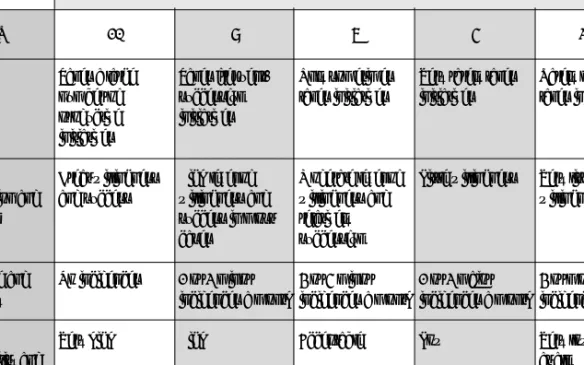
The aim of workplace training is to promote the vocational training of students in three areas (MECD, 2004): theoretical-cognitive (knowledge), practical (technical skill) and attitudinal (social attitudes and skills). Under this system, the development of socio-emotional skills only appears to be represented by the third area, where some attitudes are inter-mingled with certain socio-emotional skills. As we know, there is already a reference to affective and social factors in the official approach taken by workplace training (FCT), but it is far too restricted, not to say reductionist and sim-plistic, as is clear, for example, from the summary assessment form pro-vided by the Ministry for workplace tutors to use when assessing students on workplace training (see Table 2).
The key role of the tutor
The learning process during on-site training calls for a form of tutoring that embraces features including coaching and mentoring. As Repetto and Pérez (2003, p. 104) explain, en el coaching, el supervisor propone a su tutorizado, y acuerda con él, planes de acción concretos encaminados a mejorar su formación en determinadas competencias [in coaching, the su-pervisor offers students, and reaches agreements with them about sub-stantive action plans designed to improve their training in particular skills]. The broader process of mentoring may be defined as el proceso continuo mediante el cual un supervisor, denominado mentor, informa y orienta a un compañero de trabajo, nuevo o de menor experiencia, en su proceso
de adaptación a su puesto de trabajo y a la organización [an ongoing process whereby the supervisor, who is known as the ‘mentor’, instructs and guides new or inexperienced work colleagues in their process of adapt-ing to their job and to the organisation] (op. cit., p. 105). Lastly, the person carrying out the tutoring/guidance role in one way or another is known as the ‘tutor’. This approach is typically used as a strategy for intervening in workers’ continuing vocational training (García et al., 2003).
Moreover, tutors - that is to say both those who work in vocational train-ing schools (teachers, tutors and advisors in Departments of Guidance) and in university-based Guidance, Information and Employment Centres (Centros de Orientación, Información y Empleo, COIEs) and workplace-based tutors - are deemed to be decisive factors in promoting the train-ing of students and recent graduates in socio-emotional skills; to achieve this, they have to employ well designed and empirically validated pro-grammes and courses in work-based guidance and training.
Tutors play a key role with students undergoing on-site training, offer-ing them direction, guidance, assistance and support duroffer-ing their period of occupational training. This work carried out by the tutors needs to be of-fered to small groups of students and those who have recently complet-ed their on-site training, although the tutors also give each student person-al attention.
On-site tutors are key players in workplace training: se responsabiliza de organizar el puesto formativo con los medios técnicos disponibles, y
INDICATOR Initiative Spirit of collaboration and team work Attendance and punctuality Sense of responsibility and interest in the work
10 Takes a large number of productive initiatives Great willingness and success No incidences Very high 8 Takes frequent, successful initiatives High level of willingness and success in most cases 1 or 2 minor incidences a month High ASSESSMENT 6 Only sometimes takes initiatives Moderate level of willingness and relatively successful 3 or 4 minor incidences a month Acceptable 4
Very rarely takes initiatives Little willingness 1 or 2 major incidences a month Low 2 or 0 Rarely or never takes initiatives
Very little, or no, willingness
3 or more major incidences a month
Very low or none at all
Table 2: Elements of current assessment of attitudes and social skills
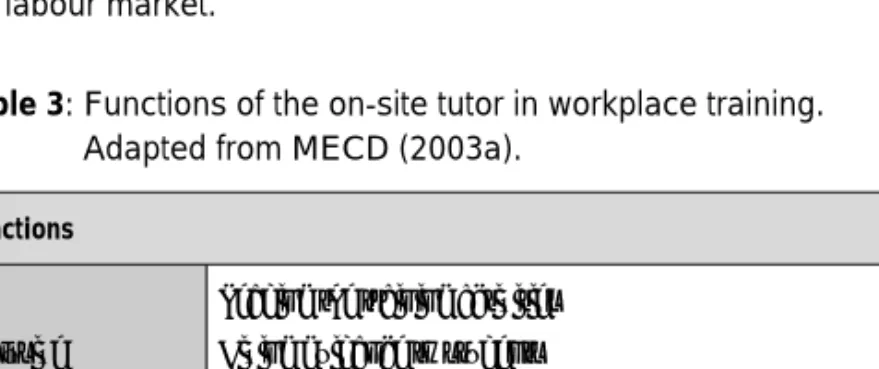
con los fines propuestos en el programa formativo. Se encarga asimismo del seguimiento de las actividades del alumno [they are responsible for organising the training, using the technical resources available and complying with the objectives set out in the training programme. They also have the task of monitoring their students’ activities] (MECD, 2003a). All of the foregoing means that the tutor has to carry out a number of func-tions (see Table 3).
Final thoughts
As both Vélaz de Medrano (2002) and Palací and Topa (2002) make clear, socio-emotional skills play an important role in vocational integra-tion, remaining in employment, employability and professional develop-ment, and also in enabling workers to achieve adaptation and social inclu-sion as participative citizens of the system.
However, research including that of Echeverría (2002) shows that key competencies frequently required in a range of jobs are team-work and self-control, both of them socio-emotional skills. Echeverria also provides data relating to the discrepancy between academic, especially university-level, education and the demands of the labour market. Similarly, the work of Cajide, Porto and Abeal (2002), which is based on information supplied by a large number of enterprises, also highlights the imbalance between academic education and employers’ requirements in relation to ‘social skills’, ‘personal development skills’ and ‘employment skills’.
On-site training and initial work experiences constitute a unique con-text for the development of skills, and particularly of socio-emotional skills (see Ballesteros, Guillamón, Manzano, Moriano and Palací, 2001; Palací and Peiró, 1995), while guidance and tutoring activities are key el-ements in promoting the person’s training and in encouraging his/her en-try into the labour market or transition from an academic environment to the labour market.
Exclusive
Shared
Leading the training activities Giving guidance to students Assessing students’ progress Planning training activities
Determining how many students can be supported at any one time Resolving technical and personal problems
Completing monitoring and assessment forms
Functions
Table 3: Functions of the on-site tutor in workplace training.
Guidance and tutorial processes have been clearly highlighted in nu-merous studies as significant factors in enabling people in employment and social contexts (Repetto, 1991; Rodríguez Diéguez, 2002). Accord-ingly, the roles of the practical skills tutor and on-site trainer are of vital im-portance in helping students and recent graduates to seize opportunities to learn socio-emotional skills (Slipais, 1993; Repetto, Ballesteros and Ma-lik, 2000).
As for the importance of contextual variables in the development of so-cio-emotional skills and vocational integration, earlier studies have high-lighted the importance of family variables among others (Osca, Palací and Hontangas, 1994). This is one of the reasons why a guidance intervention plan on citizens’ socio-emotional skills for vocational integration and the professional development of young people should also take a look at con-textual variables, and, as far as possible, give thought to coordination of the work of various institutions (the educational establishment, workplaces and employment activities, the family, and local bodies like the local au-thority and not-for-profit associations).
Workers’ training and their likely employability depend these days on the development both of their technical skills and of their socio-emotional skills, especially when the performance of their duties frequently involves teamwork, cooperation with other workers, and/or dealing with, or having direct contact with, customers. Moreover, as a number of studies have pointed out (Bachman, Stein, Campbell and Sitarenios, 2000; Wong and Law, 2002), jobs characterised by ‘emotional labor’ (for a review of this, see Glomb and Tews, 2004; Martínez, 2001), such as managers, sales as-sistants, nurses, teachers, psychologists and debt-collectors call for a high level of socio-emotional skills generally, and of emotional skills in particu-lar, to enable them both to control their own emotions and those of oth-ers appropriately in relation to the demands of the job, and to save them from emotional exhaustion and deteriorating health.
Given that the context of on-site training offers important opportunities for promoting the development of socio-emotional skills, we think it is ap-propriate and necessary to argue for the inclusion of guidance plans and socio-emotional skills training in vocational workplace courses, as long as they are supervised by a tutor/advisor/mentor, and flexibly linked to the rest of the planning of these modules. Similarly, on-site training for students and university graduates should include the same plans for guidance and training in socio-emotional skills.
However, given that skills of this type can, and should, be developed throughout a person’s life from childhood to the third age, as has been seen at other times, what would be really desirable and useful for our present and future society would be for socio-emotional skills training to have be-gun earlier in schools at all levels (Repetto, 2003; Bisquerra, 2005).
Bibliography
Álvarez Rojo, V. et al. Propuestas del profesorado bien evaluado para po-tenciar el aprendizaje de los estudiantes. Seville: University of Seville, 2000.
Bachman, J., Stein, S., Campbell, K.; Sitarenios, G. Emotional intelligence in the Collection of Debt. International Journal of Selection and Assess-ment, 2000, Vol. 8 (3), p. 176-182.
Ballesteros, B., Guillamón, J.R., Manzano, N., Moriano, J. A.; Palací, F.J.. Técnicas de inserción laboral: guía universitaria para la búsqueda de empleo. Madrid: UNED, 2001.
Bar-On, R.. The emotional intelligence inventory (EQ-i): Technical manu-al. Toronto: Multi-Health Systems, 1997.
Barnett, R. Los límites de la competencia. El conocimiento, la educación superior y la sociedad. Barcelona: Gedisa, 1994/2001.
Barret, G.V.; Depinet, R.L. A Reconsideration of Testing for Competence Rather Than for Intelligence. American Psychologist, 1991, 46, p. 1012-1024. Bethell-Fox, C. E. Selección y contratación basada en compe-tencias. In M. Ordóñez (Ed.), Psicología del Trabajo y Gestión de Re-cursos Humanos (p. 75-94). Barcelona: Gestión 2000, 1997.
Bisquerra, R. Educación emocional y competencias básicas para la vida. Revista de Investigación Educativa, 2003, Vol. 21 (1), p. 7-43. Bisquerra, R. Educación emocional y competencias emocionales. In
Aso-ciación de Psicopedagogía Colectivo Pabellón Sur (ed.), Reflexiones sobre la práctica psicopedagógica en el siglo XXI (Electronic book on CD-ROM). Huelva: Hergué Editorial, 2002.
Blas Aritio, F. A. ¿De quién se predican las competencias profesionales? Una invitación a su investigación. Revista de Psicología del Trabajo y de las Organizaciones, 1999, Vol. 15 (3), p. 407-418.
Bloom, B. S., Engelhart, M. D., Furst, E. J., Hill, W. H.; Krathwohl, D. R. (ed.). Taxonomy of educational objectives. Handbook I: Cognitive do-main. New York: Longmans, Green, 1956.
Boyatzis, R. E.; Goleman, D.; Rhee, K. S. Clustering Competence in Emo-tional Intelligence. En Bar-On, R.; Parker, J. D. (eds.), The Handbook of Emotional Intelligence (p. 343-362). San Francisco: Jossey-Bass, 2000.
Boyatzis, R. E.: The competent manager: A model for effective perform-ance. New York: John Wiley & Sons, 1982.
Bunk, G. P. Teaching Competence in Initial and Continuing Vocational Training in the Federal Republic of Germany. European journal of vo-cational training, 1994, Vol. 1, p. 8-14.
Caballo, V. Manual de evaluación y entrenamiento en habilidades sociales. Madrid: Siglo XXI, 1993.
Cajide, J.; Porto, A.; Abeal, C. Competences acquired in University and skills required by employers in Galicia. Paper presented at the
Euro-pean Conference on Educational Research. Lisbon, 11-14 September 2002.
Cardona, P. El coaching en el desarrollo de las competencias profesion-ales. In M. Vilallonga Elorza (Coord.), Coaching directivo: desarrollan-do el liderazgo. Barcelona: Ariel, 2003.
Cherniss, C. Social and Emotional Competence in the Workplace. In R. Bar-On; J.D. Parker (eds.), The Handbook of Emotional Intelligence. San Francisco: Jossey-Bass, 2000.
Dave, R.H. Psychomotor levels. In Armstrong, R. J. (Ed.), Developing and Writing Behavioral Objectives. Tucson, AZ: Educational Innovators Press, 1970.
Del Pino, A. Empleabilidad y competencias: ¿nuevas modas? In M. Or-dóñez (Ed.), Psicología del Trabajo y Gestión de Recursos Hu-manos. Barcelona: Gestión 2000, 1997, p. 104-116.
Echeverría, B. Gestión de la competencia de acción profesional. Revista de Investigación Educativa, 2002, Vol. 20 (1), p. 7-42.
Eurydice. Key Competencies. Madrid: Eurydice/MEC, 2002.
Flemming, D. The concept of meta-competence.Competence and Assess-ment, 1991, Vol. 16. Sheffield, Employment Department.
Fletcher, S. NVQs Standards and Competence. A Practical Guide for Em-ployers, Managers and Trainers. London: Kogan Page, 1991. García, E. et al. Desarrollo de competencias clave en los estudiantes y
tit-ulados universitarios. Unpublished research project funded by the Span-ish Ministry of Science and Technology, 2003.
García, M. Entrenamiento en competencias. Encuentros en Psicología So-cial, 2003, Vol. 1 (3), p. 27-32.
García, M. Factores clave en el desarrollo de competencias. In E. Aguilló, C. Remeseiro; A. Fernández, Psicología del Trabajo, de las Organiza-ciones y de los Recursos Humanos. Madrid: Biblioteca Nueva, 2000. Glomb, T. M.; Tews, M. J. Emotional labor: A conceptualization and scale
development. Journal of Vocational Behavior, 2004, Vol. 64, p. 1-23.
Goleman, D. An EI-Based Theory of Permormance. In Cherniss, C.; Gole-man, D. (eds.), The Emotionally Intelligent Workplace. San Francis-co, CA: Jossey-Bass 2001, p. 27-44.
Goleman, D. Emotional intelligence. New York: Bantam Books, 1995. González, J.; Wagenaar, R. (eds.). Tuning Educational Structures in
Eu-rope. Bilbao: Universidad de Deusto, 2003.
Gottfredson, L. S. g, Jobs and Life. In H. Nyborg (ed.), The Scientific Study of General Intelligence. Oxford: Elsevier Science/Pergamon, 2003, p. 293-342.
Harrow, A. A Taxonomy of the Psychomotor Domain. A guide for develop-ing behavioral objectives. New York: David McKay, 1972.
Informe Infoempleo. Oferta y Demanda de Empleo Cualificado en España. Madrid: Cícrulo de Progreso, S.L.
méto-dos y aplicaciones en el sector Salud. Montevideo: Cinterfor/OIT, 2002. available at: http://www.ilo.org/public/spanish/region/ampro/cinterfor/ publ/man_ops/index.htm
Jiménez, A. La gestión por competencias: una nueva manera de gestionar la organización y las personas en un nuevo paradigma. In M. Ordóñez (Ed.), Psicología del Trabajo y Gestión de Recursos Humanos (p. 347-364). Barcelona: Gestión 2000, 1997.
Krathwohl, D.; Bloom, B.; Masia, B. Taxonomy of educational objectives. Handbook II: Affective domain. New York: David McKay, 1964. Le Boterf, G. Ingeniería de las competencias. Barcelona: Gestión 2000,
2001.
Levy-Leboyer, C. Gestión de las competencias: cómo analizarlas, cómo evaluarlas, cómo desarrollarlas. Barcelona: Gestión 2000, 1997. Martínez, Mª J. Historia de la Formación Profesional en España. De la ley
de 1955 a los Programas Nacionales de Formación Profesional. Va-lencia: Publicaciones de la Universidad de Valencia (PUV).
Martínez, D. Evolución del Concepto de Trabajo Emocional: dimensiones, antecedentes y consecuencias. Una revisión teórica. Revista de Psi-cología del Trabajo y de las Organizaciones, 2001, Vol. 17 (2), p. 131-153.
Mayer, J.D.; Salovey, P. What Is Emotional Intelligence? In Salovey, P. and Sluyter, D.J., Emotional development and emotional intelligence (p. 3-31). New York: Basic Books, 1997.
McClelland, D. Testing for Competence Rather Than for Intelligence. Amer-ican Psychologist, 1973, Vol. 28, p. 1-14.
MEC. Formación Profesional. Formación en Centros de Trabajo (FCT). Madrid: MEC, Spanish Directorate-General of Regulated Vocational Training and Educational Promotion, 1994.
MECD. Formación en centros de trabajo. Guías prácticas para tutores (CD-ROM). Madrid: MECD and Chambers of Commerce, 2003a.
MECD. Formación Profesional. Titulaciones (CD-ROM). Madrid: MECD, 2003b.
MECD. Manual de formación en centros de trabajo. Guía para el tutor de empresa [2004]. Downloaded from the Internet (03/05/04): http://wwwn.mec.es/educa/formacion-profesional/index.html
Osca, A.; Palací, F. J.; Hontangas, P. Variables familiares y académicas como predictoras de la transición a la vida activa. In E. Repetto; C. Vélaz de Medrano (eds.), Career Development, Human Resources and Labour Market. Madrid: UNED, 1994.
Palací, F. J.; Moriano, J. A. (eds.). El nuevo mercado laboral: estrategias de inserción y desarrollo profesional. Madrid: UNED, 2003.
Palací, F. J.; Peiró, J. M.. La incorporación a la empresa. Valencia: Pro-molibro, 1995.
Palací, F. J.; Topa, G. (eds.). La persona en la empresa: iniciativas de in-tegración y desarrollo. Madrid: UNED, 2002.
competencias. Madrid: Editorial Centro de Estudios Ramón Areces, 2001.
Pereda, S.; Berrocal, F.: Gestión de Recursos Humanos por Competen-cias. Madrid: Editorial Centro de Estudios Ramón Areces, 1999. Pérez, J. C.; Petrides, K. V.; Furnham, A. Measuring trait emotional
intel-ligence. In R. Schulze and R. Roberts (eds.), International handbook of emotional intelligence (p. 181-201). Göttingen: Hogrefe, 2005. Pérez, J. C.; Repetto, E. Aproximación a la evaluación breve de la
inteligen-cia emocional. In E. Barberá et al. (eds.), Motivos, emociones y proce-sos representacionales: de la teoría a la práctica (p. 325-334). Valen-cia: Fundación Universidad-Empresa de Valencia (ADEIT), 2004. Pérez, J. C. Sobre la validez de constructo de la inteligencia emocional.
Encuentros en psicología social, 2003, Vol. 1 (2), p. 252-257. Petrides, K. V.; Furnham, A. Trait emotional intelligence: Psychometric
in-vestigation with reference to established trait taxonomies. European Journal of Personality, 2001, Vol. 15, p. 425-448.
Repetto, E.; Pérez, J.C. Orientación y desarrollo de los recursos humanos en la pequeña y mediana empresa. Madrid: UNED, Guía Didáctica, 2003.
Repetto, E. El desarrollo de la carrera a lo largo de la vida y la orientación de los Recursos Humanos en las organizaciones. Revista de Orientación Educativa y Vocacional, 1992, Vol. 3, p. 17-31.
Repetto, E. Following Super´s Heritage: Evaluation of a Career Develop-ment Program in Spain. International Journal for Educational and Vo-cational Guidance, 2000, Vol. 1 (1), p. 107-120.
Repetto, E. La Competencia Emocional e intervenciones para su desar-rollo. In E. Repetto (ed.): Modelos de Orientación e Intervención Psi-copedagógica (vol. II) (p. 453-482). Madrid: UNED, 2003.
Repetto, E. Objetivos y actividades del Centro de Orientación, Información y Empleo (COIE) de la UNED. In E. Repetto; C. Vélaz, La Orientación en el Sistema Educativo y en el Mundo Laboral (p. 179-185). Madrid: UNED, 1991.
Repetto, E. Tu Futuro Profesional. Programa para la transición de los jóvenes a la vida activa . Madrid: CEPE, 1999.
Repetto, E., Ballesteros, B.; Malik, B. Tareas y formación de los orienta-dores en la Unión Europea. Madrid: UNED, 2000.
Rodríguez Diéguez, A. La orientación en la Universidad. In V. Álvarez Ro-jo; A. Lázaro Martínez (eds.), Calidad en las universidades y orientación universitaria. Málaga: Aljibe, 2002.
Roe, R. Competences. A key towards the integration of theory and prac-tice in work psychology. Gedrag en Organisatie, 2002, Vol. 15, p. 203-244.
Roe, R. What makes a competent psychologist? European Psychologist, 2003, Vol. 7 (3), p. 192-202.
Royo, C.; Del Cerro, A. Revisión teórica de las competencias: su origen, concepto y escuelas más importantes. ¿Hacia dónde se dirigen? In
J. Romay, J.; R. García (ed.), Psicología social y problemas sociales (Vol. 4). Psicología de las Organizaciones, del Trabajo y Recursos Hu-manos y de la Salud (p. 453-460). Madrid: Biblioteca Nueva, 2005. Saarni, C. The development of emotional competence. New York: Guilford
Press, 1999.
Salovey, P.; Mayer, J. D. Emotional intelligence. Imagination, Cognition and Personality, 1990, 9, p. 185-211.
Sánchez, M. F. Trabajo, profesiones y competencias profesionales. In A. Sebastián (ed.), Rodríguez, M.L., and Sánchez, M.F., Orientación Profesional: Un proceso a lo largo de la vida (p. 255-297). Madrid: Dykin-son, 2003.
Simpson, E. J. The Classification of Educational Objectives in the Psy-chomotor Domain. Washington, DC: Gryphon House, 1972.
Slipais, S. Coaching in a Competence-based Training System: the Expe-rience of the Power Brewing Company. In B. J. Cadwell; E. A. M. Carter (eds.), The Return of the Mentor: Strategies for Workplace Learning (p. 125-163). London: The Falmer Press, 1993.
Sobrado, L.; Romero, S. Orientación para el desarrollo de la carrera pro-fesional del universitario. In V. Álvarez Rojo; A. Lázaro Martínez (eds.), Calidad en las universidades y orientación universitaria. Málaga: Aljibe, 2002.
Tejada, J. Acerca de las competencias profesionales. Herramientas, 1999, 56, p. 20-30.
Vargas, F., Casanova, F.; Montanaro, L. El enfoque de competencia lab-oral: manual de formación. Montevideo: Cinterfor/OIT, 2001. Available on the Internet: http://www.ilo.org/public/spanish/region/ampro/ cinterfor/publ/man_cl/index.htm
Vélaz de Medrano, C. Intervención educativa y orientadora para la inclusión social de menores en riesgo: factores escolares y socioculturales. Madrid: UNED, 2002.
Wolf, A. Competence-based Assessment. Buckingham: Open University Press, 1995.
Wong, C. S.; Law, K. S. The effects of leader and follower emotional intel-ligence on performance and attitude: An exploratory study. Leadership Quarterly, 2002, 13, p. 243-274.
Zeidner, M.; Roberts, R. D.; Matthews, G. Can emotional intelligence be schooled?: a critical review. Educational Psychologist, 2002, 37 (4), p. 215-231.
Zins, J.; Travis, L. F.; Freppon, P. A. Linking research and educational programming to promote social and emotional learning. In P. Salovey; D. J. Sluyter, Emotional development and emotional intelligence (p. 255-277). New York: Basic Books, 1997.
Zins, J. E.; Weissberg, R.P.; Wang, M.C.; Walberg, H.J. (eds.). Building academic success on social and emotional learning: What does the re-search say? New York: Teachers College Press, 2004.