The relation between the use of strategic human capital and the design of
the management control system: an empirical study in the Greek context.
Nikolaos G. Theriou
*, Željko Šević, Dimitrios I. Maditinos
Abstract
The aim of this study is to examine the relationship between the use of strategic human capital (SHC) and the design of the management control system (MCS) in the context of Greece. It combines transaction cost economics and contingency theory to develop the theoretical background of the study, since both of those theories analyse the functions of management control. This study adopts the hypotheses and the methodology of Widener (2004) who examined the same question in the US context. The MCS is assumed to consist of three components: the personnel controls, the non-traditional and the traditional results controls, while the SHC is assumed to consist of four attributes: the importance of SHC, the behavioural uncertainty of the SHC, the firm specificity and the spread of SHC. This study develops the assumption that: (a) the SHC positively influences the use of personnel controls and non-traditional results controls, while (b) the SHC negatively influences the use of traditional results controls. A structural equation model is developed to show those relations.
Using data from 67 respondents, and in line with Widener (2004), this study reveals that the data do not support the proposed structural equation model. While it shows the positive influence of the components of SHC with the personnel controls and non-traditional results controls, it does not support the negative influence of the components of SHC with the use of traditional results controls. An alternative model is proposed which supports only the first part of the main assumption: the SHC positively influences the use of personnel controls and non-traditional results controls.
Key words: Strategic Human Capital (SHC), Management Control Systems (MCS), Structural Equation Modeling (SEM).
1. Introduction
Management control systems (MCS) provide information that is intended to be useful to managers in performing their tasks and to support organizations in
* Tel.: +30-2510-462156
developing and maintaining viable patterns of behaviour. However, any evaluation of the role of such information requires consideration of how managers make use of the information provided to them (Otley, 1999). Anthony (1965), at the Harvard Business School and under the title of ‘management planning and control systems’, was the first to develop the traditional framework for considering these issues. This could distinguish ‘management control’ from ‘strategic planning’ and ‘operational control’.
According to Langfield-Smith (1997), the relationship between MCS and strategy has attracted considerable interest. Dent (1990), Samson, Langfield-Smith and McBride (1991), and Simons (1987a; 1990) suggest that the MCS should be tailored explicitly to support the strategy of the business to lead to competitive advantage and superior performance. Moreover, Ittner and Larcker (1997) point out that the need to align specific control practices with the organization’s chosen strategy is of vital importance. Concerning firm-level strategy variables, Porter (1980) discusses strategic positioning in terms of cost leadership vs. differentiation, Miles and Show (1978) analyse strategic topologies in terms of prospectors vs. defenders, while the classification of build, hold, harvest and divest focuses on variations in strategic missions (Gupta and Govindarajan, 1984). Langfield-Smith (1997, p. 212) presents a matrix of strategic positioning, strategy topologies and strategic mission.
Daniel, Reitsperger and Gregson (1995) examine the relationship between the MCS with the total quality control and zero defect strategies providing evidence that a management control system is able to design and complement management's objectives and strategies. Langfield-Smith (1997) in his research about the MCS and business strategy, focusing on performance evaluation and rewards system, tries to prove the positive relationship of the role of MCS with the strategic choices. Merchant (1985) uses the contingency approach to prove the relationship between the components of the MCS and the strategies of the organizations. Simons (1990) examines how MCS affects the structure of the strategic process. According to Morgan and Hunt (1999) the understanding and the correct use of the strategic resources may contribute to the development of a firm’s competitive advantage. Due to the competitive environment, the need for the firm to gain a competitive advantage becomes urgent. Scholars have also studied the relationship between MCS and operational strategies. Abernethy and Lillis (1995) and Perera, Harrison and Poole (1997) focus on customer, while Ittner and Larcker (1997) on quality.
There are very few empirical studies that concentrate on MCS and their link to firm strategies. According to Langfield-Smith (1997) the studies about the management control system and strategy are restricted and further research is needed. Widener (2004, p. 377) in line with Amit and Shoemaker (1993) admit that ‘an unexplored dimension of firm-level strategy is the firm’s use of strategic resources that enable the firm to sustain its competitive advantage. Accordingly, Widener (2004) following the suggestions of Barney (1991), explores the strategic resource of human capital, which includes the knowledge and skills of employees in a firm. According to Quinn, Anderson and Finkelstein (1996) human capital that enriches the knowledge of the firm is an essential strategic resource of many firms. Thus, Widener (2004) investigating the association between the use of SHC and the design of MCS provides an important and novel study. Moreover, it is considered to be the first study in the field.
The aim of the present study is to test Widener’s (2004) proposed theoretical framework and verify the empirical results on the relationship between MCS and SHC in Greek companies. The objectives of the study are the following: (a) to appreciate, through a literature review in theory and empirical evidence, the present understanding about MCS and SHC and the possible relationship between these two concepts, (b) to explore the combination of controls (personnel, non-traditional and traditional) following the critique that there is a need of examination of a more comprehensive MCS (Fisher, 1995; Winder, 2004), (c) to measure four distinct attributes of a strategic resource, namely importance of a firm, behavioural uncertainty, firm specificity and spread of use in the firm, providing more knowledge on the association between strategy and the design of the MCS (Widener, 2004), (d) to examine the combination of controls in order to provide knowledge for managers how to balance between different types of control when they design a MCS (Widener, 2004), (e) to critically examine the results and come to specific conclusions, comparing our results with those of Widener (2004).
To explore the main question of this study, namely the relationship between the use of SHC and the design of the MCS, the structural equation modeling (SEM) is adopted. According to Kline (1998) SEM evaluates the entire model and gives the opportunity to assess the MCS as a whole, rather than simply its parts. This study is characterised as a descriptive research in the sense that it tries through the literature
review, to identify and analyse the major components of a MCS as well as the major attributes of the SHC. Furthermore, it is considered as an explanatory research since it tries to explore the cause and effect relationship between MCS and SHC.
The remainder of the study is organised as follows. Theoretical background and hypotheses development are presented in section two. An overview of SHC, MCS is presented first followed by the theory and hypotheses development. Methodology is presented in section three, where the research design, the sample, the variables and the questionnaire are discussed. Statistical analysis and the results are presented in section four, while in section five conclusions are presented followed by the limitations and extensions of the study.
2. Theoretical background and hypotheses development 2.1. Strategic Human Capital
Organizational value is comprised of three major classes of assets that are integral to an organisation’s ability to produce goods and services. According to Weatherly (2003) these assets are the following: financial, physical (tangible) and intangible assets. Intangible assets include intellectual capital (patent formulas, product designs and process technology, i.e., the methods that delineate the steps in a process), goodwill, and human capital. The terminology of the human capital describes it as the knowledge, benefits, training and development programs that the employees receive from the firms. These measures are not tangible and for this reason are difficult to estimate but are valuable resources that a firm can use strategically for gaining competitive advantage.
Human capital has been extensively studied by scholars in recent years. Becker (1964) discusses the reasons why firms invest in training and education of their employees. Osterman (1987) supports the view that firms use different models of the human capital for strategic reasons. Closely related to this research, Rousseau (1995) argues that firms use specific relationships with employees and modify the scope of human capital, depending on their expected contribution to the firm. Barney (1991, p. 105) insists that ‘the strategic value of the human capital refers to its potential to improve the efficiency and effectiveness of the firm, exploit market opportunities and neutralise potential treats’. Combining these elements Lepak and Snell (2001) investigates four basic characteristics of the strategic human capital: (1)
knowledge-work, (2) job-based employment, (3) contract work and (4) alliance partnership. Moreover, Snell and Dean (1992) originally analyse the human resource practises of different employee groups in an advanced manufacturing environment, but later combine the data into a single profile.
Lepak and Snell (1999) link the human capital with the strategy that the firms should follow. They focus on the strategic value and the uniqueness of human capital as the appropriate way for the human resource configuration. They also support the view that as the human capital of a firm is unique, it represents the knowledge base and consequently firms are able to build their strategies. Liu, Lepak, Takeuchi and Sims (2003) examine the strategic human resource management perspectives supporting the importance of human capital and show the firms that they may adopt different human resource strategies in different employment groups, taking into account their skills, knowledge and abilities. Illegems and Verbeke (2004) adopt an approach that takes into account the strategic development and operational functioning of human capital. They note that SHC tends to be appropriate for large organisations and observes that human resource management practices have adjusted well to the requirements of many firms.
According to Amit and Shoemaker (1993) firms possess and manage strategic resources in order to gain competitive advantage. One type of resource that a firm should use strategically is the human capital, which includes tacit knowledge and training of employees (Barney, 1991; Widener, 2004). According to (Coff, 1997; Ross and Ross, 1997; Widener, 2004) since the individuals and not the firms possess the knowledge, firms that use SHC face challenging management control issues. Therefore, Coff (1997) clearly points out that this lack of ownership makes firms rather uncertain when they want to predict employee behaviour, tenure and performance. However, as Peter Drucker (1994) says ‘in the knowledge era the company needs to serve and nurture the knowledge worker. But at the time knowledge workers need the value creating processes and infrastructure of the organisation, as well as conversations with other knowledge workers to unleash and leverage their knowledge’. Other scholars (see Quinn, Anderson and Finkelstein 1996; Grant, 1997) suggest that firms should rely on teams, networks and other information sharing techniques to extract employees’ tacit knowledge, in order to make it more valuable to the firm.
2.1.1. Attributes of Strategic Human Capital
Human capital is valuable when it is important to the firm in terms of creating efficiencies and enabling the firm to be more effective (Barney, 1991; Widener, 2004). According to Barney (1991) and Barney and Wright (1998) when the tasks and procedures are ambiguous, the degree of firm-specific knowledge is high, or the knowledge and skills of the human capital are spread throughout the firm, human capital is difficult for other firms to imitate. Thus, Widener (2004) in order to explore the relationship between the use of a strategic resource and the design of MCS, examines all four attributes of SHC: (1) importance, (2) behavioural uncertainty, (3) firm-specificity, and (4) spread of resource through the firm.
Widener (2004) based on (Barney, 1991; Snell and Dean, 1992; Quinn, Anderson and Finkelstein 1996; Edwards, 1997; Lepak and Snell, 1999) makes clear that the first attribute, importance, is a managers’ beliefs regarding the importance of their SHC to the firm. For the second attribute, behavioural uncertainty, Widener (2004) refers to Barney (1991, p. 109) who states that ‘behavioural uncertainty arises when the link between a firm’s resources and its sustained competitive advantage are poorly understood’. That means that firms are not able to identify the specific relationships between employees’ efforts and resulting output (Widener, 2004). Firm specificity is the third attribute. For this, Widener (2004) refers to Grant (1991, p. 126) who states that ‘if firms can acquire [on similar terms] the resources required for imitating competitive advantage of a successful rival, then the rival’s competitive advantage will be short-lived’. This means that if the resource can be easily transferred between firms, a firm cannot gain competitive advantage. Finally, the fourth attribute is the spread of a resource throughout the firm. It is the degree to which there are small or large numbers of SHC within the firm (Widener, 2004).
2.2. Management Control Systems
Management control was defined by Anthony (1965) as the process by which managers ensure that resources are obtained and used effectively and efficiently in the accomplishment of an organisation’s objectives. Boone and Kurtz (1992) propose that the managerial process consists of four major functions: (1) planning, (2) organizing, (3) leading, and (4) controlling. Kaplan (1983) argues that the purpose of the MCS is
to provide useful information for decision-making, planning, control and evaluation. According to Flamholtz, Das and Tsui (1985) MCS have been described as processes for influencing behaviour. Ouchi (1979) and Flamholtz (1983) argue that MSC provides a tool for gaining cooperation among collectives of individuals or organisational units who may share only partially congruent objectives, distributing those efforts toward a specified set of organisational goals. Controls have been classified in many ways. Administrative and social controls (Hopwood, 1976), output and behavioural controls (Ouchi, 1977), market, bureaucracy and clan controls (Ouchi, 1979), results, action and personnel controls (Merchant, 1985a) and formal and informal controls (Anthony, Dearden and Bedford, 1989). However, Otley (1994) proposes that all definitions of MCS have to be reviewed to accommodate the changing business environment. Langfield-Smith (1997) provides a comprehensive review of the relationship between MCS and strategy.
According to Boone and Kurtz (1992) the tools of control in a financial organization are divided into five categories: (1) financial controls including budgets, financial analysis and ratio analysis, (2) inventory controls, (3) quality controls, (4) production controls and finally (5) organisational control that include a selection of employees, training and performance evaluation. Otley (1994) and Milgrom and Roberts (1995) clearly state that the MCS is a system consisting of complementary components. Therefore, Widener (2004) study explores three controls, namely (1) the personnel control, (2) the traditional results controls, and (3) the non-traditional results controls. Widener (2004) adopts these types of controls since they represent opposite ends of the control spectrum (i.e., ex ante controls and ex post controls). The same controls are adopted by the present study.
Widener (2004) based on (Merchant, 1982; Snell, 1992; Peck, 1994) adopts personnel controls as ex ante control mechanisms and as ones that regulate the antecedent conditions of performance. Personnel controls are usually focused on human resource policy which helps to ensure that the employees’ performance will be of a high level and in accordance with the firm’s objectives. On the other hand, results controls serve as an ex post control mechanism (Snell, 1992; Widener, 2004). There are two types of results controls: traditional and non-traditional results controls. Traditionally, firms based upon ex post controls that provided financial data, which consequently was reported for external purposes. In recent years, firms have started to
incorporate more non-financial and operational controls into their MCS (Widener, 2004). Some of the non-traditional controls are the Balanced Scorecard (Kaplan, 1994), the Economic Value Added (Otley, 1999; Stewart, 1999), the Shareholder Value Analysis (Rappaport, 1998), the Activity Based Costing (Johnson and Kaplan, 1987) etc.
As Ittner and Larcker (1995) point out, non-traditional systems provide more timely physical measures of operating performance compared to traditional managerial accounting systems which provide aggregated financial information relatively infrequently. Moreover, under traditional managerial accounting, operational control is based on variances from budgeted standards, and reward systems ties primarily to financial performance. Therefore this study, in line with Widener (2004) investigates both traditional and non-traditional ex post controls. 2.3. Theory and hypotheses development
In line with Widener (2004) to develop the theoretical framework in order to study the association between the four attributes of SHC and the three control components of MCS, the contingency theory (see: Fielder, 1967; Gordon and Miller, 1976; Otley, 1980; 1999; Gordon and Miller, 1976; Merchant, 1985; Evans, Barry and Patton, 1986; Donalson, 1994; Fisher, 1995; Chapman, 1997; Nikolaou, 2000; Reid and Smith, 2000; Jermias and Gani, 2003; Chenhall, 2003) and transaction cost economics (TCE) (see: Coase, 1937; Williamson, 1975; 1991; Spicer and Ballew, 1983; Colbert and Spicer, 1995; Noorderhaven, 1995; Spekle, 2001; 2002).
According to Widener (2004) the contingency theory and transaction cost economics are two theories that both target the design of the management control mechanisms. Each theory offers a different perspective for understanding how the firm designs its MCS. Therefore, both theories play an important role in developing the hypotheses for all four attributes of SHC. Contingency theory supports the first set of hypotheses concerning the first attribute, importance of SHC, while TCE provides evidences about how behavioural uncertainty, firm specificity and spread of human capital affect the design of management control system. The following two figures illustrate the theoretical foundation.
Figure 1. Contribution of the two theories to hypotheses development
Contingency theory TCE
organisational strategy
SHC Attributes 1. Importance 2. Behavioural uncertainty 3. Firm specificity 4. Spread of human capital Source: Widener (2004)
Figure 2. Theoretical framework based on the two theories Contingency theory
Design of MCS TCE
Source: Widener (2004)
Contingency theory
Chenhall (2003) argues that control systems are designed to assist managers to let them make progress towards firm objectives and to attain the desired results. Widener (2004) in line with Otley (1980) agrees that control systems are influenced by the environment in which they are operating. According to Otley (1980) the basic idea of contingency theory is that control systems differ across organisations, depending on underlying organisational factors. Therefore, scholars have invoked the contingency theory when they investigate the relationship between organisational factors and the design of the MCS. Widener (2004), following the contingency theory, develops the first set of hypotheses exploring the influence that the importance of SHC has on the MSC design.
2.3.1. Hypotheses based on contingency theory Attribute 1: Importance of strategic human capital.
As already discussed, one major attribute in contingency theory is the importance of SHC. Barney (1991) supports the view that SHC is able to improve the efficiency and the effectiveness of the firm, exploit market opportunities and neutralise potential threats. Grant (1997) analyses the role of knowledge within the firm and how that influences the management theory. More precisely, he emphasizes the importance of the SHC and the knowledge based-view of the firm as a key to competitive advantage. Moreover, Grant (1997, p. 451) states ‘the greater the span of the knowledge being integrated and the sophistication of the integration mechanisms,
the more difficult it is for any rival to adopt the plans of a firm’. Another important clue about the importance of the SHC is suggested by Barney (1991) and Quinn, Anderson and Finkelstein (1996), who argue that when the value of the SHC increases, so does the probability that a firm will employ it internally.
Snell and Dean (1992) suggest that if a firm considers employees as a strategically important factor, then it is more willing to invest in costly ex ante personnel controls. They also mention that firms invest in personnel controls if the benefit received from the controls is greater than the cost of implementing the control. Personnel controls, that include the knowledge and the skills of employees, support the SHC.
Although there is no empirical evidence providing the ligament of the personnel control and the use of SHC, Peck (1994) exploring the link between organizational strategy and employment relationship, supports the positive association of personnel controls and the strategy of human capital. This positive association is derived directly or indirectly from several other studies (see: Miles and Snow, 1978; Snell and Dean, 1992; Coff, 1997; Grant, 1997). Therefore, the theoretical links suggest an association between the importance of SHC and personnel controls and the following hypothesis may be assumed:
Hypothesis 1a. Use of personnel controls is positively associated with the belief that the SHC is important (Widener, 2004, p. 382).
Snell and Dean (1992) analysing the human research practices of different employee groups, receive information that firms invest in their employees in order to train them and improve their knowledge and skills. This innovation shows that firms prefer the modern controls (personnel controls including) rather than the traditional controls. Langfield-Smith and Smith (2003) in their research about business strategy and management control system, focusing more in specific aspects of MCS, examine the control developing over time and also analyse how the growing knowledge of employees and the personnel control can positively affect the goodwill trust and generally the relationship between the employees and the customers.
Kaplan (1994) describing the revolution of management theory for the years 1984-1994 realises that the manufacturing sector mentions an increased reliance on often called ‘customer defined’ non-financial measures. Viavio (1999) exploring the emergence of the non-financial measures focuses on these non-traditional measures
that according to his research are closely related to customer needs. Perera, Harrison and Poole (1997) in a previous research examine the case of a firm that maintains a customer focused manufacturing strategy and how it maintains non-financial measures. Grant (1997) and Lank (1997) support the view that the success of knowledge-based organisation depends on the willingness of the employees to share their information and knowledge. For that reason the human factor tends to be an ‘unstable’ factor and Lank (1997) supports the view that when a firm intends to make progress, it must reward the employees that share their knowledge.
Moreover, Ittner and Larker (1995) prove that traditional controls do not provide management with focused information necessary with quality initiatives and consequently suggest that firms should change their MCS relying more on non-traditional controls. Lev (2001) suggests that as firms rely more on resources such as human capital, it is possible that they will rely more on non-traditional controls that provide information concentrated on the SHC. Snell and Dean (1992) also prove the superiority of non-traditional controls as compared to those of traditional. In line with (Lev, 2001; Snell and Dean, 1992; Perera, Harrison and Poole, 1997) are the studies of (Spicer and Ballew, 1983; McNair, Lynch and Cross, 1990; Wallman, 1995; Balkcom, Ittner and Larcker, 1997; Grant, 1997; Lank, 1997). According to previously reported evidence we may assume that measures like employee satisfaction, voluntary turnover, employee skill development and employee safety are important indicators of a company’s success in gaining competitive advantage (Widener 2004). The above discussion is summarised in the following hypotheses, as developed by Widener (2004, p. 383).
Hypothesis 1b. Use of non-traditional controls is positively associated with the belief that SHC is important.
Hypothesis 1c. Use of traditional results controls is negatively associated with the belief that strategic human capital is important.
Transaction cost economics theory
Transaction cost economics (TCE) theory proposed by Coase (1937) and Williamson (1975). According to Coase (1937) transaction cost is: the search and information costs, the bargaining and decision costs, and the polishing and enforcement costs. After four decades of establishing this principal idea, Williamson
(1970; 1975) proposed that transaction cost is the cost of negotiating, drafting and monitoring contracts and also the opportunity costs. Following this theory Williamson, viewed firms not as production functions but as governance structures, focusing on negotiating, executing, modifying, and renewing the myriad contractual agreements, by which firms seek to economize on the cost of transacting business. Many scholars have investigated the various aspects of TCE (see: Spicer and Ballew, 1983; Williamson, 1985; 1991; Seal, 1993; Colbert and Spicer, 1995; Noorderhaven, 1995; Ittner and Larcker, 1998; Tsang, 2000; Spekle, 2001; 2002; Langfield-Smith and Smith, 2003).
This study in line with Widener (2004) adopts TCE to develop the hypotheses on how behavioural uncertainty, firm-specificity, and the spread of the SHC affect the design of the MCS. According to Williamson (1975), TCE acknowledges the above attributes as drives for transaction costs. Widener (2004) adopts the theory proposed by Williamson (1975; 1991) that the premise of TCE is that firms, in order to reduce the total production and transaction cost, should organise and construct proper governance structures. According to Spicer and Ballew (1983) MCS is a kind of governance structure. Therefore, MCS should be designed in such a way that transaction costs coming from behavioural uncertainty, firm-specificity, and the spread of the SHC will be minimised (Widener, 2004).
Williamson (1975) reveals that TCE is based on behavioural assumptions of opportunism and bounded rationality. Widener (2004, p. 383) states ‘Bounded rationality implies that behavior is limited by imperfect cognitive processes. Thus, contracts are incomplete. Opportunism implies that individuals behave self-interestedly, which is enabled by incomplete contracts’. Therefore, and according to Seal (1993) there is a clear need for measurement and control, especially in the ex post settling of contracts. Based on TCE, the following hypotheses, as developed by Widener (2004) examines the influence of behavioural uncertainty, firm-specificity, and the spread of the SHC on the design of the MCS.
Attribute 2: Behavioural uncertainty.
Widener (2004, p. 383) states that ‘behavioral uncertainty refers to a lack of specifiability or programmability regarding the actions undertaken by employees and how those actions influence subsequent outcomes’. Spekle (2001) identifies some
contracting problems due to the reason that they were effectuated by ‘imperfect’ human beings. Williamson (1985) and Merchant (1998) support the view that TCE assume that individuals act upon their self-interest. This causes the so called ‘information asymmetry’ (Spekle, 2001). According to Williamson (1996) information asymmetry arises mainly from the behavior uncertainty. Moreover, Widener (2004) discusses when adverse selection and moral hazards arise and how they influence the MCS (Baiman, 1982; Coff, 1997).
Widener (2004) argues that adverse selection and moral hazards can be avoided by ex ante personnel controls. Snell and Dean (1992) emphasise the usefulness of the selection of new employees and the use of multiple information sources. For reasons of minimizing moral hazard and adverse selection, firms should focus on personnel control giving also a great of significance to human capital. Abernethy and Brownell (1997) in line with Chenhall find that firms rely more on personnel controls in an environment characterised by behavioral uncertainty. Therefore, in line with Widener (2004), it is assumed that in an environment characterised by behavioral uncertainty it is possible that firms will rely on ex ante controls (e.g., personnel controls) since they reduce the transaction costs (Spicer and Ballew, 1983). Based on this discussion the following hypothesis is developed. Hypothesis 2a. Use of personnel controls is positively associated with behavioral uncertainty of the SHC.
Several scholars have extensively discussed the relationship between behavioral uncertainty and traditional financial and non-traditional controls. Spekle (2001) suggests that firms should use an explanatory control environment characterised by low reliance on traditional controls such as budgeting practices and financial measures. He also suggests that in a context characterised by behavioral uncertainty, firms should try to establish an environment of commitment and congruency to general organisational goals. Moreover, firms will try to find information that will shed light on to the true nature of activities being performed by individuals. This information is likely to be found in non-traditional controls.
The main findings of the broad research (see: Hirst, 1983; Baiman, 1990; Seal, 1993; Abernethy and Brownell, 1997; Coff, 1997; Chenhall, 2003) support the suggestions of Spekle (2001). Finally, Widener (2004) agrees that in an environment characterised by behavioural uncertainty, firms cannot rely on traditional controls,
however, it is likely they will rely on non-traditional controls. This discussion supports the development of the following hypotheses.
Hypothesis 2b. Use of traditional result controls is negatively associated with behavioral uncertainty of the SHC (Widener, 2004, p. 384).
Hypothesis 2c. Use of non-traditional result controls is positively associated with behavioral uncertainty of the SHC (Widener, 2004, p. 385).
Attribute 3: Firm-specificity.
Lepak and Snell (2001) define the firm-specificity as the uniqueness of the human capital and more precisely the degree to which the firms have specialised the skills and the knowledge of employees. Snell (1999) describes the significance of the firm-specificity as an item that is not directly available in the labour market and consequently provides a source of competitive advantage, while Coff (1997) points out that it is the skills and knowledge possessed by employees that are specific to a unique firm. Coff (1997) suggests that similar to behavioral uncertainty, firm-specificity may support opportunistic behavior since the human capital that is specific to a firm holds special skills and knowledge that others are unable to find out or to observe. Thus, Coff (1997) agrees that firm-specificity generates the same agency problems as behavioral uncertainty does. Therefore, Widener (2004, p. 385) develops the hypotheses in the same way as those for the behavioral uncertainty.
Hypothesis 3a. Use of personnel controls is positively associated with firm-specificity of the SHC.
Hypothesis 3b. Use of non-traditional results controls is positively associated with firm-specificity of the SHC.
Hypothesis 3c. Use of traditional results controls is negatively associated with firm-specificity of the SHC.
Attribute 4: Spread of SHC.
TCE is focused on minimization of costs (Williamson, 1991). One driver of TCE is considered to be the spread of the SHC through the firm. Traditional MCS are concentrated on financial accounting information (Ittner and Larcker, 1995). However, to turn in a more sophisticated MCS which is aligned closely to a firm’s strategy is particular costly (Williamson, 1991). That means that firms should take
into account whether a sophisticated, or a specialised, MCS can be used efficiently and in full capacity or whether there will be much unused MCS, a case that makes it more costly (Williamson, 1985; Widener, 2004). According to Williamson (1975), to decide whether the benefits from a sophisticated MCS are greater than the design and implementation costs, the size of the spread of SHC is considered as an important factor. That means that if a firm has a wide spread of SHC it is likely to need a more complex MSC, which will be focused on personnel controls, on modern controls and perhaps less on financial traditional measures.
Several scholars (see: Becker, 1976; Williamson, 1975; 1985; 1991; Snell and Dean, 1992; Langfield and Smith, 1997) agree that the spread of SHC will be positively related to personnel controls and non-traditional controls, while it will be negatively related to traditional controls. According to this discussion, Widener (2004, p. 386) develops the following hypotheses.
Hypothesis 4a. Use of personnel controls is positively associated with the spread of SHC throughout a firm.
Hypothesis 4b. Use of non-traditional results controls is positively associated with the spread of SHC throughout a firm.
Hypothesis 4c. Use of traditional results controls is negatively associated with the spread of SHC throughout a firm.
Column 1: Attributes of SHC Column 2: Components of MCS
Figure 3. Theoretical model and hypotheses (model A),
Source: Widener (2004) Use of Financial Measures in Information System Non-traditional Results Controls Traditional ResultsControls Personnel Controls Selective staffing Use of employee Measures in Information System Use of employee and Team Measures inEvaluation System Attribute 3: Firm-specificity Attribute 4: Spread of SHC Attribute 2: Behavioural uncertainty Attribute 1: Importance of SHC Use of Budgeting and Cost Controls
The sample consists of all listed companies trading in the Athens Stock Exchange (ASE) until 2004. Only those companies with relatively small number of employees and low equity capital were excluded. Thus, 275 listed companies comprise the final sample of the study. The questionnaire was not pre-tested since it was planned to adopt that of Widener (2004). However, 40 questionnaires were sent with a covering letter in order to test the formulation, namely wording and the sequence, of the questions. Meanwhile, five visits improved our knowledge of how to deal with this survey and especially how to contact the potential respondents (Dillman, 1978; Zikmund, 2003). Based on the results of 23 respondents and discussion during the five visits, only a few changes were needed in the formulation. After the minor changes the questionnaire (as it is presented in Appendix 1, plus a Greek version, plus a stamped return envelop) was sent to the rest of the sample asking them to answer either in Greek or in the English version. The whole survey process lasted three months, from February 2005 to April 2005.
This process resulted in 67 responses. The response rate, 24.36 per cent is considered quite satisfactory since it meets the average of 20 per cent that Young (1996) reports for comparable surveys to CEOs. The largest number of responses comes from the service industry, 37 per cent, followed by the financial service industry, 25 per cent, and the manufacturing industry, 22 per cent. The communication industry and construction industry come last with 9 and 7 per cent respectively.
3.2. Variable measures
This study measures three components of the MCS and four distinct attributes of the use of SHC (Widener, 2004).
3.2.1. Personnel control
The representative element of personnel control in this study is selective staffing (select), which defines the significance that a firm gives to the hiring and selection processes. The combination of questions like the importance of hiring process and the importance of selecting the best person for a managerial position shows how important the selective staffing process is for Greek companies. According to Widener (2004) this study used selective staffing because: (1) it is a formal control of the MCS, and (2) according to Snell and Dean (1992) the selection process is an important control for managing SHC.
3.2.2. Results Controls
It is assumed that results controls are non-traditional (nt) and traditional (trad) measures. According to Widener, (2004) the two proxies of non-traditional (nt) controls are the use of non-financial employee measures in the firm’s internal information system (emp) and the use of employee and team measures in the firm’s reward system (eval). On the other hand, the proxies of traditional (trad) results controls are the use of financial measures in the firm’s internal information system (finl) and the extent to which management focuses on budgets and controls (bcc).
Widener (2004) argues that those proxies are used because (1) they are all formal controls used in the MCS, (2) the use of financial measures may be in direct contrast control to the use of non-financial measures, and (3) non-traditional controls are controls that should be of considerable importance to firms that rely on strategic
human capital. Emp measures the employee satisfaction, safety, skill development, voluntary turnover, etc., while the four questions of eval are drawn from Simon (1987), Ittner and Larcker (1995), Balkin and Gomez (1990) and Balkcom, Ittner and Larcker (1997). Bcc uses three questions from Simons (1987), while finl measures the use of traditional financial measures, namely ROI, ROA and profitability.
3.2.3. Strategic Human Capital
The four attributes of SHC are: (1) the importance of SHC (import), (2) the behavioral uncertainty (beh), (3) the firm-specificity (fs), and (4) the spread (spread) of SHC. Import employs a set of three questions related to the firm’s beliefs concerning the importance of human capital and whether human resources make firms more efficient and effective (Barney, 1991). Fs uses a set of four questions dealing with specificity, training time of human resources (Lohtia, Brooks and Krapfel, 1994). Beh uses a set of seven validated questions related to repetitive activities, performed tasks, and how complicated it is to monitor and evaluate the staff (Abernethy and Brownell, 1997). Finally, as already discussed, there are no previously validated measures for spread (Widener, 2004). It uses a set of three questions dealing with skills found throughout the firm and knowledge.
4. Statistical Analysis 4.1. Reliability measures
Content and construct validity of variable is assessed through: a review of questions for face validity, factor analysis, correlation analysis, and Cronbach’s Alpha (Widener, 2004). Factor analysis and correlation analysis proved almost similar results to those of Widener (2004), namely, all measures are uni-dimensional, and many patterns of plausible behaviour have been revealed. The Cronbach’s Alpha 0.56 to 0.93 while those of Widener (2004) ranged between 0.64 and 0.88. Similar to Widener (2004) responses were averaged to create the final score for the variables. Table 1 shows descriptive statistics, reliability scores (Cronbach’s Alpha) and explained variance from factor analysis. For a latent construct to be consistent, it should have a Cronbach’s Alpha equal or bigger than 0.6. In this study all constructs are higher than 0.6 except the first one (select) with a Cronbach’s Alpha of 0.56, which is very close to 0.60 (see table 1).
Table 1
Descriptive statistics, reliability scores (Cronbach’s Alpha) and Explained variance from factor analysis.
Mean Std. Deviation Cronbach Alpha Explained Variance % Panel A: control system
Personnel control:
Selective staffing (select) 0.565 48.51
Q1. Importance on staffing process 5.78 1.012 Q2. How extensive is the selection
process 4.69 0.8390
Q3. Importance of selecting best person 5.94 0.919 traditional results control:
Non-financial employee measures (emp) 0.6988 65.65
Q4. Use of employee satisfaction 4.46 0.91 Q5. Use of employee skill development 4.4 0.97
Q6. Use of voluntary turnover 3.73 1.067
Q7. Use of employee safety 5.12 1.008
Q8. Use of training day per employee 4.43 1.076 Q9. Use of personnel plan completed 3.37 0.813 Non-traditional results control:
Evaluation (eval) 0.6255 52.24
Q10. Importance of team measure 4.63 0.918 Q11. Rewarded for team objectives 4.12 1.237 Q12. Rewarded for employee related
objectives 3.72 1.165
Q13. Attention focuses on team-related
goals 4.12 1.108
Traditional results control: Budgeting and
cost control (bcc) 0.6813 49.95
Q14. Use of variance analysis 4.85 1.184
Q15. Importance of meeting budgeted
targets 5.78 0.85
Q16. Formal analysis for budget changes 4.88 0.962 Q17. Cost control system for monitoring 4.34 1.109 Traditional results control:
Financial measures (finl) 0.6535 63.24
Q18. Use of profit/net profit 5.16 1.109
Q19. Use of return on investment 5.03 0.778
Q20. Use of return on assets 4.54 0.765
Importance of human capital (import) 0.8098 72.94 Q21. Employees are viewed as the most
important element in strategic plan 4.45 1.049 Q22. HC enables firm to be more efficient 4.75 1.02 Q23. HC enables firm to be more effective 4.57 1.159
Firm-specificity (fs) 0.8213 65.47
Q24. Knowledge base specific 3.88 1.237
Q25. Additional firm-specific training 3.67 1.064 Q26. Time learn f/s products/ customers 3.6 1.142 Q27. Time needed for firm-specific
training 3.75 1.235
Behavioral uncertainty (beh) 0.93 71.02
Q28. Repetitive activities 3.75 1.396
Q29. Same tasks daily 3.78 1.165
Q30. Nature of job 3.73 1.226
Q31. Follow sequence of steps 3.58 1.143
Q32. Routines of work 3.58 1.183
Q33. Established procedures/ policies 3.64 1.19
Q34. Repetitious duties 3.91 1.228
Spread (spread) 0.869 81.84
Q35. Proportion of workforce strategic
human capital 4.24 1.244
Q36. Skills found throughout the
organisation 4.84 0.914
Q37. Knowledge found throughout the
organisation 4.79 0.93
4.2. Results
Following the methodology of Widener (2004), the correlation and the discriminant validity of the four attributes of SHC are firstly investigated, and then the results of the structural equation model are presented.
4.2.1. Correlation analysis and Discriminant validity
The multitrait matrix (see: table 2a) provides evidence of whether the dimensions of the four attributes are distinct or correlated. The diagonal of the matrix (or reliability diagonal) contains the Cronbach’s Alpha for each of the four composite constructs and shows their internal consistency or reliability. The remainder of the table is the correlation matrix between the pairs of the four composite constructs. In order to demonstrate that the four dimensions are distinct, the correlation coefficient within a column should be less than coefficient alpha found in the diagonal (at the top of each column) (Churchill, 1979). This would indicate that there is a higher
correlation within each of the composite constructs than between them. Examining table 2a we notice that the internal reliability of each dimension is higher than the correlation coefficients of each pair of constructs. Moreover, examining the correlation coefficients we notice that the import and spread are significantly positively correlated as expected. The same implies for all other constructs (fs and beh), which are all significantly positively correlated. Table 2b presents the results of Widener (2004). Comparing the results of the two studies it is shown that both studies provide similar outputs.
Table 2a
Multitrait matrix
Import Fs Beh Spread Import 0.8098
Fs 0.4196 0.8213
Beh 0.365 0.733 0.93
Spread 0.429 0.265 0.197 0.869
Any correlation coefficient > |0.19| is significant at 0.05.
Table 2b
Multitrait matrix - Widener’s (2004) results
Import Fs Beh Spread Import 0.64
Fs -0.049 0.77
Beh 0.104 -0.021 0.84
Spread 0.238 0.081 -0.219 0.78
Overall both results support the claim of Discriminant validity and shows that the variables are distinct dimensions.
4.2.2. Structural Equation Model
LISREL software program is used to estimate the SEM1. Due to sample size
of the 67 firms, the four variables of the SHC and the five of the MCS are treated as manifest variables (Widener, 2004, p. 391). According to De Ruyter and Wetzels (1999) this technique is used in a small sample size since it reduces the number of parameters that are estimated thus accommodating smaller samples.
1 Several other tests have been performed. Kurtosis and skewness prove that data is within tolerance levels of univariate normality. The Variance Inflation Factor (VIF) and the residuals and White tests, found no evidence for multicollinearity or heteroscedasticity.
Results from model A (see figure 3) are similar to that of Widener (2004). It is proved that although many of the individual path coefficients are significant, the overall model fits poorly. 2 Thus, in line with Widener (2004), model A is rejected.
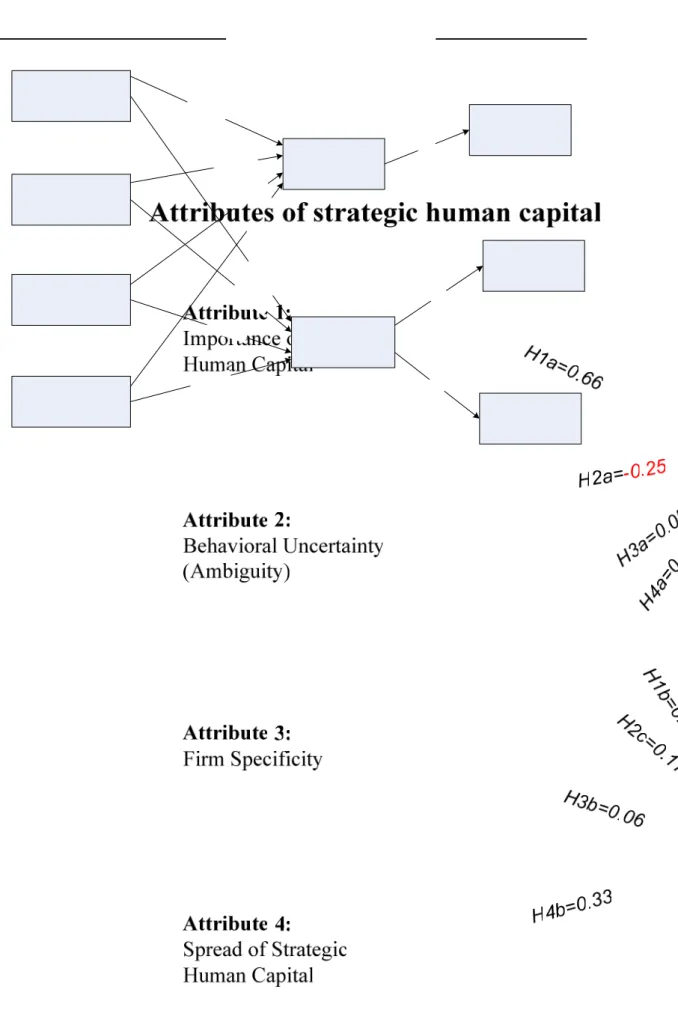
Kline (1998) suggests that when the data do not support the hypothesised model (here model A), an alternative model can be examined based on the theory of of the rejected model. Since the hypotheses of the negative association between the traditional results controls and SHC are not supported from the results of model A, the alternative model B, excludes this component from the MCS. Therefore, the alternative model is considered as components of the MSC, the personnel controls and the non-traditional results controls. This model is illustrated in figure 4. Results from the SEM B are presented in table 3. In this table the last column demonstrates the results from Widener (2004) SEM.
Table 4. Structural equation model B results
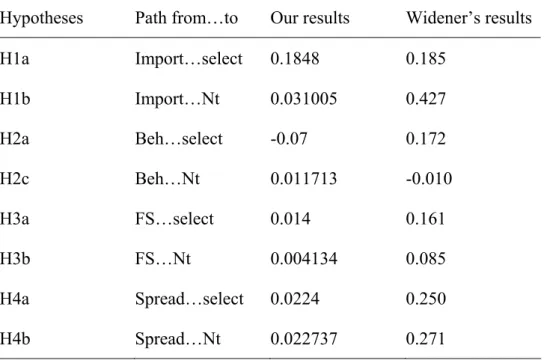
Hypotheses Path from…to Our results Widener’s results
H1a Import…select 0.1848 0.185 H1b Import…Nt 0.031005 0.427 H2a Beh…select -0.07 0.172 H2c Beh…Nt 0.011713 -0.010 H3a FS…select 0.014 0.161 H3b FS…Nt 0.004134 0.085 H4a Spread…select 0.0224 0.250 H4b Spread…Nt 0.022737 0.271
The results have been estimated with the indirect method, using the results of the structural model. For example, H1a, representing the use of personnel control is positively associated with the belief that the SHC is important. Following this step, Import…select (0.1848) is calculated from the direct results of the structural equation model (figure 4) of the two relationships: (a) the one between the variables between
2 A good model fit exists when X2 statistics is insignificant, Root Mean Square Error of Approximation (RMSEA) value is less than 0.10, and Comparative Fit Index (CFI) is greater than 0.90 (Kline, 1998).
the importance of SHC and Personnel control (H1a=0.66) and (b) the relationship between personnel controls and selective staffing (0.28), the components of SHC. Thus, we have 0.66 X 0.28=0.1848. Compared with Widener’s results the statistical results of our model are closely related. According to Widener (2004), the results of the alternative model show that the use of SHC significantly explains the design of the management control system, as it fits with the use of non-traditional and use of personnel controls. The only different results from this study and that of Widener (2004) noticed in H2a (beh and select
components) that in this study appears to be negative (-0.07) while Widener (2004) finds this relationship positive (0.172) and in H2c (beh and nt
components), which appear positive in this study (0.011713) while Widener’s (2004) results appear negative (-0,010).
It was also found that the overall model fits quite satisfactorily. Results are presented in table 5 (compared to those of Widener (2004)).
Table 5. Overall model fit
Our results Widener’s results
X2 df=19 51.14 7.329
P-value 0.0513 0.603
RMSEA 0.98 0.00
CFI 0.94 1
X2-Normed=X2/df 2.7<3 -
The comparative fit index of our model is 0.94, which according to Kline (1998) when it is greater than 0.90, indicates good model fit. The X2 df =19
(51.14) expresses the significant differences between models and as we see X2
-Normed=X2/df is equal to 2.7, accepted because it is less than 3. According to
Kline (1998) the RMSEA, when it is less than 0.10 indicates a good model fit. Although our result is equal to 0.98 it tends to be close to 0.10. Compared to the study of Widener the results of our study are satisfied.
As we can see in figure 4, there is a strong positive relationship between the importance of SHC, the firm specificity and the spread of the DHC with the personnel control, while there is a negative relationship
between behavioral uncertainty and personnel controls. We see also a positive association of the Importance of SHC, the behavioral uncertainty, the firm specificity the spread of the SHC, with the non-traditional results control (the first and the fourth attributes tends to have a stronger connection with non-traditional results controls). Figure 4 presents all the relationships.
5. Conclusion
This study examines the relationship between the strategic choices and the design of the MCS in Greek companies. A primary research has first been realised in a sample of 107 correspondents in the USA and we tried to employ the same study in the population of Greek listed companies, using a sample of 67 correspondents. The first structural model proposed by Widener (2004), combines personnel, non-traditional and traditional results control. It has been statistically rejected by both studies. For this reason the alternative model is adopted and tested. This model shows that the SHC influences positively only the personnel and non-traditional components of the MCS. It is obvious that managers rely on the control of management. The first step of the control in the history of management is traditional measures because they are focused on financial measures. The new measures of control like personnel and non-traditional control, brought innovations to the world of managers. Examining the data of this research it is generally believed that managers lean on strategic human capital using personnel and non-traditional controls. Although the reliance of managers is on the non-traditional controls, they use some measure of traditional measures like budgeting and forecasting.
This research analyses extensively the attributes of strategic resources such as the importance of human capital, behavior uncertainty, firm-specificity and the spread of human capital. Spekle (2001) supports the view that these attributes allow us to examine deeper the relationship between the MCS and the transaction cost economies.
Investigating the ligament of the human capital with the components of the MCS we notice some interesting results. More specifically, the importance of human capital is influenced both by non-traditional and personnel control, while firm specificity and behavioral uncertainty are influenced by personnel control. ‘These findings indicate that firms rely heavily on an ex ante control to prevent the potential of opportunistic behavior that may result from
firm-specificity or behavioral uncertainty, instead of trying to control the behavior ex post’ (Widener, 2004, p. 395). A previous study of Abernethy and Brownell (1997) supports the view that personnel control is effective in companies with high behavioral uncertainty and it is obvious that firms, which use traditional methods, face high uncertainty, increasing the need for communication and flexibility.
This study uses both transaction cost economics and contingency theory in order to develop a theoretical foundation capable of analysing the relationship between the four components of the SHC and the three components of the MCS. This theoretical view tries to present the relationship between the strategy and the management control system, in order to develop the hypotheses of the attribute of the SHC.
This research may be useful for firms that still use traditional control methods and ignore the effectiveness of non-traditional controls. Although many Greek firms do not support a Human Resource department, it may be useful to adjust the data of this research to the data of each Greek firm. The findings of this study show that ‘firms implement a balanced set of both traditional and non-traditional measures across four perspectives (Widener, 2004, p. 394). Many small sized Greek firms rely on financial measures because they are more obvious, ignoring the effectiveness of non-traditional controls. This study provides evidence about the role of traditional and non-traditional controls on strategic human capital and additionally shows Greek managers the importance of these measures in the decision of new strategies of their firms that may lead them to gain a competitive advantage.
Unfortunately this study appears to have some limitations. More precisely the study uses only five constructs of the SHC and three components of the MCS. Although these constructs are theoretically proved the number of the constructs are only representative. Widener’s (2004) study uses only selective staffing for personnel control but there are other dimensions in order to approach personnel control like training and development of employees.
Another limitation was the size of the sample. Although the sample was satisfied a bigger sample may give us more comprehensive and satisfying results. It must also be added, that many firms found that the questionnaire was quite exigent and needed sufficient time to be completed. For that reason the number of answered questionnaires is much smaller compared to the number of correspondent questionnaires sent.
A last limitation is that the results of our research show the relationship between the SHC with the personnel control and the non-traditional control, ignoring the relationship with the traditional control. According to Widener (2004) this issue may lead a firm to the following limitations:
Firms that may have invested in the implementation of the MCS come to the conclusion that adding non-traditional controls is more cost effective than replacing traditional with non-traditional.
Also switching costs appeared to be costly in changing from traditional to non-traditional.
Traditional controls tend to show alternative benefits like the effectiveness of managers to make other decisions within the firm.
Consequently the ‘recession’ of the traditional control of a firm may be quite costly. Considering the previous limitations we could come to the conclusion that non-traditional controls are complementary to traditional controls (Widener, 2004).
To summarise, this study has as its primary aim the presentation of the positive relationship between the SHC with personnel control and non-traditional results control, which during the study has been successfully proved. Analysing the data, we may assume that Greek companies show a great reliance on the strategy of human resources and also use extensively non-traditional results control. This fact may lead an enterprise to gain a competitive advantage and consequently may ensure a beneficial position in the market.
Bibliography
Abernethy, M. A. and P. Brownell (1997), ‘Management control systems in research and development organizations: the role of accounting, behavior and personnel controls’. Accounting, Organizations and Society 22(3/4), pp. 233–248. Abernethy, M. A. and A. M. Lillis (1995), ‘The impact of manufacturing flexibility on management control system design’. Accounting, Organizations and Society 20(4), pp. 241–258.
Amit, R. and P. J. H. Schoemaker (1993), ‘Strategic assets and organizational rent’, Strategic Management Journal, 14(1), pp. 33-46.
Baiman, S. (1990), ‘Agency research in managerial accounting: a second look’,
Accounting, Organizations and Society 15(4), pp. 341–371.
Balkin, D. B. and L. R. Gomez-Mejia (1990), ‘Matching compensation and organizational strategies’, Strategic Management Journal, 11(2), pp. 153–169. Balkom, J. E., C. Ittner and D. Larcker (1997), Strategic performance measurement: Lessons learned and future directions. Journal of Strategic Performance Measurement, pp. 22–32.
Barney, J. (1991). ‘Firm resources and sustained competitive advantage’,
Journal of Management, 17(1), pp. 99–120.
Barney, J. and P. Wright (1998), ‘On becoming a strategic partner: the role of human resources in gaining competitive advantage, Human Resource Management, 37(1), pp. 31-46.
Becker, G. S. (1964), Human capital, New York: Columbia University Press. Becker, G. S. (1976), The economic approach to human behavior, Chicago: University of Chicago Press.
Boone, L.E. and Kurtz, D.L. 1992. Management.
Chapman, C. S. (1997), ‘Reflections on a contingent view of accounting’,
Accounting, Organizations and Society, 22(2), pp. 189–205.
Chapman, C. S. (1998), ‘Accountants in organizational networks’, Accounting, Organizations and Society, 23(8), pp. 737–766.
Chenhall, R. H. (2003), ‘Management control systems design within its organizational context: findings from contingency-based research and
directions for the future’, Accounting, Organizations and Society, 28(2/3), pp. 127–168.
Churchill, G. A. (1979), ‘A paradigm for developing better measures of marketing constructs’, Journal of Marketing Research, 16(1), pp. 64–73.
Coase, R. (1937), ‘The nature of the firm’, Economica, 4, pp. 386–495.
Coff, R. W. (1997), ‘Human assets and management dilemmas: coping with hazards on the road to resource-based theory’, Academy of Management Review, 22(2), pp. 374–402.
Colbert, G. J. and B. H. Spicer (1995), ‘A multi-case investigation of a theory of the transfer pricing process’, Accounting, Organizations and Society, 20(6), pp. 423–456.
Darlington, R. B., S. Weinberg, and H. Walbert (1973), ‘Canonical variate analysis and related techniques’, Review of Educational Research, 453-454.
De Ruyter, K. and M. Wetzels (1999), ‘Commitment in auditor-client relationships: antecedents and consequences’, Accounting, Organizations and Society, 24(1), pp. 57–75.
Dillman, D. A. (1978), Mail and telephone surveys: the total design method, New York: John Wiley and Sons.
Donaldson, L. (1994), Contingency Theory, Aldershot: Dartmouth.
Evans, H. J., L. L. Barry and J. M. Patton (1986), ‘An economic modelling approach to contingency theory and management control’, Accounting Organisation and Society, pp. 483-498.
Fiedler, F. (1967). A theory of Leadership Effectiveness.
Fisher, J. (1995), ‘Contingency-based research on management control systems: categorization be level of complexity’, Journal of Accounting Literature, 14(1), pp. 24-53.
Gordon, L. A. and Miller, D., (1976), ‘A contingency framework for the design of accounting information systems’, Accounting, Organizations and Society, 1(1), 59–70.
Graham, H. J. and R. Bennett (1995), Human resource management.
Granovetter, M. and Soong, R. 1986. Threshold models of interpersonal effects in consumer demand, Journal of Economic Behavior & Organization, pp 83-99.
Grant, R. M. (1997), ‘Strategy at the leading edge. The knowledge-based view of the firm: Implications for management practice’, Long Range Planning, 30(3), pp. 450–454.
Ittner, C. and D. Larcker (1995), ‘Total quality management and the choice of information and reward systems’, Journal of Accounting Research, 33(1), pp. 1– 41.
Ittner, C. and D. Larcker (1997), ‘Quality strategy, strategic control systems, and organizational performance’, Accounting, Organizations and Society, 22(3/4), pp. 293–314.
Jermias, J. and L. Gani (2004), ‘Integrating business strategy, organizational configurations and management accounting systems with business unit effectiveness: a fitness landscape approach’, Management Accounting Research, pp. 179-200.
Johnson T. H. and R. S. Kaplan (1987), Relevance Lost: The Rise and Fall of Management Accounting, Harvard Business School Press.
Joshi, S. 1998.A framework to analyze comparative dynamics in a continuous time stochastic growth model Economic Modelling, pp. 125-134
Judith, B. (1995). Skills for managing work and leading people.
Kaplan R. S. 1994. Management accounting (1984-1994): development of new practice and theory. Management Accounting Research, pp. 247-260
Kaplan, R. S. (1983), ‘Measuring manufacturing performance: a new challenge for managerial accounting research’, The Accounting Review, 58(4), pp. 686-705. Kaplan R.S. and Norton D.P., 1992. The balanced scorecard—measures that drive performance. Harvard Business Review , pp. 71–79.
Kaplan R.S. and Norton D.P., 1993. Putting the balanced scorecard to work. Harvard Business Review, pp. 134–142.
Kaplan, R. S. and Norton, D.P. 1996. The balance scorecard: Translating strategy into action. The Journal of Academic Libriarianship, pp.53.
Kline, R. B. (1998), Principles and practices of structural equation modelling, New York: The Guilford Press.
Kloot, L. (1997), ‘Organizational learning and management control systems: responding to environmental change’, Management Accounting Research, 8(1), pp. 47–73.
managerial functions.
Langfield-Smith, K. (1997), ‘Management control systems and strategy: a critical review’, Accounting, Organizations and Society, 22(2), pp. 207–232.
Langfield-Smith, K. and D. Smith (2003), ‘Management control systems and trust in outsourcing relationships’, Management Accounting Research, pp. 281-307.
Lank, E. (1997), ‘Leveraging invisible assets: the human factor’, Long Range Planning, 30(3), pp. 406–412.
Lepak, D.P. and Snell, S.A., 1999. The human resource architecture: towards a theory of human capital allocation and development. The Academy of Management Review 24, pp. 31–48.
Lepak, D.P. and Snell, S.A., 2002, Examining the human resource architecture: The relationship among human capital, Employment and Human resource configurations, Journal of Management, pp. 517-543.
Liu, W., Lepak, P., Takeuchi, R., and Sims, H.P. 2003. Matching leadership styles with employment modes: strategic human resource management perspectives. Human Resource Management Review, pp 127-152.
Malina, M. A. and Selto, F. H. 2004, Choice and change of measures in performance measurement models, Management Accounting Research, pp.441-469.
Meer-Kooistra and Vosselman, 2000, Management control of interfirm transactional relationships: the case of industrial renovation and maintenance. Accounting, Organizations and Society.pp. 51-77
Merchant, K.A., 1985. Organizational controls and discretionary program decision making: A field study .Accounting, Organizations and Society, pp.67-85
Merchant, K.A., 1998. Modern management control systems. , Prentice Hall, Upper Saddle River, NJ.
Merchant, K.A., Harvey, D. and Rhode, J. 1979.Accounting aggregation: User preferences and decision making Accounting, Organizations and Society, pp. 187-210
Morgan R.M.and Hunt S. 1999. Relationship-Based Competitive Advantage: The Role of Relationship Marketing in Marketing Strategy. Journal of Business Research,pp.281-290.
accounting information systems: Organizational coordination and control effects. International Journal of Accounting Information Systems, pp. 91-105. Noorderhaven, N. G. 1995. Transaction, interaction, institutionalization: Toward a dynamic theory of hybrid governance. Scandinavian Journal of Management, pp 43-55.
Osterman , How common is workplace transformation and who adopts it?. Industrial and Labor Relations Review 47 (1994), pp. 173–188.
Osterman P. 1987. Choise of employment systems in internal labor markets. Industriall relations 26,pp. 48-63.
Otley, D. 1999. Performance Management: a framework for management control systems research, Management accounting research, pp.363-382.
Otley, D., 1980. The contingency theory of management accounting: achievement and prognosis. Accounting, Organizations and Society, pp. 2231–2246.
Peck, S.R., 1994. Exploring the link between organizational strategy and the employment relationship: the role of human resources policies. Journal of Management Studies 31, pp. 715–736.
Perera, S., Harrison, G. and Poole, M., 1997. Customer-focused manufacturing strategy and the use of operations-based non-financial performance measures: a research note. Accounting, Organizations and Society 22, pp. 557–572.
Quinn, J.B., Anderson, P. and Finkelstein, S., 1996. Making the most of the best. Harvard Business Review, pp. 71–80.
Reid, G.C. and Smith, J.A. 2000, The impact of contingencies on management accounting system development. Management Account ng Research, pp.427– 450.
Rousseau, D. M. (1995). Psychological contracts in organizations: Understanding written and unwritten agreements. Thousand Oaks, CA: SAGE Publications.
Simon, H.A. 1945. Administrative behaviour. (3rd edition) 1976. New York:
Free Press.
Simons, R., 1987. Accounting control systems and business strategy: an empirical analysis. Accounting, Organizations and Society 12, pp. 357–374. Simons, R., 1990. The role of management control systems in creating competitive advantage: new perspectives. Accounting, Organizations and Society, pp. 127–143
Simons, R.1995. Levers of Control: How Managers Use Innovative Control Systems to Drive Strategic Renewal, Harvard Business School Press.
Snell, S.A. and Dean Jr., J.W., 1992. Integrated manufacturing and human resource management: a human capital perspective. Academy of Management Journal 35, pp. 467–504.
Spekle, R.F., 2001. Explaining management control structure variety: a transaction cost economics perspective. Accounting, Organizations and Society 26, pp. 419–441.
Spekle, R.F., 2002. "Towards A Transaction Cost Theory Of Management Control," Research Paper ERS; ERS-2002-06-F&A, Erasmus Research Institute of Management (ERIM), RSM Erasmus University.
Spicer, B.H. and Ballew, V., 1983. Management accounting systems and the economics of internal organization. Accounting, Organizations and Society 8, pp. 73–96.
Tsang, E.W. 2000. Transaction Cost and Resource-based Explanations of Joint Ventures: A Comparison and Synthesis. Organization studies.
Vaivio, J. 1999.Exploring a non-financial management accounting change. Management Accounting Research, pp. 409-437.
Weatherly, L. 2003. Human Capital- the ellusive asset: measuring and managing Human Capital, a strategic imperative for HR 2003 Quarterly, Human Resource Magazine.
Widener, S. 2004. An empirical investigation of the relation between the use of strategic human capital and the design of the management control system. Accounting, Organization and Society, pp. 377-399.
Wilkinson I. F. and Van Nguyen, 2002. A contingency model of export entry mode performance. School of marketing , University of New South Wales Australia, Working Paper 02/2.
Williamson, O. E. 1996. Economic organization: The case for candor. . Academy of Management Review, 21: 48-57.
Williamson, O.E., 1975. Markets and hierarchies: analysis and antitrust implications. , The Free Press, New York.
Williamson, O.E., 1985. The economic institutions of capitalism. , The Free Press, New York.
organization. Strategic Management Journal 12, pp. 75–94.
Appendix I. Questionnaire. Survey questions by construct Questions : 1 – 3. Selective Staffing, select, (Scale: 1 - 7)
Q1. How much importance do you place on the managerial staffing (hiring) process in this organization?
Q2. How extensive is the employee selection process (e.g., use of tests, interviews, etc.) for a managerial position in your organization? Q3. How important is to select the best person for a managerial position?
Questions : 4 – 9. Non-financial Eployee Measures, emp, (Scale: 1 - 7) Please indicate the extent of each measure’s use as a feature of the management control system (e.g., internal information system): Q4. Employee satisfaction
Q5. Employee skill development Q6. Voluntary turnover Q7. Employee safety Q8. Training days per employee
Q9. Number of personnel plans completed
Questions : 10 – 13. Evaluation, eval, (Scale: 1 - 7)
Q10. How important are team performance measures relative to the importance of individual performance measures in determining compensation for top managers?
Indicate the extent of your agreement or disagreement with the following statements:
Q11. The pay system in this organization primarily rewards top managers for team related objectives relative to individual objectives?
Q12. The pay system in this organization rewards top managers for employee related accomplishments?
Q13. The pay system in this organization focuses top managers´ attention on team related goals relative to individual objectives?
Questions : 14 – 17. Budgeting and Cost Controls, bcc, (Scale: 1 - 7)
Q14. To what extent does your organization control operations control operations by analysing and reporting to top management variances between actual costs and standard or expected costs?