Public Accounts Committee
Senior Management Pay
An electronic copy of this report can be found on the National Assembly’s website:
www.senedd.assemblywales.org
Copies of this report can also be obtained in accessible formats including Braille, large print; audio or hard copy from:
Public Accounts Committee National Assembly for Wales Cardiff Bay CF99 1NA Tel: 029 2089 8041 Fax: 029 2089 8021 Email: [email protected] Twitter: @SeneddPAC
© National Assembly for Wales Commission Copyright 2014
The text of this document may be reproduced free of charge in any format or medium providing that it is reproduced accurately and not used in a misleading or derogatory context. The material must be acknowledged as copyright of the National Assembly for Wales Commission and the title of the document specified.
The National Assembly for Wales is the democratically
elected body that represents the interests of Wales and
its people, makes laws for Wales and holds the Welsh
Government to account.
Public Accounts Committee
Senior Management Pay Report
Public Accounts Committee
The Committee was established on 22 June 2011. The role of the Public Accounts Committee is to ensure that proper and thorough scrutiny is given to Welsh Government expenditure. The specific functions of the Committee are set out in Standing Order 18. The Committee will consider reports prepared by the Auditor General for Wales on the accounts of the Welsh Government and other public bodies, and on the economy, efficiency and effectiveness with which resources were employed in the discharge of public functions.
Current Committee membership
The following Member was also a member of the Committee during this inquiry:
Alun Ffred Jones
Plaid Cymru Arfon
Darren Millar (Chair)
Welsh Conservatives Clwyd West Mike Hedges Welsh Labour Swansea East Jenny Rathbone Welsh Labour Cardiff Central Julie Morgan Welsh Labour Cardiff North William Graham Welsh Conservatives South Wales East
Aled Roberts
Welsh Liberal Democrats North Wales
Sandy Mewies
Welsh Labour Delyn
Mohammad Asghar (Oscar)
Welsh Conservatives South Wales East
Contents
Chair’s foreword ... 5
1. Introduction... 12
2. Setting the Scene – Public Sector Pay in Wales ... 14
Reporting Requirements for Senior Management Pay ... 17
How Senior Management Pay is Set ... 19
3. Consistency and Transparency... 22
Consistency ... 22
Banding within Sectors ... 25
Banding in the National Health Service Wales ... 26
Transparency ... 27
“Benefits in Kind” ... 32
Returning Officer fees... 32
Exit Packages ... 33
Accountability ... 34
4. Advice and Guidance ... 36
Comparators ... 36
Remuneration Committees ... 39
Benchmarking / Use of Recruitment Consultants ... 42
Guidance ... 45
5. Different Approaches ... 49
Performance related pay ... 49
Internal Talent development ... 51
6. The Committee’s view ... 53
Witnesses ... 57
Chair’s foreword
Senior management pay levels in the public sector have been the subject of much media coverage and discussion. They are often
perceived as being excessive in comparison to many other posts both in public and private life. For example, top civil servants earn more than the First Minister. It was these issues that prompted the Public Accounts Committee to consider the pay arrangements for senior management pay, not to pass judgment on the salaries of individuals, but instead ensure that the decisions made in this field were
accountable and transparent.
The Committee agreed to undertake an inquiry into senior
management pay late 2013 and held a number of evidence sessions during the first half of 2014. Throughout the inquiry we focused on the rationale behind the decision-making regarding senior managers’ pay, and considered a broad range of taxpayer funded organisations in order to build a comprehensive picture of pay arrangements across the public sector.
So what did we find? Well, there was a mixed bag of disclosure requirements, and approaches to pay in the public sector. It was sometimes difficult to make comparisons between pay arrangements between similar organisations and there were inconsistencies across the public sector as a whole. We were concerned about these findings, as we believe that it is vital that the information on senior pay levels in the public sector is clear and accessible. This will allow for effective scrutiny together with an educated and informed debate about senior management pay to take place.
To address our concerns we are proposing a suite of recommendations aimed at eradicating the inconsistencies in reporting and ensuring accountability to taxpayers. Our recommendations do not place any significant additional burden on organisations, instead they aim to bring consistency to reporting on senior management pay, make information more accessible to the public and provide for greater levels of transparency regarding organisational decision-making across the whole public sector. This should make the information of use to as wide an audience as possible and allow for thorough scrutiny by those with an interest in this area.
6
We trust that the Welsh Government will accept our recommendations in full, and that this work can feed into the considerations of the Public Services Staff Commission. We also believe that the on-going work around Local Government reorganisation presents an ideal opportunity to address a number of the issues we have identified.
I would like to thank all those who took the time to contribute to this inquiry, and hope this report serves as a useful starting point for securing the much needed openness and transparency around senior management pay in the public sector that taxpayers deserve.
The Committee’s Recommendations
The Committee’s recommendations to the Welsh Government are listed below, in the order that they appear in this Report. Please refer to the relevant pages of the report to see the supporting evidence and conclusions:
Recommendation 1. The Committee recommends that a clear definition of what is meant by a senior post in the public sector is produced and disseminated by the Welsh Government. This should have consideration to the level of remuneration, scale of the
organisation and the level of responsibility of the post holder.
(Page 21)
Recommendation 2. The Committee recommends that the Welsh Government use the local government reorganisation work to consider the options for introducing consistency around senior management pay in Local Government. We would like to see a clear rationale
published setting out how pay should be set in any new structure that is introduced. Given the recent decisions by some councils to consider voluntary mergers, this should be done with a matter of urgency. Furthermore, the process of voluntary mergers should be included in any consideration of pay structures. (Page 27)
Recommendation 3. The Committee recommends that a glossary of terms relating to senior pay is produced and published by the Welsh Government, which sets out the most appropriate terms to be used in pay disclosures, as well as explanations for less frequently used terms. The Committee further recommends that narratives to accounts,
particularly for unusual situations, contain adequate notes which are
easy to interpret. (Page 29)
Recommendation 4. The Committee recommends that the Welsh Government work with local authorities to ensure that items pertaining to pay matters are listed clearly and separately on all agendas
(Executive Board and Council Level). This may require an amendment to the Local Authorities (Executive Arrangements) (Decisions,
Documents and Meetings) (Wales) (Amendment) Regulations. Page 30)
Recommendation 5. The Committee recommends that clear guidance is issued by the Welsh Government to local authorities requiring any Returning Officers fees to be published in an easily
8
accessible place alongside remuneration information. This should include clearl explainations behind this entitlement. (Page 33)
Recommendation 6. The Committee recommends that the Welsh Government, and other bodies issuing account directions, reviews their mechanisms, including grant conditions, for monitoring compliance with remuneration disclosures, and reports back to the Committee how it intends to ensure that full compliance is achieved.
(Page 34)
Recommendation 7. The Committee recommends that the Welsh Government produce and disseminate guidance on how to manage pay arrangements for joint appointments between local authorities, given the increasing moves towards these types of appointment. This should include the need for these salaries to be disclosed in all contributing
local authorities accounts. (Page 35)
Recommendation 8. The Committee recommends that the Welsh Government consider the make-up and recruitment of the independent remuneration panel for Wales, as positions become available, to
ensure it is representative of wider civil society (Page 41)
Recommendation 9. The Committee recommends that information on remuneration committees across the public sector and their
decisions are published in an easily accessible and prominent place on
the organisations website. (Page 42)
Recommendation 10. The Committee recommend that the Welsh Government produce good practice guidance for remuneration committees setting out the key principles of openness and
transparency. Alongside this guidance, we recommend that a number of seminars/training sessions are held which set out these principles and develop the important skills needed to be an effective
remuneration panel member. (Page 42)
Recommendation 11. The Committee recommends that best practice guidance is produced by the Welsh Government which sets out best methods for engaging with external consultants on senior management pay. This should include the need to have interaction with the relevant decision making group throughout the process.
Recommendation 12. The Committee recommends that the Welsh Government works with the WLGA and the Wales Audit Office to produce guidance on the role of senior officers in local authorities in providing advice in relation to pay matters. (Page 46)
Recommendation 13. The Committee recommends that the Welsh Government work with local government, higher education, further education, health, and registered social landlord sectors to ensure that training and guidance on senior pay is consistently delivered to all
sectors. (Page 47)
Recommendation 14. The Committee recommends that the Welsh Government reminds local authorities out of the importance and independence of the role of the monitoring officer, and the need to ensure that this role operates effectively across the organisation at a senior level. This should also remind monitoring officers of methods for reporting any concerns either internally or if necessary externally.
(Page 48)
Recommendation 15. The Committee recommends that the Welsh Government undertake a study into different pay mechanisms, and produce a report setting out what is considered good practice. This should consider how best to deal with senior management in failing
organisations. (Page 51)
Recommendation 16. The Committee recommends that public sector organisations are required by the Welsh Government to set out their approach to performance related pay and internal talent
management in their pay policies. (Page 52)
Recommendation 17. The Committee recommends that the Welsh Government issues advice and guidance to the Welsh Public Sector, including those sectors receiving significant funds from the Welsh Government (e.g. registered social landlords, further education and higher education) on the requirements for publication of remuneration information and pay policies, taking account the recommendations in
this report. (Page 54)
Recommendation 18. We recommend that public sector
organisations are required to publish information on the number of employees with a remuneration package of more than £100,000 in
10
Recommendation 19. We recommend that a full remuneration report is produced by all organisations within the Welsh public sector annually, and published on a prominent place on the organisations website. This should set out in full the following information about all senior staff, with due regard to the Committee’s previous
recommendation about ensuring published information is easily interpreted: –Salary; –Pension; –Benefits in kind; –Non-taxable benefits; –Severance packages;
–Returning Officer fees/additional fees;
–Pay ratio between highest and lowest paid officer;
–Gender make-up of the senior team. (Page 54)
Recommendation 20. We recommend that all organisations in the Welsh public sector are required to publish a pay policy statement, in line with the requirement on Local Authorities and Fire and Rescue authorities in the 2011 Localism Act. (Page 55)
Recommendation 21. The Committee recommends that all information on an organisations pay is published in a single, easily accessible place on their website and sets out the information in a clear and transparent fashion. To achieve this, we recommend the Welsh Government produce guidance on the format for this disclosure. We believe this will achieve maximum transparency and ultimately
accountability. (Page 55)
Recommendation 22. We recommend that the Welsh Government make these requirements a condition on any grants or funding which are provided to those organisations which do not explicitly fall within the public sector ( e.g. higher education/further education/registered
Recommendation 23. The Committee recommends that the Welsh Government collate the information on senior pay across the Welsh public sector in line with that produced by the Wales Audit Office for the Public Accounts Committee to include those sectors receiving significant funds from the Welsh Government (e.g. RSLs, Further Education and Higher Education) on an annual basis and publish this
12
1.
Introduction
1. The Public Accounts Committee agreed to undertake an inquiry into Senior Management Pay across the Public Sector in November 2013. This inquiry was generated by concerns from Committee Members about the level of consistency and transparency around senior pay in the public sector.
2. As part of this inquiry, the Committee agreed to consider:
–the decision making process for setting pay, particularly whether this is appropriate for achieving value for money across the public sector;
–the method for agreeing pay increases;
–the transparency of pay and rewards/benefits eg pensions or returning officer fees;
–the quality and level of comparative data that exists for senior management pay across the public sector; and
–whether there should be a body that has a remit for taking and overview of pay/remuneration across the public sector in Wales. 3. The Committee requested that the Auditor General for Wales (the Auditor General) produce a memorandum setting out senior
management pay across the Welsh public sector. This memorandum covered an analysis of pay in NHS bodies, local government, bodies funded directly from the Welsh Consolidated Fund, Welsh Government Sponsored Bodies and other bodies directly funded by the Welsh Government. During the course of the inquiry, the Committee sought further information on senior management pay levels in further
education, higher education and Registered Social Landlords. Copies of all the published memorandums can be found on the Public
Accounts Committee webpage.1
4. The Committee held 8 evidence sessions and heard from a range of witnesses from across the public sector, as well as the Hay Group and the Tax Payers Alliance. The full list of witnesses can be found at annex A. The Committee also held a public consultation as part of this inquiry, and a full list of the written evidence received can be found at annex B.
5. For the purpose of this inquiry, the Committee utilised a wide definition of public sector, to incorporate those bodies which receive a significant sums of public funding. Therefore, the Committee gathered evidence on the following sectors:
–local government; –NHS bodies;
–Welsh Government and associated organisations; –Registered Social Landlords;
–further education; –higher education
6. This report is structured in six chapters. Chapter two sets out the current situation with public sector senior management pay, and some comparators between sectors and with the public sector. Chapters three, four and five consider different parts of the evidence received by the Committee looking at aspects such as the consistency and
transparency of approaches to senior pay, the advice and guidance provided to those setting senior pay and possible different approaches to dealing with pay. Given the cross cutting nature of evidence
received, the final chapter sets out some conclusions, and a suite of recommendations aimed at improving the openness of senior
14
2.
Setting the Scene – Public Sector Pay in Wales
7. According to StatsWales, at the end of 31 March 2014, there were 23.2% of people employed in the public sector across the UK. This percentage was slightly higher in Wales with 29.6% of people being recorded as employed in the public sector.2 Given the significant
proportion of the population employed in the public sector, the Committee was keen to ensure that the decision making process for setting senior pay in the public sector was consistent and transparent. 8. The Auditor General’s memorandum collated statistical
information on Chief Executive and senior salaries across the Welsh public sector between 2009-10 and 2012-13. In 2012-13, salaries for local government Chief Executives ranged from £105,581 for Conwy County Borough Council to £194,661 for Pembrokeshire County
Council.3 In 2012-13, salaries for Chief Executives in Welsh NHS bodies
ranged from £120,000 for the Welsh Ambulance Services NHS Trust to £200,000 for Abertawe Bro Morgannwg University Health Board.4
9. While 2012-13 salaries for chief executive officers from the bodies funded direct from the Welsh Consolidated Fund ranged from £135,000 for the Public Service Ombudsman for Wales to £160,000 for the Permanent Secretary to the Welsh Government.5
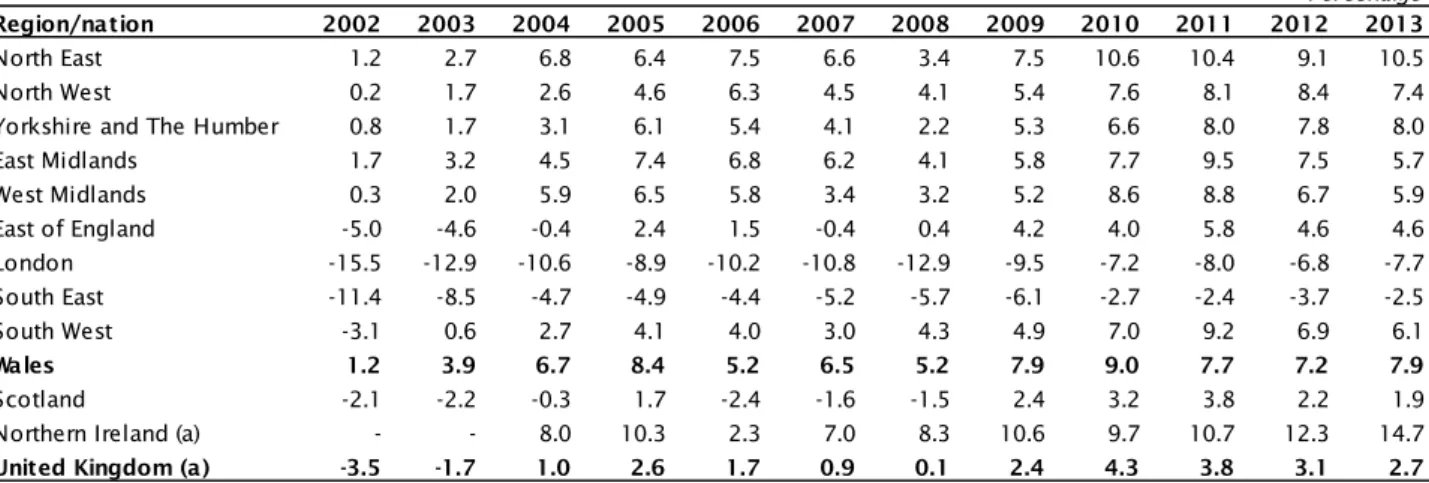
10. The Office for National Statistics (ONS) published an analysis on Public and Private Sector Earnings in March 2014. The analysis set out the differential between public and private sector pay. It produced two sets of figures one based on just personal characteristics and one which accounted for organisational characteristics as well (For further information on what is meant by this differentiation see Office for National Statistics publication Public and Private Sector Earnings,6). The
following two tables set out the findings of this analysis:
2
https://statswales.wales.gov.uk/Catalogue/Business-Economy-and-Labour-
Market/People-and-Work/Employment/Persons-Employed/PublicPrivateSectorEmployment-by-WelshLocalAuthority-Status [accessed 28/07/14]
3 Wales Audit Office, Memorandum for the Public Accounts Committee – Senior
management pay across the Welsh public sector, page 17
4 Ibid. page 13 5 Ibid page 22
Table 1: Average difference in mean hourly earnings as a percentage of private sector pay taking into account personal characteristics, 2002 to 20137
Table 2: Average difference in mean hourly earnings as a
percentage of private sector pay taking into account personal and organisational characteristics, 2002 to 20138
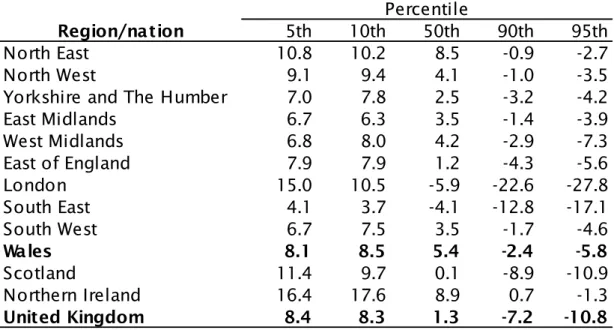
11. The ONS also undertook comparisons on pay at the top and bottom of the earning distributions. The UK wide findings are in the tables below:
7 Source: Office for National Statistics, Public and Private Sector Earnings, pages 23
and 24 Note: Data for Northern Ireland is available from 2004. Consequently, figures for the UK in 2002 and 2003 are actually for Great Britain.
8 Source: Office for National Statistics, Public and Private Sector Earnings, pages 24
and 25 Note: Data for Northern Ireland is available from 2004. Consequently, figures for the UK in 2002 and 2003 are actually for Great Britain.
Percentage
Region/nation 2002 2003 2004 2005 2006 2007 2008 2009 2010 2011 2012 2013
North East 1.2 2.7 6.8 6.4 7.5 6.6 3.4 7.5 10.6 10.4 9.1 10.5 North West 0.2 1.7 2.6 4.6 6.3 4.5 4.1 5.4 7.6 8.1 8.4 7.4 Yorkshire and The Humber 0.8 1.7 3.1 6.1 5.4 4.1 2.2 5.3 6.6 8.0 7.8 8.0 East Midlands 1.7 3.2 4.5 7.4 6.8 6.2 4.1 5.8 7.7 9.5 7.5 5.7 West Midlands 0.3 2.0 5.9 6.5 5.8 3.4 3.2 5.2 8.6 8.8 6.7 5.9 East of England -5.0 -4.6 -0.4 2.4 1.5 -0.4 0.4 4.2 4.0 5.8 4.6 4.6 London -15.5 -12.9 -10.6 -8.9 -10.2 -10.8 -12.9 -9.5 -7.2 -8.0 -6.8 -7.7 South East -11.4 -8.5 -4.7 -4.9 -4.4 -5.2 -5.7 -6.1 -2.7 -2.4 -3.7 -2.5 South West -3.1 0.6 2.7 4.1 4.0 3.0 4.3 4.9 7.0 9.2 6.9 6.1 Wales 1.2 3.9 6.7 8.4 5.2 6.5 5.2 7.9 9.0 7.7 7.2 7.9 Scotland -2.1 -2.2 -0.3 1.7 -2.4 -1.6 -1.5 2.4 3.2 3.8 2.2 1.9 Northern Ireland (a) - - 8.0 10.3 2.3 7.0 8.3 10.6 9.7 10.7 12.3 14.7
United Kingdom (a) -3.5 -1.7 1.0 2.6 1.7 0.9 0.1 2.4 4.3 3.8 3.1 2.7
Percentage
Region/nation 2002 2003 2004 2005 2006 2007 2008 2009 2010 2011 2012 2013
North East -2.8 -1.4 3.1 2.8 4.4 2.9 -0.3 3.2 6.0 6.2 5.2 6.3 North West -3.5 -2.5 -1.1 0.9 3.0 0.7 0.1 1.0 2.9 3.6 4.3 2.9 Yorkshire and The Humber -3.4 -2.9 -1.0 1.7 1.8 0.2 -2.0 0.8 1.7 3.2 3.1 2.8 East Midlands -3.0 -1.7 0.2 3.1 3.3 1.9 -0.2 1.3 3.2 5.0 3.5 1.7 West Midlands -3.8 -2.7 1.6 2.4 2.5 -0.5 -0.9 0.8 3.8 4.4 2.6 1.5 East of England -9.2 -9.2 -4.3 -1.8 -2.1 -4.7 -4.1 -0.8 -0.8 1.0 0.3 -0.2 London -18.1 -15.9 -13.3 -11.6 -12.3 -13.7 -15.6 -12.5 -10.7 -11.2 -9.9 -11.2 South East -15.1 -13.0 -8.6 -8.9 -7.7 -9.1 -9.8 -10.3 -7.2 -6.6 -7.6 -6.9 South West -7.4 -4.3 -1.8 -0.4 0.1 -1.6 -0.6 -0.4 1.5 4.1 2.5 1.2 Wales -3.9 -1.9 2.3 4.0 1.5 2.0 0.7 3.0 4.0 2.7 2.4 2.3 Scotland -6.4 -6.6 -3.9 -2.2 -5.6 -5.1 -5.2 -1.7 -1.3 -0.5 -1.8 -2.5 Northern Ireland (a) - - 3.7 5.0 -1.8 2.1 1.9 3.7 2.6 3.5 4.8 7.1
16
Table 3: Average difference in hourly earnings as a percentage of private sector pay across the earnings distribution taking into account personal characteristics, 20139
Table 4: Average difference in hourly earnings as a percentage of private sector pay across the earnings distribution taking into account personal and organisational characteristics, 201310
9 Source: Office for National Statistics, Public and Private Sector Earnings, page 27 10 Source: Office for National Statistics, Public and Private Sector Earnings, page 28
Percentage
5th 10th 50th 90th 95th
North East 14.0 13.2 12.3 5.4 2.1
North West 12.9 13.1 7.6 3.2 1.0
Yorkshire and The Humber 10.8 10.9 6.4 2.1 -0.6
East Midlands 9.5 9.7 7.2 2.2 -0.8 West Midlands 10.1 11.2 7.5 1.5 -2.9 East of England 11.5 11.1 5.7 1.0 -0.9 London 20.4 15.3 -3.1 -19.5 -24.3 South East 9.0 7.7 -0.6 -9.0 -13.0 South West 10.1 10.9 7.1 3.3 0.3 Wales 11.8 13.1 9.7 2.6 -0.7 Scotland 14.6 13.3 3.9 -4.9 -5.9 Northern Ireland 23.0 23.0 16.4 8.6 4.0 United Kingdom 12.7 12.0 4.9 -2.9 -5.9 Percentile Region/nation Percentage 5th 10th 50th 90th 95th North East 10.8 10.2 8.5 -0.9 -2.7 North West 9.1 9.4 4.1 -1.0 -3.5
Yorkshire and The Humber 7.0 7.8 2.5 -3.2 -4.2
East Midlands 6.7 6.3 3.5 -1.4 -3.9 West Midlands 6.8 8.0 4.2 -2.9 -7.3 East of England 7.9 7.9 1.2 -4.3 -5.6 London 15.0 10.5 -5.9 -22.6 -27.8 South East 4.1 3.7 -4.1 -12.8 -17.1 South West 6.7 7.5 3.5 -1.7 -4.6 Wales 8.1 8.5 5.4 -2.4 -5.8 Scotland 11.4 9.7 0.1 -8.9 -10.9 Northern Ireland 16.4 17.6 8.9 0.7 -1.3 United Kingdom 8.4 8.3 1.3 -7.2 -10.8 Percentile Region/nation
Reporting Requirements for Senior Management Pay
12. All public bodies are required to report the remuneration of their senior staff. The exact nature of the information required to be
reported varies between different sectors according to the relevant statutory requirements and the associated accounting guidance. 13. NHS bodies and all bodies within the central government sector follow the requirements set out in Government Financial Reporting Manual (FReM).
14. All local government bodies (local authorities, police and crime commissioners (PCCs), police chief constables, national parks and fire and rescue authorities) follow the requirements set out in the
Chartered Institute of Public Finance and Accountancy (CIPFA) Code of Practice on Local Authority Accounting (the Code).
15. The education sector (Higher and Further education) are governed by the Further and Higher Education Statement of Recommended
Practice (SORP). While Registered Social Landlords follow the Statement of recommended practice: Accounting by registered social landlords. 16. In Wales, these manuals, Codes and statements of recommended practice are also supported by other Welsh Government guidance. For example:
–NHS bodies – NHS Manual for Accounts;
–Welsh Government Sponsored Bides – specific directions; –local government bodies – The Accounts and Audit (Wales)
(Amendment) Regulations 2010;
–education sector: Accounts directions to higher and further education institutions (separate directions issued)
–Registered Social Landlords – the Accounting Requirements for Registered Social Landlords General Determination (Wales) 2009. 17. The exact requirements of these codes and supplementary
directions and guidance differ, which has led to some inconsistencies in reporting. These are explored further in the following table:
Senior officer remuneration disclosure requirements Guidance / recommended practice Central government sector: Government Financial Reporting Manual (FReM) NHS: Government Financial Reporting Manual (FReM) Local government: CIPFA Code Education:
Further and Higher education Statement of Recommended Practice (SORP) Registered Social Landlords: Statement of recommended practice: Accounting by registered social landlords
Definitions of senior officers where specific individual disclosure is required
The chairman and chief executive. The management board (including advisory and non-executive members) having authority or responsibility for directing or controlling the major activities of the entity during the year.
As for FreM bodies but Manual states:
“usually considered that the regular attendees of the body’s board meetings are its senior
managers”
A person whose salary is more than £150,000 per year.
A person whose salary is at least £60,000 per year and who is the designated head of paid service, a statutory or non-statutory chief officer, or any person having responsibility to the extent that the person has the power to direct or control the major activities of the body.
The Principal and the highest paid
employee, if that is not the Principal.
The highest paid director during the period of account
Definitions of senior officers, where numbers of officers are required to be disclosed. No disclosure required. No disclosure required. Officers whose remuneration was £60,000 or more, grouped in £5,000 bands. Employees whose total emoluments exceed £60,000 for further education institutions and £100,000 for higher education institutions, in £10,000 bands No disclosure required.
Disclosure requirements Central government sector: Government Financial Reporting Manual (FReM) NHS: Government Financial Reporting Manual (FReM) Local government: CIPFA Code Education:
Further and Higher education Statement of Recommended Practice (SORP) Registered Social Landlords: Statement of recommended practice: Accounting by registered social landlords
For specific senior officers
Salaries and allowances √ √ √ √ √
Performance pay or bonuses √ √ √ √ √
Compensation on loss of office √ √ √ √ √
Benefits in kind √ √ √ √ √
Pensions – annual increase in accrued pension and cash equivalent transfer value (CETV)
√ √
Pensions – employers contribution
√ √ √
For number of senior officers No disclosure
required. No disclosure required. Disclosure based on remuneration Disclosure based on “emoluments” No disclosure required.
Salaries and allowances √ √
Performance pay or bonuses √ √
Compensation on loss of office √ √
Benefits in kind √ √
Pensions – employers contribution
19
How Senior Management Pay is Set
18. There appeared to be a general lack of understanding around the process for setting Senior Management pay in the public sector. This inquiry has highlighted, in part, some of the differences between sectors and why there is variation in pay levels. However, it seems that more could be done to set out more clearly how salaries are set and increases occur.
19. The Auditor General’s memorandum sets out details of how senior management pay is set within the public sector in Wales, together with indications of any flexibility available to organisations when setting pay structures.11
20. Under section 38(1) of the Localism Act 2011, all councils and fire and rescue authorities in England and Wales are required to publish details of their policies which determine how pay is set, in particular executive pay. However, this requirement is not as explicit in other parts of the public sector.
21. The Committee took evidence from the Hay Group who work across the UK public sector to modernise their pay and reward arrangements, deliver leadership programmes and provide
organisational design solutions.12 The Hay Group’s written evidence
sets out the difficulties that they experience with regards to senior pay:
“The problems we encounter are…, for example committees which are not in a position to decide, because they do not have a common understanding of policy or are not fully prepared; and reluctance to link remuneration to organisation need and performance.”13
22. It also makes some general comments around the quality of the methodology used by public sector organisations in setting senior pay, stating that:
11 Wales Audit Office, Memorandum for the Public Accounts Committee – Senior
management pay across the Welsh public sector, page 37 [accessed 7 February 2014]
12 Hay Group, Public sector and not for profit [accessed 7 February 2014]
13 National Assembly for Wales, Public Accounts Committee, PAC(4)-05-14: Paper 1:
“Public sector organisations often lack clear and properly articulated policies for senior pay. A rounded policy will define what the organisation wants to pay for and what forms reward will take, as well as how much should be paid. Many public sector organisations concentrate on the last of these things, and some even make assumptions about market position rather than developing a rationale for what they do.”14
23. It was also suggested by witnesses that further clarity may be useful in defining what is meant by “senior posts” to ensure consistent information is provided across the public sector. Different
organisations disclose varying pieces of information about senior posts with some organisations defining it by the amount earned and others on the position held. For example, during the evidence session with the Welsh Local Government Association (WLGA), there was some confusion about the definition of senior managers whether this was just the lay under the chief executive or the wider definition used for disclosure in the accounts.15 Robert Oxley from the Taxpayers’ Alliance told the Committee that they felt:
“Councils have a certain amount of leeway in respect of staff in senior positions. So, you will have some inconsistency, whereby a member of staff could be earning over £100,000, but if that individual is not deemed to be senior, there is no requirement to provide greater data.”16
24. This concern is wider than just local government. For example in further education, remuneration committees are tasked with looking at senior post holders only. However, the definition of senior post is decided by the college corporation, Mark Jones, Chair of Coleg Cymru explained that:
“The college corporation decides that. It will always be the principal and the clerk. There are some inconsistencies below that. In some cases it includes deputies, and in some cases they are not senior post holders. So, there are some differences between different colleges. However, it will always be the
principal and the clerk; they are the two required by statute to
14 National Assembly for Wales, Public Accounts Committee, PAC(4)-05-14: Paper 1:
Evidence from the Hay Group, page 1 [accessed 7 February 2014]
15 Public Accounts Committee, RoP, 13 February 2014, paragraphs 126-131 16 Public Accounts Committee, RoP, 6 March 2014, paragraph 57
21
be senior post holders. The rest is left up to the college
corporation. However, they would still approve the salaries of everybody.”17
25. Clear definitions are essential for what is meant by senior staff. These are necessary to make sure that comparisons can be drawn across sectors and organisations, and that it is transparent what roles are being considered as senior. While the Committee does not
necessarily believe a one size fits all definition, would be applicable to all organisations, greater consistency is needed.
The Committee recommends that a clear definition of what is meant by a senior post in the public sector is produced and disseminated by the Welsh Government. This should have consideration to the level of remuneration, scale of the
organisation and the level of responsibility of the post holder.
3.
Consistency and Transparency
26. A significant concern for the Committee was the lack of
consistency and transparency around levels of senior pay, and how these rates were decided upon. The Committee found in a number of instances the published information was inconsistent among sectors and across the board. It is important to achieve consistency in this area to properly evaluate the value for money of these posts. This chapter explores a number of these areas further.
Consistency
27. Through the inquiry the Committee had a number of concerns about the inconsistency of published information, both in terms of content, availability and accessibility.
28. The Auditor General’s memorandum highlighted that there was a wide range in pay across the public sector as a whole, and within the different parts of it. The Permanent Secretary told the Committee he felt that there was probably a case for greater consistency across Wales.18
29. The Permanent Secretary also suggested that more information was needed to explain inconsistencies. For example, the salaries in the health boards are relatively high in comparison to other salaries
elsewhere in the public sector. These salaries were set as a result of a benchmarking exercise, and consideration of the market rates across the UK NHS. The Permanent Secretary suggested that:
“That process was probably a very good process and it produced a result balancing job weight and employment market issues. Nevertheless, it needs to be taken in the wider context, so that people can be satisfied about that and that, if there is any apparent inconsistency, there are good reasons for the differences.”19
30. The Auditor General’s memorandum set out the differences in salaries between chief executives in local authorities. The Committee noted that there were substantial differences in local authority pay levels despite similarities between authorities. When the WLGA were
18 Public Accounts Committee, RoP, 13 February 2014, paragraph 410 19 Public Accounts Committee, RoP, 13 February 2014, paragraph 402
23
asked about these differences, Jon Rae, Director of Resources, told the Committee that:
“There are, almost, three distinct groupings there; there are about eight authorities between £100,000 and £120,000; there are three authorities that have salaries over £150,000; and then there are about 11 authorities in the middle. When you have a range like that it has to be explained, so I think that it is up to the councils themselves to explain, rightly, to their
citizens and justify where they fall in a certain continuum. That certainly has to be explained.”20
31. In addition to inconsistencies with sectors, the Committee received a range of evidence on pay levels and the provision of financial information from the Auditor General and National
Assembly’s Research Service, which in some cases was different to the information presented by witnesses. For example, there were some inconsistencies in the evidence presented initially by the WLGA, due to interpretation of population figures21 (these were subsequently
rectified by the WLGA22).
32. Furthermore, there were some discrepancies with the information contained within the further education figures. Mark Jones told the Committee that:
“It is difficult, Chair, looking at some of the figures. I moved colleges within the last year, 2012-13, and certainly the figures that I have seen there for my previous college, Bridgend, and for Gower College Swansea, do not appear quite right. For example, at Bridgend there was a handover period where there were two principals for a couple of months, and the same in Gower as well. Those accounts do not reflect that, so the figures look a little bit high. Well, they would—there were two principals there for a couple of months.”23
33. These inconsistencies are a matter of concern for the Committee as it highlights just how difficult the information on senior pay can be difficult to obtain and interpret. When the information is
predominately just contained within the accounts without a meaningful
20 Public Accounts Committee, RoP, 13 February 2014, paragraph 216 21 Public Accounts Committee, RoP, 13 February 2014, paragraph 175 22 Written Evidence, PAC(4)-10-14 ptn3, 3 April 2014
narrative, it can be difficult to get the full story. We believe this supports our view that greater clarity is needed in this area and that clear, easily understandable narratives/explanations must be
published alongside the accounts.
34. In exploring options for addressing the lack of consistency, the Committee questioned witnesses about whether banding of pay levels across the public sector as a whole would be useful. There was little support from witnesses for this as it was felt that the variety of jobs in the Public Sector meant that there would be little value to it and it would be difficult to achieve. Concerns were also raised regarding the impact this may have on recruitment and retention. There was
recognition that there were different markets for different parts of the public sector, so a consistent approach may not be suitable.
35. Peter Smith, from the Hay Group told the Committee that: “I do not think that the public sector is one thing, so, having the same rules right across the public sector is not particularly going to apply. So, I will just take the example of local
government compared to universities. Universities, at various points, particularly for their professors, but occasionally for their senior managers, are recruiting not just UK-wide but internationally, whereas local government, typically, is not. …So, they are in different markets and those different markets have different dynamics and I do not see it as helpful for the wellbeing of, for example, universities to link them to
something that was also appropriate to local government.”24
36. Peter Smith went on to argue that the introduction of a banding system would be a sub-optimal approach to pay setting as it would have a negative impact on accountability. He argued that:
“What the current systems do, for all their faults—and there are many—is create some alignment between people’s
accountability for the performance of a local authority, a hospital, et cetera, and the remuneration and performance of the senior executives. What worries me about contrary
proposals is that, as soon as you step outside that, you end up with diluted and fractured accountability, and I would rather not have that.”
25
37. The Committee agrees with the views put forward that there are limitations on the usefulness of bands for setting pay across the public sector as a whole. However, we do believe it would be useful if there were consistent bands used within sectors for publishing the
information on senior management pay as this would help with making comparisons.
Banding within Sectors
38. Some witnesses felt that it should be possible to consider the dynamics of each sector and outline what would be expected to happen on pay, particularly as it has been achieved within the health service. The Permanent Secretary told the Committee that:
“I think that you can do reasonably hard banding within one service like the National Health Service. I think that it would be difficult to do similarly hard banding across the public services generally, but it comes back to the general question of
consistency. If there is a case for more consistency then the next question will have to be ‘What will be the best
mechanisms for pursuing that kind of consistency?’ It is not just the health service where there is banding. I am a
permanent secretary; permanent secretary salaries are set across the UK in accordance with short bands related to job weight, the size of the management and financial
accountabilities.”25
39. Robert Oxley suggested that banding even within sectors can cause some difficulties:
“The problem is that when you start to set benchmarks like this, given the fact that local communities and local areas face very different challenges and very different local circumstances, you get to the point where you will have some council chief executives, I would suggest, being underpaid and some being overpaid.”26
40. Furthermore, he highlighted that there were concerns with uniformity as:
25 Public Accounts Committee, RoP, 13 February 2014, paragraph 460 26 Public Accounts Committee, RoP, 6 March 2014, paragraph 92
“…you do not tend to reward those councils that try to do things better, try to improve or try to cut costs.”27
Banding in the National Health Service Wales
41. With the 2009 NHS reorganisation and the creation of the current local health boards, Welsh Government Ministers made a decision to pursue a national approach to pay rather than a local approach for Executive Directors.28 The salary levels were evaluated using the Civil
Service Job Evaluation for Senior Posts (JESP). The Auditor General’s memorandum notes that:
“Consequently, for NHS bodies, remuneration of senior managers has to comply with directives issued by the Welsh Government through the JESP Job Evaluation system, but with some scope for local determination.”29
42. The process undertaken for the health service after reorganisation has achieved good levels of consistency amongst senior managers. It was suggested that taking forward the work of the Williams
Commission may present an opportunity for this to be considered as an option for Local Government. Peter Smith told the Committee that:
“… there are things that one could do, even if you are not going to impose or introduce some kind of banding regime to say that the biggest authority in the new, restructured system will be banded like this and will have a salary of X or a salary between X and Y and so on, which is obviously one of the options you will be considering. So, even if you do not do that, there are lots of things to do with infrastructure, back-up, capability and openness—.”30
43. The Committee believes the Williams Commission, and the potential for local government reorganisation, presents a good
opportunity to consider greater consistency in senior pay across Welsh local government. Although local accountability and democracy
should, and would, always have an impact on pay, we would urge the
27 Public Accounts Committee, RoP, 6 March 2014, paragraph 107 28 Public Accounts Committee, RoP, 13 February 2014, paragraph 399
29 Wales Audit Office, Memorandum for the Public Accounts Committee – Senior
management pay across the Welsh public sector, paragrapgh 4.3
27
Welsh Government to use this opportunity to bring some much needed consistency to pay in this area.
The Committee recommends that the Welsh Government use the local government reorganisation work to consider the options for introducing consistency around senior management pay in Local Government. We would like to see a clear rationale published setting out how pay should be set in any new structure that is introduced. Given the recent decisions by some councils to
consider voluntary mergers, this should be done with a matter of urgency. Furthermore, the process of voluntary mergers should be included in any consideration of pay structures.
Transparency
44. The memorandum produced by the Auditor General appears to be the first time the information on senior management pay in the Welsh public sector had been collated in such a comprehensive fashion. Witnesses told the Committee that they felt the publication of this memorandum had increased transparency. For example, the Permanent Secretary told the Committee that:
“I had not, until I looked at the audit office’s report to this committee last week, seen a lot of this material brought together between two covers before. So, although I think that all the material—not the analysis—was probably previously published and therefore transparent, it was not quite visible, in the sense of being able to look at consistency, partly within the main sectors.”31
45. Although this information is publicly available, the Committee believes that having a single document or the information collated in one place makes comparisons and interpretation of the information easier and increases transparency. As well as bringing more
transparency across the Board, the work undertaken by the Auditor General and the National Assembly’s Research Service on behalf of the Committee found that there was a lack of consistency and
transparency in terms of what was actually published.
46. For example, in gathering information from the further and higher education sectors, several colleges and universities did not have their accounts available on their website, or did not publish all
the requirements of full disclosures i.e. all remuneration
(pay/benefits/pensions), or where it was published was not always clear or easy to find. The Hay Group suggested that:
“Finally, the public is also ill-served by the present approach to disclosure: information on senior management remuneration remains difficult to find and it is not always presented in a helpful way, with a clear link between what is paid and why. If all bodies in receipt of public money had to provide a
remuneration report (of a kind offered by some of the best private sector companies and certain agencies and NHS trusts, and covering at least the chief executive and all members of the top executive team) it would be a lot clearer. There could be a requirement to explain how changes to remuneration related to strategy, organisation need and organisation performance.”32
47. The Committee firmly believes that transparency is more than just publishing the information. Despite the suggestion from the WLGA that “the information is all publicly available so that it is transparent”,33
we believe it is essential that the information is easily accessible and easy to interpret for the general public, to fulfil what is intended by the principles of transparency.
48. An example of the lack of transparency was the figure reported in the accounts for the salary of the Coleg Gwent principal. Exactly the same figure (£178,567) was reported for the principal’s 2012/13 salary, and remuneration package, which Mark Jones noted was “very unusual”. Further clarification from Coleg Gwent highlighted that:
“… prior to the permanent appointment of the Principal in May 2013, the salary was paid via a recruitment company and the agency fees were included within the College’s reported emoluments figure.”
49. The disclosure in the accounts consequently gave an inaccurate picture of the salary of the Coleg Gwent Principal, although it was transparent in terms of the requirements for publication.
32 National Assembly for Wales, Public Accounts Committee, PAC(4)-05-14: Paper 1:
Evidence from the Hay Group, page 3
29
50. In addition to the difficulties finding the published information on websites, witnesses felt that the terminology used in some
disclosures was not necessarily clear or user friendly e.g. using the term “remuneration” instead of pay. For example, Robert Oxley told the Committee that you:
“…are not looking for ‘council pay’ but for the term ‘remuneration’. To the average resident and the average taxpayer who is footing this bill, it will take them a long time simply to find those data. You have to be willing and know that you have to go to look in the council accounts and that the information is probably going to be buried on about page 100. You also have to know how it is going to be broken down. So, certainly, at the moment, it is not easy to find the information. When you find the information, you find quite significant
inconsistencies.”34
51. It appears to the Committee that it would be in the public interest for information on senior pay to be as easy to find as possible. We would like to see the terminology used in describing pay to be simplified and unified. This would be the most straightforward approach for the public looking for this information, potentially in a number of different areas.
The Committee recommends that a glossary of terms relating to senior pay is produced and published by the Welsh Government, which sets out the most appropriate terms to be used in pay
disclosures, as well as explanations for less frequently used terms. The Committee further recommends that narratives to accounts, particularly for unusual situations, contain adequate notes which are easy to interpret.
52. Furthermore, it can be difficult to ascertain when items were being discussed and agreed by remuneration committees (or equivalent Decision Makers). It was suggested that more could be done to ensure these items are clearly listed on agendas and are publicised. One of the findings of the appointed auditor of
Carmarthenshire County Council, in his report in the public interest on senior officers pay and pensions was that:
“The agenda item was considered by the Executive Board without appearing on the agenda and without being open to inspection by members of the public.”35
53. Regulation 5(4) of the Local Authorities (Executive Arrangements) (Decisions, Documents and Meetings) (Wales) Regulations 2001 as substituted by regulation 2(2) of the Local Authorities (Executive Arrangements) (Decisions, Documents and Meetings) (Wales)
(Amendment) Regulations 2002 sets out that an item of business may not be considered at a [Local Authority] meeting unless a copy of the agenda including the item (or a copy of the item) is open to inspection by members of the public in pursuance of paragraph (1):
(i) for at least three clear days before the meeting; or
(ii) where the meeting is convened at a shorter notice, from the time the meeting is convened; or by reason of special
circumstances, which shall be specified in the minutes.”
54. Although this may have been part of a particularly serious case, the Committee are concerned that the failure to publish agenda items could happen routinely. It is vital that the public are able to scrutinise the decisions, and that a clear audit trail is available, to which end we believe that it would be beneficial to remind local authorities of this responsibility. Furthermore, the Committee are keen to ensure that items on pay are listed as separate items to maximise transparency.
The Committee recommends that the Welsh Government work with local authorities to ensure that items pertaining to pay matters are listed clearly and separately on all agendas (Executive Board and Council Level). This may require an amendment to the Local Authorities (Executive Arrangements) (Decisions, Documents and Meetings) (Wales) (Amendment) Regulations.
55. The information on senior salaries presented to the Committee highlighted that it can be difficult to make year on year comparisons as the information is contained within the annual accounts of each organisation rather than a single place. Although accounts may have some comparisons to the previous year, it is difficult to see trends. For example, there appears to have been an upwards drift of local
35 Senior Officers’ Pay and Pensions – Carmarthenshire County Council- Report in the
31
authority salaries since 1995, but it is difficult to trace why this may have happened, or for this trend to have been identified year on year. 56. Concerns were raised with the Committee about the process of setting pay on the median level against other organisations. The Committee were told that this could lead to the market chasing to the next median level, and that this is why transparency and governance structures at the top are vital. Marie Rosenthal from Cardiff Council told the Committee that:
“To come back to the question that was asked about how we might improve matters, I would like to encourage you to think about this whole business of transparency and openness, because, if we publish these figures, so that the public and the journalists can see, that starts the debate, does it not? It means that those employers who are being inconsistent or irrational in their pay policy arrangements are brought to account. I think the difficulty that you have legally is that each local authority is an individual employer, and it will have individually negotiated local arrangements.”36
57. The Committee believes that the publication of this information and allowing decisions to be scrutinised is absolutely vital. Without openness and transparency it can be difficult to understand the
decisions made around pay for the best paid public sector workers. We do not believe this is in the best interests of those working for these organisations, those responsible for making the decision or the wider public.
58. In addition to the information published in relation to salary and remuneration, the Committee found that there was a great need for transparency in a number of other areas, where senior managers are in receipt of benefits which impact significantly on their overall package. These include:
–“Benefits in Kind”; –returning Officer fees; –exit packages.
“Benefits in Kind”
59. The Committee found that there was a need for greater transparency in areas such as “Benefits in Kind”. There are
inconsistencies with the need to disclose these currently, for example, in the higher education sector there is no requirement for the Vice Chancellors’ grace and favour residence (and the tax exempt status to be disclosed).37
60. Furthermore, we found that some of the benefits in kind which are disclosed could benefit from better explanations. For example, the health board car allowance scheme allows for “top ups” to be paid, and therefore participants are able to get different cars. Senior managers often take advantage of this top up scheme which can make it appear that they are getting a greater benefit from this scheme. This
highlights why clarity is essential.
61. The Committee believes that benefits in kind need to be clearly disclosed in remuneration reports. They need to be published
alongside disclosures on pay, pensions and other remuneration information. This is a significant source of income for senior officers and it is in the public interest for this to be clearly set out.
Returning Officer fees
62. The Auditor General’s memorandum notes that:
“Senior officers of unitary authorities, in most cases the chief executive, also receive payment for their roles as returning officers. CIPFA has not issued a definitive statement regarding the inclusion or otherwise of returning officer fees in the remuneration of senior officers. Consequently, there is some inconsistency in the interpretation and disclosure of returning officer fees within Welsh councils’ remuneration disclosures.”38
63. The returning officer fees which were disclosed ranged between £2,895 (Anglesey County Council) and £24,239 (Cardiff County Council). These are significant sums of money, which are being received for a position, albeit a separate role of Returning Officer,
37 Public Accounts Committee, RoP, 12 June 2014, paragraph 188
38 Wales Audit Office, Memorandum for the Public Accounts Committee – Senior
33
which has been taken ondirectly as a result of employment in the local authority.39
64. There is a lack of clear guidance on whether these fees should be included in pay disclosures for senior officers, which has led to an inconsistency in whether these are presented across local authorities. The Auditor General’s memorandum found four local authorities where the returning officer fees were unclear, and therefore could not be included in the information.
65. Due to the Committee’s primary focus during this inquiry being broader than just one area of the public sector, we did not consider the issue in great detail. However, it is clear to the Committee that these returning officer fees are part of the remuneration package, and therefore should be included in the disclosure. We believe that there needs to be greater transparency around these significant sums of public money which are allocated to senior managers in local authorities. Some Councils, such as Swansea City Council, have
consolidated the Returning Officer role into the Chief Executive’s and therefore incorporated these fees into their overall remuneration package. The Committee considers this to be a good practice, and believes it warrants further consideration when considering chief executive pay.
The Committee recommends that clear guidance is issued by the Welsh Government to local authorities requiring any Returning Officers fees to be published in an easily accessible place alongside remuneration information. This should include clear explanations behind this entitlement.
Exit Packages
66. The Committee also discussed the practice of exit packages for senior staff, and whether there was adequate responsibility for failure and if this was an effective mechanism for senior officials leaving an organisation. Concerns were expressed by some witnesses about the level of exit payments made by some organisations to senior staff and about the “merry-go-round” of staff taking exit payments and then being re-employed. Furthermore, concerns were expressed about the
39 Wales Audit Office, Memorandum for the Public Accounts Committee – Senior
practice of people receiving pension payments, and then returning to a senior post in the public sector.
67. Furthermore, it was felt that there was no obvious role for
confidentiality arrangements with regards to compromise agreements in the public sector.
68. This is an area which the Committee has significant concerns over. The practice of paying off staff when they leave an organisation needs to be highly transparent. There are many legitimate concerns about the size of these payments and the reasons for the payments. The Auditor General is due to publish a Value for Money study on early departures in the public sector in by early 2015 and the Committee will return to this issue following the findings of that study.
Accountability
69. The Committee heard a number of concerns about whether there is sufficient accountability for the decisions made around senior
management pay.
70. There was an expectation from witnesses that the Welsh
Government would take interest in the senior pay process across the Welsh public sector given that it funds the cost of these posts.
71. However, the work carried out for the Committee by the Auditor General and the National Assembly’s Research Service highlighted that there may have been a lack of monitoring from the Welsh Government in relation to some sectors, for example the further education sector. As referred to earlier in this report, a number of inconsistencies were found in some remuneration disclosures, and in the further education sector some institutions had not published their accounts online despite this being a requirement in the Accounts Directions from the Welsh Government.
The Committee recommends that the Welsh Government, and other bodies issuing account directions, reviews their
mechanisms, including grant conditions, for monitoring
compliance with remuneration disclosures, and reports back to the Committee how it intends to ensure that full compliance is
achieved.
72. Furthermore, there were some concerns raised about a potential lack of accountability around pay setting for regional consortia posts.
35
These posts operate across local authorities, with one authority taking the lead in terms of setting pay and terms and conditions. Given the inconsistencies between local authorities, this raises some concerns about how accountable these posts are.
73. The Committee was informed that the Welsh Government monitor the arrangements for performance of education consortia via a series of stocktakes, but are concerned that there is no monitoring for other consortia such as those for transport and social services.40
Furthermore, we have concerns that the monitoring arrangements which are in place do not adequately consider the pay arrangements. 74. Given that these joint posts are funded by a number of councils with either one council or the WLGA taking a lead role, the Committee believes that the cost of the post should be included in the accounts of all contributing councils.
The Committee recommends that the Welsh Government produce and disseminate guidance on how to manage pay arrangements for joint appointments between local authorities, given the increasing moves towards these types of appointment. This should include the need for these salaries to be disclosed in all contributing local authorities accounts.
75. The Committee recognises that within local authorities, the fundamental accountability for senior salaries lies with local
democratic representatives, who are accountable to the electorate. We believe that given the complex nature of the public sector, with
different employers and different approaches to accountability, the best results could come from greater transparency, consistently presented information and good governance rather than central control. We explore this further in chapter six which sets out the Committee’s view.
4.
Advice and Guidance
76. To ensure that effective decisions are made in relation to the level of senior management pay, it is essential to ensure that the advice and guidance provided to decision makers is clear, accurate and
informative. Furthermore, to ensure that decisions around pay levels are accountable it is important that the information used is accessible for those scrutinising these decisions to consider and if necessary question. This chapter explores some of these concerns.
Comparators
77. There is a great deal of discussion about the level of public sector pay versus that paid in the private sector, and how the correct level of pay can be ascertained. The Committee explored with witnesses about potential comparators for senior management pay in the public sector. 78. The Office for National Statistics (ONS) and the Institute for Fiscal Studies (IFS) carried out separate studies of private and public sector pay. The ONS note in the introduction to their work that:
“Comparing the pay of the public and private sector is not a straightforward task as there are a number of different methodologies available which will yield different results.”41
79. The ONS list the following factors which need to be considered in making pay comparisons which highlight why it can be difficult:
–skill level of employees –occupational differences –age
–gender
–qualifications
–reclassification of some banks to the public sector after the recent recession
–the distribution of earnings in the public and private sector –the geographical location of the employee
–organisation size
37
–employment status – full time/part time and permanent/ temporary
80. The ONS found that public sector workers in Wales earned on average 7.9% more than private sector workers, dropping to 2.3% if organisational characteristics were accounted for. The IFS found the differential to be about 18% in 2011, although this figure has been disputed, namely by the Welsh Government. The work carried out by the ONS, also includes comparisons of pay at the top and bottom of the earning distribution of the public and private sectors. The
differential in the pay differential varied depending on whether the organisational characteristics were taken into account, but the figures found that public sector workers in Wales at the top of the pay
differential (95th percentile) earned less than those in the private sector
(range -0.7% to -5.8%). This figure increased if the UK as a whole is considered.
81. The Taxpayers’ Alliance suggest in their written evidence that: “Comparisons with private sector executives in charge of equivalent budgets or staff numbers are unhelpful and not at all instructive. Local government chief executives manage organisations in receipt of central government grants and
council tax. They do not operate on profit and loss and have no risk of going bust if big mistakes are made. They also have no risk of losing their customers to rival service providers in most cases.”42
82. Although the Committee had a number of concerns with the argument put forward by the Taxpayers’ Alliance, we do agree that comparisons with the private sector are not necessarily helpful as the jobs are often not comparable, and the accountability in terms of the pay level in the private sector is very different to the public sector. 83. The Committee also questioned whether it was useful to compare salaries in Wales against those paid in England and the other UK
nations. Many witnesses suggested that the differences in structures in Wales meant that such comparisons were not necessarily helpful. For example, the different health service model which has been adopted in Wales makes comparisons with England difficult. David Sissling, the
42 National Assembly for Wales, Public Accounts Committee, PAC(4)-07-14: Paper 5: