Pacific Gas and Electric Company
James R. Becker Diablo Canyon Power Plant Station Director Mail Code 104/5/504
P0. Box 56 Avila Beach, CA 93424 805.545.3462
April 19, 2001
Fax: 805.545.4234PG&E Letter DCL-01-038
U.S. Nuclear Regulatory Commission
ATTN: Document Control Desk
Washington, DC 20555-0001
Docket No. 50-275, OL-DPR-80
Docket No. 50-323, OL-DPR-82
Diablo
Canyon Units I and 2
Emeroaencv Plan tmplementinp Procedures Update
Dear Commissioners and Staff:
In accordance with Section V,
"Implementing
Procedures," of 10 CFR 50,
Appendix E, enclosed is an update to the Emergency Plan Implementing
Procedures for Diablo Canyon Power Plant, Units 1 and 2.
As provided under 10 CFR 50.54(q), the changes in this update have been
made without NRC approval since they do not decrease the effectiveness of the
Emergency Plan. The plan, as changed, continues to meet the standards of
10 CFR 50.47(b) and 10 CFR 50, Appendix E.
This update contains privacy/proprietary information that has been bracketed in
accordance with NRC Generic Letter 81-27.
If there are any questions regarding this update, please contact Mr. Mark Lemke
of my staff at (805) 545-4787.
Sincerely,
James R.
8
cker
Enclosures
cc:
Ellis W. Merschoff - w/Enclosures (2)
David L. Proulx
Girija S. Shukla
DDMW1345
Enclosure 1
PG&E Letter DCL-01-038
LOCATION OF PRIVACY/PROPRIETARY INFORMATION IN
EMERGENCY PLAN IMPLEMENTING PROCEDURES
FOR DIABLO CANYON POWER PLANT, UNITS
I
AND 2
Procedure
Number
EP G-3
Revision 35
EP OR-3,
Revision 6A
EP EF-3,
Revision 19
Privacy/
Proprietary
Information
Yes
No
Yes
Title/Location of Privacy/Proprietary Information
Notification of Off-Site Agencies and Emergency
Response Organization Personnel
Attachment 9.1 - pages 1, 2, 3, and 4.
Attachment 9.2 - page 3.
Emergency Recovery
Activation and Operation of the Emergency
Operations Facility
Attachment 5.2 - page 1
Attachment 5.6 - page 2
Attachment 5.7 - page 1
Attachment 5.8 - page 1
Enclosure 2
PG&E Letter DCL-01-038
DIABLO CANYON POWER PLANT EMERGENCY PLAN
IMPLEMENTING PROCEDURES
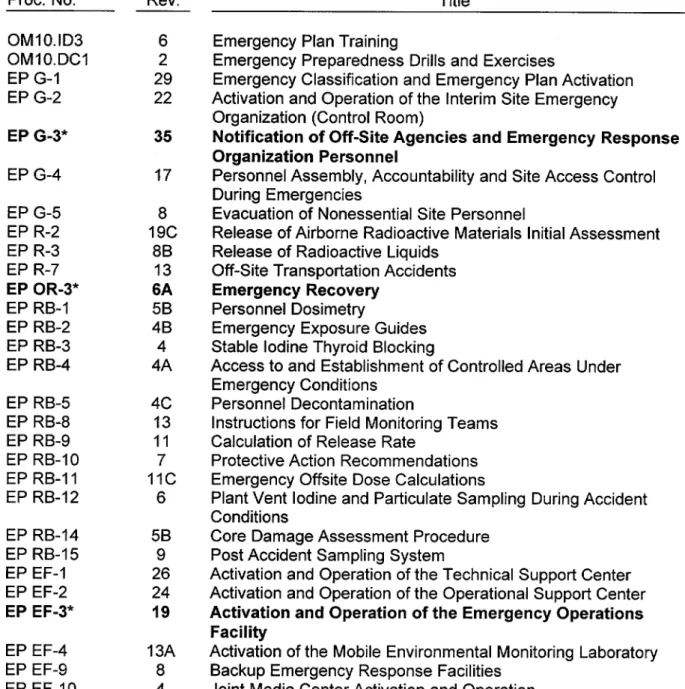
Table of Contents - Emergency Plan Implementing Procedures
Volume 1A (OM10.1D3 only), Volume 1B (OM10.DC1 only), and Volume 3B
Rev. Title OM10.1D3 OM10.DC1 EP G-1 EP G-2 EP G-3* EP G-4 EP G-5 EP R-2 EP R-3 EP R-7 EP OR-3* EP RB-1 EP RB-2 EP RB-3 EP RB-4 EP RB-5 EP RB-8 EP RB-9 EP RB-10 EP RB-11 EP RB-12 EP RB-14 EP RB-15 EP EF-1 EP EF-2 EP EF-3* EP EF-4 EP EF-9 EP EF-10
* Procedure included in this submittal
Proc. No.
6 Emergency Plan Training
2 Emergency Preparedness Drills and Exercises
29 Emergency Classification and Emergency Plan Activation 22 Activation and Operation of the Interim Site Emergency
Organization (Control Room)
35 Notification of Off-Site Agencies and Emergency Response Organization Personnel
17 Personnel Assembly, Accountability and Site Access Control During Emergencies
8 Evacuation of Nonessential Site Personnel
19C Release of Airborne Radioactive Materials Initial Assessment 8B Release of Radioactive Liquids
13 Off-Site Transportation Accidents
6A Emergency Recovery 5B Personnel Dosimetry
4B Emergency Exposure Guides 4 Stable Iodine Thyroid Blocking
4A Access to and Establishment of Controlled Areas Under Emergency Conditions
4C Personnel Decontamination
13 Instructions for Field Monitoring Teams 11 Calculation of Release Rate
7 Protective Action Recommendations 11C Emergency Offsite Dose Calculations
6 Plant Vent Iodine and Particulate Sampling During Accident Conditions
5B Core Damage Assessment Procedure 9 Post Accident Sampling System
26 Activation and Operation of the Technical Support Center 24 Activation and Operation of the Operational Support Center
19 Activation and Operation of the Emergency Operations Facility
13A Activation of the Mobile Environmental Monitoring Laboratory 8 Backup Emergency Response Facilities
*** ISSUED FOR USE BY: DATE: PACIFIC GAS AND ELECTRIC COMPANY
NUCLEAR POWER GENERATION DIABLO CANYON POWER PLANT
EMERGENCY PLAN IMPLEMENTING PROCEDURE TITLE: Notification of Off-Site Agencies and Emergency
Response Organization Personnel
EXPIRES: .. NUMBER EP G-3 REVISION 35 PAGE 1 OF 8 UNITS
I1AN2
03/20/01 EFFECTIVE DATE PROCEDURE CLASSIFICATION: QUALITY RELATEDTABLE OF CONTENTS SECTION PAGE S C O P E ... 1 D ISC U SSIO N ... 1 D E FIN IT IO N S ... 3 RESPONSIBILITIES ... 3 PREREQUISITES ... 4 PRECAUTIONS ... 4 INSTRUCTIONS ... 4 R E C O R D S ... 7 ATTACHMENTS ... 7
Control Room Assistant's Notification Procedure ... 7
Emergency Liaison Coordinator's Notification Procedure ... 7
Form 69-13238, Off-Site Notifications Log Sheet ... 8
Form 69-10295, Plant Status Emergency Form ... 8
REFERENCES ... 8 1. SCOPE
1.1 This procedure provides instructions for notification of Emergency Response Organization personnel and both initial and follow up notifications of appropriate federal, state and local agencies in the event of a declared emergency condition at Diablo Canyon.
2. DISCUSSION 2.1 Off 2.1.
site Agency Notification
1 Notification of off-site organizations is to be made immediately following declaration of an emergency condition per EP G-1, "Accident Classification and Emergency Plan Activation" and immediately following classification level changes.
a. Notification of the San Luis Obispo County Sheriff's Watch Commander and the State Office of Emergency Services shall be within 15 minutes of initial declarations, classification level changes, and event terminations.
NOTE: Notification to NRC shall be made by the Shift Manager, Shift Foreman, or a licensed operator.
03B 0320.0922
PACIFIC GAS AND ELECTRIC COMPANY NUMBER EP G-3
DIABLO CANYON POWER PLANT REVISION 35
PAGE 2 OF 8
TITLE: Notification of Off-Site Agencies and Emergency UNITS 1 AND 2
Response Organization Personnel
b. The NRC shall be notified after state and local agencies, but not later than one hour after initial event declaration, classification level change, and event termination.
c. If NRC requests an open communication channel with the Control Room, a licensed operator or STA knowledgeable of the event should be provided for this purpose.
2.1.2 Notifications should not be delayed if some information is not immediately available. It is better to provide the required notification in a timely manner, thereby allowing other organizations to begin responding.
Not all the details may be fully understood at first and it is acceptable to simply state "Unknown" for those items until more information is available. That is the purpose of follow-up notifications.
2.1.3 During transient situations plant status and key parameters may be changing constantly. Notifications, once begun, should be completed as expeditiously as possible unless a classification change is needed.
2.2 Emergency Response Organization (ERO) Notification
2.2.1 Notification of personnel at an Alert or greater classification is made using the Voice Automated Notification System (VANS).
a. Backup to this system is to manually call personnel using the Recall Roster along with Paging Phone, which is non-selective.
2.2.2 During the normal administrative day shift, the Site Emergency Signal supplemented by the Public Address System provides notification. VANS is also activated for redundancy.
2.2.3 Use of VANS or the call sequence of the Recall Roster provides a selective call out. Preferred position holders for a particular position are listed by teams of qualified personnel, and the on-call team is called first.
2.2.4 Use of Paging Phone, or use of the Site Emergency Signal, provides a nonselective call out. Essentially, all members of the emergency organization are notified to respond.
2.2.5 Information on the success of the notification- is provided by VANS reports and the Recall Roster notification methods. This feedback provides the opportunity to conduct alternate notifications, if necessary, to fill a key position. The Recall Roster includes individual phone and pager numbers for
subsequent notification.
2.2.6 Fitness for Duty (FFD) Program requires that personnel reporting for duty during an emergency be fit for duty. Plant responders who have consumed alcohol within the past five hours will report to the Security Building and complete the "DCPP Fitness for Duty Call Out Form." Responders for the EOF will report to the Recovery Manager's Office and complete the form.
PACIFIC GAS AND ELECTRIC COMPANY
DIABLO CANYON POWER PLANT
TITLE: Notification of Off-Site Agencies and Emergency Response Organization Personnel
NUMBER EP G-3
REVISION 35
PAGE 3 OF 8
UNITS
1
AND 2d
Off-Site Notification - Verbal transmittal of an approved message from PG&E to local, state, and federal authorities that provides both a non-technical classification of the emergency status and a recommendation of protective actions for the public. Verification - A call back from an off-site authority to confirm the validity of a notification or to obtain clarification of its contents.
4. RESPONSIBILITIES
4.1 Off-site Agency Notification - Control Room
4.1.1 The Interim Site Emergency Coordinator (ISEC) is responsible for ensuring off-site agency initial notification and follow-up notifications using
Form 69-10581, "DCPP Event Notification Form," and "Protective Action Recommendation" (see EP RB-10), Form 69-13216 or functional equivalents, until relieved by the TSC.
4.1.2 The Emergency Liaison Coordinator (ELC) is responsible for initiating steps in Attachment 9.2, "Emergency Liaison Coordinator's Notification
Procedure." If no ELC is available, the ISEC is responsible for ensuring Attachment 9.2 is implemented.
Off-site Agency Notification - TSC
4.2.1 Upon Technical Support Center (TSC) activation, if prior to EOF activation, the Liaison Advisor and Assistants are responsible for relieving the Control Room staff (Emergency Liaison Coordinator) of off-site organization communications responsibilities, including the NRC.
4.2.2 The Liaison Advisor and ASEC are responsible for coordinating information flow for the completion of Notification/PAR forms within required time limits, until the EOF is activated.
4.2.3 Phone/Fax notifications by PG&E personnel to the State and NRC may be discontinued when these agencies establish their own communication
channels (generally by posting their own representatives at the TSC or EOF).
00064735.DOA 03B 0320.0922
3. DEFINITIONS 3.1
3.2
PACIFIC GAS AND ELECTRIC COMPANY NUMBER EP G-3
DIABLO CANYON POWER PLANT REVISION 35
PAGE 4 OF 8
TITLE: Notification of Off-Site Agencies and Emergency UNITS 1 AND 2
Response Organization Personnel
4.3 Off-site Agency Notification - EOF
4.3.1 Upon EOF activation, the EOF Agency Liaison and Advisor to the County (upstairs) coordinate the completion and routing of Event Notifications/PARs between the involved parties. The Agency Liaison is responsible for phone. notifications to the State and the NRC.
4.3.2 Phone/Fax notifications by PG&E personnel to the State and NRC may be discontinued when these agencies establish their own communication channels (generally by posting a representative at the EOF).
4.4 Emergency Response Organization Personnel Notification
4.4.1 The CRA notifies emergency organization personnel per Attachment 9.1, "Control Room Assistant's Notification Procedure." In the absence of a CRA, the ELC or ISEC is responsible for implementing Attachment 9.1. NOTE: If Pacific Bell service is interrupted, alternate system instructions are included in Attachment 9.1.
5. PREREQUISITES
5.1 Implementation of EP G-2, "Activation and Operation of the Interim Site Emergency Organization (Control Room)."
6. PRECAUTIONS
6.1 The formal notifications to the County, State and NRC are made by phone or personal contact and must include the event Classification Level and PAR. Computer transfer or faxing the Event Notification and PAR information does not preclude the requirement for these notifications within the applicable time limits.
7. INSTRUCTIONS
Continuous Use of these instructions is expected during initial notifications and Periodic Use during follow-up notifications.
NOTE: Notifications to NRC shall be made by the Shift Manager (ISEC), Shift Foreman (ELC) or a licensed operator.
7.1 INITIAL NOTIFICATIONS FROM CONTROL ROOM
Upon determination of a declarable event (U.E., Alert, S.A.E. or G.E.), the Interim Site Emergency Coordinator (ISEC) shall:
7.1.1-- Complete Form 69-10581, "DCPP Event Notification Form," and
PAR (EP RB-10, Form 69-13216), or functional equivalents. 7.1.2 Direct the CRA to activate VANS for callout of emergency response
personnel per Attachment 9.1.
PACIFIC GAS AND ELECTRIC COMPANY NUMBER EP G-3
DIABLO CANYON POWER PLANT REVISION 35
PAGE 5 OF 8
TITLE: Notification of Off-Site Agencies and Emergency UNITS 1 AND 2
Response Organization Personnel
7.1.3 Direct the Emergency Liaison Coordinator (ELC) to make Off-Site Agency Notifications per Attachment 9.2, utilizing Form 69-13238, "Off-Site Notifications Log Sheet."
7.1.4 IF the emergency classification escalates before the ELC has completed the required 15 minute notifications to the SLO County Sheriff's Watch
Commander and California State OES, THEN perform the following:
a. Direct the ELC or assigned personnel to complete those two calls only. b. Complete both a new Event Notification Form 69-10581 and PAR
Form 69-13216, or functional equivalents, with updated information. c. If escalating from a U.E., direct the ELC to obtain a new
Form 69-13238, "Off-Site Notifications Log Sheet," and begin again from the top using the new declaration time.
d. Ensure the ELC notifies the NRC within 60 minutes of the first declaration and assist him or her as necessary to meet time limit. NOTE: The NRC shall be notified within one hour of the time when the emergency was first declared.
7.1.5 Confirm initial notifications to SLO County and State OES have been completed within required time limits.
7.1.6 IF a Site Area or General Emergency has been declared, THEN direct the ELC or assigned personnel to also notify the US Coast Guard in accordance with the Off-Site Notifications Log Sheet.
a. The US Coast Guard (Marine Safety Office) should be informed of the emergency classification, the PAR, and that SLO County authorities will call soon to request support in the vicinity of DCPP.
7.2 CR FOLLOW-UP NOTIFICATIONS AND TURNOVER TO TSC OR EOF STAFF The Interim Site Emergency Coordinator (ISEC) shall:
7.2.1 Complete follow-up Event Notification and updated PAR forms or functional equivalents, approximately every 30 minutes, OR IMMEDIATELY IF ANY of the following occurs:
a. Emergency classification changes.
- b. Significant change in off-site dose projections or required PARs. c. Wind direction changes sectors and significant release is occurring or
possible.
7.2.2 Direct the ELC to make follow-up notifications, meeting the 15 or 30 minute criterion, as applicable (one hour for NRC).
PACIFIC GAS AND ELECTRIC COMPANY NUMBER EP G-3
DIABLO CANYON POWER PLANT REVISION 35
PAGE 6 OF 8
TITLE: Notification of Off-Site Agencies and Emergency UNITS 1 AND 2
Response Organization Personnel
7.2.3 Exception to 30 minute update requirement (UE ONLY)
a. For a UE classification p__•y, the 30 minute update classifications may be waived if both of the following criteria are met:
1. Conditions are stable and not expected to degrade, AND
2. The agency (County, State, NRC) agrees that 30 minute updates are not necessary.
b. In such circumstances, give the agreeing agency an estimate of the event termination time, and then waive the 30 minute update notifications until the estimated or actual event termination time (whichever comes first).
NOTE: The event termination notice must always be given to the County and State within 15 minutes of the termination decision (1 hour NRC).
7.2.4 Direct ELC to provide a turnover of notifications responsibilities to either the TSC Liaison Advisor or EOF Agency Liaison.
NOTE: NRC may require open communications with the Control Room after turnover to the TSC.
7.3 TSC NOTIFICATIONS:
7.3.1 The TSC Liaison Advisor and the Liaison Assistants shall perform all off-site agency and personnel notifications until the EOF is activated.
7.3.2 The Asst. SEC and Liaison Advisor shall coordinate information flow for the production and transmission of Notifications/PARs as assisted by EOF RP personnel.
7.3.3 The Site Emergency Coordinator shall approve DCPP Event Notification Form 69-10581 and the PAR (EP RB-10, Form 69-13216 or 69-10412), or functional equivalents. Notification time criteria are the same as indicated in Sections 7.2.1 and 7.2.2.
7.3.4 The Liaison Assistants shall make reports from the TSC using the following EP G-3 Attachments or equivalents:
a. Forms 69-10581 and 69-13216\10412, "DCPP Event Notification Form" and "PAR."
b. Form 69-10295, "Plant Status Emergency Form," (fax to EOF) if plant status summaries are unavailable to the EOF via the computer network.
PACIFIC GAS AND ELECTRIC COMPANY NUMBER EP G-3
DIABLO CANYON POWER PLANT REVISION 35
PAGE 7 OF 8
TITLE: Notification of Off-Site Agencies and Emergency UNITS 1 AND 2
Response Organization Personnel
7.3.5 NRC requests for phone talkers:
a. ENS - A Liaison Assistant is normally assigned to NRC phone contact duties.
b. HPN - An NRC request for a knowledgeable full-time HPN phone talker should be accommodated if providing such a person will not detract from emergency response activities. Otherwise, the request must be denied until additional personnel can be called in or the EOF may assume this responsibility.
7.4 EOF NOTIFICATIONS:
7.4.1 The EOF relieves either the CR or the TSC of responsibility for generating off-site agency notifications.
7.4.2 The Recovery Manager (RM) shall determine emergency classification levels per EP G-1 and PARs per EP RB-10.
7.4.3 The EOF Agency Liaison and Advisor to the County (upstairs) shall coordinate the completion and routing of Event Notification/PAR forms, or functional equivalents, between the involved parties.
7.4.4 Updates to California OES and NRC shall be the responsibility of the Agency Liaison until these organizations establish their own communication channels and no longer need status reports (generally by posting representatives at the EOF). The Agency Liaison will generally utilize the Liaison Assistant to make notification phone calls to these agencies.
8. RECORDS
8.1 All attachments, logs, checklists and records, whether fully or partially completed, will be collected in each facility and turned over to the Shift Manager (UE only) or to the Nuclear Regulatory Services Representative (Alert and above) for compilation and retention and for filing the appropriate reports indicated below:
8.1.1 Notification of Unusual Event (NUE): Written summary required within 24 hours of close out to local and State agencies, with copies to the NRC. 8.1.2 Alert, Site Area and General Emergency: Written summary required within
8 hours of close out or class reduction to local and State agencies, with copies to the NRC.
9. ATTACHMENTS
9.1 "Control Room Assistant's Notification Procedure," 03/13/01
9.2 "Emergency Liaison Coordinator's Notification Procedure," 12/12/00 9.3 Form 69-10581, "DCPP Event Notification Form," 01/14/97
PACIFIC GAS AND ELECTRIC COMPANY NUMBER EP G-3
DIABLO CANYON POWER PLANT REVISION 35
PAGE 8 OF8
TITLE: Notification of Off-Site Agencies and Emergency UNITS 1 AND 2
Response Organization Personnel
9.4 Form 69-13238, "Off-Site Notifications Log Sheet," 12/12/00 9.5 Form 69-10295, "Plant Status Emergency Form," 12/12/00 10. REFERENCES
10.1 EP G-1, "Accident Classification and Emergency Plan Activation."
10.2 EP G-2, "Activation and Operation of the Interim Site Emergency Organization (Control Room)."
10.3 EP EF- 1, "Activation and Operation of the Technical Support Center." 10.4 EP EF-3, "EOF Activation and Operation."
10.5 EP R-2, "Release of Airborne Radioactive Materials Initial Assessment." 10.6 EP RB-10, "Protective Action Recommendations."
10.7 XI1 .ID2, "Regulatory Reporting Requirements and Reporting Process."
10.8 OM14.ID3, "Fitness For Duty Program."
10.9 OP1 .DC23, "Control of Posted Plant Signs and Information."
Page 1 of 4 DIABLO CANYON POWER PLANT
EP G-3 ATTACHMENT 9.1
IPAD2
TITLE: Control Room Assistant's Notification ProcedureActivation of VANS for:
NOTIFICATION OF UNUSUAL EVENT, ALERT, SITE AREA EMERGENCY OR GENERAL EMERGENCY. (VANS MAY ALSO BE USED FOR 1 HR/4 HR/8 HR NOTIFICATIONS.)
NOTE: If the emergency event is upgraded from a Notification of Unusual Event to an Alert or greater, activate VANS for the upgraded classification.
If VANS is initially activated at an Alert classification, do not repeat activation for upgrading to SAE or GE
1. Initial Actions
2. Activate VANS for Notification of Unusual Event, Alert, Site Area Emergency or General Emergency as requested by the Shift Manager or designee. (Follow steps 8. 1-through-8.7) 3. IF VANS was intended to be used and is unavailable or failed during execution, activate the
Paging Phone. (Follow step 11)
4. Inform the ISEC when VANS activation is complete and verify his pager was activated. If the CRA and Shift Manager pagers have not been activated after 10 minutes, then activate Paging Phone. (Follow step 11) and initiate a manual call out using the Master Recall Roster (available in the CRA Position Binder).
4.1 Begin with calling the positions of the team that is on call.
4.2 If an on call position holder cannot be confirmed, contact alternate team members until the position is filled.
5. Inform the on-duty RP Foremarf•3247 or X366]8)that VANS has been activated to call out technicians.
6. Inform the ISEC when the VANS report comes over the FAX at the end of 40 minutes for an NUE or 70 minutes for Alert or greater.
7. Activation of VANS CALLOUT SYSTEM
8. Primary VANS phone. (Italicized words in parentheses are VANS prompts) 8.1 Press the CALL VANS button
(You will hear "This is the Diablo Canyon Power Plant Voice Automated Notification System ")
("Please enter your scenario activation password, followed by the pound sign ")
8.2 Press the ENTER PASSWORD button then #.
("To start a scenario, enter the scenario ID followed by the pound sign or press pound alone for more options ")
8.3 Press the EVENT CLASSIFICATION then #, as instructed by the ISEC or as listed on form 69-10581.
("You may change On the Fly Message number one. Press 1 to listen to the message. Press 2 to record a new message. Press pound to continue
')
00064735.DOA 03B 0320.0922
03/13/01
EP G-3 (UNITS 1 AND 2) ATTACHMENT 9.1 TITLE: Control Room Assistant's Notification Procedure
8.4 Press # to continue (go to step 8.5) unless you want to record an on the fly message. If recording a message, continue here.
("After the tone, speak the new message. When you are finished recording, press the pound sign")
Speak the message then press the pound sign. The message will be played back to you.
("Press one to listen to the message. Press two to record a new message. Press pound to continue")
Press pound to continue unless you want to record over your message. I
("The event pager code is xxxx. Press 1 to change the event code, Press 2 to continue")
8.5 Press 2 to continue.
("To start the scenario press 3, to return to the main menu, press the pound sign")
8.6 Press 3 to start the scenario.
("The scenario is building")
(To start a scenario press 1. To stop a scenario press 2. To check scenario information press 3. To enter a different scenario activation password press 4. To end this call press
pound")
8.7 Press the POUND SIGN to end the call. This can be done at any time after this message begins.
9. STOPPING THE CALL-OUT
9.1 To stop the system call-out, enter the scenario in the same manner as steps 8.1 through
8.3.
("The scenario is currently active. Would you like to stop the scenario, press nine for yes or six for no")
9.2 Press 9
("The scenario will be stopped. To start a scenario press 1. To stop a scenario press 2. To check scenario information press 3. To enter a different scenario activation password press4. To end this call press pound")
9.3 Press pound to end the call. 10. REMOTE PHONE ACTIVATION
10.1 If the VANS telephone is damaged or you are forced to abandon the Control Room, VANS can be activated from an alternate phone. Directions are found in the CRA position book utilizing the "Voice Automated Notification System, Manual Operation" Step 13.
00064735.DOA 03B 0320.0922
EP G-3 (UNITS 1 AND 2) ATTACHMENT 9.1 TITLE: Control Room Assistant's Notification Procedure
11. PAGING PHONE ACTIVATION The procedure is posted as a sign next to the Paging Phone in the Control Room in accordance with OP1.DC23. (This is the brown phone next to the VANS phone in the Control Room which uses the plant pager system and sends a code to
preprogrammed pager groups.)
NOTIFICATION OF UNUSUAL EVENT (NUE) (also use for 1 hr/4 hr/8 hr notifications) 1. Pick up the receiver and listen.
2. At the beep, enter 0400 for Management Pager Group. 3. After 3 tones, enter the password, _ .(See Step 13)
4. After 3 tones, enter 111 for NUE (also for 1 hr/4 hr/8 hr notification). 5. Press the pound sign (#) and hang up.
ALERT / SITE AREA EMERGENCY / GENERAL EMERGENCY 1. Pick up the receiver and listen.
2. At the beep, enter 0411 for ALL Pager Groups
3. After 3 tones, enter the password, _ . (See Step 13)
4. After 3 tones, enter 666 for ALERT, SITE AREA EMERGENCY, or GENERAL EMERGENCY.
5. Press the pound sign (#) and hang up.
6. Verify the Shift Manager and CRA pager activates
Repeat steps 1 - 5 every 2 to 3 minutes for 3 times if the Shift Manager and CRA pagers do not activate
12. OFF-NORMAL COMMUNICATIONS
12.1 If Pacific Bell service has been lost or interrupted, VANS primary will still function, however, alternate means of off-site communications include:
"*
OPS radio to the Sheriff's Dispatch"*
OPS radio to San Luis Obispo Distribution Operations (SLODO)San Francisco (public dial tone): Dial 51-9 from the Control Room, and company phones will connect you with San Francisco Pacific Bell lines. You will receive a dial tone and continue to dial as from a normal outside Pacific Bell, line.
REMEMBER: You are connected through San Francisco and therefore their telephone area code. All phone calls4o SLO will need to be preceded by one and then our area code: 1-805-number. Phones from which you can dial 51-9 to access San Francisco telephone lines include those located on Units 1 and 2 on the Senior Control Operator consoles, Shift Foreman phones and the
k Shift Manager phones. TSC and EOF some company phones (standard ROLM phones) also have this capability.
00064735.DOA 03B 0320.0922
EP G-3 (UNITS 1 AND 2) ATTACHMENT 9.1 TITLE: Control Room Assistant's Notification Procedure
VANS MANUAL OPERATION 13.1 From any plant telephone, dial
13.2 When prompted, enter the scenario activation password (VANS Primary VANS BACKUP
j,
followed by the "#" sign.or
13.3 When prompted, enter the scenario ID number from the listing below, followed by the "#" sign.
13.4 Follow the prompts to complete the call-out.
I
I
/
00064735.DOA 03B 0320.0922
13.
SCENARIO TITLE SCENARIO ID EVENT CODE
NUMBERS NUMBERS
OCC Call-Out 777 333
Industrial Fire Officer 999 8911
DCPP Dual Unit 1 Hr/4 Hr/8 Hr Notification 101 111
DCPP Dual Unit Notification of Unusual Event 102 111
DCPP Dual Unit Alert 103 666
DCPP Dual Unit Site Area Emergency 104 666
DCPP Dual Unit General Emergency 105 666
DCPP Unit 1 1 Hr/4 Hr/8 Hr Notification 111 111
DCPP Unit 1 Notification of Unusual Event 112 111
DCPP Unit 1 Alert 113 666
DCPP Unit 1 Site Area Emergency 114 666
DCPP Unit 1 General Emergency 115 666
DCPP Unit 2 1 Hr/4 Hr/8 Hr Notification 121 111
DCPP Unit 2 Notification of Unusual Event 122 111
DCPP Unit 2 Alert 123 666
DCPP Unit 2 Site Area Emergency 124 666
DCPP Unit 2 General Emergency 125 666
Scenario ID Numbering Index l.
The first number (1) in the sequence signifies an Emergency The second number in the sequence-signifies the Unit Designation The third number in the sequence signifies the Event Level
Unit Designation Event Level
0 = Dual Unit 1 = 1 / 4 / 8 Hour Event
1 = Unit 1 2 = Notification of Unusual Event
2 = Unit 2 3 = Alert
4 = Site Area Emergency
5 = General Emergency
I
I
I
03/13/01 Page 4 of 4I
(
I
I
I
I
DIABLO CANYON POWER PLANT
EP G-3
ATTACHMENT 9.2 AND2
TITLE: Emergency Liaison Coordinator's Notification Procedure
NOTE 1: If an ELC is unavailable, the ISEC shall ensure notifications are performed.
NOTE 2: Notify SLO County and California OES within 15 minutes and NRC within one hour of the declaration of any Emergency Classification or subsequent change in classification.
03B 0320.0922
12/12/00 Page I of 3
EP G-3 (UNITS 1 AND 2) ATTACHMENT 9.2 TITLE: Emergency Liaison Coordinator's Notification Procedure
TAB 1
UNUSUAL EVENT, ALERT, SITE EMERGENCY OR GENERAL EMERGENCY AT ALL TIMES
B. INITIAL ACTIONS
NOTE 1: Notification has priority over all other assignments. It is to be performed immediately and as quickly as possible. Do not answer incoming phone calls until the initial notification is complete.
NOTE 2: If further information is requested during initial notification, inform requester that follow-up notifications will be made shortly.
1. If directed by the ISEC, fill out the DCPP Event Notification Form 69-10581 completely and obtain ISEC approval of the message content for follow-up notification.
2. Obtain a completed Form 69-13216 (EP RB-10), PARs information, from the Emergency Evaluation Coordinator or ISEC.
3. Obtain ISEC approval signatures on both of the above forms when completed. 4. Complete initial Off-Site Notifications, using the Off-Site Notifications Log Sheet,
Form 69-13238.
5. Verify the 15 minute time limit on Initial Notification to SLO County Sheriff's Watch Commander and California OES has been met, and one hour for the NRC.
6. Complete NRC Event Notification Worksheet, NRC Form 361 (XII.ID2) if directed by the ISEC.
7. Be alert to incoming calls from off-site organizations, in particular:
a. Verification calls from the SLO County Sheriff via telephone or Operations radio. b. Calls from the NRC on the ETS-2000 line.
NOTE: Immediate follow-up notification is given (within 15 min. State and County, one hour NRC):
"*
If Emergency Classification is increased or a significant increase occurs in Dose Projections."*
If the emergency is terminated.00064735.DOA 03B
12/12/00 Page 2 of 3
EP G-3 (UNITS 1 AND 2) ATTACHMENT 9.2 TITLE: Emergency Liaison Coordinator's Notification Procedure
TAB 1
UNUSUAL EVENT, ALERT, SITE EMERGENCY OR GENERAL EMERGENCY AT ALL TIMES
C. SUBSEOUENT ACTIONS
1. Provide updates to the State and County at least every thirty minutes as long as updates are required.
NOTE: If an Unusual Event is anticipated to remain in effect greater than about 2 hours, give the off-site organizations an anticipated time of termination. If agreed to by the off-site agencies, updates are not necessary unless the anticipated termination time changes. The final termination notice must be given at the time of the actual event termination.
2. Assist in answering incoming calls as time permits.
3. Fax Initial and Follow-up Event Notification Forms to the SLO County Sheriff's Watch Commander, California OES and NRC Operations Center (optional), as soon as
practicable after each verbal notification.
NOTE: Both the NRC Event Notification Worksheet, NRC Form 361, and the DCPP Event Notification Form 69-10581 may be sent by FAX to the NRC Operations Center, after verbal (official) notification is completed.
4. Inform the ISEC when notifications are completed.
5. Log all incoming calls from off-site o01anizations, in particular, verification calls from SLO County Sheriff (usually onx223 Unit 1, or3324,jUnit 2 or Operations Radio). 6. If requested by the NRC to maintain an open communications channel and there are
available personnel:
a. Request the Interim SEC assign in this preference: 1) Senior Licensed Operator
2) STA or knowledgeable Licensed Operator
b. Inform NRC of the status of staffing on the FTS-2000 line.
7. As time permits, attempt to contact the Liaison Advisor in the TSC or Agency Liaison in the EOF to turn over notifications responsibilities. Upon TSC or EOF activation,
relinquish notifications responsibilities to the Liaison Advisor or Agency Liaison.
00064735.DOA 03B
12/12/00 Page 3 of 3
DIABLO CANYON POWER PLANT EP G-3
ATTACHMENT 9.3
1AND
TITLE: DCPP Event Notification Form
DCPP EVENT NOTIFICATION FORM
Facility or Organization Unit# Date: Time: Notification # (initial is #1) Diablo Canyon I / (Declared/Reclassified/Terminated)
Notification Type (check applicable item)
El
InitialEl
Follow upEl
Termination 1. Classification: (check applicable item)El
Unusual EventEl
Alert [I Site Area EmergencyEl
General Emergency 2. Assistance to be Requested (check applicable items)County Fire/CDF
El
YESEl
NO MedicalE]
YES [I NO Law Enforcement (SLO Sheriff)E]
YESEl
NO 3. What Happened? (check or fill in applicable items)Safety Injection - Emergency Core Cooling Systems On Plant Equipment Failure (Specify Component):
Loss of Electrical Power to the Plant Fire (Specify Location):
Earthquake - Classification is by motion measured at the Plant Other (Specify):
4. Written Summary: (This section can be left blank for initial emergency notifications.)
Fill in this section for emergency notifications. Avoid the use of jargon and acronyms when possible
APPROVED BY ISEC/SEC/RM: TIME:
00064735.DOA 03B 0320.0922
DIABLO CANYON POWER PLANT
EP G-3
ATTACHMENT 9.4
1AND
TITLE: Off-Site Notifications Log Sheet
DATE: OFF-SITE NOTIFICATIONS #
CONTACT PRIMARY # ALTERNATE # TIME / INITIAL
NOTIFY WITHIN 15 MINUTES
NOTE: FAX notification sheets following completion of both 15 minute notifications. THIS IS A REQUIREMENT.
1. San Luis Obispo TIE LINE /
County (Sheriff's Fax
Watch Commander) QR call (Fax Required) 911
Adv. to Co. when staffed OPS Radio (Person Contacted) (# in FTL and NERC) Fax Time (ENCODE 11)
2. California Office of TIE LINE /
Emergency Services (OES) Fax
(Emergency Response (Fax Required)
Center) (Person Contacted)
(Communications with OES
lost, call CHP backup) Fax Time
NOTE: -Provide 30 minute updates and an estimated closeout time to the San Luis Obispo County (Sheriff's Watch Commander) and California Office of Emergency Services (Emergency Response Center).
NOTIFY WITHIN 60 MINUTES
3. NRC Operations FTS 2000 LINES /
Center Fax
(Fax Optional) Fax Time
(Person Contacted) NOTIFY AT ALERT OR GREATER WHEN TSC IS ACTIVATED
4. INPO Emergency /
Response Center
(Person Contacted) INITIAL NOTIFICATION OF SITE AREA OR GENERAL EMERGENCY
NOTE: This notification is only required if the San Luis Obispo County Emergency Operations U-effter is NOT activated.
5. US Coast Guard /
(Marine Safety Office Long Beach, CA)
(Person Contacted) RADIOLOGICAL RELEASE TO OCEAN
6. California Regional (Normal STATE OES TIE I Water Quality Control Hours) LINE (Off-Hours)
Board
(Person Contacted)
00064735.DOA 03B 0320.0922
69-10295 12/12/00
DIABLO CANYON POWER PLANT EP G-3
ATTACHMENT 9.5
IPAD2
TITLE:
Plant Status Emergency Form
Provide as much information as is available and appropriate at the time of the status report. Date:
/
/
Status Report# 1 2 3 4 5 6 7 8 9 orLiaison Advisor: Liaison Assistant:
(Reviewed By) (Transmitted By)
1. Time Data Collection Begin: (24 hr clock) Complete:
2. Reactor Status:
[
] Unit 1 I[
Unit 2 (Provide a separate form for the other unit)BEFORE CURRENT
a. Power Level: Power Range
(%)
(%)
Int Range
(pa)
(pa)
Source Range (cps) (cps)
b. Fuel Damage: [ ] None
[
Minor[
Major 3. Reactor Coolant System:a. Pressure:
b. RCP Running:
[
c. Incore Thermocouple(s d. Reactor Vessel Level:
psig Estimated RCS Leakage gpm
]1 []2 []3
[14
):
Hottest F Average F%
[
]Dynamic [ ] Full4. Pressurizer:
a. Level: %
b. PORV:
[
Open[
Closed c. Safety Valves:[
Open[
Closed5. ECCS:
a. Cent. Chg. Pumps On:
[]1
[
2 Total gpm:b. Sl Pumps On:
[]1
[ ] 2 Total gpm:c. RHR Pumps On:
[1
[ ] 2 Total gpm: d. Accumulators Discharged:[
YES [ ]NOe. Mode:
[
Inject, RWST % [ Recirculation, Contmt Level 6. Containment:a. Pressure: psig
b. Cont Isolation:
[
Phase A[ I
Reset[
Phase B[
Reset c. Cont Spray Pumps On: []1 [ ] 2 Spray from RHR [ ]d. Fan Coolers Status: (Key: H - High L - Low N - Off C - Cleared)
1
2 3 4 500064735.DOA 03B
ft.
Page I of 2
Page 2 of 2 69-10295 12/12/00
EP G-3 (UNITS 1 AND 2) ATTACHMENT 9.5 TITLE: Plant Status Emergency Form
7. Steam Generators:
21
3
4
WR Level: % % % %
Pressure: psig psig psig _ psig
Auxiliary Feedwater Pumps On:
[
Turbine[
2[]
3 Total gpm:Feedwater Source:
[
] Cond Tk % [ ] Raw Water %[
Fire Water % MSIVs Closed: [11 [ ] 2[3
[]
4 8. Cooling: a. C( b. A, ýW Pumps On: W Pumps On:[]1l
[11
[12
[12
[13
9. Other Information:RETAIN THIS FORM FOR EVENT EVALUATION
00064735.DOA 03B
a.
b.
C.
d. e. 0320.0922K
THIS IS A COMMITMENT TRACKING MEMO
Remove prior to NRC submittal
Document:
PG&E Letter DCL-01
Subject:
Emergency Plan Implementing Procedure Update
Commitment #1:
There are no commitments contained in this submittal.
S:\RS\RA\GRP_ WORK\EPEPIP•pril-2001.
DOC
A0522550E03
April 19, 2001
,j'<
PG&E Letter DCL-01-.
U.S. Nuclear Regulatory Commission
ATTN: Document Control Desk
Washington, DC 20555-0001
Docket No. 50-275, OL-DPR-80
Docket No. 50-323, OL-DPR-82
Diablo Canyon Units 1 and 2
Emer~qency Plan Implementingq Procedur&'~pat
Dear Commissioners and Staff:
In accordance with Section V, "Implementing Procedures," of 10 CFR 50,
Appendix E, enclosed is an update to the Emergency Plan Implementing
Procedures for Diablo Canyon Power Plant, Units 1 and 2.
As provided under 10 CFR 50.54(q), the changes in this update have been made
without NRC approval since they do not decrease the effectiveness of the
Emergency Plan. The plan, as changed, continues to meet the standards of
10 CFR 50.47(b) and 10 CFR 50, Appendix E.
This update contains privacy/proprietary information that has been bracketed in
accordance with NRC Generic Letter 81-27.
If there are any questions regarding this update, please contact Mr. Mark Lemke
of my staff at (805) 545-4787.
Sincerely,
Stephen R. Fridley
Director Site Services
Enclosures
cc:
Ellis W. Merschoff - w/Enclosures (2)
David L. Proulx
Girija S. Shukla
DDM/1345
Enclosure 1 .1
PG&E Letter DCL-0101-S
LOCATION OF PRIVACY/PROPRIETARY INFORMATION IN
EMERGENCY PLAN IMPLEMENTING PROCEDURES
FOR DIABLO CANYON POWER PLANT, UNITS
I
AND 2
Procedure
Number
evs
-35
r(R-evision
35
EP OR-3,
Revision 6A
EP EF-3,
Revision 19
Privacy/
Proprietary
Information
Yes
No
Yes
Title/Location of Privacy/Proprietary Information
Notification of Off-Site Agencies and Emergency
Response Organization Personnel
Attachment 9.1 - pages 1, 2, 3, and 4.
Attachment 9.2 - page 3.
Emergency Recovery
Activation and Operation of the Emergency
Operations Facility
Attachment 5.2 - page 1
Attachment 5.6 - page 2
Attachment 5.7 - page 1
Attachment 5.8 - page 1
Enclosure 2
PG&E Letter DCL-0O-'
DIABLO CANYON POWER PLANT EMERGENCY PLAN
IMPLEMENTING PROCEDURES
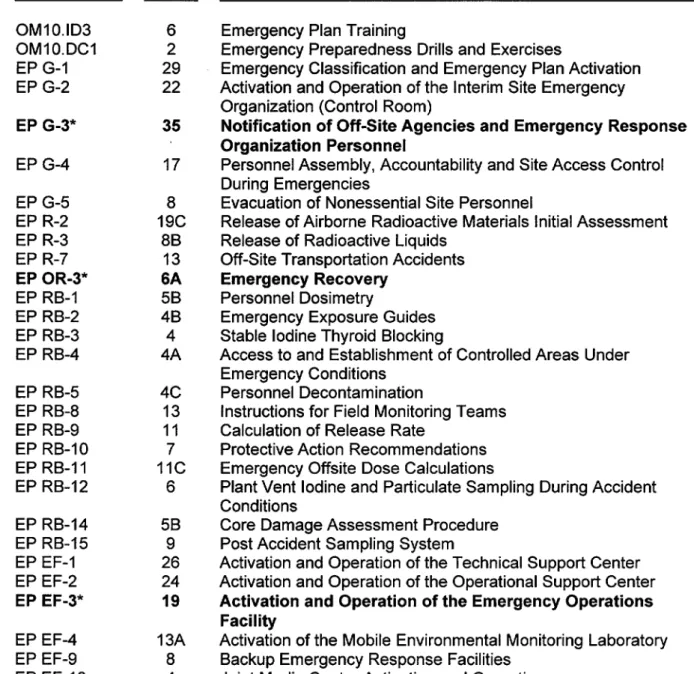
Table of Contents - Emergency Plan Implementing Procedures
Volume 1A (OM10.1D3 only), Volume 1B (OM10.DC1 only), and Volume 3B
Rev.
Title OM10.1D3 OM10.DC1 EP G-1 EP G-2 EP G-3* EP G-4 EP G-5 EP R-2 EP R-3 EP R-7 EP OR-3* EP RB-1 EP RB-2 EP RB-3 EP RB-4 EP RB-5 EP RB-8 EP RB-9 EP RB-10 EP RB-11 EP RB-12 EP RB-14 EP RB-15 EP EF-1 EP EF-2 EP EF-3* EP EF-4 EP EF-9 EP EF-10* Procedure included in this submittal
Proc. No.
6 Emergency Plan Training
2 Emergency Preparedness Drills and Exercises
29 Emergency Classification and Emergency Plan Activation 22 Activation and Operation of the Interim Site Emergency
Organization (Control Room)
35 Notification of Off-Site Agencies and Emergency Response Organization Personnel
17 Personnel Assembly, Accountability and Site Access Control During Emergencies
8 Evacuation of Nonessential Site Personnel
19C Release of Airborne Radioactive Materials Initial Assessment 8B Release of Radioactive Liquids
13 Off-Site Transportation Accidents 6A Emergency Recovery
5B Personnel Dosimetry
4B
Emergency Exposure Guides 4 Stable Iodine Thyroid Blocking4A Access to and Establishment of Controlled Areas Under Emergency Conditions
4C Personnel Decontamination
13 Instructions for Field Monitoring Teams 11 Calculation of Release Rate
7 Protective Action Recommendations 11C Emergency Offsite Dose Calculations
6 Plant Vent Iodine and Particulate Sampling During Accident Conditions
5B Core Damage Assessment Procedure 9 Post Accident Sampling System
26 Activation and Operation of the Technical Support Center 24 Activation and Operation of the Operational Support Center 19 Activation and Operation of the Emergency Operations
Facility
13A Activation of the Mobile Environmental Monitoring Laboratory 8 Backup Emergency Response Facilities
***ISSUED FOR USE BY: DATE: EXPIRES: ***
PACIFIC GAS AND ELECTRIC COMPANY NUMBER EP OR-3
NUCLEAR POWER GENERATION REVISION 6A
DIABLO CANYON POWER PLANT PAGE 1 OF 6
EMERGENCY PLAN IMPLEMENTING PROCEDURE UNITS
TITLE: Emergency Recovery
1
D2
EFFECTIVE DATE
PROCEDURE CLASSIFICATION: QUALITY RELATED TABLE OF CONTENTS SECTION PAGE SC O PE ... I D ISCU SSION ... 2 D EFIN ITIO N S ... 3 RESPONSIBILITIES ... 4 PREREQ U ISITES ... 4 PR EC A U TIO N S ... 4 IN STRU CTIO N S ... 5 ATTACHM ENTS ... 5 REFERENCES ... 5 1. SCOPE
1.1 This procedure provides guidance for the operational Recovery Phase following plant emergency declaration and response but prior to the return to normal operations. The emergency phase, in which an Emergency Classification Level (ECL) is declared at the Alert classification or higher, is addressed by the EP G-series and EF-series
procedures. When the emergency is terminated and the plant no longer requires an Alert or higher emergency classification for purposes of offsite notification, there may still remain recovery tasks to be performed outside of normal operations. This
procedure addresses this transitional Recovery Phase.
1.2 In order to maximize the efficiency and effectiveness of the transition phase and minimize potential confusion and error, use is made of normal programs of widespread familiarity that deal with non-emergency operational problems. To implement the Recovery Phase, heavy reliance is placed on the Event Investigation Team (EIT), Event Response Plan (ERP), and Nonconformance Report (NCR) and associated processes as described in procedure OM7.1D3. Also, the Outage Coordination Center (OCC) is utilized to effect material changes necessary to return the plant to normal operations. The EIT establishes both Recovery Phase and Post-Recovery Phase actions within the
ERP. The restoration processes are carried out by remaining portions of the ERO, the
OCC,
and normal plant organizational staff in a combination as directed by the
Recovery Manager. When the Recovery Phase ERP actions are completed and the
ERO fully deactivated, the Recovery Phase is terminated. Some restoration activities
may continue under direction of the Plant Manager, EIT and OCC.
PACIFIC GAS AND ELECTRIC COMPANY NUMBER EP OR-3
DIABLO CANYON POWER PLANT REVISION 6A
PAGE 2 OF 6
TITLE: Emergency Recovery UNITS 1 AND 2
2. DISCUSSION
2.1 The purpose of this procedure is to assist in the transition from an Emergency Response Organization as governed by procedures EP EF-1, EF-2 and EF-3 to a normal plant management organization assisted by an Event Investigation Team as governed by procedures OM7 and OM7.ID3 and, as necessary, by an Outage Coordination organization.
2.2 The emergency phase goals of the Emergency Response Organization (ERO) for events at the Alert or higher level include the list below. Upon entering the Recovery Phase, these goals should have been mostly or wholly attained.
2.2.1 Bring the plant to a stable condition.
2.2.2 Mitigate any real or potential radioactive releases. 2.2.3 Minimize hazards to plant personnel.
2.2.4 Work with offsite agencies to minimize hazards to the public.
2.3 In order to enter the Recovery Phase, the plant should be in a stable condition and any real or potential radioactive releases restricted to less than license limits without the likelihood of again increasing beyond those limits. There should be little probability that the accident will recur or that a new, declarable event (Alert or higher) occur as a result of the previous emergency conditions or response actions. Therefore, the gal for the Recovery Phase of returning to normal operations should include the following actions.
2.3.1 Terminate the emergency declaration.
2.3.2 Determine which ERO positions will initially be retained in the Recovery Phase.
2.3.3 Initiate the EIT/NCR process, including the Event Response Plan as a blueprint for Recovery activities.
2.3.4 Activate the Outage Coordination Center for significant plant material restoration.
2.3.5 Complete the transition to fully normal plant (non-ERO) management. 2.4 Important considerations while taking the above actions are as follows:
2.4.1 Continued assurance of plant thermal, mechanical and radiological stability. 2.4.2 Remedial work to reach or maintain normal operating conditions (any trode
from full power to refueling).
2.4.3 Radiological monitoring, dose assessment and clean up, both on-site and assistance to off-site organizations.
2.4.4 KI administration follow up. 2.4.5 Site access radiological restrictions. 2.4.6 Public Information assistance.
PACIFIC GAS AND ELECTRIC COMPANY NUMBER EP OR-3
DIABLO CANYON POWER PLANT REVISION 6A
PAGE 3 OF 6
TITLE: Emergency Recovery UNITS 1 AND 2
2.4.7 Application for any necessary dispensations for deviations from Tech Specs, license commitments and surveillances.
2.4.8 Restoration of emergency facilities to initial state of readiness. 2.4.9 Collection and disposition of all emergency response documentation. 2.5 Extraordinary Event Recovery
2.5.1 In the more probable accident scenarios, the Recovery Phase would be expected to begin upon the termination of the emergency phase (downgrade of an event from the Alert level or above to an NUE or to no ECL). 2.5.2 However, there is a possibility in some extraordinary events that the
Recovery Phase start may be appropriate while the plant still technically exceeds the criteria for an Alert or higher ECL, due to plant conditions or release (or potential release) status.
2.5.3 In such cases, the Recovery Manager may start the Recovery Phase, either concurrent with or after terminating the emergency phase for offsite
notification purposes, as agreed with the County, State and NRC authorities. 3. DEFINITIONS
3.1 Recovery (Phase): This period normally commences at the time at which an emergency at the Alert or higher level has been terminated (either de-escalated to a U.E. or to no ECL), but before the plant has returned to normal operations. In some cases, the Recovery Phase may overlap the end of the emergency phase (refer to section 2.5 above). The Recovery Phase is in turn terminated by declaration of the Recovery Manager, generally at the time he determines normal operational programs are sufficient to close out the event, and his continuous personal control is no longer
required at or near the site. During the Recovery Phase the management of the event is shifting from the Emergency Response Organization to the normal plant staff
organization as augmented by the incident Event Investigation Team and, as necessary, the Outage Coordination Center.
3.2 Recovery Organization: The Recovery Organization will consist of the normal plant management organization as assisted by the event-related Event Investigation Team and Outage Coordination Center, and as overlaid by remaining elements of the Emergency Response Organizatioadetermined necessary by the Recovery Manager- Thesem elements of the ERO will in time be phased out when the RM declares the Recovery Phase complete.
3.3 Reentry: Temporary entry into an area not previously radiologically controlled which has or may have become radiologically contaminated and has not been cleared for general public access by the State (offsite areas) or for non-radiation worker access by PG&E (onsite areas). Initially this will include evacuated PAZs. Radiological access controls must be exercised for these areas until cleaned up or cleared for general access.
PACIFIC GAS AND ELECTRIC COMPANY NUMBER EP OR-3
DIABLO CANYON POWER PLANT REVISION 6A
PAGE 4 OF 6
TITLE: Emergency Recovery UNITS 1 AND 2
3.4 Event Response Plan: The plan for returning the plant to normal operations as delineated in OM7.ID3 (EIT process). This plan specifies actions for both the Recovery Phase and the post-Recovery Phase.
4. RESPONSIBILITIES
4.1 The Recovery Manager (RM) shall determine when the emergency event at the Alert, S.A.E. or G.E. Level shall be terminated (downgraded to a U.E. or to no ECL). As appropriate in the case of a extraordinary event, the RM shall determine when the Recovery Phase should be commenced prior to the end of the emergency phase, or, as agreed by County, State and NRC officials, when the emergency phase may be
terminated for offsite notification purposes, though the plant is technically in an ECL at the Alert or higher level. The RM shall then direct the activities of the Recovery Organization until he declares the Recovery Phase complete. At this time his ERO position will be deactivated and general site area control will revert to the Plant Manager, and the use of Emergency Plan Implementing Procedures (EPIPs) will no longer be necessary to close out the event. The Recovery Manager shall also approve Planned Special Exposures related to Recovery activities.
4.2 As directed by the Recovery Manager, the Site Emergency Coordinator may exercise the responsibilities in Section 4.1 above.
4.3 As directed by the Recovery Manager (for an S.A.E. or G.E.), the TSC Radiological Advisor or the site Radiation Protection Director shall determine the proper Reentry radiological controls for the Recovery Phase (see Attachment 9.4).
5. PREREQUISITES
5.1 The Diablo Canyon ERO has been activated at the Alert or higher emergency classification level. The emergency is under control, the threat of uncontrolled radiological releases above Tech Specs has been eliminated (see 6.1 below), and all necessary protective actions are being implemented. See Attachment 9.1, RECOVERY
PHASE INITIATION.
6. PRECAUTIONS
6.1 Tech Spec deviations necessary during the emergency may not be appropriate during the Recovery Phase. Special NRC dispensation may be required to effect necessary Tech Spec or other license deviations.
6.2 Abnormalities not documented during the emergency that are discovered during the Recovery Phase must, as applicable, be reported per 10 CFR 50.72 and .73. 6.3 Radiological exposure planning reverts back to normal operational limits in the
Recovery Phase (no emergency exposure authorizations or automatic extensions of administrative limits).
PACIFIC GAS AND ELECTRIC COMPANY NUMBER EP OR-3
DIABLO CANYON POWER PLANT
REVISION 6A
PAGE
5 OF 6
TITLE:
Emergency Recovery
UNITS
1 AND 2
7.
INSTRUCTIONS
7.1
Recovery Phase Initiation - the Recovery Manager shall complete Attachment 9.1 of
this procedure.
7.2
EOF/OEL/JMC/PG&E EOC Deactivation - the Recovery Manager shall complete
Attachment 9.2 of this procedure.
7.3
TSC/OSC Deactivation - the Recovery Manager shall complete, or shall direct the Site
Emergency Coordinator to complete, Attachment 9.3 of this procedure.
7.4
Recovery Phase Radiological Controls (Reentry) - S.A.E. or G.E. - the Recovery
Manager shall direct the TSC Radiological Advisor or site Radiation Protection
Director, as applicable, to complete Attachment 9.4 of this procedure. This attachment
is not required for events at the Alert level only.
7.5
EIT/NCR Process Initiation - the Recovery Manager (or SEC or Plant Manager by
delegation) shall direct the establishment of an Event Investigation Team (EIT) and
associated Non-Conformance Report (NCR) to cover the event. The EIT shall be
directed to produce an Event Response Plan (ERP) which will specify actions that,
when accomplished, will allow termination of the Recovery Phase.
7.6
OCC Activation - the Recovery Manager (or SEC or Plant Manager by delegation)
shall direct, as necessary, involvement of the Outage Coordination Center (OCC) in
Recovery Phase remediation activities.
7.7
Recovery Phase Termination - the Recovery Manager shall complete Attachment 9.5 of
this procedure.
8.
RECORDS
8.1
Attachments from this procedure completed as part of a drill, exercise or actual event,
shall be forwarded by the next working day to the Emergency Planning Supervisor for
review and retention.
9.
ATTACHMENTS
9.1
"Recovery Phase Initiation," 10/14/98
9.2
"EOF/OEL/JMC/PG&E EOC Deactivation," 03/10/00
9.3
"TSC/OSC Deactivation," 03/02/00
9.4
"Recovery Phase Radiological Controls (Reentry) - S.A.E. OR G.E.," 01/31/01
9.5
"Recovery Phase Termination," 10/14/98
10.
REFERENCES
10.1
EP G-1, "Emergency Classification and Emergency Plan Activation."
10.2
EP EF-3, "EOF Activation and Operation."
10.3
EP RB-3, "Stable Iodine Thyroid Blocking."
10.4
EP RB-4, "Access to and Establishment of Radiologically Controlled Areas Under
Emergency Conditions."
PACIFIC GAS AND ELECTRIC COMPANY NUMBER EP OR-3
DIABLO CANYON POWER PLANT REVISION 6A
PAGE 6 OF 6
TITLE: Emergency Recovery UNITS 1 AND 2
10.5 DCPP Emergency Plan, Section 9.
10.6 RPI.D6, "Personnel Dose Limits and Monitoring Requirements." 10.7 RPI.ID8, "Planned Special Exposure."
10.8 RPI.ID9, "Radiation Work Permits."
10.9 XI1.ID2, "Regulatory Reporting Requirements and Reporting Process." 10.10 OM7, "Problem Resolution."
10.11 OM7.ID3, "Nonconformance Report (NCR) - Technical Review Group (TRG) and Event Investigation Team (EIT)."
10.12 AD8.ID1, "Outage Planning and Management."
DIABLO CANYON POWER PLANT
EP OR-3
ATTACHMENT 9.1
1AND
TITLE:
Recovery Phase Initiation
A.
CRITERIA FOR RECOVERY PHASE INITIATION
The initiation of the Recovery Phase may be considered when all of the following criteria are
met.
1. No EALs are currently declarable
at
the Alert or higher level classification(see
EP G-1), and none such are expected. Alternatively for an extraordinary event, the
Recovery Phase may be initiated concurrently with the emergency phase, or the
emergency phase may be terminated for offsite notification purposes although the
plant is technically at an ECL at the Alert or higher level (obtain County, State and
NRC concurrence).
2.
Protective Action Recommendations are being implemented and no new plume
phase PARs are required or expected.
3.
Radioactive releases do not exceed and are not expected to exceed Tech Specs
without dispensation from the NRC.
4.
Radiation levels in the plant are not expected to preclude reaching and maintaining a
stable operating mode, such as cold shutdown.
. _
The plant may be brought to and maintained at a stable operating mode, such as
cold shutdown.
6.
Any external emergency cause (fire, flood, earthquake including likely aftershock
exceeding Alert level, storm/hurricane, tsunami, security challenge) has eased and
is no longer expected to threaten plant safety.
Authorization Signature:
Emergency Termination
Signature of Recovery Manager
Termination
Time
Date
B.
ACTIONS FOR RECOVERY PHASE INITIATION
When all of the above criteria are met, then complete all the following actions to initiate the
Recovery Phase. NOTE: the following is an index to track required Recovery actions,
including completion of other attachments.
Make or direct an EOF PA announcement of the emergency termination and direct
notification calls to the OEL, JMC and PG&E EOC. Indicate that each facility
should be returned to a state of initial emergency readiness consistent with
remaining staffing levels. Note - this announcement may or may not be combined
with the notifications dismissing some or all of the facility staffs (see
Attachment 9.2, "EOF/OEL/JMC/PG&E EOC Deactivation."
2.
-Notifythe Site Emergency Coordinator in the TSC of the emergency termination.
Direct that the TSC and OSC be returned to a state of initial emergency readiness
consistent with remaining staffing levels. Note - this notification may or may not
include direction for the SEC to complete Attachment 9.3, "TSC/OSC
Deactivation" (see Step 5. below).
00841806.DOE 03B 0327.0822
Page I of 2 10/14/98