US 20090048859A1
(19) United States
(12) Patent Application Publication (10) Pub. No.: US 2009/0048859 A1
McCarthy et al.
(43) Pub. Date:
Feb. 19, 2009
(54) SYSTEMS AND METHODS FOR SALES LEAD Related US. Application Data
RANKING BASED ON ASSESSMENT OF . . . .
INTERNET BEHAVIOR
(60) gI‘O2\(/)18'17O'I1al application No. 60/933,810, ?led on Jun.
_ Publication Classi?cation
(76) Inventors: Daniel Randal McCarthy,
Greenwich, CT (US); Glenn (51) Int- Cl
Robert Goad, Cumming, GA (US)
G06Q 10/
00
(200601)
(52) US. Cl. ... .. 705/1
Correspondence Address:
(57)
ABSTRACT
JOHN 5- PRATT, ESQ Methods and systems are presented for assessing sales leads KILPATRICK STOCKTON, LLP obtained through a lead generation product. One exemplary
1100 PEACHTREE STREET method comprises receiving consumer information from a
ATLANTA, GA 30309 (Us) potential consumer via a lead generation product; receiving activity information about the potential consumer’s interac
(21) Appl' NO‘:
12/135,733
tion With the lead generation product; using the received
consumer information and received activity information todevelop one or more category scores; and developing a sales (22) Filed: Jun. 9, 2008 lead quality score from the one or more category scores.
200
Request collection and
analysis of sales lead
date
210
Collect data
220
Receive and analyze
collected data
230
Send lead quality
report to requesting
Patent Application Publication
Feb. 19, 2009 Sheet 1 0f 5
US 2009/0048859 A1
@Q 530%?
812mm
@303 2g
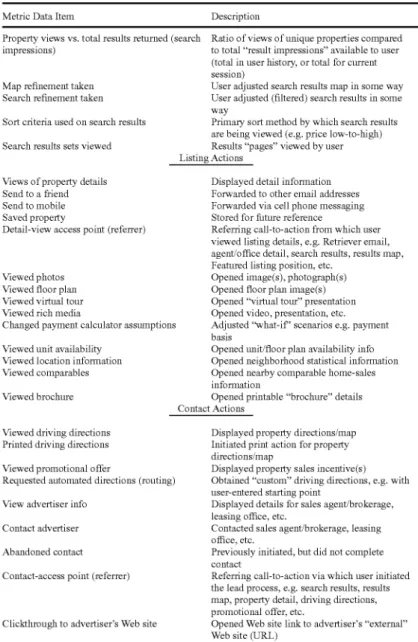
NNH howmooo?
/ 0
H
23mm
M5 540%
wm? 2E2
uzmwwom BEQEQU
m2 homwouoi
uvzmw
o:
Ema/o5 so?
.wo dosmosmm<
E26
3
H
362
QEQBWQM BEQEQU
Q
H
hommmooi
o: 025G E25
Patent Application Publication
Feb. 19, 2009 Sheet 2 0f 5
US 2009/0048859 Al
2% >55
.wmtmuiv? 2 tong
5:35 32 95w
7omm 3% @8828
oNbmcm Us“ $68M
r0mm 3% 626D
2m
8%
R2
w?mw we
wmmbwcw
98 2230200 “353%
com
Patent Application Publication
Feb. 19, 2009 Sheet 3 0f 5
US 2009/0048859 A1
m
Emmi
0mm u?ooo E
@céom mmom: 208M
6% 2E9 23:0
P582338 8 @822
?guom EH3: $8200
mommommmm w?wwmF
omm
Patent Application Publication
Feb. 19, 2009 Sheet 5 0f 5
US 2009/0048859 A1
/
500From: do-not-reply@apartment?ndeccom
To: jdoe@superleasingtcom Cc: [email protected]
Sent: Tuesday, June 12 3:02pm
Subject: Smith, Mary (830) re: Chattahoochee Landings — Apartment Finder sales lead
smaII Contact request received Tuesday, June 12, 2007 at 2:54pm
book brand
For best results, please follow up with this prospective customer ASAP.
Lead composite score:830
logo As a valued advertiser in Apartment Finder of North Atlanta, we're pleased to deliver this inquiry to you.
Mary Smith (ma[[email protected],edu) has requested intonnation on your property listing #234623 via ApartmentFindercom.
I Property Information
540
Composite score ’\/
Weighted estimate of lead quality
Based on all measurable factors 550 560 570
FJ
t)
-
()
I Relevancy
I
I Engagement
I
I immediacy
I
Search location: Roswell, GA Total searches: 4 Time *0 mOVeI 1'3 months
Price: $750-$1000
Totai property
Leads to date: 5
Bedrooms: 2 views: 17 Toiéti Site VIS_ItSI 2
Nearby Property actions: Saved property Tota' "me 0" Site: 27140
property views: 8 Viewed photos
Nearby leads: 3 \?ewed floor plans
Sent to mobile phone Contact actions: Viewed promo offer
Printed driving directions
Composite score is based on factors listed above plus additional lead behavior metrics.
Figure 5
Property #: 234623 I _
medium Apartment name: Chattahoochee Landings View full "I 9 details at
Ihumbnaii
ApartmentFindencom
Address: 123 An Pl , , _
City, State, ZlP: Alphargtta, GA 3000} 511 ' Manage vourllstlngs mAMS
Country; USA I Manage customer leads in LMS
Price: $860-$1280 \_/—~ 512
Customer comments/questions:
is covered parking included with the rent? Are small dogs (15 pounds) allowed?
520
I Customer contact information
\J
Name: Smith, Mary Estimated Move-in Date: ,
Email address: [email protected]
August 1, 2007 (approx: 6 weeks)
\\_/522
521 Address: 987 Nottingham Dr #104
City, State, ZIP: Al haretta, GA 30022 Country: U A
Phone: (770) 555-1212 Ext. 2549
US 2009/0048859 A1
SYSTEMS AND METHODS FOR SALES LEAD RANKING BASED ON ASSESSMENT OF
INTERNET BEHAVIOR
RELATED APPLICATIONS
[0001] This application claims the bene?t of US. Provi sional Application No. 60/933,810 ?led on Jun. 8, 2007, Which is incorporated herein by reference.
FIELD
[0002] The present invention is related to the ?eld of Inter net or Web-based listing services and, in particular, to a sys
tem and method for assessing and ranking leads obtained through such listing services in terms of their potential like
lihood of resulting in a successful sale.
BACKGROUND
[0003] On a daily basis millions of consumers are online
looking for properties, products, and/or services. Conse
quently these millions of consumers represent potential sales
leads that sellers and advertisers have an interest in approach ing in the hope of making a sale. A lead may be thought of as
a potential customer of an advertised property, product, or
service Where that potential customer has expressed some
interest in the advertised item and has initiated some form of contact With a sales agent or advertiser associated With that
item of interest (even if the contact is anonymous). Thus, a
person Who contacts a real estate agent, apartment commu nity, or service provider by sending an email inquiry about
one or more properties or services that he or she may have
seen online represents a lead. Millions of such leads are generated via online activities by potential consumers each day. HoWever, only a very small percentage of this activity
actually results in the sale of a property, product, or service.
[0004] Part of the dif?culty in promoting a lead to a suc
cessful sale is that sales agents, advertisers, and other persons
and entities interested in receiving sales leads cannot readily distinguish betWeen “good” leads and those potential con
sumers Who, though interested in obtaining more informa tion, are not yet ready to make a purchase. A simple email
inquiry generally does not provide the sales agent enough
information to identify the “good” or “hot” leads likely to lead to a sale. Accordingly, due to the sheer volume of leads beinggenerated each day, many of the “good” leads go unansWered
because the sales agent must arbitrarily decide Which leads to pursue and Which to ignore. Thus, there is a challenge to
identifying good potential sales leads and distinguishing such
leads from leads that are less likely to result in a successful
sale.
SUMMARY
[0005] Systems and methods for assessing sales leads
obtained through a lead generation product are disclosed. For example, in certain embodiments a method comprises receiv
ing consumer information from a potential consumer via a
lead generation product, such as, for example, a Web site. In
addition, activity information about the potential consumer’s interaction With the lead generation product is also received.
The received consumer information and received activity
information is used to develop one or more category scores. One or more category scores are then used to develop a sales
lead quality score.
Feb. 19, 2009
[0006] In another exemplary embodiment, the category
scores are used to measure the relevance of a product or
service to the consumer, the consumer’s level of interest in a
product or service, and/ or the consumer’s urgency in Wanting
to purchase a product or service. These category scores can be
combined in a Weighted fashion for a particular industry to develop a composite sales quality lead score.
[0007] These embodiments are mentioned not to limit or de?ne the disclosure, but to provide examples of embodi ments to aid understanding thereof. Embodiments are dis cussed in the Detailed Description, and further description is provided there. Advantages offered by the various embodi ments may be further understood by examining this speci?
cation.
BRIEF DESCRIPTION OF THE DRAWINGS [0008] These and other features, aspects, and advantages of
the present disclosure are better understood When the folloW ing Detailed Description is read With reference to the accom
panying draWings, Wherein:
[0009] FIG. 1 is a system diagram shoWing an exemplary system architecture for implementation of certain embodi
ments.
[0010] FIG. 2 is a How diagram shoWing an overvieW of the data collection and analysis process for an certain embodi
ments.
[0011] FIG. 3 is a How diagram shoWing a data collection process in certain embodiments.
[0012] FIG. 4 is a How diagram shoWing a data analysis and
reporting process in certain embodiments.
[0013] FIG. 5 shoWs an illustrative email message report
ing information pertaining to a potential lead in certain
embodiments.
DETAILED DESCRIPTION OF EXEMPLARY EMBODIMENTS
[0014] Detailed embodiments of the present invention are disclosed herein. HoWever, it is to be understood that the disclosed embodiments are merely exemplary of the inven tion that may be embodied in various and alternative forms. The ?gures are not necessarily to scale, and some features may be exaggerated or minimiZed to shoW details of particu
lar components. Therefore, speci?c structural and functional details disclosed herein are not to be interpreted as limiting, but merely as a basis for the claims and as a representative
basis for teaching one skilled in the art to variously employ
the present invention.
[0015] Embodiments of the present invention relate to a
Lead Quality Metrics (“LQM”) solution directed at the prob lem of assessing and ranking leads in terms of their potential likelihood of resulting in a successful sale. In one embodi
ment, a goal of the LQM solution is to assist lead recipients in
their prioritization and evaluation of individual leads they
receive. For example, a potential lead can demonstrate inter est in an advertised item by accessing information about the
item through a Web site on the Internet. In one embodiment, to assess and rank leads, the LQM system analyZes 1) the
user’s activities on the Web site prior to lead submission and 2) lead submission patterns. Information about consumer
behavior can be collected as the potential consumer navigates
through a Web site and can be used to rank potential sales leads With respect to likelihood of leading to a successful sale.
US 2009/0048859 A1
[0016] A lead quality score With respect to a potential sales
lead can be created. The lead quality score can be based on
one or more areas of interest, such as relevancy, engagement
and immediacy, and a separate score can be created for each area of interest. Relevancy can be the closeness of a product
or service match to What the user is looking for. Engagement
can be the interest of the user in ?nding a product or service.
Immediacy can be the urgency of ?nding a product or service
for the user.
[0017] The relevancy, engagement, and immediacy scores can be Weighted differently or the same and can be combined into a single lead quality score. In one embodiment, once the
lead quality score has been computed, the system using com puter software ranks and rates this sales lead in comparison to all other sales leads and thereby gives the advertiser, such as the realtor, an ordered list of sales leads ranked in terms of
likelihood of leading to a successful sale. In one embodiment,
the system provides an advertiser, such as a realtor, With leads via e-mail. In such embodiment, the e-mail can contain infor mation about the product, such as a home, information about
the consumer, and the lead quality metrics, such as a compos
ite score and further information on the relevancy metric,
engagement metric, and immediacy metric.
[0018] In addition, an embodiment can incorporate feed back from the market on exactly What happened With any
particular lead to continually re?ne the scoring criteria and
the ranking algorithms. Thus, the heuristics used to measure criteria such as relevancy, engagement, and immediacy can
evolve over time based on feedback of the correlation betWeen a lead’s scores in each area and the sales agent’s likelihood of a resulting sale. This data is gathered through surveying lead recipients. This feedback loop provides a
mechanism to push lead information to advertisers and pro vide a feedback mechanism alongside the delivery of the information.
[0019] While examples have been provided relating to the
real estate market, this technology is not limited to the real estate market and can be applied to any online search product
Where consumer behavior can be mapped and recorded.
Architecture of an Illustrative System
[0020] The system 100 shoWn in FIG. 1 illustrates one embodiment for implementation of the invention and
includes client devices 110 (there may be multiple client
devices) that can communicate With one or more server
devices 120, 130 overa netWork 106. The netWork 106 shoWn in FIG. 1 comprises the Internet. In other embodiments, other
netWorks, such as an intranet, may be used instead. In one embodiment, a consumer interacts With a Web site, Which could reside on server 130, through client device 110 con nected to netWork 106.
[0021] The client devices 110 shoWn in FIG. 1 each include a computer-readable media 114, for example a random access memory. The processor 112 executes computer-executable program instructions stored in memory 114. Such processors
may include a microprocessor, an ASIC, state machines, or other processor, and can be any of a number of suitable
computer processors, such as processors from Intel Corpora
tion of Santa Clara, Calif. and Motorola Corporation of
Schaumburg, Ill. Such processors include, or may be in com
munication With, media, for example computer-readable
media, Which stores instructions that, When executed by the
processor, cause the processor to perform the steps described
herein. Embodiments of computer-readable media include,
Feb. 19, 2009
but are not limited to, an electronic, optical, magnetic, or other storage or transmission device capable of providing a
processor, such as the processor 112 of client 110, With com
puter-readable instructions.
[0022] Client devices 110 and server devices 120, 130 can
be coupled to a netWork 106 through Wired, Wireless, or optical connections. Client devices 110 may also include a
number of external or internal devices such as a mouse, a
CD-ROM, DVD, a keyboard, a display device, or other input or output devices. Examples of client devices 110 are per
sonal computers, digital assistants, personal digital assistants,
cellular phones, mobile phones, smart phones, pagers, digital
tablets, laptop computers, Internet appliances, and other pro
cessor-based devices. In general, the client devices 110 may
be any type of processor-based platform that operates on any suitable operating system, such as Microsoft® Windows@ or
Linux, capable of supporting one or more client applications. For example, the client device 110 can comprise a personal computer executing a client application 116, Which can be contained in memory 114 and can comprise Without limita tion, for example, an email application, an instant messenger application, a presentation application, an Internet broWser
application, an image display application, an operating sys
tem shell, and other applications capable of being executed by
a client device. Client applications may also include client side applications that interact With or accesses other applica tions (such as, for example, a Web-broWser executing on theclient device 110 that interacts With a remote e-mail server to
access e-mail).
[0023] In certain embodiments, the LQM
Tracking Service
126 discussed herein could reside on server 120. LQM 126 is
an application that assists requesting entities, such as adver
tisers for example, by analyZing information supplied by a
potential consumer as Well as information about hoW the
consumer interacts With, for example, a Web site, and devel
ops one or more scores that gives the advertiser an assessment
of the quality of the potential sales lead.
[0024] In certain embodiments, the Lead Quality Metric Management Application (“LQMMA”) 138 could reside on
server 130. LQMMA 138 is an application that assists requesting entities (also sometimes referred to as “subscrib
ers”) in vieWing and managing data that is utiliZed and com puted by LQM 126 in the lead quality assessment process.
[0025] Server 120 interacts With database 140; similarly server 130 interacts With database 150. Databases 140, 150 may take any number of structured or unstructured forms as is Well-knoWn to those of skill in the art.
[0026] In an illustrative example, a subscriber requests that LQM 126 tag and collect data as potential consumers navi gate the subscriber’s Web site using a Web broWser on the consumer’s client device 110. LQM 126 then starts collecting
data both in the form of data entered by the consumer as Well
as data about the consumer’s Web interaction activities, eg
hoW many photographs of an apartment did the consumer look at. Such data can be collected over a period of time
during several different consumer Web interaction sessions
and stored in a cookie on client device 110. Once the data is collected, LQM 126 then analyZes the data to develop various scores of interest and rank the potential lead as discussed
further beloW. LQM 126 then stores the analysis results in database 140 and also communicates them back to the sub
scriber for vieWing through the LQMMA
application 138 and
possible storage in database 150. After pursuing the lead, the
US 2009/0048859 A1
126 to provide feedback on hoW accurate the analyzed results
turned out to be, thereby possibly re?ning the data collection
and analysis process to better suit the needs of the subscriber.
Illustrative Data Collection and Analysis
[0027] Currently available lead generation products take
information that is provided by the consumer to rate and rank a lead. HoWever, knowledge of a particular industry may also be utiliZed to develop various scores for categories of interestisuch as relevancy, engagement, and immediacyito
assess the potential readiness of a consumer to make a pur
chase. For example, for consumers obtaining information
about a product from a Web site, these scores and this readi ness assessment may be developed based on, among other
things, the consumer’s activity on the site, hoW the consumer arrived at the site, as Well as the information provided by the
consumer While at the site. In addition, meta-information
about the information provided by the consumer is also important. The fact that the consumer provided a signi?cant amount of detailed information about his or her purchase interests may be of more importance than the actual informa
tion provided in assessing that consumer’s readiness to make
a purchase.
[0028] Based on the consumer’s activities at the Web site in addition to the actual information provided, one may assess
and rank leads in terms of various scores, of Which relevancy, engagement, and immediacy are examples. For example, a relevancy score assesses hoW relevant the property, product,
or service is based on hoW the consumer conducted his or her Web search. Thus, in addition to knoWing the actual Zip code
of a property of interest, it may also be important to knoW
Whether the consumer identi?ed the property by speci?cally
entering the pertinent Zip code as a search parameter or if the consumer engaged in a Wide-ranging search to identify the
property of interest. The fact that the consumer entered a speci?c Zip codeiand not just the actual Zip code itselfi
may establish that a property of interest is particularly rel
evant to this consumer and could result in a high relevancy score. Similar considerations apply to the other scores as
Well.
[0029] Once the various scores or interest are developed,
knoWledge of the particular industry may be utiliZed to com bine them into a composite lead quality score and thereby
yield a ranking of the lead under consideration. For example,
in the real estate market, it may be that the relevancy score is
of more importance than the engagement and/or immediacy scores. Thus, as a function of the market sector for Which the
leads are being developed, the various scores may be given
different Weightsiincluding Zero Weight if appropriatei
and combined to arrive at the composite lead quality score and an overall ranking of the lead.
[0030] For example, a consumer may examine properties
on a real estate agent’s Web site by entering as search terms a
speci?c neighborhood, a narroW price range, and a speci?c number of bedrooms and bathrooms. For the lone property
returned in the search, the consumer may looks at every
photograph of this property available at the site and emails a link to the site to several people. The scoring system may determine high scores for relevancy (the consumer searched
for and found a very speci?c property), engagement (the
consumer spent a long time looking at the Web site and the
photographs), and immediacy (the consumer Wants other per sons to be aWare of his potential neW home). If the sales agent
then receives a simple email inquiry from the consumer ask
Feb. 19, 2009
ing for more information about the property, in the absence of theses scores the sale agent may not be able to distinguish this
inquiry from the multiple other inquiries he or she has received that day and may potentially ignore it for an arbitrary
reason (eg it appears last in his list of email inquiries). HoWever, When these scores along With a composite lead
quality score is attached to the email inquiry or sent in a separate email by the technology of this invention, the sales agent can identify this consumer as a person Who potentially is ready to buy that particular property immediately and can take steps to focus his activities on assisting this consumer. In
this case, the overall lead quality score may be used to provide
the ranking of the lead While the individual relevancy, engage
ment, and immediacy scores may alloW the sales agent to
assess the “hotness” of the lead.
[0031] In addition, the consumer may visit the Web site several different times and each time generate an email
inquiry asking for more information about the property.
Embodiments of the present invention match the consumer’s
subsequent Web searching behavior to the previous informa
tion gathered and use it to re?ne the various individual and
composite scores, thereby continually re?ning the lead rank
ing for this consumer With each pertinent Web interaction.Illustrative Lead Quality Metric Application Web
Interaction Process
[0032] In one embodiment, the Lead Quality Metric Appli
cation can be implemented through “tagging” of a Web site
With LQM
“event markers.” The tagging consists of applying
snippets of application code that are transparent to the user toactivities Within the Web site that serve as inputs to the Rel evancy, Engagement, and Immediacy metrics categories. The folloWing entities interact in the data collection and analysis process:
[0033] Consumer. Any user of a Web site that has LQM
tagging implemented.
[0034] Web site. A consumer-oriented Web application that
has a speci?c set of transaction goals for the user. Examples of
transaction goals include sales lead generation for a property,
requesting information about an automobile, submitting an
e-commerce sales order, etc.
[0035] Lead Quality Metrics (LQM) Tracking Service. The
tracking service is a hosted Web-based application thatrecords user interactions Within a Web site; analyZes user activities to determine Relevancy, Engagement, and Imme diacy metrics; and delivers metrics to the requesting applica
tion.
[0036] FloW chart 200 in FIG. 2 provides a broad overvieW
of the process of assessing and analyZing sales leads.At block
210, a requesting entity such as, for example, the oWner of a Web site hosted on server 130, requests collection and analy sis of sales lead data. The Web site oWner, for example,
instructs the provider of the LQM service to provide this
service With respect to the oWner’s Web site. The LQM ser vice provider Will then Work With the Web site oWner to identify the consumer information of interest and to imple
ment tagging of the Web site according to knoWn tagging
methods to capture this information.
[0037] At block 220 the pertinent data is then collected. A
potential consumer accesses the Web site and, as he or she navigates through the site, various data is collected in accor dance With the tagging approach that has been implemented.
Certain data Will be collected and stored in a cookie according to knoWn methods. Storing information in a cookie permits
US 2009/0048859 Al
the collection of data over several different browsing sessions
on the consumer’s client device 110.
[0038] At block 230, the collected data is then sent to and
analyzed by LQM 126. Sending of the data to the LQM 126 is
triggered when the potential consumer indicates that he or she has reached a searching goal. For example, if the consumer
self-identi?es and asks for further information or asks for a
salesperson to contact him or her, such a request would trigger
the data delivery to LQM 126 for analysis.
[0039] At block 240, LQM 126 then sends a lead quality
report to the requesting entity, such as, for example, a real
estate agency with a Web site listing apartments and/ or houses for sale, lease or rent.
[0040] The data collection of block 220 is illustrated more
fully in the ?owchart on FIG. 3. Data is collected as a user or
potential consumer interacts with a lead generation product,
such as a Web site, as shown in block 310. In the case of a Web site, the user accesses a Web site implemented on, for example, server 130 through client application 116 in the form of a Web browser.
[0041] As shown in block 320, an application 136 resident on server 130 permits tagging of the user’s interaction. Once the requesting entity decides which consumer information is
of interest, tagging of the Web site to capture this information is implemented according to known methods.
Feb. 19, 2009
[0042] The tagging application 136 collects information
about the user and his interaction and, at block 330, records
the information. In one embodiment, the tagging application collects the information in a local cookie on the user’s client
device 110. Cookie technology is well-known to those of skill
in the art and can be used to match the consumer’s subsequent Web searching behavior to information gathered from previ ous Web searching activity.
[0043] In certain embodiments, the collected data permits the LQM application 126 to develop scores in the following
categories: Relevance, Engagement, Immediacy. In one
embodiment applicable to generation of leads in the real
estate market, the types of data that are tagged at block 320 and recorded at block 330 may be organiZed into categories
that permit development of Relevance, Engagement, and
Immediacy scores. Such categories of data are illustrated in Tables l-3.[0044] The following illustrative Table 1 shows describes various data that can be used to develop a relevancy score
useful in certain embodiments:
Relevancy Data
[0045]
TABLE 1
Metric Data Item Description
Narrowing of map
Match to user’s search location
Property location is within a “reasonably
narrow” area being viewed on map (Zoom
level)
City, state, Zip
Proximity to user’s search point-of-interest Distance from college, military base, street
Match to user’s search price criteria
Match to user’s other search facets
Match to user’s search keywords
Views of nearby properties Leads for nearby properties
Session access point (referrer)
Search engine keywords
address (e.g. employer)
(Include scoring based on whether search includes price criteria or not)
Property type, bedrooms, bathrooms, square
footage, etc.
Description/data contains search terms (keywords) entered by user
Views of detail information for other “nearby”
properties (within a certain distance) Contact requests for other “nearby” properties Referring Web site, e.g. search engine, direct
entry of URL, link from partner, etc. Keywords entered by user on referring search engine
[0046] The following illustrative Table 2 describes various data that can be used to develop an engagement score useful
in certain embodiments:
Engagement Data
[0047]
TABLE 2
Metric Data Item Description
Properties viewed Searches performed
Search Actions
All properties viewed (total in user history or total for current session)
(total in user history, or total for current
US 2009/0048859 A1
TABLE 2-continued
Feb. 19, 2009
Metric Data Item Description
Property views vs. total results returned (search Ratio of views of unique properties compared
impressions) to total “result impressions” available to user (total in user history, or total for current
session)
Map re?nement taken
Search re?nement taken
way Sort criteria used on search results
User adjusted search results map in some way User adjusted (?ltered) search results in some Primary sort method by which search results
are being viewed (e.g. price low-to-high)
Search results sets viewed Results “pages” viewed by user
Listing Actions
Views of property details Displayed detail information
Send to a friend Forwarded to other email addresses
Send to mobile Forwarded via cell phone messaging Saved property Stored for ?ature reference
Detail-view access point (referrer) Referring call-to-action from which user viewed listing details, e. g. Retriever email,
agent/of?ce detail, search results, results map, Featured listing position, etc.
Opened image(s), photograph(s)
Viewed photos Viewed floor plan
Viewed virtual tour
Viewed rich media
Changed payment calculator assumptions
Opened floor plan image(s)
basis
Viewed unit availability
Viewed location information
Viewed comparables
information Viewed brochure
Contact Actions
Viewed driving directions Printed driving directions
directions/map
Viewed promotional offer
Requested automated directions (routing)
user-entered starting point
View advertiser info
leasing of?ce, etc.
Contact advertiser
ol?ce, etc.
Abandoned contact
contact
Contact-access point (referrer)
Opened “virtual tour” presentation
Opened video, presentation, etc.
Adjusted “what-if" scenarios e.g. payment
Opened unit/floor plan availability info
Opened neighborhood statistical information
Opened nearby comparable home-sales Opened printable “brochure” details
Displayed property directions/map
Initiated print action for property
Displayed property sales incentive(s)
Obtained “custom” driving directions, eg with Displayed details for sales agent/brokerage, Contacted sales agent/brokerage, leasing Previously initiated, but did not complete
Referring call-to-action via which user initiated the lead process, e. g. search results, results
map, property detail, driving directions,
promotional offer, etc.
Clickthrough to advertiser’s Web site
Web site (URL)
Opened Web site link to advertiser’s “external”
[0048] The following illustrative Table 3 describes various data that can be used to develop an immediacy score useful in
certain embodiments:
Immediacy Data
[0049]
TABLE 3
Metric Item Data Description
Time to move Time remaining until preferred or expected move-in date/deadline
(Total) sessions to lead-source Web site (Total) time spent on lead-source Web site (Total) contact requests created by user
Lead included “extended” contact info such as
phone number, mobile phone number, etc.
Frequency of site visits
Time on site
Leads generated
Extended contact
information provided
Illustrative Lead Quality Scoring
[0050] Utilizing the metric data items listed, for example, in Tables 1-3, the LQM 126 resident on server 120 calculates
and distributes selected lead quality scores which provide analytical insight into the overall sense of the lead’s “tem perature.” In particular, as shown in block 220 of FIG. 2, data
is analyzed by the LQM 126. The data analysis process of block 220 is shown in more detail in FIG. 4. In an exemplary embodiment, LQM 126 receives the tagged data that tagging application 136 collected, including any information col lected over multiple Web searches and stored in a local cookie, along with a request to analyze the tagged data for
relevancy, engagement, and immediacy, as shown at block 410 of ?owchart 400.
[0051] At block 420, LQM 126 analyzes the user’s activity
US 2009/0048859 A1
develop multiple levels of analysis based on 1) the individual data items, Which analysis may take the form of per-item metric values, 2) the categories, Where the analysis results in
aggregate scores for metrics Within each of, for example, the
Relevancy, Engagement, and Immediacy categories, and 3) a
Weighted composite assessment of the categories in the form
of an “overall” (at-a-glance) lead quality score, Which may be
computed from any one or more of the category scores or
individual data item metrics.
[0052] For example, the analysis With respect to the rel evancy category addresses measures such as: HoW closely
does this home match What the consumer is looking for? The
LQM creates this score for the lead based on hoW relevant the property is to a potential consumer based on hoW that poten tial consumer conducted his or her search on the Web. The
criteria for creating this score is based on, for example: 1) area searched (eg a metro area or a speci?c Zip code) 2) did the
potential consumer use the map feature to Zoom in on a
geographic area, 3) hoW broad Was the price range that the
potential consumer searched, 4) What amenities did the poten tial consumer ask for in the search, etc. For example, if a user
searches on the exact Zip code that the property is located in, a Weight of 5 may be applied. If the property is only Within the
city represented by the exact search a Weight of only 1 Would be applied. Other metrics include hoW closely the property
matches the user’s price criteria, did the property match a
facet criteria, does the property contain keyWords used by the
individual in their search, and similar considerations.
[0053] By Way of further example, the analysis With respect
to the engagement category addresses measures such as: HoW
invested is this individual in ?nding a property, product, or
service, eg a home? The user’s level of engagement is mea sured through the activities taken against the listing such as
emailing the listing to a friend, sending the address to a
mobile device, amount of time spent looking at the listing,
amount of times the user vieWed the listing. LQM 126 gives
the lead a score in this area based on hoW engaged the con
sumer Was With the property, product, or service. For
example, for home sales the criteria for creating this score is
based on things like: 1) hoW many photos did the potential
consumer vieW, 2) did the potential consumer look at addi
tional information, such as the neighborhood information, 3)
did the potential consumer look at the list of recently sold
properties, 4) did the potential consumer map the property,
etc.
[0054] By Way of further example, the analysis With respect
to the immediacy category addresses measures such as: HoW
urgent is ?nding a property, product, or service (e. g. a home) for this user? Immediacy is measured through responses to entries such as the time-frame during Which the property/
product, or service is need (provided With a lead), length of
time spent on the site, and number of leads generated. For example, for home sales, LQM 126 gives the lead a score in
this area based on the potential consumer’s other activities With respect to other properties. The criteria for creating this
score is based on things like: l)hoW many other properties did
the potential consumer vieW, 2) of those properties hoW many
did the potential consumer send a lead on, 3) did the potential consumer request a brochure, 4) did the potential consumer
send this property information to other people or to a mobile phone, etc.
[0055] In addition to individual data item metric scores and category scores, LQM 126 can also compute an “overall” (at-a-glance) lead quality score, Which may be computed
Feb. 19, 2009
from any one or more of the category scores or individual
metrics. In particular, this composite score can be computed by combining selected individual data item scores and/or category scores on a Weighted basis, Where the Weighting used can depend on the speci?c industry Within Which the
lead is being generated.
[0056] In one embodiment, the LQM Tracking Service 126
provides an advertiser, such as a realtor, With leads via e-mail. The LQM 126 can provide the advertiser With the top lead or the several of the top-ranked leads based on the lead compos
ite scores. An illustrative email 500 is shoWn in FIG. 5. Such an e-mail can contain product information 510, such as, for example, information about real estate. In the example shoWn
in FIG. 5, the email can contain the basic listing information
about the property information including address 511 and pricing information 512. The email can also contain con sumer information 520, such as contact information 521 and product speci?c information 522, e. g. estimated move-in
date. The illustrative email in FIG. 5 also contains lead quality metrics 530. As shoWn in FIG. 5, the composite score 540 is
includes as Well as speci?c relevancy 550, engagement 560,
and immediacy 570 scores.
[0057] At block 440, collected and analyZed data is stored both in database 140 by LQM 126 and in database 150 by the
requesting entity. Each of LQM
and the requesting entity may
store all or any subset of the collected and analyZed data as
may be of interest.
Illustrative Lead Quality Metric Management
Application
[0058] In one embodiment, the Lead Quality Metric Man
agement Application (LQMMA) 138 enables subscribers to
manage and vieW data utiliZed in the lead quality metric
determination process. Subscribers are organizations that use the LQM Tracking System to monitor & analyZe lead behav
ior on their Web applications. In one embodiment, LQMMA 136, Which resides on, for example, server 130, includes the
folloWing functionality:
[0059] Analytics. Extensive functionality for re?nement of
heuristics to determine lead quality is a key component of the
Lead Quality Metric application. Within the LQMMA 136,
subscribers can be offered many vieWs of lead quality dataand scores as Well as consumer activity as re?ected in the
individual data items, the category scores, and the composite
sales lead data score. This functionality permits the sub
scriber to re?ne the heuristics.
[0060] Surveying. Through this functionality, subscribers
can solicit feedback on correlation of LQM metrics to real World lead conversion activities, eg contact- or lead-closure rates. Subscribers can then utiliZe this feedback to improve the data and scores returned by the LQM Tracking System 126. Such feedback information can be stored in database 150.
[0061] Metric Item Management. Enables subscribers to
adjust a score by metric category (Relevancy, Engagement,
Immediacy) or individual data item in order to re?ne the
heuristics used to analyZe lead quality.
[0062] User Management. AlloWs subscribers to manage the users of the LQM application, including creation of neW users and assignment of role-based user permissions.
GENERAL
[0063] Embodiments of the present invention may com
US 2009/0048859 A1
ing different information ?oWs than those shoWn in the Fig ures. The systems shoWn are merely illustrative and are not
intended to indicate that any system component, feature, or
information How is essential or necessary to any embodiment
or limiting the scope of the present disclosure. The foregoing
description of the embodiments has been presented only for
the purpose of illustration and description and is not intended
to be exhaustive or to limit the disclosure to the precise forms
disclosed. Numerous modi?cations and adaptations are apparent to those skilled in the art Without departing from the spirit and scope of the disclosure.
What is claimed is:
1. A method of assessing sales leads obtained through a
lead generation product, said method comprising:
receiving consumer information from a potential consumer via a lead generation product;
receiving activity information about the potential consum er’s interaction With the lead generation product;
using the received consumer information and received
activity information to develop one or more category scores; and
developing a sales lead quality score from the one or more category scores.
2. The method of claim 1 Wherein the one or more category
scores comprises at least one of the folloWing categories:
relevancy, engagement, immediacy.
3. The method of claim 1 Wherein the lead generation
product comprises a Web site.
4. The method of claim 1 Wherein developing a lead sales quality score further comprises Weighting each of the one or more category scores and combining the Weighted category
scores to obtain a composite sales lead quality score. 5. The method of claim 1 further comprising reporting the
sales lead quality score to a requesting entity.
6. The method of claim 5 further comprising receiving
feedback from the requesting entity regarding the quality of
the reported sales lead quality score; and
modifying in response to the feedback one or more of the steps of:
using the received consumer information and received
activity information to develop one or more category scores; and
developing a sales lead quality score from the one or more category scores.
7. The method of claim 1 further comprising
receiving industry-speci?c information;
utiliZing the industry-speci?c information to modify one or
more of the steps of:
using the received consumer information and received
activity information to develop one or more category scores; and
developing a sales lead quality score from the one or more category scores.
8. A method of assessing sales leads obtained through a
Web site, said method comprising:
receiving consumer information from a potential consumer via a Web site;
receiving activity information about the potential consum
er’s interaction With the Web site;
using the received consumer information and received activity information to develop a lead category score; using the received consumer information and received
activity information to develop an engagement category
score;
Feb. 19, 2009
using the received consumer information and received
activity information to develop an immediacy category
score and
developing a sales lead quality score from a Weighted com bination of the lead, engagement, and immediacy cat egory scores.
9. The method of claim 8 further comprising receiving
industry-speci?c information; and
utiliZing the industry-speci?c information to modify one or
more of the steps of:
using the received consumer information and received
activity information to develop a relevancy category
score;
using the received consumer information and received
activity information to develop an engagement category
score;
using the received consumer information and received
activity information to develop an immediacy category score; and
developing a sales lead quality score from a Weighted com bination of the relevancy, engagement, and immediacy category scores.
1 0. The method of claim 8 further comprising reporting the sales lead quality score to a requesting entity;
receiving feedback from the requesting entity regarding the
quality of the reported sales lead quality score; and modifying in response to the feedback one or more of the
steps of:
using the received consumer information and received
activity information to develop a relevancy category
score;
using the received consumer information and received
activity information to develop an engagement category
score;
using the received consumer information and received
activity information to develop an immediacy category score; and
developing a sales lead quality score from a Weighted com bination of the relevancy, engagement, and immediacy category scores.
11. A computer-readable medium on Which is encoded
program code, the program code comprising
program code for receiving consumer information from a
potential consumer via a lead generation product;
program code for receiving activity information about the
potential consumer’s interaction With the lead genera
tion product;
program code for using the received consumer information
and received activity information to develop one or more
category scores; and
program code for developing a sales lead quality score
from the one or more category scores.
12. The computer-readable medium of claim 7 Wherein the
one or more category scores comprises at least one of the
folloWing categories: relevancy, engagement, immediacy.
13. A computer-readable medium on Which is encoded
program code, the program code comprising
program code for receiving consumer information from a
US 2009/0048859 A1
program code for receiving activity information about the
potential consumer’s interaction With a Web site; program code for using the received consumer information
and received activity information to develop a relevancy
category score;
program code for using the received consumer information and received activity information to develop an engage
ment category score;
Feb. 19, 2009
program code for using the received consumer information and received activity information to develop an imme
diacy category score; and
program code for developing a sales lead quality score from a Weighted combination of the relevancy, engage ment, and immediacy category scores.