5.13
Theoretical Coding: Text Analysis in
Grounded Theory
Andreas Böhm
Barney Glaser and Anselm Strauss (1967) created in their grounded theorya comprehensive idea of the epistemological and research process in the social sciences (see 2.1, 6.6). It extends from the first ideas of a research question to the production of the report on results (see 5.22). Data collection, analysis and formulation of theory are closely interrelated. The label grounded theory is often used to refer to both the method and also the research result that is sought through the use of this theory. On the basis of empirical research in a particular object area it makes it pos-sible to formulate a valid theory for this area con-sisting of interrelated concepts and suitable for the production of a description and an explana-tion of the social phenomena investigated.
1 PROCEDURE ACCORDING TO GROUNDED THEORY
Grounded theory is a Kunstlehre(art), and so its procedure cannot be learned in the form of prescriptions. A clear example of the use of the procedure may be found in the chapter by Hildenbrand about Anselm Strauss (see 2.1). The following summary of the procedure relies in particular on the presentations of Glaser (1978), Strauss (1987) and Strauss and Corbin (1990). The data material here is text in the broader sense of the term (transcribed interviews, field notes, observation reports, and so on). The
data collection is oriented to theoretical sampling (see 4.4): in the early stages as many different people, situations and documents as possible are selected to obtain data covering the complete spectrum of the research question. Subsequently data are sought that will confirm or modify the (provisional) categories of the theory that have already been developed. ‘Sensitizing concepts’ as guiding principles are the starting point of the research and have the character of open questions (‘what happens and how?’). The researchers’ own questions, their prior understanding and, related to this, their own prejudices concerning the research issue can be worked out by means of brain-storming and group discussions. The reading of relevant literature also belongs to this (special-ist publications, but also journal(special-istic work, novels and stories). The most important intel-lectual activity in the analytical process consists of comparison. This refers less to the search for identical contents than to the search for simi-larities and differences (Busse 1994). Coding may be described as the deciphering or interpre-tationof data and includes the naming of con-cepts and also explaining and discussing them in more detail. The explanations are reflected in coding notes. The result of coding is then a list of terms as well as an explanatory text. Three types of coding may be distinguished that may be partially considered as phases in the research process – open, axial and selective coding (see
1 Procedure according to grounded theory 270
2 Limitations of the method 274
below). ‘Code’ is a technical term from the analytical procedure and signifies a named con-cept. In the data indicators are sought of the phenomenon being studied. The target of the first analyses is the production of codes that relate directly to the data. Initially, concepts always have a provisional character, and in the course of the analysis they become more differ-entiated, numerous and abstract. The differenti-ated concepts are known as categories.
Writing of memos
Theoretical memos are based on the coding notes mentioned above and on broad interrela-tions that are gradually revealed by the investi-gator. The writing of theoretical memos requires researchers to distance themselves from the data, and also helps them to go beyond purely descriptive work (motto ‘Stop and memo!’). In the course of the analysis memos can become starting points for the formulation of the final manuscript. Exactly as with theoretical memos, there is a constant process of writing and revi-sion (theoretical sorting). Working in a team of colleagues prevents one-sidedness and can speed up the epistemological process, for which reason working in a team of investigators and (research) supervision have proved to be of value.
Open coding
In open coding data are ‘broken down’ analyti-cally, and in this the principle of grounded theory shows itself: from the data, that is from the text, a succession of concepts is developed that may ultimately be used as building blocks for the model. As a first step it is advisable to analyse single short textual passages (line by line). Subsequently larger paragraphs or even whole texts may be coded. In order to avoid simple paraphrasing, the following ‘theory-generating’ questions are asked of the text.
• What? What is at issue here? What phenom-enon is being addressed?
• Who? What persons or actors are involved? What roles do they play? How do they interact?
• How? What aspects of the phenomenon are addressed (or not addressed)?
• When? How long? Where? How much? How strongly?
• Why? What reasons are given or may be deduced?
• For what reason? With what intention, and for what purpose?
• By what means? What methods, tactics and strategies are used to achieve the goal? In coding researchers use their background knowledge about the context of the textual pas-sage being investigated and, in general terms, their knowledge about the area of investigation. The result of the work is an interpretative text which adheres to analytical thinking about the phenomenon and which often contains ques-tions about how the phenomenon might be further investigated (see 2.1 for an example). Theoretical codesin the sense of terms from sci-entific theories should initially be avoided. More profitable are in-vivo codes,which, as col-loquial interpretations of the phenomena, are taken directly from the language of the field of investigation. In-vivo codes are components of ‘theories’ formulated personally by the produc-ers of the text in question. Traditional categories such as age, gender, level, and so on, should only be used after a thorough scrutiny of their rele-vance. The text and the researcher’s background knowledge make it possible to specify different aspects or properties of the phenomenon being investigated. Mental comparisons (including false and extreme instances) provide some indi-cation of the possible variation in these aspects or in their characteristics. If a particular aspect or property may be plotted on a continuum, then we are dealing with a dimension.
Open codingis an expanding procedure in the sense that considerable quantities of interpreta-tive text can be added to a small segment of an original text. To retain an overview, the investi-gator should continually write memos, and sort and weigh up the results of the work. In order-ing the interim results it will become clear what concepts are important for the researcher’s own question and therefore require deeper analysis, and what results should be discarded and not pursued in greater depth.
Axial coding
This step serves to refine and differentiate con-cepts that are already available and lends them the status of categories. One category is located at the centre and a network of relationships is
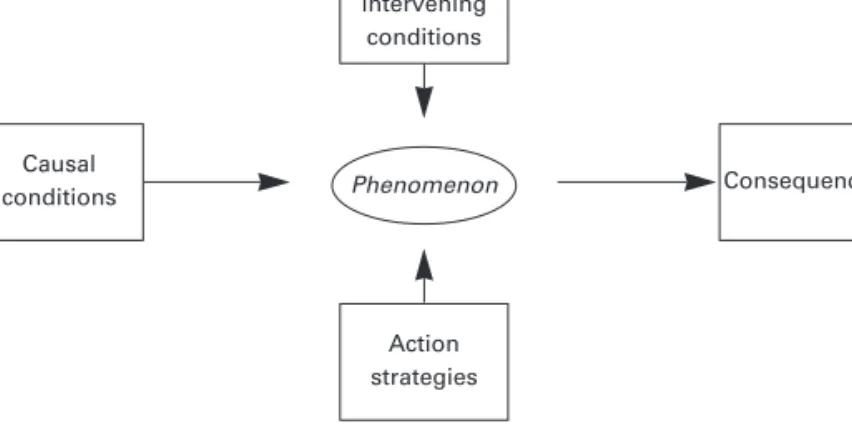
developed around it. Typically, axial coding is used particularly in the middle and later stages of an analysis. In the same way as open coding, axial coding is applied to very short textual seg-ments (in the sense of a detailed analysis), to larger extracts or to the entire text. For theory-formation what is of particular importance is the development of relationships between the axial categories and the concepts that are related to them in terms of their formal and content aspects. The axial category is developed in its temporal and spatial relationships, in relation-ships of cause and effect, in means–ends rela-tionships and in terms of argumentative and motivational connections. The hypothetical relationships in axial coding must be repeatedly checked in a deductive procedure, using new data material. To explain the relationships between categories that relate to partial aspects of social action, Strauss’s coding paradigm has proved to be of value (Figure 5.13.1).
The following example, in which ‘pain’ has been selected as the axial category, will illustrate the coding paradigm: ‘If I’ve drunk too much (context), I get (condition) a headache (phenom-enon/axial category). Then I take an aspirin (strategy). After a while it’s better (consequence)’ (taken from Strauss and Corbin 1990: 98).
The phenomenondenoted by the axial category is, for example, an event or a fact. The actions of an individual as well as interactions between dif-ferent people revolve around the phenomenon. The following questions make easier the choice of axial category: What do my data refer to? With what are the actions and interactions in the data actually concerned? Causes or causal conditions contribute to the occurrence or
development of the phenomenon, for instance, a broken leg (=cause) leads to pain (= phenome-non). It is important here to clarify the proper-ties of the cause. For the example given, this would mean asking: What kind of fracture? Simple or compound? And so on. With causes a distinction must sometimes be made between the subjective view, as it may be presented, for example, as a speaker’s perspective in an inter-view text, and the inter-view of the researcher. Causes
are normally only valid in a particular set of con-ditions, and here what is of particular importance for the formation of an action-related theory are the conditions that promote or restrict the possibilities for action or interaction. Under
contextual conditions are included particularly time, place and duration. And among intervening conditions we find the social, political and cul-tural environment and the individual biography.
Actions and interactions have two properties. (1) They are processes and have a sequence, and it is therefore appropriate to ask about sequences and temporal course of action. (2) They are goal-oriented and are often performed for particular and specifiable reasons, for which reason one may refer to (interactional) strategies or tactics.
‘Goal-oriented’ should not be confused with (conscious) intention. For the purposes of the analysis a functional mode of observation is preferred that disregards intentions. Strauss and Corbin (1990: 104) offer the following example. In an investigation into the self-consciousness of children a field observation was analysed. A child throws a glass of milk onto the floor and is rebuked by its mother in the presence of other children. It was not a conscious intention of the mother that the child’s self-consciousness Context and intervening conditions Causal conditions Consequences Action strategies
Figure 5.13.1 Coding paradigm for social science research questions Phenomenon
should suffer from the rebuke (here the interac-tional strategy), but rebuking can be coded here as a strategy.
Actions and interactions lead to particular consequences. Strauss (1987: 57) recommmends that care be exercised in applying the coding paradigm to linguistic peculiarities in the data: researchers should regard keywords such as ‘because’, ‘since’, or ‘owing to’ as indicators of causal conditions. Consequences of actions are often indicated by means of expressions such as ‘as a result of’, ‘and so’, ‘with the result that’, ‘the consequence was’, ‘consequently’.
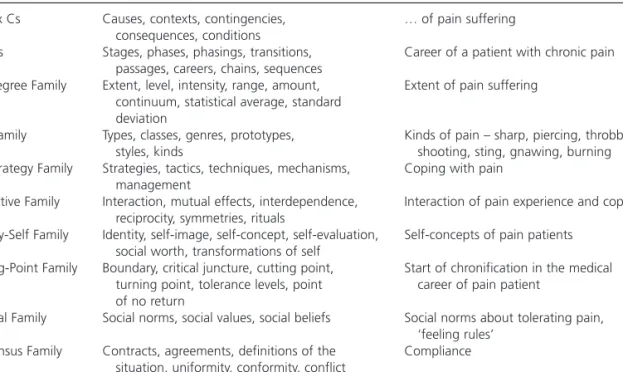
As a further stimulus in axial coding, an overview of theoretical framing concepts may be used, or so-called coding families. The C-family (causes, contexts, consequences, conditions, etc.) corresponds to the coding paradigm described above. For Glaser (1978: 74) this cod-ing family is central to the analysis of social events (the ‘bread and butter theoretical code of sociology’) (see Table 5.13.1).
Selective coding
In this phase the researcher is particularly active as an author on the basis of the categories, coding notes, memos, networks and diagrams so
far developed. As a starting point for establishing the main phenomenon of the analysis it is advisable to look at coding lists, summarizing memos and representations of networks. The main phenomenon is described as the core cate-gory and is possibly already present in the formulation of the research question of the particular investigation. Admittedly it must sometimes occur in the research process that a different phenomenon than originally assumed will take on central importance for the issue in question. There are indeed such shifts in a research perspective in the course of data collection and interpretation, which lead to new and surprising discoveries. For this reason
grounded theory recommends asking repeatedly, in the course of an investigation, which pheno-mena are central and formulating appropriate theory-memos.
If a number of well-worked-out axial cate-gories are available we may assume that the central phenomenon has been captured in its essential aspects – otherwise it is necessary to return to earlier phases in the research process. In the practice of research there are two possi-bilities. (1) One of the axial categories includes the central phenomenon and is therefore suit-able as the core category. The candidate for the
Table 5.13.1 Coding families (adapted from Glaser 1978: 75–82)
Coding families Concepts Examples
The Six Cs Causes, contexts, contingencies, … of pain suffering consequences, conditions
Process Stages, phases, phasings, transitions, Career of a patient with chronic pain passages, careers, chains, sequences
The Degree Family Extent, level, intensity, range, amount, Extent of pain suffering continuum, statistical average, standard
deviation
Type Family Types, classes, genres, prototypes, Kinds of pain – sharp, piercing, throbbing, styles, kinds shooting, sting, gnawing, burning The Strategy Family Strategies, tactics, techniques, mechanisms, Coping with pain
management
Interactive Family Interaction, mutual effects, interdependence, Interaction of pain experience and coping reciprocity, symmetries, rituals
Identity-Self Family Identity, self-image, self-concept, self-evaluation, Self-concepts of pain patients social worth, transformations of self
Cutting-Point Family Boundary, critical juncture, cutting point, Start of chronification in the medical turning point, tolerance levels, point career of pain patient
of no return
Cultural Family Social norms, social values, social beliefs Social norms about tolerating pain, ‘feeling rules’
Consensus Family Contracts, agreements, definitions of the Compliance situation, uniformity, conformity, conflict
core category is characterized by its formal relationships with all the other important cate-gories and occupies a central position in the net-work of terms. (2) It often proves to be sensible to give a central location to a phenomenon to which more than a single axial category relates. In such a case it is necessary to detach oneself from the axial categories, and to formulate a new category which comes about by means of summarizing or reformulating one of the exist-ing categories.
Frequently investigators experience difficul-ties in sticking to the central proposition of the investigation because of the ‘surfeit of important details’. Here one should ask what ‘story’ the data tell. The researcher will summarize in a few sentences the results of the investigation for an interested reader. Guiding questions for this kind of record are: What is the issue here? What have I learned from the investigation? What is central? What relationships exist? The main story revolves around a core category, unfolds this in a concise way and shows relationships with other important categories. After determin-ing the core category, its properties and dimen-sions, other relevant categories are related, systematically and in a schematically oriented manner (for example, in the sense of the coding paradigm), to the core category. Once the rela-tionships to the main categories have been formulated, their particular properties and dimensions may be compared with regard to regularities and patterns.
An example of selective coding
In an investigation of the psychological reaction to the nuclear accident at Chernobyl (Legewie et al. 1989), it was possible to discover the fol-lowing pattern: in experiencing a threat to one’s own physical health and life expectancy what was decisive was whether age was an important constituent in a person’s self-image. ‘Young’ people (not in the sense of biological age, but in the sense of a self-attributed property, or ‘sub-jective age’) saw themselves in this respect as far more threatened than ‘old’ people. This state-ment could only be made after a systematic comparison of combinations found no evidence of the combinations ‘young’ + ‘no threat’ and ‘old’ + ‘severe threat’. The example demon-strates how gaps within a theory (such as defec-tive specification, or defecdefec-tive grounding of the statements in the data) may, through a
system-atic procedure, be discovered, reviewed and ulti-mately eliminated.
The degree of generalizability of a theory developed in this way depends, at least in part, upon a process of abstraction that permeates the entire research procedure. The more abstract the formulation of the developed categories – in particular the core category – the more widely the theory may be applied. But, in addition, the time and energy invested in its development will also increase, because ultimately the route from the data to the relatively abstract cate-gories must be documented in every detail. A grounded-theory is testable by again confronting the theoretical propositions, as hypotheses, with reality. For social and, in particular, histor-ical phenomena there are limits to this, because the social conditions cannot be reproduced at will nor very precisely.
2 LIMITATIONS OF THE METHOD
The character of grounded theory as a Kunstlehre
(art) renders its learnability more difficult, and makes particular demands of investigators in res-pect of their creativity. The requirement – which seems initially to be liberating – that one should distance oneself from existing theories and allow the theory to grow out of the data, often causes insecurity among students. Particularly in respect of decisions about the transition points between the different phases of coding, there are scarcely any fixed rules (Flick 2002: 185). The pragmatic direction, in terms of which data collection and analysis is complete when theoretical saturation is reached (that is, no new aspects can be incor-porated into the theory), is hardly adequate for beginners. From this it again becomes clear how important teamwork and research supervision are in the context of this method.
3 DEVELOPMENTS AND PERSPECTIVES
While Barney Glaser withdrew from active research in the 1980s, Strauss developed the approach further and devoted himself in partic-ular to a didactic orientation in order to make the method teachable and learnable (Strauss 1987; Strauss and Corbin 1990). Glaser (1992) accuses Strauss in this respect of having aban-doned the original idea of allowing the theory
to ‘emerge’ in favour of ‘forcing’ theoretical structures. His criticism was particularly directed at the axial coding paradigm. In the first com-prehensive publication on grounded theoryit was vitally important to Glaser and Strauss (1967) that the method be adapted to particular questions and circumstances. Adaptations or systematic further developments in the proce-dure are to be found in Breuer (1996), Flick (1996) and Charmaz (1990). Breuer supple-ments the grounded theory approach for his own questions by the use of transference and counter-transference in the psychoanalytical sense (see 5.20). Flick (1996), in his investiga-tion of psychology and technology, proceeds on the basis of Moscovici’s (1984) concept of social representations. On the assumption that in dif-ferent groups difdif-ferent views of technology will be found, groups are pre-selected for investiga-tion. In that way samplingis limited to the selec-tion of cases that differ between the groups. Charmaz (1990) takes ‘thick’ presentation of cases as a starting point for theory development.
A further development of grounded theory is also to be seen in the improvement in practical analysis through the use of specific computer programs (see 5.14). Programs such as ATLAS.ti (Muhr 1997) support the task of analysis and make quality control possible by ensuring that the analytical process of individual researchers or complete teams can be documented and reproduced in every detail.
FURTHER READING
Glaser, B. G. (1978) Theoretical Sensitivity. Mill Valley, CA: The Sociology Press.
Glaser, B. G. and Strauss, A. (1967) The Discovery of Grounded Theory. Strategies for Qualitative Research. Chicago: Aldine.
Strauss, A. and Corbin, J. (1990) Basics of Qualitative Research. Newbury Park, CA: Sage.