MEDIALOGY – AN INTERDISCIPLINARY EDUCATION CHALLENGE IN A
PROBLEM BASED LEARNING ENVIRONMENT
Rolf Nordahl
Department of Architecture, Design and Media Technology, Aalborg University Copenhagen
Lise Busk Kofoed
Department of Architecture, Design and Media Technology, Aalborg University Copenhagen
ABSTRACT
Different new educations in the field of media and technology are constantly developing worldwide. Searching on the Internet almost every university has programs in both media and communication. Several universities are discussing the challenges to offer double degrees, so the students can combine an individual education according to their interests. Other universities are offering interdisciplinary educations in the field of media technology. Having worked with those interdisciplinary engineering and science educations for several years, it seems to be a challenge to define the students’ key competences, and the ability of such educations to provide new scientific paradigms and disciplines.
This paper investigates the challenges connected to a new interdisciplinary science and engineering program: Medialogy at Aalborg University. The program includes Bachelor and Master level educations and combines humanistic, sociological and technical aspects of media technology. The focus in this paper is on the students and their way of using the interdisciplinary aspects in their study. Some of the overall questions dealt with are: How do students understand and use the interdisciplinary approach and how do they carry out and combine the different disciplines when working with a problem in their projects?
In the paper we describe how the students are using the interdisciplinary nature of Medialogy in their 6th semester projects. First we will introduce Medialogy, and then we will focus on the interdisciplinary nature of the program and establish a simple model for understanding the special interdisciplinary profile of the Medialogy knowledge. Next we introduce the B.Sc. Medialogy program and the Problem Based Learning (PBL) approach. Finally we analyze and discuss the interdisciplinary content of 6th semester projects from a year group. For the analysis we use Bloom’s taxonomy and the aim described in the study plan. We can conclude that the PBL approach assures that the students are forced to get knowledge about the problem area they want to work with in their project so they have established a good problem understanding as a basis for choosing the sufficient knowledge elements and combine them in an interdisciplinary way to get the best solution of their chosen problem.
KEYWORDS
Problem Based Learning (PBL) – Project work – Interdisciplinary – Media Technology
INTRODUCTION
Different new educations in the field of media and technology are constantly developing worldwide. Searching on the Internet almost every university has programs in both media and communication. Several
universities are discussing the challenges to offer double degrees, so the students can combine an individual education according to their interests. Other universities are offering interdisciplinary educations in the field of media technology. Having worked with those interdisciplinary engineering and science educations for several years, it seems to be a challenge to define the students’ key competences, and the ability of such educations to provide new scientific paradigms and disciplines.
This paper investigates the challenges connected to a new interdisciplinary science and engineering program: Medialogy at Aalborg University. The program includes Bachelor and Master level educations and combines humanistic, sociological and technical aspects of media technology. The focus in this paper is the content of the education and how the different disciplines are combined in an interdisciplinary education. One of the overall questions dealt with are: How does the PBL learning environment fit into this interdisciplinary education and how do students carry out their projects using the interdisciplinary approach? In the paper we will introduce Medialogy education which is based on the PBL pedagogical approach, and then we will focus on the interdisciplinary nature of the education and establish a simple model for understanding the special interdisciplinary profile of the Medialogy knowledge. Next we present the interdisciplinary content of 6th semester projects from a year group. We can conclude that the PBL approach assures that the students are forced to get knowledge about the problem area they want to work with in their project so they have established a good problem understanding as a basis for choosing the sufficient knowledge elements and combine them in an interdisciplinary way to get the best solution of their chosen problem.
THE MEDIALOGY EDUCATION
Medialogy is an education started at Aalborg University in August 2002. The goal of the education is “to develop problem solvers in a digital media age independent of tasks” [1]. This goal is achieved by merging creativity, arts and technology through the development and cross-combination of areas and topics within the field of engineering technologies, computer science, psychology, sociology and arts. Such areas have until recently been kept apart by conventional standards. The education is concerned with the current and future needs of society, culture, industry, hardware and software. The purpose of the program is to provide students with a solid foundation in areas within new media comprising both technical and creative aspects. Students graduating in Medialogy will be able to integrate and combine different fields of new media technologies. In Medialogy, students typically are faced with questions such as: to which extent can computer games be made more interactive or to which extent can the borders between man and machines be overcome?
How can colours and pictures support the deaf people to get an understanding of sound and music? Medialogy offers a 3 year Bachelor program and a 2 year master program.
The Medialogy Bachelor
The Medialogy education follows the Bologna model of dividing the curriculum in 3 years of a Bachelor degree and 2 years of a Master degree [2]. During the f i r s t y e a r of the Bachelor degree, students are exposed to topics such as animation and graphic d e s i g n , introduction to problem based learning, introduction to programming, interaction design and human computer interaction as well as mathematics. During the second year of the Bachelor degree students are exposed to topics such as A/V production, human perception, computer vision, object oriented programming, sound and mu- sic computing and experiment design. During the third year students are exposed to topics such as computer graphics and screen media, interactive systems, media psychology and sociology. Each semester of the education is divided in three classes of 5 ECTS each and a project of 15 ECTS.
The project usually is based on topics covered in the courses of the semester. It is completed in groups of 5 to 7 students, and is based on PBL.
The core idea of PBL in Medialogy is that students choose a problem to work with as a semester project, and design and implement an application which addresses that problem, as well as evaluate the application with users.
As can be seen from the overview of courses offered, the Medialogy Bachelor education includes several aspects of media technology, from topics in human-computer interaction, to math and programming, to courses related to sensation and perception, courses focused specifically in one sense (either vision or sound or touch), to courses focused on the design of interactive systems such as videogames.
When finishing the Bachelor education students are trained to handle several aspects of media technology and are able to solve problems in an interdisciplinary way.
The Medialogy master
The Medialogy master is a two years education, where students follow courses and work on small projects in the first three semesters, and in the last semester work on a Master thesis.
The curriculum of the Master offer four different specializations: • Medialogy and interaction
• Medialogy and computer graphics • Medialogy and sound and music • Medialogy and games
The first three specializations are merely related to human senses and related technologies (specifically touch, vision and audition). The fourth specialization is mostly connected to a whim of fashion, since it derives from the fact that there has been lots of interest in Scandinavia to train professionals in applications of media technology to games. In addition, we offer a generalist Medialogy line which can be chosen by those who do not necessarily feel the need to specialize. In each semester, courses which belong to the same column are electives. As an example, in the first semester of the Master education there are two mandatory courses, 3 electives (where students need to choose one among the three) and a project. During the Master education all students are exposed to some topics which we believe are important no matter the specialization chosen. Such topics are principles of human center design for multimodal interfaces, multimodal perception and cognition, and advance statistical techniques for experiment design. Moreover, they are exposed to topics specific to their own chosen specialization, such as foundations in the chosen specialization, research topics in the chosen specialization and a Master thesis on the chosen specialization. Specifically, during the first semester of the Master education students are exposed to topics such as advanced human-computer interaction, multimodal perception and cognition, prototyping techniques, and statistics and pat- tern recognition. These courses are offered to students no matter which is their profile of choice. Students are then able to specialize during their project work and miniprojects associated to each class. During the second semester of the education students follow both courses related to their own specialization and interdisciplinary courses in media technology.
During the third semester students have the possibility to follow courses related to advanced research training in their own area of specialization and courses on entrepreneurship and innovation. As an alternative, they can spend a semester abroad in an university affiliated to Aalborg University Copenhagen, or work in an internship in a company. In the last semester of the education, students work on a Master thesis, either alone or in small groups.
During the Master education groupwork is organized differently than in the Bachelor education. As a matter of fact, students can work within or across specializations.
As an example, a student enrolled in the sound and music specialization can work with another student enrolled in the computer graphics specialization, and the final product of their project is represented by an application including both sound and vision. During the oral examination, students enrolled in the sound profile cannot be examined on the part of the curriculum specialized in computer graphics, and viceversa. This represents a significant difference from the bachelor education, where students are responsible for the whole curriculum. This also allows members of different groups to specialize in a selected areas while working together with other competencies. We believe this is an important interdisciplinary skill in a media technology education, which allows group work to resemble what happens in a real company, where people from different profiles work together towards a final application.
The interdisciplinary and transdisciplinary Medialogy approach
It is a challenge to design an interdisciplinary or trans - disciplinary curriculum which at the same time has a coherent and progressive curriculum [4, 5 ]. Many interdisciplinary educations are merely a combined effort of different competences from several faculty members put together. The terms interdisciplinary and crossdisciplinary or multidisciplinary are often used without considering their meaning. It is important to have a clear definition and understanding of those words when being in an environment trying to establish a common understanding of a new education with a new combination of disciplines. In this paper we will use the definition proposed by Meeth in 1978. Observing the confusion in defining what an interdisciplinary education is, Meeth proposed a hierarchical classification [4]. At the bottom he placed intradisciplinary studies i.e. studies composed of a single discipline. At the next level he placed crossdisciplinary studies i.e., studies in which one discipline is viewed from the perspective of another. Crossdisciplinary studies are relatively easy to establish according to Meeth, since they allow faculty members to remain in their own disciplines. Multidisciplinary studies are placed at the next level where each will offer their own viewpoint, but not necessarily with any integration. The next level shows
interdisciplinary studies in which the attempt is to integrate several disciplines which allow
solving particular problems. The highest level of integrated studies is transdisciplinary studies. This approach goes beyond disciplines, since they start from a problem and using problem solving, they bring the knowledge of those disciplines which contribute to the solution [4] . As also argued by Meeth, transdisciplinary studies are hard to design, since they require highly prepared and intellectual mature faculty members. The question is if Medialogy at the current state can be named a transdisciplinary program.
Our presumption is that the PBL approach represents an ideal framework to design an interdisciplinary education close to being transdisciplinary in the sense defined by Meeth (1978), where transdisciplinarity is viewed as the ability to define a problem and find the relevant disciplines which allow solving it.
The Medialogy B.Sc education … interdisciplinaryty and PBL
The study plan for the B.Sc program has been changed several times, and each new version is an improvement – and is still under revision.
The PBL approach means that each semester has a theme which defines the frames of the projects and half of the courses have to be directed towards this theme. The theme for 6. Semester is “Integrated design – Intelligent systems and computer games”. The theme establishes the frames and conditions for the projects, and related courses, and the project count about half of the semester time (15 ECTS for projects), and each project group is formed by 3 – 6 students.
Understanding of the basic function of the human senses and their interaction with the perception of the context in general and the medias in particular
Understanding of the duality between computer based recording and analysis of digital signals (pictures, sound, tactile information etc) respectively computer based generic/synthesis and presentation of corresponding signals
Understanding of the interactive process between human, computer and machine Understanding of structures for narrative styles and communication in relation to
medias and the characteristics of media technologies
Understanding of the interaction between form and content when using new media technological effects as a basic for development of own creativity in this area of tension
Understanding of media history and the basic for including cultural, ethnographic, social and sociological perspectives in solution of the problem
The foundation for designing interactive systems with regard to both the communicative- as well as the user perspectives and the technological possibilities The foundation for analysis, synthesis and evaluate techniques and methods for
development of media systems inclusive animation technology, virtual reality technology and computer games on both new and well known platforms
The foundation for carry out a synthesis and evaluation of media systems” (Medialogy Study Plan 2008)
Furthermore there is a set of common academic competences such as ability to resonate, learning competence and innovation competence as well as general professional competences such as: problem analysis and problem solving competences, communication competence and cooperation and management competences (Study Plan, 2008). So we see those competences as process competences (the general academic, project management and problem solving competences etc) and specific (technical as well as non-technical- competences close connected to Medialogy), but the whole set of competences are Medialogy competences.
In the study plan each semester is described in details regarding courses, their objectives and contents, and the descriptions are made according to Blooms’ Taxonomy [6].
According to the study plan, students should have opportunities to achieve an interdisciplinary or crossdisciplinary competence profile as described by Meeth [4].
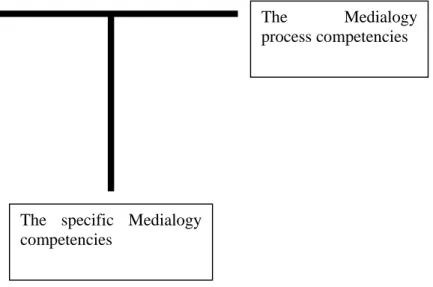
Terry Winograd claims that to get design into effective practice, one need to train designers and also to teach the people they work with how to understand, incorporate and foster design [7]. This philosophy is also at the heart of new programs around the world like the Stanford d.school which talks about creating T-shaped people [8].
Such people maintain the depth and focus of single disciplines, while integrating them and adding a crossbar of process knowledge and experience that drives the integration of multiple perspectives into solving real problems.
During the Bachelor education, students are exposed to different topics within media technology, ranging from technical implementations of input-output systems, to psychology, measurement of user experience and media sociology (see the study plan). This knowledge establishes the vertical line in the T and we call it the specific Medialogy competence.
The knowledge and experience connected to the academic competencies mentioned in the study plan and the knowledge related to project management, learning abilities, communication skills, cooperation combined with an understanding of Medialogy in general establishes the horizontal line in the T, and we call them Medialogy process competences.
Figure 3: The T-shape model illustrates the B.Sc. Medialogy profile.
The T-shape can differ. The horizontal line can be shorter or longer related to the broad knowledge, experience and understanding of the process competences. The vertical line also can be shorter or longer related to how deep the specific Medialogy specialization is. We know that Medialogy Master Graduates either have a broader or longer vertical line depending on development of their specific knowledge area. For example, some Master graduates are very specialized within sound and related communication aspects, and some are broader in their knowledge area using sound, computer graphics and virtual reality. The challenge for teachers and students is to find the balance of the T related to the goal of the education. The faculty members also need to understand their special knowledge as part of the T- model. They have to be aware of their special expertise as well as their broad knowledge so they keep their balance as well. Some faculty members are so specialized that they cannot relate to and understand others’ expertise when working in a cross disciplinary fields. Other faculty members are so eager to learn about the broad perspective in such a way that their vertical line will become too short, and they lose focus on their own expertise. One cannot work in a crossdisciplinary environment if (s) he doesn’t have enough expertise with which s (he) can contribute. So faculty members as well as students have to keep the balance of the T when developing their knowledge and expertise [9]. The study plan is developed with the aim to support the T-shape competence profile, and the PBL approach is a necessity when using the competences in action meaning when the groups of students are making their projects and prototypes.
4 The 6th semester Medialogy projects
We are choosing projects from the 6th semester 2008 as examples because those students are the first batch who have started with the basis year where many process competences are dealt with [10] (previous 6th semesters have started on the 3rd semester because of merits from other institutions). So this 6th semester should be able to fit to the T-model because they have had the PBL approach from day one. At this semester the students have completed 6 major projects all organized as group work.
The theme for 6th semester is: Integrated Design – Intelligent Systems and Computer Games. The workload is 20 ECTS of project work and project unit courses. The purpose is that the
The Medialogy process competencies
The specific Medialogy competencies
media systems, including how to use such knowledge and skills to produce a new design of an interactive media system.
The objectives are stated as examination requirements:
Analyze previous research and current trends concerning interactive and converging media.
Use such an analysis to synthesize the design of an interactive media system involving auditory and visual feedback and alternative input devices (i.e. computer vision or physical interfaces)
Apply fundamental techniques from game problem solving and artificial intelligence in the interactive media system
The project should be documented in a report and an AV-production illustrating and summarizing the project should be delivered.
12 projects were completed and 1 is confidential, so 11 projects are presented.
All projects are performed in groups and are finished to dead-line. All groups have made a good presentation of their projects, and the methods and structure in the reports show that the horizontal line in the competence profile in general is covered. The students have designed a project plan and carried out their project according to their own goal set in their problem statement. So we can conclude that the Medialogy process competences are acquired.
Problem analysis
All projects have made an analysis of the problem area finalizing or concluding with “Final problem statement”. In this section students start with a motivation for a problem they want to analyze and trying to find a solution to. They investigate what have been made, they take contact to a user group if necessary, they make pilot testing on a very early prototype – everything to understand the problem so they can make an operational problem statement, which they have to solve. 50% of the projects have a problem analysis at Blooms Analysis level. 30% are at the synthesis level, they work up new ways of combining different technical aspects or e.g. different game approaches. And 20% come up with prioritized recommendations for their projects, so they are at the highest level on Blooms taxonomy. The projects final problem statements and the solutions
All projects have a final project statement which shows the solution the students want to work with when solving the problem. The demands for problem statement are that it is operational and it should be implemented and tested. All students have accomplished the demands at different levels. They also have different structures of their chapters before reaching the problem statement. Their problem statements and solutions are as follows:
1. How can a hybrid between a board- and computer game, which combines the social and physical elements of board games, and the auditory and graphical elements of computer games be created and will this hybrid preserve the appeal of these elements? The solution became a combination of board- and computer game in a hybrid application combining social and physical aspects with strategy and teamwork. 2. How much can interactive home advertising be more attractive than the
out-of-home non-interactive advertising? The solution was to make two identical commercials: interactive and non-interactive and then test the results.
3. How can narrative intelligence conveyed through a commentator entity be utilized as a tool for story generation in the context of a single player, first shooter death match – and will it result in measureable user constructed narratives and/or a higher level of perceived intelligence in the computer controlled participants? The solution became an intelligent framework for creation of narrative content to heighten narrative potential in games as well as relieve the exponentially increasing burden from game developer’s shoulders.
4. Can we make the WH40K tabletop game more immersive in terms of putting more focus on the empathetic insight which the players obtain in the fictive Warhammer
universe while playing, so as to heighten the imaginative- and sensory immersion by eliminating obstructive factors in the game using digital functionality and AV feed-back? The solution became an interactive application referred to as the Warhammer Tec Table which is designed with audiovisual feed-back to allow the players to keep focus on the gaming platform.
5. How can we design and implement our concept in a game context in a way that it conforms to the mentioned criteria for fun? The solution became a game made up of the three factors: game play, game mechanic and interface leading to the essentials used to refine the concepts.
6. How will a co-located collaborative multiplayer game utilizing affordance of a multi-touch tabletop interface affect the player experience? The solution was to create a co-located collaborative game for a multi-touch tabletop. The development is user-driven. GameFlow framework is used to investigate player experience. A table-top game is build and tested.
7. How can we help students prepare for oral examination situations by measuring voice factors and given real-time feedback in a virtual environment?
The solution was to develop a system which takes vocal input analyses it and use the data to control a 3D modeled audience reacting real-time to vocal input.
8. How is a player’s experience of a game altered by affective gaming with
measurement of muscle activity and exposure to haptic feed-back? The solution was to change the speed of a 2D platform game and through gaming to measure the muscle activity and haptic feed-back from a gaming vest to test how the player’s experience of the game is altered.
9. How can mixed reality in a collaborative environment be used in the field of chemistry to enhance the understanding of scientific modeling of molecule structures? The solution became to use SciVi, an interactive augmented reality application used for building and visualizing molecule structures and chemical bonding between atoms. 10. How can we use an audio-visual memory game to measure the difference of
cognition between the graphical and auditory elements? The solution became a 4-4 level game in two parts. One is audio and one is visual. Players have to use his cognitive abilities to complete the game. This gives an opportunity to test difference between two stimuli.
11. What changes and additions in avatar control are afforded and what changes could be introduced to the derived game play when using a Head-Mounted-Display in combination with head tracking in First-Person- Shooters? The solution contains HMD and head-tracking as a means of interfacing with FPS games for home users, and establishing a new game-play. The solution resulted in a FPS game scenario where it is possible to change the orientation of the view, lean
forward/backward/left/right/ and look over and under obstructing objects by the use of the players actual head.
All projects had an implementation and a test of their solution.
6 projects did use further knowledge areas than mentioned in the study plan. They also showed a new and creative way to integrate the knowledge in a new solution, so we can say they solved the problem in an interdisciplinary way.
3 projects did use several knowledge areas when solving their problem, and derived a solution which was acceptable but in a crossdisciplinary way.
2 projects did a rather good problem analysis but the intentions shown in the final problem statement was not delimited so the group’s solutions were not based on sufficient knowledge. The vertical line in their T- profile was not deep enough.
The projects described did implement successfully Meeth’s notion of interdisciplinarity, and show how PBL is an effective pedagogical method to achieve interdisciplinarity. The PBL approach assures that the students are forced to get knowledge about the problem area they want to work with in their project so they have established a good problem understanding as a basis for choosing the sufficient knowledge elements and combine them in an interdisciplinary way to get the best solution of their chosen problem.
References
1 Nordahl, Rolf (2007). Panel on educational approaches to Film Sound and Editing. School of Sound – Film Sound and Film Music. London. UK.
2 www.sict.aau.dk
3 Kolmos, Anette, Fink, Flemming .,Krogh, Lone K. eds (2004 )The Aalborg model : progress, diversity and challenges . Aalborg: Aalborg University Press.
4 Meeth. L.R. (1978) Interdisciplinary studies: A matter of definition. Change, 7:10, 5 Mackay, W.E. (2004) The interactive thread: Exploring methods for multi-disciplinary
design. Proceedings of the 2004 conference on designing interactive systems: processes, practices, methods and techniques. p. 103 – 112
6 Bloom, B.S. et all (1956) Taxonomy of Educational Objectives. The classification of Educational Goals. Handbook 1: Cognitive Domain. New York: David McKay Company, Inc.
7 Winograd, T. (2008) Design education for business and engineering management students: a new approach. Interactions, ACM
8 Stanford University Institute of Design (2007)
http://www.stanford.edu/group/dschool/big_picture/radical_collaboration.html 9 Kofoed, L.B. (1997). Prerequisites for integrated manufacturing systems. In: The
workplace. Eds D.Brune et al. pp64 -77. CIS, International Labour Office Geneva and Scandinavian Science Publisher. (1997).
10 Kofoed, Lise Busk ; Hansen, Søren ; Kolmos, Anette. (2004) Teaching process competences in a PBL curriculum In: The Aalborg model : progress, diversity and challenges. red. / Kolmos, Anette : Fink, Flemming K. : Krogh, Lone (eds.). Aalborg : Aalborg University Press, 2004. s. 333-349.
11 Adamczyk, P.D. and Twidale, M.B. (2007) Supporting multidisciplinary collaboration: requirements from novel HCI education. Proceedings of the SIGCHI conference on Human Factors in computing systems, p. 1073 – 1076.
12 Nordahl, R and Busk Kofoed, L. (2007) Learning Lab – teaching experienced students PBL. In Proceedings of the 18th Conference of the Australasian Association for Engineering Education, Melbourne.
13 PUC. Pedagogical Center, Aalborg University. www.PUC.AAU.DK
14 Stanford University Institute of Design (2007)
http://www.stanford.edu/group/dschool/big_picture/radical_collaboration.html
15 Study Plan for Semester 3-6 of B.Sc.Medialogy at Aalborg University. (2008 ) hhtp://www.imi.aau.dk
16 Wenger, E. McDermott, R. Snyder, W.M. (2002) Cultivating Communities of Practice. Harward Business School Press, USA.
Biographical Information
Rolf Nordahl, Ph.D./M.Sc. (born 1974) is currently associate
professor in Medialogy at Aalborg University Copenhagen and Director of Studies for The Study Board of Media Technology, which runs a large range of studies within educations focusing on media technology. He is principal investigator for the EU funded project Natural Interactive Walking, and has earlier done seminal work on the EU-project BENOGO (the project was focused on HMD- based photo-realistic VR). Given his extensive work on PBL and curriculum development as well as extensive teaching and research experience, he is a recognized member of the expert panel under the governmental Danish Evaluation Institute. Rolf Nordahl has published numerous papers on curriculum development and PBL, as well as also being member of various steering committees and chairing conferences such as HAID and most recently the Sound and Music Computing Ph.D. Summer School. He frequently publishes both journal and conference papers and is also giving invited talks at international level. Lately, he was invited to run a special series of lectures at among other places Yale University (Connecticut). Besides his work as Director of Studies for The Study Board for Media Technology as Aalborg University his research interests lie within VR, (Tele)-Presence, Sonic Interaction Design, developing new methods and evaluation-techniques for VR, and Presence and Games. Rolf Nordahl is member of IEEE.
Lise Busk Kofoed is Professor and Head of Section in the
Department of Architecture, Design & Media Technology, Aalborg University, Copenhagen. She earned her PhD in Organizational Development, Working Environment and Learning. She teaches undergraduate and graduate subjects within organization and management development in the engineering curriculum as well as pedagogical issues for the university teaching staff. A part of the pedagogical work is courses for PhD students and supervisors. Her research areas are development of the Problem Based Learning concept within engineering educations with special focus on cross disciplinary programs.
Corresponding author
Dr. Rolf Nordahl, Ph.D., M.Sc, Member of IEEE Aalborg University Copenhagen, Medialogy
Department of Architecture, Design and Media Technology Lautrupvang 15, DK-2750 Ballerup
Phone: (+45) 9940 2472 Email: [email protected]