Making Career Development
Core Business
Centre for Post-compulsory Education and Lifelong Learning, the University of Melbourne, for the Department of Education and Early Childhood Development and the Department of Business and Innovation
The Authors
Professor Richard Sweet Dr Veronica Volkoff Professor A. G. Watts Professor Jack Keating Sue Helme
Dr Suzanne Rice Sujatha Pannel
Centre for Post-compulsory Education and Lifelong Learning, The University of Melbourne
Published by Office for Policy, Research and Innovation Department of Education and Early Childhood Development and
Department of Business and Innovation Melbourne
Published December 2010 © State of Victoria 2010
The copyright in this document is owned by the State of Victoria. No part may be reproduced by any process except in accordance with the provisions of the Copyright Act 1968, NEALS (see below) or with permission.
An educational institution situated in Australia which is not conducted for profit, or a body responsible for administering such an institution, may copy and communicate the materials, other than third-party materials, for the educational purposes of the institution.
Authorised by the Department of Educationand Early Childhood Development and the Department of Business and Innovation, East Melbourne, Victoria 3002.
Table of Contents
TABLE OF CONTENTS ... I TABLE OF FIGURES ... III TABLE OF TABLES ... III TABLE OF BOXES ... III EXECUTIVE SUMMARY ... IV EXECUTIVE SUMMARY ... IV
1 THE STUDY IV
2 METHODOLOGY IV
3 CAREER DEVELOPMENT SERVICES V
Career development ... v
International models in education and training providers ... v
Benefits ... v
Career development and education and training ... v
Good practice for education and training providers ... vi
4 THE VICTORIAN CONTEXT VII 5 SERVICES IN VICTORIA VII 6 CAREER DEVELOPMENT SERVICES FOR YOUNG VICTORIANS:POLICY CHALLENGES AND WAYS FORWARD X 1. INTRODUCTION ... 1
1.1 METHODOLOGY 1 2. CAREER DEVELOPMENT SERVICES FOR YOUNG PEOPLE: AN OVERVIEW ... 3
2.1 WHAT ARE CAREER DEVELOPMENT SERVICES? 3 2.2 WHY DO CAREER DEVELOPMENT SERVICES MATTER FOR PUBLIC POLICY? 3 2.3 WHAT INTERNATIONAL MODELS EXIST OF CAREER DEVELOPMENT SERVICES FOR YOUNG PEOPLE? 4 Services within educational institutions ... 4
External services ... 5
Follow-up and support services ... 5
2.4 WHAT ARE THE SKILLS THAT YOUNG PEOPLE NEED TO DEVELOP THAT WILL ALLOW THEM TO MANAGE THEIR CAREERS INTO THE FUTURE? 6 Educational stages and career development ... 7
Data gathering ... 13
2.5 WHAT IS KNOWN ABOUT THEIR IMPACT, BENEFITS AND EFFECTIVENESS? 14 2.6 WHAT IS GOOD PRACTICE? 15 Good practice framework for education and training providers ... 16
Indigenous students ... 18
3. THE VICTORIAN CONTEXT FOR CAREER DEVELOPMENT SERVICES ... 20
Diverse pathway choices ... 20
Longer transitions from school to work ... 20
Extended participation requirements and guarantees ... 22
Demand-driven funding for education and training ... 22
Changed Commonwealth-state responsibilities ... 23
Governance arrangements across the sectors ... 23
4. AN OVERVIEW OF CURRENT PROVISION IN VICTORIA ... 25
4.1 ASSESSING PROVISION 25 4.2 LEADERSHIP, DISTRIBUTION AND EVALUATION 25 Policy steering and quality assurance ... 25
Data ... 27
Evidence at the provider level ... 27
State wide programs ... 28
Resources ... 30
The distribution of resources in relation to needs ... 33
Integrated programs ... 40
4.4 EXTERNAL CONNECTIONS 41 4.5OVERALL SATISFACTION 44 Overall satisfaction ... 44
Meeting the needs of different 15 to 19 pathways ... 46
4.6 COMPARING VICTORIA 47 Best Practice ... 47
National comparisons ... 48
Improvement ... 49
5. CAREER DEVELOPMENT SERVICES FOR YOUNG VICTORIANS: POLICY CHALLENGES AND WAYS FORWARD ... 51
5.1 A STATE-WIDE STRATEGIC PLAN FOR YOUNG PEOPLE’S CAREER DEVELOPMENT SERVICES 51 5.2 WAYS FORWARD 52 ANNEX 1: STAKEHOLDER INTERVIEWS ... 55
ANNEX 2: EVIDENCE REVIEW ... 56
ANNEX 3: IMPROVING CAREER DEVELOPMENT IN VICTORIA FOR INDIGENOUS YOUNG PEOPLE UNDER THE AGE OF 19: LITERATURE REVIEW ... 72
ANNEX 4: CONSOLIDATED REFERENCE LIST ... 81
ANNEX 5: CAREER DEVELOPMENT STAFF: ONLINE SURVEY FINDINGS ... 89
ANNEX 6: YEAR 10-12 STUDENT SURVEY: FINDINGS ... 119
ANNEX 7: YEARS 7-9 STUDENT SURVEY: FINDINGS ... 137
ANNEX 8: 15-19 YEAR OLD STUDENTS IN TAFE AND ACE SURVEY : FINDINGS ... 148
ANNEX 9: GOOD PRACTICE IN CAREER DEVELOPMENT FOR INDIGENOUS YOUNG PEOPLE: FINDINGS AND RECOMMENDATIONS ... 158
Table of Figures
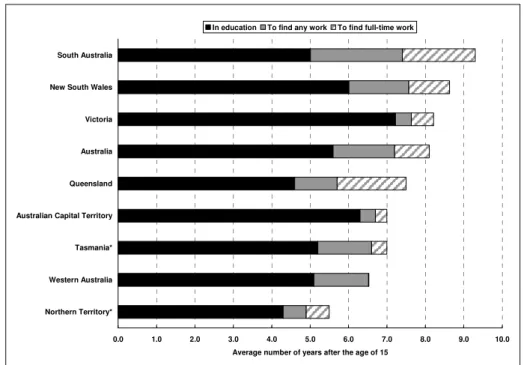
Figure 1: The duration of the transition from education to work, states and territories,
2008 21
Figure 2: Students per equivalent full-time careers staff 31 Figure 3: Total Year 7-12 enrolments and EFT careers staff 34
Table of Tables
Table 1: Enrolment share of secondary school sectors (2008) 23
Table 2: Career education staffing levels 32
Table 3: Career guidance provision and staffing by achievement level, states and
territories, 2006 35
Table 4: School year in which career advice was first received 37
Table 5: Career activities, 2003-2005 38
Table 6: Career activities used or participated in by Year 7- 9 Students 38 Table 7: Career activities provided by schools 39 Table 8: Patterns of career education lessons1 40 Table 10: Proportion of school students aged 15 to 19 in employment by sex and year
level (as a percentage of the total in each sex and year group), Australia,
2007 44
Table 11: Usefulness of career activities 45
Table 12: Average ratings of the availability and quality of five types of career
information1 47
Table of Boxes
Box 1: Garfield High 8
Box 2: Currumbeena Indigenous Education Centre 19
Box 3: Careers education and work-related learning in England 36
Box 4: Cremorne Institute of TAFE 43
Executive Summary
1
The study
The study has been commissioned by the Interdepartmental Policy Unit (Youth Transition Pathways) of the Victorian Departments of Education and Early Childhood Development (DEECD) and Innovation, Industry and Regional Development (DIIRD). It aims to:
o Identify best practice in the provision of career development locally, nationally and
internationally;
o Review the current implementation of career development programs in secondary
schools and for 15 to 19 year-olds in VET and ACE providers in Victoria to determine their effectiveness, including the ability to provide young people with the skills to navigate their further education and working careers into the future; and
o Provide recommendations for changed practice by providers and other relevant
parties to improve career development, including management practices and data collection/assessment mechanisms by education authorities to support and encourage the adoption of best practice.
The report has drawn from a range of evidence including national and international literature – including that for Indigenous Australians, examinations of relevant data bases, case studies of providers, surveys of students, surveys of careers education practitioners, and interviews with policy and stakeholder personnel.
2
Methodology
The review has drawn information and evidence from a range of sources:
1. A review of the general international and national literature on career development and its impacts.
2. A review of the literature on career development for Indigenous Australians.
3. Analysis of data on career development services in Victoria drawn from a number of data bases.
4. Case studies of career development services in eleven schools, three TAFE institutes and two ACE providers.
5. An electronic survey of careers education practitioners in post primary providers across Victoria.
6. Questionnaires completed by Year 7-9 students in eleven of the schools participating in the case studies;
7. Questionnaires completed by Year 10-12 students in eleven of the schools participating in the case studies;
8. Questionnaires completed by students in the five TAFE and ACE institutions participating in the case studies; and
9. Interviews with a number of policy makers and key stakeholders.
10. Two extended discussion groups with refugee students from the Karen community. The review was supported by an advisory group that included members from each of the provider sectors, indigenous educators, and other stakeholders in career development.
3
Career development services
Career development
The study identifies career development services as those intended to assist people, of any age and at any point throughout their lives to make educational, training and occupational choices and to manage their careers. Career development has been identified as the most encompassing term for the Australian context.
In recent years, career development has gained greater policy attention, including statements in the recent Melbourne Declaration of the Educational Goals for Young Australians (MCEECDYA, 2008). In a context where individuals need to make more complex career and life choices, career development programs and services, especially within formal education and training contexts, have become more important. Career development is especially important at the post compulsory level and for disadvantaged groups, including Indigenous young people, culturally and linguistically diverse (CALD) students, and those who have migrated to Australia.
International models in education and training providers
At the international level career development services can be classified using three dimensions:
o services in schools and colleges;
o any external support for these services; and
o any follow up services for young people who have left education.
The quality and relationships between these dimensions both define the nature of ‘national career development services’ and their quality. A wide variety of national approaches can be identified and many countries continue to innovate across these three dimensions.
Benefits
Direct evidence of the positive impact of career development programs on transition outcomes does exist, albeit in limited forms. More common is evidence of its positive impact upon the skills of young people that are related to successful transitions, including more positive attitudes towards careers, self-awareness, knowledge of possible pathways, and improved job search and entry skills.
Career development and education and training
The international and Australian literature indicates that career development should be an on going and multifaceted program in education and training that begins early in the secondary years of schooling or even in the later years of primary school. It aims to develop in students:
- Self awareness and skills for self assessment of their capacities and preferences, and the relationships between them;
- Skills in information searching, planning and decision making based upon relevant information; and
- Knowledge and awareness of opportunities and requirements in study and employment and skills to relate them to their own capacities and preferences.
These skills and knowledge need to be developed across the different stages of school and post school education and training. The international and Australian literature consistently points to the need for these knowledge and skills to be located within the wider curriculum, or the core business of education and training.
Options for the measurement of levels of knowledge and skills and changes in them at individual, provider and state wide levels include the development of a pre VCE/VCAL module, the development of curricula incorporated within VELS, or a proposal for the development of a national assessment instrument through ACARA. Either development could be supplemented with the inclusion of another question related to students’ level of confidence in their knowledge of potential career pathways to be added to the student questions that are part of the government schools climate survey. The use of this instrument could be negotiated with the Catholic sector and the outcomes of the instrument could be linked to a range of other administrative and survey data through the common student identifier.
All of these options have difficulties related to the levels of developmental investment, their inclusion in the relevant curricula, and changes to the survey instruments. An alternative would be to trial the on-line paper and pencil test cited by Bell et al (2005) and encourage and support career development personnel to use it.
Good practice for education and training providers
Based upon the literature and the information and data gathered through the review a three part good practice framework for career development is proposed:
Leadership, distribution and evaluation
o Informed, effective and a strong presence of provider leadership within the planning
and implementation of career development programs;
o The incorporation of career development programs into the on-going cycles of
school/provider program and climate evaluations that are data based, including data on student attitudes, knowledge and skills related to career development;
o On going processes to inform staff and the wider school/provider community of the
nature of the pathways opportunities that are available, the local and wider employment context for young people and the nature of the characteristics of their transition pathways – include program costs and income support arrangements, and other data on student attitudes and outcomes relevant to career development;
Quality programs
o An integrated approach where professionals responsible for career development and
transitions form a team based upon an integrated programs approach that is located within the wider school/provider curriculum and strategic plan;
o High quality career development programs that:
• begin in the early stages of the secondary curriculum, and that utilise accurate and well researched information on the full range of education, training and employment pathways, local and wider labour market conditions and employment opportunities, and packaged information based upon this research and the needs of students;
• challenge students to undertake planned and systematic research activities, that include the use of external resources and advice, in conjunction with counselling and discussions, in preparation for and as part of key careers related decisions;
o High quality and accessible web based resources that are linked to and utilised in
mainstream school programs for career development and evaluation, and that are accessible by parents and families through home access or community centres;
External connections
o Work place experiences that include hands on experiences that are linked to planned
and integrated school based programs; and
o Structured links to external resources and programs, including state and area based
and local or community resources and programs, and the integration of these resources and programs into the career development curriculum.
4
The Victorian context
With the establishment of the Victorian Certificate of Applied Learning (VCAL) and the capacity to combine this program with the Victorian Certificate of Education (VCE) young people in Victoria have a wider choice of educational programs than those available across other states and territories. They also have a wide choice of educational provider types with a wide variety of government and non-government schools, a number of strong programs for school age students in the technical and further education (TAFE) sector, and a stronger adult and community education (ACE) sector than in other states. This diversity and the strength of tertiary education in the state emphasises the importance of quality career development programs.
The length of transition pathways from compulsory schooling to full time employment have increased across all states and territories. However, young people in Victoria spend more time in education and training during this transition period. In this context, the consequences for early school leaving are likely to be intensified in a labour market that is mainly occupied by Year 12 and post Year 12 graduates. The raising of the participation age to 17 adds further demands upon providers and their provision of career development. The movement towards demand driven funding in tertiary education and the Commonwealth Government’s acceptance of the Bradley (2008) recommendations for higher education participation and access provide further imperatives for quality career development programs and services within providers and those that are parallel and linked to those within providers. The opportunity to strengthen programs and services is available through increased Commonwealth funding.
5
Services in Victoria
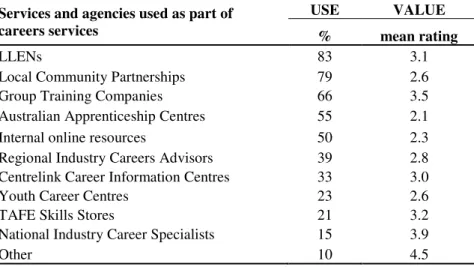
There is a wide range of career development services and programs for young Victorians. They include the Managed Individual Pathways (MIPs) program in government secondary schools as well as a range of support materials. Schools across all sectors have the capacity to provide variable levels of resources for designated career development services and programs. Beyond the school and provider based programs and services there is a range of State and Commonwealth supported initiatives that contribute to the delivery of career development across the state. They include:
o Local Learning and Employment Networks (LLENs); o Youth Transition Support Initiative (YTSI);
o Local Community Partnerships (LCP) - to be replaced by School Business
Community Partnership Brokers;
o Regional Youth Commitments; o Career On Track;
o The On Track survey and On Track Connect; o Qualifications Navigator; and
o Services provided by Industry Training and Advisory Boards (ITABs).
In government schools resources are of two types: those provided through MIPs targeted funding in government schools and those provided through all schools’ overall budgets. It appears that most government schools have less than one full time career development adviser. However, across all schools there is a considerable volume of related staffing resources, including:
o VCAL co-ordinators; o VCE co-ordinators; o VET co-ordinators;
o Workplace learning co-ordinators;
o Teachers with time allocated to act as pathways advisers and pathways
programme co-ordinators;
o Teachers who have a pastoral care role that includes careers assistance; o Youth workers;
o Indigenous Liaison Officers;
o Assistant Principals who co-ordinate the full range of career development
services; and
o School Based Apprenticeship and Traineeship co-ordinators.
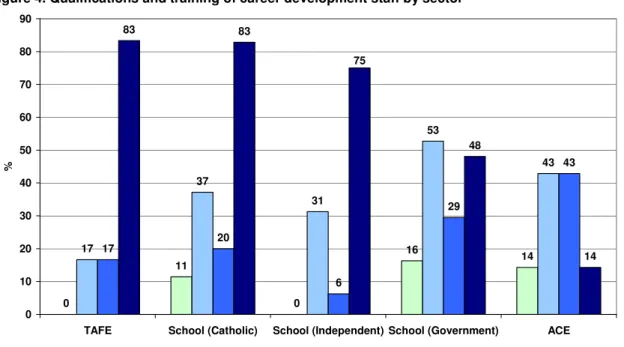
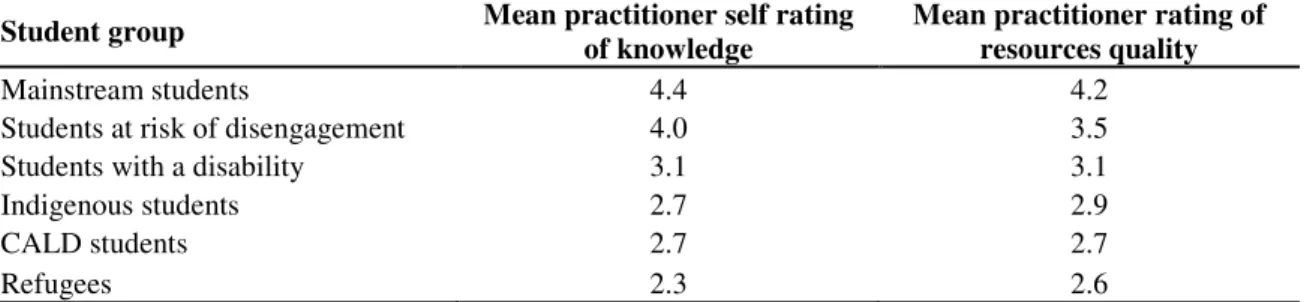
As would be expected, there is variability in the qualifications, experience and professional development activities of careers advisers in schools. Although only about one quarter of those who provide career development in schools are career development specialists, most practitioners have undertaken some career development training or professional development. Most of these people combine their career development duties with other duties.
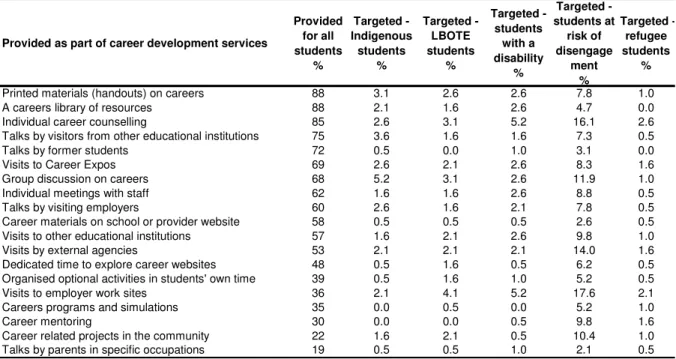
There is a high concentration of career development programs at year 10. Career development has a limited presence in years 7 to 9 in most schools. On the other hand there is a wide range of careers activities provided by schools, and most schools also use external services. Most schools in Victoria appear to use an embedded approach towards the inclusion of career development within the school curriculum. Most schools reported having dedicated resources.
Survey data indicate moderate satisfaction amongst students with career development programs and services in schools. Personal conversations with careers advisers and teachers were rated as the most valuable. Family members are the most frequent source of advice used by students. There is some evidence of strongest concentration of careers advice on university oriented pathways, compared with training and work based pathways.
Career development takes place within and beyond education and training providers. These providers include schools across the three sectors – government, Catholic and independent; technical and further education (TAFE) institutes and other Registered Training Organisations including Adult Community Education (ACE) providers. While there is a case that career development activities can take place in primary schooling, the review is based upon the assumption that it is primarily located in the post primary and post secondary areas of education and training.
Policy for and steerage of career development in Victoria are mediated by governance and ownership patterns across education and training providers, curriculum and qualifications, and programs. A range of methods are used in Victoria’s schools to help steer and improve the quality of career development services. They include guidelines and framework documents, resources, leadership development programs, planning approaches, and tracking and monitoring systems. However, because of the different relationships between the Victorian Government and its relevant agencies and the providers, approaches such as accountability requirements are not consistently applied across providers. On the other hand approaches such as career development forums have been used in some countries and could supplement the careers expos and professional development programs that have been little used in Victoria.
Several aspects of career development and related programs are quite innovative and the current level of staffing, the qualifications of staff, and their levels of engagement in continuing professional development combine to provide a solid foundation for future quality improvement.
A broad assessment of the effectiveness of career development in Victoria for 15-19 year olds against the previously described best-practice framework is as follows:
Leadership, distribution and evaluation
Victoria has a strong school leadership and program development and evaluation framework for the government and Catholic school sectors within which career development could be located as core business1. However, for this outcome to be better achieved there is a need to make career development and transition needs more explicit and integrated within leadership, school improvement and pathways planning frameworks.
The importance of career development within providers is formally acknowledged through resource commitment and the support of leaders. However, it is unlikely that this has yet achieved cultures and practices across providers that reflect the objective of making career development core business.
Quality programs
The level and range of resources devoted to career development across providers are considerable and provide the foundation upon which to build quality programs that are integrated into the core business of schools and other providers. However, the distribution and use of these resources across providers are inconsistent and are not necessarily matched with need. There is little evidence of systematic integration of resource, programs and services into the curriculum.
External connections
Victoria has been relatively advanced in investing in measures to connect providers to outside agencies and has a relatively strong suit of programs that connect students with the workplace. The quality of and integration with external sources of career development services, however, are not so strong. This will become more important in the context of the outcomes of the Bradley Review, the COAG targets, and the further weakening of the full time youth and young adult labour markets.
Within a national context the range and quality of career development programs and services in Victoria are strong and arguably the strongest in the country. This is evidenced by the data and information gathered through this review, the levels of participation in post compulsory
1
Independent schools also invest strongly in leadership and associated programs through their professional associations and university courses.
education and training and the short average period for transition from full time education and training to full time work.
Nevertheless, a number of gaps are apparent between the overall level and quality of current provision and international and national best practice benchmarks. They include:
o Services that are peripheral to the core business of some educational institutions; o Fragmented and poorly co-ordinated provision within some providers and
between sectors;
o Lack of specialist and dedicated personnel in some providers; o Uneven distribution of services and resources;
o A tendency for the most commonly used services to be the most minimal
services;
o Gaps in provision;
o Services that too often are provided at key choice points rather than integrated
across the year levels;
o Lack of incorporation into the regular school curriculum and curriculum
frameworks across the stages of learning;
o Insufficient provision of services that are independent of particular educational
providers and qualification pathways;
o Limited qualifications and status of those who provide services; and o Limited links between school programs and parents.
6
Career development services for young Victorians:
Policy challenges and ways forward
To address gaps between current provision and best practice, Victoria should develop a state-wide strategic plan, across all sectors, to be implemented in steps over the medium-term rather than all immediately, for young people’s career development services. This plan needs to address six key policy challenges:
1. Ensuring that services meet the full range of young people’s career development needs; 2. Ensuring that services meet the needs of all young people equitably;
3. Ensuring that resources match needs;
4. Ensuring that young people can have access to services that are independent and impartial;
5. Ensuring that services are properly planned and co-ordinated; and 6. Ensuring that services are accountable.
Ten proposals are set out below to assist Victoria to move in this direction: Careers curriculum
1. An explicit careers curriculum should be developed to cover the Year 7-12 period, and it should be based upon the best current knowledge about young people’s career
development needs and processes.2 Consideration also should be given to the extension and adaptation of relevant elements of this curriculum to primary schooling. This curriculum should be able to be adapted for use with students studying senior secondary qualifications in non-school providers.
Career departments in providers
2. Schools should be encouraged to establish a separate careers department, to be responsible for leading and co-ordinating all career development activities (including MIPs) within the school, for all students. It should be led by a leading teacher, preferably with a post-graduate qualification in careers and should work closely with Koorie Educators and local Indigenous communities to build career development activities that meet the needs of Indigenous students. DEECD should be responsible for encouraging schools to ensure that careers departments are led by appropriately experienced and qualified staff.
Provider career development plans
3. As part of their accountability and compliance requirements, schools (and other institutions providing education for young people who are legally required to participate in education) should be required to develop and annually report through their normal reporting processes (eg through the Annual Implementation Plan or the Strategic Plan) on a comprehensive careers plan or strategy encompassing all students. The requirements of this plan should be reflected in accountability requirements that encompass the full range of career development services and outcomes for all students, and that include the range of services, outcomes and students currently encompassed in accountability requirements for MIPs. To achieve this, schools should be advised that careers planning should be an explicit part of their strategic plans or their Annual Implementation Plans. Schools should be supported with advice on and support for the use of a specific data collection tool that can be used to measure the outcomes and quality of career development programs. The tool should be based upon a specific question added to the student survey component of the school climate survey for government schools. Schools should be assisted in linking the outcomes of this question to NAPLAN, senior secondary outcomes, On Track, and administrative data on attendance to provide an analysis of students’ career development capacities and changes in this capacity over time at the individual student and school levels. Discussions should be held with the Catholic education sector about the adoption of this tool within Catholic secondary schools.
System wide leadership
4. Within DEECD, the leadership role in promoting cultural change intended to ensure that careers becomes part of the core business of Victorian schools could be strengthened. This should include responsibility to: develop state-wide policies for the full range of career development services in schools; monitor and report on the level and quality of services on a state-wide basis against the goals for school career development services set out in the state-wide strategic plan referred to above; conduct research and evaluation and disseminate the results of this; support, resource, and advise schools; and promote higher qualification and training levels among
2
Including pathway planning as mandatory requirements for the award of the VCE and VCAL could be an additional option, and would have the advantage of extending such requirements, now mandatory in government schools, to other sectors. However by itself it is unlikely to address the existing
concentration of services in the later years of schooling and the absence of a developmental approach to careers. Accordingly it would need to be considered not in isolation but as an option within a comprehensive package of reforms to career development services.
school career development practitioners. There should be a particular focus upon the needs of young Indigenous students and ensure that the proposed state wide policy meets the specific needs of these students across years 7 to 12. DEECD should also focus upon developing resources for other targeted cohorts of students and have the role of preparing the careers coaches proposed in recommendation 9.
Independent services
5. Building upon existing services and programmes, services that are independent of particular institutions or qualifications should be strengthened. This could be done either through a strengthening and broadening of the role of the Local Learning and Employment Networks (LLENs), or through putting the integrated provision of these external services out to tender. Consideration also should be given to strengthening the role of the new Skills Stores and the role of ITABs in career development. Efforts to strengthen existing programs should take into account the need to assist young Indigenous people. As a priority young Indigenous early school leavers seeking to re-engage in education and training should be supported.
A strategic statement on career development
6. DIIRD and ACFE should develop and disseminate to the vocational education and training and the adult and community education sectors a strategic statement on the importance of career development services for all young people enrolled, setting out the case for providing these services, and outlining strategies that can be used to deliver them effectively. The statement should make specific reference to the importance of providing Indigenous TAFE and ACE students with high quality career development services, including a plan that details a pathway into employment or higher education.
State-wide career development co-ordination body
7. A state-wide career development co-ordination body should be established to guide policy and monitor cross-sectoral provision, with membership to include DEECD, DIIRD, ACFE, CEAV, employer representatives and other key stakeholders.
Strategies to support families
8. Given the centrality of family members to the provision of careers information and counselling for students, strategies should be developed to assist parents to improve their knowledge of career development, and in particular the sources of careers information and advice. These strategies should be linked to or form part of the family partnership framework that is being developed by DEECD.
Careers coaches
9. Consideration should be given to the introduction of a careers coach to each of the school education regions. The role of these coaches should be to build the capacity of the ‘system’ in career development and the encouragement of communities of practice through a range of activities including speaking to school, VET and ACE leaders and communities; supporting the audit of career development programs; assist in planning, monitoring and evaluation; advice on improvement of service delivery; and support for making connections with the Koorie workforce.
10. Relevant agencies should work together in order to harness resources to provide mentors for young people in targeted groups, including Koorie young people, refugees, and young people from low SES and intergenerational poverty households.
1. Introduction
In late April 2009 the Interdepartmental Policy Unit (Youth Transition Pathways) of the Victorian Departments of Education and Early Childhood Development and Innovation, Industry and Regional Development asked the University of Melbourne’s Centre for Post-compulsory Education and Lifelong Learning to carry out a review of career development services for young Victorians under the age of 203. The aims of the review were to:
o Identify best practice in the provision of career development locally, nationally and
internationally;
o Review the current implementation of career development programs in secondary
schools and for 15 to 19 year-olds in VET and ACE providers in Victoria to determine their effectiveness, including the ability to provide young people with the skills to navigate their further education and working careers into the future; and
o Provide recommendations for changed practice by providers and other relevant
parties to improve career development, including management practices and data collection/assessment mechanisms by education authorities to support and encourage the adoption of best practice.
The review was also asked to considered career development for indigenous and CALD students through a review of the literature and case studies of good practice.
1.1 Methodology
The review was conducted through several activities that together were designed to bring together evidence from national and international experience and research on career development, the experiences of participants and stakeholders in career development in Victoria, and evidence from practice across Victorian providers.
Career development takes place within and beyond education and training providers. These providers include schools across the three sectors – government, Catholic and independent; technical and further education (TAFE) institutes and other Registered Training Organisations (RTOs) including Adult Community Education (ACE) providers. While there is a case that career development activities can take place in primary schooling, the review is based upon the assumption that it is primarily located in the post primary and post secondary areas of education and training.
The information needed to meet the terms of reference for the review was identified as being in several locations:
o National and international literature on career development, including ‘best practice’; o The advice of local and international expertise on career development, including ‘best
practice’ in career development;
o The advice of key stakeholders in career development in Victoria;
o Details of programs and initiatives in or related to career development in Victorian
schools, institutes and centres, and other programs and services that can be accessed by 15-19 year olds;
o Statistical data that provide information of patterns of provision and utilisation of
career development programs and services;
o The views and experiences of career development practitioners across all provider
groups and students at different age levels across providers; and
3
o Studies of best or good practice providers.
These information and data sources were combined to establish the following components of the methodology of the review:
1. A review of the general international and national literature on career development and its impacts. This was undertaken by Professors Richard Sweet and Tony Watts, who were the authors of the 2004 OECD review of career guidance. This review is included as Annex 2;
2. A review of the literature on career development for Indigenous Australians (Helme, 2009) which is included as Annex 3;
3. Analysis of data on career development services in Victoria contained in the Programme for International Student Assessment (PISA 2006), Longitudinal Study of Australian Youth (LSAY 2003), On Track and Student Resource Package for government schools data bases;
4. Case studies of career development services in eleven schools, three TAFE institutes and two ACE providers. These were selected as examples of good practice in career development on the advice of the project advisory group, using criteria for good practice that drew heavily upon those identified in the national Career Lighthouse Schools project and in the project brief provided by the DEECD-DIIRD Interdepartmental Policy Unit. Three were chosen because of the opportunity that they provided to obtain a focus upon Indigenous career development issues;
5. An electronic survey of careers education practitioners in post primary providers across Victoria. In the absence of a data base for career development practitioners the survey was sent to secondary school principals with a request to pass it on to the relevant staff member, a network of career development personnel in TAFE, and to ACE providers. The Career Education Association of Victoria (CEAV) supported the survey through the distribution of notices to its members. A total of 193 usable surveys from career development practitioners in 167 organisations across government, independent and Catholic schools, TAFE and ACE providers were received;
6. Analysis of 387 questionnaires completed by Year 7-9 students in eleven of the schools participating in the case studies;
7. Analysis of 337 questionnaires completed by Year 10-12 students in eleven of the schools participating in the case studies;
8. Analysis of 76 questionnaires completed by students in the five TAFE and ACE institutions participating in the case studies;
9. Interviews with a number of policy makers and key stakeholders (listed in Annex 1); and
10. Two extended discussion groups in Werribee and Corio with 15-19 year old refugee students from the Karen community (n = 55; n = 35, respectively).
The review was supported by an advisory group that included members from each of the provider sectors, indigenous educators, and other stakeholders in career development. The group provided advice on the providers that were chosen for the case studies and met with the review team on several occasions. Feedback on the interim report was provided by the advisory group. This feedback informed the development of the final report.
2. Career development services for young
people: An overview
2.1 What are career development services?
The review has adopted a broad definition of career development services, one that is now accepted as a standard in international work in the field. In brief, career development services intend to assist people, of any age and at any point throughout their lives to make educational, training and occupational choices and to manage their careers. Career development services help people to reflect on their ambitions, interests, qualifications and abilities. They help them to understand the labour market and education systems, and to relate this to what they know about themselves. Comprehensive career development services foster the growth of career self-management skills such as planning, decision making, information acquisition, and self awareness. Career development makes information about the labour market and about educational opportunities more accessible by organising it, systematising it, and making it available when and where people need it. Career development includes a wide range of services: personal interviews; group discussions; printed and electronic information; school lessons; structured experience; telephone advice; and on-line help. Career development is provided to people in a very wide range of settings: schools and tertiary institutions; public employment services; private providers; enterprises; and community settings.4
While career guidance or educational and vocational guidance are commonly used as over-arching descriptors of these services in many OECD countries, Australia, like Canada, has adopted the term career development as a more comprehensive and holistic term. Career guidance and career counselling can be seen as a subset of the wider term, referring to personal, one-to-one services. Career education is another subset, referring to curriculum-based interventions.
2.2 Why do career development services matter for public
policy?
There has been growing international interest in the importance of career development for public policy in recent years. This interest rests upon a belief that in order to increase the effectiveness of education systems and labour markets, as with financial markets, citizens and consumers need well-organised information systems, objective and well-informed sources of advice, and the skills to be able to make choices and to manage their own futures.
Career development services are particularly important in 15 to 19 education. Here, wider curriculum choice leads to students facing more diverse and complex routes into later stages of education and into employment. Where choices are complex and their consequences are costly, effective advice and guidance on options can help to better match individuals’ learning choices to their interests, talents and intended destinations. This can help to reduce dropouts and back-tracking; improve flows between different levels of education; and improve transitions from education to the labour market. Well-organised careers services are particularly important for many disadvantaged groups such as Indigenous youth, CALD students, students from low SES households and recently arrived refugees. They can help to address the information deficits that act as barriers to accessing learning, thus helping to address equity concerns and to maximise the use of human talent. Well organised career development services can be a significant way to help overcome the lack of social capital
4
This draws heavily upon the definition of career information and guidance used as the framework for recent major international reviews of career information and guidance policies and programmes conducted by the OECD (2004), the European Commission (Sultana, 2004) and the World Bank (Watts and Fretwell, 2004).
among disadvantaged groups: for example by incorporating mentoring, work experience, role models and information and personal guidance5. They can help to widen access to learning by groups who are under-confident in, unskilled in, or unused to negotiating complex learning systems. These services grow in importance where public policy emphasises the role of individual and family choice as methods for allocating educational resources (OECD, 2004). In the Australian context the policy imperative for careers education in schooling is indicated in the Melbourne Declaration that states “Schools need to provide information, advice and options to students so that they can make informed choices about their future. All governments and school sectors need to support young people’s transition from schooling into further study, training or employment and enable them to acquire the skills that support this, including an appetite for lifelong learning. Support may also be needed for young people returning to education and training after a period of employment” (MCEECDYA, 2008). The implementation plan for the Declaration also includes the development and implementationof the Australian Blueprint for Career Development, a national project to develop a framework for lifelong, active career management skills. It also encourages cross sectoral partnerships, experience based approaches to careers education, and improved information systems, and notes the need for rural and remote students to better access higher education. Some of these themes are reiterated in the Bradley (2008) review of higher education.
2.3 What international models exist of career development
services for young people?
International surveys show that career development services for young people can be classified using three key dimensions:
o The structure of the services provided within schools and colleges, including the roles
of specialists, and how career education is structured within the curriculum;
o Whether such in-house services are supported by external services, and the nature of
such partnership arrangements, with a related issue of whether external services are structured on an age-specific or all-age basis; and
o The nature of follow-up and support arrangements for young people who have
disengaged before completing full-time education. Services within educational institutions
The most common pattern internationally is for services within educational institutions to be provided by counsellors or guidance officers who also have responsibility for personal, social and educational guidance. This way of providing career development generally results in its importance, compared to other forms of personal counselling, being down-graded, and to course and subject choice decisions taking priority over help with occupational choice and longer-term career planning. This has been used as an argument by countries such as Norway and Luxembourg for separating career development assistance from personal counselling, and for creating specialist career guidance staff within schools. Commonly these are complemented by interventions such as tutors or home room teachers, portfolio and planning systems, work experience, and by career education as part of the curriculum. Curriculum models commonly include career education in one of three ways: as a separate subject; embedded within another subject such as social studies; or infused across the entire curriculum. If the latter model is to be effective it requires a high degree of co-ordination, and strong school leadership and support. More commonly international experience shows that
5
This point is strongly emphasised in the review of the literature on career development for Indigenous youth carried out for this review (Helme, 2009) as well as in the three case studies of institutions with significant numbers of Indigenous students.
where it is embedded in the entire curriculum, provision is patchy, disconnected and often invisible to the student.
External services
Services that are exclusively provided within schools can be characterised by weak links to the labour market and a lack of impartiality. For this reason, among others, countries such as Austria, Germany and France have large external services which either visit schools, have young people visit them, or both. There is a risk of weak curriculum links under this model, and a preferred option, which can be found in countries such as Denmark and Wales, is for a partnership model, with schools and external agencies working together. Where career guidance services are provided at least in part outside schools and colleges, there is debate about whether such services should be provided on an age-specific or all-age basis. Recent reviews of all-age services in New Zealand, Scotland and Wales have indicated that they perform very strongly against the quality benchmarks provided by the OECD Career Guidance Policy Review (OECD, 2004).
Follow-up and support services
Some countries such as Denmark, Norway and Sweden have set up specific services for young people who have dropped out of education and training or are experiencing difficulties in managing their transitions into work (OECD, 2000). These have generally been introduced in association with mutual obligation arrangements for the receipt of income support, and are intended to encourage re-engagement in education and training and the completion of an upper secondary qualification. In these cases a significant impact upon the number of young people who are neither in education, employment nor training can be observed. On the other hand the English experience with the establishment of the Connexions service has not been successful, as rather than designing a universal service with special provision for those at risk, a targeted service was created with weak extrapolation to address universal provision.
The not for profit sector
The Not For Profit sector in Australia invests over one billion dollars annually in education in Australia. Most of this investment is directed at students and schools with high levels of educational need. Several of the major not for profit organisations in Victoria invest in programs that support or are parallel to career development. For example:
- The Brotherhood of St Laurence has ‘from school to work’ as one of its four life transition focus areas, which includes the PACTS (Parents As Career Transition Support) program; - The Smith Family focuses upon building links between schools and their communities; - The Foundation for Young Australians provides several programs to support career development, especially in government schools;
- Berry Street works with schools to address the issue of early school leaving;
- Mission Australia has ‘Pathways through a successful youth’ as one of its four service areas; and
- Centacare runs programs in student counselling and education.
2.4 What are the skills that young people need to develop
that will allow them to manage their careers into the
future?
Much of the literature on career self management skills is derived from a combination of career development theory and its empirical base, and expert informed practitioner judgements. An example is the Australian Blueprint for Career Development (ABCD)6 which contains 11 broad career competences. The Blueprint elaborates each competence in detail, and suggests ways of expressing each at four developmental stages: primary schooling; middle schooling; 15 to 19 education; and adulthood. The eleven competences are:
Personal management
o Build and maintain a positive self image o Interact positively and effectively with others o Change and grow throughout life
Learning and work exploration
o Participate in lifelong learning supportive of career goals o Locate and effectively use career information
o Understand the relationship between work, society and the economy
Career building
o Secure/create and maintain work o Make career enhancing decisions o Maintain balanced life and work roles
o Understand the changing nature of life and work roles
o Understand, engage in and manage the career building process
An additional and closely related example of this type of framework of career self management skills has been developed by the Association of Graduate Careers Advisory Services (AGCAS) UK. It is built on four fundamental components (self awareness; opportunity awareness; decision making; and transition learning) to establish a set of careers education learning outcomes (AGCAS 2005). Its 22 specific learning outcomes overlap strongly with the detailed elaborations of the ABCD’s 11 broad competences.
The value of using a career learning outcome framework such as the above for young people in transition receives substantial support from the empirical literature on the characteristics of young people who make successful transitions compared to those who make less successful transitions (see for example, Greenhaus, 1971; Pulkkinen et al., 1999; Nurmi et al., 2002; Pinquart et al., 2003). This shows that young people who have high self-esteem, who are confident and who understand themselves, who have a good understanding of educational and work opportunities, who focus upon their future education and work, and who are able to plan and to make decisions, achieve better transition outcomes than do young people who show the reverse characteristics.
The closely related concept of career self-efficacy, which summarises many of these notions, has shown itself both to have predictive value and to be capable of being embodied in a relatively simple on-line or paper and pencil instrument (Bell, Smith and Bright, 2005) that assesses behaviours such as job changing, procuring additional education and training, job exploration, vocational information and vocational planning. Subject to the conduct of substantial empirical verification and adaptation in the Victorian context, consideration might be given to using such an instrument as a standard performance indicator to monitor the extent to which schools are developing the career self management skills needed by young
people. Effective monitoring as a basis for performance improvement would, of course, require the associated gathering of data both on the characteristics of students receiving career development services in schools (particularly to monitor the equity of outcomes), and of the scale and character of the resources devoted to these services in order to assess benefits in relation to costs and efficiency.
Educational stages and career development
These skills are generalised for a wide range of ages and careers pathway types. Education and training is differentiated by sectors and stage bands and 15-19 year olds will need different types of skills or to have an emphasis upon types of skills for different stages. The stage bands are dictated by the structure of schooling with its two year upper secondary phase that is bracketed by the stages of levels 9 and 10 and post school education, training and employment.
These phases are differentiated by provider and their cohort differences. The independent school sector mostly provides for students from the higher SES backgrounds and has strong pathways into university studies. By contrast 15 – 19 year olds in TAFE institutes and ACE centres tend to be from lower SES backgrounds and have more dispersed pathway patterns. Nevertheless these three stages of years 9 and 10, years 11 and 12, and post school offer the best set for considering the question of stage based best practice in Victorian education and training.
Box 1: Garfield High
Garfield is a Year 7-12 government secondary school located on the outskirts of a large rural city. It has around 1,200 students, many from low income families, drawn from a wide geographical area.
An integrated and team based approach
There is a strong focus on student health and welfare, with a central facility that brings together health, welfare and careers staff in a single team. Two staff members, both of whom are educational support staff rather than teachers, combine careers (including MIPs) and welfare roles: one spends 80% of her time on careers and 20% on welfare, the other 30% on careers and 70% on welfare.
Connected to school leadership
They form part of a transitions team lead by an Assistant Principal that also includes the senior school co-ordinator and the VCE coordinator. All staff meet regularly to consider student progress and to monitor programmes, destinations and outcomes.
Linked to student welfare
Much of Garfield’s careers work is done through its pastoral care programme. Students in Years 7-10 are organised vertically into pastoral care groups of about 18 students; Year 11 and 12 students are divided into Year-level groups. All groups meet for 20 minutes four mornings per week, and for 40 minutes on Wednesdays. Students cover setting goals and strategies, job options, resumes and, interviews. Materials for this are provided to pastoral care teachers by careers staff.
Variety of hands on activities
Year 9 students do the Real Game, and this can include job tests, resumes and mock interviews. The careers co-ordinator works with the class teachers to deliver this. They complete careers work focusing on strengths, interests and goal-setting through the pastoral care program. In Year 10, the careers staff run workshops on MIPs – students do personality tests, jobs tests, get a copy of the Jobs Guide and undertake mock interviews with volunteers from Rotary. There are activities to help students link interests to potential jobs. Selected students undertake the Beacon Foundation “Polish” program – which requires students to develop resumes and presentations, and go for mock interviews with volunteer business people. There is positive feedback about participation in this. Students who are accelerated high achievers do a separate program that involves using the Career Voyager program and the local Learning Exchange to map out future options.
Outward looking
There is a strong outward-looking and community-based focus in Garfield’s career activities. It runs a careers day during a dedicated careers week with a range of guest speakers, including from universities and TAFE, the defence force, and some private colleges. Students also visit various workplaces in the community. Lunchtime information sessions with visiting local employers are common: students report at least two or three each term. The school is involved in a mentoring program with IBM for students interested in IT, runs some industry tours for interested students, students can participate in “Try a Trade” days which are very popular, and can take part in university open days and expos. Students do work experience for one to two weeks in Year 10 which they organise themselves. Previous students come back to the school to talk about their careers or courses.
Multiple sources of advice
Students from Year 10, 11 and 12 reported getting plenty of information and assistance, including information on courses, jobs, TAFE and universities, and described online resources as invaluable.
School - Years 9 and 10
These years include 15 and most 16 year olds across the three school sectors, and include the vast majority of the Victorian age cohort. Most early school leavers depart after year 10 or year 11. Approximately 50 percent of year 10 students take one or more VCE subjects.
However, for most students the bulk of the curriculum consists of core subjects. The most pressing decisions for students in these years are the nature and composition of their senior secondary study programs, for some the decision of whether to stay on at school and the non-school pathways to be taken. Most students do not change educational providers at the end of year 10. However, a sizable number do – either as early school leavers, students who attend 7 – 10 schools, and students who change schools to access different programs. Precise data on the numbers of students who change provider are not available, although this may be possible with the introduction of the common student identifier.
The survey and focus groups of year 7 – 9 (Annex 6) students found:
- almost half have not decided whether they will undertake a VCE or another program;
- of those who have decided about 80 percent intend to take the VCE;
- 61.5 percent of students anticipated that their future careers option would influence their subject choice. However, this was secondary to subjects they like and closely followed by family suggestions;
- about half of the students found careers lessons useful or very useful;
- limited knowledge of prospective employment and required study patterns, especially amongst low SES students and girls; and
- a strong and consistent reliance on family as the source of careers advice, followed by careers teacher/adviser and classroom teachers.
The early to middle years of secondary schooling has the dual task of:
- providing a platform for informed and supported decision making by students about decisions that affect their immediate pathways; and of
- contributing to the longer term development of career management skills. The two tasks clearly overlap and have implications for the design of the school curriculum. The development of longer term career management skills includes the development of an awareness of the study and work environments that students will enter, the capacity for self assessment of skills, attributes and preferences and their relationship or potential applicability to the future study and work environments. This is a difficult curriculum challenge in the secondary years where the curriculum has become more differentiated by the subject disciplines.
By the end of year 10, students should have:
o A basic understanding of the broad patterns of employment opportunities and
their relationships with school and post school education requirements;
o A developing capacity for self assessment of skills, attributes and preference
and a developing capacity to relate these attributes to future study and employment options and make decisions about these options;
o A developing capacity for information research and analysis relevant to
o A clear understanding of the program and study options available in the post
year 10 years, and the study requirements of these options; and
o Some knowledge and experience of the work environment in relations to the
routines and expectations of work and employers. School - Years 11 and 12
These years include 17 and most 18 year olds across the schools sector. The majority of the students undertake a VCE, with approximately 15 percent taking the VCAL, which in some cases is in combination with VCE studies. School based apprentices can undertake VCE or VCAL studies. Patterns of differentiation between students have been strongly established across these levels through their distribution across provider types, program types and subject patterns. Nevertheless the Australian and Victorian models of senior secondary (and equivalent) education do maintain a wide range of pathways for the majority of young people. As a consequence the need for career management skills remains intense during this phase. The survey of year 10 – 12 students (Annex 7) found:
- the vast majority used family as a source of advice when making subject choices for years 11 and 12;
- approximately a third used careers advisers/teacher and classroom teachers, and a third used friends;0
- three quarters used school handbooks when making subject choices, with students from higher SES backgrounds more likely to use sources external to the school;
- personal subject preference was the most cited factor in subject choice, followed by future career options, with higher SES students citing more reasons for subject choice;
- the most useful information provided by the school was about the VCE, with lower SES tending to value more information about other programs and pathways;
- 65 percent of students planned to go to university compared with 14 who planned to go to TAFE, with little discernable differences across SES bands; - Most students received careers lessons and individual interviews and
undertook work experience in year 10, which most found useful or very useful;
- The most frequently cited and most useful resource material or activity was printed information about careers, and the most frequently used and most useful printed information about post school options was that on university study;
- Limited use of agencies beyond the school; and
- A majority of students expressing confidence about their knowledge of their future job and study preferences.
- Supporting students to choose and fashion appropriate programs of study and training appropriate to their career preferences and trajectories and that optimise the range of post school options for them; and
- Continuing the development of students’ career management skills so that they have the capacity to utilise these skills in the post school education, training and work environments and have the capacity for continued self development of these skills within these environments.
Career development in schooling needs to be based upon the assumption that most school leavers will not enter environments of study and work where career development resources and programs are as immediate as in the school environment. This is not to underplay the importance of career development programs and resources that are external to the school. However, it does mean that young people should have some capacity for self management of their careers and self development of their career management skills.
By the end of schooling, students should have:
o A clear understanding of the future work and study options that are available
to them and the extent to which these options meet career preferences and aspirations;
o An advanced capacity for self assessment of skills, attributes and preference
and capacity to evaluate these attributes and make decisions against planned study and employment options;
o A strong capacity for information research and analysis relevant to career
development and pathways exploration and evaluation;
o A detailed understanding of their planned study and work pathways; and o Knowledge and experience of the work environment in relations to the