1
Fit of technical and socio subsystems in lean context, and
its impact on operational performance indicators
1Dávid Losonci ([email protected])
Corvinus University of Budapest, Department of Logistics and Supply Chain Management Fővám tér 8., Budapest, H-1093
Abstract
This study following socio-technical approach of lean production seeks to clarify (1) how the use of lean production practices influences socio subsystem, and (2) how different matches of work organization and production organization (i.e., production systems) influence operational performances. According to the results, implementation of lean production practices enhances the extension of HRM best practices. However, this association is quite weak. Considering (2) the study presents clear evidences that ‘lean’ production organization and ‘formalized’/’empowered’ work organization lead to superior performance. However, their excellence is not unique: same work organizations integrated with process-focus production organization leads to the same operational outcomes.
Keywords: lean production, human resource management, operational performance, IMSS
1. Introduction
Lean production has become a focal point in operations management research (OM) in the last decades (Slack et al., 2004; Pilkington and Fitzgerald, 2006). The academic interest reflects that organizations have recognized its potential. Many firms implement lean production to enhance competitiveness, but the majority of them reports disappointed results (Anand et al., 2009; LEI 2004). One of the challenges companies face is to create the supporting infrastructure, using this term in a broad sense (Koenigsaecker, 2005; Womack and Jones, 2003). A major concern is to build social subsystem or work organization that fits lean production.
The organizational logic of lean production leads to fundamental changes in human resources (HR) policy as well (MacDuffie, 1995; Liker, 2004; Sugimori et al., 1977). The set of human resource management (HRM) practices (e.g., team work, quality circles, problem solving groups, job rotation etc.) associated with lean production is well documented, at least conceptually. However, the use of and the operational performance effects of these HRM practices are rarely in focus of empirical works (Forza, 1996; Macduffie, 1995; Ahmad et al., 2003), or the findings are ambiguous. In contrast, quality management’s knowledge is more valid on the potential synergy between HR and TQM (Bayo-Moriones and Merino-Díaz de Cerio, 2001; Jiménez-Jiménez and Martínez-Costa, 2009).
In spite of its importance in OM, even today, lacks a clear picture of lean production’s social side. This topic is also deemphasized in human resource management. This study follows multidisciplinary research direction, highlighted by Ahmad and Schroeder (2003) and Birdi et al. (2008), and using socio-technical approach of lean production aims to answer: (1)
2 whether technical and human subsystems of lean production evolve together; and (2) how different matches of work organization and production organization (i.e., different production systems) influence operational performance indicators.
After the introduction the paper is organized as follows. Section 2 introduces the theoretical framework, and hypotheses are also formulated here. Then, in Section 3 the database is described, and in Section 4 lean production’s technical and social subsystems are operationalized. Section 5 contains the results, and paper is closed with conclusions and limitations (Section 6).
2. Literature review and hypotheses
2.1. Socio-technical view of (lean) production system
The study is based on the concept of ‘functional fit’ and considers the socio-technical approach of lean production. In this view (lean) production system consists of two subsystems: (1) the first subsystem, related to technical side, is determined by production elements, so it is called production organization; (2) the second subsystem, related to socio side, is determined by HR practices and called work organization. (This structure with related research steps is summarized in Figure 1).
Figure 1 – Structure of the study
The production and work organization are integrated in every production system, and each of them represents a consistent set of related practices. In this study the presence and the extent of lean production practices lead to different production organizations. Similarly, the presence and the extent of HR practices lead to different work organizations.
From OM, and especially from lean production point of view, changes in the production organization will be followed by changes in the work organization. So, theoretically technical and socio subsystems evolve integrated. In other words, implementing and deepening lean production practices lead to lean production organization. These changes are followed by the intensification and extension of HRM practices, leading to a work organization that fits lean
Production system Emphasis General Technical subsystem: Production elements Socio subsystem: Human resource elements Lean production system Patterns of practices in lean context Technical subsystem: Lean production practices Socio subsystem: Best practices in human resource management Lean production system Patterns of production and work organizations Production organizations: Based on the extent
of lean production elements
Work organizations: Based on the extent of best practices in human resource management Research steps Defining elements in literature review (Section 2.2. and 2.3. and Table 1) Operationalization and classification of production and work organizations (Section 4.1. and 4.2.) Fit of production and work organization in lean context Hypothesis 1 in Section 5.1. Lean production system Production organizations: beginner, process-focus, lean Work organizations: traditional, formalized, empowered
Theoretical framework Empirical work
Operational impact of fit of production and work organization in lean context Hypothesis 2 in Section 5.2. - manufacturing conformance - product quality and reliability - product customization ability - volumen flexibility - mix flexibility - delivery speed - unit manufacturing cost - manufacturing lead time
- labor productibvity - inventory turnover
3 production and can be characterized by empowerment, team work and skilled workforce. Altogether, these changes results in improved operational performance.
In the following paragraphs the study reviews HRM practices employed in lean environment (2.2. and Table 1) and it also touches upon the performance effects of lean production system (2.3).
2.2. Human resource practices in modern manufacturing systems
MacDuffie (1995) is the first author who empirically supports the socio-technical approach of lean production. He concludes that lean producers apply high-commitment HR practices and that firms with this integrated approach consistently outperform traditional mass producers. Oliver et al. (1996) emphasize that work organization in high performing automotive companies is in line with lean principles. According to Power and Sohal (2000) JIT firms are more focused on particular HRM management policies and see the human factors as critical to the success. Wood (2000) explains that Japanese companies are more advanced in applying high commitment practices due to their JIT efforts. Patterson at el. (2004) presents that integrated manufacturing is positively associated with empowerment, skill enhancement, and job enrichment.
Other authors do not find convincing differences between lean and traditional manufacturers’ HR practices. Oliver et al. (1994) compares world class and ‘average’ automotive parts suppliers and reports no difference in work system and human resource management. Forza (1996) finds that lean plants compared to traditional ones use more problem solving teams, take employees’ suggestions more seriously, have more flexible workers and rely on quality feedback. But there is no difference in supervisors’ role and empowerment between the groups.
OM literature suggests that a well defined set of HRM practices (high commitment work practices, best practices in HRM) fit lean production (Table 1). However, reviewing the literature a number of concerns reveal: the number of empirical studies confirming this relationship is limited, and findings are ambiguous. Even studies supporting this view do not agree what HRM practices belong to lean production socio subsystem. Based on the theoretical framework it is assumed that firms enhancing lean production organization will alter their work organization to fit that. In other words, these firms use HRM best practices to a greater extent.
Hypothesis 1. Firms enhancing lean production organization use HRM best practices to a greater extent.
2.3. Impact of human resource practices on operational performance in lean production
In mainstream OM literature it is evident that lean production (i.e., firms relying more heavily on lean production elements) leads to operational excellence. Similar arguments pervade HRM literature (Wall and Wood, 2005), but the HR authors usually present that HR practices result in significant performance improvements.
The socio-technical approach of lean production also draws attention to the influence of HR practices regarding operational excellence. The studies argue differently: (1) HRM integrated with production contributes to operational performance; (2) HRM alone can explain performance in modern manufacturing setting; and (3) production practices result in performance improvement.
As noted, MacDuffie’s (1995) findings support that in lean production fit between socio and technical subsystem leads to operational excellence. Shah and Ward (2003) also support that HR practices (as HR ‘bundle’) contribute to operational performance in lean production.
4
Table 1 – Modern production management – manufacturing practices, human resource management practices, and operational performance measures
Sources A h me d e t al . (1 9 9 1 ) H u b er a n d B ro w n ( 1 9 9 1 ) O li v er e t al . (1 9 9 4 ) M ac D u ff ie ( 1 9 9 5 ) O li v er e t al . (1 9 9 6 ) S ak ak ib ar a et a l. ( 1 9 9 7 ) P o w er a n d S o h al ( 2 0 0 0 ) Le w is ( 2 0 0 0 ) C u a et a l. ( 2 0 0 1 ) A h ma d e t al . (2 0 0 3 ) S h ah a n d W ar d ( 2 0 0 3 ) P at te rso n e t al . (2 0 0 4 ) B ir d i et l al . (2 0 0 8 ) d e M en ez es e t al . (2 0 1 0 ) C u rr en t st u d y Manufacturing programs JIT Ce ll u lar m an . Lea n Lea n Lea n
JIT JIT Lea
n JIT, TQM , TP M JIT Lea n IM S (TQ M , JIT, AMT ) IM S (TQM , JIT, AMT ) Lea n Lea n
Human resource management practices
Reduces status distinction X X X
Employment security
Job rotation X X X X X X X X
Flexible workforce X X X X X X X X
Extensive communication X X
Teamwork (functional,
cross-functional) X X X X X X X X X X X
Empowerment (decentralization of decision making, group problem solving, suggestion system)
X X X X X X X X X X X X X X
Extensive training X X X X X X X X X X X
Compensation X X X X X X X X
Selective of hiring X X X X X
Lean production practices (internal focused)
Setup time reduction X X X X X X X X X X
Reduction in lead time X
Inventory reduction X X X X
Preventive maintenance X X X X X X X
Schedule flexibility X X X
Layout (cellular) X X X X X X X X X
Pull system, kanban X X X X X X X X
Quality management (TQM, SPC,
continuous improvement) X X X X X X X X X
AMT (computer based
technology) X X X
Other authors argue that HR practices bear the real opportunity of improvements in integrated production systems. Sakakibara et al. (1997) could not find significant relationship between JIT practices, alone, and manufacturing performance. In their work infrastructure by itself explains performance. Patterson et al. (2004) also highlights that integrated manufacturing practices do not show relationship with company performance, alone the extent of empowerment predicts it. Birdi et al. (2008) reaches to a similar conclusion: empowerment and training affect productivity and none of the operational practices show significant effect. Finally, for example Oliver et al. (1996) see interdependence between HR and production practices, but according to them the relationship between HR practices and performance is not so clear in lean companies (e.g., teamwork does not impact performance).
The paper aims to analyze how production system impact operational performance. The study hypothesize that firms enhancing lean production organization and work organization, that best fits it, outperform other manufacturers. Even those that have lean production
5 organization with less advanced work organization, or companies with the most advanced work organization but less advanced lean production organization. (The research is limited to study companies where the use of lean production practices is relevant.)
Hypothesis 2. Producers that combine lean production organization with the most advanced form of work organization (empowered) outperform other manufacturers.
3. The survey
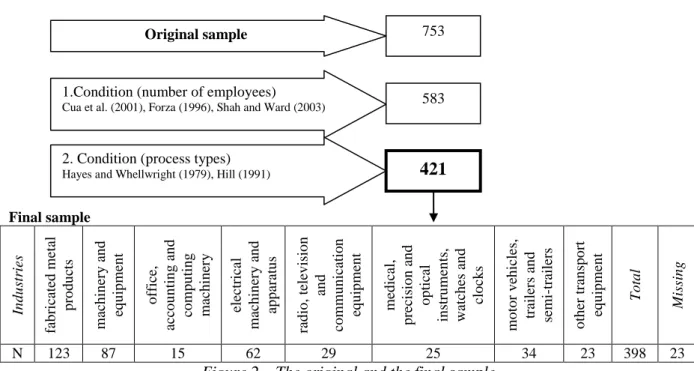
International Manufacturing Strategy Survey (IMSS) data are used for analyses. IMSS is a global network of researchers with the objective to study international manufacturing strategies, their implementation and resulting performances in operations and related areas. IMSS-V is a cross-sectional data bank and extends to 719 valid observations from 20 countries from 2009/2010. Before testing hypotheses a homogenous set of firms was created. Altogether 421 plants remained in the final (Figure 2). Plants based on two conditions were excluded from the original sample.
Number of employees. Previous researches (Cua et al., 2001; Forza, 1996; Shah and Ward, 2003) suggest that companies with more than 100 employees are more likely to implement lean production practices. According to this condition the paper only takes into consideration plants with more than 100 employees.
Process types. Although lean production can be used in different production processes (e.g., mass production, batch production, and make to order), but to avoid confusion caused by differences in their appropriate work organizations (Hayes and Wheelwright, 1979; Hill, 1991) the study is limited to those plants where the batch and mass production is dominant (i.e., the portion of make to order is less than 35 percent).
Final sample In d u str ies fab ricate d m etal p ro d u cts m ac h in er y a n d eq u ip m en t o ff ice, ac co u n tin g an d co m p u tin g m ac h in er y elec tr ical m ac h in er y a n d ap p ar atu s rad io , telev is io n an d co m m u n icatio n eq u ip m en t m ed ical, p rec is io n an d o p tical in str u m en ts , watc h es a n d clo ck s m o to r v eh icles, tr ailer s an d sem i-tr ailer s o th er tr an sp o rt eq u ip m en t To ta l Mis sin g N 123 87 15 62 29 25 34 23 398 23
Figure 2 – The original and the final sample
4. Operationalization of variables and classification procedures
4.1. Lean production practices and classification of production organizations
In many cases the lean tool set also consists of practices managing external relations (customer, supplier), and product development. This wider focus of production practices is also present in HR-related empirical works. This study grouped producers on the basis of their internal and technical lean tools, applying all internal technical elements proposed by Shah
753
583 1.Condition (number of employees)
Cua et al. (2001), Forza (1996), Shah and Ward (2003)
Original sample
421
2. Condition (process types) Hayes and Whellwright (1979), Hill (1991)
6 and Ward (2007) (Table 2). Each question was asked on a 1 to 5 Likert scale. It is assumed that companies starting their lean journey had to make steps in these listed action programs that are central to lean production. It also should be noted that many of the questions were single respond item.
After standardization of variables K-means cluster method was chosen to classify. Means of three-cluster solution are presented in Table 2. Three types of production organization is defined. The three groups of firms are the ‘beginner’ (B), the ‘process-focus’ (PF), and ‘lean’ (L) firms. It seems that basics of lean concept are embedded in manufacturing firms’ daily operations. The smooth pattern and low intensity of lean practices refers to the fact that ‘beginner’ companies do not assign importance to the implementation. The second group of firms is more conscious: process-oriented practices are more emphasized than those serving quality (process stability). The extent of process-oriented practices is at ‘lean’ companies’ level. ‘Lean’ group is highly committed in every aspect and rate quality and maintenance practices as the most important ones. The high proportions of partially or fully involved firms reveal that lean concept is widely spread in batch and process context.
Table 2 –Types of production organizations (mean (standard deviation) standardized value)
Lean production practices
Variables in the questionnaire Types of production organization Beginner (N=107) Process-focus (N=160) Lean (N=153) Controlled processes, quality improvement
undertaking programs for quality improvement and control (e.g. TQM programs, 6 projects, quality circles, etc.),
2.26 (0.828) -1.06963 3.23 (0.695) -0.15413 4.36 (0.495) 0.90822 Productive maintenance
undertaking programs for the improvement of your equipment productivity (e.g. Total Productive Maintenance programs),
2.26 (0.949) -0.88387 2.91 (0.764) -0.29670 4.25 (0.489) 0.93091 Flow
undertaking actions to implement pull production (e.g. reducing batches, setup time, using kanban systems, etc.),
2.40 (0.789) -0.99171 3.90 (0.810) 0.35916 3.86 (1.062) 0.32490
Pull production and low setup
restructuring manufacturing processes and layout to obtain process focus and
streamlining (e.g. reorganize plant-within-a-plant; cellular layout, etc.).
2.25 (0.938) -0.90858 3.58 (0.890) 0.24139 3.75 (1.085) 0.38524 Number of employees (business unit) 1036 (2550) 1130 (2179) 3851 (1213) *Business units with more than 20000 employees are excluded; L – Likert scale from 1 (no effort in the last three years) to 5 (high effort in the last three years)
4.2. HRM practices related to lean production and classification of work organizations
As noted in the previous sections, OM papers present a comprehensive list of HRM practices (e.g., problem solving groups, job rotation etc.) that fit lean principles. The vast majority of these papers are either theoretically or non-HR-focused empirical works. However, even these sources reveal that these HRM practices mostly overlap with best practices in HRM (Pfeffer, 1998; Legge, 2006), also known as high performance work systems (HPWS) model (earlier ‘high-commitment’).
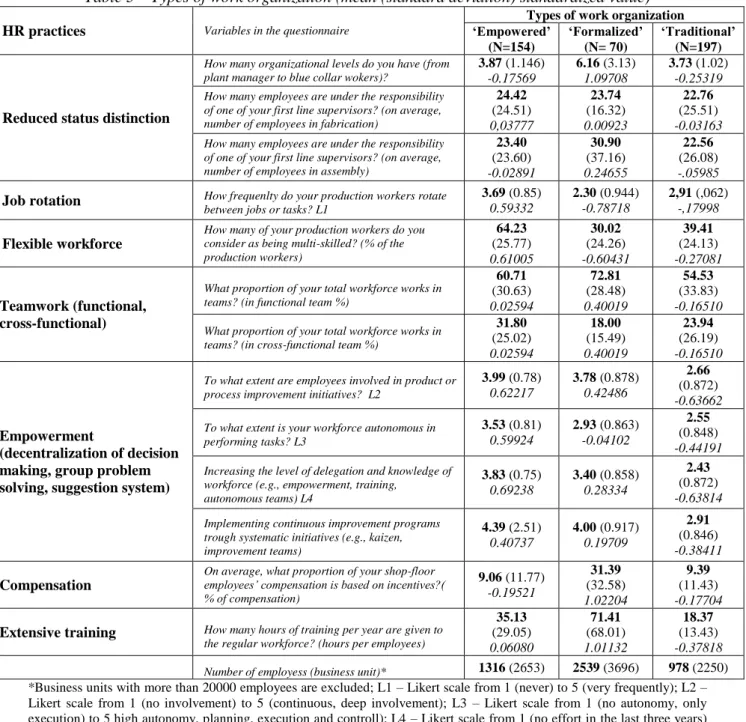
Table 1, summarizing practices in researches following the socio-technical approach of lean production, confirms that usually HRM best practices are related to lean productions’ work organization. So, the study classifies work organization of manufacturing firms based on the following HRM practices: (1) reduced status distinction (hierarchy), (2) job rotation, (3) flexible work force, (4) teamwork, (5) empowerment (decentralization of decision making), (6) compensation, (7) and extensive training. Similarly to production practices many of the questions were single respond item (see Table 3).
The classification procedure is similar to the previous section (4.1.). Three distinct forms of work organization are defined. Means of three-cluster solution are presented in Table 5. The three groups of firms are the ‘traditional’ (T), the ‘formalized’ (F), and ‘empowered’ (L)
7 firms. Table 5 reveals that almost half of the manufacturing firms, ‘traditional’, apply HRM best practices at a moderate level. This group lags behind the two other types, especially in empowerment, training and job rotation. ‘Formalized’ firms highlights training, functional teamwork and compensation in work organization. Producers following the ‘empowered’ model utilize their high proportion of flexible workforce, employ practices to empower workforce, and also emphasize cross-functional team work.
Table 3 – Types of work organization (mean (standard deviation) standardized value)
HR practices Variables in the questionnaire
Types of work organization ‘Empowered’ (N=154) ‘Formalized’ (N= 70) ‘Traditional’ (N=197)
Reduced status distinction
How many organizational levels do you have (from plant manager to blue collar wokers)?
3.87 (1.146) -0.17569 6.16 (3.13) 1.09708 3.73 (1.02) -0.25319 How many employees are under the responsibility
of one of your first line supervisors? (on average, number of employees in fabrication)
24.42 (24.51) 0,03777 23.74 (16.32) 0.00923 22.76 (25.51) -0.03163 How many employees are under the responsibility
of one of your first line supervisors? (on average, number of employees in assembly)
23.40 (23.60) -0.02891 30.90 (37.16) 0.24655 22.56 (26.08) -.05985
Job rotation How frequenlty do your production workers rotate
between jobs or tasks? L1
3.69 (0.85) 0.59332 2.30 (0.944) -0.78718 2,91 (,062) -,17998 Flexible workforce
How many of your production workers do you consider as being multi-skilled? (% of the production workers) 64.23 (25.77) 0.61005 30.02 (24.26) -0.60431 39.41 (24.13) -0.27081 Teamwork (functional, cross-functional)
What proportion of your total workforce works in teams? (in functional team %)
60.71 (30.63) 0.02594 72.81 (28.48) 0.40019 54.53 (33.83) -0.16510 What proportion of your total workforce works in
teams? (in cross-functional team %)
31.80 (25.02) 0.02594 18.00 (15.49) 0.40019 23.94 (26.19) -0.16510 Empowerment (decentralization of decision making, group problem solving, suggestion system)
To what extent are employees involved in product or process improvement initiatives? L2
3.99 (0.78) 0.62217 3.78 (0.878) 0.42486 2.66 (0.872) -0.63662 To what extent is your workforce autonomous in
performing tasks? L3 3.53 (0.81) 0.59924 2.93 (0.863) -0.04102 2.55 (0.848) -0.44191 Increasing the level of delegation and knowledge of
workforce (e.g., empowerment, training, autonomous teams) L4 3.83 (0.75) 0.69238 3.40 (0.858) 0.28334 2.43 (0.872) -0.63814 Implementing continuous improvement programs
trough systematic initiatives (e.g., kaizen, improvement teams) 4.39 (2.51) 0.40737 4.00 (0.917) 0.19709 2.91 (0.846) -0.38411 Compensation
On average, what proportion of your shop-floor employees’ compensation is based on incentives?( % of compensation) 9.06 (11.77) -0.19521 31.39 (32.58) 1.02204 9.39 (11.43) -0.17704
Extensive training How many hours of training per year are given to the regular workforce? (hours per employees)
35.13 (29.05) 0.06080 71.41 (68.01) 1.01132 18.37 (13.43) -0.37818
Number of employess (business unit)* 1316 (2653) 2539 (3696) 978 (2250)
*Business units with more than 20000 employees are excluded; L1 – Likert scale from 1 (never) to 5 (very frequently); L2 – Likert scale from 1 (no involvement) to 5 (continuous, deep involvement); L3 – Likert scale from 1 (no autonomy, only execution) to 5 high autonomy, planning, execution and controll); L4 – Likert scale from 1 (no effort in the last three years) to 5 (high effort in the last three years)
4.3. Operationalization of operational performance measures
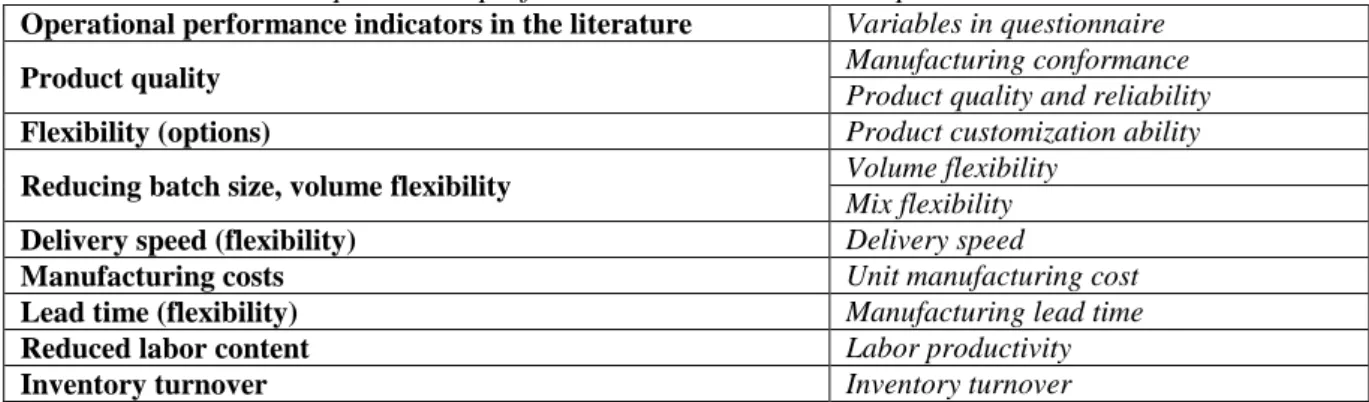
The study only considers a selected set of operational performance indicators. The significant positive impact of lean production on indicators listed in Table 4 is supported by empirical works. Each question was asked on a 1 to 5 Likert scale (see Section 5.2.).
8
Table 4 – Operational performance indicators in lean production researches
Operational performance indicators in the literature Variables in questionnaire
Product quality Manufacturing conformance
Product quality and reliability
Flexibility (options) Product customization ability
Reducing batch size, volume flexibility Volume flexibility
Mix flexibility
Delivery speed (flexibility) Delivery speed
Manufacturing costs Unit manufacturing cost
Lead time (flexibility) Manufacturing lead time
Reduced labor content Labor productivity
Inventory turnover Inventory turnover
Sources: Crawford et al. (1988), Huson and Dhanajay Nanda (1995), Flynn et al. (1995), MacDuffie et al. (1996), Sakakibara et al. (1997), McKone et al. (2001), Cua et al. (2001)
5. Results
5.1. Fit of production and work organization (Hypothesis 1)
Hypothesis 1 assumes that firm’s production (technical) organization and work (socio) organization evolve together. Based on the three distinct forms of production and work organization respectively, altogether nine production systems are defined. At one extreme end of the subsystems’ matches is the combination of ‘lean’ production organization and ‘empowered’ work organization. At the other extreme end firms work with ‘beginner’ and ‘traditional’ models. The hypothesis indicates that the more companies emphasize lean production practices the closer they get to the ‘empowered’ setting. However, the ‘formalized’ model also presents outstanding results in some HR practices (e.g., training, compensation, teamwork), so its fit is also conceivable.
Table 5 reveals that the ‘traditional’ approach of work organization is very dominant in every type of production organization. ‘Beginner’ production organization is widely (more than 70%) integrated with this form, and almost in third of ‘lean’ producers work is also organized traditionally. The ‘empowered’ work organization is mostly embedded in those firms’ production systems that apply several or all lean production practices. Its share is slightly over 40% in these contexts. The ‘formalized’ form follows the reverse direction than the ‘beginner’: enhancing lean production practices (does not) favors (‘beginner’) ‘formalized’ model.
Table 5 – Matching production organization and work organization: nine types of production systems
Work organization ‘Empowered’ ‘Formalized’ ‘Traditional’
Total Production organization ‘Beginner’ 20 (18.7%) (13.1%) 10 (9.3%) (14.3%) 77 (72%) (39.1%) 107 (100%) (25.5%) ‘Process-focus’ 67 (41.9%) (43.8%) 24 (15.0%) (34.3%) 69 (43.1%) (35%) 160 (100%) (38.1%) ‘Lean’ 66 (43.1%) (43.1%) 36 (23.5%) (51.4%) 51 (33.3%) (25,9%) 153 (100%) (36.4%) Total 153 (36.4%) (100%) 70 (16.7%) (100%) 197 (46.9%) (100%) 420
Statistically speaking, Hypothesis 1 is supported. There is significant association between production and work organization. (Pearson Chi-Square (41.284) is significant at 0.05 levels.) In other words, applying lean production practices will enhance the extension of HRM practices. Cramer V (0.222) and contingency-coefficient (0.299) are both significant (at 0.05 levels) and indicate that the association is quite weak. The proportion of uncertainty in work organization that is explained by production organization is between 5 to 7 percent (considering the value of lambda, Goodman and Kruskal tau, and uncertainty coefficient). These are rather low values, so other variables, not included in the study, can have
9 considerable impact. Comparing types of production organization in pairs (’beginner’ and ’formalized’; ’beginner’ and ’lean’) does not lead to more significant results.
5.2. Fit of production and work organization (Hypothesis 2)
Hypothesis 2 assumes that firms with ‘lean’ production organization and ‘empowered’ work organization outperform other production systems. ANOVA analysis was applied to assess the impact of production systems on operational performance. As noted previously, the study is limited to companies where lean production practices are relevant (i.e., ‘process-focus’ and ‘lean’).
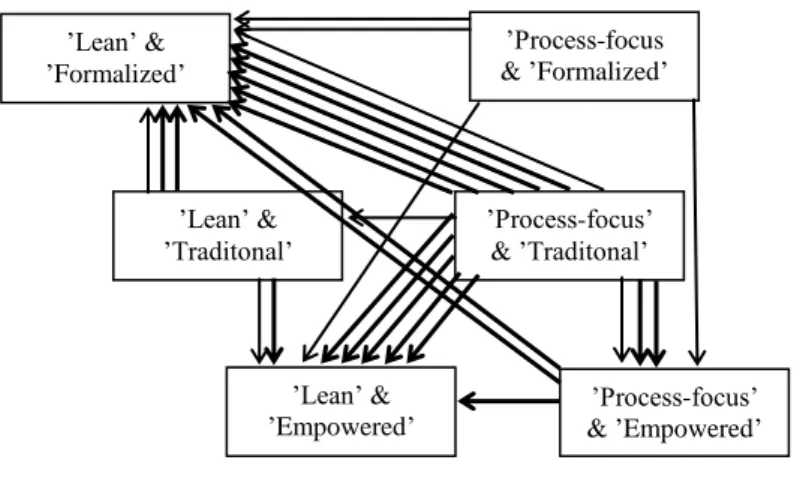
Our results (Table 6, Table 7, and Figure 3) suggest that different production systems (distinct matches of production and work organization) lead to the same superior operational performance. ‘Lean’ production organization is effective both with ‘empowered’ and ‘formalized’ work organization. In statistical terms one can expect the same results from ‘process-focus’-‘formalized’ production system. ‘Process-focus’-‘empowered’ has only to improve few indicators: product quality and reliability (to reach ‘lean’ and ‘formalized’ and ‘lean’ and ‘empowered’), and labor productivity (‘lean’ and ‘formalized’).
Table 6 – Operational performance indicators relative to main competitors Variables in questionnaire ‘lean’ production and ‘traditional’ work (LT) ‘lean’ production and ‘formalized’ work (LF) ‘lean’ production and ‘empowered’ work (LE) ‘process-focus’ production and ‘traditional’ work (PFT) ‘process-focus’ production and ‘formalized’ work (PFF) ‘process-focus’ production and ‘empowered’ work (PFE) Manufacturing conformance 3.68 3.64 3.79 3.41 3.68 3.64
Product quality and reliability 3.74 4.06 4.00 3.53 3.74 3.63
Product customization ability 3.39 4.03 3.74 3.49 3.33 3.77
Volume flexibility 3.67 3.84 3.85 3.61 3.78 3.63
Mix flexibility 3.60 3.69 3.76 3.45 3.56 3.73
Delivery speed 3.54 3.64 3.63 3.41 3.67 3.55
Unit manufacturing cost 3.23 3.48 3.25 3.13 3.28 3.20
Manufacturing lead time 3.38 3.55 3.51 3.21 3.39 3.50
Labor productivity 3.42 3.91 3.73 3.35 3.47 3.49
Inventory turnover 3.38 3.61 3.29 3.20 3.33 3.33
Likert scale – relative to our main competitor, our perfomance is (1) much worse, (3) equal, (5) much better
Table 7 – Significant differences in operational performance indicators relative to main competitors Variables in questionnaire Sign. (LT) (LF) Sign. (LT) (LE) Sign. (LT) (PFT) Sign. (LF) (PFT) Sign. (LF) (PFF) Sign. (LF) (PFE) Sign. (LE) (PFT) Sign. (LE) (PFF) Sign. (LE) (PFE) Sign. (PFF) (PFE) Sign. (PFT) (PFE) Manufacturing conformance n.s. n.s. 0.084 n.s. n.s. n.s. 0.011 n.s. n.s. n.s. n.s.
Product quality and reliability 0.085 n.s. n.s. 0.003 n.s. 0.015 0.020 n.s. 0.014 n.s. n.s.
Product customization ability 0.001 0.042 n.s. 0.05 0.060 n.s. n.s. 0.081 n.s. 0.060 0.085
Volume flexibility n.s. n.s. n.s. n.s. n.s. n.s. n.s. n.s. n.s. n.s. n.s.
Mix flexibility n.s. n.s. n.s. n.s. n.s. n.s. 0.045 n.s. n.s. n.s. 0.065
Delivery speed n.s. n.s. n.s. n.s. n.s. n.s. n.s. n.s. n.s. n.s. n.s.
Unit manufacturing cost n.s. n.s. n.s. 0.059 n.s. n.s. n.s. n.s. n.s. n.s. n.s.
Manufacturing lead time n.s. n.s. n.s. 0.034 n.s. n.s. 0.032 n.s. n.s. n.s. 0.037 Labor productivity 0.007 0.054 n.s. 0.010 0.062 0.017 0.013 n.s. n.s. n.s. n.s.
Inventory turnover n.s. n.s. n.s. 0.040 n.s. n.s. n.s. n.s. n.s. n.s. n.s. significant difference at 0.05 levels, significant difference at 0.10 levels, n.s. not significant
Even, ‘lean’-‘traditional’ production system only lags behind them in labor productivity and product customization ability. This form is not different from ‘process-focus’-‘formalized’ production system. Clear performance gap exists if one compares ‘lean’-‘formalized’ and ‘lean’-‘empowered’ production systems with production system that employs ‘process-focus’ production and ‘traditional’ work organization. This model does not differ from ‘process-focus’-‘formalized’ form. Finally, this fact together with the relations of production systems depicted in Figure 3 (all arrows are directed to ‘lean’) suggest that
‘lean’-10 ‘formalized’ and ‘lean’-‘empowered’ production systems perform better than any other types. Their superior performance cannot be supported by statistical measures.
Figure 3 – Operational performance indicators relative to main competitors
5. Conclusion and limitation
The current paper dealt with fit of socio subsystem and technical subsystem in lean production and the impact of their match on operational performance indicators. Concerning fit of subsystems the study revealed significant association between production organization and work organization. This association suggests that implementation of lean production practices enhances the extension of HRM best practices. However, the association is weak. Furthermore, the research provided interesting inside into the distribution of work organizations. According to the results, ‘traditional’ work organization remains influential in manufacturing firms. More than one third of firms enhancing lean production practices organize daily operations in traditional way. This remarkable proportion raises interesting questions about the performance outcomes of different production systems: how does the match (or mismatch) of production and work organization effect operational indicators?
The study presented clear evidences that ‘lean’ production organization and ‘formalized’/’empowered’ work organization lead to superior performance. However, it seems reasonable that firms do not strive to achieve these models where the extent use of lean production practices is matched with HRM best practices. Matching ‘formalized’ and ‘empowered’ work organization with a production system that utilizes quality and maintenance practices at a moderate level and rely on process related lean practices to a great extent (‘process-focus’ production organization ) leads to the same (‘formalized’) or almost to the same (‘empowered’) operational performance. In a business environment where product customization ability and labor productivity are not of first priority ‘lean’ production organization matched with ‘traditional’ work organization can also operate effectively.
There are clear limitations to this research. The cross-sectional data limit the generalizability of these findings. Operationalization is another limitation, since the database does not cover all aspects neither of lean producers (Shah and Ward, 2003) nor of HRM practices (Pfeffer, 1998). Contextual factors (e.g., national culture, economic development, and industry (Ahmad and Schroeder, 2003; Cagliano et al., 2011)) and company decisions (e.g., strategic orientation (Legge, 2006)) also can influence HRM practices and the fit between production and HRM (Jayaram, 1999). None of these is considered in the study. Further studies should clarify the source of operational performance improvement (HR practices or lean production practices) in distinct production systems.
’Lean’ & ’Traditonal’ ’Process-focus’ & ’Traditonal’ ’Lean’ &
’Empowered’ & ’Empowered’ ’Process-focus’ ’Lean’ &
’Formalized’
’Process-focus & ’Formalized’
11
References
Ahmad, S. & Schroeder, R.G. 2003, "The impact of human resource management practices on operational performance: recognizing country and industry differences",
Journal of Operations Management, vol. 21, no. 1, pp. 19-43.
Ahmad, S., Schroeder, R.G. & Kingshuk, K.S. 2003, "The role of infrastructure practices in the effectiveness of JIT practices: implications for plant competitiveness",
Journal of Engineering and Technology Management, vol. 20, no. 3, pp. 161-191
Ahmed, N.U., Tunc, E.A. & Montagno, R.V. 1991, "A comparative study of US manufacturing firms at various stages of just-in-time implementation", International Journal of Production Research, vol. 29, no. 4, pp. 787.
Anand, G., Ward, P.T., Tatikonda, M.V. & Schilling, D.A. 2009, "Dynamic capabilities through continuous improvement infrastructure", Journal of Operations Management, vol. 27, no. 6, pp. 444-461.
Bayo-Moriones, A. & Merino-Díaz de Cerio, J. 2001, "Quality management and high performance work practices: Do they coexist?", International Journal of Production Economics, vol. 73, no. 3, pp. 251-259.
Birdi, K., Clegg, C., Patterson, M., Robinson, A., Stride, C.B., Wall, T.D. & Wood, S.J. 2008, "The impact of human resource and operational management practices on company productivity: a longitudinal study", Personnel Psychology, vol. 61, no. 3, pp. 467-501.
Cagliano, R., Caniato, F., Golini, R., Longoni, A. & Micelotta, E. 2011, "The impact of country culture on the adoption of new forms of work organization", International Journal of Operations & Production Management, vol. 31, no. 3, pp. 297-323.
Conti, R., Angelis, J., Cooper, C., Faragher, B. & Gill, C. 2006, "The effects of lean production on l worker job stress", International Journal of Operations & Production Management, vol. 26, no. 9, pp. 1013-1039.
Crawford, K.M., Blackstone Jr., J.H. & Cox, J.F. 1988, "A study JIT implementation and operating problems", International Journal of Production Research, vol. 26, no. 9, pp. 1561.
Cua, K.O., McKone, K.E. & Schroeder, R.G. 2001, "Relationships between implementation of TQM, JIT, and TPM and manufacturing performance", Journal of Operations Management, vol. 19, no. 6, pp. 675-694.
de Menezes, L.M., Wood, S. & Gelade, G. 2010, "The integration of human resource and operation management practices and its link with performance: A longitudinal latent class study", Journal of Operations Management, vol. 28, no. 6, pp. 455-471.
Farris, J.A., Van Aken, E.M., Doolen, T.L. & Worley, J. 2009, "Critical success factors for human resource outcomes in Kaizen events: An empirical study", International Journal of Production Economics, vol. 117, no. 1, pp. 42-65.
Flynn, B.B., Sakakibara, S. & Schroeder, R.G. 1995, "Relationship between Jit and Tqm: Practices and Performance", Academy of Management Journal, vol. 38, no. 5, pp. 1325-1360.
Forza, C. 1996, "Work organization in lean production and traditional plants. What are the differences?", International Journal of Operations & Production Management,
vol. 16, no. 2, pp. 42-62.
Groebner, D.F. & Merz, C.M. 1994, "The Impact of Implementing JIT on Employees' Job Attitudes", International Journal of Operations & Production Management, vol. 14, no. 1, pp. 26-37.
Hayes, R.H. & Wheelwright, S.C. 1979, "Link manufacturing process and product life cycles", Harvard business review, vol. 57, no. 1, pp. 133-140. Hill, T. 1991, Production/operations management: text and cases, Prentice Hall, New York.
Hines, P., Holwe, M. & Rich, N. 2004, "Learning to evolve: A review of contemporary lean thinking", International Journal of Operations & Production Management, vol. 24, no. 10, pp. 994-1011.
Holweg, M. 2007, "The genealogy of lean production", Journal of Operations Management, vol. 25, no. 2, pp. 420-437.
Huber, V.L. & Brown, K.A. 1991, "Human resource issues in cellular manufacturing: A sociotechnical analysis", Journal of Operations Management, vol. 10, no. 1, pp. 138-159.
Huson, M. & Dhanajay Nanda, M. 1995, "The impact of Just-In-time manufacturing on firm performance in the US", Journal of Operations Management, vol. 12, no. 3, pp. 297-310.
Hyer, N.L., Brown, K.A. & Zimmerman, S. 1999, "A socio-technical systems approach to cell design: case study and analysis", Journal of Operations Management, vol. 17, no. 2, pp. 179-203.
Jayaram, J., Droge, C. & Vickery, S.K. 1999, "The impact of human resource management practices on manufacturing performance", Journal of Operations Management,
vol. 18, no. 1, pp. 1-20.
Jiménez-Jiménez, D. & Martínez-Costa, M. 2009, "The performance effect of HRM and TQM: a study in Spanish organizations", International Journal of Operations & Production Management, vol. 29, no. 12, pp. 1266-1289.
Koenigsaecker, G. 2005, "Leadership and the Lean Transformation", Manufacturing Engineering, vol. 135, no. 5, pp. 7-12.
Legge, K. 2006, "Human resource management" in The Oxford handbook of work and organization, eds. S. Ackroyd, R. Batt, P. Thompson & P.S. Tolbert, Oxford University Press, USA, , pp. 220-241.
LEI LEI’s first annual state of Lean report detects solid gains and common obstacles, Lean Enterprise Institute, Brookline, MA.
Lewis, M.A. 2000, "Lean production and sustainable competitive advantage", International Journal of Operations & Production Management, vol. 20, no. 8, pp. 959. Liker, J.K. 2004, The Toyota way: 14 management principles from the world's greatest manufacturer, McGraw-Hill Professional.
Losonci, D., Demeter, K. & Jenei, I. 2011, "Factors influencing employee perceptions in lean transformations", International Journal of Production Economics, vol. 131, no. 1, pp. 30-43.
Macduffie, J.P. 1995, "Human Resource Bundles and Manufacturing Performance: Organizational Logic and Flexible Production Systems in the World Auto Industry",
Industrial & labor relations review, vol. 48, no. 2, pp. 197-221.
MacDuffie, J.P. & Sethuraman, K. 1996, "Product Variety and Manufacturing Performance: Evidence from the International Automotive Assembly Plant Study",
Management Science, vol. 42, no. 3, pp. 350-369.
McKone, K.E., Schroeder, R.G. & Cua, K.O. 2001, "The impact of total productive maintenance practices on manufacturing performance", Journal of Operations Management, vol. 19, no. 1, pp. 39-58.
Mehri, D. 2006, "The Darker Side of Lean: An Insider's Perspective on the Realities of the Toyota Production System", Academy of Management Perspectives, vol. 20, no. 2, pp. 21-42.
Murphy, L.R. & Sauter, S.L. 2003, "The USA Perspective: Current Issues and Trends in the Management of Work Stress", Australian Psychologist, vol. 38, no. 2, pp. 151-157.
Oliver, N., Delbridge, R., Jones, D. & Lowe, J. 1994, "World Class Manufacturing: Further Evidence in the Lean Production Debate", British Journal of Management, vol. 5, no. 2, pp. 53.
Oliver, N., Delbridge, R. & Lowe, J. 1996, "The European auto components industry", International Journal of Operations & Production Management, vol. 16, no. 11, pp. 85-97.
Patterson, M.G., West, M.A. & Wall, T.D. 2004, "Integrated manufacturing, empowerment, and company performance", Journal of Organizational Behavior, vol. 25, no. 5, pp. 641-665.
Pilkington, A. & Fitzgerald, R. 2006, "Operations management themes, concepts and relationships: a forward retrospective of IJOPM", International Journal of Operations & Production Management, vol. 26, no. 11, pp. 1255-1275.
Power, D. & Sohal, A.S. 2000, "An empirical study of human resource management strategies and practices in Australian just-in-time environments", International Journal of Operations & Production Management, vol. 20, no. 8, pp. 932-958.
Sakakibara, S., Flynn, B.B., Schroeder, R.C. & Morris, W.T. 1997, "The Impact of Just-In-Time Manufacturing and Its Infrastructure on Manufacturing Performance",
Management Science, vol. 43, no. 9, pp. 1246-1257.
Schonberger, R.J. 2007, "Japanese production management: An evolution—With mixed success", Journal of Operations Management, vol. 25, no. 2, pp. 403-419. Shah, R. & Ward, P.T. 2007, "Defining and developing measures of lean production", Journal of Operations Management, vol. 25, no. 4, pp. 785-805. Shah, R. & Ward, P.T. 2003, "Lean manufacturing: context, practice bundles, and performance", Journal of Operations Management, vol. 21, no. 2, pp. 129-149. Slack, N., Lewis, M. & Bates, H. 2004, "The two worlds of operations management research and practice: Can they meet, should they meet?", International Journal of
Operations & Production Management, vol. 24, no. 4, pp. 372-387.
Sugimori, Y., Kusunoki, K., Cho, F. & Uchikawa, S. 1977, "Toyota production system and Kanban system Materialization of just-in-time and respect-for-human system",
International Journal of Production Research, vol. 15, no. 6, pp. 553.
Wall, T.D. & Wood, S.J. 2005, "The romance of human resource management and business performance, and the case for big science", Human Relations, vol. 58, no. 4, pp. 429-462.