ROBERT R. HACCOUN Universite de Montreal ALAN M. SAKS
York University
Abstract
This paper reviews the major contributions that I-O Psy-chology has made to the understanding of the effects of training. Moving away from a purely pedagogical perspec-tive, the psychological states of trainees, especially motiva-tion, self-efficacy, and perceived control, combined with the realities of the organisational context, all influence the outcomes of training. Many of these variables have been shown to be malleable within a training context, and this has led to the development of powerful tools, techniques, and interventions that were lacking in the past.
From a methodological perspective, research has identi-fied the relevant measurement criteria, as well as when and how evaluation can be conducted. In addition, new instru-ments that assess organisational transfer climate and continuous-learning cultures are now available. Their use will allow organizations to better understand why they obtain the training results they do, and what they can do to improve training outcomes.
Even as the importance of the work environment to training success has been amply demonstrated, it remains a very rare event when training departments intervene effec-tively to enhance the level of environmental support. Substantial practical suggestions that are theoretically and empirically grounded in research and techniques for enhancing training effectiveness under a variety of organi-sational conditions, be they favourable or not to training, are described. Several analytical models which may prove of relevance to practitioners and to scholars in guiding the selection and the design of transferable training programs are presented and discussed.
The last decade of the twentieth century points quite visibly to signs of a major transformation of work and organizations that is likely to continue into the next century. A number of geo-political forces such as the industrialization of the Asian nations which is now in full swing, and more generalized trade treaties appear to be
Canadian Psychology/Psychologic canadienne, 39:1-2
shifting the "rich" economies away from industrial production and towards service industries that are technology intensive. The services once offered by bank tellers, typists, and telephone operators to chose but three examples, are routinely provided by customer operated technologies.
Whether or not the nineties become known as the transformation decade, it has brought difficulties to all Western type economies. Although Canada shares many of the woes of the time — unemployment, uncertainty, loss of confidence, etc. — the nineties brought problems specific to us. The collapse of key resource based indus-tries, especially the East Coast Fisheries, generalized governmental cut-backs, major downsizing and plant closings have all occurred simultaneously. Many unem-ployed workers now hold competencies for jobs that no longer exist The ensuing social problem stimulated a collective response and public funds have been commit-ted, in great abundance, to job re-training.
Training as a Social Response to a Social Problem Many countries, especially European ones, have exten-sive training policies. Whereas Canada has long accepted a collective role in the development of the workforce, it has been unable as yet to frame an overall policy. Al-though Canadian companies spend $4 billion annually on training and development, on average they spend only one-half of what is spent by American firms, and much less than what is spent by organizations in Japan and Europe (Belcourt & Wright, 1996). In fact, in his study of the Canadian economy, Michael Porter warned that Canadians face a future declining standard of living if we do not increase our investment in workplace training and education (Toulin, 1991).
Fortunately, training budgets in Canadian organiza-tions are increasing at a higher rate than inflation (Mclntyre, 1994), and some provinces, notably Quebec and New Brunswick, have taken legislative steps to ensure dial this trend continues. Quebec companies, for example, are now required to follow the European example and commit funds to the training and develop-ment of tile workforce. That is not to say that Canadian organizations in other provinces are not also taking an active role in the retraining of their workforce. Ontario and die federal government have also increased spend-ing on trainspend-ing programs in recent years (Belcourt & Wright, 1996).
Thus, the growing emphasis on die importance of training tile Canadian workforce has involved huge sums of money. Yet die beneficial impact of these investments
remains unclear and, to date, relatively unresearched. One important exception is Calgary scholar Gattiker (1995) who reported that governmental efforts in training can yield positive effects on condition that the training be general and not firm specific. Interestingly, firm-specific training appears unattractive because it tends to be associated with high turnover. Perhaps it is the more ambitious employees who make themselves available for training opportunities precisely in the hope of accentuating their own marketability.
At a time of governmental restrictions, it is especially crucial diat the effectiveness of cosdy and massive government programs be assessed and improved. Fortu-nately, funding agencies are beginning to respond. For example, the Social Sciences and Humanities Research Council of Canada has funded several research proposals in die area of training and, more recently it awarded a multi-million dollar strategic grant to a consortium of Canadian scholars with die express goal of establishing "best practice" guidelines for die development of the Canadian workforce in die current context of change and employee-firm dislocations.
Downsizing, one of die main developments in diis decade, has been achieved partially by enlarging jobs. In Canada, it is being achieved in a relatively civilized way, where considerations of personal worker preferences and seniority factor heavily into die process. While it is true diat some of die vacancies created by die changes in organizations were filled by younger and better educated workers, to preserve employment for as many employees as possible many new jobs were filled by current organi-zational members displaced from discontinued jobs widiin dieir companies.. Moreover, functions typically performed by different employees have been fused into new enlarged jobs (Campion & McClelland, 1991). This has accentuated training's role in organizations where die training system has been fundamental in preparing these workers who are job naive diough organizationally seasoned for dieir new functions.
Training for work is a vast field diat refers to a num-ber of different realities. It is sometimes used to update existing skills which may be "hard" (training employees for die use of a new data base or accounting system) or "soft" (e.g. getting managers to communicate more effectively). It may be used to re-equip people with entirely new marketable skills (such as training fisher-men to become data processors) or to change specific work behaviours (such as using new sales techniques). It may involve training experiences diat are long, taking several months, or it may be very short-term and punc-tual (such as attending a seminar on decision making or die use of die Internet). The skills taught may be rele-vant to a specific organization (learning die new perfor-mance appraisal system) or it may involve die acquisition
of skills, knowledge, and attitudes diat are relevant to work in a diversity of contexts (e.g., managing a multicul-tural workforce). Finally, whereas training is sometimes implemented to prepare workers for technological innovations, it is also frequendy employed to support organizational or cultural changes desired by top man-agement.
Training and I-O Psychology
I-O Psychology's role in training has generally centered on die identification of die psychological mechanisms diat contribute to successful training. Typically, i-o Psychologists are less involved, professionally, with die training program per se. Rather, diey collect data on trainees as they flow dirough die training and job reinsertion cycle. The information is dien used to evaluate training effectiveness and to suggest ways of improving training programs.
Our access to organizations in order to conduct diis research is growing. This is in large part due to manage-ment's demand diat human resource functions such as training be, like all other organizational systems, demon-strably effective (Belcourt, 1996-97). Industrial Psycholo-gists working in die training area have made significant contributions to methodological (what, how, and when to measure), substantive (how training should be evalu-ated) , and organizational concerns (what role does die organization play in training effectiveness). Along diese lines, die journal Revue Internationale de Gestian (1997, volume 22, 3) recendy published a special issue on training and features articles from a wide diversity of perspectives from North America as well as from abroad. In diis paper, we highlight die research and interven-tions conducted by I-O psychologists who have contrib-uted to understanding and improving die training process. We will also identify areas where gaps in our knowledge lie, and how future research and practice might be directed. Our hope, in writing diis paper, is diat it will prove of use not only to academics and I-O psychologists, but also to training practitioners and managers.
Training Evaluation Design Issues
Traditional training evaluation designs serve to establish whedier trainees change and whether die observed change is attributable to die training experience per se. The typical prescriptions come from die experimental mediod (Cook & Campbell, 1979) and require die use of control groups and or longitudinal time series. In practice, however, it has never proved easy to conduct such studies. Obtaining control groups and die random assignment of trainees to control and experimental groups, is well-nigh impossible to achieve in applied contexts. Time series designs tend to rely on objective data and these are hard
to come by in most work situations. As a result, evaluation designs that respect these conditions are rarely put to practical use. At best, our evaluation designs reduce to single group pre-post designs without controls. For many years, as a field, we conducted, such studies knowing that our inferences would be severely constrained. It was a case of doing what was practical because it proved impractical to do what was correct!
The difficulties associated with the use of the classic experimental method have spurred some efforts at developing evaluation designs that are both scientifically credible and realistic for a dynamic organizational environment Several approaches were made available in the early nineties.
Haccoun and Hamtiaux (1994) proposed an "internal referencing" strategy where the pre-post performance of trainees on content areas covered during training are contrasted to pre-post differences in content areas which are "germane" though not covered during training. Training effectiveness is demonstrated when pre to post changes on the items relevant to training are greater than pre-post changes on the non-relevant items. This approach, then, is designed to make better inferential use of the pre-post data collection process. Whereas this approach may be useful when control groups are not available, it remains a partial approach because it permits inferences at an enhanced risk of Type II errors.
Several authors have looked into the issue of training evaluation design from a statistical power perspective. Arvey, Maxwell, and Salas (1992) as well as Sackett and Mullen (1993) analysed various designs from a statistical power and cost perspective, and various threats to validity. Since typical organizational training programs tend to be administered to small groups of people, they suggest that design choices should be affected by consid-eration of our ability to detect changes in trainees. From a number of power tables, both Arvey et al. (1992) and Sackett and Mullen (1993) demonstrate that under certain practical conditions, the use of control groups actually inhibits valid inferences and that simple designs, even the post-test-only design might be the more pre-ferred design in some situations. The difficulty here is that these approaches may enhance the risk of Type I error probabilities.
These contributions, although far from perfect, are important because they point to the necessity of develop-ing models of evaluation design that are realistic for use in real organizational contexts. I-O psychologists have now proposed several alternatives that can deal with many of the constraints of the natural environment in which we do our work.
Training Evaluation Measurement Issues
When a training program is effective, trainees will be
satisfied (level I), they will have learned the material (level II), they will behave differently on the job (level III), and the organization will be better for it (level IV). These are the four levels of Kirkpatrick's (1987) criteria for training evaluation, which are well known and well accepted in Canadian organizations. Consequently, these four dimensions frame most training evaluation studies. Indeed, it has become routine for reaction measures to be collected after training programs, and in a growing number of cases, knowledge acquisition is also assessed. In the nineties, organizations are showing definite interest in assessing trainee behaviour (level III), which fundamentally addresses the ultimate training question: Do trainees use the new knowledge, skills, abilities, and attitudes on the job?
Trainee reactions
Rare are the training programs that do not include at least a post-training reactions questionnaire. However, there is now little question as to the actual substantial value of such information, especially in terms of a direct relationship to the other three levels: It is negligible. Affective reaction measures rarely show variance as most trainees react positively to all training experience, and it has repeatedly been shown (Alliger & Janak's 1989 meta-analysis of available evidence is an excellent case in point) that such measures are essentially unrelated to the other levels of training success such as learning and on-the-job behaviour. Consequently, it is now recognized that training evaluations that rely on affective reaction measurement only are unacceptable estimates of training success. This has always been known by I-O psychologists, but now, management is fast coming to the same point of view. Yet post-training affective reactions remain the most accepted measure for assessing training effects
(Belcourt & Wright, 1996).
At the same time, there is now some evidence that the role of training reactions in explaining training effective-ness might be much more complex than has been indicated in previous models of training criteria (Alliger & Janak, 1989). Three studies .Illustrate this point a) Mathieu, Tannenbaum, and Salas (1992) found that reactions moderated the relationship between training motivation and learning, and mediated the relationship between training motivation and assignment method on post-test performance; b) Warr and Bunce (1995) suggested a tripartitie model of training reactions that includes enjoyment of training, usefulness of training, and difficulty of training, and c) a recent meta-analysis by Alliger, Tannenbaum, Bennet, Traver and Shetland (1997) shows that "utility" based reaction measures (I find the course useful) showed much higher levels of correlation with learning or outcome measures than did affective reaction measures (I like the course). Thus,
more attention must be given to the measurement of reaction measures (e.g., affective versus utility measures). Further, reaction measures may play a complex indirect role on the other levels of training criteria (i.e., learning and behaviour) and therefore deserve closer scrutiny in future research.
Fortunately, I-O psychologists have made a habit of "piggy-backing" other measures, of greater relevance for assessing training success, on to affective reaction questionnaires and have been in the forefront of the development of more sophisticated models of training evaluation. One of the more important contributions has been proposed by Kraiger, Ford, and Salas (1993) who published a remarkable monograph which provides a considerable expansion and a theoretically based model of training evaluation. As a result, we now have a classifi-cation scheme and a much better understanding of the cognitive, skill-based, and affective variables that should be measured in order to evaluate training programs. Although they consider this to be a classification scheme of learning outcomes, some of the outcomes in their affective category (i.e. self-efficacy and motivational disposition) can be subsumed as part of the measure-ment of reactions.
Self-efficacy remains one of the more stable predictors of behaviour and performance in both training (Saks, 1997) as well as other areas of organizational accomplish-ment (Gist & Mitchell, 1992). Since the construction of selfefficacy measures is relatively straightforward and easily learned, trainers may find it very easy to incorpo-rate such measures into post-training self-report type evaluations. Low self-efficacy leveb might indicate that the training experience itself requires modification. Fortunately, Bandura (1997) has described a basic set of activities which, when incorporated into a training program, may well enhance trainee self-efficacy. In turn, this provides some easily followed guides that can help trainers develop and administer better training programs
(more about this later).
Similarly, measures of motivation to learn and motiva-tion to transfer might also be profitably integrated into "reaction" type measures. Mathieu et al. (1992) among others (for example, Haccoun, 1997) suggest the use of the VIE model, a standard in the discipline, as a practical operationalization of the motivation dimension. The VIE approach requires separate questions to measure va-lence, instrumentality, and expectancies related to learning and/or using the training material. Separate analyses of these sub-indices provide more specific insights into the parameters which weaken training effects. For example, knowing that valences are low may indicate that the training is perceived to be of low priority to trainees while low expectancy ratings might indicate that the training is not perceived as applicable
to the trainees given their organizational context. The training situation and/or the organizational environ-ment might then be appropriately amended to correct the specific threat to motivation.
In sum, reaction measures should be designed to extract more information. For example, they should include self-efficacy measures (since they are a strong predictor of transfer) as well as motivation to learn and motivation to transfer. Reaction measures should include utilityjudgements or usefulness ratings in addition to the more traditional affective reactions (Alliger et al., 1997; Warr & Bunce, 1995). The use of reaction measures is prevalent and totally accepted by organizational trainers. It remains for us to work with our applied counterparts to better understand the role of reactions in training effectiveness, and to incorporate other easily measured parameters into the evaluation process in order to yield information that provides more meaningful insight into the effectiveness of training programs.
Trainee Learning
It is now reasonably habitual for organizations to assess the actual level of learning achieved during training. This is typically done by developing and administering multiple choice or True-False formatted knowledge tests. However, these measures tend to assess the level of declarative knowledge retained by trainees. The diffi-culty, of course, is that declarative knowledge is an insufficient predictor of behaviour use. More critical may be the extent of procedural knowledge acquired during training (see Kraiger et al., 1993).
Declarative knowledge refers to the acquisition of facts while procedural acquisition refers to the integra-tion of facts into a set of orchestrated behaviour chains required for concrete action. This suggests the need for trainers to steer away from simple declarative knowledge tests, and to substitute them for procedural assessments. The difficulty is that there does not exist, to date, an acceptable or easily practical method for establishing such knowledge in organizations. Current approaches such as verbal protocol analyses- or cognitive mapping methods like Pathfinder are extremely complex and time consuming both to develop and to administer, and as such they are not finding ready applicability in applied milieus.
One promising approach has been offered by Ostroff (1991). Various scenarios reminiscent of the situational interview approach in selection (Latham, Saari, Pursell, &: Campion, 1980) are developed and trainees indicate their likely course of action from a prepared list of alternatives. The answers provided are chosen to reflect various depths of understanding of the key training points. While more complex than the development of simple multiple choice questions, this approach holds
considerable promise. For one thing, the development of the vignettes requires the cooperation of field opera-tives that, in turn, may build greater field commitment to the training experience and to the training outcomes.
Hence, we now know that the measurement of "declarative" knowledge is insufficient and needs to be supplemented by measures of procedural acquisition. Some techniques for doing so are now available, but more research and development is required. More attention must be given to different measures of learn-ing. Along diese lines, Alliger et al. (1997) recently divided the learning dimension into three subcategories corresponding to immediate post-training knowledge (measured immediately after training), knowledge retention (measured sometime after training), and behaviour/skill demonstration (behavioural proficiency measured in the training environment). As indicated earlier, Kraiger et al. (1993) expanded the learning dimension into cognitive, skill-based, and affective learning outcomes.
Trainee Behaviours
Level in in Kirkpatrick's training evaluation model refers to the degree to which knowledge, skills, abilities, and attitudes are generalized onto the job. I-O Psychologists recognize this as the transfer of training. It is at this stage in the training process where a transfer problem has been reported to exist on a rather large scale (Baldwin & Ford, 1988). According to one estimate, not more than 10% of the billions of dollars invested on training and development in the United States actually results in transfer to the job (Georgenson, 1982). However, a recent study on Canadian organizations suggests a less dismal state of affairs. Saks and Belcourt (1997) found that transfer in Canadian organizations, according to a sample of experienced trainers, was 62% immediately after training, 43% six months later, and 34% one year after attending a training program.
Measures of transfer, however, remain a problem. There are two types of behavioural measures reported in the literature: Objective performance data and self-reports. Field studies rarely report objective data, and this is because of obvious constraints. Some studies have used direct (video taped) observations (Laval University's Jeanne, 1994) but this been in the context of a
simula-tion.
The validity of self-reports remains a concern in this as in other fields of I-O psychology (Johns, 1994 treat-ment of self reports in the absence domain provides an interesting parallel). However, some careful work (e.g., Fox & Dinur, 1988) indicates much validity for self-assessment In any case, self-reports will remain in use for the foreseeable future.
The concern associated with self-report data might be
attenuated by encouraging the use of triangulation approaches. Several studies have converged data re-ported by the trainee as well as his/her supervisor (Gaudine, 1997; Saks, Haccoun, & Laxer, 1996; Tziner, Haccoun, & Radish, 1991) or subordinates (Haccoun, 1995). At this point, the better practice consists of obtaining frequencies of the use of the specific key behaviour taught during training.
In sum, given the importance of demonstrable changes in trainee behaviour as an indicator for the transfer of training (Baldwin & Ford, 1988; Saks & Haccoun, 1996), and the need to enact change in individual behaviour as a requirement for successful organizational change and development (Porras & Robertson, 1992), the measurement of trainee behaviour will have to become an essential and integral part of all training and development programs.
Results/Bottom line measures.
Kirkpatrick's (1987) level rv refers to the "the bottom line" for an organizational unit or the organization itself. In other words, "Has the training program resulted in a net pay-off for the organization"? This is a very relevant issue since it is not at all clear how much value training actually adds to organizations (see Gattiker, 1995), although several recent studies have demonstrated the impact of various HRM activities on organizational effectiveness (Huselid, 1995). Along these lines, Saks and Belcourt (1997) recently reported a strong relationship between training transfer and perceptual measures of organizational performance.
Current attempts to assess the financial impact of training, which rely on Utility Theory and Human Capital Theory, are still embryonic. Nonetheless, it remains a great preoccupation to which Canadians have contributed (Cronshaw &: Alexander, 1991). A number of writers have focussed on the establishment of bottom line indices for assessing training effects. These attempts have primarily relied on utility theory approaches (Cascio, 1991, Phillips, 1993). For example, Mathieu and Leonard (1987) used a utility framework to assess the value of supervisory training in a bank. As with the application of utility theory in other personnel contexts (Schmidt, Hunter and Pearlman, 1982), various direct and indirect training costs are compared to job perfor-mance variances to establish utility functions.
In three consecutive articles intended for practitio-ners, Phillips (1996a) tackles the issue of Return on Investment (ROI) in the training field. Typically, the process requires that training evaluators define, prior to training, performance norms and criteria against which success will be assessed. Next, it is important to collect archival data indicating the evolution of the measure over time and to assign a dollar value to the parameter.
Phillips third article in the series (1996b) is particularly valuable because he lists and exemplifies a number of indicators which might be used to assess ROi: output (e.g., units produced), quality (e.g. waste), time (e.g. training time), and cost (e.g. sales expense). Whereas these criteria are conveniently grouped into "Hard" (such as output and scrap) and "Soft" (such as decisions made and conflicts avoided), this distinction is not immediately obvious in all cases. For example, absentee-ism, one of the more easily measured indicators is defined as "soft" but accidents are defined as "hard".
One example of cost benefit analysis in training has recently been provided by Benabou (1997) who exam-ined the cost benefit of a training program in a food processing environment. The main dependent variable used was waste reduction or scrap loss as assessed at several points both before and after training. Training effectiveness was calculated as the ratio of the net difference (pre to post training) in wastage divided by the total cost of training multiplied by 100%. In calculat-ing costs, traincalculat-ing evaluators should include the direct cost of the training (course development and diffusion etc.) as well as the cost associated with the loss of worker productivity and salaries during the training. In this case, Benabou demonstrated a very considerable pay off for the training effort.
Unfortunately, it is not entirely clear how job perfor-mance variances can be operationalized and measured in many cases. This problem is especially acute when "soft-skills" are being trained. This problem clearly emerges in Phillips' (1996b) ROI analysis, and the difficulty of translating many soft skills (such as attitudes or decision making styles) into dollar values. Of course this problem is endemic to the field, and it is not strictly limited to training.
A second problem described by Phillips (1996a) deals with attribution. It is very difficult to isolate the training impact from other potential effects associated with performance shifts. Only the use of multiple control groups can adequately satisfy this condition. However, as discussed earlier, implementing such methodologies is extremely difficult in real organizations. A partial solution to the attribution problem may be by expanding the principle of the Haccoun and Hamtiaux (1994) Internal Referencing Strategy procedure described earlier. That is, measures should be taken on output indicators that should or should not be influenced by the training program. The net impact of changes on the training relevant items could be assessed once the effects on the non-relevant parameters are statistically partialled out.
These demonstrations attempt to deal with the business imperative of the nineties: Establishing the veritable worth and value added of all organizational
efforts, including those associated with human resources (Belcourt, 1996-97). Training, like all other organiza-tional sub-systems must produce demonstrable effects. At this point, we can do this to a reasonable degree when the training content is focussed on specific concrete parameters that can be easily measured, and are tradi-tionally measured by organizations (such as unit output costs, product defects or equipment down time). How-ever, there continues to exist a vacuum that i-O psycholo-gists will be required to help fill when the purpose of training is to enhance behaviour (such as managerial, communication or critical thinking skills) which are assumed to have an indirect or long term diffused effect on performance, and cannot be simply translated into dollar terms.
Substantive Issues in Training
Research conducted in the last several years has provided significant insights in establishing more effective training efforts. Perhaps one of the most significant findings is that learning and transfer of training are controlled by a complex array of organizational, individual, and training design characteristics. A useful framework of the transfer process is provided by Baldwin and Ford (1988), and empirical data is provided by Morrison and Brantner (1992) and by Warr and Bunce (1995). Both the work environment and individual differences have proven to be especially important for understanding training effectiveness.
The role of the work environment
Trainers and i-O psychologists have long recognized that the organizational environment has an important influence on the transfer of training. In one of the first studies to demonstrate this, Fleishman (1953) found that the "leadership climate" was related to the leadership attitudes and behaviour of foreman trainees, and the effectiveness of the training program. Fleishman (1953) concluded that "leadership training cannot be consid-ered in isolation from the social environment in which the foreman must actually function" (p.220).
Of particular interest recently has been the develop-ment of scales by Rouiller and Goldstein (1993) to measure transfer of training climate, and by Tracey, Tannenbaum, and Kavanagh (1995) to measure continuous-learning culture. Rouiller and Goldstein (1993) designed an organizational transfer climate scale that measures situations and consequences that either inhibit or help to facilitate the transfer of training content to the work environment. In their study of manager trainees, they found that those trainees who were assigned to units that had a more positive organiza-tional transfer climate displayed more of the trained behaviour back on the job.
Tracey et al. (1995) developed a continuous-learning culture scale that measures the extent to which members of an organization share perceptions and expectations that learning is an important part of organizational life. In their study on supermarket managers, they found that both transfer of training climate and continuous-learn-ing culture had direct effects on post-traincontinuous-learn-ing behaviour. In addition to the direct effects of transfer of training climate and a continuous-learning culture on transfer behaviour, there is also evidence that work environment factors also moderate the effects of training on transfer outcomes. For example, Saks, Haccoun, and Appelbaum (1997) found that perceived social support moderated the relationship between post-training performance and transfer behaviour. In particular, higher perceptions of social support were related to transfer behaviour for trainees who displayed lower mastery of the trained skills in a role play following behavioural modeling training. Thus, social support was found to be an especially important factor in the transfer of training for trainees who had not mastered the training material by the end of the training program.
At a more pragmatic level, it is recognized that the training context itself, because of the time constraints under which it occurs, is generally unable to create task expertise. Clearly, that may only be achieved after considerable task exposure which, in the normal flow of things, will occur at the job level or not at all. Ford, Quinones, Sego, Douglas and Sorra (1992) found that following training, U.S. Air Force aviators had different opportunities to perform the training tasks, and the opportunity to practice trained skills depended on a number of factors, chief among them being supervisory attitudes and work group support.
The key here is understanding that skill application takes place within a specific (job or work group) as well as general (organizational) context, and all of these can have significant effects on training outcomes at the transfer level (Tesluk, Fair, Mathieu and Vance, 1995), and therefore need to be considered and incorporated into the design and implementation of training pro-grams. This is an area that is only beginning to receive empirical attention, and one that can have major impli-cations for both transfer theory and practice.
Individual differences
Training is a learning task, and as such, its success is influenced by individual parameters such as the ability level of participants (g — see Olea and Ree, 1994 or Ree, Carretta and Teachout, 1995). There is no doubt that individual differences in cognitive abilities influence trainee performance and skill acquisition (Kanfer & Ackerman, 1989). However, evidence gathered by Martocchio (1994) suggests that it is possible and useful
for trainers to intervene to alter the initial beliefs which trainees hold about their own ability to acquire the skills pertinent to the training program. In other words, beliefs about initial ability levels are both important and mallea-ble. Quinones (1995) reports similar conclusions. Kanfer and Ackerman (1989) also found that motivational interventions early in training reduce the influence of ability on performance.
The importance of perceived control in the training process has also been demonstrated. For example, Stevens, Bavetta, and Gist (1993) found that perceived control was related to negotiated salaries in simulated salary negotiations with a trained confederate, and played a major role in women's acquisition of salary negotiation skills. Saks et al. (1996) found that trainee's perceived control was related to transfer performance and satisfaction. Martocchio and Dulebohn (1994) found that the self-efficacy of trainees was greater when they were provided feedback that attributed past performance to worker control (versus outside controlled forces).
However, no single concept or individual difference has been more influential in the training literature than Bandura's (1997) concept of self-efficacy: The personal belief in one's capacity for mastering and successfully using the training content.
Self-efficacy. One of the most consistent findings to emerge from training research is the central role of self-efficacy for enhancing training effectiveness and in the transfer process (Mathieu, Martineau, & Tannenbaum, 1993; Saks, 1997). Besides the strong main effects of self-efficacy on training and work outcomes, self-self-efficacy has also been found to moderate and mediate the effects of training on transfer outcomes (Gist, Stevens, & Bavetta, 1991; Saks, 1995). Research on training and self-efficacy has overwhelmingly demonstrated that training increases self-efficacy, self-efficacy predicts training and work outcomes, and self-efficacy mediates the effects of training on training outcomes (Frayne & Latham, 1987; Gist, 1989; Gist et al., 1991; Mathieu et al., 1993; Saks, 1995).
Unfortunately, except for a number of studies that have examined the effects of different training methods and transfer interventions (Gist, 1989; Gist, Schwoerer, & Rosen, 1989; Gist et al., 1991; Stevens et al., 1993; Saks, 1994), relatively litde attention has been given to under-standing how and when to best influence trainees' self-efficacy. As a result, we know very little about how to most effectively design training programs to increase self-efficacy. This is a serious shortcoming as there is some evidence that the effectiveness of self-efficacy training might depend on when it is provided during the skill acquisition process (Mitchell, Hopper, Daniels, George-Falvy, & James, 1994). Thus, in order to maximize the
Sources of Self-Efficacy Timing of Intervention Pre-Training During Training Post-Training Mastery Experiences / Vicarious Learning / Verbal Persuasion /
V
Physiological StateV
/
Rgnre 1. Sources of Self-Efficacy x Timing of Intervention Frameworkeffectiveness of training, trainers need information on how and when to increase trainee self-efficacy. This could be partly achieved through the use of a self-efficacy intervention framework.
Setfefficocy intervention framework. Figures 1 and 2 present a self-efficacy intervention framework that can be used as a guide for trainers and a basis for future research on self-efficacy and training. The first major component of the framework deals with how to strengthen trainee self-efficacy. According to Bandura (1997), there are four major sources of self-efficacy information from which one may draw upon to increase self-efficacy (mastery experiences, vicarious learning, verbal persuasion, and physiological state). Thus, trainers can influence trainee self-efficacy by providing trainees with opportunities to successfully perform training tasks, by using role models performing training tasks, by providing positive and encouraging feedback, and by calming trainee fears and anxiety about die training task and transfer.
The second major component of the framework deals with when to strengthen trainee self-efficacy. The transfer literature has identified diree main intervals when transfer interventions can be used (Broad & Newstrom, 1992; Tannenbaum & Yukl, 1992). A similar approach can be applied for strengthening trainee self-efficacy. That is, Bandura's (1997) four sources of self-efficacy information can be integrated into the training process before die training program commences (i.e., pre-training), during the training program (during learning and practice), and/or after the training program (i.e., post-training). As indicated in Figure 1, by crossing these three time intervals widi Bandura's (1997) four sources of self-efficacy information, one has a 4 (self-efficacy source) by 3 (training interval) framework of how and when to intervene to increase trainee self-efficacy.
Strengthening self-efficacy prior to and after training is most likely to be accomplished dirough verbal persua-sion and physiological state, while mastery experiences and vicarious learning are likely to be the best sources during training.
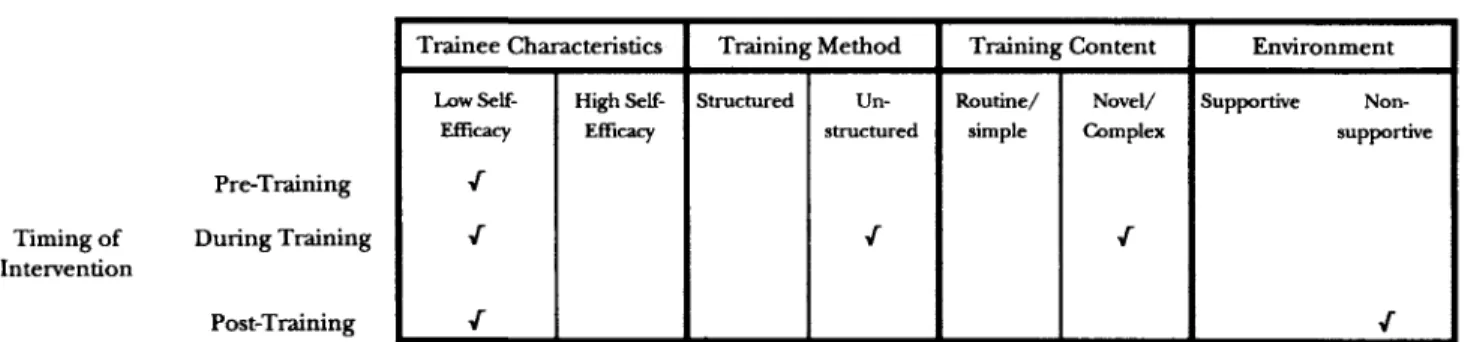
Finally, knowing how and when to increase trainee self-efficacy is likely to depend on a number of key factors in die training process or training factors. Therefore, the diird major component of the framework deals with four such variables: 1. trainee characteristics and individual differences (e.g., pretrainingself-efficacy); 2. the training mediod (e.g., structured versus unstructured); 3. die training content (e.g., simple versus novel or complex); and 4. the organization environment (supportive versus nonsupportive). As indicated in Figure 2, interventions for increasing trainee self-efficacy will be most important when trainees have low pretraining self-efficacy, die training task is unstructured, the training content is complex, and when diere is little social support in die work environment (Saks, 1997). Increasing self-efficacy prior to and during training will be most important when trainees have low self-efficacy to learn and to master die training content, and when the training mediod is unstructured and die content is novel or complex. Post-training interventions will be necessary when trainees have low self-efficacy to transfer and to overcome envi-ronmental obstacles.
Aldiough future research is needed to examine diese factors in testing die effects of various interventions designed to strengdien trainee self-efficacy, die frame-work can provide trainers a guide as diey approach each training situation by asking diree general questions: 1. What is the best approach for strengthening trainee self-efficacy (mastery experiences, vicarious learning, verbal persua-sion, and/or physiological state)?
Training Factors Timing of Intervention Pre-Training During Training Post-Training Trainee Characteristics Low Self-Efficacy V High Self-Efficacy Training Method Structured Un-structured ' Training Content Routine/ simple Novel/ Complex
'
Environment Supportive Non-supportiveFigure 2. Training Factors x Timing of Intervention Framework 2. When is the best time to intervene to strengthen trainee self-efficacy (before, during, and/or after training)? 3. And what are the implications of the training factors for strengthening trainee self-efficacy? (i.e. trainee self-efficacy, training method, training content, organizational environ-ment)
Acquisition. One of the key developments in recent years has been the integration of Anderson's (1982) model of skill acquisition into the training field. Hence, we know that the acquisition process flows through three se-quenced parameters from declarative to procedural to automation. There is clear consensus that procedural understanding is a prerequisite for skill demonstration, and that this can be enhanced when the training pro-gram instills general principles, and a multiplicity of practical examples and demonstrations of the learning points. Moreover, overlearning — a process by which training material is emphasized by repetition appears to have consistent effects on learning and retention (see Driskell, Willis and Copper, 1992 for a meta analysis of the available evidence). All of this suggests that Canadian organizations may find more profit out of training if they chose to restrict the volume of material covered in training in exchange for greater repetition and practice. Depth appears preferable to breadth.
This conclusion fits well with the finding that experi-ential learning is preferred by trainees (e.g., Bretz and Thompsett, 1992), and that it leads to higher levels of procedural knowledge acquisition (and eventual trans-fer) than more passive procedures. The difficulty, of course, is that experiential based approaches require more time than traditional approaches. Although some (e.g. Hesketh, 1997) have expressed concerns that experiential training may be more stressful, results obtained by Vancouver's John Yuille and his colleagues (Yuille, Davis, Gibling, Marxsen et al., 1994) appear to allay some of these fears.
Aptitude-Treatment-Interactions. Although there is reason to believe that the effectiveness of training programs
might depend on trainee's aptitude and other individual differences, relatively little empirical research has examined aptitude-treatment interactions in organiza-tional settings (Tannenbaum & Yukl, 1992). This is an area where research could have a profound effect on the outcomes of training programs by providing information on what training programs will be most successful for individuals with particular characteristics.
To date, there are some examples of just how useful this research can be. For example, several studies have demonstrated that self-efficacy moderates the effects of training method on training outcomes (Gist et al., 1989, 1991; Saks, 1994). This research has found that behav-ioural modelling, self-management, and formal training programs are particularly effective for trainees with low pretraining self-efficacy. In addition, Kanfer and Ackerman (1989) demonstrated ability-motivation interactions in which goal setting was found to be most beneficial for the performance of low ability trainees when implemented after the initial phase of skill acquisi-tion. They suggested the possibility of tailoring training programs for trainees with different ability levels. In the future, it might be possible to improve the effectiveness of training programs by tailoring them to trainees on the basis of key individual differences.
Choosing Training Programs: The Training Analysis Grid (TAG)
Most training programs are not developed "in house" but are purchased from specialized firms. Many such firms offer "thinking", problem analysis and decision, commu-nication programs etc.. How can the practitioners decide between the various course offerings? Usually, training managers attend each of the courses and, based on their impressions the course is imported or not into the host organization. The process of choice, however, has never been studied systematically and we do not know, at this point, how such decisions are reached. However, we now have, as described in this paper a reasonably good idea as to the actual parameters which can influence training success, when success is defined with respect to transfer.
Appendix A presents a Training Analysis Grid (TAG) which could be of use to practitioners to frame and to guide their decision making.
TAG defines a number of dimensions (defined in Appendix A) which are known to influence training outcomes. The user would be required to analyse each of the training modules or activities (for example lectures, discussions, practices etc.) and to rate the activity as to the degree to which it is designed to influence die parameter defined by the rows of the matrix. For exam-ple, activity 1 might be an initial lecture designed to explain the basic concepts to be discussed during the course. Such a lecture might enhance motivation by increasing the perceived importance of the training content and it might impact on declarative learning. Typically, such a lecture would not be designed to influence self-efficacy or procedural learning. By sum-ming the rows across the columns one would obtain an overall score reflective of the degree to which the course, as a whole, is focussed on enhancing each of the items listed in the rows. In such a manner the practitioner would have an overall scoring scheme for the training program. Now, entering the information collected on the TAG simultaneously with the analysis of the training situation would allow for better decision making. For example, a course may be planned for an environment which is unlikely to be supportive. In this case the course content should provide lots of motivationally driven activities. The examination of the TAG results will help estimate the degree to which the course proposed meets that requirement Further, the use of TAG can guide the development of new and the modification of existing courses.
Designing Training Programs and Transfer Interventions
The design of training programs has traditionally been influenced by learning theory. Most trainers know the importance of maintaining strict stimuli-response parallelism between work and training contexts, and most programs are designed to provide feedback, multiple examples etc. However, in recent years a growing number of studies have been conducted which show different and profitable ways of designing training programs, and in so doing, improving them. Latham and Seijts (1997) have called for a move away from the exclusive reliance on the principles of experimental psychology for maximizing transfer, toward a much broader and integrative approach that includes princi-ples and theory from clinical, counselling, and sport psychology.
Gary Latham (Frayne & Latham, 1987, Latham 8c Fravne, 1989) as well as American colleagues Tim Baldwin (Baldwin, 1992) and Marilyn Gist and her
colleagues (Gist et al., 1990, 1991; Stevens et al., 1993) have all been very active proponents of integrating modelling and self-management as a generalized strategy for training. Well grounded in social cognitive theory (Bandura, 1986) and easily operationalized, these approaches have been repeatedly shown to be effective for enhancing self-efficacy and transfer. Although there remains little question as to the dramatic impact that these techniques can have on the acquisition and transfer of learned skills, the development of training programs structured around these cognitive-behavioural approaches is quite distant from the typical ways in which training programs are structured. It is for this reason that the present authors (see Haccoun, 1992; Haccoun, 1997; Saks & Haccoun, 1996; and Saks et al., 1996) have proposed merging traditional training design with some of these new social cognitive theory based advances. THE TRANSFER ENHANCEMENT PROCEDURE (TEP)
In the last several years, we have proposed that organiza-tional trainers engage in a strategic shift (Haccoun, 1992; Haccoun, 1997; Saks & Haccoun, 1996; Saks et al., 1996). We have suggested that trainers add to existing training programs intervention modules designed to specifically enhance skill acquisition and transfer. These interven-tions, which we refer to as Transfer Enhancement Procedures or "TEPs", make profitable use of the research knowledge gained over the last decade or so.
Essentially, the TEP approach requires trainers to conceptually separate the substantive content of a training program from the parameters which will facili-tate learning and transfer.
The research literature has taught us that initial trainee motivation and self-efficacy can have a decided impact on learning and transfer. It has also taught us that the degree to which the trainee is prepared for the application milieu, at the end of a training program is of paramount importance. Therefore, the training function should intervene, pursuant to the TEP concept at one or both of these levels prior to or at the end of a training program.
fre-training interventions
Initial motivation levels are critical to training success because they define, in part, the initial attentional resources which will be available during training (Noe, 1986). Therefore, it is important for trainers to enhance motivation at the onset of training.
Using a VIE framework, it seems clear that motivation to learn and motivation to transfer will be heightened to die degree that individuals attach high valence to the training as well as high expectations that they can, by marshalling their efforts, successfully learn and accom-plish the trained task on the job. Trainers might consider
beginning the training process by "selling" the impor-tance of the training to the participants. The arguments used might profitably emphasize the personal pay-off to the individual (e.g., learning a skill which is marketable), to the execution of work (for example motivating supervisors to implement a new alcohol and drug abuse policy at work, might make it easier for them to deal with problem employees), and/or to die organization (avoid-ing the law suits which would ensue follow(avoid-ing a drugs related accident). Similarly, conceptually relevant pretraining negative events are also likely to increase motivation to learn and post-training performance (Smith-Jentsch, Jentsch, Payne, & Salas, 1996). As for the expectation of success, critical to eventual skill usage, self-efficacy construction techniques seem appropriate as discussed earlier. Experimentally, a number of such procedures have been successfully implemented.
Two studies in particular exemplify this approach. Martocchio (1992) showed that convincing trainees that the training program is "an opportunity" leads to positive outcomes, while Haccoun, Murtada and Desjardins (1997) showed diat convincing trainees of a link between job survival and training acquisition led to significant increments in learning. Both of these studies can be interpreted to mean that enhancing the initial motiva-tion states of trainees can be accomplished, and that doing so leads to demonstrable training effects.
Of course, another, perhaps simpler way to increase trainee motivation is to allow trainees to volunteer for participation in a training program. In an interesting study, Baldwin, Magjurka, and Loher (1991) allowed trainees to participate in selecting their training pro grams. However, some were granted their first choice and others were not though diey all participated in die same course. Those who were not granted their first choice had decidedly poorer training experiences than those who did. This suggests diat participation may in fact be quite perilous in die training context.
Anodier example is the use of realistic training previews to enhance training effects (Hicks & Klimoski, 1987). Odier mediods (see Tannenbaum & Yukl, 1992) can certainly be imagined. For example, group discus-sions about die reasons and benefits of training. This approach is very promising, diough still embryonic, and researchers as well as practitioners should consider developing these approaches for use prior to die com-mencement of a training program.
Post-training interventions
Once a training program is completed and trainees return to work, all manners of constraints may act to reduce die odds of successful transfer. As a rule, environ-ments will not reinforce die training. One way of dealing widi diis is to use die final hours scheduled for a training
session to prepare trainees for dieir return to die work environment. Here, die basic approach has been self-regulatory. Trainees are taught to plan ahead for die return to work by setting goals, developing strategies for engaging in specific actions, and by identifying con-straints to skill usage and coping strategies for dealing widi diem. These approaches have been most often used as part of goal setting, self-management, or relapse prevention interventions.
Goal setting. Getting individuals to commit to specific
goals during post-training transfer is one approach diat would appear promising and has been tested in several studies. Surprisingly, die available research is producing quite consistent diough counter-intuitive results. Several empirical studies (Gist, Bavetta, & Stevens, 1990; Haccoun, 1995; Murtada & Haccoun, 1996) have demon-strated diat goal-setting is a less effective procedure for enhancing transfer effects, especially for trainees widi low self-efficacy (Gist et al., 1991). In fact, our meta-analytic work (Haccoun, Labreche & Saks, 1997) shows it to be die least effective of all TEPs studied. This is seemingly paradoxical since goal-setting is generally recognized to be one of die better self-regulatory tech-niques available, and it is fair to say diat die reasons for its relative failure in die training context remain unclear. Many possible explanations exist (see Haccoun, 1997). There is some evidence diat goals are not as effective for complex tasks as they are for simple tasks (Wood, Mento, & Locke, 1987), and may be dysfunc-tional in die early stages of learning where cognitive resources are required for task performance (Gist et al., 1991). Kanfer and Ackerman (1989), for example, found diat goal assignments during die declarative stage of skill acquisition produced a decrement in performance for bodi low and high ability subjects. Thus, die setting of goals at an early stage of learning might interfere widi trainees ability to learn and adequately perform learned behaviour. In addition, because errors are likely during die acquisition of newly learned skills and some failure is probable, goals may prove ineffective because diey serve to make more salient those initial skill usage failures. In turn, diese "early losses" may depress self-efficacy, persistence, and perceived expectancies. Thus, trainees who set goals and who are not able to realize diem might perceive their early transfer attempts as negative, and diis might lead to a decay of learned skills. In order for goal-setting TEPs to show more positive effects, we suspect diat more attention will have to be given to die timing of die goal-setting intervention in terms of die stage of skill acquisition (declarative versus procedural), as well as die nature of die task in question (i.e., complex or novel versus simple) (see Kanfer & Ackerman, 1989).
Self-Management and Relapse Prevention. Self-management and relapse prevention (RP) are two TEPs which appear to provide consistent positive results (Haccoun, Labreche and Saks., 1997; Haccoun, Murtada, & Desjardins, 1997; Saks et al., 1997). These interventions are essentially structured to help individuals identify environmental constraints for skill usage, and to develop strategies for overcoming them. Thus, they help to inoculate the trainee against the environment Moreover, the procedures are intended to help trainees attribute skill use failures (so probable during the early period after training) not to failures of will but to failures of strategy. The main differ-ence between the two is that self-management includes a behavioural as well as a motivational component (i.e., goal setting and self-reward), whereas relapse prevention is strictly behavioural (Gistetal., 1991).
These approaches have resulted in increased transfer in a number of actual training contexts including the military (Tziner et al., 1991), and a hospital setting (Saks et al., 1996). They are associated with a number of parameters known to influence training success includ-ing self-efficacy and perceived control. In effect, the development of proactive, strategic actions which take into account work level constraints may help build the expectancies that trained behaviour can be successfully implemented.
Since environmental resistance to new skill usage is likely to wane over time, these skills are especially important immediately after training. It is for this reason that they be specifically implemented at the end of a training program, even if that requires a reduction in the training-time budgets allocated to content mastery.
If the TEP approach can be demonstrated to be as fruitful as it appears to be, this can be a major help to training systems in Canada and elsewhere for at least three reasons. First, the TEP approach relies on well-known techniques, which are easily learned and easily incorporated into training programs, and therefore they can be easily implemented in the field. Second, the activities they imply take place in the training context, and therefore can be fully controlled by the training function. The operational units' cooperation is not mandatory. Third, the sound underlying psychological principles upon which they are based frame the process of TEP creation thus facilitating the development of new techniques. However, I-O psychologists need to conduct much more research on these techniques in order to provide trainers with information on how to best choose a TEP approach for any given training program. This would be greatly aided by the use of a contingency approach for TEP usage.
A contingency approach to TEP usage
Although a number of pre- and post-training TEPS have
been found to be effective, they have been used and tested without much consideration as to their appropri-ateness across training situations. For example, consider the following two hypothetical studies, both testing the effects of goal setting and relapse prevention TEPs except in Study 1 trainees are given pre-training TEPs and in Study 2 they are given post-training TEPs. In study 1, the results show that the RP subjects demonstrated greater transfer six months after training. The researcher concludes that RP is a more effective TEP. In study 2, the results show that the goal setting subjects demonstrated greater transfer six months after training. The researcher concludes that goal setting is a more effective TEP. In an effort to be especially astute, the author writes up both studies together and concludes that an RP TEP is best for pre-training, and a goal setting TEP is best for post-training. These are all likely conclusions to be drawn from these two studies.
However, after some further inquiry, the researcher discovers that in Study 1 the training task was very complex and early goal setting interfered with trainee learning. In Study 2, the work environment was found to be highly supportive of trainees with a strong learning culture and a positive training climate. In effect, there is no need for an RP intervention in such an obstacle-free environment, but a goal-setting intervention was just what was needed to motivate the trainees to achieve high levels of transfer. Thus, the results of both studies are in large part due to the factors specific to the training situation. In Study 1, goal setting was inappropriate during the early stages of learning a complex task (Kanfer & Ackerman, 1989), while in Study 2, RP was redundant in a highly supportive environment.
Because previous research has tested TEPs without considering their appropriateness for the training situation, we do not know how useful various TEPs are for different training situations. In other words, it is not yet clear when it is best to use a TEP (pre- versus post-train-ing) , or what type of TEP will be most effective in a particular training situation. As a result, trainers will have a difficult time trying to determine when to use a TEP, and more importantly, what type to use. l-o psychology can help by providing some guidelines to ensure that TEPs are used to their maximum benefit.
In terms of the timing of a TEP (pre or post), it would be useful for trainers to have some information on maintenance curves as discussed by Baldwin and Ford (1988). Maintenance curves indicate the changes in training usage that occur in the transfer setting as a function of the time elapsed since completion of a train-ing program. Thus, they indicate when a relapse occurs and therefore, when a TEP is mostly likely to be needed.
In addition, one can simply consider trainees in terms of their motivation to learn and motivation to transfer,
both of which are known to be extremely important for learning and transfer (Noe, 1986; Tannenbaum & Yukl, 1992). Trainees with low levels of motivation to learn will require a pre-training TEP while those with low motiva-tion to transfer will require a post-training TEP. For example, if motivation to transfer is a problem, an intervention designed to heighten the importance and relevance of transfer would be most appropriate. This can be as simple as requiring some form of post-training accountability or evaluation. Along these lines, Rynes and Rosen (1995) demonstrated that post-training evaluations can enhance the perceived importance of training, and as such, might increase commitment and motivation to transfer the material to the job.
On a more complex level, it is likely that the effective-ness of any given TEP will depend at the very least on trainee characteristics and the training environment. For example, trainees with low self-efficacy will require a pre-training TEP that is designed to increase their self-effi-cacy. A training environment that is lacking in support and a positive transfer climate, will require a post-train-ing self-management or relapse prevention TEP.
Finally, a rigorous needs assessment that focuses on transfer issues needs to become a standard part of the needs assessment process. Although needs assessment information often does provide transfer information (e.g., organizational analysis of climate), this information is seldom used in the design of transfer interventions. However, given the importance of this for the success of training, it would be highly desirable for needs assess-ment to specifically include a transfer analysis in addition to the more traditional organizational, task, and person analyses. The purpose of the transfer analysis will be to identify potential transfer problems, and the need for specific transfer interventions. The approach would involve collecting information across the three levels of the traditional needs assessment. That is, the transfer analysis would focus on transfer problems at the organi-zational, task, and person levels. Thus, there can be transfer problems that stem from the organization (e.g., transfer climate), the task (e.g., complexity), and the trainee (e.g., low self-efficacy).
The identification of transfer problems can then be used to develop transfer interventions that might focus on four potential areas: motivational (e.g., motivation to learn or transfer), cognitive (e.g., self-efficacy), affective (e.g., attitude toward training), and environmental (e.g., lack of support). This approach can aid in the classifica-tion of TEPs, and provide a guide for future research and practice. Clearly, trainers will have to consider these types of factors in order to determine the most appropri-ate TEP for each training situation. I-O psychologists can contribute to research and practice by using this ap-proach in future research on transfer and TEPS.
Summary of Findings
The foregoing indicates that a great deal is now known that helps our understanding of the dimensions that affect the success of training in organizations. We now have a clearer understanding of what should be assessed in our evaluations and how to do it. One of the more macro level conclusions are that the Kirkpatrick training evaluation heuristic requires updating, perhaps using the "augmented" framework proposed by Alliger et al. (1997) and Kraiger et al. (1993). The second conclusion is that practitioners and scholars are beginning to focus on the issue of transfer of training at all levels: From the selection (see the TAG procedure above) and design of training programs to the construction of the overall training experience and the organizational milieu in which it is inscribed (see the contingency approaches described above). This "zeitgast" is further illustrated in a recent series of papers published in Applied Psychology: An International Review (1997). In it, the lead article by Hesketh (1997) is discussed by several scholars from around the world. In her rejoinder Hesketh (1997b) integrates the commentaries to introduce the Transfer of Training Needs Analysis (TTNA) concept. Whatever the choice of operational model we adopt (contingency, TTNA) the direction for the future is clearly marked.
At the evaluation design and measurement stage, we now know how to measure the first three of Kirkpatrick's levels of evaluation, but our measurement weakness still lies in defining the overall pay-off. The better available models are very difficult to use in practice. We also know what individual differences should be measured and we have stronger rationales for designing credible evalua-tion protocols that can be put to practical use in organi-zational contexts. The state of the trainees, as they enter training, their objective reception on their return to work, as well as their post-training beliefs about the applicability of the training in their contexts, have major influences on the success of the training experience. Organizational trainers should measure these parameters because they will provide very early indicators of success — indicators that will have high probabilities of forecast-ing eventual level III outcomes.
At the individual differences level, it seems clear that general cognitive ability is a salient determinant of learning. Certainly, careful selection of trainees or modulating the learning experiences as a function of the variation in the ability levels of trainees (adaptive train-ing?) is one solution though it remains quite unclear how this can be accomplished in reality. Motivation to learn, self-efficacy, and perceived control are major determi-nants of training success, and techniques are available that can help improve these initial states of trainees.
At the organizational level some elements appear established. Certainly the level of post-training support
as well as the opportunity to practice learned skills affect training outcomes, and we have reasonably clear ideas as to the parameters which affect these variables. Organiza-tional transfer climate and continuous-learning culture also seem to play an important role, and thanks to the instruments developed by Rouiller and Goldstein (1993) and Tracey et al. (1995), their effects can be empirically assessed. It is hoped that i-O psychologists will pursue this line of work and collect information that might help in die construction of cross organizational or sector norms. Training systems diat operate in organizations that are perceived to be less innovative or do not value continu-ous learning, face a more challenging task. Fortunately, there are now a number of proactive procedures that can be taken during training to facilitate success even in these more difficult circumstances.
The weight of the evidence suggests that die initial motivational states of trainees as well as their subjective evaluation of their capacity to learn and apply the requisite skills are critical to training success (Gaudine, 1997). The data also shows that organizational environ-ments, especially in their ability to promote skill usage is of great importance. This suggests that training interven-tions should be dovetailed with organization level factors. In this respect, two intervention strategies are apparent: 1) Training would be more effective when accompanied by interventions at the organizational level (for example, compelling supervisors to support the use of skills); and 2) Organization development efforts could be defined and implemented, and training provided only for those knowledge, skill, and attitudinal areas which are sup-ported by the organizational changes.
All of the literature reviewed in this paper is very recent, having been published in the last ten years and mostly in the last five. Although diis is not a census, it is a very large sample of the available data. Yet, the reader will perhaps have noted that none of the reported studies have attempted to change organizations to support training! In our view, this reflects die reality, as argued elsewhere (Haccoun, 1997), that the training function in organizations does not hold the organizational clout required to directly effect change at the operational level. Solutions to improving training effectiveness applicable under a variety of organizational conditions, be they favourable to training or not, are required. To be clear, we are not suggesting that die organizational context of training is unimportant to success, far from it, but we are saying that training design will have to incor-porate die realities of environmental constraints. This simply means diat solutions to training problems will have to be found in places where diey are most likely to be accepted and successful.
Conclusion
A great deal more is now known about how training in applied settings can be accomplished successfully than was the case in the past One major advance has been in die recognition diat training, in organizational settings, can no longer be exclusively framed in a learning or acquisition paradigm (Latham & Seijts, 1997). Indeed, training is inscribed in a complex array offerees of which only some are likely to be influenced by training content and learning. The psychological state of die trainee — especially along motivational, self-efficacy, and control parameters — requires serious attention. Thus, as we move forward into die next century, diose Canadian organizations diat pay close attention to diese issues in die design and implementation of dieir training systems, will reap more satisfactory results for diemselves, dieir workers, and die Canadian economy.
This paper was supported by a research grant to the au-thors from die Social Sciences and Humanities Research Council of Canada. Thanks are extended to Julie Gregoire for her helpful suggestions on the paper. Requests for reprints may obtained by writing to R.R. Haccoun, Departement de Psychologic, Universite de Montreal, C.P. 6128, Succ "Centre-Ville", Montreal, Quebec H3c3j7 or by email at [email protected].
Resume
II est actuellement reconnu que la formation et le developpement professionnel constituent des solutions a la realite economique de cette derniere partie du xxieme siecle. Depuis toujours, la formation est au centre des champs d'interet de la psychologic I/O, et a Pheure actuelle, elle detient une opportunite histo-rique de demontrer a nouveau sa pertinence. Get article traite des contributions majeures apportees par la discipline dans la comprehension de la formation ainsi que ses impacts sur la modification du comporte-ment au travail.
Reconnaitre que la formation ne devait plus etre abordee sous un angle purement pedagogique repre-sente sans doute 1'une de ses contributions les plus considerables. On sait que de nombreux parametres influencent les resultats obtenus en formation. Parmi celles-ci, on compte les etats psychologiques des em-ployes en formation, notamment leur motivation, leur sentiment d'efficacite personnelle et le controle perc.u, en interaction avec les realites particulieres au
contexte organisationnel.
A 1'etape de I'elaboration du devis d'evaluation et de la mesure, et au-dela du modele propose par Kirk