V T T P U B L I C A T I O N S
TECHNICAL RESEARCH CENTRE OF FINLAND ESPOO 2000
Arto Kuusisto
Safety management systems
Audit tools and reliability of auditing
4 2 8
VTT PUBLICATIONS 428
Safety management systems - Audit tools and reliability of auditing
Arto Kuusisto
Tätä julkaisua myy Denna publikation säljs av This publication is available from VTT TIETOPALVELU VTT INFORMATIONSTJÄNST VTT INFORMATION SERVICE
PL 2000 PB 2000 P.O.Box 2000
02044 VTT 02044 VTT FIN–02044 VTT, Finland Puh. (09) 456 4404 Tel. (09) 456 4404 Phone internat. + 358 9 456 4404 Faksi (09) 456 4374 Fax (09) 456 4374 Fax + 358 9 456 4374
V T T P u b l i c a t i o n s
V T T P u b l i c a t i o n s
V T T P u b l i c a t i o n s
V T T P u b l i c a t i o n s
V T T P u b l i c a t i o n s
V T T P u b l i c a t i o n s
V T T P u b l i c a t i o n s
V T T P u b l i c a t i o n s
V T T P u b l i c a t i o n s
P
Safety auditing is a systematic method to evaluate a company's safety
management system. The two main tasks of auditing are: 1) compliance
verification to establish whether the relevant legal requirements are met, and 2)
validation to see whether the correct types of methods are in use, and whether
they are effectively implemented. Several methods, or tools have been
developed for supporting safety auditing. The aim of these safety audit methods
is to help the company's management systematically follow the overall progress
in safety control.
In this work, the inter-observer reliability of one audit tools is tested. This was
done using an audit method, known as the D&S method, in six industrial
companies in the USA, and in three companies in Finland. Also, a new audit
method called MISHA was developed, and its reliability was tested in two
industrial companies.
The results of the study show that safety audit tools are helpful during the
safety audit process, but do not ensure reliable and valid audit results. The role
of the auditor is always essential in safety auditing. The reliability testing of
MISHA revealed that it gives more reliable results than D&S when the auditor
is not trained. On the other hand, it seems that the D&S is more reliable when
the auditor is a trained expert.
Some differences were found between the companies in the USA and in
Finland. The organization and administration of safety activities was at a
somewhat higher level among the companies in the USA. Also, accident
investigation and analysis were significantly better arranged among the
companies in the USA.
ISBN 951–38–5594–5 (soft back ed.) ISBN 951–38–5595–3 (URL: http://www.inf.vtt.fi/pdf/) ISSN 1235–0621 (soft back ed.) ISSN 1455–0849 (URL: http://www.inf.vtt.fi/pdf/)
VTT PUBLICATIONS 428
TECHNICAL RESEARCH CENTRE OF FINLAND
Safety management systems
Audit tools and reliability of auditing
Arto Kuusisto
VTT AutomationThesis for the degree of Doctor of Technology to be presented with due permission for public examination and criticism in Auditorium Festia pieni sali at
ISBN 951–38–5594–5 (soft back ed.) ISSN 1235–0621 (soft back ed.)
ISBN 951–38–5595–3 (URL: http://www.inf.vtt.fi/pdf/) ISSN 1455–0849 (URL: http://www.inf.vtt.fi/pdf/)
Copyright © Valtion teknillinen tutkimuskeskus (VTT) 2000
JULKAISIJA – UTGIVARE – PUBLISHER
Valtion teknillinen tutkimuskeskus (VTT), Vuorimiehentie 5, PL 2000, 02044 VTT puh. vaihde (09) 4561, faksi (09) 456 4374
Statens tekniska forskningscentral (VTT), Bergsmansvägen 5, PB 2000, 02044 VTT tel. växel (09) 4561, fax (09) 456 4374
Technical Research Centre of Finland (VTT),
Vuorimiehentie 5, P.O.Box 2000, FIN–02044 VTT, Finland phone internat. + 358 9 4561, fax + 358 9 456 4374
VTT Automaatio, Riskienhallinta, Tekniikankatu 1, PL 1306, 33101 TAMPERE puh. vaihde (03) 316 3111, faksi (03) 316 3282, (03) 316 3499, (03) 316 3493 VTT Automation, Riskhantering, Tekniikankatu 1, PB 1306, 33101 TAMMERFORS tel. växel (03) 316 3111, fax (03) 316 3282, (03) 316 3499, (03) 316 3493
VTT Automation, Risk Management, Tekniikankatu 1, P.O.Box 1306, FIN–33101 TAMPERE, Finland phone internat. + 358 3 316 3111, fax + 358 3 316 3282, + 358 3 316 3499, + 358 3 316 3493
Kuusisto, Arto. Safety management systems – Audit tools and reliability of auditing. Espoo 2000, Technical Research Centre of Finland, VTT Publications 428. 174 p. + app. 48 p.
Keywords hazard control, safety audit, safety management
Abstract
Safety auditing is a systematic method to evaluate a company’s safety management system. Auditing should cover the entire safety management system, that is, all the activities aiming to ensure adequate control of the hazards affecting people, property or the environment. The two main tasks of auditing are: 1) compliance verification to establish whether the relevant legal requirements are met, and 2) validation to see whether the correct types of methods are in use, and whether they are effectively implemented. Safety auditing is one part of the company’s general management activities, and is a similar procedure to the auditing of quality and environmental management systems.
Several methods, or tools have been developed for supporting safety auditing. Typically, these methods are checklists of the activities to be assessed. Some methods also have criteria for the assessment, as well as a scoring system which produces a numerical estimate of the safety activity level. The aim of these safety audit methods is to help the company’s management systematically follow the overall progress in safety control. Audit results should be reliable which means that different auditors should come to the same conclusions. In addition, reliability determines the upper limit for the validity.
This work concentrates on evaluating the reliability of some safety audit tools. Firstly, the factors affecting reliability in auditing are clarified. Secondly, the inter-observer reliability of one of the audit tools is tested. This was done using an audit method, known as the D&S method, in six industrial companies in the USA, and in three companies in Finland. Finally, a new improved audit method called MISHA was developed, and its reliability was tested in two industrial companies.
The results of the work show that safety audit tools are helpful during the safety audit process, but do not ensure reliable and valid audit results. The role of the auditor is always essential in safety auditing. The auditor’s expertise in the field of health and safety is particularly important when the company’s compliance with the legal requirements is evaluated.
The case studies showed that a reasonably high reliability in the use of the D&S can be achieved when the auditor is familiar with the audit tool, the national legislation, and the company’s culture. The reliability decreases when the auditor is less familiar with the audit method, or the local conditions.
The D&S method is a very rough method, and it does not help the auditor to assess the individual safety activities very thoroughly. This means that there is a lot of space for the expertise of the auditor. The D&S method also suggests certain activities which may not always be the most suitable solutions for every company. In many cases, the company can arrange its activities in another way, but equally effectively. Also, it was noticed that the D&S method needs updating. For example, some criteria of the of the D&S method are very easy to meet. The method could be improved by giving less weight to areas like fire control and industrial hygiene control, and by focusing more attention to areas like follow-up and auditing.
The new MISHA method developed in this work is slightly differently constructed to the D&S method. MISHA has more activities to be assessed and also more specific evaluation criteria than the D&S method. The reliability testing revealed that MISHA gives more reliable results than D&S when the auditor is not trained. On the other hand, it seems that the D&S is more reliable when the auditor is a trained expert.
The validity of D&S and MISHA were not statistically tested. This was solely because it is difficult to determine such safety outcomes that would relate or correlate with each safety activity of the audit tool. Accident statistics, for example, do not provide sufficient data for validity studies.
Some differences were found between the companies in the USA and in Finland. The results of the assessments indicated that the organization and administration of safety activities was at a somewhat higher level among the companies in the USA. Industrial hazard control, as well as the control of fire hazards and
industrial hygiene were at a high level in all companies in both countries. Most dispersion occurred in supervision, participation, motivation, and training activities. Finally, accident investigation and analysis were significantly better arranged among the companies in the USA. The results are in line with the findings of the literature survey carried out in the theoretical part of the work.
Preface
My interest in safety management systems traces back to the years when I worked at the Tampere University of Technology (TUT) during 1987-1994. Some of the material for this study is from that time. Some material for this work is also from the studies I carried out at the University of Louisville, USA in 1992-1993. I began to write this thesis when I worked at the Department of Occupational Safety of the Finnish Institute of Occupational Health (FIOH) in 1994-1996. The final modifications to this work were done while I was working at the VTT Technical Research Centre in Tampere.
I would like to thank professor Markku Mattila from TUT for supervising the work.
To Professor Waldemar Karwowski, many thanks for the scientific guidance, and for giving me the opportunity to carry out part of the work at the University of Louisville. Many thanks also to Ms Tiina Hakonen who gave me invaluable advice on the statistical problems, and performed the statistical computations. Mr Jari Schabel from the VTT Technical Research Centre has provided technical editing assistance and helped to revise the language of this work. Many thanks also to him.
I would also like to thank all those people at TUT, FIOH and VTT who have given me valuable comments to this work, and those people from the participating companies in Finland and in the USA who gave me the opportunity to carry out the case studies.
Dr Kari Häkkinen, Dr Lasse Reiman, and Professor Jorma Saari have read the manuscript. Their advice and constructive criticism have greatly improved the quality of this work.
For the financial support, I would like to thank the Finnish Work Environment Fund, the Academy of Finland, the Tampere University of Technology, the Finnish Institute of Occupational Health, and the VTT Technical Research Centre.
Contents
Abstract... 5
Preface ... 8
Terms and definitions ... 13
Abbreviations... 15
1. Introduction... 16
1.1 Consequences of occupational accidents... 16
1.2 Means to control health and safety hazards... 18
1.3 Evaluation of a safety management system... 19
1.4 Need for this study... 21
2. Scope and objectives of the study... 22
2.1 Scope of the study ... 22
2.2 Objectives of the study ... 23
2.3 Framework of the study... 24
3. Safety management systems ... 26
3.1 Accident causation models ... 26
3.2 Safety management as an organizational activity... 29
3.2.1 Safety culture ... 29
3.2.2 National differences in safety culture... 30
3.2.3 Preconditions for improving safety management... 31
3.2.4 Integration of safety to other management activities ... 32
3.3 Key functions of a safety management system... 33
3.4 Safety policy and planning ... 35
3.5 Organization and communication... 37
3.5.1 Safety tasks and responsibilities... 38
3.5.2 Safety communication... 43
3.6 Hazard management ... 45
3.6.1 Hazard identification process ... 45
3.6.2 Planning of the hazard analysis ... 46
3.6.3 Accident investigation as a source of information ... 46
3.6.5 Risk assessment... 50
3.6.6 Control activities ... 51
3.7 Monitoring and review ... 52
3.7.1 Overview ... 52
3.7.2 Measuring performance... 53
3.7.3 Auditing... 54
3.7.4 Reviewing performance ... 54
4. Safety auditing ... 56
4.1 From authority control to internal auditing ... 56
4.2 Theoretical basis of auditing... 57
4.3 Types of safety audits ... 58
4.4 Safety audit procedures ... 59
4.4.1 Reliability of the auditor ... 59
4.4.2 Audit techniques... 60
4.5 Management safety audit tools ... 64
4.5.1 Overview ... 64
4.5.2 Diekemper & Spartz (D&S) ... 64
4.5.3 Complete Health and Safety Evaluation (CHASE)... 65
4.5.4 International Safety Rating System (ISRS)... 66
4.5.5 Safety Management Achievement Program (SafetyMap)... 67
4.5.6 Comparison of the weights to different activities ... 70
4.5.7 Summary of the current management safety audit methods ... 70
4.6 Summary... 72
5. Materials and methods ... 73
5.1 Materials of the study ... 73
5.1.1 Case studies using the D&S method ... 73
5.1.2 Case studies using the new MISHA audit method ... 75
5.2 Research methods... 75
5.2.1 The strengths and weaknesses of the case study technique... 75
5.2.2 Interviews as an organizational assessment method ... 76
5.3 Statistical methods... 78
6. Case studies using the D&S audit method... 82
6.1 Introduction ... 82
6.2 Case studies in the USA ... 83
6.2.2 Description of the companies’ safety activities... 87
6.2.3 Results of the Case studies I–VI... 95
6.3 Case studies in Finland ... 97
6.3.1 The companies in Case studies VII–IX ... 97
6.3.2 Description of the companies’ safety activities... 99
6.3.3 Results of the Case studies VII–IX ... 107
6.4 Applicability of the D&S method... 109
6.4.1 Reliability – based on Case studies I–VI... 109
6.4.2 Reliability – based on Case studies VII–IX ... 114
6.4.3 Conclusions on the applicability of the D&S method ... 118
6.5 Comparison of the audit results: USA and Finland ... 120
6.5.1 The ratings... 120
6.5.2 Discussion on the differences... 122
7. Development of the MISHA method... 125
7.1 Introduction ... 125
7.2 Structure of the MISHA method ... 126
7.3 The scoring system ... 128
8. Testing of the MISHA method ... 129
8.1 Case study X... 129
8.2 Results of the case study X... 138
8.3 Case study XI ... 141
8.4 Results of the case study XI ... 148
8.5 Summary... 151
9. Discussion... 152
9.1 Reliability of auditing and audit tools ... 152
9.2 National differences in safety activities... 154
9.3 Limitations of the research methodology ... 156
9.4 Proposal for future studies... 156
10. Conclusions... 159
APPENDICES
Appendix A: Modified Diekemper & Spartz method used in the preliminary case studies in the USA and in Finland
Appendix B: Modifications to Diekemper & Spartz method used for the preliminary case studies in Finland
Appendix C: Results of the assessment in Case X Appendix D: Results of the assessment in Case XI Appendix E: The MISHA audit method – Version II
Terms and definitions
Accident: An unintentional event that causes harm to people, property or environment (Roland & Moriarty 1983).
Audit: A systematic and independent examination to verify conformance with established guidelines and standards, and to examine whether these arrangements are implemented effectively and are suitable to achieve objectives (ISO 10011-1 1990, Guidelines for ... 1993).
Ergonomics: A branch of science that aims at optimizing the functioning of a work system by adapting it to human capacities and needs (Grandjean 1988, Clark & Corlett 1984).
Hazard: An inherent physical or chemical characteristic that has the potential for causing harm to people, property, or the environment (Guidelines for ... 1993).
Incident: An unplanned event that has the potential to lead to an accident (BS 8800 1996).
Major Accident: An incident involving multiple injuries, a fatality, and/or extensive property damage (Guidelines for ... 1993).
Occupational Accident: An accident, the origins of which are from a workplace. A sudden occupational accident can take place either at the workplace, or while commuting between home and the workplace.
Reliability: An estimate of how consistently the studied behavior or phenomenon is observed by one person in different times (intra-observer reliability), or by two or more persons independently at the same time (inter-observer reliability).
Risk: The combination of the expected frequency (events/year) and consequence (effects/event) of a single accident or a group of accidents (Guidelines for ... 1993).
Safety: The quality of a system that allows the system to function under a predetermined condition with an acceptable minimum of accidental loss (Roland & Moriarty 1983).
Safety Management: A systematic control of worker performance, machine performance, and physical environment. The control includes both prevention and correction of unsafe conditions and circumstances. (Heinrich et al. 1980). Safety Policy: A management definition of the safety and health related actions to be followed in the work organization (Petersen 1989).
Safety Program: The term “safety system” is also used. A set of policies, procedures, and practices designed to ensure that barriers to incidents are in place, in use and effective (Guidelines for ... 1993).
Safety Review: An inspection of a plant or process unit, drawings, procedures, emergency plans, and/or management systems, etc. often by a team, and usually problem-solving in nature (Guidelines for ... 1993).
Validity: An estimate of how accurately a method or a scale describes the real situation. Validity is often divided into content validity, criterion validity, and construct validity. (Downie & Heath 1970).
Work Analysis: The terms “workplace analysis” and “workplace survey” are also used. An analysis of the work and the work environment in order to determine the quality and quantity of the task-related stress factors which might affect on employee’s health and safety (Landau & Rohmert 1989). In the Nordic Countries, it is also used for the work load and hazard analysis carried out by the occupational health service personnel (Rossi 1990).
Working Conditions: The employee’s experience of the quality of work environment, usually with special emphasis on health and safety.
Work Environment: The physical, mental (psychological) and social environment where the employee works.
Abbreviations
AET Das Arbeitswissenschaftliche Erhebungsverfahren zur Tätigkeitsanalyse
CE Concurrent Engineering
CIM Computer Integrated Manufacturing CHASE Complete Health and Safety Evaluation
D&S A safety audit method originally developed by Diekemper & Spartz
DNV Det Norske Veritas
EMG Electromyography
ETA Event-Tree Analysis
FMEA Failure Mode and Effects Analysis FSD Fragebogen zur Sicherheitsdiagnose FTA Fault-Tree Analysis
HAZOP Hazard and Operability Analysis HSE Health and Safety Executive (in UK) IMVP International Motor Vehicle Program ISRS International Safety Rating System JDS Job Diagnostics Survey
JIT Just-in-time
κκκκ Kappa coefficient
κκκκw Weighted Kappa coefficient LWIR Lost Workday Incidence Rate
MISHA Method for Industrial Safety and Health Activity Assessment MORT Management Oversight and Risk Tree
MSDS Material Safety Data Sheet OHS Occupational Health Service OSQ Occupational Stress Questionnaire
OSHA Occupational Safety and Health Administration (in the USA) OWAS Ovako Working posture Analyzing System
PAQ Position Analysis Questionnaire
SD Standard Deviation
SMEs Small and Medium-Sized Enterprises SWAT Subjective Workload Assessment Technique
TLV Threshold Limit Value
TLX Task Load Index
TQM Total Quality Management
1. Introduction
1.1 Consequences of occupational accidents
HEALTH AND SAFETY AT WORK
Health at work typically refers to the general state of an individual’s physical,
mental and emotional well-being. As a minimum, health at work would mean that a person is free from illness, injury, and mental problems which impair normal activity (Ferry 1984). Today it is commonly agreed that the control of health, in workplaces and in the society in general, includes not only preventing hazards and maintaining the current health status but also the search for means to improve the well-being.
Similarly to health, safety is more than just a condition where a human is free from hurt, injury or loss. Grimaldi & Simmonds (1975) have defined safety as “reliable control of harm”. According to this approach, the minimum level in occupational safety is achieved when the frequency and severity of occupational accidents are at an acceptable level. From a technical and organizational point of view, safety can be understood as a characteristic of a system, a similar property as quality, dependability or reliability (Roland & Moriarty 1983).
An accident is often defined as an event that causes harm to people, property or to the environment. Often they are also characterized as sudden, unexpected, and undesired occurrences. An incident can be defined as an event that has not caused loss but which could lead to an accident in other circumstances. Near-accidents, near-misses, and learning experiences are frequently used synonyms to incidents.
TYPES OF CONSEQUENCES FROM OCCUPATIONAL ACCIDENTS Those affected by occupational accidents and incidents can be divided into the following three categories: the employees, the employers, and the public administration (Söderqvist et al. 1990, Klen 1989). The consequences to the employee include, among others, mental effects, effects on off-the-job activities, disability to work, and the effects to the economic situation (Söderqvist et al. 1990). The immaterial losses to the employee can seldom be compensated, while usually a major part of the employee’s financial losses are covered by worker’s compensation systems.
The costs of the employer can be divided into prevention costs and accident
costs (Brody et al. (1990). Three types of prevention costs can be found: 1) fixed
costs (safety and other equipment, salaries of medical personnel and safety personnel), 2) variable costs (time used for accident and risk analysis), and 3) unexpected costs (re-design and equipment modification). Similarly, the accident costs can be divided into: 1) direct costs (mainly insurance costs) and 2) indirect costs (caused by wages, material damage, administration’s time, production losses, and so on). Besides these, there are costs that are difficult to measure directly. These include the company’s damaged public image which may result in difficulties to hire skilled personnel, or to find customers and external financial resources.
The third party affected by accidents and incidents is the public administration. The consequences to it comprise of the lost tax revenue and production, the costs of public and private services, the costs of medical care, and the costs due to pensions (Söderqvist et al. 1990, Klen 1989).
ACCIDENT FREQUENCIES AND COSTS
In the USA, 4,800 work deaths and 3.9 million disabling injuries occurred in 1996. The total costs of these events were estimated to be 121 billion USD (Accident facts 1997). In Finland, there were 53 fatal occupational accidents in 1994, and 64 people died of an occupational disease in the same year. More than 92,000 non-fatal occupational accidents were reported, including 6,100 compensated cases of occupational disease. Almost 14,000 accidents and 29 deaths occurred while commuting to or from the place of work (Työtapaturma-ja ammattitautitilasto 1995).
Inadequate control of health and safety may also lead to a poorly designed physical work environment, as well as to unsatisfactory mental and social working conditions. These circumstances can contribute to, for example, untimely retirements. In Finland, the average age for employees to be pensioned is 59 years. In 1994, nearly 300,000 Finnish people were disability pensioners which is almost 12 % of the total workforce. In 33 % of these cases the disability was due to mental strain, and in 31 % of the cases from musculoskeletal disorders (Statistical yearbook ... 1995).
The actual number of days of absence from work is much higher than what the accident statistics show. This is because illnesses not directly related to work cause a major part of the unplanned absences. For example, the total absenteeism rate in Finnish industries was 5.3 % of the work time in 1994. This figure includes occupational accidents and illnesses as well as illnesses not related to work. (Työaikakatsaus 1995)
It is difficult to determine how much unsatisfactory working conditions contribute to financial losses in total. According to Oxenburgh (1991), poor working conditions result besides in absenteeism, also in reduced effort on the part of the employee. Employees can be at workplace but reduce, for example, the time they spend in unsatisfactory work areas. On the other hand, Oxenburgh has stated that the correlation between absenteeism rates and the quality of the work environment is not always clear. He has found that, for example, the national differences in the systems for paying and receiving compensation partially explain why absence rates are different in different countries.
1.2 Means to control health and safety hazards
Modern accident causation models are based on the assumption that the ultimate causes for accidents and incidents are in the management decisions and organizational practices. The systematic and planned top management driven activity that aims at controlling the health and safety hazards is usually called
safety management. The terms safety program and safety system are sometimes
used for describing the same function. However, the latter ones usually put less emphasis on the management’s role.
The primary aim of safety management is to intervene in the causation process that leads to accidents and incidents (Booth & Lee 1995). This includes, above all, the active recognition of both visible and latent hazards. However, safety management is more than just a hazard identification system. It is an overall system for ensuring that the safety activities are properly planned, effectively implemented, and that the follow-up system is arranged. Typically safety management includes activities like risk analyses, arrangement of safety training, accident and near-miss investigations, safety promotion, and assessments of human reliability. In an effective safety management system
these activities are assigned to all the different hierarchical levels of the organization. (Booth & Lee 1995, Grimaldi & Simmonds 1975).
Safety management has many parallels with the other organizational management activities. For example, Total Quality Management (TQM) and environmental hazard management have many similar elements with safety management (Krause & Hidley 1989, Successful ... 1997, Tallberg & Mattila 1994, Weinstein 1996). Development of several parallel and often overlapping management systems is always a waste of resources. Nowadays, integrated SHEQ (safety, health, environment, quality) systems have been introduced in many organizations (Spedding et al. 1993, Shillito 1995), and also models for developing an integrated system are available (e.g. BS 8800 1996).
Several safety management related standards, directives, and regulations have been published during the 1990s. This progress has been noticeable especially in Europe. The BS 8800 (1996) has became the first widely spread general safety management standard. The “Seveso” Directive 82/501/EEC (1982) presents the principles for the management of major accident hazards in the chemical and petro-chemical industry. This directive has been modified twice since it was first passed, and a fundamental revision “Seveso II” (96/82/EU), which emphasizes the control of hazards by improving the management system, was released in December 1996. Finally, the “framework” Directive 89/391/EEC (1989) which presents the basic requirements for a company’s safety policy can also be considered as a tool to be used in the development of a company’s safety management system.
1.3 Evaluation of a safety management system
The effectiveness and adequacy of the safety management system should be evaluated on a regular basis. Different evaluation methods can be used for assessing the different aspects of the safety management system. The most commonly used methods are: 1) measurement of safety performance, 2) safety audits, and 3) management reviews.
MEASUREMENT OF PERFORMANCE
Measurement of safety performance is a means of monitoring the extent to which the safety policy and safety objectives are being met, and it includes both the proactive measurement tools and the reactive tools. Proactive monitoring is used for checking compliance with the company’s planned health and safety activities, while reactive monitoring is used for the investigation, analysis, and recording of the management system failures, including accidents and incidents. (BS 8800 1996).
SAFETY AUDITS
A safety audit can be done in several ways, by different people in the organization, and it can cover many different activities. In everyday language also risk analyses, technical inspections, and other plant level routine assessments are often called audits. However, when a safety audit is understood similarly to a quality system audit, it is an assessment of the management
system. This assessment has two goals: it should verify that the minimum legal
requirements are met, and that the current safety efforts are effective and sufficient. (Glendon 1995)
A safety audit should assess the company’s safety status reviews, safety policy, safety organization, implementation of the safety activities, and the performance measurement systems (BS 8800 1996). Depending on the size of the company and the nature of the company’s activities, one or more areas of the safety management system can be assessed during one audit process.
An audit should include personnel interviews, documentation reviews, and visits to the workplace. For auditors who want to systematize the audit process, several quantitative audit tools have been developed. The use of these tools makes it possible to follow the progress that has been achieved in the company, and in some cases these tools can be used for comparing the activity levels between different companies.
MANAGEMENT REVIEWS
The need to modify and further develop the safety management system can be distinguished in management reviews. A management system may work as planned, but any internal or external changes may require redesign of the system. Findings from the safety performance measurements and from the audits
are the main sources of information for the management reviews. A good review system ensures that the company can learn from experience, improve performance, develop the health and safety management system, and respond to changes (Successful ... 1997).
1.4 Need for this study
The author has studied safety management since 1988 when he audited the first companies using the D&S (Diekemper & Spartz 1970) audit method. Since then, he has assessed the safety activities of more than 30 companies. The need for this study originally arose from the fact that very few experiences were reported on the reliability of safety auditing and safety audit tools.
In this work, the reliability of one audit tool (the D&S method) was tested using nine case study companies. Six of these companies were from the United States, and three of the companies were from Finland. This research concept made it possible to observe also some national differences in safety management practices.
A new audit tool called MISHA (Method for Industrial Safety and Health Activity Assessment) was developed. The MISHA method was developed using the experiences obtained from the nine case studies. The reliability of the MISHA method was tested in two case studies in Finnish companies. The validity of the MISHA is also discussed.
There is a distinction between the concepts of health and safety at work as was mentioned in Section 1.1. However, for reasons of simplicity, from here on the concept of health and safety management will be referred to in many instances as safety management.
2. Scope and objectives of the study
2.1 Scope of the study
In this work, safety audit tools and reliability of safety auditing is studied. Since safety auditing is an assessment of the safety management system, it is useful to first define what a safety management system is.
The elements of a typical industrial safety management system are presented in Figure 1. The following four areas of interest can be found: government, public,
installation, and personnel. Two of the sectors, the government and the public,
are external to the company, and a company has very limited possibilities to directly influence on them. On the other hand, the other two – the installation and personnel – are sectors that are mostly controlled by the company.
Figure 1. Safety management – the areas of interest. Adopted and modified from Safety Management Systems (1995).
This work concentrates on the two internal sectors: 1) the installation, and 2) the personnel of a company. Besides this, some government regulations are discussed when they clearly aim to influence the company’s management
SAFETY MANAGEMENT GOVERNMENT PUBLIC INSTALLATION PERSONNEL Operation Design Maintenance Organizational culture Leadership Information Procedures Man-machine interface Behavior Education Training Motivation Commitment
practices. Furthermore, the public is involved in the scope when, for example, the control of major accidents hazards is discussed.
Safety auditing is an assessment of the safety activities. Thus, it not only a measurement of safety performance or safety results. Using the categorization presented by the Health and Safety Executive (HSE) in Successful ... (1987) the activity areas to be covered in an audit are:
− definition of the safety policy,
− organizing of the control, cooperation, communication, and competence management systems,
− planning and implementing of the safety activities, − reviewing of the performance.
A safety audit process is usually divided into the following three main stages: 1) preparation, 2) on-site activity, and 3) conclusions. The first stage includes the planning of the audit, and search of the background information. The second stage consists of interviews, observations and document reviews in the workplace. In the last stage, the audit results are reported and the follow-up plan is prepared.
The auditor or auditors can prepare the audit questions individually for every audit session. However, it is also possible to use special audit tools which include a fixed list of audit questions. Some of these tools include additional features like weights for the different questions, and a scoring system which produces a numerical value for the safety activity level.
2.2 Objectives of the study
The objective of this work is to evaluate how reliable results auditing can give. It is hypothesized that:
− the auditor’s expertise in health and safety, and in the safety legislation influences the reliability of the audit results,
− a properly constructed audit tool can improve the reliability of the audit results.
A third hypothesis can be formulated from the comparison of safety activities in Finland and in the USA. This hypothesis is:
− safety activities are at higher level among the companies in the USA compared to the Finnish companies when the D&S audit method is used as the assessment method.
2.3 Framework of the study
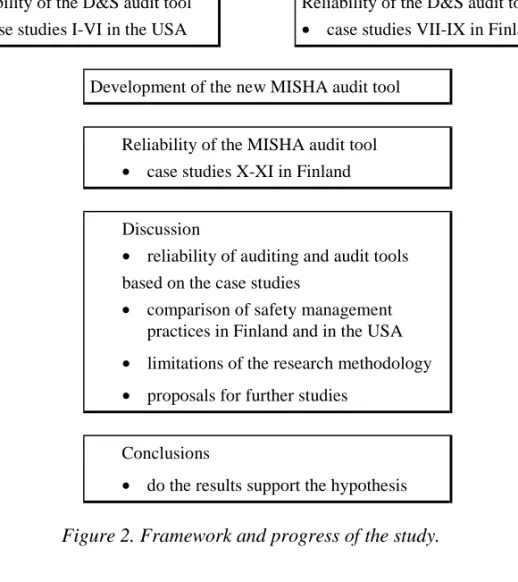
The framework of this study is presented in Figure 2. The theoretical part of the study clarifies first the concept of safety management (Chapter 3). This is followed by a summary of safety audit techniques and a review of the characteristics of some current safety audit tools (Chapter 4).
The materials and methods used in the work are presented in Chapter 5. The material is collected mainly in case studies, carried out in industrial enterprises. In total, eleven case studies were done, Cases I-VI in the USA, and Cases VII-XI in Finland.
Chapter 6 presents the safety activities in Case study companies I-IX. Besides this, it includes the reliability tests of the D&S audit tool. The aim of these tests was: 1) to evaluate the inter-observer reliability of the D&S audit tool, and 2) to evaluate the factors influencing the reliability of the auditors. In Cases I-VI, the author and the companies’ personnel acted as auditors. In Cases VII-IX, the audits were carried out by the author and 19 students of safety engineering. Based on the results of the Case studies I-IX, a new audit tools was developed. The development of the MISHA (Method for Industrial Safety and Health Activity Assessment) is described in Chapter 7. Reliability testing of this new tool was done in two Finnish companies. In the tests, the author and four persons from each of the two companies acted as auditors. These tests are described in Chapter 8.
Discussion on the results of the work is in Chapter 9. This chapter includes summary of the results, evaluation of the problems and limitations of the research methodology, and proposal for further studies in the field.
Conclusions of the work are presented in Chapter 10. In this chapter, it is determined whether the results support the three hypotheses of the work.
Theoretical background • safety management systems • safety audit procedures • safety audit tools Reliability of the D&S audit tool
• case studies I-VI in the USA
Reliability of the D&S audit tool
• case studies VII-IX in Finland Development of the new MISHA audit tool
Reliability of the MISHA audit tool
• case studies X-XI in Finland Discussion
• reliability of auditing and audit tools based on the case studies
• comparison of safety management practices in Finland and in the USA
• limitations of the research methodology
• proposals for further studies Conclusions
• do the results support the hypothesis
3. Safety management systems
3.1 Accident causation models
The most important aim of safety management is to maintain and promote workers’ health and safety at work. Understanding why and how accidents and other unwanted events develop is important when preventive activities are planned. The most common accident causation models are presented in this section.
Accident theories aim to clarify the accident phenomena, and to explain the mechanisms that lead to accidents. All modern theories are based on accident causation models which try to explain the sequence of events that finally produce the loss.
In ancient times, accidents were seen as an act of God and very little could be done to prevent them. In the beginning of the 20th century, it was believed that the poor physical conditions are the root causes of accidents. Safety practitioners concentrated on improving machine guarding, housekeeping, and inspections. One of the first industrial accident causation theories was presented by H.W. Heinrich in 1931. This model is now commonly known as the Domino theory. The new discovery that Heinrich presented was that in most cases an accident is the result of two things: the human act, and the condition of the physical or social environment.
Petersen (1988) extended the causation theory from the individual acts and local conditions to the management system. He concluded that unsafe acts, unsafe conditions, and accidents are all symptoms of something wrong in the organizational management system. Furthermore, he stated that it is the top management who is responsible for building up such a system that can effectively control the hazards associated to the organization’s operation.
The errors done by a single person can be intentional or unintentional. Rasmussen and Jensen (1984) have presented a three-level skill-rule-knowledge model for describing the origins of the different types of human errors.
Nowadays, this model is one of the standard methods in the examination of human errors at work.
Accident-proneness models suggest that some people are more likely to suffer an accident than others. The first model was created in 1919, based on statistical examinations in a munitions factory. This model dominated the safety thinking and research for almost 50 years, and it is still used in some organizations. As a result of this thinking, accident were blamed solely on employees rather than the work process or poor management practices. Since investigations to discover the underlying causal factors were felt unnecessary and/or too costly, a little attention was paid to how accidents actually happened. (Cooper 1998).
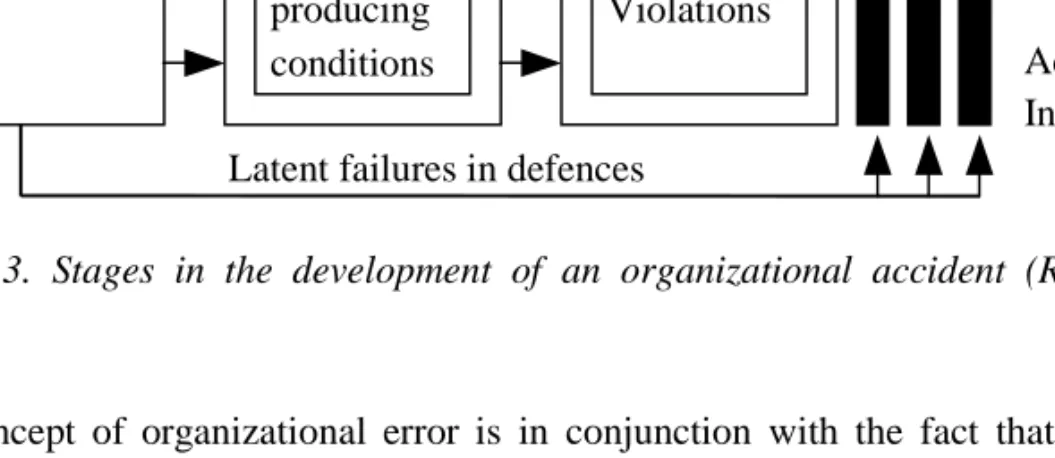
Employees’ attitudes towards risks and risk taking has been studied, e.g. by Sulzer-Azaroff (1987). According to her, employees often behave unsafely, even when they are fully aware of the risks involved. Many research results also show that the traditional promotion methods like campaigns, posters and safety slogans have seldom increased the use of safe work practices. When backed up by other activities such as training, these measures have been somewhat more effective (Smith 1988, Hislop 1993, Glendon & McKenna 1995). Experiences on some successful methods to change employee behavior and attitudes have been reported. One well-known method is a small-group process used for improving housekeeping in industrial workplaces (Komaki 1986, Saarela 1990). A comprehensive model of accident causation has been presented by Reason (1990) who introduced the concept of organizational error. He stated that corporate culture is the starting-point of the accident sequence. Local conditions and human behavior are only contributing factors in the build-up of the undesired event. The latent organizational failures lead to accidents and incidents when penetrating system’s defenses and barriers (Figure 3). Groeneweg (1992) has developed Reason’s model by classifying the typical latent error types. His TRIPOD model calls the different errors as General Failure Types (GFTs).
Figure 3. Stages in the development of an organizational accident (Reason 1994).
The concept of organizational error is in conjunction with the fact that some organizations behave more safely than others. It is often said that these organizations have good safety culture. After the Chernobyl accident, this term became well-known also to the public. The concept of safety culture is discussed more in Section 3.2.1
Loss prevention is a concept that is often used in the context of hazard control in process industry. Lees (1996) has pointed out that loss prevention differs from traditional safety approach in several ways. For example, there is more emphasis on foreseeing hazards and taking actions before accidents occur. Also, there is more emphasis on a systematic rather than a trial and error approach. This is also natural, since accidents in process industry can have catastrophic consequences. Besides the injuries to people, the damage to plant and loss of profit are major concerns in loss prevention.
The future research on the ultimate causes of accidents seem to focus on the functioning and management of the organization. The strategic management, leadership, motivation, and the personnel’s visible and hidden values are some issues that are now under intensive study.
Management decisions and organizational processes producing conditions producing conditions Errors Violations
Latent failures in defences Corporate
culture Local climate
Situation Task Accidents Incidents Defences Barriers
3.2 Safety management as an organizational activity
Safety management is one of the management activities of a company. Different companies have different management practices, and also different ways to control health and safety hazards. Sections 3.2.1-3.2.3 describe how the company culture and development stage can affect safety management. Section 3.2.4 clarifies the connections between safety, environmental, and quality management systems.
3.2.1 Safety culture
Organizational culture is a major component affecting organizational performance and behavior. One comprehensive definition for an organizational culture has been presented by Schein (1985) who has said that organizational culture is “a pattern of basic assumptions – invented, discovered, or developed by a given group as it learns to cope with its problems of external adaptation and internal integration – that has worked well enough to be considered valid and, therefore, to be taught to new members as the correct way to perceive, think, and feel in relation to those problems”.
The concept of safety culture is today under intensive study in industrialized countries. Booth & Lee (1995) have stated that an organization’s safety culture is a subset of the overall organizational culture. This argument, in fact, suggests that a company’s organizational culture also determines the maximum level of safety the company can reach. The ACSNI Human Factors Study Group has suggested the following as a working definition of a safety culture (ACSNI ... 1993):
The safety culture of an organization is the product of individual and group values, attitudes, perceptions, competencies, and patterns of behavior that determine the commitment to, and the style and proficiency of, an organization’s health and safety management. Furthermore, organizations with a positive safety culture are characterized by communications founded on mutual trust, by shared perceptions of the importance of safety, and by confidence in the efficacy of preventive measures.
There have been many attempts to develop methods for measuring safety culture. Williamson et al. (1997) have summarized some of the factors that the various studies have shown to influence organization’s safety culture. These include: organizational responsibility for safety, management attitudes towards safety, management activity in responding to health and safety problems, safety training and promotion, level of risk at the workplace, workers’ involvement in safety, and status of the safety officer and the safety committee.
3.2.2 National differences in safety culture
Organizations behave differently in the different parts of the world. This causes visible differences also in safety activities, both in employee level and in the management level. Reasons for these differences are discussed in the following. The studies of Wobbe (1990) reveal that shop-floor workers in the USA are, in general, less trained and less adaptable than those in Germany or Japan. Wobbe claims that one reason for this is that, in the USA, companies providing further training for their staff can expect to lose these people to the competitors. This is not so common in Europe or in Japan. Furthermore, for unionized companies in the USA, seniority is valued very highly, while training or individual’s skills and qualifications do not effect job security, employment, and wage levels very much.
Oxenburgh (1991) has studied the total costs of absence from work, and found that local culture and legislation has a strong effect on absenteeism rates. For example, the national systems for paying and receiving compensation explains the differences to some extent. Oxenburgh mentions Sweden as a high absenteeism country, and Australia as a low absenteeism country. In Sweden injuries and illnesses are paid by the state social security system, while in Australia, the employer pays all these costs, including illnesses not related to work.
Comparison of accident statistics reveals that there are great national differences in accident frequencies and in the accident related absenteeism from work. Some of the differences can be explained by the different accident reporting systems. For example, in some countries only absenteeism lasting more than three
working days is included in the statistics. (ESAW 2000). The frequency of minor accidents varies a lot according to the possibility to arrange substitutive work to the injured worker. Placing the injured worker to another job or to training is a common practice for example in the USA and in the UK, while in the Scandinavian countries this is a rarely used procedure.
3.2.3 Preconditions for improving safety management
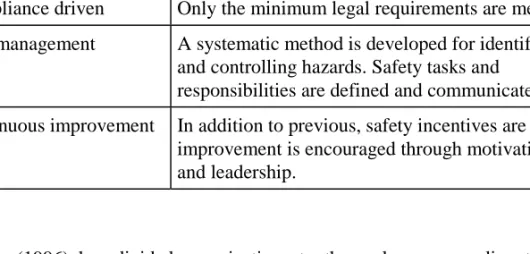
Some organizations are more aware of the importance of health and safety at work than others. Clear development stages can be found in the process of improving the management of safety (Table 1). The table has been derived from the quality improvement model of the Baldrige National Quality Program (Criteria ... 1999).
Table 1. Development stages in the improvement of safety management.
Development stage Typical features
Fire fighter Problems are solved when they arise. Origins of the problems are not analyzed.
Compliance driven Only the minimum legal requirements are met. Risk management A systematic method is developed for identifying
and controlling hazards. Safety tasks and responsibilities are defined and communicated. Continuous improvement In addition to previous, safety incentives are used,
improvement is encouraged through motivation and leadership.
Waring (1996) has divided organizations to three classes according to their maturity and ability to create an effective safety management system. Waring calls the three organizational models as the mechanical model, the
socio-technical model, and the human activity system approach.
In the mechanical model, the structures and processes of an organization are well-defined and logical, but people as individuals, groups, and the whole
organizations are not considered. The socio-technical model is an approach to work design which recognizes the interaction of technology and people, and which produces work systems that are technically effective and have characters that lead to high job satisfaction. A positive dimension in this model is that human factors are seen important, for example, in communication, training and emergency responses. The last model, the human activity system approach focuses on people, and points out the complexity of organizations. The strength of this approach is that both formal (or technical) paradigms and human aspects like motivation, learning, culture, and power relations are considered. Waring points out that although the human activity approach does not automatically guarantee success, it has proven to be beneficial to organizations in the long run.
3.2.4 Integration of safety to other management activities
Safety management has many similarities to quality management and environmental management. The connections between these different management systems have been widely discussed since early 1990s. The British Standard BS 8800 (1996), presents links between safety management activities, and activities included in the ISO 9001 quality standard and in the ISO 14001 (1996) environmental management standard. Weinstein (1996) has presented how the TQM development steps can be applied to the development of a safety management system. He has also outlined some of the safety activities that should be carried out to meet the ISO 9000 quality standard requirements. Waring (1996) has listed some reasons why the integration of quality and safety can be difficult to achieve. According to him, one reason is that there can be confusion about the scope and practical requirements of these two systems. Secondly, safety is covered by a great deal of detailed legislation requiring specific management and technical systems, and many of these management systems are mandatory. Contrary to this, quality systems are voluntary and not inspected by authorities. Finally, there can be conflicting professional ambitions between the people managing these activities – causing the control of integration to become a power struggle which detracts from the actual aim.
It has also been argued that the adoption of a quality management system will not automatically lead to high standards of health and safety. For example, the
use of quality standards can lead to the manufacture of safe products, but not necessarily to production processes that are adequately free from health and safety hazards (Successful ... 1997). This is also a fundamental difference between the quality management systems which aim to ensure sufficient quality of products, and the continuous improvement programs which aim to improve the overall performance of the company.
Since mid-1990s, the central management trend has been to develop comprehensive management systems that include both improvement of products and internal activities. The Kaizen philosophy (Imai 1986, Suzaki 1989) and Malcolm Baldrige Quality Award (Criteria for ... 1999) are examples of these methodologies. Besides these, Balanced Scorecard (Kaplan & Norton 1992) is a company strategy development and performance measurement tool that can also include safety elements.
3.3 Key functions of a safety management system
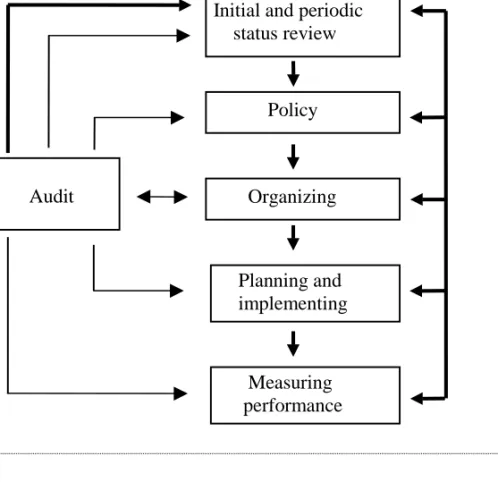
Effective control of health and safety requires planned activities in the organization. Together these activities form the safety management system. One of the latest safety management system models is presented in the British Standard BS 8800 (1996). It presents both the steps for creating a safety management system and methods for organizing the safety activities in practice. According to the BS 8800 standard, the main development steps are: 1) initial and periodic status review, 2) preparation of the safety policy, 3) organizing of the activities, 4) planning and implementation, 5) measurement of the performance, and 6) auditing (Figure 4).
Booth & Lee (1995) have defined the key functions of safety management as follows:
1. Policy and planning,
2. Organization and communication, 3. Hazard management,
4. Monitoring and review.
In this model, the policy and planning includes setting of the safety goals, determination of the safety objectives and priorities, and preparation of the
working program to achieve the objectives. Organization and communication includes, among others, the determination of responsibilities, and the establishment of a two-way communication system to all organizational levels.
Hazard management includes the determination and implementation of the
methods for hazard identification, risk assessment, and control measures. The suitability of these methods should then be evaluated on a regular basis. Finally,
monitoring and review ensures that the steps 1-3 are in place, in use, and work in
practice.
Figure 4. Elements of a safety management system (BS 8800 1996).
External factors
Internal factors
Initial and periodic status review Policy Organizing Planning and implementing Measuring performance Audit
The elements of the Booth & Lee model are similar to those presented in the BS 8800 model. They both have the following basic activities: policy making, organizing the activities, planning and implementing the activities, and measuring the performance. These activities are discussed more detailed in Sections 3.4-3.7. The subject of Section 3.4 is safety policy and planning, and the subject of Section 3.5 is organization and communication. Hazard management is discussed in Section 3.5, and monitoring and review is discussed in Section 3.7.
3.4 Safety policy and planning
INITIAL STATUS REVIEW
A status review is the basis for a safety policy and the planning of safety activities. The review should answer to the question “where are we know?”. According to BS 8800 (1996) a status review should compare the company’s existing arrangements with the applicable legal requirements, organization’s current safety guidelines, best practices in the industry’s branch, and the existing resources directed to safety activities. A thorough review ensures that the safety policy and the activities are developed specifically according to the needs of the company.
SAFETY POLICY
A safety policy is the management’s expression of the direction to be followed in the organization. According to Petersen (1989), a safety policy should commit the management at all levels and it should indicate which tasks, responsibilities and decisions are left to lower-level management. Booth and Lee (1995) have stated that a safety policy should also include safety goals as well as quantified objectives and priorities.
The standard BS 8800 (1996) suggests that in the safety policy, management should show commitment to the following subjects:
− health and safety are recognized as an integral part of business performance, − a high level of health and safety performance is a goal which is achieved by
using the legal requirements as the minimum, and where the continual cost-effective improvement of performance is the way to do things,
− adequate and appropriate resources are provided to implement the safety policy,
− the health and safety objectives are set and published at least by internal notification,
− the management of health and safety is a prime responsibility of the management, from the most senior executive to the supervisory level,
− the policy is understood, implemented, and maintained at all levels in the organization,
− employees are involved and consulted in order to gain commitment to the policy and its implementation,
− the policy and the management system are reviewed periodically, and the compliance of the policy is audited on a regular basis,
− it is ensured that employees receive appropriate training, and are competent to carry out their duties and responsibilities.
Some companies have developed so-called “safety principles” which cover the key areas of the company’s safety policy. These principles are utilized as safety guidelines that are easy to remember, and which are often placed on wall-boards and other public areas in the company. As an example, the DuPont company’s safety principles are the following (Scott 1993):
1. All injuries and occupational illnesses can be prevented. 2. Management is responsible for safety.
3. Safety is an individual’s responsibility and a condition of employment. 4. Training is an essential element for safe workplaces.
5. Audits must be conducted.
6. All deficiencies must be corrected promptly.
7. It is essential to investigate all injuries and incidents with injury potential. 8. Off-the job safety is an important part of the safety effort.
9. It is good business to prevent injuries and illnesses.
10. People are the most important element of the safety and occupational health program.
PLANNING OF SAFETY ACTIVITIES
The safety policy should be put into practice through careful planning of the safety activities. Planning means determination of the safety objectives and priorities, and preparation of the working program to achieve the goals. A company can have different objectives and priorities according to the nature of
the typical hazards, and the current status of hazard control. However, some common elements to a safety activity planning can be found. According to BS 8800 (1996) Annex C the plan should include:
− appropriate and adequately resourced arrangements, competent personnel who have defined responsibilities, and effective channels of communication, − procedures to set objectives, device and implement plans to meet the
objectives, and to monitor both the implementation and effectiveness of the plans,
− description of the hazard identification and assessment activities,
− methods and techniques for measuring safety performance, and in such way that absence of hazardous events is not seen as evidence that all is well. In the Member States of the European Union, the “framework” Directive 89/391/EEC (1989) obligates the employer to prepare a safety program that defines how the effects of technology, work methods, working conditions, social relationships and work environment are controlled. According to Walters (1996), this directive was originally passed to harmonize the overall safety strategies within the Member States, and to establish a common approach to the management and organization of safety at work.
Planning of the safety activities is often done within the framework of quality and environmental management systems. Integration of SHEQ (safety, health, environmental, and quality) management systems was discussed more detailed in Section 3.2.4.
3.5 Organization and communication
Safety policy and safety plan set the framework for health and safety activities. Organizing the activities means that clear tasks and responsibilities are determined to all hierarchical levels, from top management to every employee. Besides this, organization’s safety related decisions and desires must be effectively communicated to the personnel. These two issues are discussed in this section.
3.5.1 Safety tasks and responsibilities
Line managers, supervisors, and the safety experts are usually those who are responsible for putting the safety policy and plan into practice. The roles of the different personnel groups must be clear before the activities can be realized. Small and medium-sized enterprises (SMEs) are often in different situation compared to large-scale companies. SMEs can seldom employ trained health and safety experts, such as a full-time safety manager or medical personnel. In such a case, it is beneficial if the person responsible for organizing the safety activities knows how to utilize external services provided, for example, by the insurance companies or safety authorities.
National legislation often obligates companies to build up certain types of formal safety organizations, safety practices and safety documentation. However, most safety activities can be defined by the company itself. The key activities of the various personnel groups are discussed in the following.
ROLE OF THE TOP MANAGEMENT
The top management is a person or a group of persons who plan the company’s strategies and determine the company’s long-term goals. Organizational culture and safety culture are both strongly influenced by the top management. Thus, it can be said that top management is eventually responsible also for the defects in the organization’s safety performance. Heinrich et al. (1980) have summarized this by saying that organizational failures are caused by management which allow human failures – due to knowledge, attitude, fitness, or ability – to take place. These failures then cause or permit unsafe acts, and contribute to unsafe mechanical and physical conditions.
The top management’s task is to control the health and safety hazard by establishing the management system, by planning how it is implemented, and by following the outcomes of the system. For this, the top management must set up a safety policy and follow its implementation. By monitoring the activities and performance, top management can follow how the predetermined criteria have been realized, and set the new goals. (Petersen 1989, Smith 1988, Hislop 1993)
ROLE OF THE LINE MANAGER
In industrial companies, line managers typically have positions like a production manager or a quality engineer. Petersen (1989) claims that the line manager is more a key person in safety than the supervisor. He defines line management’s most important safety activities as: 1) ensuring supervisor performance, 2) ensuring the quality of supervisor performance, and 3) participating personally to show visible commitment.
Ensuring supervisor performance means that the line management provides the necessary resources and support to the supervisor (Petersen 1989). For motivating the supervisor to continuously work for better safety results, the line manager should build an incentive system (Hislop 1993). Safety performance can also be used as a measure of the supervisor’s management capability (Petersen 1989). ROLE OF THE SUPERVISOR
Supervisor is often in a very demanding position in the organization. Supervisor has to be a good organizer, a talented strategic manager, a leader of the personnel, and an expert in many practical questions, including safety issues. Leadership is a characteristic that is usually seen as essential in a supervisor’s work. Supervisor is the person who is in close contact to the workers in everyday work. Thus, the supervisor is also one of the most important individuals in the organization’s hierarchical structure in terms of promoting safe work practices (Hislop 1993).
Many supervisors act today as team leaders. In a team, the supervisor can use less time for controlling the work, and more time is used for planning the work, allocating resources, exploring new innovations, and motivating the team members. According to Tjosvold (1991), good social skills is a central qualification that every team leader should have.
ROLE OF THE DESIGNER
Health and safety considerations are often inadequate when work, workplaces and production processes are designed. According to Lund et al. (1993), the three major factors that influence any design process are time constraints, technical feasibility considerations, and financial and economic considerations. Several studies have shown that it is actually the expertise, training and values of
an individual designer that determine to what extent safety and health is taken into account in the design process. (Main & Ward 1992, Isotalus & Kuusisto 1992, Haslegrave & Holmes 1994)
Clemens (1999) calls the traditional design process as serial design. In this process, the system design is executed by one group of specialists, and after that another group evaluates the operational risks these designs pose. An alternate concurrent
engineering approach lets the designer conduct safety and reliability analyses as
parallel activities, and they can accompany the design throughout the design progression. Other benefits of this concurrent approach are that the resulting design can be realized on an earlier schedule, and less man-hours are needed because potential shortcomings are identified and addressed as they are encountered.
Participation in design means that the design process, or at least part of it is performed in groups composed of employees, management and designers. The idea of participatory design is based on earlier, mainly Japanese, production development methods like production cells, teamwork, just-in-time, Kanban, and quality-circles (Noro 1991).
The designer’s responsibility to carry out adequate health and safety considerations is now written in legislation in many countries. Partly due to this, the quantity of standards, handbooks and other guidelines on how to improve safety in design has increased. As an example, the basic concepts and general principles for safety in the design of machinery are presented in the European standard EN 292-1 (1991).
ROLE OF THE SAFETY PERSONNEL
The safety personnel consists usually of a safety manager, and a safety
representative (or safety delegate). The safety manager is usually a line
management level person appointed by the employer, while the representative is elected from amongst and by the employees. In small and medium-sized companies, the safety manager and the safety representative often have other duties besides their health and safety tasks.
Typically, the safety manager’s role is to act as an expert who is aware of the health and safety legislation and other obligations concerning the company. Denton (1982) has summarized the safety manager’s duties as follows: to
promote health and safety activities, to control training needs and incentives for safe performance, to improve performance evaluation, and to increase the status and recognition of the safety function. Besides this, safety manager as an internal expert should be aware of the appropriate risk analysis methods.
In some countries, national legislation gives the employees – in certain circumstances – the possibility to elect a safety representative. In Finland, the safety representative’s tasks and responsibilities are determined in the Occupational Safety Act (Työturvallisuuslaki 1993). The representative’s main task is to follow the status of safety at the workplace, and to report to the management on potential health and safety hazards. A safety representative can stop a work that includes an obvious and immediate health danger, but otherwise the representative’s enforcement power is very limited.
The safety personnel are often in a very difficult position in a company. For example, the safety manager’s ability to access top management is not self-evident. Ferry (1987) has found that, regardless of the expertise and efforts, safety experts are often unable to get support for safety and health policies and programs. Lark (1991) has stated that the lack of safety personnel’s power is partly the fault of the safety personnel themselves. According to Lark, safety must be sold to the management and the personnel. This in turn means that safety professionals need to be safety leaders who are able to apply modern leadership concepts to safety activities.
ROLE OF THE SAFETY COMMITTEES
Company-level organizations which carry out consultation and decision-making on occupational health and safety are common in most European countries (Walters 1996). Often these cooperative organizations are called safety
committees. Some countries also have legislative provisions that create safety
committees or other corresponding institutions at the workplace.
In Finland, a workplace having 20 or more employees should establish a safety committee or some other cooperative safety organization. Half of the committee members must represent the employees, and the other half the employer. The committee should prepare an annual action plan, evaluate the needs for internal safety inspections, assess the company’s safety policy, and make suggestions for how the company’s safety training and safety communication procedures should