Chapter Two
FLORIDA CASE STUDY
Burt Barnow, Johns Hopkins University
Amy MacDonald Buck, Johns Hopkins University
1Section I. Background Information and Issues
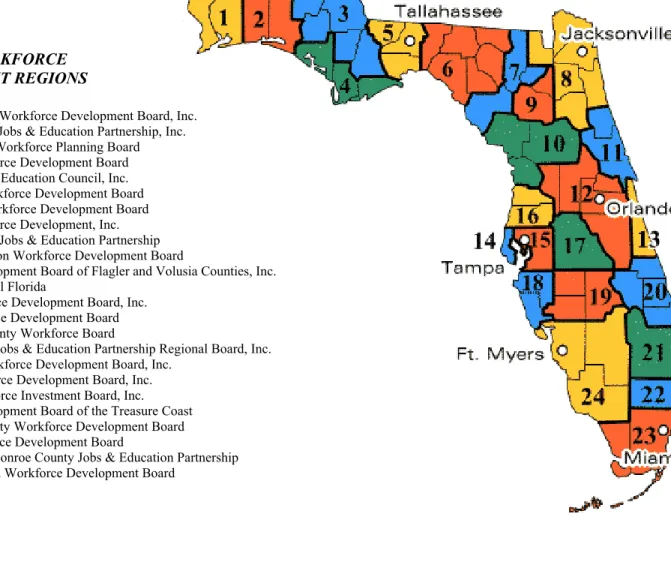
Florida has long been a highly innovative state in developing and implementing workforce development policy. The state has 24 workforce investment areas, which are referred to as Regional Workforce Boards (RWBs). See Appendix A, Figure 1 for a map of Florida’s areas. The local boards are responsible for planning and operating all
workforce development programs in the local areas, which in Florida extend beyond the Workforce Investment Act (WIA) Title I programs for adults, youth, and dislocated workers. Local Florida boards are also responsible for federally funded programs such as employment and training for welfare recipients, labor exchange services provided by the Employment Service, Welfare-to-Work services, and Food Stamp Employment and Training. Although Employment Service employees are state merit staff employees, they report to the head of the One-Stop Career Centers and receive direct supervision from Employment Service managers according to federal requirements at 20 CFR 652.216. See Appendix B for the One-Stop Career Center presence and lead state agency for Florida’s workforce development programs.
State legislation and leadership, especially in 1996 and 2000, have been the principal catalysts to progress in workforce development in Florida. Particularly noteworthy is that the state legislature decided to vest responsibility for WIA, Wagner-Peyser Act, Temporary Assistance for Needy Families (TANF), Veterans' Employment and Training, Food Stamp Employment and Training, Welfare-to-Work, and Job Corps recruitment directly under the local workforce development boards. Workforce
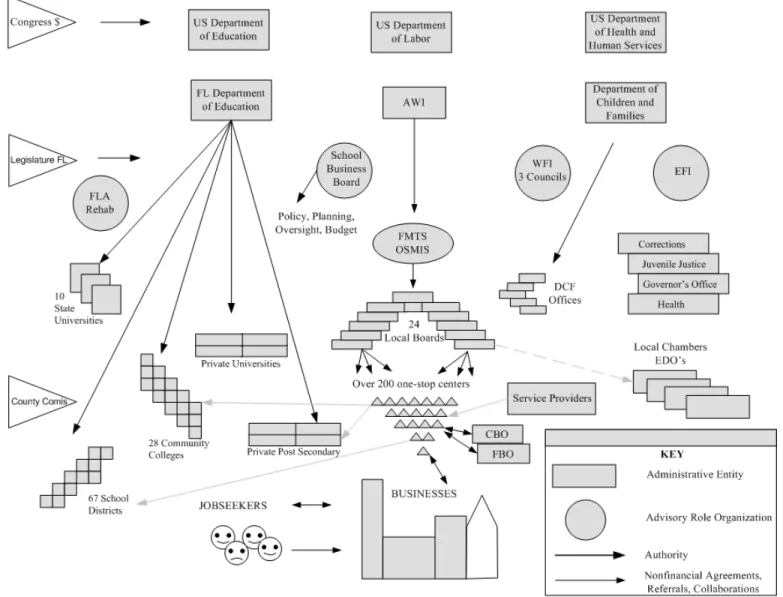
initiatives have been strongly driven by the leadership of elected officials in the legislature, consensus among workforce professionals, economic development organizations, and business leaders. See Appendix A, Figure 2 for an organizational chart of Florida’s workforce development system.
In 1996, the U.S. Department of Labor (U.S. DOL) awarded Florida a federal One-Stop early implementation grant. The majority of those funds were used to issue planning and implementation grants to local boards through a competitive process to develop their local systems. Florida received its last allocation of the three-year grant in
July 1999. Receiving funding to support the early implementation of One-Stop Career Centers helped local boards innovate in their planning process.
The chief policy organization for workforce development in Florida is Workforce Florida, Inc. (WFI), a quasi-public nonprofit organization, which serves as the state Workforce Investment Board. WFI was created by the Workforce Innovation Act of 2000 from the Workforce Division of Enterprise Florida, Inc. and the State WAGES (Work and Gain Economic Self-Sufficiency) Board, which was responsible for workforce development activities for TANF recipients. The act consolidated policy authority over all workforce related programs under WFI, and reduced the 2000 administrative budget for workforce programs by $1.4 million.
WFI has three statutorily established councils that focus on key segments of the workforce:
• First Jobs/First Wages Council promotes successful entry into the workforce through education and job experience; this council also deals with youth and adults entering the workforce for the first time;
• Better Jobs/Better WagesCouncil assists families making the transition from welfare to work and former welfare recipients working in low-wage jobs with little mobility to attain better positions; and
• High Skills/High Wages Council is involved in education and training efforts intended to place workers in high paying, high skill jobs and to attract and expand employers that hire these types of workers.
Since July 1999, Florida law has required that each local board maintain a
business-led High Skills/High Wages Committee. This committee focuses on making the workforce system more responsive to business needs. Local High Skills/High Wages Committees recommend policy actions to the state board and legislature and facilitate collaboration among businesses, economic development representatives, and training providers.2 The Workforce Innovation Act of 2000 requires that each local High Skills/High Wages Committee contains at least five private-sector business
representatives appointed by local chambers of commerce in consultation with the primary county economic development organization in the region; a representative of each primary county economic development organization within the region; the local board chair; the presidents of all community colleges within the region; those district school superintendents who conduct postsecondary educational programs within the region; and two representatives from nonpublic postsecondary educational institutions that are authorized to provide Individual Training Accounts (ITAs). The business
representatives on the committee need not be members of the local board and are required to represent local industries of primary importance to the local economy.3
Constraints to progress in workforce development include institutional inertia, some local political conflict, limited funds, state level reorganization, and a number of
federal restrictions on the use of WIA and Wagner-Peyser Act funds. Federal restrictions of particular concern to the state include the fact that Wagner-Peyser Act employees are required to be part of the state merit plan and limits on how often and how much WIA money can be moved across programs and geographical areas.4 In addition, the state would like the federal government to permit local boards to establish escrow scholarship accounts for ITAs, as the U.S. Department of Health and Human Services allows for the major federal welfare program.
Florida has a strong tradition of state and local collaboration, although there has been some tension over control issues. For example, several local boards are strongly resisting the state board’s efforts to “brand” the One-Stop Career Centers.
WFI states on its website that it “supports and promotes economic growth through workforce development.” WFI staff characterizes current state and local policy as
focusing on economic development and serving businesses first. By enhancing economic development, the state is confident that it will make jobs available and raise the skills of the workforce. For TANF recipients in particular, who receive employment and training services exclusively through the One-Stop delivery system, there is a strong “work first,” labor market attachment focus. The state promotes incumbent worker training, but not to the exclusion of the unemployed.5 Florida uses state-level WIA dollars and general funds to competitively fund employers for incumbent worker training.
The Agency for Workforce Innovation (AWI) is the state agency that administers the WIA program in Florida. AWI was created in 2000 by the legislature to consolidate administration of workforce programs, and it operates under a performance contract with WFI. Previously, most workforce development programs were administered by the Department of Labor and Employment Security (DLES), and a few of the programs administered by DLES were not transferred to AWI, e.g., vocational rehabilitation was transferred to the Department of Education, and regulation of farm labor and trade unions was transferred to the Department of Business and Professional Regulation.
In terms of the focus between the workforce and business, the state plan addresses both constituencies. The state’s vision is “Florida will develop a globally competitive workforce,” and the mission states that “Florida will develop the state business climate by designing and implementing strategies that help Floridians enter, remain in, and advance in the workplace, becoming more highly skilled and successful, benefiting businesses and the entire state.”6 The state plan also presents a number of goals that reflect a dual focus on workforce and business:
• Provide to every citizen universal and user-friendly access to the state’s workforce development programs and services;
• Foster and encourage participation of small, rural, and urban inner city business in development of workforce services to meet their needs for skilled workers;
• Coordinate and consolidate workforce resources to ensure maximum performance and accountability of resources, and provide a single point of access to accurate and timely information to all citizens; and
• Through collaborative partnerships with workforce partners and stakeholders, design workforce strategies and programs that meet the needs of Florida’s diverse regions.7
AWI staff indicated that employers are the centerpiece of the system, but, in early implementation, focus remained on the flow of job seeker services. Now there is a growing awareness that the system needs to refocus again on business because economic development is an important focus of state policy. For example, the team that analyzes and disseminates labor market information for the state recently initiated a series of focus group sessions with business leaders to try to better orient their product for business.
Florida has embraced the core principles in WIA, and, in some instances, the state has carried the principles enunciated in WIA farther than the federal statute requires. For example, Florida initiated legislation and policies on workforce development
consolidation prior to federal statute (see Appendix C for a brief timeline of state legislation and policy changes); in addition, the state has (unsuccessfully) asked for permission to have Wagner-Peyser Act funded employees hired by local workforce boards rather than under the authority of a state merit staffing system.8 The state has also carried the concept of consolidation farther than required by WIA by giving local boards authority over a number of workforce development programs.
Section II. Leadership and Governance A. Leadership
The legislature has played a major leadership role in Florida. In 2000, the Florida legislature consolidated the funding streams of TANF, WIA, Wagner-Peyser Act, Food Stamp Employment and Training, Welfare-to-Work, Veterans’ Employment and Training Services, and Job Corps outreach in Senate Bill 2050. In the same year, the state placed all Employment Service employees under the day-to-day supervision of local boards. The state legislature also provided strong leadership in establishing many performance standards beyond those required by the federal government for workforce development programs. Finally, the legislature enacted other important initiatives: it established a WIA-funded $2 million incumbent worker program, set a 50 percent individual training account (ITA) expenditure target, and specified additional required members for state and local boards (such as union representatives).
In 2000, Governor Jeb Bush selected a key player in creating Florida’s welfare reform and workforce legislation to serve as the charter chair of WFI. Prior to becoming WFI’s chair, this individual had created a Senate Select Committee to evaluate
listening to presentations from over 100 individuals and organizations, identified the following eight key concerns:
1. The workforce system and the state’s economic development strategy are disconnected;
2. Too few workers have technical skills to meet employer needs;
3. Entry level workers lack necessary literacy levels and work readiness skills to meet the needs of Florida’s employers;
4. Families transitioning from welfare to work have joined the state’s working poor; 5. Employers must have access to training programs that enhance the skills of their current workforce;
6. Small businesses, which have traditionally offered job opportunities for first time wage earners, have limited resources to devote to human resource programs;
7. Administrative entities and responsibilities overlap; and 8. Workforce programs and services are fragmented.9
At the inaugural meeting of WFI, the chair challenged the newly created state board to develop strategies to train at least 3,000 Floridians for better paying jobs within six months.10 Specifically, the chair charged each of the WFI’s three workforce councils to meet a particular challenge in partnership with their partner committees at the local level. The chair urged the High Skills/High Wages Council to rapidly train 1,000
information technology professionals to attain industry certification such as those offered by Microsoft, Oracle, and Cisco Systems. Similarly, the chair challenged the Better Jobs/Better Wages Council to rapidly train 1,000 employed former cash assistance
recipients to facilitate career advancement to allow them to be self-sufficient. Finally, the chair charged the First Jobs/ First Wages Council to identify opportunities to place 1,000 Florida youth in unsubsidized after-school programs. Each council exceeded their targets.11
Council members reported that the challenge provided a catalyst for action and cooperation between the state council and local committees. The initial chair of the High Skills/High Wages Council praised the opportunity to focus jointly on workforce and economic development issues, “This represents a great example of our ability to
strengthen the critical linkage between workforce and economic development efforts to grow our state’s economy.”12
Although the principal source of innovation in Florida has been the legislative branch, the governor’s office has been very cooperative and supportive of the state board during WIA implementation. Support from the governor’s office continued when the
party in the statehouse shifted from Democrat to Republican. There has been no great change since initial implementation in the level of interest the governor’s office has shown.
Key administrators at AWI, the agency that serves as the administrative/fiscal entity under contract with WFI, have provided extensive leadership in the arena of workforce development. In addition, key administrators from other state agencies, such as the Department for Children and Families, which is responsible for the TANF program except for workforce development, have provided leadership through membership on the state board and through partnership agreements.
WFI, the state Workforce Investment Board, has provided extensive leadership, particularly in policy development. For example, the state board was instrumental in deciding to apply for early WIA implementation status. The legislature granted the board overall statutory authority over workforce policy, planning, and accountability.
Economic development organizations have also helped to promote WIA implementation by serving on state and local boards and serving on High Skills/High Wages Council and the corresponding local committees. In the late 1980s and early 1990s, the Florida Chamber of Commerce mobilized Florida’s business community to focus attention on viable economic development strategies, including workforce development. The Chamber’s 1989 Cornerstone Report served as an early catalyst for reforming Florida’s economic development and workforce systems. In November 2001, WFI and the Florida chamber partnered to host a new Cornerstone Summit to address the major challenges facing Florida in preparing youth with the education, skills, and training necessary to succeed in the workforce.13 WFI and the chamber also partnered to host focus groups around the state to bring together education, workforce, economic development, and business partners to develop strategies and initiatives to align state policy, recommend legislation, and build consensus on youth issues.14 Though relations between WFI and economic development organizations are collaborative and have led to new initiatives, economic development organizations have not been as important in providing policy leadership at the state level as the legislature, WFI, and AWI.
B. Intergovernmental Relations
Since implementation of the Job Training Partnership Act (JTPA), the state has enjoyed increased authority over accountability and performance for local boards, but decreased authority over the process, methods, and providers of services. Local boards have statutory authority over TANF employment and training and most other workforce related programs, along with the related funding. State officials note a continued trend towards greater decentralization, but with strict accountability for outcomes and financial consequences.
First Coast Workforce Development Board
First Coast Workforce Development Board (Region 8) is the regional workforce development board (RWB) for Duval, Baker, Clay, Putnam, Nassau, and St. Johns counties of Florida, which includes the city of Jacksonville. The board is a nonprofit organization. A consortium of three partners jointly runs One-Stop Career Centers with significant input from RWB staff. The consortium competitively selects a contractor to hire key staff. Key characteristics of this RWB stem from the Florida legislature’s statute enacted in FY 2000 to consolidate the funding streams of TANF, WIA, Wagner-Peyser Act, Food Stamps
Employment and Training, Veterans’ Services, and Job Corps at the local level. Because the regional workforce development board controls these multiple funding streams, its One-Stop Career Centers are able to provide services to individuals eligible under different funding streams more easily and with fewer coordination and duplication of effort problems.
Another key feature of First Coast Workforce Development Board is its organization model. The board has adopted the Carver Governance Policy Model
(http://www.carvergovernance.com) and has structured itself so that the board focuses exclusively on broad policy decisions. Aside from setting general parameters for its staff, the board relies upon its 33 person staff to make all day-to-day managerial decisions about how to manage the One-Stop Career Centers.
The board’s policy focus sets it apart from many other regional boards, both within and outside of Florida. First Coast Workforce Development unequivocally sees business as its primary customer. The board believes that only by enhancing economic development opportunities and enticing employers to invest in the workforce can individuals’ employment opportunities improve. The regional workforce investment board focuses on its business customers by providing three tiers of services to employers and by helping facilitate incumbent worker training that meets the needs of businesses. The board believes that incumbent worker training enhances economic development by offering valuable training services to business and advances the earnings potential of some workers while opening up more entry level positions as trained workers advance; consequently, the board would like to move toward providing training only to incumbent workers. The board’s close and collaborative ties to local and regional economic development entities have helped further its goals to focus on business and to upgrade worker skills.
Finally, the board funds a contractor to gather detailed labor market information every year. The board disseminates this information to job seekers and employers through its website. Based on this labor market information, the board targets many of its training efforts to meet the employment needs of high demand, high wage industries within the region.
The U.S. DOL regional office serves as the federal management arm for WIA grant administration. Its functions include both monitoring and technical assistance. The regional office monitors the grantees to assure compliance with grant provisions for administration and fiscal matters. The regional office deals first with the states, but they also work with local programs to make sure that laws and regulations are properly administered at the local level. The regional office provides technical assistance at state conferences and workshops, often at the request of the states. In particular, the regional office offered technical assistance on the role of local boards during the early days of WIA implementation.15
One source of concern is that several substantive statewide waiver requests to U.S. DOL were denied. In particular, the state has tried several times to obtain
permission to devolve Wagner-Peyser Act funds, activities, and hiring to local boards, and the state has also asked the federal government for permission to reallocate funds more often than is currently permitted by the U.S. DOL.16
CLM Workforce Connection
The regional workforce development board for Citrus, Levy, and Marion counties of Florida (Region 10), is referred to as the CLM Workforce Connection or CLM. This region consists of three largely rural counties in the central part of the state, with Ocala the largest city. Some of CLM’s distinguishing features stem from the Florida legislature’s consolidation of major workforce development funding streams.
The One-Stop Career Centers in Region 10 are operated by a nonprofit corporation established to run the centers. One-Stop Career Centers in Region 10 are tailored to serve different types of customers. For example, there are “full service” centers that serve universal job seekers, welfare clients, and displaced workers at the site of the former unemployment insurance office. The board also maintains a new One-Stop Career Center with the look of a temporary employee agency targeted at “professionals” in a strip mall and only offers core services on-site. This center has evening and
weekend hours to better meet the needs of employed workers searching for a better job. Other One-Stop Career Centers are located in a mall kiosk, at an affordable housing site, at a county government building, and at a community college.
Collaboration is a major focus of CLM. Every board member, person on the staff, business owner, and service provider we interviewed mentioned the board’s dedication to fostering collaboration among the board, the community college, and vocational educational facility, economic development corporations, and the juvenile justice system.
CLM partners with the local school boards in two innovative programs. In one of these programs, the board financed two alternative educational options for youth who chose to leave the traditional educational path so they could earn a high school degree. The board also provides 34 mini-computer labs for career planning in local high schools that both WIA-eligible and non-eligible youth access.
CLM also partners with a community development corporation (CDC) to run a training program with Dollar General, a national retail chain. The CDC staffs the Dollar General exclusively with welfare employment and training customers who are trained on-site for several months before graduating from the program.
The regional workforce investment board has also collaborated with private temporary staffing agencies that originally were very antagonistic to the workforce investment system. At least once a week an employee of a local temporary staffing agency interviews and hires WIA clients on-site at a One Stop Career Center.
Finally, to ensure the level of service the One-Stop Career Centers provide is consistently high, the regional workforce investment board instituted a “mystery shopper” practice. Periodically, non-WIA customers enter One-Stop Career Centers, pretend to need WIA services, and document the quality of the help they receive.
C. Governance and Decentralization
Florida has increasingly decentralized authority for developing its workforce system. For example, the state has requested a waiver to allow Wagner-Peyser Act funded services to be provided by local staff rather than by state merit staff. State board members believe that the relationship between state and local control of workforce policy direction is balanced, but that there is some tension over control. For example, the state retains authority over the chartering of local boards; distributing most funds other than WIA formula pass-through dollars; and setting minimum standards for One-Stop Career Centers, eligible training providers, and programs. Local boards have significant flexibility within those parameters, including oversight of local governance structure, selection of providers, local accountability, and contracting processes. Although not generally an important issue, tensions sometimes arose when local desires conflicted with state policies. One example, described below, is that local boards have resisted state efforts to “brand” One Stop Career Centers with a common name throughout the state.
The state WIB was initially grandfathered in 1999, but new appointments were made in 2000. Members of the legislature may make an unlimited number of
nominations to the governor for membership. The terms of these “new” appointees technically expired as of June 2002, but under state law the incumbents retain authority until replaced by new appointments. Reappointments and new appointments will be made imminently. State law requires that the state board includes at least one member who represents the licensed nonpublic postsecondary educational institutions authorized as ITA providers. One member must be from the staffing service industry. Private sector representatives must constitute a majority of board membership, but those representatives of business appointed to the board may not provide workforce services, and at least half of the business appointments must represent small businesses. Finally, five organized labor representatives are required. The governor considers minority, gender, and
geographical representation when appointing representatives to the board. The full state board meets four times per year.
Many local boards were initially grandfathered in 1999, but some changes were made because they were required to conform to 2000 state legislation changes. The local boards are being monitored to assure compliance.
Organized labor has often served as the “loyal opposition” or counterpoint on many issues. For example, organized labor has historically objected to “privatization” and decentralizing the employment of Wagner-Peyser Act employees. However, organized labor has provided valuable links to apprenticeship programs, particularly at the local level.
Educators have contributed to state and local boards through membership on the state and local boards and by serving as staff to local boards, administrative/fiscal agents, One-Stop Career Center operators, and partners in special initiatives such as Operation Paycheck (described below).17 Florida’s educational system does not perfectly
universities, 28 community colleges, and 67 school districts, as well as private
universities and private postsecondary institutions do collaborate with the 24 local boards and with One-Stop Career Centers.
Governors have supported local empowerment and flexibility for workforce development programs. Even with a change from the Chiles (democrat) to Bush (republican) administration in the late 1990s, the administrative preference for local flexibility and power has not noticeably changed. The governor has allocated incentive bonuses to influence local board policies and initiatives. The state board uses both long term and short term incentive payments to local Workforce Investment Boards, using WIA, TANF, and Wagner-Peyser Act funds.
State boards have documented a significant performance gain over three years in both long term (e.g., WIA standards) and their short term measures (discussed later in this report).
Section III. Workforce System Planning A. State Strategic Planning
Major contributors to the state five-year strategic plan included the WIA design committee of WFI (the state WIB); the 24 local boards; other state agencies, particularly the Department of Education and the Department of Children and Families; and
legislative staff. Public workshops also provided important input.
The WIA planning process varies for Title I youth, adult, and dislocated worker programs. Most planning is channeled through WFI’s three standing councils that focus on high skills/high wages (mainly adult and displaced workers), better jobs/better wages (mainly low-income adults and TANF recipients), and first jobs/first wages (mainly youth). WFI also prepares an additional, more comprehensive annual “workforce
strategic plan” as required by state legislation. That plan incorporates WIA elements, but it also encompasses all programs under WFI’s authority and addresses policy, planning, accountability, and responsibility issues, with a strong emphasis on economic
development strategies.
The state submitted a unified plan in the sense that it covers all WIA Title I programs, Wagner-Peyser Act programs, the related U.S. DOL special programs such as the Work Opportunity Tax Credit (WOTC), Trade Adjustment Assistance (TAA), Job Corps, Veterans’ Employment and Training programs, etc. It does not include the WIA Title II programs for adult education, vocational rehabilitation, or TANF. Separate plans for Perkins (vocational education), vocational rehabilitation, and TANF are still prepared and submitted respectively to the U.S. Department of Education and U.S. Department of Health and Human Services, but they are coordinated with the AWI and WFI for
compatibility with the five-year WIA plan. Currently, there is no plan to unify further in a way that would require more complex, formal multi-agency sign off at the state level
and sequential review by multiple federal agencies. WFI does not see any advantage to further unification and anticipates it would involve many delays and disadvantages.
State board members believe that a more formally “unified” plan would end up being little more than the “big staple” approach due to the differing instructions from the approving federal agencies. However, staff at AWI believes that there might be
advantages to putting TANF in the unified plan. Furthermore, AWI staff believes that the joint efforts necessary to create and modify plans lead to collaboration and
communication in itself and encourages feedback from local boards.
The state plan has been modified three times so far, and a fourth modification has been prepared and is pending federal approval. Most of the changes have been required by changes in state law (e.g., changes in board membership requirements and state law for ITAs) or in the state board policies (e.g., de-obligation/re-obligation, employed worker training). The state board has also used the modification process to request waivers, such as exemption from the state merit staffing requirement for providing Wagner-Peyser Act services.
The state plan identifies responses to potential business cycle downturns,
generally in the section dealing with rapid response. The currently pending modification describes some steps and special services provided in response to the 9/11 events and the general downturn in economic activities, notably featuring Operation Paycheck .
Operation Paycheck
In response to the events of September 11, 2001, Governor Jeb Bush announced Operation Paycheck, a new program to quickly retrain Floridians who lost their jobs in industries affected by the economic downturn. In Florida, these industries included tourism related jobs in restaurants and hotels, air transportation, and healthcare. WFI, AWI, the Department of Education, and the Division of Community Colleges partnered to create this innovative program. The program aimed to quickly augment the existing skills of dislocated workers so they could find jobs in expanding sectors of the economy. Individuals applied for Operation Paycheck training through the One-Stop delivery system.
After one year, local boards had authorized 8,811 customers to receive training under Operation Paycheck. Approximately 70 percent of Operation Paycheck trainees enrolled in high tech training. Over 41 percent of Operation Paycheck participants enrolled in courses at private training entities, 26.9 percent enrolled at community colleges, 20.3 percent enrolled at school district vocational/technical centers, and 11.6 percent enrolled in public universities. Florida suspended new enrollments to the popular Operation Paycheck program on July 15, 2002 due to funding constraints. Local board members reported that the popularity of the Operation Paycheck program helped expose more Floridians to the One-Stop delivery system. (Sources: Partners’ Report, Workforce Florida, Inc. Fall 2002 and
Under WIA, there has been a greater interest in seeing an expansion of incumbent worker training. WFI, the state board, is encouraging local RWBs to broaden services to employed workers using local WIA adult funds, patterned after the highly successful and popular state-administered Incumbent Worker Training Program, which is funded with state-level 15 percent set-aside funds.
B. Local Planning
Local boards and staff are encouraged to review and comment on the state plan, and most do. AWI staff writes the plan with guidance from WFI. After AWI prepares the plan, it goes to WFI for approval. Local representatives extensively participated in developing the initial five-year plan and strategies for early WIA implementation in 1999. Less feedback has been provided on the modifications, despite invitations for comments, primarily because most of the modifications were based on changed state law. Local boards are currently revising their own plans to ensure that they support the state plan.
Local youth councils have participated in and influenced state strategic planning, but the state board has noted wide variations in the levels of activity and responsiveness among the 24 local youth councils. The state First Work/First Wages Council, which serves as the state youth council, helped provide issues and reactions to the first strategic plan in particular.
C. Summary Analysis
The strategic plan is viewed more as a guiding document than a compliance driven exercise, but it does satisfy federal paper expectations. For example, the waivers being requested in modification four were the product of extensive policy deliberations and have direct and significant impact on local resources and service delivery. The strategic plan also reflects the state’s views on the de-obligation/reallocation of funds and the proposed decentralization of Wagner-Peyser Act staff. As the administrative/fiscal WIA agency, AWI pays close attention to the strategic plan, revises it when needed, and tries to keep it current. AWI staff describes the plan as a “living document.” Because the plan leaves many decisions to the local boards, its flexibility and latitude strengthen the power of local boards. Planning under WIA differs significantly from planning that occurred under JTPA because the plans developed under JTPA were more “cookie cutter” plans than true strategic planning exercises.
State board members believe that the strategic plan is mainly directed at an audience of federal compliance reviewers, and state/local workforce professionals — definitely not the general public. For that reason, WFI also produces a separate annual report to the legislature that attempts to provide a more digestible, non-technical description of workforce structures, services, and outcomes.
Section IV. System Administration: Structure and Funding A. Overview
Across Florida, local boards have administrative authority over WIA Title I programs, Welfare-to-Work formula funds, welfare transition programs (workforce development funds in the TANF program), Food Stamp Employment and Training, Job Corps recruitment, and Wagner-Peyser Act funded activities. All of these services are provided through the One-Stop delivery system. AWI administers each of these programs.
The state does not require additional One-Stop delivery system partners beyond those laid out in WIA and the TANF/FSET services integrated under state law. However, since the passage of the Workforce Florida Act in 1996, legislation has strongly
encouraged location and many One-Stop delivery system partners have been co-located since the early implementation of One-Stop Career Centers in Florida. The WFA required the WAGES (TANF employment and training) program, Florida’s Welfare-to-Work initiative, and the Food Stamp Employment and Training program to participate in the state’s One-Stop Career Centers. Furthermore, the state legislation prohibited these and the other mandatory One-Stop delivery system partners under WIA from operating independently from One-Stop Career Centers unless they were approved to do so by the local board. The WIA 2000 legislation re-designated the WAGES program as the welfare transition program and merged it with the One-Stop delivery system, and continued to require the Food Stamp Employment and Training program and other mandatory One-Stop delivery system partners to be approved by the local boards to operate independently.
Whether or not the partners are co-located at One-Stop Career Centers varies by local board and by One-Stop Career Center site. In one of the areas we visited, staff from the Department of Children and Families were present at the One-Stop Career Center. In the other region we visited, the local board had been unable to resolve cost-sharing issues with the Department of Children and Families, so Department of Children and Families staff was not present at the One-Stop Career Centers. Similarly, Vocational
Rehabilitation had not maintained even a minimal connection to the One-Stop Career Center in one of the areas we visited. The local boards do have administrative authority for all of the required programs. The local boards have a variety of agreements with providers at the local level, which include contracts, memoranda of understanding (MOUs), and non-financial agreements.
TANF recipients who are not exempt from work requirements are required by the Department of Children and Families to report to the One-Stop Career Centers. The department's system interfaces with the One-Stop Career Center’s computer system, and the center sends the letter to the client regarding reporting to the center for job assistance services. At the One-Stop Career Centers we visited, TANF recipients meet with WIA career consultants in cubicle offices at the back of the One-Stop Career Center beyond the computer labs and core-service resource areas. TANF recipients immediately receive
intensive, not core services, and although there is a strong "work first" orientation toward TANF clients in particular, One-Stop Career Center staff stress that career consultants do consider training options for TANF recipients.
Although each of the One-Stop Career Centers we visited in Florida differed somewhat in layout and provision of services, in general a job seeker who walks into the center off the street first gets greeted and counted at the front desk and then proceeds to the resource room to receive core services. They may be asked to provide their Social Security number and are registered in the Online Data Entry and Display System, which tracks Wagner-Peyser Act program recipients, if they are receiving core services. Front line staff provides new visitors to the One-Stop Career Center with a packet of
information that summarizes available services, including training, education, and job fair information, and describes how to access those services. Staff helps identify individual job seekers who need additional assistance and, if they feel this is appropriate, refer them to an intensive services team. The intensive services team normally administers the Test of Adult Basic Education (TABE), the career scope interest inventory, and a transferable skills inventory or other tests. If clients need more services, they are counseled
individually.
Individuals receiving Unemployment Insurance (UI) who are identified through the profiling process as being at risk of exhausting their benefits are required to report to the One-Stop Career Center for an orientation and eligibility review group session. Every day approximately 25 UI claimants report to one of the One-Stop Career Centers we visited to fulfill their referral to services requirement and to learn what reemployment services are provided through the center. One-Stop Career Center staff was hesitant to refer to this process as “profiling” and stressed that interactions with unemployed individuals focus more on exposing clients to available services than trying to “catch” individuals.
Several of the One-Stop Career Center directors with whom we spoke
acknowledged that clients are not typically registered for WIA until they are receiving intensive services. However, clients are registered with the Employment Service, which provides the traditional core services. Moreover, staff assesses client commitment to training and getting a job before registering that individual in the WIA program because the centers do not want uncommitted individuals to be “liabilities” in terms of
performance standards. Several center directors indicated that in practice the divide between core assisted and intensive services is often blurred.
B. Memoranda of Understanding and Partnership Building
At the state level, AWI develops and then negotiates an MOU with each local board regarding the workforce program services delivered by AWI staff in the One-Stop delivery system. AWI, the lead state agency, rather than WFI, the state WIB, facilitates the development of MOUs. The MOUs are negotiated separately, but the basic format is the same between AWI and each local board.
At the local level, each local board develops its own MOUs by negotiating with various local partners. Local board members embrace this role and believe that they best know their area’s needs and conditions. Local boards believe they need the flexibility to negotiate MOUs that help them obtain their goals, and WFI members recognize the validity of this claim.
Both WFI members and AWI officials believe that MOUs are effective vehicles for assuring commitment to the workforce system at both the state and local level. However, local boards have found achieving collaboration with certain One-Stop Career Center partners particularly challenging. Veterans’ employment and training programs and vocational rehabilitation are prohibited by statute from being totally seamless partners in the One-Stop delivery system. Local One-Stop Career Centers have also found it difficult to reach agreements on how to share program and administrative costs. To overcome obstacles to partnering, local boards have initiated round table discussions, open communications, conferences, and workshops. Monthly partner meetings help provide a forum for discussion and are fairly common. One-Stop Career Center managers also try to foster a sense of membership among staff by providing common training and signaling uniformity through common signs, etc.
In some regions, staffing agencies (temporary help firms) provide in-kind
resources for workforce development at the One-Stop Career Centers. In these locations, staffing agencies “work the floor” of the One-Stop Career Center, and One-Stop Career Center operators view them as valuable resources because of their links to employers. The staffing agencies, in turn, benefit by using the One-Stop Career Centers as a source of labor for them to hire. This amicable relationship developed over time; initially staffing agencies were hostile to One-Stop Career Centers as a potential state-funded competitor. Local boards fostered collaboration through close communication with the staffing agencies.
Staffing issues and cost sharing issues have proven to be the most difficult problems to date. According to members of the lead state agency, restrictive grant regulations, based on outdated statutory language, do not allow veterans and vocational rehabilitation partners adequate funding to pay their fair share of the cost of operating One-Stop Career Centers.
The Workforce Innovation Act of 2000 and WFI policy prioritize achieving true integration over part-time co-location or even full-time co-location. In some ways, this focus on full integration has drawn attention to the more intractable differences between partners as program leaders have wrestled with resolving rather than glossing over differences. Whereas in other states where partners more typically interact sporadically, during set hours on certain days of the week, One-Stop Career Center staff in Florida are forced to “live together” in a way that forces staff and administrators to more frankly confront philosophical and procedural differences. As a result, at least in the initial phases of One-Stop Career Center operation, more tension may have arisen than in less integrated states. Over time, however, some programs, such as WIA and the
Employment Service, have integrated to a level that would not have occurred without strong state leadership and policy focus.
C. Education and Youth
Community and technical colleges were considered part of the state’s workforce development system prior to WIA. Technical colleges have always been a source of short term, skills-based curricula for individuals in approved training programs.
Community colleges have also been used for training, and in some cases they have served as the organization through which workforce programs were administered. WIA has made even clearer the need for all training institutions to provide curricula that align with the needs of business and the workforce. As discussed in more depth below, the
requirement for the use of ITAs has not significantly affected the role of community colleges in Florida.
Universities, community colleges, and district school boards have membership on the local workforce boards and have become more aware of the potential role they can play in the employment and training arena and workforce development. The requirement for an eligible provider list (discussed below) has not significantly affected the role of community colleges and other educational institutions. Because Florida already required these institutions to report outcome data through the Florida Education and Training Placement Information Program (FETPIP), the data reporting requirements under WIA did not pose a major hurdle for Florida educational institutions.18
WIA may have slightly shifted the focus of community colleges and other educational institutions. The emphasis on economic development and demand
occupations, and performance requirements that are necessary to remain on the eligible training provider list reinforce the need for education and training programs to be
responsive to industry and employer needs. Many have been very responsive to the short term training needs of area employers. For example, the Florida Community College at Jacksonville recently built an advanced technology center to provide area employees with facilities for pre-service and in-service employee training. The facility was designed to meet the training needs of emerging-economy career fields identified by the Jacksonville Economic Development Commission. The community college uses the facility to provide customized training or to accommodate employer training using company trainers, curriculum, and/or equipment. Proprietary schools may have had more trouble with the provider list requirement than the community colleges because it takes six months to determine provider eligibility and get on the list. Because the Department of Education’s institutions are already licensed, community colleges did not face the same wait as proprietary schools.
Early in the formation of the One-Stop Career Centers, a number of Florida’s community colleges sought to become Stop Career Center operators. In 1996, One-Stop Career Centers in 10 of Florida’s 24 local boards were operated by the community colleges. Today, only three community colleges serve as One-Stop Career Center operators. The shift to private sector involvement in the operation of One-Stop Career
Centers has been attributed, at least in part, to a report issued by the Office of Program Policy Analysis and Government Accountability, the investigative arm of the Florida legislature.19 The report suggested that real and perceived conflicts of interest arise when community colleges serve as both the operators of and primary vendors for the One-Stop Career Centers.20
In many instances, community and technical colleges are the entities that provide intensive and training services to eligible individuals who are receiving services from the One-Stop delivery system. Recently, community and technical colleges designed courses to meet short term training needs caused by a downturn in the Florida tourism and service economy after 9/11. The community and technical colleges were integral partners in implementing the program, Operation Paycheck. In Jacksonville, one innovative program for training construction workers has emerged through a
collaboration between the workforce board and the community college. In response to a severe construction worker shortage in the late 1990s, the workforce board secured a grant from the state to develop an innovative alternative apprenticeship program. The program is competency based and provides a living stipend throughout the training process. The local board provides ITAs through WIA for youth under the age of 22 years that cover child care expenses, transportation costs, and a $4 per hour stipend. Graduates from the program enter high wage jobs that local employers need to fill. Community college leaders believe that the incentives provided through the ITAs are crucial for encouraging individuals to enter high demand positions.
Adult and continuing education are linked to the workforce system at the state and local level. Many individuals receive training provided through the adult and continuing education systems as part of the individual reemployment plan and service strategy they develop along with One-Stop Career Center staff. AWI staff indicated that adult and continuing education programs are crucial in preparing individuals for work and for the requirements of subsequent training programs.
All local areas have established youth councils. Florida legislation requires the creation of a First Jobs/First Wages Council at the state level and First Jobs/First Wages Committees at the local level. Some committees evolved from the school-to-work initiative, while others were newly created. The representation of K-12 and
postsecondary educators varies among areas, depending on the relationship between the One-Stop Career Center and the local schools. K-12 education is usually involved in dropout prevention programs and other programs for “at-risk” youth in this age group. The Job Corps program in Florida is very active in identifying at-risk youth and enrolling them in appropriate Job Corps programs.
In the regions we visited, the First Jobs/First Wages Committees had implemented a number of programs targeted at youth. Overall, Florida provides more workforce development services to youth aged 14 to 18 (17,420) than youth aged 19 to 21 (2,808), but older youth can also be served with adult funds. Statewide, 14,756 of the 17,420 youth aged 14 to 18 who participated in a workforce development program received tutoring, study skills training, and instruction leading to secondary school completion;
13,154 participated in paid and unpaid work experiences, 9,323 engaged in summer employment opportunities, 1,625 received adult mentoring, and 1,446 participated in comprehensive guidance and counseling. In both local areas we visited, most youth served participated in tutoring and study skills training and paid and unpaid work experiences. In one region, the First Jobs/First Wages Council focused on dropout prevention and pregnancy prevention. In the other region, the workforce board funded remedial labs in local high schools to try to help stem the dropout rate. These resources were initially only available for WIA-eligible youth, but eventually the council was able to broaden use of these resources so youth ineligible for WIA could access services because the schools provided in-kind staff resources. In addition, the board funded two alternative schools to help at-risk youth attain their high school degree.
Finally, in addition to offering education and training opportunities to WIA eligible adults and youth, Florida encourages its own workforce development professionals to pursue training through its Workforce Training Institute (described below).
Workforce Training Institute
The Workforce Innovation Act of 2000 authorized Workforce Florida, Inc. to create a Workforce Training Institute to offer a “comprehensive program of workforce training courses designed to meet the unique needs of . . . professionals integral to the workforce system.” The law also specifies that the training institute should offer Internet-based training modules. In 2000, Workforce Florida, Inc. awarded LearningLink, a division of the Brevard Workforce Development Board, a one-time $200,000 grant to establish a Florida Workforce Training Institute. The grant stipulated that the Institute must be self-sustaining within one year. LearningLink had been serving as a training provider since 1995 when it received funds under the National One-Stop Learning Lab grant award from U.S. DOL.
LearningLink recently changed its name to Dynamic Works, but it continues to offer on-line learning opportunities to workforce professionals both within and outside of Florida. The mission of Dynamic Works is, “to provide training ‘just in time,’ using cutting edge technology and resources to meet the learning needs of workforce professionals.” Dynamic Works offers some training modules specific to Florida. For example, under contract with AWI, the Workforce Training Institute offers a course to upgrade basic Internet and
Windows skills to help workforce professionals prepare for the introduction of the One-Stop Management Information System. Dynamic Works also offers courses that lead to three tiers of Florida Professional Certification: Florida Certified Workforce Professional I (FCWP-I) covers basic workforce professional skills, Certified Workforce Professional II (FCWP-II) includes programmatic competencies, and Certified Workforce Professional III (FCWP-III) encompasses administrative expertise. As workforce professionals complete modules leading up to certification and pass computer based competency tests, they receive certificates of completion.
(Sources: Workforce Innovation Act of 2000, Title XXXI, Chapter 445.008 (1), Partners’ Report, Workforce Florida, Inc. December 8, 2000, and www.dynamicinstitute.com)
D. State and Local Workforce Investment Board Funding Issues
WFI maintains authority over several streams of workforce funding including WIA and TANF funding for welfare transition services. Florida’s total WIA allocation for PY 2000 was $30,028,772. The additional workforce development funds that the 2000 legislation placed under WFI, including Wagner-Peyser Act, TANF employment and training, Trade Adjustment Assistance, Veterans’ Employment and Training, and Food Stamp Employment and Training, total $220,233,235. In 18 of Florida’s 24 regions, TANF allocations for employment and training exceed total WIA allocations. For example, in the two areas we visited, total WIA allocations were $8,595,088 and $2,115,644, while TANF employment and training allocations were $10,128,331 and $5,710,416 respectively. Local board leaders believe that controlling both TANF and WIA funding allows them to provide more substantial and seamlessly delivered services. Florida receives federal TANF funds as a block grant, and the legislature allocates to WFI a portion of these funds for welfare transition programs and services.
Neither federal mandate nor state law establishes a formula for distributing TANF employment and training funds among the 24 regions; WFI determines the methodology for distributing TANF funds. The Workforce Innovation Act of 2000, section
445.006(4), states, “. . .the strategic plan. . .must include criteria for allocating resources to local workforce boards.” Prior to passage of the Workforce Innovation Act of 2000, no ongoing formula was used to determine TANF employment and training dollars to local boards. Rather, for fiscal years 1997-98, 1998-99, and 1999-2000, the WAGES Board (whose duties were assumed by WFI under the 2000 legislation) allocated funds on “a needs based process.” This process incorporated estimates of local caseloads and considered special challenges faced by the local boards and relied upon negotiation between local boards and the state WAGES Board.
The Workforce Executive Committee of the WFI worked with AWI, the Department of Children and Families, and regional boards to draft a recommended process and formula for distributing the TANF employment and training funds allocated by the legislature. The workgroup considered available relevant data including caseload, caseload decline, rate of expenditure, unemployment rate, and recent Census numbers. The workgroup then developed a position paper and presented recommendations to WFI. Officials at WFI indicated that regions that were failing to expend their Welfare-to-Work allocations were penalized in TANF employment and training allocations.
These efforts culminated in a new TANF funding formula for FY 2001-02, which will be applied to future fiscal years with allocations adjusted as needed based on annual legislative appropriations. Under the formula, each region receives a base distribution and a supplemental distribution. The base distribution totals $100 million of the $153.7 million appropriated for FY 2001-02 by the Florida legislature. The base is calculated on each region’s relative share of funds in the prior year. The remaining $53.7 million will be distributed to each region using 50 percent of the Food Stamp Employment and Training percentage and 50 percent of the TANF caseload percentage.
Although the State of Florida strives to maximize resources, AWI does not believe the state workforce system has sufficient resources to accomplish its mission. As evidence, they note that all eligible individuals are not being reached. Similarly, state board members believe that local workforce boards lack sufficient resources to
accomplish their missions. State board members would like to adjust the formulas for distribution of youth funds to reflect more current demographic information. Board members note that the Census data used to determine the youth allocation can be a decade or more old, and reliance on it penalizes high growth states such as Florida. Board members note that, in some regions, training funds have been limited by the universal service provision of WIA. Officials at AWI note that it is a strain to provide enough training. In addition, Pell Grant issues need to be resolved to allow for effective spending for training. The problem concerning Pell Grants is mainly a sequencing concern: WIA says that Pell Grants must be used first, while Pell regulations say that WIA funds must be used first. The state board has currently told local boards to use both Pell and WIA at the same time to circumvent the inconsistency.
Wagner-Peyser Act funds cover unassisted core services as well as staff-assisted services because it is the most flexible of the available funding streams. As technology rapidly changes, meeting the cost of being up to date has created further fiscal pressures. The desire to make One-Stop Career Centers look modern has also led to higher costs, which have placed further strain on financing training.
Florida has developed a new de-obligation/reallocation policy to give the state more flexibility to shift funds to meet needs across the state. In particular, Florida now de-obligates funds twice per year from areas that are under-spending to ensure that funds are available where they are needed and being spent. Florida recently de-obligated Welfare-to-Work funds from regions that were under-spending and reallocated these funds to regions that had spent all of their Welfare-to-Work training dollars. As noted above, the state policy is not always consistent with federal policy, and the state has sought a waiver to institutionalize the process.
Many Florida businesses, workers, and communities were adversely affected by the events of 9/11. The challenge that faced Florida’s workforce system was to provide supportive services to affected business owners and workers. Florida employed six main strategies to respond to the events of 9/11 and to serve as a model for the state’s response to other economic events:
• Identify Florida’s industries, companies, and workforce regions that are most likely to feel the impact;
• Assist local boards in significantly affected areas in responding to economic events;
• Conduct targeted marketing campaigns for workforce services available in significantly affected areas;
• Identify additional federal and state resources to provide workforce services in affected communities;
• Provide locally led reemployment and emergency assistance teams to service affected business and workers; and
• Assist former TANF recipients who have been laid off and remain eligible for welfare transition services.
Florida’s WIA allocation methods have had unanticipated effects. As of July 1, 2002, the state board only was assured of one quarter’s funding in July and did not know what the allocation for the remaining three quarters would be. This occurred because U.S. DOL was operating under a continuing resolution. According to state board members, the allocation of only 25 percent of anticipated annual funding for PY 2002 funds made it extremely difficult to operate under current obligation policies or to successfully budget for the upcoming year.
Section V. One-Stop Career Center Organization and Operations A. Overview
Local workforce boards designate the operators of local One-Stop Career Centers; these centers must meet basic minimum requirements set by the state board. Florida has not developed a model One-Stop Career Center design. There is considerable local flexibility in this regard. WFI holds the local boards accountable, but WFI sets goals and grants local areas flexibility on how to meet the goals; when local areas fail to achieve their goals, the state board intervenes. For example, when one local board consistently performed poorly, the state had the director of another local program take a leave of absence and straighten out the wayward board.
Whether or not One-Stop Career Centers should be branded statewide is a
contentious issue in Florida. The state board recently pursued the possibility of branding and hired a consultant. Local boards argue that it might have been possible to establish a state brand when the One-Stop Career Centers first opened, but they assert that they have invested heavily in establishing their own brand identity. In the face of heated opposition from local boards, the state board has backed off for now in its efforts to brand local One-Stop Career Centers, but the issue is likely to resurface as a source of local/state friction.
The Workforce Innovation Act of 2000 requires the state board to incorporate a workforce marketing plan into its strategic plan. The workforce marketing plan must outline how the state will educate individuals inside and outside the state about the employment market and employment conditions within the state. This marketing plan must include strategies to: (1) distribute information to secondary and postsecondary education institutions about the diversity of business in the state, specific clusters of businesses or business sectors in the state, and occupations by industry which are in demand by employers in the state; (2) distribute information about and promote use of the
Internet-based job matching and labor market information system; and (3) coordinate with Enterprise Florida, Inc., to ensure that workforce marketing efforts complement the economic development marketing efforts of the state.
In Florida there are a range of designations for One-Stop Career Centers, including full service centers, business services centers, more professionally tailored partial service One-Stop Career Centers in retail districts, and kiosks in malls, public housing complexes, and community colleges. These One-Stop Career Center models in Florida are derived from a combination of federal requirements, local innovations, best practices, and adaptations of models from other local areas. Florida does not require that multiple “full service” One-Stop Career Centers serve each local workforce region, although nearly all of Florida’s 67 counties have at least one full-service One-Stop Career Center. The state board monitors local boards’ five-year workforce investment plans as part of state compliance monitoring visits.
The state board does not generally approve local boards to provide services directly. To date, only two local boards have been approved as direct service providers. This occurred because the service providers terminated their contracts midway through the program year. Both regions are in rural areas where there are few service providers available. Neither region will provide services during the upcoming program year.
One of the most innovative features of One-Stop Career Center design and
operation in Florida is the large number of co-located services operated under local board control. In particular, by combining the funding sources of WIA and TANF training as well as Wagner-Peyser Act funds for labor exchange, Food Stamp Employment and Training, and Veterans’ Employment and Training, and giving control of those combined funds to the local One-Stop Career Centers, many local centers have achieved a high level of service integration.
B. Employer and Business Engagement
The Florida state board encourages business engagement with the workforce system as envisioned in WIA. The state has included substantial business representation on both the state and local boards. Additionally, employers who utilize the public
employment system are surveyed through the customer satisfaction survey to determine if the workforce system is meeting their needs. AWI also conducted a special employers survey to determine the level of familiarity that employers have with the workforce system. This survey sought to find out who knew about the One-Stop delivery system, and who was or was not using the system and why. The state also promotes programs that train incumbent workers for upgraded positions with their current employer (see nearby box). In the near future, performance reporting on employer services will be available through the One-Stop Management Information System (OSMIS).
Employers and the business sector are actively engaged in the state board and make important contributions to the workforce system and policy and funding decision making. These members are selected for their leadership and standing in the community,
and they bring these qualities to the table. In many areas, the boards’ committees are the driving forces on the board and in the community. They can be critical for support of legislation and other issues of importance to the workforce community.
Incumbent Worker Training Program
The business focus of Florida’s workforce development system is exemplified in the state funded Incumbent Worker Training Program. Florida businesses can apply for grant funding to fund customized continuing education and training for employees. Funds can be used to provide direct training costs, instructors’ wages, curriculum development, and resource materials associated with training but cannot be used to pay for trainees’ wages or training equipment. WFI administers the program, which is designed to “effectively retain and keep businesses competitive through upgrade skills training for existing full-time employees."
The Florida legislature created the incumbent worker training program in 1999 and funded the initiative at $633,243. The Florida Chamber of Commerce strongly supported the program. In response to high demand from employers, WFI supplemented funding by $1 million. In the first year of the program, 46 projects in 22 counties received grants of $974,000 that were used to train approximately 3,500 workers and create over 600 new jobs. The Workforce Innovation Act of 2000 increased annual funding to $2 million dollars.
Florida businesses applying for an incumbent worker training grant must meet several requirements. The business must have been operating in Florida for at least one year, have at least one full-time employee, demonstrate financial viability, and be current on all state tax obligations. The law established that funding priority be extended to businesses with 25 or fewer employees, businesses located in a distressed rural area, urban inner-city area, or Enterprise Zone, businesses in qualified target industries, businesses whose grant proposals represent a significant layoff avoidance strategy, and businesses whose grant proposals would significantly upgrade employee skills.
Through the Incumbent Worker Training Program, Florida has funded customized training for over 14,000 employees working at over 240 businesses throughout the state. The program is structured to maximize employer flexibility to best meet a business’s training objectives. The program allows businesses to use public, private, or its own in-house training provider (it is not necessary that the training provider be on the statewide training provider list). Funds are transmitted through grant agreements negotiated between the business and WFI. Approved training expenses are reimbursed each month.
(Sources: Workforce Innovation Act of 2000, Title XXXI, Chapter 445.003 (3a-3h); www.workforceflorida.com/wages/wfi/employers/iwt/html; Workforce Florida Strategic Plan, 2002-2005)
Florida has been aggressive in providing employer services. Three specific employer programs that have benefited the business sector and the Florida economy include the Quick Response Training program (see box below), which is funded by state general revenue for high wage, new hire training needs; the state Incumbent Worker Training program; and RWB employed worker training activities. Although the Private Industry Councils under JTPA also had business involvement, the spirit of the Workforce