Pushing the SOAP Envelope With Web Services for Scientific Computing
Robert A. van Engelen
∗Department of Computer Science and
School of Computational Science and Information Technology
Florida State University, Tallahassee, FL 32306-4530
[email protected]
Abstract
This paper investigates the usability, interoperability, and performance issues of SOAP/XML-based Web and Grid Services for scientific computing. Several key issues are addressed that are important for the deployment of high-performance and mission-critical SOAP/XML-based ser-vices. A successful deployment can be achieved by lim-iting the overhead of XML encoding through explolim-iting XML schema extensibility to define optimized XML data representations and by reducing message passing laten-cies through message chunking, compression, routing, and streaming.
1. Introduction
The Web Services framework [14] is gaining momentum as an approach to distributed computing by supporting the creation, deployment, and dynamic discovery of distributed applications. The popularity of Web Services can be con-tributed to the inevitable transition from people to soft-ware applications to access public, commercial, and gov-ernment services on the Internet. This Web Services evolu-tion is made possible in part by the adaptaevolu-tion of universally accepted standard protocols such as HTTP (Hyper Text Transfer Protocol) [13], XML (Extensible Markup Lan-guage) [23], SOAP (Simple Object Access Protocol) [21], WSDL (Web Services Description Language) [22], WSFL (Web Services Flow Language) [10] and UDDI (Universal Description, Discovery and Integration) [17].
The state-of-the-art Grid computing tools utilize the power of resource sharing with distributed applications on the Internet [6]. Grid applications enable researchers to solve large-scale problems in science and engineer-ing. The Grid community recently embraced Web Services
∗ Supported in part by NSF grants 9904943, 0105422, CCR-0208892, and DOE grant DEFG02-02ER25543.
as a key technology supporting the shift to service-oriented Grid applications. A Grid Service is envisioned as “a (po-tentially transient) stateful service instance supporting re-liable and secure invocation (when required), lifetime management, notification, policy management, creden-tial management, and virtualization” [7]. The Open Grid Services Architecture (OGSA) [8] leverages Web Ser-vices protocols and additional interfaces to manage Grid service lifetime, policies and credentials, and to pro-vide support for notification as mandated by the OGSA specification.
This paper addresses the usability, interoperability, and performance aspects of Web and Grid Services for scien-tific computing. Usability is largely motivated by the fact that the Web Services framework provides universal access to numerous public and commercial services on the Inter-net. This creates new opportunities for Grid applications. Another important aspect of the framework is the high level of interoperability and service compositionality across plat-forms and programming languages. In addition to these us-ability and interoperus-ability aspects, the framework also of-fers a practical infrastructure for Internet computing that includes protocols for enhanced routing capabilities such as multi-hop routing with intermediaries and the stream-ing of Direct Internet Message Encapsulation (DIME) at-tachments. Also available are Web Service security exten-sions such as HTTPS, WS-Security [12], SOAP digital sig-nature [2], and GSI [3]. These enhancements are important to propel Web Services in performance-demanding environ-ments, such as computational Grids.
It is widely perceived that Web and Grid Services can suffer severe performance penalties by adopting the XML-based SOAP protocol for transporting large volumes of data. Several papers have reported on the performance of scientific computing with Web Services, such as a per-formance investigation of SOAP for scientific applications that utilize large floating point arrays [4], a comparison of the latency of SOAP Web Services implementations [5], an evaluation of Web Services based implementations for
GridRPC [16], and the design and implementation of the gSOAP toolkit for efficient SOAP/XML Web Services [18, 20]. However, these studies did not address the key issues that can affect performance the most. The key issues that may prevent a successful deployment are the overhead of XML encodings with SOAP/XML and the message pass-ing latencies of HTTP over TCP/IP. These issues are ad-dressed in this paper by exploiting XML schema extensi-bility for defining optimized XML representations for nu-merical data and by message passing optimizations such as chunking, compression, routing, and streaming media tech-niques.
This paper attempts to answer the following questions to help identify several key issues for deploying high-performance and mission-critical SOAP/XML-based ser-vices:
• How does SOAP/XML as a generic data representation compare to more specific XML representations for sci-entific data such as MathML and XSIL, for example?
• What is the performance impact of SOAP/XML Web Services compared to Java RMI?
• Can performance be improved using HTTP chunking and/or compression of SOAP/XML messages?
• What is the speedup of streaming SOAP/XML with DIME?
• Which alternative XML representations for numerical data are available and what is the impact on communi-cation latency and performance?
We are currently developing a new software package called gNTL (gSOAP Numerical Task Library) for efficient scien-tific computing with Web Services in C, C++, and Fortran (using a Fortran-to-C bridge). The design recommendations of the gNTL package are largely based on the results of the study presented in this paper. The package includes a set of XML schemas that provide alternative views of numer-ical data in XML, including sparse vectors, matrices, and arrays. The XML schemas provide SOAP/XML interoper-ability with other SOAP implementations such as Apache Axis (for Java), for example.
The remainder of this paper is organized as follows. Sec-tion 2 introduces Web and Grid Services toolkits. SecSec-tion 3 discusses SOAP/XML for scientific computing. Section 4 compares performance results of HTTP chunking, compres-sion, DIME streaming, and XML representations of numer-ical data. Section 5 discusses the observations and results. Finally, Section 6 concludes with a summary.
2. Web and Grid Services Toolkits
Currently more than seventy SOAP Web Services toolk-its are available for a variety of programming languages and
platforms, see e.g. [15]. Because production-quality scien-tific applications are written in Fortran1, C, or C++, we will only mention the C/C++ SOAP toolkits. These SOAP Web Services toolkits and libraries for C++ are Borland builder 6 with Delphi, easySOAP, eSOAP, gSOAP, the .NET frame-work, WASP for C++, and SQLData.
The gSOAP toolkit is a platform-independent develop-ment environdevelop-ment for C and C++ Web Services [18]. Ease of use and performance were important design considera-tions in the development of the toolkit. In fact, the toolkit of-fers an easy-to-use RPC compiler that produces the stub and skeleton routines to integrate (existing) C and C++ applica-tions into SOAP/XML Web Services. A unique aspect of the toolkit is that it automatically maps native C/C++ appli-cation data types to semantically equivalent XML types and vice versa. This enables direct SOAP/XML messaging with C/C++ applications on the Web. The overhead and mem-ory usage of the run-time mapping to XML with gSOAP’s schema-optimized XML parsing techniques is low, which makes gSOAP attractive in high-performance environments and embedded systems.
The Globus Toolkit v3 [8] includes the gSOAP toolkit. gSOAP is used to implement C/C++ bindings for the OGSA-compliant Grid Services. The gSOAP toolkit is also used in the GridLab project [9] with the Globus Toolkit v2 and the GSI plug-in for gSOAP [3] and in the Har-ness [1] project for distributed computing. Many companies have shown an interest in gSOAP. For example, the gSOAP toolkit is integrated in the IBM alphaWorks Web Ser-vices Tool Kit for Mobile DeSer-vices [11].
3. Scientific Computing With SOAP/XML
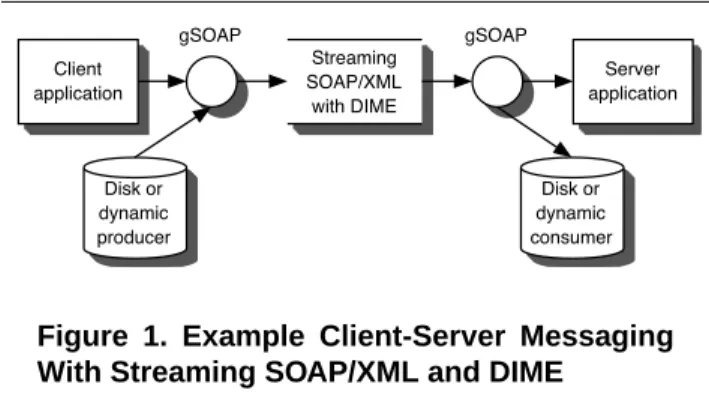
SOAP is a protocol for remote procedure calling and messaging with XML-encoded application data. However, SOAP does not require the use of XML per se. In fact, SOAP supports binary data attachments and remotely refer-enced data such as objects provided by third parties that are produced or consumed at separate hosts, for example. These features can be exploited to create data portals on the Web. SOAP also specifies various usage scenarios, such as one-way message passing, single and multiple request-response invocations, and routing.Consider for example the data transfer illustrated in Fig-ure 1. Data is efficiently transfered from a client to a server with gSOAP’s streaming SOAP/XML and DIME. This form of routing streams the (binary) data encapsulated in DIME from a data source at the client side into a data repository at the server side. This data can be retrieved and stored on disk or processed dynamically by tasks running on separate machines, for example. Note that SOAP/XML with
Client application Disk or dynamic producer Server application Disk or dynamic consumer Streaming SOAP/XML with DIME gSOAP gSOAP
Figure 1. Example Client-Server Messaging With Streaming SOAP/XML and DIME
ing DIME file transfers are more flexible than current file transfer protocols such as FTP and GridFTP, because the SOAP/XML messages can be utilized to carry meta-data with the file transfer requests and responses. In addition, Web Services extensions, such as routing and security for example, are orthogonal which means that file transfers can be routed and protected.
SOAP and WSDL are a protocols that exploit the rich-ness of the XML schema specification standard for defining XML content. XML schemas define the structure of XML documents by defining document layout and content con-straints. The schema notation is amenable to meta-level data translation and interpretation. In fact, SOAP toolkits already translate WSDL service descriptions into service objects and client proxies by inspecting the WSDL schema types parts to determine the parameter marshaling requirements. The SOAP RPC and (to a limited extend) the SOAP literal encoding styles provide a rich set of data types that can be utilized for XML encoding, including primitive types (XSD types), enumerations, bitmasks, arrays, lists, and records (structs). Arbitrary data types with application-specific se-mantics can be added by XML schema extension and re-striction. Schema extension and restriction introduces an object-oriented approach to data modeling with XML.
In contrast, many XML protocols for scientific data are based on DTDs rather than XML schemas and lack XML namespace and extensibility properties. The expressiveness of these protocols is restricted to a set of pre-defined data types offered by the protocol. For example, XSIL (Extensi-ble Scientific Interchange Language) [25] and XDMF (Ex-tensible Data Model and Format) [24] both provide encod-ings for primitive and aggregate types in XML. XSIL con-centrates on data structures with a Java-dependent XML format. The XSIL, XDMF, MathML, and BioML XML rep-resentations can be seamlessly blended into SOAP/XML. However, the application-specific XSIL and XDMF rep-resentations have a limited set of data types and offer no means to exploit schema extension to define optimized and application-specific XML layouts.
The XML schema standard provides a basis for
pro-gramming language bindings for XML as demonstrated by gSOAP and the .NET framework, for example. gSOAP gen-erates XML schemas at compile time and automatically performs data mappings at run time. The toolkit guaran-tees the preservation of the logical structure of graph-based data which is difficult to achieve with hand-written con-version routines (often referred to as wrappers). Scientific applications typically deal with large symbolic or numer-ical data sets. Symbolic data can be text-based or graph-based, such as symbolic expressions. Graph-based data can be represented in XML using SOAP RPC encoding of nodes as “structs” and co-referenced nodes as “multi-referenced objects” [19]. The use of XML graph nodes to represent-ing symbolic expressions in XML can be based on exist-ing XML standards, such as MathML and CML (Chemical Markup Language).
Flat data structures such as numerical vectors and ma-trices can be represented in many different forms of XML, including sparse SOAP arrays, UTF8-encoded strings, and hexadecimal and base64 binary encodings. Flat data struc-tures don’t necessarily require a generic SOAP array repre-sentation with values represented in decimal notation. The loss of floating point precision and the encoding overhead of floating point numbers in decimal often prohibits the ex-change of numerical data in plain text form.
Table 1 list the storage requirements of 32-bit, 64-bit, and 128-bit floating point values in XML. Hexadecimal no-tation requires a pair of octets to encode each octet of the internal binary floating point representation, UTF8 encod-ing treats the internal representation of floats as sequences of unicode characters represented in UTF8, and base64 re-quires 4 octets to encode each sequence of 3 octets. UTF8 encoding represents float point values as strings in XML, which means that the string contents have to be stored in XML CDATA sections to prevent interference with XML markup. In addition, most floating point values will be en-coded with the full 24 UTF8 characters. As a result, much of the space gains of UTF8 encoding will be lost. Base64 is more attractive because of the low overhead of the encod-ing scheme.
To save space and preserve precision, a numerical vec-FP Prec. Decim. Hex UTF8 Base64
32 bit 1–14 8 1–6 8
64 bit 1–24 16 2–12 12
128 bit 1–40 32 4–24 24
Table 1. XML Storage Requirements (in Octets) of One Floating Point Value in Dec-imal Notation Compared to HexadecDec-imal, UTF8, and Base64 Binary Encodings.
class xsd__base64Binary // built-in base64Binary XSD type { unsigned char *__ptr; // pointer to block of memory
int __size; // size of memory block
};
class ns__int32: public xsd__base64Binary
{ bool normalized = true; // initially true when recv’d void set_int32(int*,int); // set data and normalize
int *get_int32(); // get de-normalized data
};
class ns__fp32: public xsd__base64Binary
{ bool normalized = true; // initially true when recv’d void set_fp32(float*,int);// set data and normalize float *get_fp32(); // get de-normalized data }; <?xml version="1.0" encoding="UTF-8"?> <schema targetNamespace="http://www.genivia.com/gntl" xmlns:xsd="http://www.w3.org/2001/XMLSchema" xmlns:ns="http://www.types.org" xmlns="http://www.w3.org/2001/XMLSchema"> <simpleType name="int32"> <restriction base="xsd:base64Binary"/> </simpleType> <simpleType name="fp32"> <restriction base="xsd:base64Binary"/> </simpleType> </schema> (a) (b)
Figure 2. Base64 and Derived int32 and fp32 gSOAP Specifications(a)and XML Schema(b)
tor can be encoded with a SOAP array of base64-encoded IEEE 754 floating point values. However, space require-ments can be further reduced by encoding the entire vec-tor in base64. An appropriate XML schema can be defined for these base64-encoded arrays using the generic base64 binary XSD type as the base type. The gSOAP specifica-tion of the int and float arrays derived from the base64 XSD type is shown in Figure 2.
The specification exploits inheritance to produce the nec-essary schema extensions for the int and float array types. Getter and setter methods are added to access the binary representation and to (de-)normalize the data to big endian integers or IEEE 754 floats, for example, to ensure interop-erability of the XML representations with applications run-ning on different platforms. The run-time encoded base64 XML content carries the schema type with the data, so the recipient can determine the numerical array encoding used and apply de-normalization when necessary.
4. Latency and Performance
The choice of XML encoding for the data of a SOAP/XML Web Service application can have a signifi-cant impact on the communication latency and overall per-formance of the service. The XML representation of float-ing point arrays, for example, can be as large as ten times the original binary representation. However, the total mes-sage length is not always the determining factor of per-formance but the time to convert data in XML (such as floats to decimal notation and back) is, because it intro-duces a significant overhead [4]. This overhead is also apparent in the linear systems solver service that uti-lizes SOAP arrays of floats [18].
To determine the impact of XML encoding and HTTP transport on the performance of a service, we used the well-known magic squares algorithm to build a “MagicSquares” Web Service with gSOAP that produces 32-bit integer ma-trices. Part of the gSOAP specification of the MagicSquares service is shown in Figure 3. This algorithm is fast and
lin-ear in the size of the matrix. Because the algorithm is fast, it enables us to investigate the XML encoding/decoding and communication latencies rather than the compute latency of the service.
The service specification includes the definition of XML base64-encoded matrices in gSOAP. The definitions for SOAP-array matrices and binary DIME attachments that were used in the performance tests are similar (not shown). The gSOAP service method implementation uses the magic squares algorithm shown in Figure 4
We measured the impact of HTTP chunking, compres-sion, base64 encoding, and DIME on the performance of the service. HTTP chunking provides a form of streaming. Chunking can be used to omit the extra pre-serialization phase that gSOAP uses to determine HTTP content length. We also measured the overhead of real-time HTTP com-pression to transfer SOAP arrays with gSOAP. The results are shown in Figure 5. The response times of the Mag-icSquares service with HTTP chunking and base64 en-coding is very low compared to non-chunked and chun-ked+compressed SOAP array transfers for varying matrix ranks (rank=100 corresponds to an array of 100 arrays of 100 integers). The experiments were conducted with two 550 MHz dual P3 machines with Red Hat Linux and a 100BaseT LAN.
Real-time compression appears to be very expensive but also very effective because it reduces the message length to a size that is comparable to the size of the compressed form of the binary data (which is about 20KB for a 100 by 100 matrix with 32-bit integers). The gzip compression rate
struct matrix // matrix is a base64 type
{ unsigned char *__ptr; // pointer to memory block
int __size; // size of block
};
int ns__magic(int n, struct matrix *q);
Figure 3. gSOAP MagicSquares Web Service Specification With Base64-Encoded Matrices
int ns__magic(struct soap *soap, int n, struct matrix *q) { int i, j, k, l, v;
int *a = (int*)soap_malloc(soap, sizeof(int)*n*n); for (i=0; i<n*n; i++) a[i] = 0;
i = 0; j = (n-1)/2; a[n*i+j] = 1; for (v=2; v<=n*n; v++)
{ if (i<1) k = n-1; else k = i-1; if (j<1) l = n-1; else l = j-1;
if (a[n*k+l]) i = (i+1)%n; else { i = k; j = l; } a[n*i+j] = v; } q->__ptr = (unsigned char*)a; q->__size = sizeof(int)*n*n; return SOAP_OK; }
Figure 4. gSOAP MagicSquares Web Service Method
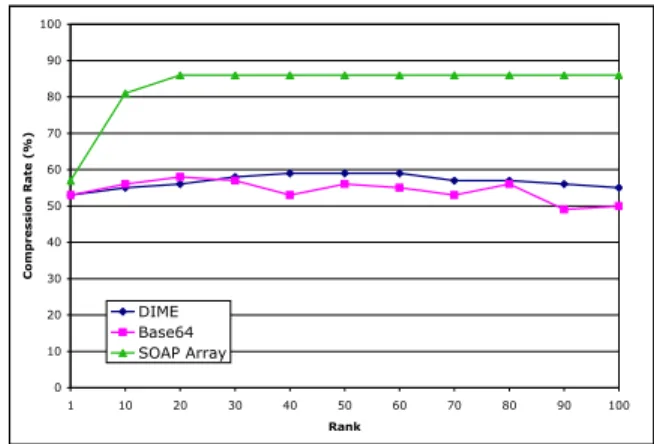
of XML containing SOAP arrays is very high as is shown in Figure 6, where the compressionrate = (1− c
`)%,`
denotes the length of the original message, andcdenotes the length of the compressed message. Compression is use-ful when the network bandwidth is limited. However, some experimentation with low-bandwidth networks such as a phone line did not yield any performance gains with com-pressed HTTP transfers because v.90 modems already ap-ply compression.
Figure 7 (a) shows the response times of the Magic-Squares server using chunked SOAP messages with base64 encoding and SOAP/XML with DIME over the LAN. The startup overhead indicates the network latency to estab-lish a socket connection with the service. gSOAP supports
0 10 20 30 40 50 60 70 80 90 100 1 10 20 30 40 50 60 70 80 90 100 Rank Time (ms) Compressed SOAP/XML Non-chunked SOAP/XML Chunked SOAP/XML
Chunked SOAP/XML With Base64
Figure 5. Response Times of the Magic-Squares Service With Base64 and Chun-ked/Compressed SOAP Arrays for Varying Matrix Rank 0 10 20 30 40 50 60 70 80 90 100 1 10 20 30 40 50 60 70 80 90 100 Rank Compression Rate (%) DIME Base64 SOAP Array
Figure 6. Compression Rates of SOAP Ar-rays, Base64, and DIME-Encoded Matrices Returned by the SOAP/XML MagicSquares Server for Varying Matrix Rank
HTTP keep-alive, which means that the startup time can be avoided using HTTP keep-alive connections after establish-ing a connection with a service. In addition, gSOAP dis-ables the Nagle algorithm to reduce the connection startup latency (TCP NODELAY).
Figure 7 (b) shows the response times of a Java imple-mentation of the MagicSquares server using Java RMI over the LAN (JDK 1.3 with JIT). The startup overhead is the time it takes for the Java RMI lookup operation to estab-lish a connection to the server. The SOAP/XML service response is almost twice as fast with HTTP chunking and DIME compared to the Java RMI implementation.
5. Discussion
This section briefly summarizes the results and discusses these findings in the context of scientific computing with Web and Grid services.
File transfers File transfer protocols such as FTP and
GridFTP are commonly used to exchange large static data sets. However, SOAP/XML with stream-ing DIME is more flexible than these file transfer protocols. Firstly, the SOAP/XML request and re-sponse messages can be utilized to carry meta-data such as application-specific information items. Sec-ondly, multiple files can be streamed at once. Thirdly, streaming DIME supports the exchange of dynamic data (producer and consumer type applications).
Fi-0 1 2 3 4 5 6 7 8 9 10 1 10 20 30 40 50 60 70 80 90 100 Rank Tim e (m s)
SOAP/XML With Base64 SOAP/XML With DIME Startup Overhead 0 1 2 3 4 5 6 7 8 9 10 1 10 20 30 40 50 60 70 80 90 100 Rank Time (ms) Java RMI Startup Overhead (a) (b)
Figure 7. Response Times of MagicSquares Servers With Base64 and DIME-Encoded Matrices (a)
and Java RMI(b)for Varying Matrix Rank
nally, the industry standard WS routing and WS se-curity protocols are orthogonal to SOAP/XML/DIME which means that file transfers based on Web Ser-vices can be routed and protected.
Data encodings SOAP and WSDL are protocols that
ex-ploit the richness of the XML schema specification standard for defining XML content. The XML schema extension and restriction features introduces an object-oriented approach to data modeling with XML. It en-ables the definition of derived data types to optimize the exchange of application-specific data formats such as numerical arrays. The gNTL library for gSOAP (gNTL is currently under development) is based on this powerful concept and offers alternative XML views of application-specific data.
DIME attachments provide the most efficient means to exchange raw binary data. While binary data trans-fers are often best utilized for platform-independent streaming media types such as images and sound, binary numerical data exchange is platform depen-dent due to the differences between big- and little-endian architectures and internal floating point repre-sentations. The results presented in this paper demon-strated that the base64 encoding is almost as efficient as DIME transfers of data sets (550MHz P3, Linux RH, and 100BaseT LAN). Base64 has the advantage that individual data items (ints and floats) can be en-coded within the SOAP/XML message contents such as SOAP arrays, for example.
HTTP keep-alive A client can request a persistent
con-nection with a service using HTTP keep-alive. How-ever, the service may drop the connection after a while (to enforce a fairness policy) thereby forc-ing the client to reconnect. The start-up time to establish a connection between a gSOAP client and service is relatively low and less than 0.5 ms (550MHz P3, Linux RH, and 100BaseT LAN). HTTP keep-alive is enabled in gSOAP with the command soap set omode(soap,
SOAP IO KEEPALIVE).
HTTP chunking Either a client or a service or both
can utilize HTTP chunked transfers. HTTP chunk-ing is a simple form of streamchunk-ing, because the chun-ked SOAP/XML messages are not buffered to deter-mine the HTTP content length header. In fact, in con-trast to other SOAP implementations, gSOAP does not buffer a message to determine the HTTP con-tent length header, but uses a two-phase serializa-tion scheme consisting of a message length counting phase followed by the transmission of the mes-sage [18]. This scheme is implemented by serializing the message twice. HTTP chunking limits the mes-sage transmission to only one phase, which is faster. In addition, gSOAP implements a form of latency hid-ing with chunked transfers, where communication is overlapped with the serialization computations. HTTP chunking is enabled in gSOAP with the command
HTTP compression Compression should be used
spar-ingly. The overhead of the Zlib compression algorithm outweighs the benefit of the message size reduc-tion to improve bandwidth utilizareduc-tion, for example. Most modems and some network routers already com-press TCP/IP packets on the fly, which eliminates the need to compress SOAP/XML messages. How-ever, compression is still useful to store data in compressed XML using gSOAP’s data serializ-ers. HTTP gzip compression is enabled in gSOAP with the command soap set omode(soap, SOAP ENC ZLIB)
6. Conclusions
This paper discussed the use of SOAP/XML Web and Grid Services for scientific computing. SOAP and WSDL are based on extensible schemas which allows the selection of alternative XML layouts for application data depending on on interoperability and performance goals. Performance testing with HTTP chunking, compression, binary DIME attachments, and XML representations such as SOAP Ar-rays and base64 shows that significant performance gains with SOAP/XML Web Services are possible, surpassing the performance of Java RMI, for example.
References
[1] Beck et al. HARNESS: A next generation distributed virtual machine. Future Generation Computer Systems, 15, 1999. [2] A. Brown et al. SOAP security extensions:
Dig-ital signature. Technical report, W3C, 2001. http://www.w3.org/TR/SOAP-dsig.
[3] M. Cafaro, D. Lezzi, and R. van Engelen. Secure web services with globus GSI and gSOAP. In submitted to EUROPAR2003, 2003. http://sara.unile.it/˜cafaro/gsi-plugin.html.
[4] K. Chiu, M. Govindaraju, and R. Bramley. Investigating the limits of SOAP performance for scientific computing. In proceedings of the 11th IEEE International Symposium on High-Performance Distributed Computing, 2002.
[5] D. Davis and M. Parashar. Latency performance of SOAP implementations. In 2nd IEEE International Symposium on Cluster Computing and the Grid, 2002.
[6] I. Foster and C. Kesselman. The Grid: Blueprint for a New Computing Infrastructure. Morgan Kaufmann, San Fran-cisco, 1998.
[7] I. Foster, C. Kesselman, J. Nick, and S. Tuecke. Grid services for distributed system integration. Computer, 35(6):37–46, 2002.
[8] I. Foster, C. Kesselman, J. Nick, and S. Tuecke. The physiology of the Grid: An Open Grid Ser-vices Architecture for distributed system integra-tion. Technical report, the Globus project, 2002. http://www.globus.org/research/papers/ogsa.pdf.
[9] GridLab. The gridlab project. http://www.gridlab.org.
[10] IBM. WSFL specification, 2001.
http://www.ibm.com/software/solutions/webservices/pdf/WSFL.pdf. [11] IBM alphaWorks. Web services tool kit for mobile devices,
2002. http://www.alphaworks.ibm.com/tech/wstkMD. [12] IBM and Microsoft. WS-Security
specifica-tion. Technical report, IBM and Microsoft, 2002. http://msdn.microsoft.com/ws-security.
[13] IETF. HTTP 1.1 specification rfc2616. www.ietf.org/rfc/rfc2616.txt.
[14] H. Kreger. Web services conceptual architecture WSCA 1.0. Technical report, IBM, 2001.
[15] P. Kulchenko. SOAP::Lite for Perl. http://www.soaplite.com. [16] S. Shirasuna, H. Nakada, and S. Sekiguchi. Evaluating web services based implementations of GridRPC. In IEEE Inter-national Symposium on High Performance Distributed Com-puting HPDC-11, page 237, 2002.
[17] UDDI. The universal description, discov-ery, and integration (UDDI) specification. http://www.uddi.org/specification.html.
[18] R. van Engelen and K. Gallivan. The gSOAP toolkit for web services and peer-to-peer computing networks. In 2nd IEEE International Symposium on Cluster Computing and the Grid, 2002.
[19] R. van Engelen, K. Gallivan, G. Gupta, and G. Cybenko. XML-RPC agents for distributed scientific computing. In IMACS’2000 Conference, Lausanne, Switzerland, 2000. [20] R. van Engelen, G. Gupta, and S. Pant. Developing web
ser-vices for C and C++. IEEE Internet Computing, pages 53– 61, March 2003.
[21] W3C. SOAP specification. http://www.w3.org/TR/SOAP. [22] W3C. WSDL specification. http://www.w3.org/TR/wsdl. [23] W3C. XML specification. http://www.w3.org/XML/Core. [24] XDMF. Extensible data model and format.
http://www.arl.hpc.mil/ice/.
[25] XSIL. Extensible scientific interchange language. http://www.cacr.caltech.edu/SDA/xsil/.