31
Evaluation models for e-learning platforms
and the AHP approach: a case study
Colace, F.; De Santo, M.
Abstract - Our “information-oriented” society shows an
increasing exigency of life-long learning. In such framework, the E-Learning approach is becoming an important tool to allow the flexibility and quality requested by such a kind of learning process. In the recent past, a great number of on-line platforms have been introduced on the market showing different characteristics and services. With a plethora of E-Learning providers and solutions available in the market, there is a new kind of problem faced by organizations consisting in the selection of the most suitable E-Learning suite. This paper proposes a model for describing, characterizing and selecting E-Learning platform. The E-Learning solution selection is a multiple criteria decision-making problem that needs to be addressed objectively taking into consideration the relative weights of the criteria for any organization. We formulate the quoted multi criteria problem as a decision hierarchy to be solved using the Analytic Hierarchy Process (AHP). In this paper we will show the general evaluation strategy and some obtained results using our model to evaluate some existing commercial platforms.
Keywords – E-Learning, E-Learning Platform, Multiple Criteria Decision Making Problem
Introduction
The whole world is undergoing a change that maybe is the most important one in the last thirty years, and, through the spreading of new information technologies, is deeply modifying relations among countries, markets, people and culture. The technological revolution has clearly promoted a globalization process (nowadays Internet represents the global village) and information exchange. Information can be considered as an economical value whose significance is closely associated with the knowledge that it offers. Updated knowledge is a fundamental and decisive aspect of professions related to the New Economy but the new society’s dynamism does not well adapt itself to past training models developed in more static or slowly changeable contexts [1]. The continuous need of new knowledge and competences has really shattered this boundary and professional people have to qualify themselves and to be willing to acquire new knowledge. So new didactic models have arisen. In this scenario one of the most promising approaches is the E-Learning approach. Several enabling factors played key role in today developments, including, among the other, the wide acceptance of the concept of Learning
Objects, the availability of several E-Learning platforms and the diffusion of standards, like SCORM, to improve interoperability. Evaluation of E-Learning platforms requires evaluating not only the implementing software package, but additional features as well, including, among the others the supported teaching and delivering schema, the provided QoS and so on. With respect to this question, both pedagogical and technological aspects must be carefully evaluated. In the first case, it is necessary to develop new training models clearly defining how to organize new training paths and the didactic contents associated with them, as well as how to provide these contents in relation to the user who benefits from them. As for the technological aspect, new tools for distributing knowledge must be created, tools able to reproduce as efficiently as possible pedagogical training models. In fact, a series of features should be taken into account when one evaluates E-Learning platforms, starting from the function and usability of the overall learning system in the context of the human, social and cultural organization within which it is to be used. Obviously, the analysis of the features of a system is not sufficient: it is also important to understand how they are integrated to facilitate learning and training and what principles are applied to guide the way the system is used. To evaluate them both pedagogical and technological aspects must be carefully evaluated. So the goal of this paper is to show a model for selecting the most suitable E-Learning solution taking into account its technological and pedagogical aspects. In literature there are many approaches to the evaluation of E-Learning platform. A common approach is the introduction of some evaluation grids able to evaluate the various aspects of an E-Learning platform. The weak point of this approach is in the subjectiveness of the judgements. The starting point of the proposed model is the formulation of a multi criteria decision problem to be solved by the Analytic Hierarchy Process (AHP). The hierarchical structure of the problem allows the decision maker to compare various features that characterize E-Learning platforms. The Analytical Hierarchy Process (AHP) is a decision-aiding method developed by Saaty [2][3][4]. It aims at quantifying relative priorities for a given set of alternatives on a ratio scale, based on the judgment of the decision-maker, and stresses the importance of the intuitive judgments of a decision-maker as well as the consistency of
Manuscript received April, 7th, 2008.
Authors are with the Dipartimento di Ingegneria dell’ Informazione e Ingegneria Elettrica – DIIIE, Università degli Studi di Salerno, Via Ponte don Melillo, 1 84084 Fisciano (SA), Italy, e-mail contact author:
32
the comparison of alternatives in the decision-making process. Since a decision-maker bases judgments on knowledge and experience, then makes decisions accordingly, the AHP approach agrees well with the behaviour of a decision-maker. The strength of this approach is that it organizes tangible and intangible factors in a systematic way, and provides a structured yet relatively simple solution to the decision-making problems [5][6]. So the real aim of this paper is to introduce the application of the AHP in E-Learning Platform Evaluation. The paper briefly reviews the concepts and applications of E-Learning platform and of the multiple criteria decision analysis, the AHP's implementation steps. Finally we the obtained results applying the proposed approach on some existing commercial and Open Source E-Learning platforms.
E-Learning Platforms
The Internet offers effective tools for exchanging information that can be used in different ways for on-line learning. Chat (textual message exchange) and e-mail are currently the most widespread ones, since they have first arisen in the Internet world. However, new technologies and the use of wider transmitting bands allow to utilize audio/video communication tools in real time as well as to share multimedia contents. At first, on-line learning platforms had to integrate such services. NetMeeting application developed by Microsoft is a useful example to understand how a distance learning tool was structured. NetMeeting offers such services as on-line textual chat, videoconferencing, audio chat, application sharing and whiteboards. At least until the first half of the 90s, this was the predominant way of organizing distance education platforms. Once technological problems related to the delivery and implementation of such services was resolved, industries have began to improve platforms by introducing modules and services able to manage pedagogical aspects (associated with the training process) [7] as well as content updating and availability. The most part of contemporary e-learning platform can be viewed as organized into three fundamental macro components: a Learning Management System (LMS), a Learning Content Management System (LCMS) and a Set of Tools for distributing training contents and for providing interaction [8]. The LMS integrates all the aspects for managing on-line teaching activities. The LCMS offers services that allow managing contents while paying particular attention to their creation, importation and exportation. The Set of Tools represents all the services that manage teaching processes and interactions among users. In the following, after describing in detail the characteristics of the LCMS, LMS, and Set of
Tools, technological and pedagogical requisites for a distance learning application will be defined, in order to outline an evaluation model.
Learning Content Management System
(LCMS)
A Learning Content Management System includes all the functions enabling creation, description, importation or exportation of contents as well as their reuse and sharing. Contents are generally organized into independent containers, called learning objects, able to satisfy one or more didactic goals. An advanced LCMS must be able to store interactions between the user and each learning object, aiming at gathering detailed information about their utilization and efficacy. When one talks about on-line learning, it is natural to think of interactive media-based contents. Actually, this is only a part of the widespread contents. The contents available before the spreading of on-line learning were mainly documents, and most of them have been proposed as didactic material in HTML format for on-line courses. In addition, interactive media have been sometimes introduced, such as audio, video or training resources created by using other multimedia tools (for example, Flash). A good LCMS should accurately choose the contents to be offered to the student during the lessons as well as the way in which they must be provided. The importance of LCMS is related to the growing distance learning request that is determining a significant increase in content production. The current effort is to avoid a useless duplication of contents by realizing learning objects consonant to given standards in order to reuse them in different contexts and platforms. All the contents must be appropriately stored in special repositories and be easily accessible and updatable. In fact, a LCMS must be designed so as to enable a constant updating of its contents, allowing this process (if possible) to semiautomatically take place. It is important to point out that, from our point of view, contents are not considered as objects external to the platform but as integral parts of it. This is possible thanks to the services that constitute the learning content management system. The trend towards a growing of training resources, though necessary to better characterize the training process, does not allow the teacher an easy consultation and use of these ones. At the same time, such an important number of resources can disorientate students that may run the risk of not choosing, during the auto-training phase, the contents more suitable to them. A solution to this problem is given by a more detailed description for each content so as to avoid ambiguity or duplication among them. In particular, some information will
33
support the content so as to better identify the domain in which resources are included and to draw LCMS and teacher’s attention to the most peculiar characteristics of the training content. In literature, this descriptive process is known as metadata description [9]. At present, the scientific community and industries engaged in this field are trying to define standard metadata rules, so as to encourage understanding of the real semantic content of the various training resources. From this point of view, such organizations as LTSC supported by IEEE or IMS Global Learning Consortium [10][11] are trying to create standardization rules and processes able to describe training resources as well as the user and training paths. Therefore, the aim is not only to facilitate and automate research and training resource acquisition over the web, but also to find the contents that better satisfy the student training needs [12].
Learning Management System (LMS)
The Learning Management System (LMS) embraces all the services for managing on-line teaching activities. In particular, it aims to offer management functionality to training platform users: system administrators, teachers and students. From students’ point of view, a LMS must offer services able to evaluate and report the acquired skills storing the training path followed by them. The System administrator should have the possibility of drawing up statistics on the use of platform services in order to better organize on-line learning service delivery. A LMS should give the teacher the possibility of verifying the right formulation of the various lessons and suggesting changes (in case it is semi-automatically inferred from student tracking) in the learning path. Therefore, the functionalities of a LMS integrated within a distance learning platform can be synthesized as follows:
• Student management • Course management • Student skill assessment
• Student activity monitoring and tracking • Activity reporting
A student management system integrated within a LMS must manage a database containing standardized descriptions of student data so as to better identify the user and his/her characteristics. This type of description is generally based on the XML meta-language (Extensible Markup Language), an element that guarantees data portability. When we talk about portability, we refer to the possibility of accessing a resource, in this case, the students’ descriptions, independently of the computer type and operating system. This characteristic is necessary for an
e-learning platform that aims to be compatible with a high number of hardware platforms, operating systems and standard applications. Standardized descriptions of users can be then used within the platform to store personal data, training profiles and the most significant events characterizing their training path. A LMS must implement a functionality that adds a significant value to the distance learning process. This functionality is that enabling the student to consult, at any time, results he/she has reached and, consequently, to monitor his/her preparation level. This possibility allows the student to understand his/her own gaps and, possibly, to identify the training contents more suitable to his formative requirements [13]. As for course management, an LMS can generally manage self-paced, asynchronous instructor-led and synchronous instructor-led courses. Self-paced courses are usually asynchronous, in hypertextual format, and give much freedom to the student who accesses a course index. The LMS system manages these courses starting from their creation. Asynchronous courses are run by an instructor, but they do not foresee interactive moments between students and instructor. Their design foresees delivery of strongly multimedia-oriented contents. Synchronous courses generally make use of collaborative learning that is of all the tools that allow creating interactions in real time between students and instructor. The LMS must keep track of who is present at the courses. These functions are useful to students, who can know how they are using the course, and teachers, who can control student participation in the courses, as well as to administrators that evaluate the use of on-line courses in order to determine their efficiency and convenience.
Tools for delivering and accessing
contents
On-line training efficiency is directly related to the tools made available by the delivery platform as well as to their usage easiness. The services should satisfy teacher and student needs and it is therefore necessary that the same kinds of services are different in accordance with the user. In particular, teachers should be provided with tools enabling them to manage teaching processes for single individuals or groups, as well as all the interactions, including asynchronous discussions or live events. In addition, it is important to provide the teacher with updated reports on learner or learner groups’ progresses so as to better manage evaluation processes and facilitate activities. Besides, it is necessary to give students the possibility of synchronously and asynchronously communicating with both the teacher and other students. We will shortly analyze some of the most popular services that
34
characterize on-line training platforms from a collaborative point of view, and that they tend to integrate within themselves. The Virtual Classroom Service is a service designed for distributing courses in a synchronous mode, and also for supporting on-line live teaching. This type of service aims to reproduce the mechanisms present in a classroom during a traditional training session and is considered as a kind of container in which all the services able to recreate a virtual classroom atmosphere will be included. The use of a virtual classroom is obviously foreseen during “live” lessons in order to better manage synchronous interactions. The synchronous communication systems are based on audio and video conferencing technologies. The possibility of transmitting network videoconferencing has been implemented through the introduction of compressing movie techniques that allow reducing the use of bandwidth during the transmission in comparison with the uncompressed movies, intelligibility being equal. However, it is true that compressed video stream representations do not generally guarantee high definition movie reproductions. The latter can be anyway obtained by using high capability transmitting channels (a satellite channel, for example), whose utilization can be more expensive. Audio/video conferencing tools allow the display and dialogue in real-time among the various members located in remote areas. The interface generally presents a window in which the video captured by a video camera is displayed. Another service enabling synchronous communication within e-learning platforms is provided by chat. This service allows participants to send textual messages to the other students or the teacher in a public mode (all the participants see all the things) or a private one (only who is directly involved receives the communication). Chat service surely increases collaboration within the environment in which it is used, but the teacher or tutor must continuously monitor its utilization, since it could lead to a lack of attention and confusion within the virtual classroom. In addition to a textual chat, the most recent platforms tend to implement a vocal one by using VoIP mechanisms. From an historical point of view, the whiteboard has been one of the first services made available by an online learning platform. This service makes it available and shareable to teachers and learners a virtual space, usually called whiteboard. Both teachers and learners can work with it by virtue of control rights. This tool allows to write and draw on a shared space and to display PowerPoint presentations and images. E-mail has been one of the first asynchronous communication tools used by e-learning environments. Thanks to this service, students can send messages to a specific addressee only by having his/her e-mail address.
Some platforms can include, within their own infrastructures, functionalities for exchanging e-mail messages, but most of them allow the integration with tools developed just for this purpose, such as Outlook Express, Netscape Messenger, Eudora, etc.
Characterizing distance learning platforms
As previously discussed, an on-line learning platform can be characterized through an analysis that takes into account:
the adopted teaching methodologies
the level of the training path personalization
operative modalities and didactic interaction quality
learning assessment and student tracking methods
typology and quality of both didactic material and support system
In order to meet the exigencies of distance training processes, support technologies should also have characteristics that make the training process functional and available. In particular, the student should be allowed to fully benefit from auto-learning, auto motivation and auto-evaluation methods [14], and at the same time tutor and teachers should be provided with a direct and constant contact with the learners. So distance learning platforms must adopt a pedagogical approach based on constructivism a theory that is based on results of Piaget's research [15]. Constructivist learning is based on students' active participation in problem-solving and critical thinking regarding a learning activity which they find relevant and engaging. They are "constructing" their own knowledge by testing ideas and approaches based on their prior knowledge and experience, applying these to a new situation, and integrating the new knowledge gained with pre-existing intellectual constructs. So a constructivist e-learning platform is an environment where learners collaborate and support each other using a variety of tools and resources, as well as an environment where knowledge is constructed and learners assume a central role in the cognitive process. On-line learning platforms can implement easily a constructivist approach [16] because they can allow easily:
encouragement and acceptance of student autonomy and initiative
encouragement of students to engage in dialogue, both with the teacher and within the group
continuous feedback
In other words, an on-line learning platform must be able to efficiently and effectively manage the single components of the process and their interactions. A distance learning platform that has these characteristics must carry out four principal
35
functions: communication, information sharing, information access and co-operation. These functionalities characterize both the pedagogical and technological approach. As for technical requisites, the best solution to be adopted in platform design should be based on the utilization of a multilayered, web-based architecture [17][18]. In particular an e-learning platform must be web-based, in this way the client can access the environment by simply using a web browser, without compelling the user to install other software into his/her computer. This characteristic should be always taken into account by industries producing distance training environments. Thanks to it, students only need a basic knowledge in computer science enabling them to interact with a browser, which also avoids difficult installations of not open source software. Another technical requisite to be considered is portability, that is, the possibility for a platform to rightly work independently of the computer and the operating system on which it runs. Obviously, the possibility of not installing open source software into the client machine increases system portability, since it guarantees that all clients can use the same services. A further requisite, as previously described, is the system compatibility with the most accredited descriptive standards of training resources and users, such as AICC [19] and IMS [10]. Compatibility with these standards is fundamental, since it allows to import and export contents and courses realized by different industries, and gives the platform the possibility of being equipped with a still little used tool: the Intelligent Tutoring System (ITS). An ITS is an application that can semiautomatically reach decisions after acquiring information by the LMS and LCMS. In other words, an ITS has the task of monitoring students’ behaviour and advise them on the most suitable retrieval programs [20]. Besides, on the basis of the acquired data, it can advise the teacher on a different lesson organization and a different technology use. In fact, a course designer must have the possibility of making the several training process modules interactive, of adapting the training paths to the specific learner needs, and defining new training paths by using those already existing. Such operations are surely speeded up by adopting descriptive standards, even when an ITS is still not used. Another aspect to be evaluated is related to the services integrated into the LMS and LCMS. As for management, services able to manage enrolments, training paths, and student tracking are really significant and add a new value. Platforms including such systems are surely ahead of others in services, as these tools will represent in the next future the core of an e-learning environment. In general, at present, indispensable management services are the following:
services for including and updating user profile
services for creating courses and cataloguing them
services for creating tests described through a standard
user tracking services
services for managing reports on course frequency and use
services for creating, organizing and managing own training contents or contents provided by other producers
The aspect related to the offered services is particularly interesting, because it characterizes the pedagogical approach. An analysis of the teaching tools made available by the various platforms is therefore necessary. These tools, as previously discussed, can be divided into two fundamental categories:
asynchronous communication tools
synchronous communication tools
Such tools as e-mail, discussion forum or newsgroup surely belong to the first category. Asynchronous services are really important for an e-learning platform, since they eliminate the space and time limits that can exist among the interlocutors. Tools that belong to the second category are:
textual or vocal chat
whiteboard
live video stream
virtual classroom
application and file sharing.
Real-time communication is used to carry out at distance activities that are normally performed in face-to-face meetings. In this way, learners can interact with teachers creating an atmosphere more similar to that of a traditional classroom. The use of these new technologies will lead to a pedagogical approach based on group’s interactions, where the teacher has the role of facilitating and organizing discussions. This approach debates traditional teaching methods (in which teachers are dominant and students are passive) and substitutes them for one based on active pedagogy. On the basis of the previous considerations, we have grouped the parameters of interest into four macro fields:
system requisites
training resources and course management
user management
services offered to users
For each macro field, an evaluation grid has been designed.
The Multiple Criteria Decision Analysis and the AHP Approach
The selection of an E-Learning platform is not a trivial or easy process. Project managers are faced with decision environments and problems in
36
projects that are complex. The elements of the problems are numerous, and the inter-relationships among the elements are extremely complicated. Relationships between elements of a problem may be highly nonlinear; changes in the elements may not be related by simple proportionality. Multiple criteria decision-making (MCDM) approaches are major parts of decision theory and analysis. They seek to take explicit account of more than one criterion in supporting the decision process [21]. The aim of MCDM methods is to help decision-makers learn about the problems they face, to learn about their own and other parties' personal value systems, to learn about organizational values and objectives, and through exploring these in the context of the problem to guide them in identifying a preferred course of action. In other words, MCDM is useful in circumstances which necessitate the consideration of different courses of action, which can not be evaluated by the measurement of a simple, single dimension [21]. A good solution for the MCDM problem is in the AHP approach. After a long period of debate, in fact, on the effective value of the AHP approach Harker and Vargas [22] and Perez [23] proved that the AHP approach is based upon a firm theoretical foundation. The AHP approach is composed by the following steps:
1. Define the problem and determine its goal.
2. Structure the hierarchy from the top (the objectives from a decision-maker's viewpoint) through the intermediate levels (criteria on which subsequent levels depend) to the lowest level which usually
contains the list of alternatives.
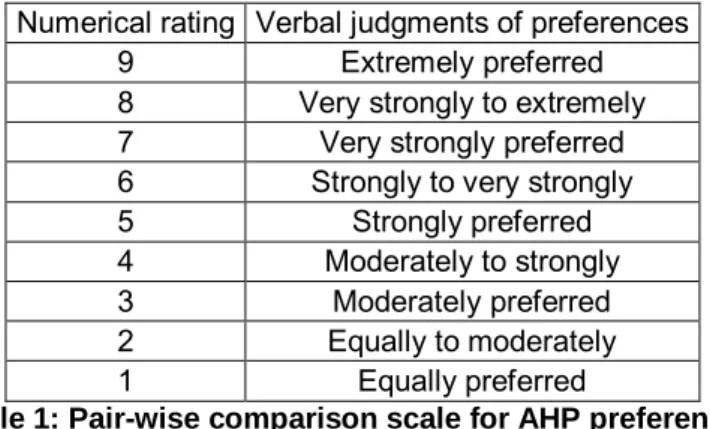
3. Construct a set of pair-wise comparison matrices (size NxN) for each of the lower levels with one matrix for each element in the level immediately above by using the relative scale measurement shown in Table 1. The pair-wise comparisons are done in terms of which element dominates the other.
4. There are n(n-1) judgments required to develop the set of matrices in step 3. Reciprocals are automatically assigned in each pair-wise comparison.
5. Hierarchical synthesis is now used to weight the eigenvectors by the weights of the criteria and the sum is taken over all weighted eigenvector entries corresponding to those in the next lower level of the hierarchy.
6. Having made all the pair-wise comparisons, the consistency is determined by using the eigenvalue, max,
to calculate the consistency index, CI as follows: CI = (max-n)/(n-1) where n is the
matrix size. Judgment consistency can be checked by taking the consistency ratio (CR) of CI with the appropriate value in Table 2. The CR is acceptable, if it does not exceed 0.10. If it is more, the judgment matrix is inconsistent. To obtain a consistent matrix, judgments should be reviewed and improved.
7. Steps 3-6 are performed for all levels in the hierarchy
Numerical rating Verbal judgments of preferences 9 Extremely preferred 8 Very strongly to extremely 7 Very strongly preferred 6 Strongly to very strongly 5 Strongly preferred 4 Moderately to strongly 3 Moderately preferred 2 Equally to moderately 1 Equally preferred
Table 1: Pair-wise comparison scale for AHP preferences
Size of matrix 1 2 3 4 5 6 7 8 9 10 Random Consistency 0 0 0.58 0.09 1.12 1.24 1.32 1.41 1.45 1.49
37
T
HEAHP
A
PPROACH AND THES
ELECTION OF ANE-
LEARNINGP
LATFORME-Learning platforms have to satisfy some rules in order to be effective and, besides, some platforms can be really effective only in some well defined scenario. Obviously this is a Multiple Criteria Decision Problem. So the first step is to set the interest scenarios; in this paper we consider the following cases: An ECDL course, a blended university course, a professional training course. In the following paragraphs we will describe in more details the selected scenarios. So now the first step is the definition of the AHP hierarchy. Obviously in this case the first level is the selection of the best E-Learning platform for the selected scenario. The second level is composed by features that have in account pedagogical, technological and usability aspects. In particular we have introduced five main features:
Management
Collaborative Approach
Management and enjoyment of interactive learning objects
Usability
Adaptation of learning path
Obviously every feature involves, in their determination, some sub-features. In order to test our approach we selected the following platforms:
Docent [24] Quasar [25] Claroline [26] IWT [27] Running Platform [28] Moodle [29] ATutor [30] ADA [31] Ilias3 [32] Docebo [33]
Now we can describe in details the proposed approach for the various scenarios. We have to outline that the various scenarios are obtained from the analysis of real cases. In particular we have considered scenarios that are in our University. The first involves the selection of an E-Learning platform for the endowment of ECDL courses. In this case the platform has to support classes composed by thirty students. These students are not really familiar with computers’ world. So the usability feature has to be highly and carefully evaluated. In this scenario it is very
important the tracking of the progress of the students. Another characteristic of this user group is the not very wide internet connection bandwidth. The second scenario describes a typical situation: E-Learning platform has to support the activities of some courses. So in this scenario management tools are very important. Also the collaborative tools have to be considered. The last scenario involves the use of an E-Learning platform in the case of professional training. In this case the target group is not very skilled on ICT technologies and needs to interact with very simple and clear graphic user interfaces. In this case the usability feature has a really importance. Also the tools for the adaptation of learning path are important because the target group could be very heterogeneous. So according to the AHP approach we have to compare the various platforms each other for every feature and scenario. First of all we have to declare the standing of the features ordered by importance. For the various scenarios we have the following standing (Table):
ECDL
Course Blended Course Professional Training Management Management Usability Management and enjoyment of interactive learning objects Management and enjoyment of interactive learning objects Adaptation of learning path
Usability Collaborative Approach
Management and enjoyment of interactive learning objects Adaptation of learning
path Usability Management Collaborative Approach Adaptation of learning path Collaborative Approach
Table 3: Standing of considered features ordered by importance for the considered scenarios
After this phase in order to have a value for every feature we considered some evaluation grids introduced in [8] in order to evaluate the following indexes:
Management Index
Management Index = IM = Obtained Value for the supported tools / Max Value
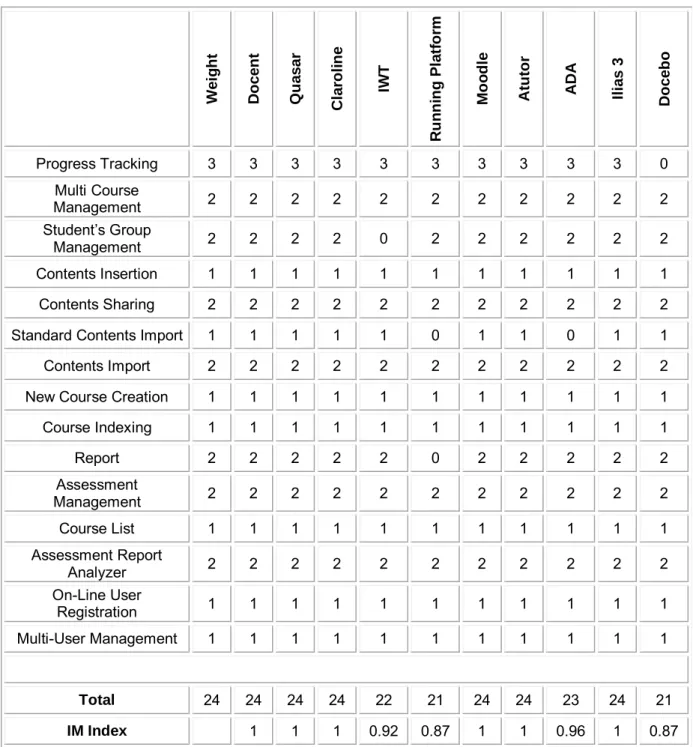
This index aims to evaluate how many services for the management of students and of their progress are in the various platforms. In the table we show the obtained results. In this table the column Weight indicates the relative importance of the feature.
38
W e ig h t D o c e n t Q u a s a r C la ro li n e IW T R u n n in g Pl a tf o rm Mo o d le A tu to r ADA Ilia s 3 D o c e b o Progress Tracking 3 3 3 3 3 3 3 3 3 3 0 Multi Course Management 2 2 2 2 2 2 2 2 2 2 2 Student’s Group Management 2 2 2 2 0 2 2 2 2 2 2 Contents Insertion 1 1 1 1 1 1 1 1 1 1 1 Contents Sharing 2 2 2 2 2 2 2 2 2 2 2 Standard Contents Import 1 1 1 1 1 0 1 1 0 1 1 Contents Import 2 2 2 2 2 2 2 2 2 2 2 New Course Creation 1 1 1 1 1 1 1 1 1 1 1 Course Indexing 1 1 1 1 1 1 1 1 1 1 1 Report 2 2 2 2 2 0 2 2 2 2 2 Assessment Management 2 2 2 2 2 2 2 2 2 2 2 Course List 1 1 1 1 1 1 1 1 1 1 1 Assessment Report Analyzer 2 2 2 2 2 2 2 2 2 2 2 On-Line User Registration 1 1 1 1 1 1 1 1 1 1 1 Multi-User Management 1 1 1 1 1 1 1 1 1 1 1 Total 24 24 24 24 22 21 24 24 23 24 21 IM Index 1 1 1 0.92 0.87 1 1 0.96 1 0.87Table 4: Obtained results for the Management Index
Collaborative Index
IC = Obtained Value for the supported tools / Max Value
This index aims to evaluate how many “collaborative” services are in the various platforms. With the term “collaborative” services we intend these platform services allowing the interaction among students and/or teachers. In the table 5 we show the obtained results. In this table the column Weight indicates the relative importance of the feature.
39
W e ig h t D o c e n t Q u a s a r C la ro li n e IW T R u n n in g Pl a tfo rm Mo o d le A tu to r ADA Ilia s 3 D o c e b o E-Mail 1 1 1 1 1 1 1 1 1 1 1 Forum 2 2 2 2 2 2 2 2 2 2 2 Chat 2 2 2 2 2 2 2 2 2 2 2 Whiteboard 2 2 0 0 2 1 0 2 0 0 0 A/V Streaming 2 2 0 0 2 0 0 0 2 0 0 Contents Download 2 2 2 2 2 2 2 2 2 2 2 Application Sharing 2 2 0 0 2 0 0 0 0 0 0 Virtual Classroom 3 3 3 0 3 0 0 0 0 0 0 Total 16 16 10 7 16 8 7 9 9 7 7 IC Index 1 0.62 0.44 1 0.50 0.44 0.56 0.56 0.44 0.44Table 5: Obtained results for the Collaborative Index
Management
and
enjoyment
of
interactive learning objects index
MIO = Obtained Value for the supported tools / Max Value
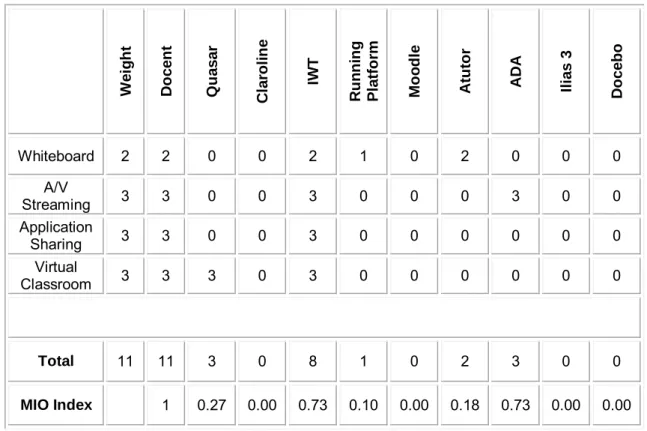
This index aims to evaluate how many services for the management and enjoyment of interactive learning objects are in the various platforms. In the table 6 we show the obtained results. In this table the column Weight indicates the relative importance of the feature.
40
W e ig h t D o c e n t Q u a s a r C la ro li n e IW T R u n n in g Pl a tfo rm Mo o d le A tu to r ADA Ilia s 3 D o c e b o Whiteboard 2 2 0 0 2 1 0 2 0 0 0 A/V Streaming 3 3 0 0 3 0 0 0 3 0 0 Application Sharing 3 3 0 0 3 0 0 0 0 0 0 Virtual Classroom 3 3 3 0 3 0 0 0 0 0 0 Total 11 11 3 0 8 1 0 2 3 0 0 MIO Index 1 0.27 0.00 0.73 0.10 0.00 0.18 0.73 0.00 0.00Table 6: Obtained results for the Management and enjoyment of interactive learning objects index
Usability
For the usability feature we used a questionnaire introduced by Nielsen [34]. The aim is to evaluate the use easiness of the platforms and of their interfaces. The obtained results are depicted in the table 7: Usability Index Docent 0.65 Quasar 0.70 Claroline 0.85 IWT 0.65 Running 0.75 Moodle 0.80 Atutor 1.00 ADA 0.85 Ilias3 0.70 Docebo 0.85
Table 7: Obtained results for the Usability Index
Adaptation
of
user’s
formative
learning path index
LPA = Obtained Value for the supported tools / Max Value
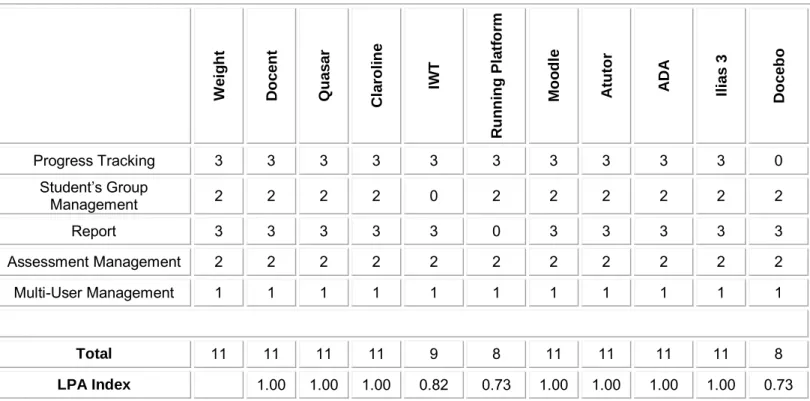
This index aims to evaluate how many services for the adaptation of user’s formative learning path are in the various platforms. These services have to allow the creation of personalized learning paths and the continue assessment of students. In the table 8 we show the obtained results. In this table the column Weight indicates the relative importance of the feature.
41
W e ig h t D o c e n t Q u a s a r C la ro li n e IW T R u n n in g Pl a tf o rm Mo o d le A tu to r ADA Ilia s 3 D o c e b o Progress Tracking 3 3 3 3 3 3 3 3 3 3 0 Student’s Group Management 2 2 2 2 0 2 2 2 2 2 2 Report 3 3 3 3 3 0 3 3 3 3 3 Assessment Management 2 2 2 2 2 2 2 2 2 2 2 Multi-User Management 1 1 1 1 1 1 1 1 1 1 1 Total 11 11 11 11 9 8 11 11 11 11 8 LPA Index 1.00 1.00 1.00 0.82 0.73 1.00 1.00 1.00 1.00 0.73Table 8: Obtained results for the Adaptation of users formative learning path index
At the end of this phase we can compare the “relative” obtained results of platforms in every feature in order to have a standing. According to the AHP approach we defined the “absolute” weight of every feature keeping in mind the constraints of the selected scenario. According to the AHP strategy we can compose the results in the following way:
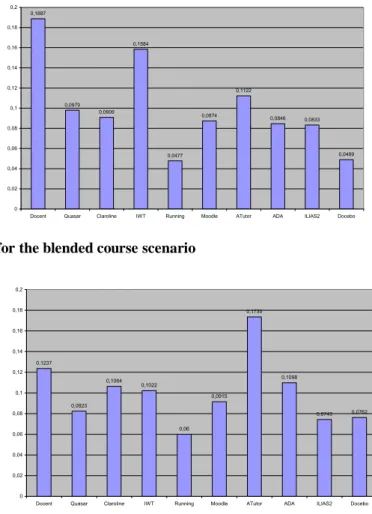
The obtained results for each scenario are the depicted in the next figures:
1,..,5
Platform Final Score =
i*
ii
Weight
PlatformValue
0,1647 0,0996 0,1000 0,1322 0,0493 0,0942 0,1274 0,0900 0,0876 0,0550 0,0000 0,0200 0,0400 0,0600 0,0800 0,1000 0,1200 0,1400 0,1600 0,1800Docent Quasar Claroline IWT Running Moodle ATutor ADA ILIAS2 Docebo
42
0,1887 0,0979 0,0909 0,1584 0,0477 0,0874 0,1122 0,0846 0,0833 0,0489 0 0,02 0,04 0,06 0,08 0,1 0,12 0,14 0,16 0,18 0,2Docent Quasar Claroline IWT Running Moodle ATutor ADA ILIAS2 Docebo
Figure 2: Obtained Results for the blended course scenario
0,1237 0,0823 0,1064 0,1022 0,06 0,0915 0,1735 0,1098 0,0743 0,0762 0 0,02 0,04 0,06 0,08 0,1 0,12 0,14 0,16 0,18 0,2
Docent Quasar Claroline IWT Running Moodle ATutor ADA ILIAS2 Docebo
Figure 3: Obtained Results for the professional training
The AHP approach allows not only to evaluate the platforms but to test them application in a well defined scenario. In fact Docent platform has very good results in the first two scenarios while in the third it is not still true. In fact in the third case all the management or collaborative tools are not very important. The obtained results confirm that the difference between commercial platforms and open source in general is still very high, but our method shows as in some scenarios this is not true. In this case it can suggest the use of a cheaper platform.
Conclusion
In order to accurately evaluate the potentialities of an online learning platform, it is important to pay attention to its three main components: Learning Management System, Learning Content Management System and Virtual environment for teaching and services associated with it. An efficient system must be able to integrate into oneself all these components so that they can efficaciously interact with each other. Besides, it is necessary that such platforms make reporting data services available, so as to allow accurate analyses on activities carried out by users. One of the most interesting problem is the introduction of
a general and objective model for the evaluation of E-Learning platforms. This task is not trivial because a good evaluation model has to take in account not only the platform and its services but also the scenario where it has to work. So in this paper we have introduced an evaluation model based on the use of AHP approach. The AHP approach, in fact, is useful in circumstances which necessitate the consideration of different courses of action, which can not be evaluated by the measurement of a simple, single dimension. In this way we can evaluate an E-Learning platform considering both its application in the interest scenario, both its comparison with other considered platforms. We tested our approach on four E-Learning platforms and in three scenarios. The obtained results are encouraging and effective. The proposed method, in fact, does not only evaluate the platform but also its effectiveness in the considered scenario. In this paper, for example, we showed as in some scenario the performances of a commercial platform as Docent are similar to the ones of “academic” frameworks. We aim to extend the proposed approach to new scenarios and platforms.
43
References
[1] Ubell R., “Engineers turn to E-Learning”, IEEE Spectrum, Volume: 37, 2000
[2] Saaty TL., “Decision making for leaders”, Belmont, California: Life Time Learning Publications, 1985.
[3] Saaty TL., “How to make a decision: the analytic hierarchy process”, European Journal of Operational Research, North-Holland 1990
[4] McCaffrey, J., “The Analytic Hierarchy Process”, MSDN Magazine, June 2005 (Vol. 20, No. 6)
[5] Drake, P.R. (1998). "Using the Analytic Hierarchy Process in Engineering Education", International Journal of Engineering Education, 1998
[6] Skibniewski MJ, Chao L., “Evaluation of advanced construction technology with AHP method”, Journal of Construction Engineering and Management, ASCE 1992 [7] Jonassen D.H., “Thinking Technology, toward a Costructivistic Design Model”, Educational technology XXXIV, 1994
[8] Colace F., De Santo M., Vento M., “Evaluating On-line Learning Platforms: a Case Study”, Proceedings of the 36th Hawaii International Conference on System Sciences (HICSS’03), 2003
[9] Berners-Lee, T., “Metadata Architecture”, Unpublished
white paper, January 1997,
http://www.w3.org/pub/WWW/DesignIssues/Metadata.html [10] The IMS Enterprise Specification, http://www.imsproject.org/
[11] IEEE Learning Technology Standard Committee, http://www.ltsc.ieee.org/
[12] Schakelman, J.L., “The changing role of on-line pedagogy: how many istructional management systems, metadata, and problem-based learning combine to facilitate learner-centered instruction”, SIGUCCS 2001
[13] Carchiolo V., Longheu A., Malgeri M., “Learning through Ad-hoc Formative Paths”, ICALT 2001
[14] H.S. Barrows, A.C. Kelson, “Problem based learning in secondary education and the problem based learning institute”, Springfield, 1993
[15] Piaget, J., “To understand is to invent”, New York, Grossman, 1973
[16] Jonassen D.H., Peck K. L., Wilson B. G., Pfeiffer W. S., “Learning with Technology: A Constructivist Perspective”, Prentice Hall, 1998
[17] Drira, K., Villemur, T., Baudin, V., Diaz, M., “A Multi-Paradigm Layered Architecture for Synchronous Distance Learning”, Proceedings of the 26th Euromicro Conference, 2000.
[18] Anido, L., Llamas, M., Fernández, M.J., Caeiro, M., Santos, J., Rodríguez, J., “A Component Model for Stardardized Web-based Education”, WWW10, 2001, Hong Kong
[19] AICC CMI Guidelines for interoperability, http://www.aicc.org/
[20] Zhou, Y., Evens, M. W., “A Practical Student Model in an Intelligent Tutoring System”, ICTAI, 1999
[21] Belton V., “Multiple criteria decision analysis practically the only way to choose”, Hendry LC, Eglese RW, editors. Operational research tutorial papers, 1990
[22] Harker PT, Vargas LG, “The theory of ratio scale estimation: Saaty's analytic hierarchy process”, Management Science, 1987;33(1):1383
[23] Perez J., “Some comments on Saaty's AHP”, Management Science, 1995;41(6):1091-1095
[24] Docent: http://www.docent.com/
[25] Quasar: http://www.quasaronline.it/elearning/ [26] Claroline: http://www.claroline.net/
[27] IWT: http://www.didatticaadistanza.com/ [28] Running Platform: http://rp.csedu.unisa.it/portal [29] Moodle: http://moodle.org/
[30] ATutor: http://www.atutor.ca/ [31] ADA: http://ada.lynxlab.com/ [32] Ilias: http://www.ilias.de/
[33] Docebo: http://www.docebo.org/doceboCms/
[34] Nielsen, J., “Usability Engineering”, Academic Press, San Diego, 1993