J of Evolution of Med and Dent Sci/ eISSN- 2278-4802, pISSN- 2278-4748/ Vol. 4/ Issue 55/ July 09, 2015 Page 9568
COMPARATIVE STUDY ON THE EFFECTS OF PRETREATMENT WITH
MAGNESIUM SULPHATE AND PROPOFOL INDUCTION ON SERUM
CREATINE PHOSPHOKINASE AND URINARY MYOGLOBIN LEVELS
ASSOCIATED WITH THE USE OF SUCCINYLCHOLINE
Sadhana Roy1, Mrunalini K2, G. Venkateshwarlu3, A. Sowmya Sri4
HOW TO CITE THIS ARTICLE:
Sadhana Roy, Mrunalini K, G. Venkateshwarlu, A. Sowmya Sri. “Comparative Study on the Effects of Pretreatment with Magnesium Sulphate and Propofol Induction on Serum Creatine Phosphokinase and Urinary Myoglobin Levels Associated with the use of Succinylcholine”. Journal of Evolution of Medical and Dental Sciences 2015; Vol. 4, Issue 55, July 09; Page: 9568-9580, DOI: 10.14260/jemds/2015/1383
ABSTRACT: Succinyl Choline possess unique properties of rapid onset and short duration of action to facilitate endo tracheal intubation but myalgias, hyperkalemia, increase in serum myoglobin, creatine phosphokinase and masseter spasm are adverse effects associated with its use in apparently healthy population. The aim of present study is to compare the effects of with and without pretreatment with magnesium sulphate and propofol induction on serum creatine phosphokinase and urinary myoglobin levels associated with use of succinyl choline. 60 patients aged between 18-60 years of both sexes of ASA Grade – I and II undergoing elective Surgery with minimal or no muscle damage were divided into two groups randomly. After taking informed consent, patient was shifting to operation table, monitors were connected, vital parameters recorded, intravenous line secured and 2ml of blood was collected in plain bottle and 10-15 ml of urine sample was collected and set to lab for serum creatine phosphokinase and urinary myoglobin estimation. Patients of both groups were preoxygenated for 5 minutes, premedicated with Inj. Gycopyrolate (o.2mg) iv, Inj. Fentanyl 2 Micro Grams per Kg iv and induced with Inj. Propofol 2mg/kg and succinyl choline 2mg./kg was given to facilitate endotracheal intubation. One group was pretreated with 10cc of 0.9% Normal saline and other group with magnesium sulphate 40mg/kg in 10ml slowly over 10 minutes before induction with propofol. The occurrence of fassiculations was noted. 10-15 ml of urine was collected in both groups for myoglobin estimation 20 minutes after intubation. At the end of surgery patients was revered with neostigmine (0.07 mg/kg) and Inj. Glycopyrdate (0.01 mg/kg). After complete recovery extubation was done and patient shifted to postoperative ward 2ml of blood was collected 20-24 hours post-surgery for serum creatine phosphokinare estimations and results tabulated. The study found that there was raise in serum phosphokinase levels in both groups. The raise was significantly lower in magnesium sulphate group compared to other group, urinary myoglobin was detected in both groups but significantly lower in magnesium sulphate group. Fasiculations and postoperative myalgias were significantly lower in magnesium sulphate group. In conclusion magnesium sulphate is effective in lowering serum creatine phosphokinase levels, urinary myoglobin levels, postoperative myalgias and fasiculations associated with use of succinyl choline.
KEYWORDS: Succinyl Choline: Magnesium Sulphate, Serum Creatine Phosphokinase: Urinary Myoglobin.
INTRODUCTION: In 1942 Cullen described the use of d-tubocurarine as a safe drug to use during surgery to provide skeletal muscle relaxation in 131 patients.1
Succinylcholine was introduced by The sleff and Foldes in 1952.Its rapid onset of effect and ultrashort duration of action permitted rapid sequence intubation.2 With Succinylcholine and
DOI: 10.14260/jemds/2015/1383
ORIGINAL ARTICLE
J of Evolution of Med and Dent Sci/ eISSN- 2278-4802, pISSN- 2278-4748/ Vol. 4/ Issue 55/ July 09, 2015 Page 9569 Vecuronium bromide introduction, knowledge of physiology of neuromuscular junction and reversal of its blockade, the technique of general anesthesia has become popular.
Succinylcholine possesses the unique properties of rapid onset and short duration of action but its use is often accompanied by adverse effects like Myalgias, Masseter spasm, Hyperkalemia, increase in Serum Myoglobin levels and Creatine phosphokinase levels in apparently healthy population. Cardiac dysrrythmias manifested as sinus bradycardia and cardiac arrest is caused by Succinylcholine in patients with hyperkalemia.
It also increases intraocular pressure, intracranial pressure, intragastric pressure and also causes rhabdomyolysis and acidosis.
Magnesium sulphate which is commonly used in the treatment of Eclampsia and Torsades de pointes has got an action of decreasing release of prejunctional Ach at neuromuscular junction.3 It is
thus thought to decrease muscle fasiculations when given along with SCh.
In view of the above advantages with Magnesium sulphate, a comparative study of Succinyl choline and pretreatment with Magnesium sulphate is undertaken to quantitatively assess the effect Magnesium sulphate on Succinylcholine induced CPK levels and urine Myoglobin.
MATERIALS AND METHODS: A clinical study was undertaken to compare the raise of Serum Creatine phosphokinase and urinary Myoglobin with and without pretreatment with Magnesium sulphate followed by Succinylcholine intubation in ASA Grade I-II adult patients of age between 18 to 60 years, who were undergoing elective surgeries with minimal or no muscle damage at Gandhi Hospital, Musheerabad, Secunderabad, Telangana.
60 patients aged between 18 to 60 years of both sexes belonging to ASA I-II, undergoing elective surgery were selected from Gandhi hospital for the study. They were divided into two groups randomly Group-NS and Group-MS. Each group consisted of 30 patients. After obtaining permission from institutional approval committee, informed consent was taken from all the patients. Preanesthetic check was conducted and detailed history was obtained. Complete clinical examination and surgical profile were done. These patients were instructed to fast for 6hours prior to surgery.
Type of study was prospective randomized double blind study.
EXCLUSION CRITERIA: Family history of muscular dystrophy, Myopathies, Muscle cutting surgeries, Trauma, Burns, Previous history of CAD, History of unexplained high fever.
SURGICAL PROCEDURES INCLUDED IN THE STUDY: Laprascopic cholecystectomy, Laparoscopic ovarian cystectomy, Laparoscopic appendicectomy, Laparoscopic meshplasty, Diagnostic laparoscopy.
After the confirmation of fasting status and informed consent, patient was shifted to the theatre, transferred to operation table. They were connected with monitors. After recording the vital parameters, an intravenous line secured and 2m1 of blood was collected in a plain bottle. 10 to 15 ml of urine sample was collected. These samples were sent to lab for serum creatine phosphokinase levels and urine myoglobin. Patients were then pre-oxygenated for 5minutes with 100% oxygen. lnj. Glycopyrrolate 0.2mg, Inj. Fentanyl 2mcglkg was given as premedication. Group-NS were induced with Inj. Propofol 2mg/kg and Succinyl choline 2mg/kg was given to facilitate endotracheal intubation. They were pretreated with 10cc of 0.9% normal saline. Group-MS were pretreated with
J of Evolution of Med and Dent Sci/ eISSN- 2278-4802, pISSN- 2278-4748/ Vol. 4/ Issue 55/ July 09, 2015 Page 9570 Magnesium sulphate 40mg/kg in 10m1 slowly over 10minutes and induced with lnj. Propofol 2mg/kg and lnj. Succinylcholine 2mg/kg for intubation. The occurence of fasiculations was noted.
Storage Instructions and Reagent Stability: All the components of the kit are stable until the expiry date on the label, when stored at 2-8°C, protected from light and contamination is prevented.
Materials Required: Spectrophotometer or colorimeter measuring at 340nm, Thermostatic bath at 25°C, 30°C and 37°C, Matched cuvettes 1.0 cm light path, General lab equipment.
Specimen: Serum free of haemolysis or heparin plasma. Stability for 7days at 2 - 8°C, protected from light.
Assay Procedure: Assay conditions wavelength of 340nm, curettes-1cm light path, constant temperature of 37°C Adjust the instrument to zero with distilled water or air Pipette into a curette-working reagent (1.0 mil) and sample (40 microlit) Mix and incubate for 10min Feed the sample to instrument and read the value given
Reference Range: In males: 24 to 195u/L in females: 24 to 170 u/ L.
Chemical Examination: Albumin - 1+ to 3+, Sugar - nil, Ketone bodies - nil, Bile salts and pigments - nil, Blood - nil, Urobilinogen - nil.
Combination of dipstick test for protein and test for occult blood in urine is considered as myoglobinuria positive.
Other Characteristics:
Blood: Pinkish red in colour, normal in consistency and haeme crystals seen under microscope. Myoglobin: Smoky grey in colour, turbid in consistency, haeme crystals are not seen under microscope.
Fasiculations: Fasiculations were observed for on table and presence or absence was noted.
Post-operative myalgia were enquired 20 to 24 hours in the post-operative period and recorded as present or absent.
OBSERVATION AND RESULTS: Statistical analysis in present study is expressed as mean and standard deviation wherever appropriate. Statistical analysis was done for age, weight, sex, preoperative and postoperative serum creatine phosphokinase levels and difference between preop and postop values Qualitative analysis of urine myoglobin was done as we are not having quantitative analysis in our hospital setting. Statistical analysis was done using unpaired 't' test for parametric data and chi square test for non-parametric data.
DOI: 10.14260/jemds/2015/1383
ORIGINAL ARTICLE
J of Evolution of Med and Dent Sci/ eISSN- 2278-4802, pISSN- 2278-4748/ Vol. 4/ Issue 55/ July 09, 2015 Page 9571
Sex Group NS Group MS No. of Cases % No. of Cases %
Males 15 50 16 53.3
Females 15 50 14 46.6
Total 30 100 30 100.0
Table 1
From the above table, sex distribution in both the groups was comparable and statistically insignificant.
Graph 1: Gender wise distribution of study Subjects
Graph 2: Distribution of study subjects according to age Subjects
J of Evolution of Med and Dent Sci/ eISSN- 2278-4802, pISSN- 2278-4748/ Vol. 4/ Issue 55/ July 09, 2015 Page 9572
Age (Years) Group NS Group NS Group MS Group MS
18 – 29 9 30 8 26.6 30 - 39 16 53.4 15 50 40 – 49 3 10 4 13.3 50 – 60 2 6.6 3 10 Total 30 100 30 100 Table 2
From the above table, mean age of Group – NS is 37.43 Years and in Group – MS is 35.53. The age groups are comparable and statistically insignificant.
Body Weight Group NS Group MS
Mean 59.94 60.8
Standard Deviation 7.80 8.13 Table 3
P. Value more than 0.05.
The above table shows mean weight of the two groups are comparable and difference in weight is statistically insignificant.
Graph 3: Group wise distribution of body weight, mean weight Subjects
DOI: 10.14260/jemds/2015/1383
ORIGINAL ARTICLE
J of Evolution of Med and Dent Sci/ eISSN- 2278-4802, pISSN- 2278-4748/ Vol. 4/ Issue 55/ July 09, 2015 Page 9573
Pre op CPK Levels Group NS Group MS
Mean 67.0 65.3
Standard Deviation 19.2 18.47 Table 4
P. Value greater than 0.001.
The above table shows preop cpk levels in two groups which are comparable and statistically insignificant.
Graph 4: Preoperative values of serum creatine phosphokinase levels, mean pre-op CPK
Subjects
Graph 5: Post-operative values of serum creatine phosphokinase levels, mean post op CPK
J of Evolution of Med and Dent Sci/ eISSN- 2278-4802, pISSN- 2278-4748/ Vol. 4/ Issue 55/ July 09, 2015 Page 9574
Post OP CPK Levels Group NS Group MS
Mean 392.1 266.13
Standard Deviation 126.0 125.1 Table 5
P. Value is 0.003 when both the groups are compared.
The above table shows the mean post op cpk levels raise in the two groups and is statistically significant. Group NS Group MS PREOP 67 65.3 POST OP 392.1 266.13 MEAN (DIFFERENCE) 321.7 200.833 STANDARD DEVIATION 124.41 110.00 Table 6 P. Value is 0.0002 when compared to two groups.
The above table shows difference in cpk levels between the two groups. The raised in cpk levels are statistically highly significant.
Graph 6: Difference in the raise of serum creatine phosphokinase levels, difference in CPK levels
DOI: 10.14260/jemds/2015/1383
ORIGINAL ARTICLE
J of Evolution of Med and Dent Sci/ eISSN- 2278-4802, pISSN- 2278-4748/ Vol. 4/ Issue 55/ July 09, 2015 Page 9575
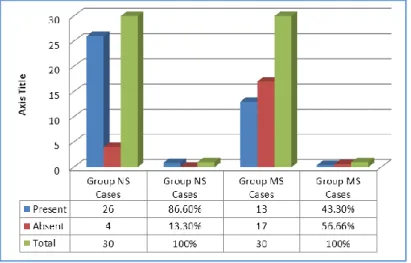
Urine Myoglobin Group NS Cases Group MS Cases
Present 26 86.6% 13 43.3% Absent 4 13.3% 17 56.66%
Total 30 100% 30 100%
Table 7 CHI SQUARE Test was used.
X2 = 12.675.
P VALUE IS < 0.001.
The above table shows that postoperative urinary myoglobin was present in 87% of the control group and only 43% is study group i.e. group MS. The difference is statistically highly significant.
Graph 7: Difference in urinary myoglobin level changes
J of Evolution of Med and Dent Sci/ eISSN- 2278-4802, pISSN- 2278-4748/ Vol. 4/ Issue 55/ July 09, 2015 Page 9576
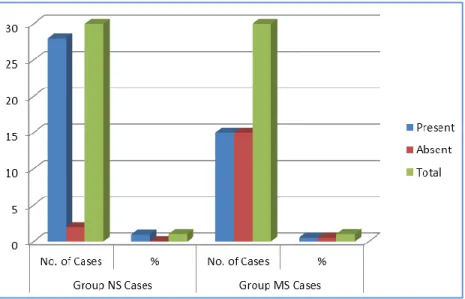
Fasciculation’s Group NS Cases Group MS Cases No. of Cases % No. of Cases %
Present 28 93.3% 15 50%
Absent 2 6.66% 15 50%
Total 30 100% 30 100%
Table 8 X2 = 11.8, P VALUE IS <.001.
The above table compares the occurrence of fasiculations in both groups.
Fasiculations were present in 93% of cases in group NS and only 50% in group MS and is statistically highly significant.
Group NS Cases Group MS Cases Myalgias No. of Cases % No. of Cases %
Present 24 80% 3 10%
Absent 6 20 27 90%
Total 30 100% 30 100%
Table 9 X2 = 26.93, P VALUE is < 0.001.
The above table shows that 90% of pts in Group MS did not experience fasiculations while compared to 20% in Group NS, which is statistically highly significant.
DISCUSSION: Recent advancement in medical system and introduction of newer muscle relaxants have changed scenario of general anesthesia.
Graph 9: Comparison of occurrence of postoperative myalgias
DOI: 10.14260/jemds/2015/1383
ORIGINAL ARTICLE
J of Evolution of Med and Dent Sci/ eISSN- 2278-4802, pISSN- 2278-4748/ Vol. 4/ Issue 55/ July 09, 2015 Page 9577 However, Succinylcholine, a depolarizing muscle relaxant has a unique role in clinical practice because it causes quick and excellent skeletal muscle relaxation for few minutes followed by spontaneous recovery. Unfortunately its use is often accompanied by muscle fasiculations, postoperative myalgia and biochemical evidence of skeletal muscle damage with raised Creatine phosphokinase concentration, Myoglobinemia and Myoglobinuria. With all these adverse effects, Succinylcholine has lowered its popularity among the surgical procedures.
Fasiculations have been attributed to a prejunctional depolarizing action of Succinylcholine, resulting in repetitive ring of the motor nerve terminals and antidromic discharges that manifest as uncoordinated vigorous contraction of the muscle bundles with no possibility of shortening and without synchronous activity in adjacent bundles. This might produce fibre rupture and damage thus causing increase in serum Creatine phosphokinase levels and Myoglobinuria.
Post-operative myalgias are either attributed to shearing forces associated with the fasiculations at the onset of phase I block or due to accumulation of lactic acid in muscle.
Many strategies have been used to reduce the side effects of succinylcholine like precrurisation with non-depolarizing muscle relaxant, stretching exercises, Dantrolene Sodium, Calcium gluconate, Vitamin C, Lidocaine, Magnesium, Diazepam and Midazolam, self-taming with Succinylcholine and more.4
M.A. Yousef at al have studied the changes in serum Creatine phosphokinase levels and anesthesia induced rhabclomyolysis after major and minor surgical procedures in children and showed that Creatine phosphokinase levels increased in both groups.5 The raise was significantly
higher in major surgical group. In this study we have included procedures with minimal or no muscle damage.
Creatine phosphokinase is found in the heart and skeletal muscles. Any damage to this tissues can lead to raise in its levels. In the present study, all precautions were taken to prevent excessive muscle injury. Patients with family history of muscular dystrophy, myopathies or previous history of myocardial infarction are excluded from the study.
Waters et al in their study have shown that there is a rise in Creatine phosphokinase levels due to shearing of soft tissues due to unsynchronized contractions of adjacent muscle fibres just before the onset of paralysis.6 This damage to muscle has been substantiated as increase in Creatine
phosphokinase levels.
A study was conducted by Mohammed Naguib et at (2006) to know the dose of Succinylcholine required for excellent endotracheal intubating conditions. They started with different doses of Succinyt choline. The intubation was performed 60 seconds later. Blind investigator has performed all laryngoscopy and graded intubating conditions. The intubating conditions was excellent in patients who received 2mglkg Succinylcholine. So in the present study we have taken 2mglkg of the drug to facilitate endotracheal intubation.
According to Maddineni VR, Mirakhur RK, Cooper AR, study on Myalgia and biochemical changes following Suxamethonium after induction of anaesthesia with Thiopentone or Propofol it is concluded that neither the induction agent nor the time between the induction agent and Suxamethonium administration has any significant influence on the incidence of muscle pains or Creatine kinase elevation following Suxamethonium.7 In the present study we have used 2mglkg body
weight of lnj. Propofol as induction agent.
Manataki et at studied the effect of continuous Propofol administration and Isoflurane administration on Creative kinase and Suxamethonium-induced postoperative myalgia in 50 patients.
J of Evolution of Med and Dent Sci/ eISSN- 2278-4802, pISSN- 2278-4748/ Vol. 4/ Issue 55/ July 09, 2015 Page 9578 Creative kinase was measured before and after operation. Myalgia was evaluated postoperatively by a blinded observer. The median level of myalgia was reduced significantly in the continuous propofol group than in isoflurane group.8
James MF, Cork RC, Dennett JE studied the effect of pretreatment with 60 mg/kg Magnesium sulfate on the neuromuscular blockade and consequent potassium release produced by 1.5 mg/kg Succinylcholine. They mentioned that Magnesium sulphate decreases Succinyl choline induced fasiculations.9
Ryu et al. injected Magnesium sulfate 50 mg/kg IV as bolus and then 15 mg/kg/ hr IV infusion till the end of surgery. Serum magnesium levels were found to be significantly higher in patients who received Magnesium sulfate than those who received saline only (1.5±0.2 vs. 0.9±0.lmmol/l). Magnesium toxicity begins at the concentration of 2.5-5 mmo1/1, which is much higher than highest level observed in their study. When serum magnesium level reaches 3.1mmo1/1, depression of deep tendon reflexes occurs as a sign of toxicity. In the present study, a bolus of Magnesium 40 mg/kg without infusion was used which is a safe dose considering the result of above study and no patient had any signs of Magnesium toxicity.
Laurence AS at at studied about Myalgia and biochemical changes following intermittent Suxamethonium and administration and effects of alcuronium, lignocaine, midazolam and Suxamethonium pretreatments on serum Myoglobin, Creatinine kinase and myalgia in 100 patients and confirmed that the fasiculations followed by Succinylcholine lead to increase in Creatine phosphokinase levels.10 In the present study, we have correlated occurrence of fasiculations with
Creatine phosphokinase levels.
However, occurrence of fasiculations do not correlate to occurrence of myalgias. Mc Loughlin et al, conducted a study on muscle pains and biomedical changes following Suxamethonium administration after six pretreatments regimens and showed no correlation between fasciculatlons and postoperative myalgia.11
Shreiber and colleagues conducted a metaanalysis of 52 randomised controlled trials attempted at prevention of succinylcholine induced fasciculations and myalgia and concluded that there is no clear relation between Succinylcholine related fasciculation and myalgia.12
Mahender et al conducted a study regarding the effects of Magnesium sulphate with Propofol induction of anesthesia on Succinylcholine induced fasiculations and myalgia. It was concluded that Magnesium sulphate 40mg/kg intravenously maybe used with Propofol for induction of anesthesia to control Succinylcholine induced fasiculations and myalgia.13 In the present study, the results are
similar to the above mentioned.
Stacey and colleagues studied the effects of Magnesium sulphate on Succinylcholine induced complications during rapid sequence induction of anaesthesia with Thiopentone. They observed that the incidence of fasciculations was significantly lower in the patients pretreated with magnesium in comparison to control group whereas there was no difference between the groups in the incidence of myalgia after surgery.14
CONCLUSION: The following conclusions were made from the study;
There was a raise in serum Creatine phosphokinase levels in the two groups.
The raise of serum Creatine phosphokinase levels was significantly lower in Magnesium sulphate group (group MS) compared to the other group.
DOI: 10.14260/jemds/2015/1383
ORIGINAL ARTICLE
J of Evolution of Med and Dent Sci/ eISSN- 2278-4802, pISSN- 2278-4748/ Vol. 4/ Issue 55/ July 09, 2015 Page 9579 Urinary Myoglobin was detected in both the groups, but significantly lower in Magnesium
sulphate group (group MS).
Fasiculations were significantly lower in Group MS.
Postoperative myalgias were significantly lower in Group MS.
REFERENCES:
1. Griffith H, Johnson GE, The use of curare in general anesthesia. Anesthesiology 1942; 3: 418. 2. Folder FF: Succinylcholine a new approach to muscle relaxation in anaesthesiology. N England
Journal of Medicine 1952; 247: 596.
3. W. J. Fawcett, E. J. Haxby & D. A. Male Magnesium: Physiology and Pharmacology, BJA 1999, 83 (2) 302 – 20. Kohlschutter B, Bauer H, Roth F, at at. Suxamethonium - induced hyperkalemia in patients with intraabdominal infections. Br J Anaesth 1976; 48: 557.
4. SF, Wong, F Chung: Succinylcholine-associated postoperative myalgia. Anaesthesia; 2002, 55(2): 144-152.
5. Yousef MA, Vaida S, Somri M, Molinger J et al: changes in CPK LEVELS after minor and major surgeries in children, Br J Anaesth, 2006; 96; 786.
6. Waters DJ, Mapleson WW: Suxamethonium pains - hypothesis and observation. Anaesth 1971; 26: 127.
7. Maddineni V R (1), Mirakhur R K, Cooper A R, Myalgia and biochemical changes following suxamethonium after induction of anaesthesia with thiopenton or propofol. Anaesthesia. 1993 July; 48 (7): 626-8.
8. Manataki AD (1), Arnaoutoglou HM, Tefa LK, Glatzounis GK, Papadopoulos GS. Continuous propofol I administration for suxamethonium - induced postoperative myalgia. Anaesthesia. 1999 May; 54(5): 419-22.
9. James MF, Cork RC, Dennett JE. Succinylcholine pretreatment with magnesium sulfate. Anesth Analg. 1986 Apr; 65(4): 373-6.
10. Laurence AS, Myalgia and biochemical changes following intermittent suxamethonium administration. Effects of alcuronium, lignocaine, midazolam and suxamethonium pretreatments on serum myoglobin, creatinine kinase and myalgia. Anaesthesia. 1987 May; 42(5): 503-10.
11. Mc Loughlin C, Elliott P, McCarthy G, Mirakhur RK.et al: Muscle pains and biochemical changes.Anesthesia 1992; 47: 202.
12. Schreiber J, Lysakowski C, Fuchs-Buder T, Tramer MR. Prevention of Sch - induced Fasciculations and myalgia. A MetaAnalysis of randomized trials. Anesthesiology 2005; 103: 877-84.
13. Mahendra M, Nalin T et at: Effect of magnesium sulphate with propofol induction of anesthesia on Sch insuced muscle fasiculations and myalgia. J Anesthesiol Clin Pharmacol. 2012 Jan - Mar ; 28 (1): 81 - 85
14. Stacey MR, Barclay K, Asai T, Vaughan RS. Effect of magnesiumsulphate on suxamethonium - induced complication during rapid sequence induction of anaesthesia. Anaesthesia 1995; 50: 933-6.
J of Evolution of Med and Dent Sci/ eISSN- 2278-4802, pISSN- 2278-4748/ Vol. 4/ Issue 55/ July 09, 2015 Page 9580 AUTHORS: 1. Sadhana Roy 2. Mrunalini K. 3. G. Venkateshwarlu 4. A. Sowmya Sri PARTICULARS OF CONTRIBUTORS:
1. Associate Professor, Department of Anaesthesiology, Gandhi Medical College. 2. Senior Resident, Department of
Anaesthesiology, Gandhi Medical College. 3. Professor, Department of Anaesthesiology,
Gandhi Medical College.
FINANCIAL OR OTHER
COMPETING INTERESTS: None
4. Junior Resident, Department of
Anaesthesiology, Gandhi Medical College.
NAME ADDRESS EMAIL ID OF THE CORRESPONDING AUTHOR:
Dr. Sadhana Roy, H. No. 17-1-391/S/581,
Near Vaidehi Ashram, Singareni Colony, Hyderabad-500059.
E-mail: [email protected]
Date of Submission: 13/06/2015. Date of Peer Review: 14/06/2015. Date of Acceptance: 01/07/2015. Date of Publishing: 07/07/2015.