Hint Function in Room Escape Games by using
Eye-tracking
著者
Jin Fengrui
出版者
法政大学大学院情報科学研究科
journal or
publication title
法政大学大学院紀要. 情報科学研究科編
volume
13
page range
1-6
year
2017-03-31
URL
http://doi.org/10.15002/00021512
Hint Function in Room Escape Games
by using Eye-tracking
Fengrui Jin
Graduate School of Computer and Information Sciences Hosei University
Tokyo 184-0003, Japan [email protected]
Abstract—The DDA (Dynamic Difficulty Adjustment), is an
ideal in many interaction design fields. The concept of DDA, is to balance the difficulty of activity and the participant’s skill, to let each participant in a suitable difficulty automatically. For the game design field, always use it to keep player enjoy the game, and stay in the flow zone, which means have a good immersion and game experience. Recent years, with the universal of VR devices and eye tracker devices for gameplay, eye-tracking become more and more universal as well. By using eye-tracking, the way to get player’s status in playing games will be more convenient. This research puts forward some ideas for hint function in room escape games with the concept of DDA and the eye-tracking. The goal of this hint function is to help the player find the current target object at the right time in player’s gameplay. Though this way to make sure player is not feel irritable or get lost in game playing, and to keep player in the flow zone.
Keywords—DDA; flow; room escape game; eye-tracking; hint
I. INTRODUCTION
Video game was a limited recreational activity in the past, but recent years it evolved to a mature media. Now, video games have infiltrated our daily life and our society deeply. Although those who do not play video games are more and more received the video games, especially the “old” mans, as an entertainment just like films or music. Those people are still not willing to play games. As almost all game players know, watching someone playing a video game is different from playing a video game by yourself. To reduce prejudice, disagree and resistance from non-gamers, to let them try the video games will be the most effective way, just like let the people who never watch a film to watch. When they find a game that they like, they will be never considering video games shallow.
Game developers are looking for ways to expand the reach of their products. By making use of the existing intellectual property rights from books or movies, making both gamers and non-gamers to enjoy the games is not as difficult as it looks like. With the richness, the length, especially the difficulty of the content of games, most gamers, especially which are not the target audiences, can’t even finish their games. For almost all developers, designing a video game is very much about how to keep the player in the game and eventually be able to finish the game. If players, especially for the new one, feel the game is too difficult, they will feel anxious, conversely, they feel boring.
Therefore, the game system needs to maintain as many as possible different players' experiences inside the comfortable game experience, or we can say the Flow Zone [1].
Fig. 1. Main idea of research
This research is going to find a good way, for example, let game itself to change the difficult (Fig.1), to let the players, especially the new ones, keep in playing games and no need to confuse about the game difficulty at the same time.
A. Room Escape Game
Room Escape Game, also known as escape-the-room game or 脱 出 ゲ ー ム, is a sub-genre of point-and-click graphic adventure game. At the beginning, these sorts of games are almost low budget, low production value, low programming, next-to-no story line, and usually created as a freeware browser game for the Adobe Flash platform [2].
The goal of Room Escape Games is simple: escape from imprisonment by exploiting their surroundings, like a room, building or situation you are confined to. The room usually consists of locked doors, objects to manipulate, and hidden clues or secret compartments. Like the adventure games that proceeded them (Myst or 999: Nine Hours, Nine Persons, Nine Doors were some strong influences on the genre), you most acquire items, and proceed to use them in interesting and unexpected ways to interact with other items in the room to reveal a way to get yourself out [3].
B. Game Hint
Hint function is a part of the game guide. Almost all games have hint function, it can help the player to familiarize the game and find the current problem.
For the room escape games, the difficulty of the game is mainly reflected in two ways: the difficulty of puzzles and the difficulty of finding the puzzle and key tools. Because the difficulty of puzzles is the core of escape games, adjusting the difficulty of that will change the whole game, and normally this will be determined at the very beginning of the development. So, about to make better experience of playing escape games, this research will talk about adjusting the difficulty of finding the puzzle and key tools, which means a good guide (whether obvious way, like highlight and arrows, or invisible way) of helping player to find something they need.
C. Eye-tracking
Eye tracking is the process of measuring either the point of gaze (where one is looking) or the motion of an eye relative to the head. An eye tracker is a device for measuring eye positions and eye movement. Eye trackers are used in research on the visual system, in psychology, in psycholinguistics, marketing, as an input device for human-computer interaction, and in product design. There are a number of methods for measuring eye movement. The most popular variant uses video images from which the eye position is extracted. Other methods use search coils or are based on the electrooculogram.
Fig. 2. eye-tracking principle[4]
Two general types of infrared / near-infrared (also known as active light) eye tracking techniques are used: bright-pupil and dark-pupil (Fig.2). Their difference is based on the location of the illumination source with respect to the optics. If the illumination is coaxial with the optical path, then the eye acts as a retroreflector as the light reflects off the retina creating a bright pupil effect similar to red eye. If the illumination source is offset from the optical path, then the pupil appears dark because the retroreflection from the retina is directed away from the camera [4].
II. RELATED WORK
A. Game Difficulty
The problem with difficulty settings in most games is the fact that they are very hard to get right in terms of a balanced challenge. You sometimes see developers make the harder settings without any thought in terms of balance; making the game punishing to play, because they think that’s what the hardcore want. Other times, you have cases where the game is not meant to have different difficulty settings. The best difficulty setting in game design, is used it as a fully integrated part of the design and not just simply altering stat values. To achieve this goal, some games like to give the player additional rewards or unlock content based on the difficulty that the player is at. The higher the difficulty meant getting better rewards and fighting new types of enemies and situations. The advantage is that playing on the lower difficulty, the player is not punished as much for using advanced mechanics and rules, but the option is there for higher skilled players to really fight the enemy. The best part is that neither group is punished for playing the game
their way; expert players don’t have to unlock the higher settings and newcomers can enjoy the base experience [5].
B. Game Guide and Hint Function
If we say the game difficulty is a balance board between players and games, then the game guide must be a bridge between players and games. The intention of the game guide is to guide the player, especially the new player, to understand the whole game system and operation. The time it runs is the time for the player to establish an impression of the game. It's important for keeping the player continue to play the game. But in actual development, the position of game guide is rather awkward.
As a part of the game guide, almost all games have hint function, it can help the player to familiarize the game and find the current problem. For the room escape games, the main problem to finish game are the puzzle itself and the unknown of interactive objects. Almost room escape games have the hint function to help player finish the game, especially to let players know which object can be interactive. The hint function which currently in use is not enough clear and convenient.
C. Eye-tracking in Games
Recent years, there are some eye trackers for game especially for PC games, like SteelSeries Sentry Gaming Eye Tracker and Tobii Eye Tracker [6] those provide entirely new game experiences by allowing players to communicate with their PCs, using their eyes. This type of eye trackers can support many types of games. Take Tobii Eye Tracker for example, it can help and improve the gaming experience in several ways.
1) Vision
a) Clear UI: With the eye-tracking, all the HUD elements can become almost transparent unless you look at them, include the mini-map, ammunition, health, tutorials, missions, tool tips and so on. By the eye-tracking, it can reduce clutter and enhance the game world exposure.
b) Light: With the eye-tracking, the game can add the responsive gaze awareness to light and dark environments, after that, your character’s eyes will adapt to different lighting scenarios in a more realistic way.
c) Expand: By using eye-tracking, the center of the screen will follow player’s eyes as player gaze reaches the edge of the screen, it will auto broadening player’s field of view, and increasing player’s situational awareness.
d) Highlight: After using eye-tracking, Player’s gaze will interact with surroundings to quickly locate shelter points, adding target acquisition speed and improve the situational awareness to the gameplay [7].
2) Operation
a) Tag: Looking at an enemy you want to tag for several times with eye-tracking, and press the prompt button, obviously, it is more convenient to tag in this way. And it also can help your group to facilitate group target acquisition speed and awareness in multiplayer games.
b) Choice cover: By using eye-tracking player can just Look to a point in which you want to take cover, press the prompt button to run and take cover. Combine this feature with
Extended View to quickly locate targets while in cover, to reduce the misoperation. With eye-tracking the speed of adding target acquisition will be more fast than with controller [8].
c) Menu: Similarly, the eye-tracking can also help player to choice in menu. Go through augmentations or inventory items by quickly navigating the menu with your gaze, and then press designated key to select. It can minimize your time response and will be very helpful in many critical or urgent situation [9].
d) Aim target: Now in many games, for example Tom Clancy’s Ghost Recon® Wildlands, player can use eyes by eye-tracking to automatically aim at the target which the player is looking at. It will greatly improve the operational efficiency when against the enemy.
In a word, with eye-tracker, players now can complement keyboards, mice and gamepads as an input method for a new game experience.
III. DESIGN
A. Basic Idea
About 30 years ago, with an intention to explain happiness, Mihaly Csikszentmihalyi found Flow, the feeling of complete and energized focus in an activity, with a high level of enjoyment and fulfillment. Due to the special relationship between challenge and ability, Flow has been used in fields like sports and tutoring. The famous GRE test is a good example of design based on the concept of the Flow Zone. The description of Flow is identical to what a player experiences when totally immersed in a video game. During this experience, the player loses track of time and forgets all external pressures. It is obvious that balance the game difficulty and the player’s skill which means can provide Flow experiences is very important for a game. For escape room game, the game difficulty includes puzzle difficulty and the difficulty to find the “key”. The hint function in my idea, should be an implement to achieve Dynamic Difficulty Adjustment, also known as DDA, is a fairly straightforward and ideal concept in the game design field. The difficulty of a game should change dynamically based on its player’s skill and performance [10].
The goal of DDA, is to keep player stay in the flow zone, which can provide the greatest game experience. However, designing and implementing a DDA system is not trivial. Every so often, DDA systems take control away from the game designers, which potentially causes more problems than a linear game. But I want to try to achieve this goal in a certain extent. So I decided to try it in room escape games, which have more simple difficulty system, basically, just the hint function can be regarded as a difficulty system in room escape games. In my research I was trying to make the hint function more effective and timely. The traditional way which depend on the passing time to judge whether player need help is not enough for this goal. So I decided to use eye-tracking to get the player’s gaze data to find the time when player need help. And to keep player stay in the flow zone.
B. Interaction
Room escape game is a sub-genre of point-and-click graphic adventure game. the player typically controls their character through a point-and-click interface using a computer mouse or
similar pointing device. With the improvement of touchscreen technology, more and more room escape games developed for the touch screen device, and player can use these devices to play games. For every player who first open the game, they have to point-and-click somewhere on the screen to start game, interact with the objects and finally, complete the game. For every one who ever played the room escape game, they all know the most important things of playing game, especially when you want to finish it, is to find the right objects which you need to use them to pass every mission in this game.
As we all know, for the room escape game, the most common problem is the player doesn’t know where is the key tools for the puzzle, and at the very beginning of the game, they also often can’t find every objects which can be interacted. So many games have the hint function to help player finish the game, especially to let players know which object can be interactive. The hint function which currently in use is not enough clear and convenient. Besides that, the traditional hint function always untimely, so that players still need a lot of time to wait the hint, most traditional hint function also use text or some words to tell player the information of next step, and split the information to several part, the hint of each part will be more and more specific, for those stepped hint, whether players know the front hints, they still need to wait for them, for example, if the hints will show as three part, but the player already know the information in the first two part, they still need to wait after the system show the first two. The reason of this problem is the unknown of the information, which about what is the player already known, and which not.
1) Idea
So for this problem, I designed a function which can get the information of players’ knowledge, which means the game can know what information is the players already known, and which not. This function is by using the players’ gazing data to get the information of every objects, to analysis which object has been found by the player and which not. After that to show the player from all they have ever watched, which is the object can be interacted.
By traditional way to determine the player ever watched or not is difficult, judged it with the click always hard because the mouse or finger can click or pass everywhere of the screen. But with eye-tracking, it becomes possible. With use eye-tracking to track the player’s gaze, can easy know where the parts of screen have been watched. According to that, the system could know the object player have ever watched and show it to the player to let them know that this on is an object can be interacted which means this on is one of the key tools of this game or this mission.
2) Key point
Although we can know the parts of screen the player has watched, but there is still have two problems. First, how can we split the place player glancing at and the place player gazing at. Because as we all know, when a player played such a puzzle game, he (or she) will definitely looking at everywhere to find the key tools or the objects, we have to know that this one, we want to tell the player that it is a “key”, is the one which player want to know if it is an interacted object. And at the same time, we still have to split the objects, which just want player get it first and use it to unlock some puzzle in other place, and the
objects or puzzle, which need player to analysis and consider and then to find it with that.
For the first one I have set a value of gazing time to judge. If player gazed the object less than a certain time, for example one second, that means player is just look around and doesn’t realize that here is an interacted object, so that, the hint function will not run. If player gazed the object more than one second, which means he (or she) believed this one or here is an object can be interacted. After that the hint function will run to judge if this one can be show to the player (Fig.3).
Fig. 3. Flowchart for Interaction
And the judgement step is going to solve the second problem, to split the one can directly show and the one need some pre-conditions. For the first one, it easy to be confirm. When player gazed the first kind object, reached the enough time condition, then show it to the player, for example highlight the object, to let player know this one should be get or put in to their package for the future puzzles. For the second one, system should do some extra judgement. For example, If the puzzle need player to solve some pre-puzzle and only then they can get the enough information to solve this puzzle, so, before that this object will be an un-hint object.
C. Guide & Re-guide
Basically, hint function is a part of the game guide. Just like the game guide, the goal of hint function is to help the player to familiarize the game and find the current problem. That is to say, when player stuck, miss, or do the wrong choice, the hint function should appear and show the right way of completing the game and lead the player back to the right way.
1) Missing
After show the interacted objects to the player, which they gazed at. It will lead a new problem, missing objects, which means the player sometimes can find all the objects they need. If we say, let the player know the interacted objects is to save time, especially the trial and error time of playing. Then the function of show the missing one is also to save time for the player. When you played a puzzle game or room escape game, sometimes you have to pay many time to find the key tools or objects, developer to hind it in somewhere to improve the difficulty of game, let the game not be boring. But if this place is too hard to find or the player’s experience or common sense are not enough to help him find it, they will get cranky. It will lead to a bad gaming experience.
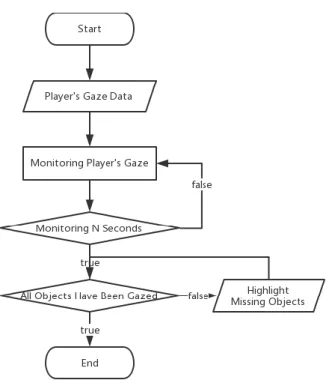
I designed a way to help the player get the object that they can't find it anywhere. Just like before, we can’t just show it very simple, it will make the game to be boring and too easy. In same scene, the system will to show the missing one only on player find enough right objects, and started to look around for several times or started to solve the problem. When player’s gaze is in the moving mode (searching the lost objects or find the puzzle), the hint function is going to check if there are some objects not be found. If exist, the hint of missing object will show with highlight. And the player will get the missing one to continue play the game (Fig.4).
Fig. 4. Flowchart for Missing
2) Wrong Choice
Besides the unknown or unsure of objects, missing of objects or puzzles, another situation of wasting time is the wrong choice or trial and error. This wrong choice is different from which in missing, in missing mode, the trial and error mostly have no focus. In this part, wrong choice means player know the puzzle or the key tool, but they can’t match them correctly. Basically,
the moving mode of player’s gaze are similar, but the hint which help the player is different kind.
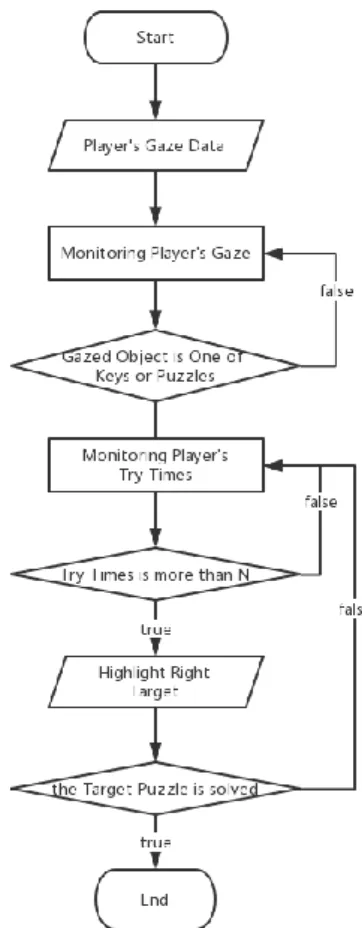
For this part, the hint function first should know which puzzle or key tool is player want to solve or find, that means the system should get the player’s gaze and judge which is player focus and after that to set a monitor to get the player’s try times and the wrong choice times, if the try times or the wrong choice times are reached some value, system will show the hint to the player, to lead them to the right one, and save them time (Fig.5).
Fig. 5. Flowchart for Wrong Choice
Besides that, there is another mode of this part to judge if player random try without considering. Obviously, this mode is more complex than others, and it’s hard to implement. To implement this mode might use some gaze motion study about biology and psychology.
IV. IMPLEMENTATION
A. Interaction
To achieve this function, I set some object in the projects, and split them by the interaction. The one which cannot be interacted will not interact with player’s gaze. Like the orange, pink and gray one in follow photos. And if player’s gaze is just look around the screen without gaze the objects (Fig.6), it will not show to them the objects with highlight, though this way to keep the player still need to find with his gaze, that means they still need to consider which is the one may be can be used.
Fig. 6. Look around mode
And only if player gazed one object for a certain time, for example 1 second, it will show to player with highlight or change to white (Fig.7).
Fig. 7. Gaze mode
Get the gazing data from device and get the information of every objects, to analysis which object has been found by the player and which not. After that to show the player from all they have ever watched, which is the object can be interacted. To let the player knows the right or interacted objects from those objects they thought they are, and exclude the wrong choice. B. Guide & Re-guide
After show the interacted objects to the player, which they gazed at. The system will mark the objects which are gazed by the player, and after several times to compare with the database to check if all objects have been gazed.
If not, it will show the missing objects to the player. For example, in this case, the green, red, black and yellow one have been already gazed by the player (Fig.8), and the gray, orange and pink one are un-interacted objects (Fig.9), the yellow one is the missing one, so after several seconds it will show to the player with change color to white.
Fig. 9. Show the missing one
V. DISCUSSION AND CONCLUSION
A. Evolutions &Limitations
The hint function with eye-tracking in my research can improve the experience in game playing. It will cut down the player’s meaningless try times, to help player pass the mission without anxious. At the same time, thought this way to show hint is more specific and visual, it can make player find and solve puzzles more quickly and accuracy.
Obviously, the game I implemented in the research is just in the room escape game. But the hint function can be used in widely kind of games, almost all games have this function. The function can help the player, especially the beginning of the game, to quickly know the basic operation, common and basic knowledge and skills in the game. And it is simpler (although it’s more trivial) to change than other complex systems. use the DDA with it. At the same time, the eye-tracking is also used in more and more games, and to become an aided function in many kinds of systems.
The research is more like to change the textual hint into dynamic graphic hint which can be more vivid and lively to show to the players. And on this foundation, to make the hint function more timely and easy to understand. But the idea of this research is trying to find some way or some basic idea to achieve DDA, by DDA to make the game suit each player’s skill, and keep them in flow zone when they played the game. According to this goal, my research is still having many things to do. And for this research, it is still need many data of different players to find some better design or value of parameters in this research B. Future Works
About the future works or the future research, as I said in the limitations part, the research of DDA is still a fairly straightforward and ideal concept in the game design field. Designing and implementing a DDA system is not trivial. Every so often, DDA systems take control away from the game designers, which potentially causes more problems than a linear game. Few commercial developers have implemented DDA systems for their games, and even fewer have shipped them. The DDA is also a powerful design tool applicable not only in video games, it can be applied to nearly any fields where there are
human interactions, like exam. If an exam use DDA as the main idea, students can gain as much score as possible during the test period, even top students can still challenge themselves every time they take test, and the normal students can also gain a good score. By this kind of exam, even can split the students to the investigative ones and practical ones.
And about the flow research, it has been mainly focused on the relationship between challenge and ability, which naturally assume the interaction. When work is fun we have created complex, but negotiable challenges, challenges that allow the individual to engage or disengage, to work harder or work safer. fun can be defined as Flow, a balance of the relationship between challenge and ability. But there are still some games like Sims has already proven that there are more interesting aspects in the field of Flow that are beyond challenge and ability. May be we can also be able to leap far beyond challenges and conflicts, that will be a new way to let the player feel flow in game and do not to consider about if the game is too difficult or too easy.
ACKNOWLEDGMENT
Here and now, I would like to extend my sincere thanks to all those who have helped me make this thesis possible and better. Firstly, I am deeply grateful to my honorable supervisor, Prof. Takafumi Koike and Prof. Jianhua Ma, who have checked through my thesis with patience and given me instructive suggestions, and they also played an important role in indicating a bright road in my future writing. Then thanks to the teachers and professors who have taught me over the past one years of study. Finally, I am very grateful to my lovely friends who have offered me quiet situation to compose my thesis and discussed with me about my thesis.
REFERENCES
[1] Jenova Chen, "Flow in Games (and Everything Else)" in Communications
of the ACM magazine, Vol50, Num4, pp.31, Apr 2007
[2] Leigh Alexander, "Could The Room's success predict a new trend?", Gamasutra, Jan, 2013
[3] Kino Diaries, "Escape-the-Room Games: A History, A Catalogue, and an
Explanation - Kino Diaries", Oct 2009.
[4] G. Massimo, S. Maurizio, C. Silvia, D’A.Tommaso. "A free geometry model-independent neural eye-gaze tracking system". Journal of NeuroEngineering and Rehabilitation, Dec 2012.
[5] Josh Bycer, “Debating Difficulty Settings in Game Design”, Gamasutra,
Jun 2016.
[6] Tobii ,“Tobii Eye Tracker 4C”, Tobii Eye Tracker 4C
[7] Tobii, “ Play Rise of the Tomb Raider with Eye Tracking”, tobiigaming,
2017.
[8] Tobii, “Play Tom Clancy’s The Division with Eye Tracking”, tobiigaming,
2017.
[9] Tobii, “Play Deus Ex: Mankind Divided with Eye Tracking”, tobiigaming,
2017
[10] Robin Hunicke, “The case for dynamic difficulty adjustment in games”,
Proceedings of the 2005 ACM SIGCHI International Conference on Advances in computer entertainment technology, Jun 2005