autonomous language learning. PhD thesis, University
of Nottingham.
Access from the University of Nottingham repository: http://eprints.nottingham.ac.uk/13665/1/574615.pdf
Copyright and reuse:
The Nottingham ePrints service makes this work by researchers of the University of Nottingham available open access under the following conditions.
· Copyright and all moral rights to the version of the paper presented here belong to
the individual author(s) and/or other copyright owners.
· To the extent reasonable and practicable the material made available in Nottingham
ePrints has been checked for eligibility before being made available.
· Copies of full items can be used for personal research or study, educational, or
not-for-profit purposes without prior permission or charge provided that the authors, title and full bibliographic details are credited, a hyperlink and/or URL is given for the original metadata page and the content is not changed in any way.
· Quotations or similar reproductions must be sufficiently acknowledged.
Please see our full end user licence at:
http://eprints.nottingham.ac.uk/end_user_agreement.pdf A note on versions:
The version presented here may differ from the published version or from the version of record. If you wish to cite this item you are advised to consult the publisher’s version. Please see the repository url above for details on accessing the published version and note that access may require a subscription.
as
autonomous language learning
Lucy Cooker, BSc, MSc, MA
Thesis submitted to the University of Nottingham for the degree of
Doctor of Philosophy
PAGINATED
BLANK PAGES
ARE SCANNED AS
FOUND IN
ORIGINAL
THESIS
NO
INFORMATION
MISSING
CONTAINS
PULLOUTS
THESIS CONTAINS
While learner autonomy is often lauded as an important goal in language education, applied linguists have debated if it is a construct that has been given proper attention in terms of definition and assessment. In order to address this debate the researcher implemented a two-phase study within the context of higher education. Theories of learner autonomy, sustainable assessment and transformative learning guided the study design.
In the research design, the nexus between language learner autonomy and assessment as learning was first explored in phase one of the study. Here survey methodology was used on a global scale: Findings from 45
respondents in 13 countrles' indicate that indeed language learner autonomy is being widely assessed, and, further that a variety of tools, evidence and people are implemented in this task.
In phase two of the study, the most important stakeholders of learner autonomy - language learners - participated in Q-methodological study of their perceptions of the non-linguistic outcomes of learning in an
autonomous environment: A total of 30 participants from Hong Kong, Japan and the UK completed a Q sort and interview. The findings of the Q study showed that there were six different ways of being autonomous, and these were interpreted as 'modes of autonomy'. These modes of autonomy were lastly used to devise a tool for the formative self-assessment of learner autonomy.
COUNTS, AND NOT EVERYTHING
THAT COUNTS
CAN BE COUNTED.
ALBERT EINSTEIN
Firstly I would like to thank my supervisors Dr Barbara Sinclair and Dr Richard Pemberton. Both of you have been incredibly supportive through difficult and testing times and lowe you an enormous debt. Barb, you may not be aware but it was your work which first inspired me to pursue the issue of assessment and learner autonomy and you have continued to be an inspiration over these five years. You have provided intellectual
stimulation, but also personal support, and you have picked up the pieces when they appeared broken and stuck them back together again. Richard, you have been such an influential part of my professional journey, from our first meeting in Hong Kong, talking about self-access issues, to our recent collaboration when you gave me the opportunity to write about my
research in an edited publication, and everything that has gone in between. Thank you to you both.
I would like to thank the colleagues, including Research Network on Language Learner Autonomy members, and members of AUTO-L, LD-SIG, IATEFL LA SIG, iLearn, and others, who participated in the survey which forms Part 1 of this study.
I would like to thank the thirty three students who were participants in the second phase of research. I have given you pseudonyms, but you know who you are, and I am grateful for the time you spent and the inspiration you gave me to continue my study. I would also like to thank the
gatekeepers, whose practical assistance and moral support ensured that the research in Part 2 of the study could take place: Dr Michael Torpey, Dr Jo Mynard, Marisa Marmo, Dr Ulrike Bavendiek, Dr Xuesong (Andy) Gao, Jane Lockwood, Helen Lavender, Mark Hopkins, Sarah Toogood, Dr Pauline Lee, Dr Bruce Morrison, Nick Florent, Fiona Williams, Ian Lee, Jean Young, and Professor Kathleen Ahrens. I would also like to thank the members of the HASALDgroup, who were very willing pilot participants, despite the chaos of 30+ Q sorts taking place in one room. You were so supportive that day, and many of you - David, Phil, Andy and Nalini, - have been subsequently. Thank you.
Some other people deserve a special mention. Phil Murphy and Ruth Ong -you know what part -you played in this research. Thank -you for -your time and your professionalism. David Gardner, for enabling me to become a part of ~he CAESfamily for one month, for all the chats in Starbucks, and for being a wonderful mentor. My Q friends: Odessa, you are the loveliest pe~son I have ever met online; John Bradley for the hours spent in your office and elsewhere looking at PQMethod print outs; Nicola Plastow, for helping me understand the basics at a time when it really mattered. Kelly Peake - Thank you for setting me on my doctoral path back in February 2006. You have been an incredibly supportive friend, and have taken time to read my work and give feedback at times that were not easy for you.
Chri~tine Rosalia - I have lost count of the hours we have spent emailing, skvplnq and occasionally in face-to-face communication, but you have been such a rock and support for me over these last 5 years. Thank you.
Sara Cotterall - You have been an incredible mentor CoP member role model, critical friend, and mate. Frequently just knO\~~ingthat you have
My Stamford friends, who have looked after me and been so supportive in so many ways. Particularly Cheryl & Bret, Kate, Ulli &Julie, and Ian for friendship and spaces to work in. Also Catherine and Duncan, Ian and
Karen, and Anna and Rich, for always being interested, and putting up with me being only half there on holidays, weekends away and nights out. And to Catherine and Tim for helping when you did.
Finally, to Mum and Dad, and Liz and Onyx for being patient, supportive, and for believing in me. And to my darling Claire. For all those meals cooked and clothes washed; for all the holidays you've taken alone, and the countless times I've said 'when the PhD is over'; for consoling me on those nights of panic, for making me laugh, and for always, always, knowing that I could do it.
1 Introduction--- 1
1.1 Overview of the research --- 3
1.2 Background and motivation for the study --- 4
1.3 Researchaims --- 9
1.4 Thesis outline---1 0 2 Learner Autonomy---13
2.1 Introduction ---13
2.2 Theoretical understandings of autonomy in language learning: definitions, versions, perspectives and dimensions ---13
2.2.1 Attribute or product? ---17
2.2.2 Behaviour or psychological capacity? ---18
2.2.3 Individual or social?--- 20
2.2.4 Political or apolitical? ---22
2.3 Practical understandings of autonomy in language learning ---24
2.4 Why autonomy in language learning is important---28
2.5 Challenges in researching autonomy---33
2.6 Levels of autonomy --- 35 2.7 Chapter summary --- 36 3 Assessment --- -- --- ---- ---- --- --- -- -- --- --- ---- --- -- --- --- --39 3.1 3.2 3.3 Introd uction --- --- --- --- ---- -- --- -- --39
Assessment, measurement, testing and evaluation ---41
Theoretical concepts of assessment used in the thesis ---42
3.4 Purposes of assessment --- 46
3.5 Traditional assessment practices --- 49
3.6 Alternative assessment practices --- 51
3.6.1 Peer assessment --- 52
3.6.2 Self-assessment --- 53
3.6.3 The importance of self-assessment for language learner autonomy--- 56
3.7 Review of previous research --- 57
3.7.1 Assessing autonomy --- 57
3.8 Non-linguistic learning outcomes --- 62
.3.9 Chapter summary --- 63
4 Theoretical Perspectives--- 65
4.1 Introduction --- 65
4.2 Ontological and epistemological pOsitioning--- 65
.
4.3 Theories --- 654.3.1 Transformative learning theory --- 66
4.3.2 Theories of autonomy, assessment, and Q methodology ---- 71
4.4 Chapter summary --- 71
5 A New Model of Learner Autonomy for Assessment--- 73
5.1 Introduction --- 73
5.2 Previous models of learner autonomy for assessment--- 73
5.3 The model of learner autonomy used in the current study --- 80
6 Phase 1: Survey of Current Practices in the Assessment of Autonomy 87
6.1 Introduction ---87
6.2 Researchquestions ---87
6.3 Research methodology --- --- -- ---- -- --- 88
6.3.1 Questionnaire design and piloting ---88
6.3.2 Main study sampling, access and ethical considerations ---93
6.3.3 Administration of the questionnaire ---94
6.3.4 Data preparation ---95
6.3.5 Data analyses ---.--- 95
6.4 Survey fi ndings- --- --- -- --- --- --- -- --- -- -- --- 96
6.4.1 Contexts of learner autonomy ---97
6.4.2 Assessing learner autonomy --- 102
6.4.3 How is autonomy assessed?--- 105
6.4.4 Who assessesautonomy? --- 115
6.5 Discussion --- 116
7 Phase2: Learners' Perceptions of the Outcomes of Learning in an Autonomous Learning Environment--- 117
7.1 Introduction ---_ 117 7.2 What is Q methodology? --- 120
7.2.1 The stages of Q methodology--- 120
7.2.2 7.2.3 7.2.4 Provenance and history --- 141
Research paradigm and philosophical underpinnings--- 143
7.3 A quest for better methods: Comparisonof Q with other research
methods for learner autonomy ---153
7.3.1 Data collection methods---154
7.3.2 Data analysis techniques ---160
7.4 Why is Q methodology appropriate for this study? ---162
7.5 Q methodology in practice ---166
7.5.1 Step 1: Establishingthe domain of subjectivity ---166
7.5.2 Step 2: Identifying and building the concourse ---167
7.5.3 Step 3: Generating the Q-sample---174
7.5.4 Step 4: Selecting the P-set---178
7.5.5 Step 5: Carrying out the Q-sort---181
7.5.6 Step 6: Doing the Q factor analysis---186
7.5.7 Step 7: Interpreting the factors---189
8 Phase2 Findings and Implications ---191
8.1 Introduction ---191
8.2 Factor interpretation ---191
8.2.1 Technical information about the factor ---194
8.2.2 Demographic information about the participants ---194
8.2.3 Visual representation of the idealised array for the factor--194
8.2.4 Descriptive overview according to the face value of the statements ---19 5 8.2.5 Thematic interpretation of the statements ---195
8.3 Factor A: 'A love of languages' --- 199
8.3.1 Overview--- 200
8.3.2 Factor A: Higher ranking statements--- 206
8.3.3 Factor A: Lower ranking statements --- 215
8.3.4 Factor A: Distinguishing statements --- 225
8.4 Factor B: 'Oozing confidence'--- 226
8.4.1 Overview--- 227
8.4.2 Factor B: Higher ranking statements--- 230
8.4.3 Factor B: Lower ranklnq statements --- 235
8.5 Factor C: 'Socially oriented and enthusiastic'--- 244
8.5.1 Overview--- 244
8.5.2 Factor C: Higher ranking statements--- 247
8.5.3 Factor C: Lower ranking statements --- 253
8.5.4 Factor C: Distinguishing statements --- 262
8.6 Factor D: 'A love of language learning' --- 263
8.6.1 Overview --- 263
8.6.2 Factor D: Higher ranking statements --- 266
8.6.3 Factor D: Lower ranking statements --- 269
8.7 Factor E: 'Teacher-focused' --- 273 8.7.1 8.7.2 8.7.3 8.7.4 Overview- --- --- ---- --- --- ---- -- --- -- --- 273
Factor E: Higher ranking statements --- 275
Factor E: Lower ranking statements --- 278
8.8.1 Overview --- 281
8.8.2 Factor F: Higher ranking statements ---283
8.8.3 Factor F: Lower ranking statements --- 289
8.804 Factor F: Distinguishing statements --- 298
8.9 Chapter summary --- 299
9 Modesof Autonomy: Towards Self-assessment--- 301
9.1 Part 1: Modesof autonomy --- 301
9.2 'A love of languages' mode of autonomy --- 302
9.2.1 Narrative interpretation --- 302
9.2.2 Monica --- 303
9.3 'Oozing confidence' mode of autonomy ---304
9.3.1 Narrative interpretation --- 304
9.3.2 Chihiro--- 306
904 'Socially oriented and enthusiastic' mode of autonomy---307
904.1 Narrative interpretation --- 307
9.4.2 Emiko--- 309
9.5 'Love of language learning' mode of autonomy ---311
9.5.1 Narrative interpretation --- 311
9.5.2 Justin --- 312
9.6 'Teacher-focused' mode of autonomy ---314
9.6.1 Narrative interpretation --- 314
9.6.2 Tim --- 315
9.7.2 Rebecca--- 318
9.8 Part two: The self-assessment tool --- 320
9.9 Theoretical basis --- 321
9.10 Designing the tool: drawing from research --- 323
9.11 Operating the tool--- 324
10 Conclusion --- 331
10.1 Introduction --- 331
10.2 Significance--- --- 331
10.3 Strengths and limitations --- 333
10.3.1 Research aim 1--- 333
10.3.2 Research aim 2 --- 334
10.3.3 Research aim 3 --- 334
10.3A Research aim 4 --- 336
lOA Future research --- 336
10.5 Dissemination --- 337
10.5.1 Publications --- 337
10.5.2 Presentations --- 337
10.5.3 Future dissemination plans --- 338
References ---- -- ---- ---- --- --- --- --- --- --- --- -- -- --- 341
Appendix A: Questionnaire used in Phase 1 --- 357
Appendix B: Sample email inviting potential Q sorters to participate in the stu dy - -- --- -- -- --- --- --- --- ---- -- - --- -- --- --- --- -- - 375
Appendix E: Factor loadings of defining participants--- 379 Appendix F: Demographic information for the participants in the study ---380
Appendix G: Sample interview transcript--- 384 Appendix H: Idealised Q sorts for FactorsS, C, D, E, F---395
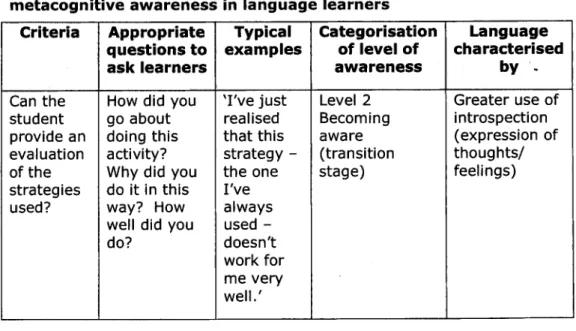
Table 3.1: An example of Sinclair's framework for evaluating metacognitive awareness in language learners --- 58 Table 3.2: Components of the assessment of autonomy (Champagne et al.,
2001) --- -- -- ---- -- -- --- --- -- -- --- -- -- --- -- -- --- --- -- -- -- - -- --- -- -- - 60 Table 3.3: Examples of 'can' statements from the Common European Framework, the European Language Portfolio from the Czech Republic, and the Languages Ladder ---62
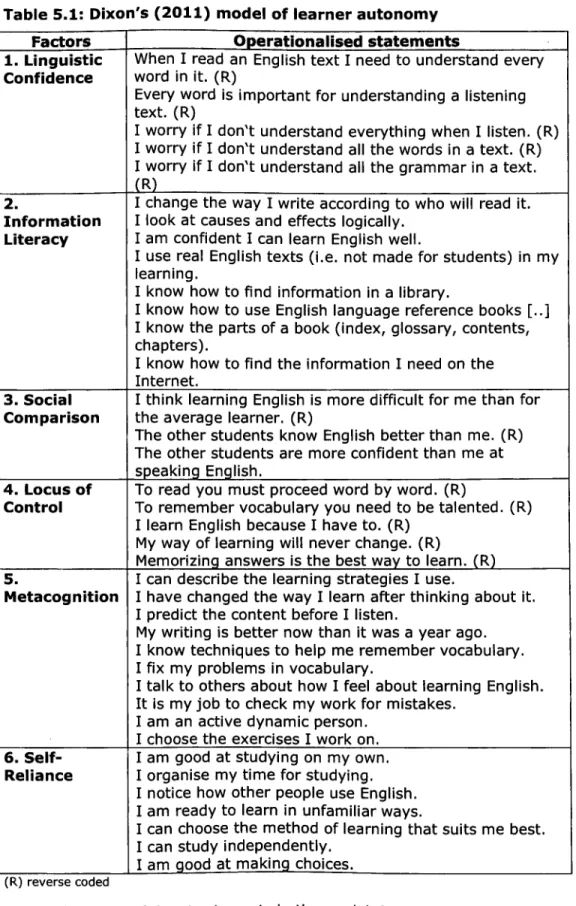
Table 5.1: Dixon's (2011) model of learner autonomy ---77 Table 5.2: Can-do descriptors for 'motivating myself' from Tassinari's dynamic autonomy model---79 Table 5.3: Full model of learner autonomy: Categories and constitutive elements --- ---84 Table 6.1: Revisions made to the questionnaire after Pilot la (paper version) --- ---90 Table 6.2: Revisions made to the questionnaire after Pilot lb (online
version) -- --- --- ---- -- --- -- -- --- --- --- ---- --- --- -- --- -- - --- -- 91 Table 6.3: Number of respondents retained at each stage of the survey--9S Table 6.4: Example of averaging of results across categories---96 Table 6.5: Countries in which questionnaire respondents were based---98 Table 7.1: Theoretical structure of the Uruguayan Qsample (Kramer et al., 2003) - --- -- --- -- -- -- --- -- -- -- -- --- -- --- - --- - - -- --- 128 Table 7.2: Main features of contemporary Mixed Methods Research
compared with Q methodology--- 146 Table 7.3: Comparison of different logics of inquiry --- 153 Table 7.4: Examples of feedback on the concourse from the expert panel
--- 170 Table 7.5: Demographic information pilot study (2) partlclpants --- 173
categori sed --- -- --- -- --- --- ---- ---- -- -- --- --- -- ---- ---- ---- -- -- --- 177 Table 7.7: Location of institutions involved in Phase 2, the means of
recruiting participants in each institution and the number of participants
drawn from each institution 180
Table 7.8: Angle of judgemental rotations for the five pairs of factors
rotated - --- --- --- -- --- --- ---- -- --- --- --- -- --- --- --- -- ---- --- -- 187 Table 7.9: Extract from defining participants' factor loadings (Appendix E)
______________________________________________________---187
Table 7.10: Correlation between factor scores ---189 Table 8.1: Ranking of statement 1 ('I have more of a desire to learn
[language name]') in each factor---199 Table 8.2: Simplified demographic information for participants loading significantly on Factor A --- 20 1 Table 8.3: Idealised Q-sort for Factor A ---203 Table 8.4: Factor A interpretation overview ---205 Table 8.5: Simplified demographic information for participants loading significantly on Factor B --- 226 Table 8.6: Factor B interpretation overview --- 229 Table 8.7: Simplified demographic information for participants loading
significantly on Factor C --- 244 Table 8.8: Factor C interpretation overview --- 246 Table 8.9: Simplified demographic information for participants loading
significantly on Factor D ---~--- 263 Table 8.10: Factor D interpretation overview --- 265 Table 8.11: Simplified demographic information for participants loading significantly on Factor E--- 273 Table 8.12: Factor E interpretation overview --- 274
significantly on Factor F --- 281 Table 8.14: Factor F interpretation overview--- 283
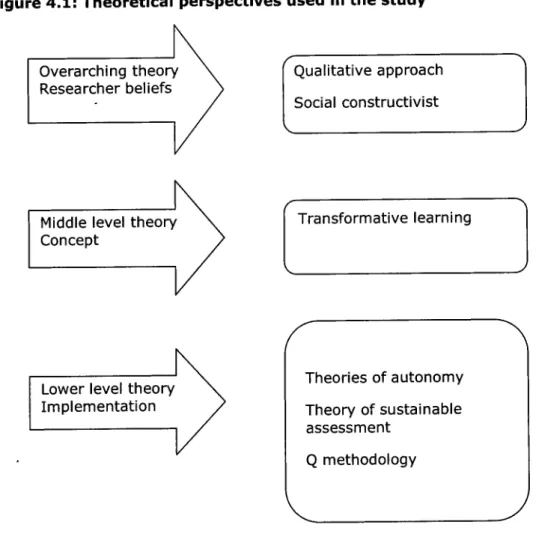
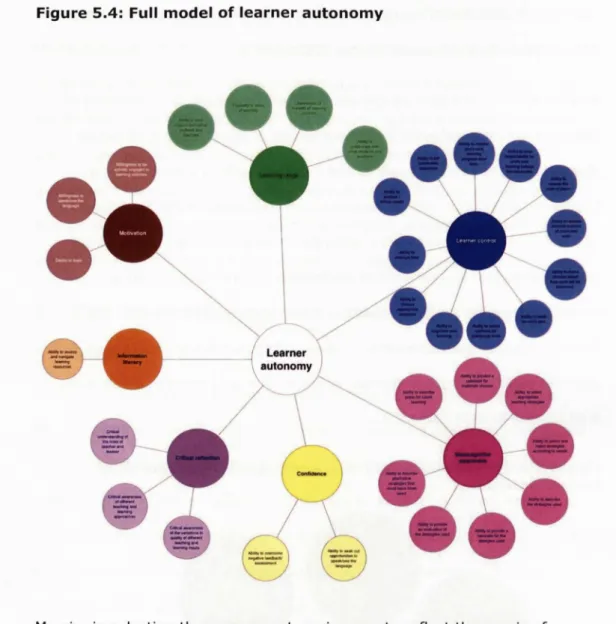
Figure 4.1: Theoretical perspectives used in the study ---66 Figure 5.1: Operational definition of learner autonomy (Murase, 2010)---74 Figure 5.2: Dynamic autonomy model (Tassinari, 2011b) ---78 Figure 5.3: Microconceptual framework of seven categories of learner autonomy - --- --- --- --- -- ---- --- --- --- --- --- -- -- --- 81 Figure 5.4: Full model of learner autonomy ---82 Figure 6.1: Type of learning institution in which respondents were based 97 Figure 6.2: Type of students taught by respondents ---99 Figure 6.3: Learning environments --- 101 Figure 6.4: Breakdown of assessment in each microconceptual framework category ---_. --- 104 Figure 6.5: Tools for the assessment of autonomy --- 106 Figure 6.6: Tools used for assessment of autonomy within each category of the microconceptual framework--- 108
Figure 6.7: Use of descriptor bands/rubrics as a tool for assessment --- 109 Figure 6.8: Tools used in the assessment of 'motivation' --- 110 Figure 6.9: Evidence for the assessment of autonomy --- 111 Figure 6.10: Evidence used for assessment of autonomy in each category of the microconceptual framework--- 113
Figure 6.11: Three categories of learner autonomy (metacognitive awareness, motivation and information literacy) shown proportionately within types of evidence used in their assessment --- 114
Figure 6.12: Assessors for each category of learner autonomy --- 115 Figure 7.1: The eight stages of Q methodology --- 122 Figure 7.2: Example of a card in a Q-sample --- 127 Figure 7.3: A research participant sorting the Q-sample into three piles 131 Figure 7.4: A research participant engaged in a Q-sort --- 132
Figure 7.6: Front screen of PQMethod ---137
Figure 7.7: PQMethod screen shot showing project name and the full menu of options for entering and analysing data ---137 Figure 7.8: File of statements entered into PQMethod ---138 Figure 7.9: Example of a Q-sort (sorted by Participant 23) entered into PQMethod ---139
Figure 7.10: The Varimax factors shown prior to additional rotation---140 Figure 7.11: Fictional example of a Likert scale questionnaire with sample answers --- -- --- -- --- --- --- -- ---- --- -- --- ---- -- --- -- --- -- -- --- ---- --- -- 157 Figure 7.12: Two possible variations of a Q-sort derived from the
questionnaire in Figure 7.11 ---158 Figure 7.13: The Museums Libraries and Archives model of Generic
Learni ng Outcomes---17 5
.
Figure 7.14: Main study sorting grid ---183 Figure 8.1: Analysis and interpretation in Q methodology ---193 Figure 8.2: An example of a Q statement as shown in the idealised array
---195
ALL - Autonomous language learning
EFL - English as a foreign language
ELT - English Language Teaching
ESL - English as a second language
ESOL - English as a Second or Other Language
L2 - second language
LA - learner autonomy
LLA - language learner autonomy
MMR - mixed methods research
1 Introduction
In a TEDTalk (B. Brown, December 2010), an American social worker and researcher called Brene Brown recalls a memory from her days as a doctoral student. She describes how she got excited when a research professor told the class 'Here's the thing. If you cannot measure it, it does not exist.' Her talk then goes on to describe how her research into
'connection' between people developed, and how her desire to measure 'connection' - and thus control and predict it - was thwarted when she discovered that, at the root of connection, was vulnerability: a construct that is not measurable, and, according to Brown, is far from controllable and predictable. This revelation - that her research was premised on a notion which was subsequently shown to be unfounded, caused Brown to have what she called a 'breakdown' and what her therapist called a 'spiritual awakening'. As an introduction to this thesis, I would like to tell you about my spiritual awakening.
There are similarities between Brene Brown's doctoral journey and the one I am about to share with you in this thesis. I initially set out with the aim of measuring, or at least quantifying, learner autonomy in some way. I was not sure what that way was going to be, and so when I discovered 'Q
methodology' I realised that this might be the research method that could help me on the route to quantification of what was, essentially, a very subjective area. As my research progressed however, I realised that, for me, the 'holy grail' of calculating the
amount
of learner autonomy that an individual is able to manifest in the process of language learning is not only most probably unattainable, but also undesirable. At heart I am aninterpretivist researcher, and one who takes a social constructivist stance towards learning - and learner autonomy and assessment are not
exceptions to that. Learner autonomy lacks clear definition and delineation, which in itself makes it difficult to quantify, but one of the things that makes it important is the focus on the person. By reducing learner
autonomy to a number, much of what is significant and meaningful about the concept is lost. In terms of assessment, what excited me about the topic was the notion of alternative assessment as a means of enhancing learning and being in the control of the learner. These views did not sit comfortably with my original aim of being able to give a learner a number to show how autonomous they are compared to someone else.
Interestingly, the cognitive dissonance I experienced at this point became most apparent to me through the use ofQ methodology: the stories focusing on the person - which Q methodology helped me to generate -were, I felt, more nuanced than they might have been had I used a more conventional methodology, and they demonstrated to me just how complex our understanding of learner autonomy needed to be. I realised that Q
methodology could allow me to retain my interpretivist stance, and at the same time offer greater depth and understanding than might otherwise have been possible using qualitative methods alone.
At the start of my doctoral journey, I was told that research is not linear or straightforward but always messy, like a child 'taking a pencil for a walk' on a piece of paper. Brene Brown's journey took her from connection to
shame to vulnerability. Mine has taken me from rather fixed ideas about whether learner autonomy can be assessed or not, to the non-linguistic outcomes of autonomous language learhing, to modes of autonomy, to the understanding that autonomy and assessment should both be about knowing our learners and allowing them to develop richer, more fulfilled lives. Here is that account.
1.1 Overview of the research
This thesis investigates the assessment of language learner autonomy' but starts from a basic viewpoint: that language learner autonomy has
consequences that reach far beyond the language classroom. That, in fact, autonomy is about developing as a language learner, but in ways which benefit the life of the learner beyond language proficiency. In the words of Little (1991, p.8), learner autonomy is about 'the desire to remove the barriers between learning and living'. This view sees language learner autonomy to be about the development of the individual as much as it is about the development of the language learner.
In this thesis, assessment is considered an important tool in that learner development. However, 'assessment' in this context has a particular connotation: one of being a humane process, at the root of which are the everyday concepts of making judgements and a sense of knowing what one is making judgements about. My work has been greatly influenced in this sense by two scholars - one a Professor of Education, Derek Rowntree, whose seminal book about assessing students asked 'How shall we know them?' (Rowntree, 1977). The other influence is David Boud, a Professor Emeritus of Adult, H'igher and Professional Education in Australia, whose work on assessment in higher education and the workplace has, I believe, done much to make us aware of the irrelevance of many assessment practices and how they might be changed.
The research started with the development of a model of learner autonomy to be used in subsequent phases of the study. Then, to set the scene and to complement the literature review, the next phase sought to gain an
1Henceforth, the terms 'learner autonomy' and 'autonomy' are used to
understanding of the worldwide practices of the assessment of language learner autonomy in the field using survey research methods. Thirdly, Q methodology was used to investigate learners' perceptions of the non-ltnqulstlc outcomes of autonomous language learning, and the data derived from this phase were used to indicate the emergence of 'modes of
autonomy'. These modes of autonomy were then utilised to outline how a tool for the formative (self- )assessment of language learner autonomy might be developed. The tool aims to provide a means by which learners are able to know themselves better (and, where relevant, their educators are able to know them better) and to make better-informed judgements about their progress as autonomous language learners.
1.2 Background and motivation for the study
In 1999, when I started my career in tertiary language teaching, the idea of autonomous learning was relatively new, especially in my teaching context in Japan. The concept of learner autonomy had first been
introduced to language learning in the 1980s by Holec (1981) in his work for the Council of Europe, and although the idea had been around before that in education in a general sense, it had not been adopted on a _wide scale until that time. Now though, the notion of autonomous or
independent learners is wide-ranging. The idea of autonomous learning has not just underpinned work in language learning and teaching, but
references to autonomous and independent learners can now be found throughout higher education across all disciplines (e.g., Bull, Quigley, & Mabbott, 2006; Fazey& Fazey, 2001; Todd, Bannister, &Clegg, 2004). Indeed, in some recent work I have been doing on employability in the curriculum, the ability to learn autonomously is regarded as fundamental to what makes a graduating tertiary level student 'employable' in the UK work place. Thus the notion of autonomous learning has taken hold and has
become central to our understanding of what makes good learning, and increasingly, what makes good citizens and good people. Such ideas were implicit in Holec's work as well: that learner autonomy is not just about the learner but is about the person as a whole. According to Holec (1981), the development of language learner autonomy emerged from a democratic ideal in which citizens would be able to take stock of their own lives and contribute to a wider society in ways which enrich our humanity; that, in fact, autonomy was a response to the 'need to develop the individual's freedom by developing those abilities which will enable him [sic] to act more responsibly in running the affairs of the society in which he lives' (Holec, 1981, p. 1).
Developing good citizens and enriching humanity might be considered a grandiose and idealistic view of education and learning, and yet it appeals to me because I believe that this is fundamentally what the role of an educator should be. These idealistic views of autonomous learning also have implications for what it means to provide a university education in the 21st century. This question is currently prominent in the UK, with the rise of neo-liberalism in higher education (Clarke, forthcoming; Sleeter, 2008) and the increase in fees to a maximum of £9,000 per year, payable by
undergraduates to go to university. This issue is also being discussed in Hong Kong, where the whole system of education is undergoing rapid reform in the move to a 3+3+4 system of education with the 4
representing an extra year of university education (ECHK, 2000). In Japan, also, where for many years now the numbers of students attending
university has decreased, there is an acknowledgement that the
homogeneity of society means that there is now a vital need to open up SOCietyand develop citizens who are able to operate in an increasingly globalised world, both at home and overseas (MEXT, 2009). In part, it is
for these reasons that these countries formed the context for this research. More about the research context is discussed in section 7.5.4; here my point is simply that higher education institutions and government policy in these three countries, and arguably elsewhere, appear to recognise the
need to address what is being sought and achieved by tertiary level students. Furthermore, what is society at large hoping to gain from the process of educating its young people? One of my arguments is that what should be gained through the process of higher education are learners with greater levels of autonomy who are able to utilise their lifelong learning skills through their adult working years.
To return to language learning, in particular, I believe very strongly that developing greater autonomy is important for language learners. Not only does autonomy help language learners to be more effective in the process of learning a language (Benson, 2011b; Dafei, 2007), but good language
users
need to develop greater autonomy too, because language learning does not stop in the classroom. If you are to be a successful user of a language you need to continue your learning in environments where you do not necessarily have the support of a teacher; where you need to maximise the human and material resources around you to support you in your learning endeavours. Further discussion of the relationship between autonomous language use and autonomous language learning is made below in section 2.2 in the discussion about dimensions of learner autonomy (Macaro, 1997, 2008).So far in this section I have discussed the background for the study in terms of learner autonomy, but what about assessment of autonomy? During my time working as the self-access learning centre (SALe) founder and supervisor at a small, private university in Japan, I was frequently asked by the university administration - who part-funded the centre - and
visitors who came to learn about setting up a self-access centre in their own institutions, how we knew that students benefitted from using the SALC.They wanted to know if there were any benefits, what exactly was being learned, how did autonomous learning impact on the language proficiency of learners, and, ultimately, was investment in such learning environments worthwhile? On the one hand I resented having to justify something that was popular with learners. At that time, we had
approximately 3000 registered users and were constantly trying to find extra space for both resources and users of the centre. Furthermore, research had found that students enjoyed using the SALC and felt that it provided them with many opportunities to use and practise their language skills (Cooker, 2004). On the other hand I was frustrated that, at that time, no tool existed for being able to prove the effect that using the SALC had on learners. We could have looked at various measures of language proficiency such as the KEPT(the university in-house proficiency test with a ground-breaking, group oral component) or TOEIC® (Test of English for International Communication), and compared scores of students who used the SALCand those who did not, but as has been well documented in the literature (Gardner, 2001; Morrison, 2005), there are difficulties in separating the language learning which can be attributed to autonomous
language learning and that which can be attributed to learning in other ways. After some preliminary research and reading, I started to think that perhaps one way of proving the effect that learning in an autonomous learning environment had on learners was to focus on autonomy rather than linguistic proficiency. That led me towards the desire to be able to measure the level of autonomy of our SALC users, and this led me to the focus for this doctoral research.
What though, is the connection between learner autonomy and language learning? As mentioned earlier, I believe that learner autonomy is crucial for effective language learning. Good language learners do not stop learning when they leave the classroom, and so it could be argued that a lot of the pedagogy for learner autonomy is about encouraging out-of-class learning so that students recognise and maximise the opportunities
available to them to practise their language skills in daily life. It is also about equipping students for and encouraging lifelong learning. In other words, to help them carry on learning after they leave school, college or university. In my view, successful language learning has to be considered a lifelong project. As teachers, we see our students in class for a limited number of hours per week. Over the time span of a semester, or even a year, however much time is spent in class will be relatively little time in which to 'make a difference'. What we can do, however, in that time, is ensure that our students have the knowledge and awareness to further their own learning of languages once they have left our classrooms -whether that be at the end of the day or at the end of the course. I believe that as language teachers we have a particular responsibility to support the development of our learners' autonomy, and that this is as equally
-important as our responsibility to support the development of their language proficiency.
As well as a strong belief in the importance of learner autonomy, I also have a strong belief in the power of assessment to both empower and demotivate learners. This belief comes from my own experiences at school. As an 0 level student I loved exams. I understood clearly what I had to do and how I needed to study to make the most of my abilities. As a
consequence, I did well and I'was satisfied with my progress. However, during A levels I was not at all clear about what was expected of me. I did
not understand how to learn or how to succeed at A level. I became very unmotivated and subsequently I did poorly in my final exams. Although I had the knowledge and strategies to work successfully within the
assessment system at 16, I lacked understanding of the system and how to work successfully within it at 18.
My story here and the background given earlier in this chapter helps to position me within this research study. To summarise, I am an advocate of language learner autonomy for in-class and out-of-class learning. I
understand that assessment is an important part of learning, and acknowledge that being able to assess learner autonomy could have institutional and personal benefits, but I also understand the demotivating power of assessment when learners have little understanding of the assessment system or the benefits of using that system. In this thesis, I hope I have gone some way towards balancing these beliefs and exploring both autonomy and assessment in ways which will benefit our students.
1.3 Research aims
The overall research aims of this thesis are:
1.To define language learner autonomy from a practical perspective in terms of what learners need to do to support themselves in the
development of their autonomy.
2. To investigate whether and how language learner autonomy in higher education is currently assessed.
3. To understand learners' perceptions of the non-linguistic outcomes of autonomous language learning as a means by which a learner-informed assessment tool can be developed.
4. To develop a learner-informed tool for the self-assessment of language learner autonomy.
1.4 Thesis outline
Chapter.s 2 and 3 make up the two parts of the literature review. In these chapters, I position the thesis in relation to the learner autonomy literature and the literature on assessment and argue that effective assessment is fundamental to the successful development of learner autonomy.
Chapter 4 presents the theoretical perspectives underpinning the thesis, drawing on social constructivism, theories of autonomy and transformative learning theory.
Chapter 5 presents the model of learner autonomy developed for this thesis and used as the basis for the two stages of research presented in Chapters 6, 7 and 8.
In Chapter 6, the first phase of research, surveying global learner
autonomy assessment practices, is presented and discussed. The chapter includes a description of the survey methodology used, the results of the survey study, and a discussion of the implication of the findings.
Chapter 7 is the first of two chapters dealing with Phase 2 of the research. It describes Q methodology from a theoretical perspective, including a discussion of its appropriateness in this research, and then explains how Q
methodology was adapted for, and implemented in, the current study.
Chapter 8 presents the findings of Phase 2 of the research. It discusses the six factors which were generated from the Q methodology study, and contextualises these with an analysis of the interview data, which were also generated in this phase of the research, to create six modes of autonomy.
Chapter 9 is the culmination of the previous two chapters and comes in two parts. Part 1 presents the narrative descriptions of the six modes of
autonomy and provides an illustrative profile for one of the learners who defined each mode. Part 2 presents the self-assessment tool developed from the modes of autonomy together with a discussion of its theoretical basis and an explanation of how it was developed and its use is envisaged.
Chapter 10 concludes the thesis, explaining its significance, discussing its limitations, outlining ways in which the research has been disseminated and plans for future dissemination, and suggesting some areas for future research.
2 Learner Autonomy
2.1 Introduction
Learner autonomy is commonly defined as complex, multifaceted, and multidimensional (Benson, 2011a, 2011b; Blin, 2004). These terms are a useful shorthand to introduce what has been called a 'slippery notion' (Tschirhart & Rigler, 2009, p. 71), but they perhaps also belie the vast amount of work that has gone into defining and refining what is meant by the term over the last twenty years. Here I argue that the plethora of definitions, versions, and perspectives of autonomy provides a useful, theoretical understanding of what learner autonomy means, and indeed should perhaps lead us to think of learner 'autonomies' (Sinclair, 2008, p. 238) rather than learner autonomy. However, I shall also assert that if we are to push the boundaries of research and practice into learner autonomy then a more practical model is needed. Such a model is outlined in Chapter
5.
2.2 Theoretical understandings of autonomy in
language learning: definitions, versions,
perspectives and dimensions
Holec's (1981) seminal definition of autonomy in language learning - 'the ability to take charge of one's own learning' (p. 3) - is reassuringly straightforward compared to the somewhat overwhelming proliferation of definitions (Little, 1991), versions (Benson, 1997), and perspectives (Oxford, 2003; Schwienhorst, 2003) of the intervening twenty years. Despite Benson's recent assertion that 'On the basic definition of learner autonomy, there has been a remarkable degree of consensus' (Benson, 2011b, p. 16) others, such as Macaskill and Taylor, (2010, p. 351) have
pointed out that 'there does not appear to be a single consensual definition of what is meant by autonomous learning and, indeed, many articles appear to discuss autonomous learning without defining exactly what they mean by it.' Here I review the different definitions, versions and
perspectives and argue that there are two aspects to this question of what is meant by autonomy: the theoretical and the practical. Both of these are discussed below.
Theoretical understandings of learner autonomy began with Holec's classic definition (given on page 12 above) which has had an enduring quality. Other definitions which have been influential in contributing to our understanding of what is meant by learner autonomy include the 1990 'Bergen definition':
Learner autonomy is characterised by a readiness to take charge of one's own learning in the service of one's needs and purposes. This entails a capacity and willingness to act independently and in cooperation with others, as a socially responsible person. (Dam, Eriksson, Little, Miliander, & Trebbi, 1990)
which emphasised the social dimension of learner autonomy and Little's (1991) 'provisional definition' which built on this understanding of autonomy as a social phenomenon:
Essentially, autonomy is a capacity - for detachment, critical reflection, decision-making, and independent action. It presupposes, but also entails, that the learner will develop a particular kind of psychological relation to the process and content of his learning
[."J
Because we are social beings our independence is always balanced by dependence; our essential condition is one of interdependence. (pp. 4-5)Sinclair (1997, 2000) offers a thirteen point definition of learner autonomy which moves towards a more practical understanding. She draws on previous definitions with elements such -as 'Autonomy is a construct of capacity', 'Autonomy involves a willingness on the part of the learner to take responsibility for their own learning', and 'Autonomy has a social as
well as an individual dimension', but includes other important aspects not addressed in definitions of autonomy elsewhere, such as 'There are degrees of autonomy' and 'The degrees of autonomy are unstable and variable'. These two understandings of what autonomy is are of particular concern in this thesis: two of the underlying principles are that learner autonomy is not a monolithic construct, and that learners can be more or less autonomous at anyone time.
Few other definitions have had an original contribution to make to our understanding of learner autonomy, with the exception of the definition of learner and teacher autonomy proposed by Raya, Lamb and Vieira (2007), which included a transformative element:
The competence to develop as a self-determined, socially responsible and critically aware participant in (and beyond) educational environments, within a vision of education as (inter)personal empowerment and social transformation (p. 1)
In terms of the present study, the Raya, Lamb and Vieira definition is arguably the most useful. In the breakdown of the definition, the authors show how it encompasses notions of autonomy as: a degree of scale, learner control, metacognitive awareness, criticality, and having a transformative function, all of which are pertinent to this study.
Aside from theoretical definitions, autonomy in language learning has also been conceptualised theoretically in terms of versions (Benson, 1997). Benson proposed three versions: technical ('situations [emphasis added] in which learners are obliged to take charge of their own learning', p. 19), psychological ('a capacity ... which allows learners to take more
responsibility for their own learning' p. 19) and political (,control over the processes and content of learning' p. 19). Benson's framework of versions, whilst widely used and quoted, was criticised by Oxford (2003) for ignoring
the social aspect. Oxford augmented Benson's three versions in her new framework with two sociocultural 'perspectives', which drew upon
Vygotsky's (1978) concept of the Zone of Proximal Development, and Lave and Wenger's (1991) notion of Communities of Practice, to underline the importance of a more capable other and cognitive apprenticeships in the development of learner autonomy.
The final theoretical understanding of learner autonomy reviewed here is Macaro's (1997, 2008) 'dimensions'. Macaro is unusual in the learner autonomy literature in that he incorporates second language acquisition theory into his theory of autonomy and includes language use in his model which comprises three dimensions: autonomy of language competence (the developing ability to communicate in the L2); autonomy of language
learning competence (the developing ability, confidence and motivation to use cognitive and metacognitive strategies and possibly transfer those into a third, fourth language, etc.); and autonomy of learner choice (the
developing ability to set goals, select materials, and feel ownership over the target language). Ultimately, for Macaro (2008), 'autonomy resides in being able to say what you want to say rather than producing the language of others' (p. 60), thus uniquely amongst the other theoretical stances discussed here, Macaro's dimensions clearly address language learner autonomy. This, and his emphasis on metacognitive awareness,
confidence, and motivation as aspects of learner autonomy are of particular relevance to this thesis.
From these theoretical understandings of learner autonomy, several dichotomies have emerged and include the following:
• Is learner autonomy an attribute of the learner or an outcome of the learning situation (Holec, 1981; Pennycook, 1997)?
• Is learner autonomy a behaviour or a psychological capacity (Dearden, 1972; Little, 1990)?
• Is learner autonomy a facet of the individual or socially mediated (Benson, in press; Oxford, 2003)?
• Does learner autonomy refer to a capability or an observed behaviour (Allford & Pachler, 2007)?
• Should learner autonomy encompass the emancipatory and transformative notions (Benson, 1997; Pennycook, 1997; Raya et al., 2007) that autonomy has outside the world of the language learner, or is this political and developmental aspect now an anachronism?
From my years of creating what Holec (2009, p. 21) has called 'autonomy-inspired language learning environments', I am keenly aware that perhaps these dichotomies should not be seen as such, but should be regarded more as two ends of a continua along which different autonomies lie. However, for the purpose of this thesis, I believe that further clarification is necessary in order to exemplify the construct of language learner
autonomy that was the main underpinning for the basis of this research. Thus, drawing on Cooker (2007), I argue for a view of learner autonomy within language learning which is a personal attribute, evident in both behaviour and attitude, socially mediated, political, and transformative (Raya et al., 2007). By emphasising the transformative nature of learner autonomy, with the attendant focus on power relations, control, and self-actualisation, I propose that from the theoretical perspective, it is here where the interplay between learner autonomy and assessment exists.
2.2.1 Attribute or product?
In the early days of studies on learner autonomy, and with the adjoining interest in the development of self-access centres, there was some debate
as to whether learner autonomy was a product of the learning environment in which learners were placed (Bertoldi, Kollar, & Ricard, 1988; Higgs, 1988) or an attribute integral to the learner. Whilst self-access centres and computer-assisted language learning (CALL) can certainly be a way of encouraging learners along the autonomous path (Gardner & Miller, 1999; Victori, 2000) scholars have more recently agreed that they do not in themselves create autonomous learners (Allford & Pachler, 2007; Cooker & Torpey, 2004). Instead, it is asserted that autonomy is internal to the learner and this 'personal characteristic' (Gardner & Miller, 1999, p. 6) can simultaneously drive forward the development of autonomous learning and be the result of autonomous development. As Kenny (1993, p. 433)
helpfully points out, 'when learners take the opportunity to explore their own self-concept ... this is their autonomy at work.'
. It is now commonly accepted then, that autonomy is a personal attribute, rather than the product of a learning environment or a construct which is external to the learner.
2.2.2 Behaviour or psychological capacity?
Another dichotomy to be discussed in the literature is the Cartesian -dualism of learner autonomy: whether it is a personal attribute which is evidenced as behaviour or as a psychological capacity. The difference is an important one for this thesis as there are implications for the
understanding of autonomy itself, and for its relationship with assessment. Littlewood, (1996) has defined capacity as 'an ability and the willingness to act on that ability' which presupposes that learner autonomy is a
behaviour, albeit in an indirect way. Holec (1981, p. 3) on the other hand, is adamant that autonomy is
n_ot
a behaviour:It is indeed an ability, "a power or capacity to do something" and not a type of conduct, "behaviour". 'Autonomy' is thus a
term describing a potential capacity to act in a given situation - in our case, learning - and not the actual behaviour of an individual in that situation.
Citing Holec, Sinclair (1999a, p. 101) also clearly states her point of view for autonomy as a psychological capacity:
With respect to autonomy in language learning, current understandings of the concept refer to a capacity or ability to make informed decisions about one's learning, rather than actual behaviour ...'
and Schmenk (2005) argues for autonomy as a 'human potential' rather than a construct which is socioculturally mediated:
Furthermore, the psychologization of autonomy can sometimes take on forms of naturalization or biologization. Attempts to conceptualize autonomy as an inborn capacity shared by all human beings, for example, clearly aim at neutralizing autonomy on biological grounds. As a result of such naturalization, autonomy is construed as a universal pregiven biological human potential. It may therefore appear to be grounded in our human nature rather than in culturally and historically specific settings. (p. 113)
Whilst the view of autonomy as a capacity certainly has advantages and a logical intuition - in that presumably an autonomous learner is still
autonomous whether they are displaying that behaviour or not, in the same way that a piano player can still play the piano whether they are actually doing so or not - it is harder to conceive of autonomy as a useful construct for developing pedagogy if it is not formulated as a behaviour. Indeed, Benson (2011a, p. 73) suggests that 'the validity of our concept of autonomy depends in part on our ability to ground it in observable
behaviours and mental states.' Furthermore, evidence for autonomy as a behaviour can be found in the literature on learner beliefs. In her 1995 paper, Cotterall (1995) identified six constructs underlying learners' beliefs about learner autonomy, and then investigated the relationship between those constructs and autonomous behaviour. In a later paper (Cotterall,
Boud (1988, p. 17) takes the idea of learner autonomy as behaviour further when he describes learner autonomy as ' ... an ideal of individual behaviour to which students or teachers may wish to aspire'. The
importance of this aspiration was shown by Ade-ojo (2005). In his research on the pre-disposition of adult learners towards autonomy, he found that not all categories of learner are willing to be autonomous in their language learning, suggesting that even if one has the capacity, if it is not willingly utilised, then the behaviour will not result.
In a useful synthesis of the 'autonomy-as-psychological capacity' and the 'autonomy-as-behaviour' postttonsjt.tttte (1990) has argued for autonomy as a psychological construct which emerges through behaviour. Thus, while not a behaviour itself, autonomy as a capacity, and the behaviour which is driven by that capacity, are inextricably linked: '\
Learner autonomy is essentially a matter of the learner's psychological relation to the process and content of learning. We recognise it in a wide variety of behaviours as a capacity for detachment, critical reflection, decision-making, and independent action. (p. 7)
In this thesis, I will follow Little and argue that it is the combination of behaviour and capacity working in tandem which comprises another piece of the autonomy jigsaw. In section 5.3, I explain how I operationalised learner autonomy by cataloguing relevant autonomy-focused behaviours.
2.2.3 Individual or social?
Over the years of the development of, and the writing about, the notion of autonomous language learning, it has been regarded as synonymous with terms suggesting that autonomous learning is a solo activity. Two
publications in the early 1980s, and one in the late 1990s explicitly linked 'autonomy' with 'individualisation', 'independence' and 'learning alone' either in the titles or in the contents (Benson & Voller, 1997; Brookes &
Grundy, 1988; Geddes&Sturtridge, 1982). This has led to the
misconceived but frequently expressed view, both in the literature and in my personal experience in talking to professional educators, that learner autonomy is about learning alone and without support from others. This is understandably a rather worrying proposition both for learners (who are intimidated at the thought of having to do so) and for teachers (who do not want to lose their jobs!).
Reassuringly, an alternative view of autonomy has been accepted for some time: that true autonomy in language learning does not just have a social element, but is fundamentally a social construct. Little (1990, p. 7) expresses this very powerfully when he states: 'As social beings ...total detachment is a principal determining feature not of autonomy but of autism.' Elsewhere, he argues for 'social autonomy' (Little, 1991, p. 27) as the underpinning of psychological autonomy which leads to successful autonomous language learning. Social autonomy develops in environments where naturalistic language use is possible and heavily supported (Little makes the analogy with first language learning situations), and in environments where learners feel in control of their social situation (he gives the example of a woman learning the language of her future husband).
Little further develops his ideas of autonomy as a social construction in a paper co-authored with Dam (Little & Dam, 1998). Here they argue that 'learner autonomy does not equal learner isolation' (para. 7), and talk of 'inescapable interdependence' (para. 8). This echoes Boud's (1988) argument. He posits that interdependence is the ideal end-point of a journey in which learners travel from dependence through
counterdependence to independence and finally interdependence. He believes the stage of interdependence to be one of mature autonomy, in
which learners are able to fully interact with a world they have control of. Benson (1996) makes a similar point when he asserts that the issues of power and control, which are so central to the concept of the autonomous learner,( ca.n only be achieved through the 'transformation of the learner as a social individual/p. 34). To paraphrase Benson (op. cit.), and to outline the position in this study regarding the individual/social dichotomy of learner autonomy, there is power in collective decision-making and collective actions: such decision-making and actions are achieved when learners reach the understanding that the most effective learning, perhaps particularly language learning, occurs as a social, and not a solo, activity.
2.2.4 Political or apolitical?
(The idea of power developing through the 'social and transformative
character of learner autonomy' (Benson, 1996, p. 33) leads logically to the politicised perspective of learner autonomy. ~hiS is the most radical
perspective, and is the counterpoint to what Sinclair (1997, p. 12) has coined 'learning imperialism': the imposition of a Western version of learner autonomy - one which emphasises the use of strategies, and the development of individuals - at the expense of other versions which may be more rooted in local cultures. (The polttlcal aspect of autonomy is related to the debate surrounding the implementation of autonomous approaches in different national and cultural settings (Palfreyman, 2003), as well as to arguments concerning the rights of learners and the concatenation of learner, power, and control (Benson, 2000; Crabbe, 1993)./
Recent thinking on the political perspective has been informed by scholars such as Benson (1997), Pennycook (1997), Kenny (1993), and Oxford
(2003). In arguing for a political version of learner autonomy, Benson
...A recognition of the rights of learners within educational systems ...[and] ...a recognition of the rights of the non-native speaker' in relation to the 'native speaker' within the global order of English. (p. 29)
The political version of autonomy is important to the ideas put forward in this thesis: that learners have rights in assessment practices, and that autonomous approaches can help give learners those rights. Without the politicisation of autonomy the effect of autonomy as being an empowering force behind the learner is weakened.
In an attempt to find some consensus in the debate, Allford and Pachler (2007) have attempted to integrate the various versions under two umbrella terms: 'radical autonomy' and 'gradualist autonomy'. 'Radical autonomy', which they launch a fierce critique of, encompasses the political-critical versions discussed earlier as well as Holec's original definition, specifically the claim that the autonomous learner is able to decide on many aspects of the learning experience, from determining
objectives to evaluating what has been learned, 'with or without the help of a teacher' (Holec, 1981, p. 4). Indeed, it is the 'conflict between the
teacher's professional expertise and the learner's struggle for autonomy' (Allford & Pachler, 2007, p. 153) which Allford and Pachler are heavily resistant to. Perhaps this is explained by the fact that both have worked in teacher education and thus are somewhat resistant to the notion that teachers can be done without; however, in their versions of learner autonomy, neither Holec nor Benson advocate that the role of the teacher should be diminished - simply altered, so that their 'expertise' is utilised in different ways. Holec (1981, pp. 24-25) describes in detail 'the teacher's new roles' which can be summarised as those of a counsellor (Kelly, 1996) or advisor (Gremmo & Castillo, 2006). Elsewhere I have stressed the
importance of having 'expert' advisors, indeed have suggested that there is a case to be made for learning advisors who are more qualified and who
have greater expertise, than teachers who only work in the classroom (Cooker & Foale, 2005). Benson focuses not on the teacher's changing role per se, but on the development of teacher autonomy. He frames teacher autonomy as part of the expertise of teachers that must be developed if learners are also to 'exercise their own right to autonomy' (Benson, 2000, p. 117); in fact he goes further and as the title of his chapter suggests, argues for learner autonomy as a teachers' right as well as a learners' right (Benson, 2000) in that it is only when teachers are 'prepared to exercise their own right to autonomy' (p. 117) that the broader goals of education -'shaping the collective life of the society in which ones lives' (p. 114) - are able to be met.
The choices that are made between all of these dichotomies discussed above influence how learner autonomy is construed, and therefore how it is evaluated and assessed. Peer assessment practices have more credibility if one believes that autonomy is a social construct; the position taken here, that learner autonomy encompasses notions of behaviour and
psychological capacity has implications for self-assessment; and future-directed self-assessment (Tan, 2007) is relevant if one takes a critical political perspective on autonomy and follows Benson's (2000) argument: that lifelong learning skills empower learners. To summarise the position taken here, the proposal for assessment of autonomy which will be outlined requires an understanding of learner autonomy incorporating autonomy as an attribute, as a psychological capacity emergent in behaviour, and as both a social and political construct.
2.3 Practical understandings of autonomy in language
learning
The overview in the previous section offered an understanding of language learner autonomy from a theoretical perspective, but these theoretical
debates have been criticised as 'idealistic' (Tschirhart & Rigler, 2009, p. 72) and 'of little use to practitioners implementing language learning
programmes in the real world' (ibid.). However, such real world
understandings of learner autonomy are more difficult to encounter in the literature, causing scholars 'such as Benson to express a need for
'determining what the necessary components of autonomy are' (Benson, 2011a, p. 65). This is a problematic issue, but a focal one for this paper, and so addressed in some detail here by looking at the work of four scholars: Candy (1991), Cotterall (1995), and Breen and Mann (1997), who go some way towards formulating a real world understanding of learner autonomy.
Candy's (1991) 'Profile of the Autonomous Learner' is a comprehensive and useful collection of 134 competencies, collated from writings of other researchers, spanning twenty years from 1964 to 1984. Candy listed these 134 competencies under 13 headings:
1. Be methodical/disciplined 2. Be logical/analytical 3. Be reflective/self-aware
4. Demonstrate curiosity/openness motivation 5. Be flexible
6. Be interdependent/interpersonally competent 7. Be persistent/responsible
8. Be venturesome/creative
9. Show confidence/have a positive self-concept 10. Be independent self-sufficient
11. Have developed information seeking and retrieval skills 12. Have knowledge about, and skill at, 'learning processes' 13. Develop and use criteria for evaluating
Candy's work was in general education, not specifically language education, nevertheless, his comprehensive list is relevant to our
understanding o!,what is meant by learner autonomy in language learning and many of his criteria have relevance to this study. For example, the criterion 'Be able to choose relevant resources, on the basis of needs, potentialities, objectives, means, and limitations' (op. cit. p. 465) under the heading 'Have developed information seeking and retrieval skills' has a clear relevance to the language learner, whereas others such as 'Be
amiable and peace loving' (op. cit. p. 462) seem less relevant. Other criteria are less useful in that they are vague ('Know of available opportunities' op. cit. p. 465) or appear self-defining (,Be able to work autonomously' ibid.). Despite these criticisms, Candy's work is a useful resource for the interested practitioner in language learner autonomy to draw upon.
In section 2.2.2 above, Cotterall's (1995) work on readiness for autonomy was discussed in relation to the discussion on whether or not autonomy is a behaviour or a capacity. However, Cotterall's study was also significant in that it was one of the first studies to attempt to identify components of autonomy in language learning in a practical sense. As mentioned earlier, she identified six constructs underlying language learners' beliefs using a questionnaire study and factor analysis, and then 'hypothesized [the] relationship of each factor to autonomous language learning'. The six constructs underlying language learner beliefs identified by Cotterall were: 1) role of the teacher, 2) role of feedback 3) learner independence, 4) learner confidence in study ability, 5) experience of language learning and 6) approach to studying. The autonomous behaviour which was then linked to the constructs came from the questionnaire statements themselves. For example, the 'learner independence' construct, comprised three statements
from the questionnaire: 1) I have a clear idea of what I need English for, 2) I like trying new things out by myself, and 3) Learning a language is very different from learning other subjects. Cotterall's study was one of the first to identify autonomous behaviours that could be directly linked back to learners through their beliefs, however the extrapolations made from belief to behaviour are arguably faulty because they ARE extrapolations, in other words guesses about what learners might do. For example, in response to statement 32 'I like the teacher to offer to help me', Cotterall concludes: 'Item 32 suggests that learners who agree with these statements are not ready to initiate enquiries or seek help' (p. 197). Furthermore, in
discussing the first construct - the role of the teacher - Cotterall states 'Learners who subscribe to such a view do not correspond to the profile of the autonomous learner. In fact the functions which they assign to the teacher - diagnosing difficulties, allocating time, establishing the purpose of activities - are central to the behaviour of autonomous learners' (p. 197). I shall return to discuss this point later in the thesis.
Breen and Mann (1997) state explicitly that they 'raise issues which are directly related to the practical implementation of autonomous language learning' (p. 132) and that they are concerned with 'what it means to be autonomous' from the perspective of the learner. Their list is a succinct one comprising eight aspects: the learner's stance
Ca
position from which to engage with the world' p. 134); the desire to learn; a robust sense of self; metacognitive capacity; management of change; independence; a strategic engagement with learning; and a capacity to negotiate. Breen and Mann's list informed the understanding of learner autonomy which is used in this study and presented in section 5.3, but their work also has significance for the likening of practical autonomous behaviour to a mask which can be put on at will by learners wishing to please a teacher:Learners will generally seek to please me as the teacher. If I ask them to manifest behaviours that they think I perceive as the exercise of autonomy, they will gradually discover what these behaviours are and will subsequently reveal them back to me. Put simply, learners will give up their autonomy to put on the mask of autonomous behaviour (Breen &Mann,
1997, p. 141).
Breen and Mann argue that this putting on of a mask can be overcome if learners themselves are in control of what is meant by autonomous
behaviour. This was the guiding principle behind the current study: that by developing a means of assessing learner autonomy which is
learner-informed and learner-formed, the 'mask of autonomous behaviour' would be minimised.
Candy, Cotterall and Breen and Mann all address a real-world
understanding of learner autonomy, but I suggest that their models still do not provide enough guidance for language learners or language educators to know how to alter their thinking or adjust their behaviour to become more autonomous. A model which does provide such guidance is presented in Chapter 5.
2.4 Why autonomy in language learning is important
The concept of learner autonomy has become a part of mainstream English Language Teaching over the last thirty years (Schmenk, 2005; Smith, 2003) signified by the inclusion of learner autonomy and its derivatives (teacher autonomy, learner independence, and self-access language learning, for example) as increasingly standard on the strand listings of general ELT conferences, and in text books for teachers on CELTA-type courses and relevant Masters programmes (e.g. Benson, 2003; Harmer, 2007). The universality of learner autonomy can be seen as problematic, however. Benson (2011a), for example, sees the increased prevalence of 'innovations associated with autonomy' (p. 19) such as increased choices and independence for students, perhaps offered within the guise of
timetabled and mandatory 'self directed learning' or 'student centered learning' slots in university course programmes, as a feature of the neo-liberal forces within education, themselves a sign of the globalisation of education and the new capitalism on which our workforces are based. Despite this problematising of the globalisation of learner autonomy, the view I am proposing in this thesis, is that language learner autonomy is a worthy goal for language educators and learners themselves. In fact I will go further and argue that it is a crucial aspect of language learning and I believe that it is important to remind ourselves why this is so. What is it that takes learner autonomy beyond whimsy and into the realms of accepted language learning and teaching methodology?
Jacobs and Farrell (2001) have argued that learner autonomy is central to a paradigm shift that is taking place in English language teaching. In their paper written a decade ago, they listed the eight major changes concerned with the paradigm shift. These were:
1. Learner autonomy 2. Cooperative learning 3. Curricular integration 4. Focus on meaning 5. Diversity 6. Thinking skills 7. Alternative assessment 8. Teachers as co-learners
Jacobs and Farrell argued that 'all the changes are parts of a whole and that the successful implementation of one is dependent on the successful