The Open University’s repository of research publications
and other research outputs
An investigation into the role of a wiki in supporting
collaborative learning activities
Thesis
How to cite:
King, David John (2010). An investigation into the role of a wiki in supporting collaborative learning activities. PhD thesis The Open University.
For guidance on citations see FAQs.
c
2010 David King Version: Version of Record
Copyright and Moral Rights for the articles on this site are retained by the individual authors and/or other copyright owners. For more information on Open Research Online’s data policy on reuse of materials please consult the policies page.
An investigation into the
role of a wiki in supporting
collaborative learning
activities
A dissertation submitted in partial completion of
the requirements for the degree of
Doctor of Philosophy in Computer Science
David John King
MSc (Dis) Computing
BA (Hons) International History and Politics
Department of Computing
The Open University, UK
Submitted – July 2010
Abstract
Providing students with learning opportunities based on real-life situations has been found to enhance student learning. With this aim, two Open University post-graduate courses introduced collaborative activities modelled on workplace situations. The activities employed wikis: a lightweight, web-based collaborative authoring
environment. The purpose of this research has been to investigate the role of a wiki in supporting the collaborative learning activities, and to assess how the wiki influenced student engagement with the activities.
The dissertation draws data from the three presentations of Open University courses’ 56 wikis produced by almost 240 students. The base data includes wiki content and student discussions. Issues identified in the base data were further explored through post-course questionnaires and interviews. An iterative inductive qualitative analysis was applied to analyse students' perceptions and experiences with the wikis. Activity theory was used to place these within the context of the activities.
The wikis enabled all student groups to author collaboratively the documents required by their courses. Writing the documents benefited the students because it prompted discussion and personal reflection; both of which many students reported as enhancing their learning. The students particularly valued the wiki’s role as a central repository that helped them achieve these two benefits. The research shows that wikis can support collaborative activities among students and lead to enhanced learning opportunities. The key findings suggest that a wiki’s simplicity enabled students to engage easily with the collaborative learning activities. However, a wiki’s lack of inherent structure hindered their progress until they had worked out how to organise their use of the wiki.
The insights from the research are presented as guidelines for educators intending to incorporate wiki supported collaborative learning activities into their courses. The guidelines have two aims: first, to help educators facilitate speedy induction and participation of the students in the collaborative activities; second, to ensure the wiki is used effectively by students to increase their collaborative learning opportunities.
Acknowledgements
I would like to thank all the people who have contributed, directly or indirectly, to the completion of this research.
Foremost of course are my supervisors: Shailey Minocha, Pete Thomas and Josie Taylor, who have provided invaluable direction and guidance through these last few years.
Thank you to The Open University course teams who allowed me to use their courses as part of my research: Pete Thomas, Shailey Minocha, Arosha Bandara, Geoff Peters and Jill Mordaunt. A special mention also to Pam Brightman, course manager on the Computing course, for being ever helpful and providing some interesting insights into student behaviour.
Thank you too to the Post-Graduate Research Forum co-ordinators, Marian Petre and Trevor Collins, and to the students with whom I shared so much learning.
Thanks also to Stephen Potter and the U500 course team, who not only provided an excellent introduction to the PhD skill set, but many an opportunity to visit the Cellar Bar.
Special thanks my fellow students, Geke van Dijk, Angela Lozano-Rodriguez, Ann Abraham and John Brier.
Thank you to all in the Human-Computing Interaction group at the Open University. Especially to Simon Holland and Paul Marshall, for their interest in my work and fascinating discussions.
Finally, and most importantly, I thank my family, and especially my wife Judith, for the support and patience shown with me while I have worked to achieve one of my life’s ambitions.
Table of Contents
Table of Contents ... 7
List of Figures ... 10
List of Tables ... 11
Chapter 1 Introduction ... 12
1.1 Topic of the research ... 12
1.2 Background to the research ... 17
1.3 Overview of the thesis ... 21
1.4 Chapter summaries ... 23
Chapter 2 Literature Review ... 24
2.1 Introduction ... 24
2.2 Wikis and their characteristics ... 25
2.3 Literature on the usability of wikis in education ... 27
2.4 Literature on wiki-enabled activities in education ... 33
2.5 Literature on the challenges of using a wiki ... 41
2.6 Chapter summary... 53
Chapter 3 Choosing a methodology and identifying sources of data ... 55
3.1 Introduction ... 55
3.2 Epistemological background ... 56
3.3 Data gathering methods ... 65
3.4 The data analysis process ... 79
3.5 Ethical approvals for conducting research ... 83
3.6 Quality, validity and reliability ... 84
3.7 Chapter summary... 87
Chapter 4 Course collaborative activities and course team intentions ... 89
4.2 The Computing course ... 94
4.3 The Business course ... 101
4.4 Comparison of course collaborative activities ... 109
4.5 Chapter summary... 113
Chapter 5 Collaborative group working using a wiki ... 115
5.1 Introduction ... 115
5.2 Student and tutor comments on the use of a wiki to support group working ... 116
5.3 Overview of Computing student attitudes ... 149
5.4 Summary of emergent concepts ... 152
5.5 Conclusions ... 155
Chapter 6 Collaborative authoring using a wiki ... 159
6.1 Introduction ... 159
6.2 Student and tutor comments on the use of a wiki to support collaborative authoring ... 162
6.3 Overview of Computing student attitudes ... 180
6.4 Summary of emergent concepts ... 183
6.5 Conclusions ... 187
Chapter 7 Collaborative learning using a wiki ... 189
7.1 Introduction ... 189
7.2 Student and tutor comments on the use of a wiki to support collaborative learning ... 190
7.3 Overview of Computing student attitudes ... 208
7.4 Summary of emergent concepts ... 215
7.5 Conclusions ... 217
Chapter 8 Synthesis and Discussion ... 220
8.1 Introduction ... 220
8.2 Emergent concepts grouped using operational mapping ... 220
8.4 Conclusions ... 246
Chapter 9 Review, reflections and future work ... 249
9.1 Introduction ... 249
9.2 Review of research questions ... 249
9.3 Review of the reliability and validity of the findings ... 258
9.4 Review of the differences in the course collaborative activities ... 267
9.5 Updates to the courses since this research ... 270
9.6 Updates to the wiki since data gathering was completed ... 274
9.7 Areas for future research ... 276
9.8 Conclusion ... 277
Abbreviations ... 278
Glossary ... 280
References ... 286
Appendix 3.1 The standard Open University end of course student survey ... 295
Appendix 3.2 The Computing course end of course student survey ... 297
Appendix 3.3 Development of data gathering tools ... 303
Appendix 3.4 Implementation of data gathering tools ... 300
Appendix 3.5 Sample interview protocols ... 307
Appendix 3.6 Emergent qualitative analysis codes ... 317
Appendix 4.1 Using Activity Theory to elicit course team intentions ... 321
Appendix 4.2 Computing course reflection template ... 322
List of Figures
Figure 1-1: Chapter structure for thesis ... 21
Figure 1-2: Research design for thesis ... 22
Figure 2-1 Leo's FAQ page ... 26
Figure 2-2 Wikipedia's home page ... 26
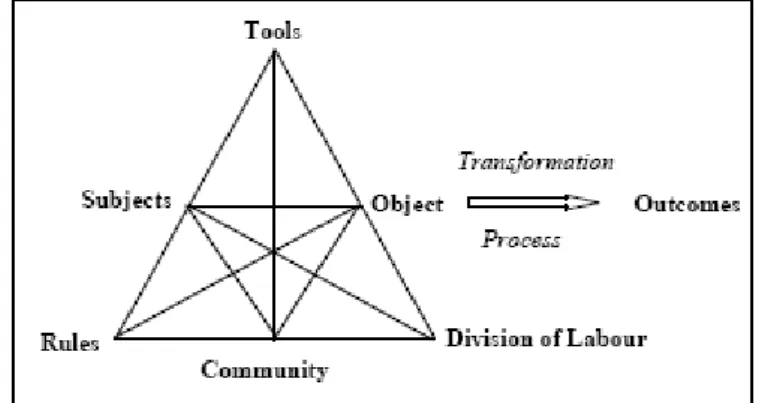
Figure 3-1: The Activity Triangle model or Activity System (Engeström, 1987) ... 60
Figure 3-2: Focus on Subject—Tools—Object-ive sub-activity triangle ... 64
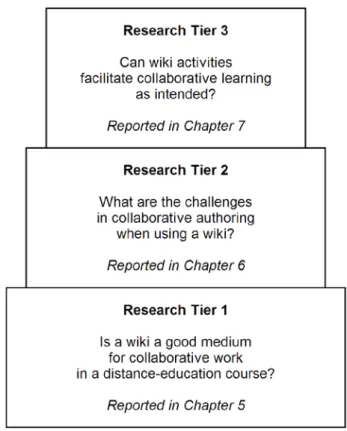
Figure 3-3 Three research tiers ... 73
Figure 4-1: Engeström's Activity Theory model (Engeström, 1987) ... 90
Figure 4-2: M883 course team intentions for the activity ... 91
Figure 4-3: B857 course team intentions for the activity ... 91
Figure 4-4: Availability of tools to courses ... 92
Figure 4-5: Computing course calendar ... 98
Figure 4-6: Business course calendar ... 105
Figure 8-1: Sub-activity triangle Subject—Tools—Object-ive ... 222
Figure 8-2: Sub-activity triangle Subject—Rules—Object-ive... 231
Figure 8-3: Sub-activity triangle Subject—Community—Object-ive ... 234
Figure 8-4: Sub-activity triangle Subject—Rules—Community ... 237
List of Tables
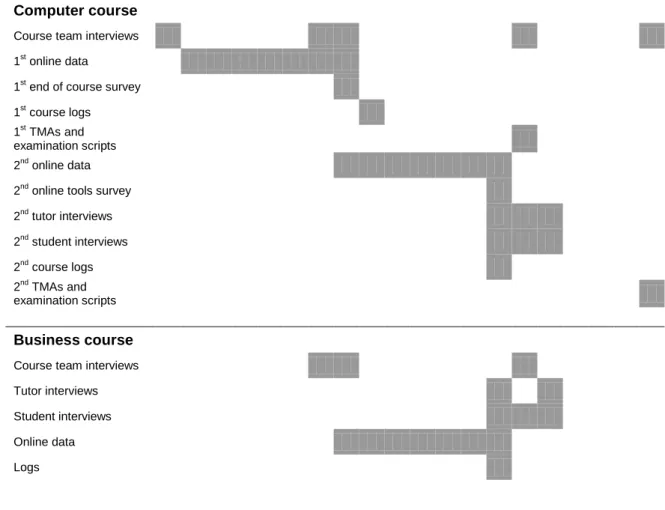
Table 3-1 Data gathering schedule ... 71
Table 3-2: Relating research question to aims and methods ... 75
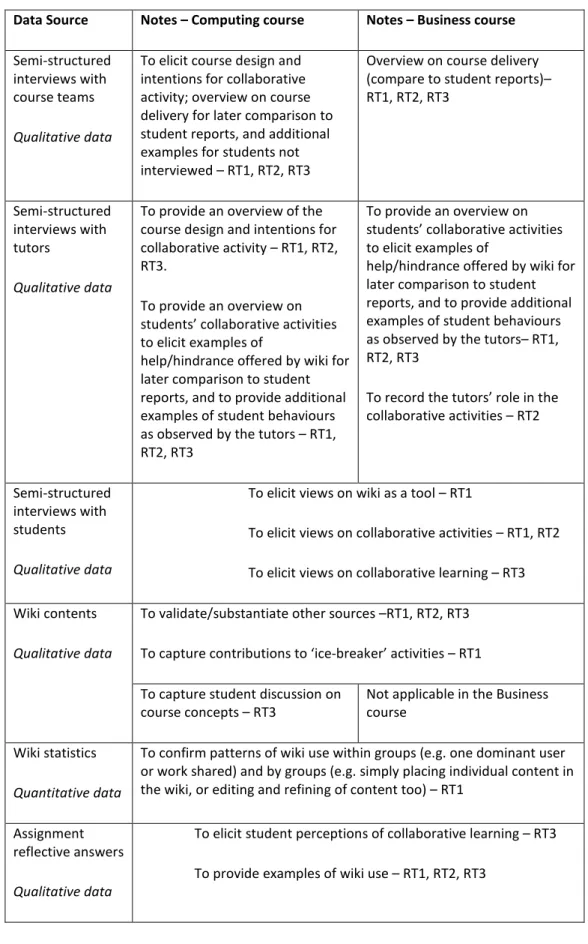
Table 3-3: Relating data sources to research tiers... 76
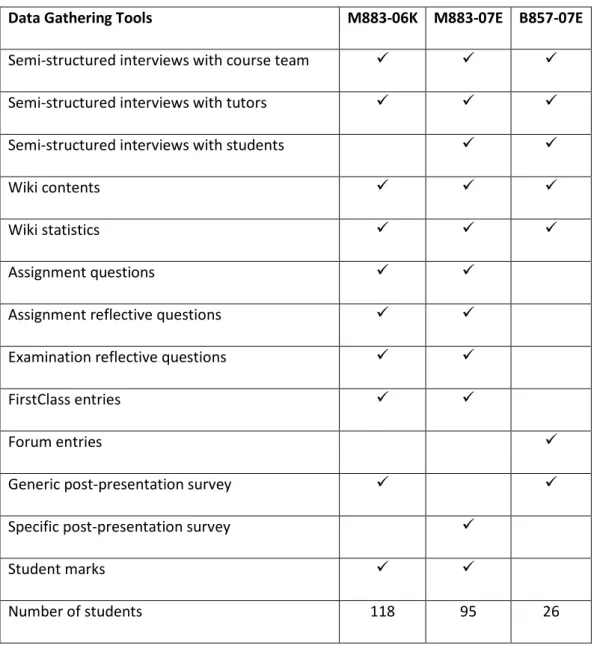
Table 3-4: Data gathering tools related to course presentations ... 78
Table 3-5: Data gathered related to course presentations ... 79
Table 4-1: Course comparison table ... 109
Table 5-1: Student responses to closed questions on wiki use (N=20) ... 150
Table 5-2: Summary of group working concepts ... 152
Table 6-1: Student responses to closed questions on using the wiki for writing their documents. (N=20) ... 181
Table 6-2: Summary of collaborative authoring concepts ... 183
Table 7-1: Student responses to closed questions on the use of a wiki to support collaborative learning activity. (N=20) ... 209
Table 7-2: Summary of collaborative learning concepts ... 216
Table 8-1: Table mapping concepts to sub-activity triangles ... 222
Table 8-2: Table listing Subject—Tools—Object-ive concepts ... 223
Table 8-3: Table listing Subject—Rules—Object-ive concepts ... 231
Table 8-4: Table listing Subject—Community—Object-ive concepts ... 234
Table 8-5: Table listing Subject—Rules—Community concepts ... 238
Table 8-6: Table listing Subject—Community—Division of Labour concepts ... 240
Chapter 1
Introduction
1.1 Topic of the research
I wanted to find out how a wiki can best be used for educational purposes. This thesis documents my investigation into how a wiki can be used to support collaborative learning activities in distance-education courses. From the investigation findings, a set of good practice guidelines is produced to help other educators make effective use of a wiki in collaborative learning activities.
A wiki is an asynchronous collaborative authoring tool. Wikis are readable and writeable websites in which all the visitors to the site can create new pages or modify existing ones (Choate, 2008). Wikis are claimed to excel at supporting collaboration and have been “designed to facilitate exchange of information within and between teams” (Goodnoe, 2006). The best-known application of a wiki is the collaborative online encyclopaedia, Wikipedia. This is written and maintained by thousands of contributors from around the world exploiting the advantage of wikis to allow them to edit content directly. However, the first wiki was devised to meet the needs of software engineering (Leuf and Cunningham, 2001).
Wikis in software engineering
The first wiki, WikiWikiWeb (#WikiWikiWeb), was created by Ward Cunningham in 1995 to make the exchange of ideas between programmers easier. Wikis have since proven very popular in software engineering and are used to support collaboration within software teams. In the open source movement, wikis are now universal. All projects hosted on Sourceforge (#SourceForge) and GitHub (#GitHub) are provided with wikis (#SourceForge:Tools; #GitHub:Features).
The general use of wikis in business generally seems to have been growing too (Goodnoe, 2006). Though Majchrazak et al (2006) in a survey extending over 168 corporate wiki users found the most common use was for software development. They also found cases of wikis being used for tasks that support software development such as knowledge management, project management and information sharing. Arazy et al‘s (2009) more focused investigation into the use of wikis within IBM found that more than a third of IBM employees were using wikis within 18 months of wikis first being made available to them.
One particular use of wikis is for supporting non-collocated teams. Damian (2007) reports the strategies involved in managing stakeholders in global requirements engineering. Issues arise when software teams are separated from their clients and the requirements analysts. They may even be located on different continents. Yet, there remains the need for intensive communication and collaboration, something that Damian notes can be addressed by using a wiki as a central repository. Decker et al (2007) similarly examined the issue of dispersed teams in industry. They conducted a research study between 2003 and 2005 that involved 12 people only, which the authors acknowledge to be a small sample. In their study, they found that “wikis are indeed useful for stakeholder collaboration, as well as for grouping and structuring requirements.”
The issues raised in industrial practice by Damian and Decker et al are similarly applicable when the students are not collocated as when engaged in distance
education. Wikis could provide the means for communication and collaboration among students, as well as a central repository for collaboratively produced documents. Hence, it could be beneficial for computer science students to use wikis in their studies because they are likely to encounter similar issues regarding collaboration later in their
careers in industry, and to use wikis as the solution to those issues. Lave and Wenger (1991) argued that the disjoint of work and educational experiences not only
undermines the students’ later potential to contribute at work but also only hinders their learning. Incorporating wikis into computer science education enables students to acquire a transferable skill and, through appreciating the course tools’ relevance, engage with the course material.
Wikis in education
Wikis are popular in software engineering because they enable collaboration among the software developers (Goodnoe, 2008). Collaboration is also recognised to benefit to students’ learning because students have to explain and refine their experience and understanding of the concepts to be learnt (Laurillard, 2002). This model of learning is derived from Vygotsky’s work on child development in which he proposes that knowledge is constructed by a child through reflecting on shared experiences (Vygotsky, 1978). Social constructivist pedagogy is an application of this model of learning in education. Courses embodying the pedagogy, incorporate learning opportunities that take place in a social context where learners can share and discuss their evolving understanding of new concepts (Felix, 2005).
The learning process can be supported by technology (Laurillard, 2008), especially when the technology enables collaboration among students studying a distance-education course who could not otherwise interact. This collaboration can lead to collaborative learning, which is defined by Kaye (1992) as “individual learning as a result of [a] group process.” In providing an environment in which students can collaborate to share knowledge, educators are realising the potential of wikis to facilitate collaborative learning.
Hence, wikis can provide a double benefit to computer science students. Not only because there are opportunities for enhanced learning through wiki-enabled
collaboration but as already noted, because using a wiki is in itself valuable learning as the students acquire a transferable skill.
Evans (2006), in his overview of wikis’ potential impact on business, identifies that students need to learn what wikis may mean to business and the skill to use them. He suggests there is a need to teach three things: the subject domain itself, the wiki technology and the supporting transferable skills.
Transferable skills have long been recognised as important for graduate careers. Harvey et al (1997) reported that, “… communication skills emerge as one of the most
important, if not the most important quality that employers require of graduates.” A meta-analysis conducted the following year by Burden and McAvinia (1998) found a demand for a similar set of transferable skills. The most commonly cited skill was ‘communication’ with 90% of sources referring to it. The second most common skill was ‘teamwork’ with 50% of sources. The need to collaborate in a course provides students with the opportunity to improve their communication skills and teamwork skills. The drive to provide students with transferable skills has led course designers to incorporate collaboration as a learning outcome into their courses (Bower and
Richards, 2006). Students have also recognised the potential benefit of transferable skills. Those studied by Flood et al (2004) cited acquiring transferable skills as important to their learning and satisfaction. Raza Ali (2006), in suggesting improvements to training graduate software engineers, highlighted the need to develop their
collaborative working skills. He argued that software engineering graduates would be entering a workplace where there is an increasing use of agile technologies and Extreme Programming techniques, both of which demand collaboration among the
participants. Hence, through engaging with wikis in a collaborative learning activity, all students have the opportunity to acquire several transferable skills, with computer science students having the added benefit of working with an authentic tool.
It is to realise these several advantages for students that this research is based on the use of wikis in computer science education.
Research questions
The primary objective of this research was to investigate the following research questions:
Are wikis a usable medium for collaboration in an educational context? Can a wiki enable a social constructivist activity?
What are the challenges in using a wiki in a social constructivist educational activity?
A review of the existing literature has shown that the questions cannot be addressed from published empirical investigations.
The first question is the fundamental building block upon which everything else must be built. The wiki is designed to be easy to use, with minimal support and guidance. This question seeks to confirm if this claim applies in an educational context, as well as in the software engineering domain where the claim was first made.
A wiki is a tool, and should only be used if its serves a benefit in that context. The second question seeks to answer this question. It considers the motivation for including collaborative activities in teaching and learning, and the potential role a wiki can play in supporting elements of those activities.
The third question is a synthesis of the previous two as it seeks to understand if the students’ use of the wiki was in the manner intended by the course team who designed the collaborative activity, and whether the students gained the intended benefit. The answer is sought in determining the challenges encountered by students when using a wiki, and the impact of them on the students.
The answers to the three research questions are used to identify good practice guidelines for educators when using wikis to support collaborative learning. The guidelines are especially relevant to computer science education, but could be applied to other subjects.
1.2 Background to the research
The Open University (OU) has around 200,000 adult distance students who mainly study part-time. The OU was specifically set up to provide a distance-education to those who could not make use of the traditional campus-based full-time alternative. To enhance its home-based students’ learning experience, the OU has a record of
exploiting emerging technologies. This led to notable pioneering work in the 1970s with the use of television broadcasts to supplement the printed course materials. The OU’s use of technology has evolved in step with technological changes, especially the internet (Thomas et al, 1998). The OU was an early user of dedicated online Computer Mediated Communication (CMC) tools such as FirstClass (#FirstClass) for asynchronous text-based discussions and Lyceum (#Lyceum), an audio-conferencing tool with shared workspace, for synchronous collaborative activities for student mutual support and formal use in learning activities. The most recent development in the OU’s use of technology is the introduction of an integrated virtual learning environment (VLE). The adoption of the open source VLE, Moodle (#Moodle) offers course teams a wide range of collaborative tools.
This has given the opportunity to gather and evaluate data to answer the research questions in the context of distance-education.
Data sources
Two courses were used as the data sources for this dissertation. The first is a requirements engineering course, the second is a management course that makes similar demands on its students as the requirements engineering course. The two courses are post-graduate courses that incorporate collaborative activities. The requirements engineering course provides the baseline data for this study, with the management course providing contrasting information to enhance the validity and reliability of the research.
Computing course: Software requirements for business systems
This course teaches the systematic eliciting, recording and communication of
requirements for software systems. This process is commonly known as Requirements Engineering (RE). More information is available at the course’s web site,
http://tinyurl.com/2pke2k, and the course collaborative activities are described in more detail in Chapter 4.
On a software development project, eliciting requirements is generally carried out by a team of requirements engineers or system analysts. In software enterprises, such teams are increasingly using wikis to develop requirements specification documents collaboratively (Farrell, 2006; Ras, 2009). The aim of introducing collaborative activities in a wiki environment on the course was to emulate this team experience and allow a group of students to discuss a set of requirements, remove conflicts in the
requirements, and produce an unambiguous requirements specification in ways similar to those used by requirements engineers in practice. Through the need to author collaboratively the requirements the course team of the RE course intended that
students would have the opportunity to discuss the course concepts too, thereby enabling collaborative learning.
Business Course: Current issues in Public Management and Social Enterprise
This course is aimed at keeping professionals up to date with current debates and topics in and around the public and not-for-profit sectors. More information is available at the course’s web site, http://tinyurl.com/6njhtk, and the course collaborative
activities are described in more detail in Chapter 4.
It is the second of two specially prepared core courses in the OU’s Master of Public Administration (MPA) degree alongside Shaping Public Policy: contexts and processes. Within the context of the whole MPA degree, the course continues a progression of learning modes that begin with highly structured individual activities at the start of the programme to more learner-designed investigations towards the end. As part of this progression, the course “emphasises learning through researching, working
collaboratively in teams to achieve agreed and negotiated objectives, undertaking peer review and responding to peer critique” (taken from the Business Course Guide). The Business course’s course team identified five current management issues, from which each student chooses two to work on. For one of the chosen issues, the students collaborate with others who made the same choice and use a wiki to prepare a joint report on each issue. Students then individually relate the issue to their own
organisation or one they know well. Thus, the students have the opportunity to learn collaboratively through sharing these different experiences.
The students then repeat the same activity in a new learning group for their second chosen issue and submit a second assignment. This means that the students can build on their experience of using a wiki and of teamwork from the first activity, and
Contrast between the courses
The two courses are similar enough to provide comparable data, in that both are intended for post-graduates and both involve collaboratively authoring a document. However, they are drawn from different domains and have several detailed differences to provide an informative contrast. The similarities and differences are explored in more detail in Chapter 4, Course collaborative activities and course team intentions.
1.3 Overview of the thesis
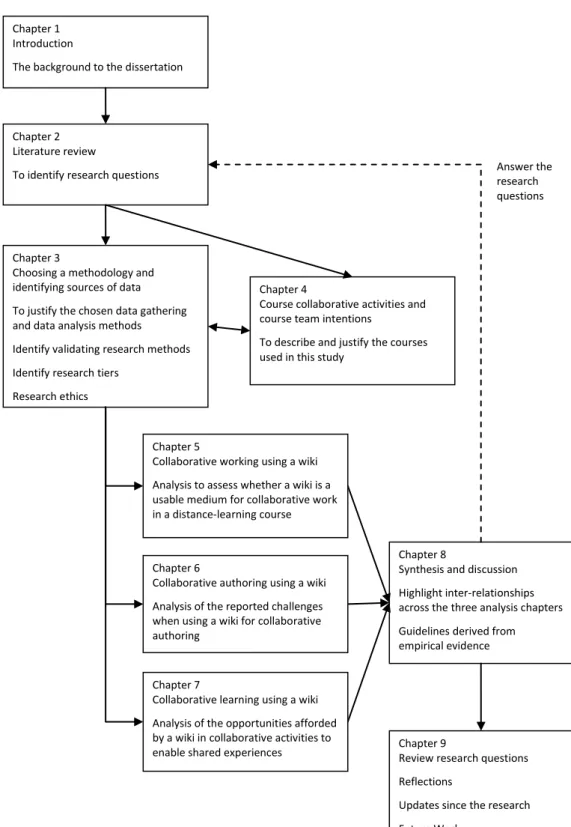
Figure 1-1 shows the structure of this dissertation, and how the dissertation will document both the research process and the research results.
Figure 1-1: Chapter structure for thesis
Chapter 2 Literature review
To identify research questions
Chapter 3
Choosing a methodology and identifying sources of data To justify the chosen data gathering and data analysis methods Identify validating research methods Identify research tiers
Research ethics
Chapter 4
Course collaborative activities and course team intentions
To describe and justify the courses used in this study
Chapter 5
Collaborative working using a wiki Analysis to assess whether a wiki is a usable medium for collaborative work in a distance-learning course
Chapter 8
Synthesis and discussion Highlight inter-relationships across the three analysis chapters Guidelines derived from empirical evidence Chapter 7
Collaborative learning using a wiki Analysis of the opportunities afforded by a wiki in collaborative activities to enable shared experiences Chapter 6
Collaborative authoring using a wiki Analysis of the reported challenges when using a wiki for collaborative authoring
Chapter 9
Review research questions Reflections
Updates since the research Future Work
Chapter 1 Introduction
The background to the dissertation
Answer the research questions
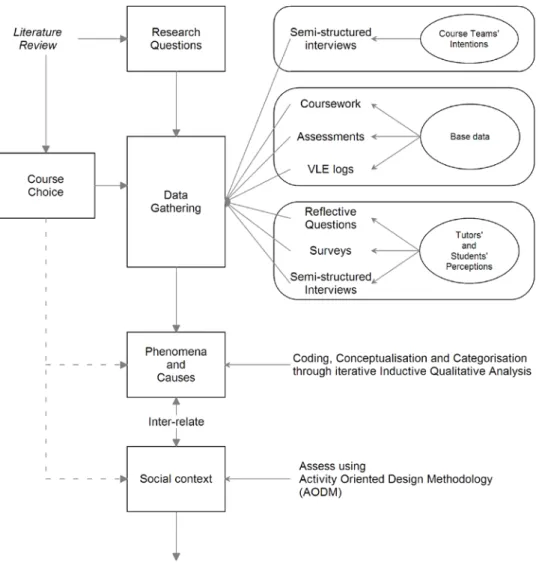
The research design, showing the research process and how the selected methodologies address the research questions, is pictured in Figure 1-2.
1.4 Chapter summaries
The body of the thesis is organised as follows.
Chapter 2 presents a literature review to identify gaps in existing published material and thereby define and justify the current research to address the outstanding issues.
Chapter 3 covers the methodologies used in this thesis to answer the research questions. It details the choice of data gathering and data analysis methodologies, justifying the choices made and their contribution to the validity and reliability of this research.
Chapter 4 describes the collaborative activities that were the source of the data used in the thesis. It details the courses and activities, explaining how they are similar enough to provide a useful comparison, yet different enough to provide contrasting data.
Chapters 5, 6 and 7 present the data analysis for each of the three research tiers the merged from the initial inductive qualitative analysis. The questions are answered sequentially so as to build upon the preceding chapter. Therefore, the first question considered is the ability of a wiki to support collaborative work (research tier 1) is presented in Chapter 5. Then the ability of a wiki to support collaborative authoring (research tier 2) is presented in Chapter 6. In conclusion, the ability of a wiki to facilitate collaborative learning (research tier 3) is presented in Chapter 7.
Chapter 8 brings together and summarises the findings in the previous three chapters and how these findings relate across the chapters. It includes a discussion on guidelines that can be derived from these findings, and of their limitations.
Chapter 9 concludes the thesis by reviewing the research questions and discussing the contributions from this research, the limitations of the findings and future work.
Chapter 2
Literature Review
2.1 Introduction
This chapter presents an examination of published papers describing contemporary research relevant to the research topic set out in Chapter 1. The chapter draws on literature from several domains to cover the technical aspects of wikis, the educational aspects of collaborative learning activities, and the overlap that is the subject of this research. A critical review of the literature identifies the questions that are the basis for this research.
This chapter contains four substantive sections. The first, Section 2.2, defines a wiki. The next three sections address each of the research questions through reviews of published papers relating to wiki use, especially in software engineering and computer science education. From this critical review, three high-level research questions are identified:
1. Are wikis a usable medium for collaboration in an educational context? 2. Can a wiki enable a social constructivist activity?
3. What are the challenges in using a wiki in a social constructivist educational activity?
2.2 Wikis and their characteristics
A wiki is a collaborative authoring tool. Ward Cunningham created the first wiki in 1995. He wanted a shared, easy to use editing tool whose output could be published on the internet (Leuf and Cunningham, 2001). A wiki consists of a collection of pages. A user can visit a wiki and create, edit or delete content using only a web browser. All users have the same access rights to change a wiki’s content. A wiki has simple locking mechanisms to prevent change conflicts.
Two distinguishing features of a wiki
The two key features of a wiki are its simplicity and flexibility (Reinhold, 2006). A user need only have access to a web browser to use a wiki. There is no need for additional software to be installed and maintained. The wiki has no pre-defined page layout or links among the pages. The expectation is that the internal structure will emerge from actual practice when using the wiki, and so be optimised to a user’s needs.
Two example wikis
Figure 2-1 shows the Frequently Asked Questions page from the Leo wiki (#Leo:FAQ), a wiki true to Ward Cunningham’s original concept. Leo is an outliner application and is open source software. The wiki exists for its developers and users to document all aspects of the application. The wiki is purely text based and has a simple layout. This simplicity is in contrast to probably the best-known wiki, Wikipedia.
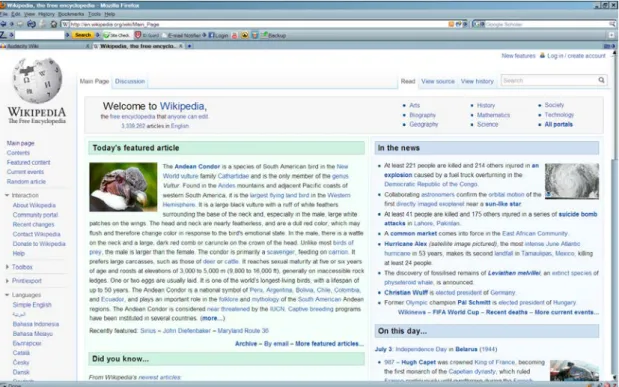
As shown in Figure 2-2 Wikipedia’s Home page has a multi-column layout, embedded pictures, and both side and top navigation bars. Ward Cunningham as part of his original wiki concept did not envisage these features because they are not necessary for collaborative authoring. Through reducing the features available to users, Ward
Cunningham sought to minimise the users’ learning time and support needs to use a wiki.
Figure 2-1 Leo's FAQ page
In addition to losing some of a wiki’s simplicity, Wikipedia has also lost some flexibility. The page structure is defined for contributors. There are standards and rules for contributors to adhere to. In one sense, this represents a mature wiki, one in which an effective structure has emerged as Ward Cunningham intended. However, now that Wikipedia has a defined structure, further change is difficult. The ability for new structures and rules to emerge is limited as demonstrated by a failed request of Professor Page of Glasgow University to enhance taxonomic descriptions (Page, 2010).
These two examples demonstrate the range of web sites that can be produced with wiki software. The emphasis in this research is on a simple wiki because that is the form that is prevalent in software engineering (Louridas, 2006).
2.3 Literature on the usability of wikis in education
Comparing wikis with other collaborative authoring tools
Ward Cunningham devised the wiki to be usable and overcome the disadvantages of contemporary online collaborative tools, commonly called groupware (Choate, 2008). Groupware includes products such as Lotus Notes (#Notes) and Microsoft Exchange (#Exchange). These products require expertise to install and configure, and continuing support and administration. They also require trained users.
Today, as well as wikis and groupware, there are other online collaborative tools to facilitate document sharing and editing. Kamel Boulos and Wheeler (2007) list several examples including Gliffy (#Gliffy), Google Docs and Spreadsheets (#GoogleDocs) and Microsoft Office Live (#OfficeLive). These other tools are not the same as a wiki because:
• They require registration to access and share documents, eg GoogleDocs.
• They can be sufficiently complicated that the user needs to invest considerable effort to learn how to use them, eg Gliffy.
Hence, these tools lack a wiki’s advantages, especially ease of set up and ease of use.
There are other online authoring tools, but they do not support collaborative authoring. They are discussed briefly to highlight the specific features of wikis that support collaborative authoring.
A blog is an online authoring tool but unlike a wiki there is only one author. Readers cannot create or edit content, they can only append comments. As Dalsgaard (2006) notes, a blog primarily supports individual work. In education, blogs provide students with an audience for their writing and can invite discussion (Kennedy, 2003). Knowing they are writing for an audience can encourage a greater sense of personal
responsibility (Godwin-Jones, 2003). Blogs can also be used as journals or portfolios to record a student’s progress and accomplishments, as well as reflections (Weller et al, 2005). Blogs can permit more than one author to post an entry. These are known as collaborative blogs. However, further contributions are constrained to comments on the post. The post itself cannot be edited.
Forums are another form of online communication, but as with blogs, they offer the opportunity to comment on another’s writing rather than to share in the writing. Like blogs, readers can append comments but not change the original content. This is in contrast to the dynamic content of a wiki. In effect, both blogs and forums are a form of broadcasting where the tool permits one author to reach many readers. This does not stop either tool approaching the wiki’s ability to support many-to-many
comment on their individual blogs and develop shared knowledge based on mutual posts and comments. However, neither blogs nor forums allow the collaborative authoring of a common document in the same way as a wiki can.
Conversely, wikis can approach the functionality of blogs and forums through a ‘thread mode’ (#ThreadMode). In thread mode, users make signed contributions to a page leaving earlier contributions intact. This is similar to a blog or forum in which users append contributions to a shared page. Thread mode enables users to discuss a wiki web site’s content by using a dedicated page also within the web site. Thus, the discussion is adjacent to, but separate from, the content being discussed.
Using a wiki without training
Wikipedia is a good example of how easy a wiki can be to use, for none of its users have received formal training. Wikipedia’s English edition has 14,808,869 registered users, who have created 3,667,928 articles. The active nature of the users’ contributions can be seen in the 470,098,081 edits1. Each Article page is accompanied by a Discussion page, and many of the edits relate to users taking part in the accompanying discussion rather than modifying content. Perhaps Wikipedia’s most controversial discussion was that regarding Jyllands-Posten’s publication of cartoons depicting Muhammad
(#Wikipedia:Muhammad). The ease with which hundreds of comments were made demonstrates that a wiki can facilitate discussion.
The Wikipedia discussion page works in thread mode, and hence offers the same functionality for comments as does a blog. However, a blog does not permit commentators to edit the content as a wiki does.
Wikis as a Content Management System
There is a third way to use a wiki beyond document and thread modes. This is using it as a Content Management System (CMS). When used as a CMS the shared content is written in documents attached to a wiki page rather than written in a wiki page itself. As a Project Locker whitepaper (2006) summarises, a wiki differs from a conventional CMS in four ways:
“Wikis are cheap, extensible, easy to implement, and don't require a massive software rollout because of their ability to interface well with existing network infrastructures.
Wikis are Web-based and thus present little or no learning curve in the adoption cycle.
Wikis allow the user to determine the relevancy of content rather than being dependent upon a central distribution center or a linear distribution chain. Wikis organize themselves organically, allowing users to create their own site structure, or ontology, rather than have it imposed upon them by the developers of content management software.”
All four points highlight the ease of use of a wiki compared to a conventional CMS. The ProjectLocker (2006) authors argue that the benefits allude to the “inherently
collaborative nature of wikis, as opposed to the workflow structure of content management software.” Arguably, the collaborative nature of wikis identified in the whitepaper just represents another aspect of a wiki’s inherent simplicity and flexibility removing the technical barriers to users’ collaboration on the web (Choate, 2008). This suggests that the benefits of simplicity and flexibility may be applicable no matter how a wiki is used.
Wikis’ suitability for use in education
Leuf and Cunningham (2001) envisaged that wikis could support collaborative work in an educational setting and enjoy the same advantages as wikis used in software engineering. Reinhold (2006) summarises that vision as being “the Wiki interactive pages model of collaboration allows participating members to actively work on the same materials online… to be authors and readers at the same time, and to easily build information networks.” McMullin (2005) in his review of emerging web 2.0
technologies in education states, “The “barriers” to entry [for using wikis] are extremely
low.” Echoing the sentiment already applied to wikis in a general context (ProjectLocker, 2006).
It is the simplicity and flexibility of wiki that makes it an appealing tool for content sharing and online collaboration. This has led to wikis being described as “the easiest and most effective Web-based collaboration tool in any instructional portfolio. Their inherent simplicity provides students with direct (and immediate) access to a site’s content, which is crucial in group editing or other collaborative project activities” (Educause 2005).
Wikis enhanced for use in education
There are several reported uses of enhanced wikis in education; one such is Forte and Bruckman’s (2007) 'ReferenceTools' for bibliographic citations. This is an extension they developed for MediaWiki, the wiki engine used by Wikipedia. However, there are disadvantages to creating extensions. The first is to the institution using the extension. There will be a long-term support commitment as the tool might require maintenance when MediaWiki is upgraded. There are also potential disadvantages for the students. The extension requires initial training to use, time that will have to come from the course schedule. In addition, the students might come to expect the extension to be
generally available in other wikis they encounter during their education and afterwards at work. To avoid these disadvantages, the current research reported in this
dissertation focuses on simple wikis, devoid of additional features. While the
extensions may be successful in meeting a perceived need, their presence does detract from the originally defined benefits of using a wiki.
Wikis used in education
That there is a role for wikis is apparent from their reported increasing use in education (Lund and Smørdal, 2006; Crook et al, 2008). None of these authors report problems with students learning to use wiki software. However, there is one example in the literature of students having problems understanding their wiki.
In Désilets et al’s (2005) study, 15 primary school pupils aged 8 and 9 were divided into 6 groups and given minimal instruction before using a wiki to author collaboratively an adventure story. Of the recorded problems, 62% were due to hypertext and 49% to link creation, problems could be in more than one category. Both of these categories are specific to the wiki and so had not been encountered by the students previously. Even then, many of the problems, 40% of the link creation problems for example, were relatively trivial such as forgetting to use underscores in place of whitespace in link names. The authors’ concluded that a wiki is indeed usable by non-technical users.
There is a rich body of literature suggesting the ease of use of wikis. The success of Wikipedia is frequently cited as evidence of the ease of use of a wiki. This supposition is supported by published refereed articles covering industry and education. However, these articles are mainly reviews and not empirical studies. As noted by Désilets et al (2005) “In spite of much anecdotal evidence to the effect that wikis are usable by non technical experts, this has never been studied formally.” Therefore, the primary
question that underpins all this research remains unanswered, and asks if a wiki really is usable for collaboration in an educational context?
This leads to the first research question:
Are wikis a usable medium in an educational context?
2.4 Literature on wiki-enabled activities in education
Varieties of wiki enabled activities
A consequence of a wiki’s unstructured nature is that users have almost complete freedom over the content writing process without formal workflow, access restrictions or predefined structures to constrain them. This means that wikis can support a variety of activities, and that users can make their existing working practices define their use of the wiki (Schaffert et al, 2006). Examples given by Schaffert et al include:
• encyclopaedia systems: collect knowledge in a certain area (e.g. Wikitravel) or unrestricted (e.g. Wikipedia) in a community effort with contributions from a wide range of users;
• software development: collaboratively create documentation, collect ideas, track bugs; most of today’s high-profile Open Source projects (e.g. Apache, Mozilla, OpenOffice) use wikis for coordination;
• project knowledge management: brainstorming and exchange of ideas, coordination of activities, coordination and records of meetings, notepad for common information items;
• personal knowledge management: sketchpad to collect and elaborate personal ideas, addresses, dates, tasks, bookmarks, etc.
All, except the last, represent some form of collaborative authoring.
Personal knowledge management seeks to leverage a person’s experience with an authoring too and to exploit a wiki’s advantage of not requiring special software, only a web browser. One example of a personal knowledge management wiki is TiddlyWiki (#TiddlyWiki). This repurposing of a wiki as a note-taking tool does not exploit the wiki as a collaborative authoring tool, and so falls outside the scope of the current research.
There is, however, an educational practice that does seek to exploit a wiki in the manner envisaged by Ward Cunningham and use it as a collaborative authoring tool. This is social constructivist pedagogy.
Social constructivist pedagogy
Constructivist pedagogy is the practical implementation of constructivism, a theoretical model of how learning happens (Duffy and Jonassen, (1992). There are two main varieties of constructivism arising from differing studies into child developmental psychology (Piaget, 1977; Vygotsky, 1978). All varieties of constructivism reject the transmission model of teaching that informs traditional instructivist pedagogical practice in which knowledge is passed from a teacher to the learner. Education has been moving away from instructivist pedagogy towards constructivist pedagogy (Laurillard, 2002).
Derived from the ideas of constructivism, constructivist pedagogy views knowledge as something constructed by the learner rather than something given to the learner, a view that informs the design of educational materials. Felix (2005) notes that there are two main forms of constructivism and two matching constructivist pedagogies:
• cognitive constructivism (derived from Piaget’s work) focuses on interaction with content and the individual construction of knowledge. Applied to
education, e-learning tools used by an individual, such as interactive CD-ROMs, can provide an appropriate learning experience.
• social constructivism (derived from Vygotsky’s work) focuses on interaction between people and the co-construction of knowledge. Applied to
distance-education, shared e-learning tools are required to provide interaction with fellow learners.
The need for collaboration in social constructivist pedagogy arises from Vygotsky’s theory that the personal creation of knowledge is not a private matter, but a social concept (Vygotsky, 1978). Vygotsky proposed that a learner could refine their naïve conceptions. Through collaboration, the necessary discourse would foster a rich learning environment and assist learners to construct and reconstruct their knowledge through reflection
In applying this social constructivist theory to education, the emphasis is on providing shared experiences from which Vygotsky (1978) called for collaborative, situated and active learning. Van Merriënboer and Pass (2003) interpret this call as leading to learning activities characterised by:
• group collaboration, interaction and cooperation so that there is the opportunity for discourse;
• complex and realistic problems (authentic activities) so that the learning is situated in real world experiences;
• goals set by the students, so that while teachers provide guidance, the students own the task and hence engage in reflection.
Laurillard (2002) relates these characteristics of social constructivist pedagogy to online communication tools, in particular how they can support students’ dialogue, be it external discourse or internal reflection. She states that online communication tools are useful because students can articulate and re-articulate their descriptions of the topic in response to others’ ideas and comments, and then reflect on the discussion to clarify their own understanding.
A wiki is capable of facilitating Laurillard’s application of social constructivist pedagogy. Its content can be edited, unlike blogs and forums that only permit new material to be appended to the original. This means that a wiki facilitates the re-articulation of a student’s ideas better than those other tools. In addition, because a student can review the development of their writings through the wiki’s history function there is a record to support reflection.
As Tétard et al (2009) summarise in their review of using wikis to support constructivist learning, “Informality is at the core of the wiki concept: wiki sites invite users to freely and easily contribute to the content of a wiki”. Through lowering the barrier to taking part in an online activity, a wiki can support engagement of the student with the activity.
The ability of students to be active participants is reinforced by equality among wiki users. All users of a wiki have equal access rights. In his review of the potential of wikis, Lamb (2004) states that this equality of wiki users breaks down the barriers between ‘content creators’ and ‘content consumers’. Other tools may demand pre-defined roles among their users, so that some gain an authority over their peers. Using a wiki, all can participate equally, and hence all can actively engage with the activity as required by social constructivist pedagogy.
The next three sub-sections consider the wiki as an online communication tool and how it can support the three elements of a social constructivist learning activity: discourse, authentic activities and reflection.
Supporting discourse with a wiki
Parker and Chao (2007) in their literature review, identify several benefits of the applications of wikis including enhanced interaction and group work, and a sharing of knowledge and expertise within the group.
Investigating the importance of interaction in discourse, Piccicano (2002) studied 23 students on a graduate course in education administration. The students’ discourse was conducted using the asynchronous communication tools within Blackboard, a commercial course management system (#Blackboard). Owing to the small numbers of students in the study, Piccicano undertook qualitative analysis only. The analysis identified a significant correlation in the written assignment: the high interaction group scored better in the end of course examination.
The written assignment required students to assimilate multiple viewpoints. Piccicano suggested the assimilation was easier for those students who participated in the online discussions because they were actively articulating the different viewpoints to their peers. However, in other assignments where personal reflection on the material might suffice alone for assimilation of ideas, the correlation between a student’s participation in discourse and a student’s examination results broke down. This result suggests the importance of discourse in a student’s learning.
Supporting authentic activities with a wiki
The authentic nature of a collaborative learning activity can encourage student engagement as well as providing practice with a skill directly applicable to a student’s
career. An example of successful wiki-enabled authentic activity in software engineering is described by Chao (2007).
In Chao’s study, a wiki was used for undergraduate student project collaboration in a project-based software engineering course. This was a small-scale study of 38 students. The students were divided into groups of 9 or 10, with the wiki used to cover most of their project communications from requirements through project planning and tracking to test case management and defect tracking. The students were primarily developers but all were expected to share in the managerial tasks. The end of course survey received 28 responses. The survey was of relatively limited scope but did show that 25 students thought the wiki a good tool for project collaboration overall and had used it regularly, while two were neutral in their opinion of the wiki, and one alone thought it bad. Unfortunately, the survey did not provide the scope for students to justify their answers or to distinguish those features of the wiki that were good from those that might have been bad in supporting their group work. Hence we have a potentially interesting result, but without gaining an understanding of the students’ motivations.
In another example of an authentic activity, Forte and Bruckman (2006) report a pilot study with an undergraduate student writing exercise. The students were expected to produce a science paper. A total of 19 students participated but not all of them for the entire pilot. The primary object of the activity was for them to learn about the writing process. To create an authentic experience for their students, the authors modelled the activity on writing an article for Wikipedia. The activity was judged a success by the authors because the students came to appreciate the public nature of their writing, and the importance of understanding the intended audience for the writing. However, the authors do not report the students’ perspective on the activity.
The small-scale studies in the literature suggest that authentic wiki-enabled activities can be delivered and judged a success by the teaching staff. However, there is a gap in reporting the students’ view.
Supporting reflection with a wiki
Wikis maintain a written record of their changing content. This permits students to review their developing ideas and reflect upon the material. Several overview papers such as Parker and Chao (2007) and McMullin (2005) cite the beneficial role a wiki could play in reflection. This view is supported by the one in depth study published on the topic.
Chen et al (2005) define reflective learning as structured approaches that enable students to reflect upon their learning and to understand their own learning processes. They identify this as one of the critical features of constructivism. They conducted a study to see if wikis and blogs could assist a student’s reflection. In particular, could a wiki help students on project-based courses overcome the problem that they see “what they have produced but they do not see what they have learned.” In other words, the students could reflect on the material they had produced, but not the effect that material might have had on their learning.
Chen et al added wikis and blogs to an existing undergraduate project-based course on Design Engineering to see if the students would use the additional tools to help them reflect on what they had learnt as well as on the product they had produced. Using a wide variety of data gathering methods, both qualitative and quantitative, the results suggested that the students did use the tools to integrate their thoughts, the course resources and their individual experiences. The study continued with a second presentation of the course. The authors reported encouraging results. They ascribed
resolved. The authors found that the “wikis and weblogs we used proved to be reasonably usable” and they considered that “a number of relatively simple
adjustments may have improved the usability of the environment for the students, and thus enabled better reflective work.” This finding would support the earlier conclusion of Glasson and Lalik (1993) who identified that written dialogue generally promotes more reflection than purely spoken dialogue. However, Chen et al do not elaborate on the simple adjustments and leave unanswered their own question: “What aspects of this software in particular… enable or impede the students’ reflective work?”
The technical features of a wiki suggest it can support the dialogue elements required of social constructivist pedagogy, both dialogue external to the students (discourse) and dialogue internal to the student (reflection). Further, with the growing use of wikis in industry and business, there is the scope for providing students with authentic activities. All three elements of social constructivist pedagogy — discourse, authentic activity and reflection — encourage student engagement with the activity. This in turn, as Dalsgaard (2006) suggests in his review, encourages students to become actively involved with the learning process rather than be passive recipients of ‘knowledge’. There is, however, little conclusive research published on these topics in the context of a wiki-enabled collaborative activity. The papers cited above generally report results, not motivations. It will be a contribution of this research to address this deficiency through answering the research question; can a wiki enable a social constructivist activity?
This leads to the second research question:
2.5 Literature on the challenges of using a wiki
Klobas (2007) introduces many examples of communities of users who are united only through their use of a particular wiki web site. This would suggest that the challenges of using a wiki can be overcome and that a wiki can enable collaboration. A review of wiki directories would support this supposition. The largest directory, Wiki index (#WikiIndex) lists more than 3,500 wikis. However, wikis need not be successful. As Cole (2009) reports, it was not sufficient to say, “If you build it [a wiki] they will use it.” Her third year undergraduates failed to engage with the provided wiki because of “an unattractive course design.” For her students, the problem lay with the course, not the wiki. The papers discussed in this section focus on the challenges when using a wiki in a collaborative activity.
An unsuccessful wiki
Kennard (2007) reported disappointing uptake of a wiki. His study involved 25
postgraduate students studying for a Masters in Interactive Multimedia. He looked at one module, Digital Culture. This was taught without face-to-face sessions, all
communication being via the internet. The module made use of a VLE, Moodle. The students came from a variety of backgrounds and several countries. They were divided into seven teams of three or four students in each and were asked to design a website. Kennard collected quantitative data only. The data included the number of wiki pages created, the number of forum posts and the number of forum posts relating to the wiki. From this Kennard identified that the “levels of participation in the wiki were low”, and that there “was a weak correlation between the overall number of forum posts and the number of wiki pages”. Without gathering other data, he goes on to speculate on the causes for his findings. He draws only what is recorded in the forums, such as requests for technical help in using the wiki. From this, he concludes that the students
were unfamiliar with wiki technology and that they struggled with wiki page creation. These two conclusions were neither validated nor extended through interviews with the students. Instead, Kennard proposed future research to record Page History to reveal the number of interactions with each page by each student. He does not propose going beyond a quantitative metric, stating that the number of interactions “may reveal how engaged a student became with the wiki”. Thus, we have a reported failure of students to use a wiki, but are no clearer as to the challenges they faced. Fortunately, other published papers are more forthcoming.
Klobas (2007) and other authors highlight that one of the main factors for successful wikis is a community of users who are committed to the wiki and continually update the content. The ability of students to form groups to support their online activities has been the subject of research reported in the published literature.
The benefits of socialisation
Salmon (2000; 2002) stresses the need for socialisation as an aid to student motivation to engage with the course materials and to sustain those engagements in cooperation with the other group members when participating in an online learning activity. It is through socialisation that the student is motivated to exploit the e-learning tool knowing that they are part of a larger community of learners. The importance of socialisation leading to communication is supported by Kiernan (2002) whose study of 21 new on-line moderators suggests, “it is only after socialization occurs that
information can be exchanged and lead to knowledge construction”. Kiernan’s finding was reinforced by an empirical study of a further 19 new on-line moderators.
There are two aspects to socialisation as described by Salmon and Kiernan. The first is for the student to engage with the communication tool, in this research a wiki, and use it as a medium for social communication. The second is establishing membership of a
group through gaining familiarity with the other group members. It is through these two aspects that a student gains commitment to the collaborative activity.
Attrition through lack of socialisation
Dutton et al (2002) compared several presentations of the same ‘An Introduction to Programming in C++’ course over several years. The course was available to
undergraduate and post-graduate students. It was offered in both a traditional form with lectures and supervised labs, as well as a purely online form. Students could choose the course on which they enrolled. During course delivery, the online course suffered from higher attrition rates. Dutton et al reported that this was in part due to external non-academic pressures on the students, though indirect factors were identified too, particularly a sense of isolation. As Wheeler (2006) notes, students can feel socially isolated if they are geographically separated or studying during unsociable hours. However, these are often pre-existing factors in the students’ life, and it is only through online technology that the student can follow the course at all. Wheeler reported that social isolation could be a significant barrier for some learners, and lead to a reduction in motivation normally derived from traditional, on-site education.
Wikis for socialisation
Augar et al (2004) studied the use of a wiki to aid socialisation at Australia’s Deakin University. The wiki was used to provide an online ice-breaker session to help with students’ online socialisation, preparatory to online group work using other tools later in the course. This much cited paper has some methodological issues but it is the only recently reported use of a wiki explicitly for socialisation in the context of the present research. The authors reported the wiki activity as successfully developing a sense of community among its participants. However, it is difficult to follow this conclusion from the data in the paper. Some 451 of the 538 registered students are claimed to have
actively participated in the activity, but only 68% made posts in the wiki. There is no explanation of what ‘actively participated’ means in this context. In addition, while all students were encouraged to place photographs of themselves in the wiki, only 87 photographs were uploaded, and from the phrases used in the paper one may surmise that some students loaded more than one photograph. However, even if the exercise did not address the socialisation that Salmon suggests as necessary for a successful online activity, it can claim to have addressed her first concern of proving access because “All participating students completed the exercise to a satisfactory standard, proving they could use the wiki in the process.” So while the paper demonstrated that wikis could be “used successfully to enable hundreds of students to participate in a collaborative icebreaker exercise” and so use the wiki, the subsequent claims are not supported in their paper. This paper has been cited uncritically by other authors, for example by Naish (2006) in his introduction to wikis in learning. The Augar et al paper seems to have limited further discussion of the role of wiki-enabled ice-breakers. The present research looks at how students are introduced to wikis and follows up to look at how that introduction affected the students’ use of the wiki and their engagement with the collaborative activities.
Other barriers to socialisation
Augar et al (2006) identified time as the main barrier to an authentic sense of community amongst learners. The authors found that while the 2004 and 2005 iterations of their research benefited from steadily improving reliability of the technology and the opportunities for authentic collaboration online, their students’ attitudes to working in groups and socialising online did not improve significantly. Without elaborating, Augar et al state that it “may not be possible to achieve an authentic web-based learning community in a university setting with a 13-week semester timetable.” However, they record that students have been observed
progressing from working as individuals to working in groups, and in some cases for the groups to begin to bond socially and form effective virtual teams. They state, “an authentic web-based learning community remains a goal instead of a reality.” They argue that the social bonding and extensive networking required to inspire feelings of membership in a community take time to foster. Since the present research
investigates courses that last six months, Augar et al’s concern about time can be investigated further.
Student motivation by assessment
Augar et al raised another concern because their research indicated student
participation in online group work was motivated primarily by assessment. Only a third of students participated in those exercises that were not assessed, as opposed to nearly 100% participation in the assessed task. If participation in online activities is motivated solely by assessment, they conclude that an authentic learning community cannot be fostered as a result. Their conclusion is outside the scope of the investigation in the present research because, as will be described in chapter 4, all wiki-enabled activities in this research are assessed.
Content security in wikis
A general concern for wiki users is succinctly described by Brain (2008) in his article introducing wikis to a lay audience. The open nature of a wiki and the ability to amend any content anonymously can be “extremely disconcerting.”
In an educational context Augar et al (2004) refer to the “Possible problems faced when using wikis for e-learning include inappropriate posting of content and unintentional deletions.” For Augar et al the solution to this lay in forming trusting groups of students through socialization. This solution is in line with conventional wiki practice in which the answer to problem posts and deletions lies in the community of users and soft
security. Soft security is described as being “like water. It bends under attack, only to rush in from all directions to fill the gaps” (SoftSecurity, 2008). Soft security relies on the community of users to convince other people against attacking and to limit any damage the attacker might do: “It works socially in offense to convince people to be friendly and to get out of the way of people adding value” (SoftSecurity, 2008). For this to be effective, the object of the collaborative activity should be laudable, and the need of the community of users to meet that objective will override attempts at subversion. This seems to be effective for, as Ebersbach et al (2006) state, it “has generally been observed that in wiki projects, destruction and/or damage remains relatively
insignificant.” The sentiment should also apply in education.
There is one caveat noted in Chao (2007). Following a successful pilot of wikis used in undergraduate software engineering projects, he was planning for future wikis to be installed on a local server so that “security concerns [can be] satisfied.” Unfortunately the issue is expanded upon in the paper. This suggests that using a simple wiki, with the open editing propounded by Ward Cunningham, may yet lead to student distrust of the wiki.
Another dimension of open editing and trust is explored by Gonzalez-Reinhart (2005) who argues in a state of the art review that open editing encourages participation through making the users feel empowered. Through open editing, students are being trusted not to act out of context or in a malicious manner. Gonzalez-Reinhart extends this principle to education when he highlights that trust is required in constructivist learning theory. In this theory, it is trust that enables the learner to express knowledge in order to construct it. Wagner (2004) echoes this concept in an introduction to wikis in education. However, neither author has followed up their ideas with empirical evidence.
The absence of structure or layout
Another consequence of open editing is the initial absence of structure or layout in a wiki. Gonzalez-Reinhart (2005) comments on how a wiki, through being flexible and unstructured, can be adapted to a changing working environment. Thus, as users gain a better understanding of what they want from the wiki, they can revise its internal structure to meet changing needs, and change their working methods to match. Rick et al (2002) report part of the wikis’ success as a tool is the lack of structure. This
functionality was intended by Ward Cunningham to permit the emergence of an optimum organisation within the wiki for the group using it. This approach was in contradiction to the prevailing practice of designing the structure of groupware software before release to the users. A consequence of the wiki approach however, is that there is no structure to guide users when first using the wiki.
The unstructured approach is not always followed when wikis are implemented in industry. Decker et al (2007) reports on the use of existing template documents in wikis when used to support requirements engineering. In this example, there is a clear precedent of established working practices, and the wiki is being used as a tool to implement those practices more easily than other tools could implement them. Hence, there is no need for working practices to emerge for they already exist.
A similar example is reported in education. Haake et al (2005) successfully used a template page that restricted what student could enter into the wiki. In their study, the students were writing reviews on papers and so a structure could be applied to their writing.
The absence or presence of a template suggests another potential challenge in wiki use, but one that is determined by the context of the collaborative activity. There