An Early Pleistocene hominin mandible from
Atapuerca-TD6, Spain
E. Carbonell*, J. M. Bermu´dez de Castro†‡§, J. L. Arsuaga¶, E. Allue*, M. Bastir†, A. Benito储, I. Ca´ceres*, T. Canals*, J. C. Dı´ez**, J. van der Made†, M. Mosquera*, A. Olle´*, A. Pe´rez-Gonza´lez储, J. Rodrı´guez†, X. P. Rodrı´guez*, A. Rosas†‡, J. Rosell*, R. Sala*, J. Vallverdu´*, and J. M. Verge´s*
*A` rea de Prehisto´ria, Universitat Rovira i Virgili, Plaza Imperial Tarraco, 1, 43005 Tarragona, Spain;†Departamento de Paleobiologı´a, Museo Nacional de Ciencias Naturales, Consejo Superior de Investigaciones Cientı´ficas, Jose´ Gutie´rrez Abascal, 2, 28006 Madrid, Spain;‡Centro Nacional de Investigacio´n Sobre Evolucio´n Humana, 09001 Burgos, Spain;¶Departamento de Paleontologı´a, Universidad Complutense de Madrid–Instituto de Salud Carlos III, 28040 Madrid, Spain;储Departamento de Geodina´mica, Universidad Complutense de Madrid, 28040 Madrid, Spain; and **Departamento de Ciencias Histo´ricas, Facultad de Humanidades, Universidad de Burgos, 09001 Burgos, Spain
Contributed by J. L. Arsuaga, March 8, 2005
We present a mandible recovered in 2003 from the Aurora Stratum of the TD6 level of the Gran Dolina site (Sierra de Atapuerca, northern Spain). The specimen, catalogued as ATD6-96, adds to the hominin sample recovered from this site in 1994 –1996, and as-signed toHomo antecessor. ATD6-96 is the left half of a gracile mandible belonging to a probably female adult individual with premolars and molars in place. This mandible shows a primitive structural pattern shared with all African and AsianHomospecies. However, it is small and exhibits a remarkable gracility, a trait shared only with the Early and Middle Pleistocene Chinese homi-nins. Furthermore, none of the mandibular features considered apomorphic in the European Middle and Early Upper Pleistocene hominin lineage are present in ATD6-96. This evidence reinforces the taxonomic identity ofH. antecessorand is consistent with the hypothesis of a close relationship between this species andHomo sapiens.
human evolution
B
etween 1994 and 1996, during the excavation of a 7-m2test pit, a sample of⬇100 hominin fossil remains was found in the so-called Aurora Stratum of the stratigraphic unit TD6 of the Gran Dolina site in Sierra de Atapuerca, Burgos, northern Spain (1). The hominin remains were associated with 268 lithic artifacts made of flint, quartzite, sandstone, limestone, and quartz. This sample is characterized by the presence of small artifacts, and includes flakes, denticulates, notches, and side-scrapers and can be characterized as Mode 1 technology (2). The excavation of the Aurora Stratum also yielded a rich small mammal assemblage (26 species, including the water voleMimomys savini) as well as ⬇1,000 large mammal fossil remains. The study of the arvicolids suggests that the TD6 level can be referred to the Biharian biochron (3). The macromammal assemblage is biochronologi-cally consistent with the end of the Early Pleistocene or early Cromerian (4, 5). Paleomagnetic dating places TD6 in the Matuyama reversed Chron, hence, before 780 thousand years ago (6, 7). These paleomagnetic data combined with electron spin resonance and uranium series results give an age range of between 780 and 857 thousand years for TD6 (8). Pollen analysis suggests that the Aurora Stratum was deposited under wet, temperate conditions (9); thus, the Aurora Stratum possibly correlates to oxygen isotope stages 21 or 19.In 1997, the TD6 hominins were attributed toHomo anteces-sor, a new European Lower Pleistocene species (10). On the basis of cranial and dental features, it was suggested that this species could be the common ancestor of modern humans (Homo sapiens) and Neandertals (Homo neanderthalensis). The new taxon was defined in part by using facial and mandibular traits observed in immature individuals. Although the TD6 remains were compared with those of individuals of the same dental age (e.g., KNM-WT 15000), it was clear that the credibility of the species would improve if new specimens corresponding to adult
individuals were found. In 2003, we obtained in the Aurora Stratum an excellently preserved mandible, whose description and comparative analysis is the subject of the present study. Mandible ATD6-96
Preservation and Age at Death. The specimen catalogued as ATD6-96 was recovered in a planar section of⬍1 m2, near the area excavated during the 1994–1997 field seasons (1). ATD6-96 is a left half of a gracile mandible of an adult individual (Hominid 7) with the premolars and molars in place (Fig. 1). The specimen is broken at the level of the lateral incisor–canine septum, and the left genial apophysis is preserved. Some post-mortem fractures are observed at the region between the corpus and ramus and near the neck of the condyle, but there is no noticeable distortion. Molar (M)3 is fully erupted and exhibits a minimal wear facet at the mesial marginal ridge. During resto-ration, the corpus and ramus were separated, and the roots of the M3 were observed directly. These roots are at stage Rc of tooth formation (11). Thus, according to modern human standards of dental development, the age at death of this probably female individual was 17–18 years. However, considering recent evalu-ations of dental development in H. antecessor (12) an age at death of 15–16 is more convincing.
Description (Figs. 1 and 2).In lateral view, the basal and alveolar margins of ATD6-96 are almost parallel. The height of the corpus decreases slightly from the level of the mental foramina to the level of the lateral prominence (Table 1). As in the specimen ATD6-5 (13) the mandibular body of ATD6-96 is gracile, and exhibits a smooth lateral prominence, that is placed at the level of M2. The swelling of the lateral prominence is greater at the middle area of the corpus, equidistant from the alveolar and basal margins. The posterior part of the lateral prominence is separated from the alveolar margin by a sulcus extramolaris. The sulcus extramolaris is 6.0 mm wide at the level of M3. The torus lateralis superior, torus marginalis, and tuber-culum marginalis posterior are barely expressed and only per-ceived by touch. The tuberculum marginalis anterior is absent. Judging by the preserved portion of the mandibular body, it seems that no mentum osseum was developed in ATD6-96. Four mental foramina are present: The bigger one lies below the level of premolar (P)3 and approximately halfway between the alve-olar and basal borders. This foramen opened laterally. The more distal foramen is located at the level of the interalveolar P4兾M1 septum, 18.8 mm from the alveolar border, and is directed posteroinferiorly. Two smaller foramina lie below the P3兾P4
Freely available online through the PNAS open access option. Abbreviations: Mn, molarn; Pn, premolarn.
§To whom correspondence should be sent at the † address. E-mail: [email protected].
interalveolar septum, 6.2 and 12.8 mm away from the alveolar border. Despite the small size of the M3 (Table 1) as seen in norma lateralis, the anterior border of the ramus rises at the level of the distal half of M3, and there is no retromolar space. The trigonum postmolare is oblique and measures 7.0 mm. The trigonum postmolare is clearly delimited by the crista pharyngea (or endoalveolaris) and by a less marked crista buccinatorix. The maximum width of the buccinator gutter (the insertion area of the anterior fasciculi of musculus temporalis) is 12.5 mm.
The masseteric fossa is shallow, and the gonion profile is regular, following a smooth curve. The incisura semilunaris is 12.9 mm deep and describes an asymmetric trajectory, the posterior slope being longer and gentler than the anterior slope. The lowest point of the incisura semilunaris is located closer to the coronoid process. The crest defining the mandibular notch meets the condyloid process in the lateral part of the articular surface. The condyloid process is 22.3 mm long and 10.0 mm wide. In posterior view, this process shows a gentle medial lateral convexity. The neck is robust, and the fossa subcondylea is very broad but not especially deep. The posterior border of the ramus is medially flexed because of the action of the sphenoid man-dibular ligament.
ATD6-96 lacks an alveolar prominence and a torus mandibu-laris. As in ATD6-5, the mylohyoid line is defined by a step between the flat and vertical subalveolar plane and a moderately hollowed subalveolar fossa. The mylohyoid line runs from just below the trigonum postmolare forwards and downwards to
disappear near the plane of M1. At the M3 level, this line is⬇9.0 mm below the alveolar margin and finishes 15.0 mm below this margin. At the canine level, the planum alveolare is almost vertical. At the level of M3, a smooth step of the basal margin marks the transition from the corpus to the ramus and the limits between the subalveolar fossa and the pterygoid fossa.
The mylohyoid groove is 20.0 mm long. A thin bony sheet bridges⬇4.5 mm of its middle section. The mesial end of this groove lies at the level of the trigonum postmolare, 16.4 mm from the alveolar margin and 10.2 mm from the basal margin. The mylohyoid groove forms an angle of 42° with the alveolar margin. A lingula mandibulae is present.
A photographic restoration of the entire ATD6-96 mandible (Fig. 3) shows an index of the alveolar arcade of⬇100, thus clearly surpassing the highest values obtained in the Middle Pleistocene hominin sample and the Neandertals (14). The pterygoid fossa is shallow. Marked muscular impressions for the attachment of the pterygoid muscle are present at the angulus mandibulae. The medial pterygoid tubercle is well developed.
The posterior teeth are relatively small in comparison to those of Hominid 1 from TD6, the holotype of H. antecessor (15). ATD6-96 shows the P3⬎P4 and M1⬍M2 size sequences. The crown of P3 is asymmetrical and exhibits a vestige of buccal cingulum. P4 shows a moderately developed talonid. As seen in a computerized tomography scan, both premolars have a single Table 1. Measurements of the mandible and teeth of ATD6-96 Mandibular sections Thickness, mm Height, mm Mesiodistal, mm Bocculingual, mm Corpus at M1 16.6 28.5 — — Corpus at LP 18.6 27.5 — — Ramus 60.0 40.6 — — P3 — — 8.0 9.7 P4 — — 7.6 9.4 M1 — — 10.5 11.0 M2 — — 12.3 11.0 M3 — — 9.2 8.8
The ramus value under thickness represents breadth. Measurements for the ramus breadth and height were taken by following the methods in ref. 27. LP, Lateral prominence; —, not applicable.
Fig. 3. Photographic restoration of ATD6-96: occlusal view. The original
photograph was transformed into a drawing, manipulated inPHOTOSHOP (Adobe Systems, San Jose, CA), and then edited byDRAW(Corel, Ottawa, Canada).
Fig. 1. Lateral view of ATD6-96.
Fig. 2. Medial view of ATD6-96.
root (Fig. 4), the one of P3 showing a bifurcation (Tomes’ root) of the lower half, with buccal and lingual components. The upper half of the root of the third molar is fused and exhibits an expanded single canal (mesotaurodontism).
As additional evidence of cannibalism in the Aurora Stratum (16), ATD6-96 shows seven clear, subparallel cut marks on the external aspect of the coronoid apophysis, probably for detach-ing the mandible from the skull.
Comparative Analysis
Before comparing the dimensions of the TD6 mandibles with those of other specimens, it is necessary to note that judging by the remarkable size difference between the teeth of ATD6-5 (Hominid 1) and ATD6-96 (Hominid 7), the former was prob-ably a male, whereas the latter mandible belonged to a female. The dimensions of the upper canine of Hominid 1 are at the high end of the range of the genus Homo, which supports the sex status of this individual. On the other hand, the mandible ATD6-5 belonged to an adolescent whose M3 was at the gingival stage of eruption. According to the Rosas and Bermu´dez de Castro estimates (13), this mandible could have reached a height at M1 of ⬇30 mm, whereas its corpus thickness would have remained similar. InH.sapiens, adult corpus thickness is reached
at the time of M2 eruption, which means that inH.antecessor
both males and females probably had small mandibles (low and narrow) in comparison withHomo ergaster(East African Early and Middle Pleistocene specimens), Homo mauritanicus, and
Homo erectus(Table 2). Especially high are the mandibles from the North African sites of Tighenif and Sidi Abderrahman.
Homo heidelbergensis males also have mandibles higher than those ofH. antecessor, whereas only the height of the Chinese Middle Pleistocene specimens (mean value) is similar to that of the TD6 mandibles. The width of the Chinese mandibles from Zhoukoudian, Lantian, or Hexian is also comparable with that of the TD6 mandibles, andH. antecessorandHomo pekinensis
share a similar robustness index.
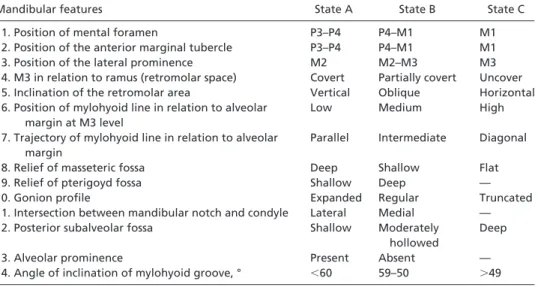
H. antecessor exhibits a primitive structural pattern in the mandible that is shared with all African and AsianHomospecies (Tables 3 and 4). Some features of the TD6 mandibles, such as the position of the M3 in relation to the ramus, the inclination of the retromolar area, or the gonion profile, are slightly derived from the primitive status, as is also seen in some specimens assigned toH. ergaster,H. mauritanicus, H. pekinensis, andH. heidelbergensis. From the taxonomic and phylogenetic points of view, these traits are only useful in distinguishingH. antecessor
from the Java specimens (H. erectusin our narrow vision of this taxon), which maintained a primitive pattern in the mandible. The low angle of inclination of the mylohyoid groove in Sangiran 9 might be an exception. The interpretation of this feature is, however, difficult. In the TD6 mandibles, the angle is small (35° in ATD6-5), thus differentiating these individuals from most hominins except for the Sangiran specimen and the immature individual KNM-WT 15000 (13).
The absence of an alveolar prominence, the almost vertical inclination of the planum alveolare, and the moderately hol-lowed posterior subalveolar fossa are signs of the gracility of the TD6 mandibles, contrasting with the robustness of the African specimens and some European mandibles, such as Mauer and Arago 13.
The TD6 and Chinese mandibles show some minor differ-ences, which might disappear with more representative samples. The lateral prominence is stronger in the Zhoukoudian speci-mens, which also exhibit a mandibular angle that is clearly everted and forms a prominent crest, which is especially marked in the male mandible GI (17). In the Lantian mandible, the torus
Fig. 4. Computerized tomography scan image of ATD6-96. The slice concerns
the premolars and first and second molars.
Table 2. Measurements of the mandibular body at the level of M1 in someHomospecies
Species Thickness, mm (n) Height, mm (n) Robustness (n)
Homo habilis 19.7⫾2.3 (5) 29.3⫾2.2 (4) 64.5⫾5.3 (4) H. ergaster* 19.8⫾1.4 (8) 31.2⫾2.8 (8) 63.8⫾5.0 (8) H. erectus† 19.8⫾2.6 (4) 36.3⫾1.1 (4) 54.7⫾7.4 (4) H. mauritanicus‡ 18.0⫾1.1 (4) 35.8⫾1.5 (4) 50.2⫾1.8 (4) H. pekinensis§ 16.5⫾1.8 (7) 28.6⫾3.3 (7) 58.0⫾5.6 (7) H. antecessor 16.4 (2) 27.6 (2) 62.6 (2) H. heidelbergensis 16.4⫾1.7 (16) 30.8⫾3.4 (16) 53.4⫾5.1 (16) H. neanderthalensis 15.3⫾1.7 (21) 32.1⫾3.3 (21) 47.9⫾5.1 (21)
Data are given as means⫾SD.
*Includes East African Early and Middle Pleistocene adult specimens KNM-ER 730, KNM-ER 731, KNM-ER 992, KNM-BK 67, KNM-BK 8518, OH 22, OH 23, and OH 51.
†We consider that the taxonH. erectusshould be restricted to the Javanese specimens. This sample includes the Sangiran mandibles 1B, 5, 8, and 9.
‡There is a recent trend to classify the North African Middle Pleistocene specimens asH. mauritanicus(32), using the specific name proposed by C. Arambourg in 1963 (33). This sample includes the specimens from Tighenif and Sidi Abderraman.
§The idea that the taxonH. erectusshould be restricted to the fossils from Java was proposed in 1977 by Aguirre and de Lumley (34). Furthermore, some authors have observed that the Zhoukoudian and Nanjing specimens exhibit a unique cranial metric pattern not shared by African and Indonesian specimens assigned toH. erectus
(35). For this reason we prefer to use the specific nameH. pekinensisfor the Chinese specimens. This sample includes the mandibles from Zhoukoudian, Lantian, Hexian, and PA86.
lateralis superior and torus marginalis are more conspicuous, and the alveolar prominence is slightly developed (17). It is also interesting to mention the presence of multiple foramina in the Chinese specimens, as in ATD6-96. Nevertheless, this feature is also present in specimens like Mauer or the Tighenif mandibles (18). As in ATD6-96, the planum alveolare is much less con-spicuous in the Zhoukoudian and Lantian mandibles than in the Early and Middle Pleistocene European and African specimens. Discussion
The differences in dimensions and robustness between the TD6 mandibles and the East and North African mandibles cast doubt on the African origin ofH.antecessor. In contrast, our compar-ative analysis suggests looking toward the Asian continent. In this respect, it is relevant to mention some data that remained unpublished in 1997, when the new species was named (10), and that are relevant to this discussion. The partial cranium Nanjing I, recovered in 1993–1994 from the Hulu Cave (Tangshan Hill, eastern central China), shows clear modern midfacial traits similar to those observed in the specimen ATD6-69 (19). Wang and Tobias (20) also found similarities between Nanjing I and the Zhoukoudian hominins. Geochronological dates, combined with
ecological and paleoclimatic evidence, indicate that the Nanjing skull is⬇600 thousand years old (21). Furthermore, the Locality 1 levels at Zhoukoudian, which yielded most hominin specimens, are now considered at least 800 thousand years old (22). Thus, these Chinese hominins may be contemporaneous with or slightly younger than the TD6 hominins. If the Gran Dolina and Chinese populations are phylogenetically related, they should share a common ancestor that also had a modern midfacial pattern and a gracile mandible. In the cranium, this hypothetical common ancestor would have had a low and flat temporal squama, and an unfused styloid process. These traits would have been retained in the Asian hominins but lost in the TD6 hominins, who exhibit a fused styloid process, a convex temporal squama, and probably a significant increase in cranial capacity (19). The Ceprano calvaria (Italy), which has been tentatively assigned to H. antecessor (23), exhibits a convex temporal squama and a cranial capacity of about 1,057 ml (24). Interest-ingly, TD6 and Zhoukoudian are the only hominins that have a zygomaxillary tubercle before the Upper Pleistocene (19).
On the other hand, none of the mandibular features consid-ered apomorphic of the European Middle and Early Upper Pleistocene hominin lineage (25) are present in ATD6-96. This Table 3. State of mandibular features analyzed in Table 4 [partially modified from Rosas (17)]
Mandibular features State A State B State C
1. Position of mental foramen P3–P4 P4–M1 M1
2. Position of the anterior marginal tubercle P3–P4 P4–M1 M1
3. Position of the lateral prominence M2 M2–M3 M3
4. M3 in relation to ramus (retromolar space) Covert Partially covert Uncover
5. Inclination of the retromolar area Vertical Oblique Horizontal
6. Position of mylohyoid line in relation to alveolar margin at M3 level
Low Medium High
7. Trajectory of mylohyoid line in relation to alveolar margin
Parallel Intermediate Diagonal
8. Relief of masseteric fossa Deep Shallow Flat
9. Relief of pterigoyd fossa Shallow Deep —
10. Gonion profile Expanded Regular Truncated
11. Intersection between mandibular notch and condyle Lateral Medial —
12. Posterior subalveolar fossa Shallow Moderately
hollowed
Deep
13. Alveolar prominence Present Absent —
14. Angle of inclination of mylohyoid groove, ° ⬍60 59–50 ⬎49
—, not applicable.
Table 4. State of the mandibular features listed in Table 3 in differentHomospecies Mand.
features habilis ergaster erectus mauritanicus antecessor pekinensis heidelbergensis neanderthalensis
1 A A, B A A, B A A, B B, C C 2 A, 0 A, 0 A A, 0 0 A, 0 A, B, C A, B, C 3 A A, B A A, B, C A B C C 4 A A, B A B B B, C B, C C 5 A A, B A B, C B A, B B, C C 6 A, B A, B A A A A A A, B, C 7 A A, B A A, B A A A, B B 8 A A, B, C A A B A A, B, C B, C 9 — A A A A A A, B B 10 — A, B — A, B B A, B B, C B, C 11 — A — A A A A, B B 12 A A A A B C B, C C 13 A A A A B A, B A, B B 14 A A, B C A, B C B A, B A, B
Numbers in the mandibular (Mand.) features column represent the numbers given for the traits in the same column in Table 3. A, B, and C represent states A, B, and C of the manibular features, respectively, also in Table 3. 0, Absence of the trait; —, no specimans available for that mandibular feature.
conclusion is consistent with observations made in the TD6 cranial and dental remains (19, 26) and suggests that the TD6 hominins do not belong to this lineage. SomeH.heidelbergensis
specimens, such as Mauer and Arago 13, which exhibit some European apomorphic traits, also retained great robustness, and a conspicuous planum alveolare, which forms a small angle (generally⬍50°) with the alveolar plane (27). Thus, a probable African origin for the European Middle Pleistocene populations is the most reasonable hypothesis (28).
ATD6-96 was found in association with some lithic objects, whose technical characteristics (Mode 1) are similar to those of the tools found during the 1994–1996 field seasons in the Aurora Stratum (1). In contrast, the Sima de los Huesos and Trinchera Galerı´a Middle Pleistocene sites, also located in Sierra de Atapuerca, have yielded human remains attributed toH. heidel-bergensis(29) and associated with Mode 2. Thus, it is probable that the early hominin population of Europe was replaced or genetically absorbed during the Middle Pleistocene by another population, probably coming from Africa, that carried the Mode 2 technology and is well represented by specimens, such as Arago, Atapuerca-Sima de los Huesos, Boxgrove, Mauer, or Petralona (30, 31).
Conclusions
We have made a comparative study of the mandible ATD6-96 recovered in 2003 from the Aurora Stratum, TD6 level, of the
Gran Dolina site in Sierra de Atapuerca. The size and shape of this mandible reinforce the taxonomic identity ofH. antecessor
and are consistent with the hypothesis that this species is closely related to the lineage leading toH. sapiens(10). However, the present evidence does not support the hypothesis of a phyloge-netic relationship between the TD6 hominins and the European lineage leading to the Neandertals. On the other hand, obser-vations on TD6 hominins and some Pleistocene Chinese speci-mens, like Nanjing I, suggest the hypothesis that the Gran Dolina hominins have an Eurasian origin, although the relationships betweenH. antecessorand other Eurasian populations or species cannot be determined on present evidence. We consider that more information on the Gran Dolina and other contempora-neous hominins will be necessary before revising the phyloge-netic position ofH. antecessor.
We thank Giorgio Manzi and Ian Tattersall for helping to improve the quality of the manuscript, Lucı´a Gomez-Polı´n for the cleaning and restoration of ATD6-96, and Ana Muela and Susana Sarmiento for photography and image computer processing. The computerized tomog-raphy scan images were obtained in the Sant Joan Hospital from Reus (Tarragona, Spain). The Atapuerca research project is supported by Ministerio de Educacio´n y Ciencia Coordinated Projects BOS2003-08938-C03-01, -02, and -03, the Consejerı´a de Cultura y Turismo of the Junta de Castilla y Leo´n, and the Fundacio´n Atapuerca.
1. Carbonell, E., Bermu´dez de Castro, J. M., Arsuaga, J. L., Dı´ez, J. C., Rosas, A., Cuenca-Besco´s, G., Sala, R., Mosquera, M. & Rodrı´guez, X. P. (1995)
Science269,826–830.
2. Carbonell, E., Garcı´a-Anto´n, M. D., Mallol, C., Mosquera, M., Olle´, A., Rodrı´guez, X. P., Sahnouni, M., Sala, R. & Verge´s, J. M. (1999)J. Hum. Evol.
37,653–693.
3. Cuenca-Besco´s, G., Laplana, C. & Canudo, J. I. (1999)J. Hum. Evol.37,353–373. 4. Garcia, N. & Arsuaga, J. L. (1999)J. Hum. Evol.37,415–430.
5. van der Made, J. (1999)J. Hum. Evol.37,389–413.
6. Pare´s, J. M. & Pe´rez-Gonza´lez, A. (1995)Science269,830–832. 7. Pare´s, J. M. & Pe´rez-Gonza´lez, A. (1999)J. Hum. Evol.37,325–342. 8. Falgue`res, C., Bahain, J.-J., Yokoyama, Y., Arsuaga, J. L., Bermu´dez de Castro,
J. M., Carbonell, E., Bischoff, J. L. & Dolo, J.-M. (1999)J. Hum. Evol.37, 343–352.
9. Garcia-Anto´n, M. (1995) inHuman Evolution in Europe and the Atapuerca Evidence, eds. Bermu´dez de Castro, J. M., Arsuaga, J. L. & Carbonell, E. (Junta de Castilla y Leo´n, Valladolid, Spain), pp. 147–165.
10. Bermu´dez de Castro, J. M., Arsuaga, J. L., Carbonell, E., Rosas, A., Martı´nez, I. & Mosquera, M. (1997)Science276,1392–1395.
11. Moorrees, C. F. A., Fanning, E. A. & Hunt, E. E. (1963)J. Dent. Res.42, 1490–1502.
12. Ramirez-Rozzi, F. & Bermu´dez de Castro, J. M. (2004)Nature428,936–939. 13. Rosas, A. & Bermu´dez de Castro, J. M. (1999)J. Hum. Evol.37,567–590. 14. Rosas, A. & Bermu´dez de Castro, J. M. (1998)Am. J. Phys. Anthropol.107,
145–162.
15. Bermu´dez de Castro, J. M., Nicola´s, M. E. & Rosas, A. (1999)J. Hum. Evol.
37,523–566.
16. Ferna´ndez-Jalvo, Y., Dı´ez, J. C., Ca´ceres, I. & Rosell, J. (1999)J. Hum. Evol.
37,591–622.
17. Xinzhi, W. & Poirier, F. E. (1995)Human Evolution in China(Oxford Univ. Press, Oxford).
18. Howell, F. (1960)Curr. Anthropol.1,195–232.
19. Arsuaga, J. L., Martı´nez, I., Lorenzo, C., Gracia, A., Mun˜oz, A., Alonso, O. & Gallego, J. (1999)J. Hum. Evol.37,431–457.
20. Wang, Q. & Tobias, P. V. (2000)Acta Anthropol. Sin.19,23–33. 21. Zhao, J., Hu, K., Collerson, K. D. & Xu, H. (2001)Geology29,27–30. 22. Shen, G. (2001) inHumanity from African Naissance to Coming Millennia, eds.
Tobias, P.V., Rath, M.A., Moggi-Cecchi, J. & Doyle, G.A. (Firenze Univ. Press, Florence, Italy), pp. 257–260.
23. Manzi, G., Mallegni, F. & Ascenzi, A. (2001)Proc. Natl. Acad. Sci. USA98, 10011–10016.
24. Ascenzi, A., Mallegni, F., Manzi, G., Segre, A. G. & Segre Naldini, E. (2000)
J. Hum. Evol.39,443–450.
25. Rosas, A. (2001)Am. J. Phys. Anthropol.114,74–91.
26. Bermu´dez de Castro, J. M., Martino´n-Torres, M., Sarmiento, S. & Lozano, M. (2003)J. Archaeol. Sci.30,1421–1428.
27. Lumley, H., de Lumley, M. A. & Fournier, A. (1982) inL⬘Homo erectus et la Place de l⬘Homme de Tautavel Parmi les Hominides Fossils, (Actes Congre´s Int. Pale´ontol. Hum., Nice, France) pp. 178–221.
28. Aguirre, E., de Lumley, M. A., Basabe, J. M. & Botella, M. (1980) in
Proceedings of the 8th Panafrican Congress of Prehistory and Quaternary Studies Nairobi, eds. Leakey, R. E. & Ogot, B. A. (The International Louis Leakey Memorial Institute for African Prehistory, Nairobi), pp. 171–173.
29. Arsuaga, J. L., Martı´nez, I., Gracia, A. & Lorenzo, C. (1997)J. Hum. Evol.33, 219–281.
30. Manzi, G. (2004)Evol. Anthropol.13,11–24.
31. Bermu´dez de Castro, J. M., Martino´n-Torres, M., Carbonell, E., Sarmiento, S., Rosas, A., van der Made, J. & Lozano, M. (2004)Evol. Anthropol.13,24–41. 32. Stringer, C. (2003)Nature423,692–695.
33. Arambourg, C. (1963)Arch. Inst. Paleontol. Hum.32,37–190. 34. Aguirre, E. & de Lumley, M. A. (1977)J. Hum. Evol.6,681–688. 35. Kidder, J. H. & Durband, A. C. (2003)J. Hum. Evol.46,297–313.