This article was downloaded by: [148.251.235.206] On: 03 September 2015, At: 18:43
Publisher: Taylor & Francis
Informa Ltd Registered in England and Wales Registered Number: 1072954 Registered office: 5 Howick Place, London, SW1P 1WG
Grana
Publication details, including instructions for authors and subscription information: http://www.tandfonline.com/loi/sgra20
Long distance pollen transport cause problems for
determining the timing of birch pollen season in
Fennoscandia by using phenological observations
Hanna Ranta a , Eero Kubin b , Pilvi Siljamo c , Mikhail Sofiev c , Tapio Linkosalo d , Annukka Oksanen a & Kristoffer Bondestam ea
Aerobiology Unit , Department of Biology , University of Turku , Finland b
The Finnish Forest Research Institute , Muhos Research Station , Muhos, Finland c
The Finnish Meteorological Institute , Helsinki, Finland d
Department of Forest Ecology , University of Helsinki , Finland e
The Skin and Allergy Hospital , Helsinki, Finland Published online: 20 Feb 2007.
To cite this article: Hanna Ranta , Eero Kubin , Pilvi Siljamo , Mikhail Sofiev , Tapio Linkosalo , Annukka Oksanen & Kristoffer Bondestam (2006) Long distance pollen transport cause problems for determining the timing of birch pollen season in Fennoscandia by using phenological observations, Grana, 45:4, 297-304, DOI: 10.1080/00173130600984740 To link to this article: http://dx.doi.org/10.1080/00173130600984740
PLEASE SCROLL DOWN FOR ARTICLE
Taylor & Francis makes every effort to ensure the accuracy of all the information (the “Content”) contained in the publications on our platform. However, Taylor & Francis, our agents, and our licensors make no
representations or warranties whatsoever as to the accuracy, completeness, or suitability for any purpose of the Content. Any opinions and views expressed in this publication are the opinions and views of the authors, and are not the views of or endorsed by Taylor & Francis. The accuracy of the Content should not be relied upon and should be independently verified with primary sources of information. Taylor and Francis shall not be liable for any losses, actions, claims, proceedings, demands, costs, expenses, damages, and other liabilities whatsoever or howsoever caused arising directly or indirectly in connection with, in relation to or arising out of the use of the Content.
This article may be used for research, teaching, and private study purposes. Any substantial or systematic reproduction, redistribution, reselling, loan, sub-licensing, systematic supply, or distribution in any
form to anyone is expressly forbidden. Terms & Conditions of access and use can be found at http:// www.tandfonline.com/page/terms-and-conditions
Long distance pollen transport cause problems for determining the
timing of birch pollen season in Fennoscandia by using phenological
observations
HANNA RANTA
1, EERO KUBIN
2, PILVI SILJAMO
3, MIKHAIL SOFIEV
3,
TAPIO LINKOSALO
4, ANNUKKA OKSANEN
1& KRISTOFFER BONDESTAM
51
Aerobiology Unit, Department of Biology, University of Turku, Finland,2The Finnish Forest Research Institute, Muhos Research Station, Muhos, Finland,3The Finnish Meteorological Institute, Helsinki, Finland,4Department of Forest Ecology, University of Helsinki, Finland and5The Skin and Allergy Hospital, Helsinki, Finland
Abstract
The male flowering and leaf bud burst of birch take place almost simultaneously, suggesting that the observations of leaf bud burst could be used to determine the timing of birch pollen release. However, long-distance transport of birch pollen before the onset of local flowering may complicate the utilization of phenological observations in pollen forecasting. We compared the timing of leaf bud burst of silver birch with the timing of the stages of birch pollen season during an eight year period (1997–2004) at five sites in Finland. The stages of the birch pollen season were defined using four different thresholds: 1) the first date of the earliest three-day period with airborne birch pollen counts exceeding 10 grains m23air; and the dates when the accumulated pollen sum reaches 2) 5%; 3) 50% and 4) 95% of the annual total. Atmospheric modelling was used to determine the source areas for the observed long-distance transported pollen, and the exploitability of phenological observations in pollen forecasting was evaluated.
Pair-wise comparisons of means indicate that the timing of leaf bud burst fell closest to the date when the accumulated pollen sum reached 5% of the annual total, and did not differ significantly from it at any site (pv0.05;
Student-Newman-Keuls test). It was found that the timing of leaf bud burst of silver birch overlaps with the first half of the main birch pollen season. However, phenological observations alone do not suffice to determine the timing of the main birch pollen season because of long-distance transport of birch pollen.
Keywords: Birch pollen, leaf bud burst, long-distance transport, pollen season, phenology
There are two treelike birch species in northern Europe, silver birch (Betula pendula Roth.) and downy birch (Betula pubescens L.), both very common forest and ornamental trees. Birch pollen is the most abundant and important allergenic airborne pollen type in the region and approximately 15% of the population is sensitised to its allergens (WHO, 2003). The timing of the male flowering of birches may vary in Scandinavia from year to year within a range of several weeks (Luomajoki, 1999). The adverse health effects of allergens can be reduced by pre-emptive medical measures. Con-sequently, an accurate forecasting of the birch pollen season would be important for those responsible for
pollen information services, and ultimately for allergic subjects and allergologists. It has been suggested that real-time phenological monitoring, observing the timing of the life-cycle events of organisms, could be utilized in pollen forecasting. Moreover, phenological observations, in the form of field observations and/or satellite images, might be useful in determining areas with increasing or high pollen release and could be used as input data for atmospheric dispersion models (Høgda et al., 2002; WHO, 2003; Siljamo et al., 2004).
Definitions of phenophases and observational methodologies may vary from one country to another (van Vliet et al., 2003). In Finland leaf
Correspondence: Hanna Ranta, Aerobiology Unit, Department of Biology, University of Turku, 20014 Turku, Finland. E-mail: [email protected]
(Received 15 December 2005; accepted 13 April 2006)
ISSN 0017-3134 print/ISSN 1651-2049 online#2006 Taylor & Francis DOI: 10.1080/00173130600984740
bud burst is defined as the stage when the leaves have emerged from the bud but the petioles have not (Kubin et al., 2004). Leaf bud burst and flowering take place almost simultaneously. According to Linkosalo (1999, 2000), the difference between the observed first date for male flowering and leaf bud burst is 1.1 days, with male flowering observed first. The result is based on over 750 observations of leaf bud burst and male flowering during 55 years in south and central Finland. The correlation between the two phenophases, calculated from 55 annual means, is 0.97, which strongly suggests that they are driven by the same environmental phenomena.
Airborne pollen at given location, however, may have two components: pollen grains originating from local vegetation and ones produced at distant sites and then transported to the location with air masses (Faegri et al., 1989). The long-distance transport of pollen has been known for aerobiologists and palynologists for a long time (Erdtman, 1937). There are recent examples from different parts of the world of allergenic pollen travelling long distances (Cabezudo et al., 1997; Lorenzo et al., 2006; Van de Water et al., 2003). In Scandinavia, the long-distance transport of birch pollen before the onset of local flowering has been documented during several springs (Hjelmroos, 1991). The phenom-enon probably affects the exploitability of phenolo-gical observations in pollen forecasting.
We compared the timing of leaf bud burst in silver birch to the timing of the stages of the birch pollen season in order to quantify the overlap and correla-tion of leaf bud burst and the full pollen season. Our overall goals were to ascertain whether phenological observations can be used to determine the timing of birch pollen release. Additionally, atmospheric modelling was used to determine the source areas for the observed long-distance transported pollen, and the exploitability of phenological observations in pollen forecasting together with atmospheric model-ling was discussed.
Material and methods
Since 1996 the Finnish Forest Research Institute (FFRI) has coordinated a phenological observation network covering the whole of Finland; it comprises 37 observation points at the field stations and research areas of the FFRI. The network focuses among other things on the phenology of forest trees. The birch trees used are adult trees growing in exposed habitats representing typical conditions with respect to regional climate. Observations are made using a standardised method repeatedly from the same tree individuals at least twice a week (Kubin et al., 2004). The FFRI phenological
network monitors both silver birch and downy birch. Only silver birch was used in this study, because it flowers earlier or at the same time as downy birch (Luomajoki, 1999).
According to the observation instructions applied in Finland, leaf bud burst is defined as the stage when the leaves have emerged from the bud but the petioles have not. This is the first point that birch branches begin to look green. The phenophase is recorded as having taken place at a given site when half of the buds have reached this stage (Kubin et al., 2004). We used observations of leaf bud burst in the study because no corresponding dataset for the onset of male flowering of silver birch is available for Finland.
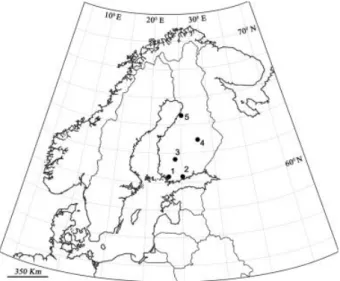
Phenological observations were compared with the counts of airborne birch pollen grains from five sampling sites in Finland during the years 1997– 2004 (Figure 1). The total number of observations of pollen concentrations for stages of the pollen season was 39; it was eight continuous years at each site except for Oulu, where it was seven because of a technical malfunction in pollen sampling during the spring of 2001.
At all sites, pollen sampling was performed with the volumetric Burkard-spore trap (Hirst, 1952) on an open rooftop. The technique of volumetric trapping is standard throughout most of Europe (British Aerobiology Federation, 1995). Pollen grains were counted and identified on randomised fields under microscopic observation (Ma¨kinen, 1981). The phenological observation sites were located within a range of 10 to 35 km of the pollen monitoring sites (Figure 1).
Figure 1. Pollen sampling sites: 1. Turku, 2. Helsinki, 3. Kangasala, 4. Kuopio, 5. Oulu. The phenological observation sites were located within a range of 10–35 km from the pollen monitoring sites.
298 H. Ranta et al.
We compared the dates of leaf bud burst with 1) the first date of the earliest 3-day period with airborne birch pollen counts exceeding 10 grains m23 of air, 2) the onset of the main season (the date when the accumulated pollen sum reaches 5% of the annual total), the height of the main season (the date when the accumulated pollen sum reaches 50% of the annual total) and the end of pollen season (the date when the accumulated pollen sum reaches 95% of the annual total). The first threshold value was used because the most sensitive hay fever patients start to have symptoms with airborne birch pollen counts exceeding 10 grains m23of air (Viander & Koivikko, 1978). The limit of the accumulated pollen sum reaching 5% of annual total has been used especially in Fennoscandia to define the onset of the main pollen season (Dahl & Strandhede, 1996; Høgda et al., 2002).
All dates were transformed into the number of days beginning from January 1st (Julian days). Descriptive statistics were calculated for each vari-able. The homogeneity of variances was investigated with Levene’s test. The data were log-transformed to normalize the distributions after which the dates for the pollen season stages were plotted against the dates for leaf bud burst and compared using Pearson correlation analysis. The means of the dates for bud burst were compared with the means of the four pollen season stages using the Student-Newman-Keuls test. The means (n56 for Oulu, for the other sites n57) were calculated from untransformed year-specific values for each site. The data of the year 1999 was excluded from the comparison; earlier analyses indicated with reason-able certainty that the timing of the pollen season was crucially influenced by long-distance transport of pollen.
The potential source for long-distance-transported birch pollen during April 1999 was analysed by the integrated pollen emission and transport model constructed on the basis on the emergency modelling system SILAM (Siljamo et al., 2004; Sofiev, 2002; Sofiev & Siljamo, 2003; Sofiev et al., 2006a; http:// silam.fmi.fi), which is currently used to forecast accidental atmospheric releases of hazardous sub-stances in Europe. SILAM is a Lagrangian random-walk dispersion model, which takes necessary input meteorological information - precipitation, winds etc – from numerical weather prediction model, such as, European Centre for Medium-Range Weather Forecasts (ECMWF) (http://www.ecmwf.int) or HIRLAM (Unde´n et al., 2002). Dry deposition of the pollen grains is based on resistance analogy and wet deposition – on scavenging coefficients (Sofiev et al., 2006b). The model is capable of both forward and adjoint (inverse) simulations, the latter being
used for data assimilation and source apportionment problems.
Analyses were performed by delineation of poten-tial source areas using cumulative adjoint simula-tions with the SILAM model. Weather data were taken from the numerical weather prediction model FMI-HIRLAM v.2 (Ka¨llen, 1996) with a six-hour time step. Inverse simulations were using a passive tracer, which features closely resemble the prob-ability density. In particular, the simulations did not consider removal processes revealing only the sources of air parcels (with or without pollen) that affect the specific monitoring site during the specific observation cycle. The results of the simulations were formulated in terms of probability of the delineated areas to affect the above monitoring sites during the high-concentration episodes. If such probability was significantly positive and the birch flowering has already started in the suspected source area, then these very forests were indeed causing the observed peaks.
Results
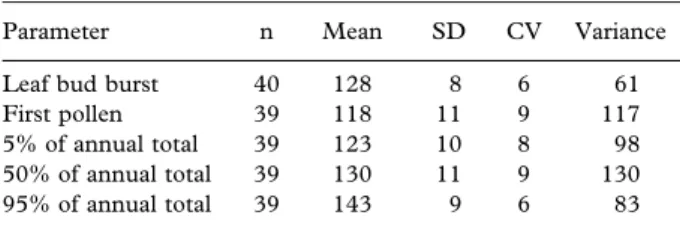
Descriptive statistics show that the largest variability occurs between the first date when the earliest three-day period with airborne birch pollen counts exceeds 10 grains m23 air and the date when the accumu-lated pollen sum reaches 50% of the annual total. The difference among the homogeneities of the variances was suggestive (Levene’s test; F52.35, pw0.056; Table I).
When all sites and years were pooled, all pollen season stages were statistically significantly corre-lated with the dates of bud burst (Figure 2A–D). The dates for accumulated pollen sums reaching 5% and 50% of the annual total were reached excep-tionally early in 1999, and within four days (April 18–21), at all study sites, from southern to northern Finland (Figures 1, 2B–C, 3). The number of days between leaf bud burst and the onset of the main
Table I. Descriptive statistics calculated from year-specific values for the variables leaf bud break and pollen season stages at the five sites during the years 1997–2004.
Parameter n Mean SD CV Variance Leaf bud burst 40 128 8 6 61 First pollen 39 118 11 9 117 5% of annual total 39 123 10 8 98 50% of annual total 39 130 11 9 130 95% of annual total 39 143 9 6 83 First pollen – the first date (Julian days) of the earliest 3-day period with airborne birch pollen counts exceeding 10 grains m23 air; N – number of observations; SD – standard deviation; CV – coefficient of variation.
season was 13 and 28 for Turku and Oulu, respectively (Figure 3).
Pair-wise comparisons of means indicate that the timing of leaf bud burst fell closest to the date when the accumulated pollen sum reached 5% of the annual total and did not differ significantly from it (Figure 4A–E). The first date of the earliest three-day period with airborne birch pollen counts exceeding 10 grains m23 air occurred significantly earlier (pv0.05) than leaf bud burst in all sites
except Turku. At all sites, leaf bud burst occurred statistically significantly earlier than the date when the accumulated pollen sum reached 95% of the annual total. The date when the accumulated pollen sum reached 50% of the annual total differed significantly from the date of leaf bud burst in Kangasala and Oulu (pv0.05), but not in Turku,
Helsinki and Kuopio (Figure 4A–E).
The analyses for the source of long-distance transported pollen between April 18th and 21st
1999 indicated that at the beginning of the period air masses were transported to Finland from Russia and Poland (Figure 5A), then from areas lying along the south coast of the Baltic Sea (Figure 5B). After that, Finland received air from two directions; mainly from Russia, in part again from areas lying along the south coast of the Baltic Sea (Figure 5C). At the end of the period, air again reached Finland through Estonia from western Russia (Figure 5D).
Discussion
The analyses revealed that the timing of leaf bud burst of silver birch in Fennoscandia overlaps with the first half of the main birch pollen season. This finding was expected, since leaf bud burst and male flowering of the birch occur almost simultaneously (Linkosalo, 1999, 2000). The results encourage the wider use of phenological observations in Figure 2. A–D. The date of the silver birch bud burst (Julian days) at five sites during 1997–2004 (n539) plotted against: (A) first day (Julian days) of the earliest 3-day period with airborne birch pollen counts exceeding 10 grains m23air (rp50.645, pv0.0001); (B) the Julian day when accumulated pollen sum reached 5% of the annual total (rp50.567, pv0.0002); (C) the Julian day when accumulated pollen sum reached 50% of the annual total (rp50.458, p50.0034); (D) the Julian day when accumulated pollen sum reached 95% of the annual total (rp50.678, pv0.0001). Diagonal line indicates 100% correlation.
300 H. Ranta et al.
determining the timing of pollen seasons, with some reservations.
It was verified that the long-distance transport of birch pollen may cause airborne birch pollen counts to increase rapidly, considerably before the local birches start releasing pollen. On April 21st 1999 birch pollen counts exceeded 2 000 grains m23 air in Turku (S. Finland) and in Oulu (N. Finland) (Figure 3). Leaf bud burst took place considerably later, on May 4thin Turku and on May 20thin Oulu (Figure 3). Birch flowering in Finland was very weak in 1999, following an exceptionally abundant flower-ing in 1998 (Ranta et al., 2005). It can be assumed that in 1999 most birch pollen in Finland originated from distant regions.
Also other scientific reports have shown that the relationship between phenological observations and airborne allergenic pollen counts may not be straightforward. The findings of Jato et al. (2002) indicated that on a local scale the start of theQuercus
pollen season may not even overlap with the observed onset of Quercus flowering in north-west Spain. This may have been because other trees started to flower earlier than those observed; other potential causes may have been medium-distance transport (from 10–30 km away) of pollen from other sites, rainfall, and/or damage to catkins from gall-forming insects. Orlandi et al. (2005) found out that in regional scale, the peaks observed with the monitoring of airborne olive pollen could be
attributed to particular olive areas and cultivars in central Italy.
Likewise our results show that the first date of the earliest three-day period with airborne birch pollen counts exceeding 10 grains m23 varies widely from year to year and is reached considerably (on average ten days) before the observed date of leaf bud break (Table I). This may be due to several reasons. Phenological monitoring is performed two or three times per week, which may cause a three-day lag in detecting leaf bud break. Although the study trees grow in exposed habitats representing typical condi-tions with respect to the regional climate (Kubin et al., 2004), silver birches growing in very warm sites will probably start to flower a few days earlier than the observed trees. Finally, it has been shown that in addition to 1999, episodes of long-distance transport of birch pollen to Finland occurred also during 2002, 2003 and 2004 (Sofiev et al., 2006b). Unlike 1999, these episodes preceded the local flowering uninterrupted, which makes it impossible to deter-mine the fraction of pollen contributed by remote and/or local sources during the progress of the pollen season.
There is plenty of evidence that the long-distance transport of pollen can significantly modify pollen seasons not only in Fennoscandia (Hjelmroos, 1991; Oikonen et al., 2005) but also in other regions (Corden et al., 2002; Damialis et al., 2005; Van de Water et al., 2003). In Europe, the primary source Figure 3. Development of airborne birch pollen counts in Turku (S. Finland) and Oulu (N. Finland) in the spring of 1999. Accumulated pollen sums of 5% and 50% of annual total were reached on April 18 and 21 respectively in Turku and Oulu.
region for birch pollen is the Nordic and Baltic countries along with western Russia and Belarus, where large areas of birch forests grow (Hjelmroos, 1991; Ko¨ble & Seufert, 2001; Pisarenko et al.,
2001). In our study, the highest concentrations of long-distance transported birch pollen were observed in air masses originating chiefly from western Russia and Estonia (Figures 3 & 5C–D).
Leaf bud burst, according to the Finnish defini-tion (Kubin et al., 2004), occurs when the birches first start to look green. This may enable the use of remote sensing techniques for locating areas with increasing and/or high birch pollen emissions. The first attempts to use low resolution satellite data to measure leaf bud burst and the male flowering of birch were carried out by Høgda et al. (2002). They found a correlation between observations of leaf bud break and the onset of the main pollen season (defined as an accumulated sum of 5% of the annual total). On average the differences between the dates of these two phenomena at three sites in Norway varied from eight to ten days, with bud burst observed first.
Conclusions
Phenological observations of birch leaf bud burst overlap with the timing of the first half of the main pollen season in Fennoscandia. However, phenolo-gical observations alone do not suffice to determine the timing of the main birch pollen season because long-distance transport of pollen may greatly affect the timing of the local birch pollen season. A tool for predicting episodes of long-distance transport is therefore needed to supplement local monitoring of pollen counts and phenological observations in northern Europe.
Since leaf bud burst is the time when the birches first start to look green, remote sensing data might be used to locate areas with increasing and/or high pollen emission. This information may be useful as input data for atmospheric dispersion models.
While considering the wider use of phenological observations in pollen forecasting, it should be kept in mind that both phenophase definitions and observational methods may vary from one country to another.
Figure 4. Pair-wise comparisons of means between the timing of leaf bud burst (black bars), and stages of pollen season (white bars) at the five sites during 1997–2004. The first date of the earliest three-day period with airborne birch pollen counts exceeding 10 grains m23air, and the dates when the accumulated pollen sum reached 5% and 50% of the annual at (A) Turku, (B) Helsinki, (C) Kangasala, (D) Kuopio and (E) Oulu. Standard error of mean is shown and is calculated from year specific values; statistically significant differences (pv0.05) between bars high-lighted by*.
302 H. Ranta et al.
Acknowledgements
Data for Helsinki was produced with the support of Skin and Allergy Hospital. The study was supported by the Finnish Academy.
References
British Aerobiology Federation (1995)Airborne pollens and spores, a guide to trapping and counting(1sted.). Harpenden: BAF. Cabezudo, B., Recio, M., Sa´nchez-Laulhe´, J. M., Del Mar Trigo,
M., Toro, F. J. & Polvorinos, F. (1997). Atmospheric transportation of marihuana pollen from North Africa to Southwest of Europe.Atmos. Environ.,31, 3323–3328. Corden, J. M., Stach, A. & Millington, W. (2002). A comparison
ofBetulapollen season at two European sites: Derby, United Kingdom and Poznan, Poland (1995–1999).Aerobiologia,18, 54–53.
Dahl, A. & Strandhede, S.-O. (1996). Predicting the intensity of the birch pollen season.Aerobiologia,12, 97–170.
Damialis, A., Gioulekas, D., Lazopoulou, C., Balafoutis, C. & Vokou, D. (2005). Transport of airborne pollen into the city of Thessaloniki: the effect of wind direction, speed and persis-tence.Int. J. Biometeorol.,49, 139–145.
Erdtman, G. (1937). Pollen grains recorded from the atmosphere over the Atlantic.Medd. Go¨teborgs Bot. Tra¨dg.,12, 186–196. Faegri, K. & Iversen, J. (1989)Textbook of pollen analysis(4thed.
by K. Faegri, P. E. Kaland & K. Krzywinski). Chichester, New York, Brisbane, Toronto, Singapore: J. Wiley & Sons. Hirst, J. M. (1952). An automatic volumetric spore trap. Ann.
Appl. Biol.,39, 29–33.
Hjelmroos, M. (1991). Evidence of long-distance transport of Betulapollen.Grana,30, 215–228.
Høgda, K. A., Karlsen, S. R., Solheim, I., Tommervik, H. & Ramfjord, H. (2002). The start dates of birch pollen seasons in Fennoscandia studied by NOAA AVHRR NDVI data. In IEEE (Ed.), IGARSS ’02, Toronto 2002. Proc. Vol., (no 6, pp. 3299–3301). Piscataway, NJ: IEEE Int.
Figure 5. Cumulative SILAM sensitivity area. Grey indicates areas whence air masses travelled over the pollen monitoring sites at Turku, Helsinki, Kangasala, Kuopio, Oulu and Vaasa during the two days preceding the observation of birch pollen: (A) April 18; (B) April 19; (C) April 20; (D) April 21, 1999. Grey areas with flowering birches are potential source areas for long-range transport. Dark grey indicates higher air parcel concentrations.
Jato, V., Rodrı´guez-Rajo, F. J., Me´ndez, J. & Aira, M. J. (2002). Phenological behaviour of Quercus in Ourense (NW Spain) and its relationship with the atmospheric pollen season.Int. J. Biometeorol.,46, 176–184.
Kubin, E., Poikolainen, J., Hokkanen, T., Karhu, J. & Pasanen, J. (2004). Field instructions for plant-phenological observations. Muhos: Res. St. Finn. Forest Res. Inst.
Ka¨llen, E. (1996).HIRLAM documentation manual. System 2.5. Norrko¨ping: Swed. Meteorol. Hydrol. Inst.
Ko¨ble, R. & Seufert, G. (2001). Fate and impact of terrestrial natural emissions, Document nr. TP35; Novel maps for tree species in Europe. In J. Hjort, F. Raes & G. Angeletti (Eds), A changing atmosphere. Proc. 8thEur. Symp. Phys.-Chem. Behav. Air Pollut. Torino 2001. Torino: Org. Comm,CD-ROM. Linkosalo, T. (1999). Regularities and patterns in the spring
phenology of some boreal trees.Silva Fenn.,33, 237–245. Linkosalo, T. (2000). Mutual regularity of spring phenology of
some boreal tree species: Predicting with other species and phenological models.Can. J. Forest Res.,30, 667–673. Lorenzo, C., Marco, M., Paola, D. M., Alfonso, C., Marzia, O. &
Simone, O. (2006). Long distance transport of ragweed pollen as a potential cause of allergy in central Italy.Ann. Allergy, Asthma Immunol.,96, 86–91.
Luomajoki, A. (1999). Differences in the climatic adaptation of silver birch (Betula pendula) and downy birch (Betula pubescens) in Finland based on male flowering phenology.Acta Forest. Fenn,263, 1–35.
Ma¨kinen, Y. (1981). Random sampling in the study of micro-scopic slides.Rep. Aerobiol. Lab. Univ. Turku,5, 27–43. Oikonen, M. K., Hicks, S., Heino, S. & Rantio-Lehtima¨ki, A.
(2005). The start of the birch pollen season in Finnish Lapland: separating non-local from local birch pollen and the implication for allergy sufferers.Grana,44, 181–186. Orlandi, F., Ruga, L., Romano, B. & Fornaciari, M. (2005). An
integrated use of aerobiological and phenological data to analyse flowering in olive growes.Grana,44, 51–56. Pisarenko, A. I., Starkhov, V. V., Pa¨ivinen, R., Kuusela, K.,
Dyakun, F. A. & Sdobnova, V. V. (2001).Development of forest resources in the European part of the Russian Federation. Leiden, Boston, Ko¨ln: E. J. Brill. EFI Res. Rep. 11.
Ranta, H., Oksanen, A., Hokkanen, T., Bondestam, K. & Heino, S. (2005). Masting byBetulaspecies; applying the resource budget model to North European data sets.Int. J. Biometeorol., 49, 146–151.
Siljamo, P., Sofiev, M., Ranta, H., Kalnina, L. & Ekebom, A. (2004). Long-range atmospheric transport of birch pollen. Problem statement and feasibility studies. In SMHI (Ed.), Baltic HIRLAM workshop, St. Petersburg 2003(pp. 100–103). Norrkoping: SMHI.
Sofiev, M. (2002). Real time solution of forward and inverse air pollution problems with a numerical dispersion model based on short-term weather forecasts. HIRLAM Newslett., 14, 131–138.
Sofiev, M. & Siljamo, P. (2003). Forward and inverse simulations with Finnish emergency model SILAM. In C. Borrego & S. Incecik (Eds),Air pollution modelling and its applications. XVI (pp. 417–425). New York: Kluwer Acad./Plenum Publ. Sofiev, M., Siljamo, P., Valkama, I., Ilvonen, M. & Kukkonen, J.
(2006a). A dispersion modelling system SILAM and its evaluation against ETEX data.Atmos. Environ.,40, 674–685. Sofiev, M., Siljamo, P., Ranta, H. & Rantio-Lehtima¨ki, A. (2006b). Towards numerical forecasting of long-range air transport of birch pollen: theoretical considerations and a feasibility study.Int. J. Biometeorol.,50, 392–402.
Unde´n, P., Rontu, L., Ja¨rvinen, H., Lynch, P., Calvo, J., Cats, G., Cuxart, J., Eerola, K., Fortelius, C., Garcia-Moya, J. A., Jones, C., Lenderlink, G., McDonald, A., McGrath, R., Navascues, B., Woetman, Nielsen, N., Odegaard, V., Rodriguetz, E., Rummukainen, M., Room, R., Sattler, K., Hansen Sass, B., Savija¨rvi, H., Wichers Schreur, B., Sigg, R., The, H. & Tijm, A. (2002). HIRLAM-5 Project, Helsinki Workshop 2002. Norrko¨ping: SMHI.HIRLAM-5 Sci. Doc..
Van de Water, P. K., Keever, T., Main, C. E. & Levetin, E. (2003). An assessment of predictive forecasting of Juniperus asheipollen movement in the Southern Great Plains, USA.Int. J. Biometeorol.,48, 76–82.
van Vliet, A. J. H., de Groot, R. S., Bellens, Y., Braun, P., Bruegger, R., Bruns, E., Clevers, J., Estreguil, C., Flechsig, M., Jeanneret, F., Maggi, M., Martens, P., Menne, B., Menzel, A. & Sparks, T. (2003). The European Phenology Network.Int. J. Biometeorol.,47, 202–212.
Viander, M. & Koivikko, A. (1978). The seasonal symptoms of hyposensitized and untreated hay fever patients in relation to birch pollen counts: correlation with nasal sensitivity, prick test and RAST.Clin. Allergy,8, 387–396.
WHO (2003). Phenology and human health: allergic disorders. Copenhagen: WHO Reg. Office Europe.
304 H. Ranta et al.