M AR IN E CORP S OP
ERATIONAL TEST & EVALU ATIO N A CT IVIT Y
MCOTEA
Operational Test
& Evaluation
Manual
Marine Corps Operational Test and Evaluation Activity
M
CO
TE
A
O
pe
ra
tio
na
l T
es
t &
E
va
lu
at
io
n M
an
ua
l
Third
Edition
3rd
Ed.
UNITED STATES MARINE CORPS
MARINE CORPS OPERATIONAL TEST AND EVALUATION ACTIVITY 2032 BARNETT AVENUE
QUANTICO, VIRGINIA 22134-5014
3980 Dir/0058 22 Feb 13 From: Director, Marine Corps Operational Test and Evaluation Activity (MCOTEA) To: MCOTEA All Hands
Subj: MCOTEA OPERATIONAL TEST AND EVALUATION MANUAL THIRD EDITION 1. The MCOTEA Operational Test and Evaluation Manualpresents a process rooted in both the scientific method and Marine Corps operations. The Manual combines elements of Marine Corps missions and tasks with systems engineering, decision analysis, and design of experiments providing a process supporting all test and evaluation (T&E) activities MCOTEA performs. The execution of the steps outlined in this Manual must result in a balance between objective data gathering with operational judgment rooted in realistic scenarios and hard-learned lessons through combat experiences.
2. The overall T&E, as established in the first edition continuing throughout the second edition, has not changed apart from adjustments and clarifications based on lessons learned. The third edition of the Manual, which supersedes the second edition, incorporates policy revisions to Department, Component, and Service-level instructions and orders and to internal MCOTEA policy. Changes to the third edition also include a new in-depth example running throughout the six-steps of the MCOTEA process. Division and Staff responsibilities have been updated within and external to the MCOTEA six-step process reflecting organizational structure changes rooted in the establishment of the technical skills necessary to support operations analysis for Marine Corps capabilities. The third edition brings about increased guidance on test execution and an update to the MCOTEA T&E templates. Finally, the third edition splits into two volumes. Volume I is the core of the MCOTEA process, while Volume II presents the unique elements incorporated in the second edition like Reliability, Availability, and Maintainability, Live Fire, and Modeling and Simulation.
3. This Manual is a living document and will be updated regularly with additional material. All hands are encouraged to submit comments or recommendations to the Scientific Advisor for the improvement of this Manual.
4. Use of this Manual for performing Marine Corps operational test and evaluation is mandatory and effective immediately.
5. Thank you for all your continued professionalism and cooperation.
MCOTEA provides operational testing and evaluation for the Marine Corps and conducts additional testing and evaluation as required to support the Marine Corps mission to man, train, equip, and sustain a force in readiness.
MCOTEA Vision
MCOTEA is the Marine Corps leader in all aspects of realistic operational test and evaluation of materiel system capabilities throughout a materiel system’s life cycle. Our highly trained, professionals are a voice for the Operating Force Marine, enabling informed decision-making, and ensuring always that our test reports accurately and objectively describe what we know and don’t know about the Operational Effectiveness, Suitability, and Survivability of the materiel solution we evaluate. MCOTEA is a source for objectivity in the Marine Corps and, where appropriate, DOD’s acquisition process. Our expertise, professionalism, and integrity makes us a sought-after partner within the DOD acquisition community.
TOC-i Table of Contents
Table of Contents
Chapter 1. Organization ...1-2
General Philosophy ...1-2
Executive Office ...1-2
Director ...1-2
Deputy Director ...1-2
Scientific Advisor ...1-3
Chief of Staff ...1-3
Divisions ...1-3
Combat Service Support Division ...1-4
Cyber Division ...1-4
Expeditionary Division ...1-4
Live Fire Division ...1-4
MAGTF C4ISR ...1-4
Operational Test and Analysis Division ...1-4
Staff Functions ...1-5
Business Management ...1-5
S-1: Human Capital and Administration ...1-5
S-3: Operations ...1-6
S-4: Logistics ...1-6
Fiscal ...1-7
Chapter 2. Background & Paradigm ...2-2
MCOTEA’s Mandate and Purpose...2-2
MCOTEA’s Working Relationships with Other Organizations ...2-3
Working Partners ...2-3
Deputy Commandant for Combat Development and Integration ...2-3 Marine Corps Systems Command ...2-3 Program Executive Officer Land Systems ...2-3
Oversight/Non-Chain of Command ...2-3
Director, Operational Test and Evaluation ...2-3 Assistant Secretary of the Navy (Research, Development, and Acquisition) ...2-4
Gate Reviews ...2-4
Fellow Operational Test Agencies ...2-5
Communication/Information Sharing ...2-5
Navy Enterprise T&E Board of Directors ...2-5 N084 ...2-6 OSD Test Investment Coordinating Committee ...2-6 Test Resources Management Center ...2-6
Acquisition Life Cycle Overview ...2-6
ACAT Designation ...2-6
Evolutionary Acquisition ...2-6
Incremental Testing Requirements ...2-7
Test and Evaluation Paradigm ...2-7
Test Relationship to Evaluation ...2-8
The Evaluation Continuum ...2-9
Advantages of MCOTEA’s Early Involvement ...2-9
Continuous Evaluation ...2-9
Early Identification of Deficiencies ...2-10
Collaboration Along the Acquisition Time Line ... 2-11
Pre-Milestone A ...2-11
Milestone A to Milestone B ...2-12
Post Milestone B ...2-13
Obtaining and Using Developmental Test Data ...2-13
MCOTEA Test Team Billets and Best Practices ... 2-14
The Operational Test ...2-14
Before Testing ... 2-14 During Testing ... 2-15 After Testing ... 2-15
Test Manager ...2-15
Before Testing ... 2-15 During Testing ... 2-15 After Testing ... 2-15Operations Research/Systems Analyst ...2-15
Before Testing ... 2-16 During Testing ... 2-16 After Testing ... 2-16
Mathematical Statistician ...2-16
Before Testing ... 2-16 During Testing ... 2-16 After Testing ... 2-16TOC-iii Table of Contents
Data Manager ...2-16
Before Testing ... 2-16 During Testing ... 2-16 After Testing ... 2-17Supplementary Team Members ...2-17
MCOTEA’s 6-Step Test and Evaluation Process ... 2-17
Step 1. System Evaluation Plan and FD/SC Charter ...2-17
Step 2. Test Concept and TEMP Input ...2-17
Step 3. Test Planning ...2-17
Step 4. Operational Test Execution ...2-17
Step 5. Operational Test Reporting ...2-18
Step 6. System Evaluation and Reporting ...2-18
Records Management and Lessons Learned ... 2-18
Types of MCOTEA Tests ... 2-18
Operational Testing ...2-18
Initial Operational Test and Evaluation ...2-19
Follow-on Operational Test and Evaluation ...2-19
Multi-Service Operational Test and Evaluation ...2-19
Marine Corps Lead Service ... 2-19 Other Service OTA Lead ... 2-20
MCOTEA Assessments ... 2-20
Top-Level MCOTEA Functions ... 2-21
Chapter 3-0. The 6-Step Process ...3-2
Entry of New Work into MCOTEA ...3-2
Program SharePoint Support ...3-2
Staff Responsibilities ...3-3
Plan-Test-Report...3-4
Integrated Testing Within the 6-Step Process ...3-4
MCOTEA Assessments ...3-4
System Assessments ...3-5
Quick Reaction Assessment ...3-6 AAPs and ACAT IV(M) ...3-6
Intermediate Assessments ...3-6
DT Observation ...3-6
Early Operational Assessment ...3-8
Chapter 3-1. Step 1: System Evaluation Plan ... 3-1-2
Evaluation Purpose ...3-1-2
Evaluation Paradigm:
The Importance and Benefits of Continuous Evaluation ...3-1-2
Review Program Documentation ...3-1-3
System Evaluation Plan (SEP) ...3-1-3
Background ...3-1-3 Scope ...3-1-4 Objectives ...3-1-4
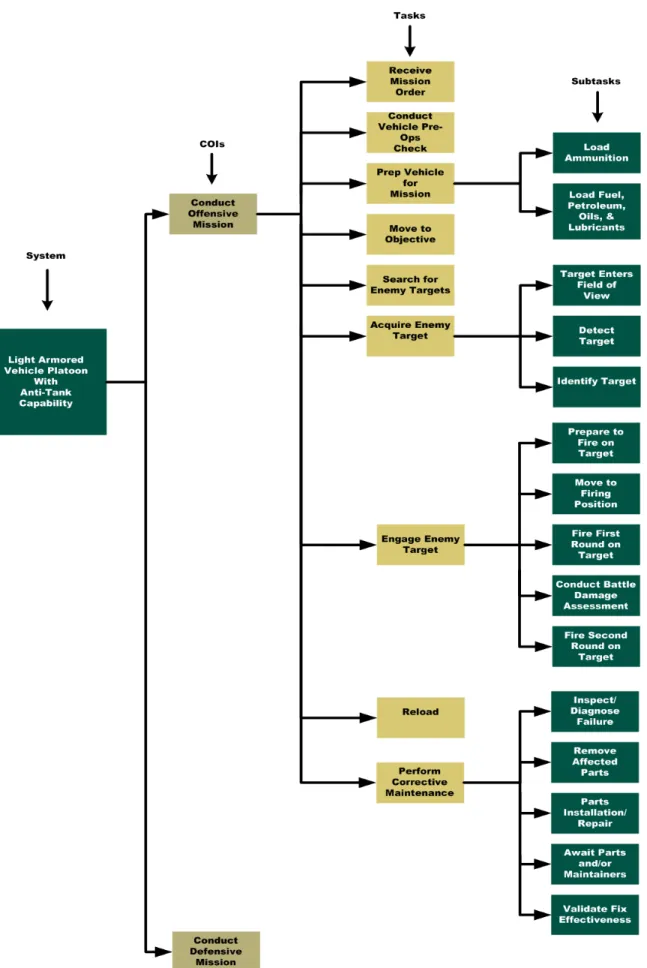
Operational Task Analysis ...3-1-5
Identify Missions ...3-1-5
Identify Tasks ...3-1-5
Identify Lower-Level Subtasks ...3-1-6
Develop Evaluation Questions ...3-1-8
Evaluation Questions ...3-1-8
Characteristics of Evaluation Questions ...3-1-8
Top-Down & Mission-Based ...3-1-9 OE/OS/OSur Interrelationship ...3-1-9 Operational Effectiveness ...3-1-9 Operational Suitability ...3-1-9 Operational Survivability ... 3-1-10
Critical Operational Issues ... 3-1-10
Issues ... 3-1-10
Tasks and Subtasks ... 3-1-10
Suitability and Survivability ... 3-1-11 Determine Level of M&S Support Required ... 3-1-11 Construct Evaluation Standards and Measures ... 3-1-11 Developing Standards ... 3-1-11 Attribute Variations ... 3-1-11 Mapping Attributes to the Evaluation Framework... 3-1-13 Attributes Mapping Matrix ... 3-1-13 Establish Standards for Evaluation Questions ... 3-1-13 Standards for Performance and Conditions ... 3-1-16 Finalize Evaluation Questions ... 3-1-17 Types of Measures ... 3-1-17 Properties of Measures ... 3-1-17 Measures of Effectiveness ... 3-1-18
TOC-v Table of Contents Measures of Performance ... 3-1-18 Measures of Suitability ... 3-1-18 Measures of Survivability ... 3-1-18 Preferential Measures... 3-1-18 Measure Scales ... 3-1-18 Measure Alignment with Objectives ... 3-1-18 Measure Data Type ... 3-1-19 Establishing Dominant Measures ... 3-1-19 Properties of the Evaluation Model ... 3-1-20 Screening Criteria ... 3-1-20 Aggregation Method ... 3-1-20 Properties Necessary for Aggregation ... 3-1-20 Collectively Exhaustive ... 3-1-21 Mutual Exclusivity ... 3-1-21 Evaluation Framework Operability ... 3-1-21 Building an Evaluation Model ... 3-1-22 Identifying Screening Criteria ... 3-1-22 Constructing the Analytic Model ... 3-1-23 Constructing an Example Decision Model ... 3-1-24 Weighting Elements of the Decision Model ... 3-1-27 Combining Screening Criteria, Analytic Model, and Decision Model ... 3-1-28
Additional SEP Elements ...3-1-28
Preparation ... 3-1-28
Chapter 3-2. Step 2: Test Concept, TEMP Input,
and Charter Development ... 3-2-2
Technical Information about Test Concept Development ...3-2-2
Identify the Test Objective ...3-2-2
Define the System ...3-2-2
Define the Trial ...3-2-2
Identify Cause-Effect Relationships ...3-2-3
Factors and Cause and Effect Relationships ...3-2-3 Link Inputs, Process Flows, and Outputs to Cause-Effect Relationships ...3-2-4 Select Sample Size, Design Type, and Analysis Method ...3-2-5 Test Limitations ...3-2-5
Integrated Data Requirements List ...3-2-6
Preparing TEMP Input ...3-2-6
TEMP Background and Structure ...3-2-6 Summary of TEMP Part III Development ...3-2-8 Preparing TEMP Part IV Inputs ...3-2-8
Identifying Resource Requirements ...3-2-8 Identify Test Locations ...3-2-8 Estimate Time Requirements ...3-2-8 Identify M & S, Cyber, and LFT&E Needs and Required Resources ...3-2-9 Identify Key Resources ...3-2-9 Estimate Costs ...3-2-9
Inputs and the Operational Test Plan ...3-2-9
Integrated Testing ...3-3-2
Writing DT Observation Plans ...3-3-2
Chapter 3-3. Step 3: Test Planning ... 3-3-2
Observing Test Events ...3-3-3
DT Observation Reporting ...3-3-6
DT Report Review Process and IAR Preparation ...3-3-6
Early Operational Test Planning Activities ...3-3-6
Human Research Protection Program ...3-3-7
Creating the Feasibility of Support Message ...3-3-7
Test Planning Timeline ...3-3-8
Test Planning Process ...3-3-8 Check Lessons Learned Database ...3-3-8 Writing the Test Plan ...3-3-8 Initial Sections of the Test Plan ...3-3-8 Refining the Schedule ...3-3-8
Operational Test Readiness Board/Review Process ...3-3-9
Conducting the Pre-OTRR ...3-3-9
Conducting the OTRB ... 3-3-10 Conducting the OTRR ... 3-3-10
Coordination of Personnel ...3-3-11
Marine Officer in Charge and Test Unit ... 3-3-11
Data Collectors ... 3-3-11
Contractors ... 3-3-11
Active Duty Marines ... 3-3-11
Reservists ... 3-3-12
Detailed Test Planning ...3-3-12
Insert Sample Size and Test Design ... 3-3-13
Finalize Data Requirements ... 3-3-13
TOC-vii
Table of Contents
Determine Data Requirements for Analysis ... 3-3-13
Develop Data Collection Methods ... 3-3-13
Automated Data Collection ... 3-3-13 Manual Data Collection ... 3-3-14
Develop Data Reduction Methods ... 3-3-16
Adding Details to Test Trials ... 3-3-16
Test Plan Annexes ... 3-3-16
Requirements for Other-Service Assets ...3-3-20
Navy Assets ... 3-3-20
Army Air Assets ... 3-3-20
Marine Air Assets ... 3-3-20
Air Force Assets ... 3-3-20
Equipment Requirements and Test Site Coordination ...3-3-21
Identifying Required Facilities and Logistics Support ...3-3-21
Data Collection Forms ...3-3-22
Types of Forms ... 3-3-22
Quantitative Forms ... 3-3-22 Qualitative Forms ... 3-3-22 Verification Forms... 3-3-22
Survey Questions ...3-3-22
Data Collector Training ...3-3-22
Environmental Considerations ...3-3-23
Data Collection Based on Data Requirements ...3-3-23
Building a Data Repository ...3-3-23
Maintaining Data Integrity and Security ... 3-3-24
Data Collection Verification and Validation ...3-3-24
Test Site Visit ...3-3-24
Equipment Check ...3-3-24
Instrumentation ... 3-3-24
Transporting the Test Team and Test Equipment ... 3-3-25
Travel Orders ... 3-3-25
Transporting Test Equipment ... 3-3-25
Site-Specific Restrictions ... 3-3-25
Marine Corps Equipment ... 3-3-25
Test Funding ...3-3-26
Chapter 3-4. Step 4: Operational Test Execution ... 3-4-2
Pretest Activities ...3-4-2
New Equipment Training ...3-4-2
DC Training ...3-4-2
Test Execution ...3-4-2
Pilot Test ...3-4-2
Operator Learning Curve During Pilot Test ...3-4-3 Pilot Test Data Collection ...3-4-4
Record Test ...3-4-4
Hold a Morning Brief ...3-4-4 Manage Test Deviations ...3-4-4 Manage Site Visitors ...3-4-5 Validate Data Daily ...3-4-7 Transfer Data to Analysts ...3-4-7 Conduct Daily Hot Wash ...3-4-7 Write Daily Situation Reports ...3-4-7
Release of Test Data ...3-4-7
Data Reduction ...3-4-7
Posttest Activities ...3-4-7
FD/SC Scoring Conference ...3-4-7
Test Site Closeout ...3-4-8
Data Review ...3-4-9
Chapter 3-5. Step 5: Operational Test Data Reporting ... 3-5-2
Background ...3-5-2
Test Data Report ...3-5-2
Test Data Report Examples ...3-5-2
Chapter 3-6. Step 6: System Evaluation and Reporting ... 3-6-2
Purpose of Evaluation ...3-6-2
Evaluation and Reporting Requirements for OT ...3-6-2
Determine Threshold Satisfaction ...3-6-2 Determine Operational Effectiveness ...3-6-2 Determine Operational Suitability ...3-6-2 Determine Operational Survivability ...3-6-3 Assess Impact to Combat Operations ...3-6-3 Major System Deficiencies ...3-6-3
TOC-ix
Table of Contents
Operational Deficiencies ...3-6-3
Types of Evaluation Reports ...3-6-3
Evaluation Process Basics ...3-6-4
Populations and Samples ...3-6-4
Parameters and Statistics ...3-6-4
Considering Uncertainty with Confidence Bounds ...3-6-4
Evaluation at Early Stages of System Development ...3-6-4
Evaluation at Later Stages of System Development ...3-6-5
Evaluating COIs ...3-6-8
Example of Analysis of COI Results ... 3-6-8
OE/OS/OSur Conclusions ...3-6-13
Determining OE ... 3-6-13
Transferring Decision Model Answers to the OER ... 3-6-14
Determining OS and OSur ... 3-6-14
Performing Sensitivity Analysis ... 3-6-14
Transparency of Evaluation ...3-6-14
Why Depict? ...3-6-15
Exploring the Data ... 3-6-15
How Often to Depict? ... 3-6-15 Which Depictions to Use?... 3-6-15 Types of Depiction ... 3-6-15 In General ... 3-6-16
Working with Graphics in MCOTEA Documents ...3-6-17
System Evaluation Plan ... 3-6-17
Formulas ... 3-6-17 Mission Capability Level Value Function ... 3-6-17 Test Plans ... 3-6-17 Reports ... 3-6-17
Chapter 4. Documentation...4-2
MCOTEA’s Standardized Approach to Documentation ...4-2
Early Test and Evaluation Planning ...4-2
DT Observation ...4-2
Operational Test Plans ...4-2
Operational Test Reports ...4-2
Joint or Multi-Service Test Events ...4-3
M&S Accreditation Process ...4-3
Base Templates ...4-3
Using Citations in Text ...4-3
CRB Document Approval Process ...4-4
Document Change Process ...4-4
General Guidance for Using Templates ...4-4
Cover Pages ...4-4
Executive Summaries ...4-4
Graphics ...4-4
Annexes ...4-4
Editorial References ...4-6
Annex A: Marking Cover Pages ...4-7
Distribution Statements ...4-7
Method ...4-7
Proper Marking of Documents ...4-7
Defense Technical Information Center ...4-7
DTIC Submission Process ...4-7
Cover Page ...4-7
Volume II, Chapter 1. Live Fire Test and Evaluation ...VII-1-10
Background ...VII-1-10
Objective ...VII-1-10
Requirement for LFT&E ...VII-1-11
Vulnerability LFT&E ...VII-1-12
Penetration ...VII-1-12
Kill ...VII-1-13
Lethality LFT&E ...VII-1-13
LFT&E Management ...VII-1-13
MCOTEA Vulnerability Process ...VII-1-15
Building Block Approach ...VII-1-15
Armor Validation ...VII-1-16 Armor Characterization ...VII-1-16 Armor Exploitation ...VII-1-16 Ballistic Hull and Turret ...VII-1-16
TOC-xi
Table of Contents
Component Ballistic Testing ...VII-1-16 System-Level Testing ...VII-1-17 Controlled Damage Testing ...VII-1-17 Full-Up System-Level Testing ...VII-1-17
Marine Corps Lethality Process...VII-1-17
Building Block Approach ...VII-1-17 Qualification Testing ...VII-1-17 Munition Terminal Effects Characterization ...VII-1-17 System-Level Testing ...VII-1-18 End-to-End FUSL Testing ...VII-1-18
LFT&E Key Elements ...VII-1-18
Scope of LFT&E ...VII-1-18 LFT&E Strategy...VII-1-18
Live Fire System Evaluation Plan ...VII-1-20
Threats ...VII-1-20 Shotlines ...VII-1-21
LFT&E Reporting ...VII-1-21
Volume II, Chapter 2. Reliability, Availability, and Maintainability
(RAM) ...VII-2-2
Availability (A) ... VII-2-2
Material Availability (A
m) ...VII-2-2
Achieved Availability (A
a) ...VII-2-4
Inherent Availability (A
i) ...VII-2-4
Reliability ... VII-2-4
Maintainability ... VII-2-6
Maintenance ... VII-2-6
Preventive (Scheduled) Maintenance ...VII-2-6
Corrective (Unscheduled) Maintenance ...VII-2-6
Operational Mission Failures ... VII-2-7 Crew-Correctable Maintenance Action ... VII-2-7 Essential Maintenance Actions ... VII-2-7 Unscheduled Maintenance Actions ... VII-2-7
Maintenance Metrics ...VII-2-7
Mean Time to Repair ... VII-2-8 Maximum Time to Repair... VII-2-8 Maintenance Ratio ... VII-2-8 Administrative and Logistics Down Time ... VII-2-8
Time-Based Models ...VII-2-8
Operational Mode Summary and Mission Profile ...VII-2-11
Operational Mode Summary ...VII-2-11
Mission Profile ...VII-2-12
Linking Time-Based Models to Failure Definition/Scoring Criteria ...VII-2-13
Incident Classification ...VII-2-14
No Test ...VII-2-14 Crew Correctable Maintenance Action (Optional) ...VII-2-14 Operational Mission Failure ...VII-2-15 Essential Maintenance Action ...VII-2-15 Unscheduled Maintenance Actions ...VII-2-15
Incident Chargeability ...VII-2-15
Hazard Severity Assessment ...VII-2-16
Hazard Probability Assessment ...VII-2-16
Chapter VII-3. Modeling and Simulation and the
Verification, Validation, and Accreditation Process ...VII-3-2
Deciding to Use M&S... VII-3-3
Expanded Definitions of M&S ...VII-3-3
Using M&S in the Test Process ...VII-3-4
Requirement for VV&A ...VII-3-4
Developing Specific Intended Uses and Accreditation Criteria... VII-3-5
Locating the Right M&S ...VII-3-5
Existing Models ... VII-3-5 New/Modified Models ... VII-3-6
M&S Funding and Schedule Requirements ...VII-3-6
Verifying, Validating, and Accrediting M&S ... VII-3-6
Accreditation Agent ...VII-3-8
Other Important V&V Roles ...VII-3-8
VV&A Process in Total ...VII-3-9
The Accreditation Process ... VII-3-9
Accreditation Schedule ...VII-3-9
Overview of the Accreditation Assessment ...VII-3-9
Simulation Control Panel ...VII-3-12
Overall Assessment ...VII-3-15
VV&A Documentation Process ...VII-3-15
TOC-xiii
Table of Contents
Organization
Executive Office
Divisions
Staff Functions
1
1-2 Chapter 1
1-2
General Philosophy
The Marine Corps Operational Test and Evaluation Activity (MCOTEA) is organized into an Executive Office, Divisions, and Staff sections (figure 1-1). These components support the Director in accomplishing all of the functions assigned to MCOTEA to ensure realistic, rigorous, independent, and unbiased Operational Test and Evaluation (OT&E) for the Marine Corps.
This section briefly describes each component of the MCOTEA
organization. These descriptions are an overview and do not attempt to cover all of the functions associated with each component.
Executive Office
Director
The Director, MCOTEA, with support from the divisions and staff, ensures the effective performance of all the top-level functions discussed in Chapter 2 and the following additional responsibilities (Secretary of the Navy 2011):
♦ Director, MCOTEA, shall prepare the operational test content, with the exception of Live-Fire Test and Evaluation (LFT&E), and a listing of resources required to execute operational test for input into the Test and Evaluation Master Plan (TEMP).
♦ Director, MCOTEA, shall request, from the office of Assistant Commandant of the Marine Corps (ACMC), the assignment of a test director (TD) for acquisition category (ACAT) I and certain ACAT II programs and shall coordinate with the Marine operating forces and other commands in matters related to OT&E by publishing a test planning document (TPD).
♦ Director, MCOTEA, shall manage those joint Office of the Secretary of Defense (OSD)-directed multi-service OT&Es for which the Marine Corps is tasked and
coordinate Marine Corps support for other military Services’ OT&Es.
♦ Director, MCOTEA, shall prepare and provide directly to the ACMC, within 90 days (or as stipulated in the TEMP) after completion of OT&E, an Operational test Agency (OTA) evaluation report for the system under test.
♦ Director, MCOTEA, shall advise the ACMC on OT&E matters. When significant limitations are identified during system evaluation, the Director, MCOTEA, shall advise the milestone decision
authority (MDA) of risk associated in the procurement decision.
♦ Director, MCOTEA, shall maintain direct liaison with OSD’s Director, Operational Test and Evaluation (DOT&E), the Marine operating forces for OT&E matters, and other military activities and commands, as required.
♦ Director, MCOTEA shall represent the Marine Corps in all multi-service OT&E matters.
♦ Director, MCOTEA shall be the primary interface with Joint Interoperability Test Command (JITC) on joint interoperability testing conducted during OT.
♦ For USMC programs not required by statute to conduct LFT&E, but where LFT&E is appropriate, the Director, MCOTEA shall concur with the LFT&E strategy as approved by the MDA in the Test and Evaluation Strategy (TES) or TEMP.
Deputy Director
The Deputy Director, MCOTEA, assists the Director in performing his responsibilities and directs the staff in supporting the Director and executing MCOTEA functions. In addition, the Deputy assists in determining the future direction of and vision for the Activity and represents MCOTEA by interfacing with external organizations. Finally, the Deputy is the organization’s security officer and
Chapter 1. Organization
handles all security-related issues.
Scientific Advisor
The Scientific Advisor (SA) provides technical advice on evaluation strategies, test planning, and test execution and provides quality assurance for MCOTEA products. The SA tracks Department of Defense (DOD) and Department of the Navy (DON) policies and interprets their effect on MCOTEA. In addition, the SA assists the Director and the Deputy in determining MCOTEA’s future direction. The SA investigates new testing and evaluation methodologies and instrumentation of use to MCOTEA. The SA also interfaces with external organizations in various forums. Finally, the SA leads MCOTEA’s efforts in process improvement and recommends any changes to the Director.
Chief of Staff
The Chief of Staff (COS) serves as the overall staff lead under the cognizance of the Deputy Director. The COS ensures that the staff executes the Director’s guidance in a coordinated and integrated manner. The COS also ensures timely, efficient, and effective coordination of staff efforts in support of the divisions. The COS is responsible for implementing the MCOTEA Safety Program.
Divisions
Testing and evaluation is accomplished in MCOTEA’s functionally aligned divisions. The divisions ensure that sufficient and qualified personnel are assigned to each test program and that MCOTEA testing is well planned, well coordinated, and has
Figure 1-1. MCOTEA’s Organization
1-4 Chapter 1
sufficient materiel support. Each division is run by a Division Head, who may be assigned as a technical authority providing oversight of other Government agency personnel or contractors supporting their programs.
The divisions provide services to the Marine Corps, Multi-Service, and Joint Service organizations and perform various levels of testing depending on system complexities and the decision maker’s needs. The divisions work in close coordination with the lead OTA for programs requiring MOT&E. The divisions are supported by the Operational Test and Analysis Division (OTAD).
Combat Service Support
Division
Combat Service Support Division (CSSD) is responsible for monitoring and testing programs associated with personnel combat survivability, motor transport, and medical assets (Combat Service Support Section); combat engineering equipment and robotics (Combat Engineer Section); and Chemical, Biological, Radiological, and Nuclear (CBRN) equipment.
Cyber Division
The Cyber Division (CD) is responsible for evaluating all programs entering MCOTEA to ensure that they have an integrated, realistic Cyber Test and Evaluation program that provides operationally relevant data to determine Operational Survivability (OSur). The Cyber Division is also responsible for conducting Information Assurance (IA) and Interoperability (IOP) Assessments of the Marine Expeditionary Forces under the DOT&E IA & IOP Program.
Expeditionary Division
Expeditionary Division (ED) is responsible for monitoring and testing programs associated with USMC
amphibious vehicles (Amphibious Vehicle Section); Navy ship and ship-to-shore
connector programs (Naval Section); and expeditionary initiatives (Expeditionary Initiatives Section).
Ground Combat Division
Ground Combat Division (GCD) is responsible for monitoring and testing programs associated with infantry weapon systems, infantry combat equipment, and non-lethal systems (Infantry Section); artillery and artillery support equipment (Fires Section); and combat vehicle and anti-armor systems (Combat Vehicles Section).
Live Fire Division
The Live Fire Division (LFD) is responsible for evaluating all programs entering MCOTEA to ensure that they have an integrated, realistic Live Fire Test and Evaluation program where applicable, to include the assessment of ballistic and lethality requirements for non-LFT&E programs.
MAGTF C4ISR
The Marine Air-Ground Task Force (MAGTF) Command, Control,
Communications, Computers, Intelligence, Surveillance , and Reconnaissance Division (MC4ISRD) is responsible for monitoring and testing programs associated with Marine Corps information, command, control, and intelligence systems (C4ISR Section); command and control systems (MAGTF Command and Control (C2) Section); information systems, communications and networking systems, and simulators (Information Systems Section).
Operational Test and Analysis
Division
The Operational Test and Analysis
Division (OTAD) provides support directly to each division’s Operational Test Project Officers (OTPO). This support includes decision science capabilities in evaluation strategy, analytical test design, test concept
development, test and data management, and evaluation reporting. The OTAD is also responsible for providing specialty services, including:
♦ Design of Experiments (DOE) Development
♦ Implementation of Modeling & Simulation (M&S) and Accreditation for MCOTEA use in evaluations
♦ Development of techniques for determining Reliability, Availability, and Maintainability (RAM)
♦ Consideration of Human Factors in test planning and system evaluation
♦ Development, auditing, improvement, and enforcement of MCOTEA processes
Staff Functions
Staff Sections support the Director in executing all MCOTEA functions. In particular, the staff supports the divisions by ensuring that testing and evaluation is well planned and coordinated, adequately staffed, and has sufficient materiel support. The staff also helps ensure that internal processes:
♦ Are efficient and consistent with higher-level directives
♦ Contribute to the delivery of high-quality products
♦ Support effective communication and coordination with external agencies
Staff Section numbering and functions reflect common MAGTF usage where possible to facilitate communication with Marine Corps organizations. Each Staff Section is run by a Staff Lead, who may be assigned as a technical authority providing oversight of other Government agency personnel or contractors supporting program tasks.
Business Management
The Business Management section coordinates business activities and processes across MCOTEA. The section consists of a Business Manager and
a Business Administration Specialist, with augmentation by technical experts as required. The Business Management Section focuses on consistency and efficiencies in sustained work efforts as well as achievement of MCOTEA initiatives. Section interfaces are directed both internally and externally in support of the Activity. The Business Management Section helps to maintain an organization responsive to changes in the acquisition environment as well as to internal and external leadership direction. Specific activities include:
♦ Initiatives as directed by the Director
♦ Supplemental resourcing to support the Activity through Services Contract development and execution
♦ Supplemental resourcing to support the Activity through other Government agency resourcing
♦ Coordination of supply and other contracting efforts
♦ Cost estimation process improvement
♦ Development and application of Activity-level Quality Control and Process Improvement Metrics and Configuration Management and Change Control processes
♦ Development and application of resource analysis and allocation tools and processes, scheduling tools and processes, and risk management practices
♦ Coordination and integration with MCOTEA’s Fiscal Section
♦ Support of Information Sharing and Management processes
♦ Best practices identification and implementation
S-1: Human Capital and
Administration
The S-1 is the primary advisor to the Director, Deputy Director, divisions, and staff on all civilian and military personnel matters, and maintains accountability of all personnel. The S-1 is responsible for: ♦ Developing plans, policies, procedures, and
1-6 Chapter 1
programs related to civilian and military human capital administration
♦ Overseeing the Unit Table of Organization
♦ Recommending manpower allocation in collaboration with the Staff Leads and Division Heads
♦ Performing administrative support functions including correspondence, mail, Freedom of Information Act requests, travel authorization, etc.
♦ Maintaining the MCOTEA Records Management system
♦ Coordinating Commanders’ Conferences, ceremonies, change of command, and other events
♦ Processing Digital Message Service traffic
♦ Tracking and coordinating training for MCOTEA military and civilian personnel
♦ Handling protocol issues and public affairs
♦ Managing the civilian Performance Management System
S-3: Operations
The S-3 coordinates and manages MCOTEA’s external logistics support for current and future operations. This includes, but is not limited to, the coordination of ranges and all facets of external logistics support expected from the host unit. The S-3 coordinates MCOTEA’s attendance and participation at the Force Synchronization Conference to ensure that training and support requirements for the OTPOs in support of OT/DT are identified and deconflicted with the MARFORCOM G-3/5/7. The S-3 serves as MCOTEA’s central point of contact when it comes to coordinating test schedules and test range usage.
In order to provide support, the S-3 takes an active role in the staffing of test documents and plans, and provides input from an S-3 perspective.
The S-3 is also the entry for programs at MCOTEA. As part of the civilian force development perspective, the S-3 coordinates with the Competency Leads from MARCORSYSCOM, or their
designates, to give MCOTEA personnel the opportunity to get the same training that their Acquisition professional counterparts receive.
S-4: Logistics
S-4 Logistics/Information Technology Staff Section supports the organization in all areas of information technology (IT), logistics, facilities maintenance, and operational test. S-4 coordinates with test teams during test planning, analyzing IT and logistics requirements, developing solutions, and making recommendations for data collection and data management in support of test events. S-4 is responsible for the MCOTEA Test Support Facilities at Twentynine Palms Marine Air Ground Combat Center (MAGCC) and Camp Pendleton, providing site coordination for all support requirements during operational test.
The S-4 logistics section is responsible for: ♦ Ensuring the adequacy and sufficiency of
test sites
♦ Coordinating use of test assets, ranges, and other facilities with other USMC, DOD, and Joint Services test agencies and logistics commands
♦ Coordinating the transportation of all equipment to and from test sites
♦ Serving as a single point of contact with Base Comptrollers for coordination of test site ranges, fuel, vehicles, food, ServMart and inventory management of test equipment
♦ Maintaining facilities and supply inventories
The S-4 IT section is responsible for: ♦ Managing MCOTEA data collection
equipment and databases for testing world-wide
♦ Managing NIPR/SIPR web portals
♦ Navy Marine Corps Intranet (NMCI) contracting services
♦ Managing telecommunications, including Blackberry service, base telephones, VTC services
network connectivity
♦ Reporting Information Assurance (IA) workforce compliancy
♦ Providing help desk support
♦ Providing SharePoint administration functions
Fiscal
The Fiscal Section manages all funds received throughout the year for Operations and Maintenance Marine Corps (O&MMC); Research, Development, Test, and Evaluation (RDT&E); and other programs. The Fiscal Section also develops Program Objective Memorandum (POM) briefs for consideration in the overall RDT&E and O&MMC POM submissions, and submits POM and budget exhibits justifying the request for resources. In addition, the Fiscal Section
♦ Manages and monitors transaction source documents
♦ Oversees the development of civilian labor cost projections
♦ Approves all credit card purchases and training requests
♦ Manages Procurement Request builder
♦ Oversees the Defense Travel System program
MCOTEA’s Mandate and Purpose
MCOTEA’s Working Relationships with Other Organizations
Acquisition Life Cycle Overview
Test Relationship to Evaluation
The Evaluation Continuum
Collaboration Along the Acquisition Time Line
MCOTEA Test Team Billets and Best Practices
MCOTEA’s 6-Step Evaluation Process
T&E Basics
Background and Paradigm
2-2 Chapter 2
proposed for acquisition is tested adequately, evaluated objectively, and reported on independently. Integrated testing and system evaluation allow the acquisition community to learn about and correct or mitigate a system’s operational limitations before full-rate production (FRP) and deployment. In turn, a fielded system’s user community can apply knowledge gained from IOT&E to optimize system use.
To properly measure a system’s capabilities, MCOTEA uses a Mission-Based Testing approach and custom designs each evaluation strategy. Test planning focuses on the missions the system is designed to support. Top-level requirements for adequate operational testing are as follows: Employ a production-representative system
in realistic operating conditions with typical Marine operators and maintainers
Collect data that accurately describes the
test conditions and system performance results
Analyze the data independently and
without bias for use in system evaluation
Top-level requirements for objective system evaluation are as follows:
Collect and evaluate information from a
variety of developmental and operational test events
Determine if thresholds in the approved
capabilities documentation and Critical Operational Issues (COI) have been satisfied
Determine the system’s OE/OS/OSur Assess system effects on combat operations
MCOTEA’s Mandate and
Purpose
MCOTEA is the independent OTA for the United States Marine Corps (SECNAV 2011). In this capacity, MCOTEA provides information to the MDA as part of the decision-making process for acquiring solutions that satisfy validated user needs. MCOTEA serves the MDA, the USMC, and the DOD by objectively evaluating, under operational conditions, how well a solution meets required mission capabilities. MCOTEA’s role is to ensure that deployed
systems accomplish their missions
effectively without imposing unreasonable requirements on field support infrastructure. The fundamental purpose of Initial
Operational Test and Evaluation (IOT&E) is to assist in managing the risks involved in developing, producing, fielding, operating, and sustaining systems and capabilities. Initial Operational Test (IOT), preceded by the materiel developer’s developmental testing,
investigates the Operational Effectiveness, Operational Suitability, and Operational Survivability (OE/OS/OSur) of an acquisition system. MCOTEA assists program acquisition by collaboratively planning and participating in integrated test events, observing developmental test events, and providing Observation and Assessment Reports throughout the acquisition cycle.
Evaluation of test data from integrated testing and IOT provides a basis for assessing system performance. System evaluation is typically an overarching strategy that gathers information from multiple developmental and operational test events.
MCOTEA strives to provide decision makers with timely information on program capabilities and limitations. To accomplish this, MCOTEA ensures that each system
OE/OS/OSur
OE is based on mission successOS is based on factors that affect mission accomplishment
OSur is based on the degree to which the system puts operators at risk
Integrated testing is “the collaborative planning and collaborative execution of test phases and events to provide shared data in support of independent analysis, evaluation, and reporting by all stakeholders, particularly the developmental (both contractor and government) and operational test and evaluation communities” (Office of the Secretary of Defense 2008).
Provide any additional information on the
system’s operational capabilities
MCOTEA’s Working
Relationships with Other
Organizations
MCOTEA reports directly to the ACMC and interacts with other organizations at various levels and to varying degrees (fig. 2-1).
Working Partners
MCOTEA’s closest working partners, Deputy Commandant for Combat Development and Integration (DC, CD&I) and Marine Corps Systems Command (MCSC)/Program Executive Officer Land Systems (PEO LS), form the acquisition “triad” with MCOTEA.
Deputy Commandant for Combat
Development and Integration
The DC, CD&I is responsible for identifying gaps in combat capabilities and for generating the Joint
Capabilities Integration Development System (JCIDS) documents to address these gaps, including the Initial Capabilities Document (ICD) Capability Development Document (CDD) Capability Production Document (CPD) Concept of Operations (CONOPS) Concept of Employment (COE) MCOTEA works closely with the DC, CD&I organization, primarily the Capabilities Development Directorate, very early in the system’s acquisition cycle to ensure that requirements are testable and that MCOTEA understands the context in which the requirements were generated. All inquiries or discussions about
requirements should occur in the context of a Capabilities Development Integrated Product Team (IPT) and/or the Test and Evaluation Working-level IPT (T&E WIPT). These two chartered activities are essential and official tools of integrated
testing (USMC 2010).
Marine Corps Systems Command
MCSC is the Commandant’s agent for acquiring and sustaining systems and equipment used to accomplish the warfighting mission. MCSC addresses system capabilities and requirements generated by DC, CD&I. MCOTEA works closely with MCSC from early in the acquisition cycle to after IOT to help mitigate program risk. The Commander, MCSC is the Marine Corps Executive Agent for DT.
Program Executive Officer Land Systems
PEO LS partners with MCSC to develop, deliver, and provide lifecycle planning for assigned programs. As with MCSC, MCOTEA works closely with PEO LS from early in the acquisition cycle to after IOT to help mitigate program risk. As with MCSC, MCOTEA observes developmental testing and conducts assessments on systems with PEO LS and conducts Initial Operational Test (IOT) on selected systems, as required.
Oversight/Non-Chain of Command
Director, Operational Test and
Evaluation
The Director, Operational Test and Evaluation (DOT&E) in the Office of the Secretary of Defense (OSD) is the principal OT&E official within the DOD. DOT&E’s job is to help ensure that a system is operationally effective and suitable before going beyond Low-Rate Initial Production (LRIP). Stated another way,
Figure 2-1.
MCOTEA’s Relationship with Other Organizations
MCOTEA
Oversight and Directives MCOTEA must follow
DDT&E DOT&E ASN (RDA) Working Partners MCSC DC, CD&I PEO LS TECOM Fellow OTAs ATEC COTF AFOTEC JITC Committee membership/ info exchange T&E BOD N84 OTICC TRMC ACMC
2-4 Chapter 2
Assistant Secretary of the Navy
(Research, Development, and
Acquisition)
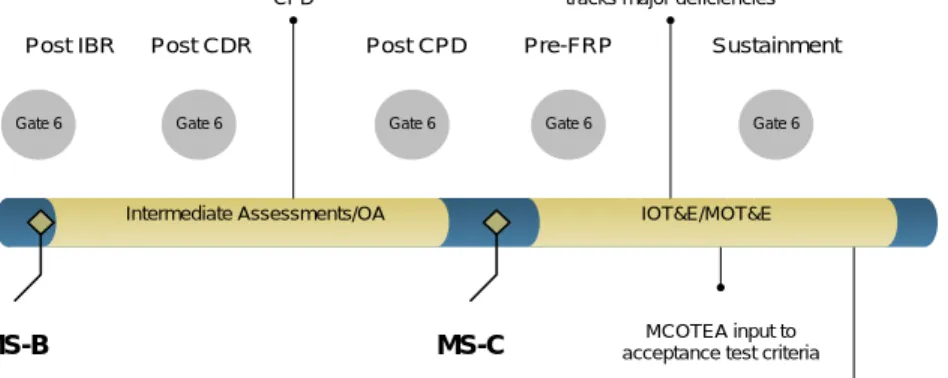
Assistant Secretary of the Navy (Research, Development, and Acquisition) (ASN (RDA)) is the DOD’s Component Acquisition Executive for acquisition activity, including test and evaluation. ASN (RDA) provides DON-level acquisition and T&E guidance to supplement guidance from DOD. Although ASN (RDA) is not in the MCOTEA chain of command, MCOTEA is required to conform to ASN (RDA) T&E guidance. DON uses the Gate Review process to help monitor programs of interest. The Gate Review process provides a framework for engaging senior naval leadership on certain acquisition programs to improve decision making through better understanding of program risks and costs (SECNAV 2011).
Gate Reviews
The Gate Review process helps ensure alignment between capability requirements and acquisition while improving senior leadership visibility into program risks and costs throughout the development cycle. DON has adopted the Probability of Program Success (PoPS) approach, used in conjunction with Gate Reviews, to assess and monitor the health of naval acquisition programs. Program health is subdivided into 17 metrics, one of which is T&E. Six Gate Reviews are distributed over two “passes.” Figure 2-2 shows where the Gate Reviews fall in the acquisition process. The first three gates constitute the “requirements” gates while the last three constitute the “acquisition” gates. The Gate Reviews are conducted at the 3-star level and above, and attendance is by invitation only. Table E1T3 of SECNAVINST 5000.2E (SECNAV 2011) contains more detail about participants and topics for each Gate Review.
MCOTEA is periodically called upon to contribute to or attend a Gate Review DOT&E’s primary interest is to ensure that
OT&E and Live-Fire Test and Evaluation (LFT&E) are adequate before FRP or deployment, and that tests and evaluations are properly executed according to statute and DOD policy.
Although not in the MCOTEA chain of command, DOT&E has significant oversight over any MCOTEA programs on the DOD T&E Oversight List, and MCOTEA is required to conform to DOT&E guidance for these programs. Any program, regardless of Acquisition Category level, can be included on the T&E Oversight List. Selection criteria include ACAT level, Congressional and/ or DOD interest, programmatic risk level, technical complexity, and relationship with other systems. All “oversight” programs require additional briefings, reports, and supporting documentation and often require additional testing. The DOT&E website at http://www.dote.osd. mil contains the Annual T&E Oversight List. The Defense Acquisition Guidebook (DAU 2012) contains additional details. DOT&E’s primary responsibilities for Oversight List programs are to provide final approval for the TEMP before milestone decision reviews and to approve operational test plans before those tests may commence. No operational testing may occur for a program on the Oversight List until DOT&E has provided written approval of the operational test plans. Early involvement of DOT&E personnel in drafting the T&E strategy, the TEMP, and operational test plans for programs on the Oversight List will help ensure smooth approval.
planned test events to generate required data for the OSD-directed Net-Ready Key Performance Parameter (KPP)
certification. A special test will be necessary only if other events do not provide the appropriate data.
Communication/
Information Sharing
Navy Enterprise T&E Board of
Directors
The T&E Board of Directors (BOD) primarily addresses issues of concern to the Navy. The Director, MCOTEA is a member of the T&E BOD. SECNAVINST 3900.44 states “The pertaining to the T&E metric. Although
this typically happens at Gate 6 (there are usually multiple Gate 6s), MCOTEA could be involved in earlier Gate Reviews as well. The key to success during a Gate Review is to coordinate with the materiel developer’s Program Manager (PM) ahead of time so the PM understands MCOTEA’s concerns and MCOTEA understands the PM’s position and proposed courses of action.
Fellow Operational Test
Agencies
Each Service conducts OT&E through its respective OTA. MCOTEA periodically meets with fellow OTAs in various forums to discuss DOD-wide issues relating to OT&E. MCOTEA also participates with one or more of these OTAs in conducting MOT&E (ATEC 2012).
Joint Interoperability Test
Command
For information technology systems (including National Security Systems) with interoperability requirements, the Joint Interoperability Test Command (JITC) is required to provide system Net-Ready certification memoranda to the Director, Joint Staff J-6 throughout the system life cycle, regardless of ACAT. JITC’s philosophy is to leverage other
Figure 2-2. Gate Reviews in the Acquisition Process
MCOTEA’s Fellow OTAs
Navy: Operational Test and Evaluation
Force (OPTEVFOR), headquartered in
Norfolk, VA.
Air Force: Air Force Operational Test
and Evaluation Center (AFOTEC),
headquartered at Kirtland AFB, NM.
Army: Army Test and Evaluation Command
(ATEC), headquartered in Aberdeen, MD.
Joint Command: Joint Interoperability Test
Command (JITC) headquartered at Fort
Huachuca, AZ.
2-6 Chapter 2
Modernization Program, the Resource Enhancement Project, Threat Simulators, and Target Management Investment projects. TRMC, in conjunction with the OTICC, coordinates with the T&E Executive Agents for each Service on the review and submission of T&E/S&T projects to ensure that Service/Agency Improvement and Modernization projects are addressed. MCOTEA participates as a primary member on all of these program/ project working groups.
Acquisition Life Cycle
Overview
ACAT Designation
One of the earliest steps in an acquisition system’s lifecycle is ACAT designation. A program’s ACAT is based on cost and/ or MDA designation as a special interest. The ACAT level determines both the level of review required by law and the MDA’s level within DOD. All ACAT programs except ACAT IV(M) and Abbreviated Acquisition Programs (AAP) require operational testing. MCOTEA participates in the ACAT determination process when the MDA requests MCOTEA’s written concurrence with ACAT IV(M) or AAP designation.
Evolutionary Acquisition
Evolutionary acquisition delivers system capabilities in increments. A program executing an evolutionary acquisition strategy incorporates time-phased requirements into the system. Block upgrades, planned product improvements, and other efforts that provide a significant increase in operational capability and meet an ACAT threshold are managed as a separate increment (DOD 2008). The evolutionary approach recognizes the need for incremental improvements at the beginning of a program. The idea is to balance technological maturity with evolving threats, cost, and the need to Marine Corps members of this board
will participate on a limited basis, pending corporate decisions on the applicability of the Enterprise concept of operations for the Marine Corps” (SECNAV 2009). Involvement in this Board helps MCOTEA stay abreast of new instructions, issues, and direction from SECNAV and opens a line of communication between MCOTEA and OPTEVFOR. SECNAVINST 3900.44 contains a list of all Board members (SECNAV 2009).
N084
N084 is the OPNAV Director, Test and Evaluation and Technology Requirements; N084 establishes T&E requirements and issues policy, regulations, and procedures governing Navy T&E. Historically, N084 has served as a conduit for MCOTEA to ASN (RDA) by promulgating directives from ASN (RDA) to MCOTEA and including MCOTEA in the review of key pending SECNAV documentation.
OSD Test Investment Coordinating
Committee
The OSD Test Investment Coordinating Committee (OTICC) is the primary coordinating structure for test and evaluation investment matters within OSD. The OTICC advises the Director, Test Resources Management Center (TRMC) in oversight of the development of test technology and Joint test capabilities. MCOTEA is a primary member of the OTICC.
Test Resources Management Center
The Test Resource Management Center (TRMC) coordinates DOD test and evaluation resources and implements the annual DOD Strategic Plan for DOD T&E Resources. The primary program for execution oversight is the Central Test and Evaluation Investment Program (CTEIP) and the DOD T&E and Science and Technology (S&T) Programs. CTEIP includes the Joint Improvement and
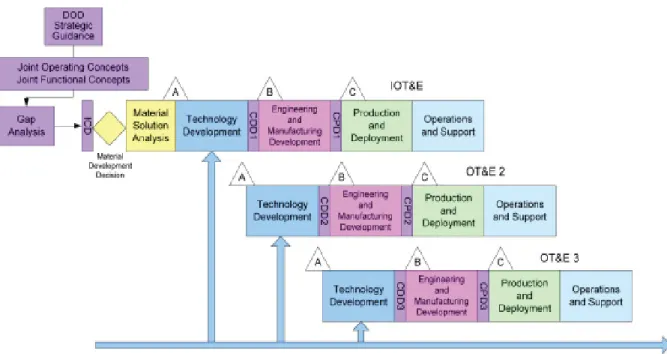
requiring each increment to be carefully tracked. The evolutionary strategy for each increment will be described in the TEMP. In general, T&E that has confirmed the mission capabilities of an increment need not be repeated in its entirety to confirm that the subsequent increment continues to provide those mission capabilities. “However, regression testing to reconfirm previously tested operational capabilities and/or suitability might be required if the subsequent increment introduces a significantly changed hardware or software configuration, or introduces new functions, components, or interfaces that could reasonably be expected to alter previously confirmed capabilities” (DAU 2012).
Test and Evaluation Paradigm
The MCOTEA approach to testing and evaluating is designed to maximize synergy with the rest of the Marine Corps acquisition process consistent with federal law and DOD, DON, CJCS, and Marine Corps guidance. This approach reduces program risk and overall cost, thereby maximizing value to the Marine Corps and DOD. In accordance with DODI 5000.02 (DOD 2008), MCOTEA must accomplish the following before or during IOT&E:
Determine if thresholds in the approved get a capability to the user quickly. This
allows the fielding of an initial, well-defined, and significant core operational capability quickly in response to validated requirements. This strategy results in fielding increased capability in succeeding increments as technology matures.
Incremental Testing
Requirements
Figure 2-4 shows that, aside from developing the initial capability, each increment starts at the technology development phase and has its own milestones and operational testing requirements (SECNAV 2011; DAU 2012). The CDD defines the KPPs and Key System Attributes (KSA) that apply to each increment of Engineering and Manufacturing Development. Each increment will complete DT&E, OT&E, and LFT&E as required. An independent phase of OT&E must be completed for each increment before release to the user for programs requiring OT&E. As suggested by the figure, each increment is treated individually and will be at a different phase in the OT&E process at any particular time. This will involve concurrent test planning and execution activity for the different increments and may result in a higher degree of complexity,
Figure 2-4. Incremental Technology Development
2-8 Chapter 2
Test Relationship to
Evaluation
Test and evaluation are often thought of as a single process, while in reality they are two related but distinct processes. Testing involves the physical exercising, by trial or examination, of a component, system, concept, or approach for the sole purpose of gathering data and information regarding the item under test. Evaluation seeks to ascertain the worth of, or to fix the value of, a component, system, concept, or approach. Testing provides a source of data for the evaluation process that uses the data to derive useful information about what has been tested. The relationship of testing to evaluation is many-to-one; that is, several tests may be required to support a single evaluation.
MCOTEA’s System Evaluation Plan (SEP) creates a framework and methodology for evaluating the entirety of program data obtained from assessments and IOT. The SEP is intended to provide a transparent, repeatable, and defensible approach to evaluation with the added benefit of minimizing the overall cost of program testing. In addition, MCOTEA welcomes DOT&E, Program Office, and DC, CD&I suggestions pertaining to the SEP; however, in the final analysis, the evaluation process belongs to MCOTEA and MCOTEA is under no obligation to accept these suggestions.
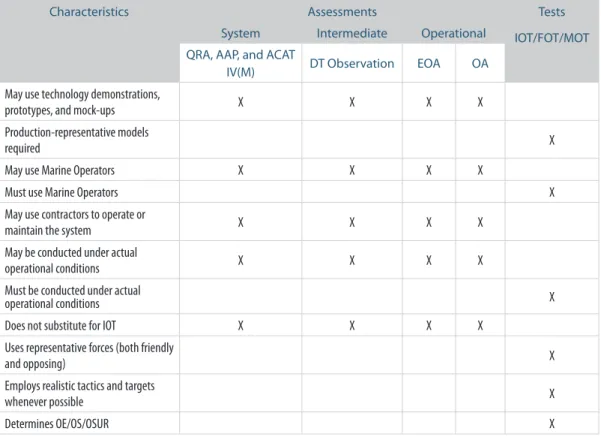
As the OTA for the Marine Corps, MCOTEA is charged with both the operational testing and evaluation of systems. The purpose of operational testing is to determine how the system performs under test using production-representative components, operated and maintained by typical users, under realistic operational conditions. An Operational Test (OT) is a discrete event that provides invaluable information about the system under test and its expected capabilities and limitations during combat operations. It is a major input to the evaluation of the system, but
capabilities documents and COIs have been satisfied
Determine OE/OS/OSur of the system
under realistic operational conditions, including Joint combat operations
Assess the effect to combat operations Provide additional information on the system’s
operational capabilities and limitations
The evaluation associated with
accomplishing these tasks is rooted in a process that takes place throughout the life of a program. MCOTEA uses the results of non-MCOTEA developmental testing, when appropriate, as well as the results of MCOTEA’s assessments and operational testing. MCOTEA accomplishes these tasks using a combination of integrated planning and frequent testing in
conjunction with continuous evaluation. MCOTEA employs the DOD definition of integrated testing: “Integrated
testing is the collaborative planning and collaborative execution of test phases and events to provide shared data in support of independent analysis, evaluation, and reporting by all stakeholders, particularly the developmental (both contractor and government) and operational test and evaluation communities” (OSD 2008). MCOTEA does not call out individual tests as being “integrated”; instead, MCOTEA collaboratively plans all test phases with the Materiel Developer throughout the life of a program while maintaining the independence of IOT. Although test events are collaboratively planned to ensure all needed data will be available, and some may be collaboratively executed (excluding IOT/Follow-on Operational Test (FOT)/Multi-Service Operational Test (MOT), which is executed only by MCOTEA), both the DT and the OT evaluations must be done separately and independently.
Transition Team (RTT), a team formed before the Materiel Development Decision (MDD) to facilitate the development and transition of potential requirements into the acquisition process (USMC 2010). This early involvement includes early program reviews, demonstrations, developmental working groups, M&S activities, and other technical development activities. According to SECNAVINST 5000.2E, “Early, active, and continuous participation by test agencies during the development of capabilities documents will support effective communication and common interpretation” (SECNAV 2011).
MCOTEA’s goal is to develop draft COIs (see Chapter 3-1) prior to the Analysis of Alternatives (AoA). The AoA identifies potential options to an MDD, thereby guiding the Materiel Solution Analysis phase of acquisition.
Having draft COIs available allows the AoA to examine alternatives based on the same high-level Issues the system will be expected to address throughout its lifetime, including during operational testing. Although other Issues may also be examined during the AoA, the COIs should form the basis of the major areas of comparison addressed in the AoA.
In addition to MCOTEA’s involvement in monitoring and analyzing developmental testing, use of assessments early in a system’s development can help to identify technology risks and illuminate potential operational issues. Integrated testing and early OAs can be expected to emphasize the use of prototypes. Early MCOTEA involvement should benefit the entire Marine Corps acquisition process while minimizing the cost of the overall program.
Continuous Evaluation
The evaluation of a system is the result of the accumulation of data and facts about the system obtained during the entire acquisition cycle (SECNAV 2011). This accumulation of data starts with early research and developmental not the only input.
Other tests and assessments increase the knowledge about the system under test as the system matures during the acquisition cycle. These tests also provide input to the overall system evaluation. During developmental testing, system components are checked to ensure that they function as designed and the system is checked to ensure that it meets the requirements derived from the ICD/CDD/ CPD. MCOTEA generally uses the data gathered during DT to determine if the thresholds in the approved capabilities documentation have been demonstrated. In addition, aggregating DT data over time can be useful in determining aspects of a system’s OS. Furthermore, MCOTEA’s assessments provide insight into the level of system maturity and overall system capabilities and limitations.
The purpose of the evaluation is to use all relevant information from DT, MCOTEA’s assessments, operational testing, relevant M&S results, and the results of any Live Fire testing to determine OE/OS/OSur. Evaluation involves compilation and analysis of data gathered over the life of the program, with emphasis on system performance during operational testing.
The Evaluation Continuum
Advantages of MCOTEA’s Early
Involvement
According to DODI 5000.02, “T&E expertise must be brought to bear at the beginning of the system lifecycle to provide earlier learning about the strengths and weaknesses of the system under development” (DOD 2008). MCOTEA does not wait until a full-blown OT is needed to get involved in the program acquisition process. Ideally, MCOTEA involvement begins very early in the acquisition cycle. MCOTEA’s goal is to become involved in a new program as early as the formation of the Requirements
MCOTEA’s
involvement at
an early stage
benefits both
MCOTEA and the
new program
for the following
reasons:
Generates COIs at an early stage so system designers know the high-level issues their system is intended to address
Lends operational test perspective that aids in developing unambiguous requirements that can be tested
Helps MCOTEA gain
better understanding of the context in which the capabilities and requirements were determined
Provides insight into potential system and operational deficiencies early in the program when remedial action can easily be taken
Provides insight into potential IOT requirements to ensure that range capabilities and technologies exist to meet those test requirements. If a shortfall is recognized early enough, initiation of a test technology development program may be in order.
Provides independent
insight to decision makers into the program’s progress toward meeting the desired level of Operational Effectiveness, Suitability, and
2-10 Chapter 2
testing and continues through IOT and FOT. Integrated testing and early assessments can contribute important contextual information, result in enhanced understanding of system capabilities, and make significant contributions to satisfying the requirement to examine the extent to which CDD/CPD thresholds have been satisfied. Of course, the events that will yield the most important information from the system evaluation perspective are the IOT and, if applicable, FOT.
Figure 2-5 illustrates how input from various assessments and testing events contribute to the aggregated evaluation of a system. As shown in the figure, in
addition to OT results near the end of the acquisition cycle, the results of observations and assessments at earlier stages in the program are fed back to the program to help the PM identify program risks. Waiting until IOT to evaluate a system for the first time does little to affect the actual design of the system. Therefore, MCOTEA provides feedback to the PM and MDA periodically during the acquisition cycle. This feedback indicates if a program is progressing towards IOT and identifies potential concerns.
Early Identification of
Deficiencies
Identification of system deficiencies is
IOT and Evaluation FOT and
Evaluation AssessmentsOperational
System Assessments/ Intermediate Assessments MCOTEA Posttest Feedback To MCOTEA Feedback to the PM /MDA Evaluation Re sults to Decision Make r
Feedback to the PM/MDA
Operations and Support MS-A Technology Development MS-B Engineering and Manufacturing Development MS-C Production and Deployment Figure 2-5. MCOTEA ‘s test and evaluation process is a cycle of continuous feedback
Continuous
evaluation
increases the
efficiency of the
Marine Corps
acquisition cycle
in the following
ways:
Gathers important data on most of the thresholds in the capabilities documents before operational testing
Allows evaluation feedback throughout the program focused on the PM and decision maker’s needs and based on standards appropriate for the program’s developmental stage
Identifies important issues and potential deficiencies early enough in the program to allow relatively inexpensive corrective action
Enables an
independent mechanism for tracking program progress over time
Allows operational testing to focus on COIs and operational mission performance rather than specification and threshold compliance
teams. In general, the Materiel Developer, MCOTEA, and DC, CD&I will
participate in one another’s Subject Matter Expert (SME) panels throughout the life of a program. The cognizant MCOTEA Division can expect to participate in various Gate Reviews to support the briefing requirements of PoPS program criteria pertaining to test and evaluation.
Pre-Milestone A
Figure 2-6 illustrates key points of MCOTEA’s interaction with other
agencies before MS A. Early in a program’s life, the RTT stands up to facilitate the transition from desired capabilities to an actual system. Participation in this team may be MCOTEA’s first official activity on a new program. MCOTEA reviews the draft Initial Capabilities Document (ICD) once it is written to ensure that the proposed capabilities are testable. MCOTEA also participates in working groups that generate the applicable CONOPS and COE. This early participation with DC, CD&I enhances MCOTEA’s understanding of the context in which the capabilities were generated. Before the AoA, MCOTEA establishes draft COIs, which help the AoA team determine the categories for comparing alternatives and by using the process most valuable early in the program. The
value of identifying deficiencies diminishes as the program matures. Alterations to a more mature program are more difficult and expensive to make, whereas assessing program progress at early and intermediate stages enables the Marine Corps to adjust the program more effectively.
System assessment feedback that occurs early in a program is different in nature from the evaluation of a mature program. MCOTEA assesses a system’s progress based on standards appropriate for its developmental stage. Early evaluation feedback tends to be limited in scope, but this feedback builds a history for the program that shows when issues were identified and how they were mitigated. This opens an additional window on how the program is maturing as a function of time. Finally, obtaining Warfighter feedback after system fielding is important for optimizing the MCOTEA test process as well as the Marine Corps acquisition process.
Collaboration Along the
Acquisition Time Line
Throughout the acquisition cycle,
MCOTEA brings the operational testing perspective to all milestone assessment
5/4/2009
Materiel Developer, MCOTEA review and comment
on ICD
10/11/2009
MCOTEA; DC, CD&I; Materiel Developer participate in
milestone assessment team
May
MDD
7/9/2009
AoA
7/21/2009
MCOTEA & Materiel Developer observe CONOPS generation 8/13/2009 MCOTEA; DC, CD&I; Materiel Developer revisit COIs 9/7/2009 Preliminary COIs briefed at Gate 2 4/30/2009
DC, CD&I, Materiel Developer, MCOTEA participate in RTT
10/17/2009
MS-A
5/25/2009
MCOTEA establishes draft COIs for AoA
(collaborates with Materiel Developer & DC, CD&I)
8/2/2009
MCOTEA & Materiel Developer review and comment on CDD
Gate 1 Gate 2 Gate 3
Figure 2-6. MCOTEA Interaction with System Acquisition Before MS A