The Overview of the Implementation of Total Quality Management in the
Libyan Construction Industry
Salah, Mohamed. Khalil . Abdelgalil and Ilias Said
School of housing, Building and PlanningUniversity Sains Malaysia
ABSTRACT
The current trends in the construction industry are now moving toward higher quality. Contractors are forced to upgrade the quality of their services. The implementation of total quality management (TQM) becomes necessary in the construction industry. It is actually the set of activities that are performed by the contractor for the customer satisfaction. The main reason for the introduction of the TQM in the construction industry is the knowledge level of the customer which is increasing gradually regarding to the quality issues. Therefore, this elevation in the knowledge level of the client results demand for the better quality, because in many construction projects clients often find themselves paying high prices for defective works that don’t satisfy their needs. The objectives of this paper are 1) to investigate the awareness of the contractors in Libya with regards to TQM, level of customer satisfaction and the government interventions for quality. This research was a cross sectional survey conducted in the capital of Libya Tripoli. This study found that the Libyan Government is stressing on allocation of high budget for construction, so far no importance is shown regarding to the ISO implementation. This study reflects the situation of Libyan construction industry regarding to the quality practices. The knowledge level among the Libyan construction industry is moderate and the implementation within the organisation is also at a grass root level, this is because of lack of consideration of a quality system in the Libyan construction industry. There is a need of immediate initiative by the government and the ministry of housing building and planning to stress on implementation of TQM and ISO certification within the Libyan construction industry to attain better customer services and quality construction. Libyan government can play a vital role in this regard by stressing on adopting ISO and TQM practices in Libyan construction industry. This paper also recommends suggestions for future research.
Keywords: Total Quality Management, Construction Industry, Libya
1.0 Introduction:
Accomplishment of satisfactory levels of quality in the construction diligence has been an extensive problem. Great expenditures of time, capital and resources are worn out each year due to ineffective or fictional quality levels (Khurram, H. 2002) The condition is even worse in the case of mass housing
The current trends in the construction industry are now moving toward higher quality. Contractors are forced to upgrade the quality of their services (Hasegawa 1988). The implementation of total quality management (TQM) becomes necessary in the construction industry. It is actually the set of activities that are performed by the contractor for the customer satisfaction. Total Quality Management (TQM), has been defined as: ‘harnessing or tackling everyone’s effort to attain zero error at lowest expenditure and frequently fulfilling customer requirements (Turner 1994, p. 164). The main reason for the introduction of the TQM in the construction industry is the knowledge level of the customer which is increasing gradually regarding to the quality issues (Ofori, G. 1994). So this elevation in the knowledge level of the client results demand for the better quality, because in many construction projects clients often find themselves paying high prices for defective works that don’t satisfy their needs( Low Sui Phengand Jasmine Ann Teo 2004).
Now a day in Libya there is a boom in the construction industry, this study aims to investigate awareness among the Libyan Construction companies regarding to the TQM Principles.
2.0 Material and Method
A descriptive and explanatory study was conducted mainly focusing on the implementation of the quality services by the Libyan construction industry in Tripoli. This study will highlight the awareness among the construction companies for the Total Quality Management.
To attain these objectives a questioner was designed and distributed among the different companies to have their view about TQM. The items mentioned in the questionnaire were adopted from the review of the literature. Random sampling method is used for the distribution of the questioner among the different construction companies within the Libya.
2.1
Instruments
The main instrument of this study is the questioner which is designed by reviewing literature from different source and the key point considered to be essential for this study are put in this questioner to assess the company response. More over along with this the government policies are also considered to check out the interest of the Libyan government for the development of the construction sector.
3. Results:
The survey was conducted in Jan 2008. About 120 questioners were distributed; out of this 93 were received and 73 out of this figure found complete in every respect and considered to be in the acceptance criteria for analysis. The response rate observed is 60.83%. About 84.95% of the construction companies were Libyan and about 15.00% of the companies they were foreigner. 93.2% of the respondents were private and only 6.8% of the respondents were public. While evaluating the company status it revealed that 83.6% of the companies were small enterprises and only 16.4%. Main focus of most of the companies was housing projects.
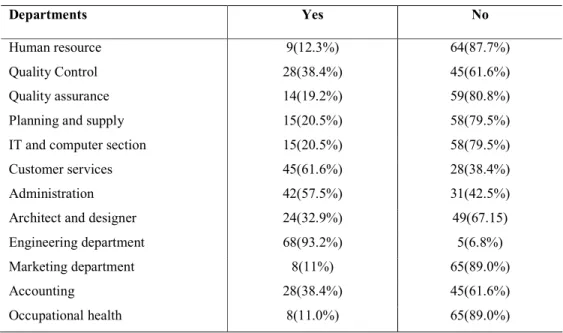
About 79.50% of respondents were found aware of TQM practices and about 87.00% they believe that project handling process can be improved by incorporating TQM. Majority relate TQM with ISO certification but the ISO Certification was observed at a very initial level among the Libyan construction company. Only 16.00% companies very ISO certified and among these majorities were foreigner. When the company organisational structure was reviewed majority of the firms were found deficient in various departments. Details regarding to the organisation structure mention in table 3.1.
Table 3.1: Organizational structure
Departments Yes No
Human resource 9(12.3%) 64(87.7%)
Quality Control 28(38.4%) 45(61.6%)
Quality assurance 14(19.2%) 59(80.8%)
Planning and supply 15(20.5%) 58(79.5%)
IT and computer section 15(20.5%) 58(79.5%)
Customer services 45(61.6%) 28(38.4%)
Administration 42(57.5%) 31(42.5%)
Architect and designer 24(32.9%) 49(67.15)
Engineering department 68(93.2%) 5(6.8%)
Marketing department 8(11%) 65(89.0%)
Accounting 28(38.4%) 45(61.6%)
Occupational health 8(11.0%) 65(89.0%)
When the respondents they are asked about how they handle the project then
different view are obtained from different respondents their practices regarding to the
project handling are mentioned in table 3.2.
Table 3.2: Project handling practices
Project handling practices Yes No
Make a feasibility report 52(71.2%) 21(28.8%)
Develop a plan for architecture and time period 54(74.0%) 19(26.0%) Make different teams to divide the task 58(79.5%) 15(20.5%) Document every single step in the process 61(83.6%) 12(16.4%) Have you company faced some problem during the project. 66(90.4%) 7(9.6%) If you have some problem in accomplishing the project then do you
seek help from another company?
22(30.1%) 51(69.9%)
take them seriously and do the level best to solve them on immediate basis. Details about the other preferences are mentioned in table 3.3
Table 3.3: Company preference in a project
Company preference Yes No
Quality services 58(79.5%) 15(20.5%) Customer satisfaction 60(82.2%) 13(17.8%) To earn good profit for company stability 46(63.0%) 27(37.0%) Low margin profit to attract customer.
32(43.8%) 41(56.2%)
4.0 Discussion:
4.1
Knowledge about TQM:
Majority of the firms participated in this survey were small enterprise and showing their participation in hosing and small projects. They have very basic thoughts about TQM; the main reason to be observed is that the trend of ISO certification is not fully recognized in the Libyan construction industry. Only (58/79.5%) of the firms they have some idea about the TQM and its benefits. Those companies having a good know how about TQM found to be involved in mega projects and majority of them are foreign companies. These foreign companies bear a good level of knowledge in comparison with the local construction firms. All of these are also ISO certified and involved in mega projects which force them to compete, the challenges of the construction sector worldwide.
4.2
Relationship of ISO with TQM:
During this survey the firms which are found to be ISO certified they have a good knowledge of TQM practices and nearly all of them are foreigner. To go for ISO certification is the good choice to make your firm ready to absorb and learn the practices of TQM. The ISO certified firm bears a good knowledge regarding to TQM because:
1. They have a wide exposure they willing to go to different countries to prove their expertise. 2. The requirement if ISO certification has trained them to learn all these practices.
4.3
Customer satisfaction and the organizational structure:
Organizational structure have a very positive impact on the customer satisfaction it is observed in this survey about 45(61.5%) of the participants they agree to give more importance to the customer satisfaction and least to the profit margin and among this figure (38/52.1%) have customer satisfaction department. And almost same number of the respondents they take serious notice to the customer complaints in order to attain a good quality standards.
4.4
Organizational structure and TQM practices:
Though among Libyan construction firm they have a very preliminary knowledge regarding to the TQM but they concur that a good organizational sector can result a good performance in return. Betterment in the organization can be attained through employee training (68/93.2%) and by hiring a educated staff. About (37/50.7%) state that organizational changes and good team building can lead the organization toward betterment and provide zeal to go for challenges.
4.5
Customer satisfaction from the Libyan construction sector:
Majority of the respondents (58/79.5%) they believe that the Libyan construction company fail to achieve the desired level of customer satisfaction. They suggest that if the companies they are committed to provide, cheap price (40/54.8%), long term services (23/31.5%), good architecture (35/47.9%), good schedule (73/100%), use of quality material (60/82.2%), services after completion of the project and sincerity to the customer are the key elements if implemented properly, Libyan construction industry can fulfil the requirements of the customer.
4.6
Views of respondents about incorporating TQM in the organization:
When they are questioned about how to attain the good level of TQM practices about (72/98.2%) concur that quality of material and method is the most important thing to be maintained if the organizations is willing to achieve the TQM. Other prioritized ways to incorporate TQM in the industry are better customer services (65/89%), followed by employee training (65/89%)( Martin, L. 1993), time management (52/71.2%) , good architecture and good management team are essential to attain TQM in the construction industry.
5.0 Conclusion:
This study reflects the situation of Libyan construction industry (LCI) regarding to
the quality practices. The knowledge level among the LCI is moderate and the
implementation within the organisation is also at a grass root level, this is because of
lack of consideration of a quality system in the LCI. There is a need of immediate
initiative by the government and the ministry of house building and planning to stress
on implementation of TQM and ISO certification within the LCI to attain better
customer services and quality construction.
Reference
2.
Khurram, H. (2002) Introduction and Implementation of Total Quality Management (TQM), Pakistan Air Force Academy PAF Journal Of technology ,Vol 13 review regarding to six sigma available on line on www.isixsigma.com.3.
Low Sui Pheng and Jasmine Ann Teo Implementing Total Quality Management in Construction Firms J. Mgmt. in Engrg., Volume 20, Issue 1, pp. 8-15 (January 2004).4.
Ofori, G, Construction technology development: Role of an appropriate policy.Engineering, Construction & Architectural Management, 1, no.2 (December 1994): 147-168.