ENVIRONMENT AND PRODUCTION TECHNOLOGY DIVISION FEBRUARY 2006
EPT Discussion Paper 147
An Analysis of Trade Related International Regulations of
Genetically Modified Food and their Effects on Developing
Countries
Guillaume P. Gruère
2033 K Street, NW, Washington, DC 20006-1002 USA • Tel.: +1-202-862-5600 • Fax: +1-202-467-4439 [email protected] www.ifpri.org
IFPRI Division Discussion Papers contain preliminary material and research results. They have not been subject to formal external reviews managed by IFPRI's Publications Review Committee, but have been reviewed by at least one internal or external researcher. They are circulated in order to stimulate discussion and critical comment.
Copyright 2005, International Food Policy Research Institute. All rights reserved. Sections of this material may be reproduced for personal and not-for profit use without the express written permission of but with acknowledgment to IFPRI. To reproduce the material contained herein for profit or commercial use requires express written permission. To obtain permission, contact the Communications Division at
i
ACKNOWLEDGMENTS
I would like to thank David Orden for providing a very thorough and valuable review of the paper. I also thank Colin Carter, Janet Carpenter and seminar participants at the International Food Policy Research Institute (IFPRI) for their inputs and comments. All remaining errors are the author's alone. The work reported here was undertaken as part of the South Asia Biosafety Program, a research project funded by the United States Agency for International Development.
ii
ABSTRACT
This paper reviews current trade–related regulations of genetically modified (GM) food and discusses their effects on developing countries. There is a large heterogeneity in current import approval and marketing policies of GM food worldwide. At the international level, the harmonization efforts are led by the Codex Alimentarius Commission, the Cartagena Protocol on Biosafety and the World Trade Organization. While internationally harmonized guidelines for safety approval have been finalized, we show that there is no clear consensus on labeling regulations for GM food, and there is an increasing risk of conflicts among international agreements. We analyze the GM food regulations of two large rich importers, Japan and the European Union (EU) and discuss their differences and their potential impact on international trade. We also show that the effects of international and domestic trade related regulations critically depend on the type of traded products and their intended use: food and unprocessed products are subject to more stringent regulations than animal feed and processed products. Finally, we identify the main spillover effects of national and international regulations on developing countries’ policy making, and suggest four policy arrangements on GM food to enable developing countries to satisfy production, consumption, international trade, and risk management objectives simultaneously while complying with their international obligations.
Key words: Genetically modified food, Labeling, Biosafety, Non-tariff barriers to trade, Developing countries.
iii
TABLE OF CONTENTS
1. Introduction 1
2. Overview of National Trade related Regulations of GM Food 5
3. International Harmonization Efforts 9
4. Major Importers Regulations 32
5. Effects of International Regulations by Type of Product 40 6. Effects of International Regulations on Developing Countries’ Policymaking 43
7. Conclusion 56
Guillaume P. Gruère
1. INTRODUCTION
Ten years after its first products, agricultural biotechnology has allowed significant agronomic improvements of some of the major field crops traded internationally (soybeans, cotton, maize and canola). In 2005, transgenic crops, also called genetically modified (GM) crops, were grown in seventeen countries by an estimated 8.5 million farmers on a total acreage of 90 million hectares (James 2005). The fact that so many farmers are now planting GM crops and that the total area in these crops is increasing annually (e.g. 11 percent increase in area
between 2004 and 2005) is an evidence of the commercial success of this production technology. However, there are only four GM crops widely produced, and these four crops are mostly used for animal feed or non-food uses,1 whereas no major transgenic “food” crop has been
released yet.2 If the number of GM “food” crops in the regulatory pipeline of many countries has been steadily increasing in the last five years, ranging from fruits and vegetables to major field crops such as wheat and rice, only a few transgenic “food” crops were officially approved and produced at a small scale (GM papaya and sweet corn in the United States, GM white maize in South Africa, and GM rice in Iran).3 In addition, only five large countries represent the
overwhelming majority of GM crop acreage (Argentina, Brazil, Canada, China and the United
1 Approximately 65 percent of maize and 71 percent of soybean supply is used for animal feed; cotton is mostly
used for textile and cottonseed is mostly used for animals.
2 The quotes for “food” put the emphasis on the fact that these crops are mostly used for human consumption. In
contrast, in the article, we will use the generic term GM food without quotes for raw and processed products derived from GM crops and used for food and/or animal feed.
States represent over 96 percent of GM crop acreage). These limitations reflect the other side of the economics of GM crops; the demand side and the effects of GM food regulations.
Due to consumer, environmental, ethical or political reasons, many countries have adopted stringent regulation regarding the approval and the marketing of food and feed products derived from GM crops. Some of these regulations (such as labeling requirements or import approval), associated with the relative lack of demand in rich importing countries for GM products have offset the economic productivity gains of GM food crops to the point of making them potentially unprofitable for developers, large producers and exporters of these crops. In particular, GM wheat was developed in the United States, but was shelved by the Monsanto in 2004 before commercialization, partially because it lacked the full approval of producer associations from U.S. and Canada who reportedly feared to lose export markets (Berwald, Carter, and Gruere forthcoming).
In fact, international regulations of GM food vary widely among developed countries. In particular, the European Union and the United States have adopted different approaches on the marketing of genetically modified food. The EU regulations follow an approach based on the “precautionary principle” and consumers’ “right to know,” with stringent approval, labeling and traceability standards on any food produced from or derived from GM ingredients. In contrast, the U.S. regulation approach is based on differences in the end product, and includes a voluntary safety consultation and voluntary labeling guidelines for GM food.45 Most other developed countries, including Japan, Canada, or Australia have introduced intermediary regulations between these two (Carter and Gruère forthcoming).
4 However, the voluntary safety consultation de facto Acts as a mandatory safety approval because all four comply
with it (See Section 2).
5 Regarding labelling, non-substantially equivalent GM foods have to display the difference with conventional
In the developing world, some of the large agricultural traders (such as Brazil) have developed biosafety and marketing regulations on GM food, but at the same time many other developing countries have not adopted any specific regulation of GM food because they lack the capacity to do so, or perhaps they have adopted a position of wait and see. One of the reasons advanced by these latter countries is that the introduction of any GM crop and the
implementation of any particular regulations may have a direct effect on their current and future agricultural exports to countries with stringent regulations (Zarrilli 2005). With the increasing globalization of agriculture, some of them prefer to observe policies implemented in other countries and the development of international harmonized regulations before deciding what set of regulation they should adopt.
At the international level, two main institutions have worked in an effort to provide harmonized regulations on agricultural biotechnology: the Cartagena Protocol on Biosafety, which is part of the United Nations (UN) Convention on Biodiversity, and the Codex Alimentarius Commission, under the UN Food and Agriculture Organization (FAO) and the World Health Organization (WHO). In addition, discussions over the regulation of agricultural biotechnology has arisen at the World Trade Organization (WTO) as the United States,
Argentina and Canada launched a trade dispute against the alleged EU moratorium on approval of new GM crops in 2003. U.S. observers believe that another trade dispute may follow on the strict traceability and labeling requirements replacing the moratorium in the EU since April 2004.
The objectives of this paper are first to analyze current trade related national and international approval and marketing regulations of GM food, and second to identify the effects of these regulations on developing countries’ policymaking. Our review of policy is limited to
trade related regulations of GM food. We deliberately exclude biosafety regulations concerning the planting and environmental release of GM crops except if they are likely to affect
international trade. We define GM food as raw and processed products derived from GM crops and used for food and/or animal feed. These products represent an average trade value of $42 billion/year.6 Since there is no trade related regulations on non-food or non-feed products from GM crops (e.g, cotton fibers derived from GM cotton, or ornamental GM plants), regulations considered in this article do not apply to them.
The paper is organized as follows. In the next section, we offer a general overview of current approval and food labeling policies worldwide. In the third section, we present current and pending regulations of the Codex Alimentarius Commission, the Cartagena Protocol on Biosafety and at the WTO. In the fourth section, we review the regulations of two large importing regions (the European Union and Japan) and we discuss the effects of these
regulations on international trade. In the fifth section, we classify all the reviewed trade related regulations according to the type of products they affect: raw versus processed GM products and those affecting products used for food versus animal feed. In the sixth section, we identify the main effects of international regulations on developing countries, and draw lessons from our review of regulations to analyze what should be done to find adequate policy response for developing countries under these constraints. We conclude this paper by drawing policy lessons and identifying future areas of research.
2. OVERVIEW OF NATIONAL TRADE RELATED REGULATIONS OF GM FOOD Trade related regulations of GM food include import approval measures and marketing regulations. More specifically, unlike in the case of conventional commodities, exported GM food is subject to specific import approval procedures or complete bans in many countries, labeling requirements in an increasing number of countries, and traceability requirements in a few countries. Import approval is a direct measure affecting market access, whereas labeling and traceability indirectly affects trade through the imposition of the cost of implementation for exporters of GM crops. In addition, marketing regulations can affect the demand for GM versus non-GM crops; for example, GM food labels can act as perceived hazard warnings and reduce demand for these crops despite their approval from food safety authorities.
In 2005, ten years after the introduction of the first GM crop, there is large heterogeneity across nations in the regulations of GM food. At a macro level, countries can be divided into three groups according to the status or type of their regulations (Zarrilli 2005): first, countries with a comprehensive and stringent regulatory framework applied to GM food, including
mandatory safety approval and mandatory labeling; secondly, countries that have adopted a more pragmatic regulatory approach based on the notion of substantial equivalence with voluntary labeling instead of mandatory labeling for GM food; and third a large number of countries either without regulations or pending towards adopting certain regulations on GM food approval and marketing. Currently, developed countries are in the first and second group, while most developing countries are in the third group, with a few notable exceptions. The distinction between voluntary and mandatory labeling is important, because it drives a number of necessary regulatory requirements. Mandatory labeling requirement affects the whole agro-food channel from the retailers to the producers requiring them to acquire and transmit information about the
presence or origin for each food product, whereas voluntary labeling is driven by private incentives and the presence of market niches for non-GM food.7
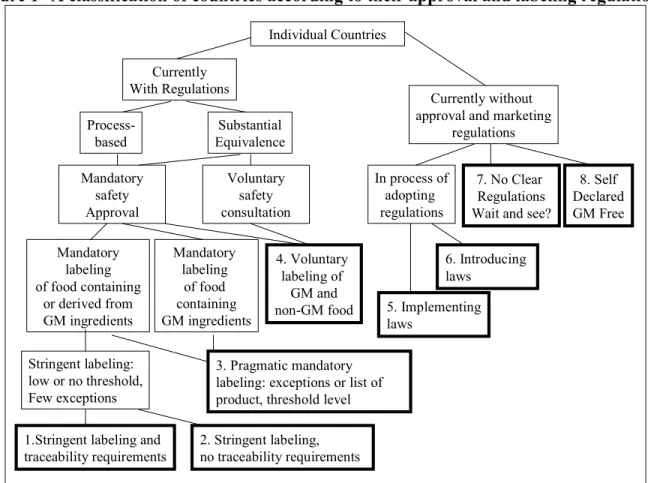
Even within these groups, the regulatory process from approval to commercialization varies widely across individual countries. Figure 1 presents a schematic decision tree of countries according to their approval and marketing regulations.
Figure 1--A classification of countries according to their approval and labeling regulations
Individual Countries Currently
With Regulations
Currently without approval and marketing
regulations In process of adopting regulations 7. No Clear Regulations Wait and see?
8. Self Declared GM Free Substantial Equivalence Process-based Mandatory safety Approval Voluntary safety consultation 4. Voluntary labeling of GM and non-GM food Mandatory labeling of food containing GM ingredients Mandatory labeling of food containing or derived from GM ingredients
1.Stringent labeling and traceability requirements
3. Pragmatic mandatory labeling: exceptions or list of product, threshold level Stringent labeling: low or no threshold, Few exceptions 6. Introducing laws 5. Implementing laws 2. Stringent labeling, no traceability requirements
At the first level of division, countries may or may not have adopted any type of approval or marketing regulation on GM food. Then among the ones with regulations, there are two main groups of countries, the ones that rely on a test of substantial equivalence (substantial equivalent products are exempt from specific requirements) and the other who generally do not and whose
7 For more information on an economic comparison between voluntary and mandatory labeling, see Runge and
regulatory procedure depends on the production process (which means that any food produced with or derived from transgenic crop is subject to GM food regulations). Each country has also adopted its set of safety approval and labeling policies with specific characteristics. As shown in Section 4, the specificities of the labeling regulation largely determine the observable effects of regulations on international trade. More stringent regulations will generally require more costly procedures on behalf of exporters and more comprehensive policies may have a more important trade effect. On the other hand, countries with no specific regulations include those that are about to adopt approval or marketing regulations, the ones with no clear regulations, and the ones that have declared themselves GM free. A subdivision in Figure 1 separates countries that are in the process of introducing regulations from the ones about to implement regulations of GM food.
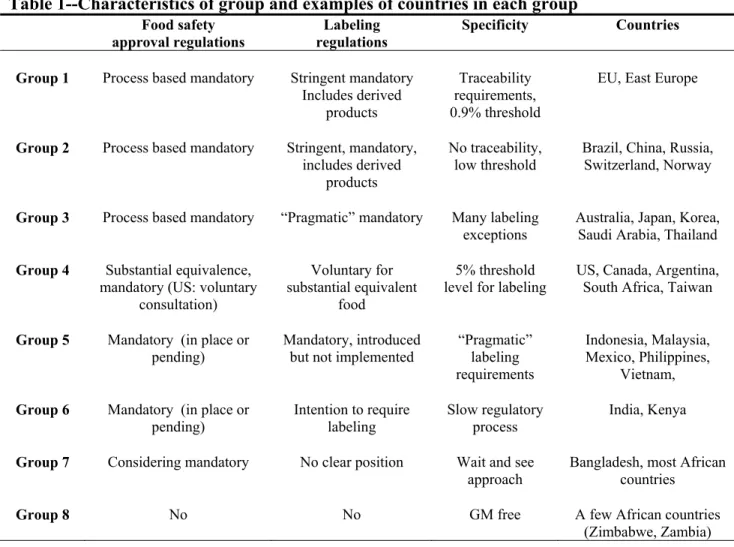
At the end of the division tree in Figure 1, countries can be divided into eight categories or groups (defined by their eight terminal boxes) according to their regulatory framework. Table 1 presents example of countries in each of these eight groups. OECD countries are represented in the first four categories (except Mexico and Turkey), and several countries with transition
Table 1--Characteristics of group and examples of countries in each group
Food safety
approval regulations regulations Labeling Specificity Countries
Group 1 Process based mandatory Stringent mandatory Includes derived
products
Traceability requirements, 0.9% threshold
EU, East Europe
Group 2 Process based mandatory Stringent, mandatory, includes derived
products
No traceability,
low threshold Brazil, China, Russia, Switzerland, Norway
Group 3 Process based mandatory “Pragmatic” mandatory Many labeling exceptions
Australia, Japan, Korea, Saudi Arabia, Thailand
Group 4 Substantial equivalence, mandatory (US: voluntary
consultation)
Voluntary for substantial equivalent
food
5% threshold
level for labeling US, Canada, Argentina, South Africa, Taiwan
Group 5 Mandatory (in place or
pending) Mandatory, introduced but not implemented “Pragmatic” labeling requirements
Indonesia, Malaysia, Mexico, Philippines,
Vietnam,
Group 6 Mandatory (in place or pending) Intention to require labeling Slow regulatory process India, Kenya
Group 7 Considering mandatory No clear position Wait and see
approach Bangladesh, most African countries
Group 8 No No GM free A few African countries
(Zimbabwe, Zambia)
All these countries have adopted specific regulatory framework for GM food and other products derived from GM crops. In contrast, most developing countries are currently in groups 5 to 8, because they are either without or in the process of adopting specific trade related
regulations of GM food.
The large producers and exporters of GM crops have well defined regulations, but most of them are in Group 4 (Canada, United States, Argentina, South Africa), with pragmatic regulations of GM food, while the last two are in Group 2 (Brazil and China), with stringent regulations. In contrast large importers of these crops are in Groups 1 and 3 with relatively more
stringent regulations. More specifically, Table 1 shows the level of stringency differentiating national regulations or approaches. Most groups of countries have adopted, are about to adopt or intend to adopt mandatory safety approval regulations of GM food. The United States is a particular case; it has a voluntary safety consultation that is de facto considered a mandatory requirement, because all companies comply with it for liability reasons. But different groups have distinctive approaches on labeling of GM food. As argued in the following section, this reflects the level of success of international harmonization efforts: international convergence on specific requirements for safety approval and important divergences among countries with regulations on labeling and traceability of GM food.
To sum up, this overview of national regulations reveals that there is a large
heterogeneity in regulations among countries, first in terms of development stages of regulatory framework, and second between countries with well defined regulations. Developed countries differ in their general approach of regulations, with most GM producers and exporters in groups of pragmatic regulations while importers tend to have more stringent marketing regulations for GM food and GM derived products. Developing countries tend to have fewer regulations in place. We will now review the major international efforts to harmonize policies on approval and labeling regulations of GM food.
3. INTERNATIONAL HARMONIZATION EFFORTS
There are six international organizations directly or indirectly involved in setting up harmonized rules, standards and recommendation related to international trade in GM crops (Smyth et al. 2004). Table 2 reviews these institutions coverage, membership and orientation.
Table 2--International institutions involved in the regulation of international trade of GM crops and GM food
Institution Coverage Member
States (5/2005) Dispute Settlement Mechanism Role International Office of Epizootics (1924)
Infectious animal disease 167 Non-binding: sets
WTO standards
Harmonizes trade regulations for animal
and animal products
GATT/WTO
(1947/1994) Trade in goods and most services 148 Binding transparency and Sets rules for dispute settlement International Plant
Protection
Convention (1952)
Pests and pathogens of
plants and plant products 136 Non-binding; sets WTO standards
Sets international standards for plant
OECD (1961) Harmonization of international regulations,
standards and policies
30 None Writes consensus
documents and international data Codex Alimentarius
Commission (1972)
Food labeling and food
safety standards 170 Non-binding; sets WTO standards Sets international standards and recommendations Biosafety Protocol (2003) movements of GM Transboundary organisms
120 None Information sharing
and biosafety measures Source: Smyth et al. (2004) page 80, and institutions’ websites.
Among these six institutions, three only have an indirect role in the regulation of the products of agricultural biotechnology. The International Office of Epizootics and the International Plant Protection Convention are based on multilateral treaties that provide standards on the movement of animal and plant pathogens, respectively. Even if they have standards that may apply to living modified organisms,8 they do not have specific rules on GM food. These institutions may affect international trade because their standards are recognized as reference standards by the Sanitary
8 In particular the IPPC has a particular standard (ISPM 11) providing guidance on risk assessment for living
and Phytosanitary (SPS) Agreement of the WTO. If a country follows an IPPC or IOE standard it is presumed to be in compliance and not adopt other standards. Countries can use other standards but under SPS rules they have to make a case for their standard on the basis of risk. The third organization is the Organization for Economic Cooperation and Development (OECD). The OECD develops documents, guidelines and recommendations on harmonized rules, policies and standards on agricultural biotechnology for its members. Because the EU and the United States are members of the OECD, any recommendation on how to regulate biotechnology approved in this forum may influence future international decisions in other institutions.
The three other institutions, namely the Codex Alimentarius, the Biosafety Protocol and the WTO are directly involved in trade related issues and the regulations of the products of agricultural biotechnology. We will present their specific harmonization efforts in the next three sections.
UN FAO/WHO CODEX ALIMENTARIUS
The Codex Alimentarius is an inter-governmental organization managed jointly by the United Nations Food and Agriculture Organization and the World Health Organization. The Codex has two main purposes 1) to protect the health of consumers and 2) to promote fair practices in international trade (Kimbrell 2000). The Codex provides international
recommendations and standards based on a consensus among members. The Codex standards and recommendations are important for international traders, because they are recognized as reference standards of food safety in the Sanitary and Phytosanitary Agreement of the World Trade Organization.
The Codex Commission has been working on finding a common terminology, a common food safety approval procedure, and a common position on the labeling of GM food since the
beginning of the 1990s. The Codex Commission has published guidelines for the safety assessment of GM food, but it failed thus far to reach any agreement on the issue of GM food labeling.
On questions related to food safety, the Codex Commission reached an official agreement, which resulted in the publication of the following three documents in 2003:9
• Principles for the Risk Analysis of Foods Derived from Modern Biotechnology: This document lays up a framework of analysis, with the following steps:
y Risk assessment: it should be based on a comparison of the new food with the conventional food;
y Risk management: it should take into account the level of risk and the uncertainty associated with it, and may include labeling and post-market monitoring;
y Risk communication: it is necessary to assure the transparency in the system; y Consistency: the risk analysis for these particular products should be consistent with
other risk analysis;
y Capacity Building and Information Exchange: this part underlines the necessity for the parties to help developing countries to build a regulatory capacity, and should be encourages to share information
y Review Process: the risk analysis should be reviewed after a certain period to account for new scientific knowledge and technologies.
• Guideline for the Conduct of Food Safety Assessment of Foods Derived from Recombinant-DNA Plants: This document proposes a framework for food safety assessment, largely based on the principle of establishing substantial equivalence between the GM product and its conventional counterpart. It recommends to proceed with the following steps:
y Description of the recombinant-DNA plant; y Description of the host plant and its use as food; y Description of the donor organism(s);
y Description of the genetic modification(s); y Characterization of the genetic modification(s); y Safety assessment:
o expressed substances (non-nucleic acid substances); o compositional analyses of key components;
o evaluation of metabolites; o food processing;
o nutritional modifications; and o other considerations.
• Guideline for the Conduct of Food Safety Assessment of Foods Produced Using
Recombinant-DNA Microorganisms: This document proposes a framework for the safety assessment of GM organisms following the same general scheme as the guideline for GM food. It adds two steps to the safety assessment: first an assessment of viability and residence of microorganisms in the human gastrointestinal tract, and secondly an assessment of antibiotic resistance and gene transfer.
The international consensus on risk assessment of safety of GM food reflects the similarities between existing approval procedures across major trading countries. In particular, the mandatory safety assessment in the European Union, Japan, Korea, Canada, Australia and New Zealand and the voluntary safety assessment guidelines of the U.S. Food and Drug Administration all prescribe to follow a framework based on these different steps. The main differences of approval procedures among these developed countries appear at the risk management level. 10
In contrast, on the labeling of GM food, there is no agreement within the Codex and the effort of the Session on Food Labeling seems to be stopped. No formal standard has been adopted on labeling. There are 8 steps to follow in the setting of Codex standards (MacKenzie 2000), from the decision to elaborate a standard (Step 1) to the point were the draft standard is adopted by the Codex Alimentarius Commission and sent to governments for final acceptance (Step 8). After eleven years of discussions within the Codex Committee on Food Labeling, the draft guideline on the labeling of GM food remains at Step 3: the proposed draft standard is sent again to international organization and governments for comments.
In 2004, at the 32nd Session of the Codex Committee on Food Labeling, only the
amendment Definition of Terms of the General Standard for the Labeling of Prepackaged Foods, which is directly related to the labeling guidelines, was advanced to Step 7 of the Procedure. But the actual “Proposed Draft Guidelines for the Labeling of Food and Food Ingredients Obtained through Certain Techniques of Genetic Modifications/Genetic Engineering” remained at Step 3 of the Procedure in 2005.
10 We detail the specific steps for the EU and Japan in Section 4. For more detail on the other countries’ procedure,
The labeling provisions of the draft guidelines (section 3) include the following recommendations:
3.1. Labeling should be required to GM food that is not substantially equivalent; 3.2. Labeling should be required for GM food that contain allergens;
3.3. Labeling should be required for substances with physiological or metabolic impacts;
3.4. Where label indicate the presence of production process, GM food (food containing GM and food with ingredients derived from GM food) should be labeled;
3.5. For GM food products for which there are religious or dietary concerns, labeling should be required.
The three first provisions (3.1, 3.2 and 3.3) are supported by virtually all active members of the Codex Commission. They recommend labeling requirements for GM food with significant changes in product characteristics. In contrast, article 3.4. is the object of a large disagreement among Codex members. This article recommends the use of labeling based on differences in production methods; under this article, all GM food should be labeled, whether or not there is any detectable GM ingredient in the final product.
The United States, Canada, and others are opposed to this latter recommendation, because they consider that it has no information related to food safety (since all commercialized GM food would have passed the safety assessment), which means that it has no place in the Codex Alimentarius, and that such labeling products under this rule may act as a warning effect on consumers. While others, including, the EU, Switzerland, Brazil, India, and Cameroon support this clause, because they see it as a response to a strong demand for information from consumers. They agree that this labeling clause is not related to food safety but to consumer
information, and they refer to other work of the Codex Committee on Food Labeling on the issues of country-of-origin labeling and organic food labeling.
The draft guidelines also include a provisional section on the necessity to set up a threshold level for adventitious presence of GM food, and a section on exemptions for labeling provisions 3.4 and 3.5, letting countries decide whether or not to require labeling on certain specific GM food products (such as oils and other highly processed products). The sixth section provides recommendations on text declarations for labeling based on product characteristics (i.e., under provisions 3.1, 3.2, and 3.3) and labeling based on the method of production (under
provisions 3.4 and 3.5). The last section proposes to consider rules of implementation and enforcement (such as testing standards and traceability).
During the 32nd Session of the Codex Committee on Food Labeling in 2004, countries did not reach any type of agreement, and failed to make progress on the labeling guidelines. Some countries (such as Canada) said they would like to split the text of the guidelines into two parts, one with labeling provisions related to changes in the product and health and safety related labeling (sections 3.1, 3.2, and 3.3) and the other with labeling based on methods of production (sections 3.4 and 3.5). They argue that the first part would quickly advance in the Codex approval Procedure, because there appears to be a consensus on this issue. But other countries (such as the EU and the United States) would prefer to keep the text together. In addition, there was no consensus on setting up a new taskforce to help advance in the labeling issues.
During the 33rd Session, in May 2005 in Malaysia, the Codex Committee on Food Labeling discussed GM food labeling during a whole day. Once again, there was no simple consensus, but this time two clear groups of countries were identified. A group of thirty countries (including the EU, Japan, Brazil, Malaysia, India, Kenya, Indonesia, Switzerland, Norway, New
Zealand, Tunisia, Senegal, Swaziland, Panama, Turkey and Ghana) showed support for a standard including extensive labeling requirements for GM food and based on the adoption of sections 3.4, and 3.5 of the proposed guidelines. In a second group, seven countries (the United States, Mexico, Argentina, Thailand, Australia, and the Philippines) were in favor of the adoption of sections 3.1, 3.2 and 3.3 – related to GM products with substantial differences- and clearly opposed to the other two sections of the proposed guidelines. Given the significant difference between these two groups, the Chair of the Committee decided to form a Working Group whose task will be to “reconstitute” the proposed guidelines. In the current state of debate, this effort should help to separate clauses that gather support from the overwhelming majority of countries –those that require labeling on products that are not substantially equivalent- and that could be adopted easily, from clauses that remain contested- those that require the labeling of GM food products and products derived from GM ingredients- and that could be first accepted on a voluntary basis (BRIDGES 2005).
UN CARTAGENA PROTOCOL ON BIOSAFETY
The Cartagena Protocol on Biosafety was introduced in January 2000 as part of the United Nation Convention on Biodiversity in an effort to set up a harmonized framework of risk assessment, risk management and information sharing on the transboundary movements of Living Modified Organisms (LMOs). The Protocol entered into force on 11 September 2003, ninety days after receipt of the 50th instrument of ratification, but the Parties still have to decide a number of specific rules to implement it. GM organisms, GM seeds, and raw products from GM crops (used for food or feed) are considered LMOs. As shown in Table 3, unprocessed food (i.e., LMOs) represents over 60 percent of the total trade value of GM commodities (measured as
import value), at a total of about $26 billion/year, in comparison with $16 billion for processed products.
Table 3--Five-year average (2000-2004) world import value of raw versus processed products for major GM commodities
Total import value ($ million)
Maize Soybeans Rapeseed Cottonseed Total four crops Unprocessed (raw) 9,932 13,091 2,516 235 25,789
Processed 1,290 12,879 1,989 131 16,358
Share of unprocessed 87.9% 50.4% 55.8% 55.9% 61.2% Source: Author’s derivations, derived from UN Comtrader data base (HS 1996 classification).
In detail, the share of total trade value varies by crop; a very large share of maize is exported unprocessed, whereas roughly half of the soybean trade value comes from processed products (mainly soybean oil and soybean oil cake). In addition, the overall share of unprocessed food for these crops remained approximately constant between 2000 and 2004 (between 60.7 and 63 percent).
The key elements of the Biosafety Protocol (BSP) are the following (Secretariat of the Convention on Biological Diversity 2000). First, the BSP introduces an Advanced Informed Agreement (AIA) procedure between exporters and the importers of LMOs for intentional introduction into the environment (Art. 7). This procedure requires the exporter to provide an application with a comprehensive risk assessment and risk management file before the first entry of any particular LMO. In addition the BSP initiates a harmonized information sharing
mechanism, the Biosafety Clearing-House, where all risk assessments and information should be reported. The BSP provides rules related to the bundling, transport, packaging and identification for any transboundary movement of LMOs (Article 18). The BSP also institutes a financial mechanism to provide support for the parties that cannot afford its implementation (Art. 22). Finally the BSP introduces liability rules in the case of illegal transboundary movements of LMOs.
In the context of international trade, Article 18 of the BSP allows importers of LMOs intended to be released in the environment to request information regarding specific GM content and varieties to the exporters, and obliges the exporters to conduct a risk assessment on any new GM crop. In addition, BSP parties may decide to ban imports of one or more GM crop variety as a precautionary measure. The BSP follows a precautionary approach, consistently with the Convention on Biodiversity, and was supported by the EU and other countries as what they consider a necessary procedure to protect human health and the environment from GM crops with unknown or non-quantified long term risks.
There are specific rules for LMOs intended for direct uses as feed, food or processing (noted LMO-FFPs). This group of LMOs represents about 90 percent of all movements of LMOs (Kalaitzandonakes 2004). Article 11 and Article 18.2.a. of the BSP provide the main set of rules for LMO-FFPs. These particular LMOs are not subject to the full biosafety assessment of Article 18 because they are not intended to be released in the environment. Article 11 suggests that importers use domestic regulations that are consistent with the objective of the Protocol. In the absence of domestic regulatory framework, Article 11 suggest as an option that developing countries ask exporters to provide a simplified risk assessment analysis before the first
introduction, and decide whether or not to import it based on this assessment within a predictable timeframe, not to exceed 270 days. Many importing countries already have approval regulations for GM food, but if applied this article could extend the requirements for exporters of GM food to developing countries with no specific regulations. More importantly, under Article 18.2.a, parties to the BSP should request information from exporters regarding the presence and the identification of LMO-FFPs in any shipment before importation. At present, the BSP only requires exporters to notify the potential presence of LMO-FFPs in traded shipments by writing
that the shipment “may contain” LMO-FFPs. However, the definitive nature of the information requirements was not agreed, and a decision was expected in the Second Meeting of the Parties in Montreal, in June 2005.
However, no agreement was reached on the specific implementation of Article 18.2.a. during the Second Meeting of the Parties (May 30 to June 3 2005 in Montreal, Canada), and the issue was reported to the next annual meeting of the Parties to be hold in Brazil in March 2006. In particular, BSP members could not agree on the degree of detail required to exporters and on the presence of a threshold level for the adventitious presence of GM crops without notification in non-GM shipments.
Despite the divisions and conflicts, the negotiations resulted in the writing of a draft decision by the Swiss Chair of the so called Working Group 1, which gathered support by all members except Brazil and New-Zealand. Under this proposed draft rules, there are three main propositions on documentation requirements:
1. If a country exports a shipment of non-GM with the possible (but unknown) presence of several GM varieties, the exporter would have to state clearly that the shipment “may contain LMO-FFPs that have been approved in the Party of Import,” to provide the list of possible GM crops with unique identifiers for each GM event possibly present in the shipment, and to check that it actually has the authorization to export all possible varieties.
2. If a country exports an explicitly known GM shipment (mix or single GM crop), the exporter would have to declare that the shipment “Contains the following GM crops” and provide a detailed list with unique identifiers for each GM event present in the shipment, and to check that it actually has the authorization to export all possible varieties.
3. If a country exports a non-GM shipment, the exporter would not be required to mention anything as long as there is no GM content over the possible threshold level decided by the importer.
Although the draft decision listed these three measures, the distinction between when to apply Options 1 and 2 is not well defined- it is based on intentional knowledge of the presence of
GM. It is more likely that BSP members will choose to apply either Option 1 or 2 to all
shipments. For example, a second version of the draft decision was letting the importing country choose whether the exporter should be required to comply with Option 1 or Option 2 for any GM shipment. The main debate is whether the BSP should require Option 1 or Option 2 for all GM shipments, and whether there should be any mention of threshold level (Option 3).
Despite the potential cost they would likely bear with III or IV, importers without domestic regulations on GM (African countries, led by Ethiopia) are strongly opposed to scenario I and in favor of III or IV.
A recent study conducted for the International Food & Agricultural Trade Policy Council (Kalaitzandonakes 2004) showed that depending on the implementation rules, these regulations could impose a substantial cost on exporters and importers of the main GM and non-GM crops. Depending on the type of identification (may contain GMO, type of LMO, quantitative
evaluation of each type of LMO), the report estimates annual testing cost between $1 and 87 million per year for the U.S. and Argentina maize exporting industry, in countries where different types of GM and non-GM corn are commingled. Many other types of costs would be added to that. The report also argues that to enforce the agreement, the same level of expenses would be required for importers, and that developing countries would probably have to pay more to access the necessary technology and manage a team of expert measurement of LMOs. An earlier report done for the Canadian government (JRG Consulting Group 2004) estimates that information requirement costs for all crops would range between CAD 33 and 155 million per year (between $28 and 124 million per year) for Canada, depending on the necessity to test non-GM traded crops (wheat and barley, adding CAD 67 million) and on Canada’s decision to ratify the Cartagena Protocol on Biosafety (adding an estimated CAD 55 million).
WORLD TRADE ORGANIZATION
Unlike the two other international bodies presented in this section, the World Trade Organization (WTO) does not have any mandate on GM food regulations. The WTO’s role in the context of international trade and agriculture biotechnology is directly related to trade distorting regulations. There is no specific article of the WTO Agreement related to agricultural
biotechnology; however the general rules of the trade agreement are in question when biosafety and marketing regulations potentially act as barriers to trade. Many WTO country members have adopted different domestic regulations on the approval and the marketing of GM food and in the absence of international consensus and standards, the Dispute Settlement Body of the WTO can act as an arbitrator to resolve trade disputes among members.11
Two WTO agreements are at the heart of the question of the legality of GM food regulations. First the Agreement on the Applications of Sanitary and Phytosanitary Measures (SPS Agreement) provides rules related to safety regulations. Secondly, the Agreement on Technical Barrier to Trade (TBT Agreement) concerns domestic regulations that may be involved for other societal goals. In the case of GM food, the SPS agreement would rule in a dispute related to the validity of GM food safety regulations (including bans) based on unproved risks of GM food. The TBT agreement would rule if the importer raises technical standards or regulations (such as labeling) that are not directly related to safety or whose purpose is not related to safety, but that still may be trade distorting.
The case of agricultural biotechnology presents new challenges to the application of the WTO trade agreement. First, the current WTO trade agreement does not provide a clear guidance
11 Recent cases (e.g., Hormone-beef) show that the Dispute settlement mechanism is likely to be less effective in
on the question of regulating products according to their process and production methods (Josling, Roberts, and Orden 2004). Recent trade disputes have created precedents (Tuna-Dolphin and Shrimp-Turtle Disputes) but there is a general lack of agreement, especially in the case of standards for non-product related process and production methods (i.e., production attributes that cannot be verified in the product itself). At the same time, many national
regulations covering GM foods are based on production process: for instance, they do not apply to any product produced with conventional agriculture methods, even if this product is exactly identical to a GM product. In other words, herbicide resistant crops, with the exact same property and characteristics as certain GM products, but obtained through conventional breeding methods (including induced mutagenesis) would not be subject to approval and marketing regulations in many countries. Moreover, a few countries (the EU, Brazil and China) require labeling of GM ingredients even in highly processed products where there is no available precise method to quantify transgenic DNA or proteins synthesized by novel DNA. This raises the issue of
regulation enforcement: if all final products are virtually unidentifiable, it is impossible to ensure that they were produced with GM or non-GM ingredients.
Secondly, the SPS agreement bases safety standards on a scientific assessment of existing risks, which goes against the strict application precautionary principle supported by the EU (based on the presence of unknown risks). The SPS Agreement has two main objectives: first to recognize the right of nations to set up their own domestic regulations with respect to health and second to ensure that these measures are not unnecessary barriers to trade. In particular, WTO members are not allowed to ban imports of products they consider risky for an extended period of time unless they are able to scientifically demonstrate the existence of significant risk or to prove that they are conducting a significant effort in scientific research to evaluate these risks. In
other words, the SPS agreement allows countries to use precautionary measures but only during a provisional period, and provided they show effort of evaluating the risk of the products.12 In the case of the Hormone-Beef WTO dispute, which was raised by the United States against a ban of beef by the EU on the basis of unknown risk associated with the consumption of beef raised with growth hormones, the WTO settlement body ruled against the EU, because the EU was unable to provide scientific evidence of the presence of risk to human health in a sufficiently time
manner.13
Thirdly there is no clear rule for or against mandatory labeling, but rather open rules under the TBT agreement. The TBT Agreement includes two main clauses relevant to the case of mandatory labeling of GM food (Heumueller and Josling 2004). First, Article 2.1 restates the main principles of the GATT agreement with regard to national preference treatment and most favored nation treatment. Imported products “shall be accorded treatment no less favorable than that accorded to like products of national origin and to like products originating in any other country.” The main point of contention on this article relates to the definition of ‘like products,’ which could be based on end product differences (making GM food labeling a TBT illegal regulation only in some cases such as countries of Group 3) or on consumer preferences. Secondly, Article 2.2 of the TBT provides conditions under which a technical regulation is allowed for WTO members; it mainly requires two conditions: a broadly defined legitimate objective and the absence of any other less trade distorting measures that could achieve the same objectives. For the case of labeling requirements, the interpretation would depend on the
legitimacy of a specific labeling requirement, on its importance and visual effects to achieve the
12 The question then becomes how long is ‘provisional’? Josling et al. (2004) mention the case of a
forty-eight-year-long regulation of Japan against U.S. exports, which the Dispute Settlement body ruled as too forty-eight-year-long to be considered ‘provisional.’
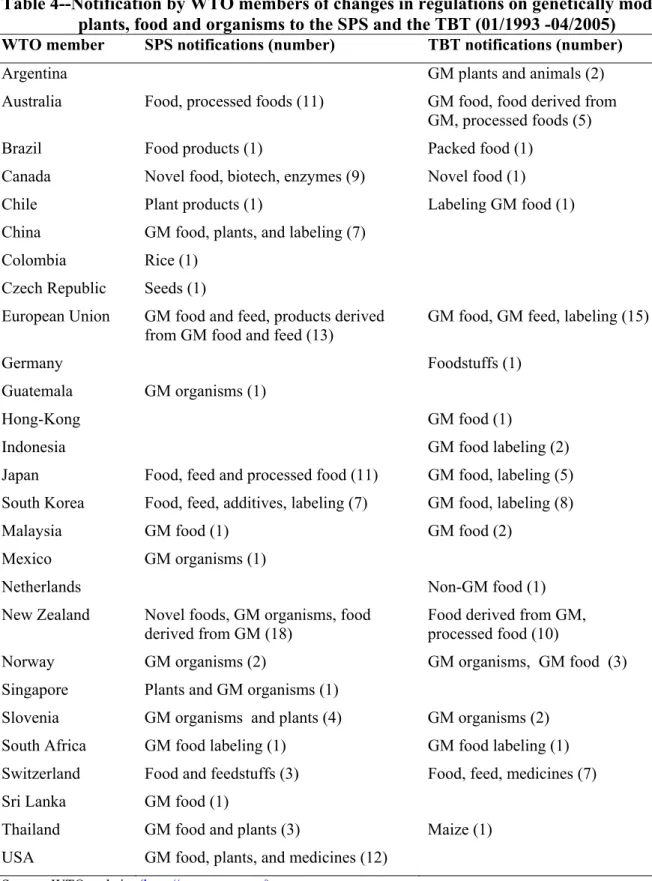
objective as compared to other measures (such as educational programs or voluntary labeling for the objective of information provision). Heumueller and Josling (2004) argue that the TBT may rule for or against the labeling requirements, depending on the interpretation of this Agreement. WTO members have to notify new or changed SPS measures that may affect trade and that are not based on international recognized standards (Wolff 2001). At the end of April 2005, 111 notifications related to genetically modified food or crops had been deposed at the SPS committee from twenty-two countries (the EU being counted as one country), as shown in Table 4. Similarly, WTO members have to notify the TBT committee when they adopt new technical measures (such as labeling or other information requirements) that may affect trade.
Table 4--Notification by WTO members of changes in regulations on genetically modified plants, food and organisms to the SPS and the TBT (01/1993 -04/2005)
WTO member SPS notifications (number) TBT notifications (number)
Argentina GM plants and animals (2)
Australia Food, processed foods (11) GM food, food derived from GM, processed foods (5) Brazil Food products (1) Packed food (1)
Canada Novel food, biotech, enzymes (9) Novel food (1) Chile Plant products (1) Labeling GM food (1) China GM food, plants, and labeling (7)
Colombia Rice (1) Czech Republic Seeds (1)
European Union GM food and feed, products derived from GM food and feed (13)
GM food, GM feed, labeling (15)
Germany Foodstuffs (1)
Guatemala GM organisms (1)
Hong-Kong GM food (1)
Indonesia GM food labeling (2)
Japan Food, feed and processed food (11) GM food, labeling (5) South Korea Food, feed, additives, labeling (7) GM food, labeling (8) Malaysia GM food (1) GM food (2)
Mexico GM organisms (1)
Netherlands Non-GM food (1)
New Zealand Novel foods, GM organisms, food derived from GM (18)
Food derived from GM, processed food (10)
Norway GM organisms (2) GM organisms, GM food (3) Singapore Plants and GM organisms (1)
Slovenia GM organisms and plants (4) GM organisms (2) South Africa GM food labeling (1) GM food labeling (1) Switzerland Food and feedstuffs (3) Food, feed, medicines (7) Sri Lanka GM food (1)
Thailand GM food and plants (3) Maize (1) USA GM food, plants, and medicines (12)
But by April 2005, only sixty-nine notifications had been made at the TBT committee by nineteen countries (the same caveat applies). The presence of labeling notification under both TBT and SPS agreements provide an evidence of the relative lack of clarity on the application of one or the other agreement on labeling. In addition, this table shows that forty-seven of the one hundred and forty-eight members of the WTO have adopted domestic regulations (counting twenty-five countries for the EU) on GM food based on their own standards.
In 1998, EU members decided to ban imports of new GM varieties for precautionary reasons, waiting to obtain data about the safety of these varieties. As a result the EU applied a de facto moratorium on any new GM varieties, thus blocking the entrance of GM corn from the United States for four years. In 2003, the United States, Argentina and Canada have filed a WTO dispute over the EU moratorium. This dispute is important in the sense that it will provide a precedent regarding GM food and standards based on process and production methods. Bernauer (2005) argued that in view of both sides and WTO precedents with the SPS and TBT
agreements, it is probable that the WTO would not rule completely against the EU moratorium, in part because they lift this measure in 2004, while replacing it with traceability and labeling regulations. But, at the same time, six EU countries decided to keep the moratorium in place. After delaying its decisions five times, the WTO panel sent a confidential settlement report to the four Parties on February 7 2006. According to the press, the Dispute Settlement Body ruled in favor of the complainants (Cage, 2006). But at the time of this paper’s publication, there was no detailed information about the complex decision outlined in the one-thousand-page-long report. It is likely that the EU will appeal to the decision, which would delay the final ruling until the end of 2006.
DISCUSSION
In the current state of international agreements, the political view on GM food has
remained polarized by the EU and the United States. At the international level, the harmonization effort is led by the two transatlantic powers through the Cartagena Protocol on one side–
supported by the EU–and the WTO dispute on the other, which was launched by the United States. In addition, both the United States and the EU are indirectly pushing for a change in rules in their favor, at the BSP and WTO SPS, respectively. Discussions at the Codex may balance the two powers, because the Codex is by nature a UN body that sets standards recognized by the WTO, but it is doubtful that it will generate a consensus in the short run.
In the meantime, regional factors have pushed the globe towards local harmonization of labeling and approval procedures in Asia, Europe and North America. The three members of the North American Free Trade Agreement (NAFTA) have decided to agree on a common
information scheme for transboundary movements of GM crops, on the basis of a “May Contain” GM and an informal 5 percent threshold level. European countries outside of the EU have
progressively moved their import and labeling regulations toward EU standard in order to facilitate trade (Switzerland), or as a measure helping them make their case for accession to the EU (Croatia). In Asia, Thailand and Indonesia have adopted labeling regulations that are very similar to the ones of Japan.
International institutions have made significant progress on approval and biosafety procedures. The Codex Commission published official recommendations for the approval of GM food, and the Cartagena Protocol provides recommendations for environmental regulations on GM crops as recognized by over one hundred countries. Yet on the question of marketing regulations (labeling, segregation, traceability), there are no explicit rules in any international
agreement; discussions have not advanced at the Codex Commission and the Cartagena Protocol does not clearly proposes specific requirements.
In this context, three factors could affect the choice of regulations and technologies in developing countries. First, the final outcome of the WTO dispute will clearly send a signal to the rest of the world by setting a precedent. Bernauer (2005) argues that a clear ruling in favor or GM producing countries would set a signal that EU like policies will not be accepted in the WTO. On the other hand, a ruling in favor of (or not against) the EU policy would clearly show that countries have the right to have stringent regulations, and even ban those crops if they consider it necessary. Secondly, the United States Government has announced several times that it was also considering launching a WTO dispute against the new labeling and traceability regulations of the EU. A ruling on such a dispute would create a precedent on the question of the legality of mandatory labeling requirements based on production process and methods. Thirdly, if the BSP adopts stringent information requirements, large exporters of GM crops such as the United States, Canada and Argentina could dispute these requirements at the WTO, and create an international conflict between agreements.
In this particular eventuality, the relevant question would be whether the BSP can act as a binding international agreement and thus be recognized as a reference in WTO rulings. If the Codex Commission was able to find a consensus on labeling, it could be recognized as a reference standard by the SPS agreement of the WTO. But would the BSP prevail in a WTO trade dispute? According to Cors (2000), under the Vienna Convention on the Law of Treaties, the latest agreement should rule. Unless a new statement is introduced in the SPS, the Biosafety Protocol should prevail. But at the same time, Cors argue that the WTO and SPS will only
recognize the BSP if all WTO members are also members of the BSP. Since this is not the case, there are two possibilities depending on the countries involved in the dispute:
- if both countries are WTO and BSP members, the BSP will rule;
- if one country is a non-party to the BSP and the other is a party to the BSP, the WTO and SPS agreement will rule, and will not recognize the BSP.
Cors concludes that to avoid confrontation and to harmonize the SPS agreement of the WTO with the BSP, the easiest thing would be to include in the BSP a rule that would only allow temporary “provisional” use of precautionary measures for importers. But since this article, the BSP has been implemented and did not include such SPS type of measure. Other authors have argued that the BSP and the WTO are in conflict. Phillips and Kerr (2000) argue that the BSP is inconsistent with WTO rules because it allows trade restrictions based on process and production methods. More recently, Winham (2005) argues that the regime conflict between the WTO and the BSP over food safety and GMOs is singularly different than any other previous trade and environmental regime conflicts and could have very dramatic effects in the future.
International organizations are setting up rules on information and risk related requirements for the products of agricultural biotechnology that will be determinant for developing countries. In particular, the Cartagena Protocol on Biosafety offers to use its mechanism as a default policy for all transition and developing countries without domestic regulations. Many countries in Africa and Asia have followed the BSP’s requirements. For developing countries members of the Protocol the question will then be the cost of
implementation of a regulatory system consistent with the BSP (which should be partially funded by the Protocol) and the long run costs of implementation and enforcement. In addition we argued that the Biosafety Protocol is not necessarily consistent with WTO rules. In particular, the
upcoming decision on information requirements will play a crucial role in determining whether the BSP will incur a significant cost on country members and non-members and likely distort international trade of unprocessed GM food and feed.
4. MAJOR IMPORTERS REGULATIONS
Apart from their international obligations, developing countries may be influenced by the choice of regulations of their international trade partners. In particular, exports of agricultural products can provide a substantial source of income for developing countries, and agriculture remain a sector were they may have a competitive advantage over developed countries. In recent years, several rich countries (particularly the European Union) importing large volumes of agricultural products have raised their food safety standards, and developing countries seeking to maintain their exports had to comply with these standards to maintain market access. Some of these new measures may be legitimately based on food safety risks but others may only be new types of non-tariff barriers. As in the case of GM food, large importers have raise significant standards requiring approval, labeling and traceability for consumer safety, but that could potentially be considered trade restrictive measures.
In this section, we focus on two large importers with significant economic and political influence on the developing world: the European Union and Japan. GM food regulations in these two countries are representative of larger regions. In particular, most non-EU countries in Europe (e.g., the Eastern European nations) are adopting regulations similar to those in the EU.
Switzerland is changing its threshold level to become compatible with EU standards. Similarly the Japanese labeling requirements may have influenced other Asian countries in their choice of GM labeling regulations. Thailand, Indonesia and South Korea have similar requirements to Japan’s; Vietnam and Malaysia are considering similar labeling policies.
THE EU’S REGULATIONS
The EU regulatory approach is precautionary, process related, and includes mandatory labeling traceability requirements- it belongs to category 1. Requirements include food and feed crops, unprocessed or processed. Only non-food GM products (unseeded), such as textile or other industrial products are not subject to any requirement.
The EU regulatory system for GM foods has become increasingly more stringent. In 1990, the European Council adopted Directive 90/220 on the deliberate release of GM organisms into the environment. The directive regulated approval of GM crops for field trials and
cultivation, and it also governed the approval of GM food.This first regulation did not define any specific approval procedures or labeling regulations. In 1997, the EU Parliament and the EU Council adopted Regulation 258/97, entitled the Novel Foods Regulation. This regulation
applied to new food products including GM foods, and it defined approval procedures requiring proof that any GM food is safe for human consumption. Later, the EU commission and the Council published Regulations 1813/97 and 1139/98, which required the labeling of food
products containing approved GM soybeans and GM corn. These regulations were augmented by Regulation 49/2000, introducing mandatory labeling of GM food and GM ingredients at the 1 percent level and Regulation 50/2000, extending the labeling requirements to food ingredients containing GM additives and flavorings.
The EU's most recent laws on GM food authorization (Regulation 1829/2003 and Regulation 1830/2003) took effect on April 18, 2004. These regulations established procedures for evaluating potential risks from GM food, and laid down rules on labeling of GM food and feed. Approvals are now granted for a period of 10 years, renewable. There is a 0 percent threshold for unapproved GM crops. Labeling is extended to animal feed, food sold by caterers, and food derived from GM ingredients even if the end product has no significant traces of
transgenic DNA or proteins. One major addition is the traceability requirements for GM and non-GM food: any food potentially containing GM material has to be tracked all the way from the farm to the consumer. This requires food companies to keep track of all shipments and to conduct DNA or protein tests at different stages. There is no labeling requirement for products such as meat, milk or eggs produced from animals fed with GM feed. The threshold for labeling is 0.9 percent.
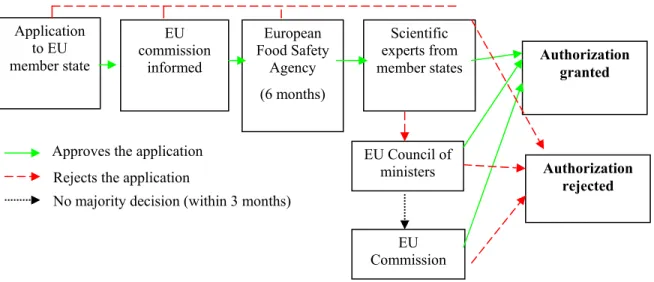
Under the new EU authorization system, as described in Commission Regulation
641/2004 of April 6, 2004 (Figure 2), a company that intends to market a GM food product in the EU must follow four successive steps (Reuters).
Figure 2--The EU authorization process in 2005
First, the company must apply to the relevant authority of the EU member state where the product is first to be marketed, and provide a full risk assessment, a monitoring plan, a labeling proposal and a detection method. Second, if the authority gives a favorable opinion, the member state informs other member states via the European Commission. Thirdly, if there are no
Application to EU member state EU commission informed European Food Safety Agency (6 months) Scientific experts from member states EU Council of ministers EU Commission Authorization granted Authorization rejected
Approves the application Rejects the application
objections by other member states, the notifying state or its national food safety authority may authorize the product for marketing throughout the EU. Fourth, a decision is required at the EU level and the following procedure is initiated. The Commission asks the independent European Food Safety Authority (EFSA) for an opinion based on a risk assessment procedure. The EFSA must give an opinion within 6 months. If the opinion is favorable, the Commission submits a draft decision to the Standing Committee on the Food Chain and Animal Health, made up of scientific experts from the member states. If the committee approves the authorization, the Commission adopts the decision and authorizes the new GM food product. If the committee does not agree, the Commission sends its draft approval to the Council of Ministers (agricultural or environmental ministers), who has three months to reject or adopt it. If they do not act within this time, the Commission may adopt its own decision and authorize the new GM food product.
Globally, the EU has the most comprehensive regulations on GM food. The new labeling and traceability regulation was introduced to force member states to end the de facto 4-year moratorium on new GM crops and to respond to the pressure imposed by the United States and other countries when they launched a WTO dispute on the moratorium. Since then, the EU has approved only three new GM varieties,15 and it is now the labeling regulations that have become the new de facto trade barrier for targeted “food” products. Although labeling was introduced to provide consumer choice, the mandatory labeling system encouraged all food processors and retailers to avoid GM ingredients entirely.
According to surveys and polls, a majority of EU consumers claim that they do not want to eat GM food, but at the same time some empirical studies (Noussair, Robin, and Ruffieux 2004;MORI 2002) have shown that a positive share of consumers would be willing to purchase GM products in the EU. Carter and Gruère (2003) argued that the EU mandatory labeling system
has acted as a majority voting system where the winner takes all. Currently, it is almost impossible to find products derived from GM ingredients in the EU (Gruère forthcoming). GM animal feed is available because animal products are not required to be labeled. It is unlikely that the positions of the retailers and food processors will change, except if there is an abrupt shift in consumer acceptance (Knight, Mather, and Holdsworth 2005).
JAPAN’S REGULATIONS
Japan’s regulations include mandatory safety assessment and mandatory labeling based on differences in products and with a number of exemptions. Labeling is based on the end products, which means that highly processed products are exempt from labeling. Japan can be considered in category 3 of Figure 1
In 2000, Japan introduced regulations defining the authorization procedure. The Ministry of Health Labor and Welfare (MHLW) is in charge of the approval procedure for GM food. All GM food, GM processing aids, and GM food additives are subject to pre-marketing safety assessment. The safety assessment includes information regarding the host, the vector, the inserted gene, the recombinants, and the toxicity levels. If the application to MHLW is complete, it is then submitted to the Expert Panel of the Biotechnology Subcommittee within the Food Sanitation Committee. The Panel reviews and makes recommendations to the Biotechnology Subcommittee, which then passes its judgment on to the Food Sanitation Committee. This committee makes a recommendation to MHLW’s minister, and if approved the new variety is announced in the Japanese Gazette. It usually takes about one year to go through the regulatory process.
The MHLW enforces standards under the Food Sanitation Law (FSL), and it samples and tests imported foodstuffs at ports of entry. The testing focuses on GM foods approved abroad but
not in Japan. There is a 0 percent tolerance for unapproved GM material. After the Starlink corn food scare, Japan increased the frequency of food safety inspections on corn from 5 to 50 percent of all cargoes.
The Ministry of Agriculture, Fisheries and Forestry (MAFF) is responsible for
environmental safety approval, feed safety assessment and biotech labeling rules. The MAFF’s environmental assessment is voluntary but all companies comply. The MAFF’s feed safety assessment is mandatory, from April 1, 2003. All applications for feed approval are reviewed by the Feed Division of MAFF, and then sent to the Expert Committee of the Agricultural Materials Council. There is a 1 percent tolerance level for the unintentional presence of GM feed that has been approved in other countries, under the condition that the exporting country’s safety assessments are deemed equivalent to Japan’s.
Japan’s mandatory labeling scheme was introduced on April 1, 2001 under the Law on Standardization and Proper Labeling of Agricultural and Forestry Products, which was
introduced into the Japanese Agricultural Standards (JAS). Labeling is required for all GM food if DNA/protein can be detected in the finished food products and if the GM ingredient is one of the top three ingredients and accounts for more than 5 percent of the total weight. This 5 percent tolerance level is informal but currently applied. The MAFF list of products subject to mandatory labeling included 30 foods in 2003. Importantly, there are no labeling requirements for soy oil or corn oil, except if the oil has special properties (such as high oleic soy oil). The labeling
regulations are enforced jointly by MAFF and MHLW under the JAS and the FSL, respectively. In addition to the mandatory GM labeling requirements, there is a voluntary labeling option for non-GM, subject to identity preservation procedures.
Overall, the Japanese policy can be described as pragmatic, in the sense that it requires the labeling of GM food but the regulations do not cover all products and the tolerance levels are higher than in other countries. Food processors and retailers in Japan have typically avoided products with GM labels. As in the EU, most GM products are used for animal feed, but unlike in the EU, many highly processed products derived from GM ingredients (e.g., soy oil) are sold without labels.
DISCUSSION: INTERNATIONAL EFFECTS OF THE EU AND JAPAN’S REGULATIONS Labeling and approval regulations in major trading countries have affected international trade in all GM crops except cotton (because most cotton products are not edible and thus not subject to food safety and labeling requirements). In particular, regulations in the EU and Japan– two large importers of these crops– have impacted trade. Furthermore, the choice of regulations in the EU and Japan may have discouraged the development of new GM food varieties and at the same time encouraged third countries to adopt labeling requirements similar to those in the EU.
The EU regulations managed to halt almost all corn imports during the de facto
moratorium between 1998 and 2004. U.S. corn growers contend the ban has blocked around $300 million in annual sales of corn (King 2003). U.S. exports of corn byproducts to the EU also fell. But at the same time–even during the moratorium–the EU still imported a relatively large volume of GM soybeans for feed, mainly because meat from animals fed with GM crops is exempt from EU labeling requirements. Since the Bovine Spongiform Encephalopathy (BSE) crisis, EU farmers are required to use only vegetable feed, and the EU is incapable of producing enough soybeans for its animals. Thus EU farmers import GM soybeans from Brazil, the United States, and Argentina.