Ssengooba, Freddie Peter (2010) Performance-based contracting: case-study for non-profit hospitals in Uganda. PhD thesis, London School
of Hygiene & Tropical Medicine. DOI: https://doi.org/10.17037/PUBS.00682436 Downloaded from: http://researchonline.lshtm.ac.uk/682436/
DOI:10.17037/PUBS.00682436
Usage Guidelines
Please refer to usage guidelines at http://researchonline.lshtm.ac.uk/policies.html or alterna-tively [email protected].
Performance-based
Contracting: a Case Study
of Non-profit Hospitals in Uganda.
Freddie Peter Ssengooba
Thesis in Fulfilment of the Doctorate of Philosophy in
Health Systems and Policy
University of London
2010
Declaration:
I Freddie Peter Ssengooba
confirm that the work presented
in
this thesis is my own. Where information has been derived
from other sources, I confirm that this has been indicated in
the thesis.
Acknowledgements
Gratitude go to London University for its contribution to my education and to the UK's DFID for its financial support for the knowledge programmes in particular, the Health System Development Programme at London School of Hygiene and Tropical Medicine (LSHTM) which enabled me to undertake this study. Tremendous thanks go to Makerere University and its School of Public Health for allowing me the time to undertake this study.
I am very honoured for the teachings, kindnesses, and advice of some of the very best in this academic field. Most gratitude go to my Supervisors Dr. Natasha Palmer and Prof. Barbara Isobel McPake and to the staff and fellow students of Dept. of Global Health and
Development (GHD) - formally Health Policy Unit at LSHTM for the enduring support and
encouragement along this path. No less gratitude goes to Ms. Nicola Lord and the administration staff of the GHD.
Additional thanks go to the implementation team that steered the performance-based contracting pilot. Without their regular updates and invitations to participate in the pilot activities, I would have had less to learn from. This work would not have been possible without the support and cooperation of the hospitals managers, members of the Boards of Governors and officials of Uganda Catholic Medical Bureau and district/local governments. Heartfelt gratitude goes to my wife Dr. Jennifer Nabukenya-Ssengooba, my mum Maria Namata (RIP) and uncle John Mary Waliggo (RIP) and the rest of my family for all forms of
support and sacrifices they had to make during the period of this study.
Table of Contents:
TABLE OF FIGURES ... 7 TABLE OF TABLES ... 7 ABSTRACT ... 9 CHAPTER 1: INTRODUCTION ... 10 1.0 INTRODUCTION: ... 10 1.1 UGANDA BACKGROUND ... 11 1.2 PNFP DEVELOPMENTS IN UGANDA ... 111.3 BRIEF DESCRIPTION OF THE PBC PILOT ... 13
1.4 STUDY RATIONALE ... 15 CHAPTER 2: LITERATURE REVIEW ... 16 2.0 INTRODUCTION ... 16 2.1 PERFORMANCE-BASED CONTRACTING (PBC) ... 17
2.2 WHY SHOULD HOSPITALS RESPOND TO PBC? ... 17
2.2.1 What Problem is PBC Trying to Solve? ... 18
2.2.2 Why Performance Contracting in the Health Sector ... 19
2.3 AGENCY-BASED THEORIES ... 19 2.3.1 Transaction Cost Theory and Performance Metering 20 2.3.2 Property Rights and New Public Management ... 22
2.3.3 Incentives and Performance Management ... 23
2.4 How WOULD HOSPITALS RESPOND? ... 24 2.4.1 Motivation and Performance at the Individual Level ... 24
2.4.2 Will do: Commitment to Organisational Goals ... 25
2.4.3 Can Do: Intrinsic Motivation for Work ... 26 2.4.4 Psychological Contract ... 27 2.5 MOTIVATION AND PERFORMANCE AT THE ORGANISATIONAL LEVEL ... 28
2.5.1 Incentive and System-level Dynamics ... 29
2.5.2 Organisational Culture and Performance ... 30
2.5.3 Expectancy Theory ... 31
2.5.4 Packaging Incentives ... 32
2.6 UNPACKING THE PBC INTERVENTION AND ITS IMPLEMENTATION ... 32
2.6.1 Theory of Dynamic Response: ... 33
2.6.2 Complexity Theory ... 33
2.7 THE NATURE OF RESPONSE TO PBC: STRATEGIC OPTIONS ... 34
2.7.1 Hospital Objectives and Corporate Governance ... 35
2.8 EXPERIENCES OF PERFORMANCES-BASED CONTRACTING ... 37
2.8.1 High Income Country Experiences ... 37
2.8.2 Low income country experiences ... 39
2.9 State of Knowledge about PBC ... 44
CHAPTER 3 STUDY OBJECTIVES AND METHODS ... 46 3.0 INTRODUCTION ... 46 3.1 CONCEPTUAL FRAMEWORK ... 46 3.2 WILL HOSPITALS RESPOND? ... 48
3.3 How WILL HOSPITALS RESPOND? ... 49
3.4 STUDY PROPOSITIONS: COMPETING PARADIGMS ... 51
3.5 STUDY QUESTIONS, AIMS AND OBJECTIVES ... 52
3.5.1 Study Questions ... 52
3.5.2 Research objectives ... 52
3.6 METHODS AND STUDY DESIGN ... 53
3.6.1 Case Study Approach ... 53
3.6.2 Case Study Limitations ... 54
3.6.3 Selection Criteria for Case Study Hospitals ... 55
3.6.4 Selection of Study Hospitals ... 56
3.6.5 The Case for Prospective In-depth Study Approach ... 57
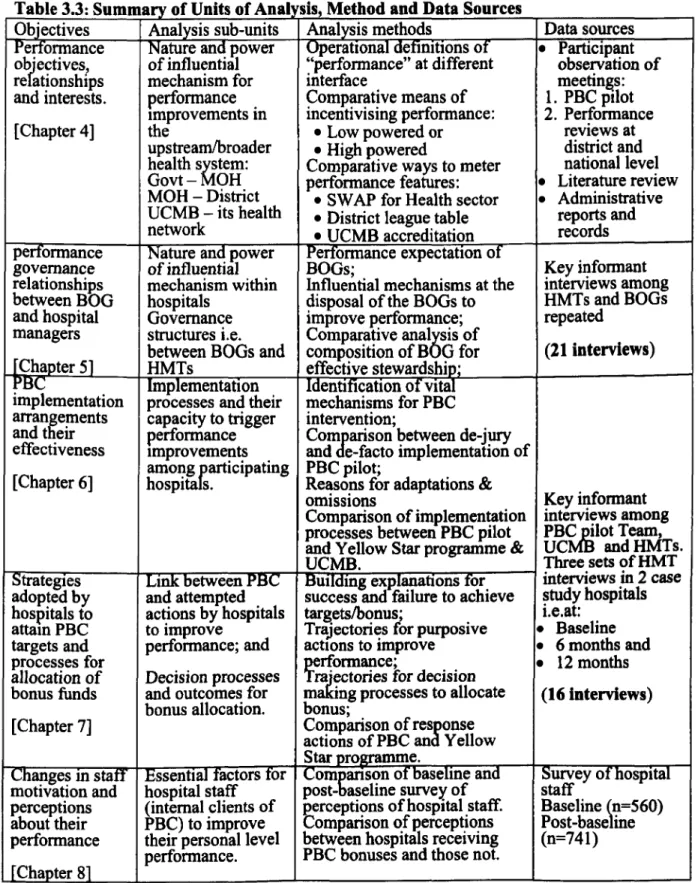
3.6.6 Units o Anal sis -a Summa 58 3.6.6 Research Data ... 60
3.8 OVERVIEW OF RESULTS CHAPTERS: ... 69
CHAPTER 4: PERFORMANCE MANAGEMENT IN THE HEALTH SYSTEM ... 70
4.0 INTRODUCTION ... 70 4.1 MACRO LEVEL PERFORMANCE EXPECTATION ... 71
4.2 PERFORMANCE EXPECTATIONS AT THE NATIONAIJSTATE LEVEL ... 72 4.2.1 National Development Expectations Versus the Health Sector ... 73
4.2.2 Health Sector Performance Monitoring - SWAP ... 74
4.2.3 The league Table: Ministry of Health - Districts' Performance ... 75
4.3 EXPECTATIONS AT THE DECENTRALISED/DISTRICT HEALTH SYSTEM ... 78
4.3.1 Performance Review Meetings ... 79
4.3.2 Performance Recognition and Awards ... 80
4.3.3 Districts as Middlemen in Performance Management ... 81
4.4 UCMB AND ITS PERFORMANCE EXPECTATIONS: A CASE STUDY ... 82
4.4.1 UCMB and its Institutional Basis for Performance Governance ... 83
4.4.2 The Complementary Roles of UCMB ... 84
4.4.3 UCMB - Hospital Interface ... 84
CHAPTER 5: PERFORMANCE GOVERNANCE MECHANISMS ... 92
5.0 INTRODUCTION ... 92 5.1 PERFORMANCE EXPECTATIONS OF BOARDS OF GOVERNORS ... 93
5.1.1 Viability of the Hospital Operation ... 95
5.1.2 Expanding Infrastructure ... 96 5.1.3 Code of Conduct ... 97 5.1.4 Management Competence ... 99 5.2 THE BOARDS OF GOVERNORS (BOG) AND THEIR CAPACITY TO GOVERN ... 100
5.2.1 Board Composition ... 101 5.2.2 Governance Structures and Power Play ... 101
5.2.3 The Complication of Delegated Managers ... 110
5.3 SUMMARY: STRATEGIC INTENTS AND THEIR CONTROL ... ... 110
5.3.1 Context. - Performance Governance as a Barrier ... 112
CHAPTER 6: PBC IMPLEMENTATION ... 115
6.0 INTRODUCTION ... 115
6.1 PBC IMPLEMENTATION: DE JURE AND DE FACTO ... ... 116
... ... 6.1.1 Consensus Building for PBC Pilot ... 117
6.1.2 Selection of the Targets for PBC Contract ... 118
6.1.3 Performance Verification ... 120 6.1.4 Performance Feedback ... 124 6.1.5 Bonus Payment ... 129
6.1.6 Pilot Financing: Uncertainty of Bonus Funds ... 131
6.2 COMPARISON WITH OTHER PERFORMANCE FRAMEWORKS ... 132
6.2.1 UCMB Performance Reviews ... 132
6.2.2 Yellow Star Programme ... 135 6.3 SUMMARY: ... 138 6.3.1 Measurement D fculties ... 139 6.3.2 Performance Feedback ... 140
6.3.3 Bonus: Financing and Size ... 141
CHAPTER 7: HOSPITAL RESPONSES TO PBC ... 143
7.0 INTRODUCTION: ... 143
7.1 PBC PERFORMANCE TRAJECTORIES: ... 143
7.2 General Strategies for Performance Improvement ... 145
7.3 PERFORMANCE STRATEGIES ATTRIBUTED TO PBC ... 149
7.3.1 Early Adopters and Poor Sustainers ... 150
7.3.2 Case 2- Late Adoption and a Focus on Records ... 152
7.4 ATTRIBUTIONS FOR PERFORMANCE FAILURE ... 154
7.4.1 Increased Costs and Dependence on Uncertain Government Grants ... 154
7.4.2 Lock-in of "Unstrategic " Choice of Targets ... 155
7.5 How WERE THE BONUSES USED? ... 156
7.5.1 Case I Hospital ... 156
7.5.2 Case-2 Hospital ...:... 160
7.6 RESPONSE TO YELLOW STAR PROGRAMME ... 164
7.6.1 Case I HOSP-1 Hospital ... 164 7.6.2 Case-2 Hospital ... 165 7.7 SUMMARY ... 166
CHAPTER 8: STAFF PERCEPTIONS ABOUT HOSPITAL PERFORMANCE ... 170
8.0 INTRODUCTION ... 170
8.1 DESCRIPTION OF THE STAFF SURVEYS ... 170
8.2 EXPLORATORY FACTOR ANALYSIS ... 171
8.3 EXTRACTIONS OF LATENT FACTORS ... 172
8.3.1 Factor Description ... 173
8.3.2 Reliability for Extracted Factors ... 175
8.3.3 Sample Differences in Relation to Extracted Factors ... 175
8.4 CHANGES IN PERCEPTIONS DURING PBC INTERVENTIONS ... 177
8.5 MEASURE OF PERFORMANCE PERCEPTIONS ... 179
8.5.1 Internal Consistence of Performance Measure ... 179
8.5.2 Performance Perceptions: Baseline and Post-baseline ... 180
8.6 PERFORMANCE DRIVERS AND THEIR DYNAMICS ... 182
8.6.1 Regression Results ... 183 8.7 SUMMARY AND IMPLICATIONS ... 187
8.7.1 Implications ... 189 CHAPTER 9: DISCUSSION ... 191 9.0 INTRODUCTION ... 191 9.1 PERFORMANCE MANAGEMENT AND MULTIPLE PERFORMANCE OBJECTIVES ... 191
9.1.1 Quality as a Desirable Performance Dimension ... 192
9.2 IMPLICATIONS OF WEAK GOVERNANCE ... 192
9.3 PBC IMPLEMENTATION: MEASUREMENT OF PERFORMANCE ... 193
9.3.1 Feasibility of Measuring Performance ... 194
9.3.2 The Best as the Enemy of the Good: Performance Measures for PBC Pilot ... 194
9.3.3 Implication of Measurement Problems: ... 196
9.4 HOSPITAL RESPONSE TO PBC ... 196 9.4.1 Effective Performance Influences ... 196 9.4.2 Incentive Package for Performance Development ... 197 9.4.3 Weak Performance Influences ... 197 9.5 RESPONSE ACTIONS AND ROLE OF THE CONTEXT ... 200
9.6 RESPONSE ACTION AND ORGANISATIONAL PRECEDENTS ... 202
9.7 THEORETIC PERSPECTIVES AND THEIR UTILITY IN PBC PILOT EVALUATION ... 203
9.7.1 Strategic Intents and Their Control ... 204
9.7.2 Agency-based Theory Applications: Use of Bonuses ... 204
9.7.3 Process Theory Applications ... 206
9.7.4. Trust or Audit based Control Systems ... 209
9.7.5 Integration as a Form of Performance Control ... 211
9.7.6 Theoretical Complementarities: Agency and Process theories ... 212
9.8 METHODOLOGICAL INSIGHTS ... 213
9.8.1 Lessons from Mixed Methods ... 213 CHAPTER 10: CONCLUSIONS ... 219 REFERENCES ... 226 ANNEx 1 ... 242
Production costs and revenue considerations in PBC response ... 242
Annex 2 Unstructured Questionnaire Guide for In-depth Key Informant Interviews ... 244
Annex 3 Structured Questionnaire ... 250
Table of Figures
FIGURE 1.1 TREND OF PUBLIC ALLOCATION TO THE PNFP SUB-SECTOR
... 12 FIGURE 3.1 CONCEPTUAL FRAMEWORK FOR HOSPITAL RESPONSE TO PBC PILOT
... 47 FIGURE 3.2 PURPOSIVE HOSPITAL SAMPLE DRIVEN BY PBC PILOT PARTICIPATION
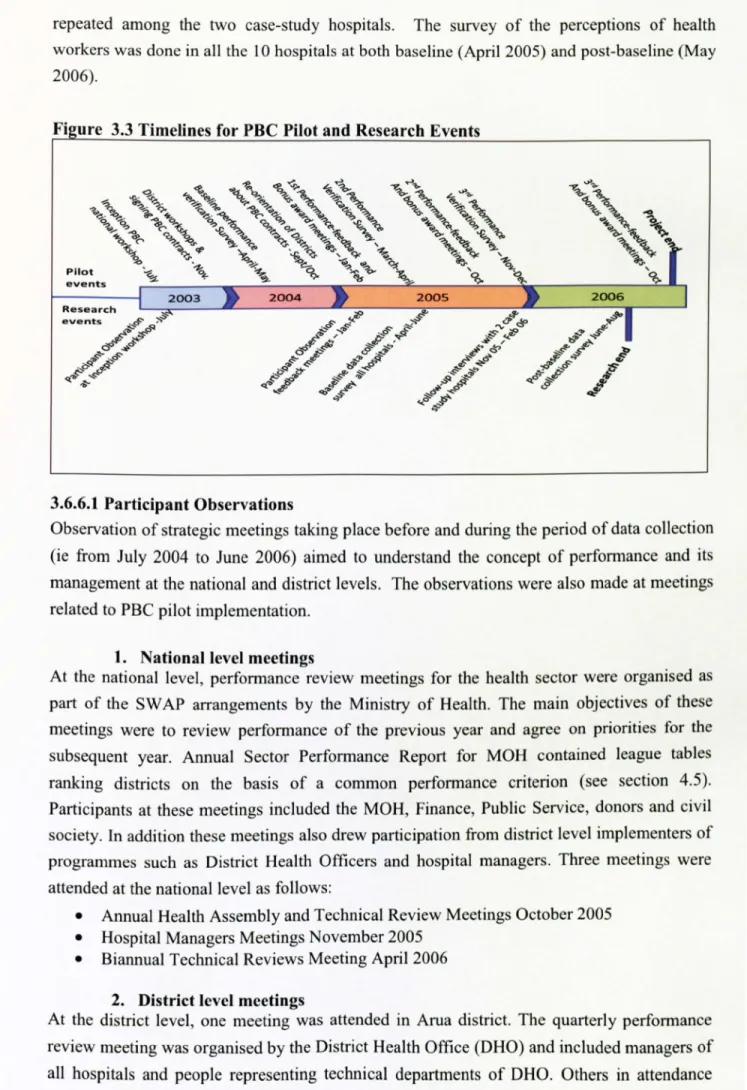
... 56 FIGURE 3.3 TIMELINE FOR PBC PILOT AND RESEARCH EVENTS
... 61 FIGURE 5.1: OPERATIONAL FUNDS (GRANTS) PER BED AMONG STUDY HOSPITALS*
... 95
TEXT BOX 6.1: PERFORMANCE GOALS MENU FOR PBC
... 115 TEXTBOX 6.2: BOTTLENECKS TO PBC PILOT IMPLEMENTATION
... 122 TEXT BOX 6.3: BONUS AS A SOURCE OF NEGATIVE MOTIVATION FOR CONTROL GROUP
... 127 FIGURE 6.4: STANDARD UNIT OF OUTPUT FOR 63 UCMB HOSPITALS (1997/98 TO 2006/07)
... 134 FIGURE 6.5: YELLOW STAR PROGRAMME: LOG AND PUBLIC EVENT TO RECOGNISE SUCCESS IN QUALITY IMPROVEMENTS
... 138 FIGURE 7.1: RESPONSE TO YELLOW STAR PROGRAMME FEEDBACK
... 165 FIGURE ANNEX: 10.1 A AND B: SHORT-RUN COSTS AND REVENUE RELATIONSHIPS
... 242
Table of Tables
TABLE 1.1: HOSPITAL ASSIGNMNET TO PBC PILOT EXPERIMENT AND INTERVENTION(S)
... 14 TABLE 2.1: CONTRACTUAL DIFFICULTIES UNDER BOUNDED RATIONALITY AND OPPORTUNISM ... 20 TABLE 2.2 TASK MEASURABILITY AND INFORMATION SYSTEM
... 21 TABBLE 3.2 CHARACTERISTICS OF HOSPITALS PARTICIPATING IN THE STUDY
... 59 TABLE 3.3: SUMMARY OF UNITS OF ANALYSIS, METHOD AND DATA SOURCES
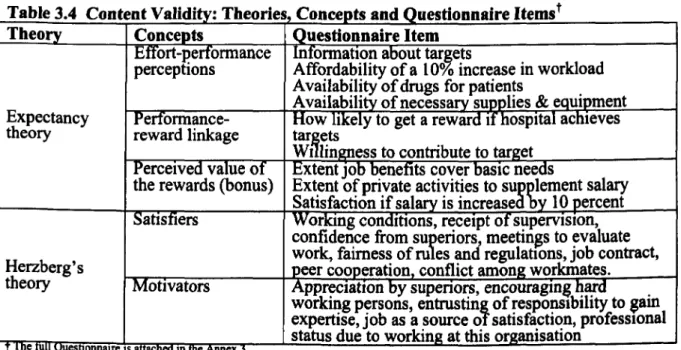
... 59 TABLE 3.4: CONTENT VALIDITY: THEORIES, CONCEPTS AND QUESTIONNAIRE ITEMS
... 65 TABLE 4.1: MACRO LEVEL PERFORMANCE EXPECTATIONS AND INFLUENCES FOR HEALTH OUTCOMES
... 72 TABLE 4.2: HEALTH INDICATORS FOR PEAP MONITORING BY MOFP&ED
... 73 TABLE 4.3: HEALTH SECTOR HSSP INDICATORS (1999 TO 2005) FOR MONITORING BY MOH
... 74 TABLE 4.4: LEAGUE TABLE MEASURES, WEIGHTS AND EXPRESSED CONCERNS BY ACTORS 79
... 77 TABLE 4.5: SUMMARY PERFORMANCE EXPECTATIONS, SUPPORT AND ENFORCEMENT AT MOH
... 79 TABLE 4.6: SUMMARY OF DISTRICT PERFORMANCE FRAMEWORK TOWARDS HOSPITALS
... 82 TABLE 4.7: ILLUSTRATIVE ANALYTICAL INDUCTION FOR PERFRORMANCE EXPECTATIONS OF UCMB
... 85 TABLE 4.8: UCMB ACCREDITATION REQUIREMENTS FOR 2005-06
... 89 TABLE 4.9: SUMMARY OF UCMB PERFORAMANCE EXPECTATIONS, SUPPORT AND ASSESSMENT ... 91 TABLE 5.1 ILLUSTRATIVE ANALYTIC INDUCTION OF THE PERFORMANCE EXPECTATIONS OF THE BOGS... 94 TABLE 5.2: DOMINANT CHARACTERISTICS IN THE INTERACTIONS BETWEEN THE BOG AND HMT
... 102 TABLE 6.1: SCHEDULE FOR PILOT IMPLEMENTATION ACTIVITIES
... 129 TABLE 6.2: BONUS PAYMENTS AND AS PROPORTIONS TO ANNUAL REVENUES IN ELIGIBLE HOSPITALS ... 130 TABLE 6.3: PERFORMANCE FRAMEWORKS
-CONTRASTS BETWEEN PBC, UCMB AND YELLOW STAR ... 142 TABLE 7.1: CASE 1 HOSPITAL- EXPLANATIONS FOR SUCCESS AND FAILURE TO SECURE A BONUS
... 144 TABLE 7.2: CASE 2 HOSPITAL- EXPLANATIONS FOR BONUS FAILURE FOLLOWED BY SUCCESS
... 144 TABLE 7.3: RANGE OF STRATEGIES TO INCREASE SERVICE OUTPUTS
... 167 TABLE 8.1: SAMPLE AND RESPONSE RATES AT BASELINE (2005) AND POST-BASELINE (2006)
... 170 TABLE 8.2: RESPONDENT DEMOGRAPHICS AT BASELINE 2005 AND POST-BASELINE (2006)
... 171 TABLE 8.3: RESEARCH PURPOSES AND EXPLORATORY FACTOR ANALYTIC APPROACHES USED
... 172 TABLE 8.4: TOTAL VARIANCE EXPLAINED BY EXTRACTED FACTORS
... 174 TABLE 8.5: ITEM DESCRIPTIVE STATISTICS AND ITEM TO SCALE PARTIAL CORRELATIONS
... 174 TABLE 8.6: CORRELATION AMONG FACTORS AND THEIR RELIABILITY ESTIMATES (DIAGONAL)
... 175 TABLE 8.7: MEAN CHANGES IN THE FACTOR SCORES: BASELINE (2005) AND IN 2006'
... 178 TABLE 8.8: ITEM DESCRIPTIVE STATISTICS AND ITEM-TO-SCALE PARTIAL CORRELATIONS
... 180 TABLE 8.9: MEAN CHANGE FOR THE ELEMENTS IN THE PERFORMANCE SCORE
... 181 TABLE 8.10 VARIABLE DEFINITION AND DESCRIPTIVE STATISTICS
... 183 TABLE 8.11: LINEAR REGRESSION RESULTS: 2005 AND 2006 SURVEYS
... 184
List of Abbreviations AIC AIM ANC ARVs BOD CAO CAS CCU CEO CMH CUAMM DAM DCPP DHB DHO DPT3 DRG EFA FAC GAVI GFATM HMIS H MT HRDERD HSD HSSP IOM MDGs MMR MOFP&ED MOH MTEF NGO NIDs N LT OGAC OPD PBC PCA PEAP PEPFAR PHC PIT PNFP PRSP PVT SUO SWAP UCMB UK UNCST UPMB WBRG WDR YSP
Aids Information Centre Aids Integrated Model project Ante Natal Care
Anti-retroviral (drugs) Board of Governors
Chief Administrative Officer (District Govt) Complex Adaptive System
Catholic Church of Uganda Chief Executive Officer
Commission for Macroeconomics and Health University College for Aspiring Missionary Doctors District Awareness Meetings (for PBC)
Disease Control Priority Project Diocesan Health Board
District Health Officer
Diphtheria, Purtusis and Tetanus (3rd dose) Diagnosis related group
Exploratory Factor Analysis
Factor (composite factor from EFA) Global Action for Vaccine Initiative
Global Fund for AIDS Tuberculosis and Malaria Health Management Information System Hospital Management Teams
High Degrees and Ethical Review Board (Makerere University) Health Sub-District
Health Sector Strategic Plan Institute of Medicine
Millennium Development Goals Maternal Mortality Review
Ministry of Finance, Planning and Economic Development Ministry of Health
Medium Term Expenditure Framework Non-governmental organisation National Immunisation Days
National League Table (for MOH)
Office of the Global AIDS Coordinator (for PEPFAR) Out Patient Department
Performance-based contracting Principal Component Analysis Poverty Alleviation Action Plan
Presidents Emergency Programme for AIDS Relief Primary Health Care
Pilot Implementation team Private Not for Profit
Poverty reduction strategy programmes Performance Verification Team
Standard Unit of Output
Sector-wide approach (for health development) Uganda Catholic Medical Bureau
United Kingdom
National Council for Science and Technology (Uganda) Uganda Protestant Medical Bureau
World Bank Research Group World Development Report Yellow Star Programme
Abstract
Background: Performance-based contracting (PBC) and similar approaches to tie funding to
measured performance have become major characteristics of innovative financing mechanisms. The World Bank and Uganda's Ministry of Health pilot tested PBC in five
districts for a period 2003 to 2006. This PhD examines the response to this pilot among private-not-for-profit (PNFP) hospitals.
Methods: A multi-level analysis was undertaken to explore essential up-stream and down- stream institutional relationships and functions for PBC success. Agency-based and process- based organisational theories were used as alternative frameworks to build explanations of the response actions. In -depth case studies were carried out using mixed methods among
PNFP hospitals that were assigned to different mix of PBC pilot components (performance targets, service output metering, performance feedback and financial bonuses). Seven PNFP hospitals participated in the PBC pilot while an additional three non-participating public hospitals provided opportunity for comparative analysis. In-depth interviews (28) covered hospital management teams (HMTs) and members of their Board of Governors (BOG) in all the ten hospitals. Five district health officials, two implementers of PBC pilots and two officials from Uganda Catholic Medical Bureau (UCMB) were also interviewed. A survey of
560 hospital staff at baseline and 741 after 12 months was undertaken among the 10 hospitals to measure changes in perceptions relevant to hospital performance. Participant observations were undertaken during meetings for PBC pilot activities as well as meetings for reviewing the performance of health activities at national and district levels.
Major findings: Upstream support functions like financial disbursement, staff movements and costs of service provision formed contextual constraints for the hospitals to respond to PBC. Likewise, governance relationships between HMT and BOG provided additional constraints for PBC success. Hospital managers were expected to respond to several performance-focused interventions - many of which were contradictory to the PBC targets. Among the difficulties observed during the PBC pilot implementation, poor metering of performance and inadequate financing for the essential pilot elements were particularly problematic. The implementation arrangements generated unanticipated negative performance influences especially among the control group -a situation that may over- estimate the pilot effectiveness. Findings show that financial bonuses at the organization level can create either motivation or demotivation among staff depending on the hygiene of the bonus allocation processes within an organization. Results from the staff surveys indicate that the drivers for performance improvements in the hospitals were related to job satisfaction, performance governance of work teams, availability of medicines and supplies, as well as staff satisfaction with their financial benefits.
Conclusions: PBC may not achieve optimal effectiveness in settings without a package of supplementary interventions for improving resource inputs, performance governance and motivating the workforce. Financial incentives as predicted from agency theory were not sufficient for PBC success. Micro-care approaches aimed at improving the organisational processes (process-based theory) for better performance will be required for greater effectiveness of PBC initiatives and policies. Policy prescriptions and implementation arrangements for PBC interventions need to provide for on-going monitoring of mechanisms and consequences as a basis for mitigating harmful effects on health systems and optimizing the good.
Chapter 1: Introduction
1.0 Introduction:
There is expanding interest in the potential of performance-based contracting (PBC) as an intervention to fix the performance of health systems (Eichler, Auxila et al. 2001; Adam and Gunning 2002; Penelope and Murray 2002; Hecht, Baston et al. 2004; Loevinsohn and Harding 2005; Low-Beer, Afkhami et al. 2007; Allen 2009; Eichler, Levine et al. 2009). The advents of global financing instruments intending to support the achievement of measurable targets such as Millennium Development Goals (MDGs) have adopted performance-based aid frameworks with explicit targets. Global financial instruments such as GAVI, The Global Fund, PEPFAR, and World Bank's Multi-country AIDS Programmes (MAP) have made
claims for the use of performance-based aid for improving the accountability of health
systems and recipient countries despite mixed empirical evidence of effectiveness of this approach (Lim, Stein et al. 2008) At the national and sub-national levels, performance-based aid translates into performance-based contracts between fund-holders and service providers (Chapin and Fetter 2002; Penelope and Murray 2002; Taylor 2003; Meessen, Kashala et al. 2007; Eichler, Levine et al. 2009).
At the global level, performance-based aid is a major development in the aid modalities between international development partners and developing countries. Although first advocated in the early 1990s (World Bank 1993), the renewed interest is based on a number of reasons (Scott, Mannion et al. 2003):
" Millennium development goals (MDGs) are explicit commitment between governments
and development partners to achieve measurable results in health status and poverty worldwide (Vandemoortele 2008).
" Poverty reduction strategies programmes (PRSPs) of governments have sought to explicitly plan for and measure their performance in the reduction of poverty and other MDGs(Uganda Govt 2005).
" Transition from project-based aid to Sector-wide Approaches (SWAps) in developing countries have necessitated the development of measurable indicators of progress as a form of accountability mechanism for development aid (Adam and Gunning 2002). " Increased efforts to leverage the non-state sectors to play a greater role in the provision of
health services (McPake and Ngalande 1994; Palmer 2000; Palmer, Strong et al. 2006)
" International aid disbursements are adopting performance-based financing tied to
demonstrable progress as measured by performance indicators (GFATM 2003; OGAC 2005; Low-Beer, Aflchami et al. 2007).
" Increasing accountability of the health system has been promoted by reforms to make the
services reach the intended groups. This was the theme of the 2004 World Development 10
Report - Making Services Work for Poor People (World Bank, 2004) as well as for the World Health Report in 2000(WHO 2000). It has also been a driver for reforms in the UK, USA and for international aid (Chapin and Fetter 2002; Hecht, Baston et al. 2004; Allen 2009).
1.1 Uganda Background
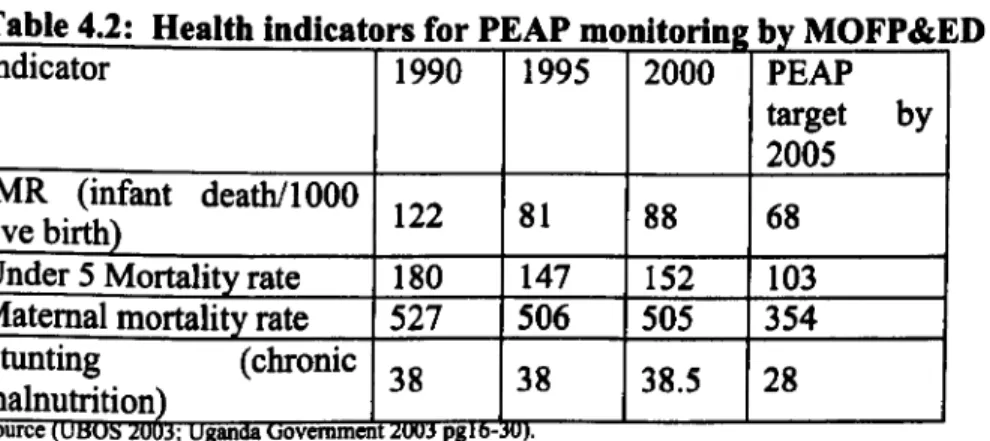
The overall government policy is to alleviate poverty. The health sector is one of the sectors contributing to this goal through the reduction of ill-health and premature death. As part of the PRSP process, the health sector's contribution is tracked by its implementation of the minimum health care package. The package is a set of services that were judged to be cost- effective in reducing morbidity and mortality in Uganda (MOH 1999a). A set of indicators are used by the government to monitor performance of the sector ie:
" OPD unitisation of health services
" DPT3 immunisation coverage
" Deliveries in health facilities
" Approved posts filled by trained health workers
" Urban and rural HIV sero-prevalence
To implement the health policy objectives of expanding access
to the minimum health care
package
to all Ugandans,
MoH has pursued two inter-related
policies among others:
" Expansion and up-grading of the service infrastructure by establishing functional
health sub-districts
" Supporting the faith-based sector also called Private-not for profit (PNFP) sector to
deliver a more comprehensive service.
The health sub-district (HSD) policy has invigorated the hospital sector with the intent to expand access to essential clinical care, at the same time broadening the participation of hospitals (serving as HSD referral centres) in health prevention and promotion activities (MOH-c 1999).
1.2 PNFP Developments In Uganda
The provision of health care services in Uganda is shared between the state and non-state providers. Although the non-state providers range from informal drug vendors to up-scale private hospitals, the faith-based sector or private not-for-profit (PNFP) providers makes a major contribution to the delivery of the Minimum Health Care Package (MHCP) and the realisation of the Health Sector Strategic Plan of the Government (MoH 2003a). The PNFP sub sector owns about 30 percent of the health facilities in the country i. e. 44 hospitals and 520 lower level health centres and accounts for about 50 percent of the expected annual health service outputs of the health sector (MOH 2004; MOH 2007). PNFP facilities provide health services in more remote areas that are underserved by the public sector (Ritva and Svensson 2002). In recognition of its capacity to serve the health sector objectives, government has provided variable support to the PNFP sector over the years.
Government support to the faith-based sector in Uganda started shortly after independence in 1962 whereby Government was required to provide subventions to the missionary hospitals. During the 1970s, economic and other political changes diminished the value of these subventions. The hospitals turned to charitable organisations abroad for support and little effort was put in pursuing the government subventions that were getting smaller over time (Green 2002). However, some mission hospitals continued to receive personnel (with salary) from MOH as a form of support from Government (Uganda 2002).
From 1995, it became increasingly difficult for PNFP hospitals to cope with the costs of providing care. There was a decline in the funding of PNFP hospitals from charitable organisations abroad(Green 2002). In addition, Government progressively increased the emolument package of public servants to a point well above the levels sustainable in the PNFP sector. This situation caused an exodus of personnel especially nurses from the latter to the public sector (Guisti 2007). The initial response in PNFP hospitals was to increase charges in an effort to generate more local funds. This option did not get very far due to the general poverty and outcry of the communities. In 1997/98 fiscal year, Government had introduced a conditional primary health care grant to districts to guarantee the allocation of funds for PHC. In the same vein, PNFP hospitals were provided a direct subsidy(UCMB
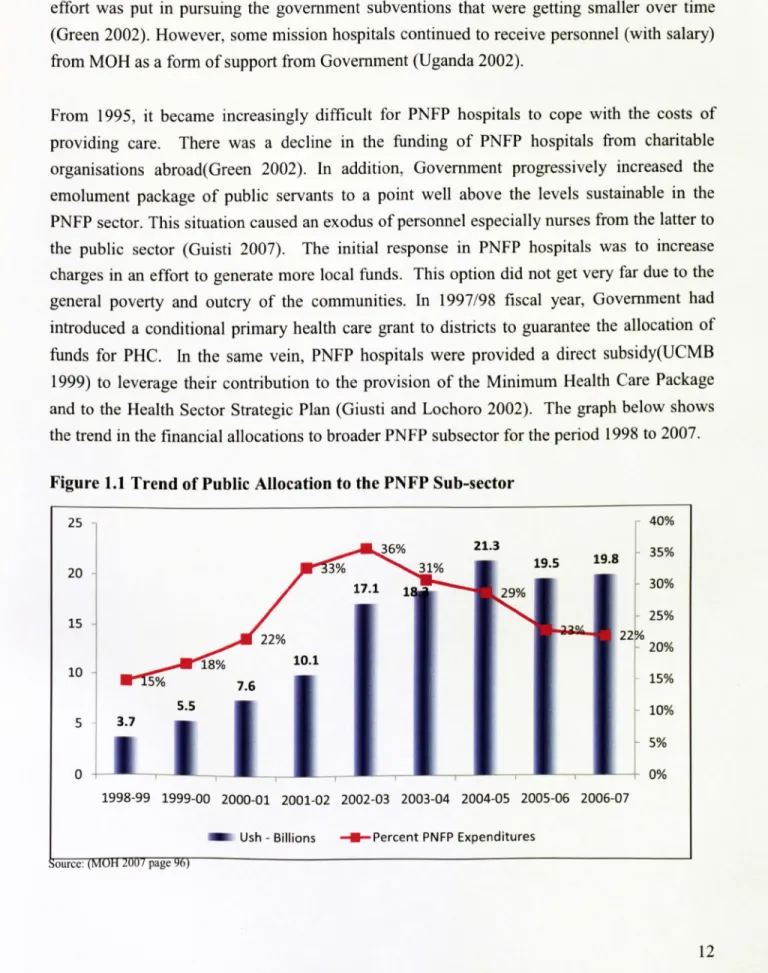
1999) to leverage their contribution to the provision of the Minimum Health Care Package and to the Health Sector Strategic Plan (Giusti and Lochoro 2002). The graph below shows the trend in the financial allocations to broader PNFP subsector for the period 1998 to 2007.
Figure 1.1 Trend of Public Allocation to the PNFP Sub-sector
25 40%
20
15 10 R 5 3.701
5% 5.5 18% 3% 17.1 40 10.1 7.6 36% 31% 21.3 29% 19.5 19.8 0 22% 1998-99 1999-00 2000-01 2001-02 2002-03 2003-04 2004-05 2005-06 2006-07 M Ush - Billions --M-Percent PNFP ExpendituresSource: (MOH 2007 page
35% 30% 25% 20% 15% 10% 5% 0% 12
During the 2001 presidential campaigns, user-charges were retracted from all public health facilities. This policy change exerted pressure on the PNFP sub-sector to reduce their charges to ensure that those communities served by them equally benefit from the policy(Giusti and Lochoro 2002; Odaga and Maniple 2003). District local leaders grumbled about the lack of
reciprocal action (removal of charges) from the PNFP facilities. Indeed, some local
governments (eg Kamuli District) disowned the arrangement of a PNFP facility as the gazetted provider in their communities and constructed public facilities next to the PNFP ones -a situation that ran counter to the goal of efficiency being pursued in public-private partnerships policy. Furthermore, the change in user fee policy of Government left fee- charging PNFP providers relatively uncompetitive (Peter Waalwo Kajula 2004; Xu, Evans et al. 2006).
Figure 1.1 shows that the government subsidies were contributing 22 - 36 percent of the expenditures in the PNFP sub-sector. Available evidence shows that districts local governments signed a memorandum of understanding with PNFP as the basis for the subsidies. Without any specifics of contractual obligations, the memoranda required PNFP to use the subsidies for the provision on the minimum health care package and gradually reduce their charges to the users(MOH 1999b; Giusti and Lochoro 2002).
Administrative measures such as budgets, guidelines, reports of accounts and services utilisation have been used to control the PNFP providers under MoU. The MoU specified the details about allowable expenditures. For instance, expenditure for staff wages and salaries were not allowed. As noted in the mid-term review of HSSP, the key constraint in the Govt- PNFP partnership was the nature of contractual relationship:
"... the administrative as opposed to contractual nature of the PNFP relationship with the local governments has not helped to strengthen the partnership. It may also not be providing the best value for money
... it is recommended that a study be conducted to gather evidence- based data on the most appropriate contractual arrangement that would improve access to the minimum health care package for the poor and most vulnerable (and) at the same time increase value for money " (M0H f 2003 page 51).
Upon this backdrop, a performance-based contracting (PBC) pilot was designed and undertaken by the World Bank Research Group and Uganda's Ministry of Health (MOH) with the aim of providing explicit annual service targets to the PNFP providers as the contractual obligations for the subsidies they received from the Government.
1.3 Brief Description of the PBC Pilot
The pilot was undertaken between 2003 and 2007 in five districts i. e. Arua, Bushenyi, Jinja, Kyenjojo, and Mukono. All health facilities in the five districts were invited to participate in one of the three experimental groups. Government health facilities were assigned to the
control group largely to avoid the legal burden associated with changing public financing entitlements and limited decision space for handling financial bonuses in the intervention. PNFP facilities were randomly assigned to the three experimental groups. The following table summarises the interventions and their allocation to the three experimental groups:
Table: 1.1: Hospital Assignment to PBC Pilot Experiment and Components
Experimental group
Unique interventions
Common interventions
Control group (Status quo continues i. e. 1. Baseline assessment of
(Public and PNFP Allocation Guidelines & MOU for service outputs,
facilities) PNFPs) 2.6-montly assessments:
1. Contract addendum to MOU; " service outputs achieved,
2. Selection of 3 service targets " client satisfaction survey,
Experimental group A
from a list of 6; " facility inputs survey,(PNFP facilities only) 3. Freedom to allocate Govt. grant " household service,
to PNFP. utilisation survey.
1. Contract addendum to MOU; 3. Performance feedback from
Experimental group B 2. Selection of 3 service targets the service output
(PNFP facilities only) from a list of 6; assessments
3. Freedom to allocate Govt. grant to PNFP;
4. Bonus payment if targets are
achieved.
The control study group was provided with information about the study but did not enter into a contractual arrangement with the district. A number of public and PNFP facilities were assigned to this group.
The PNFP facilities in experimental groups A and B were required to sign a "Contract Addendum" to the usual Memorandum of Understanding (MOU) that each facility signs with the District Local Government. For Study Group A and B, the Addendum specified a number of performance goals and allowed participants the freedom to allocate grant monies as they wished. For Study Group B, the Addendum also provided for bonus payments for successful performance. The bonus amounts to be paid to Group A facilities were calibrated on the basis of how many of the three targets were attained at midyear and at the end of the year. The total bonus payments within the fiscal year would not exceed a maximum of 11
percent of the government subsidy provided to the health facility. The following
performance targets were selected on the basis of the key interventions in the Health Sector Strategic Plan and availability of information on service outputs:
1. Increase the number of outpatient visits by 10%
2. Increase
the number of births attended
by a skilled health worker by 5%
3. Increase
the number of children under one year immunised by 10%
4. Increase the number of new acceptors of family planning methods by 5%
5. Increase
the average
number of antenatal
visits by pregnant
women by 10%
6. Increase
the number of children under five treated for malaria by 10%
The performance of all three study groups was monitored every six months over a period of two years, beginning with a baseline survey in September 2005. The service output assessments and the surveys for facility inputs, client satisfaction and household use of services were outsourced to the Makerere University, Institute of Public Health and a Pilot Coordinator was recruited by the World Bank Research Group and situated within the Ministry of Health headquarters.
1.4 Study Rationale
To understand the potential benefit of performance-based contracting (PBC) as a tool for improving access and equity objectives in health delivery in Uganda, the study in this thesis was proposed to examine how the PBC pilot would work to increase access to services in PNFP hospitals. This study also sought to explore the literature on performance-based contracting, its theoretical premise, experiences of applications to public health sectors and the overall impact PBC might have on improving efficiency in service delivery using the PBC pilot in Uganda as a case study. Contracting for performance as implemented in the Uganda pilot has implications on the capacity to measure and objectively verify performance targets. The literature review also sought to understand how control of hospital performance is exercised though measurement of targets and payment of bonuses and how these might
elicit responses behaviour among hospitals.
The next section will explore the literature on contracting in health care provision. The key question guiding the review was the extent to which performance-based contracts provides incentives for improving access to health services and how providers might respond to these incentives. Economic, sociological and psychological theories have been used to explain how individuals, groups and organisations response to incentives. Subsequent sections introduce contracts and why they are increasingly being used in the health sector, before discussing theories on how contracts may succeed or fail to improve performance.
Chapter 2: Literature Review
2.0 Introduction
The concept of the contract is rooted in the historical transition from a single entrepreneur business to multi-disciplinary and specialised industrial economy which depends on multiple skills and a broader scope of action. Macneil (1974) outlined the roots and key dimensions of contracts in economic exchange. He observed that the concept of the contract is a result of the necessity in society to plan for future activity -a situation that elevated the use of "promises" instead of on-the-spot "quid-pro-quo" in economic exchange.
"A contract is a promise or a set of promises for the breach of which the law gives a remedy, or the performance of which, the law in some way, recognizes as a duty " (Macneil 1974) Macneil identifies three key features for a classical contract arising from the above definition of the contract law 1) specificity (ie exact characterization of the goods for exchange), 2) communication (ie clear understanding of the transaction) and 3) measured reciprocity (ie the
exchange/monetised obligations of transactors).
As observed by Palmer (2000) and Allen (2002) classical contracts with full specification of the exchange goods or services are difficult to operationalise in the health care industry. This has necessitated the evolution of more relational contracts whereby trust and mutual dependence replaces the need to resort to the legal resolution of conflicts nor the need to fully specify and measure the goods or services at the heart of the contractual exchange(Palmer 2000; Allen 2002). As observed by Macneil, most economic activity is organised on the basis of relational contracts.
".. in post-industrial states, with their centuries of old transactional histories, perhaps the most important way by which exchange is projected is through (. ) expectations that exchange
motivations and dependence in exchange (. ) relations will continue in future. Such
relational expectations, if firmly enough grounded in fact, assure "satisfactory" exchange in the future without need for present specificity, present communication and present measured reciprocity. A vast amount of economic activity is carried on at least partly on this basis"
(Macneil 1974 page 718).
However, the reforms like new-public management in the UK have shown that there is a zone in the middle of the classical pole and relational pole of contractual exchange where some degrees specifying performance targets, communicating contract obligations and measuring and reimbursing performance may work(Le Grand 1998).
2.1 Performance-based Contracting (PBC)
By definition, performance-based contracting is a tool or approach for linking monetary or material rewards conditional to taking a measurable action or achievement of predetermined performance targets (Eichler, Levine et al. 2009 page 6). Performance-base contracting is a mechanism that seeks to specify the product/outcome at the centre of the exchange in the provider-payer relationship. Performance-based contracting has several characteristics that distinguish it from the more traditional types of contracting. Performance-based contracting typically incorporates some or all of the following:
" Emphasises results related to output, quality, and outcomes rather than how the work is performed,
" Has an outcome orientation and clearly defined objectives and timeframes,
" Uses measurable performance standards and or quality assurance plans, and
" Provides performance incentives that ties payment to output or outcomes.
For example the "output contract" specifies the volume and/or quality of the outputs or outcome such as number of children fully immunised. By contrast, "process product" contract may specify a set of procedures to put into operations to bring about a desired outcome. An example of this nature is when contracts require accreditation regimens or specified institutional capabilities and resource standards such as workforce size and professional mix. Advances in cost-effectiveness interventions, diagnostic and information technologies have enabled the development of standard means of measurement and costs of treating interventions. For example, cost reimbursement for diagnostic related groups (DRGs) is widely used in the US and UK. Likewise, as the trend for provider autonomy increases, there is a need for fund-holders to ensure that their objectives are met by organisations that are outside of their bureaucratic controls. Similar needs for accountability for results are driven by disease-specific initiatives that would like to ensure that multi-purpose organisations deliver on the specific disease control objectives as much as by reforms such as new public management that seek to optimise outcomes from public investments.
"As decision rights are delegated to the organisation, the ability of governments to assert direct accountability (through the hierarchy) is diminished. When autonomy increases, accountability must be secured by shifting from hierarchical supervision to reliance on monitoring, regulations, and the economic incentives embedded in contract "(WHO 2000 page 65).
"
... Performance contracts permit financiers to move away from the micromanagement
associated with accounting for and examining the use of each input and toward a more hand- off approach where the desired results are what is counted"(Eichler, Levine et al. 2009 page 20).
Z2 Why Should Hospitals Respond to PBC?
This literature review is aimed at guiding the assessment
of the responses
of the hospitals to
performance contracting intervention. Three related questions are essential to guide the
17
design, implementation
and evaluation
of PBC pilot for public policy action and scale-up (Le
Grand 2003; Pawson and Tilley 2004):
1. Why should hospitals respond to PBC? 2. How is the response elicited?
3. What is the nature of the response?
In answering these questions lies the theoretical and practical lessons for policy and programmes to guide and successfully replicate the desirable responses and mitigate the negative ones. These questions are addressed in turn by reviewing the relevant theoretical and empirical literature. The chapter ends with a synthesis and related study propositions to
guide the assessment of the hospital responses to performance-based contracting in Uganda.
Central to understanding why hospitals should or should not respond is in unpacking of the intervention
- performance-based contracting (PBC) and the premises underlying its use as a
tool for performance improvements in general and in the health system in particular.
" Why is PBC being used in the first place?
" What incentives are contained in PBC?
" Why should these incentives have an effect on the hospitals?
2.2.1 What Problem is PBC Trying to Solve?
Traditional approaches to financing health services such as input-based or bureaucratic process approaches have often failed to yield sustained improvements in services, particularly
for the poor and underprivileged populations (McPake 1997; Castro-Leal, Dayton et al. 2000; WHO 2000; Filmer 2001; Gwatkin 2003; Harding and Preker 2003; WDR 2004). This is one of the major reason for the international concern in the last decade, to explore ways to organize, deliver and target health services to promote efficiency, innovation and increase accountability for performance.
In general performance contracting is theorised to improve contractor performance by tying providers' compensation to the achievement of specified objectives. Other hypothesised benefits includes more flexibility to the contractor to achieve the desired results usually by igniting creative/innovative means of production (Shen 2003; Sanchez 2004; FCS 2005). What constitutes "performance" in a performance-based contract is determined based on the objective of the payer. This has led some authors to refer to PBC as a "buyer's side solution" (Chapin and Fetter 2002 pg 104). In the health sector, performance specification can be based on service "outcomes" such as abstinence from alcohol or drug addiction (Shen 2003; Lu and Ma 2006) or based on volume of outputs such as patient visits, children immunised, maternal deliveries (Eichler, Auxila et al. 2001; Soeters and Griffiths 2003; WHO 2003; Akashi, Yamada et al. 2004; Palmer and Mills 2005; McNamara 2006; Meessen, Musango et al. 2006). In some cases the measure of performance is on efficiency of resource utilisation such as reduction in the unit costs for care (Bartlett and Le Grand 1994; Le Grand 1998; Dawson,
Goddard et al. 2001; Dawson and Dargie 2002; Smith 2002; Jacobs and Dawson 2003) while in other situations the measure is on the quality of services or productivity of the workers (Schneider, Riehl et al. 1999; Moody 2004; Rosenthal, Frank et al. 2005; Lyroudi, Glaveli et al. 2006; McNamara 2006). The multiplicity of designs in the above literature attests to the flexibility of the PBC as a method for performance improvement in different contexts and performance needs.
2.2.2 Why Performance Contracting in the Health Sector
From the economic perspective and as expressed
in the 2004 World Development
Report,
problems of inefficiency arise from lack of incentives for service providers to optimise their
performance:
"... teachers must be present and effective at their jobs, just as doctors, and nurses must provide the care that patients need. But they are often mired in a system where the incentives
for effective service delivery are weak, ... Since those who do serve there are rarely
monitored, the penalties for not being at work are low. " (WDR 2004 pg 4)
Performance contracting is claimed to have the potential for enhancing managerial innovation and discipline, by exerting greater attention to performance and efficiency; by motivating providers to structure their services for better performance (Mills 1997; Palmer 2000; Taylor 2003): As expressed by Eichler et al (2009), contracting is seen as a tool to convey incentives for preferred provider behaviours.
"Optimism is warranted because material incentives are powerful; when incentives have been introduced, the improvements in key health indicators have been large and rapid and appear to have exceeded what would have occurred in the absence of the incentive. Based on an emerging base of evidence, performance incentives appear to be effective ways to achieve important health gains. The positive effects have been demonstrated when only a relatively modest sum (of money) was used as the reward" (Eichler, Levine et al. 2009 page 6).
This optimistic view of performance contracts may be at odds with the possible differences in objectives of the contract parties and their motivations in pursuing contractual relations. Several economic and behavioural theories - sometimes referred to as agency-based theories - have been advanced to explain why and when contractual relationships may serve to
coordinate and control the agent(s) to serve the interest of the principle. These are reviewed below.
2.3 Agency-based Theories
The standard agency theory (Milgrom and Roberts 1988; Mooney and Mandy 1993; Mooney and Ryan 1993) posits that:
" The principal is ill-informed about the task from which he wants to maximise benefits
" The agent is well informed and too, wants to maximise his/her own benefits from the task
" The agent may not want a high risk or to expend a lot of effort in maximising his/her
benefit;
" The principal has to design a viable contract to attract the participation of the agent; and " The principal has to motivate the agent to choose the set of actions that will maximize the
principal's benefit, subject to information asymmetry.
Agency problems arise due to the reliance on the agents in the context of asymmetry of information. In practice, specialized skill or knowledge makes information asymmetry the norm in contract relations (Alchian and Demsetz 1972; Macneil 1974; Williamson 1985; Strong and Waterson 1987; Sappington 1991; Douma and Schreuder 2002). The problem is worsened if the agents are risk averse or stand to benefit by pursuing objectives different from that of the principal. Attempts to remedy the conflict in objectives may take several forms including:
" to bring the agents into a hierarchical command to ensure that their behaviours are
controlled according to principals' expectations(Williamson 1985; McPake,
Kumaranayake et al. 2002).
" to adopt outcome benefit schemes to ensure profit sharing and/or transfer of property
rights (Smith, Stephan et al. 1997; Saltman 2002). This approach seeks to introduce incentives for the agent to adopt the principal's objective.
2.3.1 Transaction Cost Theory and Performance Metering
By using the natural tendency by individuals to maximise own utility in a way that involves selfish, strategic and guileful behaviour (opportunism) and the limitation of individuals to acquire and process all information essential for rational decisions (bounded rationality), Williamson (1985) developed a typology to illustrate situations where comprehensive contracting (box C in table 2.1) and rational decision making are feasible as control mechanisms. Comprehensive contracting is possible if agents actions can be observed,
unambiguously measured and are directly attributed to the outcome of interest (Williamson 1985 pg 52. ). In situations where opportunism is much less, general clause contracting is the alternative control approach necessitating less recourse to performance measurement.
Table 2.1: Contractual difficulties under bounded rationality and opportunism Bounded Rationality
Absent Admitted
Absent (A) Bliss (B) General Clause
contracting Opportunism
Admitted
(C) Comprehensive (D) Serious
contractual
contracting
difficulties
ource: (wiuwamson
In the health sector comprehensive contracting and accompanying performance metering would suit highly contestable (easy market entry) and simpler services e. g. immunisations, antenatal, delivery care, and intermediate outputs such as client volume in out-patient services(Preker and Harding 2000). In contrast, the difficulty of measurement of complex hospital services and their quality attributes creates serious contractual difficulties (box D) due to less than optimal metering mechanisms for performance control.
Following Williamson's framework, Ouchi urged that performance control mechanisms can be achieved by measuring the outcomes or behaviours. The behaviour of the employees can be measured in situations where the outcomes of employees' behaviours cannot feasibly be
measured (Ouchi 1979; Strong and Waterson 1987). To be effective, behaviour
measurements requires that the task(s) are programmable i. e. sequence and standards are specified and required behaviours are explicitly defined and readily measured. Task-specific behaviours are equivalent to adherence to clinical standards and care protocols in hospital /clinical care. These protocols lay down the processes of care and the required standards. Upon this assumption, a typology to explain the ability to measure performance behaviours/outcome and the programmability of the task looks like table 2.2.
Table 2.2 Task measurability and information system
Knowled e of trans rmadon process
Perfect Imperfect
High (A) Behaviour or (B) Outcome
Ability to Measure outcome control control
activity/outcome (C) Behaviour (D) Socialization
Low
control "Clan" control
From Ouchi's typology, for the nature of measurability and knowledge of the transformation process (e. g. clinical protocols or algorithms), performance measurement can be organized through three governance (control) systems:
" Hierarchical surveillance: This is more suited to a situation with perfect information on the transformation process but low measurability of the activity (box C) e. g. immunisations or child birth.
" Market control: i. e. where there is imperfection in the knowledge of the transformation
processes but high outcome measurability (eg cure from malaria) the market can be used
to provide performance information of the production process (A) and (B).
" Clan governance also called "peer monitoring" is most appropriate where there is poor
measurability of outcomes and/or difficulty of standard behaviours of production e. g.
emergency care of road traffic accident victims (box D). In these circumstances,
individuals socialised into particular traditions of appropriate behaviour or committed to a code of conduct and ethics are required to constitute a clan form of control.
From the Japanese experience, Ouchi concluded that it was cheaper to control people through
socialisation and norms than through the use of material incentives or bureaucratic rules
(Ouchi 1980). In a clan system, performance information is transmitted via soft and informal channels and is closely associated with standards, culture and norms of professional behaviour, a situation also echoed by Arrow (1963):
"the usual reason why the market acts as a check to ensure quality operates with weak force here (health care). It is for this reason that the ethical indoctrination is of such crucial importance. The control that is exercised ordinarily by informed buyers is replaced by internalised values" (Arrow 1963 pg 143).
The recourse to performance-based contractual relations with incentives such as bonuses, and measurements based on explicit targets may be understood as attempts to introduce the
market forces in the health care industry and overcome the dependence on the medical values
and ethical socialisation of health professionals in the performance management of the industry. From economic perspectives, improving efficiency requires market-based features such as competition (e. g. the threat of exit) and the appeal of profitable activities to individuals as a means of broader welfare improvements(Homstrom and Milgrom 1991; Petersen, Woodard et al. 2006). Property rights and profitable entrepreneurship have been used as economic rationale for New Public Management reforms. A brief review of these is
explored next.
2.3.2 Property Rights and New Public Management
The need to protect welfare benefits of public provision from market-induced extinction (exit) and at the same time address their inefficiencies led to the New Public Management (NPM) reforms (Shaw 1999; Stark 2002; Dawson and Dargie Ed. ). New Public Management came to symbolise a set of interventions aimed as replicating entrepreneurial mechanisms in the management of public services. Among the NPM set of interventions was the separation of the purchasing and provision functions and infusing competition and choice into the conduct of public bureaucracies (McPake 1996; Mills 1997; Ashton 1998; Taylor 2003). "Profit" was introduced in the form of financial incentives such as bonuses and share-holding which allowed public agents to claim some benefits arising from their improved performance. In these quasi-market arrangements, contractual arrangements replaced command and control of the public service bureaucracy. From the perspective of the public-private partnerships, contracting has been seen as a tool to engage and leverage private resources for health of the population for which there is little incentive(Taylor 2003; Palmer and Mills 2005). As a tool, contracting has therefore been used to introduce competition, financial incentives, risk sharing and performance measurement to guide the delivery systems in fulfilling particular objectives and become more accountable to the payers (Mills 1997; Harding and Preker 2003).
These reforms are premised on introducing market-like incentives into public or social
systems of service provision. The incentives broadly involve the introduction of property
rights within public service institutions. Freedom to make decisions on the use of assets
and
22
rights to allocate residual returns such as revenue surplus are credited for the burgeoning efficiency of the for-profit sector and market-based developments (Milgrom and Roberts 1988). For example, a rational private owner will optimise her efficiency to ensure profitable provision as well as expand her market share. Ownership of productive assets assigns the rights to claim profits/residual. As a result, property rights theorists have advanced policies to introduce ownership rights to ensure that public sector managers bear the full financial impact of their choices. For example, organisational reforms like decentralization, autonomy and privatisation have sought to introduce decision rights in management (eg hire and fire) and rights to allocate revenue surplus (McPake 1996; Harding and Preker 2003). These provide strong (high-powered) incentives to managers of public services to optimise efficiency and service coverage in a manner similar to private entrepreneurship. For example, Le Grand (1998) argued that "waiting lists" were used by managers in the NHS to justify higher hospital budgets but this changed when NPM reforms introduced throughput volume and cost control as a basis for resource allocation (Le Grand 1998).
Firms may attempt to transmit these high-powered incentives internally in the form of bonus payment, higher salaries and promoting workers into higher paying jobs so that they too, share in the firm's residual returns (Akashi, Yamada et al. 2004; Jacobs and Price 2004; Jacobs and Price 2006; Meessen, Van Damme et al. 2006). From this perspective, the use of bonuses in PBC can be seen as attempts to introduce a conditional surplus (bonus) to which the hospitals are entitled upon fulfilment of the contractual performance-targets.
2.3.3 Incentives and Performance Management
From the economic perspective, the principal consideration is the need to expand the production frontier to the optimal level of efficiency through appropriate incentives to the agents. Health provision is a complex industry with many tasks, some more measurable than others and some requiring more attention to quality than the speed of production or requiring team action rather than individual effort (Preker et al 2000). There exists a tension among the incentives provided for performance of a particular task and the allocation of effort by agents on that task relative to other mandated tasks(Dixit 1996). In general, the theory of incentives argue that when there are multiple tasks, incentives serves not only to allocate risk and to motivate hard work, but also to direct the allocation of the agents' attention among the various tasks (Homstrom B and Milgrom P 1991).
If volume of output is easy to measure but quality is not, then a system of incentives based on measures of service volume may lead health providers to increase their volume at the expense of quality. If responsive to the incentives, the provider (agent) would assign more effort to the elements that are measured compared to those that are not (Goddard et al 2000; Homstrom and Milgrom 1991). The implication of this theory is that the recourse to performance-based contracts among health providers might cause reallocation of effort away from some other tasks especially those that are not considered central to the obligations under the incentivised
contract or tasks/services that are not monitored as a basis for the payment. Therefore, the design of incentives needs to be well linked to all the desired outcomes as observed in McPake et al (2002):
"In any payment system, rewards must be linked with some aspect of performance that is observable. Under incentive management and regulation, the objective is that the aspect chosen should also be that which is intended to be encouraged" (pg 179).
2.4 How Would Hospitals Respond?
Although agency-based economic theories above explain why incentives are needed for performance improvements, they have weak operational explanations as to how these
incentives lead to performance improvements (Gauri 2001; Kingma 2003; Pawson and Tilley 2004; Hodak 2005). Human resource management practitioners rightly concerned with sustained employee productivity and continued employee commitment to the organisation find little practical assistance from agency-based theories (Marsden and Richardson 1994; Kingma 2003; Le Grand 2003; Natasha Palmer 2003; West, Wilk et al. 2003). Operational mechanisms of how external incentives lead to performance improvement at the front line (street level) have been a central concern of the field of organisational psychology. In equal measure, perspectives from organisational sociology and anthropology have provided contrasting approaches such as Human Relations, Organisational Contingency, Leadership and Governance and others - to deal with the issues of performance, efficiency and labour force commitment.
Process theories of motivation have been advanced to explain the causal factors for labour productivity and organisational performance. Process theories refer to a system of ideas or statements that account for or explain a group of facts or phenomena related to the implementation of activities - how they should be planned, organised, and scheduled in order to be effective (Grol, Bosch et al. 2007). Process theories vary in scope and application areas.
Processes theories range from those seeking to explain the performance of organisations and
work-team, to those dealing with the motivation, perceptions, organisational resources and support systems, and those that deal with how financial incentives influence performance. These are reviewed below:
2.4.1 Motivation and Performance at the Individual Level
Although they have a long history in the business sector, recently, attention has turned to the psychosocial dimensions of labour productivity in the health sector(Marsden and Richardson 1994; Bennett, Franco et al. 2001; West, Wilk et al. 2003; Crilly and Le Grand 2004; Franco, Bennett et al. 2004; Moody and Pesut 2006). At the level of an individual worker within an organisational environment, two interrelated psychosocial streams are identified in the literature (Franco, Bennett et al. 2002) as sources of motivation and productivity:
The "will do" component relates to the extent to which a worker will adopt organisational goals and this is said to depend on intrinsic and extrinsic rewards from the work.
The "can do" component depends on the extent the worker mobilises personal resources/skills to achieve goals and depends on perception of competency, availability of resources and work environment. These are expanded in turn below:
2.4.2 Will do: Commitment to Organisational Goals
Several process-based theories have been advanced to understand an individual's intrinsic and extrinsic motivation for work. These include those that seek to identify the factors essential for individual's motivation (content theories) such as Maslow's hierarchy of needs, McGregor's X and Y theories and Herzberg theory. These theories address the human needs that give rise to motivated behaviour. These theories identify various "needs" essential for the worker motivation, satisfaction and continued commitment to work. The needs arising from these theories range from basic ones such as food and shelter to higher ones such as recognition, growth and sense of accomplishment. Other needs relate to relationships with others and a sense of belonging.
However in the context of human resource management as an explicit concern for sustained hospital performance, Herzberg's motivation-hygiene theory offers more explanatory potential (Baysinger and Butler 1985; Marsden and Richardson 1994; Westphal 1999; O'Donnell and Shields 2002; Hauck and Street 2006). It identifies the short and long term factors as well as personal and environmental factors for employee motivation. In brief, motivation-hygiene theory posits that two factors i. e. motivators and satisfiers have different causal elements. The satisfiers relate to what a person does while the dissatisfiers relate to the situation in which the person does her work. For example, supervision, interpersonal relations, organisational rules, working conditions and salary are short-term satisfiers rather than motivators. The absence of hygiene factors can create job dissatisfaction, but their presence does not necessarily motivate or create satisfaction. The motivators are related to elements that enrich a person's job; such as achievement, recognition, the work itself, responsibility, and advancement. These motivators are associated with long-term positive effects in job performance while the hygiene factors produce only short-term changes in job attitudes and performance, that may fluctuate over time (Herzberg, Mausner et al. 1959). In particular, the use of financial rewards such as salary and bonuses are classified as hygiene factors with transient effects on productivity. The two factor theory has found broad application especially in managing and motivating knowledge-based productivity where tasks involve broad discretionary space from the employee. This situation is similar to hospital care where decision making is delegated to health professionals (Weaver and Sorrells-Jones 1999; Horwitz, Heng et al. 2003; Chan, McBey et al. 2004; Moody 2004; Moody and Pesut 2006).
2.4.3 Can Do: Intrinsic Motivation for Work
Although performance management and human resource management are related, the latter
addresses the central concern of how to maintain productive employment relations between
the worker and her organisation. In contrast, performance management relates to the processes that maintain or improve performance during employment. Performance management has attracted research especially in the field of industry, universities and hospitals (Guest 1999; May, Korczynski et al. 2002; MSH 2002; Smith 2002; Landrum and Baker 2004; Moody 2004; Veldhoven 2005; Hauck and Street 2006). Given its appeal to the incentive-based approach, Expectancy Theory has been widely embraced in this context. In general expectancy explains the links between external incentive and internal (or intrinsic) motivation to undertake or accomplish the required task by a person. Expectancy theory (Vroom Victor 1964; Lawler 1971) suggests that individuals can be motivated if they believe that:
" There is a positive correlation between their efforts and required performance outcomes,
" Favourable performance will result in a desirable reward,
" The reward will satisfy an important personal need, and
" The desire to satisfy the personal need is strong enough to make the effort
worthwhile.
Thus, expectancy theory suggests that an individual consider the outcomes associated with various levels of his/her performance and elects to pursue the effort level that generates the greatest reward. The conscious or subconscious calculus for effort behaviour called "motivational force" is a product of three beliefs referred to as expectancy, instrumentality and valence:
" Expectancy - the belief that one's effort will result in the attainment of the desired performance. This depends on skills, goal difficulty and perceived control over outcome. For example, the resources required, the skills and support available to the worker affect their expectancy.
" Instrumentality - the belief that if one does attain performance goals, a reward will be received depends on trust and control mechanisms for the reward to be given (ie how, when and why rewards are distributed). This requires policies or formal organisational structures and rules that link the reward to expected performance. This also encompasses an objective and reliable means of measuring the expected performance.
" Valance - this encompass the value that the individual personally places on the rewards.
This is a function of his/her needs, goals and values. For example what value does a worker attach to the bonus, salary, promotion or recognition for task accomplishment?