BANCO DE PORTUGAL Economic Research Department
ON THE USE OF THE FIRST
PRINCIPAL COMPONENT AS ACORE
INFLATION INDICATOR
José Ramos Maria
WP 3-04 January 2004
The analyses, opinions and findings of these papers represent the views of the authors, they are not necessarily those of the Banco de Portugal.
Please address correspondence to José Ramos Maria, Economic Research Department, Banco de Portugal, Av. Almirante Reis nº. 71, 1150-165 Lisboa, Portugal;
On the use of the first principal component
as a
core
inflation indicator
Jos´e Ramos Maria∗
Banco de Portugal January 2004
Abstract
This paper investigates if the (OLS-scaled) first principal component (P C1), extracted from standardized yearly rates of change of basic items of the CPI, represents a reasonable option for acoreinflation indicator. The evaluation is carried out by (i) confronting alternative linear transformations of the original variables; (ii) analyzing the impact of stacking lagged variables to the original database; and (iii) exploring the contents of the remaining principal components. An orthogonal factor model framework will also be introduced so as to fully reproduce any variable that can be expressed as a linear combination of the original input variables, such as, in this case, the overall inflation rate. The model incorporates the following properties: (i) the results are not conditional on the eigenvectors length; (ii) the variance of the CPI accounted for by each component is unique, and (iii) the outcome is equivalent to an OLS regression between the CPI and theP C1. Along with empirical evidence for the Portuguese case, it will be claimed that the above-mentioned (OLS-scaled)P C1 does capture the general movement of the overall inflation rate, however, no OLS regression would have to be implemented if the core indicator is fully aligned with the orthogonal factor model.
KEYWORDS:Principal components, factor models, core inflation indicators.
JEL Classification: C43, E31.
Acknowledgements: I am indebted to Francisco Dias and to Maximiano Pinheiro for helpful comments and suggestions. The assistance of Teresa Nascimento was also appreciated. The usual disclaimer applies.
1
Introduction
Principal components analysis continues on being one of the most used techniques in multivariate analysis. Within the price development dimension, several authors have used this technique to estimate “summary indicators” and to classify those time series as trend inflation indicators. Recent work for the euro area includes, for instance,
Angelini, Henry and Mestre (2001b), who use a time domain approach to estimate
a non-stationary factor that intends to represent a common trend in the inflation measures (along the lines suggested by Stock and Watson (1998); the forecasting
performance was address in Angelini, Henry and Mestre (2001a)); and Cristadoro,
Forni, Reichlin and Veronese (2001), who use a frequency domain approach to extract a medium and long-run common component for consumer prices. Recent work with Portuguese data includes, for instance, Machado, Marques, Neves and Silva (2001).
This paper investigates if the (OLS-scaled) first principal component (P C1), extracted
in the time domain from standardized yearly rates of change of basic items of the
con-sumer price index (CP I), represents a reasonable option for acore inflation indicator.
Currently, the Banco de Portugal uses this procedure to measure (and regularly
pub-lish) acore inflation indicator for the Portuguese case. An objective of this paper is to
evaluate this option, which was proposed by Coimbra and Neves (1997), while look-ing for possible improvements. Machado et al. (2001) suggested, for instance, that to take into account the non-stationarity feature of the input variables, a specific linear transformation could be implemented, instead of making use of standardized
vari-ables, as in Coimbra and Neves. In both studies, the core indicator is only derived
from the information contained in the basic items of the Portuguese CP I, which
are mostly non-stationary data. Not surprisingly, the need of having to compare the
core measure with some observable variable raised the question of having to find an
“appropriate scaling” for the P Ci. In what has been classified as just an “ad-hoc”
procedure, both studies solved this issue by running an OLS regression between the
inflation rate and the P C1 (and, therefore, depend on this final parameter to scale
the P C1). It will be shown that this decision has some important implications. The
current paper confronts the results obtained by these studies and, furthermore, in-vestigates if alternative linear transformations of the observed variables, within the same course of action, produce structurally different outcomes. It will be claimed
that none of the transformations have an obvious superiority or advantage; nor can the non-stationarity nature of the data be used to distinguished the overall results. Other possibilities of improvement, such as (i) stacking lagged variables to the original database, along the lines suggested for instance by Stock and Watson (1998) or (ii)
including more principal components for the derivation of the core inflation indicator
are also analyzed.
The rest of the paper is organized as follows. Section 2 confronts the results obtained from alternative linear transformations of the original data. Section 3 analyzes the use of lagged variables in the database. The use of more than the first principal component is considered in section 4. Finally, section 5 introduces a simple theoretical orthogonal factor model that captures the general underlying conceptual framework
of the proposed indicator. The factor model fully reproduces the overall CP I, and
embodies several appealing properties, in which the so called“ad-hoc” procedure has
a well defined interpretation. Without any assumption on the data generation process of the different input variables, it will be shown that the model represents a solution for the fundamental eigenvectors length indeterminacy, it uniquely determines the
variance of the CP I accounted for by each P Ci and it is fully equivalent to an OLS
regression, using the CP I as the endogenous variable and theP Ci as the exogenous
variables.
Section 6 concludes. It will be claimed that unless a smoother core inflation indicator
is being envisaged on a priori grounds, no obvious gain seems to be achieved by
changing the currently used procedure at the Banco de Portugal. However, no OLS regression would have to be implemented if the core inflation indicator is fully aligned with the factor model introduced in section 5.
2
On the use of transformed variables
Let the matrix X be the initial information set, with N observable variables x1, x2,
..., xN (in columns), andT observations (in lines). The principal components are just
special linear combinations of those initial variables and if none of the N variables is
an exact linear combination of the others, then there will exist as many distinct P Ci
as variables.
of the initial information set and therefore a decision has always to be made on whether the database justifies certain transformations prior to the calculation of the
P C.1 Given that the second moment matrix may be non-centered, the first common
transformation of the original data is to subtract the mean of eachxi. If one does not
wish to have a P C1 dominated by those variables who have the largest variance, then
a second common transformation is standardization and instead of deriving theP C1
from the variance-covariance structure of X (from now on denoted as ΣX), the P C1
can be derived from the correlation matrix (from now on denoted asρX). Using
year-on-year rates of change of basic items of the CPI, which are basically non-stationary data, this was the procedure followed by Coimbra and Neves (1997). Let this linear transformation be denoted as LT1.
The general conceptual framework of Coimbra and Neves (1997) can be written down as x1 =x1 +l∗11F1∗+ε1 ... xN =xN +l1N∗ F1∗+εN (1)
wherex1,x2, ...,xN correspond to the average values ofx1t,x2t, ...,xNt;F1∗ represents
a common factor to all variables and F1∗ =P C1; l∗1j =aj1, j = 1...N, where aj1
rep-resents the scalars defining the eigenvector (scaled to unity) associated to the largest
eigenvalue (extracted fromρX); and, finally,ε1, ε2, ...εN correspond to specific factors
of each variable. Note that the N variablesx1,..., xN are just being linearly expressed
in terms of their mean plus (1 +N) unobservable variables: F1∗ and ε1, ε2, ...εN.2
Presumably, the behaviour of each year-on-year rate of change is not only reflecting specific factors but also the “inflation trend”.
It is well known that if the original variables are subject to LT1, the eigenvalues and resulting eigenvectors are in general not the same as the ones derived from
ΣX, or even a simple function of them.3 If the eigenvectors are collected in A =
a1 a2 ... aN
, this implies that, in general, the matrix A will depend on the
transformation.
Other transformations of the original (centered) variables are also available. For
1See Jackson (1991) and Jollife (2002).
2This model is usually expressed in terms of deviations, i.e. (xi−xi), and to satisfy the usual assumption of
unit variances of the common factors, theFi should have been defined asFi=P Ci/(V ar[P Ci]1/2) and, therefore, Fi=P Ci/√λi⇔P Ci=√λiFi, withlij=√λiaji, instead of assumingP Ci=Fi∗. See, for instance, Afifi (1984).
instance, Machado et al. (2001) suggested that to take into account the non-stationary
feature of the original variables, the xi should be scaled by (σ∆xi)−1, where σ∆xi
represents the standard error of the first difference of xi. By defining the smoothness
of the integrated variable as the variance of the first differences, Machado et al. (2001) argue that a core inflation indicator should take into account the degree of smoothness
of the P C1 by looking at linear combinations of the year-on-year rates of change of
the basic CPI items “with a large signal (variance) and not to much volatility” (p.7).
Let this linear transformation be denoted as LT2. Note that both possibilities can
be represented by a diagonal matrix H, with hii in the main diagonal, i = 1, ..., N,
where H is alternatively associated with LT1 or LT2, i.e.,
P C = (X−X)H−1A (2)
The principal components (extracted from unit length eigenvectors) are being
gath-ered in a matrix named P C, where the first principal component (P C1) is placed
in the first column of P C, the P C2 in the second, etc; and X corresponds to the
average values of x1t, x2t, ..., xNt. If hii = σi in (2), H is associated with LT1. If
hii = σ∆xi, and σ∆xi is the standard error of the first difference of xi, then H is
associated with LT2.4 This section will directly confront the results obtained
un-der this two transformations. However, other transformations (purely arbitrary and motivated by no reason, except for comparison purposes against LT1 or LT2) will also be implemented. Alternative linear transformations of the same type of LT1 or
LT2 may be given, for instance, by hii = [max(xi)−min(xi)], abbreviated to LT3;
or simply hii = max(xi), abbreviated to LT4. Note that for each possibility, the
importance of each original (centered) variable (xi −x) is just being changed by a
scaling constanthii−1, in particular when computing the second moment matrix from
which the scalars of the eigenvectors are extracted. In the case of LT1, for instance, the importance of the variables with high standard deviations will be highly affected
and the same follows for a higher σ∆xi,[max(xi)−min(xi)] or max(xi) in the case of
LT2, LT3 or LT4, respectively.5
After having decided the relevant second moment matrix from which the matrix A
is derived, there is still the need to find comparable scores to those of the observed
4This type of representation by no means intends to express the entire group of transformations that the original
variables may be subjected to. On this issue, see, for instance, Jollife (2002).
5A more elaborated transformation could be given byhii=σ
∆2xi, where ∆2xirepresents the second difference of xi. However, the results from this transformation will not be reported, as they do not change the overall conclusions.
1,0 2,0 3,0 4,0 5,0 6,0 7,0 8,0 9,0 10,0
Jan-92 Jan-94 Jan-96 Jan-98 Jan-00 Jan-02 CPI - observed LT1 LT2 LT4 LT3
Inflation rate and O LS scale d PC 1
(%) -0.6 -0.3 0.0 0.3 0.6
Jan-92 Jan-94 Jan-96 Jan-98 Jan-00 Jan-02 LT2 LT4 LT3 +0.15 -0.15
Diffe re nce s against LT1
(p.p.)
Figure 1 - OLS results using the full sample period
overall inflation rate. To such purpose, Coimbra and Neves (1997) or Machado et al. (2001) computed the OLS fitted values of the following regression
·
CP I =β0+β1P C1+ε (3)
where CP I· denotes the observed inflation rate.
The database used by Coimbra and Neves (1997) and by Machado et al. (2001) has
90 variables (N = 90), with monthly year-on-year rates of change of basic items of
the CP I. Following the EUROSTAT classification, 14 of those variables refer to
unprocessed fooditems, 24 are processed food items, 3 are energy items, 26 are
non-energy industrial goods items and 23 are services items.6 The current paper makes
use of 141 observations, covering the period 1992:01-2003:09, and the same proce-dures will be extended to the other loosely defined transformations (LT3 and LT4). Therefore, the principal components methodology will be just used as a mechanical
device to decompose, through alternative N ×N matrices obtained from different
transformations, the original matrix of observed variables.7
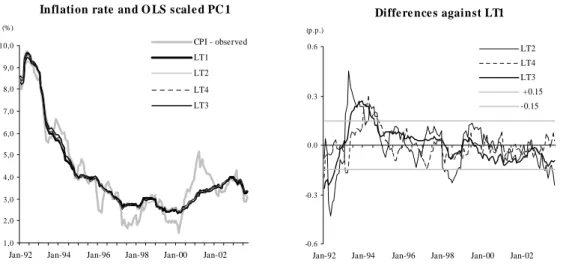
Using the full sample period, the left panel of figure (1) contains all OLS-scaledP C1
from LT1, LT2, LT3 and LT4. As it can be seen, all transformations seem to capture the general driving behaviour of the observed inflation rate, and thus, these final results cannot be used to distinguish between the transformations. The results are obviously not identical, nevertheless, no outcome is systematically above or below the
6A complete list may be found in Annex 1.
remaining ones. The differences, in percentage points, against the results obtained under LT1 were highlighted in the right panel of the same figure; during most of
the time, the differences evolved within a small range (the interval [−0.15; +0.15] is
highlighted); over the sample period, the average is virtually nil for all cases. In the case of LT2, the major differences against LT1 were registered in the beginning of the sample period. In mid-1998 and in the last part of the sample period, the differences have also exceeded the lower limit of the reported interval.
In the face of such similar results, it was then investigated if non-stationarity effects could be used so as to distinguish between the linear transformations. The use of
centered data has no effect on ΣX or ρX, however, this may raise an issue with
non-stationarity data, given that (3) was derived after having unfolded the second
moment matrices and their associated eigenvector structure. For instance, with one
additional observation, the mean of the CP I may change from CP I(T) toCP I(T+1).
To evaluate the impact of additional observations on all scalars that produce the
OLS-scaledP Ci, either from LT1, LT2, LT3 or LT4, the following recursive procedure was
implemented: the sample period was (arbitrarily) shortened in 90 observations, to 1992:01-1996:3, and a first set of estimates was computed; one observation was then added and a second set of estimates was computed for the sample period
1992:01-1996:4, and so on, until T = 141. These ninety one sets of estimates give rise to
ninety one core inflation indicators for each transformation. When the full sample
period is used, the last OLS-scaled P C1 are equal to the ones presented above, which
was already seen not to be very different. Those estimates may be analyzed so as to answer several questions: are there disruptive effects, given that most of the input variables are non-stationarity?; are the results dramatically different in nature, given that the transformations are themselves very different from each other?; given that the introduction of LT3 and LT4 were not motivated by any specific reason and may be seen as rather loosely defined, can the final outcome be used to distinguish among the linear transformations?
After having compiled these sets of core inflation indicators, two general procedures
were then followed. Given that the level recorded for each month may obviously
change within each sample period, a first general approach was just to evaluate if
1.0 2.0 3.0 4.0 5.0 6.0 7.0 8.0 9.0 10.0
Jan-92 Jan-94 Jan-96 Jan-98 Jan-00 Jan-02 PC1 derived from LT1 (%) β0 1.0 2.0 3.0 4.0 5.0 6.0 7.0 8.0 9.0 10.0
Jan-92 Jan-94 Jan-96 Jan-98 Jan-00 Jan-02
(%) PC1 de rived from LT2 β0 1.0 2.0 3.0 4.0 5.0 6.0 7.0 8.0 9.0 10.0
Jan-92 Jan-94 Jan-96 Jan-98 Jan-00 Jan-02
(% ) PC 1 de rived from LT3 β0 1.0 2.0 3.0 4.0 5.0 6.0 7.0 8.0 9.0 10.0
Jan-92 Jan-94 Jan-96 Jan-98 Jan-00 Jan-02
(% )
PC1 de rive d from LT4
β0
Figure 2 - OLS results within the recursive procedure (I)
fundamentally unstable against the previous scaled result.
A second general approach was to evaluate if, along with another additional
observa-tion, the inner products under which the final OLS-scaled P C1 are being computed
incorporates some abnormal or unacceptable behaviour in time; for this purpose, the
partial derivatives of P C1 with respect to xi, i = 1,2, ...,90 were also disclosed and
analyzed.
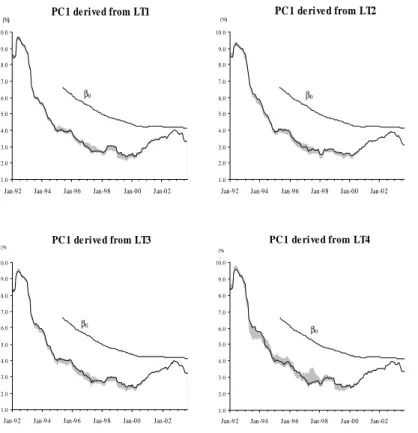
Within the first general approach, the maximum and minimum values recorded in each month were firstly retrieved and plotted in figure (2). This was done for all transformations. For each month, the maximum and minimum values define the upper and lower limit of the grey region. The differential between those limits acts
as an indication of how much the core inflation level has changed (for each month)
within the 91 sets of final OLS-scaledP C1. The core inflation indicator, using the full
sample period, and the evolution in time of β0 of equation (3), during the recursive
computation, were also depicted.
maximum (Max) and the sum (Sum) of the differential between the upper and lower
core inflation levels of each month (in basis points). As it can be seen, the
differ-ences cannot be considered very substantial and once again cannot be used to clearly distinguish between the transformations. The exception is perhaps LT4. Using the
full set of recursive estimates, the reported statistics have higher levels vis-`a-vis the
other transformations.
Av Stdev Max Sum Av Stdev Max Sum
LT1 21 12 47 2928 LT3 22 13 53 3149
LT2 21 13 47 2979 LT4 34 25 104 4801
It should be clear that one of the reasons behind such close results derives from the
fact that all core inflation indicators have the same mean. If the overall mean is
non-stationary and changes from CP I(T) to CP I(T+1), it will always be CP I(T+1)
that will be the relevant mean underlying the systematic use of equation (3), and not
CP I(T)
, implying that the mean of the core inflation indicator will not diverge, by
construction, and over any sample period, from the mean of the observed inflation
rate. Given that β0 is added in the end of the process, as additional observations
are being disclosed, the use of (3) simply adapts the fact that in the Portuguese
case the mean of the inflation rate has decreased over time (as registered by β0 in
the graph). With no differences in the mean, the only possible way to differentiate between the linear transformations has to be based on the inner products under which
the OLS-scaled P C1 are being derived. The inner products depend upon three types
of scalars: (i) the scaling constant β1, (ii) the scalars defining the first eigenvector
and (iii) the scalars defining the transformation of the original variables. With one
additional observation, any one of these scalars may change. Let [P C1]xi be the
partial derivative of the P C1 with respect to the original variable xi. From (2) and
(3),
[P C1]xi =β1 ai1 hii−1, i= 1,2, ..., N. (4)
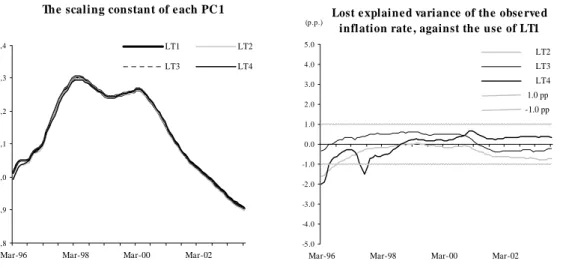
The scaling constants β1 of LT1, LT2, LT3 and LT4 were also computed and plotted
in the left panel of figure (3). For comparison purposes, the eigenvectors were scaled
to the inverse of their roots. As it can be seen, β1 has not remained unchanged over
1,8 1,9 2,0 2,1 2,2 2,3 2,4
Mar-96 Mar-98 Mar-00 Mar-02 LT1 LT2
LT3 LT4
The scaling constant of e ach PC 1
-5.0 -4.0 -3.0 -2.0 -1.0 0.0 1.0 2.0 3.0 4.0 5.0
Mar-96 Mar-98 Mar-00 Mar-02 LT2 LT3 LT4 1.0 pp -1.0 pp
Lost e xplaine d variance of the obse rve d inflation rate , against the use of LT1
(p.p.)
Figure 3 - OLS results within the recursive procedure (II)
again virtually the same in practice. In all cases, β1 follows an initial upward trend,
reaching a maximum in the first half of 1998 and then follows in general a downward
trend until the end of the sample period. The lost variance of the CP I for having
chosen LT1 and not LT2, LT3 or LT4 was also computed and plotted in the right panel of figure (3). Within each sample period, this lost variance is being defined as (β2
1 −βLT i2 )/σCP I2 , where β12 is being derived from LT1, βLT i2 is being derived from
LT2, LT3 or LT4 (a negative sign indicates a loss against the use of LT1) andσ2
CP I is
the variance of the inflation rate. In general, the percentage variance of the overall
inflation rate that is being captured by the first P C, derived from LT1, is most of
the times less than 1 percentage points away from the other possibilities.
The inner products of [P C1]xi were further investigated and the following course of
action was implemented. In a first step, the results obtained during the computation
of the ninety one sets of core inflation indicators were separated into (i) N scalars
defining the first eigenvector (the ai1) and (ii) N multiplying scalars of the original
variables associated to each transformation (the h−ii1). In a second step, for
com-parison purposes, the a1 and the h−ii1 obtained in (i) and (ii) were scaled under the
restriction that their sum would equal one, respectively, i.e. ΣN
i=1ai1 = ΣNi=1h−ii1 = 1. As a third step, the disaggregated results obtained in the second step were aggre-gated (added) according to the Eurostat classification of unprocessed food, processed food, energy, non-energy industrial goods and services prices. Without any scaling,
results are just equal to the sum of each β1 ai1 hii−1 belonging to the same Eurostat aggregate).
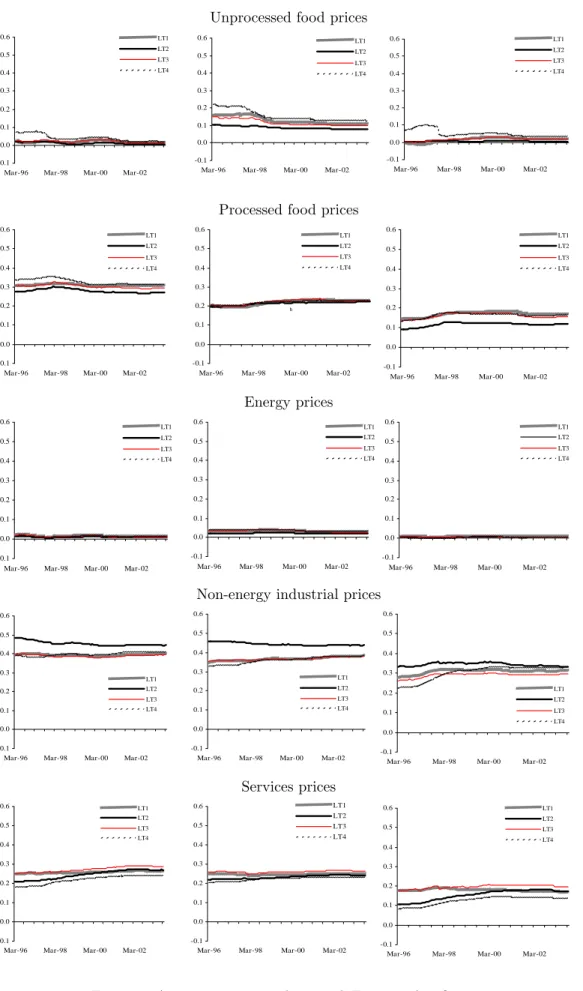
The behaviour over time of the Eurostat aggregates steming from LT1, LT2, LT3 and LT4 were plotted in the next 5 rows of figure (4). In each figure, the graphs on the left
correspond to the results for the first eigenvector (the scaled ai1); the graphs on the
center correspond to the results for the scalars with an effect on the importance of the
original variables (the scaled h−1
ii ); the graphs on the right correspond to the results
for the final partial derivatives affecting the original variables (the β1 ai1 hii−1).
Several conclusions may be drawn from those figures. First, energy prices are treated in a rather indistinguishable way in all cases. Second, all transformations share the common internal features, in the end of the process, of (i) attaching a lower im-portance to those original variables belonging to the same aggregates (Energy and Unprocessed Food), and (ii) favour those of non-energy industrial goods. Third, LT4 does effectively seem to incorporate a higher variability then the remain
transforma-tions, but specially when the P C1 is derived with fewer observations. In the case of
LT2, it should be mentioned that the partial derivatives associated with processed food prices sum up to a lower level, as compared to the remaining transformations; and services items have received a growing importance over time. Using the full sample period, the differences against LT1 are almost non-existent in the case of unprocessed food, energy and services prices. Finally, the non-stationarity feature of the original data is not having any noticeable undesirable and distinctive effect
on the final partial derivatives of any of the transformations (including under LT18).
Nor can it be used to clearly distinguish the overall results.
The empirical evidence therefore suggests that, under all the transformations consid-ered, the importance of each original variable is being relatively changed in such a way that the final results do empirically emerge as similar and hard to distinguish (which is particularly striking, given that no justification was given to implement LT3 or LT4). Although each transformation may qualitatively change the eigenvalues/eigenvectors solution of the original maximization problem, the use of structurally different linear transformations do not produce, clearly, dissimilar final results. In the case of LT1,
8It may also be the case that the non-stationarity of the original data is basically creating a correlation matrix
with a large number of positive elements, as the variables are somehow moving in the same directions, and to some extent the evolution of the first eigenvector over the different sample periods may only be reflecting what is usually referred to as a “size effect”. See Chatfield and Collins (1996) and Jollife (2002). During the different sample periods, the number of positive elements of the second moment matrix stood always between 75 and 80 per cent.
Unprocessed food prices -0.1 0.0 0.1 0.2 0.3 0.4 0.5 0.6
Mar-96 Mar-98 Mar-00 Mar-02
LT1 LT2 LT3 LT4 -0.1 0.0 0.1 0.2 0.3 0.4 0.5 0.6
Mar-96 Mar-98 Mar-00 Mar-02
LT1 LT2 LT3 LT4 -0.1 0.0 0.1 0.2 0.3 0.4 0.5 0.6
Mar-96 Mar-98 Mar-00 Mar-02
LT1 LT2 LT3 LT4
Processed food prices
-0.1 0.0 0.1 0.2 0.3 0.4 0.5 0.6
Mar-96 Mar-98 Mar-00 Mar-02
LT1 LT2 LT3 LT4 -0.1 0.0 0.1 0.2 0.3 0.4 0.5 0.6
Mar-96 Mar-98 Mar-00 Mar-02
LT1 LT2 LT3 LT4 b -0.1 0.0 0.1 0.2 0.3 0.4 0.5 0.6
Mar-96 Mar-98 Mar-00 Mar-02
LT1 LT2 LT3 LT4 Energy prices -0.1 0.0 0.1 0.2 0.3 0.4 0.5 0.6
Mar-96 Mar-98 Mar-00 Mar-02
LT1 LT2 LT3 LT4 -0.1 0.0 0.1 0.2 0.3 0.4 0.5 0.6
Mar-96 Mar-98 Mar-00 Mar-02
LT1 LT2 LT3 LT4 -0.1 0.0 0.1 0.2 0.3 0.4 0.5 0.6
Mar-96 Mar-98 Mar-00 Mar-02
LT1 LT2 LT3 LT4
Non-energy industrial prices
-0.1 0.0 0.1 0.2 0.3 0.4 0.5 0.6
Mar-96 Mar-98 Mar-00 Mar-02
LT1 LT2 LT3 LT4 -0.1 0.0 0.1 0.2 0.3 0.4 0.5 0.6
Mar-96 Mar-98 Mar-00 Mar-02
LT1 LT2 LT3 LT4 -0.1 0.0 0.1 0.2 0.3 0.4 0.5 0.6
Mar-96 Mar-98 Mar-00 Mar-02
LT1 LT2 LT3 LT4 Services prices -0.1 0.0 0.1 0.2 0.3 0.4 0.5 0.6
Mar-96 Mar-98 Mar-00 Mar-02
LT1 LT2 LT3 LT4 -0.1 0.0 0.1 0.2 0.3 0.4 0.5 0.6
Mar-96 Mar-98 Mar-00 Mar-02 LT1 LT2 LT3 LT4 -0.1 0.0 0.1 0.2 0.3 0.4 0.5 0.6
Mar-96 Mar-98 Mar-00 Mar-02
LT1 LT2 LT3 LT4
the sum of the partial derivatives belonging to the each aggregate has remained
rela-tively stable in time and no obvious gain is apparently achieved by changing the core
inflation indicator, as proposed in Coimbra and Neves (1997), for any other of the remaining possibilities. On the contrary, under LT2, LT3 or LT4, the quantity under maximization ceases to be a standard and well perceived statistic, i.e, without a clear advantage, the input variables cease to be treated as “equally important” variables, as in the case of LT1. It may be argued that standardization has only an immediate
statistical interpretation when the input variables are stationary.9 However, all four
transformations herein applied do not change the non-stationarity feature of the orig-inal database. It is only a matter of different scaling of the origorig-inal variables and of different second moment matrices. Whereas under LT2, LT3 or LT4, these matrices are somehow more difficult to interpret, under LT1 the second moment matrix is the rather straightforward correlation matrix. By conveying a well known information, the overall process becomes apparently more easily perceptible and intuitive.
3
On the use of non-contemporaneous variables
The common factors can be derived not only from contemporaneous but also from
non-contemporaneous values of X. So far, the P Ci has only been derived from
contemporaneous data and therefore a possible improvement of this core measure
could be to allow for some dynamics, along the lines suggested for instance by Stock and Watson (1998), or Stock and Watson (2002).
Following the same recursive procedure introduced in the previous section, the core
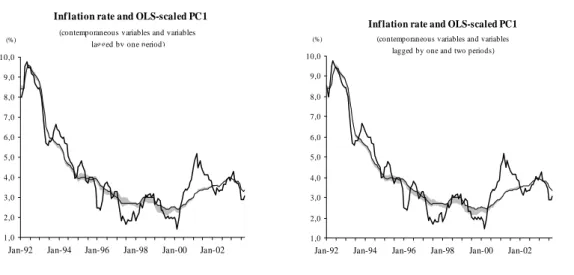
inflation indicator can now be derived from equation (3), but after having stacked non-contemporaneous figures to the original database. Figure (5) reports the results
for all OLS-scaled P C1, conditional on LT1, where the grey region is limited, as in
the previous section, by the maximum and minimum values obtained for each month. The left panel of figure (5) considers contemporaneous variables and variables lagged
by one period, the right panel also considers variables lagged by two periods.10
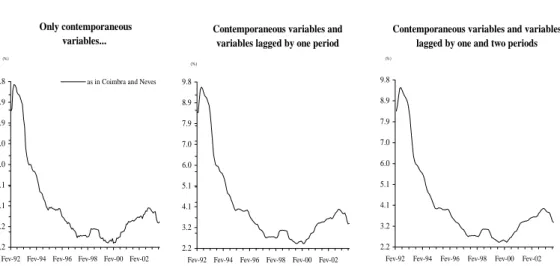
As before, these results do not seem highly different from the ones obtained by only using contemporaneous variables in the database, except that the inflation indicator
9Alexander (2001) goes even further and declares that the data input of Principal Component Analysis “must be
stationary” (p. 145). On this issue, see also Machado et al. (2001).
10With contemporaneous variables and variables lagged by one and two periods, the number of input data is now
1,0 2,0 3,0 4,0 5,0 6,0 7,0 8,0 9,0 10,0
Jan-92 Jan-94 Jan-96 Jan-98 Jan-00 Jan-02
Inf lation rate and OLS-scaled PC1
(contemporaneous variables and variables lagged by one period) (%) 1,0 2,0 3,0 4,0 5,0 6,0 7,0 8,0 9,0 10,0
Jan-92 Jan-94 Jan-96 Jan-98 Jan-00 Jan-02
(%)
Inf lation rate and OLS-scaled PC1
(contemporaneous variables and variables lagged by one and two periods)
Figure 5 - OLS results within the recursive procedure (III)
is now smoother (see figure (6)). The standard deviation of the first difference of the
OLS-scaledP C1, using the full sample period, falls from 0.17 in the contemporaneous
case, to 0.14 with one lag and to 0.13 with two lags.11 The following table contains
the average, the standard deviation, the maximum and the sum of the differentials, as in the previous section. In all cases, the sum of the differentials obtained for each month is also lower than in the contemporaneous case.
Av Stdev Max Sum
Contemporaneous and lag1 21 11 43 2881
Contemp., lag1 and lag2 21 11 40 2863
Contemp., lag1, lag2 and lag3 21 11 41 2863
Nevertheless, unless a smoother core inflation indicator is being envisaged ona priori
grounds, no obvious gain seems to be achieved by changing the currently used pro-cedure at the Banco de Portugal (as in the previous section), specially if the shocks that hit the economy are themselves not smooth or if the transmission of the effects
of these shocks onto prices is changing.12 Furthermore, this possible strategy requires
that some type of non-contemporaneous dynamic structure as to be superimposed on the original data. In the above examples, one, two or three lags were just arbitrarily considered and analyzed. On the other hand, if leads are also to be considered as
11Although the empirical results reported in this section are all conditional on LT1, it should be mentioned that
the differences between LT1 and the transformations anayzed in the previous section are again very small. In the case of LT2, LT3 and LT4, the results were 0.135, 0.159 and 0.168, respectively. Using hii=σ∆2xi, whereσ∆2xi
represents the standard deviation of the second difference ofxi, the result would have been 0.138.
12See Mankikar and Paisley (2002). On the desirable properties of a measure of “core” inflation, see, for instance,
2.2 3.2 4.1 5.1 6.0 7.0 7.9 8.9 9.8
Fev-92 Fev-94 Fev-96 Fev-98 Fev-00 Fev-02 as in Coimbra and Neves
Only contemporaneous variables... (%) 2.2 3.2 4.1 5.1 6.0 7.0 7.9 8.9 9.8
Fev-92 Fev-94 Fev-96 Fev-98 Fev-00 Fev-02
Contemporaneous variables and variables lagged by one period
(%) 2.2 3.2 4.1 5.1 6.0 7.0 7.9 8.9 9.8
Fev-92 Fev-94 Fev-96 Fev-98 Fev-00 Fev-02
(%)
Contemporaneous variables and variables lagged by one and two periods
Figure 6 - OLS results within the recursive procedure (IV)
input variables and unless some projections can be used, it is clear that the core
inflation indicator ceases to be a real time index (not computable until t=T).
4
On the use of more than one principal component
Within the principal components methodology, i.e., behindP C = (X−X)H−1A, the
objective is to find “clean”, orthogonal (uncorrelated) variables, which are extracted from noisy and possibly highly correlated original variables. It may be the case that a large percentage of the total variance present in the system might be retained by
a few P Ci and, in this sense, the effective dimensionality of the original information
set may be substantially reduced. Within factor analysis, the objective may be seen as having the inverse direction. It may be the case that the main internal features of a given set of variables may be captured by a small number of unobservable variables - the common factors. It is therefore crucial to the correct specification of the factor model the use of an adequate number of factors. Several proposals may be found in
the literature to properly determine, from the observed data, the number of factors.13
A classical way to determine the number of principal components that should be
retain as factors simply relies on the contribution of each P Ci to the total variation
present in the system. If the eigenvalues and eigenvectors (scaled to unity) are
ex-tracted from the correlation matrix ρX, the appealing feature of ΣN
i=1V ar[P Ci] =
ΣN
i=1λi =tr(Λ) =tr(ρ) =N is valid, where a descending order of the eigenvalues has
0,5 0,6 0,7 0,8 0,9 1,0
Mar-96 Mar-98 Mar-00 Mar-02 PC1 PC2 PC3 PC4 PC5 PC6 Pe rce ntage of total variance accounte d
for by 6 PC i 49.9% 58.6% 64.9% 69.6% 74.1% 77.5% 0% 20% 40% 60% 80% 100% l1 l2 l3 l4 l5 l6 Cumulated M arginal
Pe rce ntage of total variance accounte d for by 6 PC
Figure 7 - On the use of more then one principal component (I)
a direct link with a descending order of variance accounted for by their respective
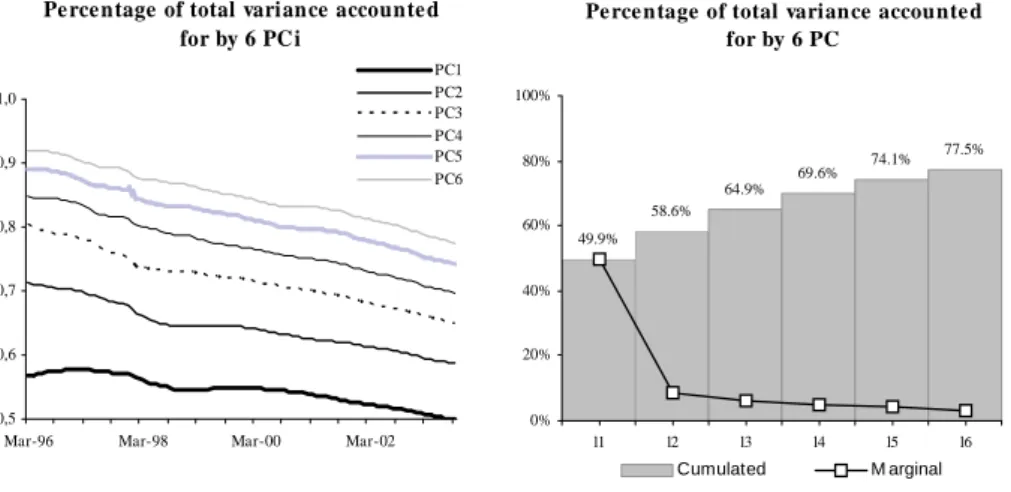
P Ci. The results of up to 6 P C were gathered and plotted in figure (7). From the
graph on the left, the percentage variance accounted for by theP C1has never reached
60%, during the computation of the 91 core inflation indicators (already introduced
in the previous sections), and has somehow evolved along a downward trend.14 In the
end of the sample period (see graph on the right), with T = 141, it stood at 49.9%.
As expected, the inclusion of more P Ci increases this percentage, with marginally
decreasing contributions (for instance, using all observations, P C2 accounts for 8.7%
of the total variance present in the system; P C3 accounts for 6.3%; P C4 for 4.7%).
With the aim of capturing more variance of the observed inflation rate, it might
therefore be suggested that the core inflation indicator should be derived not only
from the first, but probably from two or more P Ci. Coimbra and Neves (1997) or
Machado et al. (2001) simply seem to assume the need for one factor and, in fact, there are several reasons to maintain this option. A first reason is based on the relevant
information criteria under which the number of retained P Ci is determined. In fact,
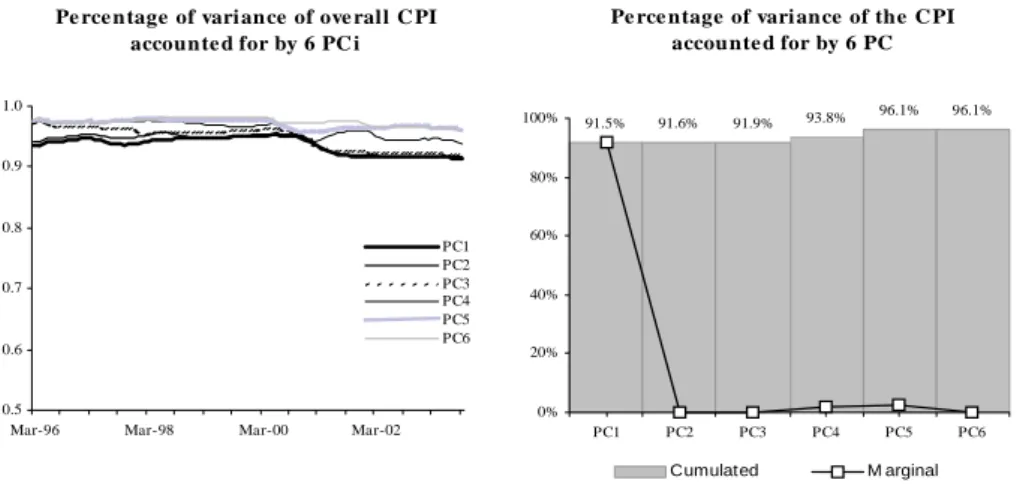
although a slight downward trend was also detected, the OLS-scaled P C1 has always
captured a high percentage of the variance of the overall inflation rate, as illustrated in the left panel of figure (8). In the end of the sample period (see right panel), it stood
at 91.5%. Therefore, the general driving behaviour of the CP I is being captured,
to a large extent, by one single P C, and the contribution of the remaining ones is
negligible. Moreover, a descending order of λi has no direct link with a descending
14The percentage of total variance accounted for by theithP Ccan be sought as λi tr(Λ) =
λi
N, which evolves in time
0.5 0.6 0.7 0.8 0.9 1.0
Mar-96 Mar-98 Mar-00 Mar-02 PC1 PC2 PC3 PC4 PC5 PC6
Pe rce ntage of vari ance of ove rall C PI accounte d for by 6 PC i 91.5% 91.6% 91.9% 93.8% 96.1% 96.1% 0% 20% 40% 60% 80% 100% PC1 PC2 PC3 PC4 PC5 PC6 Cumulated M arginal
Pe rce ntage of vari ance of the C PI accounte d for by 6 PC
Figure 8 - On the use of more then one principal component (II)
order of the variance accounted for by the respective OLS-scaledP Ci.15 For instance,
the variance of the OLS-scaledP C4 is higher than the variance of the OLS-scaledP C2
or P C3. Therefore, marginal gains would be obtained from including, successively,
the P Ci with i = 1,2 and 3, and a sudden larger gain is obtained when the
OLS-scaled P C4 is also included. This result, which simply implies a clear approximation
of the “core” inflation to the observed inflation, is basically explained by the fact that
a higher variance accounted for by a specific P Ci (obtained from eigenvectors scaled
to unity) may be abruptly reduced or increased by its respective OLS-scaling.
Another related reason to reject the possibility of including more than theP C1 in the
computation of thecoreinflation indicator is based on the analysis of the eigenvectors.
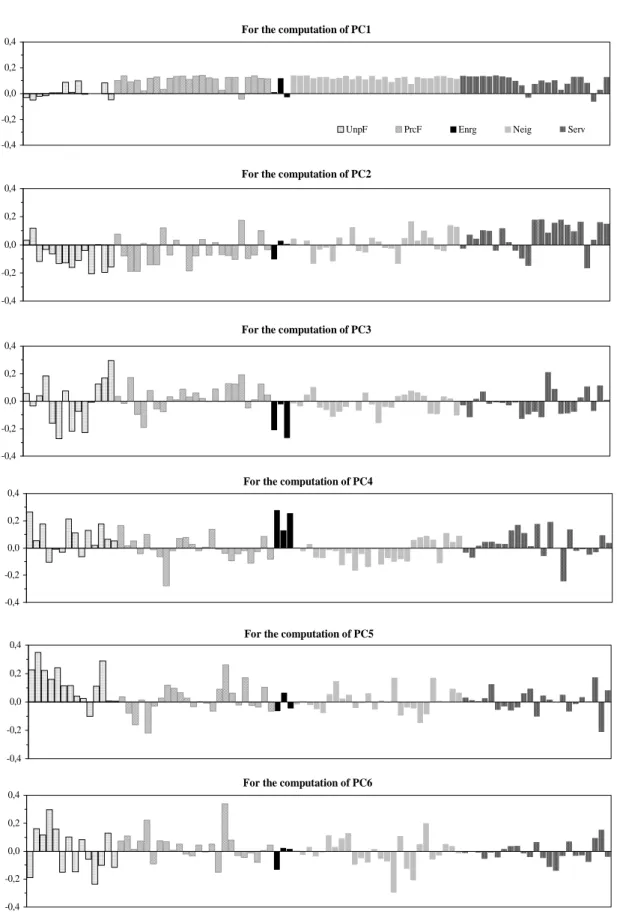
Using the full sample period, the scalars defining the first six eigenvectors (scaled to unity) were plotted in figure (9). With few exceptions, the scalars associated to the first eigenvector have all basically the same sign (non-negative), whereas the scalars associated to the remaining eigenvectors oscillate quite substantially between
positive and negative signs.16 This implies that the different P C
i may be capturing
different phenomena and therefore some additional explanation will have to be put
forward so as to include more the first principal component.17 By taking advantage
of the positive correlations found in the database, positive ai1hii−1 simply implies
that higher year-on-year rates of change of specific items of the CPI are associated
15This is not surprising given that the variance of theP Ciis dependent upon the scaling of the eigenvectors. For
instance, under eigenvectors scaled to the inverse of their roots, the link with the descending order of the (respective) λidoes not exists, since the variances of eachP Ciare always equal to one.
16The negative signs in the case ofP C1were already mentioned in Machado et al. (2001).
17An example where theP C1, theP C2 and theP C3 are used to capture three different effects may be seen in
Eigenvectors scaled to unity -0,4 -0,2 0,0 0,2 0,4
UnpF PrcF Enrg Neig Serv
For the computation of PC1
-0,4 -0,2 0,0 0,2 0,4
For the computation of PC2
-0,4 -0,2 0,0 0,2 0,4
For the computation of PC3
-0,4 -0,2 0,0 0,2 0,4
For the computation of PC4
-0,4 -0,2 0,0 0,2 0,4
For the computation of PC5
-0,4 -0,2 0,0 0,2 0,4
For the computation of PC6
with higher scores of the principal component. Moreover, it will be seen in the next
section that the small number of negative signs in the case of the P C1 can also assure
that β1 of (3) will most probably be positive, whereas the sign and the magnitude in
the remaining cases is largely unknown.
5
The OLS scaling of the principal components solution
The estimation of factor scores, common to all variables present in the system, using
unweighted ordinary least has been a customary procedure18and the previous section
has in fact computed the OLS fitted values of (3) in order to have a core inflation
indicator with comparable scores to those of the CP I. Along with other properties,
this so called “ad-hoc” procedure19 can now have a well defined interpretation if the
system of equations (1) also incorporates the fact that the CP I is also a [T ×1]
vector where CP I = ΣNi=1αixi = Xα. Derived from some household budget survey,
αi are the consumption basket weights of each item and ΣNi=1αi = 1. In this case,
note that xi is a price index and not a price change. If thexi are previously centered:
(CP I −ΣNi=1αixi) = (CP I −CP I) = (X−X)α. Let CP I represent the average of
the CP I index.
For simplicity reasons, assume that (2) was written down with price indices and that
H is equal to the identity matrix, i.e. the principal components were derived from
ΣX. It is well known that from P C = (X−X)A, the full [T ×N] matrix X can be
reproduced without error through a principal components representation
X =X+P CA−1 (5)
If the eigenvectors ai included inA were scaled to unity, the variance of their
respec-tive P Ci will be given by λi and A−1 of (5) is equal to A. However, the variance
of each P Ciis fundamentally undetermined as each ai may be scaled to any
con-stant ci, i.e., to aiai = ci, which implies that V ar(P Ci) = a
iΣXai = ciλi. Unless
other considerations are brought into the computational process, choosing aiai = 1
and V ar(P Ci) = λi is just one of the possible options. Let P CiU represent the ith
principal component obtained from unit length eigenvectors.
After having unfolded the matrix A and using, for simplicity reasons, unit length
18See, for instance, Johnson and Wichern (2002). 19See Coimbra and Neves (1997,p.31).
eigenvectors, it can now be showed that both the CP I, and its overall variance (σ2
CP I) can also be reproduced without error through a principal components
struc-ture. Algebraically, the initial linear combination of the original variables, i.e., the
overall CP I, is just going to be expressed as a linear combination of another set of
vectors. From (5), the entire [T ×N] matrix X collapses to a single equation for
the CP I and, with a principal component solution, the following orthogonal factor
model emerges CP I =Xα= (X+P CUA)α= CP I+ ΣN i=1P CiUaiα (6) and, as expected, V ar[CP I] ≡σ2 CP I =V ar[P CUAα] = [αA P CU][P CU Aα] = [αAΛAα] =αΣXα
In short, the overall CP I index and its variance can be exactly reproduced within an
orthogonal factor model framework with as many common factors (principal compo-nents) as variables. Thus, without any assumption on the data generation process of
each variable, theCP I is not only a product of the aggregation of all its basic items;
it is also a product the all its scaled principal components. Moreover, if only p < N
principal components are retained within this framework, this will produce an index
(by construction) with comparable scores as those of the observed overall CP I (it
will have, namely, the same average), but with a smaller variance. Those retained
P C will now account for a certain percentage of the overall variance of the CP I,
which is a different quantity against the accounted percentage of the total variance present in the system.
It turns out that equation (6) not only represents a solution for the fundamental eigenvectors length indeterminacy, but also uniquely determines the variance of the
CPI accounted for by each P Ci.20 Model (6) surpasses the problem of having to
choose a particular eigenvector length to solve the initial problem ΣXa = λa, given
that all possible choices can be proved to collapse to (6). Changing the length of an
eigenvector will change the variance of the P Ci but this will also functionally change
the scaling constant and the inner product of both will, most conveniently, remain
unchanged. Under this result, the percentage variance of the CP I accounted for
by these products is not conditional on the eigenvectors length.21 Using unit length
20The proofs are included in Annex 2. 21Each productP CU
i aiαis therefore independent of the eigenvector’s length (aiαis the result of an inner product
eigenvectors, V ar[CP I] can be further subjected to the following breakdown.
V ar[CP I]≡σ2
CP I = ΣNi=1V ar[P CiU](αaiaiα) = ΣNi=1λi(αaiaiα)
Within this framework, the use of one or several P CiU can be easily scrutinized and
naturally allows to classify any core inflation indicator steaming from this
specifica-tion to be, by construcspecifica-tion, a “trimmed variance” index (to use an expression from the trimmed mean literature). Finally, it is relevant to point out that equation (6) is
fully equivalent to an OLS scaling. A regression between theCP I and theP Ci
struc-ture, i.e. CP I =β0+β1P C1U+...+βNP CNU+ε will pre-determine thatβ0, β1, ..., βN
will be equal to the above results CP I, a1α, ..., aNα, respectively, and, in this case,
ε= 0.22 By construction,
(P CUP CU)−1P CUCP I = (P CUP CU)−1P CU(P CUA)α = a1α a2α ... aNα
Assume for now that thecore indicator (CP IT) was defined as the OLS fitted values
of CP I = β0 +β1P C1U +ε (i.e. it only uses the first P C). It is now clear that
this specification is not ad hoc and, instead, has the following consequences: (i) the
CP IT is pre-determined and is equal to CP I +a
1αP C1, as the PC are orthogonal;
(ii) V ar[CP IT] is pre-determined and is equal to λ1(αa1a1α), where V ar[CP IT]
represents part of the variance of the overall CP I that is being captured;23 (iii)
ε = ΣN
i=2aiαP Ci is ignored; and, as a consequence, (iv) V ar[ε] = ΣNi=2V ar[P Ci]
(αaiaiα) is also ignored. The CP IT will be, by construction, smoother than the
CP I by an amount given by V ar[ε] as the CP IT is “trimming” the variance of the
CP I by a percentage given by ΣN
i=2λi(αaiaiα)/(σCP I2 ). V ar[ε] can be seen as the
ignored variability of the overall CP I against the variability of the CP IT.
After having established in the previous section that the core inflation indicator
derived from the correlation matrix does emerge as a reasonable option, namely under non-stationary input variables, the OLS scaling can now be simply interpreted
as the appropriate linear combination of P Ci that replicates the observed inflation
rate. Given that the database that has been used so far is not made of indices but ones introduced in the first section, equation (6) would have to be modified. With unit length eigenvectors, P C= (X−X)H−1A⇔X =X+P CAH and thereforeCP I=CP I+P C1a1Hα+...+P CNaNHα. Nevertheless, the
properties that were mentioned in the main text remain in place.
22It is now clear that if the scalars of the eigenvector are all positive, thana
1αwill also be a positive scalar. Note
also that if the scalars of the eigenvector are all negative,βiwill also be negative and therefore the product of both will reverse to a positive scalar.
23Using eigenvectors scaled to the inverse of their roots, and not to unity, can now be seen as most useful and
highly appealing. Not only the final OLS fitted values of the regression do not change, as V ar[CP IT] is now simply obtained by β12. In general, with the principal component associated with this scaling denoted as P CiW, V ar[CP I] =V ar[β0+β1P C1W+...+βNP CNW] =β21+β22+...+β2N.
of N year-on-year rates of changes, the restriction for the overall CP I index has to
be adapted for the rate of change of the overall CP I index. With monthly data,
this can be implemented by changing the database from xit ≡(Iit −Iit−12)/Iit−12, to
xit ≡i×(Iit−Iit−12)/Iit−12, i.e., to contributions for the year-on-year rate of change
to the CP I. Ii is a specific price index,i= 1...N and i = (Iit−12/CP It−12)×αi. In
this case, an OLS regression such as CP I· =β0+β1P C1U would simply collapse to
·
CP IT =CP I + (ΣN
i=1ai1σi)P C1U (7)
where the data has been standardized, ai1 represents the first eigenvector scaled
to unity, σi is the standard deviations of the new xit, P C1U is the first principal
component obtained from the first eigenvector scaled to unity, andCP I is the average
inflation rate.24 To put it differently, no OLS regression would have to be implemented
and no parameter has to be estimated as a final stage for the determination of the
core inflation indicator if the length of thejth eigenvector is not scaled to unity, but
to (ΣN
i=1ai1σi)2. The percentage of the overall variance of the rate of change of the
CP I that is being captured is given by V ar[CP IT]/σCP I2 , where V ar[CP IT] = (β12
λ1) = (ΣNi=1ai1σi)2λ1. Under LT1 and with unit length eigenvectors, model (7) can
easily be expanded to
CP I = ΣN
i=1xit =CP I + (ΣNi=1ai1σi)P C1U+...+ (ΣNi=1aiNσi)P CNU.
Moreover, as already mentioned, if the ai are extracted from the correlation matrix,
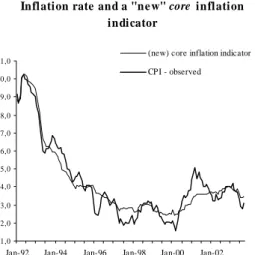
which is the case under LT1, this choice involves an arbitrary decision to make the variables “equally important”. The transformed variables will be indistinguishable from a “variance and location point of view”, as the diagonal elements of the cor-relation matrix are all unity. Using the new database, it also seems conceptually appealing to make the contributions and not the rates of change the “equally impor-tant variables”. An implementation of (7) may be found in figure (10).
The new database incorporates the weighting schemes associated to the House-hold Budget Surveys of 1989-90, 1994-95 and 2000, used for the calculation of the CPI(1991=100), CPI(1997=100) and the CPI (2002=100), respectively. As an im-provement against the previous core inflation indicators and with the objective of
widening the information contained in theP C1, the database was also expanded with
24If the P Ci are extracted from standardized data and the consumption basket weights remain unchanged over
time, note also that the use of indices or weighted indices is a totally irrelevant issue, as it has no effect on the correlation matrix. Nevertheless, equation (6) can only be seen as an approximation for the specification in changes.
1,0 2,0 3,0 4,0 5,0 6,0 7,0 8,0 9,0 10,0 11,0
Jan-92 Jan-94 Jan-96 Jan-98 Jan-00 Jan-02 (new) core inflation indicator CPI - observed
Inflation rate and a "ne w" core inflation indicator
Figure 10 - Core inflation indicator derived from the contributions of CPI items
two additional variables related with housing expenditures (housing rents and prices
of maintenance and repair of the dwelling).25 As expected, the overall behaviour of
the observed inflation rate is once again being captured by this factor model.26
6
Conclusions
This paper has investigated if the (OLS-scaled) first principal component (P C1),
ex-tracted from standardized yearly rates of change of basic items of the CPI, represents
a reasonable option for a core inflation indicator. Currently, the Banco de Portugal
uses this procedure to measure (and regularly publish) a core inflation indicator for
the Portuguese case. A special focus was placed on the final stage of the process of
finding the core indicator, in which theP C1 is subject to an OLS scaling, through a
regression of the CP I inflation rate on the CP1. The fitted values of this regression
- a so called ad-hoc procedure - determines the core inflation level.
From the confrontation of structurally different linear transformations of the original data, including the one suggested by Machado et al. (2001), it was concluded that no obvious gain is clearly achieved by changing the standardization procedure for any other of the remaining possibilities. The overall final results of all transformations were not easily distinguishable, which may be seen as particularly striking given that two of those transformations were purely arbitrary and not motivated by any
25During the period 1992-1997, only annual observations are available. In line with the monthly behaviour that
has been observed since 1997, it was therefore assumed that those annual figures were basically determined in the beginning of each year.
reason (except for comparison purposes). Even though most input variables are non-stationary, which was the main reason underlying the suggested transformation of Machado et al. (2001), the results were not find to be structurally dissimilar.
Secondly, if the objective is the find a smoother core inflation indicator then the
one currently in use, then lagged variables can be stacked to the original database. However, it was also argued that unless other reasons are brought into the
deci-sion process, this increased smoothness does not seem to represent per se a clear
superiority feature. Some type of non-contemporaneous dynamic structure as to be superimposed on the original data and if the shocks that hit the economy are not
smooth, why should thecore inflation indicator be smooth? In addition, the inclusion
of leads would prevent the indicator to be updated until the last period (abstracting from the possible use of some type of projections).
Finally, within a classical approach, the contents of the remaining principal compo-nents were also explored. Given that the main objective in the current analysis is to capture the general driving behaviour of the overall inflation rate, and not the total
variance present in the system, the conclusion was that a single component (theP C1)
seems sufficient. In the last 91 estimates, the OLS-scaled P C1 has always captured
more than 90% of the total variance of the CP I. Moreover, it was claimed that the
other eigenvectors may be capturing other effects rather than the “trend component”.
The sign and the magnitude of the OLS scaling of the remaining P Ci is also largely
unknown.
In general, the empirical evidence incorporated throughout this paper does suggest
that the OLS-scaled P C1, extracted from standardized yearly rates of change of basic
items of the CPI, does represent a reasonable option for a core inflation indicator.
Moreover, it was showed that no OLS parameter has to be estimated as a final
stage of the process of finding the core indicator. Instead of being seen as an
ad-hoc procedure, the OLS scaling can simply be interpreted as an appropriate linear
combination ofP Ci that replicates the observed inflation rate. To such purpose, this
paper introduced an orthogonal factor model that fully reproduces theCP I, in which
the following properties apply: (i) the results are not conditional on the eigenvectors
length; (ii) the variance of the CP I accounted for by each component is unique, and
as explanatory variables. The model was written down in price levels and in price changes (yearly rates) and this has given a clear interpretation to the OLS scaling.
To achieve these results, it is only necessary to respect the fact that the CP I can
be written down as a linear combination of the input data. In the latter case, under standardization, it would be the contributions and not the rates of change that could
be made “equally important variables” (which implies that the weights of the CP I
have to be fully taken into account for the determination of the CP1) and no OLS
regression has to be implemented (given that the final results are fully equivalent to a well defined scaling of the first eigenvector).
References
Afifi, A. A. (1984), Computer-Aided Multivariate Analysis, Lifetime Learning.
Alexander, C. (2001), Market Models, Wiley.
Angelini, E., Henry, J. and Mestre, R. (2001a), Diffusion index-based inflation
fore-cast for the euro area, Working Paper 61, European Central Bank.
Angelini, E., Henry, J. and Mestre, R. (2001b), A multi country trend indicator for
euro area inflation: Computation and properties, Working Paper 60, European Central Bank.
Bai, J. and Ng, S. (2002), ‘Determining the number of factors in approximate factor
models’, Econometrica 70, 191–221.
Carroll, J. D. and Green, P. E. (1997), Mathematical Tools for Applied Multivariate
Analysis, Academic Press.
Chatfield, C. and Collins, A. (1996),Introduction to Multivariate Analysis, Chapman
and Hall.
Coimbra, C. and Neves, P. D. (1997), Indicadores de tendˆencia de infla¸c˜ao, Boletim
Econ´omico, Banco de Portugal. (March 1997).
Cristadoro, R., Forni, M., Reichlin, L. and Veronese, G. (2001), A core inflation index for the euro area, Temi di discussione 435, Banca D’Italia.
Jackson, J. E. (1991), A User’s Guide to Principal Components, Wiley.
Johnson, R. A. and Wichern, D. W. (2002),Applied Multivariate Statistical Analysis,
Prentice Hall.
Jollife, I. (2002), Principal Component Analysis, Springer.
Krzanowski, W. (1996), Principles of Multivariate Analysis - A User’s Perspective,
Oxford University Press.
Machado, J., Marques, C. R., Neves, P. N. and Silva, A. G. (2001), Using the first principal component as a core inflation indicator, Working Paper WP 9/01, Banco de Portugal.
Mankikar, A. and Paisley, J. (2002), What do measures of core inflation really tell us?, Quarterly bulletin, Bank of England.
Marques, C. R., Neves, P. D. and Sarmento, L. M. (2000), Evaluating core inflation indicators, Working Paper WP 3-00, Banco de Portugal.
Stock, J. H. and Watson, M. W. (1998), Diffusion indexes, Working Paper 6702, NBER.
Stock, J. H. and Watson, M. W. (2002), ‘Macroeconomic forecasting using diffusion
Annex 1
List of CPI items1 UnpF x1 Potatoes and other tubers 1 Neig x42 Garments (man)
2 x2 Beans and grains 2 x43 Garments (woman)
3 x3 Vegetables 3 x44 Clothes (babies)
4 x4 Fruits 4 x45 Clothing accessories
5 x5 Mutton and others 5 x46 Clothing materials
6 x6 Pork 6 x47 Footwear (man)
7 x7 Cow meat 7 x48 Footwear (woman)
8 x8 Small meat parts and related items 8 x49 Footwear (children)
9 x9 Sausage 9 x50 Repairs to footwear
10 x10 Poultry 10 x51 Water supply
11 x11 Fresh and frozen fish 11 x52 Electric household appliances
12 x12 Sea food 12 x53 Non-electric household appliances
13 x13 Canned fish 13 x54 Furniture
14 x14 Smoked fish other related items 14 x55 Household textiles
15 x56 Glassware, tablewater, kitch. Items
16 x57 Kitch. utensils and related items
1 PrcF x15 Cereals 17 x58 Products used currently
2 x16 Flours 18 x59 Medicines
3 x17 Pasta products 19 x60 Medical materials
4 x18 Bread and bakery products 20 x61 Therap. appliances and equipment
5 x19 Eggs 21 x62 Purchase of vehicles
6 x20 Milk 22 x63 Sound and pictures related equip.
7 x21 Milk derivatives 23 x64 Newspapers and books
8 x22 Oils 24 x65 Non durable household goods
9 x23 Fats 25 x66 Durable household goods
10 x24 Sugar and honey 26 x67 Other articles
11 x25 Jam
12 x26 Biscuits
13 x27 Cakes and related items 1 Serv x68 Restaurants, caf´es and canteens
14 x28 Confectionary 2 x69 Clothing services
15 x29 Cocoa and related items 3 x70 Maintenance and repair
16 x30 Coffee and related items 4 x71 Medical and paramedical services
17 x31 Tea 5 x72 Services of medical auxiliaries
18 x32 Sauce, spices and foodstuff n.e.c. 6 x73 Other maintenance expendit.
19 x33 Food related items 7 x74 Other expenditure
20 x34 Wine 8 x75 Urban collect. pass. transp.
21 x35 Other alcohol beverages 9 x76 Suburban collect. pass. transp.
22 x36 Water 10 x77 Long distance collect. pass. transp.
23 x37 Juices 11 x78 Other public transp.
24 x38 Tobacco 12 x79 Postal services and telegraph
13 x80 Telephone
14 x81 Education
1 Enrg x39 Gas 15 x82 Repair services
2 x40 Electricity 16 x83 Culture
3 x41 Fuels and lubrificants 17 x84 Recreational services
18 x85 Radio fees and other services
19 x86 Other services
20 x87 Hotels
21 x88 Package holidays
22 x89 Games of chance