Hippocampal and striatal dependent navigation: Sex differences are limited
to acquisition
Brandy Schmidt
a,b, Tara K. Jacobson
b, Etan Markus
b,⁎
aUniversity of Hartford, West Hartford, CT, USA
bDepartment of Psychology, University of Connecticut, 406 Babbidge Rd Unit 1020, Storrs, CT 06269, USA
a b s t r a c t
a r t i c l e i n f o
Article history: Received 4 November 2008 Revised 7 April 2009 Accepted 22 April 2009 Available online 3 May 2009Keywords: Estrogen Place Response Learning Spatial Memory systems Navigation
Estrogen has been demonstrated to enhance the use of hippocampal-based place learning while reducing the use of striatal-based motor-response strategy (Korol, D.L., Malin, E.L., Borden, K.A., Busby, R.A., & Couper-Leo, J. (2004). Shifts in preferred learning strategy across the estrous cycle in female rats. Horm. Behav. 45, 330– 338). Previous research has focused on task acquisition and the switch from a place to motor-response navigation with training. The current paradigm allowed an examination of the interplay between these two systems by having well-trained animals switch strategies“on demand.”Female and male Sprague–Dawley rats were taught a motor-response task on a plus maze. The rats were then introduced to a place task and taught to switch, by cue, from the motor-response to place strategy. Finally, the rats were trained to continuously alternate between place and motor-responses strategies. The maze configuration allowed for an analysis of cooperative choices (both strategies result in the same goal arm), competitive choices (both strategies result in different goal arms), and single strategy choices (can only use the motor-response strategy). The results indicate that sex and estrogen-related effects on navigation strategy are limited to the initial stages of learning a task. The role of sex and estrogen is diminished once the task is well learned, and presumably, the relative involvement of the hippocampal and striatal systems is established.
© 2009 Elsevier Inc. All rights reserved.
Introduction
Different neural systems mediate a range of behaviors and learning. Two such systems are the hippocampal system–known to be involved in spatial navigation (Jarrard, 1995) and the dorsal striatal system – involved in habit and motor-responses (Packard and Knowlton, 2000). These disparate systems are suggested to be parallel processors— that is, they receive the same information but only activate it when that information is pertinent to the task at hand (Poldrack and Packard, 2003; White and McDonald, 2002). In place learning, the rat utilizes spatial cues in order to determine the whereabouts of a goal, while in motor-response learning, the goal location is based on a body movement. Exactly how these systems interact is the subject of much research (Chang and Gold, 2003; Gibson and Shettleworth, 2005; Kesner et al., 1993; Packard and McGaugh, 1996; Packard and Knowlton, 2000; Schroeder et al., 2002; White and McDonald, 2002). Evidence that the hippocampus mediates place learning (“go there”) and the striatum mediates motor-response learning (“turn right”) is demonstrated using an ambiguous T-maze alternation task (Tolman et al., 1946).Packard and McGaugh (1996)trained rats on a T-maze to turn right (east arm) for
food reward. After eight and sixteen trials, a probe trial was administered, and the start location was rotated 180°. The rat could use a motor-response and make a right hand turn (west arm) or use a place strategy and turn left (east arm). On thefirst probe trial, rats predominately used place strategies. Upon extended training, the rats predominately used a motor-response. Reversible lesions of the hippocampus biased the animals to the motor-response strategy, while striatal inactivation resulted in a place strategy preference (Packard and McGaugh, 1996). Similar effects are seen with post-training hippocampal inactivation (Schroeder et al., 2002). Addition-ally, post-training infusions of glutamate have been shown to enhance memory. Using the same place and motor-response strategy T-maze paradigmPackard (1999)infused glutamate into the dorsal striatum or hippocampus. Glutamate infusions into the hippocampus pre-served place strategy preference from the early to the late probe trial. Additionally, when glutamate was infusioned into the striatum motor-response learning was accelerated in the early probe and maintained during the late probe trial.Chang and Gold (2003)demonstrated that with training there is increased acetylcholine in the striatum that is correlated with the switch from place to motor-response strategies. The double dissociation between the hippocampus and striatum suggests that these two systems are in competition, with the relative amount of activity in each system affecting which system will dictate the animal's behavior. The dissociation between the hippocampus and striatum has been seen in humans (Doeller et al., 2008).
⁎Corresponding author.
E-mail address:[email protected](E. Markus).
0018-506X/$–see front matter © 2009 Elsevier Inc. All rights reserved. doi:10.1016/j.yhbeh.2009.04.004
Contents lists available atScienceDirect
Hormones and Behavior
in the degree to which they depended upon a spatial or motor-response strategy. It has been shown that estrogen modulates strategy use during maze tasks (Korol et al., 2004; Zurkovsky et al., 2007). Systemic injections of estradiol facilitated place learning and exacerbated motor-response learning (Korol and Kolo, 2002). Infu-sions of estradiol into the hippocampus enhanced place learning, but had no effect on motor-response learning (Zurkovsky et al., 2007). However, estradiol infusions into the striatum produced the opposite effect; while there was no effect on place learning, motor-response learning was impaired. Similar results have also been seen in natural cycling rats. Rats in proestrus (high estrogen levels) show a preference of place over motor-response strategies, while rats in estrus (low estrogen) show the opposite (Korol et al., 2004).
In the past, two approaches have been used to examine strategy dominance. Thefirst, the ambiguous T-maze alternation task, is based on one or two probe trials to uncover which strategy the animal has been using (e.g. see abovePackard and McGaugh, 1996). This paradigm provides only two data points and does not allow for a continuous assessment of behavior. A second approach is based on training the rats to solve the maze using afixed strategy (e.g.“always turn right”) and recording the rate of acquisition (e.g.Korol and Kolo, 2002). The speed of acquisition allows for inferences regarding the dominance of the competing system; this approach is limited to examining acquisition rate. While both these experimental paradigms have shown dissociation between the hippocampal “place” system and the striatal “ motor-response”system, they cannot determine the degree to which these two regions interact with each other as animals perform a navigation task.
A new paradigm developed in our lab (Jacobson et al., unpublished data) combines hippocampal-dependent place strategy and striatal-dependent motor-response strategies within the same training session. First, rats were taught a simple motor-response (“turn right”) task on a plus maze. Second, once proficient at the motor-response task, rats were introduced to the place task, identified by a salient cue (flashing light), and taught tofind the same goal arm (east arm), regardless of their location on the maze. Rats were then trained to switch between blocks of the previously learned motor-response and newly learned place strategies. Finally, rats were trained to pseudorandomly switch between place and motor-response trials. This paradigm allows for the examination of sex differences in the acquisition of motor-response and place tasks. Importantly, this paradigm also allows for an examination of post-acquisition effects of estrogen on strategy choice.
Methods Subjects
Eight male and ten female Sprague–Dawley, 4 months old at the beginning of the study, were trained (Harlan Sprague Dawley, Indiana). The rats were housed individually in clear Plexiglas cages (46 × 20 × 23 cm) with wood chip bedding and maintained on 12/ 12 hour light/dark cycle. The rats were maintained at about 90% of their ad lib. weight during the experiment. All procedures were approved by the University of Connecticut IACUC.
leukocytes (≤10%) were classified as proestrus. Smears containing primarily cornified cells (≥90%) were classified as estrus. Data from irregular cycling animals were not used in the analysis. The male rats were given an anal probe with a Q-tip in parallel to the female lavage in an attempt to equate handing.
Behavioral training and apparatus Apparatus
A black Plexiglas runway (120.7 cm × 10.2 cm) was used for pretraining. The four arm plus maze was constructed of black Plexiglas (112.4 cm × 10.8 cm raised 15.9 cm off the table) and had four black Plexiglas perimeter runways (seeFig. 1).
Pretraining
Rats were trained to run back and forth on a linear runway for chocolate sprinkle rewards once a day, daily for 14 days. The daily training sessions continued up to 15 min on the maze or until the rat reached criterion offive trials in 5 min.
General plus maze procedure
The animals were trained on a plus maze in a dimly lit room. Animals were placed on the start arm behind a transparent barrier. The trial started when the barrier was lifted and ended as soon as the rat chose an arm (forelimbs half way through the arm). Once a trial ended, the rat was blocked from re-entering the maze and guided through the perimeter runways to the next start arm (seeFig. 1). The perimeter allowed the animal to return to the start arm after each trial without traversing back through the maze. Additionally this was expected to minimize stress by reduced experimenter handling of the animal (Conrad et al., 2004). When errors were made the animal was returned to the start arm to repeat the trial until it was done successfully. The rats were divided into two groups of nine rats. Each group was run every other day, six days a week. Each rat was trained until thirty-two correct trials were completed or until 25 min had passed.
Experiment I: motor-response training
During the first two training days, the rats were allowed to explore the maze freely until the reward was found. After the reward was found, the rats were guided via the perimeter runway to the next start arm and the next trial commenced. This allowed the rats to get acclimated to the maze. These two days were not used for data analysis. On the third day of training, the rats were trained to perform a motor-response task (“make a right hand turn”). Each trial ended after the rat entered a maze arm, whether or not a correct motor-response was made. The rat was then guided via the perimeter runway to the next start arm (if an error was made, the rat was returned to the original start arm to repeat the trial until successful). Training continued until each rat reached criterion (≥80% correct total trials on two consecutive training days). Once the rat reached criterion for Experiment I, the rat commenced training on Experiment II, the mixed place/motor-response task (Table 1).
Experiment II: place and motor-response blocks training
In Experiment II, rats were trained on blocks of motor-response and place trials with session lasting 25 min or thirty-two correct trials, whichever camefirst. The sessions were broken up roughly into half place/half motor-response blocks (∼16 trials each). Again, during the motor-response block, rats were rewarded for making a right hand turn on the maze. During the place block, rats were trained to go to the designated place arm (east arm) regardless of the start arm. The place trials were differentiated from the motor-response trials by aflashing light. Thefirst training day began with a block of the motor-response trials, followed by a block of place trials. This was switched on the next training day, which began with a block of place trials, followed by a block of motor-response trials. The subsequent training consisted of switching once or twice between motor-response trails and place trials. As with Experiment I, after making a correct choice, the rats were guided via the perimeter runway to the next start arm, and an incorrect response resulted in a repeat of the trial until successful. Training continued until each rat reached criterion (≥80% correct for both place and motor-response trials for two consecutive days) after which the rat commenced training on Experiment III, the mixed place and motor-response task (Table 1).
Experiment III: mixed place and motor-response training
In Experiment III, each rat was given a similar number of place and motor-response trials with sessions lasting 25 min or thirty-two correct trials, whichever camefirst. However, the place and motor-response trials were interwoven with no more than three consecutive trials of one trial type. All rats were tested for eight days past criterion (≥80% correct on both place and motor-response trials for two consecutive days). To gather more estrous cycle data, female rat testing continued up to sixteen days past criterion.
Data analysis
Sex differences were assessed with one-tailed student's t-tests with the alpha level set at .05. Trial type error analysis (see below) and estrous cycle effects were assessed with a one-way ANOVA.
Maze performance analysis
The configuration of the plus maze allowed for an examination and analysis of errors made (see Fig. 1). The four arms of the maze contained a designated start arm, a goal arm, and two alternate arms. Each trial configuration was designated as cooperative, competitive, or single option, based on the strategy that could be used at the start arm. The north and west arms are designated competitive arms (Fig. 1C). On a competitive arm/trial the rat could utilize either a place or motor-response strategy, resulting in different end arms (east/west for a north start arm and east/south for a west start arm). Specifically, the rat could use a place strategy, which would lead to the east arm, or a motor-response strategy and make a right hand turn (i.e. if the rat is starting on the north arm, the rat could use a place strategy, which would lead to the east arm, or use a motor-response strategy that would lead to the west arm). The east arm is designated a single strategy trial (Fig. 1D). A single strategy arm/trial permits for the use of only the motor-response strategy (i.e. the rat would start on the east arm, allowing only for a right hand turn onto the north arm). The south arm is designated a cooperative arm/trial (Fig. 1E). On a cooperative trial, both strategies resulted in ending in the goal arm/ east arm (i.e. the rat could use a place strategy, which would lead to the east arm, or a motor-response strategy and make a right hand turn, also ending on the east arm). Therefore, errors were designated based upon task and trial configuration (i.e. when designated a place trial (light on), if the rat starts at the north arm and then goes to the west
Fig. 1.Representation of task types and error configuration. The rats were taught two different strategies. (A) In the motor-response task rats were trained to make a right hand turn regardless of start arm. (B) A strobe light cued the place task where the rat learned to go to the same end arm regardless of start arm. Errors are based on task type (place/response) and the trial configuration of the start arm; each start arm is designated competitive (north and west), single strategy (east) and cooperative (south) (i.e. when designated a place trial (light on), if the rat starts at the north arm and then goes to the west arm, the rat has made a competitive place error). (C) On a competitive trial place and motor-response strategies indicated different goal locations. The rat could also make an“other choice”and disregard both place and response possibilities by going to the third arm. (D) A single strategy trial only allowed for the use of the motor-response strategy since the start arm is the place strategy goal arm. (E) On a cooperative trial both place and motor-response strategies result the same goal location.
Table 1
Experiment procedure.
Exp. Task Trials Criterion
I Motor-response All response 2 days 80% correct
II Half motor/half place Blocks of 16 motor/16 place trials
2 days 80% correct on both place/response III Mixed motor/place Interleaved motor and
place trials
2 days 80% correct on both place/response Sessions ended after 32 correct trials or after 25 min. Rats were trained until criterion was met. All rats were trained on all three experiments.
number of trials run per session, and latency per trial were not affected by sex (Table 2). Overall, the males required fewer days to reach criterion (t (15)= 2.90, pb.05). Once all the rats reached
criterion (two days of≥80% correct), there were no effects of sex (Table 2) or estrous cycle (Table 3) on percent choice correct, number of trials or latency.
Experiment II: place and motor-response task blocks task
Thefirst training day began with a block of motor-response trials followed by a block of place trials. Introducing the place task was confusing for the animals, bringing their performance close to chance (Table 2), with no sex effects on percent correct (t(16)=−.07,pN.10).
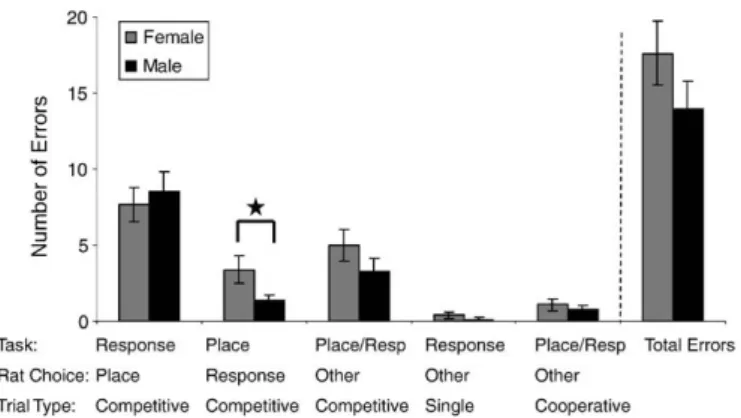
Day two of training began with a block of place trials followed by a block of motor-response trials. Females tended to make more errors than males during the place trial block (t(16)=−1.518,p= .067,Fig. 2). There was a carry over effect, due to an increased use of previously learned motor-response strategy during competitive place type trials and failure to switch to the newly learned place strategy (t(16)= 1.86, pb.05,Figs. 1 and 2). There were no other sex differences (Table 2). Following the place trial block, the motor-response trial block was reintroduced, and again the rats had a carry over effect since both sexes had difficulty switching back to the motor-response strategy (combined male–female data, comparing percentage of correct motor-response trials day one to day two,t (34)= 8.37, pb.0001).
After day two of Experiment II a carry over effect was not looked for in the following training sessions. The data analysis focused on a general incapability to switch between tasks regardless of the previous trial type.
Table 2
Sex difference summary for studentt-tests and ANOVA analysis.
Experiment Male Female
I: Response task Day 1 % Correct 58% (.12)a 29% (.06)a Total errors 13.86 (3.91) 21.1 (3.67) Latency 40.6 (4.80) 42.05 (2.99) Total # of trials 33.57 (2.20) 27.9 (3.81) Days to criteria 3.0 (.31)a 4.1 (.23)a At criteria % Correct 91% (.01) 92% (.02) Total errors 3.35 (.52) 3.0 (.72) Latency 31.91 (1.21) 31.70 (1.33) Total # of trials 34.92 (.70) 34.72 (.56)
II: Place and response task blocks
Day 1
Total % Correct 61% (.03) 60% (.03)
Place trials % Correct 38% (.05) 38% (.04)
Response trials % Correct 98% (.01)a
92% (.03)a
Total # of errors 19.0 (1.96) 18.7 (1.52)
Place errors on response trial .00 (.00) .2 (.13)
Response errors on place trial 11.25 (1.57) 11.3 (1.02)
Other arm errors 6.63 (.88) 6.1 (.69)
Single strategy error .125 (.125)b
.70 (.33)b Cooperative strategy error 1.0 (.38)b
.40 (.16)b
Latency 26.64 (1.57) 29.14 (1.46)
Total # of trials 48.38 (1.63) 47.1 (1.24)
Day 2
Total % Correct 67% (.04) 63% (.04)
Place trials % Correct 79% (.03)b
69% (.05)b
Response trials % Correct 58% (.06) 58% (.06)
Latency 31.09 (1.80) 29.22 (2.26)
Total # of trials 42.75 (.82) 46.4 (1.93)
Days to criterion 7 (1.05) 6.9 (.75)
At criteria
Total % Correct 86% (.01) 87% (.01)
Place trials % Correct 84% (.02) 86% (.02)
Response trials % Correct 89% (.02) 89% (.02)
Latency 21.84 (1.04)a
25.10 (1.18)a
Total # of trials 37.13 (.46) 36.75 (.54)
III: Pseudorandom place and response task
Day 1 Latency 22.04 (2.41) 23.94 (1.27) Total # of trials 38.0 (1.46) 40.8 (.55) Days to criterion 3.5 (.38) 3.2 (.43) At criteria Total % Correct 90% (.01) 90% (.01)
Place trials % Correct 90% (.01) 90% (.01)
Response trials % Correct 90% (.01) 90% (.01)
Total # of errors 3.79 (.22) 3.88 (.27)
Place errors on response trial 1.82 (.17) 1.82 (.16)
Response errors on place trial 1.79 (.14) 1.77 (.16)
Other arm errors .13 (.04)a .24 (.05)a
Single strategy error .01 (.01) .02 (.01)
Cooperative strategy error .04 (.02) .05 (.02)
Latency 19.43 (.36)a
22.28 (1.07)a
Total # of trials 35.81 (.22) 35.24 (.29)
Note. Values given represent mean. Standard error of measurement is represented in parentheses. a pb.05. b pb.10. Total # of errors 5.5 (.78) 5.67 (.88) 4.5 (2.5) 4.67 (1.76) Place errors on response
trial
2.5 (.71) 2.33 (1.86) 1.5 (.50) 1.33 (.88) Response errors on place
trial
2.00 (.46) 3.0 (1.15) 2.0 (2.0) 3.33 (.88) Other arm errors .75 (.31) .33 (.33) .00 (.00) .00 (.00) Single strategy error .00 (.00)⁎ .00 (.00)⁎ .50 (.50)⁎ .00 (.00)⁎
Cooperative strategy error .25 (.16) .00 (.00) .50 (.50) .00 (.00) Latency 28.78 (2.03) 24.40 (.60) 22.62 (.32) 22.08 (2.70)
III: Pseudorandom place and response training
At criteria
Total % Correct 91% (.01) 91% (.01) 89% (.02) 93% (.01) Place trials % Correct 90% (.01) 90% (.02) 90% (.02) 92% (.02) Response trials % Correct 92% (.01) 92% (.02) 90% (.02) 94% (.01) Total # of errors 3.36 (.37) 3.44 (.56) 4.1 (.68) 2.45 (.43) Place errors on response
trial
1.48 (.23) 1.52 (.34) 2.05 (.49) 1.15 (.25) Response errors on place
trial
1.61 (.19) 1.76 (.32) 1.8 (.45) 1.1 (.27) Other arm errors .16 (.06) .16 (.07) .20 (.12) .15 (.11) Single strategy error .09 (.04) .00 (.00) .00 (.00) .00 (.00) Cooperative strategy error .07 (.04) .00 (.00) .05 (.05) .05 (.05) Latency 20.13 (.86) 21.90 (2.51) 20.44 (1.00) 19.44 (.66)
Note. Values given represent mean. Standard error of measurement is represented in parentheses.
Once at criterion, sex did not have an effect on correct responses, although males ran faster than females (t(31)=−2.067,pb.05,Table 2). Notably, although the rats were at asymptotic performance at criterion, they continued to show a distinct pattern of errors on the maze. The rats made more incorrect strategy errors on competitive than other types of trials (combined male–female data,F(4, 175)= 32.05, pb.000;Fig. 3). A post hoc analysis showed more competitive place or competitive response type errors than on single, cooperative, and choosing the“other”arm type errors (all Tukeypb.0001). Despite the errors on competitive trials, an analysis of the female data did not show any effect of the estrous cycle on any type of error (allpN.10) or latency (F(3,12)= 2.20,pN.10) (Table 3).
Experiment III: mixed place and motor-response task
On thefirst day of the mixed motor-response/place task, males performed better than females. Males had more correct trials overall (t(16)= 2.25,pb.05); this was primarily due to better performance on
motor-response trials (t(16)= 2.67,pb.01,Fig. 4andTable 2). Females
made more errors on motor-response trials —specifically, females made more errors by incorrectly utilizing the place strategy on the
motor-response task (Fig. 5). There was no difference in latency or days to criterion (Table 2).
Once at criterion, males were faster than females (t(155)=−2.34, pb.05). The rats continued to make errors while at asymptomatic performance, however, the trial configuration error analysis showed no sex differences (all trials pN.10) except on competitive “other”
trials (t(178) = 1.78,pb.05). As in Experiment II, the combined data showed the same pattern of errors (F(4, 1075)= 179.73,pb.0001). A
post hoc analysis showed more competitive place or motor-response type errors than on single, cooperative, and choosing the“other”arm type errors (all Tukeypb.0001). Also, once at criterion there were no effects of the estrous cycle on performance or latency (Table 3).
Discussion
The current series of experiments allowed for an examination of both acquisition and post-acquisition performance in a number of navigation tasks. Thefirst was a motor-response task similar to that used byKorol and Kolo (2002). This was followed by the addition of a second method of reaching the goal, using a place strategy. The degree to which adding this second strategy disrupted the previously learned motor-response strategy was measured. The third experiment used a task that demanded a constant shift in navigation strategy. This allowed for the analysis of the continuous interplay between the place system and motor-response system.
Ten naturally cycling female rats were tested across the estrous cycle. The repeated testing of the animals at criterion allowed for a
Fig. 2.Experiment II, day two error analysis. In Experiment II, the rats were taught to use a place strategy for half of the session. Thefirst half of the day one session consisted of motor-response trials. The second half of the session consisted of place trials. Depicted are the data from the following day (day 2), where thefirst half of the session consisted of place trials and the second half motor-response trials. In thefirst half of the session (place trials) females continued to (incorrectly) use motor-response strategies more than the males. In the second half of the session (response trials), the males and females both incorrectly used place trials to solve the task. Rats that were trained successfully on Experiment I were subsequently trained in Experiment II.
Fig. 3.Experiment II, at criterion. Rats made more incorrect strategy errors on competitive arms than other types of trials. Specifically, competitive trials where the rat could utilize either strategy, place or motor-response, had more errors than other trials types that utilized both strategies (cooperative trials), only the motor-response strategy (single trial) or lastly a competitive arm where neither place or motor-response strategies would lead to a goal arm (competitive“other”). Rats that were trained successfully on Experiment I were subsequently trained in Experiment II.
Fig. 4.Percent correct for Experiment III, day one. These sessions consisted of mixed place and motor-response trials. Overall the males had a higher percent of correct trials. This was mostly due to the fact that males performed better than females on the motor-response trials. Rats that were trained successfully on Experiment II were subsequently trained in Experiment III.
Fig. 5.Error analysis for Experiment III, day one. Females made more overall errors than males. Additionally, females made more errors by incorrectly using place strategies on motor-response trials. Interestingly, there were no differences between incorrectly using motor-response strategies on place trials. Rats that were trained successfully on Experiment II were subsequently trained in Experiment III.
in anxiety, exploration, and cue utilization; however, these effects are diminished with repeated exposure to the environment (Tropp and Markus, 2001).
Learning the motor-response task
In Experiment I, rats were trained on a motor-response task.
Packard and McGaugh (1996)demonstrated that rats are initially disposed to use spatial strategies. Thus the motor-response task training required the animals to inhibit their place bias. The current results indicate that initially males were better than females at learning the motor-response task. However, with continuous training, both sexes showed equal asymptotic performance.
Korol and colleagues (Korol, 2004; Korol and Kolo, 2002; Korol et al., 2004; McElroy and Korol, 2005) found that estrogen-treated rats had a harder time than oil-treated animals when they had to acquire this motor-response strategy over the course of a single day. In the current study, no such affect was found at criteria. Taken together these data indicate that the estrogen effects are limited to the acquisition of a navigation task.
Introducing the place task and mixed trials
By the end of Experiment I, the rats had successfully learned the motor-response task, and the effect of adding a second strategy (place) was examined. Experiment II required switching back and forth between the newly learned place task and previously learned motor-response task. This task was harder and required twice as much training to reach criterion as Experiment I. After learning this task, rats were trained to switch between place and motor-response strategies many times during the same session.
On thefirst day of Experiment II, all groups showed only chance performance on the place trials. On the following training day, both groups showed above chance performance during the block of place trials, and sex differences and a carry over effect were found. The female rats were utilizing the old and incorrect (at the time) motor-response strategy and did not switch over to utilizing the place strategy as well as the males. Following the place trials, the rats were given a block of motor-response trials, and both males and females were equally able to switch back to the previous strategy (although performance for both was significantly impaired, again a carry over effect, noteTable 2). On thefirst day of Experiment III, again females made more errors than males. This was mainly due to females making more place strategy errors on motor-response trials. Beyond the initial day of training, both males and females acquired the task equally well. Again, once at asymptomatic performance, sex no longer mitigated the type of errors made, nor the total amount of errors.
At criterion for Experiments II and III, the males ran faster than the females, in agreement with previous data (Blokland et al., 2006). Additionally, once at asymptomatic performance, estrogen did not modulate cognitive strategies. Unlike previous acquisition studies, once at criterion, rats in proestrus did not demonstrate improved performance on place trials, and rats in estrus were not better on motor-response trials. Thesefindings are in contrast with previous
existed on the initial trial of the day. These data demonstrate that the effects of estrogen, if any, are minimal once the task is well learned (Frye, 1995). To what degree Frye's findings are specific to using estrogen replacement, the water maze, or the relearning of a task is unclear.
Behavioralflexibility
Studies exploring multiple memory systems suggest that the prefrontal cortex is important in behavioralflexibility (i.e. switching between/within tasks) (Ragozzino et al., 1999; Rich and Shapiro, 2007). Thus,Ragozzino et al. (1999)showed that the prefrontal cortex is necessary for the behavioralflexibility between different strategies (i.e. place followed by motor-response or motor-response followed by place) but isn't required for the switching within strategies (i.e. place reversal learning or motor-response reversal learning). However, the contribution of the prefrontal cortex in strategy switching is diminished with extensive training (Rich and Shapiro, 2007). A similar study in humans using fMRI (Doeller et al., 2008) looked at hippocampal and striatal activity during a simulated version of the MWM, as well as prefrontal cortex activity. Activation of the ventromedial prefrontal cortex was highest when both the hippo-campus and striatum were highly active. Ventromedial prefrontal cortex activation was lowest when only the hippocampus or striatum was active. Taken together these two studies suggest that even though the prefrontal cortex is involved in behavioralflexibility, the intensity of the activation drives which system is utilized.
Conclusion
Multiple memory systems have been a topic of recent interest. Several studies have elucidated how different neural systems interact with each other during learning (Packard and McGaugh, 1996; Poldrack and Packard, 2003; White and McDonald, 2002). The maze paradigm used in the current study was designed to do the following: 1) analyze how the hippocampus and striatum interact during strategy selection, and 2) analyze how sex and estrous cycle affect navigation choice. Place and motor-response trials were used to presumably engage (respectively) the hippocampal and striatal systems (Packard and McGaugh, 1996; Packard and Knowlton, 2000; Poldrack and Packard, 2003; Schroeder et al., 2002; White and McDonald, 2002; Kesner et al., 1993). The analysis of trial confi gura-tion type (Figs. 2, 3 and 5) demonstrates that trials requiring the place and motor-response navigation system to work competitively resulted in more errors. Conversely, trials that allowed these systems to work cooperatively to solve a task resulted in almost no errors. This error pattern was retained through criterion (seeTable 2III), and even extensively trained animals found the constant switching between tasks difficult, as shown by their continuing∼10% errors, mostly on the competitive trial configuration. Dissociation studies, such as that of Packard and McGaugh (1996) and Kesner et al. (1993), used lesions to demonstrate that place and motor-response learning is contingent upon the hippocampus and striatum, respec-tively. Taken together with previous research (Kesner et al., 1993;
Packard and McGaugh, 1996; White and McDonald, 2002), our data reaffirms that hippocampus and striatum are active in parallel and compete with each other to influence behavioral output. Our maze paradigm suggests that when the hippocampus and striatum are simultaneously engaged during place and motor-response learning, respectively, there is a competition between these two systems which results in an increase in performance errors. Specifically, when an error was made during a competitive trial, the rat most often made a competing system error and rarely a neutral error (i.e. on a competitive place trial, an error would result in the incorrect use of a motor-response strategy). This suggests that when one system was not being utilized (for example, place), the other system (motor-response) was readily available.
Importantly, this pattern of errors at criterion was not affected by sex or estrous cycle. Taken together with previous research, these data indicate an estrogen role only during the initial organization of a navigation behavior. Once the relative contributions of the hippo-campus and striatum have been established, they become indepen-dent from the effects of naturally circulating hormones.
Acknowledgments
We would like to thank Chris Cleaver for his contribution to the paradigm, Greg Peters for help with lavaging, and David Morrow for help with lavaging and data input.
References
Blokland, A., Rutten, K., Prickaerts, J., 2006. Analysis of spatial orientation strategies of male and female Wistar rats in a Morris water escape task. Behav. Brain Res. 171, 216–224.
Chang, Q., Gold, P.E., 2003. Switching memory systems during learning: changes in patterns of brain acetylcholine release in the hippocampus and striatum in rats. J. Neurosci. 23 (7), 3001–3005.
Conrad, C.D., Jackson, J.L., Wieczorek, L., Baran, S.E., Harman, J.S., Wright, R.L., Korol, D.L., 2004. Acute stress impairs spatial memory in male but not female rats: influence of estrous cycle. Pharmacol. Biochem. Behav. 78, 569–579.
Davis, D.M., Jacobson, T.K., Aliakbari, S., Mizumori, S.J.Y., 2005. Differential effects of estrogen on hippocampal and striatal dependent learning. Neurobiol. Learn. Mem. 84, 132–137.
Doeller, C.F., King, J.A., Burgess, N., 2008. Parallel striatal and hippocampal systems for landmarks and boundaries in spatial memory. Proc. Natl. Acad. Sci. U. S. A. 105 (15), 5915–5920.
Dohanich, G.P., 2002. Gonadal steroids, learning and memory. Hormones brain and behavior. Academic, San Diego, pp. 265–327.
Frye, C.A., 1995. Estrus-associated decrements in a water maze task are limited to acquisition. Physiol. Behav. 57 (1), 5–14.
Gibson, B.M., Shettleworth, S.J., 2005. Place versus response learning revisited: tests of blocking on the radial arm maze. Behav. Neurosci. 119 (2), 567–586.
Jarrard, L.E., 1995. What does the hippocampus really do? Behav. Brain Res. 71 (1–2), 1–10.
Jonasson, Z., 2005. Meta-analysis of sex differences in rodent models of learning and memory: a review of behavioral and biological data. Neurosci. Biobehav. Rev. 28, 811–825.
Kesner, R.P., Bolland, B.L., Dakis, M., 1993. Memory for spatial locations, motor responses, and objects: triple dissociation among the hippocampus, caudate nucleus, and extrastriate visual cortex. Exp. Brain Res. 93 (3), 462–470. Korol, D.L., 2004. Role of estrogen in balancing contributions from multiple memory
systems. Neurobiol. Learn. Mem. 82, 309–323.
Korol, D.L., Kolo, L.L., 2002. Estrogen-induced changes in place and response learning in young adult female rats. Behav. Neurosci. 116 (3), 411–420.
Korol, D.L., Malin, E.L., Borden, K.A., Busby, R.A., Couper-Leo, J., 2004. Shifts in preferred learning strategy across the estrous cycle in female rats. Horm. Behav. 45, 330–338. Packard, M.G., 1999. Glutamate infused posttraining into the hippocampus or caudate-putamen differentially strengthens place and response learning. Proc. Natl. Acad. Sci. U. S. A. 96 (22), 12881–12886.
Packard, M.G., Knowlton, B.J., 2000. Learning and memory functions of the basal ganglia. Annu. Rev. Neurosci. 25, 563–593.
Packard, M.G., McGaugh, J.L., 1996. Inactivation of hippocampus or caudate nucleus with lidocaine differentially affects expression of place and response learning. Neurobiol. Learn. Mem. 65, 65–72.
Poldrack, R.A., Packard, M.G., 2003. Competition among multiple memory systems: converging evidence from animal and human brain studies. Neuropsychology 41, 245–251.
Ragozzino, M.E., Detrick, S., Kesner, R.P., 1999. Involvement of the prelimbic-infralimbic areas of the rodent prefrontal cortex in behavioralflexibility for place and response learning. J. Neurosci. 19 (11), 4585–4594.
Rich, E.L., Shapiro, M.L., 2007. Prelimibic/infralimbic inactivation impairs memory for multiple task switches, but notflexible selection of familiar tasks. J. Neurosci. 27 (17), 4747–4755.
Schroeder, J.P., Wingard, J.C., Packard, M.G., 2002. Post-training reversible inactivation of hippocampus reveals interference between memory systems. Hippocampus 12, 280–284.
Tropp, J., Figueiredo, C.M., Markus, E.J., 2005. Stability of hippocampal place cell activity across the rat estrous cycle. Hippocampus 15 (2), 154–165.
Tropp, J., Markus, E.J., 2001. Sex differences in the dynamics of cue utilization and exploratory behavior. Behav. Brain Res. 19 (2), 143–154.
Tolman, E.C., Ritchie, B.F., Kalish, D., 1946. Studies in spatial learning. II. Place learning versus response learning. J. Exp. Psychol. Gen. 36 (3), 221–229.
White, N.M., McDonald, R.J., 2002. Multiple parallel memory systems in the brain of the rat. Neurobiol. Learn. Mem. 77, 125–184.
Zurkovsky, L., Brown, S.L., Boyd, S.E., Fell, J.A., Korol, D.L., 2007. Estrogen modulates learning in female rats by acting directly at distinct memory systems. Neuroscience 144, 26–37.