1
CULTURAL DIFFERENCES AFFECTING DECISION-MAKING
STYLE: A COMPARATIVE STUDY BETWEEN 4 COUNTRIES
Marina Dabić1, Darko Tipurić2, Najla Podrug31 Faculty of Economics and Business, University of Zagreb, Zagreb, Croatia, Nottingham Business School, Nottingham Trent University, Nottingham, UK
2,3 Faculty of Economics and Business, University of Zagreb, Zagreb, Croatia
E-mail 1[email protected] (corresponding author) Received 24 March 2012; accepted22 October 2013
Abstract. The aim of this paper was to identify the impact of national culture on decision-making styles in selected countries: Croatia, Slovenia, Bosnia and Herzegovina and Hungary. The estimation of Hofstede’s dimensions of national cultures and comparative analyses was carried out by using a narrow-sample strategy. The estimated positions on each dimension confirmed the Hofstede’s original research ranking. The result with significant value was the confirmation of the global trend of decreasing power distance and significant movement towards the individualism. Besides the standardization procedure of comparative cross-cultural analyses, variance analyses were used to identify cultural differences in decision-making styles related to complex decisions (Janis and Mann’s typology). The proposition is that complex decisions are, above and beyond all others, the
consequence of social and cultural values installed in every individual. Statistically significant dependency was identified for hyper-vigilant and vigilant decision-making style and national culture’s dimensions. A beneficial goal was to identify the differences and the similarities in value orientation and those in the decision-making style which should not be mistreated as they may influence future business cooperation and political and economic integrations within the CEE context. Keywords: cultural differences, decision-making styles, Croatia, Slovenia, Bosnia and Herzegovina, Hungary.
Jel Classification: M10, M16.
Introduction
In the context of globalization processes and the growth of economic interdependence among countries, the national culture is becoming more and more important (Adler 1991; Harvey, Miceli 1999; Ginevičius, Vaitkūnaitė 2006; Radović-Marković 2008; Harvey, Moeller 2009; Stah et al. 2010; Minkov, Hofstede, 2011; Schwartz 2014). Understanding culture can equip a person for the challenges of contemporary international business even within the national context. Nevertheless, recognizing the importance of cultural differences helps managers understand their international partners and competitors and ultimately helps to improve their managerial skills (Cullen, Praveen Parboteeah 2011). The objective of this research was to identify the cultural distinction between Croatia, Slovenia, Bosnia and Herzegovina and Hungary using the methodology introduced by Hofstede. Countries positioning by the Hofstede’s dimensions do not expose all differences among cultures or countries, but do sum up the greater part (MacNab, Worthley 2013). These dimensions representing
2
cultural differences have confirmed empirically on many occasions that they are related with numerous aspects from the management and organizational domains (Iglehart 1997; Trompenaars, Hampden-Turner 2000; House et al. 2002).
The additional interest of this research is to determine cultural differences in decision-making styles. The decision-decision-making process depends on cultural background and choice of “the right way” – the decision-making style is dependent on values and beliefs of people involved in the decision-making process (Mann et al. 1998). According to Yousef (1998) empirical research in cultural differences in the decision-making style is marginalized in comparison to other aspects in management research. So, those were the arguments for identifying cultural differences in decision-making style.
2. National culture: definitions and dimensions
Various authors from completely different scientific fields have attempted to analyse and define culture by observing it at different levels and in different forms (Fisher, Poortinga 2012). On the one hand Weber and Hsee (2000) used the psychological approach and revealed encouraging trends in cross-cultural judgment and decision-making research with an emphasis on a shift from merely describing national differences in overt behaviour to exploring the underlying processes that explain these differences.
On the other hand Bazerman and Tenbrunsel (2011) and Wright and Drewery (2006) bring into focus the importance of national cultures linking cultures and systems of thought through holistic versus analytic cognition.
Hofstede (1980) deserves credit for the most popular definition of culture that also refers to the sources and the important characteristics of culture seen as “the collective programming of the mind which distinguishes the members of one human group from another…the interactive aggregate of common characteristics that influences a group’s response to its environment”. The mind stands for the head, the heart and hands, i.e. for thinking, feeling and acting resulting in beliefs, attitudes and skills. The concept of a collective programming of the mind resembles the concept of habitus proposed by the French sociologist Bourdieu (Hofstede 2001).
In 1961Kluckhohn and Strodtbeck came up with a multidimensional classification of culture while in 1976 Halldeveloped a unidimensional culture model according to the ways of communicating. Inkeles and Levinsondeveloped the following dimensions of national culture in terms of standard analytic issues: (1) the relation to authority, (2) the concept of self, including an individual’s concepts of masculinity and femininity and (3) primary dilemmas of conflicts and the ways of dealing with them, including the control of aggression and the expression versus inhibition of affect (Hofstede, Hofstede 2005).
The above-mentioned authors (and the authors indicated in Table 1.) have determined their dimensions primarily starting from theoretical postulations. In continuation the conclusions of the empirical research are presented. Besides classifying the values on the individual level, Schwartz (1999) outlined the classification of values on the
3
national level, such as conservatism, hierarchy, mastery, affective autonomy, intellectual autonomy, egalitarian commitment and harmony. Schwartz’s map facilitates mutual comparison of national cultures on each orientation discovering eight discrete world cultural regions that depict the influence of geographic proximity, history, language, and other factors. Schwartz (2014) also discussed the distinctive cultural profiles of each world cultural region to illustrate the meaningfulness of the cultural map. According to Schwartz (2014) culture in Hungary, Bosnia and Herzegovina and Slovenia emphasizes harmony, intellectual autonomy, and egalitarianism, and moderately emphasizes affective autonomy. The cultural emphasis on embeddedness is low, and very low with respect to mastery and hierarchy. In contrast, in Croatia, mastery, embeddedness, and hierarchy are highly emphasized, affective autonomy is moderately emphasized, and egalitarianism, intellectual autonomy, and harmony receive little cultural emphasis.
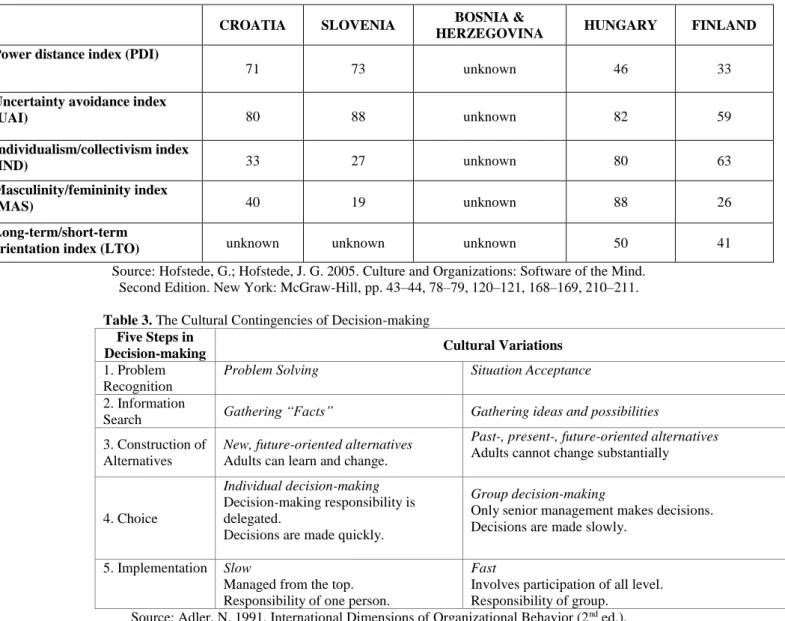
Insert table 1.
Hofstede’s dimensions of national culture, determined for 53 countries and regions of the world, lead by the number of quotes and by the importance in the field of cross-cultural management (Sǿndergaard 1994; Taras et al. 2012). In terms of factor analysis Hofstede defined four factors or four dimensions of national culture: (1) power distance, (2) uncertainty avoidance, (3) individualism/collectivism and (4) masculinity/femininity; the fifth dimension was added later – long-term versus short-term orientation – as a result of Hofstede and Bond’s joint effort.
The Power Distancedimension measures “the extent to which less powerful members of institutions and organizations within a country expect and accept that power is distributed unequally” (Hofstede 2001).
The Uncertainty Avoidancedimension measures “the extent to which the members of a culture feel threatened by uncertain and unknown situations” (Hofstede 1980).
Individualism/Collectivism is the third dimension where, according to Hofstede, individualism stands for “a society in which the ties between individuals are loose – everybody is expected to look after him/herself and his/her immediate family only” while collectivism stands for “a society in which people from birth onwards are integrated into strong, cohesive in-groups, which throughout people’s lifetime continue to protect them in exchange for unquestioning loyalty”.
Masculinity/Femininityrepresents the fourth dimension where masculinity stands for a society in which social gender roles are clearly distinct: men are supposed to be assertive, tough and focused on material success, and women are supposed to be modest, tender, and concerned with the quality of life while femininity stands for a society in which social gender roles overlap: both men and women are supposed to be modest, tender and concerned with the quality of life (Hofstede 2001).
These four national culture’s dimensions were later extended by the fifth, which was not part of the original Hofstede’s study and is called Long-term versus Short-term Orientation – originally, called Confucian dynamism (Hofstede, Bond 1984). “Long-term orientation stands for th fostering of virtues oriented towards future rewards, in
4
particular, perseverance and thrift. Short-term stands for the fostering of virtues related to the past and present, in particular, respect for tradition, preservation of face and fulfilling social obligations” (Hofstede, Hofstede 2005).
Only a small number of countries do not have the dimensions of their national culture calculated according to Hofstede’s methodology and their estimated values have been added afterwards. The primary aim of this paper was to check the accuracy of the projected value dimensions for Croatia and Slovenia Hofstede based on the original data for the former Yugoslavia before it fell apart in 1991, and to determine additionally the fifth dimension long-term/short-term orientation. Bosnia and Herzegovina is quite curious as it was never included in any cross-cultural research up until now. There are estimated values for Hungary, while Finland is the only country from Hofstede’s original research used for methodology purposes (table 2).
Insert table 2.
3. Decision-making style: definitions, typologies and cultural differences
Determining the relative position of the observed countries in particular dimensions aims at better understanding of the managerial practice in a given cultural context, as well as at identifying the sources and the consequences of different principles and managerial practices (Taras et al. 2012). Unlike other aspects of management and organization which were analyzed on numerous occasions in connection with cultural contexts and Hofstede’s dimensions, this is not the case for decision-making styles. Taylor, Tannerbaum and Schmidt were pioneers in academic discussions on decision-making styles although these were also closely connected to leadership styles. With Simon and some other authors, 1960s were characterized as the years of revolutionary turnaround towards decision-making and decisions. In general, researchers and practitioners are generally in agreement on the definition of decision-making styles but not so in terms of the types of decision-making styles (Bik 2010). Vroom and Yetton, Muna, Ali, Janis and Mann, etc. defined different typologies of decision-making styles. The leading assumption of this paper is following: decision-making is culturally contingent, depending on the values, beliefs, attitudes and behavioural patterns of the people involved. Therefore, cultural contingency becomes yet another contingency in the fit-models of decision-making. At each step in decision-making, as illustrated on table 3, the culture influences the ways managers and others make decisions and solve problems.
Insert table 3.
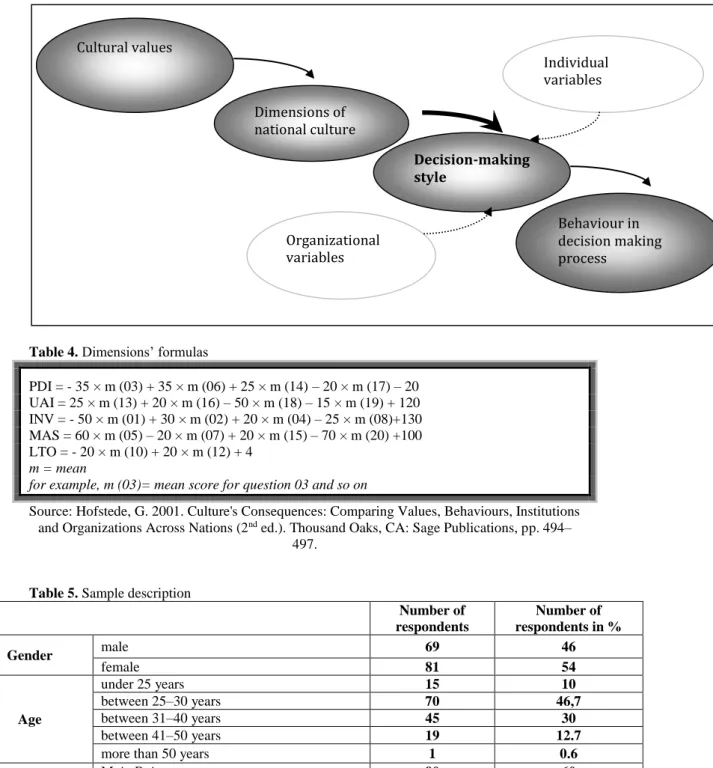
Figure 1 illustrates different variables that influence the adoption of certain decision-making style. Many empirical studies (Ali 1989, 1993; Tayeb 1995; Mann et al. 1998; Gupta 2012) have confirmed the role of the cultural background choosing a a
decision-5
making style. Cultural background is the variable whose influence on the decision-making style will be discussed in this paper.
Insert figure 1.
Since, modern business conditions frequently result in situations in which complex decisions have to be made with long-term consequences, and complex decisions are widely accepted to be the consequence of social and cultural values that are, above and beyond all others, installed in every individual (Festing et al. 2011).
4. Methodological issues
Designs in international and cross-cultural management research are understandably complex (Usunier 1998). Replications are a very popular type of study that offers the ease of having a preset design (for example, original Hofstede’s research) and require only a new round of research implementation including the collection of new data (Harkness et al. 2010).
The instrument VSM 1994 used in the study was the was defined by Hofstede and developed for the purpose of recurrence of the original research on national cultures’ dimensions and for comparison with the results of the original research. Furthermore, the questionnaire contained general information about the respondents and questions regarding decision-making styles (Janis and Mann’s typology). Janis and Mann (1977) have defined the styles in the decision-making process associated with complex decisions as (1) vigilance making, then styles of avoidance in decision-making which include (2) liability avoidance and (3) procrastinationand as the last one (4) hyper-vigilance decision-making. Janis and Mann’s typology of decision-making styles was simply analyzed in the aspect of practised decision-making style.
Four questions were needed to calculate each national culture’s dimension score. The index formulas are presented in table 4.
Insert table 4.
The VSM is a test designed for comparing mean scores for matched samples of respondents across two or more countries, regions, or ethnic groups. It is not a personality test for comparing individuals within countries. Therefore, the Cronbach alpha reliability coefficients across individuals are irrelevant (Hofstede 2001). An unreliable test cannot produce valid results, so if validity is proven, reliability can be assumed. Validity is shown through significant correlations of test results with the outside criteria related to the test scores by some kind of theory or logic. In his way the reliability of the VSM, even for smaller number of countries, can be proven indirectly (Hofstede,Hofstede 2005).
There are three different kinds of research possibilities: 1. survey studies of other narrow but matched samples of populations, 2. representative sample polls of entire national populations and 3. the features of countries directly measured at the country
6
level (Hofstede 2001). A narrow sample was chosen as optimal research option for this cross-cultural analysis. The empirical research was carried out on postgraduate students of business administration meaning MBA and Ph.D. students. The size of the sample in a particular country is satisfactory according to Hofstede (2001) who suggests that a sample includes at least 20 subjects, and that the optimal size is 50.
Insert table 5.
Absolute scores do not mean anything at all, only the differences between the scores from at least two countries can be interpreted and compared to the original database (Hofstede, Hofstede 2005). As presented in table 5 all of the methodological prerequisites were fulfilled.
5. Discussion
“Standardization” is the strategic requirement for interpretating and comparing comparative cultural research (Kolman et al. 2003; Nasierowski, Mikula 1998). The country used for standardization purposes must be one of the countries from the original research so that the original values for each dimension can be compared to the calculated values in this research.
Therefore, the unstandardized values for Croatia, Slovenia, Bosnia and Herzegovina, and Hungary (shown in brackets in table 6) cannot be compared to the results of other investigations or other countries. Consequently, to meet the requirement of value standardization research was carried out in Finland, the country that participated in the original research carried out in 1971.
Calculated dimensions for Finland are: power distance index 30.88
uncertainty avoidance index 24.27
individualism/collectivism index 101.51
masculinity/femininity index 14
long-term versus short-term orientation index 56.6.
The results for Finland are comparable to those of Hofstede’s original research. For every dimension the correction factor is determined by determining the difference between power distance for Finland and the original value of power distance in the same country from table 2 (for example, the calculated value for power distance is 30.88 and the value from the original research is 33 – so the correction factor is 2.12). The calculated correction factor is then applied to the values of the same dimension for other countries. For example, the uncalibrated value of power distance for Croatia is 34.08 and after standardization the calibrated position of power distance index for Croatia is 36.2.
The calculated correction factors are:
1. correction factor for power distance index + 2.12
2. correction factor for uncertainty avoidance index + 34.73
7
4. correction factor for masculinity/femininity index + 40
5. correction factor for long-term versus short-term orientation index - 15.6.
The standardized values of national culture’s dimensions are shown in table 6 and the uncalibrated positions are given in brackets.
Insert table 6.
From tables 6 and 7 it is obvious that the total cultural distance (by methodology taken from Zagorsek et al. 2004) is the greatest between Croatia and Slovenia, while the differences between Croatia and Bosnia and Herzegovina are almost negligible.
Insert table 7.
Analysing the recent cross-cultural research, Hofstede (2001) pointed to a trend towards decreasing power distance, which has also been confirmed by this research. The explanation is connected to the growth of GDP which negatively correlates with the power distance index. The highest uncertainty avoidance has been recorded in Slovenia, then in Hungary and Bosnia and Herzegovina while the lowest was in Croatia. The rank corresponds to the estimated values of Hofstede’s original research from table 2 and the explanation of the values of uncertainty avoidance dimension lies in both religious and historical contexts (Hofstede 2001). The high uncertainty avoidance values in these countries can be related to the communist heritage which is characterized by emphasis on equality and safety. Hofstede points out that “young democracies” always show the highest uncertainty avoidance values – the fact that has been confirmed by this research as well.
The results of the individualism/collectivism dimension show a significant move towards individualism, which confirms Hofstede’s assumption about the process of convergence and the influence of global economic growth on the shift towards individualism. The calculated values of the masculinity/femininity dimension for Croatia, Slovenia and Hungary confirm that in these cultures masculine values dominate, i.e. the emphasis is on assertiveness, competitiveness, success, acknowledgment, achievements and challenges, and less on collaboration, the quality of life, and the care for others, so-called feminine values. In conclusion it is worth mentioning that the countries in the sample are characterized by the importance of tradition, conservativism and the importance of religion, which Hofstede (1980) considers to be the fundamental characteristics of a masculine society.
The values for long-term/short-term orientation are especially significant because they do not confirm or deny Hofstede’s estimated values, as in the case of other national culture’s dimensions. This dimension was determined for Croatia, Slovenia, and Bosnia and Herzegovina for the first time. In Croatia and in Bosnia and Herzegovina short-term orientation dominates evenly while in Slovenia and Hungary the values are different to so some level.
Decision-making styles were a supplementary objective of the analysis with the aim of identifying the dominant style in Croatia, Slovenia, Bosnia and Herzegovina and
8
Hungary. In all countries as presented in table 8 decision-making may be characterized as vigilant. Liability avoidance, procrastination or hyper-vigilance decision-making styles are used infrequently which may be connected to the sample characteristics to a degree. The similarities in complex decision-making are evident in Croatia and Bosnia and Herzegovina while Hungary and Slovenia generated very similar results.
Insert table 8.
According to results from table 8, it is clear that the respondents from Croatia and Bosnia and Herzegovina have a more vigilant approach to decision-making when compared to their Hungarian and Slovenian counterparts. They typically almost always consider all versions of the decisions and their possible shortcomings. Afterwards, they try to gather as much reliable information as they can and set as clear goals as possible. Variance analysis was used to identify statistical dependency between vigilance decision-making and national culture’s dimensions. Dependency was confirmed (table 9) and it is statistically significant with 5% probability (p-value = 0.013).
Insert table 9.
Identical analysis was conducted for liability avoidance and procrastination and the national culture’s dimensions, but it did not identify statistical dependency. However, the results presented in table 10 determine statistical dependency between hyper-vigilant decision-making style and the national culture’s dimensions and it is statistically significant with 10% probability (p-value = 0.095).
Insert table 10. .
Cross-cultural analysis of complex decision-making offered interesting conclusions. As for similar styles (vigilance and hyper-vigilance decision-making styles), the conclusions are also similar – statistically significant dependency between these styles and the national culture dimensions. In contrast to procrastination and liability avoidance, which are also similar decision-making styles and actually represent ways of avoiding decision-making, statistical dependency to national culture’s dimensions was not identified.
Conclusions
Countries are rarely homogeneous societies with a unified culture. Inferences about national culture may depend on the subgroups studied (Schwartz 2014) Value differences between nations described by authors centuries ago are still present today. Research on the development of cultural values has shown repeatedly that there is little evidence of international convergence over time, apart from individualism in the countries that become wealthier. The conclusions from this paper may facilitate better
9
understanding of managerial activities and identifying the sources and consequences of different practices and principles in the analyzed countries.
Evidently, there are significant cultural differences in decision-making styles and especially in complex decision-making since they are beyond all others the consequence of social and cultural values installed in every individual. Therefore, the gains from this research include the relevant replication component that needs to be recognized as well as the identified cultural variations, convergence processes and influences in decision-making style.
Data collection is a limitation for cross-cultural research as there is no ideal method and it is probably impossible to describe the phenomena in their full complexity. Optimal international management research should involve the combination of quantitative and qualitative research methods while embracing the confrontation of different sorts of biases and prejudices rather than insisting on language-free, prejudice-free, context-free and supposedly bias-free research.
Cross-cultural research in management serves the purpose of creating unique and new insights and of generating broader concepts, rather than simple comparisons. Therefore, some topics would also deserve better coverage such as research on cross-cultural interactions, cross-cultural intermediation, cross-cultural mediation, intercross-cultural competence in broader perspective than basic adjustment. Cross-cultural research should also focus on unlearning as well as learning processes. Cross-cultural research should also focus on extreme rather than average situations because these central tendencies may only be the result of people not daring to do what other people allow themselves. There are many other interesting research topics, for example the study of cultural distance in foreign entries, affecting both the choice of entry mode and the rate of success. Yet, there are no simple and uniform rules that can be generalized across countries, industries and points in time.
References
Aberle, D. F. ; Cohen, A. K.; Davis, A. K.; Levy, Jr. M. J.; Sutton, F. X. 1950. The Functional Prerequisities of a Society, Ethics 60: 100–111.
Adler, N. 1991. International dimensions of organizational behavior 2nd ed. Belmont: Wadsworth
Publishing Company.
Ali, A. J. 1989. Decision style and worksatisfaction of Arab Gulf executives: a cross-national study,
International Studies of Management and Organization 19(2): 22–37.
Ali, A. J. 1993. Decision-Making Style, Individualism, and Attitudes toward Risk of Arab Executives,
International Studies of Management and Organization 23(3): 53–73.
Bazerman, M. H.; Tenbrunsel, A. E. 2011. Der ethische Manager, Harvard Business Manager Juni: 49–58.
Bik, O. P. G. 2010. The behavior of assurance professionals: A cross-cultural perspective. Eburon: Delft.
Cullen, J. B.; Praveen Parboteeah, K. 2011. Multinational Management: A Strategic Approach. Fifth edition.Mason: Thomson South-Western.
Douglas, M. 1973. Natural Symbols. Harmondsworth: Penguin.
Festing, M.; Dowling, P. J.; Weber, W.; Engle, A. D. 2011. Internationales Persona lmanagement. Wiesbaden: Gabler Verlag.http://dx.doi.org/10.1007/978-3-8349-6421-2
10
Fisher, R.; Poortinga, Y. H. 2012. Are cultural values the same as the values of individuals? An examination of similarities in personal, social and cultural value structure, International Journal of Crosss Cultural Management 12(2): 157–170.http://dx.doi.org/10.1177/1470595812439867 Fiske, A. P. 1992. The Four Elementary Forms of Sociality: Framework for a Unified Theory ofSocial Relations, Psychological Review 99(4): 689–723.
Ginevičius, R.; Vaitkūnaitė, V. 2006. Analysis of Organizational Culture Dimensions Impacting Performance, Journal of Business Economics and Management 7(4): 201–211.
Gupta, S. F. 2012. Integrating national culture measures in the context of business decision making: An initial measurement development test of a mid levele model, Cross Cultural Management: An International Journal 19(4): 455–506.
Hall, E. T. 1976. Beyond Culture. New York: Anchor Books.
Harkness, J. A.; Braun, M.; Edwards, B.; Johnson, T. P.; Lyberg, L. E.; Mohler, P. Ph.; Pennell, B; Smith, T. W. (eds.) 2010. Survey: Methods in Multinational, Multiregional, and Multicultural Contexts. New York: John Wiley and Sons. http://dx.doi.org/10.1002/9780470609927
Harvey, M. G.; Miceli, N. 1999. Exploring inpatriate manager issues: an exploratory empirical study,
International Journal of Intercultural Relations 23(3): 339–371. http://dx.doi.org/10.1016/S0147-1767(99)00001-2
Harvey, M. G.; Moeller, M. 2009. Expatriate managers: a historical review, International Journal of Management Reviews 11(3): 275–296.http://dx.doi.org/10.1111/j.1468-2370.2009.00261.x
Hofstede, G. 1980. Culture's Consequences: International Differences in Work-Related Values
(Abridged Edition). Newbury Park, CA: Sage Publications.
Hofstede, G. 2001. Culture's Consequences: Comparing Values, Behaviours, Institutions and Organizations Across Nations (2nd ed.). Thousand Oaks, CA: Sage Publications.
Hofstede, G.; Bond, M. H. 1984. Hofstede's culture dimensions: An independent validation using Rokeach's value survey, Journal of Cross-Cultural Psychology 15: 417–433.
http://dx.doi.org/10.1177/0022002184015004003
Hofstede, G.; Hofstede, J. G. 2005. Cultures and Organizations: Software of the Mind (2nd ed.). New
York: McGraw-Hill.
House, R. J.; Javidan, M.; Hanges, P.; Dorfman, P. 2002. Understanding cultures and implicit leadership theories across the globe: An introduction to project GLOBE, Journal of World Business 37: 3–10.http://dx.doi.org/10.1016/S1090-9516(01)00069-4
Inglehart, R. 1997. Modernization and postmodernization: Cultural, economic and political change in 43 societies. Princeton, NJ: Princeton University Press.
Inkeles, A.; Levinson, D. J. 1954. National character: The study of modal personality and sociocultural systems, in G. Lindzey (Ed.). Handbook of social psychology. Reading, MA: Addison-Wesley.
Janis, I. L.; Mann, L. 1977. Decision making: A psychological analysis of conflict, choice and commitment. New York: Free Press.
Kluckhohn, F.; Strodtbeck, F. 1961.Variations in Value Orientations. Evanstron, IL: Row, Peterson. Kolman, L.; Noorderhaven, N. G.; Hofstede, G.; Dienes, E. 2003. Cross-cultural differences in
Central Europe, Journal of Managerial Psychology 18(1): 76–88.
http://dx.doi.org/10.1108/02683940310459600
Lynn, R.; Hampson, S. L. 1975. National differences in extraversion and neuroticism, British Journal of Social and Clinical Psychology 14: 223–240.
MacNab, B. R.; Worthley, R. 2013. Stereotype awareness development and effective cross-cultural management – An experiental approach, International Journal of Cross Cultural Management
13(1): 67–87. http://dx.doi.org/10.1177/1470595812452635
Mann, L.; Radford, M.; Burnett, P.; Ford, S.; Bond, M.; Leung, K.; Nakamura, H.; Voughan, G.; Yang, K. 1998. Cross-Cultural Differences in Self-reported Decision-making Style and Confidence, International Journal of Psychology 33: 325–335.
http://dx.doi.org/10.1080/002075998400213
Minkov, M.; Hofstede, G. 2011. The evolution of Hofstede’s doctrine, Cross Cultural Management: An International Journal 18(1): 10–20..
11
Nasierowski, W.; Mikula, B. 1998. Culture Dimensions of Polish Managers: Hofstede's Indices,Organization Studies 19(3): 495–509.http://dx.doi.org/10.1177/017084069801900306
Nisbett, R. E.; Peng, K.; Choi, I.; Norenzayan, A. 2001. Culture and Systems of Thought: Holistic Versus Analytic Cognition, Psychological Review 108(2): 291–310.
Parsons, T.; Shils, E. A. (Eds.). 1951. Toward a general theory of action. Cambridge, MA: Hardvard University Press.
Radović-Marković, M. 2008. Managing the organizational change and culture in the age of globalization, Journal of Business Economics and Management 9(1):3–11.
http://dx.doi.org/10.3846/1611-1699.2008.9.3-11
Schwartz, S. H. 1999. A theory of cultural values and some implications for work, Applied Psychology: An International Review 48(1): 23–47.
Schwartz, S. H. 2014. Chapter 20 - National Culture as Value Orientations: Consequences of Value Differences and Cultural Distance, in: Ginsburgh, V. A.; Throsby, D. (eds.), Handbook of the Economics of Art and Culture Elsevier, 2: 547–586.
Sǿndergaard, M. 1994. Hofstede’s Consequences: A study of reviews, citations and replications,
Organization Studies 15(3): 447–456.
Stah, G. K.; Maznevsky, M.; Voigt, A.; Jonsen, K. 2010. Unraveling the Efects of Cultural Diversity in Teams: A Meta-Analysis of Research on Multicultural Work Group, Journal of International Business Studies 41(4): 690–709.http://dx.doi.org/10.1057/jibs.2009.85
Tayeb, M. 1995. Supervisory Style and Cultural Context: a Comparative Study, International Business Review’, 4(1): 75–89.http://dx.doi.org/10.1016/0969-5931(94)00032-H
Taras, V.; Steel, P.; Kirkman, B. L. 2012. Improving national cultural indices using a longitudinal meta-analysis of Hofstede's dimensions, Journal of World Business 47(3): 329–341.
http://dx.doi.org/10.1016/j.jwb.2011.05.001
Trompenaars, F.; Hampden-Turner, C. 2000. Riding the Waves of Culture: Understanding Cultural Diversity in Business (2nd ed.). London: Nicholas Brealey Publishing.
Usunier, J.-C. 1998. International and Cross-Cultural Management Research. London: Sage Publication. Yousef, D. A. 1998. Predictors of decision-making styles in a non-western country,
Leadership & Organization Development Journal 19(7): 366–373.
http://dx.doi.org/10.1108/01437739810242522
Weber, E.; Hsee, C. 2000. Culture and Individual Judgment and Decision Making, Applied Psychology: An International Review 49: 32–61.
Wright, N.; Drewery, G. P. 2006. Forming cohesion in culturally heterogenous teams, Cross Cultural Management: An International Journal 13(1): 43–53.
Zagorsek, H.; Jaklic, M.; Stough, S. J. 2004. Comparing Leadership Practices Between the United States, Nigeria, and Slovenia: Does Culture Matter?, Cross Cultural Management 11(2): 16–34.http://dx.doi.org/10.1108/13527600410797774
Professor Marina DABIĆ, Ph.D. Department of International Economics, Faculty of Economics and Business, University of Zagreb, Croatia and Nottingham BusinessSchool, Nottingham Trent University the UK . Research interests: international business, entrepreneurship, expatriats, knowledge transfer.
Professor Darko TIPURIĆ, Ph.D. Department of Organization and Management, Faculty of Economics and Business, University of Zagreb, Croatia. Research interests: corporate governance, strategic management and decision making.
Najla PODRUG, Ph.D. Department of Organization and Management, Faculty of Economics and Business, University of Zagreb, Croatia. Research interests: international management, cross-cultural management, strategic management and corporate governance.
12
Table 1. Overview of national culture’s dimensions: theory and empirical basedAuthor Year Dimensions
Theory approach Aberle, Cohen,
Davis, Levy and Sutton
1950 (1)adequate physical and social relationships with the
environment, (2) role differentiation according to age, gender and hierarchy, (3) communication, (4) shared knowledge, beliefs, and rules of logic thinking, (5) shared goals, (6) normative regulation of means towards these goals, (7) regulation of affective
expression; (8) socialization of new members, (9) effective control of disruptive forms of behaviour
Parsons and Shils 1951 (1)affectivity versus affective neutrality, (2) self-orientation versus collectivity-orientation, (3) universalism versus particularism, (4) ascription versus achievement, (5) specificity versus diffuseness
Inkeles and Levinson
1954 (1) relation to authority, (2) conception of self, including individual’s concept if masculinity and femininity, (3) primary dilemmas or conflicts and ways of deling with them, including control of aggression and the expression versus inhibition of affect Kluckhohn and
Strodtbeck
1961 (1) an evaluation of human nature, (2) the relationship of man to the surrounding natural environment, (3) the orientation in time, (4) the orientation toward activity and (5) relationship among people Douglas 1973 two-dimensional ordering of “cosmologies”: (1) “group” or
inclusion and (2) “grid” or classification
Hall 1976 (1) way of communication
Fiske 1992 (1)communal sharing, (2) authority ranking, (3) equality matching, (4) market pricing
Empiricial based
Hofstede 1980 (1) power distance, (2) uncertainty avoidance, (3)
individualism/collectivism, (4) masculinity/femininity, (5) long-term versus short-long-term orientation
Lynn and Hampson 1975 (1) neuroticism, (2) “extraversion”
Inglehart 1997 (1)“well-being versus survival”, (2) “secular-rational versus traditional authority”
Schwartz 1999 (1) conservatism, (2) hierarchy, (3) mastery, (4) affective autonomy, (5) intellectual autonomy, (6) egalitarian commitment, (7) harmony
Trompenaars and Hampden-Turner
2000 (1)universalism versus particularism, (2) individualism versus collectivism, (3) affectivity versus neutrality, (4) specificity versus diffuseness, (5) achievement versus ascription, (6) time orientation and (7) relation to nature
House, Javidan, Hanges, and Dorfman
2002 (1)power distance, (2) uncertainty avoidance, (3) social
collectivism, (4) in-group collectivism, (5) gender egalitarianism, (6) assertiveness, (7) future orientation, (8) performance
orientation and (9) humane orientation Nisbett, Peng, Choi
and Norenzayan
2001 holistic versus analytic cognition
Table 2. The projected positions of Croatia and Slovenia, estimated values for Hungary and original values for Finland’s dimensions
13
CROATIA SLOVENIA BOSNIA &HERZEGOVINA HUNGARY FINLAND Power distance index (PDI)
71 73 unknown 46 33
Uncertainty avoidance index
(UAI) 80 88 unknown 82 59 Individualism/collectivism index (IND) 33 27 unknown 80 63 Masculinity/femininity index (MAS) 40 19 unknown 88 26 Long-term/short-term
orientation index (LTO) unknown unknown unknown 50 41 Source: Hofstede, G.; Hofstede, J. G. 2005. Culture and Organizations: Software of the Mind.
Second Edition. New York: McGraw-Hill, pp. 43–44, 78–79, 120–121, 168–169, 210–211. Table 3. The Cultural Contingencies of Decision-making
Five Steps in
Decision-making Cultural Variations 1. Problem
Recognition
Problem Solving Situation Acceptance
2. Information
Search Gathering “Facts” Gathering ideas and possibilities 3. Construction of
Alternatives
New, future-oriented alternatives Adults can learn and change.
Past-, present-, future-oriented alternatives Adults cannot change substantially
4. Choice
Individual decision-making Decision-making responsibility is delegated.
Decisions are made quickly.
Group decision-making
Only senior management makes decisions. Decisions are made slowly.
5. Implementation Slow
Managed from the top. Responsibility of one person.
Fast
Involves participation of all level. Responsibility of group.
Source: Adler, N. 1991. International Dimensions of Organizational Behavior (2nd ed.). Belmont: Wadsworth Publishing Company, pp. 163.
14
Table 4. Dimensions’ formulasPDI = - 35 × m (03) + 35 × m (06) + 25 × m (14) – 20 × m (17) – 20 UAI = 25 × m (13) + 20 × m (16) – 50 × m (18) – 15 × m (19) + 120 INV = - 50 × m (01) + 30 × m (02) + 20 × m (04) – 25 × m (08)+130 MAS = 60 × m (05) – 20 × m (07) + 20 × m (15) – 70 × m (20) +100 LTO = - 20 × m (10) + 20 × m (12) + 4 m = mean
for example, m (03)= mean score for question 03 and so on
Source: Hofstede, G. 2001. Culture's Consequences: Comparing Values, Behaviours, Institutions and Organizations Across Nations (2nd ed.). Thousand Oaks, CA: Sage Publications, pp. 494–
497.
Table 5. Sample description
Number of respondents Number of respondents in % Gender male 69 46 female 81 54 Age under 25 years 15 10 between 25–30 years 70 46,7 between 31–40 years 45 30 between 41–50 years 19 12.7
more than 50 years 1 0.6
Educational level M.A, B.A. 90 60 M.Sc. 55 36.6 PhD 5 3.3 other 0 0 Behaviour in decision making process Decision-making style Cultural values Dimensions of national culture Individual variables Organizational variables
15
Work positionnon-managerial positions 58 38.6
lower level management 21 14
middle level management 23 15.3
top management 14 9.3
others 34 22.6
Country
Croatia 30 20
Slovenia 30 20
Bosnia and Herzegovina 30 20
Hungary 30 20
Finland 30 20
Total 150 100
Table 6. Calibrated (uncalibrated) positions of the countries on five Hofstede’s dimensions CROATIA SLOVENIA BOSNIA &
HERZEGOVINA HUNGARY Power distance index (PDI) 36.2
(34.08) 34.07 (31.95) 40.78 (38.66) 25.71 (23.59) Uncertainty avoidance index (UAI) 57.68 (22.95) 87.86 (53.13) 63.39 (28.66) 77.62 (42.89) Individualism/collectivism index (IND) 73.92 (112.42) 60.49 (98.99) 73.35 (111.85) 72.83 (111.33) Masculinity/femininity index (MAS) 91.62 (51.62) 87.31 (47.31) 83 (43) 90 (50) Long-term/short-term
orientation index (LTO)
30.37 (45.97) 43.74 (59.34) 29.73 (45.33) 40.31 (55.92) Table 7. Total cultural distance, calculation for Croatia, Slovenia, Bosnia & Herzegovina and Hungary
CROATIA SLOVENIA BOSNIA &
HERZEGOVINA HUNGARY Total
cultural distance
289.8 313.5 290.3 306.5
Table 8. Results on complex decision-making for Croatia, Slovenia, Bosnia and Herzegovina, Hungary
VIGILANCE
LIABILITY
AVOIDANCE PROCRASTINATION HYPER VIGILANCE average stand. deviation average stand. deviation average stand. deviation average stand. deviation Croatia 1.77 0.10 .99 0.08 3.79 0.07 3.92 0.07
16
Slovenia 1.99 0.15 4.19 0.12 3.84 0.10 4.10 0.10 B&H 1.88 0.15 3.97 0.12 3.91 0.10 3.94 0.10 Hungary 2.17 0.12 4.12 0.09 4.07 0.08 4.18 0.08
Table 9. Variance analysis results (Vigilance decision-making and national culture’s dimensions)
Univariate Results for Each DV Sigma-restricted parameterization Effective hypothesis decomposition
Degr. of Vigilance decision-making Vigilance decision-making Vigilance decision-making Vigilance decision-making Intercept 1 757.6301 757.6301 1171.886 0.000000 "Q26" - culture 4 8.4027 2.1007 3.249 0.013083 Error 101 129.9475 0.6465 Total 105 138.3502
Table 10. Variance analysis results (Hyper-vigilance decision-making and national culture’s dimensions)
Univariate Results for Each DV Sigma-restricted parameterization Effective hypothesis decomposition Degr.
of Hyper-vigilance Hyper-vigilance Hyper-vigilance Hyper-vigilance
Intercept 1 3030.776 3030.776 10084.06 0.000000
"Q26" -
culture 4 2.410 0.603 2.00 0.095220
Error 102 60.711 0.301