351
PROJECT MANAGEMENT GOVERNANCE
A MODEL FOR KNOWLEDGE CREATION
Maria do Rosário Bernardo
APOGEP – Associação Portuguesa de Gestão de Projectos
Abstract
During XX century last years, Project Management focused on methods, techniques, and tools to ensure project’s success. Project Managers’ certification systems recognize today a large number of professionals having required competences to manage projects, programs and portfolios.
Last decade, Project Management theories had their focus on Project Management Maturity Models designed to establish performance measures and to define continuous improvements processes. To ensure Project Management maturity, whatever the model is, we need to apply Governance principles to projects, programs, portfolios and project management, coexisting with the organization’s governance framework.
Projects and Programs Governance is a new theme to refer organization and communication management based on the best project management practices. Project Management Governance is another new unexplored theme requiring qualitative and quantitative measures, from current and past projects, base on learning-oriented review processes.
This paper presents a model to extract project management measures across the project life cycle to help project managers evaluating the project, steering groups on the decision making process, portfolio management to optimize portfolios and prioritize projects.
Keywords: project management governance; projects governance; project measures;
lessons learned.
Resumo
No final do século XX, a Gestão de Projectos centrou-se nos métodos, técnicas e ferramentas. Os sistemas de certificação de gestores de projecto reconhecem hoje a exigência de um grande número de profissionais com as competências necessárias para a gestão de projectos, programas e portfolios.
Na última década, as teorias de Gestão de Projectos focaram-se nos Modelos de Maturidade, desenvolvidos para estabelecer medidas de desempenho e processos de melhoria contínua. Para assegurar a maturidade da Gestão de Projectos, é necessário aplicar os princípios de Governance a projectos, programas, portfolios bem com à gestão de projectos.
A Governance de Projectos abrange a gestão da organização e da comunicação, baseada nas melhores práticas de gestão de projectos. A Governance da Gestão de Projectos é um tema novo e pouco explorado, que requer medidas qualitativas e quantitativas, baseadas em processos de revisão orientados à aprendizagem.
352
Este paper apresenta um modelo para extrair métricas de gestão de projectos ao longo do ciclo de vida do projecto, com o objectivo de auxiliar o gestor de projecto na avaliação do mesmo, os comités de direcção no processo de decisão e a gestão de portfolios na optimização dos portfolios e na definição de prioridades dos projectos.
Palavras chave: governance da gestão de projectos; governance de projectos; métricas de
projectos; lições aprendidas.
1. Introduction
The discipline of project management, has some well defined bodies of knowledge, e.g. PMBoK (PMI, 2004), focused on project management processes, and ICB (IPMA, 2006), defining a project management competences assessment model.
After having established bodies of knowledge contents, project management development next wave was the development of project management maturity models. This concept started from an adaptation of CMMI® (Capability Maturity Model® Integration) used in IT industry to improve software development and related services. The Project Management Institute (PMI) adapted that approach to project management with OPM3 - Organizational Project Management Maturity Model (PMI, 2003). Following this approach, a large number of project management maturity models have been developed, all of them presenting five maturity levels, but diverging on each level content. These models have been the basis for some project management consultancy companies start selling their maturity assessment services to Organizations.
In the project management field, a large number of project management methodologies might be found, most of the times not suitable to all Organization’s project types, dimensions and complexity, and usually not considering programs and portfolios management. The Organizations usually feel very hard the use of use those methodologies, brought from the market, based on the experience and knowledge of external consultants, but usually not aligned with the Organization’s business models, culture, experience and history.
In many Organisations, it remains a gap in the governing surveillance of project activities (APM, 2004). This situation is no longer possible, since organizational strategies are no longer limited to maximize production results. Organisations are more concerned to address multiple market changes and to improve the Organization’s image on fields as sustainability and social responsibility. Those required changes only may be successfully implemented through projects, programmes and portfolios, managed under an adequate project management governance model, coexisting with the Organization’s governance framework. As projects and programmes are the vehicles for implementing corporate strategies, effective project management governance, within the corporate governance framework, becomes a serious concern for Organisations, offering to top management a clear visibility and control of non-routine corporate operations and delivery capability (Crawford et al, 2005).
2. Corporate and Project Management Governance
There are several definitions of corporate governance but we may chose the one presented by OECD - Organization for Economics Co-operation and Development, as “corporate governance involves a set of relationships between a company’s management, its board, its shareholders and other stakeholders. Corporate governance also provides the structure through which the objectives of the company are set, and the means of attaining those objectives and monitoring performance are determined.” (OECD, 2004).
353
The second sentence of this definition ensures that the needed structures exist to define objectives for operations and projects, to define the means of obtaining those objectives, and the process to monitoring progress to ensure that those objectives are achieved (Turner, 2008).Corporate governance is concerned with: 1. accountability;
2. disclosure and transparency; 3. roles and responsibilities; 4. risk management; 5. decision-making: 6. ethics;
7. performance and effectiveness.
Governance applied to projects, programmes and portfolios and to project management, coexists within the corporate governance framework. It includes a value system, responsibilities, processes and policies definitions, to allow projects to achieve organizational objectives (Muller, 2009).
The UK Association of Project Management (APM) has a special interest group (SIG) looking at the governance of project management. Their guide to governance of project management states: “Effective governance of project management ensures that an organization’s project portfolio is aligned to the organization’s objectives, is delivered efficiently and is sustainable. Governance of project management also supports the means by which the board, and other major project stakeholders, are provided with timely, relevant and reliable information” (APM, 2004, p.4).
“The governance of project management concerns those areas of corporate governance that are specifically related to project activities” (APM, 2004,p 4). According with Turner, there are three levels of governance within the projects-based organizations (Turner, 2008). 1. A first level, at which the board operates, and the extent of their interest in projects is
stated;
2. On the second level, the right organizational infrastructures are defined to undertake projects effectively, ensuring that the appropriate capability exists within the Organization to deliver projects successfully and ensuring that the right projects are done;
3. The third level concerns with individual projects which, defined as temporary organization, needs governing.
The first level, concerned with the interest of the Organization’s board in the project, is one of the project management governance core components, it “seeks to ensure that project sponsorship is the effective link between the Organization’s senior executive body and the management of the project” (APM 2004, p 9).
The second level, denominated by GOVERNANCE OF PROJECT MANAGEMENT, includes:
• the definition of a project, programme and portfolio governance framework;
• the definition of prioritization rules for resources allocation between projects sharing Organization’s resources;
• the development of organizational project management competences, including the projects support offices (PSOs) or project management offices (PMOs) implementation;
354
• ensuring an efficient and adjusted alignment of projects portfolio with the Organization’s objectives,
The third level, concerns to PROJECT GOVERNANCE, the set of principles, structures and processes applied to an individual project or programme. It defines the project organization breakdown structure, defines and regulates roles, responsibilities, decision levels and management boundaries. Additionally, it coordinates project communication and control processes.
APM suggests four main components of the governance of project management (APM, 2004):
1. Portfolio direction 2. Project sponsorship
3. Project management effectiveness and efficiency 4. Disclosure and reporting
These components are aligned with the organizational levels and their specific responsibilities in governing the Organization.
Project governance will outline the relationships between all internal and external groups involved in the project; describes the proper information flow to all project stakeholders; ensures the appropriate review of issues encountered within each project; ensures that required approvals and directions for the project are obtained at each appropriate stage of the project.
2.1. Portfolio direction
To ensure an effective portfolio direction, the Organization must ensure that all projects are identified within a portfolio and that they are managed according with Organization’s objectives and constraints.
2.2. Project sponsorship
“Project sponsors are the route through which project managers directly report and from which project managers obtain their formal authority, remit and decisions. Sponsors own the project business case. Competent project sponsorship is of great benefit to even the best project managers.” (APM, 2004 p.9). So, projects sponsorship includes the effective link between the Organization’s top management and project management. Project sponsor assumes decision, direction and representation responsibilities. The project manager reports to the project sponsor and receives from him authority and decisions.
2.3. Project management effectiveness and efficiency
Project management effectiveness and efficiency is related to the project team skills and capabilities, including subcontractors, to achieve the project objectives.
2.4. Disclosure and reporting
Disclosure and reporting “ensure that the content of project reports will provide timely, relevant and reliable information that supports the organization’s decision making process, without fostering a culture of micro-management”. (APM, 2004,p 11).
355
3. Project management governance framework
It is not possible to define a unique project management governance framework; it depends on the corporate governance framework and the mix of projects presented in the Organization. Each organization must create a framework build for its own proposals and culture. Each particular project management governance framework must cover the following core elements:
1. Roles and responsibilities
2. Decision making process and levels 3. Methodologies
4. Competences
5. Communication process 6. Controlling process
These elements should be aligned to Organization’s strategies, based on management commitment and ethics principles.
A project management governance framework, to be continuously improved and maintaining its required benefits, needs to receive and analyse project management metrics across the project life cycle. A timely and reliable set of project measures will ensure the last sentence of the Corporate Governance definition presented in this paper: “that monitoring performance is determined”.
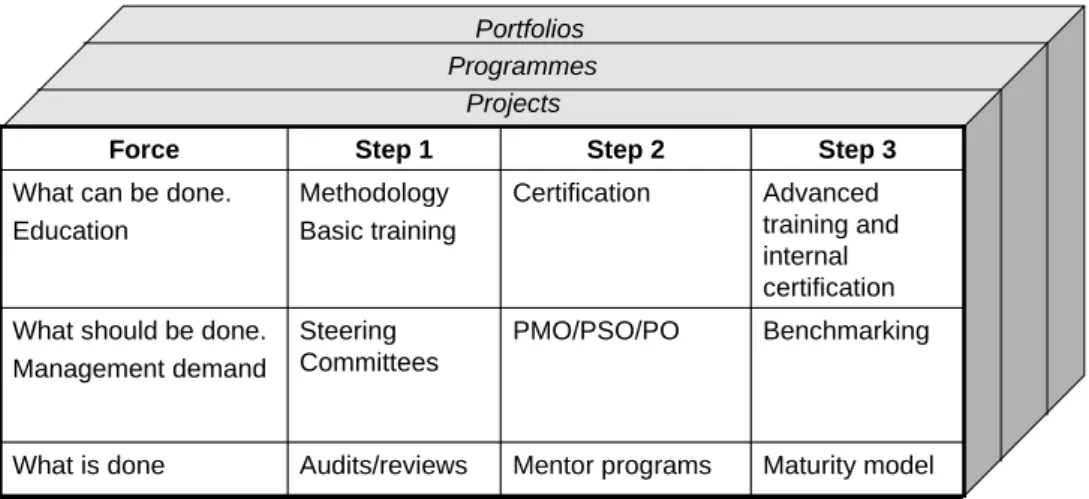
Figure 1 shows the governance framework for project management presented by Ralf Muller (Muller, 2009). The proposed framework presents three steps corresponding to the Organization’s increasing focus on project management. Each step is split into three forces which impact and determine the project management quality (Muller et all, 2007):
1. Force 1: “What Can Be Done?” - By the project manager, depending on his / her education and experience.
The Organization’s project managers education and development, to be effective, needs to be planned in order to cover all technical, behavioural and contextual project management competences.
At the first step, the Organization must develop its own project management methodology and train on project management all the project managers, team leaders, project sponsors and projects support staff, according with their needs. The main goal is to have a project management common language and artefacts across the Organization.
At the second step, the main goal is to certify the project managers by an independent system, as the 4-L-C IPMA certification system, that might be used by a career development system for Organization’s project management personnel (IPMA, 2006), improving the Organization’s project management credibility.
The author presents the third step as advanced training and internal certification. I personally consider that, to be recognized by the market, this certification shall also to be external, aligning project manager’s career with the higher levels of the above referred IPMA 4-L-C certification system.
2. Force 2: “What Should Be Done?” Determines how project management should be done by the project manager, how the project management methodology shall de adapted and used, considering the project specificities and what project management deliverables shall be used by the project manager (eg. status reports, change management
356
processes). This force is related to the specific project management practices demanded by the project sponsors.
At the first step, the Organization must pay attention to project sponsorship. The sponsor and/or steering group must have a clear understanding of project management discipline, to ensure the use of the most effective and efficient project management processes (What should de done). An effective project sponsorship shall focus the project manager on the business needs and avoid project manager decisions based upon his / her own perceptions, usually just focused on time and cost criteria.
Organisations at step 2 shall have in place organizational linking structures, such as PSOs or PMOs, in order to improve and support project management.
At the last step, organizations use benchmarks to compare their project management capabilities against competitors and to incorporate the results in a continuous improvement process.
Figure 1: Governance framework for project management. Source (Muller, 2009, p.39)
Step 3 Step 2 Step 1 Force Maturity model Mentor programs Audits/reviews What is done Benchmarking PMO/PSO/PO Steering Committees What should be done.
Management demand Advanced training and internal certification Certification Methodology Basic training What can be done.
Education Step 3 Step 2 Step 1 Force Maturity model Mentor programs Audits/reviews What is done Benchmarking PMO/PSO/PO Steering Committees What should be done.
Management demand Advanced training and internal certification Certification Methodology Basic training What can be done.
Education
Projects Programmes
Portfolios
3. Force 3: “What is Done?” Determines how project management is performed, in compliance with the Organization’s methodology and policies.
At the first step, the Organization needs to ensure that revisions are made to know what is being done. Those reviews might be project audits, formal reviews or health checks. At the next step, the “mentor programs address the approach and attitude project managers develop towards their work as well as communication and teamwork with their teams, sponsor and project stakeholders”, (Muller, 2009, pp 37).
The last step will align the Organization with a select project management maturity model.
4. Project governance framework
As referred before, project governance demands a project organization breakdown structure, defined project roles and responsibilities, appropriate decision levels and approved management boundaries. This definition, to be effective and to contribute to Organization’s governance, must describe how to monitor project performance, specifying the adequate performance indicators.
357
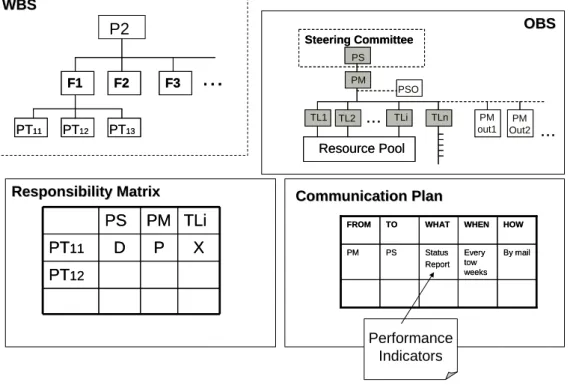
To represent project governance, a combination of representations, as shown in Figure 2, might be used:1. An OBS (Organization Breakdown Structure);
2. A Responsibility Matrix, resulting from the combination of the WBS (Work Breakdown Structure) work packages and the OBS elements;
3. A Communication Plan, defining the contents and information flows between project actors;
4. Identified Performance Indicators, which must be included in the contents of communications flows.
Figure 2 – Project governance
PS PM TLi PT11 D P X PT12 PS PM TLi PT11 D P X PT12 F1 F2 F3 PT11
…
PT12 PT13 F1 F2 F3 PT11…
PT12 PT13 P2 TL1 TL2 TLi TLn PM out1 PSO PM PS … … PM Out2 Resource Pool Steering Committee TL1 TL2 TLi TLn PM out1 PSO PM PS … … PM Out2 Resource Pool Steering Committee WBS WBS OBS OBS Responsibility Matrix Responsibility Matrix By mail Every tow weeks Status Report PS PM HOW WHEN WHAT TO FROM By mail Every tow weeks Status Report PS PM HOW WHEN WHAT TO FROM Communication Plan Communication Plan Performance Indicators5. Project governance integrated model
To define project information flows, the organizational roles linked to projects, need to be identified, implying the integration of both project management and project governance frameworks.
Inside the project structure, represented by the project OBS, steering roles (typically the project sponsor and steering committee), management roles (the project manager) and executing roles (team leaders and team members) are represented. Not represented in the project OBS, some other steering, management and executing roles must be defined and regulated by the Organization’s project management governance framework.
To represent all the above roles, Oakes matrix is proposed in this paper to identify the project information flows (Oakes, 2008).
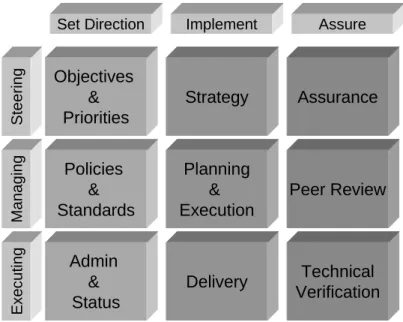
The governance matrix, presented by Graham Oakes, Figure 3, gives us a simple model to represent roles and to identify information needs of different Organization’s stakeholders. It
358
doesn’t substitute the OBS or the Communication Plan but can complement them, giving another perspective on who is involved in the decision making and information processes. The matrix columns represent the following decision types:
1. Set Direction: defining objectives, priorities, policies and standards - the “What” decisions;
2. Implement: making decisions when we are implementing the project - the “How” decisions;
3. Assure: validating the decisions about how the project is being implemented and managed.
The matrix lines represent the decision levels scope:
1. Steering: Level where the Organization sets-up objectives and priorities, focusing on strategies, business needs and resources availability;
2. Managing: Level of resources allocation, planning and controlling activities, including risks management;
3. Executing: Level where project activities are performed, to build the planed deliverables.
Figure 3 - Governance Matrix. Source (Oakes, 2008, pp 187)
Objectives & Priorities Policies & Standards Admin & Status Strategy Planning & Execution Delivery Assurance Peer Review Technical Verification
Set Direction Implement Assure
Steering Ma nag ing Exe c uting
Oakes’s governance matrix might be linked with the Muller’s governance framework for project management.
Muller’s first force, “what can be done”, project management education and certification, is linked to policies & standards cell of Oakes’s matrix.
Muller’s second force, “what should be done”, creating steering committees, PSO’s and benchmarking, is represented in Oakes’s matrix by steering line and set direction column. Muller’s third force, “what is done”, defining Organization’s steps to improve project management efficiency and effectiveness, based on audits and reports, mentor programs and maturity models, is represented in Oakes’s matrix assuring column.
359
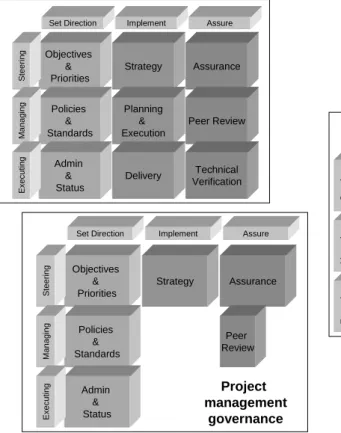
Oakes’s matrix might be split in two subsets, as represented in Figure 4. The fist one representing project management governance roles, including the steering line, set direction column and part of peer review. The second set of roles represents project governance, including planning & execution, delivery, technical verification and part of peer review. Peer review role belongs to project management governance when it executes project management audits and to project governance when the project is reviewed.Figure 4 - The two perspectives of Governance Matrix.
Objectives & Priorities Policies & Standards Admin & Status Strategy Planning & Execution Delivery Assurance Peer Review Technical Verification
Set Direction Implement Assure
St eerin g M anag in g Executi n g Objectives & Priorities Policies & Standards Admin & Status Strategy Planning & Execution Delivery Assurance Peer Review Technical Verification
Set Direction Implement Assure
St eerin g M anag in g Executi n g Objectives & Priorities Policies & Standards Admin & Status Strategy Assurance Peer Review
Set Direction Implement Assure
S teeri n g Man agi ng Execut in g Planning & Execution Delivery Peer Review Technical Verification
Set Direction Implement Assure
Steeri n g Man agi ng Executi n g Project governance Project management governance
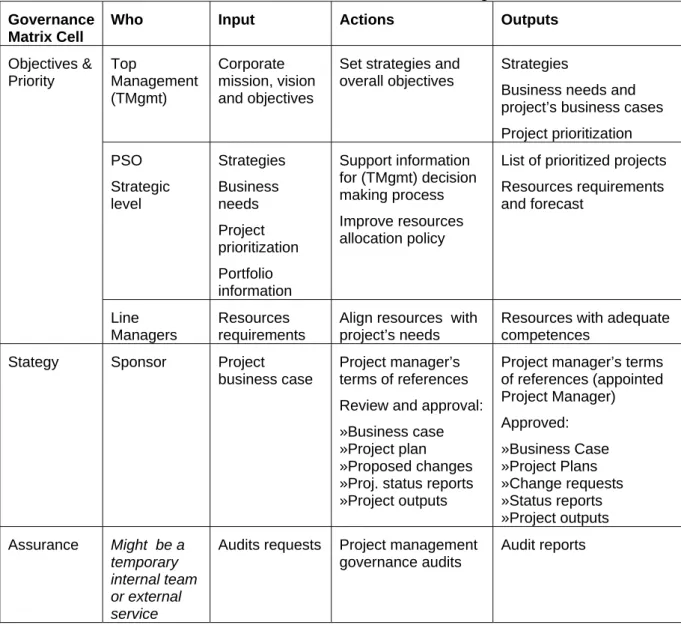
For a given project, each of the nine cells from Oakes matrix captures the organizational components and activities involved in making decisions, the required input information, the actions taken and the expected outputs.
Table 1 presents the detailed cells of steering level.
Projects’ business case must be developed and approved at the steering project management governance level. The business case must clearly define the project outcome and benefits to achieve the Organization’s objectives, based on business priorities and resources availability. This definition starts with the output from Organization’s top management and must be reviewed by the appointed project sponsor, which is measured by the project outcome, the operational project output, and the project benefits, meaning, the use of the project outcome (Turner, 2008).
To evaluate the project outcome, it’s needed to identify the project success criteria. Success factors, must also be identified because they influence the successful achievement of success criteria. Success factors and criteria variables only may be effectively established with the cross revision between project business case and project plan, resulting from the cross information from steering and management levels.
360
Project manager’s terms of reference includes the project manager roles and responsibilities description. It must be compliant with the principle that the project sponsor is measured by the project outcome and project benefits and the project manager by the project outputs. This means that the project manager will be measured by the project asset (the new information system, the new facility plan, the new building, etc.), including the intermediate project deliverables, and the project sponsor is measured by the project outcome, the operational project output, and the project benefits.
Table 1 - Detailed Governance Matrix – Steering Level Governance
Matrix Cell
Who Input Actions Outputs
Objectives & Priority Top Management (TMgmt) Corporate mission, vision and objectives
Set strategies and overall objectives
Strategies
Business needs and project’s business cases Project prioritization PSO Strategic level Strategies Business needs Project prioritization Portfolio information Support information for (TMgmt) decision making process Improve resources allocation policy
List of prioritized projects Resources requirements and forecast Line Managers Resources requirements
Align resources with project’s needs
Resources with adequate competences
Stategy Sponsor Project business case
Project manager’s terms of references Review and approval: »Business case »Project plan »Proposed changes »Proj. status reports »Project outputs
Project manager’s terms of references (appointed Project Manager) Approved: »Business Case »Project Plans »Change requests »Status reports »Project outputs Assurance Might be a temporary internal team or external service
Audits requests Project management
governance audits
Audit reports
Project management governance audits must be done to ensure that “What is Done” is aligned to Organization’s strategies and business needs; compliant with the project management governance components and, as a result, the proposal of corrective or improvement actions.
After the steering level is defined, “what is need”, the “How to do” should be defined, to achieve the stated business needs.
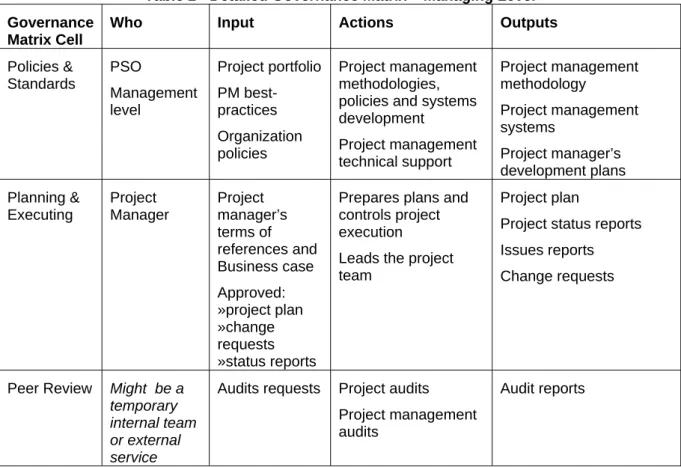
Table 2 presents the cells detail of managing level.
The managing level includes the core of project management processes and tools, covering all project management subjects: scope, time, costs, organization, communication, quality and risks.
361
Table 2 - Detailed Governance Matrix – Managing LevelGovernance Matrix Cell
Who Input Actions Outputs
Policies & Standards PSO Management level Project portfolio PM best-practices Organization policies Project management methodologies, policies and systems development Project management technical support Project management methodology Project management systems Project manager’s development plans Planning & Executing Project Manager Project manager’s terms of references and Business case Approved: »project plan »change requests »status reports
Prepares plans and controls project execution
Leads the project team
Project plan
Project status reports Issues reports Change requests
Peer Review Might be a
temporary internal team or external service
Audits requests Project audits
Project management audits
Audit reports
The executing level, detailed in Table 3, presents the roles, inputs, actions and outputs needed to execute the project results.
Table 3 - Detailed Governance Matrix – Executing Level Governance
Matrix Cell
Who Input Actions Outputs
Admin & Status PSO Tactical level Approved project plans Project status reports Consolidate projects status reports Maintains project portfolio information Guaranties administrative support to project managers Admin. support Updated portfolio information Delivery Project teams (internal or external teams) Team assignments
executes the project activities Project results Progress reports Technical verification Team of technical experts and K-users Project quality plan Audits requests Independent quality control Technical audits Quality control reports
362
At the steering level, the PSO has a portfolio role, influencing the prioritization of projects and the allocation of resources across the portfolio. This may be considered the strategic PSO. At the management level, the PSO owns project management processes and standards, defines and implements methodologies, designs and plans project management training, and creates and maintains project management tools. This may be considered the supporting PSO.
At the execution level, the tactical PSO assumes an administrative role, creating control mechanisms for reporting project status and tools to support project management processes. In the detailed governance matrix tables, inputs and outputs are identified, which must be ensured during different stages of a project life cycle, based on information flows. Concerning continuous improvement, it’s needed to ensure that these flows will include project measures and that they can contribute to project success and Organization’s project management governance maturity.
6. Start-up information flows and measures.
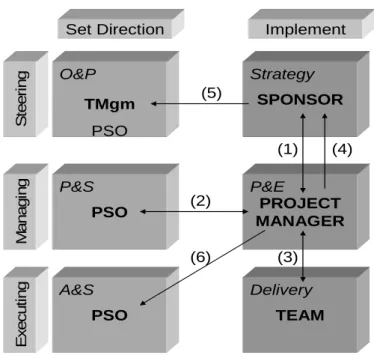
During project start-up decisions are made at the governance matrix steering level. The project start-up begins with the business needs identification and finishes with the business case approval, the decision to do the project, and the project manager appointment. During the project start-up tree major information flows may be identified, represented in Figure 4: 1. The organization’s top management, aligned with line managers and business unit’s
goals, will identify the business need and main business constraints, developing the first version of the project business case, and appointing a project sponsor to ensure the desired outcome and benefits.
2. The new business need is evaluated in the Organization’s project portfolio. The portfolio evaluation is performed by the strategic PSO, in a portfolio management role, to obtain the required information for the top management prioritization decisions.
3. The sponsor will review and approve the project business case, outlining the business and project objectives, the expected benefits, the deliverables, performance indicators, constraints, risks and opportunities and stakeholder’s analysis (identifying the project stakeholders and their expectations). The sponsor will establish the project manager’s terms of reference.
Figure 4 – Start-up Information Flows
TMgmt PSO
SPONSOR
PROJECT MANAGER
Set Direction Implement
Steering Ma nag ing O&P Strategy P&E (1) (2) (3)
363
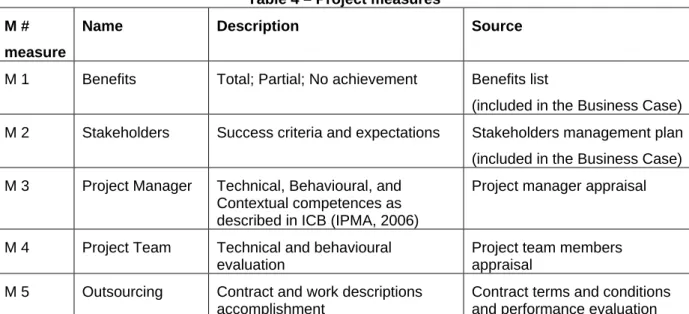
The project start-up is the most relevant phase to identify the project management measures. At this phase, project benefits linked to the project outcome; time, costs and quality constraints; project stakeholders; risks and opportunities are indentified.From the project start-up information flows, the first set of project management measures is identified, as represented in table 4.
Table 4 – Project measures M #
measure
Name Description Source
M 1 Benefits Total; Partial; No achievement Benefits list
(included in the Business Case)
M 2 Stakeholders Success criteria and expectations Stakeholders management plan
(included in the Business Case)
M 3 Project Manager Technical, Behavioural, and
Contextual competences as described in ICB (IPMA, 2006)
Project manager appraisal
M 4 Project Team Technical and behavioural
evaluation
Project team members appraisal
M 5 Outsourcing Contract and work descriptions
accomplishment
Contract terms and conditions and performance evaluation Benefits must be clearly identified as part of the project business case. Clear benefits identification will help to focus steering groups, project manager, stakeholders and support functions on the project purpose. The metrics to measure benefits shall be the achievement of each benefit. This achievement might be total or partial, during the project life cycle. However, some of the benefits only can be measured after project closure, during the operations phase.
Stakeholder’s identification and expectations must be described in the business case and should be reviewed during the project planning process and along the project life cycle. The project manager’s appointment must be formalized by a set of terms of reference, which represents a contract between the project sponsor, the project manager and the performing Organization. The metrics of project manager’s performance must consider the contractual terms and might be complemented with the competences assessment, based on ICB (IPMA, 2006) competence elements. This assessment will provide crucial information for education and personal development purposes.
7. Project plan information flows
During project plan, governance matrix management level is considered. Planning starts with the business case approval and project management appointment and finishes whit project plan approval. Six major information flows, represented in Figure 5, may be identified:
1. The project manager receives the mandate from the project sponsor. This mandate is based on the project business case and the project manager’s terms and references. This information is represented by a two ways arrow indicating that both documents must be agreed between the project manager and the project sponsor.
2. The project manager gets support from PSO on appropriate project management methodology use, standards and tools.
364
3. Project manager works with team leaders to define the project detailed plan, performing estimations, defining resources allocations and assessing technical risks.
4. Project manager integrates detailed plans and inputs from project team leaders, peers and PSO and presents the project plan to the project sponsor.
5. Project sponsor reviews and approves the project plan and submits it to top management and strategic PSO, for portfolio update.
6. Project manager sends the approved project plan to the Administrative PSO and to the adequate administrative support functions, such as finance, human resources, purchasing, and so on.
Figure 5 – Planning Information Flows
TMgm PSO PSO PSO SPONSOR PROJECT MANAGER TEAM
Set Direction Implement
S tee ri ng M ana g in g Ex e c u ti n g O&P P&S A&S Strategy P&E Delivery (2) (3) (1) (5) (6) (4)
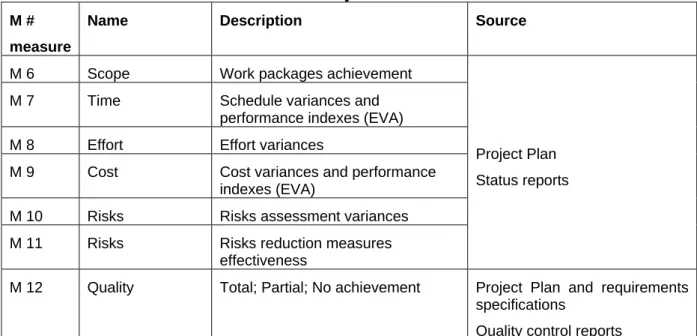
From the identified project plan information flows, a second set of project management measures needed for project management governance improvement is defined, as represented in table 5.
These seven project measures, from M6 to M 12, are the main measures extracted from the project controlling process, when the planed objectives are compared with the current project status.
The best known project measures are the time and cost indicators, based on Earned Value Analysis (EVA).
The risk objectives are proposed to be split in two separated measures. M 10 to evaluate how accurate was the risk identification and assessment, M 11 to evaluate the risk reduction measures effectiveness.
365
Table 5 – Project measuresM # measure
Name Description Source
M 6 Scope Work packages achievement
Project Plan Status reports
M 7 Time Schedule variances and
performance indexes (EVA)
M 8 Effort Effort variances
M 9 Cost Cost variances and performance
indexes (EVA)
M 10 Risks Risks assessment variances
M 11 Risks Risks reduction measures
effectiveness
M 12 Quality Total; Partial; No achievement Project Plan and requirements
specifications
Quality control reports
8. Project execution and control information flows
At the project execution and control processes, all the governance matrix levels are covered. During these processes, starting with the project plan approval and considered to finish with the project closure, six major information flows may be identified, as represented in Figure 6.
Figure 6 – Execution Information Flows
TMgm PSO PSO PSO SPONSOR PROJECT MANAGER TEAM
Set Direction Implement
S teer in g M a na gi n g Ex e c u ti n g O&P P&S A&S Strategy P&E Delivery (1) (2) (3) (3) (4) (5) (6)
1. The project manager creates project team assignments 2. Project team leaders provide progress reports
3. Project manager consolidates the progress reports and provides status reports, issues reports and change requests evaluations
366
4. Project sponsor approves status reports and change requests, updating the business case information, according with the change management process
5. Administrative PSO updates portfolio information, based on projects status reports
6. If the project situation requires business case updates, project sponsor will inform the top management accordingly.
Between the management level PSO and the project manager, the information flow is represented by a dashed arrow showing the continuous project manager support provided by PSO.
Project execution and closure processes will use the twelve measures identified above.
9. Conclusions
As referred, one of the project management governance basic components is disclosure and reporting which must be build to “ensure that the content of project reports will provide timely, relevant and reliable information that supports the organization’s decision making process, without fostering a culture of micro-management” (APM, 2004,p 11).
To have reliable information that may influence the projects effectiveness, project management measures, across the project life cycle, needs to be properly defined to be applied on project reviews, assurance and lessons learned.
Based on my field experience, mainly in IT consultancy organizations, project management performance indicators are taken from a tactical, short-time perspective, based on quantitative indicators of time, costs and effort variances. Qualitative indicators, with a strategic long-time perspective as well as some other important success criteria, such as employees and stakeholder’s satisfaction, that might leave a legacy for future projects, are usually out of those evaluations.
To implement project management governance, projects results evaluation can’t be limited to projects performance indicators based on quantitative data.
An effective model to extract project management measures, along the project life cycle, adequate to help project managers implementing timely corrective actions, supporting steering groups on the decision making process, providing portfolio management with reliable information to optimize portfolios and prioritize projects, shall include the 12 measures identified in this paper.
367
References
APM (2004). Directing Change. A guide to governance of project management. London: Association for Project Management.
Brandon, D. (2004). Project performance measurement. In Morris, P., & Pinto, J. (Ed.), The wiley guide to managing projects. (pp 830-851).New Jersey: John Wiley and Sons. Crawford, L. H., & Terence J. C. (2005). Project governance: The pivotal role of the
executive sponsor. Originally published as a part of 2005 PMI Global Congress Proceedings. Toronto.
Frame, J.D. (2004). Lessons learned: project evaluation. In Morris, P., & Pinto, J. (Ed.), The wiley guide to managing projects. (pp 1197-1233).New Jersey: John Wiley and Sons Gareis, R. (2005): Happy projects. Vienna: Manz.
Harpum, P. (2004). Project control. In Morris, P., & Pinto, J. (Ed.), The wiley guide to managing projects. (pp 1197-1233).New Jersey: John Wiley and Sons
Klakeegg, O.J., & Williams, T., & Magnussen O. M. (2009). Governance frameworks – for public project development and estimation. Newton Square: Project Management Institute.
Muller, R. (2009). Project governance. Farnham: Grower Publishing Limited. Muller, R., & Stawicki, J. (2007). A framework for building successful project based
organizations. Project Perspectives 29:1, pp 68-71.
IPMA (2006). ICB IPMA Competence Baseline Version 3.0. The Netherlands: International Project Management Association.
Oakes, G.(2008). Project reviews, assurance and governance. Aldershot: Grower Publishing Limited
OECD (2004) OECD Principles of Corporate Governance. Paris, France: OECD.
PMI (2004). A guide to project management body of knowledge. Newton Square: Project Management Institute.
PMI (2003). Organizational Project Management Maturity Model (OPM3), Newton Square: Project Management Institute.
Powell, M.,& Young J. (2004). The Project management support office. In Morris, P., & Pinto, J. (Ed.), The wiley guide to managing projects. (pp 937-969).New Jersey: John Wiley and Sons
Shannon, D (2004, October/November). The governance of project management. British Journal of administrative management, p.18-19
Turner, J.R. (2008). The Handbook of Project-Based Management: Leading Strategic Change in Organizations. Berkshire: Mc-Graw-Hill.