Bangladesh J Pharmacol 2006; 1: 35-41 Available online at www.bdjpharmacol.com
Copyright © 2006 by Bangladesh Pharmacological Society
Minireview
Anticancer agents from medicinal plants
Mohammad Shoeb
Department of Chemistry, University of Dhaka, Dhaka 1000, Bangladesh.
[Received 29 November 2006]
Abstract
Cancer is a major public health burden in both developed and developing countries. Plant derived agents are being used for the treatment of cancer. Several anticancer agents including taxol, vinblas-tine, vincrisvinblas-tine, the camptothecin derivatives, topotecan and irinotecan, and etoposide derived from epipodophyllotoxin are in clinical use all over the world. A number of promising agents such as flavopiridol, roscovitine, combretastatin A-4, betulinic acid and silvestrol are in clinical or preclinical development.
Key words: anticancer, cytotoxicity, medicinal plants, natural products, taxol
Introduction
Natural Products, especially plants, have been used for the treatment of various diseases for thousands of years. Terrestrial plants have been used as medicines in Egypt, China, India and Greece from ancient time and an impressive number of modern drugs have been developed from them. The first written records on the medi-cinal uses of plants appeared in about 2600 BC from the Sumerians and Akkaidians (Samuel-sson, 1999). The “Ebers Papyrus”, the best known Egyptian pharmaceutical record, which documented over 700 drugs, represents the history of Egyptian medicine dated from 1500 BC. The Chinese Materia Medica, which descri-bes more than 600 medicinal plants, has been
well documented with the first record dating from about 1100 BC (Cragg et al., 1997). Docu-mentation of the Ayurvedic system recorded in Susruta and Charaka dates from about 1000 BC (Kappor, 1990). The Greeks also contributed substantially to the rational development of the herbal drugs. Dioscorides, the Greek physician (100 A.D.), described in his work “De Materia Medica” more than 600 medicinal plants (Samuelsson, 1999). The World Health Organi-zation estimates that approximately 80% of the world’s inhabitants rely on traditional medicine for their primary health care (Farnsworth et al., 1985). Cancer is a major public health burden in both developed and developing countries. It was estimated that there were 10.9 millions new cases, 6.7 million deaths, and 24.6 million
per-leading cause of death in the United States (Hoyert et al., 2005), where one in four deaths is due to cancer. Plants have long been used in the treatment of cancer (Hartwell, 1982). The National Cancer Institute collected about 35,000 plant samples from 20 countries and has screened around 114,000 extracts for anticancer activity (Shoeb, 2005). Of the 92 anticancer drugs com-mercially available prior to 1983 in the US and among world wide approved anticancer drugs between 1983 and 1994, 60% are of natural origin (Cragg et al., 1997). In this instance, natural origin is defined as natural products, derivatives of natural products or synthetic pharmaceuticals based on natural product models (Jaspars and Lawton, 1998).
Plant derived Anticancer agents in clinical use
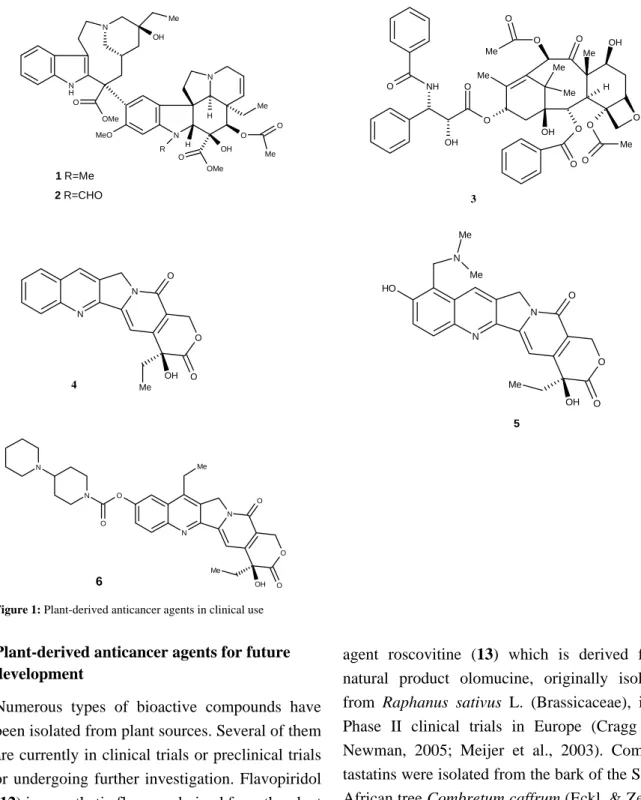
The isolation of the vinca alkaloids, vinblastine (1) and vincristine (2) from the Madagascar periwinkle, Catharanthus roseus G. Don. (Apo-cynaceae) introduced a new era of the use of plant material as anticancer agents. They were the first agents to advance into clinical use for the treatment of cancer (Cragg and Newman, 2005). Vinblastine and vincristine are primarily used in combination with other cancer chemothe-rapeutic drugs for the treatment of a variety of cancers, including leukemias, lymphomas, ad-vanced testicular cancer, breast and lung cancers, and Kaposi’s sarcoma (Cragg and Newman, 2005).
The discovery of paclitaxel (Taxol®, 3) from the bark of the Pacific Yew, Taxus brevifolia Nutt. (Taxaceae), is another evidence of the success in natural product drug discovery. Various parts of Taxus brevifolia and other Taxus species (e.g., Taxus Canadensis Marshall, Taxus baccata L.) have been used by several Native American Tribes for the treatment of some non-cancerous
cases (Cragg and Newman, 2005) while Taxus
baccata was reported to use in the Indian
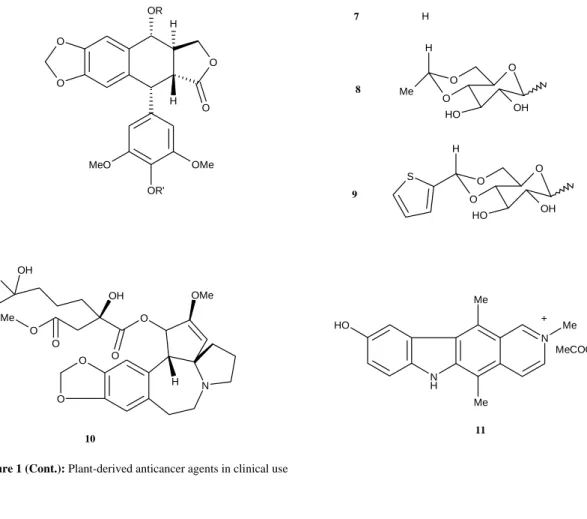
Ayurvedic medicine for the treatment of cancer. The structure of paclitaxel was elucidated in 1971 and was clinically introduced to the US market in the early 1990s (Wani et al., 1971; Rowinsky et al., 1992).Paclitaxel is significantly active against ovarian cancer, advanced breast cancer, small and non-small cell lung cancer (Rowinsky et al., 1992). Camptothecin (4), isolated from the Chinese ornamental tree Camptotheca acuminate Decne (Nyssaceae), was advanced to clinical trials by NCI in the 1970s but was dropped because of severe bladder toxicity (Potmeisel, 1995). Topotecan (5) and irinotecan (6) are semi-synthetic derivatives of camptothecin and are used for the treatment of ovarian and small cell lung cancers, and colo-rectal cancers, respectively (Creemers et al., 1996; Bertino, 1997). Epipodophyllotoxin is an isomer of podophyllotoxin (7) which was isola-ted as the active anti-tumor agent from the roots of Podophyllum species, Podophyllum peltatum
Linnaeus and Podophyllum emodi Wallich
(Berberidaceae) (Stahelin, 1973). Etoposide (8) and teniposide (9) are two semi-synthetic deriva-tives of epipodophyllotoxin and are used in the treatment of lymphomas and bronchial and testicular cancers (Cragg and Newman, 2005; Harvey, 1997).
Homoharringtonine (10), isolated from the
Chinese tree Cephalotaxus harringtonia var.
drupacea (Sieb and Zucc.) (Cephalotaxaceae), is another plant-derived agent in clinical use (Itokawa et al., 2005; Powell et al, 1970). A racemic mixture of harringtonine and homoha-rringtonine has been used successfully in China for the treatment of acute myelogenous leukemia and chronic myelogenous leukemia (Cragg and Newman, 2005; Kantarjian et al., 1996). Ellipti-nium (11), a derivative of ellipticine, isolated from a Fijian medicinal plant Bleekeria vitensis A.C. Sm., is marketed in France for the treatment of breast cancer (Cragg and Newman, 2005).
N N O OMe H Me O Me O R H MeO OH N H N Me OH O OMe NH O O OH O Me Me Me O O Me O Me O H OH OH O Me O O O N N O O O OH Me N N O O O OH O H Me N Me Me N N O O O OH Me Me O N O N 1 R=Me 2 R=CHO 3 4 6 5
Figure 1: Plant-derived anticancer agents in clinical use
Plant-derived anticancer agents for future development
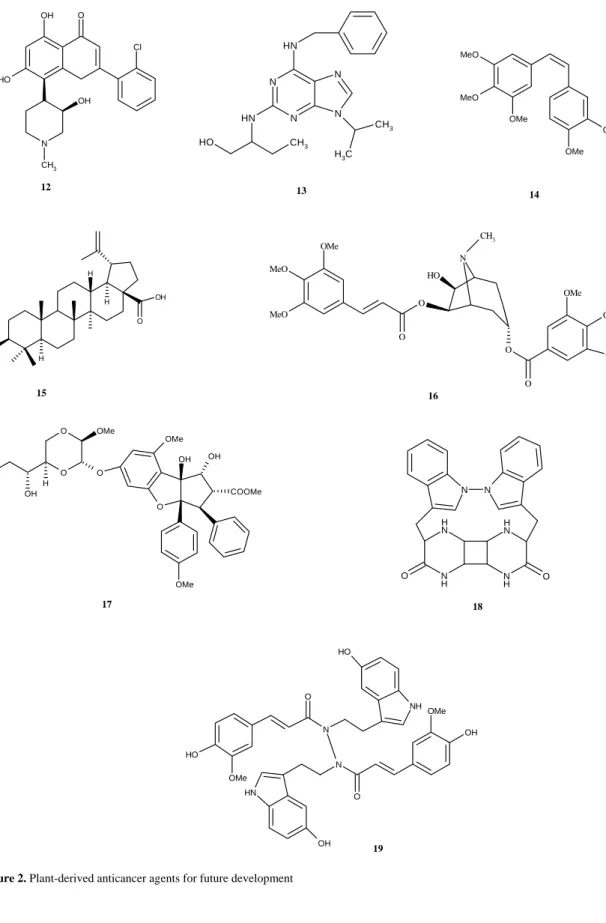
Numerous types of bioactive compounds have been isolated from plant sources. Several of them are currently in clinical trials or preclinical trials or undergoing further investigation. Flavopiridol (12) is a synthetic flavone, derived from the plant alkaloid rohitukine, which was isolated from Dysoxylum binectariferum Hook. f. (Meliaceae) (Kellard et al., 2000). It is currently in phase I and phase II clinical trials against a broad range of tumors, including leukemia, lymphomas and solid tumors (Christian et al., 1997). Synthetic
agent roscovitine (13) which is derived from natural product olomucine, originally isolated from Raphanus sativus L. (Brassicaceae), is in Phase II clinical trials in Europe (Cragg and Newman, 2005; Meijer et al., 2003). Combre-tastatins were isolated from the bark of the South African tree Combretumcaffrum (Eckl. & Zeyh.) Kuntze (Combretaceae) (Pettit et al., 1987). Combretastatin A-4 (14) is active against colon, lung and leukemia cancers and it is expected that this molecule is the most cytotoxic phyto-molecule isolated so far (Ohsumi et al., 1998; Pettit et al., 1995).
O O O OR H H O OR' MeO OMe O OH O H O O H Me O OH O H O O H S O O N H OMe O O Me O OH Me Me OH O N H N O H Me Me Me 7 8 H Me H 9 H R R' 10 MeCOO -+ 11 Figure 1 (Cont.): Plant-derived anticancer agents in clinical use
Betulinic acid (15), a pentacyclic triterpene, is a common secondary metabolite of plants,
primarily from Betula species (Betulaceae)
(Cichewitz et al., 2004). Betulinic acid was isolated from Zizyphus species, e.g. mauritiana, rugosa and oenoplia (Pisha et al., 1995; Nahar et al., 1997) and displayed selective cytotoxicity against human melanoma cell lines (Balunas et al., 2005). The development of systemic and topical formulations of the agent for potential clinical trials by the NCI is ongoing (Cragg and Newman, 2005). Pervilleine A (16) was isolated from the roots of Erythroxylum pervillei Baill. (Erythroxylaceae) (Silva et al., 2001). Pervilleine A was selectively cytotoxic against a multidrug resistant (MDR) oral epidermoid cancer cell line (KB-V1) in the presence of the anticancer agent vinblastine (Mi et al., 2001). Pervilleine A is currently in preclinical development (Mi et al.,
2003). Silvestrol (17) was first isolated from the fruits of Aglaila sylvestre (M. Roemer) Merrill (Meliaceae) (Hwang et al., 2004). Silvestrol exhibited cytotoxicity against lung and breast cancer cell lines (Cragg and Newman, 2005). Biological studies are ongoing to determine the mechanism(s) of action for silvestrol.
Two novel alkaloids, schischkinnin (18) and
montamine (19) have been isolated from the
seeds of Centaurea schischkinii and Centaurea montana (Shoeb et al., 2005; 2006). Both of the alkaloids exhibited significant cytotoxicity against human colon cancer cell lines. The uni-que structural features of 18 and 19 can be exploited as a template for generating com-pounds with enhanced anticancer activity. However, further investigations are necessary for their use as anticancer agents.
OH OMe OMe MeO MeO OH O H N Cl CH3 OH O N N N N C H3 CH3 N H O H CH3 N H O H H H H O OH O OMe MeO MeO O N O H O O OMe OMe OMe CH3 O O O O OH OH COOMe OMe O H OH H OMe OMe N N N H N H O N H N H O N H OH N O OH OMe NH O H N O O H OMe 14 12 13 15 16 17 18 19 Figure 2. Plant-derived anticancer agents for future development
Conclusion
Natural products discovered from medicinal
product derivatives comprised 14 of the top 35 drugs in 2000 based on worldwide sales (Butlet,
account for nearly one-third of the global anticancer market or about $3 billion of $9 billion in total annually in 2002 (Oberlines and Kroll, 2004). There are more than 270,000 higher plants existing on this planet. But only a small portion has been explored phytochemically. So, it is anticipated that plants can provide potential bioactive compounds for the development of new ‘leads’ to combat cancer diseases.
References
Balunas MJ, Kinghorn AD. Drug discovery from medicinal plants. Life Sci. 2005; 78: 431-41.
Bertino JR. Irinotecan for colorectal cancer. Semin Oncol. 1997; 24: S18-S23.
Butlet MS. The role of natural product chemistry in drug discovery. J Nat Prod. 2004; 67: 2141-53.
Cichewitz RH, Kouzi SA. Chemistry, biological activity, and chemotherapeutic potential of betulinic acid for the prevention and treatment of cancer and HIV infection. Med Res Rev. 2004; 24: 90-114.
Cox PA. Ethnopharmacology and the search for new drugs. In: Bioactive compounds from plants. Ciba Foundation Symposium 154. Chichester, England, John Wiley and Sons, 1990, pp 40-55.
Christian MC, Pluda JM, Ho TC, Arbuck SG, Murgo AJ, Sausville EA. Promising new agents under development by division of cancer treatment, diagnosis, and centers of the National Cancer Institute. Semin Oncol. 1997; 13: 2643-55.
Cragg GM, Newman DJ, Snader KM. Natural products in drug discovery and development. J Nat Prod. 1997; 60: 52-60.
Cragg GM, Newman DJ. Plants as source of anticancer agents. J Ethnopharmacol. 2005; 100: 72-79.
Creemers GJ, Bolis G, Gore M, Scarfone G, Lacave AJ, Guastalla JP, Despax R, Favalli G, Kreinberg R, VanBelle S, Hudson I, Verweij J, Huinink WWT. Topotecan, an active drug in the second-line treatment of epithelial ovarian cancer: results of a large European phase II study. J Clin Oncol. 1996; 14: 3056-61.
Farnsworth NR, Akerele O, Bingel AS, Soejarto DD, Guo Z. Medicinal plants in therapy. Bull World Health Organ. 1985; 63: 965-81.
Hartwell JL. Plants used against cancer: a survey. Lawrence, MA. Quarterman Publications, 1982, pp 438-39.
Harvey AL. Medicines from nature: are natural products still relevant to drug discovery. Trends Pharmacol Sci. 1999; 20: 196-98.
Hoyer DL, Kung HC, Smith BL. Natl. Vital. Stat. Rep. 2005; 53: 1-48.
Hwang BY, Su BN, Chai H, Mi Q, Kardono LB, Afriastini JJ, Riswan S, Santarsiero B D, Mesecar AD, Wild R, Fairchild CR, Vite GD, Rose WC, Farnsworth NR, Cordell GA, Pezzuto JM, Swanson SM, Kinghorn AD. Silvestrol and episilvestrol, potential anticancer rocaglate derivatives from Aglaila silvestris. J Org Chem. 2004; 69: 3350-58 (ibid. 69 (18), 6156).
Itokawa H, Wang X, Lee K-H. Homoharringtonine and related compounds. In: Cragg GM, Kingston, DGI, New-man D, (eds). Anticancer agents from natural products. Boca Raton, Florida, Brunner-Routledge Psychology Press, Taylor & Francis Group, 2005, pp 47-70.
Jaspars M, Lawton LA. Cyanobacteria as a novel source of pharmaceuticals. Curr Opin Drug Discovery Develop. 1998; 1: 77-84.
Kantarjian HM, O’Brien S, Anderlini P, Talpaz M. Treat-ment of chronic myelogenous leukemia: current status and investigational options. Blood. 1996; 87: 3069-81. Kappor LD. CRC Handbook of ayurvedic medicinal plants.
Boca Raton, Florida, CRC Press, 1990, pp 416-17. Kelland LR. Flavopiridol, the first cyclic-dependent kinase
inhibitor to enter the clinic: current status. Expert Opin InvestigDrugs. 2000; 9: 2903-11.
Meijer L, Raymond E. Roscovitine and other purines as kinase inhibitors. From starfish oocytes to clinical trials. Accounts Chem Res.2003; 36: 417-25.
Mi Q, Cui B, Silva GL, Lantvit D, Lim E, Chai H, You M, Hollingshead MG, Mayo JG, Kinghorn AD, Pezzuto JM. Pervilleine A, a novel tropane alkaloid that reverses the multidrug-resistance phenotype. Cancer Res. 2001; 61: 842-50.
Mi Q, Cui B, Silva GL, Lantvit D, Reyes-Lim E, Chai H, Pezzuto JM, Kinghorn AD, Swanson SM. Pervilleine F, a new tropane alkaloid aromatic ester that reverses the multidrug-resistance phenotype. Anticancer Res. 2003; 23: 3607-16.
Nahar N, Das RN, Shoeb M, Marma MS, Aziz MA, Mosihuzzaman M. Four triterpenoids from the bark of Zizyphus rugosa and Z. oenoplia. J Bangladesh Academy Sci. 1997; 21: 151-56.
Oberlines NH, Kroll DJ. Camptothecins and taxol: historic achievement in natural products research. J Nat Prod. 2004; 67: 129-35.
Ohsumi K, Nakagawa R, Fukuda Y, Hatanaka T, Morinaga Y, Nihei Y, Ohishi K, Suga Y, Akiyama Y, Tsuji T. New combretastatin analogues effective against murine solid tumors: design and structure-activity relationship. J Med Chem. 1998; 41: 705-06.
Parkin DM, Bray F, Ferlay J, Pisani P. Global cancer statistics, 2002. CA Cancer J Clin. 2005, 55; 74-108. Pettit GR, Singh SB, Niven ML, Hamel E, Schmit JM.
Isolation, structure, and synthesis of combretastatins A-1 and B-1, potent new inhibitors of microtubule assembly, derived from Combretum caffrum. J Nat Prod. 1987; 50: 119-20.
Pettit GR, Singh SB, Boyd MR, Hamel E, Pettit R, Schmit JM, Hogan F. Antineoplastic agents. 291. Isolation and synthesis of combretastatins A-4, A-5 and A-6. J Med Chem. 1995; 38: 1666-72.
Pisha E, Chai H, Lee IS, Chagwedera TE, Farnsworth NR, Cordell GA, Beecher CW, Fong HH, Kinghorn AD, Brown DM, Wani MC, Wall ME, Hieken TJ, Das Gupta TK, Pezzuto JM. Discovery of betulinic acid as a selective inhibitor of human melanoma that functions by induction of apoptosis. Nat Med. 1995; 1: 1046-51. Potmeisel M, Pinedo H. Camptothecins: new anticancer
agents. Boca Raton, Florida, CRC Press, 1995, pp 149-150.
Powell RG, Weisleder D, Smith CRJr, Rohwedder WK. Structures of harringtonine, isoharringtonine, and homo-harringtonine. Tetrahedron Lett. 1970; 11: 815-18. Rowinsky EK, Onetto N, Canetta RM, Arbuck SG,
Taxol-the 1st of Taxol-the texanes, an important new class of anti-tumor agents. Semin Oncol. 1992; 19: 646-62.
Samuelsson G. Drugs of natural origin: a textbook of pharmacognosy. 4th ed., Stockholm, Swedish Pharmaceu-tical Press, 1999.
Shoeb M. Cytotoxic compounds from the Genus Centaurea. PhD Thesis. Aberdeen, UK, The Robert Gordon Univer-sity, 2005.
Shoeb M, Celik S, Jaspars, M, Kumarasamy Y, MacManus S, Nahar L, Kong TLP, Sarker SD. Isolation, structure elucidation and bioactivity of schischkiniin, a unique indole alkaloid from the seeds of Centaurea schischkinii. Tetrahedron.2005; 61: 9001-06.
Shoeb M, MacManus SM, Jaspars M, Trevidadu J, Nahar L, Thoo-Lin PK, Sarker SD.Montamine, a unique dimeric indole alkaloid, from the seeds of Centaurea montana (Asteraceae), and its in vitro cytotoxic activity against the CaCo2 colon cancer cells. Tetrahedron. 2006; 62: 11172-77.
Silva GL, Cui B, Chavez D, You M, Chai HB, Rasoanaive P, Lynn SM, O’Neill MJ, Lewis JA, Besterman JM, Monks A, Farnsworth NR, Cordell GA, Pezzuto JM, Kinghorn AD. Modulation of the multidrug-resistance phenotype by new tropane alkaloids aromatic esters from Erythroxylum pervillei. J Nat Prod. 2001; 64: 1514-20. Stahelin H. Activity of a new glycosidic lignan derivative
(VP 16-213) related to podophyllotoxin in experimental tumors. Eur J Cancer. 1973; 9: 215-21.
Wall ME, Wani MC. Camptothecin and taxol: from discovery to clinic. J Ethnopharmacol. 1996; 51: 239-53. Wani MC, Taylor HL, Wall M E, Coggon P, McPhail AT.
Plant anti-tumor agents. VI. The isolation and structure of taxol, a novel anti-leukemic and anti-tumor agent from Taxus brevifolia. J Am Chem Soc. 1971; 93: 2325-27.