Group decision making using neutrosophic soft matrix: An algorithmic
approach
Sujit Das
a,⇑, Saurabh Kumar
b, Samarjit Kar
c, Tandra Pal
b aDept. of Computer Science and Engineering, Dr. B. C. Roy Engineering College, Durgapur-6, India
b
Dept. of Computer Science and Engineering, National Institute of Technology, Durgapur-9, India
c
Dept. of Mathematics, National Institute of Technology, Durgapur-9, India
a r t i c l e i n f o
Article history: Received 10 September 2016 Revised 9 April 2017 Accepted 1 May 2017 Available online xxxx Keywords:Group decision making Neutrosophic soft matrix Choice matrix Relative weight
a b s t r a c t
This article proposes an algorithmic approach for group decision making (GDM) problems using sophic soft matrix (NSM) and relative weights of experts. NSM is the matrix representation of neutro-sophic soft sets (NSSs), where NSS is the combination of neutroneutro-sophic set and soft set. We propose a new idea for assigning relative weights to the experts based on cardinalities of NSSs. The relative weight is assigned to each of the experts based on their preferred attributes and opinions, which reduces the chance of unfairness in the decision making process. Firstly we introduce choice matrix and combined choice matrix using neutrosophic sets. Multiplying combined choice matrices with the individual NSMs, this study develops product NSMs, which are aggregated to find out the collective NSM. Then neu-trosophic cross-entropy measure is used to rank the alternatives and for selecting the most desirable one (s). This study also provides a comparative analysis of the proposed weight based approach with the nor-mal procedure, where weight is not considered. Finally, a case study illustrates the applicability of the proposed approach.
Ó2017 The Authors. Production and hosting by Elsevier B.V. on behalf of King Saud University. This is an open access article under the CC BY-NC-ND license (http://creativecommons.org/licenses/by-nc-nd/4.0/).
1. Introduction
Fuzzy set (Zadeh, 1965a) uses membership degree
l
AðxÞ 2 ½0;1 to find the belongingness of an element to a set. Whenl
AðxÞitself becomes uncertain, then it is hard to define by a crisp value for it. This was solved by using interval-valued fuzzy sets (IVFSs) in Turksen (1986). In some real life applications, one has to consider not only the truth membership supported by the evidence but also the falsity membership against the evidence, which is beyond the scope of fuzzy sets and IVFSs. Intuitionistic fuzzy set (IFS) (Atanassov, 1986) was introduced as a generalization of fuzzy sets to consider both truth membership and falsity membership. Later IFS was extended to the interval-valued intuitionistic fuzzy sets (IVIFSs) (Atanassov, 1989) for generalization purpose. Abibliomet-ric analysis on fuzzy decision-related research and a scientometbibliomet-ric review on IFS studies can be respectively found in Liu and Liao (2017)andYu and Liao (2016). Due to some restrictions on truth and falsity membership values, fuzzy sets and its extensions can only handle uncertain information but not the indeterminate and inconsistent information, which may exist in reality. For example, when we ask the opinion of an expert about certain statement, he/ she may inform that the possibility of the statement to be true is between 0.5 and 0.7 and to be false is between 0.2 and 0.4 and the degree where he/she is not sure be between 0.1 and 0.3. Con-sider another example, where 10 voters are participating in a vot-ing process. In time t1, three vote ‘‘yes”, two vote ‘‘no” and five are undecided. In neutrosophic notation, it is expressed as (0.3, 0.5, 0.2). In time t2, three vote ‘‘yes”, two vote ‘‘no”, two give up and three are undecided, then it can be expressed as (0.3, 0.3, 0.2), which is beyond the scope of the intuitionistic fuzzy set. This type of situation is well managed by the neutrosophic set (NS), where indeterminacy is quantified explicitly and truth, indeterminacy, and falsity membership are independent to each other. NS provides a more reasonable mathematical framework to deal with indeter-minate and inconsistent information. During the last decade, the concept of NS and interval neutrosophic set (INS) have been used in various applications such as medical diagnosis, database,
http://dx.doi.org/10.1016/j.jksuci.2017.05.001
1319-1578/Ó2017 The Authors. Production and hosting by Elsevier B.V. on behalf of King Saud University. This is an open access article under the CC BY-NC-ND license (http://creativecommons.org/licenses/by-nc-nd/4.0/).
⇑ Corresponding author.
E-mail addresses: [email protected] (S. Das), [email protected]
(S. Kumar),[email protected](S. Kar),[email protected](T. Pal). Peer review under responsibility of King Saud University.
Production and hosting by Elsevier
Contents lists available atScienceDirect
Journal of King Saud University –
Computer and Information Sciences
topology, image processing (Guo and Sengur, 2014), and decision making problems (Ye, 2013, 2014a,b; Broumi and Smarandache, 2013b; Peng et al., 2014; Zhang et al., 2014; Ye, 2013).
Smarandache (Smarandache, 1999, 2003) first introduced neu-trosophy as a branch of philosophy which studies the origin, nat-ure, and scope of neutralities. Neutrosophic set is an important tool which generalizes the concept of the classical set, fuzzy set, interval-valued fuzzy set, intuitionistic fuzzy set, interval-valued intuitionistic fuzzy set, paraconsistent set, dialetheist set, paradox-ist set, and tautological set (Smarandache, 1999). Smarandache (1999) defined indeterminacy explicitly and stated that truth, indeterminacy, and falsity-membership are independent and lies within 0;1þ½, which is the non-standard unit interval and an extension of the standard interval½0;1.Wang et al. (2010) pro-posed single valued neutrosophic sets (SVNSs) from scientific and engineering points of view. SVNS is an instance of the neutrosophic set which was developed considering the difficulty of applying NS in real life problems. Entropy measure of SVNS was introduced by Majumdar and Samant (2014). As an extension of the cross entropy of fuzzy sets,Ye (2014a)defined cross entropy measure of SVNSs called single valued neutrosophic cross entropy. Then the author presented a multi criteria decision making method based on the proposed single valued neutrosophic cross entropy. Ye (2014b) also introduced the concept of simplified neutrosophic sets (SNSs) and proposed an MCDM method using the aggregation operators of SNSs.Peng et al. (2015)defined some operations of simplified neu-trosophic numbers (SNNs) and developed a comparison method using the related research of intuitionistic fuzzy numbers. Based on these operations and the comparison method, the authors developed some SNN aggregation operators and applied them in multi criteria group decision making (MCGDM) problems.Zhang et al. (2014)defined some new operations on INSs and developed aggregation operators for interval neutrosophic number. Broumi and Smarandache (2013b)discussed the correlation coefficient of INSs.Ye (2013) proposed the similarity measures between INSs based on the Hamming and Euclidean distances and developed a multi criteria decision making method based on the similarity degree. Ye (2016) also introduced new exponential operational laws of INSs, where the bases are crisp values or interval numbers and the exponents are interval neutrosophic numbers (INNs). The author proposed a couple of aggregation operators. i.e., interval neutrosophic weighted exponential aggregation (INWEA) operator and a dual interval neutrosophic weighted exponential aggregation (DINWEA) operator based on these exponential operational laws. Finally he applied INWEA and DINWEA operators in decision mak-ing problems.Zhao et al. (2015)studied that many types of incom-plete or comincom-plete information can be expressed as interval valued neutrosophic sets (IVNSs) and proposed improved aggregation
operation rules for IVNSs. They also extended the generalized weighted aggregation (GWA) operator in the context of IVNSs. Peng et al. (2014)presented a new outranking approach for multi criteria decision making (MCDM) problems in the context of a sim-plified neutrosophic environment based on ELECTRE method. Com-bining neutrosophic set with other mathematical models, a number of research works have been published.Maji (2012) intro-duced neutrosophic soft set (NSS) as a combination of NS and soft set (Molodtsov, 1999) and presented a neutrosophic soft set theo-retic approach for a multi-observer object recognition problem. Combining generalized neutrosophic set (Salama, 2012) with soft set (Molodtsov, 1999), Broumi (2013)introduced the concept of generalized neutrosophic soft set. Broumi and Smarandache (2013a)developed intuitionistic neutrosophic soft set by combin-ing intuitionistic neutrosophic set and soft set.Deli (2014) devel-oped interval-valued neutrosophic soft set which is a combination of interval-valued neutrosophic set and soft set. Broumi et al. (2014a) defined neutrosophic parameterized soft set and studied some of its properties. They introduced neutro-sophic parameterized aggregation operator and applied it in deci-sion making problem.Broumi et al. (2014b), in 2014, extended generalized neutrosophic soft set and proposed the idea of gener-alized interval neutrosophic soft set.Deli and Broumi (2014) intro-duced the concept of neutrosophic soft matrix and redefined some operations of neutrosophic soft set given byMaji (2012).Deli et al. (2014)introduced the concept of neutrosophic soft multi-set the-ory and studied their properties and operations.Rivieccio (2008) presented a critical introduction to neutrosophic logics. The author defined suitable neutrosophic propositional connectives and dis-cussed the relationship between neutrosophic logics and other well-known frameworks.Deli et al. (2015)introduced bipolar neu-trosophic set and studied some of its operations. To compare the bipolar neutrosophic sets, they studied score functions and accu-racy functions.Deli et al. (2016)proposed interval valued bipolar fuzzy weighted neutrosophic set (IVBFWN-set) as a generalization of fuzzy set, bipolar fuzzy set, neutrosophic set and bipolar neutro-sophic set.Liu and Luo (2017)developed a series of power aggre-gation operators on simplified neutrosophic set (SNS) called simplified neutrosophic number power weighted averaging (SNNPWA) operator, simplified neutrosophic number power weighted geometric (SNNPWG) operator, simplified neutrosophic number power ordered weighted averaging (SNNPOWA) operator and simplified neutrosophic number power ordered weighted geo-metric (SNNPOWG) operator. Additionally, using the developed aggregation operators, they presented a multi attribute group deci-sion making (MAGDM) approach within the framework of SNSs. In Ye (2015), Ye proposed a neutrosophic number tool for group deci-sion making problems with indeterminate information under a
Table 1
Some significant contributions in neutrosophic set.
Authors Type of study Tools and approaches
Smarandache (1999, 2003) Proposed concept Introduced neutrosophy and defined indeterminacy explicitly and
stated that truth, indeterminacy, and falsity-membership are independent
Wang et al. (2010) Proposed concept Introduced SVNS as an instance of the neutrosophic set
Maji (2012) Proposed concept Introduced NSS and presented a neutrosophic soft set theoretic approach
Ye (2013) Developed approach Proposed similarity measures between INSs
Broumi and Smarandache (2013) Proposed concept Developed intuitionistic neutrosophic soft set
Majumdar and Samant (2014) Proposed concept Introduced entropy measure of SVNS
Ye (2014a,b) Proposed concept Proposed cross-entropy and correlation coefficients of SVNSs
Zhang et al. (2014) Developed approach Developed aggregation operators for interval neutrosophic number
Broumi et al. (2014a) Proposed concept Defined neutrosophic parameterized soft set
Peng et al. (2014) Proposed approach Presented a new outranking approach for MCDM problem
Peng et al. (2015) Proposed concept Developed SNN aggregation operators
Zhao et al. (2015) Proposed concept Improved aggregation operation rules for IVNSs
Ye (2016) Proposed concept Proposed a couple of aggregation operators
Liu and Luo (2017) Proposed concept Developed a series of power aggregation operators on simplified neutrosophic set
Uni-neutrosophic number environment. Some significant contributions in neutrosophic sets are given below inTable 1.
As per our knowledge, there are no articles published in neutro-sophic sets and its hybridizations, where experts’ relative weights have been considered. Experts opinions are vital for any decision making process. When experts prescribe their preferences using soft sets, they provide their opinions only about their known set of attributes/parameters. As the domains of expertise of different experts are different, they may be interested in different subset of attributes and remain silent about the rest of attributes. More specifically, one expert may provide opinion about more number of attributes; whereas other expert may be interested in less num-ber of attributes. In another way, one expert may be more confi-dent on his/her opinion than the other on the same set of attributes. For this type of environment, equal weights assignment to different experts may lead to improper and biased solution. Pre-ceding situation motivated us to develop the relative weight assignment procedure, where more confident opinions are given more importance. Suppose Mr. X and Mr. Y provide their opinions about an attribute using neutrosophic set. According to Mr. X, the opinion is (0.3, 0.4, 0.6) and opinion of Mr. Y is (0.9, 0.1, 0.2). Here more importance will be given to Mr. Y as he/she is more confident, since the truth membership value for his/her is close to 1 which is more than that of Mr. X. In this article, we propose an algorithmic approach for GDM using NSMs and relative weights of experts. Ini-tially experts provide their opinions using NSMs, which are nor-malized by the relative weights of the corresponding experts. The relative weights are assigned to individual experts based on their information, which reduces the chances of biasness. The proposed approach focuses on the choice parameters/attributes of various experts to find out the neutrosophic choice matrix (NCM) and com-bined NCM for individual decision maker/expert. In the process, the combined NCMs are multiplied with the normalized NSMs to obtain the product NSMs, which are aggregated to produce the resultant NSM. Then cross-entropy measure is applied on the alter-natives of the resultant NSM to rank the alteralter-natives. The case study is related to investment in business sectors, where two cases have been considered. Case I shows the final outcome without assigning any weight and Case II shows the result by assigning weights.
The rest of the article is organized as follows. Section 2 provides the basic notions and backgrounds of neutrosophic sets, NSSs, NSMs, and cross-entropy measure of neutrosophic sets. Section 3 proposes NCM, combined NCM, and some operations on NSMs. Proposed algorithmic approach is presented in section4 followed by case study in Section 5. Then a brief discussion on the results is given in Section 6. Finally, we have concluded in Section7.
2. Preliminaries
This section briefly describes neutrosophic set (NS), neutro-sophic soft set (NSS), neutroneutro-sophic soft matrix (NSM), and cross-entropy measure of neutrosophic sets.
2.1. Neutrosophic set, NSS, and NSM
Definition 1 Smarandache (1999). Let U be an universe of dis-course. The neutrosophic set A in U is expressed by
A¼ fhx:TAðxÞ;IAðxÞ;FAðxÞi;x2Ug, where the characteristic functions
T;I;F:U! 0;1þ½respectively define the degree of membership, the degree of indeterminacy, and the degree of non-membership of the element x2U to the set A with the condition: 06TAðxÞþIAðxÞþFAðxÞ63þ.
From philosophical point of view, the neutrosophic set takes the value from real standard or non-standard subsets of 0;1þ½. For convenient application in real life problems, we take the interval ½0;1 instead of 0;1þ½. For a given element x2U, the triplet ðTAðxÞ;IAðxÞ;FAðxÞÞis usually called neutrosophic value (NV) or neutro-sophic number (NN).
Soft set was introduced byMolodtsov (1999)as a generic math-ematical tool for dealing with uncertain problems which cannot be handled using traditional mathematical tools. There are many the-ories, such as theory of probability, theory of fuzzy sets (Zadeh, 1965a), theory of neutrosophic sets (Smarandache, 1999, 2003), etc., which can be considered to deal with uncertainties. But all these theories have their inherent difficulties due to the inade-quacy of the parameterization tool. Soft set is free from such diffi-culties which can be used for approximate description of objects without any restriction. As a definite outcome, soft set theory has emerged as a convenient and easily applicable tool in practice. Neutrosophic set is combined with soft set to get the advantages of both the neutrosophic set and soft set.
Definition 2 Maji (2012). Let U be a universe of discourse and E be a set of parameters. Let NS (U) denotes the set of all neutrosophic subsets of U andAE. A pairðNfAg;EÞis called a NSS over U, where
NfAgis a mapping given byNfAg:E!NSðUÞ.
Example 1.. LetU¼ fc1;c2;c3g ¼{celerio, xcent, eon} be the set of
3 models of cars,E¼ fe1;e2;e3;e4;e5g= {speed, comfort, durability,
costly, branded} be the set of parameters considered for a car, and
A¼ fe1;e2;e3;e5g E. Let
NfAgðe1Þ ¼ fc1=ð0:6;0:4;0:8Þ;c2=ð0:4;0:6;0:8Þg; NfAgðe2Þ ¼ fc2=ð0:4;0:9;0:7Þ;c3=ð0:2;0:3;0:6Þg;
NfAgðe3Þ ¼ fc1=ð0:5;0:3;0:8Þ;c2=ð0:1;0:6;0:3Þ;c3=ð0:4;0:1;0:7Þg; NfAgðe5Þ ¼ fc1=ð0:7;0:1;0:3Þ;c3=ð0:5;0:4;0:7Þg
HereNfAgðe1Þ ¼ fc1=ð0:6;0:4;0:8Þ;c2=ð0:4;0:6;0:8Þgimplies the association of objects (cars)c1;c2{celerio, xcent} with the param-etere1(speed). Parametere1is associated with the objectc1using the degree of membership 0.6, degree of indeterminacy 0.4, and degree of non-membership 0.8. This example shows that parame-tere5(branded) is not associated with any other cars, i.e., when the cars are being considered, the parameterbranded has no signifi-cance particularly in this example.
Then the NSSðNfAg;EÞis given by
ðNfAg;EÞ ¼ ðe1;fc1=ð0:6;0:4;0:8Þ;c2=ð0:4;0:6;0:8ÞgÞ; ðe2;fc2=ð0:4;0:9;0:7Þ;c3=ð0:2;0:3;0:6ÞgÞ; ðe3;fc1=ð0:5;0:3;0:8Þ;c2=ð0:1;0:6;0:3Þ;c3=ð0:4;0:1;0:7ÞgÞ ðe4;f£gÞ; ðe5;fc1=ð0:7;0:1;0:3Þ;c3=ð0:5;0:4;0:7Þg 8 > > > > > > > < > > > > > > > : 9 > > > > > > > = > > > > > > > ; :
Definition 3 Deli and Broumi (2014). LetðNfAg;EÞbe a NSS over the initial universe U. Let E be a set of parameters andA#E. Then a subset of UE is uniquely defined by the relation fðx;eÞ:e2A; x2NfAgðeÞgand denoted byRA¼ ðNfAg;EÞ. Now the relation RA is characterized by the truth function TA:UE! ½0;1, indeterminacyIA:UE! ½0;1, and the falsity function FA:UE! ½0;1. [TAðx;eÞ is the truth value, IAðx;eÞ is the indeterminacy value, and FAðx;eÞis the falsity value of the object x associated with the parameter e.] RA is represented as RA¼ fððTAðx;eÞ;IAðx;eÞ;FAðx;eÞÞ:06TAþIAþFA63;ðx;eÞ 2UEg.
Now if the set of universeU¼ fx1;x2; ;xmg and the set of parameters E¼ fe1;e2;. . .;eng, then RA can be represented by a matrix as follows: RA¼ ðaijÞmn¼ a11 a12 . . . a1n a21 a22 . . . a2n ... ... ... ... am1 am2 . . . amn 0 B B B @ 1 C C C A; whereaij¼ ðTAðxi;ejÞ;IAðxi;ejÞ;FAðxi;ejÞÞ.
The above matrix is called a neutrosophic soft matrix (NSM) of order mn corresponding to the neutrosophic setðNfAg;EÞoverU.
Example 2. The matrix representation of the NSS, described above in Example 1, is shown inTable 2.
2.2. Cross-entropy of neutrosophic sets
Entropy is used to measure the degree of fuzziness or uncertain information in fuzzy set theory. The fuzzy entropy was first intro-duced byZadeh (1965b, 1968)to quantify the amount of fuzziness. De Luca and Termini (1972)introduced some axioms to describe the degree of fuzziness of a fuzzy set based on Shannon’s function. Shannon (1949) defined an information theory in 1949 which introduced cross-entropy. A measure of fuzzy cross-entropy between fuzzy sets was proposed byShang and Jiang (1997)which is used to measure the discrimination information between two fuzzy sets. Zhang and Jiang (2008)defined vague cross-entropy measure between vague sets.Ye (2011)extended the idea of fuzzy cross-entropy to interval-valued intuitionistic fuzzy sets. Hesitant fuzzy linguistic entropy and cross-entropy measures were pro-posed byGou (2017). Ye also proposed cross-entropy measure in Ye (2014a)for single valued neutrosophic set as an extension of the fuzzy cross-entropy.
Suppose bA¼ ðAbðx1Þ;bAðx2Þ;. . .;AbðxnÞÞ and bB¼ ðBbðx1Þ;bBðx2Þ;
. . .;bBðxnÞÞ be two fuzzy sets in the universe of discourse
X¼ fx1;x2;. . .;xng. Then the fuzzy cross-entropy between Ab and
b Bis defined as HðA;bbBÞ ¼Xn i¼1 b AðxiÞlog2 b AðxiÞ 1 2ðbAðxiÞ þbBðxiÞÞ þ ð1AbðxiÞÞlog2 1AbðxiÞ 11 2ðAbðxiÞ þBbðxiÞÞ ! ; ð1Þ
which describes the degree of discrimination of bA from bB. Since
HðAb;bBÞis not symmetric with respect to its arguments, a symmetric discrimination information measure was proposed in Shang and Jiang (1997) as IðbA;bBÞ ¼HðbA;bBÞ þHðbB;AbÞ, whereIðAb;bBÞP0 and
IðAb;bBÞ ¼0 if and only ofAb¼bB. The cross-entropy and symmetric discrimination information measures between two fuzzy sets have been extended to the context of SVNSs. LetA¼ fhxi;TAðxiÞ;IAðxiÞ; FAðxiÞixi2XgandB¼ fhxi;TBðxiÞ;IBðxiÞ;FBðxiÞixi2Xgbe two SVNSs and X¼ fx1;x2;. . .;xng be the universe of discourse, where TAðxiÞ;IAðxiÞ;FAðxiÞ, TBðxiÞ;IBðxiÞ;FBðxiÞ 2 ½0;1. Now considering truth-membership, indeterminacy-membership, and falsity-membership, the amount of information discrimination of TAðxiÞ fromTBðxiÞ,IAðxiÞfromIBðxiÞ, andFAðxiÞfromFBðxiÞare respectively computed using(2), (3), and (4)given below.
ETðA;BÞ ¼X n i¼1 TAðxiÞlog2 TAðxiÞ 1 2ðTAðxiÞ þTBðxiÞÞ " þð1TAðxiÞÞlog2 1TAðxiÞ 11 2ðTAðxiÞ þTBðxiÞÞ # ð2Þ EIðA;BÞ ¼X n i¼1 IAðxiÞlog2 IAðxiÞ 1 2ðIAðxiÞ þIBðxiÞÞ " þð1IAðxiÞÞlog2 1IAðxiÞ 11 2ðIAðxiÞ þIBðxiÞÞ # ð3Þ EFðA;BÞ ¼Xn i¼1 FAðxiÞlog2 FAðxiÞ 1 2ðFAðxiÞ þFBðxiÞÞ " þð1FAðxiÞÞlog2 1FAðxiÞ 11 2ðFAðxiÞ þFBðxiÞÞ # ð4Þ
The single valued neutrosophic cross-entropy measure between
AandBis computed as the sum of three amounts:
EðA;BÞ ¼X n i¼1 TAðxiÞlog2 TAðxiÞ 1 2ðTAðxiÞ þTBðxiÞÞ " þð1TAðxiÞÞlog2 1TAðxiÞ 11 2ðTAðxiÞ þTBðxiÞÞ # þX n i¼1 IAðxiÞlog2 IAðxiÞ 1 2ðIAðxiÞ þIBðxiÞÞ " þð1IAðxiÞÞlog2 1TAðxiÞ 11 2ðTAðxiÞ þTBðxiÞÞ # þX n i¼1 FAðxiÞlog2 FAðxiÞ 1 2ðFAðxiÞ þFBðxiÞÞ " þð1FAðxiÞÞlog2 1FAðxiÞ 11 2ðFAðxiÞ þFBðxiÞÞ # ð5Þ EðA;BÞ is also a discrimination degree between A and B, where
EðA;BÞP0. Here EðA;BÞ ¼0 if and only if TAðxiÞ ¼TBðxiÞ;IAðxiÞ ¼ IBðxiÞ;FAðxiÞ ¼FBðxiÞ. SinceEðA;BÞis not symmetric, so a symmetric discrimination information measure for SVNSs is obtained as
DðA;BÞ ¼EðA;BÞ þEðB;AÞ: ð6Þ DiðA;AiÞ ¼ Xn j¼1 log2 1 1 2ð1þTijÞ þlog2 1 11 2ðIijÞ þlog2 1 11 2ðFijÞ " # þX n j¼1 Tijlog2 Tij 1 2ð1þTijÞ þ ð1TijÞlog2 1Tij 11 2ð1þTijÞ " # þX n j¼1 Iijþ ð1IijÞlog2 1Iij 11 2ðIijÞ " # þX n j¼1 Fijþ ð1FijÞlog2 1Fij 11 2ðFijÞ " # : ð7Þ Table 2
Tabular representation of NSSðNfAg;EÞ.
U=E e1 e2 e3 e4 e5
c1 (0.6,0.4,0.8) 0 (0.5,0.3,0.8) 0 (0.7,0.1,0.3)
c2 (0.4,0.6,0.8) (0.4,0.9,0.7) (0.1,0.6,0.3) 0 0
c3 0 (0.2,0.3,0.6) (0.4,0.1,0.7) 0 (0.5,0.4,0.7)
Uni-Using (5) and (6),Ye (2014a) defined weighted neutrosophic cross-entropy DiðA;AiÞ between an alternative Ai and the ideal alternative A as given in (7). Here the smaller the value of
DiðA;AiÞ, the better will be the alternativeAiand the alternative Ai will be close to the ideal alternativeA. The concept of ideal alternative is used in decision making environment for the purpose of identifying the best alternative in the decision set. Normally the ideal alternative does not exist in real world, but it provides theo-retical framework for evaluating the alternatives.
The ideal alternativeA in neutrosophic concept is defined as
A¼ hT;IFi ¼ h1;0;0i.
3. NCM, combined NCM, and basic operations on NSMs This section presents NCM, combined NCM, and operations on NSMs, such as addition, complement, and product of NSMs with the combined NCMs.
3.1. NCM and combined NCM
This sub-section defines NCM and combined NCM with neces-sary examples.
Definition 4. NCM is a square matrix whose rows and columns both indicates parameters. Ifnis a NCM, then its elementnði;jÞis defined as
nði;jÞ= (1, 0.5, 0) when ith and jth both parameters are the choice parameters of decision maker
=(0, 0.5, 1) when at least one of theith orjth parameters be not under choice of the decision maker.
Example 3.Let U and E are same as in Example 1. Suppose Mr. X is interested for buying a car based on the attributes
AX¼ fe3;e4;e5g E. Then the NCM for Mr. X can be represented as
eX nXði;jÞ ¼eX fð0;0:5;1Þ;ð0;0:5;1Þ;ð0;0:5;1Þ;ð0;0:5;1Þ;ð0;0:5;1Þg fð0;0:5;1Þ;ð0;0:5;1Þ;ð0;0:5;1Þ;ð0;0:5;1Þ;ð0;0:5;1Þg fð0;0:5;1Þ;ð0;0:5;1Þ;ð1;0:5;0Þ;ð1;0:5;0Þ;ð1;0:5;0Þg fð0;0:5;1Þ;ð0;0:5;1Þ;ð1;0:5;0Þ;ð1;0:5;0Þ;ð1;0:5;0Þg fð0;0:5;1Þ;ð0;0:5;1Þ;ð1;0:5;0Þ;ð1;0:5;0Þ;ð1;0:5;0Þg 0 B B B B B @ 1 C C C C C A
In combined NCM, denoted bync, rows indicate choice parame-ters of single decision maker and columns indicate combined choice parameters (obtained by the intersection of parameter sets) of the remaining decision makers.It is noted that in NCMn, both row and column indicate the attributes of same decision maker.
Example 4. Suppose Mr. X and Mr. Y want to buy a car as per their combined opinion. Attributes preferred by of Mr. X are mentioned in Example 3. Let Mr. Y shows his/her preference in
AY¼ fe1;e3g E. Combined NCMncX, for Mr. X is given below. eY nc Xði;jÞ ¼eX fð0;0:5;1Þ;ð0;0:5;1Þ;ð0;0:5;1Þ;ð0;0:5;1Þ;ð0;0:5;1Þg fð0;0:5;1Þ;ð0;0:5;1Þ;ð0;0:5;1Þ;ð0;0:5;1Þ;ð0;0:5;1Þg fð0;0:5;1Þ;ð0;0:5;1Þ;ð1;0:5;0Þ;ð0;0:5;1Þ;ð0;0:5;1Þg fð0;0:5;1Þ;ð0;0:5;1Þ;ð1;0:5;0Þ;ð0;0:5;1Þ;ð0;0:5;1Þg fð0;0:5;1Þ;ð0;0:5;1Þ;ð1;0:5;0Þ;ð0;0:5;1Þ;ð0;0:5;1Þg 0 B B B B B B @ 1 C C C C C C A 3.2. Addition of NSMs
Two NSMs, ðN;AÞmn¼ ½aijmn andðN;BÞmn¼ ½bijmn are said to be conformable for addition, if they have the same order.
The addition of two NSMs matrices½aijmnand½bijmnis defined by½cijmn¼ ½aijmn ½bijmn, where½cijmnis also the NSM of order mnandðcijÞ ¼ ðmaxfTaij;Tbijg;a
v
gfIaij;Ibijg;minfFaij;FbijgÞ8i;j. Example 5. Suppose NSMsðaijÞmnandðbijÞmnare given below.ðaijÞmn¼ ð0:6;0:5;0:3Þ;ð0;0:5;1Þ;ð0:6;0:8;0:3Þ;ð0;0:8;1Þ;ð0;0:5;1Þ ð0:8;0:9;0:3Þ;ð0;0:6;1Þ;ð0:8;0:6;0:3Þ;ð0;0:2;1Þ;ð0;0:7;1Þ ð0:8;0:5;0:4Þ;ð0;0:5;1Þ;ð0:8;0:5;0:4Þ;ð0;0:5;1Þ;ð0;0:2;1Þ 0 B @ 1 C A ðbijÞmn¼ ð0:4;0:5;0:7Þ;ð1;0:5;1Þ;ð0:4;0:2;0:7Þ;ð1;0:2;0Þ;ð1;0:5;0Þ ð0:2;0:1;0:7Þ;ð1;0:4;0Þ;ð0:2;0:4;0:7Þ;ð1;0:8;0Þ;ð1;0:3;0Þ ð0:2;0:5;0:6Þ;ð1;0:5;0Þ;ð0:2;0:5;0:6Þ;ð1;0:5;0Þ;ð1;0:8;0Þ 0 B @ 1 C A
Then the addition of these two NSMs givesðcijÞmn, where ðcijÞmn¼ ðaijÞmn ðbijÞmn ¼ ð0:6;0:5;0:3Þ;ð1;0:5;1Þ;ð0:6;0:5;0:3Þ;ð1;0:5;0Þ;ð1;0:5;0Þ ð0:8;0:5;0:3Þ;ð1;0:5;0Þ;ð0:8;0:5;0:3Þ;ð1;0:5;0Þ;ð1;0:5;0Þ ð0:8;0:5;0:4Þ;ð1;0:5;0Þ;ð0:8;0:5;0:4Þ;ð1;0:5;0Þ;ð1;0:5;0Þ 0 B @ 1 C A:
3.3. Product of NSM and combined NCM
If the number of columns of NSMðN;AÞis equal to the number of rows of the combined NCMnc, thenðN
;AÞandncare said to be conformable for the product fðN;AÞ ncg and the product fðN;AÞ ncg becomes an NSM, which is denoted by ðN;PÞ. If ðN;AÞ ¼ ðaijÞmn and n c¼ ðb jkÞnp, then ðN;PÞ ¼ ðN;AÞ n C¼ ðcikÞmp, where cik¼ ðmax n
j¼1 minfTaij;Tbjkg;max
n
j¼1 minfIaij;Ibjkg;min
n
j¼1 maxfFaij;FbjkgÞ:
Example 6. Let NSM and combined NCM of Mr. X are respectively defined as given below.
ðN;AÞX¼ fð0;0;0Þ;ð0;0;0Þ;ð0:3;0:5;0:6Þ;ð0:6;0:7;0:3Þ;ð0:3;0:6;0:7Þg fð0;0;0Þ;ð0;0;0Þ;ð0:7;0:6;0:3Þ;ð0:8;0:2;0:7Þ;ð0:7;0:2;0:3Þg fð0;0;0Þ;ð0;0;0Þ;ð0:7;0:8;0:4Þ;ð0:6;0:1;0:7Þ;ð0:8;0:1;0:4Þg 0 B @ 1 C A nc Xði;jÞ ¼ fð0:0:5;1Þ;ð0:0:5;1Þ;ð0:0:5;1Þ;ð0:0:5;1Þ;ð0:0:5;1Þg fð0:0:5;1Þ;ð0:0:5;1Þ;ð0:0:5;1Þ;ð0:0:5;1Þ;ð0:0:5;1Þg fð0:0:5;1Þ;ð0:0:5;1Þ;ð1;0:5;0Þ;ð0:0:5;1Þ;ð0:0:5;1Þg fð0:0:5;1Þ;ð0:0:5;1Þ;ð1;0:5;0Þ;ð0:0:5;1Þ;ð0:0:5;1Þg fð0:0:5;1Þ;ð0:0:5;1Þ;ð1;0:5;0Þ;ð0:0:5;1Þ;ð0:0:5;1Þg 0 B B B B B B @ 1 C C C C C C A Then the product
ðN;PÞ ¼ ðN;AÞX nCði;jÞ fXg ¼ fð0;0:5;1Þ;ð0;0:5;1Þ;ð0:6;0:5;0:3Þ;ð0;0:5;1Þ;ð0;0:5;1Þg fð0;0:5;1Þ;ð0;0:5;1Þ;ð0:8;0:5;0:3Þ;ð0;0:5;1Þ;ð0;0:5;1Þg fð0;0:5;1Þ;ð0;0:5;1Þ;ð0:7;0:5;0:4Þ;ð0;0:5;1Þ;ð0;0:5;1Þg 0 B @ 1 C A 3.4. Complement of NSM Complement of an NSM ðN;AÞ ¼ ðaijÞmn is denoted by ðNC;AÞ ¼ ðac
ijÞmn, where ðaijÞmn is the matrix representation of the NSS ðNfAg;EÞ. ðacijÞmn is the matrix representation of the NSSðNc f:Ag;EÞ and defined as acij¼ ðT c aij;I c aij;F c aijÞ ¼ ð1Taij; 1Iaij;1FaijÞ.
Example 7. Let NSMðaijÞmnis given below. ðN;AÞ ¼ ð0:6;0:5;0:3Þ;ð0;0:5;1Þ;ð0:6;0:8;0:3Þ;ð0;0:8;1Þ;ð0;0:5;1Þ ð0:8;0:9;0:3Þ;ð0;0:6;1Þ;ð0:8;0:6;0:3Þ;ð0;0:2;1Þ;ð0;0:7;1Þ ð0:8;0:5;0:4Þ;ð0;0:5;1Þ;ð0:8;0:5;0:4Þ;ð0;0:5;1Þ;ð0;0:2;1Þ 0 B B @ 1 C C A
Then the complementðNC;AÞis given by
ðNC; AÞ ¼ ð0:4;0:5;0:7Þ;ð1;0:5;1Þ;ð0:4;0:2;0:7Þ;ð1;0:2;0Þ;ð1;0:5;0Þ ð0:2;0:1;0:7Þ;ð1;0:4;0Þ;ð0:2;0:4;0:7Þ;ð1;0:8;0Þ;ð1;0:3;0Þ ð0:2;0:5;0:6Þ;ð1;0:5;0Þ;ð0:2;0:5;0:6Þ;ð1;0:5;0Þ;ð1;0:8;0Þ 0 B B @ 1 C C A: 3.5. Cardinality of NSM
More cardinality is assigned to the NSM, which gives more emphasis to the given opinion on the set of attributes irrespective of the number of attributes focused by the NSM. The cardinal set of neutrosophic soft setðNfAg;EÞ, denoted byðcNfAg;EÞand defined by ðcNfAg;EÞ ¼ fðTcNfAgðxÞ;IcNfAgðxÞ;FcNfAgðxÞÞ;x2Eg, is a neutrosophic soft set over E. The membershipTcNfAgðxÞ, indeterminacyIcNfAgðxÞ and falsity membership valueFcNfAgðxÞare respectively defined by
TcNfAgðxÞ ¼ X x2E o2U TNfAgðxÞ=jEnj;IcNfAgðxÞ ¼ X x2E o2U j0:5INfAgðxÞj=jEnj; and FcNfAgðxÞ ¼ X x2E o2U FNfAgðxÞ=jEnj; where
En¼ fijTNfAgðxÞ;INfAgðxÞ;FNfAgðxÞ–0
8
x2Eg:Cardinal score of a neutrosophic soft set corresponding to the cardi-nal setðcNfAg;EÞis defined as
SðcNfAgÞ ¼ ðTcNfAgðxÞ þIcNfAgðxÞ FcNfAgðxÞÞ=jUj:
Example 8. Let two experts Mr. X and Mr. Y provide their opinions using their NSMs as given below (see Tables3and4).
Cardinality score of Mr. X is given below.
SðcNfAgÞ ¼ ðTcNfAgðxÞ þIcNfAgðxÞ FcNfAgðxÞÞ=jUj
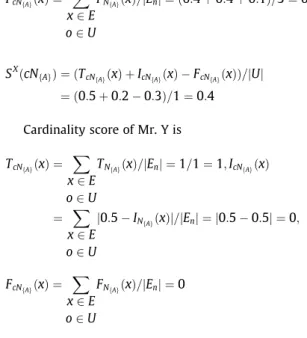
TcNfAgðxÞ ¼ X x2E o2U TNfAgðxÞ=jEnj ¼ ð0:3þ0:4þ0:8Þ=3¼0:5 IcNfAgðxÞ ¼ X x2E o2U j0:5INfAgðxÞj=jEnj ¼ j0:50:2j þ j0:50:5j þ j0:50:2j=3¼0:2 FcNfAgðxÞ ¼ X x2E o2U FNfAgðxÞ=jEnj ¼ ð0:4þ0:4þ0:1Þ=3¼0:3
SXðcNfAgÞ ¼ ðTcNfAgðxÞ þIcNfAgðxÞ FcNfAgðxÞÞ=jUj
¼ ð0:5þ0:20:3Þ=1¼0:4 Cardinality score of Mr. Y is TcNfAgðxÞ ¼ X x2E o2U TNfAgðxÞ=jEnj ¼1=1¼1;IcNfAgðxÞ ¼ X x2E o2U j0:5INfAgðxÞj=jEnj ¼ j0:50:5j ¼0; FcNfAgðxÞ ¼ X x2E o2U FNfAgðxÞ=jEnj ¼0 SYðcN
fAgÞ ¼ ðTcNfAgðxÞ þIcNfAgðxÞ FcNfAgðxÞÞ=jUj ¼1=1¼1:
4. An approach for GDM using NSM
In this section, we propose an algorithmic approach based on NSM, cardinality score of NSM, and NCM of experts to solve the multiple attribute group decision making (MAGDM) problems. Suppose thatU¼ fo1;o2;. . .;omgbe a discrete set of alternatives, E¼ fe1;e2;. . .;eng be the set of attributes or parameters, and D¼ fd1;d2;. . .;dkgbe the set of decision makers or experts. NSM Rl
Adenotes the decision information provided by decision maker dl; l¼1;2;. . .;k. The neutrosophic valuealij, which is in the form of neutrosophic number represents the evaluation of alternative
oi;i¼1;2;. . .;mfor the attributeej;j¼1;2;. . .;ngiven by deci-sion makerdl;l¼1;2;. . .;k.
The steps of the proposed algorithm for solving GDM problems using NSM are presented below.
Step 1: NCMnlði;jÞand combined NCMnclði;jÞof each of the deci-sion makersdl;l¼1;2;. . .;kare computed in the context of NSS based on their choice parameters or attributes. Step 2: Cardinal score SlðcN
fAgÞ for NSMRlA is computed, where l¼1;2;. . .;k.
Step 3: Cardinal scoreSlðcN
fAgÞis multiplied with the correspond-ing NSMRl
A;l¼1;2;. . .;kto produce the normalized NSM. Let½Abl
ðijÞmnbe an NSM andhis the cardinal score, then the normalized NSM, denoted by Nl
NSM, is defined by Nl
NSM½bAðijÞ ¼ ½hbAðlijÞmn 8i;j;k. Step 4: Product of normalized NSM Nl
NSM and combined choice matrixnc
lði;jÞfor each decision makerdl is calculated as given in Section3.3and denoted byPl
NSM;l¼1;2;. . .;k. Step 5: Aggregation of the product NSMsPlNSM8lis done as defined
in Section3.2, which produces the resultant NSM denoted byðRNSMÞ.
Step 6: Neutrosophic cross-entropy, discussed above in Sec-tion2.2, between the ideal alternative and theith alterna-tiveoi8iis computed to rank the alternatives.
Step 7: Alternative(s) having lowest cross-entropy value is selected as the most desirable one(s).
Table 3 NSM for Mr. X. U=E e1 e2 e3 c1 (0.3,0.2,0.4) (0.4,0.5,0.4) (0.8,0.2,0.1)) Table 4 NSM for Mr. Y. U=E e1 e2 e3 c1 (1,0.5,0) (0,0,0) (0,0,0)
Uni-In this approach, NCM shows the impact of choice parameters of individual experts in decision making process, whereas com-bined NCM is used to provide the impact of choice parameters of individual experts with respect to other experts. Basically NCM and combined NCM have been used to provide more importance to the choice parameters of different experts. Here cardinal score is used to assign relative weights to the experts. When an expert is confident about his/her opinion, this approach assigns more weight, i.e., more cardinal score to the corresponding NSM. By nor-malizing the NSMs, we provide more importance to the NSMs of confident experts and less importance to the NSMs of less confi-dent experts. Then normalized NSMs are associated with the com-bined NCMs with the hope that the resultant NSM will focus on both of the expert’s confident and choice parameters. Finally, we compute neutrosophic cross-entropy between our alternatives and the ideal alternative to find the ranking.
5. Case study
In order to demonstrate the application of the proposed method, we cite an example about the investment for three possi-ble business sectors. Let three experts Mr. John, Mr. Smith, and Mr. Peter, the members of a setD¼ fd1;d2;d3gjointly want to select a business sector for investment. Their proposed business sectors are travel agencies, hotel, and restaurant, given by U¼ fo1;o2;o3g. These business sectors have a set of common attributes: first time Investment, risk factor, profit, place of running business, and qual-ity of services, given byE¼ fe1;e2;e3;e4;e5g. Among three experts, Mr. John is interested in profit, place of running business, and qual-ity of services, i.e.,ðe3;e4;e5Þ. Mr. Smith shows his interest in first time investment and profit, i.e.,ðe1;e3Þand Mr. Peter is interested in first time investment, profit, and quality of services, i.e., ðe1;e3;e5Þ. Opinions of Mr. John, Mr. Smith, and Mr. Peter are rep-resented in the three different NSMs,RJA;R
S A, and R
P
Arespectively, which are given below.
RJ A¼ fð0;0;0Þ;ð0;0;0Þ;ð0:3;0:5;0:6Þ;ð0:6;0:7;0:3Þ;ð0:3;0:6;0:7Þg fð0;0;0Þ;ð0;0;0Þ;ð0:7;0:6;0:3Þ;ð0:8;0:2;0:7Þ;ð0:7;0:2;0:3Þg fð0;0;0Þ;ð0;0;0Þ;ð0:7;0:8;0:4Þ;ð0:6;0:1;0:2Þ;ð0:8;0:1;0:4Þg 2 66 4 3 77 5 RSA¼ fð0:6;0:4;0:8Þ;ð0;0;0Þ;ð0:3;0:5;0:6Þ;ð0;0;0Þ;ð0;0;0Þg fð0:7;0:5;0:6Þ;ð0;0;0Þ;ð0:7;0:6;0:3Þ;ð0;0;0Þ;ð0;0;0Þg fð0:8;0:3;0:4Þ;ð0;0;0Þ;ð0:7;0:8;0:4Þ;ð0;0;0Þ;ð0;0;0Þg 2 64 3 75 RPA¼ fð0:6;0:4;0:8Þ;ð0;0;0Þ;ð0:3;0:5;0:6Þ;ð0;0;0Þ;ð0:3;0:6;0:7Þg fð0:7;0:5;0:6Þ;ð0;0;0Þ;ð0:7;0:6;0:3Þ;ð0;0;0Þ;ð0:7;0:2;0:3Þg fð0:8;0:3;0:4Þ;ð0;0;0Þ;ð0:7;0:8;0:4Þ;ð0;0;0Þ;ð0:8;0:1;0:4Þg 2 66 4 3 77 5 In this case study, we consider two cases. In the first case, we use non-normalized NSM and normalized NSM in the second case.
Case I.In this case, we use non-normalized NSM as input. [Step 1]:Neutrosophic choice matrices for the experts and their corresponding combined choice matrices are given below.
nJði;jÞ ¼ fð0;0:5;1Þ;ð0;0:5;1Þ;ð0;0:5;1Þ;ð0;0:5;1Þ;ð0;0:5;1Þg fð0;0:5;1Þ;ð0;0:5;1Þ;ð0;0:5;1Þ;ð0;0:5;1Þ;ð0;0:5;1Þg fð0;0:5;1Þ;ð0;0:5;1Þ;ð1;0:5;0Þ;ð1;0:5;0Þ;ð1;0:5;0Þg fð0;0:5;1Þ;ð0;0:5;1Þ;ð1;0:5;0Þ;ð1;0:5;0Þ;ð1;0:5;0Þg fð0;0:5;1Þ;ð0;0:5;1Þ;ð1;0:5;0Þ;ð1;0:5;0Þ;ð1;0:5;0Þg 2 66 66 66 66 4 3 77 77 77 77 5 nSði;jÞ ¼ fð1;0:5;0Þ;ð0;0:5;1Þ;ð1;0:5;0Þ;ð0;0:5;1Þ;ð0;0:5;1Þg fð0;0:5;1Þ;ð0;0:5;1Þ;ð0;0:5;1Þ;ð0;0:5;1Þ;ð0;0:5;1Þg fð1;0:5;0Þ;ð0;0:5;1Þ;ð1;0:5;0Þ;ð0;0:5;1Þ;ð0;0:5;1Þg fð0;0:5;1Þ;ð0;0:5;1Þ;ð0;0:5;1Þ;ð0;0:5;1Þ;ð0;0:5;1Þg fð0;0:5;1Þ;ð0;0:5;1Þ;ð0;0:5;1Þ;ð0;0:5;1Þ;ð0;0:5;1Þg 2 66 66 66 66 4 3 77 77 77 77 5 nPði;jÞ ¼ fð1;0:5;0Þ;ð0;0:5;1Þ;ð1;0:5;0Þ;ð0;0:5;1Þ;ð1;0:5;0Þg fð0;0:5;1Þ;ð0;0:5;1Þ;ð0;0:5;1Þ;ð0;0:5;1Þ;ð0;0:5;1Þg fð1;0:5;0Þ;ð0;0:5;1Þ;ð1;0:5;0Þ;ð0;0:5;1Þ;ð1;0:5;0Þg fð0;0:5;1Þ;ð0;0:5;1Þ;ð0;0:5;1Þ;ð0;0:5;1Þ;ð0;0:5;1Þg fð1;0:5;0Þ;ð0;0:5;1Þ;ð1;0:5;0Þ;ð0;0:5;1Þ;ð1;0:5;0Þg 2 66 66 66 66 4 3 77 77 77 77 5 nc Jði;jÞ ¼ fð0;0:5;1Þ;ð0;0:5;1Þ;ð0;0:5;1Þ;ð0;0:5;1Þ;ð0;0:5;1Þg fð0;0:5;1Þ;ð0;0:5;1Þ;ð0;0:5;1Þ;ð0;0:5;1Þ;ð0;0:5;1Þg fð1;0:5;0Þ;ð0;0:5;1Þ;ð1;0:5;0Þ;ð0;0:5;1Þ;ð0;0:5;1Þg fð1;0:5;0Þ;ð0;0:5;1Þ;ð1;0:5;0Þ;ð0;0:5;1Þ;ð0;0:5;1Þg fð1;0:5;0Þ;ð0;0:5;1Þ;ð1;0:5;0Þ;ð0;0:5;1Þ;ð0;0:5;1Þg 2 66 66 66 66 4 3 77 77 77 77 5 nc Sði;jÞ ¼ fð0;0:5;1Þ;ð0;0:5;1Þ;ð1;0:5;0Þ;ð0;0:5;1Þ;ð1;0:5;0Þg fð0;0:5;1Þ;ð0;0:5;1Þ;ð0;0:5;1Þ;ð0;0:5;1Þ;ð0;0:5;1Þg fð0;0:5;1Þ;ð0;0:5;1Þ;ð1;0:5;0Þ;ð0;0:5;1Þ;ð1;0:5;0Þg fð0;0:5;1Þ;ð0;0:5;1Þ;ð0;0:5;1Þ;ð0;0:5;1Þ;ð0;0:5;1Þg fð0;0:5;1Þ;ð0;0:5;1Þ;ð0;0:5;1Þ;ð0;0:5;1Þ;ð0;0:5;1Þg 2 66 66 66 66 4 3 77 77 77 77 5 nc Pði;jÞ ¼ fð0;0:5;1Þ;ð0;0:5;1Þ;ð1;0:5;0Þ;ð0;0:5;1Þ;ð0;0:5;1Þg fð0;0:5;1Þ;ð0;0:5;1Þ;ð0;0:5;1Þ;ð0;0:5;1Þ;ð0;0:5;1Þg fð0;0:5;1Þ;ð0;0:5;1Þ;ð1;0:5;0Þ;ð0;0:5;1Þ;ð0;0:5;1Þg fð0;0:5;1Þ;ð0;0:5;1Þ;ð0;0:5;1Þ;ð0;0:5;1Þ;ð0;0:5;1Þg fð0;0:5;1Þ;ð0;0:5;1Þ;ð1;0:5;0Þ;ð0;0:5;1Þ;ð0;0:5;1Þg 2 66 66 66 66 4 3 77 77 77 77 5 [Step 2 & Step 3]:These steps are not applied in Case 1. [Step 4]:Product of NSMRlAand combined choice matrixnclði;jÞ for each decision makerdl;l¼1;2;3 are
PJ NSM¼R J A n c Jði;jÞ ¼ fð0;0;0Þ;ð0;0;0Þ;ð0:3;0:5;0:6Þ;ð0:6;0:7;0:3Þ;ð0:3;0:6;0:7Þg fð0;0;0Þ;ð0;0;0Þ;ð0:7;0:6;0:3Þ;ð0:8;0:2;0:7Þ;ð0:7;0:2;0:3Þg fð0;0;0Þ;ð0;0;0Þ;ð0:7;0:8;0:4Þ;ð0:6;0:1;0:2Þ;ð0:8;0:1;0:4Þg 2 66 4 3 77 5 fð0;0:5;1Þ;ð0;0:5;1Þ;ð0;0:5;1Þ;ð0;0:5;1Þ;ð0;0:5;1Þg fð0;0:5;1Þ;ð0;0:5;1Þ;ð0;0:5;1Þ;ð0;0:5;1Þ;ð0;0:5;1Þg fð1;0:5;0Þ;ð0:0:5;1Þ;ð1;0:5;0Þ;ð0:0:5;1Þ;ð0;0:5;1Þg fð1;0:5;0Þ;ð0:0:5;1Þ;ð1;0:5;0Þ;ð0:0:5;1Þ;ð0;0:5;1Þg fð1;0:5;0Þ;ð0:0:5;1Þ;ð1;0:5;0Þ;ð0:0:5;1Þ;ð0;0:5;1Þg 2 66 66 66 66 4 3 77 77 77 77 5 ¼ ð0:6;0:5;0:3Þ;ð0;0:5;1Þ;ð0:6;0:5;0:3Þ;ð0;0:5;1Þ;ð0;0:5;1Þ ð0:8;0:5;0:3Þ;ð0;0:5;1Þ;ð0:8;0:5;0:3Þ;ð0;0:5;1Þ;ð0;0:5;1Þ ð0:8;0:5;0:2Þ;ð0;0:5;1Þ;ð0:8;0:5;0:2Þ;ð0;0:5;1Þ;ð0;0:5;1Þ 2 66 4 3 77 5
PS NSM¼R S A n c Sði;jÞ ¼ fð0:6;0:4;0:8Þ;ð0;0;0Þ;ð0:3;0:5;0:6Þ;ð0;0;0Þ;ð0;0;0Þg fð0:7;0:5;0:6Þ;ð0;0;0Þ;ð0:7;0:6;0:3Þ;ð0;0;0Þ;ð0;0;0Þg fð0:8;0:3;0:4Þ;ð0;0;0Þ;ð0:7;0:8;0:4Þ;ð0;0;0Þ;ð0;0;0Þg 2 64 3 75 fð0;0:5;1Þ;ð0;0:5;1Þ;ð1;0:5;0Þ;ð0;0:5;1Þ;ð1;0:5;0Þg fð0;0:5;1Þ;ð0;0:5;1Þ;ð0;0:5;1Þ;ð0;0:5;1Þ;ð0;0:5;1Þg fð0;0:5;1Þ;ð0;0:5;1Þ;ð1;0:5;0Þ;ð0;0:5;1Þ;ð1;0:5;0Þg fð0;0:5;1Þ;ð0;0:5;1Þ;ð0;0:5;1Þ;ð0;0:5;1Þ;ð0;0:5;1Þg fð0;0:5;1Þ;ð0;0:5;1Þ;ð0;0:5;1Þ;ð0;0:5;1Þ;ð0;0:5;1Þg 2 66 66 66 64 3 77 77 77 75 ¼ ð0;0:5;1Þ;ð0;0:5;1Þ;ð0:6;0:5;0:6Þ;ð0;0:5;1Þ;ð0;0:5;1Þ ð0;0:5;1Þ;ð0;0:5;1Þ;ð0:7;0:5;0:3Þ;ð0;0:5;1Þ;ð0;0:5;1Þ ð0;0:5;1Þ;ð0;0:5;1Þ;ð0:8;0:5;0:4Þ;ð0;0:5;1Þ;ð0;0:5;1Þ 2 64 3 75 PP NSM¼R P A n c Pði;jÞ ¼ fð0:6;0:4;0:8Þ;ð0;0;0Þ;ð0:3;0:5;0:6Þ;ð0;0;0Þ;ð0:3;0:6;0:7Þg fð0:7;0:5;0:6Þ;ð0;0;0Þ;ð0:7;0:6;0:3Þ;ð0;0;0Þ;ð0:7;0:2;0:3Þg fð0:8;0:3;0:4Þ;ð0;0;0Þ;ð0:7;0:8;0:4Þ;ð0;0;0Þ;ð0:8;0:1;0:4Þg 2 64 3 75 fð0;0:5;1Þ;ð0;0:5;1Þ;ð1;0:5;0Þ;ð0;0:5;1Þ;ð0;0:5;1Þg fð0;0:5;1Þ;ð0;0:5;1Þ;ð0;0:5;1Þ;ð0;0:5;1Þ;ð0;0:5;1Þg fð0;0:5;1Þ;ð0;0:5;1Þ;ð1;0:5;0Þ;ð0;0:5;1Þ;ð0;0:5;1Þg fð0;0:5;1Þ;ð0;0:5;1Þ;ð0;0:5;1Þ;ð0;0:5;1Þ;ð0;0:5;1Þg fð0;0:5;1Þ;ð0;0:5;1Þ;ð1;0:5;0Þ;ð0;0:5;1Þ;ð0;0:5;1Þg 2 66 66 66 64 3 77 77 77 75 ¼ ð0;0:5;1Þ;ð0;0:5;1Þ;ð0:6;0:5;0:6Þ;ð0;0:5;1Þ;ð0;0:5;1Þ ð0;0:5;1Þ;ð0;0:5;1Þ;ð0:7;0:5;0:3Þ;ð0;0:5;1Þ;ð0;0:5;1Þ ð0;0:5;1Þ;ð0;0:5;1Þ;ð0:8;0:5;0:4Þ;ð0;0:5;1Þ;ð0;0:5;1Þ 2 64 3 75
[Step 5]:Aggregation of the product NSMs,PlNSM8l, isRNSM, given below. RNSM¼ ð0:6;0:5;0:3Þ;ð0;0:5;1Þ;ð0:6;0:5;0:3Þ;ð0;0:5;1Þ;ð0;0:5;1Þ ð0:8;0:5;0:3Þ;ð0;0:5;1Þ;ð0:8;0:5;0:3Þ;ð0;0:5;1Þ;ð0;0:5;1Þ ð0:8;0:5;0:2Þ;ð0;0:5;1Þ;ð0:8;0:5;0:2Þ;ð0;0:5;1Þ;ð0;0:5;1Þ 2 64 3 75 ð0;0:5;1Þ;ð0;0:5;1Þ;ð0:6;0:5;0:6Þ;ð0;0:5;1Þ;ð0;0:5;1Þ ð0;0:5;1Þ;ð0;0:5;1Þ;ð0:7;0:5;0:3Þ;ð0;0:5;1Þ;ð0;0:5;1Þ ð0;0:5;1Þ;ð0;0:5;1Þ;ð0:8;0:5;0:4Þ;ð0;0:5;1Þ;ð0;0:5;1Þ 2 64 3 75 ð0;0:5;1Þ;ð0;0:5;1Þ;ð0:6;0:5;0:6Þ;ð0;0:5;1Þ;ð0;0:5;1Þ ð0;0:5;1Þ;ð0;0:5;1Þ;ð0:7;0:5;0:3Þ;ð0;0:5;1Þ;ð0;0:5;1Þ ð0;0:5;1Þ;ð0;0:5;1Þ;ð0:8;0:5;0:4Þ;ð0;0:5;1Þ;ð0;0:5;1Þ 2 64 3 75 ¼ ð0:6;0:5;0:3Þ;ð0;0:5;1Þ;ð0:6;0:5;0:3Þ;ð0;0:5;1Þ;ð0;0:5;1Þ ð0:8;0:5;0:3Þ;ð0;0:5;1Þ;ð0:8;0:5;0:3Þ;ð0;0:5;1Þ;ð0;0:5;1Þ ð0:8;0:5;0:2Þ;ð0;0:5;1Þ;ð0:8;0:5;0:2Þ;ð0;0:5;1Þ;ð0;0:5;1Þ 2 64 3 75 [Step 6]:According to the formula defined in section2.2, the cross-entropy values of ðA;o1Þ;ðA;o2Þ, and ðA;o3Þ can be calculated as D1ðA;o1Þ ¼16:7353; D2ðA;o2Þ ¼16:2216, and
D3ðA;o3Þ ¼15:9770
SinceD3ðA;o3Þhas least cross-entropy value, alternativeo3, i.e., restaurant business sector is selected as the collective decision of all the three decision makers.
Case II.It uses normalized NSM as input. [Step 1]:This step is similar as in case 1.
[Step 2]:It calculates the cardinal scoresSJðcNfAgÞ,SSðcNfAgÞ, and
SPðcNfAgÞrespectively for the NSMsRJA;R S A, andR
P A.
SJðcNfAgÞ ¼ ðTcNfAgðxÞ þIcNfAgðxÞ FcNfAgðxÞÞ=ðjEnj jUjÞ
TcNfAgðxÞ ¼ X x2E o2U TNfAgðxÞ=jEnj ¼ ð0:3þ0:6þ0:3þ0:7þ0:8þ0:7þ0:7þ0:6þ0:8Þ=3¼5:5=3 IcNfAgðxÞ ¼ X x2E o2U j0:5INfAgðxÞj=jEnj ¼ j0:50:5j þ j0:50:7j þ j0:50:6j þ j0:50:6j þ j0:50:2j þj0:50:2j þ j0:50:8j þ j0:50:1j þ j0:50:1j 3 ¼ ð0þ:2þ:1þ:1þ:3þ:3þ:3þ:4þ:4Þ=3¼2:1=3 FcNfAgðxÞ ¼ X x2E o2U FNfAgðxÞjEnj ¼ ð0:6þ0:3þ0:7þ0:3þ0:7þ0:3þ0:4þ0:2ð0:7Þ þ0:4Þ=3¼3:9=3 SJðcN^fAgÞ ¼SJðcNfAgÞ ¼ ðð5:5Þ þ ð2:1Þ 3:9Þ=3Þ=3¼0:411 Similarly,SSðcN fAgÞ ¼0:23,SPðcNfAgÞ ¼0:28
[Step 3]:Normalized NSMs for the decision makers, John, Smith and Peter are respectively
NJ NSM½aðijÞ ¼ haJðijÞ h i 35 ¼ ð0:41Þ fð0;0;0Þ;ð0;0;0Þ;ð0:3;0:5;0:6Þ;ð0:6;0:7;0:3Þ;ð0:3;0:6;0:7Þg fð0;0;0Þ;ð0;0;0Þ;ð0:7;0:6;0:3Þ;ð0:8;0:2;0:7Þ;ð0:7;0:2;0:3Þg fð0;0;0Þ;ð0;0;0Þ;ð0:7;0:8;0:4Þ;ð0:6;0:1;0:7Þ;ð0:8;0:1;0:4Þg 2 64 3 75 ¼ fð0;0;0Þ;ð0;0;0Þ;ð0:123;0:205;0:246Þ;ð0:246;0:287;0:123Þ;ð0:123;0:246;0:287Þg fð0;0;0Þ;ð0;0;0Þ;ð0:287;0:246;0:123Þ;ð0:328;0:082;0:287Þ;ð0:287;0:082;0:123Þg fð0;0;0Þ;ð0;0;0Þ;ð0:287;0:328;0:164Þ;ð0:246;0:041;0:287Þ;ð0:328;0:041;0:164Þg 2 64 3 75 NS NSM½aðijÞ ¼ haSðijÞ h i 35¼ ð0:23Þ fð0:6;0:4;0:8Þ;ð0;0;0Þ;ð0:3;0:5;0:6Þ;ð0;0;0Þ;ð0;0;0Þg fð0:7;0:5;0:6Þ;ð0;0;0Þ;ð0:7;0:6;0:3Þ;ð0;0;0Þ;ð0;0;0Þg fð0:8;0:3;0:4Þ;ð0;0;0Þ;ð0:7;0:8;0:4Þ;ð0;0;0Þ;ð0;0;0Þg 2 64 3 75 ¼ fð0:138;0:092;0:184Þ;ð0;0;0Þ;ð0:069;0:115;0:138Þ;ð0;0;0Þ;ð0;0;0Þg fð0:161;0:115;0:138Þ;ð0;0;0Þ;ð0:161;0:138;0:069Þ;ð0;0;0Þ;ð0;0;0Þg fð0:184;0:069;0:092Þ;ð0;0;0Þ;ð0:161;0:184;0:092Þ;ð0;0;0Þ;ð0;0;0Þg 2 64 3 75 NP NSM½aðijÞ ¼ haP ðijÞ h i 35¼ ð0:28Þ fð0:6;0:4;0:8Þ;ð0;0;0Þ;ð0:3;0:5;0:6Þ;ð0;0;0Þ;ð0:3;0:6;0:7Þg fð0:7;0:5;0:6Þ;ð0;0;0Þ;ð0:7;0:6;0:3Þ;ð0;0;0Þ;ð0:7;0:2;0:3Þg fð0:8;0:3;0:4Þ;ð0;0;0Þ;ð0:7;0:8;0:4Þ;ð0;0;0Þ;ð0:8;0:1;0:4Þg 2 64 3 75 ¼ fð0:168;0:112;0:224Þ;ð0;0;0Þ;ð0:084;0:140;0::168Þ;ð0;0;0Þ;ð0:084;0:168;0:196Þg fð0:196;0:149;0:168Þ;ð0;0;0Þ;ð0:196;0:168;0:084Þ;ð0;0;0Þ;ð0:196;0:056;0:084Þg fð0:224;0:084;0:112Þ;ð0;0;0Þ;ð0:196;0:224;0:112Þ;ð0;0;0Þ;ð0:224;0:028;0:112Þg 2 64 3 75 [Step 4]:Product of normalized NSMNl
NSMand combined choice matrixnc
lði;jÞfor each decision makerdlis computed as follows.
PJ NSM¼N J NSM ncJði;jÞ ¼ ¼ fð0;0;0Þ;ð0;0;0Þ;ð0:123;0:205;0:246Þ;ð0:246;0:287;0:123Þ;ð0:123;0:246;0:287Þg fð0;0;0Þ;ð0;0;0Þ;ð0:287;0:246;0:123Þ;ð0:328;0:082;0:287Þ;ð0:287;0:082;0:123Þg fð0;0;0Þ;ð0;0;0Þ;ð0:287;0:328;0:164Þ;ð0:246;0:041;0:287Þ;ð0:328;0:041;0:164Þg 2 64 3 75 fð0;0:5;1Þ;ð0;0:5;1Þ;ð0;0:5;1Þ;ð0;0:5;1Þ;ð0;0:5;1Þg fð0;0:5;1Þ;ð0;0:5;1Þ;ð0;0:5;1Þ;ð0;0:5;1Þ;ð0;0:5;1Þg fð1;0:5;0Þ;ð0;0:5;1Þ;ð1;0:5;0Þ;ð0;0:5;1Þ;ð0;0:5;1Þg fð1;0:5;0Þ;ð0;0:5;1Þ;ð1;0:5;0Þ;ð0;0:5;1Þ;ð0;0:5;1Þg fð1;0:5;0Þ;ð0;0:5;1Þ;ð1;0:5;0Þ;ð0;0:5;1Þ;ð0;0:5;1Þg 2 66 66 66 64 3 77 77 77 75 ¼ fð0:246;0:287;0:123Þ;ð0;0:287;1Þ;ð0:210;0:287;0:105Þ;ð0;0:287;1Þ;ð0;0:287;1Þg fð0:328;0:246;0:123Þ;ð0;0:246;1Þ;ð0:328;0:246;0:123Þ;ð0;0:246;1Þ;ð0;0:246;1Þg fð0:328;0:328;0:164Þ;ð0;0:328;1Þ;ð0:328;0:328;0:164Þ;ð0;0:328;1Þ;ð0;0:328;1Þg 2 64 3 75 PS NSM¼N S NSM ncSði;jÞ ¼ fð0:138;0:092;0:184Þ;ð0;0;0Þ;ð0:069;0:115;0:138Þ;ð0;0;0Þ;ð0;0;0Þg fð0:161;0:115;0:138Þ;ð0;0;0Þ;ð0:161;0:138;0:069Þ;ð0;0;0Þ;ð0;0;0Þg fð0:184;0:069;0:092Þ;ð0;0;0Þ;ð0:161;0:184;0:092Þ;ð0;0;0Þ;ð0;0;0Þg 2 64 3 75 fð0;0:5;1Þ;ð0;0:5;1Þ;ð0;0:5;1Þ;ð0;0:5;1Þ;ð0;0:5;1Þg fð0;0:5;1Þ;ð0;0:5;1Þ;ð0;0:5;1Þ;ð0;0:5;1Þ;ð0;0:5;1Þg fð1;0:5;0Þ;ð0;0:5;1Þ;ð1;0:5;0Þ;ð0;0:5;1Þ;ð0;0:5;1Þg fð1;0:5;0Þ;ð0;0:5;1Þ;ð1;0:5;0Þ;ð0;0:5;1Þ;ð0;0:5;1Þg fð1;0:5;0Þ;ð0;0:5;1Þ;ð1;0:5;0Þ;ð0;0:5;1Þ;ð0;0:5;1Þg 2 66 66 66 64 3 77 77 77 75 ¼ fð0:138;0:115;0Þ;ð0;0:138;1Þ;ð0:138;0:115;0Þ;ð0; :138;1Þ;ð0;0:138;1Þg fð0:161;0:138;0Þ;ð0;0:138;1Þ;ð0:161;0:138;0Þ;ð0;0:138;1Þ;ð0;0:138;1Þg fð0:184;0:184;0Þ;ð0;0:184;1Þ;ð0:184;0:184;0Þ;ð0; :184;1Þ;ð0;0:184;1Þg 2 64 3 75
Uni-PP NSM¼N P NSM ncPði;jÞ ¼ fð0:168;0:112;0:224Þ;ð0;0;0Þ;ð0:084;0:140;0:168Þ;ð0;0;0Þ;ð0:084;0:168;0:196Þg fð0:196;0:149;0:168Þ;ð0;0;0Þ;ð0:196;0:168;0:084Þ;ð0;0;0Þ;ð0:196;0:056;0:084Þg fð0:224;0:084;0:112Þ;ð0;0;0Þ;ð0:196;0:224;0:112Þ;ð0;0;0Þ;ð0:224;0:028;0:112Þg 2 64 3 75 fð1;0:5;0Þ;ð0;0:5;1Þ;ð1;0:5;0Þ;ð0;0:5;1Þ;ð1;0:5;0Þg fð0;0:5;1Þ;ð0;0:5;1Þ;ð0;0:5;1Þ;ð0;0:5;1Þ;ð0;0:5;1Þg fð1;0:5;0Þ;ð0;0:5;1Þ;ð1;0:5;0Þ;ð0;0:5;1Þ;ð1;0:5;0Þg fð0;0:5;1Þ;ð0;0:5;1Þ;ð0;0:5;1Þ;ð0;0:5;1Þ;ð0;0:5;1Þg fð1;0:5;0Þ;ð0;0:5;1Þ;ð1;0:5;0Þ;ð0;0:5;1Þ;ð1;0:5;0Þg 2 66 66 66 4 3 77 77 77 5 ¼ fð0:168;0:168;0:168Þ;ð0;0:168;1Þ;ð0:168;0:168;0:168Þ;ð0;0:168;1Þ;ð0:168;0:168;0:168Þg fð0:196;0:168;0:084Þ;ð0;0:168;1Þ;ð0:196;0:168;0:084Þ;ð0;0:168;1Þ;ð0:196;0:168;0:084Þg fð0:224;0:224;0:112Þ;ð0;0:224;1Þ;ð0:224;0:224;0:112Þ;ð0;0:224;1Þ;ð0:224;0:224;0:112Þg 2 64 3 75 [Step 5]:Aggregation of the product NSMs,Pl
NSM8lis denoted by RNSM. RNSM¼ fð0:246;0:287;0:123Þ;ð0;0:287;1Þ;ð0:210;0:287;0:105Þ;ð0;0:287;1Þ;ð0;0:287;1Þg fð0:328;0:246;0:123Þ;ð0;0:246;1Þ;ð0:328;0:246;0:123Þ;ð0;0:246;1Þ;ð0;0:246;1Þg fð0:328;0:328;0:164Þ;ð0;0:328;1Þ;ð0:328;0:328;0:164Þ;ð0;0:328;1Þ;ð0;0:328;1Þg 2 64 3 75 fð0:138;0:115;0Þ;ð0;0:138;1Þ;ð0:138;0:115;0Þ;ð0;0:138;1Þ;ð0;0:138;1Þg fð0:161;0:138;0Þ;ð0;0:138;1Þ;ð0:161;0:138;0Þ;ð0;0:138;1Þ;ð0;0:138;1Þg fð0:184;0:184;0Þ;ð0;0:184;1Þ;ð0:184;0:184;0Þ;ð0;0:184;1Þ;ð0;0:184;1Þg 2 64 3 75 fð0:168;0:168;0:168Þ;ð0;0:168;1Þ;ð0:168;0:168;0:168Þ;ð0;0:168;1Þ;ð0:168;0:168;0:168Þg fð0:196;0:168;0:084Þ;ð0;0:168;1Þ;ð0:196;0:168;0:084Þ;ð0;0:168;1Þ;ð0:196;0:168;0:084Þg fð0:224;0:224;0:112Þ;ð0;0:224;1Þ;ð0:224;0:224;0:112Þ;ð0;0:224;1Þ;ð0:224;0:224;0:112Þg 2 64 3 75 ¼ fð0:246;0:19;0Þ;ð0;0:19;1Þ;ð0:246;0:19;0Þ;ð0;0:19;1Þ;ð0;0:19;1Þg fð0:328;0:184;0Þ;ð0;0:184;1Þ;ð0:328;0:184;0Þ;ð0;0:184;1Þ;ð0:196;0:184;1Þg fð0:328;0:245;0Þ;ð0;0:245;1Þ;ð0:328;0:245;0Þ;ð0;0:245;1Þ;ð0:224;0:245;1Þg 2 64 3 75 [Step 6]: Cross-entropy values ofðA;o1Þ;ðA;o2Þ, andðA;o3Þ are
D1ðA;o1Þ ¼15:235; D2ðA;o2Þ ¼14:075; D3ðA;o3Þ ¼14:366
SinceD2ðA;o2Þhas least cross-entropy value, alternativeo2, i.e., hotel business sector will be selected as the collective decision of John, Smith, and Peter.
6. Discussion on the results
Expert’s opinion exhibit a vital role in GDM (Das et al., 2015; 2017). This study proposes a decision making methodology using NSM, which is used to represent the opinion of individual decision maker. The relative weight assigned to an expert is based on the expert’s prescribed opinion and is computed by deriving the cardi-nal score of the corresponding NSM. The more the cardicardi-nal score, the more important is the opinion. When an expert is more confi-dent about her opinion, more cardinal score is assigned to that expert. Due to lack of information or limited domain knowledge, experts often prefer to express their opinions only for a subset of attributes instead of the entire attribute set. Often it is also found that experts are confident about a few attributes among the subset of attributes. In that case, cardinal score will be more where an expert is confident about her opinion irrespective of the number of attributes provided. This is similar to our real life situations. It also removes the biasness which might be imposed by different experts and as a result adds more credibility to the final decision. In (Das and Kar, 2014; Das et al., 2014), authors considered to assign more cardinal score when an expert provides his/her opin-ion about more number of attributes, which is also practical in real life environment. More specifically, which case should be consid-ered for assigning higher cardinal score, may be case dependent. When experts’ opinions about the selected set of attributes are quite significant and no attributes can be ignored, then one can consider the relative weight assigning procedure as proposed in Das and Kar (2014), Das et al. (2014). But when opinion about some of the selected attributes are not significance and can be ignored, then the approach proposed here can be used. Moreover, the key aspect of the proposed algorithm is that it does not use any knowledgebase for finding the distances and similarity mea-sures of the individual experts. Rather more importance is given on the parameter selection of experts by finding initial choice
matrices and then combined choice matrices. Among the two cases used here in case study, Case I does not use the relative weight, while Case II uses it. As per collective opinion of a group of experts, the order of selection of the business sectors is given inTable 5. The result shows different ordering in Case II as we have considered the experts’ relative weights. Case I produces the final outcome aso3, i.e., restaurant business sector while Case II produceso2, i.e., hotel business sector as per the collective opinion.
7. Conclusion
This article has proposed an algorithmic approach for solving GDM problems using NSM and relative weight of experts. Firstly, we have presented NSM and discussed some of its relevant opera-tions. Next we have proposed the relative weight assigning proce-dure of experts using cardinal score in the context of neutrosophic environment. The proposed algorithm is based on combined choice matrix, product NSM, cardinal score, and cross entropy measure of NSMs, which yields the collective opinion of a group of decision makers. The case study is related to the selection of a business sec-tor for investment purpose, where a set of three experts suggests their opinions about a common set of attributes. Future scope of this research work could be to investigate the application of robustness in GDM in the framework of neutrosophic set. Also researchers might focus on various properties of NSMs and then apply them to suitable uncertain decision making problems. Acknowledgment
The authors are very grateful to the Editor-in-Chief and the anonymous referees, for their constructive comments and sugges-tions that led to an improved version of this paper.
References
Atanassov, K., 1986. Intuitionistic fuzzy sets. Fuzzy Sets Syst. 20, 87–96. Atanassov, K., 1989. More on intuitionistic fuzzy sets. Fuzzy Sets Syst. 33, 37–46. Broumi, S., 2013. Generalized neutrosophic soft set, international journal of
computer science. Eng. Inf. Tech. (IJCSEIT) 3 (2), 17–30.
Broumi, S., Smarandache, F., 2013a. Intuitionistic neutrosophic soft set. J. Inf. Comput. Sci. 8 (2), 130–140.
Broumi, S., Smarandache, F., 2013b. Correlation coefficient of interval neutrosophic set. Appl. Mech. Mater. 436, 511–517.
Broumi, S., Deli, I., Smarandache, F., 2014a. Neutrosophic Parameterized soft set theory and its decision Making. Italian J. Pure Appl. Math. 32, 503–514. Broumi, S., Sahin, R., Smarandache, F., 2014b. Generalized interval neutrosophic soft
set and its decision making problem. J. New Results Sci. 7, 29–47.
Das, S., Kar, S., 2014. Group decision making in medical system: an intuitionistic fuzzy soft set approach. Appl. Soft Comput. 24, 196–211.
Das, S., Kar, S., Pal, T., 2014. Group decision making using interval-valued intuitionistic fuzzy soft matrix and confident weight of experts. J. Artif. Intell. Soft Comput. Res. 4 (1), 57–77.
Das, S., Kumari, P., Verma, A.K., 2015. Triangular fuzzy soft set and its application in MADM. Int. J. Comput. Syst. Eng. 2 (2), 85–93.
Das, S., Kar, S., Pal, T., 2017. Robust decision making using intuitionistic fuzzy numbers. Granular Comput. 2, 41–54. http://dx.doi.org/10.1007/s41066-016-0024-3.
De Luca, A., Termini, S., 1972. A definition of non probabilistic entropy in the setting of fuzzy sets theory. Inf. Control 20, 301–312.
Deli, I. 2014. Interval-valued Neutrosophic soft sets and its decision making, arXiv:1402.3130v3 [math.GM], pp. 1–24.
Deli, I., Broumi, S. 2014. Neutrosophic soft sets and neutrosophic soft matrices based on decision making, arXiv:1404.0673v1 [math.GM], pp. 1–28. Deli, I., Broumi, S., Ali, M., 2014. Neutrosophic soft multi-set theory and its decision
making. Neutrosophic Sets Syst. 5, 65–76.
Table 5
Ordering of business sectors in different cases.
Case I o3>o2>o1
Deli, I., Ali, M., Smarandache, F., 2015. Bipolar neutrosophic sets and their application based on multi-criteria decision making problems. Int. Conf. Adv. Mechatronic Syst. (ICAMechS).http://dx.doi.org/10.1109/ICAMechS.2015.7287068.
Deli, I., Sßubasß, Y., Smarandache, F., 2016. Interval valued bipolar fuzzy weighted neutrosophic sets and their application. In: IEEE International Conference on Fuzzy Systems (FUZZ-IEEE).http://dx.doi.org/10.1109/FUZZ-IEEE.2016.7738002. Gou, X., Xu, Z.-S., Liao, H., 2017. Hesitant fuzzy linguistic entropy and cross-entropy
measures and alternative queuing method for multiple criteria decision making. Inf. Sci. 388–389, 225–246.
Guo, Y., Sengur, A., 2014. A novel image segmentation algorithm based on neutrosophic similarity clustering. Appl. Soft Comput. 25, 391–398.
Liu, W., Liao, H., 2017. A bibliometric analysis of fuzzy decision research during 1970–2015. Int. J. Fuzzy Syst. 19 (1), 1–14.
Liu, C.F., Luo, Y.S., 2017. Power aggregation operators of simplified neutrosophic sets and their use in multi-attribute group decision making. IEEE/CAA J. Automatica Sinica, 1–10.http://dx.doi.org/10.1109/JAS.2017.7510424. Maji, P.K., 2012. A neutrosophic soft set approach to a decision making problem.
Ann. Fuzzy Math. Inf. 3 (2), 313–319.
Majumdar, P., Samant, S.K., 2014. On similarity and entropy of neutrosophic sets. J. Intell. Fuzzy Syst. 26 (3), 1245–1252.
Molodtsov, D.A., 1999. Soft set theory-first results. Comput. Math. Appl. 37, 19–31. Peng, J., Wang, J., Zhang, H., Chen, X., 2014. An outranking approach for multi-criteria decision-making problems with simplified neutrosophic sets. Appl. Soft Comput. 25, 336–346.
Peng, J., Wang, J., Wang, J., Zhang, H., Chen, X., 2015. Simplified neutrosophic sets and their applications in multi-criteria group decision-making problems. Int. J. Syst. Sci.http://dx.doi.org/10.1080/00207721.2014.994050.
Rivieccio, U., 2008. Neutrosophic logics: prospects and problems. Fuzzy Sets Syst. 159, 1860–1868.
Salama, A.A., 2012. Generalized neutrosophic set and generalized neutrosophic topological spaces. Comput. Sci. Eng. 2 (7), 129–132.http://dx.doi.org/10.5923/ j.computer.20120207.01.
Shang, X.G., Jiang, W.S., 1997. A note on fuzzy information measures. Pattern Recognit. Lett. 18, 425–432.
Shannon, C., 1949. The Mathematical Theory of Communication. The University of Illinois Press, Urbana.
Smarandache, F., 1999. A Unifying Field in Logics. Neutrosophy: Neutrosophic Probability, Set and Logic. American Research Press, Rehoboth.
Smarandache, F. 2003. A unifying field in logics: neutrosophic logic. Neutrosophy, neutrosophic set, neutrosophic probability and statistics, third ed., Xiquan, Phoenix.
Turksen, I., 1986. Interval valued fuzzy sets based on normal forms. Fuzzy Sets Syst. 20, 191–210.
Wang, H., Smarandache, F., Zhang, Y.Q., Sunderraman, R., 2010. Single valued neutrosophic sets. Multispace Multistruct. 4, 410–413.
Ye, J., 2011. Fuzzy cross entropy of interval-valued intuitionistic fuzzy sets and its optimal decision-making method based on the weights of alternatives. Expert Syst. Appl. 38, 6179–6183.
Ye, J., 2013. Similarity measures between interval neutrosophic sets and their applications in multi criteria decision making. J. Intell. Fuzzy Syst.http://dx.doi. org/10.3233/IFS-120724.
Ye, J., 2014a. Single valued neutrosophic cross-entropy for multi criteria decision making problems. Appl. Math. Model. 38, 1170–1175.
Ye, J., 2014b. A multicriteria decision-making method using aggregation operators for simplified neutrosophic sets. J. Intell. Fuzzy Syst. 26 (5), 2459–2466. Ye, J., 2015. Multiple-attribute group decision-making method under a
neutrosophic number environment. J. Intell. Syst. 25 (3), 377–386.http://dx. doi.org/10.1515/jisys-2014-0149.
Ye, J., 2016. Exponential operations and aggregation operators of interval neutrosophic sets and their decision making methods. SpringerPlus 5, 1488. http://dx.doi.org/10.1186/s40064-016-3143-z.
Yu, D., Liao, H., 2016. Visualization and quantitative research on intuitionistic fuzzy studies. J. Intell. Fuzzy Syst. 30 (6), 3653–3663.
Zadeh, L.A., 1965a. Fuzzy Sets. Inform. Control 8, 338–353.
Zadeh, L.A., 1965b. Fuzzy sets and systems. Proceedings of the Symposium on Systems Theory. Polytechnic Institute of Brooklyn, NY, pp. 29–37.
Zadeh, L., 1968. Probability measures of fuzzy events. J. Math. Anal. Appl. 23, 421– 427.
Zhang, Q.S., Jiang, S.Y., 2008. A note on information entropy measures for vague sets. Inf. Sci. 178, 4184–4191.
Zhang, H., Wang, J., Chen, X., 2014. Interval Neutrosophic Sets and Their Application in Multi criteria Decision Making Problems. Sci. World J. http://dx.doi.org/ 10.1155/2014/645953645953.
Zhao, A., Du, J., Guan, H., 2015. Interval valued neutrosophic sets and multi-attribute decision-making based on generalized weighted aggregation operator. J. Intell. Fuzzy Syst. 29 (6), 2697–2706.