PDF hosted at the Radboud Repository of the Radboud University
Nijmegen
The following full text is a publisher's version.
For additional information about this publication click this link.
http://hdl.handle.net/2066/178604
Please be advised that this information was generated on 2018-07-08 and may be subject to
change.
SEMANTIC
M
APPING IN
VIDEO
R
ETRIEVAL
Proefschrift
ter verkrijging van de graad van doctor aan de Radboud Universiteit Nijmegen
op gezag van de rector magnificus prof. dr. J.H.J.M. van Krieken, volgens besluit van het college van decanen
in het openbaar te verdedigen op maandag 18 december 2017 om 12.30 uur precies
door
Maaike Heintje Trijntje de Boer
geboren op 7 november 1990 te Utrecht
Promotor:
Prof. dr. ir. W. Kraaij
Copromotor:
Dr. K. Schutte TNO
Manuscriptcommissie:
Prof. dr. ir. A.P. de Vries voorzitter
Prof. dr. M.A. Larson
Prof. dr. M.-F. Moens KU Leuven, België
Prof. dr. A.F. Smeaton Dublin City University, Verenigd Koninkrijk
Dr. C.G.M. Snoek Universiteit van Amsterdam
SIKS Dissertation Series No. 2017-43
The research reported in this thesis has been carried out under the auspices of SIKS, the Dutch Research School for Information and Knowledge Systems, the institute for Computing and Information Science (iCIS) of the Radboud University Nijmegen, and TNO.
Copyright © 2017 by M.H.T. de Boer
Cover Design: Stefanie van den Herik ©
Printed by: ProefschriftMaken || www.proefschriftmaken.nl
ISBN 978-94-6295-759-6
An electronic version of this dissertation is available at
C
ONTENTS
1 Introduction 1
1.1 Use Cases and Thesis Statement . . . 1
1.2 Overview of Content Based Video Indexing and Retrieval . . . 4
1.2.1 Indexing . . . 5
1.2.2 Query Interpretation . . . 8
1.2.3 Feedback Interpretation . . . 9
1.2.4 Scoring & Ranking . . . 11
1.3 Research Questions . . . 13
1.4 Research Methods and Collaboration . . . 17
1.5 Main Contributions . . . 18
1.6 Thesis Outline . . . 19
2 Knowledge Based Query Expansion in Multimedia Event Detection 21 2.1 Introduction . . . 22
2.2 Related Work . . . 23
2.2.1 Query Expansion using Knowledge Bases . . . 23
2.2.2 Complex Event Detection . . . 25
2.3 Experiments . . . 26
2.3.1 Task . . . 26
2.3.2 Design . . . 27
2.4 Results . . . 32
2.4.1 Query Expansion vs. No Query Expansion . . . 34
2.4.2 Expert Knowledge vs. Common Knowledge . . . 34
2.4.3 ConceptNet vs. Wikipedia . . . 34
2.4.4 Late Fusion . . . 34
2.5 Discussion, Conclusion and Future Work . . . 36
3 Semantic Reasoning in Zero Example Video Event Retrieval 39 3.1 Introduction . . . 40
3.2 Related Work . . . 42
3.2.1 Vocabulary . . . 42
3.2.2 Concept Selection . . . 43
3.3 Semantic Event Retrieval System . . . 45
3.3.1 Vocabulary . . . 45
3.3.2 Concept Selection (i-w2v) . . . 47
3.4 Experiments . . . 48
3.4.1 Vocabulary . . . 48
3.4.2 Concept Selection . . . 49
vi CONTENTS 3.5 Results . . . 50 3.5.1 Vocabulary . . . 50 3.5.2 Concept Selection . . . 52 3.6 Discussion . . . 56 3.7 Conclusion . . . 57
4 Improving Video Event Retrieval by User Feedback 59 4.1 Introduction . . . 60
4.2 Related Work . . . 61
4.3 Video Event Retrieval System . . . 62
4.3.1 Query Interpretation . . . 62
4.3.2 Scoring and Ranking . . . 64
4.3.3 Feedback Interpretation -Adaptive Relevance Feedback (ARF) . . . 64
4.4 Experiments . . . 65
4.4.1 Experimental Set-up . . . 65
4.4.2 Relevance Feedback on Concepts . . . 67
4.4.3 Relevance Feedback on Videos. . . 68
4.4.4 Baseline methods . . . 68
4.5 Results . . . 70
4.5.1 MAP and MAP* . . . 70
4.5.2 Robustness. . . 71
4.6 Conclusions and Future Work . . . 72
5 Query Interpretation—an Application of Semiotics in Image Retrieval 73 5.1 Introduction . . . 74
5.2 Related Work . . . 76
5.2.1 Automatic image annotation. . . 76
5.2.2 Relation-based query expansion . . . 76
5.2.3 Semiotics in CBIR . . . 77
5.3 Generic Semantic Reasoning System . . . 78
5.3.1 Semantic Initialization . . . 79
5.3.2 Lexical Analysis . . . 79
5.3.3 Semantic Interpretation . . . 79
5.3.4 Semantic Analysis . . . 81
5.3.5 Retrieval and Result . . . 82
5.4 Experiment . . . 82 5.4.1 Dataset. . . 82 5.4.2 Queries . . . 83 5.4.3 Experimental variable . . . 84 5.4.4 Experiment design . . . 84 5.4.5 Evaluation criteria . . . 85 5.5 Results . . . 86 5.5.1 Semantic Matching . . . 86 5.5.2 Image Retrieval . . . 90
CONTENTS vii
5.6 Dicussion . . . 93
5.6.1 Semantic matching . . . 93
5.6.2 Image retrieval . . . 95
5.6.3 Limitations of experiment . . . 96
5.7 Conclusion and Future Work . . . 97
6 Blind Late Fusion in Multimedia Event Retrieval 99 6.1 Introduction . . . 100
6.2 Related Work . . . 101
6.3 Blind Late Fusion . . . 102
6.3.1 state of the art . . . 103
6.3.2 Inverse . . . 105 6.3.3 Ratio . . . 107 6.3.4 Combining Ratios . . . 109 6.4 Experiments . . . 111 6.4.1 Simulations . . . 111 6.4.2 Hypothesis . . . 113 6.4.3 TRECVID MED. . . 114 6.5 Discussion . . . 117 6.6 Conclusions. . . 118
7 Counting in Visual Question Answering 123 7.1 Introduction . . . 124 7.2 Related Work . . . 124 7.3 Method . . . 125 7.3.1 Concept Detection . . . 125 7.3.2 Postprocessing repair . . . 126 7.4 Results . . . 126 7.5 Conclusions. . . 129 8 Conclusion 131 8.1 Knowledge Bases (RQ1 KnowledgeBases) . . . 131
8.2 Semantic Embeddings (RQ2 word2vec) . . . 132
8.3 Feedback Interpretation (RQ3 ARF) . . . 133
8.4 Semantic Structures (RQ4 Semiotics) . . . 133
8.5 Fusion (RQ5 JRER) . . . 134
8.6 Visual Question Answering (RQ6 VQA) . . . 134
8.7 Semantic Query-to-Concept Mapping (Main Research Question) . . . . 135
8.8 Limitations . . . 135
8.9 Potential Impact and Future Work . . . 136
Bibliography 139
Glossary 155
Summary 157
viii CONTENTS
Acknowledgements 162
Curriculum Vitæ 165
1
I
NTRODUCTION
1.1.
U
SE
C
ASES AND
T
HESIS
S
TATEMENT
In the modern world, networked sensor technology makes it possible to capture the world around us in real-time. For example, in the security domain cameras are an important source of information. The police in the USA is already using body cams (White, 2014; Kelsh, 2016) and the police in the Netherlands is starting to use them, surveillance cameras are present in many public places (Tokmetzis, 2013) and aerial vehicles or drones record aerial images (Reese, 2015). In case of a special event, such as a robbery or some type of violence, citizens are often recording videos with their smartphones. All these types of information can be used 1) for real time monitoring of the environment to prevent crime (monitoring case); and/or 2) for investigation and retrieval of crimes, for example in evidence forensics (Chamasemani et al., 2015) (forensic case).
In the monitoring case, security operators have to monitor many video streams to detect suspicious behavior. Some application areas of monitoring are: (public) trans-port (airtrans-port, railway), public places (bank, supermarket, parking lot), public events (concerts, football matches) and military (near national borders, secure perimeters) (Lee et al., 2000; Valera et al., 2005). According to Ainsworth (2002), a security opera-tor can lose up to 95% of the activity on the screen after just 22 minutes of continuous surveillance. With the increasing amount of video data, it becomes unfeasible for a security employee to track all streams in real time to monitor the environment. Cur-rent systems are already able to assist the security operator (Vishwakarma et al., 2013; Ko, 2008). Start of the art technologies include automatically providing an estimation of the density of a crowd (Davies et al., 2005; Zhan et al., 2008), object detection and recognition (Hu et al., 2004; Uijlings et al., 2013), motion analysis / tracking (Zhang et al., 2015b; Yilmaz et al., 2006; Hu et al., 2004), person identification (over multiple video streams)(Bouma et al., 2013a; Vezzani et al., 2013) and human behavior anal-ysis (Ko, 2008; Aggarwal et al., 2011; Vishwakarma et al., 2013), such as pickpocket-ing (Bouma et al., 2014; Arroyo et al., 2015), stealpickpocket-ing from a truck (Burghouts et al., 2014) or digging up an Improvised Explosive Device (IED) (Schutte et al., 2016). In
2 1.INTRODUCTION
the monitoring case, it is important that the systems 1) work in (near)-real time, i.e. can process the video streams as fast as they occur; 2) have a low false alarm rate (Bouma et al., 2014), because millions of alarms per minute are not feasible to go af-ter; 3) have a low probability that an event is missed (high recall), because important events should not be missed. These latter two performance measures have a trade-off.
In the forensic case, the security operator, law enforcement employee or home-land security employee currently has to rewind the videos to find evidence, read the logbook transcriptions of the radio and read through a lot of paper work. Examples of evidence are the location of the suspect at a certain point of time, an illegal event, child abuse or signs of radicalisation (Mould et al., 2014). Different from an alert in the monitoring case, the forensic case often works with user queries. The secu-rity operator can either use an example image (query-by-visual-example) or a tex-tual description (query-by-keyword) as query to explain what he/she is searching for (Snoek et al., 2008). Instead of real time video streams, the system searches through a database with videos or video segments. To allow fast look-up in the database, the videos are often indexed with the date and location information, and pre-trained concepts, such as the people, objects, or pre-trained suspicious behavior (Schutte et al., 2013). The previously mentioned techniques for monitoring can, thus, also be used in the forensic case. The alerts can be seen as pre-defined queries that produce an alert when detected. On the other hand, the forensic case can use (potentially bet-ter) detection methods that are slower than real-time and the case allows for multiple interactions with the system to gather the information, i.e. interactive search. In the presentation of the results, the monitoring and forensic case also differ. In the mon-itoring case few alerts should be given, whereas in the forensic case the amount of results can be bigger, dependent on the amount of time the operator has available. A security operator can scroll through the results until satisfaction. This difference also results in a different evaluation of performance. In the monitoring case the main fo-cus is on the perceived positives (precision), i.e. few good results, whereas the foren-sic case mainly focuses on the actual positives (recall).
In both the monitoring case and the forensic case, the alerts and detections rely on an algorithm that is trained to detect the suspicious behavior or event. Without this training, or a visual example, current systems will not be able to find the event. It is, however, not possible to train all potential events of interest, because unexpected or unseen events will always occur. In this thesis, we use the security case as an inspi-ration for our research regarding unseen events. We only focus on the technical sci-entific challenges regarding the security case, and not on the juridical, ethical or pri-vacy challenges. Obviously, the application of intelligent analysis of video footage in forensic or monitoring situations is a sensitive topic in the public debate as it touches the delicate balance between privacy and security. As a civilian, I do not like the idea of cameras tracking me on every corner of the street. On the other hand, with all the recent terrorist attacks I want to feel safe. This causes a tension between privacy and security in which we expect that the government takes care of our security without invading our privacy. With the upcoming technologies, this tension between privacy and security is reinforced. As an example of this tension in the Netherlands, we take
1.1.USECASES ANDTHESISSTATEMENT 3
the example of the commotion about the company Exterion Media last September (2017). This company used cameras in their billboards on the train stations to count the number of people passing by and how much time people spent looking at the billboard. Although this company did not collect privacy sensitive information, they still have removed the cameras. In national and international law it is regulated that people or companies cannot just record and process everything. For example in the Netherlands there is a law (article 151c Gemeentewet) that states that camera footage of public space can only be kept for four weeks, unless illegal acts are recorded and used by the police for detection and prosecution of suspects. There is also a law ‘Wet bescherming persoonsgegevens’ that takes care of the usage of personal information. Within the EU the General Data Protection Regulation (GDPR) determines what is al-lowed and what is not alal-lowed. Within the boundaries of the law content-based video search is a legal instrument. In this thesis, we do not search for specific instances of a specific object (instance search) or work on (re-)identification of people. We do, how-ever, use the search for unseen events in the security case as the societal inspiration for our research.
In order to allow a user to find a previously unseen (type of ) event, the system should be able to handle ad-hoc queries, i.e. queries that include concepts or events that are not pre-trained. In this thesis, we focus on textual queries, such asWhere can I find the pink Cadillac in Amsterdam?,Look out for a person with a red jacket, grey pants and black backpackorWho left the bag at camera 2 and where is the person now?. These type of queries are applicable to both the forensic case and the monitor-ing case, but also to general search systems or other application domains.
Thesis Statement: We aim to assist a user in their work on video stream data by pro-viding a search capability that handles ad-hoc textual queries.
Our methods to obtain such a search capability are inspired by the search engines on the World Wide Web, i.e. the Internet. Research in this field is named ‘MultiMedia Information Retrieval’ (MMIR). Currently, the most popular online search engines, or video databases with a search function, are YouTube (Burgess et al., 2013) and Google Videos (Sivic et al., 2006). Although we can use these search engines as inspiration, important differences between the videos uploaded to the Internet and the videos in the security domain are present. First, the uploaded videos often contain metadata in the form of a title and textual description of the content of the video. This infor-mation is highly valuable, because it allows for the same search mechanisms that are used in the retrieval of text documents on the Internet, i.e. document retrieval. In the security domain, the video streams typically have no textual information about the content besides the date and location of the stream. Without textual information, we have to focus on ‘Content-Based’ (multimedia) Information Retrieval (CBIR) (Kato, 1992). Second, the uploaded videos are often specifically produced or edited. The videos in the surveillance domain are typically not edited. Third, the characteristics of the use case within the security domain and the ‘YouTube’ domain are different. For the majority of YouTube-style videos, the primary use case is entertainment. The primary access function is through social channels or recommender systems. Some videos ‘go viral’ over the internet and other videos are never retrieved. Within the
se-4 1.INTRODUCTION
curity domain, the focus is on alerting or forensic search. This means that search ef-fectiveness (especially recall) and relevance have a completely different meaning, i.e. they aim at another point on the ROC curve. The security domain, therefore, can be inspired by the search capabilities obtained from document retrieval, but the main differences have to be taken into account in the creation of the search capability.
In the next section, we provide a short high level overview of the state of the art re-garding the current search capabilities for ad-hoc queries. Section 1.2 introduces the research questions, whereas Section 1.3 discusses the scientific methodology. Sec-tion 1.4 contains the main contribuSec-tions of this thesis, and SecSec-tion 1.5 consists of an overview of the structure the thesis.
1.2.
O
VERVIEW OF
C
ONTENT
B
ASED
V
IDEO
I
NDEXING AND
R
ETRIEVAL
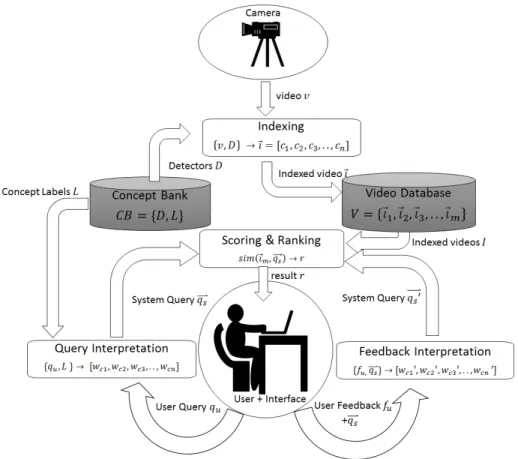
In our goal to implement a search capability that handles ad-hoc queries, we envi-sion several common elements in CBIR that have to be in place. Figure 1.1 provides an overview of the visual search system components that are important for ad-hoc queries. This figure is only intended as an example of how such a system would work, because in the literature many different systems are proposed. The important com-ponents are Indexing, Query Interpretation, Feedback Interpretation and Scoring & Ranking (indicated by the blocks). Each of the components can be interpreted as a function that converts an input to an output. The system on the one hand obtains video data from one or multiple sensors, such as a camera, drone or body cam. This video data is processed and indexed in the componentIndexing. The pre-trained de-tectors (D) are applied to the video (v) and the result is an indexed video (~ıi), which is
a vector with for each detector a score indicating the whether the concept is present in the video or not. This indexed video is stored in the video database (V). In the monitoring case, the video database might also be filled, but the score is then di-rectly forwarded to the Scoring & Ranking component to check whether the video triggers an alert.
The user can search the video database for relevant information. The user has to provide a query to the system using an interface (qu). This query is interpreted
in the componentQuery Interpretation. This component uses information from a Concept Bank that contains the labels of the pre-trained detectors (L), i.e. the words that are used to index the videos with. The Query Interpretation component outputs a system query (−→qs), which is, in this case, a (sparse) vector with a weight for each
of the concepts in the Concept Bank. In a query that is not ad-hoc (but pre-trained) this component will only output a weight of one for the pre-trained concept. This can be either implicit through a neural network or explicit, that is in the query. The system representation of the query is provided to the componentScoring & Ranking. This component uses a similarity measure to combine the system query with each of the indexed videos from the video database. Depending on the case, the component outputs a ranked list of results or an alert. The user can provide feedback on these videos (for example relevant / not relevant / not sure), or on the set of concepts (for example add / delete / adjust weight) (fu). This information is used, together with
1.2.OVERVIEW OFCONTENTBASEDVIDEOINDEXING ANDRETRIEVAL 5
Figure 1.1: Overview of Visual Search System Components:C Bis the Concept Bank that contains a set ofndetectorsDand their respective labelsL.V is the video database that contains the set of indexed videos−→I. Videovis indexed inI nd exi ng, usingD, in an indexed video~ı. This index (descriptor) is a vector of concept detector scoresc. The user can pose a queryqu, which is interpreted together withLin
Quer y I nt er pr et at i oninto a system query−→qs. InScor i ng&Ranki ngthis−q→sis used together with−→I to
produce the resultr, which is a ranking score. The user can provide feedbackfu, which results through
F eed back I nt er pr et at i onin a new system queryqs0and new results.
the original system query, in the componentFeedback Interpretation, in which the system query is updated to create a better result.
Each of the previously described components embodies a full research field. We will not explain all state of the art in each of the research fields, but rather provide just enough information to understand the choices and challenges present in this thesis.
1.2.1.
I
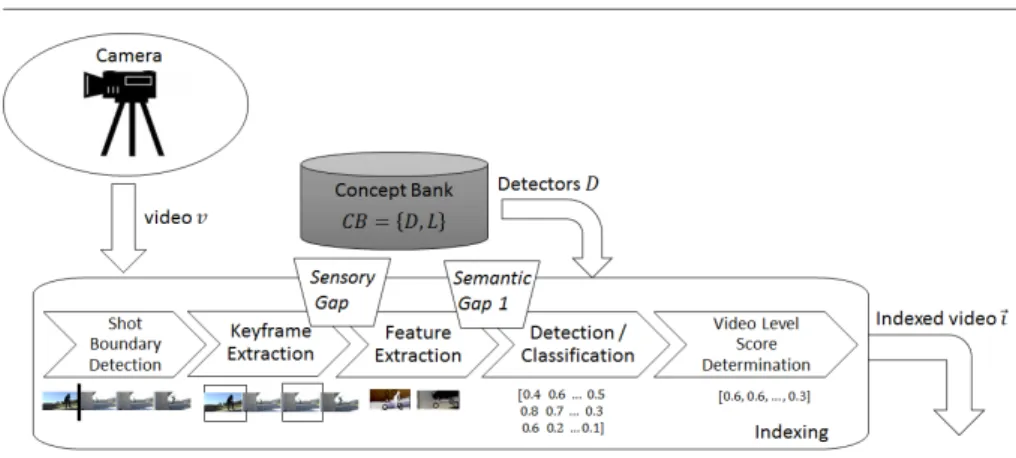
NDEXINGAn overview of typical components in Indexing is shown in Figure 1.2. Some key ref-erences related to this Indexing can be found in Smeulders et al. (2000), Snoek et al. (2008), Lew et al. (2006), Liu et al. (2007), Hu et al. (2011), and Zhang et al. (2015c). In general, videos are split into shots, which are the “consecutive sequence of frames captured by a camera action that takes place between start and stop operations" (Hu et al., 2011). Shot boundaries are detected by a shift or change of the camera by
us-6 1.INTRODUCTION
Figure 1.2: Components within indexing: Shot Boundary Detection, Keyframe Extraction, Feature Extrac-tion, Detection / Classification and Video Level Score Determination.
ing for example threshold-based or statistical-based methods (Hu et al., 2011). Addi-tionally the shots are split into keyframes, defined as a single image in a sequence of frames that represent an important point in the sequence. The selection of keyframes should contain salient points and little redundancy. Several methods used to extract keyframes are: sequential comparison-based, global comparison-based, reference frame-based, clustering-based, curve simplication-based, and object/event-based (Truong et al., 2007). An often used strategy is to pick one keyframe in every two seconds of video. Additionally, features are extracted from the keyframes. Features are distinctive characteristics of an image, such as colors, edges, textures and shapes (Snoek et al., 2008). One of the challenges in the feature extraction is thesensory gap
(Smeulders et al., 2000). This is the gap between a concept in the world and the in-formation in a digital recording of that concept. This implies that the extracted fea-tures should be invariant to for example illumination, rotation, scale, translation and viewpoint. Some common features used on images include Scale-Invariant Feature Transform (SIFT) (Lowe, 2004), Speeded Up Robust Feature (SURF) (Bay et al., 2008), Histogram of Oriented Gradients (HOG) (Dalal et al., 2005), Opponent-SIFT (Tuyte-laars et al., 2008; Van De Sande et al., 2010), color histogram (Novak et al., 1992; Wang et al., 2010b) and Local Binary Pattern (LBP) (Ojala et al., 2002). Some features used on shot level include Spatio-Temporal Interest Points (STIP) (Laptev et al., 2003), Motion Boundary Histograms (MBH) (Dalal et al., 2006) and Histogram of Optical Flow (HOF) (Laptev et al., 2008). Currently, Convolutional Neural Networks (CNN) are used to extract the features (Krizhevsky et al., 2012; Sharif Razavian et al., 2014; Jia et al., 2014; Karpathy et al., 2014). Examples of these CNNs are AlexNet (Krizhevsky et al., 2012), VGG(16/19) (Simonyan et al., 2014), GoogleNet (Szegedy et al., 2015), In-ception V3 (Szegedy et al., 2016) and ResNet (He et al., 2016). The extracted features from the image (or shot) are often named descriptors. These descriptors are then converted into a feature representation. This representation is often a Bag of (Visual) Words (BoW), in which each descriptor is assigned to the closest entry of a visual vocabulary / codebook. This codebook is previously learned on a large dataset. The histogram of BoW, a Fisher vector representation (Perronnin et al., 2010) or Vector of
1.2.OVERVIEW OFCONTENTBASEDVIDEOINDEXING ANDRETRIEVAL 7
Locally Aggregated Descriptors (VLAD) pooling (Jegou et al., 2012) is used as a repre-sentation of the image. With this reprerepre-sentation a classification to a concept can be done, using the pre-trained concept detectors from the Concept Bank. The concept detectors are trained using image representations as input and the concept classes as output. A combination of large datasets, such as ImageNet (Deng et al., 2009), PAS-CAL VOC (Everingham et al., 2015) and TRECVID SIN (Over et al., 2015), are often used to create the Concept Bank. In the past decades, machine learning methods, such as SVMs, Bayesian Classifiers and Random Forests (Liu et al., 2007; Jiang et al., 2012) were used, but currently deep learning techniques are the common state of the art (Karpathy et al., 2014; Schmidhuber, 2015; Jiang et al., 2017). These deep learning techniques often process some of the previous steps, such as the feature extraction, implicit in the network. The deep learning techniques either take an image or a video as input and directly output the classification. The output score for the classification is a vector with a length that is equal to the number of concepts and each item has a value between zero and one, resembling a confidence that the concept is present in the image. If the classification was applied on keyframe or shot level, some kind of pooling, such as average or max pooling (Wang et al., 2010a; Zhang et al., 2015c), is applied for the video level score determination step to create the index video score (~ı).
One of the major challenges in multimedia information retrieval, related to the in-dexing, is thesemantic gapand it is defined as the gap between the abstraction level of the pixels in a video and the semantic interpretation of the pixels (Smeulders et al., 2000). This gap can be split into two parts (Hare et al., 2006): the gap between descrip-tors and object labels (semantic gap 1) and the gap between object labels (concepts) and full semantics (semantic gap 2). As explained in the previous paragraph, descrip-tors are the feature vecdescrip-tors of an image and object labels or concepts are the symbolic names for the objects in the image. Full semantics is the meaning of the words in the query or even the intent of the user. The first gap is also referred to as automatic im-age annotation and is part of the indexing of the video. One of the challenges with this gap is the context dependency on the training examples, i.e. only training the conceptfirein the context of a campfire might not detect a house on fire. The con-cept labels should, thus, be disambiguous and precise (campfire). The second gap is related to the query interpretation (see next section).
An advantage of indexing a video is that the videos are searchable through the pre-trained concepts available in the Concept Bank, and not all low-level features have to be stored in the database (which requires more space and search time). Because of big annotated datasets such as ImageNet (Russakovsky et al., 2015), PASCAL VOC (Everingham et al., 2015) and TRECVID SIN (Over et al., 2015), the improvement of hardware and computing power (i.e. GPU) and the new techniques within the field of deep learning, the detection accuracy of concepts in video and images has signifi-cantly improved in the past decade (Deng, 2014; Awad et al., 2016b).
8 1.INTRODUCTION
1.2.2.
Q
UERYI
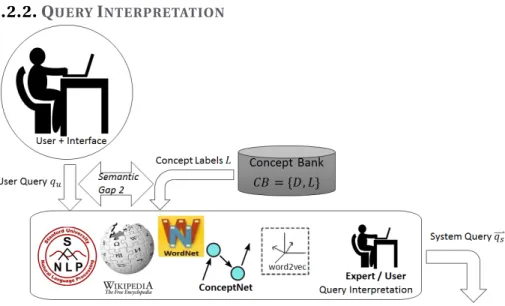
NTERPRETATIONFigure 1.3: Examples of tools used within Query Interpretation: knowledge bases such as Wikipedia, Word-Net and ConceptWord-Net, machine learning such as the semantic embedding method word2vec, manual map-ping through a expert or user.
The second component is the Query Interpretation (QI), of which an illustrative figure is shown in Figure 1.3. Query Interpretation is often used in text retrieval, to map the user query to words present in the documents (Zhao et al., 2012). Some of the approaches include linguistic analysis (i.e. stemming, ontology browsing and syntactic parsing), corpus-specific techniques (concept terms and term clustering), query-specific techniques (distribution difference analysis, model-based Automatic Query Expansion, document summarization), search log analysis (related queries, query-document relationships) and web data techniques (anchor texts, Wikipedia) (Carpineto et al., 2012). One of the challenges in this mapping is thevocabulary mis-match. This is the (semantic) mismatch between the concepts people use to for-mulate their query and the concepts that are used to index the document, image or video with. In the image or video domain the vocabulary of trained concepts is much smaller than the vocabulary of for example the English language. One reason is that not all words in a vocabulary are visually presentable and another reason is that it is unfeasible to train concept detectors for all words in the English vocabulary. A related challenge, specifically for the image / video retrieval, is the semantic gap. As explained in the previous section, the gap between object labels (concepts) and full semantics (semantic gap 2) is related to the query interpretation: to capture the meaning or intent of the user query in terms of the available object labels, or con-cepts, which we define asquery-to-concept mapping. As an example, the user query
extinguishing a fireneeds at least the conceptsfire,fire extinguisherandfire (wo)man
to be able to match the semantics of the information need underlying the query. The query-to-concept mapping, also named concept selection, is often done us-ing one of the followus-ing three categories: ontologies, machine learnus-ing or manual mapping (Liu et al., 2007). Ontologies are conceptual representations of the world.
1.2.OVERVIEW OFCONTENTBASEDVIDEOINDEXING ANDRETRIEVAL 9
Ontologies or knowledge bases can be created by expert (expert knowledge base) or created by the public (common knowledge base). Expert knowledge bases provide good performance, but dedicated expert effort is needed in the creation of such a knowledge base. Some early work on expert knowledge bases and reasoning in the field of event recognition is explained in Ballan et al. (2011). One current expert on-tology for events is EventNet (Ye et al., 2015). Common knowledge bases, such as Wikipedia (Milne et al., 2013) and WordNet (Miller, 1995), are freely available and of-ten used in the video retrieval community (Neo et al., 2006; Yan et al., 2015; Tzelepis et al., 2016), but might not contain the specific information that is needed. The query-to-concept mapping in common knowledge bases is often done by using the most similar or related concepts to events found in the knowledge base. An overview of the type of methods to find similar or related concepts can be found in Natsev et al. (2007).
Machine learning techniques can be used to automatically select the proper con-cepts. Examples are graphical models, such as hidden Markov models (Dalton et al., 2013), and statistical methods, such as co-occurrence statistics (Mensink et al., 2014) and a skip-gram model (Chang et al., 2015). One group of current state of the art models isword2vec, which produce semantic embeddings. These models either use skip-grams or continuous bag of words (CBOW) to create neural word embeddings using a shallow neural network that is trained on a huge dataset, such as Wikipedia, Gigawords, Google News or Twitter. Each word vector is trained to maximize the log probability of neighboring words, resulting in a good performance in associations, such asking - man + woman = queen.
Currently, often a manual mapping from the user query to a set of concepts is used in benchmarks such as TRECVID Multimedia Event Detection (Awad et al., 2016a). This manual mapping can either be done by an expert or the user that entered the query. Allowing the user to map the query to the concepts in the Concept Bank implies that the user should learn the concepts in the Concept Bank, and asks for additional effort. The expert mapping is, similar to the expert knowledge base, probably good performing, but unfeasible with many user queries.
1.2.3.
F
EEDBACKI
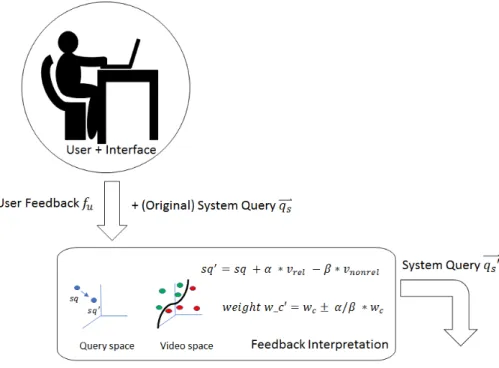
NTERPRETATIONFeedback interpretation can be divided into Relevance Feedback (RF) and active learning approaches (Snoek et al., 2008). Relevance feedback displays the most rele-vant results on top and uses the positively and negatively annotated results to update the system query in an iterative process. Relevance feedback is typically used in an ad-hoc case, such as our use case. Active learning displays the most uncertain results, i.e. the results that are most informative for the system, to the user to quickly learn an optimal model. Active learning is typically used to train (or improve) concepts. In this section, we will only focus on relevance feedback. An illustration is shown in Figure 1.4.
The use of relevance feedback stems from the dynamic nature of information seeking (Ruthven et al., 2003): information needs can be continuously changing and be unique to each user. Relevance feedback can be done in different ways: implicit, explicit and blind/pseudo. Inimplicitrelevance feedback, implicit information, such
10 1.INTRODUCTION
Figure 1.4: Examples of algorithms used in Feedback Interpretation: changing the concept space in for ex-ample query point modification, changing the video space in for exex-ample cluster-based methods, chang-ing the weights in re-weightchang-ing and uschang-ing Rocchio to change the system query.
as user clicks or dwell time, is used. The advantage of this method is that you do not have to bother the user, but the inference of the results is much harder. Inexplicit
relevance feedback, the user explicitly indicates if a certain item is relevant or not relevant. This can be done using a binary scale or a gradual scale. The advantage of this method is that you have a clear indication of the relevance and a higher per-formance, but the disadvantage is that you have to bother the user. This user might not have time or motivation to give such feedback. Inblind- or pseudo-relevance feedback, the manual user part is automated. In this automation, we assume that the firstkranked items are relevant. This assumption is not without a risk, because in the case of rare events or new query domains, bad retrieval systems or ambiguous queries this assumption might not hold. Human relevance feedback (implicit and ex-plicit) has been known to provide major improvements in precision for information retrieval system. Dalton et al. (2013) have shown that — in the domain of video re-trieval — pseudo-relevance feedback can increase Mean Average Precision (MAP) up to 25%, whereas with human judgments this number can grow up to 55%. Of course the effectiveness of pseudo-relevance feedback critically depends on the assumption that the collection contains at least a reasonable number of relevant results and that the first retrieval pass is able to pick up a good fraction of those in the topk. It is clear that relevance feedback, when applied correctly, can help the user in better finding results.
1.2.OVERVIEW OFCONTENTBASEDVIDEOINDEXING ANDRETRIEVAL 11
One of the most well-known and applied relevance feedback algorithms that has its origins in text retrieval is the Rocchio algorithm (Rocchio, 1971). This algorithm is used in state of the art video and text retrieval systems that use for example Query Point Modification (QPM) to move the query representation in the vector space and re-weighting in which the terms in the query are re-weighted (Rocha et al., 2015; Jiang et al., 2014b; Tsai et al., 2015; Kaliciak et al., 2013). Often a document is represented as a vector with a real-valued component, e.g. tf-idf weight (see next section), for each word. The Rocchio algorithm works on a vector space model in which the query drifts away from the negatively annotated documents and converges to the positively annotated documents. The Rocchio algorithm is effective in relevance feedback, fast to use and easy to implement. The disadvantages of the method are that itsαandβ parameters have to be tuned and it cannot handle multimodal classes properly.
Other state of the art approaches, such as feature-, navigation-pattern, and cluster-based approaches, in image retrieval are explained by Zhou et al. (2003) and Patil (2012). Some vector space models use k-Nearest Neighbor methods, such as in the studies by Gia et al. (2004) and Deselaers et al. (2008). Other methods use decision trees, SVMs, or multi-instant approaches are explained in Crucianu et al. (2004).
1.2.4.
S
CORING& R
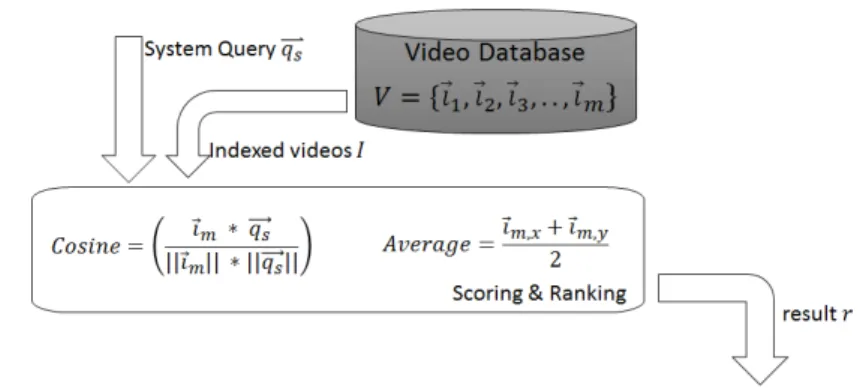
ANKINGFigure 1.5: Algorithm (cosine similarity) and often used Average Fusion in Scoring & Ranking component The final component is Scoring & Ranking, illustrated by Figure 1.5. This component deals with the retrieval models and fusion. Examples of models are set-theoretic, algebraic and probabilistic models (Baeza-Yates et al., 1999). The
set-theoreticor Boolean model represents the system query with AND, OR and NOT operators. The video or document is indexed with concepts in a binary fashion (present or not). The Boolean model returns the videos or documents that contain the concepts that need to be (not) present according to the query. This type of model can be extended towards fuzzy sets, in which the binary separation is less strict. The Boolean models are not often used, because they have no gradation or weighting and do not allow partial matching. Thealgebraicor vector space model, which is the model of our choice, computes the distance between the system query and each of the videos or documents. This model allows gradation, or ranking of the
12 1.INTRODUCTION
videos, as well as weighting. In text retrieval the most basic weight is a TF-IDF value, which represents how often a word in the query occurs in a certain document normalized by the number of documents the word occurs in. This allows specific words to have a higher weight compared to often occuring words, such as stopwords. The distance between the query and the video or document is often calculated through a cosine similarity (Salton et al., 1988; Salton et al., 1997). Latent Semantic Indexing and Neural Network approaches are also algebraic models that allow implicit weights and more sophisticated distance measures. Probabilistic
models calculate the probability that a video or document is relevant and the probability that it is not relevant. The ratio of these probabilites often determines the ranking. This probability can be determined with for example language models, Bayesian Networks or measures such as BM25. Both vector space and probabilistic models can perform well, but their retrieval performance is dependent on the validity of the assumptions, such as the independence assumption.
Often multimedia information retrieval systems do not only rely on one source of information. The Concept Bank can for example contain concepts trained on differ-ent datasets, as well as visual and motion information. These differdiffer-ent types of infor-mation (visual and motion) are defined as a modality or data source. In the Scoring & Ranking component, this information should be fused. Atrey et al. (2010) give an overview of the multimodal fusion methods in multimedia analysis. Firstly, a distinc-tion between early fusion on feature level and late fusion on decision level is made. The advantage of early fusion is that correlations between multiple features can be used, but it can be hard to create a meaningful combined feature vector. Lan et al. (2012) add that early fusion techniques suffer from the curse of dimensionality and require much training data. According to Atrey et al. (2010), the advantage of late fu-sion is that the most suitable method for a single modality can be applied and it is more flexible and robust to features that have a negative influence compared to early fusion. A disadvantage is that the correlation between modalities cannot be fully ex-ploited.
Besides the level of fusion, the method of fusion is also important. Two of the methods explained in Atrey et al. (2010) are rule-based methods and classification-based methods. Examples of rule-based methods are linear weighted fusion and manually defined rules. In the linear weighted fusion some form of normalization and weighting is used to combine different modalities. In general, the rule-based methods are computationally inexpensive and easy to implement, but the assignment of appropriate weights remains an issue. This method is often used in late fusion. Oh et al. (2014) further split late fusion into a blind method with fixed rules, such as geometric mean, a normalization method with assumptions on score distributions and a learning method that needs training data to set an appropriate weight. The difficulty of assigning appropriate weights made us focus on blind methods with fixed rules for the integration of different information sources.
According to Xu et al. (1992), three types of classifier outputs can be used in fu-sion: 1) abstract level: single class label; 2) rank level: ordered sequence of candidate classes; 3) measurement level: candidate classes with confidence scores. According to Tulyakov et al. (2008), voting techniques such as majority voting and borda count
1.3.RESEARCHQUESTIONS 13
are the methods most used for the abstract and rank level classifiers, whereas sum, product and max-rules are the elementary combinations on measurement level.
1.3.
R
ESEARCH
Q
UESTIONS
In this thesis, we cannot focus on all components to create the search capability. Given our aim that the search capability should handle ad-hoc textual queries, the major challenge is the Query Interpretation. We assume that we have no training ex-amples for the ad-hoc queries, and, thus, we should represent the query in terms of the concepts used to index the video (query-to-concept mapping). Our main research question is:
Main Research Question:How can we improve visual search effectiveness by semantic query-to-concept mapping?
Our main research question touches some of the central problems of Artificial Intelligence, such as reasoning, knowledge representation, natural language processing and perception. Both the vocabulary mismatch and the semantic gap are present in the semantic query-to-concept mapping. We zoom in on cases in which the videos are already indexed with concepts, disregarding the challenges in processing the video, training concept detectors and storing the videos in a scalable way. Because of the decision to index the video with concepts instead of non-semantic descriptors or features, we, however, use a scalable solution that has the complexity ofO(n∗m), wherenis the number of concept detectors andmis the number of videos. Because we assume that the number of concepts is much lower than the number of features, our query-to-concept mapping enables a scalable system.
Additionally, we have two assumptions. Our first assumption is theopen-world assumption. This means that it is not the case that our system has complete world knowledge. This means that not all queries are known at design time of the system, which is the case in the ad-hoc search task. Because not all queries are known not enough concepts can be trained to cover all queries, hence we have a vocabulary mismatch. Although current state of the art systems are able to detect an increas-ingly large number of concepts, this number still falls far behind the near infinite number of possible (textual) queries that a system needs to be able to handle. In or-der to handle the ad-hoc queries with a vocabulary mismatch, we assume thatour query can be decomposed to smaller pieces(decompositionality). For a certain unseen event ‘birthday party’, we assume that we can use related concepts, such as a group of people, a cake and decorations and relations between those concepts to capture the essence of that unseen event. The system query can then be formalized as a vector of concepts in which each concept has a weight (Equation 1.1).
−→q
s=[wc1,wc2,wc3, ..wcn] (1.1)
As a working hypothesis, we use a sparse linear combination (inproduct) of these concepts as our retrieval model (Equation 1.2). This is based on the fact that it is hard to determine a good non-linear retrieval model without training examples.
14 1.INTRODUCTION
rv= −→qs·−→iv (1.2)
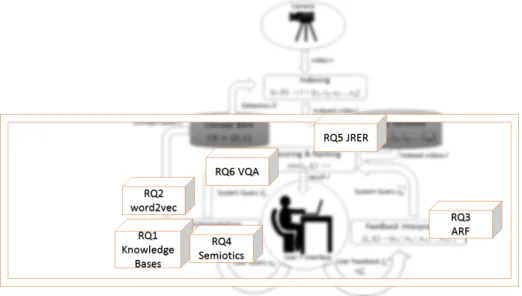
Given the main research question and our assumptions, we have formulated some in depth research questions that help to answer the main research question. Figure 1.6 places the research questions in the visual search system that was introduced in the previous section. Each research question is addressed in one chapter of this thesis, which relates to one peer reviewed paper. Additional published papers are mentioned in this section and a full list of publications is included on page 161.
Figure 1.6: Visualization of the Research Questions in the Visual Search System
The first research questions are related to the method that is used to apply for the query-to-concept mapping. The query-to-concept mapping is currently done using any of the following three methods: using knowledge bases, using a machine learning approach, such as an semantic embedding, or using a manual mapping. The first research question, named KnowledgeBases, explores the incorporation of knowledge bases as a method in the Query Interpretation:
RQ1 KnowledgeBases: How can we incorporate knowledge bases in query-to-concept mapping and which of the current knowledge bases is most applicable for this pur-pose?(Chapter 2)
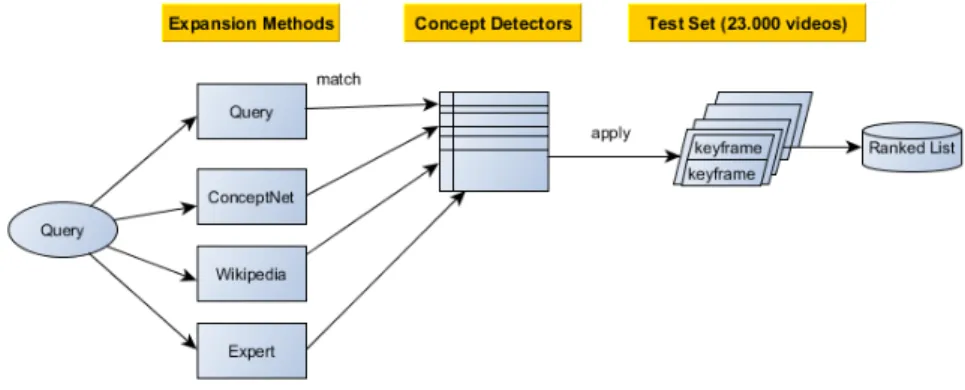
Based on the literature, we choose to compare three knowledge bases. We distinguish common knowledge bases such as Wikipedia and expert knowledge bases such as a manually created ontology. We use the text retrieval method TF-IDF on the text from Wikipedia, the graphical structure / ontology from ConceptNet to exploit the strength of the relations between words and a manually created ontology
1.3.RESEARCHQUESTIONS 15
as our in-domain knowledge base. This research is published in Boer et al. (2015b). We also explored directions with the knowledge base WordNet, such as natural language processing with WordNet (Boer et al., 2013; Bouma et al., 2013b) and TFIDF with WordNet (Ngo et al., 2014; Lu et al., 2016b). The result of Lu et al. (2016b) is mentioned in chapter 3, but the methods are not included in this thesis.
Knowledge bases are, however, not the only way to perform the query-to-concept mapping. In 2013, Mikolov et al. (2013) introduced word2vec, which is a method based on semantic embeddings. This method extracts knowledge from large text corpora, without the explicit modelling and structuring that is needed for the knowledge bases. The disadvantage of this method is that it can only model that two words are used in the same context, but not what this specific relation is. In the research question word2vec, we investigate whether word2vec is a better alternative in query-to-concept mapping:
RQ2 word2vec:How can we use semantic word embedding in query-to-concept map-ping, and how does the mapping depend on the concepts in the Concept Bank? (Chap-ter 3)
We explore the semantic embedding based on word2vec and different types of concepts in the Concept Bank, such as low-level objects or scenes, mid-level actions and high-level events, and how these types of concepts influence the mapping and effectiveness of the whole search capability in terms of Mean Average Precision. This research is published in Boer et al. (2017b). An initial exploration of word2vec is also published in Zhang et al. (2015a).
The third type of mapping is the manual mapping. A disadvantage of a manual map-ping is that the user should know all concepts in the Concept Bank to be able to select the relevant concepts. This is often not feasible, and thus the third research question explores how we can involve the user in the query-to-concept mapping without the manual mapping:
RQ3 ARF:How can we involve the user to optimize semantic mapping and retrieval performance for a visual search capability?(Chapter 4)
We propose and compare methods that use the user feedback on both concept level and video level. For the video level relevance feedback, we base our method on literature in text retrieval. We propose an Adaptive Relevance Feedback (ARF) algo-rithm that uses the Rocchio algoalgo-rithm (Rocchio, 1971) in the video retrieval domain by using the concept space. We compare our algorithm to a k-Nearest Neighbour (k-NN) method (Gia et al., 2004; Deselaers et al., 2008) that is perceived as state of the art in video retrieval, and several algorithms on concept level, such as Query Point Modification and re-weighting. This research is published in Boer et al. (2017a). Ad-ditional experiments on ARF are published in Pingen et al. (2017). These experiments include different modes of feedback, such as optimal, random and pseudo relevance feedback, and the usability of our video retrieval system named AVES. An exploration
16 1.INTRODUCTION
on personal re-ranking of results using k-NN for queries with subjective adjectives, such asdangerous animal, can be found in Schavemaker et al. (2015).
The success of the query-to-concept mapping is not only dependent on the model, Concept Bank and user feedback, but the type of query might have influence on the performance. Some type of queries might have a higher performance, because they have a better fit to the type of semantic structure that is assumed in the mapping. As an example, for some queries a mapping from ‘man’ in the query to ‘woman’ as a con-cept might not hurt performance, whereas in other queries it might. In this research question, we explore different types of semantic structures in a query:
RQ4 Semiotics:To what extent can semantic structures increase understanding of the query?(Chapter 5)
We create a set of queries with different objects and spatial relations, and provide ground truth for all concepts and images in a created Toy and Office-Supplies Objects (TOSO) dataset. We compare performance of methods that only use specific semiotic structures and all structures on both concept level (semantic query-to-concept map-ping) and image (retrieval) level. This research is published in Boer et al. (2015c). Ini-tial papers on this topic can be found in Boer et al. (2015a) and Schutte et al. (2015a).
Our fifth research question is not directly used in the Query Interpretation or query-to-concept mapping, but focuses on fusion. Most concept detectors are not trained on one dataset. In this research question, we look into fusion of trained classifier outputs based on their score distribution and dependency:
RQ5 JRER: Can we design a more effective score fusion method that is motivated by explicit assumptions about the distribution of classifier output values and the depen-dency between input sources?(Chapter 6)
We introduce a novel blind late fusion method named Joint Ratio Exterme Ratio (JRER) to combine information from multiple modalities. This method is based on state of the art methods, such as the average fusion or joint probability. This research is published in Boer et al. (2016b).
Other research questions on the query-to-concept mapping have focused on an ex-plicit mapping of the query to specific concepts, but currently many deep learning methods used in image understanding do not use an explicit mapping. Our last re-search question aims to explore these implicit mappings:
RQ6 VQA:What are the possibilities of implicit query-to-concept mapping in terms of visual search effectiveness?(Chapter 7)
We explore the state of the art deep learning network named DPPnet (Noh et al., 2016) in a benchmark that involves a query and an image as input and a textual an-swer as output. We improve upon this method by adding concept detectors to the
1.4.RESEARCHMETHODS ANDCOLLABORATION 17
network and postprocessing the answers to filter on the right type of answer. This research is published in Boer et al. (2016a).
1.4.
R
ESEARCH
M
ETHODS AND
C
OLL ABORATION
As an experimental testbed, we would like to use a large statistical dataset, which is more tuned to a retrieval case (forensic) than a real-time case with alerts (mon-itoring). Our methods can, however, be used for video streaming data. A security task would be in scope for this thesis, as this is used as an inspiration for this re-search. Although many countries, such as the US, have big research programs for the security domain, such as DARPA (military domain)1and IARPA (homeland se-curity domain)2, we could not find a dataset that met our requirements. The known benchmarks for the security domain, such as the Performance Evaluation of Track-ing and Surveillance (PETS) (Ferryman et al., 2009) and the i-Lids data that is used in the TRECVID Surveillance Event Detection (SED) task (Over et al., 2015), contain (pre-defined) actions such as picking up a phone, a group formation or speeding up. These events need a specifically trained action classifier, because the combination of a person and a phone might not be sufficient to retrieve the specific action of pick-ing up a phone. In this thesis, we focus on high-level events, which can be described in terms of objects and actions between those objects, i.e. meets our requirement of decompositionality. To our knowledge, no large annotated dataset is available for complex events in the security domain.
Within the multimedia information retrieval field, many standard test collections, or international benchmarks, are available. With the increase of performance on existing benchmarks, new more complex benchmarks were created. The advances in object detection through benchmarks, such as PASCAL VOC (Everingham et al., 2015) and ImageNet (Russakovsky et al., 2015), have led to harder datasets such as MSCOCO (Lin et al., 2014) or VisualQA (Antol et al., 2015). These datasets have led to advances in image understanding. The earlier datasets were often contructed and therefore less generalizable, whereas MSCOCO and VisualQA contain more real world data, which allows researchers to measure whether the tested systems are also generalizable or applicable for real world applications. Within the event retrieval domain, the advances in the TRECVID MED benchmark on the detection of events using 100 examples and 10 examples have led to the introduction of a task without any training examples.
Because of the disadvantages of creating a new large annotated dataset, we choose to use the TRECVID Multimedia Event Detection (MED) task in the majority of our work (Awad et al., 2016a). The data set that is released with the task contains videos of different types of quality, which resembles the surveillance domain with static cameras, body cams and mobile phone videos. The MED task consists of a train set of forty events and a test set of twenty events, varying from social events such astailgatingto procedural events such aschanging a vehicle tire. These events can typically be described using multiple concepts, such as objects, actions and
1https://www.darpa.mil/ 2https://www.iarpa.gov/
18 1.INTRODUCTION
scenes. Although these events have been inspired by cases from the homeland security domain, the transfer of the developed knowledge in this thesis to a security case is not a part or goal of this thesis. The events have the same magnitude of visual dissimilarity, i.e. every instance of an event looks different, but all are positive for the event, and there is a high imbalance of positive examples in the videos compared to the number of videos in the database (20 positives on 27.000 videos). The evaluation metric of the TRECVID MED is the Mean Average Precision, which focuses on the rank of the positive examples, i.e. penalizes systems for the positive examples that are not retrieved. This metric is not uncommon in a forensic case, in which a combination of true positives, false positives, true negatives and/or false negatives is often used (Schütze, 2008). In the monitoring case the metric is often based on false alarms and misses, such as Normalized Detection Cost Rate (NDCR), Area under the Curve (AUC), or ROC curve (Bouma et al., 2014; Over et al., 2015). The dataset and evaluation metric are, thus, suitable as an experimental testbed for our research question.
The TRECVID MED benchmark is of such a size that it takes a large research team to complete the full task. After a TNO-only participation in 2013, we intensively col-laborated with the VIREO team from the City University of Hong Kong in 2014 and 2015, from where we received all the concepts in the Concept Bank and the detec-tions on all videos. This allowed us to focus on the query-to-concept mapping, with-out the burden of the indexing component.
1.5.
M
AIN
C
ONTRIBUTIONS
The main contribution of this thesis can be summarized as:
• We create a smart automatic query-to-concept mapping method named in-cremental word2vec (i-w2v) (Chapter 3). This i-w2v method uses word2vec trained on GoogleNews items as a semantic embedding model and incremen-tally adds concepts to the set of selected concepts for a query in order to deal with query drift. In combination with a state of the art video event retrieval pipeline, we achieve top performance on the TRECVID MED benchmark re-garding the zero-example task (MED14Test results).
• We propose a feedback interpretation method named ARF that not only achieves high retrieval performance, but is also theoretically founded through the Rocchio algorithm (Rocchio, 1971) from the text retrieval field (Chapter 4). This algorithm is adjusted to the event retrieval domain in a way that the weights for the concepts are changed based on the positive and negative annotations on videos. The ARF method has higher visual search effectiveness compared to k-NN based methods on video level annotations and methods based on concept level annotations.
• We introduce several blind late fusion methods based on a combination of state of the art methods (Chapter 6). Especially theJRERmethod achieves high performance in cases with reliable detectors, i.e. enough training examples.
1.6.THESISOUTLINE 19
1.6.
T
HESIS
O
UTLINE
In the remainder of this thesis, we follow the structure and order of the research ques-tions in which one research question is addressed in one chapter. All chapters are based on a peer-reviewed and published paper. This means that the chapters can be read separately. InChapter 2we explore different knowledge bases that can be used to create a query-to-concept mapping. InChapter 3we propose a novel semantic embedding method named i-w2v that improves upon word2vec that achieves state of the art performance. We also compare vocabularies / Concept Banks with differ-ent types of concepts in terms of complexity, i.e. low- (object, scene), mid- (action) and high-level (event).Chapter 4is dedicated to user feedback. We analyze differ-ent feedback interpretation methods, both on concept level and video level. Addi-tionally, we propose a novel method named ARF based on the well-known Rocchio algorithm that improves upon state of the art performance.Chapter 5is related to semiotics. We use different type of queries and different type of semantic structures, such as synonyms and functional related words (man vs. woman), to calculate the performance on concept level and image level.Chapter 6is focused on fusion. We introduce novel blind late fusion methods based on state of the art methods, such as average and product. InChapter 7we explore how and whether we can use an im-plicit query-to-concept mapping in a visual question answering task.Chapter 8 con-tains the conclusion, limitations and future work. Additionally, the thesis concon-tains a glossary with a definition of the technical terms used in this thesis, a summary (in English and Dutch), the acknowledgements, CV and list of publications.
2
K
NOWLEDGE
B
ASED
Q
UERY
E
XPANSION IN
M
ULTIMEDIA
E
VENT
D
ETECTION
Edited from:Maaike de Boer, Klamer Schutte and Wessel Kraaij(2016)Knowledge Based Query Expansion in Complex Multimedia Event Detection. In: Multimedia Tools and Applications (MTAP), volume 75, pp. 9025 - 9043.
For our aim to improve visual search effectiveness, we use a semantic query-to-concept mapping. In order to achieve a good mapping, we need to interpret the query and un-derstand the relation of the query to the concepts. This requires world knowledge. One of the sources that can provide such knowledge are knowledge bases. In this chapter, we propose and compare methodologies to use knowledge bases as a resource for content-based information retrieval of complex events. This chapter is related to the first re-search questionRQ1 KnowledgeBases. We distinguish common knowledge bases such as Wikipedia and expert knowledge bases such as a manually created ontology. We use text retrieval methods, such as TFIDF, to map the query to the most related concepts using Wikipedia through query expansion. We compare that method with a method that exploits the graphical structure of the common knowledge base ConceptNet. Ad-ditionally, we use an expert knowledge base on the TRECVID MED events for our com-parison. Results on the TRECVID MED test set of 2014 show that using a knowledge base improves performance if a vocabulary mismatch exists, i.e. if the main noun in the query has no direct match to a concept in the Concept Bank. Additionally, the ex-pert knowledge base does not necessarily outperform the approaches using common knowledge bases. From the common knowledge bases, ConceptNet performs slightly better compared to Wikipedia.
22 2.KNOWLEDGEBASEDQUERYEXPANSION INMULTIMEDIAEVENTDETECTION
2.1.
I
NTRODUCTION
Retrieving relevant videos for your information need is most often been done by typ-ing a short query in a video search engine such as YouTube (Burgess et al., 2013). Typically, such visual search engines use metadata information such as tags pro-vided with the video, but the information within the video itself can also be extracted by making use of concept detectors. Concepts that can be detected include objects, scenes and actions (Jiang et al., 2012). Concept detectors are trained by exploiting the commonality between a large number of training images. One of the challenges in content-based visual information retrieval is the semantic gap, which is defined as "the lack of coincidence between the information that one can extract from the visual data and the interpretation that the same data have for a user in a given situation" (Smeulders et al., 2000). The importance of bridging the semantic gap is reflected by the emergence of benchmarks such as TRECVID (Over et al., 2004) and ImageCLEF (Caputo et al., 2014).
The semantic gap can be split in two sections (Hare et al., 2006): the gap between descriptors and object labels and the gap between object labels and full semantics. Descriptors are feature vectors of an image and object labels are the symbolic names for the objects in the image. Full semantics is the meaning of the words in the query or even the information need of the user. The first gap is also referred to asautomatic image annotationand progress is made rapidly (Snoek et al., 2010; Russakovsky et al., 2015). For the purpose of this chapter the second gap is considered.
In the second semantic gap, the challenge is to represent the user intent in terms of the available object labels, which are provided by the concept detectors. State-of-the-art methods used to bridge this second semantic gap include query expansion using knowledge bases (Hoque et al., 2013) and relevance feedback (Patil et al., 2011). Relevance feedback is a method that uses feedback from the user, such as explicit relevance judgments or user clicks, to optimize results. Relevance feedback is a pow-erful tool, but it requires an iterative result ranking process and dedicated algorithms (Patil et al., 2011), which is outside the scope of this chapter. Another disadvantage of relevance feedback is that the system does not know why a video is not relevant.
Knowledge bases, on the other hand, are interpretable for both systems and hu-mans. Knowledge bases can add more relevant words to the short user query to rep-resent the user intent in a better way. This larger user query contains more words and, thus, more potential to match the object labels. Both common knowledge bases such as WordNet (Liu, 2002) or Wikipedia (Hassan et al., 2011) and expert knowledge bases created by an expert can be used (Bagdanov et al., 2007; Tu et al., 2014). Com-mon knowledge bases are easy to access and do not require a lot of dedicated effort to construct, but they might not have sufficient specific information and they can be noisy due to disambiguation problems. The lack of sufficient specific information implies that no additional relevant concept detectors can be selected and the noise can cause the selection of irrelevant concept detectors. Expert knowledge bases may have sufficient specific information and are less noisy, but it requires a lot of dedi-cated effort to create them.
2.2.RELATEDWORK 23
Our research focuses on which type of knowledge base is best to use in the do-main of complex or high-level events, defined as "long-term spatially and temporally dynamic object interactions that happen under certain scene settings" (Jiang et al., 2012). Examples of complex events arebirthday party,doing homeworkanddoing a bike trick. In this chapter, only textual information is used as input for the system, which is referred to as the zero-example case. In this situation it is unfeasible to cre-ate a dediccre-ated detector for each possible word and we, therefore, have to bridge the semantic gap between the pre-determined labels assigned to the image and the full semantics of the event. Complex events cannot be captured by a single object, scene or action description and, therefore, complex events have a large semantic gap.
In our experiments, we use the Test Set of TRECVID 2014 Multimedia Event De-tection (MED) task (Over et al., 2013) to compare retrieval performance on the com-plex event query, ConceptNet 5 (Speer et al., 2012) and Wikipedia as common knowl-edge bases and the textual description provided with the TRECVID task to determine which type of knowledge base is best to use. ConceptNet and Wikipedia are chosen, because both are easy accessible and provide information about complex events. We expect that query expansion has a positive effect on performance, especially if the main noun of the query cannot be detected with the available concept detectors. Be-cause common knowledge bases are not tailored, expert knowledge bases might be able to outperform common knowledge. No difference in performance of Concept-Net and Wikipedia is expected. Fusion, on the other hand, is expected to increase performance, because not all knowledge bases will provide the same information.
In the next section, related work about the query expansion using knowledge bases and complex event detection is reviewed. The third section contains informa-tion about the method with the TRECVID MED task and design of the experiment. Section 2.4 consists of the results and the last section contains the discussion, con-clusions and future work.
2.2.
R
EL ATED
W
ORK
2.2.1.
Q
UERYE
XPANSION USINGK
NOWLEDGEB
ASESOne of the challenges in keyword search is that the user uses different words in the query than the descriptors used for indexing (Bodner et al., 1996). Another challenge is that users often provide a short, vague or ill-formed query (Bodner et al., 1996). In order to find relevant results, the query has to be expanded with relevant, related words, such as synonyms. Computers have no knowledge of our world or language themselves and, therefore, cannot use this information in the way humans do. In order to automatically expand the query without requiring the user to reformulate the query, computer systems should have access to world knowledge and language knowledge. One way to provide this knowledge is to use a knowledge base (Bodner et al., 1996). Two types of knowledge bases exist: common knowledge bases and ex-pert knowledge bases. In Bodner et al. (1996) these are calledGeneral World Knowl-edge BaseandDomain Specific Knowledge Base, respectively. Both types of knowledge bases are accessible on the Internet because of the Semantic Web and Linked Open Data (LOD) initiative (Sheth et al., 2005; Baeza-Yates et al., 2008). The Semantic Web
24 2.KNOWLEDGEBASEDQUERYEXPANSION INMULTIMEDIAEVENTDETECTION
is about exposure of structured information on the Web and the LOD is about linking the structured information. This information is often structured using an ontology, which is a formal way to represent knowledge with descriptions of concepts and re-lations. An advantage of using ontologies is that they provide a formal framework for supporting explicit, specific and machine-processable knowledge and provide infer-ence and reasoning to infer implicit knowledge (Ballan et al., 2011). Several standards such as OWL (Web Ontology Language) are easy accessible. A disadvantage of an on-tology is that the knowledge has to be inserted in the framework manually.
COMMONKNOWLEDGEBASES
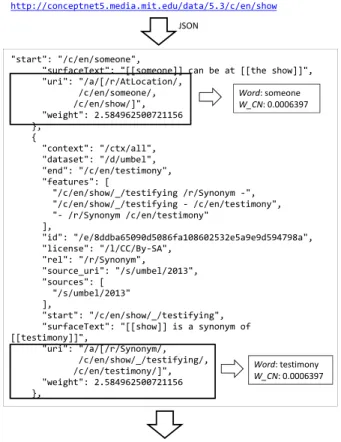
Many common knowledge bases are available on the Internet and this section can, therefore, not include all available common knowledge bases. Many comparisons between common knowledge bases are available including Mascardi et al. (2007) and Zon (2014). The Linked Open Data initiative gave rise to using existing common knowledge bases in order to expand your own common knowledge base. One example is ConceptNet 5, which is a knowledge representation project in which a semantic graph with general human knowledge is build. This general human knowledge is collected using other knowledge bases, such as Wikipedia and WordNet, and experts and volunteers playing a game called Verbosity (Von Ahn et al., 2006). Some of the relations extracted using this game are RelatedTo, IsA,
partOf,HasA,UsedFor,CapableOf,AtLocation,Causes,HasSubEvent,HasProperty,
MotivatedByGoal,ObstructedBy,CreatedBy,SynonymandDefinedAs. The strength of the relation is determined by the number and reliability of the sources asserting the fact. As of April 2012, ConceptNet contains 3.9 million concepts and 12.5 million links between concepts (Speer et al., 2012). Experiments on the previous version of ConceptNet, which is ConceptNet 4, indicated that the knowledge base is helpful in expanding difficult queries (Kotov et al., 2012).
Besides factual knowledge, the common knowledge base Wikipedia contains en-cyclopedic information. Wikipedia is a free multi-lingual online encyclopedia edited by a large number of volunteers. Wikipedia contains over 4.8 English million articles. Both information on Wikipedia pages and links between the pages are often used (Voss, 2005). An open source tool kit for accessing and using Wikipedia is available (Milne et al., 2013) and many other common knowledge bases include information or links from Wikipedia, such as YAGO2 (Hoffart et al., 2013) and ConceptNet (Speer et al., 2012).
Besides encyclopedic and factual knowledge bases, WordNet is a hierarchical dic-tionary containing lexical relations between words, such as synonyms, hyponyms, hypernyms and antonyms (Miller, 1995). It also provides all possible meanings of the word, which are calledsynsets, together with a short definition and usage examples. WordNet contains over 155,000 words and over 206,900 word-sense pairs. WordNet is often used to expand a query with similar words (Carpineto et al., 2012) and several similarity measures can be used (Pedersen et al., 2004). Most similarity measures use path-based algorithms.
The common knowledge base sources described above are easy to access, provide enough data for statistical analysis and do not require a lot of human effort to get re-sults, but they might not have sufficient specific information or they might be noisy.